Search Results: "reg"

18 February 2011

Vincent Sanders: Shedding

For some time now Melodie has wanted more outside storage.

The current outhouse is an 3 foot by 8 foot converted outside toilet. Due to its age (built 1884) this building is no longer watertight and is generally disintegrating at an alarming rate. One day soon it will have to be demolished. That day has not yet arrived, instead we purchased a plastic shed.

Unfortunately the only viable place for the new shed was next to the old one, this required removing a six foot section of flower bed complete with ivy, bamboo and an old sink.

Last Saturday I completed this removal and lay a concrete base ready to take the new shed. You would not think such a small area (2.8m square) would require so much material and effort to concrete over. 300Kg of 3:2:1 aggregate:sand:cement concrete mix went into the hole along with 100Kg of instant set concrete (for a rapid surface in the changable weather).

Thursday afternoon Geoff (my nice helpful neighbour) offered to assist me in the assembly of the shed. I re-arranged my work schedule (yay home working) and after three hours the shed was assembled.

This morning it occurred to me that my webcam had recorded a time-lapse movie of the construction. I uploaded it to YouTube and present it here for your amusement.

<iframe allowfullscreen="" frameborder="0" height="240" src="http://www.youtube.com/embed/brTXLO2R5D0?rel=0" title="YouTube video player" width="320"></iframe>

17 February 2011

Rapha&#235;l Hertzog: People behind Debian: Maximilian Attems, member of the kernel team

Maximilian, along with the other members of the Debian kernel team, has the overwhelming job of maintaining the Linux kernel in Debian. It s one of the largest package and certainly one where dealing with bug reports is really difficult as most of them are hardware-specific, and thus difficult to reproduce. He s very enthusiastic and energetic, and does not fear criticizing when something doesn t please him. You ll see. My questions are in bold, the rest is by Maximilian. Who are you? My name is Maximilian Attems. I am a theoretical physicist in my last year of PhD at the Technical University of Vienna. My main research area is the early phase of a Quark-Gluon Plasma as produced in heavy ion collisions at the LHC at CERN. I am developing simulations that take weeks on the Vienna Scientific Cluster (in the TOP 500 list). The rest of the lab is much less fancy and boils down to straight intel boxes without any binary blobs or external drivers (although lately we add radeon graphics for decent free 3D). Mathematica and Maple are the rare exceptions to the many dev tools of Debian (LaTeX, editors, git, IDE s, Open MPI, ..) found at the institute, as those are unfortunately yet unmatched in Free Software for symbolic computations. The lab mostly runs a combination of Debian stable (testing starting from freeze) for desktops and oldstable/stable for servers. Debian is in use for more than 10 years. So people in the institute know some ups and downs of the project. Newcomers like my room neighbors are always surprised how functional a free Debian Desktop is. :) What s your biggest achievement within Debian? Building lots and lots of kernels together with an growing uptake of the officially released linux images. I joined the Debian kernel team shortly after Herbert Xu departed. I had been upstream Maintainer of the linux-2.6 janitor project for almost a year brewing hundreds of small cleanups with quilt in a tree named kjt for early linux-2.6. In Debian we had lots of fun in sorting out the troubles that the long 2.5 freeze had imposed: Meaning we were sitting on a huge diverging monolithic semi-good patchset. It was great fun to prepare 2.6.8 for Sarge with a huge team enthusiastic in shipping something real close to mainline (You have to imagine that back then you had no stable or longterm release nor any useful free tools like git. This involved passing patches around, hand editing them and seeing what the result does.) From the Sarge install reports a common pattern emerged that the current Debian early userspace was causing lots of boot failures. This motivated me to develop an alternative using the new upstream initramfs features. So I got involved in early userspace. Thanks to large and active development team initramfs-tools got a nice ecosystem. It still tries to be as generic and flexible as possible and thus gains many nice features. Also H. Peter Anvin (hpa) gave me the official co-maintenance of klibc. klibc saw uptake and good patches from Google in the last 2 years. I am proud that the early userspace is working out fairly well these days, meaning you can shuffle discs around and see your box boot. Later on we focused on 2.6.18 for Etch, which turned out to a be good release and picked up by several other distributions. Only very much later we would see such a sync again. With 2.6.26 for Lenny we got somehow unlucky as we just missed the new longterm release by one release. We also pushed for another update very late (during freeze) in the release cycle, which turned out to semi-work as too much things depend on linux-2.6. For Squeeze 2.6.32 got picked thanks to discussions at Portland Linux Plumbers and it turned out to be a good release picked up by many distributions and external patchsets. The long-term support is going very well. Greg KH is doing a great job in collecting various needed fixes for it. Somehow we had hoped that the Squeeze freeze would start sooner and that the freeze duration would be shorter, since we were ready for a release starting from the actual freeze on. The only real big bastard on the cool 2.6.32 sync is Red Hat. Red Hat Enterprise 6.0 is shipping the linux-2.6 2.6.32 in obfuscated form. They released their linux-2.6 as one big tarball clashing with the spirit of the GPL. One can only mildly guess from the changelog which patches get applied. This is in sharp contrast to any previous Red Hat release and has not yet generated the sharp and snide comments in press it deserves. Red Hat should really step back and not make such stupid management moves. Next to them even the semi-maintained Oracle Unbreakable 2.6.32 branch looks better: It is git fetchable. What are your plans and those of the kernel team for Debian Wheezy? Since 2.6.32 many of the used patches landed upstream or are on the way (speakup, Kbuild Debian specific targets, ..). The proper vfs based unionfs is something we d be looking forward. We haven t yet picked the next upstream release we will base Wheezy on, so currently we can happily jump to the most recent ones. There are plans for better interaction with Debian Installer thanks to generating our udebs properly in linux-2.6 source itself. Also we are looking forward to using git as tool of maintenance. We d hope that this will also allow for even better cross distribution collaboration. Concerning early userspace I plan to release an initramfs-tools with more generic userspace for the default case and finally also a klibc only for embedded or tuning cases. What do you like most in Debian? For one thing I do like the 2 year release cycle. It is not too long to have completely outdated software and on the other hand it gives enough time to really see huge progress from release to release. Also at my institute the software is is recent enough without too much admin overhead. For servers the three years support are a bit short, but on the manageable side. I do enjoy a lot the testing distribution. For my personal use it is very stable and thus I mainly run testing on my desktop and work boxes. (Occasionally mixing in things from sid for unbreaking transition or newer security fixes). Debian is independent and not a commercial entity. I think this is its main force and even more important these days. I enjoy using the Debian platform a lot at work thus in return this motivates me to contribute to Debian itself. I also like the fact that we strive for technical correctness. Is there some recurrent problem that hinders the progress of Debian? The New Maintainer process is a strange way to discourage people to contribute to Debian. It is particularly bureaucratic and a huge waste of time both for the applicant and his manager. It should be completely thrown overboard. One needs a more scalable approach for trust and credibility that also enhances the technical knowledge for coding and packaging of the applicant. NM is currently set in stone as any outside critics is automatically rejected. Young and energetic people are crucial for Debian and the long-term viability of the project, this is the reason why I d consider the New Maintainer process as Debian s biggest problem. Note from Rapha l Hertzog: I must say I do not share this point of view on the New Maintainer process, I have witnessed lots of improvements lately thanks to the addition of the Debian Maintainer status, and to the fact that a good history of contribution can easily subsume the annoying Tasks & Skills questionnaire. Another thing I miss is professional graphics input both for the desktop theme and the website. I know that effort has been done there lately and it is good to see movement there, but the end result is still lacking. Another trouble of Debian is its marketing capabilities. It should learn to better sell itself. It is the distribution users want to run and use not the rebranded copies of itself with lock-in sugar . Debian is about choice and it offers plenty of it: it is a great default Desktop. Linus Torvalds doesn t find Debian (and/or Ubuntu) a good platform to hack on the kernel. Do you know why and what can we do about this? The Fedora linux-2.6 receives contributions from several Red Hat employed upstream sub-Maintainers. Thus it typically carries huge patches which are not yet upstream. As a consequence eventual userland troubles get revealed quite quickly and are often seen there first. The cutting edge nature of Fedora rawhide is appealing for many developers. The usual Debian package division of library development files and the library itself is traditionally an entry barrier for dev on Debian. Debian got pretty easily usable these days, although we could and should again improve a lot more in this sector. Personally I think that Linus hasn t tried Debian for years. I have the feeling that the implication of the Debian Kernel team in LKML has been on the rise. Is that true and how do you explain this? Ben Hutchings is the Nr.1 contributor for 2.6.33. He also is top listed as author of patches on stable 2.6.32. Debian is not listed as organization as many send their linux-2.6 patches from their corporate or personal email address and thus it won t be attributed to Debian. There is currently no means to see how many patches get forwarded for the stable tree, but I certainly forwarded more then fifty patches. I was very happy when Greg KH personally thanked me in the 2.6.32.12 release. In the Squeeze kernel, the firmwares have been stripped and moved into separate packages in the non-free section. What should a user do to ensure his system keeps working? There is a debconf warning on linux-2.6 installation. It is quite clear that the free linux-2.6 can t depend on the firmware of the non-free archive (also there is no strict dependency there technically). On the terminal you d also see warnings by update-initramfs on the initramfs generation for drivers included in the initramfs. The debconf warning lists the filename(s) of the missing firmware(s). One can then apt-cache search for the firmware package name and install it via the non-free repository. The check runs against the current loaded modules. The match is not 100% accurate for special cases as the one where the device might be handled well by this driver without firmware, but is accurate enough to warrant the warning. The set of virtualization technologies that the official Debian kernel supports seems to change regularly. Which of the currently available options would you recommend to users who want to build on something that will last? KVM has been a smooth ride from day zero. It almost got included instantly upstream. The uptake it has is great as it sees both dev from Intel and AMD. Together with libvirt it s management is easy. Also the performance of virtio is very good. The linux containers are the thing we are looking forward for enhanced chroots in the Wheezy schedule. They are also manageable by libvirt. Xen being the bad outside boy has an incredible shrinking patchset, thus is fair to expect to see it for Wheezy and beyond. For many it may come a bit late, but for old hardware without relevant CPU it is there. Many tend to overstate the importance of the virtualization tech. I d be much more looking forward to the better Desktop support in newer linux-2.6. The Desktop is important for linux and something that is in heavy use. The much better graphics support of the radeon and nouveau drivers: The performance optimizations thanks to dcache scalability work and the neat automatic task-grouping for the CPU scheduler are very promising features for the usability of the linux desktop. Another nice to have feature is the online defrag of ext4 and its faster mkfs. Even cooler would be better scalability in ext4 (This side seems to have seen not enough effort lately). Is there someone in Debian that you admire for their contributions? Hans Peter Anvin and Ted Tso are a huge source of deep linux-2.6 knowledge and personal wisdom. I do enjoy all sorts of interactions with them. Christoph Hellwig with Matthew Wilcox and also William Irwin for setting up the Debian kernel Team. Several Debian leaders including the previous and the current one for their engagement, which very often happens behind the scene. The Debian Gnome Team work is great, also the interactions have always been always easy and a pleasure. Martin Michlmayr and previously Thiemo Seufer do an incredible job in porting Debian on funny and interesting ARM and MIPS boxes. Debian has a lot of upcoming potential on this area. I m looking forward to other young enthusiastic people in that area. Colin Watson is bridging Debian and Ubuntu, which is an immense task. Michael Prokop bases on Debian an excellent recovery boot CD: http://www.grml.org. I d be happy if any Debian Developer would work as carefully coding and working.
Thank you to Maximilian for the time spent answering my questions. I hope you enjoyed reading his answers as I did. Subscribe to my newsletter to get my monthly summary of the Debian/Ubuntu news and to not miss further interviews. You can also follow along on Identi.ca, Twitter and Facebook.

One comment Liked this article? Click here. My blog is Flattr-enabled.

16 February 2011

Stefano Zacchiroli: in the news - Debian and the FreedomBox

Fellow geeks who have attended FOSDEM this year probably remember Eben Moglen's announcement about the creation of a foundation to support the development of FreedomBox-es. The FreedomBox foundation and its goals have been featured in a New York Times article appeared yesterday, together with a nice Debian mention which points to our wiki. Debian is also prominently present on the (ikiwiki-powered) website of the foundation. Yet another reason why I'm proud of being part of Debian.
(thanks to Faidon for the heads up)

Gunnar Wolf: Responsible biking: We are not exempt from the traffic rules!

As you know, I very often advocate using the bycicle as the main means of transportation in Mexico City. The city is very apt for biking through it, and contrary to the fears of mostly everybody, the city is neither aggressive nor as dangerous as people say. However, I have seen cyclists which seem to be looking for the best ways to be hit by a car, or to hit a pedestrian. Yesterday, I read this note in La Jornada: The local Environment Secretary calls cyclists to respect vial regulations. Many cyclists assume they are a special case of pedestrians, and zig-zag as they please between the road and the walkway, or just stay in the walkway. That is dangerous, both to pedestrians and to themselves. You might find children, elderly or motion-challenged people on your way. Also, not only will pedestrians only expect other people in the walkway, moving at their pace or slightly more, but cars will also not expect somebody moving at 10-20Km/h. A car driver pulling out of his garage, or crossing a street, will not have enough warning when he sees you, and you are very likely to end up in an accident. Since ~5 years ago, Mexico City is growing a grid of Metrob s and confined troleb s cero emisiones (trolleybus) lanes. Many cyclists use those lanes That is VERY dangerous. Public transport vehicles are large, have a lot of inertia, and will take longer to react to finding you ahead of them. Besides, they can go way faster than a regular bike (~60Km/h for metrob s, ~40Km/h for troleb s), and have to stop every couple of blocks. So, you will be uncomfortable if trailing them, and you will be a liability to ~100 people if you go ahead of them. Besides, it is illegal to drive in the confined lanes if you are not a public, semimassive transport vehicle! Surprisingly many people have argued they prefer riding their bicycles against the traffic I think they prefer staring at Death into its blue, glowing eyes (or into its long, thin whiskers)... By far, most cars that hit a bicycle do so from the side, when crossing a road. And if you arrive at a crossing from the wrong way, the way a driver does not expect you, don't expect the driver to be aware of you. Also, in the much less likely event of a car running into you, would it be better to be hit at 80Km/h (60Km/h of the car plus 20Km/h of your own speed on a full frontal crash), or at 40Km/h (substracting instead of adding)? Yes, some people say that looking at the car will allow you to maneuver How far in advance would you know a car coming from the front will hit you? One second? That's 22 meters at 80Km/h (again, if you realize the 60Km/h car is heading straight to you, at 20Km/h). Too short notice for you to do anything Any maneuver will most likely end in an accident. And the driver would not be so much to blame, as he would not be anticipating you riding against the traffic. Make sure you get seen. By night, always use proper lights (red on the back, white on the front, and reflective material to the sides). Day or night, wear bright, reflective clothes (or over-clothes material). Act in a predictable fashion. Remember you are riding a vehicle and are subject to the same rules any driver is A cyclist is not exempt from driving correctly! Do not jump red lights. Never ride on the walkway. Do your best to enjoy the ride. And ride. Yes, ride, take the streets, enjoy the streets. But don't attempt to drive the traffic out of it The streets belong to us all, and we can all share them. PS I also saw this note in the same paper: Sunday Rides in "Campo Militar N mero Uno". The main military field was open as a park this weekend! I have to make sure it is regularly open I am definitively going there!

15 February 2011

Kartik Mistry: conf.kde.in

I'm going to conf.kde.in Yes. And, I m talking about Localization in Localization foo talk. Speaker list is awesome. See you there! * List of talks: http://kde.in/conf/talks/
* Delegate registration: http://kde.in/conf/register/ In case, you re in Ahmedabad or near by (and college student!) , I ve awesome posters to put into your college notice board to let your friends and spread the word. Ping me that case.

14 February 2011

Gunnar Wolf: Subsidizing private education?

Hrmh... I am listening to a local news radio station. Of course, what I am about to write lacks information and insight but it follows a conversation I have had with several groups of friends. Our de-facto president has decreed that the tuition for private schools will be deducted from the Impuesto sobre la renta (revenue/profit tax) up to a given tuition level (IIRC up to MX$2000 a month per child per school). The interviewed subsecretary said they expect this deduction will reach MX$13,000 million, around US$1,000 million. This is, about a third of what is assigned to the National University (UNAM). At a first sight, this sounds good. However, I just thought about a discussion I have had with many friends. This money the government will hand back to the taxpayers has to be cut from somewhere (after all, we are not in a country with huge superavit or anything like that). Why does this sound unfair ot me? Because it benefits the few in perjudice of the many. I did a quick search, and found this work based on numbers published by INEGI ten years ago: According to the last table, the money spent on private education was between 5% and 10% of that spent on public education Of course, it is almost impossible to infer the number of students from this alone. I know I could find authoritative data on this regard by searching a bit more, but after all I don't want to spend all (work!) evening on a blog post unless it creates some discussion. Lets say, just for the sake of the exercise, that this means that ~3% of the country's students learn in a private school. In Mexico, the quality of the basic public education (primary/secondary, ages 6 to 18) has fallen hugely in the last decades. Even when I was to school (but not when my parents), the first subjective sign that a family had broken the low-income barrier is that they were finally able to send their children to private schools. Because, no matter how bad they are, public schools are perceived to be worse. Of course, I was among the "lucky" ones to be in a private school. Higher education (universitary level) is still way better ranged. Anyway... I want to get this post over with. Why do I oppose this subsidies/tax devolution? Because it will lead to widen the difference between private and public education. And because it will be benefical only for medium-high and high classes People who are formaly employed (as I am) do not present a tax declaration, so we won't get any deductions. Between and of the country's economically active population work informally (from selling in the street to covering up huge transactions in large locals). Most of the population don't (directly) pay "impuesto sobre la renta", and will not get the benefit of this subsidy. This money has to be taken from other sources in order to be given to private education. If the government wants to improve the education for everybody, why not assign it to the public sector? To specific areas in the public sector, if they don't want to hand it over to the (yes, very, incredibly) corrupt SNTE (National Union of Education Workers)?

Rapha&#235;l Hertzog: Debian Cleanup Tip #3: get rid of third-party packages

Last week, we learned how to get rid of obsolete packages. This time, we re going to learn how to bring back your computer to a state close to a pure Ubuntu/Debian installation. Thanks to the power of APT, it s easy to add new external repositories and install supplementary software. Unfortunately some of those are not very well maintained. They might contain crappy packages or they might simply not be updated. An external package which was initially working well, can become a burden on system maintenance because it will be interfering with regular updates (for example by requiring a package that should be removed in newer versions of the system). So my goal for today is to teach you how to identify the packages on your system that are not coming from Debian or Ubuntu. So that you can go through them from time to time and keep only those that you really need. Obsolete packages are a subset of those, but I ll leave them alone. We took care of them last week. Each (well-formed) APT repository comes with a Release file describing it (example). They provide some values that can be used by APT to identify packages contained in the repository. All official Debian repositories are documented with Origin=Debian (and Origin=Ubuntu for Ubuntu). You can verify the origin value associated to each repository (if any) in the output of apt-cache policy:
[...]
 500 http://ftp.debian.org/debian/ lenny/main i386 Packages
     release v=5.0.8,o=Debian,a=stable,n=lenny,l=Debian,c=main
     origin ftp.debian.org
[...]
From there on, we can simply ask aptitude to compute a list of packages which are both installed and not available in an official Debian repository:
$ aptitude search '?narrow(?installed, !?origin(Debian))!?obsolete'
or
$ aptitude search '~S ~i !~ODebian !~o'
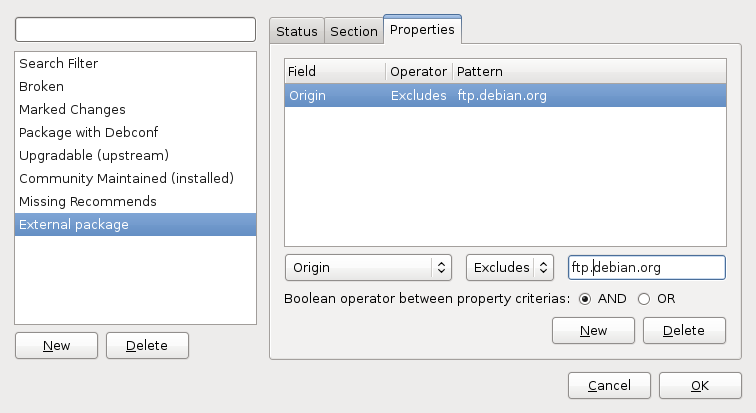
You can replace search with purge or remove if you want to get rid of all the packages listed. But you re more likely to want to remove only a subset of carefully chosen packages you re probably still using some of the software that you installed from external repositories. With synaptic, you can also browse the content of each repository. Click on the Origin button and you have a list of repositories. You can go through the non-Debian repositories and look which packages are installed and up-to-date. But you can do better, you can create a custom view. Click on the menu entry Settings > Filter . Click on New to create a new filter and name it External packages . Unselect everything in the Status tab and keep only Installed . Go in the Properties tab and here add a new entry Origin Excludes ftp.debian.org . In fact you must replace ftp.debian.org with the hostname of your Debian/Ubuntu mirror. The one that appears on the origin line in the output of apt-cache policy (see the excerpt quoted above in this article). Note that the term Origin is used to refer to two different things, a field in the release file but also the name of the host for an APT repository. It s a bit confusing if you don t pay attention. Close the filters window with OK. You now have a new listing of External packages under the Custom Filters screen. You can see which packages are installed and up-to-date and decide whether you really want to keep it. If the package is also provided by Debian/Ubuntu and you want to go back to the version provided by your distribution, you can use the Package > Force version menu entry.
Click here to subscribe to my free newsletter and get my monthly analysis on what s going on in Debian and Ubuntu. Or just follow along via the RSS feed, Identi.ca, Twitter or Facebook.

8 comments Liked this article? Click here. My blog is Flattr-enabled.

13 February 2011

Wouter Verhelst: PMW uploaded

Earlier today (or, well, last night, since it's fairly late alrady) I uploaded pmw (about which I blogged previously). In preparation for that, I've also uploaded aspic, which is required to build pmw's documentation. While I'm quite fond of pmw already, and intend to maintain it inside Debian for quite some time, my interest in aspic is limited to the fact that I need it for pmw. So if anyone seems interested in adopting it... be my guest. But do talk to me, first. In my previous blog post, I've raved about how I like pmw much more than I do lilypond. I had two reasons for that, at the time: Now, I have a third:
wouter@celtic:~$ grep-available --eregex -FPackage -sInstalled-Size -sPackage '(pmw lilypond)'
Installed-Size: 1916
Package: pmw
Installed-Size: 7048
Package: lilypond-data
Installed-Size: 392344
Package: lilypond-doc
Installed-Size: 896
Package: pmw-doc
Installed-Size: 4184
Package: lilypond
Less than two megs for pmw, versus over ten for lilypond and lilypond-data combined; and less than a megabyte for complete documentation plus examples for pmw, versus several hundred megs for lilypond-doc. And it's not because pmw is less flexible, or has less features, or is less well documented, or anything of the sorts. It does have less output options; but then it's not like it's hard to convert PostScript into something else or anything.

12 February 2011

Joerg Jaspert: Daily comic strips

I ve been using dailystrips since April 2006 to get a daily overview page of all the various daily web comics I (and a few friends) like to see. It makes it much simpler than having to browse dozens of various webpages, with all their useless webbugs integrated, to see stuff. That had some drawbacks: So about two or three weeks ago I took a look at dailystrips code to figure out where I need to stuff some lines in to get the additional information. Yuck. No. I don t like it. Not because it is perl, that alone would be fine. So, instead I went and did a little rewrite of it. In a simple and pure bash script. I duplicated the functionality of the daily mode (fetch images per day and put them into a daily subdirectory, create html files for them) and didn t bother with the fetch a random strip one as I never used that. Turned out at 276 lines of shell script that can even fetch alt/title and not break on funny characters in them, yay. Even better, as the search terms for the additional information is just a regex using bashs capability there run over the html file, one can have anything from it put as alt/title onto the final page. When I had that working I asked a colleague to provide a bit of CSS, so it also looks better now. An example output is available (note that the Previous/Archive links are not available there), and if you want you can take a look at the code too. There is no Debian package and I m not sure there should ever be one. If you want to get me patches feel free to mail me, be it for the CSS or the script, whatever.

Evgeni Golov: Privacy-over-IP does not exist

Did not exist.Will never exist.There was quite a lot of buzz about privacy with that new IPv6 thingy. Some say it is bad, as you will have a static address. Some say the privacy extensions will fix everything. I say: lemme rant ;)First of all, that was the internet, when I started using it back in 1999:
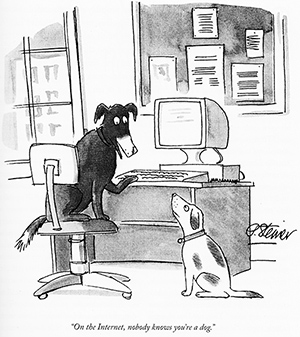
 [  New Yorker Magazine, March 1993] On the Internet nobody knows that you are a dog'
[ New Yorker Magazine, March 1993] On the Internet nobody knows that you are a dog And that s the internet today:
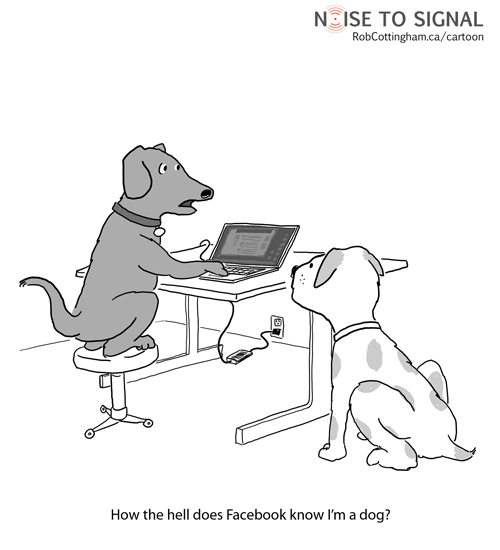
robcottingham.ca - How the hell does Facebook know I'm a dog?
[ robcottingham.ca] How the hell does Facebook know I m a dog?

Well, I d say that s not correct. Even in 1999 facebook could know you are a dog (if you ignore the fact, that there was no facebook in 1999), it s just noone really cared about it. But let s start from the beginning :)An IP-address is a 32-bit integer

An IP-address is technically a 32-bit integer, formatted into 4 8-bit parts (you can read more about IPv4 at Wikipedia), which makes a total of 4,294,967,296 possible IP-addresses. Your ISP has a range in this address-space it can give to its customers (you). My ISP (Unitymedia) owns about 300,000 IP-addresses (based on the RIPE database), which is about 0.007% of the whole address-space. If you look at the RIPE page, you see two common netname prefixes (DE-KNRW and DE-IESY-HFC) which match two regions of Germany where my ISP has its customers (Unitymedia is a merge of ish and iesy). What does that mean? It means one can map a Unitymedia customer into one of these regions, even if he would change his IP-address (Unitymedia uses DHCP with high lease-times, so this does not happen actually). It does not map the customer to a dog yet, but I bet real GeoIP databases can map them correctly to a city (I didn t try much, but this site suggests it works: http://www.ip-adress.com/?lc=en at least they map me correctly to Duesseldorf).Dynamic IP-addresses do not improve privacy

Given the above facts, even if Unitymedia would give me a new IP-address every X hours (many DSL-providers have X=24), it is still possible to map me into a set of about 150,000 users (here user means customer, there still may be multiple computers connected via the same line). I would even go further and say the set is much smaller, as I think I am not able to get every free IP-address from DE-KNRW-*, as these should be bound to cities/regions (GeoIP databases exist, you rememember?) and I do not move with my line.Routers and reverse DNS kill privacy

Currently, my IP-address is 62.143.232.104, which has a reverse DNS entry ip-62-143-232-104.unitymediagroup.de and does not say anything about me or my location, besides of the obvious Unitymedia customer . But look at the traceroute:

4  7111A-MX960-01-ae5.frankfurt.unity-media.net (80.81.192.181)
5  13NOC-MX960-01-ae8.kerpen.unity-media.net (80.69.107.26)
6  1411G-MX960-01-ae9.neuss.unity-media.net (80.69.107.2)
7  1411J-MX960-01-ae1.bilk.unity-media.net (80.69.107.70)
8  PH-1411J-uBR10k-06-Te-1-2-0.bilk.unity-media.net (80.69.102.106)
Frankfurt is about 250km from here, Kerpen about 60, Neuss about 10 and Bilk is a part of the city I live in, about 4km away from my home. I guess you get the idea :)Browsers kill privacy tooDo I have to say more than a link to https://panopticlick.eff.org/? My Chromium scores one in 1,400,000. How much IP-addresses did I have to hide in again?We are at the dog level now, dogs use BoneOS with FireBark, not Linux with Chromium :)IPv6 kills cute kittensOh, and privacy, because with IPv6, there are 2^128 IPv6-addresses out there, of which your provider will maybe own a /32 (2^96 addresses) and give you a /48 (2^80 addresses) or (more likely) /64 (2^64 addresses). Then you enable the great IPv6 privacy extensions (RFC4941) and happily hide in your own assigned subnet, still being a customer of your ISP, still living in the same city and using your old browser It s just about mapping subnets instead of individual IP-addresses then. And we can t get lower as the dog levelPeople can annoy meI did not write all this to teach you, you can do yourself with Wikipedia and RFCs. There is a person out there, who thinks using a random name, mail address and twitter account could fool me into thinking that s a new, yet unknown, person to me. Well, I am not stupid, sorry. When you comment on my blog, your IP-address is logged, when I approve the comment, I often look at the reverse DNS and the whois entry of that IP-address (sorry, I AM paranoid). I even might check my webserver logs (or Piwik) where did you come from (Google etc), writing accidentally in your comment does not help :) Also, if you are trying to fool me, don t use your own computer, running Windows 7 and Firefox which I installed. Oh, and probably do not use your home line which I used to login into my admin-area using my unique Chromium ;)Sorry Hanna Lena, the chicken has just eaten her own eggs And yes, one can track down a single person on this big thing called internet, IPv6 will not change this (in any direction).

Norbert Tretkowski: MySQL 5.5 and Debian

Since MySQL 5.5 was declared stable in December last year, I regulary receive e-mails from people asking when it will get uploaded to Debian. The good thing is that the initial conversion from automake to cmake has already been done by Clint Byrum from Ubuntu, and we are going to use his work as a basis for our packages. The not so good thing is bug #59078, an issue in libmysqlclient which breaks ABI compatibility. According to Lenz Grimmer from Oracle the MySQL upstream developers are already looking at it.

I am still not sure if it is a good idea to upload MySQL 5.5 in the current state to experimental, but I am definitely not going to upload it to unstable until this issue is fixed.

11 February 2011

Pau Garcia i Quiles: Nokia + Microsoft WTF

We just learned about the Nokia and Microsoft strategic partnership today and many people are concerned. I think the agreement is worrying for Qt, but even more worrying for Nokia. I foresee an exodus of current developers and Nokia mobile device users. Many Windows developers will come. Hopefully? I really wonder who is actually benefited by this strategic partnership. Nokia already had many mobile devices with Symbian, one with Maemo (and there could have been many more with Maemo, but for some unknown reason there weren t) and Meego could have been adopted already (but again, for some reason, Nokia had not). On the other hand, Microsoft had an operating system but no users. Virtually nobody wanted Windows 7. It was either Android or your own solution (MeeGo, WebOS, Bada, etc). In my opinion, the next move we will see is Microsoft buying Nokia to be able to compete one-to-one with Apple and Google. I think it will not take too longer, probably they are just waiting for Nokia stock to fall a bit more. So what should have been the change of direction Nokia should have done a few years ago? In my opinion, when Nokia acquired TrollTech, they should have released at least 10 devices with Qtopia. Immediately. And dump Maemo. In parallel, they could have added more and more Maemo features to Qtopia. By doing that, they would have had a good mobile operating system and applications in no time. There was even an X11 compatibility layer for Qtopia back then. I did not understand why Nokia adopted Qt and went on with Maemo and Meego based on Gtk+, and tried to keep as much backwards compatibility (regarding to source compatibility, development methodology,e tc) with devices which barely had users (N770, N800 and N810). I think noone understood that move. From my point of view, that was a waste of time, money and effort, which ultimately led to Nokia s demise. PS: Yes, I still am a KDE on Windows developer and part of the Debian Qt-KDE team

10 February 2011

Adrian von Bidder: Freedom

LWN Coverage of Eben Moglen's FOSDEM keynote. A very thoughtful article on freedom and how to get there. While we can, technically, build these free systems that Eben Moglen talks about, history has shown that we won't. People don't care until it's too late until the police is on their doorstep with an arrest warrant (if the regime cares about such details at all.) So it's up to the small minority of people who actually cares and is prepared to pay the price (in money or in being isolated by not being on Facebook or whatever) to create systems that are both Free and also appealing to the uneducated masses. People will move to Free systems only when they're much cheaper and also offer more value as perceived by them, in terms of features, or coolness or whatever. Bling. We're almost there in terms of software (Firefox managed to get noticeable market share, and people at least talk about OpenOffice / LibreOffice.) We're nowhere close in terms of networks and content, though. Wikipedia and Openstreetmap are the rare exceptions, but there's not much in terms of social networking, searching, messaging, collaboration platforms etc.: all firmly in corporate hands. I'm not sure that Moglen's Freedom Box idea will succeed either: so far, I can't see the must have element for people who don't care about these things that might change the game.

Russell Coker: LCA2011, Harassment, etc

The conference LCA 2011 had an anti-harassment policy [1] which was violated by a keynote speech. The speaker and the conference organisers apologised, but of course the matter didn t end there.Discussion continued on the lca-chat list (for conference delegates) [2], on the Linux-aus list (for members of Linux Australia the parent body of the LCA conference) [3], and in some blog posts.There is also some discussion on an LWN article that is linked from an ITWire article [4].I think that the policy was reasonable and from all the descriptions it seems to have worked reasonably well. With such things there are always possibilities to tweak things, so probably there will be future policies which are better in some ways, but it seemed to do the job. The way that the LCA organisers handled the situation was appropriate. In the discussion there were some comments with logical failures that I think need further analysis, I ll summarise them one per paragraph with the heading being a para-phrase of the claim.Is it Offensive?A particularly relevant blog post is Skud s post about avoiding the use of the word offense [5]. In the various discussions about the speech in question most of the people who disapprove of the erotic images don t use the word offense , this is presumably due in part to the influence of Skud s post. This hasn t stopped people claiming that the debate is about whether the images are offensive, I m not sure if this is a deliberate straw-man attack or just cluelessness.The anti-harassment policy does use the word offensive in two places, I think that this was a mistake but it doesn t detract from the overall meaning of the document.Is it Harassment?There was some discussion about whether the actions in question were harassment. Wordnet s definition of harassment includes the act of tormenting by continued persistent attacks and criticism . It seems unlikely that any of the people in the audience who objected to the erotic content in the lecture slides had never seen unwanted erotic material before. So I think that it s worth considering this incident as just another entry in a list of similar incidents that some of the delegates have experienced, and thus as a continuation of persistent attacks IE harassment. Melissa McEwan s post about the variety of harassment that she has received from men is worth reading in this regard [6].I think that a reasonable analogy here is the school bullying campaigns that were experienced by many members of the Linux community when they were younger. School bullying in most cases is not about a small number of extreme incidents, but about a large number of small incidents each of which when considered independently can be rationalised as something that isn t significant (excusing such incidents independently is what allows bullying to be rife in most schools). In many cases of high school bullying the victim is blamed for supposedly over-reacting after a reaction is compared to some small incident at the end of a long harassment campaign, some of the criticism of the Geek Feminists seems to echo this pattern.It seems to me that some of the more dismissive comments which demonstrated a lack of regard for the experiences of other people can reasonably be considered as harassment too (which is also something that Melissa McEwan mentions). Note that I am specifically not advocating that the discussion be shut down, merely that the people who claim that it s only the (supposed) opinion of the majority that matters are part of the problem. However the fact that the apology for the talk received applause from the majority of the audience seems to indicate that the majority is in fact in favor of the anti-harassment policy.Derald Wing Sue, Ph.D. and David P. Rivera (a doctoral candidate in counseling psychology) have written a couple of interesting short articles about this for Psychology Today. Bullying and Microaggressions describes bullying as more than physical violence and also discusses adult bullies [7]. The Power to Define Reality describes the way that the experiences of people who lack power can have the reality of their experiences denied [8] this one really relates to some of the discussions about harassment.But it s Legal!It has been claimed that the legal system works well in Australia and that Australian law should be the only necessary guide to content. A trivial counter-case that was noted in the discussion is the fact that pure sales presentations are not accepted at LCA and such presentations are certainly legal! There is a good precedent for prohibiting things that are legal as part of the conference speaker agreement.More generally the legal system changes slowly and still infringes on what many people in our community regard as basic human rights. There is no reason why an Australian conference should have as it s standards the bare minimum that is required by Australian law.It was pointed out that workplace social norms translate well between cultures, they are usually more stringent than Australian law requires and Australian workplace law is a lot more stringent than the laws relating to conferences and other public events. It seems to me that a presentation which would result in a visit from HR if given at the office shouldn t be regarded as suitable for a conference such as LCA.But there is a Balance of Men and Women in Erotic Pictures!The complaints are not about a lack of balance in the erotic material, but it s presence there at all. Defending the slides on the basis that there was a supposed balance of male and female misses the point that most people just want no erotic material in presentations at conferences.Also it seems to me that if there are pictures which aren t offensive then the way to demonstrate this would be to publish them and say look, they aren t offensive . If it takes 600 words in a blog post to justify the use of some images then that alone seems to be evidence that the images were poorly chosen.But the talk was EffectiveSome of the people who have commented on this issue mentioned that they couldn t remember what was said when the images in question were displayed. When images from the talk are remembered and the main content of the talk isn t that seems to be a failure of the talk.When a major sponsor of the conference complains and requests that the talk video never be published that also seems like a major failure of the talk.I think that the effective talks are ones that educate people and inspire them to do something positive and useful. A talk that inspires a discussion about whether the speaker deserves censure doesn t seem effective.There are claims that there is no way the talk could have made the point as well if it wasn t for the images in question. But I can t believe that someone who is capable enough to get awarded a keynote speaking position at a conference such as LCA is incapable of finding other images to make the same point.But Similar Images are on MTVWhen people want MTV content they can watch MTV.Why Can t we just try Educating Men?It was claimed that education works in dealing with such issues in corporate environments and sporting clubs. My observation of the corporate environment is that such training must be extremely rare in Australia, the Netherlands, and probably the UK due to the fact that none of my employers have done it. I have heard first-hand reports of diversity training from people who work in the US. I expect that the fact that people who fail diversity training in a corporate environment get a meeting with HR is a major factor in it s effectiveness.The long email discussions and blog comment threads when these incidents happen could theoretically be used as training. But when you have some men using multiple mailing lists and dozens of posts arguing without appearing to learn it seems clear that they are not about to learn anything no matter what education is offered. It seems to me that you could broadly divide the free software community into two groups, those who want to learn how to do things better (but who are unlikely to make gross errors anyway), and those who won t learn.Besides, having a keynote speaker at a major conference apologise should be educational.But Clueless Nerds Hit on GirlsI don t know why every discussion about the treatment of women ends up getting a mention of this supposed issue.But Women Could make False AccusationsIn any classification system you have to make some sort of balance between false-positives and false-negatives. If the aim is to get zero false-positives then the incidence of false-negatives will increase. So if the aim was to never ever have a false accusation brought against a man for sexual harassment then the vast majority of real harassment cases would result in no action at all.I don t think it s reasonable to expect that most women who are mistreated should suffer in silence just to reduce the possibility that men might be falsely accused.The Rape Statistics cited in the discussion may be InaccurateThere is no possible way of interpreting rape statistics to make it not be a serious problem, now matter how you analyse the available information it happens far too often and has a significant impact on the victim. Also the suggested reinterpretation of the statistics didn t contradict the claim that it is likely that there are multiple rape victims attending LCA. So interpreting the statistics in a different way to get different numbers doesn t change anything. Trying to diminish the significance of rape generally doesn t support any other arguments that you might make.There are things that you can just discuss for the heck of it and things which should be discussed with care (if at all) to avoid needlessly hurting people. In these sorts of discussions the right thing to do is to avoid debating the numbers as much as possible.I think that the numbers produced by RAINN [9] are as good as we can get.But I am very supportive of women in our communityIf you spend all your time arguing with women and don t listen to what they have to say then you really aren t supporting them.ConclusionAfter publishing this post I ll email the URL to a few of the men who helped inspire it, I will explain how disappointed I am and how I expect better from them. I encourage others to do the same.Also when such discussions happen I encourage men to vote in favor of the positions advocated by women. Writing a message that addresses points in the debate can be difficult and if the debate is rapid then you may find that every point that you might make has been made by someone else. But in that case just posting to agree with the women can really mean a lot.

9 February 2011

Steve Kemp: Random tools I would use - and pictures

So previously I talked about pictures. Having spent a while playing with some new lighting ideas I'll present three recent images:
Now that's out of the way lets talk software. There are two specific things I think would be useful to me right now:
Opportunistic "cron"
I've got a few jobs that don't take long to run, and I schedule for once a day when my systems are idle. It'd be nice to have some long-running daemon which could trigger these odd-jobs (which do things like update my list of mutt mailboxes) when the system has been idle for >30 minutes, or some similar criterion. Ideally I'd say "Run this job when the system is idle, but if the system is never idle run it once a day, or once an hour regardless".
Content-aware tracking software
I use rsync to archive images across a number of systems. Imagine I rename a few images locally, I have to re-rsync even though ideally all I need to do is rename the contents remotely. The issue is remembering what I've changed. So given:
~/Images/Stolen-Souls/2011.02/
~/Images/Stolen-Souls/2011.02/02-Borcsa
~/Images/Stolen-Souls/2011.02/02-Camilla
~/Images/Stolen-Souls/2011.02/06-Indigo
~/Images/Stolen-Souls/2011.02/07-Rosa
If I rename "06-Indigo" then it's trivial to ssh to the remote host and do the same job. But what if I rename a bunch of individual files? Ideally I'd be able to run something like:
~$ tool --snapshot ~/Images/
~$ mv Images/old.jpg Images/new.jpg
~$ tool --show-changes ~/Images
mv Images/old.jpg Images/new.jpg
I half believe git can do something like this, but it seems like you should be able to index the filename+SHA1+size to ~/.snapshot, then later do the same thing and output a list of "mv" commands.
Anyway; I'm drunk. I'm probably not making sense, and I need to sleep. Goodnight. ObQuote: "Hello Mr. Svenning how have you been?" - Mallrats

Alexander Reichle-Schmehl: WOW! We are on the front page of the taz!

The taz (short for die tageszeitung) is one of the major German daily newspapers. And they currently feature the Squeeze release on their frontpage! The article is very good (and well investigated), managing to explain some technical details quite well, and...
It's currently the most read article! Wow! Update: The online version of the austrian newspaper der Standard has also an article about the Squeeze release!

Alexander Wirt: squeeze-backports and lenny-backports-sloppy started

The backports team is proud to announce the next generation of backports:
squeeze-backports. From now on all contributors will be able to upload
backports of packages available in wheezy (testing) to squeeze-backports.
Additionally the previously announced lenny-backports-sloppy is now officially
open for uploads.

To ensure the basic principle that a system consisting of lenny plus
lenny-backports can be upgraded to squeeze proper, the handling of the
lenny-backports branch has changed. From now on uploads to lenny-backports
need manual approval from a backports team member similar to the handling of
the proposed-updates queue within the regular archive. Feel free to upload
packages here, especially security updates to previously backported versions,
but please ensure the versions are lower than those in stable /
stable-security.

If you feel the need of newer versions for lenny than which are available in
squeeze, please do upload them to lenny-backports-sloppy. The rules for this
suite are practically the same as for squeeze-backports: Do base your uploads
on packages available in testing (wheezy) and build them in the appropriate
environment.

Please remember when using lenny-backports-sloppy you can't easily upgrade to a
plain squeeze. This suite is specificly meant to contain newer versions than
squeeze. While the aim is to only carry packages that will also be provided in
squeeze-backports for upgrade possibilities, we can't guarantee that, so be
careful.

User visible change to squeeze-backports

As the apt maintainers had been so kind to introduce a new archive wide option
in squeeze, the usage of backports.debian.org is easier than ever before: In
the past you had to explicitly configure pinning for the backports repository
to enjoy the full feature set including upgrades to new versions of packages
you had installed from there. As this is cumbersome, errorprone and a nuisance
this new setting got introduced. With this feature backports get handled in a
way that updates for packages installed from squeeze-backports will happen out
of the box.

And last but definitely not least, let us send a big "thank you" to all
contributors that backports.debian.org enjoys to have - you made it possible to
serve more than 1400 binary packages through 837 source backports since
lenny-backports got kicked into life. Keep up the good work.

Thank you very much!

MJ Ray: SPI February 2011

The regular monthly board of SPI (Software in the Public Interest, the contributor-run non-profit which supports debian, drupal and many other projects not beginning with the letter d) is on IRC this evening at 20:30 UTC in #spi on irc.oftc.net. If you need an Internet Relay Chat client, check what s available in your package manager, or you could do worse than adding Chatzilla to Iceweasel or Firefox. The agenda has been posted and the reports really ought to be included by the time this blog post appears. Come along and see FOSS project support infrastructure do its thing, then maybe chat a bit afterwards.

8 February 2011

Lars Wirzenius: Growing the Debian development community

In an article about gender issues among American atheists, Sharon Moss and Lyz Liddell give a list of things to consider to be better community, not just for women:
  • Be a leader. Take responsibility for the tone of your group. If potential new members are being made to feel uncomfortable and aren t coming back, you re doing it wrong. As a leader, it is your job to prioritize the comfort of your attendees in programs, group dynamics, and communications. Try to put yourself in other members shoes and also ask for feedback.
  • Promote a sense of community. Take the time to socialize and get to know each other. If you re group isn t primarily a social group, thinking about adding some social time. Go to breakfast before the protest, compose your letters to the editor over coffee, or grab a pizza and beer after that lecture. When you know each other, you have each others backs. Being a jerk isn t tolerated.
  • Moderate discussions. Make sure everyone has the opportunity to participate- new people, quiet people, etc. Don t let conversation be dominated by one or two people who must win.
  • Embrace and accept different ways of communicating. Whether someone is an aggressive debater or not, make sure they re still welcome. The other atheist in the room isn t your enemy.
  • Encourage subgroups. Every event your group hosts doesn t need to appeal to your entire membership. Many women appreciate women-only space to express their nonbelief and to connect with other atheist women. Here at the Humanist Community of Central Ohio, we started a subgroup book club called Reasonable Women. When it grew to have about 25 regular members and was beginning to be a little too large and unwieldy to function as a book club, we created a second group, Heathen Chicks, which is just a social group that meets at a local cafe. It isn t just about creating women only space, for us, this has been a way to draw more women into other events our group hosts.
  • Foster women in leadership. Groups with women in leadership positions tend to have more women. Encourage women in your group to be visible in leadership.
These should work pretty well for Debian as well. I mean for the project in general, for getting all kinds of new people in, and getting them to stay, not just women, even if the gender imbalance is perhaps the biggest glaring problem we have. As a concrete suggestion, maybe it would be a good idea to continue the Debian party line that Joey set up for the squeeze release. We already have IRC, but having an audio chat with your Debian peers might be a nice addition. Specifically a social one, instead of something intended to boost productivity.

Gregor Herrmann: merci !

now that we have released squeeze, I'd like to say thanks to the release team. I've really enjoyed the cooperation in the past months.

the people I had the most contact with were mehdi & also adam, & they were always very quick, very friendly, & very cooperative when I had some requests.

merci beaucoup, & I hope you continue your good work!

Next.

Previous.