Search Results: "tin"

3 November 2017

Rog rio Brito: Comparison of JDK installation of various Linux distributions

Today I spent some time in the morning seeing how one would install the JDK on Linux distributions. This is to create a little comparative tutorial to teach introductory Java. Installing the JDK is, thanks to the OpenJDK developers in Debian and Ubuntu (Matthias Klose and helpers), a very easy task. You simply type something like:
apt-get install openjdk-8-jdk
Since for a student it is better to have everything for experiments, I install the full version, not only the -headless version. Given my familiarity with Debian/Ubuntu, I didn't have to think about the way of installing it, of course. But as this is a tutorial meant to be as general as I can, I tried also to include instructions on how to install Java on other distributions. The first two that came to my mind were openSUSE and Fedora. Both use the RPM package format for their "native" packages (in the same sense that Debian uses DEB packages for "native" packages). But they use different higher-level tools to install such packages: Fedora uses a tool called dnf, while openSUSE uses zypper. To try these distributions, I got their netinstall ISOs and used qemu/kvm to install on a virtual machine. I used the following to install/run the virtual machines (the example below, is, of course, for openSUSE):
qemu-system-x86_64 -enable-kvm -m 4096 -smp 2 -net nic,model=e1000 -net user -drive index=0,media=disk,cache=unsafe,file=suse.qcow2 -cdrom openSUSE-Leap-42.3-NET-x86_64.iso
The names of the packages also change from one distribution to another. On Fedora, I had to use:
dnf install java-1.8.0-openjdk-devel
On openSUSE, I had to use:
zypper install java-1_8_0-openjdk-devel
Note that one distribution uses dots in the names of the packages while the other uses underscores. One interesting thing that I noticed with dnf was that, when I used it, it automatically refreshed the package lists from the network, something which I forgot, and it was a pleasant surprise. I don't know about zypper, but I guess that it probably had fresh indices when the installation finished. Both installations were effortless after I knew the names of the packages to install. Oh, BTW, in my 5 minute exploration with these distributions, I noticed that if you don't want the JDK, but only the JRE, then you omit the -devel suffix. It makes sense when you think about it, for consistency with other packages, but Debian's conventions also make sense (JRE with -jre suffix, JDK with -jdk suffix). I failed miserably to use Fedora's prebaked, vanilla cloud image, as I couldn't login on this image and I decided to just install the whole OS on a fresh virtual machine. I don't have instructions on how to install on Gentoo nor on Arch, though. I now see how hard it is to cover instructions/provide software for as many distributions as you wish, given the multitude of package managers, conventions etc.

2 November 2017

Steinar H. Gunderson: Introducing Narabu, part 5: Encoding

Narabu is a new intraframe video codec. You probably want to read part 1, part 2, part 3 and part 4 first. At this point, we've basically caught up with where I am, so thing are less set in stone. However, let's look at what qualitatively differentiates encoding from decoding; unlike in interframe video codecs (where you need to do motion vector search and stuff), encoding and decoding are very much mirror images of each other, so we can intuitively expect them to be relatively similar in performance. The procedure is DCT, quantization, entropy coding, and that's it. One important difference is in the entropy coding. Since our rANS encoding is non-adaptive (a choice made largely for simplicity, but also because our streams are so short) works by first signaling a distribution and then encoding each coefficient using that distribution. However, we don't know that distribution until we've DCT-ed all blocks in the picture, so we can't just DCT each block and entropy code the coefficients on-the-fly. There are a few ways to deal with this: As you can see, tons of possible strategies here. For simplicity, I've ended up with the former, although this could very well be changed at some point. There are some interesting subproblems, though: First of all, we need to decide the data type of this temporary array. The DCT tends to concentrate energy into fewer coefficients (which is a great property for compression!), so even after quantization, some of them will get quite large. This means we cannot store them in an 8-bit texture; however, even the bigger ones are very rarely bigger than 10 bits (including a sign bit), so using 16-bit textures wastes precious memory bandwidth. I ended up slicing the coefficients by horizontal index and then pairing them up (so that we generate pairs 0+7, 1+6, 2+5 and 3+4 for the first line of the 8x8 DCT block, 8+15, 9+14, 10+13 and 11+12 for the next line, etc.). This allows us to pack two coefficients into a 16-bit texture, for an average of 8 bits per coefficient, which is what we want. It makes for some slightly fiddly clamping and bit-packing since we are packing signed values, but nothing really bad. Second, and perhaps surprisingly enough, counting efficiently is nontrivial. We want a histogram over what coefficients are used the more often, ie., for each coefficient, we want something like ++counts[dist][coeff] (recall we have four distinct distributions). However, since we're in a massively parallel algorithm, this add needs to be atomic, and since values like e.g. 0 are super-common, all of our GPU cores will end up fighting over the cache line containing counts[dist][0]. This is not fast. Think 10 ms/frame not fast. Local memory to the rescue again; all modern GPUs have fast atomic adds to local memory (basically integrating adders into the cache, as I understand it, although I might have misunderstood here). This means we just make a suitably large local group, build up our sub-histogram in local memory and then add all nonzero buckets (atomically) to the global histogram. This improved performance dramatically, to the point where it was well below 0.1 ms/frame. However, our histogram is still a bit raw; it sums to 1280x720 = 921,600 values, but we want an approximation that sums to exactly 4096 (12 bits), with some additional constraints (like no nonzero coefficients). Charles Bloom has an exposition of a nearly optimal algorithm, although it took me a while to understand it. The basic idea is: Make a good approximation by multiplying each frequency by 4096/921600 (rounding intelligently). This will give you something that very nearly rounds to 4096 either above or below, e.g. 4101. For each step you're above or below the total (five in this case), find the best single coefficient to adjust (most entropy gain, or least loss); Bloom is using a heap, but on the GPU, each core is slow but we have many of them, so it's better just to try all 256 possibilities in parallel and have a simple voting scheme through local memory to find the best one. And then finally, we want a cumulative distribution function, but that is simple through a parallel prefix sum on the 256 elements. And then finally, we can take our DCT coefficients and the finished rANS distribution, and write the data! We'll have to leave some headroom for the streams (I've allowed 1 kB for each, which should be ample except for adversarial data and we'll probably solve that just by truncating the writes and accepting the corruption), but we'll compact them when we write to disk. Of course, the Achilles heel here is performance. Where decoding 720p (luma only) on my GTX 950 took 0,4 ms or so, encoding is 1,2 ms or so, which is just too slow. Remember that 4:2:2 is twice that, and we want multiple streams, so 2,4 ms per frame is eating too much. I don't really know why it's so slow; the DCT isn't bad, the histogram counting is fast, it's just the rANS shader that's slow for some reason I don't understand, and also haven't had the time to really dive deeply into. Of course, a faster GPU would be faster, but I don't think I can reasonably demand that people get a 1080 just to encode a few video streams. Due to this, I haven't really worked out the last few kinks. In particular, I haven't implemented DC coefficient prediction (it needs to be done before tallying up the histograms, so it can be a bit tricky to do efficiently, although perhaps local memory will help again to send data between neighboring DCT blocks). And I also haven't properly done bounds checking in the encoder or decoder, but it should hopefully be simple as long as we're willing to accept that evil input decodes into garbage instead of flagging errors explicitly. It also depends on a GLSL extension that my Haswell laptop doesn't have to get 64-bit divides when precalculating the rANS tables; I've got some code to simulate 64-bit divides using 32-bit, but it doesn't work yet. The code as it currently stands is in this Git repository; you can consider it licensed under GPLv3. It's really not very user-friendly at this point, though, and rather rough around the edges. Next time, we'll wrap up with some performance numbers. Unless I magically get more spare time in the meantime and/or some epiphany about how to make the encoder faster. :-)

Antoine Beaupr : October 2017 report: LTS, feed2exec beta, pandoc filters, git mediawiki

Debian Long Term Support (LTS) This is my monthly Debian LTS report. This time I worked on the famous KRACK attack, git-annex, golang and the continuous stream of GraphicsMagick security issues.

WPA & KRACK update I spent most of my time this month on the Linux WPA code, to backport it to the old (~2012) wpa_supplicant release. I first published a patchset based on the patches shipped after the embargo for the oldstable/jessie release. After feedback from the list, I also built packages for i386 and ARM. I have also reviewed the WPA protocol to make sure I understood the implications of the changes required to backport the patches. For example, I removed the patches touching the WNM sleep mode code as that was introduced only in the 2.0 release. Chunks of code regarding state tracking were also not backported as they are part of the state tracking code introduced later, in 3ff3323. Finally, I still have concerns about the nonce setup in patch #5. In the last chunk, you'll notice peer->tk is reset, to_set to negotiate a new TK. The other approach I considered was to backport 1380fcbd9f ("TDLS: Do not modify RNonce for an TPK M1 frame with same INonce") but I figured I would play it safe and not introduce further variations. I should note that I share Matthew Green's observations regarding the opacity of the protocol. Normally, network protocols are freely available and security researchers like me can easily review them. In this case, I would have needed to read the opaque 802.11i-2004 pdf which is behind a TOS wall at the IEEE. I ended up reading up on the IEEE_802.11i-2004 Wikipedia article which gives a simpler view of the protocol. But it's a real problem to see such critical protocols developed behind closed doors like this. At Guido's suggestion, I sent the final patch upstream explaining the concerns I had with the patch. I have not, at the time of writing, received any response from upstream about this, unfortunately. I uploaded the fixed packages as DLA 1150-1 on October 31st.

Git-annex The next big chunk on my list was completing the work on git-annex (CVE-2017-12976) that I started in August. It turns out doing the backport was simpler than I expected, even with my rusty experience with Haskell. Type-checking really helps in doing the right thing, especially considering how Joey Hess implemented the fix: by introducing a new type. So I backported the patch from upstream and notified the security team that the jessie and stretch updates would be similarly easy. I shipped the backport to LTS as DLA-1144-1. I also shared the updated packages for jessie (which required a similar backport) and stretch (which didn't) and those Sebastien Delafond published those as DSA 4010-1.

Graphicsmagick Up next was yet another security vulnerability in the Graphicsmagick stack. This involved the usual deep dive into intricate and sometimes just unreasonable C code to try and fit a round tree in a square sinkhole. I'm always unsure about those patches, but the test suite passes, smoke tests show the vulnerability as fixed, and that's pretty much as good as it gets. The announcement (DLA 1154-1) turned out to be a little special because I had previously noticed that the penultimate announcement (DLA 1130-1) was never sent out. So I made a merged announcement to cover both instead of re-sending the original 3 weeks late, which may have been confusing for our users.

Triage & misc We always do a bit of triage even when not on frontdesk duty, so I: I also did smaller bits of work on: The latter reminded me of the concerns I have about the long-term maintainability of the golang ecosystem: because everything is statically linked, an update to a core library (say the SMTP library as in CVE-2017-15042, thankfully not affecting LTS) requires a full rebuild of all packages including the library in all distributions. So what would be a simple update in a shared library system could mean an explosion of work on statically linked infrastructures. This is a lot of work which can definitely be error-prone: as I've seen in other updates, some packages (for example the Ruby interpreter) just bit-rot on their own and eventually fail to build from source. We would also have to investigate all packages to see which one include the library, something which we are not well equipped for at this point. Wheezy was the first release shipping golang packages but at least it's shipping only one... Stretch has shipped with two golang versions (1.7 and 1.8) which will make maintenance ever harder in the long term.
We build our computers the way we build our cities--over time, without a plan, on top of ruins. - Ellen Ullman

Other free software work This month again, I was busy doing some serious yak shaving operations all over the internet, on top of publishing two of my largest LWN articles to date (2017-10-16-strategies-offline-pgp-key-storage and 2017-10-26-comparison-cryptographic-keycards).

feed2exec beta Since I announced this new project last month I have released it as a beta and it entered Debian. I have also wrote useful plugins like the wayback plugin that saves pages on the Wayback machine for eternal archival. The archive plugin can also similarly save pages to the local filesystem. I also added bash completion, expanded unit tests and documentation, fixed default file paths and a bunch of bugs, and refactored the code. Finally, I also started using two external Python libraries instead of rolling my own code: the pyxdg and requests-file libraries, the latter which I packaged in Debian (and fixed a bug in their test suite). The program is working pretty well for me. The only thing I feel is really missing now is a retry/fail mechanism. Right now, it's a little brittle: any network hiccup will yield an error email, which are readable to me but could be confusing to a new user. Strangely enough, I am particularly having trouble with (local!) DNS resolution that I need to look into, but that is probably unrelated with the software itself. Thankfully, the user can disable those with --loglevel=ERROR to silence WARNINGs. Furthermore, some plugins still have some rough edges. For example, The Transmission integration would probably work better as a distinct plugin instead of a simple exec call, because when it adds new torrents, the output is totally cryptic. That plugin could also leverage more feed parameters to save different files in different locations depending on the feed titles, something would be hard to do safely with the exec plugin now. I am keeping a steady flow of releases. I wish there was a way to see how effective I am at reaching out with this project, but unfortunately GitLab doesn't provide usage statistics... And I have received only a few comments on IRC about the project, so maybe I need to reach out more like it says in the fine manual. Always feels strange to have to promote your project like it's some new bubbly soap... Next steps for the project is a final review of the API and release production-ready 1.0.0. I am also thinking of making a small screencast to show the basic capabilities of the software, maybe with asciinema's upcoming audio support?

Pandoc filters As I mentioned earlier, I dove again in Haskell programming when working on the git-annex security update. But I also have a small Haskell program of my own - a Pandoc filter that I use to convert the HTML articles I publish on LWN.net into a Ikiwiki-compatible markdown version. It turns out the script was still missing a bunch of stuff: image sizes, proper table formatting, etc. I also worked hard on automating more bits of the publishing workflow by extracting the time from the article which allowed me to simply extract the full article into an almost final copy just by specifying the article ID. The only thing left is to add tags, and the article is complete. In the process, I learned about new weird Haskell constructs. Take this code, for example:
-- remove needless blockquote wrapper around some tables
--
-- haskell newbie tips:
--
-- @ is the "at-pattern", allows us to define both a name for the
-- construct and inspect the contents as once
--
--   is the "empty record pattern": it basically means "match the
-- arguments but ignore the args"
cleanBlock (BlockQuote t@[Table  ]) = t
Here the idea is to remove <blockquote> elements needlessly wrapping a <table>. I can't specify the Table type on its own, because then I couldn't address the table as a whole, only its parts. I could reconstruct the whole table bits by bits, but it wasn't as clean. The other pattern was how to, at last, address multiple string elements, which was difficult because Pandoc treats spaces specially:
cleanBlock (Plain (Strong (Str "Notifications":Space:Str "for":Space:Str "all":Space:Str "responses":_):_)) = []
The last bit that drove me crazy was the date parsing:
-- the "GAByline" div has a date, use it to generate the ikiwiki dates
--
-- this is distinct from cleanBlock because we do not want to have to
-- deal with time there: it is only here we need it, and we need to
-- pass it in here because we do not want to mess with IO (time is I/O
-- in haskell) all across the function hierarchy
cleanDates :: ZonedTime -> Block -> [Block]
-- this mouthful is just the way the data comes in from
-- LWN/Pandoc. there could be a cleaner way to represent this,
-- possibly with a record, but this is complicated and obscure enough.
cleanDates time (Div (_, [cls], _)
                 [Para [Str month, Space, Str day, Space, Str year], Para _])
    cls == "GAByline" = ikiwikiRawInline (ikiwikiMetaField "date"
                                           (iso8601Format (parseTimeOrError True defaultTimeLocale "%Y-%B-%e,"
                                                           (year ++ "-" ++ month ++ "-" ++ day) :: ZonedTime)))
                        ++ ikiwikiRawInline (ikiwikiMetaField "updated"
                                             (iso8601Format time))
                        ++ [Para []]
-- other elements just pass through
cleanDates time x = [x]
Now that seems just dirty, but it was even worse before. One thing I find difficult in adapting to coding in Haskell is that you need to take the habit of writing smaller functions. The language is really not well adapted to long discourse: it's more about getting small things connected together. Other languages (e.g. Python) discourage this because there's some overhead in calling functions (10 nanoseconds in my tests, but still), whereas functions are a fundamental and important construction in Haskell that are much more heavily optimized. So I constantly need to remind myself to split things up early, otherwise I can't do anything in Haskell. Other languages are more lenient, which does mean my code can be more dirty, but I feel get things done faster then. The oddity of Haskell makes frustrating to work with. It's like doing construction work but you're not allowed to get the floor dirty. When I build stuff, I don't mind things being dirty: I can cleanup afterwards. This is especially critical when you don't actually know how to make things clean in the first place, as Haskell will simply not let you do that at all. And obviously, I fought with Monads, or, more specifically, "I/O" or IO in this case. Turns out that getting the current time is IO in Haskell: indeed, it's not a "pure" function that will always return the same thing. But this means that I would have had to change the signature of all the functions that touched time to include IO. I eventually moved the time initialization up into main so that I had only one IO function and moved that timestamp downwards as simple argument. That way I could keep the rest of the code clean, which seems to be an acceptable pattern. I would of course be happy to get feedback from my Haskell readers (if any) to see how to improve that code. I am always eager to learn.

Git remote MediaWiki Few people know that there is a MediaWiki remote for Git which allow you to mirror a MediaWiki site as a Git repository. As a disaster recovery mechanism, I have been keeping such a historical backup of the Amateur radio wiki for a while now. This originally started as a homegrown Python script to also convert the contents in Markdown. My theory then was to see if we could switch from Mediawiki to Ikiwiki, but it took so long to implement that I never completed the work. When someone had the weird idea of renaming a page to some impossible long name on the wiki, my script broke. I tried to look at fixing it and then remember I also had a mirror running using the Git remote. It turns out it also broke on the same issue and that got me looking in the remote again. I got lost in a zillion issues, including fixing that specific issue, but I especially looked at the possibility of fetching all namespaces because I realized that the remote fetches only a part of the wiki by default. And that drove me to submit namespace support as a patch to the git mailing list. Finally, the discussion came back to how to actually maintain that contrib: in git core or outside? Finally, it looks like I'll be doing some maintenance that project outside of git, as I was granted access to the GitHub organisation...

Galore Yak Shaving Then there's the usual hodgepodge of fixes and random things I did over the month.
There is no [web extension] only XUL! - Inside joke

1 November 2017

Steve Kemp: Possibly retiring blogspam.net

For the past few years I've hosted a service for spam-testing blog/forum comments, and I think it is on the verge of being retired. The blogspam.net service presented a simple API for deciding whether an incoming blog/forum comment was SPAM, in real-time. I used it myself for two real reasons: As a result of the Debian-Administration server cleanup I'm still in the process of tidying up virtual machines, and servers. It crossed my mind that retiring this spam-service would allow me to free up another host. Initially the service was coded in Perl using XML/RPC. The current version of the software, version 2, is written as a node.js service, and despite the async-nature of the service it is still too heavy-weight to live on the host which runs most of my other websites. It was suggested to me that rewriting it in golang might allow it to process more requests, with fewer resources, so I started reimplementing the service in golang at 4AM this morning: The service does the minimum: I've ported several plugins, I've got 100% test-coverage of those plugins, and the service seems to be faster than the node.js version - so there is hope. Of course the real test will be when it is deployed for real. If it holds up for a few days I'll leave it running. Otherwise the retirement notice I placed on the website, which chances are nobody will see, will be true. The missing feature at the moment is keeping track of the count of spam-comments rejected/accepted on a per-site basis. Losing that information might be a shame, but I think I'm willing to live with it, if the alternative is closing down..

Jonathan Dowland: In defence of "Thought for the Day"

BBC Radio 4's long-running "Thought for the Day" has been in the news this week, as several presenters for the Today Programme have criticised the segment in an interview with Radio Times magazine. One facet of the criticism was whether the BBC should be broadcasting three minutes of religious content daily when more than half of the population are atheist. I'm an atheist and in my day-to-day life I have almost zero interaction with people of faith, certainly none where faith is a topic of conversation. However when I was an undergrad at Durham, I was a member of St John's College which has a Christian/Anglican/Evangelical heritage, and I met a lot of religious friends during my time there. What I find a little disturbing about the lack of faithful people in my day-to-day life, compared to then, is how it shines a light on how disjoint our society is. This has become even more apparent with the advent of the "filter bubble" and how irreconcilable factions are around topics like Brexit, Trump, etc. For these reasons I appreciate Thought for the Day and hearing voices from communities that I normally have little to do with. I can agree with the complaints about the lack of diversity, and I particularly enjoy hearing Thoughts from Muslims, Sikhs, Hindus, Buddhists, and such. Another criticism levelled against the segment was that it can be "preachy". I haven't found that myself. I get the impression that most of the monologues are carefully constructed to be as unpreaching as possible. I can usually appreciate the ethical content of the talks, without having to buy into the faith aspect. Interestingly the current principal of St John's College, David Wilkinson, has written his own response to the interview for the Radio Times.

Bernd Zeimetz: Connecting your 3D printer to OctoPrint automatically

Recently I joined the group of 3d printer owners and OctoPrint users. After some days I got annoyed by the fact that so far nobody seems to have thought about automatically connecting a printer to OctoPrint after turning the printer on. If you start OctoPrint after your printer, everything works fine. But here OctoPrint runs 24 7 but I turn off the printer when it is done with printing. My solution of the problem is based on udev and systemd and should work on most recent Linux installations.

Petter Reinholdtsen: Some notes on fault tolerant storage systems

If you care about how fault tolerant your storage is, you might find these articles and papers interesting. They have formed how I think of when designing a storage system. Several of these research papers are based on data collected from hundred thousands or millions of disk, and their findings are eye opening. The short story is simply do not implicitly trust RAID or redundant storage systems. Details matter. And unfortunately there are few options on Linux addressing all the identified issues. Both ZFS and Btrfs are doing a fairly good job, but have legal and practical issues on their own. I wonder how cluster file systems like Ceph do in this regard. After all, there is an old saying, you know you have a distributed system when the crash of a compyter you have never heard of stops you from getting any work done. The same holds true if fault tolerance do not work. Just remember, in the end, it do not matter how redundant, or how fault tolerant your storage is, if you do not continuously monitor its status to detect and replace failed disks.

James McCoy: Monthly FLOSS activity - 2017/10 edition

Debian subversion vim
libvterm
pangoterm
vim-gnupg
neovim
vim

31 October 2017

Paul Wise: FLOSS Activities October 2017

Changes

Issues

Review

Administration
  • Debian: respond to mail debug request, redirect hardware access seeker to guest account, redirect hardware donors to porters, redirect interview seeker to DPL, reboot system with dead service
  • Debian mentors: security updates, reboot
  • Debian wiki: upgrade search db format, remove incorrect bans, whitelist email addresses, disable accounts with bouncing email, update email for accounts with bouncing email
  • Debian website: remove need for a website rebuild
  • Openmoko: restart web server, set web server process limits, install monitoring tool

Sponsors The talloc/cmocka uploads and the remmina issue were sponsored by my employer. All other work was done on a volunteer basis.

Chris Lamb: Free software activities in October 2017

Here is my monthly update covering what I have been doing in the free software world in October 2017 (previous month):
Reproducible builds

Whilst anyone can inspect the source code of free software for malicious flaws, most software is distributed pre-compiled to end users. The motivation behind the Reproducible Builds effort is to allow verification that no flaws have been introduced either maliciously or accidentally during this compilation process by promising identical results are always generated from a given source, thus allowing multiple third-parties to come to a consensus on whether a build was compromised. I have generously been awarded a grant from the Core Infrastructure Initiative to fund my work in this area. This month I:


I also made the following changes to our tooling:
diffoscope

diffoscope is our in-depth and content-aware diff utility that can locate and diagnose reproducibility issues.

  • Improve names in output of "internal" binwalk members. (#877525).
  • Don't crash on malformed md5sums files. (#877473).
  • Omit misleading "any of" prefix when only complaining about a single module on import. [...]
  • Adjust tests as ps2ascii now varies its output on timezone. [...]

strip-nondeterminism

strip-nondeterminism is our tool to remove specific non-deterministic results from a completed build.

  • Clojure considers .class file to be stale if it shares the same timestamp of the .clj. We thus adjust the timestamps of the .clj to always be younger. (#877418).
  • Print a message in --verbose mode if no canonical time was specified. [...]

buildinfo.debian.net

buildinfo.debian.net is my experiment into how to process, store and distribute .buildinfo files after the Debian archive software has processed them.

  • Always show SHA-256 checksums, regardless of the browser viewport size. [...]
  • Add an API endpoint to fetch specific .buildinfo files for a certain package/version/architecture. [...]


Debian My activities as the current Debian Project Leader are covered in my "Bits from the DPL" email to the debian-devel-announce mailing list.
Patches contributed
  • devscripts: Please print the actual arguments debuild makes to Lintian. (#880124)
  • hw-detect: Drop reference to floppy disks; it's almost 2018. (#880122)
  • debci:
    • Use deb.debian.org over http.debian.net. (#879654)
    • Document how to use an alternative mirror. (#879655)

Debian LTS

This month I have been paid to work 18 hours on Debian Long Term Support (LTS). In that time I did the following:
  • "Frontdesk" duties, triaging CVEs, etc.
  • Followed up on a large number of upstream "pings" that have been left dormant.
  • Issued DLA 1121-1 to fix an out-of-bounds read vulnerability in curl where a malicious FTP server could abuse this to prevent clients from interacting with it.
  • Issued DLA 1123-1 for the "Go" programming language where an attacker could generate a MIME request such that the server ran out of file descriptors.
  • Issued DLA 1126-1 for the libxfont font selection and rasterisation library, correcting two vulnerabilities, both involving the library being tricked into reading invalid/random memory.
  • Issued DLA 1134-1 for sdl-image1.2, an image loading library. A maliciously-crafted .xcf file could cause a stack-based buffer overflow resulting in potential code execution.

Uploads
  • python-django:
    • 2.0~beta1-1 New upstream 2.x release.
    • 1.11.6-1 New upstream bugfix release.
  • gunicorn (19.6.0-10+deb9u1) Prepared a release for stable to avoid a runtime dependency on a compiler. (#877722)
  • redis:
    • 4:4.0.2-3:
      • Drop the Debian-specific /etc/redis/redis-server.pre-up.d (etc.) hooks and remove them if unchanged.
      • Include systemd redis-server@.service and redis-sentinel@.service template files to easily run multiple Redis instances. (#877702)
      • Patch redis.conf and sentinel.conf with quilt instead of maintaining our own versions under debian/.
    • 4:4.0.2-4:
      • Add input validity checking to cluster config slot numbers to fix CVE-2017-15047. (#878076)
      • Drop debian/bin/generate-parts now we aren't calling it.
      • Correct Bash-ism in NEWS file.
    • 4:4.0.2-5: Replace the existing patch for CVE-2017-15047 with an upstream-blessed version that covers another case.
  • redisearch (0.21.3-5) Initial release.
  • docbook2man (2.0.0-40) Correct spelling mistakes in binaries and other misc packaging tidying.
  • python-redis (2.10.6-1) New upstream release.
  • bfs (1.1.3-1) New upstream release.

FTP Team

As a Debian FTP assistant I ACCEPTed 103 packages: amcheck, argagg, binutils, blockui, bro-pkg, chkservice, citus, django-axes, docker-containerd, doctest, dtkwidget, duktape, feed2exec, fontforge, fonttools, gcc-8, gcc-8-cross, generator-scripting-language, gitgraph.js, haskell-uri-encode, hoel, iniparser, its, jquery-areyousure, kodi, libcatmandu-mods-perl, libcatmandu-template-perl, libcatmandu-xml-perl, libcatmandu-xsd-perl, libcode-tidyall-plugin-sortlines-naturally-perl, libgdamm5.0, libinfinity, libmods-record-perl, libreoffice-dictionaries, libset-intervaltree-perl, libsodium, linux, linux-grsec, ltsp-manager, lxqt-themes, mailman3-core, measurement-kit, mini-buildd, musescore, node-babel, node-babel-eslint, node-babel-loader, node-babel-plugin-add-module-exports, node-babel-plugin-transform-define, node-gulp-newer, node-regenerate-unicode-properties, node-regexpu-core, node-regjsparser, node-unicode-data, node-unicode-loose-match, openjdk-9, orafce, pgaudit, pgsql-ogr-fdw, pk4, postgresql-mysql-fdw, powa-archivist, python-azure-devtools, python-colormap, python-darkslide, python-dotenv, python-karborclient, python-logfury, python-lupa, python-marshmallow, python-murano-pkg-check, python-octaviaclient, python-pathspec, python-pgpy, python-pydub, python-randomize, python-sabyenc, python-searchlightclient, python-stestr, python-subunit2sql, python-twitter, python-utils, python-wsgilog, r-cran-bindr, r-cran-desc, r-cran-hms, r-cran-readstata13, r-cran-rprojroot, r-cran-wikidatar, r-cran-wikipedir, r-cran-wikitaxa, repmgr, requests-file, resteasy3.0, sdl-kitchensink, stardicter, systemd-el, thunderbird, tomcat8.0, uwsgi-plugin-luajit, uwsgi-plugin-mongo, uwsgi-plugin-php & uwsgi-plugin-v8. I additionally filed 3 RC bugs against packages that had incomplete debian/copyright files against: fonttools, generator-scripting-language & libsodium.

Petter Reinholdtsen: Web services for writing academic LaTeX papers as a team

I was surprised today to learn that a friend in academia did not know there are easily available web services available for writing LaTeX documents as a team. I thought it was common knowledge, but to make sure at least my readers are aware of it, I would like to mention these useful services for writing LaTeX documents. Some of them even provide a WYSIWYG editor to ease writing even further. There are two commercial services available, ShareLaTeX and Overleaf. They are very easy to use. Just start a new document, select which publisher to write for (ie which LaTeX style to use), and start writing. Note, these two have announced their intention to join forces, so soon it will only be one joint service. I've used both for different documents, and they work just fine. While ShareLaTeX is free software, while the latter is not. According to a announcement from Overleaf, they plan to keep the ShareLaTeX code base maintained as free software. But these two are not the only alternatives. Fidus Writer is another free software solution with the source available on github. I have not used it myself. Several others can be found on the nice alterntiveTo web service. If you like Google Docs or Etherpad, but would like to write documents in LaTeX, you should check out these services. You can even host your own, if you want to. :)

Dirk Eddelbuettel: linl 0.0.2: Couple improvements

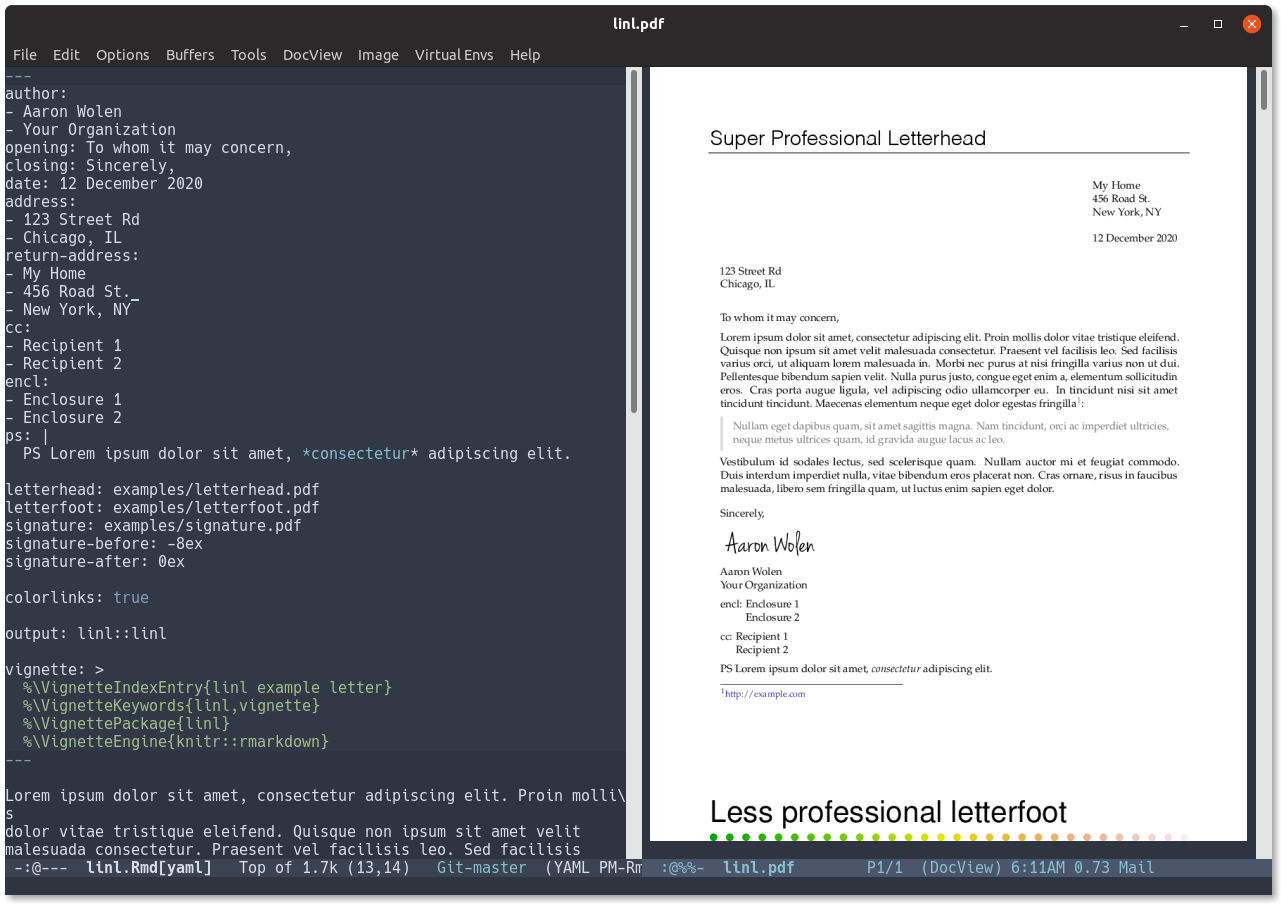
Following up on the initial 0.0.1 release of linl, Aaron and I are happy to announce release 0.0.2 which reached the CRAN network on Sunday in a smooth 'CRAN-pretest-publish' auto-admittance. linl provides a simple-yet-powerful Markdown---and RMarkdown---wrapper around the venerable LaTeX letter class; see below for an expanded example also included as the package vignette. This versions sets a few sensible default values for font, font size, margins, signature (non-)indentation and more; it also expands the documentation.
The NEWS entry follows:

Changes in tint version 0.0.2 (2017-10-29)
  • Set a few defaults for a decent-looking skeleton and template: font, fontsize, margins, left-justify closing (#3)
  • Blockquote display is now a default as well (#4).
  • Updated skeleton.Rmd and vignette source accordingly
  • Documented new default options (#5 and #6).
  • Links are now by default printed as footnotes (#9).

Courtesy of CRANberries, there is a comparison to the previous release. More information is on the tint page. For questions or comments use the issue tracker off the GitHub repo. For questions or comments use the issue tracker off the GitHub repo.

This post by Dirk Eddelbuettel originated on his Thinking inside the box blog. Please report excessive re-aggregation in third-party for-profit settings.

Norbert Preining: Debian/TeX Live 2017.20171031-1

Halloween is here, time to upload a new set of scary packages of TeX Live. About a month has passed, so there is the usual big stream up updates. There was actually an intermediate release to get out some urgent fixes, but I never reported the news here. So here are the accumulated changes and updates. My favorite this time is wallcalendar, a great class to design all kind of calendars, it looks really well done. I immediately will start putting one together. On the font side there is the new addition coelacanth. To quote from the README: Coelacanth is inspired by the classic Centaur type design of Bruce Rogers, described by some as the most beautiful typeface ever designed. It aims to be a professional quality type family for general book typesetting. And indeed it is beautiful! Other noteworthy addition is the Spark font that allows creating sparklines in the running text with LaTeX. Enjoy. New packages algobox, amscls-doc, beilstein, bib2gls, coelacanth, crossreftools, dejavu-otf, dijkstra, ducksay, dynkin-diagrams, eqnnumwarn, fetchcls, fixjfm, glossaries-finnish, hagenberg-thesis, hecthese, ifxptex, isopt, istgame, ku-template, limecv, mensa-tex, musicography, na-position, notestex, outlining, pdfreview, spark-otf, spark-otf-fonts, theatre, unitn-bimrep, upzhkinsoku, wallcalendar, xltabular. Updated packages acmart, amsmath, animate, arabluatex, arara, babel, babel-french, bangorexam, baskervillef, beebe, biblatex-philosophy, biblatex-source-division, bibletext, bidi, bxjaprnind, bxjscls, bxpapersize, bytefield, classicthesis, cochineal, complexity, cooking-units, curves, datetime2-german, dccpaper, doclicense, docsurvey, eledmac, epstopdf, eqparbox, esami, etoc, fbb, fei, fithesis, fmtcount, fnspe, fonts-tlwg, fontspec, genealogytree, glossaries, glossaries-extra, hecthese, hepthesis, hvfloat, ifplatform, ifptex, inconsolata, jfmutil, jsclasses, ketcindy, knowledge, koma-script, l3build, l3experimental, l3kernel, l3packages, langsci, latex2man, latexbug, lato, leadsheets, libertinust1math, listofitems, luatexja, luatexko, luatodonotes, lwarp, markdown, mcf2graph, media9, newtx, novel, numspell, ocgx2, overpic, philokalia, phonenumbers, platex, poemscol, pst-exa, pst-geometrictools, pst-ovl, pst-plot, pst-pulley, pst-tools, pst-vehicle, pst2pdf, pstool, pstricks, pstricks-add, pxchfon, pxjahyper, quran, randomlist, rec-thy, reledmac, robustindex, scratch, skrapport, spectralsequences, tcolorbox, tetex, tex4ht, texcount, texdoc, tikzducks, tikzsymbols, toptesi, translation-biblatex-de, unicode-math, updmap-map, uplatex, widetable, xcharter, xepersian, xetexko, xetexref, xsim, zhlipsum.

Dirk Eddelbuettel: pinp 0.0.3: More docs, more features

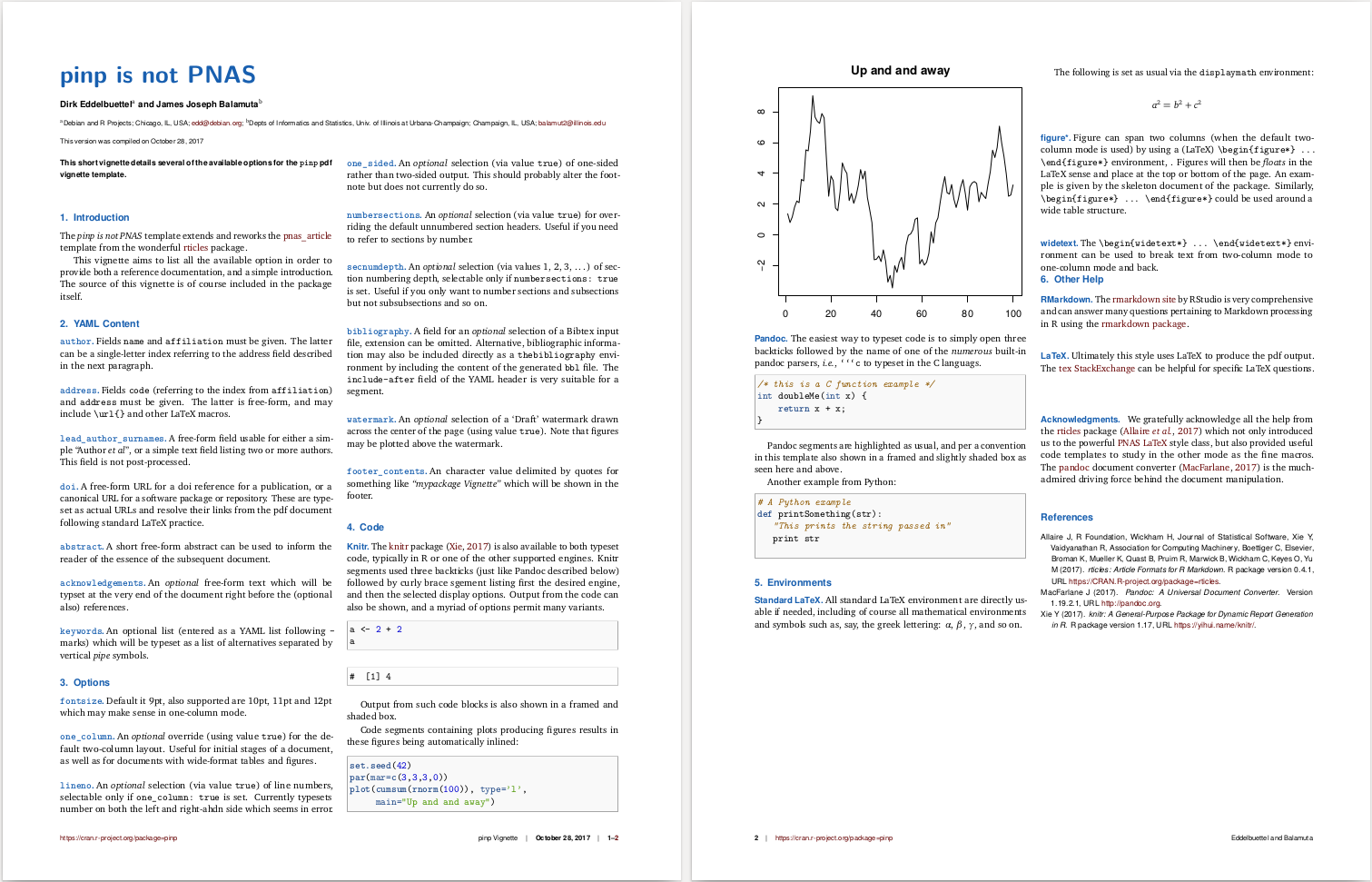
Our pinp package for snazzier one or two column vignette received it second update. Now at version 0.0.3, it arrived on CRAN on Saturday with minimal fuzz as an 'CRAN-pretest-publish' transition. We added more frontmatter options, documented more, and streamlined some internals of the LaTeX class borrowed from PNAS. A screenshot of the (updated) vignette can be seen below. Additional screenshots of are at the pinp page.
The NEWS entry for this release follows.

Changes in tint version 0.0.3 (2017-10-28)
  • Section 'Acknowledgements' now conditional on a frontmatter setting, section 'Matmethods' has been removed, pnasbreak no longer used which stabilizes LaTeX float formatting. References are now shown in the column just like other content (Dirk in #36).
  • Vignette now uses new numbered sections frontmatter switch which improves the pdf outline.
  • New front-matter options for title/section header colors, and link colors (Dirk in #39).
  • YAML frontmater options are now documented in the help page for pinp as well (Dirk in #41).
  • Some typos were fixed (Michael in #42 and #43).

Courtesy of CRANberries, there is a comparison to the previous release. More information is on the tint page. For questions or comments use the issue tracker off the GitHub repo.

This post by Dirk Eddelbuettel originated on his Thinking inside the box blog. Please report excessive re-aggregation in third-party for-profit settings.

30 October 2017

Russell Coker: Logic of Zombies

Most zombie movies feature shuffling hordes which prefer to eat brains but also generally eat any human flesh available. Because in most movies (pretty much everything but the 28 Days Later series [1]) zombies move slowly they rely on flocking to be dangerous. Generally the main way of killing zombies is severe head injury, so any time zombies succeed in their aim of eating brains they won t get a new recruit for their horde. The TV series iZombie [2] has zombies that are mostly like normal humans as long as they get enough brains and are smart enough to plan to increase their horde. But most zombies don t have much intelligence and show no signs of restraint so can t plan to recruit new zombies. In 28 Days Later the zombies aren t smart enough to avoid starving to death, in contrast to most zombie movies where the zombies aren t smart enough to find food other than brains but seem to survive on magic. For a human to become a member of a shuffling horde of zombies they need to be bitten but not killed. They then need to either decide to refrain from a method of suicide that precludes becoming a zombie (gunshot to the head or jumping off a building) or unable to go through with it. Most zombie movies (I think everything other than 28 Days Later) has the transition process taking some hours so there s plenty of time for an infected person to kill themself or be killed by others. Then they need to avoid having other humans notice that they are infected and kill them before they turn into a zombie. This doesn t seem likely to be a common occurrence. It doesn t seem likely that shuffling zombies (as opposed to the zombies in 28 Days Later or iZombie) would be able to form a horde. In the unlikely event that shuffling zombies managed to form a horde that police couldn t deal with I expect that earth-moving machinery could deal with them quickly. The fact that people don t improvise armoured vehicles capable of squashing zombies is almost as ridiculous as all the sci-fi movies that feature infantry. It s obvious that logic isn t involved in the choice of shuffling zombies. It s more of a choice of whether to have the jump-scare aspect of 18 Days Later, the human-drama aspect of zombies that pass for human in iZombie, or the terror of a slowly approaching horrible fate that you can t escape in most zombie movies. I wonder if any of the music streaming services have a horror-movie playlist that has screechy music to set your nerves on edge without the poor plot of a horror movie. Could listening to scary music in the dark become a thing?

Norbert Preining: Inconsistent version numbers in subversion

Update 2017-10-31: The developers of Subversion were a bit surprised, but it turned out to be a genuine bug. The bug has been fixed the same day. The TeX Live project uses Subversion as its main repository. Reasons for that there are many, see my blog post on svn and git. But today I realized that subversion is broken, badly broken, because one can easily end up with inconsistent version numbers. To understand why this is a problem, I restart from the already linked blog: Our packages have revision numbers based on the latest change revision of all the contained files. Since subversion has a linear history and central repository, this guarantees that in contrast to version numbers provided by authors the revision numbers are strictly increasing . Well, it turned out that this assumption was wrong. Because it is easy to trick subversion to have wrong revision numbers for files. Consider the following flow: In our case we have files listing other packages, and they are getting moved around at times. In this case one package was moved from one collection to another and back. Now, if user A does svn up between revision A+n and A+n+m, then the final revision in his checkout of file xxx will be A+n+m. But a user B that does NOT do svn up between A+n and A+n+m will end up with a final revision of A for file xxx in his checkout. And boooom, revisions are different, although the files are in sync with the server. I cannot grasp what the developers of subversion thought about here, but I consider it deeply broken by design. One more reason the rewrite all our distribution scripts to work with git instead of subversion.

29 October 2017

Niels Thykier: Building packages without (fake)root

Turns out that it is surprisingly easy to build most packages without (fake)root. You just need to basic changes:
  1. A way to set ownership to root:root of paths when dpkg-deb build constructs the binary.
  2. A way to have debhelper not do a bunch of (now) pointless chowns to root:root .
The above is sufficient for dpkg, debhelper, lintian, apt-file, mscgen, pbuilder and a long list of other packages that only provide paths owned by root:root . Obviously, packages differ and yours might need more tweaks than this (e.g. dh_usrlocal had to change behaviour to support this). But for me, the best part is that the above is not just some random prototype stuck in two git repos on alioth: Unfortunately, if you are working with games or core packages like shadow with need for static ownership different from root:root (usually with a setuid or setgid bit), then our first implementation does not support your needs at the moment[1]. We are working on a separate way to solve static ownership in a declarative way. [1] Note regarding /usr/local : If your package needs to provide directories there owned by root:staff with mode 02775, then dh_usrlocal can handle that. The non- root:root ownership here works because the directories are created in a maintainer script run as root during installation. Unfortunately, it cannot provide different ownership or modes with R != binary-targets at the moment.
Filed under: Debhelper, Debian

Russ Allbery: Review: Why We Sleep

Review: Why We Sleep, by Matthew Walker
Publisher: Scribner
Copyright: October 2017
ISBN: 1-5011-4433-2
Format: Kindle
Pages: 341
The world is full of theories, and corresponding books, about things that will make you healthier or prevent disease. Nearly all of them are scams, either intentional or created through the placebo effect and the human tendency to see patterns that don't exist. The rare ones that aren't have a certain pattern: they're grounded in our best understanding of biology, align with what our body wants to do anyway, have been thoroughly studied using proper testing methodology, and don't make money for powerful corporations. I'm fairly sure this is one of those rare ones that isn't a scam. And, if so, it's rather important and worth your attention. Matthew Walker is a professor of neuroscience and biology at the University of California at Berkeley, where he's the founder of the Center for Human Sleep Science. He's not a doctor; he started medical training, but (as he says in the book) found himself more attracted to questions than answers. He's a professional academic researcher who has been studying sleep for decades. This book is a combination of summary of the current state of knowledge of academic sleep research and a plea: get more sleep, because we're literally killing ourselves with the lack of it. Walker opens the book with a discussion of the mechanisms of sleep: how we biologically fall asleep and why, how this has changed over time, and how it changes with age. Along with that, he defines sleep: the REM and NREM sleep cycle that you may have already heard of, how it manifests itself in most people, and where dreams fit in. The second part then discusses what happens when you sleep, with a focus on what goes wrong when you don't. (Spoiler: A lot. Study after study, all cited and footnoted, has found connections between sleep and just about every aspect of mental and physical health.) The third part does the same for dreams, fitting them into the picture along with a scientific discussion of just what's going on during dreams. The fourth and final part tackles the problem: why don't we get enough sleep, and what can we do about it? I will warn in advance that this book will make you paranoid about your sleeping patterns. Walker has the missionary zeal of an academic who has sunk his teeth into something really important that society needs to take into account and will try to drown you in data, analysis, analogies, and sheer earnestness until you will believe him. He wants you to get at least seven, and preferably eight, hours of sleep a night. Every night, with as little variation as you can manage. Everyone, even if you think you're someone who doesn't need as much sleep (you're probably not). There's a ton of science here, a great popularization of a whole field of research, but this is also a book that's trying to get you to do something. Normally, that sort of book raises my shields. I'm not much of a believer in any book of the general genre of "most people are doing this basic part of life wrong, and should do it my way instead." But the hallmarks of good science are here: very widespread medical consensus, no corporate interest or obvious path to profit, and lots of studies (footnoted here, with some discussions of methodology although not the statistical details, which will require looking up the underlying studies and careful caveats where studies indicate correlation but may not find causes). And Walker makes the very telling point early in the book that nearly every form of life on the planet sleeps in one way or another (defined as a daily recurring period of time during which it doesn't respond to outside stimulus), which is a strong indicator of universal necessity. Given the vulnerability and loss of useful hours that come with sleep, one would expect some species to find an evolutionary path away from it if it were dispensable. But except for extremely short-lived species, we've never found a living creature that didn't sleep. Walker's argument for duration is also backed up by repeated studies on human capability before and after various quantities of sleep, and on studies of the sleep phases in various parts of the night. Study after study used six hours as the cutoff point and showed substantial deterioration in physical and mental capabilities even after only one night of short sleeping. (Reducing sleep to four hours is nearly catastrophic.) And, more worrisomely, that degradation is still measurable after "catching up" on sleep on subsequent nights. Sleeping in on weekends doesn't appear to fully compensate for the damage done by short-sleeping during the week. When Walker gets into the biological reasons for sleep, one starts to understand why it's so important. I think the part I found the most fascinating was the detailed analysis of what the brain is doing while you sleep. It's not inactive at all, even outside of REM sleep. Walker and other sleep researchers have done intriguing experiments showing how different parts of the sleep cycle transfer memories from short to long term storage, transfer physical skills into subconscious parts of the brain, discard short term memories that the conscious brain has tagged as being unwanted, and free up space for new knowledge acquisition. REM sleep appears to attempt to connect otherwise unrelated memories and bits of knowledge, inverting how association normally works in the brain, thus providing some concrete explanation for sleep's role in creativity. And (this research is fairly new), deep NREM sleep causes temporary physical changes in the brain that appear to be involved in flushing metabolic waste products away, including the plaque involved in Alzheimer's. The last part of the book is probably the most concretely useful: what can one practically do to get more sleep? There is quite a lot that's proven effective, but Walker starts with something else: sleeping pills. Here, you can almost see the lines drawn by a lawyer around what Walker should say. He stresses that he's not a medical doctor while laying out study after study that all point in the same direction: sleeping pills are a highly dangerous medical fraud that will shorten your lifespan for negligible benefit in helping you fall asleep, while limiting your brain's ability to enter true sleep. They're sedation, sedation is not sleep, and the four billion dollar sleeping pill market is literally making everything worse. The good news is there is an effective treatment for insomnia that works for many people; the better news is that it's completely free (although Walker does suggest some degree of medical supervision for serious insomnia so that some parts of it can be tailored to you). He walks through CBT-I (cognitive behavior therapy for insomnia), which is now the medically recommended primary treatment for insomnia, and takes apart the pieces to show how they line up with the results of sleep research studies. Alongside that are recommendations for improving sleep for people who don't have clinical insomnia but who aren't regularly getting the recommended amount of sleep. There are a lot of interesting bits here (and he of course talks about blue LED light and its relationship to melatonin cycles), but I think the most interesting for me was that you have to lower your core body temperature by a couple of degrees (Fahrenheit) to enter sleep. The temperature of your sleeping environment is therefore doubly important: temperature changes are one of the signals your body uses to regulate circadian rhythms (cold being a signal of night), and a colder sleeping area helps you lower your core body temperature so that you can fall asleep. (The average person does best with a sleeping room temperature of 65F, 18C.) There's even more in here: I haven't touched on Walker's attack on the US tendency to push high school start times earlier and earlier in the day (particularly devastating for teenagers, whose circadian rhythms move two hours later in the day than adults before slowly returning to an adult cycle). Or the serious problems of waking to an alarm clock, and the important benefits of the sleep that comes at the end of a full night's cycle. Or the benefits of dreams in dealing with trauma and some theories for how PTSD may interfere with that process. Or the effect of sleep on the immune system. Walker's writing style throughout Why We Sleep is engaging and clear, although sometimes too earnest. He really wants the reader to believe him and to get more sleep, and sometimes that leaks around the edges. One can also see the effort he's putting into not reading too much into research studies, but if there's a flaw in the science here, it's that I think Walker takes a few tentative conclusions a bit too far. (I'm sure these studies have the standard research problem of being frequently done on readily-available grad students rather than representative samples of the population, although the universality of sleep works in science's favor here.) Some of the recitations of research studies can get rather dry, and I once again discovered how boring I find most discussion of dreams, but for a first book written by an academic, this is quite readable. This is one of those books that I want everyone to read mostly so that they can get the information in it, not as much for the enjoyment of reading the book itself. I've been paying closer attention to my own sleep patterns for the last few years, and my personal experience lines up neatly with the book in both techniques to get better sleep and the benefits of that sleep. I'd already reached the point where I was cringing when people talk about regularly going on four or five hours of sleep; this is an entire book full of researched reasons to not do that. (Walker points out that both Reagan and Thatcher, who bragged about not requiring much sleep, developed Alzheimer's, and calls out Trump for making the same brag.) The whole book may not be of interest to everyone, but I think everyone should at least understand why the World Heath Organization recommends eight hours a night and labels shift work a probable carcinogen. And, as Walker points out, we should be teaching some of this stuff in school health classes alongside nutrition and sex education. Alas, Walker can't provide much advice on what I think is the largest robber of sleep: the constant time pressure of modern life, in which an uninterrupted nine hour sleep opportunity feels like an unaffordable luxury. Rating: 9 out of 10

28 October 2017

Steinar H. Gunderson: Introducing Narabu, part 4: Decoding

Narabu is a new intraframe video codec. You probably want to read part 1, part 2 and part 3 first. So we're at the stage where the structure is in place. How do we decode? Once we have the structure, it's actually fairly straightforward: First of all, we need to figure out where each slice starts and ends. This is done on the CPU, but it's mostly just setting up pointers, so it's super-cheap. It doesn't see any pixels at all, just lengths and some probability distributions (those are decoded on the CPU, but they're only a few hundred values and no FP math is involved). Then, we set up local groups of size 64 (8x8) with 512 floats of shared memory. Each group will be used for decoding one slice (320 blocks), all coefficients. Each thread starts off doing rANS decoding (this involves a lookup into a small LUT, and of course some arithmetic) and dequantization of 8 blocks (for its coefficient); this means we now have 512 coefficients, so we add a barrier, do 64 horizontal IDCTs (one 8-point IDCT per thread), add a new barrier, do 64 vertical IDCTs, and then finally write out the data. We can then do the next 8 coefficients the same way (we kept the rANS decoding state), and so on. Note how the parallelism changes during the decoding; it's a bit counterintuitive at first, and barriers are not for free, but it avoids saving the coefficients to global memory (which is costly). First, the parallelism is over coefficients, then over horizontal DCT blocks, then over vertical DCT blocks, and then we start all over again. In CPU multithreading, this would be very tricky, and probably not worth it at all, but on the GPU, it gives us tons of parallelism. One problem is that the rANS work is going to be unbalanced within each warp. There's a lot more data (and thus more calculation and loading of compressed data from memory) in the lower-frequency coefficients, which means the other threads in the warp are wasting time doing nothing when they do more work. I tried various schemes to balance it better (like making even larger thread groups to get e.g. more coefficient 0s that could work together, or reordering the threads' coefficients in a zizag), but seemingly it didn't help any. Again, the lack of a profiler here is hampering effective performance investigations. In any case, the performance is reasonably good (my GTX 950 does 1280x720 luma-only in a little under 0.4 ms, which equates to ~1400 fps for full 4:2:2). As a side note, GoPro open-sourced their CineForm HD implementation the other day, and I guess it only goes to show that these kind of things really belong on the GPU; they claim similar performance numbers to what I get on my low-end NVIDIA GPU (923.6 fps for 1080p 4:2:2, which would be roughtly 1800 fps on 720p60), but that's on a 4GHz 8-core Broadwell-E, which is basically taking the most expensive enthusiast desktop CPU you can get your hands on and then overclocking it. Kudos to GoPro for freeing it, though (even under a very useful license), even though FFmpeg already had a working reverse-engineered implementation. :-) Next time, we'll look at the encoder, which is a bit more complicated. After that, we'll do some performance tests and probably wrap up the series. Stay tuned.

Russ Allbery: Review: Provenance

Review: Provenance, by Ann Leckie
Publisher: Orbit
Copyright: September 2017
ISBN: 0-316-38863-7
Format: Kindle
Pages: 448
In a rather desperate attempt to please her mother, Ingray has spent every resource she has on extracting the son of a political enemy from Compassionate Removal (think life imprisonment with really good marketing). The reason: vestiges, a cultural touchstone for Ingray's native planet of Hwae. These are invitation cards, floor tiles, wall panels, or just about anything that can be confirmed to have been physically present at an important or historical moment, or in the presence of a famous figure. The person Ingray is retrieving supposedly pulled off the biggest theft of vestiges in history. If she can locate them, it would be a huge coup for her highly-placed politician mother, and the one time she would be victorious in her forced rivalry with her brother. About the best thing that could be said for this plan is that it's audacious. The first obstacle is the arrival of the Geck on the station for a Conclave for renegotiation of the treaty with the Presger, possibly the most important thing going on in the galaxy at the moment, which strands her there without money for food. The second is that the person she has paid so much to extract from Compassionate Removal says they aren't the person she was looking for at all, and are not particularly interested in going with her to Hwae. Only a bit of creative thinking in the face of a visit from the local authorities, and the unexpected kindness of the captain from whom she booked travel, might get her home with the tatters of her plan intact. But she's clearly far out of her depth. Provenance is set in the same universe as Ancillary Justice and its sequels, but it is not set in the empire of the Radchaai. This is another human world entirely, one with smaller and more provincial concerns. The aftermath of Ancillary Mercy is playing out in the background (so do not, on risk of serious spoilers, read the start of this book without having read the previous trilogy), but this is in no way a sequel. Neither the characters nor the plot are involved in that aftermath. It's a story told at a much smaller scale, about two political families, cut-throat maneuvering, horrible parenting, the inexplicable importance of social artifacts, the weirdness of human/alien relations, and the merits of some very unlikely allies. Provenance is a very different type of story than Ancillary Justice, and Ingray is a very different protagonist. The shape of the plot reminded me of one of Lois McMaster Bujold's Miles Vorkosigan stories: hair-brained ideas, improvisation, and unlikely allies. But Ingray couldn't be more different than Miles. She starts the book overwhelmed, despairing, and not at all manic, and one spends the first part of the story feeling sorry for her and becoming quite certain that everything will go horribly wrong. The heart of this book is the parallel path Leckie takes the reader and the characters along as they discover just what Ingray's true talents and capabilities are. It's a book about being hopelessly bad at things one was pressured towards being good at, while being quietly and subtly good at the skills that let one survive a deeply dysfunctional family. There are lots of books with very active protagonists, and a depressing number of books with passive protagonists pushed around by the plot. There are very few books that pull off the delicate characterization that Leckie manages here: a protagonist who is rather hopeless at taking charge of the plot in the way everyone wants (but doesn't particularly expect) her to, but who charts her own path through the plot in an entirely unexpected way. It's a story that grows on you. The plot rhythm never works in quite the way one expects from other books, but it builds its own logic and its own rhythm, and reached a very emotionally satisfying conclusion. The Radchaai, or at least one Radchaai citizen, do show up eventually, providing a glimmer of outside view at the Ancillary Justice world. Even better, the Geck play a significant role. I adore Leckie's aliens: they're strange and confusing, but in a refreshingly blunt way rather than abusing gnomic utterances and incomprehensible intelligence. And the foot-stomping of the spider bot made me laugh every time. The stakes are a lot lower here than in Ancillary Justice, and Ingray isn't the sort of character who's going to change the world. But that's okay; indeed, one of the points of this book is why and how that's okay. I won't lie: I'd love more Breq, and I hope we eventually get an exploration of the larger consequences of her story. But this is a delightful story that made me happy and has defter character work than most SF being written. Recommended, but read the Ancillary trilogy first. One minor closing complaint, which didn't change my experience of the book but which I can't help quibbling about: I'm completely onboard with the three-gender system that Leckie uses for the Hwae (I wish more SF authors would play with social as well as technological ideas), and I think she wove it deftly into the story, but I wish she hadn't used Spivak pronouns for the third gender. (e/em/eir, for those who aren't familiar.) Any of the other gender-neutral pronouns look better to me and cause fewer problems for my involuntary proofreader. I prefer zie/zir for personal reasons, but sie/hir, zhe/zhim/zher, or even thon or per would read more smoothly. Eir is fine, but em looks like 'em and throws my brain into dialect mode and forces a re-parse, and e just looks like a typo. I know from lots of Usenet discussions of pronouns that I'm not the only one who has that reaction to Spivak. But it's a very minor nit. Rating: 8 out of 10

Next.

Previous.