Search Results: "tar"

16 April 2015

Daniel Pocock: Debian Jessie release, 100 year ANZAC anniversary

The date scheduled for the jessie release, 25 April 2015, is also ANZAC day and the 100th anniversary of the Gallipoli landings. ANZAC day is a public holiday in Australia, New Zealand and a few other places, with ceremonies remembering the sacrifices made by the armed services in all the wars. Gallipoli itself was a great tragedy. Australian forces were not victorious. Nonetheless, it is probably the most well remembered battle from all the wars. There is even a movie, Gallipoli, starring Mel Gibson. It is also the 97th anniversary of the liberation of Villers-Bretonneux in France. The previous day had seen the world's first tank vs tank battle between three British tanks and three German tanks. The Germans won and captured the town. At that stage, Britain didn't have the advantage of nuclear weapons, so they sent in Australians, and the town was recovered for the French. The town has a rue de Melbourne and rue Victoria and is also the site of the Australian National Memorial for the Western Front. Its great to see that projects like Debian are able to span political and geographic boundaries and allow everybody to collaborate for the greater good. ANZAC day might be an interesting opportunity to reflect on the fact that the world hasn't always enjoyed such community.

15 April 2015

Rhonda D'Vine: HollySiz

Sometimes one stumbles upon stuff that touches one deeply. Granted, the topic of the first video from the artist I want to present you now did touch me naturally. But it made me take a closer look. This is about HollySiz. Yes, yet another French singer, but fortunately (for me) she sings mostly in English. :) So here are the songs: Like always, enjoy! And take good care of your kids if you happen to have some.

/music permanent link Comments: 0 Flattr this

Michal Čihař: Packaging python-gammu

After Monday release of separate Gammu and python-gammu, the obvious task was to get the new package to distributions. First I've started with Debian packages, what was quite easy as from quite complex CMake + Python package it is now purely CMake and it was mostly about removing stuff. Soon the updated Gammu package was uploaded to experimental. Once having that ready, I've also update the backports for Ubuntu and these are available in Gammu PPA. Creating new python-gammu package was a bit harder as this is the first Python 3 compatible package I've created, but it's now ready and sitting in the NEW queue. While working on python-gammu package, I've realized that some of the data used in testsuite are missing in the tarball. While not being critical, this is definitely not nice, so I've decided to release python-gammu 2.1 today. It also includes fixes for some corner cases found by coverity. For openSUSE the packaging was quite easy as well, stripping out unneeded parts of Gammu package went smoothly and it's now in hardware project, SR to Factory is pending. With python-gammu it turned out to be much harder as the testsuite had failed there with some strange error coming out of libdbi. After looking deeper into it, the problem is in new return type available in Git snapshot openSUSE is shipping. Fortunately producing fix was quite easy, so next Gammu upstream will handle that properly and package in hardware project is already patched. You can now use python-python-gammu from devel:languages:python and SR to Factory is pending as well.

Filed under: Debian English Gammu python-gammu SUSE Wammu 0 comments

Raphaël Hertzog: Looking back at the Debian Long Term Support project

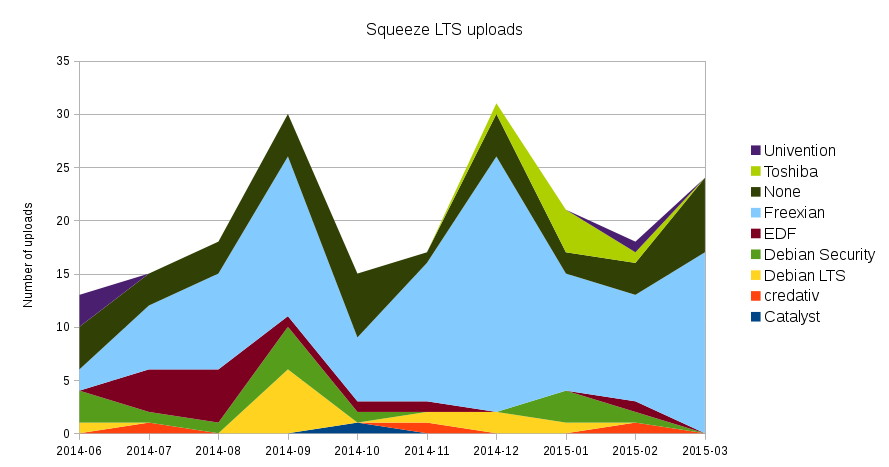
On Sunday I gave a talk about Debian LTS during the Mini-DebConf in Lyon. Obviously I presented the project and the way it s organized, but I also took the opportunity to compute some statistics. You can watch the presentation (thanks to the video team!) or have a look at the slides to learn more. Here are some extracts of the statistics I collected: The number of the uploads per affiliation (known affiliations are recorded in the LTS/Team wiki page) is displayed on the graph below. None corresponds to packages maintainers taking care of their own packages, Debian Security corresponds to members of the security team who also contributed to LTS, Debian LTS corresponds to individual members of the LTS team without any explicit affiliation. Freexian represents in fact 29 financial sponsors (see detail here). Debian LTS uploads over time Top 12 contributors (in number of uploads): The talk also contains explanations about the current funding setup. Hopefully this clears things up for people who were still wondering how the LTS project is working.

One comment Liked this article? Click here. My blog is Flattr-enabled.

Petter Reinholdtsen: Debian Edu interview: Shirish Agarwal

It was a surprise to me to learn that project to create a complete computer system for schools I've involved in, Debian Edu / Skolelinux, was being used in India. But apparently it is, and I managed to get an interview with one of the friends of the project there, Shirish Agarwal. Who are you, and how do you spend your days? My name is Shirish Agarwal. Based out of the educational and historical city of Pune, from the western state of Maharashtra, India. My bread comes from giving training, giving policy tips, installations on free software to mom and pop shops in different fields from Desktop publishing to retail shops as well as work with few software start-ups as well. How did you get in contact with the Skolelinux / Debian Edu project? It started innocently enough. I have been using Debian for a few years and in one local minidebconf / debutsav I was asked if there was anything for schools or education. I had worked / played with free educational softwares such as Gcompris and Stellarium for my many nieces and nephews so researched and found Debian Edu or Skolelinux as it was known then. Since then I have started using the various education meta-packages provided by the project. What do you see as the advantages of Skolelinux / Debian Edu? It's closest I have seen where a package full of educational software are packed, which are free and open (both literally and figuratively). Even if I take the simplest software which is gcompris, the number of activities therein are amazing. Another one of the softwares that I have liked for a long time is stellarium. Even pysycache is cool except for couple of issues I encountered #781841 and #781842. I prefer software installed on the system over web based solutions, as a web site can disappear any time but the software on disk has the possibility of a larger life span. Of course with both it's more a question if it has enough users who make it fun or sustainable or both for the developer per-se. What do you see as the disadvantages of Skolelinux / Debian Edu? I do see that the Debian Edu team seems to be short-handed and I think more efforts should be made to make it popular and ask and take help from people and the larger community wherever possible. I don't see any disadvantage to use Skolelinux apart from the fact that most apps. are generic which is good or bad how you see it. However, saying that I do acknowledge the fact that the canvas is pretty big and there are lot of interesting ideas that could be done but for reasons not known not done or if done I don't know about them. Let me share some of the ideas (these are more upstream based but still) I have had for a long time : 1. Classical maths question of two trains in opposing directions each running @x kmph/mph at y distance, when they will meet and how far would each travel and similar questions like these. The computer is a fantastic system where questions like these can be drawn, animated and the methodology and answers teased out in interactive manner. While sites such as the Ask Dr. Math FAQ on The Two Trains problem (as an example or point of inspiration) can be used there is lot more that can be done. I dunno if there is a free software which does something like this. The idea being a blend of objects + animation + interaction which does this. The whole interaction could be gamified with points or sounds or colourful celebration whenever the user gets even part of the question or/and methodology right. That would help reinforce good behaviour. This understanding could be used to share/showcase everything from how the first wheel came to be, to evolution to how astronomy started, psychics and everything in-between. One specific idea in the train part was having the Linux mascot on one train and the BSD or GNU mascot on the other train and they meeting somewhere in-between. Characters from blender movies could also be used. 2. Loads of crossword-puzzles with reference to subjects: We have enormous data sets in Wikipedia and Wikitionary. I don't think it should be a big job to design crossword puzzles. Using categories and sub-categories it should be doable to have Q&A single word answers from the existing data-sets. What would make it easy or hard could be the length of the word + existence of many or few vowels depending on the user's input. 3. Jigsaw puzzles - We already have a great software called palapeli with number of slicers making it pretty interesting. What needs to be done is to download large number of public domain and copyleft images, tease and use IPTC tags to categorise them into nature, history etc. and let it loose. This could turn to be really huge collection of images. One source could be taken from commons.wikimedia.org, others could be huge collection of royalty-free stock photos. Potential is immense. Apart from this, free software suffers in two directions, we lag both in development (of using new features per-se) and maintenance a lot. This is more so in educational software as these applications need to be timely and the opportunity cost of missing deadlines is immense. If we are able to solve issues of funding for development and maintenance of such software I don't see any big difficulties. I know of few start-ups in and around India who would love to develop and maintain such software if funding issues could be solved. Which free software do you use daily? That would be huge list. Some of the softwares are obviously apt, aptitude, debdelta, leafpad, the shell of course (zsh nowadays), quassel for IRC. In games I use shisen-sho while card-games are evenly between kpat and Aiselriot. In desktops it's a tie between gnome-flashback and mate. Which strategy do you believe is the right one to use to get schools to use free software? I think it should first start with using specific FOSS apps. in whatever environment they are. If it's MS-Windows or Mac so be it. Once they are habitual with the apps. and there is buy-in from the school management then it could be installed anywhere. Most of the people now understand the concept of a repository because of the various online stores so it isn't hard to convince on that front. What is harder is having enough people with technical skills and passion to service them. If you get buy-in from one or two teachers then ideas like above could also be asked to be done as a project as well. I think where we fall short more than anything is in marketing. For instance, Debian has this whole range of fonts in its archive but there isn't even a page where all those different fonts in the La Ipsum format could be tried out for newcomers. One of the issues faced constantly in installations is with updates and upgrades. People have this myth that each update and upgrade means the user interface will / has to change. I have seen this innumerable times. That perhaps is one of the reasons which browsers like Iceweasel / Firefox change user interfaces so much, not because it might be needed or be functional but because people believe that changed user interfaces are better. This, can easily be pointed with the user interfaces changed with almost every MS-Windows and Mac OS releases. The problems with Debian Edu for deployment are many. The biggest is the huge gap between what is taught in schools and what Debian Edu is aimed at. Me and my friends did teach on week-ends in a government school for around 2 years, and gathered some experience there. Some of the things we learnt/discovered there was :
  1. Most of the teachers are very territorial about their subjects and they do not want you to teach anything out of the portion/syllabus given.
  2. They want any activity on the system in accordance to whatever is in the syllabus.
  3. There are huge barriers both with the English language and at times with objects or whatever. An example, let's say in gcompris you have objects falling down and you have to name them and let's say the falling object is a hat or a fedora hat, this would not be as recognizable as say a Puneri Pagdi so there is need to inject local objects, words wherever possible. Especially for word-games there are so many hindi words which have become part of english vocabulary (for instance in parley), those could be made into a hinglish collection or something but that is something for upstream to do.

14 April 2015

Neil Williams: Extending an existing ARMMP initramfs

The actual use of this extension is still in development and the log files are not currently publicly visible, but it may still be useful for people to know the what and why The Debian ARMMP kernel can be used for multiple devices, just changing the DTB. I ve already done tests with this for Cubietruck and Beaglebone-Black, iMX.53 was one of the original test devices too. Whilst these tests can deploy a full image (there are examples of building such images in the vmdebootstrap package), it is a lot quicker to do simple tests of a kernel using a ramdisk. The default Debian initramfs has a focused objective but still forms a useful base for extension. In particular, I want to be able to test one initramfs on multiple boards (so multiple dtbs) with the same kernel image. I then want to be able, on selected boards, to mount a SATA drive or write an image to eMMC or a USB stick or whatever. LAVA (via the ongoing refactoring, not necessarily in the current dispatcher code) can automate such tests, e.g. to allow me to boot a Cubietruck into a standard Debian ARMMP armhf install on the SATA drive but using a modified (or updated) ARMMP kernel over TFTP without needing to install it on the device itself. That same kernel image can then be tested on multiple boards to see if the changes have benefitted one board at the expense of another. Automating all of that could be of a lot of benefit to the ARM kernel developers in Debian and outside Debian. So, the start point. Install Debian onto a Cubietruck in my case, with a SATA drive attached. All well and good so far, standard Debian Jessie ARMMP. (Cubietruck uses the LPAE kernel flavour but that won t matter for the initramfs.) Rather than building the initramfs manually, this provides a shortcut at some point I may investigate how to do this in QEMU but for now, it s just as quick to SSH onto the Cubietruck and update. I ve already written a little script to download the relevant linux-image package for ARMMP, unpack it and pull out the vmlinuz, the dtbs and a selected list of modules. The list is selective because TFTP has a 32Mb download limit and there are more modules than that. So I borrowed a snippet from the Xen folks (already shown previously here). The script is in a support repository for LAVA but can be used anywhere. (You ll need to edit the package name in the script to choose between ARMMP and ARMMP LPAE. Steps
  1. Get a working initramfs from an installed device running Debian ARMMP and copy some files for use later. Note: use the name of the symlink in the copy so that the file in /tmp/ is the actual file, using the name of the symlink as the filename. This is important later as it saves a step of having to make the (unnecessary) symlink inside the initramfs. Also, mkinitramfs, which built this initrd.img file in the first place, uses the same shared libraries as the main system, so copying these into the initramfs still works. (This is really useful when you get your ramdisk to support the attached secondary storage, allowing you to simply mount the original Debian install and fixup the initramfs by copying files off the main Debian install.) The relevant files are to support DNS lookup inside the initramfs which then allows a test to download a new image to put onto the attached media before rebooting into it.
    cp /boot/initrd.img-3.16.0-4-armmp-lpae /tmp/
    cp /lib/arm-linux-gnueabihf/libresolv.so.2 /tmp/
    cp /mnt/lib/arm-linux-gnueabihf/libnss_dns.so.2 /tmp/
    
    Copy these off the device for local adjustment:
    scp IP_ADDR:/tmp/FILE .
    
  2. Decompress the initrd.img:
    cp initrd.img-3.16.0-4-armmp-lpae initrd.img-3.16.0-4-armmp-lpae.gzip
    gunzip initrd.img-3.16.0-4-armmp-lpae.gzip
    
  3. Make a new empty directory
    mkdir initramfs
    cd initramfs
    
  4. Unpack:
    sudo cpio -id < initrd.img-3.16.0-4-armmp-lpae
    
  5. Remove the old modules (LAVA can add these later, allowing tests to use an updated build with updated modules):
    sudo rm -rf ./lib/modules/*
    
  6. Start to customise - need a script for udhcpc and two of the libraries from the installed system to allow the initramfs to do DNS lookups successfully.
    cp ../libresolv.so.2 ./lib/arm-linux-gnueabihf/
    cp ../libnss_dns.so.2 ./lib/arm-linux-gnueabihf/
    
  7. Copy the udhcpc default script into place:
    mkdir ./etc/udhcpc/
    sudo cp ../udhcpc.d ./etc/udhcpc/default.script
    sudo chmod 0755 ./etc/udhcpc/default.script
    
  8. Rebuild the cpio archive:
    find .   cpio -H newc -o > ../initrd.img-armmp.cpio
    
  9. Recompress:
    cd ..
    gzip initrd.img-armmp.cpio
    
  10. If using u-boot, add the UBoot header:
    mkimage -A arm -T ramdisk -C none -d initrd.img-armmp.cpio.gz initrd.img-armmp.cpio.gz.u-boot
    
  11. Checksum the final file so that you can check that against the LAVA logs.
    md5sum initrd.img-armmp.cpio.gz.u-boot
    
Each type of device will need a set of modules modprobed before tests can start. With the refactoring code, I can use an inline YAML and use dmesg -n 5 to reduce the kernel message noise. The actual module names here are just those for the Cubietruck but by having these only in the job submission, it makes it easier to test particular combinations and requirements.
- dmesg -n 5
- lava-test-case udevadm --shell udevadm hwdb --update
- lava-test-case depmod --shell depmod -a
- lava-test-case sata-mod --shell modprobe -a stmmac ahci_sunxi sd_mod sg ext4
- lava-test-case ifconfig --shell ifconfig eth0 up
- lava-test-case udhcpc --shell udhcpc
- dmesg -n 7
In due course, this will be added to the main LAVA documentation to allow others to keep the initramfs up to date and to support further test development.

Rapha&#235;l Hertzog: Freexian s report about Debian Long Term Support, March 2015

A Debian LTS logoLike each month, here comes a report about the work of paid contributors to Debian LTS. Individual reports In February, 61 work hours have been equally split among 4 paid contributors. Their reports are available: The remaining hours of Ben and Holger have been redispatched to other contributors for April (during which Mike Gabriel joins the set of paid contributors). BTW, if you want to join the team of paid contributors, read this and apply! Evolution of the situation April has seen no change in terms of sponsored hours but we have two new sponsors in the pipe and May should hopefully have a few more sponsored hours. For the need of a LTS presentation I gave during the Mini-DebConf Lyon I prepared a small graph showing the evolution of the hours sponsored through Freexian:
freexian-hours The growth is rather slow and it will take years to reach our goal of funding the equivalent a full time position (176 hours per month). Even the intermediary goal of funding the equivalent of a half-time position (88h/month) is more than 6 months away given the current growth rate. But the perspective of Wheezy-LTS should help us to convince more organizations and hopefully we will reach that goal sooner. If you want to sponsor the project, check out this page. In terms of security updates waiting to be handled, the situation looks similar to last month: the dla-needed.txt file lists 40 packages awaiting an update (exactly like last month), the list of open vulnerabilities in Squeeze shows about 56 affected packages in total (2 less than last month). Thanks to our sponsors The new sponsors of the month are in bold (none this month).

No comment Liked this article? Click here. My blog is Flattr-enabled.

Michal &#268;iha&#345;: Hacking Gammu

I've spent first day of SUSE Hackweek on Gammu. There are quite many tasks to be done and I wanted to complete at least some of them. First I started with the website. I did not really like the old layout and aggressive colors and while touching it's code it's good idea to make the website work well in mobile devices. I've started with conversion to Bootstrap and It turned out to be quite easy task. The next step was making the pages simpler as in many places there was too much information hidden in sidebar. While doing content cleanup, I've removed some features which really don't make much sense these days (such as mirror selection). Anyway read more in the news entry on the site itself. Second big task was to add support for Python 3 in python-gammu. It seems that world is finally slowly moving towards Python 3 and people started to request python-gammu to be available there as well. The porting itself took quite some time, but I've mostly completed it before Hackweek. Yesterday, there was just some time spent on polishing and releasing standalone python-gammu and Gammu without python bindings. Now you can build python-gammu using distutils or install it using pip install python-gammu.

Filed under: English Gammu python-gammu SUSE Wammu 0 comments

13 April 2015

Mehdi Dogguy: DPL campaign 2015

This year's DPL campaign is over and voting period is also almost over. Many did not vote yet and they really should consider doing so. This is meant as a reminder for them. If you didn't have time to dig into debian-vote's archives and read questions/answers, here is the list with links to candidates' replies:
Compared to past years, we had a comparable number of questions. All questions did not start big threads as it used to be the case sometimes in the past :-) The good side of this is that we are trolling DPL candidates less than we used to do :-P

Now, if you still didn't vote, it is really time to do so. The voting period ends on Tuesday, April 14th, 23:59:59 UTC, 2015. You have only a few hours left!

Russ Allbery: Review: Zero Sum Game

Review: Zero Sum Game, by S.L. Huang
Series: Russell's Attic #1
Publisher: S.L. Huang
Copyright: 2014
ISBN: 0-9960700-1-X
Format: Kindle
Pages: 326
Cas Russell finds things for people, often involving some strategic violence. She belongs to that genre of action novel protagonists who have a rough code of ethics, but who don't exactly follow the law. Her friend Rio is much worse: a functioning sociopath with his own code of ethics, the derivation of which is a key plot point. When the book opens, Cas is on a mission to find a person and rescue them from a drug cartel not her normal mission, but her contact said she was referred by Rio. Oh, and Rio is currently hitting her in the face. This setup matches any number of present-day thrillers. The SFnal twist is that Cas is very good at numbers, in a completely unrealistic action hero way. (I found it unsurprising that Huang was inspired by the superhero genre; that's the right model to have in mind when reading about Cas.) She can calculate where bullets are going to go, knows just the right angle and velocity with which to throw things (and, even more notably, can get her body to do that), and, in one particularly memorable scene, sets up an eavesdropping sound concentrator by changing the angles of available random surfaces in the neighborhood, like trash cans. This ability is not without drawbacks. When she's not in a middle of a job, with something to focus on, she usually ends up drinking herself into a stupor to get her brain to stop working. But it's an extremely useful ability that requires the villains of this book go to great efforts to try to kill her. The plot starts out as fairly typical thriller material, involving threats and dire consequences to those Cas loves (or at least likes a lot) and an unfolding sense that this retrieval of a kidnapped woman is the tip of a very deep iceberg. The expected counterpart, a private investigator with a less casual attitude towards killing than Cas, shows up early on. (Rio does not play that role in the story. His role is much more complex.) But the superhero inspirations show up in the villains as well, in a twist that many on-line summaries spoil, but which I will leave unmentioned. Mostly, Zero Sum Game is a fast-moving story with lots of violence, lots of guns, shadowy conspiracies, and a hypercompetent protagonist. (Female, refreshingly, particularly since she doesn't fall in love with any of the other characters in the book.) It's a recipe for enjoyable brain candy, and I think that's the best attitude to bring to it. However, a couple of things set it apart for me. First, Cas spends quite a bit of time really thinking about her life and questioning her decisions, rather than just blithely enjoying her world of stress and violence. There's more introspection here than in the typical thriller plot, but she stops short of wallowing in angst and stays decisive. I liked that balance: a bit of inner discomfort, and a few hard ethical decisions, but not to the point of paralyzing her. Second, her relationship with Rio is something special. Rio himself is a character type that I've seen before in books like this, but I don't think I've seen the dynamic with a character like that handled this well before. I particularly liked that the focus of the book stayed on Cas, not on Rio, and the reader was encouraged to see that relationship as a reflection on Cas and her sense of internal ethics. Seeing Rio through Cas's eyes, and then seeing other characters react to him and react to their relationship, touched some chords that I really enjoyed reading. Unfortunately, the villains weren't as successful, at least for me. Partly this is a personal quirk: the nature of the threat posed (not revealed for about half the book) is a kind that I dislike reading about. It makes my skin crawl in a way that I don't enjoy. But, even putting that aside, the story ends on a very odd and disturbing anti-climax. It's clearly the first book of an ongoing series, and I hope later books will salvage this. (I certainly liked it well enough to read on.) But the ending left me unsettled and rather irritated at the author. Huang plays fair, and the ending is consistent with what we know by the end of the book, but I read this sort of action-thriller story for catharsis and the glory of competent people doing what they do well. I got deeply engrossed in this book and had a hard time putting it down. Both Cas and Rio are great characters, as are most of the supporting cast. I wish the ending wasn't quite as much of a letdown so that I could recommend it more strongly. But it's still a fun superhero thriller. If you're looking for something with unrealistic superpowers, a large helping of competence, and a high body count, this may be worth picking up. (And no, I don't know what the series title means. I know what the series title refers to, but I haven't yet figured out what connection it or the Axiom of Choice has to the plot.) Followed by Half Life. Rating: 7 out of 10

10 April 2015

Dirk Eddelbuettel: drat 0.0.3: More features, more fixes, more documentation

Several weeks ago we introduced the drat package. Its name stands for drat R Archive Template, and it helps with easy-to-create and easy-to-use repositories for R packages. Two early blog posts describe drat: First Steps Towards Lightweight Repositories, and Publishing a Package, and since the previous release, a a guest post on drat was also added to the blog. Several people have started to use drat to publish their packages, and this is a very encouraging sign. I also created a new repository and may have more to say about this in another post once I get time to write something up. Today version 0.0.3 arrived on CRAN. It rounds out functionality, adds some fixes and brings more documentation: The work on the vignettes is clearly in progress as Colin's guest post isn't really finished yet, and I am not too impressed with how the markdown is rendered at CRAN so some may still become pdf files instead. Courtesy of CRANberries, there is a comparison to the previous release. More detailed information is on the drat page.

This post by Dirk Eddelbuettel originated on his Thinking inside the box blog. Please report excessive re-aggregation in third-party for-profit settings.

9 April 2015

Mario Lang: A C++ sample collection

I am one of those people that best learns from looking at examples. No matter if I am trying to learn a programming pattern/idiom, or a completely new library or framework. Documentation is good (if it is good!) for diving into the details, but to get me started, I always want to look at a self contained example so that I can get a picture of the thing in my head. So I was very excited when a few days ago, CppSamples was announced on the ISO C++ Blog. While it is a very young site, it already contains some very useful gems. It is maintained over at GitHub, so it is also rather easy to suggest new additions, or improve the existing examples by submitting a pull request. Give it a try, it is really quite nice. In my book, the best resource I have found so far in 2015. BTW, Debian has a standard location for finding examples provided by a package. It is /usr/share/doc/<package>/examples/. I consider that very useful.

7 April 2015

Thorsten Glaser: exciting news, or so

I implemented <? support (including <?php ) script embedding support for *.inc in MirWebseite today; the specific syntax was explicitely requested by Natureshadow. Ugh. My own hacking activities are progressing, even if slowly. I do some other interesting, funny, social, beneficial, etc. stuff in between, though. I ll even have to get some of my DD buddies to sponsor me some QA uploads of packages I formerly maintained, whereever changes are queued up such as better old-format repo compatibility in cvs(GNU) Though some of the stuff I do at work is currently done only there sorry. Also: prepare to be fully enlightened about just what evil (nice picture) Docker is. I especially liked the comparison of containers to a herd of cattle, mere numbers, replaceable, whereas VMs are cats, each with their individual name, lovely petted each day, etc. ObHint: Some may have noticed I do have a Twitter account now. I do not really use it much. I got it because I wanted to rant at someone who only gave Twitter as means to contact them (a European company running a lottery for USA citizens only). But I found one nice thing: @HourlyCats (though @FacesPics and @BahnAnsagen are funny too, and the Postillon anyway). The internet is there for cat content, anyway.
Ahem. Do not contact me there, use IRC, more specifically, the Freenode network, and possibly memoserv to mirabilos instead, I can t fit things into 140 chars, that s just ridiculous. Also, don t follow me. It may contain rants, it s NSFW, and I m not censoring there. As I said: I do not use it. So should you. (But kudos for having a mostly functional fallback site (the mobile one), which even works in PocketIE (Windows Mobile) and Opera 9, though not so much lynx(1) ) odc (from #!/bin/mksh on IRC) is hacking support to use mksh instead of GNU bash for bootstrapping pkgsrc (e.g. on Solaris). Nice! Good luck! propos mksh(1), dear Debian armel and armhf buildd maintainer colleagues, pretty please with strawberries and chocolate ice on top (I just had that on waffles at my favourite ice salon, so I may be biased), do like s390x and update your chroots and wanna-build give-back mksh, as we requested, so the privacy fix makes it into jessie. Thanks in advance! Oh, and Y_Plentyn and I both have been putting more and updated packages into my APT repository. XTaran held a talk at CLT 2015 mentioning it maybe I should write up some docs about how to use it for which purposes (e.g. how to avoid systemd but not get the other packages from it, or how to use it with systemd (trivial but has to be stated, it s freedom of choice after all), etc.)? Besides decent fanfiction (the stories in the Uzumaki Naruto universe seem, on average, to be much longer than those in the Harry Potter one), the weather is becoming good, so I ve already been enjoying going out for some geocaching and will have the bike fixed at the shop RSN (it suffers a bit each winter, as it stands outside, since our basement is mouldy, which is worse than a bit of rust IMHO) to get more activity in. Also planning to head to the GPS Maze in Mainz and, besides what time FrOSCon (including preparation) allows, heading to DebConf for a while. mirabilos  Waypoints

Mario Lang: I am sorry, but this looks insane

I am a console user. I really just started to use X11 again about two weeks ago, to sometimes test an a Qt application I am developing. I am not using Firefox or anything similar, all my daily work happens in shells and inside of emacs, in a console, not in X11. BRLTTY runs all the time, translating the screen content to something that my braille display can understand, sent out via USB. So the most important programs to me, are really emacs, and brltty. This is my desktop, that is up since 179 days.
PID   USER      PR  NI    VIRT    RES    SHR S  %CPU %MEM     TIME+ COMMAND
 1227 message+  20   0    7140   2860    672 S   0,0  0,1 153:33.10 dbus-daemon
21457 root      20   0   44456   1116    788 S   0,0  0,1 146:42.47 packagekitd
    1 root      20   0   24348   2808   1328 S   0,0  0,1 109:16.99 systemd
 7897 mlang     20   0  585776 121656   4188 S   0,0  6,0 105:22.40 emacs
13332 root      20   0   10744    432    220 S   0,0  0,0  91:55.96 ssh
19581 root      20   0    4924   1632   1076 S   0,0  0,1  53:33.56 systemd
19596 root      20   0   20312   9764   9660 S   0,0  0,5  48:10.76 systemd-journal
10172 root      20   0   85308   2472   1672 S   0,0  0,1  20:30.18 NetworkManager
   29 root      20   0       0      0      0 S   0,0  0,0  18:40.24 kswapd0
13334 root      20   0  120564   5748    304 S   0,0  0,3  16:20.89 sshfs
    7 root      20   0       0      0      0 S   0,0  0,0  15:21.15 rcu_sched
14245 root      20   0    7620    316    152 S   0,0  0,0  15:08.64 ssh
  438 root      20   0       0      0      0 S   0,0  0,0  12:14.80 jbd2/dm-1-8
11952 root      10 -10   42968   2028   1420 S   0,0  0,1  10:36.20 brltty
I am sorry, but this doesn't look right, not at all. I am not even beginning to talk about dbus-daemon and systemd. Why the HECK does packagekitd (which I definitely don't use actively) use up more then two hours of plain CPU time? What did it do, talk to NSA via an asymmetric cipher, or what?! I play music via sshfs, sometimes FLAC files. That barely consumed more CPU time then brltty, which is probably the most active daemon on my system, erm, it should be. I don't want to chime into any flamewars. I have accepted that we have systemd. But this does not look right! I remember, back in the good old days, emacs and brltty were my top CPU users.

Carl Chenet: Backup Checker, the ServerSpec for your backups

Follow me on Identi.ca or Twitter or Diaspora*diaspora-banner Sysadmins usually know ServerSpec, a tool allowing to check if your servers are correctly configured. The use of automated deployment tools makes deployments easier and easier, but lot of unexpected situations can come up using this tool, especially when more and more servers are implied. ServerSpec allows to verify that the result of your deployments are what you were expecting for and that no exception or unexpected event goes undetected. serverspec Backup Checker (Github stars appreciated :)) offers the same kind of controls, but for your backups. Once you have backups, you don t know if they contain what you are expecting for. And this is especially important because having broken backups mean losing your data after a major outage! Moreover if you think you are well protected with backups but they are eventually broken (corrupted archives, archives being filled with empty files, saving useless files ), you will perform your server or database upgrades without being really protected, leading to terrible situations.
github-logo

Backup Checker on github

Backup Checker offers lots of controls over backups: Use Backup Checker with Backup-Manager or Rsnapshot Starting from Backup Checker 1.7,if you use a backup tool like Backup-Manager or Rsnapshot, you ll be glad to know that Backup Checker perfectly works with them. The documentation is available on the Backup Checker Community page with the howtos to install and configure Backup Checker with Backup-Manager or with Rsnapshot. weneedyou What about you? Let us know in the comments what you think of Backup Checker and its features to connect with other backup tools. We would be happy to get your feedbacks about how you use Backup Checker or what you expect from a backup checking solution.

Olivier Berger: Publishing my papers as Linked Research

I intend to make the extra effort of republishing my own research papers as Linked Research, i.e. in a form readable by humans (HTML5), but also embedding meta-data (as RDF) for machine processing. I ve started with Authoritative Linked Data descriptions of Debian source packages using ADMS.SW (a good candidate, as it deals with Linked Data ;). You ll notice the menu which helps select different style sheets for preparing clean printable versions, not far from the LaTeX output usually converted to PDF. I hope this will pave the way to more Linked Research, and less opaque publications. The only hassle at the moment is the conversion from LaTeX to HTML5 which I m doing manually, in Emacs + nxml-mode. Update: Check the preprint links in my publications page, for more papers.

6 April 2015

Daniel Leidert: Motion picture capturing: Debian + motion + Logitech C910

Woodpecker near the windowWinter time is a good time for some nature observation. Yesterday I had a woodpecker (picture) in front of my kitchen window. During the recent weeks there were long-tailed tits, a wren and other rarely seen birds. So I thought, it might be a good idea to capture some of these events :) I still own a Logitech C910 USB camera which allows HD video capturing up to 1080p. So I checked the web for some software that would begin video capturing in the case of motion detection and found motion, already available for Debian users. So I gave it a try. I tested all available resolutions of the camera together with the capturing results. I found that the resulting framerate of both the live stream and the captured video is highly depending on the resolution and some few configuration options. Below is a summary of my tests and the results I've achieved so far.

Logitech C910 HD cameraJust a bit of data regarding the camera. AFAIK it allows for fluent video streams up to 720p.
$ dmesg
[..]
usb 7-3: new high-speed USB device number 5 using ehci-pci
usb 7-3: New USB device found, idVendor=046d, idProduct=0821
usb 7-3: New USB device strings: Mfr=0, Product=0, SerialNumber=1
usb 7-3: SerialNumber: 91CF80A0
usb 7-3: current rate 0 is different from the runtime rate 16000
usb 7-3: current rate 0 is different from the runtime rate 32000
uvcvideo: Found UVC 1.00 device (046d:0821)
input: UVC Camera (046d:0821) as /devices/pci0000:00/0000:00:1a.7/usb7/7-3/7-3:1.2/input/input17

$ lsusb
[..]
Bus 007 Device 005: ID 046d:0821 Logitech, Inc. HD Webcam C910
[..]

$ v4l2-ctl -V -d /dev/video1
Format Video Capture:
Width/Height : 1280/720
Pixel Format : 'YUYV'
Field : None
Bytes per Line: 2560
Size Image : 1843200
Colorspace : SRGB
Also the uvcvideo kernel module is loaded and the user in question is part of the video group. Installation and startInstallation of the software is as easy as always:
apt-get install motion
It is possible to run the software as a service. But for testing, I copied /etc/motion/motion.conf to ~/.motion/motion.conf, fixed its permissions (you cannot copy the file as user - it's not world readable) and disabled the daemon mode.
daemon off
Note that in my case the correct device is /dev/video1 because the laptop has a built-in camera, that is /dev/video0. Also the target directory should be writeable by my user:
videodevice /dev/video1
target_dir ~/Videos
Then running motion from the command line ...
$ motion
[..]
[0] [NTC] [ALL] motion_startup: Motion 3.2.12+git20140228 Started
[..]
[1] [NTC] [ALL] motion_init: Thread 1 started , motion detection Enabled
[0] [NTC] [ALL] main: Thread 1 is device: /dev/video1 input -1
[1] [NTC] [VID] v4l2_get_capability:
------------------------
cap.driver: "uvcvideo"
cap.card: "UVC Camera (046d:0821)"
cap.bus_info: "usb-0000:00:1a.7-1"
cap.capabilities=0x84000001
------------------------
[1] [NTC] [VID] v4l2_get_capability: - VIDEO_CAPTURE
[1] [NTC] [VID] v4l2_get_capability: - STREAMING
[1] [NTC] [VID] v4l2_select_input: name = "Camera 1", type 0x00000002, status 00000000
[1] [NTC] [VID] v4l2_select_input: - CAMERA
[..]
[1] [NTC] [ALL] image_ring_resize: Resizing pre_capture buffer to 1 items
... will begin to capture motion detection events and also output a live stream. CTRL+C will stop it again. Live streamThe live stream is available by pointing the browser to localhost:8081. However, the stream seems to run at 1 fps (frames per second) and indeed does. The stream gets more quality by this configuration:
stream_motion on
stream_maxrate 100
The first option is responsible, that the stream only runs at one fps if there is no motion detection event. Otherwise the framerate increases to its maximum value, which is either the one given by stream_maxrate or the camera limit. The quality of the stream picture can be increased a bit further too by increasing the stream_quality value. Because I neither need the stream nor the control feed I disabled both:
stream_port 0
webcontrol_port 0
Picture capturingBy default there is video and picture capturing if a motion event is detected. I'm not interested in these pictures, so I turned them off:
output_pictures off
FYI: If you want a good picture quality, then the value of quality should very probably be increased. Video capturingThis is the really interesting part :) Of course if I will "shoot" some birds (with the camera), then a small image of say 320x240 pixels is not enough. The camera allows for a capture resolution up to 1920x1080 pixels (1080p). It is advertised for fluent video streams up to 720p (1280x720 pixels). So I tried the following resolutions: 320x240, 640x480, 800x600, 640x360 (360p), 1280x720 (720p) and 1920x1080 (1080p). These are easily configured by the width and height variables. For example the following configures motion for 1280x720 pixels (720p):
width 1280
height 720
The result was really disappointing. No event is captured with more then 20 fps. At higher resolutions the framerate drops even further and at the highest resolution of 1920x1080 pixels, the framerate is only two(!) fps. Also every created video runs much too fast and even faster by increasing the framerate variable. Of course its default value of 2 (fps) is not enough for fluent videos. AFAIK the C910 can run with 30 fps at 1280x720 pixels. So increasing the value of framerate, the maximum framerate recorded, is a must-do. (If you wanna test yourself, check the log output for the value following event_new_video FPS.)The solution to the issue, that videos are running too fast, however is to increase the pre_capture value, the number of pre-captured (buffered) pictures from before motion was detected. Even small values like 3..5 result in a distinctive improvement of the situation. Though increasing the value further didn't have any effect. So the values below should almost get the most out of the camera and result in videos in normal speed.
framerate 100
pre_capture 5
Videos in 1280x720 pixels are still captured with 10 fps and I don't know why. Running guvcview, the same camera allows for 30 fps in this resolution (even 60 fps in lower resolutions). However, even if the framerate could be higher, the resulting video runs fluently. Still the quality is just moderate (or to be honest, still disappointing). It looks "pixelated". Only static pictures are sharp. It took me a while to fix this too, because I first thought, the reason is the camera or missing hardware support. It is not :) The reason is, that ffmpeg is configured to produce a moderate(?)-quality video. The relevant variables are ffmpeg_bps and ffmpeg_variable_bitrate. I got the best results just changing the latter:
ffmpeg_variable_bitrate 2
Finally the resulting video quality is promising. I'll start with this configuration setting up an observation camera for the bird feeding ground.There is one more tweak for me. I got even better results by enabling the auto_brightness feature.
auto_brightness on
Complete configurationSo the complete configuration looks like this (only those options changed to the original config file)
daemon off
videodevice /dev/video1
width 1280
height 720
framerate 100
auto_brightness on
ffmpeg_variable_bitrate 2
target_dir /home/user/Videos
stream_port 0 #8081
stream_motion on
stream_maxrate 100
webcontrol_port 0 #8080
Links Continue with part II ...

Eddy Petri&#537;or: HOWTO: Dnsmasq server for network booting using TFTP and DHCP

Dnsmasq is a very lightweight server that besides the expected DNS caching functionality, it also offers DHCP and TFTP functionality in a single binary.

This makes it very useful if one needs to network boot a system since you can have the TFTP and DHCP part of the setup done easily, and only add NFS for a complete network boot.

Add to that that

One extra nice thing dnsmasq has is that it can mark specific hosts, addresses or ranges with some internal markers, then use those markers as symbolic names to apply settings based for classes of devices.

In the configuration snippet below, there is a rule I set up to make sure I would apply the 'netbsd' label to any system connecting through specific ethernet interfaces (one is the interface of the system, the other is a USB NIC I use from time to time):
#You will need a range for static IPs in the main file
dhcp-range=192.168.77.250,192.168.77.254,static

# give the name 'kinder' to any machine connecting through the given ethernet nics and apply 'netbsd' label
dhcp-host=00:1a:70:99:60:BB,00:06:4F:0D:B1:95, kinder, 192.168.77.251, set:netbsd

# Machines tagged 'netbsd' shall use the given NFS root path
dhcp-option=tag:netbsd, option:root-path,/export/netbsd-nslu2/root
# Enable dnsmasq's built-in TFTP server
enable-tftp

# Set the root directory for files available via FTP.
tftp-root=/srv/tftp
Saving this configuration file in /etc/dnsmasq.d/kinder-netboot will enable this to be used by dnsmasq if this line is present in /etc/dnsmasq.conf
conf-dir=/etc/dnsmasq.d
Commenting it will disable the netbsd part easily.

5 April 2015

Ingo Juergensmann: It has been 30 years now...

Sometimes you happen to realize how old you are when listening to the radio where they announce hits from your days of youth as "oldies". Or when todays youth asking you what a music casette or a 5.25" floppy disk is. You're even older than that when you still know 8" disks. We have one of those on our pin board. Or you may realize your age when your favorite computer of your youth will celebrate its 30th anniversary this year! In 1985 the Amiga was introduced to the public - and 30 years later Amigas around the world are still running! Some are still operated under AmigaOS, some are running maybe NetBSD, but some are running the Debian m68k port - even though the port was expelled from Debian years ago! But some people still take care of this port and it is keeping up with building packages, although mostly due to emulators doing the most work. But anyway, the Amiga is turning 30 this year! And what a great machine this was! It brought multitasking, colorful graphics and multi-channel audio to the masses. It was years ahead of its competitors, but it was doomed to fail because of management failures by the producing company Commodore, which went bankrupt in 1994. The "30th Anniversary Event" will take place on July 25th at the Computer History Museum in Mountain View, California, USA - if the kickstarting the event will be successful during the next two weeks. So, when you earned your first merits in computing on an Amiga as well, you might want to give your Amiga history another kickstart! Not the Kickstart floppy as the A1000 needed to boot up, but fundraising the event on kickstart.org! I think this event is not only important to old Amiga users from the good old days, but for the rememberance of computing history in general. Without doubt the Amiga set new standards in computer history and is an important part of industrial heritage.
Kategorie:

Dominique Dumont: Improving creation of debian copyright file

Hello In my opinion, creating and maintaining Debian copyright file is the most boring task required to create a Debian package. Unfortunately, this file is also one of the most important of a package: it specifies some legal aspect regarding the use of the software. Debian copyright file is scrutinized by ftp masters gatekeepers when accepting a new package in Debian project: this file must accurately describe the copyright and licenses of all files of a source package, preferably using a specific syntax. (Kudos to the ftp-masters team: reading copyright files must be even more boring than writing them). The content of the copyright file must reflect accurately the license of all files. This license is often specified in the comments of a source files. The licencecheck command is able to scan sources files and reports the copyright and licenses declared in there. But it does not summarize this information: a copyright line is generated for each file of a package. licensecheck2dep5 (provided by cdbs package as /usr/lib/cdbs/licensecheck2dep5) does better: the output of licensecheck is consolidated and translated in Debian copyright format. The result is better, but must be heavily edited to be reviewable by ftp-masters team. The new update subcommand of cme (available with libconfig-model-dpkg-perl 2.061 currently in experimental) goes further than licensecheck2deb: For instance, here s the (slightly edited) output of cme run for pan package starting without debian/copyright file:
$ cme update dpkg-copyright -quiet
Adding dummy license text for license public-domain 
for path pan/general/sorted-vector.h
Adding dummy license text for license BSD-2-clause 
for path pan/usenet-utils/MersenneTwister.h
$ cat debian/copyright
Format: https://www.debian.org/doc/packaging-manuals/copyright-format/1.0/
Files: *
Copyright: 1994-2001, Frank Pilhofer. The author may
License: GPL-2+
Files: pan/*
Copyright: 2002-2007, Charles Kerr 
License: GPL-2
Files: pan/data/cert-store.cc
  pan/data/cert-store.h
Copyright: 2011, Heinrich M ller 
  2002-2006, Charles Kerr 
License: GPL-2
Files: pan/general/e-util.cc
  pan/general/e-util.h
Copyright: 2000, 2001, Ximian, Inc
License: LGPL-2
Files: pan/general/locking.h
  pan/general/worker-pool.cc
  pan/general/worker-pool.h
Copyright: 2007, Calin Culianu 
  2002-2007, Charles Kerr 
License: LGPL-2+
Files: pan/general/sorted-vector.h
Copyright: 2002, Martin Holzherr (holzherr@infobrain.com).
License: public-domain
 Please fill license public-domain from header
 of pan/general/sorted-vector.h
[ about 100 more lines including license text for Zlib and several 
  GPL licenses ]
This is a good start, but some modifications must be applied to get a correct license file: These modifications can be done: This post has mentioned creation of Debian copyright file, but does not address the problem of updating an existing copyright file when packaging a new version of a software. This will be the subject of a next post. I hope this new feature of cme will save hours of work for Debian packagers. As usual comments and suggestions are welcome All the best

Next.

Previous.