Search Results: "pm"

12 June 2007

Michal Čihař: Troubles on being popular

phpMyAdmin is quite popular tool and it attracts people who want to earn money on it. For long time Navicat company used phpMyAdmin name to propagate their completely different product, but this seems to be gone now (probably with help from Google, but I haven't receive reply from them, but short after my complain, all their ads abusing phpMyAdmin were gone). Today Marc spotted that somebody just stole our website added Google shopping cart and started to sell phpMyAdmin: Main stolen page screenshot Buy page screenshot Lets see how long will it take to get them down. PS: There is intentionally no link in this post, you can see URL on screenshot, if you really want. Update: It looks like hosting is very responsible on such problems, they just disabled this domain:
Hello, Thank-you for your e-mail enquiry. Please be advised that we have disabled site php-my-admin.awardspace.com. AWARDSPACE.COM provides legitimate web hosting services and has a ZERO tolerance policy towards these violations. We apologize for the inconvenience this has caused you. If you still have any concerns in regards this matter feel free to contact us. Best Regards, Harry AWARDSPACE Dedicated Support Team support@awardspace.com /"Your winning web hosting provider"/ http://www.awardspace.com

11 June 2007

Enrico Zini: libept

libept 0.5.3 hit unstable I prepared a new toy to play with at Debconf and uploaded it to unstable:
Package: libept-dev
Description: High-level library for managing Debian package information
 The library defines a very minimal framework in which many sources of data
 about Debian packages can be implemented and queried together.
 .
 The library includes four data sources:
 .
  * APT: access the APT database
  * Debtags: access the Debtags tag information
  * Popcon: access Popcon package scores
  * TextSearch: fast Xapian-based full text search on package description
 .
 This is the development library.
Package: ept-cache
Description: Commandline tool to search the package archive
 ept-cache is a simple commandline interface to the functions of libept.
 .
 It can currently search and display data from four sources:
 .
  * The APT database
  * The Debtags tag information
  * Popcon package scores
  * A fast Xapian-based full text index on package descriptions
Yes, this finally brings lots of very cool data sources about packages together. Try this one:
# Check if all data providers are active and give instructions on how
# to activate those that aren't
ept-cache info
# Follow the instructions to activate everything
# Show all GUI image editors, sorted by popularity, in reverse order
ept-cache search image editor -t gui -s p-
If you have the Xapian data provider enabled, the results of a search are given in relevance order, the most relevant first. And also, searches are done with proper stemming, so if you look for image editor it will also find image editing, although it would score image editor higher. It's also quite lovely to work with it in C++. I'll improvise here a few examples: Print name and short description of every package
#include <ept/apt/apt.h>
#include <ept/apt/packagerecord.h>
using namsepace std;
using namespace ept::apt;
void playWithApt()
 
    // Apt data source
    Apt apt;
    // Parser of package records
    PackageRecord rec;
    // Iterate all package records
    for (Apt::record_iterator i = apt.recordBegin();
        i != apt.recordEnd(); ++i) 
     
        rec.scan(*i);
        cout << rec.pakcage() << " - " << rec.shortDescription() << endl;
     
 
Show all image editors
#include <ept/debtags/debtags.h>
#include <set>
using namespace ept::debtags;
void playWithDebtags()
 
    // Apt data source
    Apt apt;
    // Parser of package records
    PackageRecord rec;
    // Debtags data source
    Debtags debtags;
    if (!debtags.hasData())
        return;
    set<Tag> tags;
    tags.insert(debtags.vocabulary().tagByName("works-with::image:raster"));
    tags.insert(debtags.vocabulary().tagByName("use::editing"));
    tags.insert(debtags.vocabulary().tagByName("role::program"));
    set<string> results = debtags.getItemsHavingTags(tags);
    for (set<string>::const_iterator i = results.begin();
        i != results.end(); ++i)
     
        rec.scan(apt.rawRecord(*i));
        cout << rec.pakcage() << " - " << rec.shortDescription() << endl;
     
 
Print all package names, sorted by popularity
#include <ept/popcon/popcon.h>
#include <algorithm>
using namespace ept::popcon;
// STL comparator
struct PopconCompare
 
    Popcon& popcon;
    bool operator<(const std::string& pkg1, const std::string& pkg2) const
     
        return popcon[pkg1] < popocon[pkg2];
     
 ;
void playWithPopcon()
 
    // Apt data source
    Apt apt;
    // Popcon data source
    Popcon popcon;
    vector<string> sorted;
    if (!popcon.hasData())
        return;
    // Get all package names in the vector
    copy(apt.begin(), apt.end(), back_inserter(sorted));
    // Sort it by popularity
    sort(sorted.begin(), sorted.end(), PopconCompare(popcon));
    // Print it out
    for (vector<string>::const_iterator i = sorted.begin();
        i != sorted.end(); ++i)
        cout << *i << endl;
 
Search for image viewer, but we don't want to view kernel images
#include <xapian.h>
using namespace ept::textsearch;
void playWithXapian()
 
    TextSearch textsearch;
    vector<string> wanted;
    vector<string> notwanted;
    Xapian::Enquire enq(textsearch.db());
    // This will tokenise the search query into terms, stem them
    // and OR them together in a query.  Xapian will score higher
    // those results in which more ORed terms match, which is what
    // we want.
    Xapian::Query want = textSearch.makeOrQuery("image viewer");
    Xapian::Query dontWant = textSearch.makeOrQuery("linux kernel");
    enq.set_query(Xapian::Query(Xapian::Query::OP_AND_NOT, want, dontWant));
    // Print the top 20 results, with their relevance percentage
    Xapian::MSet matches = enq.get_mset(0, 20);
    for (Xapian::MSetIterator i = matches.begin(); i != matches.end(); ++i)
     
        // The get_data() of a document is the package name
        cout << i.get_document().get_data() << " ("
             << i.get_percent() << "%)" << endl;


10 June 2007

Adam Rosi-Kessel: Hospital Thoughts

Hospital CEO Paul Levy is seeking responses to some remarkably frank comments on competition in the hospital industry:
…Please remember that health care is not like other industries, in which companies are rewarded in the marketplace for being the high-quality, low-cost provider. That situation does not yet exist in the health care system. So, am I better off being a industry leader with regard to that approach, or am I better off biding my time and continuing to follow the traditional path until there is a real sign of change in the marketplace?
As I’ve written before, this kind of openness is refreshing and potentially a brilliant business strategy. (It may continue to be so even once every one is doing it.) Paul’s comments and receptivity to feedback remind me of my numerous concerns about Children’s Hospital Boston, which, as far as I know, has no analogous public forum. I’ve sent in comment cards, but they may just drop into a black hole. Two principal complaints about Children’s Hospital: television and food. There are TVs everywhere, including in the waiting rooms. They are always on, even if no one is watching them. On one occasion, we were the only ones in the waiting room. When we attempted to turn the TV off, the staff told us we couldn’t. When we went in examination rooms and our daughter was unhappy, the first response by the medical staff was often to turn on a TV. Our daughter (just over two years old) has never watched TV, and doesn’t find it comforting. Research indicates that TV is not good for young kids, and especially not infants:
Babies are glued to television sets these days, with 40 percent of 3-month- olds and 90 percent of 2-year-olds regularly watching TV, according to a University of Washington study released Monday. …”While appropriate television viewing at the right age can be helpful for both children and parents, excessive viewing before age 3 has been shown to be associated with problems of attention control, aggressive behavior and poor cognitive development,” Frederick Zimmerman, the UW study’s lead author, said in a news release…. The American Academy of Pediatrics recommends no television for children younger than 2, and only one to two hours a day of quality programming for older children.
Recently, we had to stay over in the hospital for a night. There were no private rooms available, so we requested at least not to be stuck in a room where the TV would always be on. They looked at us like we were from Mars. (In the end, our roommate’s TV was always on. The three month old patient didn’t care, but his private nurse wanted to watch TV.) Why is a pediatric healthcare facility encouraging TV for infants? The food complaint is similar: so much of the hospital food provided for children is high in fat, refined sugar, white flour, and artificial ingredients. I was looking for a fruit-juice popsicle for our daughter (what she eats at home), and the only options the hospital could offer had high glucose corn syrup as the first ingredient after water. Again, this is not rocket science — these are not appropriate foods for one- and two-year old children. I realize in both cases (TV and food), the hospital is just mirroring popular culture in an attempt to provide familiarity for most kids, but I wish they would at least provide an option for those families whose kids don’t watch TV and eat a high-sugar diet.

9 June 2007

Axel Beckert: .org registration rules arbitrariness

For about nine years, my domain deuxchevaux.org was hosted (which means web, DNS and a catchall e-mail forward) by Internett at Saarbr cken. Although it was a sponsered hosting without much support I was quite happy with their service. But especially my ideas and demands regarding spam filtering grew out of the possibilities of a mass hosting solution. Since I run my own web, mail and name servers for a while now, it was no question that also deuxchevaux.org should become self-hosted. Since I run a root-server at Hetzner and their “robot” also offers domain handling, I planned to transfer deuxchevaux.org to them. Therefore I first had to register my two DNS servers (sym.noone.org and virt.noone.org) with them. In the documentation there was a note that for .org domains, name servers in a .org domain have to be registered with the same registrar. And just a few hours after registering the name servers via their web interface I got a mail from Hetzner Support that the domain of my name servers are not registered with Hetzner and so I cannot use them form .org domains. Asking for the cause of this rule, I got the answer that this is a rule by Hetzner’s upstream registrar, Cronos AG. Well, since I don’t understand such arbitrarily looking rules, I was looking around for another registrar with usable web interface. On the DaLUG mailing list, someone recommended eDNS. Since their single user account is free of setup and monthly fees, I signed up with them and started playing around with their web interface. When I tried to transfer deuxchevaux.org using the Auth-Code, I got the response that the transfer failed and when I clicked on “Details”, I got “$VAR1 = [];” as detailed information about the failure. Data::Dumper says hello. I wrote them and asked if they can tell me, what that should mean last Thursday and got no answer so far. I don’t think, I’ll register domains with them anymore. So where to try it now? Someone recommended GoDaddy, but I neither like their website (way too much targeted on beginners and mainstream) nor do I want to apply for a credit card or a PayPal account to be able to pay their bills. So a bill from my UML hoster Korypet (aka VD Server) caught my eye: They were lowering prices for registrations at some top level domains (and in comparison to the recent lowerings at eDNS the new prices also apply to existing contracts) including .at and .org (and I only have .at, .ch and .org domains). I didn’t knew they also do domains outside of selling them in packages with UML hosts. So I wrote to Korypet support, if they offer a web interface for domain handling and got a reply less than two hours later: Not yet, but they’re working on it. Until then, I can request domain handling tasks by e-mail to their support. Since I know their UML managing web interface – which works fine – and since I’m happy with their support, service and prices since years (I’m customer there since 2003), I replied with all the necessary data for the transfer. Well, the transfer failed, too. But in comparsion to Hetzner or eDNS, they made the effort to exactly find out, what happened. So what did happen? The rule which the Hetzner support guy told me that it was from their upstream registrar wasn’t from there but from Public Internet Registry (PIR) itself. And the rule seems to match not that often, so that many people involved in domain registration don’t know about it (and usually neither understand its existence when they hear about it). Also I have no understanding for this harassment and so I felt the strong urge to get one over on them. Korypet suggested several solutions fitting my needs (i.e. the usage of my DNS servers for my domains). They even offered A records under some of their PIR registrered domains pointing to the IP addresses of my DNS servers for no fee, but luckily some A records under my own .ch domain sufficed. So the transfer was successful on Friday evening, 6pm local time, my own mail server (running Postfix) was happily rejecting a lot of spam to (and even from) non-existing users (which came in over the catch-all before) as well as hosts greeting with not fully qualified or invalid HELOs and greylisting others via David Schweikert’s Postgrey. The number of accepted mails and recognized spam sunk immediately by approximately factor four on the whole mail server, although deuxchevaux.org isn’t the only domain that receives mail there (but was the only one which had a catch-all before). So in the long run, I’ll probably move all .org and .at domains over to Korypet since they have not only fair prices but also a competent and individual support. (And yes, this is a recommendation. ;-)

Isaac Clerencia: How to hire great people: drive, curiosity and ethics

I’ve just come across this article from Marc Andreessen about hiring. It raises some interesting points about the hiring process, which he bases in three criteria. Drive
I like to see what someone has done. Not been involved in, or been part of, or watched happen, or was hanging around when it happened. If you’re a programmer: the open source project to which you’ve made major contributions. Something. If you can’t find anything — if a candidate has just followed the rules their whole lives, showed up for the right classes and the right tests and the right career opportunities without achieving something distinct and notable, relative to their starting point — then they probably aren’t driven. And you’re not going to change them. Motivating people who are fundamentally unmotivated is not easy.
Curiosity
Sit a programmer candidate for an Internet company down and ask them about the ten most interesting things happening in Internet software. REST vs SOAP, the new Facebook API, whether Ruby on Rails is scalable, what do you think of Sun’s new Java-based scripting language, Google’s widgets API, Amazon S3, etc. If the candidate loves their field, they’ll have informed opinions on many of these topics. That’s what you want.
Ethics
Pick a topic you know intimately and ask the candidate increasingly esoteric questions until they don’t know the answer.
They’ll either say they don’t know, or they’ll try to bullshit you.
Guess what. If they bullshit you during the hiring process, they’ll bullshit you once they’re onboard.
He also links to Software Interview, a site which lists questions and answers that several companies use in their hiring processes.

8 June 2007

Ian Murdock: Where do I download OpenSolaris ?

Quick poll: What do you think of when you hear the name “OpenSolaris”? It’s an operating system? The community version of Solaris? Right? Not quite. Like Linux, OpenSolaris is a kernel. Except that it’s more than a kernel. Or, rather, more than a kernel but not quite a complete operating system. Are you confused yet? This comment from a recent Register article sums up the problem quite nicely:
If you go to the OpenSolaris web site, all bright eyed and eager to download a new operating system, you will walk away in bitter disappointment. Sure, it says the word “open” in two dozen languages on the web page, but when you go hunting for an installer disk to download, suddenly you are cast into a maze. Nevada builds? What the hell is Nevada? Oh, it’s what they’re calling the OpenSolaris code base. You’ll need to download these components and build them. Well, how do I install it? Oh, you can’t do that, you need to have a Solaris machine up already to build on. But you can get started if you go to Sun’s site and download their Solaris Express Enterprise Pro Champion Edition (after dutifully registering), and then enjoy that pleasant install experience. And when that’s done, you still have the work ahead of you of getting ON (what the hell is that? Oh, OS and Network. Sorry, I don’t work at Sun) built and updated. Did I miss anything? We haven’t gotten to packages to make the system usable yet.
Now, I’m willing to wager most of you reading this have probably heard about DTrace, ZFS, Zones, and the other great stuff Solaris has to offer, not to mention that Solaris is about as enterprise grade as they come, having been at the heart of the data center longer than many of the alternatives have even existed. And don’t forget about more mundane but critical things like backward compatibility, where Solaris has excelled for a very long time. But how many of you have actually experienced this great stuff first hand? How many hands go down if you’re under 30 and don’t remember the Sun workstation—i.e., you’re one of the many for whom Linux = Unix for as long as you’ve been in the computer business? How many of you would take Solaris for a spin if doing so was as easy as, say, downloading the latest version of Ubuntu and installing it? In other words, with all the buzz about making Solaris more familiar to Linux users, it turns out the widest part of the familiarity gap isn’t even technological. So, how do we bridge it? We need to make “OpenSolaris” something you can touch, something you can “Download Now!” and run on your laptop to try out the latest and greatest from the OpenSolaris community. We need to clearly articulate the link between Solaris and OpenSolaris in ways the industry understands—namely, that OpenSolaris is the rapidly moving version that delivers the latest innovations, and that Solaris is the enterprise-grade, supported-for-many-years, backward-compatibility- guaranteed version for the data center. Furthermore, the link needs to be more than just “OpenSolaris as upstream for Solaris”. Given how many more copies of Fedora and Ubuntu are running in the world than the enterprise Linuxes, there is significant opportunity here if we can get the model right. In short, to make OpenSolaris (and, by extension, Solaris) more familiar to Linux users, the first thing we need to do is make it a “distro” in the Linux sense of the word. After all, when people say they know “Linux”, that’s what they’re talking about—how many people really care about the Linux kernel underneath? What they care about is the GNU tools, the desktop, the development environment, and all the other things their favorite distro bundles—and the package system that holds it all together. There’s no reason in the world why (Open)Solaris can’t deliver those same things. Oh yeah, and DTrace, ZFS, Zones, enterprise grade security/scalability/performance/etc., backward compatibility, etc. too. Put this way, it’s easy to imagine what OpenSolaris needs to look like. That’s why the issues here are not primarily technological. This is the essence of the Project Indiana you’ve read so much about in the past several weeks. Our goal is to create a binary distribution of OpenSolaris that simultaneously delivers what people have come to expect from “Linux” alongside the great stuff that make Solaris unique. What comes next? We’re working that out in real time. If you’re interested in following along, participating, or just giving us your two cents, I encourage you to join the indiana-discuss mailing list we just created. We’re particularly interested in hearing from you if you consider yourself a “Linux user” and have been interested in taking Solaris for a spin but, for whatever reason, have considered the gap too wide. What would it take to get you running Solaris?

Evan Prodromou: 19 Prairial CCXV

It's been a topsy-turvy week, but I'm finally getting my head above water again here at our new home. A lot has happened, which I'll try to capture here, but I'm not sure I can get it all. On Tuesday, Maj, Amita June and I spent the morning in Central Park in New York City. It was a beautiful day -- the rains had cleared overnight, and it was warm and crisp everywhere. We went to the big playground near Columbus Circle, which had about 1000 kids from 2 to 14 running in every direction, and a huge water spray fountain which meant that most of those kids were soaking wet. We went and grabbed lunch at the Whole Foods Market on the circle itself, and ate it out on the grass. AJ and Maj went back to the hotel for a nap, and I got a haircut for the awards ceremony that night. Then I had coffee with Tim Wu, creator of the concept of net neutrality and a writer for Slate. We had a great talk about net neutrality, the future of Wikitravel (Tim wrote a critical piece in Slate in April), and new projects we're both working on. It was really pretty fun. Unfortunately, I took too long talking to Tim, and not enough time buying myself a pair of pants for the awards ceremony. So by the time we were done, I was in a huge hurry. I ran down to the Old Navy on W 34th, picked a pair of black khakis off the shelf, and jammed in a cab to get back to our hotel room in time. Maj was done up to the nines, so I jumped in the shower, shaved, threw on my sport jacket and slacks, cut off all the tags with nail clippers, and ran out the door. The event itself was pretty incredible, and I don't want to flood this blog post with all of my comments and recollections. So I'll add a more detailed report later today. tags:

Drive time Suffice it to say that we were out really, really late. We got up at 6AM the next morning to make our 8AM train back to Montreal, and it was clear to everyone (even Amita June) that if we tried to make this train it would be one of the worst days of our life. But there's only one train from NYC to Montreal per day, so we'd have to stay in town another night, and then have the same problem the next morning. So Maj canceled our Amtrak train tickets -- which were 100% refundable, even a couple of hours before the train leaves. Bravo, Amtrak! Then I got to work trying to rent us a car to drive home. It turns out that it's hard to get a rental car for a one-way trip from New York to Montreal. I tried Budget and Avis and National, and none of them would let me rent one-way into Canada. Annoyingly, none of their Web sites gave straight error messages on the subject -- I got "no cars available" or "unable to find your destination" (!) -- and I had to call the 1-800 numbers for each one in turn. I finally got a car from Hertz, on-line, and there was even a little note in my confirmation email to the effect of "ONE WAY TRAVEL CONFIRMED". I guess there's a reason that some companies get to be number one -- the more flexible you are, the more grateful your customers are going to be. I, for one, am planning to use Hertz in the future. I picked up the car at the W 55th Hertz office, and it took me 45 minutes to get back to our hotel at 7th and W 47th. The garage at Hertz goes onto W 54th, which is a "Thru Street" -- no turns allowed until you're halfway across town. And, it was bumper-to-bumper, of course. I finally gave up and made an illegal turn, and was promptly pulled over by a motorcycle cop. D'oh! Luckily, he let me off with a warning. Our trip out of New York was uneventful, but pleasant. It was a beautiful day, and the Catskills and Hudson Valley are a beautiful place to drive in the early summer. Deep, cool woods and bright green fields -- they're lush and fertile-looking. We stopped in Lake George for an early-afternoon dinner, and then had a pretty sunset drive through the Adirondacks up to the border. We got in late -- 10:30PM -- but it was overall a pretty good trip. And nice to have left at 2PM rather than 6AM. tags:

MANA Yesterday Mark, Allegra, No ma and Anoushka stopped back through Montreal as they wended their way home to Lausanne?. We had a nice lunch at Zyng and then took a walk down av Mont-Royal, where a pedestrian fair is going on this week. They got off yesterday evening, which makes the last of our RoCoCoCamp visitors to leave. tags:

Pecha Kucha Montreal I'm very interested to hear via Boris and James that we'll be having a Pecha Kucha night here in Montreal. It's going to be on 14 Jun 2007 at 20:20h (8:20PM) at the SAT. Pecha Kucha is an unconference for designers (not necessarily Web designers). I think it sounds like a really interesting event, and I hope to go. tags:

7 June 2007

Joerg Jaspert: Laptop suspend

Dear Lazyweb, some time ago I got a new notebook, a HP nw9440. It’s all nice and great and stuff and does what I want. Except two little things that I couldn’t fix yet, but maybe you have some suggestions? The first is only a little bit annoying. X does not like DPMS after a suspend/resume cycle. Running
xset dpms force off
will turn off the display, but the next acpi event received (according to acpi_listen) turns it on again. Restarting acpid fixes this, until next resume/suspend. For some reason the restart trick only works if done some time after the whole resume finished. Adding it to the scripts so its done automagically doesn’t fix this. The second thing, mostly time consuming, is the fact that this laptop does not like Suspend-to-RAM, so only Suspend-to-Disk working. It happily suspends to ram and goes to sleep and it also gets back on. Just that it doesnt turn the display back on, no matter what I try. I tried all combinations of options for s2ram I could find, nothing. Is there someone out there that has the same laptop and got it to suspend to ram and can tell me what screw he had to jump on? Update: Looks like the first problem is fixed in Xorg upstream.. Just that it didn’t got into etch anymore. Looking at xserver-xorg that probably means updating to sid right now, which I don’t want to do. So well, lets wait until a newer version is in lenny, maybe someone backports Xorg at some point? :)

Miriam Ruiz: Sponsorship of Debian Packages

One of the worse things for a maintainer that happens not to be a DD (Heh!) is finding a sponsor for the packages. I remember some time ago I preferred to send the packages I had developed to upstream so that they could hang them in their own pages, instead of Debian repositories, because it was much more effort for me (and more emotionally stressing) to deal with finding a sponsor than to develop and maintain the package itself. I still have that feeling when I need to find an sponsor for any of my packages. The fact that I’m maintaining much more of them now doesn’t help, and I seem to be needing a sponsor almost every day lately. Even though I might have been spending lots of hours in getting a package ready for Debian, solved the problems with upstream, replaced non-free stuff inside, getting everything ready so that other people can benefit from my work, I still have that strange feeling that they’re doing me a favor by letting me put that package into the repositories. I wonder if the people developing other distributions have that feeling too or if it’s Debian-specific. Of course, having a lot of friends as DDs, knowing them in person, knowing that they trust you, helps a lot. At least you don’t have the feeling that you’re being scrutinized that you have when you’re a newbie to Debian Development. Still, when I need sponsorship for any of my packages, I still have the feeling that I’m appealing to friendship to achieve it, and that I’m pestering my friends. I’ve even been directly accused by some of pestering them about sponsoring my packages. It makes me feel bad. I don’t like spending lots of hours doing something for other people, and afterwards feeling an egoist for wanting to share it. That’s how the current sponsorship process makes me feel, and I guess I’m not the only one out there feeling this way. Do people doing stuff from Ubuntu feel this way too? “Finish your NM, Become a DD“, I’m often told when I complain about this. Yup, it’s true, I agree. Anyway I’m mentioning this not as a personal problem I myself have, but something that many non-DD maintainers feel, and that might be one of the reasons why some of them might decide in the end to jump into another distribution that doesn’t make them feel kinda bad people just for doing stuff. It might be surprising to here, but I don’t feel myself ready for becoming a DD yet. It might be kinda Impostor Syndrome, dunno, but I cannot keep myself from feeling it.

6 June 2007

Michael Prokop: Python on the console

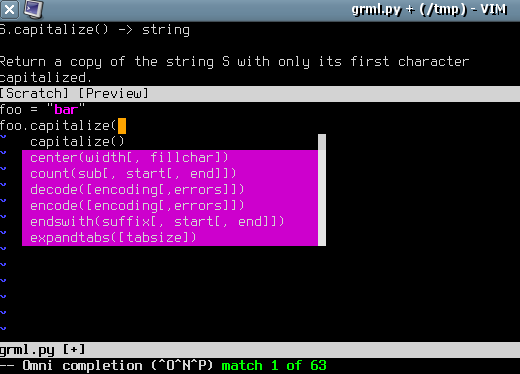
I wrote a small python webpage for the grml-wiki to provide some information regarding Python-development on grml. I just upgraded Vim on my main system to version 7.1 and omnicompletion with vim-python became better once more. So time for a short demo of ctrl-x-o: Python coding in Vim 7.1 - Screenshot I also very much like ‘%ed’ within ipython using the following snippet in my ~/.ipython/ipythonrc:
editor 1
editor /usr/bin/vim.python
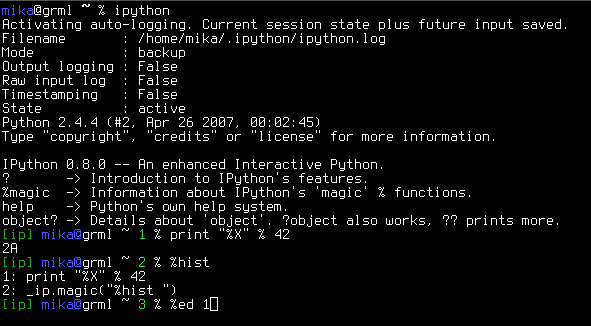
Notice: Don’t wonder about the prompt style of the following ipython-screenshot, I customized it a little bit (see python-webpage in the grml-wiki again to get an idea). ipython demo - Screenshot So running the last line containing ‘%ed 1′ will execute /usr/bin/vim.python providing the code from the first command line of ipython and I can use all the magic of Vim for editing the code. When exiting the editor I have the code within ipython. Rocking. :) Oh, don’t forget to check out the Quick tips of ipython when exploring it. Now what’s missing in ipython is the edit-command-line feature of Zsh. That would allow me to edit already typed (but not yet executed) code with an external editor. Anyone out there with an according tip? ;-)

5 June 2007

Martin-&#201;ric Racine: Good news for those who care about Debian

Via Hector:
Debian, Ubuntu and DCCA joint efforts for improving laptop support and for Linux kernel and X11 packaging on Debian -derivative software distributions.
This kind of group effort is precisely what makes the Free Software development model so great and, as this story demonstrates eloquently, it applies remarkably well to corporate software development, even among vendors that are competing for the same market segment. Awesome, isn't it?

Martin-&#201;ric Racine: Eesti keele spelleri arendus

As I mentioned in a previous post, I maintain the Debian and Ubuntu package of ispell-et (Estonian dictionaries for the Aspell, Ispell and MySpell spell checkers - plus an hyphenation pattern for OpenOffice). Packaging this software was a natural choice for someone like me who is learning the language and who needs something to highlight obvious mistakes. This being said, the Estonian wordlists that serve as raw material to generate those dictionaries are in desperate need of Language Love; the vocabulary appears frozen in Soviet time and rather incomplete to begin with: obsolete words nobody can even remember (probably of importance only to linguists or philologists), omission of even the most basic colloquial slangs, complete absence of contemporary technical vocabulary, etc. Therefore, I am hereby inviting all Estonians to contribute to the development of the wordlist. The procedure is fairly simple: install the Estonian dictionary package for your favorite text editor or word processor (on Ubuntu 6.04, simply install language-support-et), load a few documents and report all words that were mistakenly marked as misspelled to Jaak Pruulmann. As an incentive, please note that all improvements will go into the Estonian version of Edubuntu, providing free language learning tools to Estonian children and thus benefiting the entire Estonian community. Tore homma, eks ole? :-)

Martin-&#201;ric Racine: Award to the Debian community of Finland

Open Source 2006 is a one-day seminar that provides Free Software actors of Finland with a forum to present their work and the current trends in Free Software development to a greater audience comprised mainly of decision-makers from the business and governmental sectors. Finnish Open Office localization team This year, a noticeable trend were governmental cases of transition to Open Office and other Free Software solutions on the municipal desktop. Thus, it was only fitting that Finnish localization took greater importance than before and, in concordance, that this year's Linux-tekij award went to the Finnish Open Office localization team. The jury invited 3 people from the localization team to receive the award on their team's behalf: Pastor Koskinen also gave a very stimulating lecture on the collaborative effort behind the localization, mentioning in passing that Czech Pavel Jani k also plays an important role in building the Open Office binaries for a number of Baltic and Scandinavian languages. Debian community of Finland The jury also granted an honorary mention to the Debian community of Finland to acknowledge years of achievements, reaching an important milestone in 2005 when Finland hosted the yearly Debian Conference. Another motivation was a number of nominations for Ubuntu, both as a distribution and for its extremely active local user community. Given how a majority of Ubuntu developers actually are Debian Developers, the jury unanimously decided to honor them collectively from the perspective of Debian and its derivatives. The jury invited 3 people to receive the honorary mention on the community's behalf: Lars gave the audience a very interesting perspective of his long involvement with Debian, while Tapio emphasized particular pride in seeing non-programmers that maintain documentation or localize software be acknowledged. Fabian gave a very emotional speech in which he praised the commendable efforts of dozens of volunteer DebConf5 organizers that discretely handled unpleasant tasks that were nonetheless essential to the success of the event. The Jury Yours truly was invited to join the jury on behalf of Linux Aktivaattori, alongside representatives from the academic, business and Free Software communities. During the prize ceremony, FLUG chairman Arto Ter s and myself took turns at describing the award's selection process and at introducing the winners.

Matt Brubeck: 5 Jun 2007

My toy is cheaper than yours. My recent purchases:

Eddy Petri&#537;or: Customizing D-I

An interesting opportunity appeared at work. I am going to make a custom D-I image.
It will involve:
This way I will probably get back in touch with D-I development ;-) .
Fun, fun fun. Doing Debian stuff at work, payed by my employer!

Martin-&#201;ric Racine: Alpha debian-installer bounty

From my good friend Eki:
I'd appreciate you informing people that I'm commiting a 100 euro bounty towards upgrading debian-installer images with MILO support for the Debian Etch release. I can personally help with development by testing the upgraded installer images on any of my 11 Alpha machines.
If you have MILO knowledge and are willing to produce updated debian-installer images for Etch and to submit your work to the debian-boot team, contact eki at his regular sci.fi account. Kiitos!

Martin-&#201;ric Racine: Planner 0.14 released

I had the pleasant surprise to notice that Planner 0.14 was finally released last night, more than a year after development had stopped, this time under the direction of Kurt Maute. I packaged it this morning and uploaded it to Debian's repository. There's still 9 bugs remaining and help is welcome towards clarifying whether they still apply to this new release. Enjoy!

Martin-&#201;ric Racine: Life after Etch

This week, following the announce of the freeze, I upgraded most of my home cluster to Etch. The upgrade went surprisingly smoothly, although I had a bit of a scare when the kernel upgrade pulled in a bunch of dependencies that resulted in the forced removal of all previous kernels. This minor scare asides, kudos to everyone who made this new Debian release possible! My only disappointment about Etch is that we're stuck with Firefox 1.5.0.7 instead of 2.0.1 or Iceweasel. Then again, speaking of Iceweasel: Forget it! Breakages it introduces have been marked as pending or patched for a number of weeks and yet there's still no updated package. At this rate, better wait until Etch r1 or Lenny to introduce it, rather than release Etch with a browser fork that has not undergone several months of thorough testing! This got me thinking about life after Etch, or more specifically, about what I'm gonna do with the packages I maintain. The Dunc Tank debacle and similar other unfortunate events that overtook Debian this year have prompted me to reevaluate my motivation. Another unrelated issue is, I've been working in software development for more than 10 years and my guts are telling me that it's time to move on so, while my computers will still run on Debian or Ubuntu, I don't intend on doing any more development per-se. Thus, I have already taken the initiative of soliciting co-maintainers for most of my packages. The Debian GNOME team agreed to be added for Planner, which is nice given the sheer number of bugs that are regularly found against this package. CUPS-PDF, Gaim-IRChelper and NumlockX haven't seen a meaningful bug in ages and can be rebuilt using bin-NMU magic, so they're pretty much taken care of. This leaves the issue of the Estonian and Russian dictionaries (plus a large patch in my personal repository that would upgrade Aigars' Latvian dictionary to generate the Aspell wordlist from his MySpell wordlist) open. For these, native speakers that develop for Debian or Ubuntu would be welcome to join me. What next? I have a couple of interesting offers, one on the Business side of computer hardware manufacturing in Estonia and another one as the manager of a western company's Latvian office. The tricky part in either case would be the immigration process: despite close to 9 years of living right here in Europe, I am still perceived as foreign labor whose hiring must be thoroughly justified (in the case of Estonia, I even need to request an explicit exemption to the immigration quotas), whereas if I had been granted EC Long-Term Resident status or Finnish citizenship, I could just sign the contract and notify the local authorities of my change of address. Instead, 9 years later, I'm stuck at the passport control queues for non-EU citizens with its disgustingly suspicious border guards. Sigh! Thus, while I indeed have shares in Linutop (yes, we are finally shipping - stay tuned for details) that might eventually turn into gold, I also have close to zero motivation left in my personal life, because lingering European bureaucrazy prevents my talent from reaching its customers - turning all my attempts at having a career into a neverending series of bitter disappointments. Is it any wonder that I'm so adamant about getting out of the Rat Race to return to more gratifying creative activities like composing and photography, then? Post Scriptum Actually, there is a second disappointment about Etch: we are stuck with Evince 0.4.0, at a time where upstream just released 0.7.0 with strong recommendations that everyone upgrade to that. Heck, even Ubuntu has 0.6.0 already. I find the Evince situation way more annoying than the Firefox one, because, from a user's perspective, Evince 0.4.0 fails to display several PDF documents that more recent releases handle just fine.

Martin-&#201;ric Racine: Linutop Solutions Linux, Paris, La D fense, 30 janvier au 1er f vrier 2007

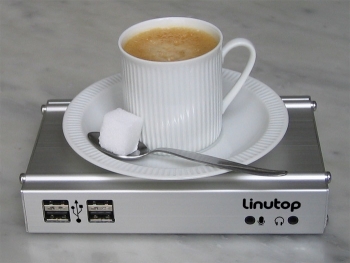
Linutop will makes its first public appearance tomorrow at Solutions Linux in Paris. French developers who are interested in getting their hands on one of our 50 development units should call up Fred at 0685868576 and schedule an appointment. Others who just wanna see the Linutop in action are welcome to drop by booth D 16 during the exhibition. Meanwhile, rumor has it that someone else might be dropping by Montr al for the February meeting of FACIL with a mysterious Free Software -powered aluminum box...

Martin-&#201;ric Racine: Tip of the day: fetching all Debian source packages

A few weeks ago, the Linutop team received a request for its source code. We had already anticipated the GPL source offer clause in our development plan, so it was just a matter of myself getting around producing a source code ISO image. Piece of cake, right? Almost. You see, Linutop includes a custom kernel package and several separate wireless module packages, so the the following command would not work as expected:
apt-get --download-only --ignore-missing source $(dpkg --get-selections   cut -f 1)
Why is that? Because APT ignores the --ignore-missing option whenever executing the source command. Instead, Roland Mas suggested that I used this simple Bourne loop:
for p in $(dpkg --get-selections   cut -f 1) ; do apt-get --download-only source $p ; done
Done this way, the source code of each package is fetched individually and, if any package's source is not available, APT exits but the Bourne loop moves on to the next package in the list. Nifty, isn't it?

Next.

Previous.