Search Results: "don"

18 September 2014

Jaldhar Vyas: Scotland: Vote NO

        _  __<;
      </_/ _/__   
     /> >  7   )  
     ~;</7    /   
     /> /   _*<---- Perth    
     ~ </7  7~\_  
        </7     \ 
         /_ _ _   
If you don't, the UK will have to rename itself the K. And that's just silly. Also vote yes on whether Alex Trebek should keep his mustache.

17 September 2014

NOKUBI Takatsugu: Met with a debian developer from Germany

Last weekend, I (knok), Hideki (henrich) and Yutaka (gniibe) met with John Paul Adrian Glaubitz (glaubitz). In the past, I had met with another Germany developer Jens Schmalzing (jensen) in Japan. He was a good guy, but unfortunately he gone in 2005. I had an old OpenPGP key with his sign. It is a record of his activity, but the key is weak nowaday (1024D), so I stop to use the key but don t issue revoke. Anyway glaubitz is also a good guy, and he loves old videogame console. gniibe gave him five DreamCast consoles. I bring him to SUPER POTATO, a old videogame shop. He bought some software for Virtual Boy. DebConf 2015 will hold in Germany, I want to go for it if I can.

16 September 2014

Matthew Garrett: ACPI, kernels and contracts with firmware

ACPI is a complicated specification - the latest version is 980 pages long. But that's because it's trying to define something complicated: an entire interface for abstracting away hardware details and making it easier for an unmodified OS to boot diverse platforms.

Inevitably, though, it can't define the full behaviour of an ACPI system. It doesn't explicitly state what should happen if you violate the spec, for instance. Obviously, in a just and fair world, no systems would violate the spec. But in the grim meathook future that we actually inhabit, systems do. We lack the technology to go back in time and retroactively prevent this, and so we're forced to deal with making these systems work.

This ends up being a pain in the neck in the x86 world, but it could be much worse. Way back in 2008 I wrote something about why the Linux kernel reports itself to firmware as "Windows" but refuses to identify itself as Linux. The short version is that "Linux" doesn't actually identify the behaviour of the kernel in a meaningful way. "Linux" doesn't tell you whether the kernel can deal with buffers being passed when the spec says it should be a package. "Linux" doesn't tell you whether the OS knows how to deal with an HPET. "Linux" doesn't tell you whether the OS can reinitialise graphics hardware.

Back then I was writing from the perspective of the firmware changing its behaviour in response to the OS, but it turns out that it's also relevant from the perspective of the OS changing its behaviour in response to the firmware. Windows 8 handles backlights differently to older versions. Firmware that's intended to support Windows 8 may expect this behaviour. If the OS tells the firmware that it's compatible with Windows 8, the OS has to behave compatibly with Windows 8.

In essence, if the firmware asks for Windows 8 support and the OS says yes, the OS is forming a contract with the firmware that it will behave in a specific way. If Windows 8 allows certain spec violations, the OS must permit those violations. If Windows 8 makes certain ACPI calls in a certain order, the OS must make those calls in the same order. Any firmware bug that is triggered by the OS not behaving identically to Windows 8 must be dealt with by modifying the OS to behave like Windows 8.

This sounds horrifying, but it's actually important. The existence of well-defined[1] OS behaviours means that the industry has something to target. Vendors test their hardware against Windows, and because Windows has consistent behaviour within a version[2] the vendors know that their machines won't suddenly stop working after an update. Linux benefits from this because we know that we can make hardware work as long as we're compatible with the Windows behaviour.

That's fine for x86. But remember when I said it could be worse? What if there were a platform that Microsoft weren't targeting? A platform where Linux was the dominant OS? A platform where vendors all test their hardware against Linux and expect it to have a consistent ACPI implementation?

Our even grimmer meathook future welcomes ARM to the ACPI world.

Software development is hard, and firmware development is software development with worse compilers. Firmware is inevitably going to rely on undefined behaviour. It's going to make assumptions about ordering. It's going to mishandle some cases. And it's the operating system's job to handle that. On x86 we know that systems are tested against Windows, and so we simply implement that behaviour. On ARM, we don't have that convenient reference. We are the reference. And that means that systems will end up accidentally depending on Linux-specific behaviour. Which means that if we ever change that behaviour, those systems will break.

So far we've resisted calls for Linux to provide a contract to the firmware in the way that Windows does, simply because there's been no need to - we can just implement the same contract as Windows. How are we going to manage this on ARM? The worst case scenario is that a system is tested against, say, Linux 3.19 and works fine. We make a change in 3.21 that breaks this system, but nobody notices at the time. Another system is tested against 3.21 and works fine. A few months later somebody finally notices that 3.21 broke their system and the change gets reverted, but oh no! Reverting it breaks the other system. What do we do now? The systems aren't telling us which behaviour they expect, so we're left with the prospect of adding machine-specific quirks. This isn't scalable.

Supporting ACPI on ARM means developing a sense of discipline around ACPI development that we simply haven't had so far. If we want to avoid breaking systems we have two options:

1) Commit to never modifying the ACPI behaviour of Linux.
2) Exposing an interface that indicates which well-defined ACPI behaviour a specific kernel implements, and bumping that whenever an incompatible change is made. Backward compatibility paths will be required if firmware only supports an older interface.

(1) is unlikely to be practical, but (2) isn't a great deal easier. Somebody is going to need to take responsibility for tracking ACPI behaviour and incrementing the exported interface whenever it changes, and we need to know who that's going to be before any of these systems start shipping. The alternative is a sea of ARM devices that only run specific kernel versions, which is exactly the scenario that ACPI was supposed to be fixing.

[1] Defined by implementation, not defined by specification
[2] Windows may change behaviour between versions, but always adds a new _OSI string when it does so. It can then modify its behaviour depending on whether the firmware knows about later versions of Windows.

comment count unavailable comments

Petter Reinholdtsen: Speeding up the Debian installer using eatmydata and dpkg-divert

The Debian installer could be a lot quicker. When we install more than 2000 packages in Skolelinux / Debian Edu using tasksel in the installer, unpacking the binary packages take forever. A part of the slow I/O issue was discussed in bug #613428 about too much file system sync-ing done by dpkg, which is the package responsible for unpacking the binary packages. Other parts (like code executed by postinst scripts) might also sync to disk during installation. All this sync-ing to disk do not really make sense to me. If the machine crash half-way through, I start over, I do not try to salvage the half installed system. So the failure sync-ing is supposed to protect against, hardware or system crash, is not really relevant while the installer is running. A few days ago, I thought of a way to get rid of all the file system sync()-ing in a fairly non-intrusive way, without the need to change the code in several packages. The idea is not new, but I have not heard anyone propose the approach using dpkg-divert before. It depend on the small and clever package eatmydata, which uses LD_PRELOAD to replace the system functions for syncing data to disk with functions doing nothing, thus allowing programs to live dangerous while speeding up disk I/O significantly. Instead of modifying the implementation of dpkg, apt and tasksel (which are the packages responsible for selecting, fetching and installing packages), it occurred to me that we could just divert the programs away, replace them with a simple shell wrapper calling "eatmydata $program $@", to get the same effect. Two days ago I decided to test the idea, and wrapped up a simple implementation for the Debian Edu udeb. The effect was stunning. In my first test it reduced the running time of the pkgsel step (installing tasks) from 64 to less than 44 minutes (20 minutes shaved off the installation) on an old Dell Latitude D505 machine. I am not quite sure what the optimised time would have been, as I messed up the testing a bit, causing the debconf priority to get low enough for two questions to pop up during installation. As soon as I saw the questions I moved the installation along, but do not know how long the question were holding up the installation. I did some more measurements using Debian Edu Jessie, and got these results. The time measured is the time stamp in /var/log/syslog between the "pkgsel: starting tasksel" and the "pkgsel: finishing up" lines, if you want to do the same measurement yourself. In Debian Edu, the tasksel dialog do not show up, and the timing thus do not depend on how quickly the user handle the tasksel dialog.
Machine/setup Original tasksel Optimised tasksel Reduction
Latitude D505 Main+LTSP LXDE 64 min (07:46-08:50) <44 min (11:27-12:11) >20 min 18%
Latitude D505 Roaming LXDE 57 min (08:48-09:45) 34 min (07:43-08:17) 23 min 40%
Latitude D505 Minimal 22 min (10:37-10:59) 11 min (11:16-11:27) 11 min 50%
Thinkpad X200 Minimal 6 min (08:19-08:25) 4 min (08:04-08:08) 2 min 33%
Thinkpad X200 Roaming KDE 19 min (09:21-09:40) 15 min (10:25-10:40) 4 min 21%
The test is done using a netinst ISO on a USB stick, so some of the time is spent downloading packages. The connection to the Internet was 100Mbit/s during testing, so downloading should not be a significant factor in the measurement. Download typically took a few seconds to a few minutes, depending on the amount of packages being installed. The speedup is implemented by using two hooks in Debian Installer, the pre-pkgsel.d hook to set up the diverts, and the finish-install.d hook to remove the divert at the end of the installation. I picked the pre-pkgsel.d hook instead of the post-base-installer.d hook because I test using an ISO without the eatmydata package included, and the post-base-installer.d hook in Debian Edu can only operate on packages included in the ISO. The negative effect of this is that I am unable to activate this optimization for the kernel installation step in d-i. If the code is moved to the post-base-installer.d hook, the speedup would be larger for the entire installation. I've implemented this in the debian-edu-install git repository, and plan to provide the optimization as part of the Debian Edu installation. If you want to test this yourself, you can create two files in the installer (or in an udeb). One shell script need do go into /usr/lib/pre-pkgsel.d/, with content like this:
#!/bin/sh
set -e
. /usr/share/debconf/confmodule
info()  
    logger -t my-pkgsel "info: $*"
 
error()  
    logger -t my-pkgsel "error: $*"
 
override_install()  
    apt-install eatmydata   true
    if [ -x /target/usr/bin/eatmydata ] ; then
        for bin in dpkg apt-get aptitude tasksel ; do
            file=/usr/bin/$bin
            # Test that the file exist and have not been diverted already.
            if [ -f /target$file ] ; then
                info "diverting $file using eatmydata"
                printf "#!/bin/sh\neatmydata $bin.distrib \"\$@\"\n" \
                    > /target$file.edu
                chmod 755 /target$file.edu
                in-target dpkg-divert --package debian-edu-config \
                    --rename --quiet --add $file
                ln -sf ./$bin.edu /target$file
            else
                error "unable to divert $file, as it is missing."
            fi
        done
    else
        error "unable to find /usr/bin/eatmydata after installing the eatmydata pacage"
    fi
 
override_install
To clean up, another shell script should go into /usr/lib/finish-install.d/ with code like this:
#! /bin/sh -e
. /usr/share/debconf/confmodule
error()  
    logger -t my-finish-install "error: $@"
 
remove_install_override()  
    for bin in dpkg apt-get aptitude tasksel ; do
        file=/usr/bin/$bin
        if [ -x /target$file.edu ] ; then
            rm /target$file
            in-target dpkg-divert --package debian-edu-config \
                --rename --quiet --remove $file
            rm /target$file.edu
        else
            error "Missing divert for $file."
        fi
    done
    sync # Flush file buffers before continuing
 
remove_install_override
In Debian Edu, I placed both code fragments in a separate script edu-eatmydata-install and call it from the pre-pkgsel.d and finish-install.d scripts. By now you might ask if this change should get into the normal Debian installer too? I suspect it should, but am not sure the current debian-installer coordinators find it useful enough. It also depend on the side effects of the change. I'm not aware of any, but I guess we will see if the change is safe after some more testing. Perhaps there is some package in Debian depending on sync() and fsync() having effect? Perhaps it should go into its own udeb, to allow those of us wanting to enable it to do so without affecting everyone. Update 2014-09-24: Since a few days ago, enabling this optimization will break installation of all programs using gnutls because of bug #702711. An updated eatmydata package in Debian will solve it.

15 September 2014

Keith Packard: xserver-pending-fixes

A Forest of X Server Changes We've got about another month left in the X server merge window for 1.17 and I've written a small set of fixes which haven't been reviewed yet for merging. I thought I'd advertise them a bit and see if I couldn't encourage a few of you to take a look and see if they're useful, correct and complete. All of these are in my personal X server repository:
git://people.freedesktop.org/~keithp/xserver.git
Cleaning up the X Registry Branch: registry-fixes I'll bet most of you don't even know about this code. It serves as a database mapping various X enumerations to strings to aid in diagnostics. For the security extensions, SECURITY and XSELinux, it holds names for all of the request, event and errors in the core protocol and all registered extensions. For X-Resource, it has the names of the registered resource types. The X registry gets the request, event and error data from a file, "protocol.txt", which is installed in /usr/lib/xorg/protocol.txt on my machine. It gets the resource names as a part of resource type allocation. So, what's wrong with this? Three basic things:
  1. A simple bug -- protocol.txt is left open while the server runs. This consumes a file descriptor for no good reason.
  2. protocol.txt is read and parsed even if the security extensions aren't available. This wastes time and memory.
  3. The resource names are kept even if X-Resource isn't in use.
The fixes remove the configure options for including the registry code; these functions are only used by the above extensions, so we can tell whether to include the code based solely on whether the extensions are being built. Getting rid of the TCP listener by default Branch: listen-fixes We've had the '-nolisten' option for a while now to disable inbound TCP connections. It's useful for security reasons, but we've never enabled this by default. This patch sequence provides configure options for each of the listen sockets (tcp, unix and local), leaves unix and local enabled by default and disables tcp by default. A new option, '-listen', is added which allows the user to override the -nolisten defaults in case they actually want to use TCP connections to X. Glamor bug fixes branch: glamor-fixes This branch fixes two bugs:
  1. Scale a large pixmap down to a small pixmap. This happens when you display enormous images in a web page. Iceweasel sends the whole huge image to X and uses Render to scale it to the screen. If the image is larger than a single texture, the X server splits it up into tiles, but the code which tries to perform the merged scale is just broken. Five patches fix this.
  2. Shader-based trapezoids. This code uses area coverage to compute trapezoids. That violates the Render spec, which requires point sampling. Further, the performance of these trapezoids is lower than software (by a lot). This one patch removes the code.
Present bug fixes branch: present-fixes A selection of small bug fixes:
  1. Clear pending flips at CloseScreen. This removes a reference to any pending flip pixmap, allowing it to be freed. Otherwise, we'll leak memory across server reset.
  2. Add support for PresentOptionCopy. This has been in the protocol spec for a while, and was completely trivial to implement. However, it never got done. One tiny little patch.
  3. Expose the Present API to drivers via sdksyms.sh. Until now, the present extension APIs have only been available inside the X server. This exposes them to drivers. This took a few cleanup patches first.
Use Present for Glamor XV branch: glamor-present-xv Painting XV to the screen should be done at vblank time to avoid tearing. Present offers vblank synchronized operations. Hooking those two together required a few new present APIs to expose the vblank functionality outside of the present code, then a bit of glamor code to hook up that new API to the XV bits. Switching Glamor to a GL core profile context branch: glamor-core-profile This patch set is still in progress, but demonstrates how close we are. We'll be requiring OpenGL 3.3 for this so that we get texture swizzling, which is required for our single channel objects. The changes present on the branch are:
  1. Switch single channel surfaces from GL_ALPHA to GL_RED.
  2. Use vertex array objects.
  3. Switch ephyr over to using a core 3.3 profile.
Still left to do is
  1. Switch Render code to VBOs
The core code uses VBOs everywhere, but the Render code doesn't. This means that all Render drawing fails, which makes the resulting server not very useful. My main objective for getting this done is to reduce memory usage by about 16MB, which is the space allocated for software rendering in Mesa in case someone does something which the hardware doesn't handle, and that can only with some legacy OpenGL APIs. Please help out! All of these friendly little patches are looking for a bit of review so that they can get merged before the 1.17 window closes.

Vincent Sanders: NetSurf 3.2

We recently released a new version of NetSurf this was largely to address numerous small bugs but did also include the persistent caching implementation I have written about previously. A release used to require the release manager (usually me) to perform a lot of manual processes and while we had a checklist it was far too easy to miss things.

The Continuous Integration (CI) system combined with signed release tags in git has resulted in a greatly simplified process indeed it has become almost completely automated. The majority of the manual work is now confined to doing the tasks that require actual decision making and checking we are releasing what was intended.

By having the CI system build release binaries the project now has a much clearer and importantly traceable process, I can recommend such a system to any project that produces releases especially if they release binaries for any of their targets.

I have also managed to package and upload this version of NetSurf ready for the Debian Jessie release. I would like to thank Jonathan Wiltshire for his assistance in ensuring this was a good quality package.

The release incorporates the successfully merged work of Rupinder Singh who was our our GSoc 2014 student. Rupinder mainly made improvements to our core DOM implementation and was very responsive and enthusiastic throughout his time despite the mentor team sometimes not being available.

This work goes towards improving NetSurf in the future by ensuring the underlying features are present in our core libraries. The GSoc mentors and all project developers are all pleased with the results of this years GSoc participation and would like to thank everyone involved in making our participation possible.

Along with the good news comes a little bad:
PowerPC Mac OS X
Despite repeated calls for assistance with new hardware and Java builds none has been forthcoming meaning that from this release we ware no longer able to ship PowerPC builds for MAC OS X.

The main issue is the last version of MAC OS X that runs on PPC is Leopard and there is no viable Java 1.6 port necessary for our CI system to run. Additionally the fully loaded PPC Mac mini (kindly donated to us by Mythic Beasts) had become far too slow to keep up with our builds and was causing long delays.
Bugs
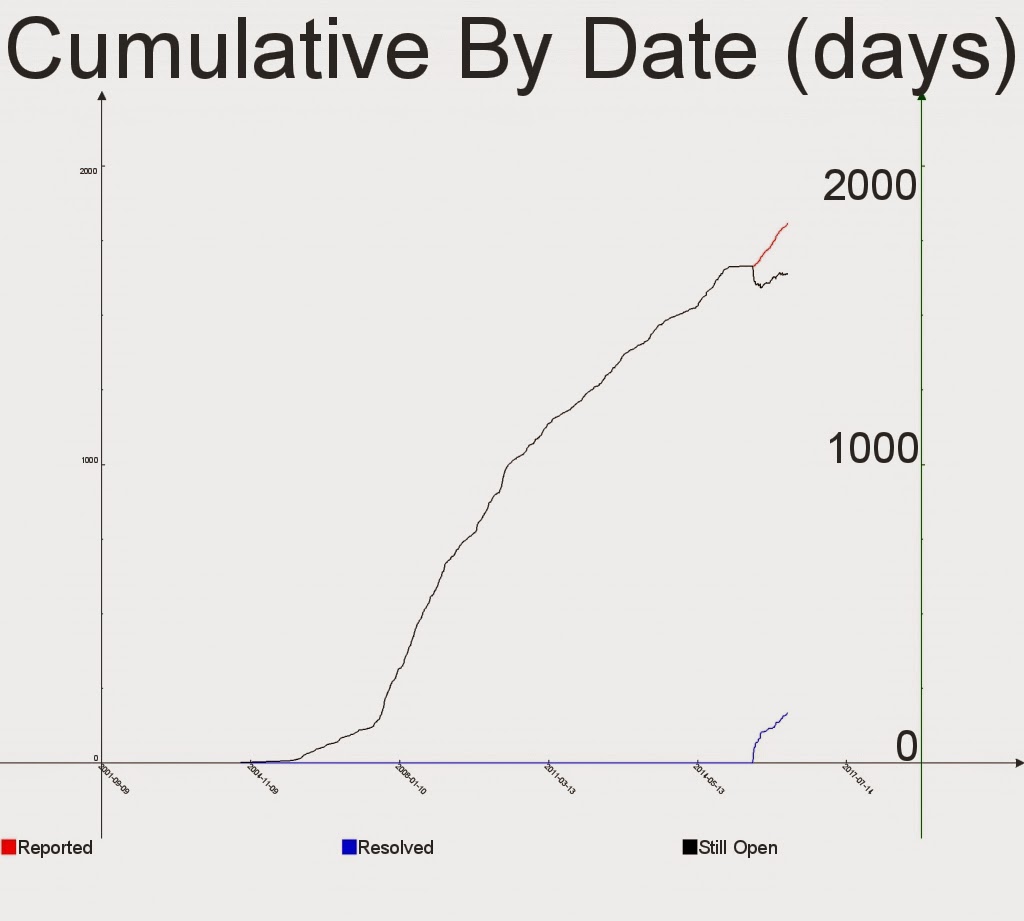
NetSurf 3.2 Bug graph
We have a lot of bugs, in fact just during this release cycle we have 30 more bugs reported than we closed.So while the new bug reporting system has been a success and our users are reporting issues when they find them the development team is not keeping up..

The failure to keep up stems from the underlying issue of lack of manpower. We have relatively few active developers which is especially problematic when there are many users for a platform, such as RISCOS, but the maintainer is unable to commit enough time to fixing issues.

If you would like to help making NetSurf a better browser we are always happy to work with new contributors.

Junichi Uekawa: ARM assembly.

ARM assembly. I was reading up some docs on Unified Assembly Language (UAL). and confusions. I don't seem to be able to find a comprehensive doc about what works and what doesn't. Heh.

Julien Danjou: Python bad practice, a concrete case

A lot of people read up on good Python practice, and there's plenty of information about that on the Internet. Many tips are included in the book I wrote this year, The Hacker's Guide to Python. Today I'd like to show a concrete case of code that I don't consider being the state of the art. In my last article where I talked about my new project Gnocchi, I wrote about how I tested, hacked and then ditched whisper out. Here I'm going to explain part of my thought process and a few things that raised my eyebrows when hacking this code. Before I start, please don't get the spirit of this article wrong. It's in no way a personal attack to the authors and contributors (who I don't know). Furthermore, whisper is a piece of code that is in production in thousands of installation, storing metrics for years. While I can argue that I consider the code not to be following best practice, it definitely works well enough and is worthy to a lot of people. Tests The first thing that I noticed when trying to hack on whisper, is the lack of test. There's only one file containing tests, named test_whisper.py, and the coverage it provides is pretty low. One can check that using the coverage tool.
$ coverage run test_whisper.py
...........
----------------------------------------------------------------------
Ran 11 tests in 0.014s

OK
$ coverage report
Name Stmts Miss Cover
----------------------------------
test_whisper 134 4 97%
whisper 584 227 61%
----------------------------------
TOTAL 718 231 67%

While one would think that 61% is "not so bad", taking a quick peak at the actual test code shows that the tests are incomplete. Why I mean by incomplete is that they for example use the library to store values into a database, but they never check if the results can be fetched and if the fetched results are accurate. Here's a good reason one should never blindly trust the test cover percentage as a quality metric. When I tried to modify whisper, as the tests do not check the entire cycle of the values fed into the database, I ended up doing wrong changes but had the tests still pass. No PEP 8, no Python 3 The code doesn't respect PEP 8 . A run of flake8 + hacking shows 732 errors While it does not impact the code itself, it's more painful to hack on it than it is on most Python projects. The hacking tool also shows that the code is not Python 3 ready as there is usage of Python 2 only syntax. A good way to fix that would be to set up tox and adds a few targets for PEP 8 checks and Python 3 tests. Even if the test suite is not complete, starting by having flake8 run without errors and the few unit tests working with Python 3 should put the project in a better light. Not using idiomatic Python A lot of the code could be simplified by using idiomatic Python. Let's take a simple example:
def fetch(path,fromTime,untilTime=None,now=None):
fh = None
try:
fh = open(path,'rb')
return file_fetch(fh, fromTime, untilTime, now)
finally:
if fh:
fh.close()

That piece of code could be easily rewritten as:
def fetch(path,fromTime,untilTime=None,now=None):
with open(path, 'rb') as fh:
return file_fetch(fh, fromTime, untilTime, now)

This way, the function looks actually so simple that one can even wonder why it should exists but why not. Usage of loops could also be made more Pythonic:
for i,archive in enumerate(archiveList):
if i == len(archiveList) - 1:
break

could be actually:
for i, archive in itertools.islice(archiveList, len(archiveList) - 1):

That reduce the code size and makes it easier to read through the code. Wrong abstraction level Also, one thing that I noticed in whisper, is that it abstracts its features at the wrong level. Take the create() function, it's pretty obvious:
def create(path,archiveList,xFilesFactor=None,aggregationMethod=None,sparse=False,useFallocate=False):
# Set default params
if xFilesFactor is None:
xFilesFactor = 0.5
if aggregationMethod is None:
aggregationMethod = 'average'

#Validate archive configurations...
validateArchiveList(archiveList)

#Looks good, now we create the file and write the header
if os.path.exists(path):
raise InvalidConfiguration("File %s already exists!" % path)
fh = None
try:
fh = open(path,'wb')
if LOCK:
fcntl.flock( fh.fileno(), fcntl.LOCK_EX )

aggregationType = struct.pack( longFormat, aggregationMethodToType.get(aggregationMethod, 1) )
oldest = max([secondsPerPoint * points for secondsPerPoint,points in archiveList])
maxRetention = struct.pack( longFormat, oldest )
xFilesFactor = struct.pack( floatFormat, float(xFilesFactor) )
archiveCount = struct.pack(longFormat, len(archiveList))
packedMetadata = aggregationType + maxRetention + xFilesFactor + archiveCount
fh.write(packedMetadata)
headerSize = metadataSize + (archiveInfoSize * len(archiveList))
archiveOffsetPointer = headerSize

for secondsPerPoint,points in archiveList:
archiveInfo = struct.pack(archiveInfoFormat, archiveOffsetPointer, secondsPerPoint, points)
fh.write(archiveInfo)
archiveOffsetPointer += (points * pointSize)

#If configured to use fallocate and capable of fallocate use that, else
#attempt sparse if configure or zero pre-allocate if sparse isn't configured.
if CAN_FALLOCATE and useFallocate:
remaining = archiveOffsetPointer - headerSize
fallocate(fh, headerSize, remaining)
elif sparse:
fh.seek(archiveOffsetPointer - 1)
fh.write('\x00')
else:
remaining = archiveOffsetPointer - headerSize
chunksize = 16384
zeroes = '\x00' * chunksize
while remaining > chunksize:
fh.write(zeroes)
remaining -= chunksize
fh.write(zeroes[:remaining])

if AUTOFLUSH:
fh.flush()
os.fsync(fh.fileno())
finally:
if fh:
fh.close()

The function is doing everything: checking if the file doesn't exist already, opening it, building the structured data, writing this, building more structure, then writing that, etc. That means that the caller has to give a file path, even if it just wants a whipser data structure to store itself elsewhere. StringIO() could be used to fake a file handler, but it will fail if the call to fcntl.flock() is not disabled and it is inefficient anyway. There's a lot of other functions in the code, such as for example setAggregationMethod(), that mixes the handling of the files even doing things like os.fsync() while manipulating structured data. This is definitely not a good design, especially for a library, as it turns out reusing the function in different context is near impossible. Race conditions There are race conditions, for example in create() (see added comment):
if os.path.exists(path):
raise InvalidConfiguration("File %s already exists!" % path)
fh = None
try:
# TOO LATE I ALREADY CREATED THE FILE IN ANOTHER PROCESS YOU ARE GOING TO
# FAIL WITHOUT GIVING ANY USEFUL INFORMATION TO THE CALLER :-(
fh = open(path,'wb')

That code should be:
try:
fh = os.fdopen(os.open(path, os.O_WRONLY os.O_CREAT os.O_EXCL), 'wb')
except OSError as e:
if e.errno = errno.EEXIST:
raise InvalidConfiguration("File %s already exists!" % path)

to avoid any race condition. Unwanted optimization We saw earlier the fetch() function that is barely useful, so let's take a look at the file_fetch() function that it's calling.
def file_fetch(fh, fromTime, untilTime, now = None):
header = __readHeader(fh)
[...]

The first thing the function does is to read the header from the file handler. Let's take a look at that function:
def __readHeader(fh):
info = __headerCache.get(fh.name)
if info:
return info

originalOffset = fh.tell()
fh.seek(0)
packedMetadata = fh.read(metadataSize)

try:
(aggregationType,maxRetention,xff,archiveCount) = struct.unpack(metadataFormat,packedMetadata)
except:
raise CorruptWhisperFile("Unable to read header", fh.name)
[...]

The first thing the function does is to look into a cache. Why is there a cache? It actually caches the header based with an index based on the file path (fh.name). Except that if one for example decide not to use file and cheat using StringIO, then it does not have any name attribute. So this code path will raise an AttributeError. One has to set a fake name manually on the StringIO instance, and it must be unique so nobody messes with the cache
import StringIO

packedMetadata = <some source>
fh = StringIO.StringIO(packedMetadata)
fh.name = "myfakename"
header = __readHeader(fh)

The cache may actually be useful when accessing files, but it's definitely useless when not using files. But it's not necessarily true that the complexity (even if small) that the cache adds is worth it. I doubt most of whisper based tools are long run processes, so the cache that is really used when accessing the files is the one handled by the operating system kernel, and this one is going to be much more efficient anyway, and shared between processed. There's also no expiry of that cache, which could end up of tons of memory used and wasted. Docstrings None of the docstrings are written in a a parsable syntax like Sphinx. This means you cannot generate any documentation in a nice format that a developer using the library could read easily. The documentation is also not up to date:
def fetch(path,fromTime,untilTime=None,now=None):
"""fetch(path,fromTime,untilTime=None)
[...]
"""

def create(path,archiveList,xFilesFactor=None,aggregationMethod=None,sparse=False,useFallocate=False):
"""create(path,archiveList,xFilesFactor=0.5,aggregationMethod='average')
[...]
"""

This is something that could be avoided if a proper format was picked to write the docstring. A tool cool be used to be noticed when there's a diversion between the actual function signature and the documented one, like missing an argument. Duplicated code Last but not least, there's a lot of code that is duplicated around in the scripts provided by whisper in its bin directory. Theses scripts should be very lightweight and be using the console_scripts facility of setuptools, but they actually contains a lot of (untested) code. Furthermore, some of that code is partially duplicated from the whisper.py library which is against DRY. Conclusion There are a few more things that made me stop considering whisper, but these are part of the whisper features, not necessarily code quality. One can also point out that the code is very condensed and hard to read, and that's a more general problem about how it is organized and abstracted. A lot of these defects are actually points that made me start writing The Hacker's Guide to Python a year ago. Running into this kind of code makes me think it was a really good idea to write a book on advice to write better Python code!
The Hacker's Guide to Python
A book I wrote talking about designing Python applications, state of the art, advice to apply when building your application, various Python tips, etc. Interested? Check it out.

Martin Pitt: autopkgtest 3.5: Reboot support, Perl/Ruby implicit tests

Last week s autopkgtest 3.5 release (in Debian sid and Ubuntu Utopic) brings several new features which I d like to announce. Tests that reboot For testing low-level packages like init or the kernel it is sometimes desirable to reboot the testbed in the middle of a test. For example, I added a new boot_and_services systemd autopkgtest which configures grub to boot with systemd as pid 1, reboots, and then checks that the most important services like lightdm, D-BUS, NetworkManager, and cron come up as expected. (This test will be expanded a lot in the future to cover other areas like the journal, logind, etc.) In a testbed which supports rebooting (currently only QEMU) your test will now find an autopkgtest-reboot command which the test calls with an arbitrary marker string. autopkgtest will then reboot the testbed, save/restore any files it needs to (like the tests file tree or previously created artifacts), and then re-run the test with ADT_REBOOT_MARK=mymarker. The new Reboot during a test section in README.package-tests explains this in detail with an example. Implicit test metadata for similar packages The Debian pkg-perl team recently discussed how to add package tests to the ~ 3.000 Perl packages. For most of these the test metadata looks pretty much the same, so they created a new pkg-perl-autopkgtest package which centralizes the logic. autopkgtest 3.5 now supports an implicit debian/tests/control control file to avoid having to modify several thousand packages with exactly the same file. An initial run already looked quite promising, 65% of the packages pass their tests. There will be a few iterations to identify common failures and fix those in pkg-perl-autopkgtest and autopkgtestitself now. There is still some discussion about how implicit test control files go together with the DEP-8 specification, as other runners like sadt do not support them yet. Most probably we ll declare those packages XS-Testsuite: autopkgtest-pkg-perl instead of the usual autopkgtest. In the same vein, Debian s Ruby maintainer (Antonio Terceiro) added implicit test control support for Ruby packages. We haven t done a mass test run with those yet, but their structure will probably look very similar.

13 September 2014

Keith Packard: Altos1.5

AltOS 1.5 EasyMega support, features and bug fixes Bdale and I are pleased to announce the release of AltOS version 1.5. AltOS is the core of the software for all of the Altus Metrum products. It consists of firmware for our cc1111, STM32L151, LPC11U14 and ATtiny85 based electronics and Java-based ground station software. This is a major release of AltOS, including support for our new EasyMega board and a host of new features and bug fixes AltOS Firmware EasyMega added, new features and fixes Our new flight computer, EasyMega, is a TeleMega without any radios: AltOS Changes We've made a few improvements in the firmware: AltOS Bug Fixes We also fixed a few bugs in the firmware: AltosUI and TeleGPS EasyMega support, OS integration and more The AltosUI and TeleGPS applications have a few changes for this release:

Laura Arjona: Disabling comments in the blog

I m getting more spam than the amount that I can stand in this blog. Comments are moderated, so the public is not suffering that, only me. From time to time I go to my dashboard and clean the spam. I m afraid that I delete some legit comment in these spam-cleaning-fevers, or, more probably, that a legit comment waits in the queue for several days (weeks?), just because I m lazy to deal with spam and let days pass by (until the fever comes). I think I m going to follow the wisdom of Bradley M. Kuhn and link to a pump.io note for comments on my blog posts (disabling them here in WordPress.com). I usually post a notice when I write something in my blog, so the only task is to update the blog post with the pump.io URL of the thread for comments. While WordPress.com allows to write comments quickly, without need of an account (you write just a name and an email, and the comment), in pump you need to have an account and sign in to comment. That looks as a bad thing, a barrier for people to participate. But of course, it stops spam :) After thinking about it a bit, pump.io it s a federated network, you can choose the pump server that they want, you can create a fake account, you don t need to provide personal information and it s another way to promote one of the social networks where I live. Other systems link to facebook, twitter, or other places, and nobody complains! Even when those services don t have any of the advantages of being in a federated free-software powered social network :) If anybody don t want to use pump.io but wants to comment, other ways to reach me or the related blog post are: So now it s decided, and this is the first post of this new experiment. This text is posted in pump.io too, and you can comment there :)
Filed under: My experiences and opinion, Tools Tagged: Blog, English, federation, pump.io, social networks, Wordpress

12 September 2014

Steve Kemp: Storing and distributing secrets.

I run a number of hosts, and they are controlled via a server automation tool I wrote called slaughter [Documentation]. The policies I use to control my hosts are public and I don't want to make them private because they server as good examples. Because the roles are public I don't want to embed passwords in them, which means I need something to hold secrets securely. In my case secrets are things like plaintext-passwords. I want those secrets to be secure and unavailable from untrusted hosts. The simplest solution I could think of was an IP-address based ACL and a simple webserver. A client requests something like: That returns a JSON object, if the requesting host is permitted to read the data. Otherwise it returns a HTTP 403 error. The layout is very simple:
 -- secrets
     -- 206.190.139.148
         -- auth.json
     -- 127.0.0.1
         -- example.json
     -- 80.68.84.109
         -- chat.json
Each piece of data is beneath a directory/symlink which controls the read-only access. If the request comes in from the suitable IP it is granted, if not it is denied. For example a failing case:
skx@desktop ~ $ curl  http://sss.steve.org.uk/chat
missing/permission denied
A working case :
root@chat ~ # curl  http://sss.steve.org.uk/chat
  "steve": "haha", "bot": "notreally"  
(The JSON suffix is added automatically.) It is hardly rocket-science, but I couldn't find anything else packaged neatly for this - only things like auth/secstore and factotum. So I'll share if it is useful. Simple Secret Sharing, or Steve's secret storage.

Richard Hartmann: Release Critical Bug report for Week 37

Remember, remember; the fifth of November. The UDD bugs interface currently knows about the following release critical bugs: Graphical overview of bug stats thanks to azhag:

Elena 'valhalla' Grandi: Sometimes apologies are the worst part

I am sick of hearing apologies directed to me just after a dirty joke.

Usually, I don't mind dirty jokes in themselves: I *do* have a dirty mind and make my share of those, or laugh for the ones my friends with even dirtier minds make.

There are of course times and places where they aren't appropriate, but I'd rather live in a world where they are the exception (although a common one) rather than the norm.

Then there is the kind of dirty jokes strongly based on the assumptions that women are sexual objects, a nuisance that must be tolerated because of sex or both: of course I don't really find them fun, but that's probably because I'm a nuisance and I don't even give them reason to tolerate me. :)

Even worse that those, however, is being singled out as the only women in the group with an empty apology for the joke (often of the latter kind): I know you are not really sorry, you probably only want to show that your parents taught you not to speak that way in front of women, but since I'm intruding in a male-only group I have to accept that you are going to talk as appropriate for it.

P.S. no, the episode that triggered this post didn't happen in a Debian environment, it happened in Italy, in a tech-related environment (and not in a wanking club for penis owners, where they would have every right to consider me an intruder).

11 September 2014

Enrico Zini: suspend-i-really-mean-it

Laptop, I demand that you suspend! Dear Lazyweb, Sometimes some application prevents suspend on my laptop. I want to disable that feature: how? I understand that there may exist some people who like that feature. I, on the other hand, consider a scenario like this inconceivable:
  1. I'm on a plane working with my laptop, the captain announces preparations for landing, so I quickly hit the suspend button (or close the lid) on my laptop and stow it away.
  2. One connecting flight later, I pick up my backpack, I feel it unusually hot and realise that my laptop has been on all along, and is now dead from either running out of battery or thermal protection.
  3. I think things that, if spoken aloud in front of a pentacle, might invoke major lovecraftian horrors.
I do not want this scenario to ever be possible. I want my suspend button to suspend the laptop no matter what. If a process does not agree, I'm fine with suspending it anyway, or killing it. If I want my laptop to suspend, I generally have a good enough real-world reason for it, and I cannot conceive that a software could ever be allowed to override my command. How do I change this? I don't know if I should look into systemd, upowerd, pm-utils, the kernel, the display manager or something else entirely. I worry that I cannot even figure where to start looking for a solution. This happened to me multiple times already, and I consider it ridiculous. I know that it can cause me data loss. I know that it can cause me serious trouble in case I was relying on having some battery or state left at my arrival. I know that depending on what is in my backpack, this could also be physically dangerous. So, what knob do I tweak for this? How do I make suspend reliable? Update Systemd has an inhibitor system, and systemd-inhibit --list only lists 'delay' blocks in my system. It is an interesting feature that seems to be implemented in the right way, and it could mean that I finally can get my screen to be locked before the system is suspended. It is possible to configure the inhibitor system in /etc/systemd/logind.conf, including ways to ignore inhibitors, and a maximum time after which inhibitors are ignored if not yet released. Try as I might to run everything that I was running on the plane that time, I could not manage to see anything take an inhibitor block that could have prevented my suspend. I now suspect that what happened to me was a glitch caused by something else (hardware? kernel? cosmic rays!) during that specific suspend. When I had this issue in the past it looks like the infrastructure at the time was far more primitive that what we have now with systemd, so I guess that when writing my blog post I had simply correlated my old experiences with a one-off suspend glitch. If I want to investigate or tune further, to test the situation with a runaway block, I can use commands like systemd-inhibit --mode=block sleep 3600. I'm quite happy to see that we're moving to a standard and sane system for this. In the meantime, I have learnt that pm-utils has now become superfluous and can be deinstalled, and so can acpi-support and acpi-support-base. Thanks vbernat, mbiebl, and ah, on #debian-devel for all the help.

Sylvestre Ledru: Rebuild of Debian using Clang 3.5.0

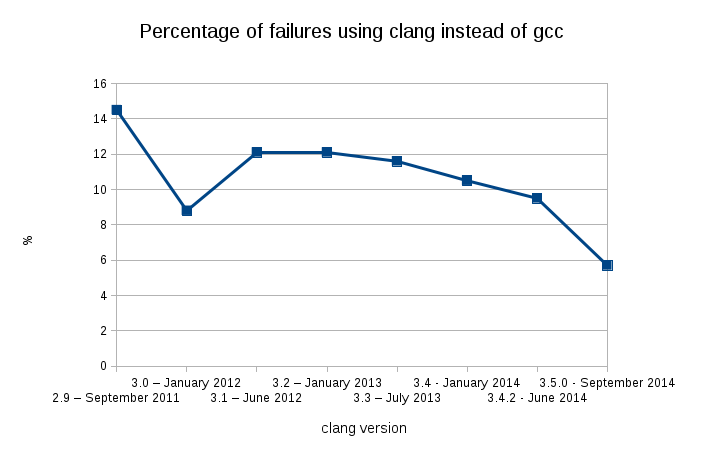
Clang 3.5.0 has just been released. A new rebuild has been done highlight the progress to get Debian built with clang. tl;dr: Great progress. We decreased from 9.5% to 5.7% of failures. Full results are available on http://clang.debian.net At time of the rebuild with 3.4.2, we had 2040 packages failing to build with clang. With 3.5.0, this dropped to 1261 packages. Fixes With Arthur Marble and Alexander Ovchinnikov, both GSoC students, we worked on various ways to decrease the number of errors. Upstream fixes First, the most obvious way, we fixed programming bugs/mistakes in upstream sources. Basically, we took categories of failure and fixed issues one after the other. We started with simple bugs like 'Wrong main declaration', 'non-void function should return a value' or 'Void function should not return a value'.

They are trivial to fix. We continued with harder fixes like ' Undefined reference' or 'Variable length array for a non POD (plain old data) element'.

So, besides these one, we worked on:
In total, we reported 295 bugs with patches. 85 of them have been fixed (meaning that the Debian maintainer uploaded a new version with the fix).

In parallel, I think that the switch by FreeBSD and Mac OS X to Clang also helped to fix various issues by upstreams. Hacking in clang As a parallel approach, we started to implement a suggestion from Linus Torvalds and a few others. Instead of trying to fix all upstream, where we can, we tried to update clang to improve the gcc compatibility.

gcc has many flags to disable or enable optimizations. Some of them are legacy, others have no sense in clang, etc. Instead of failing in clang with an error, we create a new category of warnings (showing optimization flag '%0' is not supported) and moved all relevant flags into it. Some examples, r212805, r213365, r214906 or r214907

We also updated clang to silent some useless arguments like -finput_charset=UTF-8 (r212110), clang being UTF-8 compliant.

Finally, we worked on the forwarding of linker flags. Clang and gcc have a very different behavior: when gcc does not know an argument, it is going to forward the argument to the linker. Clang, in this case, is going to reject the argument and fail with an error. In clang, we have to explicitly declare which arguments are going to be transfer to the linker. Of course, the correct way to pass arguments to the linker is to use -Xlinker or -Wl but the Debian rebuild proved that these shortcuts are used. Two of these arguments are now forwarded: New errors Just like in other releases, new warnings are added in clang. With (bad) usage of -Werror by upstream software, this causes new build failures: I also took the opportunity to add some further categorizations in the list of errors. Some examples: Next steps The Debile project being close to ready with Cl ment Schreiner's GSoC, we will now have an automatic and transparent way to rebuild packages using clang. Conclusion As stated, we can see a huge drop in term of number of failures over time:
Hopefully, Clang getting better and better, more and more projects adopting it as the default compiler or as a base for plugin/extension developments, this percentage will continue to decrease.
Having some kind of release goal with clang for Jessie+1 can now be considered as potentially reachable. Want to help? There are several things which can be done to help: Acknowledgments Thanks to David Suarez for the rebuilds of the archive, Arthur Marble and Alexander Ovchinnikov for their GSoC works and Nicolas S velin-Radiguet for the few fixes.

Matthias Klumpp: Listaller: Back to the future!

Listaller-Logo (with text)It is time for another report on Listaller, the cross-distro 3rd-party package installer, which is now in development for depending how you count 5-6 years. This will become a longer post, so you might grab some coffee or tea ;-) The original idea The Listaller project was initially started with the goal to make application deployment on Linux distributions as simple as possible, by providing a unified package installation format and tools which make building apps for multiple distributions easier and deployment of updates simple. The key ideas were: The current state The current release of Listaller handles all of this with a plugin for PackageKit, the cross-distro package-management abstraction layer. It hooks into PackageKit and reads information passing through to the native distributor backend, and if it encounters Listaller software, it handles it appropriately. It can also inject update information. This results in all Listaller software being shown in any PackageKit frontends, and people can work with it just like if the packages were native packages. Listaller package installations are controlled by a machine policy, so the administrator can decide that e.g. only packages from a trusted source (= GPG signature in trusted database) can be installed. Dependencies can be pulled from the distributor s repositories, or optionally from external sources, like the PyPI. This sounds good on paper, but the current implementation has various problems. The issues The current Listaller approach has some problems. The biggest one lies in the future: Soon, there will be no PackageKit plugins anymore! PackageKit 1.0 will remove support for them, because they appear to be a major source for crashes, even the in-tree plugins cause problems. Also, the PackageKit service itself is currently being trimmed of unneeded features and less-used code. These changes in PackageKit are great and needed for the project (and I support these efforts), but they cause a pretty huge problem for Listaller: The project relies on the PackageKit plugin if used without it, you loose the system-integration part, which is one of the key concepts of Listaller, and a primary goal. But this issue is not the only one. There are more. One huge problem for Listaller is dependency-solving: It needs to know where to get software from in case it isn t installed already. And that has to be done in a cross-distributional way. This is an incredibly complex task, and Listaller contains lots of workarounds for various quirks. It contains so much hacks for distro-specific stuff, that it became really hard to understand. The Listaller dependency model also became very complex, because it tried to handle many corner-cases. This is bad, of course. But the workarounds weren t added for fun, but because it was assumed to be easier than to fixing the root cause, which would have required collaboration between distributors and some changes on the stack, which seemed unlikely to happen at the time the code was written. The systemd effort Also a thing which affects Listaller, is the latest push from the systemd team to allow cross-distro 3rd-party installations to happen. I definitively recommend reading the linked blogpost from Lennart, if you have some spare time! The identified problems are the same as for Listaller, but the solution they propose is completely different, and about three orders of magnitude more invasive than whatever the Listaller project had in mind (I make these numbers up, so don t ask!). There are also a few issues I see with Lennarts approach, I will probably go into detail about that in another blogpost (e.g. it requires multiple copies of a library lying around, where one version might have a security vulnerability, and another one doesn t it s hard to ensure everything is up to date and secure that way, even if you have a top-notch sandbox). I have great respect for the systemd crew and especially Lennart, and I hope them to succeed with their efforts. However, I also think Listaller can achieve a similar things with a less-invasive solution, at least for the 3rd-party app-installations (Listaller is one of the partial-fix solutions with strict focus, so not a direct competitor to the holistic systemd approach. Both solutions could happily live together.) A step into the future Some might have guessed it already: There are some bigger changes coming to Listaller! The most important one is that there will be no Listaller anymore, at least not in its old form. Since the current code relies heavily on the PackageKit plugin, and contains some ugly workarounds, it doesn t make much sense to continue working on it. Instead, I started the Listaller.NEXT project, which is a rewrite of Listaller in C. There are a some goals for the rewrite: I made a last release of the 0.5.x series of Listaller, to work with PackageKit 0.9.x the future lies in the C port. If you are using Listaller (and I know of people who do, for example some deploy statically-linked stuff on internal test-setups with it), stay tuned. The packaging format will stay mostly compatible with the current version, so you will not see many changes there (the plan is to freeze it very soon, so no backwards-incompatible changes are made anymore). The o.5.x series will receive critical bugfixes if necessary. Help needed! As always, there is help needed! Writing C is not that difficult ;-) But user feedback is welcome as well, in case you have an idea. The new code will be hosted on Github in the new listaller-next branch (currently not that much to find there). Long-term, we will completely migrate away from Launchpad. You can expect more blogposts about the Listaller concepts and progress in the next months (as soon as I am done with some AppStream-related things, which take priority).

10 September 2014

Lucas Nussbaum: Will the packages you rely on be part of Debian Jessie?

The start of the jessie freeze is quickly approaching, so now is a good time to ensure that packages you rely on will the part of the upcoming release. Thanks to automated removals, the number of release critical bugs has been kept low, but this was achieved by removing many packages from jessie: 841 packages from unstable are not part of jessie, and won t be part of the release if things don t change. It is actually simple to check if you have packages installed locally that are part of those 841 packages:
  1. apt-get install how-can-i-help (available in backports if you don t use testing or unstable)
  2. how-can-i-help --old
  3. Look at packages listed under Packages removed from Debian testing and Packages going to be removed from Debian testing
Then, please fix all the bugs :-) Seriously, not all RC bugs are hard to fix. A good starting point to understand why a package is not part of jessie is tracker.d.o. On my laptop, the two packages that are not part of jessie are the geeqie image viewer (which looks likely to be fixed in time), and josm, the OpenStreetMap editor, due to three RC bugs. It seems much harder to fix If you fix it in time for jessie, I ll offer you a $drink!

Steve Kemp: kvm-hosting will be ceasing, soon.

Seven years ago I wanted to move on from the small virtual machine I had to a larger one. Looking at the the options available it seemed the best approach was to rent a big host, and divide it up into virtual machines myself. Renting a machine with 8Gb of RAM and 500Gb of disk-space, then dividing that into eights would give a decent spec and assuming that I found enough users to pay for the other slots/shares it would be economically viable too. After a few weeks I took the plunge, advertised here, and found users. I had six users: There were some niggles, one user seemed to suffer from connectivity problems more than the others, but on the whole the experiment worked out well. These days, thanks to BigV, Digital Ocean, and all the new-comers there is less need for this kind of thing so last December I announced that the service would cease - and gave all current users 1 year of free service to give them time to migrate away. The service was due to terminate in December, but triggered by some upcoming downtime where our host would have been moved, in the back of a van, from Manchester to York, I've taken the decision to stop it early. It was a fun experiment, it provided me with low cost hosting (subsidized by the other paying users), and provided some other people with hosting of their own that was setup nicely. The only outstanding question is what to do with the domain-names? I could let them expire, I could try to sell them, or I could donate them to other people running hosting setups. If anybody reading this has a use for kvm-hosting.org, kvm-hosting.net, or kvm-hosting.com, then do feel free to get in touch. No promises, obviously, but it'd be a shame for them to end up hosting adverts in a year or twos time..

Ian Donnelly: New Release: Elektra 0.8.8

Hi Everybody! Great news! I am very happy to announce that we have reached a new milestone for Elektra and released a new version, 0.8.8! This release comes right on the tail of the 0.8.7 release and it might just be our biggest release yet! We already have a great article covering all the changes from the previous release on our News documentation on GitHub. I just wanted to focus on a few of those changes on this blog, especially the ones that pertain to my Google Summer of Code Project. First of all, Felix has worked to greatly improve the ini plug-in. This is the plug-in I used in my technical demo for mounting Samba s smb.conf file. It now works even better with complex ini files such as smb.conf which means the automatic merging of files like smb.conf is even better now! That really goes to show one of the greatest strengths of the design of Elektra. Just by improving plug-ins, all the functions of Elektra can improve as well. The merge code was not changed in this release, yet because of an updated plug-in, the merge has improved. Secondly, there have been some good improvements to the kdb command-line tool. Many of these improvements were used in my technical demo, but now they are actually a part of release (and a little more refined from then). We added a new command called kdb remount which allows a user (or script) to mount a file to the Elektra Key Database using an existing backend. An example of this command is:
kdb remount [new filename] [new path] [existing mountpoint]

This command mounts the new file to the new path in the Key Database using an existing backend. This works with the conffile merging by allowing us to mount the various versions of the conffile without having to specify which backend to use (it will use the same backend as the currently used conffile). Additionally, the umount command was updated to allow users to umount using the current mountpath (allowing commands such as kdb umount system/smb.conf) as opposed to backends. Moreover, we added an option to the kdb import command to specify a merge strategy using thing -s option. Now you can import a file into the Key Database and merge the content of that file with the current Keys in the Database. Thirdly, we added some new scripts to Elektra to help with the ucf integration. These scripts were used in my technical demo, but now they are part of the release. elektra-mount and elektra-umount are wrappers for the commands kdb mount and kdb umount respectively. They are designed to be used in debian package scripts and are adapted for easier use than the generic commands. For instance, running elektra-mount will check to see if a file is already mounted at that location in the Key Database. Similarly, elektra-umount will not produce an error if the file was already unmounted. This is because maintainer scripts can be run multiple times in a row and producing an error will stop dpkg even when it shouldn t. Additionally, we added a script called elektra-merge which can be used as a method for ucf to merge configuration files. This script acts as a liaison between ucf and elektra allowing automatic merges to be done by ucf using Elektra s merge features in a seamless manner. For information of how these scripts work, check out my tutorial on integrating elektra-merge into a debian package. The last bit of news I would like to share is the great progress of the Debian package. Thanks to Pino Toscano, version 0.8.7-4 of Elektra is now available in the Debian testing repo! This is great news as we are now that much closer to replacing the outdated Elektra 0.7 versions that are currently the latest versions of Elektra in the stable repo. Once the 0.8.X versions of Elektra make it to stable it will be much easier for us to keep the latest versions of Elektra in Debian, and that s key to allowing Elektra to help improve users lives. You can download the release from:
http://www.markus-raab.org/ftp/elektra/releases/elektra-0.8.8.tar.gz size: 1644441
md5sum: fe11c6704b0032bdde2d0c8fa5e1c7e3
sha1: 16e43c63cd6d62b9fce82cb0a33288c390e39d12
sha256: ae75873966f4b5b5300ef5e5de5816542af50f35809f602847136a8cb21104e2 And the API-Documentation can be found here: http://doc.libelektra.org/api/0.8.8/html/ Hope you enjoy the new release! Sincerely,
Ian S. Donnelly

Next.

Previous.