Search Results: "nic"

1 December 2012

Thorsten Glaser: Proposed extensions to the JSON specification

The following proposal extends the JSON specification, with the idea of using JSON as an information interchange format, rather than just a way of writing certain ECMAscript values. They do not add anything but only restrict valid JSON content and encoders with some rationale. First of, I d like to remind everyone, including JSON s author, that JSON is case-sensitive, except in the four hexdigits after a backslash-u sequence in a String. Second, I d like to remind everyone that JSON is not binary-safe. No way around that, it implements Unicode (actually, 16-bit UCS-2, and it doesn t guarantee that UTF-16 surrogates are correctly paired) text. I also consider only UTF- 8, 16,32 B,L E valid encodings for JSON. (No PDP endian, either. Sorry, guys.) For my first proposal, I d like to point out CVE-2011-4815 which was about overflowing hashtables. The obvious fix is to randomise the hash per hashtable; to ensure this doesn t leak, we sort ASCIIbetically the keys of an Object in the encoder. (Using Unicode is good here we can just sort the keys as UTF-8 strings by their uint8_t value or as Unicode (UCS-2 or even UCS-4 or UTF-16) strings by the codepoints.) JSON was never preserving the order of elements in an Object anyway so we make it standardised (we still accept any order, and, when parsing, in collision cases, the later value wins). This also helps diffs. For my second proposal, I d like to forbid \u0000, \uFFFE, \uFFFF in strings. The first because many implementations use C strings, and for an information interchange format this is better; it also has security implications to allow NUL in a string. The other two, but not unpaired UTF-16 surrogates (as ECMAscript uses UCS-2 and got UTF-16 only later) because they re not valid Unicode; JSON was not binary-safe already so why bother. Among other benefits, this also helps implementations. For my third proposal, I d like to agree that implementations should impose a nesting depth limit that may be user-defined, and in the face of which, cyclic checking may be ignored by an encoder. I emit nesting depth overflows as literalnull; might also throw an error. Since I was asked, the common standard value is to restrict nesting depth is 32, unless the user specified one. (I also saw 8, but 32 WFM pretty well.) Most seem to use it even if it may seem low at first. Only specialised applications probably need more, and they can always pass a value. For my forth proposal, backslash-escape U+007F U+009F always. It may upset humans, editors, databases, etc. (This paragraph is newly added, after some IRC discussion.) All these do not permit anything that wasn t accepted to be accepted afterwards. I ve got a fifth proposal which changes acceptance rules but only for a subset of parsers: formally JSON is defined in ECMA-262 as industry standard that, in contrast to RFC 4627, always allowed any Value as top-level element of a JSON text. I d like to make it so, and ignore the RFC s requirement for it to be an Object or Array. Even so, the first two characters (after the BOM, if any) of a JSON text always are in the non-NUL 7-bit ASCII range, allowing for encoding detection. (This is done by the NUL octet pattern in the first four octets.) JSON has only taken off because it s a tightly defined simple format that can be used everywhere and isn t too awful for humans (escaping not needed for U+0020 U+D7FF and U+E000 U+FFFD after all, although I d also take the C1 control characters out, see my forth proposal above). I ve started to use a trailing comma in indexed and associative arrays in code I write at work, when the array values are one a line, to help version control systems to do their diffs, but refrain from asking for a JSON extension to permit that in order to not endanger compatibility any (no comment needed, it s just not worth it), but I d like my above proposals to be followed by implementators (and I m one of them). Some more discussion with Jonathan pointed out that JSON5 allows for trailing commata in Object and Array; IMHO the only feature of it that is not bad or outright harmful. I ll probably keep from accepting them because, on their own, they re not that useful, and I usually would run JSON texts, even configs, through a parser/encoder roundtrip to pretty-print them which would lose them anyway. As for binary-safeness: probably best to just use base64 and let the outer layers worry about compression. The data is usually unrelated to the JSON-encoded structure, and even if it s related to other data the base64 representation is usually similar (unless misaligned). Update 02.12.2012 Wrong I was about the first two characters: " " is a valid JSON text. Still possible to peek at four octets and determine the encoding by ordering the tests; updated my notes.

30 November 2012

Christoph Berg: pgbouncer running on the same hardware

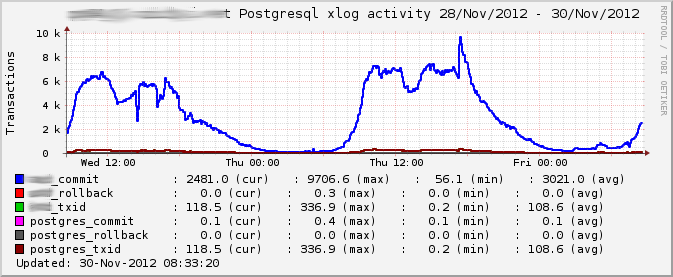
We have a PostgreSQL server with 16 cores that was apparently running well below its capacity: load something between 3.0 and 4.0, around 200 active database connections, almost all always being <IDLE>. However, when the tps count reached 7k transactions per second, things started to throttle, and pgbouncer (running on the database server) started listing up to half of the client connections to be in cl_waiting state. Load was still low, but application performance was bad. The culprit turned out to be the kernel scheduler, fairly distributing CPU time among all running processes. There's one single pgbouncer process, but hundreds of postgres processes. A simple renice of the pgbouncer process did the trick and gave us another extra 2k tps.

29 November 2012

Wouter Verhelst: HELMo talk about Debian

About a month and a half ago, I got an email from someone studying at the HELMo institute for higher eduction in Li ge, Belgium, inviting me to talk at their conference which was held today. In the email, they asked me to talk about "Debian and Open Source", which is such a wide subject that I could talk about it all day; and then they gave me 20 minutes to do it. So I picked "Debian", and focused a bit more on that, only to find out when I saw their schedule that they'd put "Open Source" there instead. Hrm. Oh well. The talk itself went pretty good. I believe I managed a good balance between introducing Debian to those who've not heard of it before, and explaining to those who have, how this Debian thing works (or is supposed to work). The fact that the audience consisted of first- and second-year IT students made this easier (in case you were wondering: the third-year students, who're supposed to graduate at the end of this eyar, organized the thing). I got some interesting questions afterwards (which is always a good sign), and only positive comments as well (which is even better). After me, Lionel Dricot held a talk which was titled "Pirate Party", but which could be summarized as his personal history into the open source world, followed by some parallels between the open source world and the pirate party.That, too, was an interesting talk, even if I'm not sure I'd vote for the pirate party (which isn't even possible in Mechelen, but ignoring that). All in all, a nice use of my time.

25 November 2012

Lucas Nussbaum: Half of the package maintainers are not DDs or DMs

During the Paris Mini-Debconf, Nicolas Dandrimont talked about The state of mentors.debian.net: GSoC and beyond. He said that Half of Debian s packages are maintained by sponsored maintainers. That statement was actually wrong, as he confirmed later. However, using a few UDD queries, I could come up with: Full UDD notes:
all packages in sid:
select source, version from sources_uniq where release = 'sid'
packages in sid known to upload_history:
select source, version from upload_history where
(source, version) in (select source, version from sources_uniq where release = 'sid')
packages that were uploaded by the changed_by person:
create temporary table sources_not_sponsored as select distinct source, version
 from upload_history, carnivore_keys, carnivore_emails
 where (source, version) in (select source, version from sources_uniq where release = 'sid')
 and fingerprint = key
 and carnivore_keys.id = carnivore_emails.id
 and carnivore_emails.email = changed_by_email;
packages not uploaded by the changed_by person:
create temp table uh_sid as select source, version, fingerprint, changed_by_email
from upload_history
where (source, version) in (select source, version from sources_uniq where release = 'sid');
create temp table uh_sid_sponsored as select source, version, fingerprint, changed_by_email from uh_sid
where (source, version) not in (select source, version from sources_not_sponsored);
list with sponsor login:
select distinct source, version, fingerprint, changed_by_email, login
from uh_sid_sponsored
left join carnivore_keys on fingerprint = key
left join carnivore_login on carnivore_keys.id = carnivore_login.id;
=> 4188 sponsored packages. some of them are in a strange state (changed_by is a DD, but uploaded by another DD). excluding those:
create temp table sponsored_but_dds as select distinct source, version, fingerprint, changed_by_email, login
from uh_sid_sponsored, carnivore_emails, carnivore_login
where changed_by_email = carnivore_emails.email
and carnivore_emails.id = carnivore_login.id;
create temp table really_sponsored as select distinct source, version, fingerprint, changed_by_email, login
from uh_sid_sponsored
left join carnivore_keys on fingerprint = key
left join carnivore_login on carnivore_keys.id = carnivore_login.id
where (source, version) not in (select source, version from sponsored_but_dds);
=> 3147 sponsored packages
select distinct changed_by_email from really_sponsored ;
=> 963 different sponsorees
select distinct changed_by_email from upload_history where
(source, version) in (select source, version from sources_uniq where release = 'sid');
=> 2015 distinct emails.
no DD amongst maintainer or uploader:
create temp table dds_emails as select email from carnivore_emails, carnivore_login
where carnivore_emails.id = carnivore_login.id;
select source, version, maintainer, uploaders from sources_uniq
where release='sid'
and maintainer_email not in (select * from dds_emails)
and not exists (select * from uploaders where release = 'sid' and sources_uniq.source = uploaders.source and sources_uniq.version = uploaders.version and email in (select * from dds_emails))
and maintainer_email != 'packages@qa.debian.org'
and (source, version) in (select source, version from really_sponsored);

Lucas Nussbaum: Mini-debconf lightning talk: Get involved! It s not that hard!

This week-end I attended the Paris Mini-Debconf, which was really a great event, and a nice opportunity to meet everybody again.
I delivered a lightning talk on Get involved! It s not that hard! , which was also a good excuse to mention the Debian packaging tutorial and the Debian Maintainer Dashboard.

Michael Stapelberg: RC bugs

I recently worked on the following RC bugs: I have to say that I find the BTS to be very hard to read from the perspective of a newcomer who wants to help squashing RC bugs, both from a technical and a social standpoint. As an example for the technical side: blocking bugs are very easy to miss, so innocent bugreports which seem actionable turn out to just wait for another bug with lots of discussion. Also, it seems like the best interface to the BTS for RC bugs is UDD, so RichiH s RC report was quite helpful. For the social side: Bugreports often are in a state in which it is not clear what the next course of action is, e.g. #634261 (the bug is not considered RC, but still has severity: grave) or #684633 (dropping from testing suggested but not clear whether a removal request has been filed or not). I m aware that this is very vague critic. I suppose what I am missing is a way in which we can make the list of RC bugs more actionable. When I am browsing through RC bugs, I often open bugreports and figure out that there s nothing I can do. Possibly a way to improve this situation is by letting people claim ownership of a bug and then filtering for un-owned bugs and those which have an owner but have not seen any activity for some period of time.

Mart&iacute;n Ferrari: MiniConf12

I'm typing this from the departure gate of the Beauvais airport, about to board my plane back home. I came to Paris for the Debian MiniConf, a/k/a another excuse to meet so many friends. Needless to say, it was great fun. I already signed and mailed all the keys from the KSP, and spent some time during the weekend finishing the transition of my blog from Blosxom to Ikiwiki. I liked Blosxom, specially the fact that it produced static pages, but I wanted to try Ikiwiki, with its elegance and so many interesting features. The combination of web-edition, backed by revision control, with a static blog finished convincing me. So, I have just changed the feed link in Planet. I hope I don't flood you! (I took the effort of adding meta tags to all my old posts so the GUID won't change). And thanks to the MiniConf team!

Pietro Abate: Mini Debian Conf 2012 in Paris : Bootstrapping Debian for a new architecture

I just finished to address the awesome debian crowd at the Mini Deb conf in paris. My presentation was about a few challenges we have ahead to bootstrap debian on a new architecture. Johannes Schauer and Wookey did a lot of work in the last few months particularly focusing on Linaro/Ubuntu. After Wheezy I think it is important to catch up with their work and integrate it in debian. The two main take away messages from my presentation : This week we just reached an important milestone toward a fully automatic bootstrap procedure. Hopefully we are going to tell you more about this work during fosdem 2013 My slides are attached.
AttachmentSize
debminiconf2012.pdf271.56 KB

24 November 2012

Richard Hartmann: Release Critical Bug report for Week 47

The gap As you can see below, the gap between this release cycle and the last is closing slowly but steadily. The graph Pawel Sadkowski published a very nice graph up to and including week 46. The gang This weekend, there are BSPs in Essen (Germany), Munich, Paris, and Tokyo. They are all hanging out on irc.debian.org (OFTC) in #debian-bugs. The gist The UDD bugs interface currently knows about the following release critical bugs: How do we compare to the squeeze cycle ?
Week Squeeze Wheezy Diff
43 284 (213+71) 468 (332+136) +184 (+119/+65)
44 261 (201+60) 408 (265+143) +147 (+64/+83)
45 261 (205+56) 425 (291+134) +164 (+86/+78)
46 271 (200+71) 401 (258+143) +130 (+58/+72)
47 283 (209+74) 366 (221+145) +83 (+12/+71)
48 256 (177+79)
49 256 (180+76)
50 204 (148+56)
51 124 (124+54)
52 115 (78+37)
1 93 (60+33)
2 82 (46+36)
3 25 (15+10)
4 14 (8+6)
5 2 (0+2)
6 release!

23 November 2012

Benjamin Mako Hill: Cultivated Disinterest in Professional Sports

Like many of my friends, I have treated professional sports with cultivated indifference. But a year and a half ago, I decided to become a football fan. Several years ago, I was at a talk by Michael Albert at MIT where he chastised American intellectuals for what he claimed was cultivated disdain of professional sports. Albert suggested that sports reflect the go-to topic for small talk and building rapport across class and context. But he suggested that almost everybody who used the term "working class struggle" was incapable of making small talk with members of the working class because unlike most working class people (and most people in general) educated people systematically cultivate ignorance in sports. Professional sports are deeply popular. In the US, Sunday Night Football is now the most popular television show among women in its time slot and the third most popular television in America among 18-49 year old women. That it is also the most popular television show in general is old news. There are very few things that anywhere near half of Americans have in common. Interest in football is one of them. An enormous proportion of the US population watches the Superbowl each year. I recognized myself in Albert's critique. So I decided to follow a local team. I picked football because it is the most popular sport in America and because their strong revenue sharing system means that either team has a chance to win any given match. My local team is the New England Patriots and I've watched many of the team's games or highlights over the last season and a half. I've also followed a couple football blogs. A year and half in, I can call myself a football fan. And I've learned a few things in the process:
  1. With a little effort, getting into sports is easy. Although learning the rules of a sport can be complicated, sports are popular because people, in general, find them fun to watch. If you watch a few games with someone who can explain the rules, and if you begin to cheer for a team, you will find yourself getting emotionally invested and excited.
  2. Sports really do, as Albert implied, allow one to build rapport and small talk across society. I used to dread the local cab driver who would try to make small talk by mentioning Tom Brady or the Red Sox. No more! Some of these conversations turn into broader conversations about life and politics.
  3. Interest in sports can expand or shrink to fill the time you're willing to give it. It can mean just glancing through the sports sections of the paper and watching some highlights here or there. Or it can turn into a lifestyle.
  4. It's not all great. Football, like most professional sports, is deeply permeated with advertisements, commercialism, and money. Like other sports, it is also violent. I don't think I could ever get behind a fight sport where the goal is to hurt someone else. The machoness and absence of women in the highest levels of most professional sports bothers me deeply.
I've also tried to think a lot about why I, like most of my friends, avoided sports in the past. Disinterest in sports among academics and the highly educated is, in my experience, far from passive. I've heard people almost compete to explain the depth of their ignorance in sports one doesn't even know the rules, one doesn't own a television, one doesn't know the first thing about the game. I did the same thing myself. Bethany Bryson, a sociologist at JMU has shown that increased education is associated with increased inclusiveness in musical taste (i.e., highly educated people like more types of music) but that these people are most likely to reject music that is highly favored by the least educated people. Her paper's title sums up the attitude: "Anything But Heavy Metal". For highly educated folks, it's a sign of cultivation to be eclectic in one's tastes. But to signal to others that you belong in the intellectual elite, it can pay in cultural capital to dislike things, like sports, that are enormously popular among the least educated parts of society. This ignorance among highly educated people limits our ability to communicate, bond, and build relationships across different segments of society. It limits our ability to engage in conversations and build a common culture that crosses our highly stratified and segmented societies. Sports are not politically or culturally unproblematic. But they provide an easy and enjoyable way to build common ground with our neighbors and fellow citizens that transcend social boundaries.

Keith Packard: MicroPeak

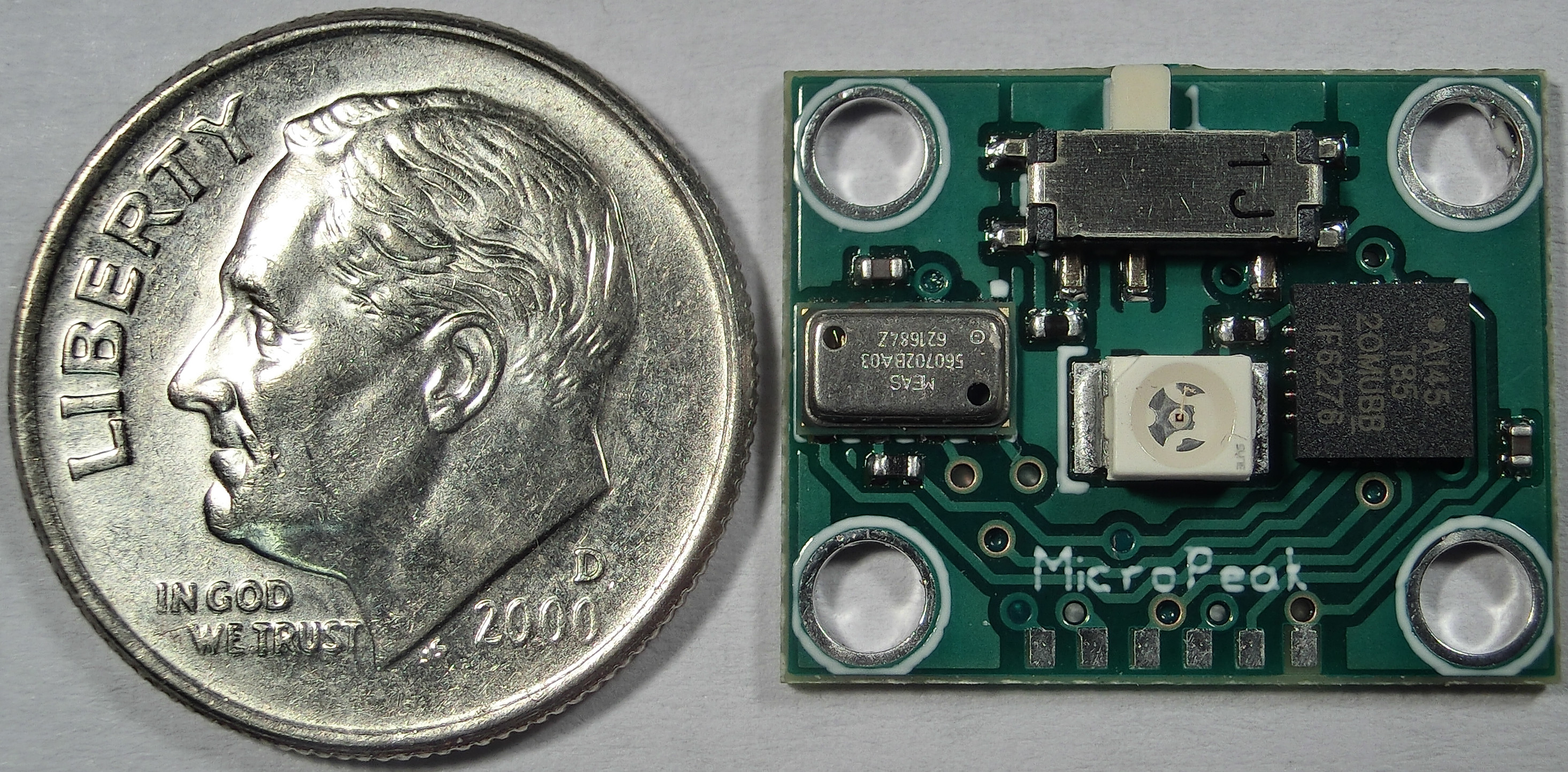
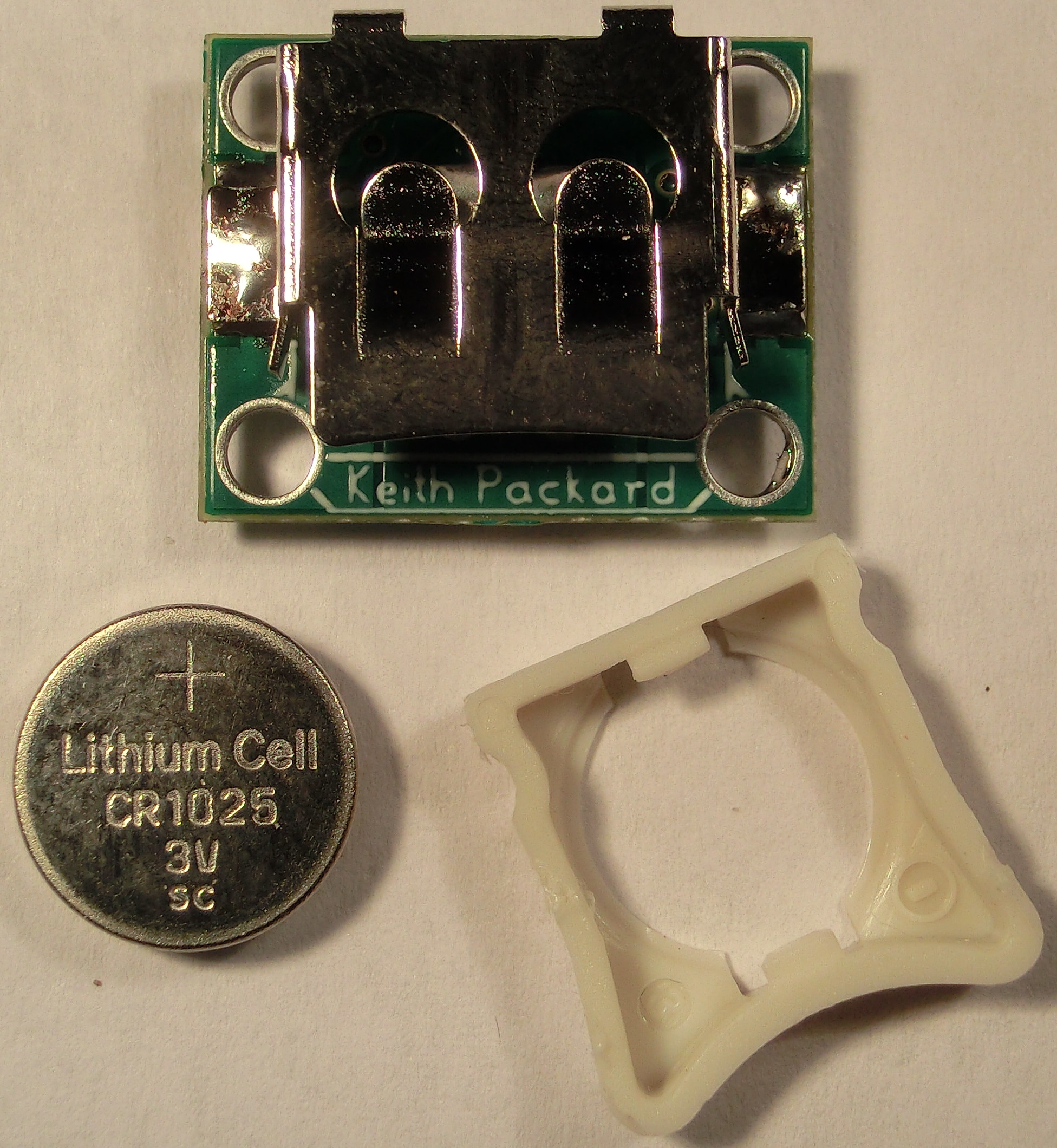
MicroPeak tiny peak-recording altimeter now available MicroPeak is a miniature peak-recording altimeter. About the same size and weight as a US dime (with battery), MicroPeak offers fabulous accuracy (20cm or 8in at sea level) and wide range (up to 31km or 101k ). The size of the board was predicated with the premise that we needed a battery included to avoid having wiring running between the altimeter and the board, we found some small lithium coin-cell battery holders for the CR1025 battery. These battery holders are rated to hold the battery secure up to 150gs. We d already started playing with the Measurement Specialties MS5607 pressure sensor which offers amazing accuracy while using very little power. Taking full-precision measurements every 96ms consumes about .2mA on average. Once on the ground, we stop taking measurements entirely, dropping the power use to around 1 A. It s also pretty small, measuring only 5mm x 3mm. For a CPU, this little project didn t need much. The 8-bit ATtiny85 comes in a 20qwfn package which is only 4mm x 4mm. When run at full speed (8MHz), it consumes a couple of mA of power. Reduce the clock to a pokey 250kHz and the CPU has enough CPU power to track altitude while consuming less than .2mA on average. To avoid losing the battery, we wanted to avoid having it removed while the board wasn t in use. So, we added a little power switch to the board. The one we found is good to at least 50g. Finally, we wanted to find a nice bright LED to show the state of the device and to blink out the final altitude. The OSRAM LO T67K are bright-orange surface-mount LEDs that run happily on 2mA. We used OSHPark.com to create prototype circuit boards for this project. Because of the small size of the board, each prototype run cost only $2 for three boards. It takes a couple of weeks to get boards, but it s really hard to beat the price. All of the schematic and circuit board artwork are published under the TAPR Open Hardware License and are available via git. All of the source code is published under the GPLv2 and is included in the main AltOS source repository.

22 November 2012

Andrew Pollock: [life] Silicon Valley Turkey Trot

Sarah, Zoe and I ran in the 10K Applied Materials Silicon Valley Turkey Trot this morning. Apparently it's a bit of a Silicon Valley institution (people get dressed up, particularly as turkeys), so I guess it's up there with the Bay to Breakers. This is the first time I've ever run a 10K fun run and actually run the whole way, so I'm feeling pretty happy with my fitness. In fact, I think I'm the fittest and lightest I've ever been. I'm actually a couple of kilograms under my target weight, and really pleased with myself for being able to run a 10K training run on Tuesday as well as the race today. I managed to run it in a respectable 1:05. I think I'll set a goal for myself to be able to run 10K in under an hour. No idea if that's realistic or not, but it's a goal with a nice round number. Sarah did her run in 1:06, which is impressive considering she was pushing Zoe in the jogging stroller. Zoe also did well putting up with being in the jogging stroller for that long. I think it helped having lots of things for her to look at, as well as a steady supply of food to graze on. She was having a great time running on the closed streets as we headed back to where we parked the car. We might have to make this a Thanksgiving family tradition. It'll be nice when Zoe's big enough to run in the kid's fun run as well.

Andrea Veri: The Linux s perception of my neighbours

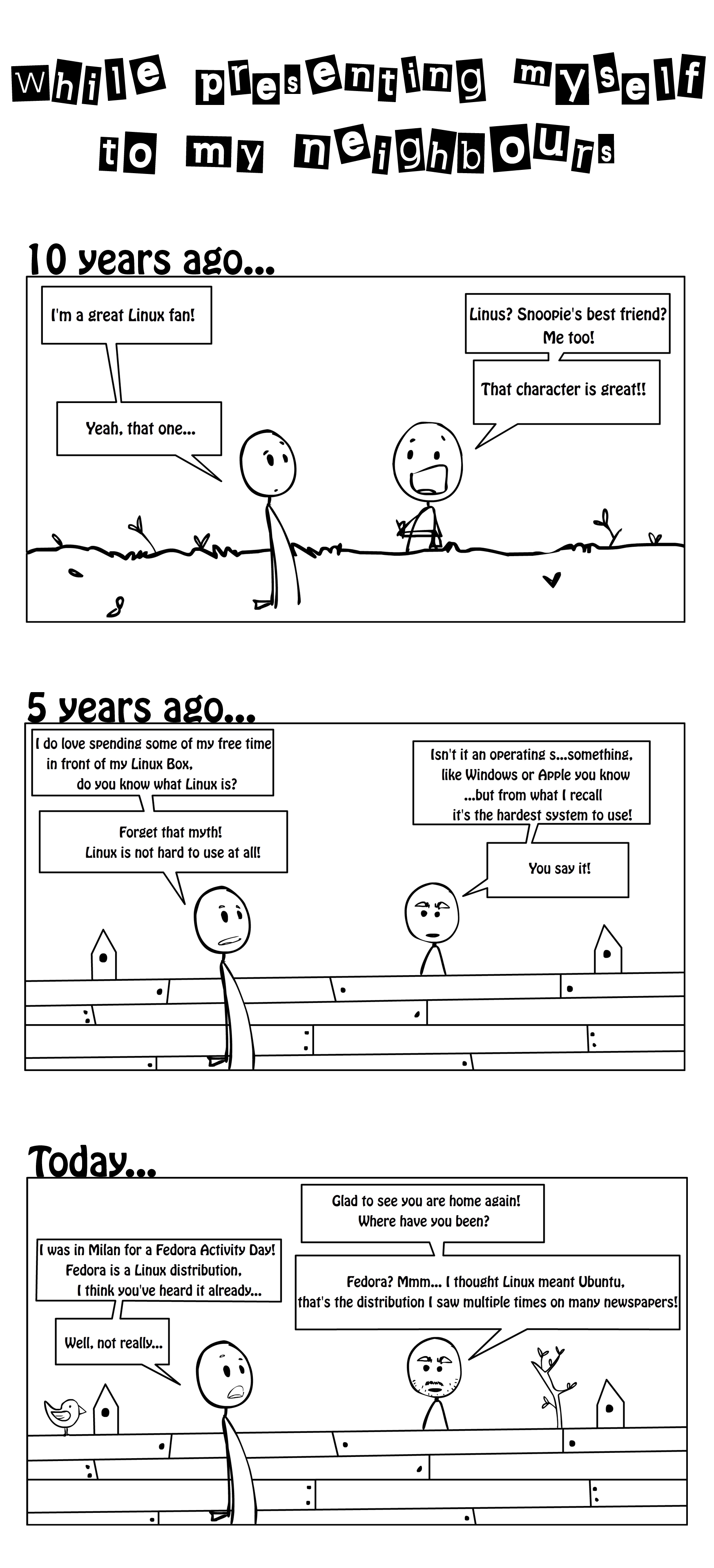
I live in a little village close to the city and one of the houses close to my property is for rent since more than ten years. A lot of families and people succeeded in that house and every time someone new joined my Linux evangelist hat jumped in my head. I ve always presented myself as a Linux geek to my neighbours and it has been nice seeing how the Linux word evolved (with funny and surprising quotes) during the past ten years in their minds. A friend of mine (Aretha Battistutta) made a little comic strip out of the topic and the result is simply amazing. Enjoy!

Ian Wienand: Upgrading Samsung Series 9 Laptop BIOS without Windows

Having recently acquired a Samsung Series 9 laptop, I'd like to update the BIOS. This is proving rather difficult without Windows. The first thing you download from the Samsung website isn't actually BIOS update at all; it's a Windows application which then goes and finds a BIOS update for your machine. Some time with a Windows VM, tcpdump and you'll end up at http://sbuservice.samsungmobile.com/. I'll leave interested parties to play around at that website, but with a little fiddling you can find the BIOS you're looking for. In this case, it is ITEM_20121024_754_WIN_P08AAH.exe which is the latest version, P08AAH. Unfortunately, this still won't run in any useful way -- in a virtual-machine it errors out saying the battery isn't connected. On previous endeavors such as this, running various incarnations of zip on the .exe file has found interesting components, but not in this case. Not to be deterred, some work with strings will yield the following
$ strings ./ITEM_20121024_754_WIN_P08AAH.exe   grep Copyright
inflate 1.2.7 Copyright 1995-2012 Mark Adler
deflate 1.2.7 Copyright 1995-2012 Jean-loup Gailly and Mark Adler
Now this is interesting, because it tells us that the components aren't using some fancy compression scheme we have no hope of figuring out. Checking RFC1952 we see the following header mentioned
Each member has the following structure:
+---+---+---+---+---+---+---+---+---+---+
 ID1 ID2 CM  FLG      MTIME      XFL OS   (more-->)
+---+---+---+---+---+---+---+---+---+---+
We can easily look for that in the file. Expanding the values, what we're looking for is 0x1f 0x8b 0x08 0x0 0x0 0x0 0x0 0x0 0x0 0x0 which represents the compressed stream (the OS byte is 0xb for NTFS which we can just ignore). A quick hack will get that done and give us the offsets we need
$ ./look-for-headers
Found potential header at 455212
Found potential header at 677136
Found potential header at 1293930
Found potential header at 1294980
Found potential header at 2771193
Found potential header at 2779874
Found potential header at 2789142
Found potential header at 2935778
Found potential header at 3078639
Found potential header at 3083039
Found potential header at 3338552
Found potential header at 3339443
Found potential header at 3352440
Found potential header at 3366757
Found potential header at 3391734
Found potential header at 3444255
Found potential header at 3494372
So, we can feed this into a shell script and extract the streams
FILE=ITEM_20121024_754_WIN_P08AAH.exe
for offset in 455212 677136 1293930 1294980 \
    2771193 2779874 2789142 2935778 3078639 \
    3083039 3338552 3339443 3352440 3366757 \
    3391734 3444255 3494372
do
    echo "create $offset.gz"
    dd if=$FILE  bs=1 skip=$offset   zcat > $offset.data
done
We don't have to worry about the end-point, because zcat will handily stop outputting and ignore junk at the end of the stream. That will yield the following output files:
$ md5sum *
c014e900b02ae39d6e574c63154809b2  1293930.data
982747cd5215c7d51fa1fba255557fef  1294980.data
942c6a8332d5dd06d8f4b2a9cb386ff4  2771193.data
d98d2f80b94f70780b46d1f079a38d93  2779874.data
33ce3174b0e205f58c7cedc61adc6f32  2789142.data
1d6851288f40fa95895b2fadee8a8b82  2935778.data
3a0a9b2fa9b40bdf5721068acde351ce  3078639.data
fc166141d06934e9c7238326f18a4e68  3083039.data
8cf7f86f84afa81363d3cef44b257d50  3338552.data
85e09e18fd495599041e13b4197e1746  3339443.data
0c72004eae0131d52817f23faf8a46a7  3352440.data
26347f93721e7ac49134a17104f56090  3366757.data
26973e301da4948a0016765e40700e8c  3391734.data
c8e4675cda3aa367d523a471bb205fba  3444255.data
7bf5ea753d4cc056b9462a02ac51b160  3494372.data
a2c6562f7f43aaa0e636cc1995b7ee3d  455212.data
d5c91b007dac3a5c6317f8a8833f9304  677136.data
65c0dcd1e7e9f8f87a8e9fb706eb8768  ITEM_20121024_754_WIN_P08AAH.exe
$ file *
1293930.data:                     MS-DOS executable
1294980.data:                     data
2771193.data:                     PE32 executable (native) Intel 80386, for MS Windows
2779874.data:                     PE32+ executable (native) x86-64, for MS Windows
2789142.data:                     PE32 executable (console) Intel 80386 (stripped to external PDB), for MS Windows
2935778.data:                     PE32+ executable (console) x86-64 (stripped to external PDB), for MS Windows
3078639.data:                     MS-DOS executable
3083039.data:                     PE32 executable (GUI) Intel 80386, for MS Windows
3338552.data:                     ASCII text, with CRLF line terminators
3339443.data:                     PE32 executable (native) Intel 80386, for MS Windows
3352440.data:                     PE32+ executable (native) x86-64, for MS Windows
3366757.data:                     PE32 executable (DLL) (GUI) Intel 80386, for MS Windows
3391734.data:                     PE32 executable (GUI) Intel 80386, for MS Windows
3444255.data:                     PE32 executable (GUI) Intel 80386, for MS Windows
3494372.data:                     PE32 executable (DLL) (GUI) Intel 80386, for MS Windows
455212.data:                      PE32 executable (DLL) (console) Intel 80386, for MS Windows
677136.data:                      data
ITEM_20121024_754_WIN_P08AAH.exe: PE32 executable (GUI) Intel 80386, for MS Windows
This is where I get a bit stuck. There is clearly a bunch of WinFlash stuff that Wine kind-of recognises, but so far I haven't managed to figure out how I might go about flashing this from a DOS boot disk. So far I know it's a "Phoenix SecureCore Tiano" based BIOS, and there is some indication that there is a UEFI app to flash the BIOS, but unfortunately I didn't set the laptop up with UEFI (note to anyone setting this up; probably a good idea to do that). I believe that if you have Windows, you can halt the install part-way through and see these files extracted in a temp directory. Possibly if we can put some file-names to the blobs it might help. There may also be a much easier way to do this that I'm completely missing. If anything comes up, I'll update this post; hopefully a future Googlenaut who enjoys BIOS hacking will drop a comment... Update 2012-11-27 I'm unfortunately less optimistic about being able to update this. Certainly the files identified above as MS-DOS executable are EFI binaries; however they are both 32-bit binaries. You can easily get an EFI shell up and running by putting a 64-bit EFI shell binary on a FAT formatted USB disk in the efi/boot/bootx64.efi but it will not run either of those binaries, presumably because they're 32-bit. A 32-bit EFI binary doesn't seem to be recognised for boot, so no luck there. A comment also mentioned some issues with Samsung's and UEFI boot in this bug though it's not clear what models are affected. Another comment mentioned binwalk which also does a nice job of finding the embedded zip streams.
$ strings ./1293930.data
...
RSDS
D:\flash\Source\ENV\src\Efi863\edk\phoenix\edk\Sample\Platform\DUET\ldr16\IA32\oemslp20.pdb
oemslp20.dll
InitializeDriver
2n3u3
$ strings ./3078639.data
en-us;zh-Hans
slp20.marker
slp20.size
slp20.offset
slp20.offset2
read marker fail!
Marker file '%s''s size(%d)!=%d
Not a valided OemMarker!
Update image data error.
marker file is updated.
marker file size too big!
Not a valided OemMarker in ROM.
Update image data error.
SLP marker is reserved.
-PROT
Prot flag is found, mProgFlag is true.
Prot flag is not found, mProgFlag is false.
Please specify input file name.
-PROT
slpFile
OEM Activation 2.0 processing
Failed to Locate Flash Support protocol.
...
D:\flash\Source\ENV\src\Efi863\edk\phoenix\edk\Sample\Platform\DUET\ldr16\IA32\SLP20.pdb

21 November 2012

Dirk Eddelbuettel: Rcpp attributes: A simple example 'making pi'

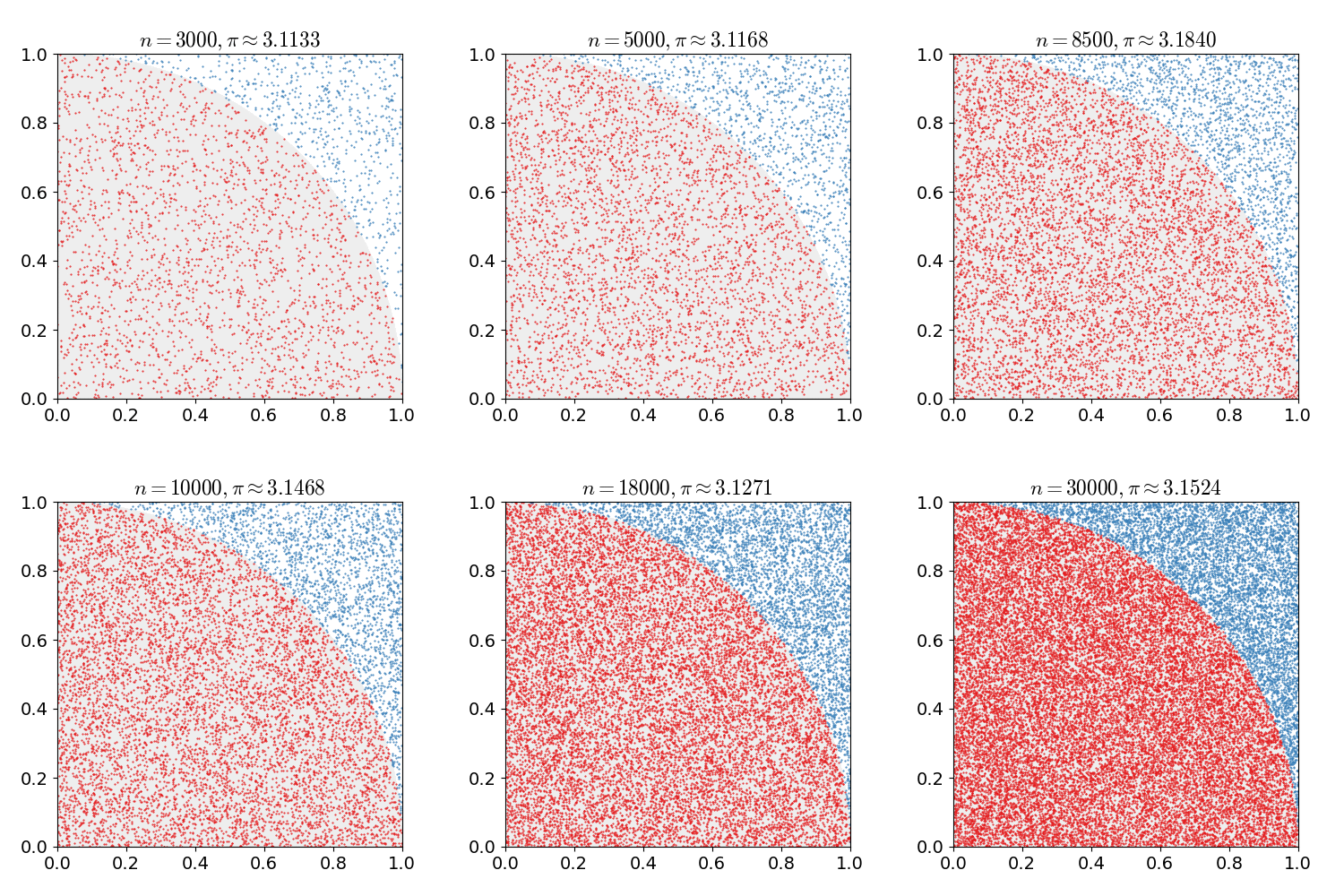
We introduced Rcpp 0.10.0 with a number of very nice new features a few days ago, and the activity on the rcpp-devel mailing list has been pretty responsive which is awesome. But because few things beat a nice example, this post tries to build some more excitement. We will illustrate how Rcpp attributes makes it really easy to add C++ code to R session, and that that code is as easy to grasp as R code. Our motivating example is everybody's favourite introduction to Monte Carlo simulation: estimating . A common method uses the fact the unit circle has a surface area equal to . We draw two uniform random numbers x and y, each between zero and one. We then check for the distance of the corresponding point (x,y) relative to the origin. If less than one (or equal), it is in the circle (or on it); if more than one it is outside. As the first quadrant is a quarter of a square of area one, the area of the whole circle is -- so our first quadrant approximates over four. The following figure, kindly borrowed from Wikipedia with full attribution and credit, illustrates this: Example of simulating pi Now, a vectorized version (drawing N such pairs at once) of this approach is provided by the following R function.
piR <- function(N)  
    x <- runif(N)
    y <- runif(N)
    d <- sqrt(x^2 + y^2)
    return(4 * sum(d < 1.0) / N)
 
And in C++ we can write almost exactly the same function thanks the Rcpp sugar vectorisation available via Rcpp:
#include <Rcpp.h>
using namespace Rcpp;
// [[Rcpp::export]]
double piSugar(const int N)  
    RNGScope scope;		// ensure RNG gets set/reset
    NumericVector x = runif(N);
    NumericVector y = runif(N);
    NumericVector d = sqrt(x*x + y*y);
    return 4.0 * sum(d < 1.0) / N;
 
Sure, there are small differences: C++ is statically typed, R is not. We need one include file for declaration, and we need one instantiation of the RNGScope object to ensure random number draws remain coordinated between the calling R process and the C++ function calling into its (compiled C-code based) random number generators. That way we even get the exact same draws for the same seed. But the basic approach is identical: draw a vector x and vector y, compute the distance to the origin and then obtain the proportion within the unit circle -- which we scale by four. Same idea, same vectorised implementation in C++. But the real key here is the one short line with the [[Rcpp::export]] attribute. This is all it takes (along with sourceCpp() from Rcpp 0.10.0) to get the C++ code into R. The full example (which assumes the C++ file is saved as piSugar.cpp in the same directory) is now:
#!/usr/bin/r
library(Rcpp)
library(rbenchmark)
piR <- function(N)  
    x <- runif(N)
    y <- runif(N)
    d <- sqrt(x^2 + y^2)
    return(4 * sum(d < 1.0) / N)
 
sourceCpp("piSugar.cpp")
N <- 1e6
set.seed(42)
resR <- piR(N)
set.seed(42)
resCpp <- piSugar(N)
## important: check results are identical with RNG seeded
stopifnot(identical(resR, resCpp))
res <- benchmark(piR(N), piSugar(N), order="relative")
print(res[,1:4])
and it does a few things: set up the R function, source the C++ function (and presto: we have a callable C++ function just like that), compute two simulations given the same seed and ensure they are in fact identical -- and proceed to compare the timing in a benchmarking exercise. That last aspect is not even that important -- we end up being almost-but-not-quite twice as fast on my machine for different values of N. The real takeaway here is the ease with which we can get a C++ function into R --- and the new process completely takes care of passing parameters in, results out, and does the compilation, linking and loading. More details about Rcpp attributes are in the new vignette. Now enjoy the .

Update:One somewhat bad typo fixed.

Update:Corrected one background tag.

20 November 2012

Jon Dowland: Waterstones

In May this year, in a desperate bid to bail water out of a sinking ship, HMV group sold off the Waterstones chain of bookstores. I'm fond of reading so naturally I visit Waterstones from time to time. (but not exclusively.) For many years, their promotions were unanimously structured as "3 for 2" offers: find three books in the promotion, in-store, and get the cheapest of the three for free. I hated these promotions. I always found it very challenging to find three books in the promotion that I wanted. If I was visiting to buy a specific book and found it in the promotion, on more than one occasion I left the shop empty handed: I wasn't prepared to pay full price for a book in a promotion and not get the benefit of the promotion. Since being sold, Waterstones seem to have made a lot of changes. Many new hardbacks from popular authors have debuted at a discount for a short period (Rowling, Pratchett). I've found many more discounted books not tied to others in 3-for-2-style offers, sometimes window-display stock at half price, a month or so after release. They started a loyalty-card scheme, with a 10 gift card the prize you reach once you've spent 100. (I wonder if such schemes are examples of a token economy?) Finally, they've tentatively started to explore putting cafes in their branches. The one in Newcastle is best described as 'fledgling', but it's nice to have one more place to escape for a cup of tea at lunchtimes. The cafe, as well as a very well stocked collection of magazines, were the two killer features of the sadly- defunct Borders bookseller chain. For years before we got our own Borders in the North East, I used to enjoy the York branch if I was passing. I actually managed to fill a loyalty card this year, so clearly their change in attitude has worked on me! I'm generally not a fan of gift cards, especially in today's climate, so I quickly spent it. I hold an American Express credit card, which earns me cashbask on purchases which I make with it. I think the rate is about 1%. However, I can opt to receive the cashback in the form of gift vouchers. If I do so, I get them to the value of 110% my cashback balance. One of the retailers in on the scheme are Waterstones. I'm tempted

Michal &#268;iha&#345;: Weblate hook at Github

Github now provides native hook for Weblate. This means that all you need to do to link these two together is to enter URL of your Weblate installation and you are done. This was actually my first code in Ruby and I don't think I will start to like it, Python still looks nicer to me :-). However it was not that hard as I expected and I've even contribute (simple) testcase for this service.

Filed under: English Weblate 3 comments Flattr this!

19 November 2012

Vasudev Kamath: Weekly Log - 17/23 - 112012

The last week was quite productive as I was on vacation and at home town but sadly I couldn't complete this post so again merging the work with this week but this week ain't much productive as I was tired from journey back and didn't get enough time to recover. So here it goes. Debian Related Upstream Related I raised a pull request #8 on Gubbi fixing the Makefile to more organized and introducing xz compression in it. Additionally I removed distribution specific stuffs from Makefile and made it generic. That's all for the two weeks. This week there will be foss.in and we will be having some Debian specific mini conference, including some Debian basics to newbies and some bug squashing if any :-). So more to report next week, till then Cya.

18 November 2012

Sven Mueller: Ingress

As some may have noticed, Google launched something that is unusual for the company: A game. A mobile alternate reality game, to be precise. See allthingsd article for a bit more information. In my opinion this game is most interesting to people who are mildly interested in geo-caching. You spend most of the gaming time either looking for the right portals (geo-location that is an interesting place for one reason or another, many located at sculptures, murals or (more scarcely) interesting local businesses), or trying to solve the puzzles that appear in the game itself or on http://www.nianticproject.com/. I was one of the beta testers and really enjoy the game, especially in areas with more players. As the game is most fun when people coordinate a bit, I started a google group for the munich area for one of the two teams (the enlightenment), but I will only let people enter that group who can be verified to be on that team. On a side note: I still have a few invites to the game left, so if you are interested, please leave a comment and enter your gmail.com email address (you need a Google account to play anyway) while doing so. I will send out invites in the order I received the requests (which I admit might not always be the same in which they were submitted. First come first serve and no guarantee to get an invitation though. Your email address you enter when commenting isn t shown to anyone and I don t share them with anyone but the game (and thus Google). EDIT: So short time went past, but I already ran out of invites (note that I didn t approve comments that really only were like please send me an invite , but still did sent one out). Feel free to still ask me for an invite, I will send some out as I get new ones, but this might take anything between a few days and some weeks. PS: For the lucky ones who got invites: You don t strictly need to do the training offered when you start the game for the first time, but I strongly encourage you to do so.
PPS: I m opening my group to any enlightened players in Germany. I will share some useful information about some game details there in the near future (nothing company confidential of course, just information anyone can gather in the game or from the published information). EDIT: As noted before, I don t have any more invites to give away. As I still get like 4 requests for invites per day, and now have more than 30 unfulfilled requests pending (with no new invites to give in sight), I m now disabling comments. Disclaimer: I work for Google since a few months ago, but this post solely represents my own opinions and hasn t been endorsed by Google in any way.

Russ Allbery: Powell's anniversary haul

Powell's was holding an anniversary sale and giving out free gift cards with a qualifying order, so it seemed like a good idea to pick up a few books. Ben Aaronovitch Midnight Riot (sff)
Patricia Briggs Alpha & Omega (sff)
Patricia Briggs Moon Called (sff)
Mark Forster Get Everything Done (non-fiction)
Lynn Galli Wasted Heart (romance)
Sam Harris Lying (non-fiction)
K.E. Lane And Playing the Role of Herself (romance)
Jack McDevitt Firebird (sff)
Marshall Rosenberg Nonviolent Communication (non-fiction)
Deborah Tannen The Argument Culture (non-fiction)
Bill Willingham, et al. Fables: Animal Farm (graphic novel) I'm not sure if the Forster will be worth the cost, but I've really liked his other writing about time management, so I thought I'd take a chance on it. I think the Tannen and the Rosenberg are on roughly the same topic, but I arrived at them through different recommendation paths. I've been feeling like reading about how to communicate lately. The McDevitt novel is the latest in the Alex Benedict series. I'm only a couple of books away from being caught up. I've gotten lots of positive recommendations for Aaronovitch's series, so thought I'd get the first one. There's also a variety of random stuff, mostly on the Kindle, that I'd not added to one of these posts, noted here mostly for my own records. Alpha & Omega is a novella rather than a novel, which I grabbed because I picked up and read Cry Wolf during vacation.

Next.

Previous.