Search Results: "gt"

4 October 2020

Enrico Zini: Science links

Weather: We can only forecast the weather a few days into the future. Nuclear: I had no idea Thorium-based nuclear power was a thing. Fluid dynamics applied to traffic: Traffic Flow and Phantom Jams. Psychology, economics, and a history of culturally biased experiment results: We aren t the world.

Sylvain Beucler: git filter-branch and --state-branch - how?

I'm mirroring and reworking a large Git repository with git filter-branch (conversion ETA: 20h), and I was wondering how to use --state-branch which is supposed to speed-up later updates, or split a large conversion in several updates. The documentation is pretty terse, the option can produce weird results (like an identity mapping that breaks all later updates, or calling the expensive tree-filter but discarding the results), wrappers are convoluted, but I got something to work so I'll share :) The main point is: run the initial script and the later updates in the same configuration, which means the target branch needs to be reset to the upstream branch each time, before it's rewritten again by filter-branch. In other words, don't re-run it on the rewritten branch, nor attempt some complex merge/cherry-pick.
git fetch
git branch --no-track -f myrewrite origin/master
git filter-branch \
  --xxx-filter ... \
  --xxx-filter ... \
  --state-branch refs/heads/filter-branch/myrewrite \
  -d /dev/shm/filter-branch/$$ -f \
  myrewrite
Updates restart from scratch but only take a few seconds to skim through all the already-rewritten commits, and maintain a stable history. Note that if the process is interrupted, the state-branch isn't modified, so it's not a stop/resume feature. If you want to split a lenghty conversion, you could simulate multiple upstream updates by checking out successive points in history (e.g. per year using $(git rev-list -1 --before='2020-01-01 00:00:00Z')). --state-branch isn't meant to rewrite in reverse chronological order either, because all commit ids would constantly change. Still, you can rewrite only the recent history for a quick discardable test. Be cautious when using/deleting rewritten branches, especially during early tests, because Git tends to save them to multiple places which may desync (e.g. .git/refs/heads/, .git/logs/refs/, .git/packed-refs). Also remember to delete the state-branch between different tests. Last, note the unique temporary directory -d to avoid ruining concurrent tests ^_^'

3 October 2020

Ben Hutchings: Debian LTS work, September 2020

I was assigned 16 hours of work by Freexian's Debian LTS initiative and carried over 9.75 hours from August. I only worked 8.25 hours this month, and will return excess hours to the pool. I attended and participated in the LTS team meeting on the 24th. I updated linux-4.19 to include the changes in the buster point release, and issued DLA-2385-1. I began work on an update to the linux (Linux 4.9 kernel) package.

Dirk Eddelbuettel: pinp 0.0.10: More Tweaks

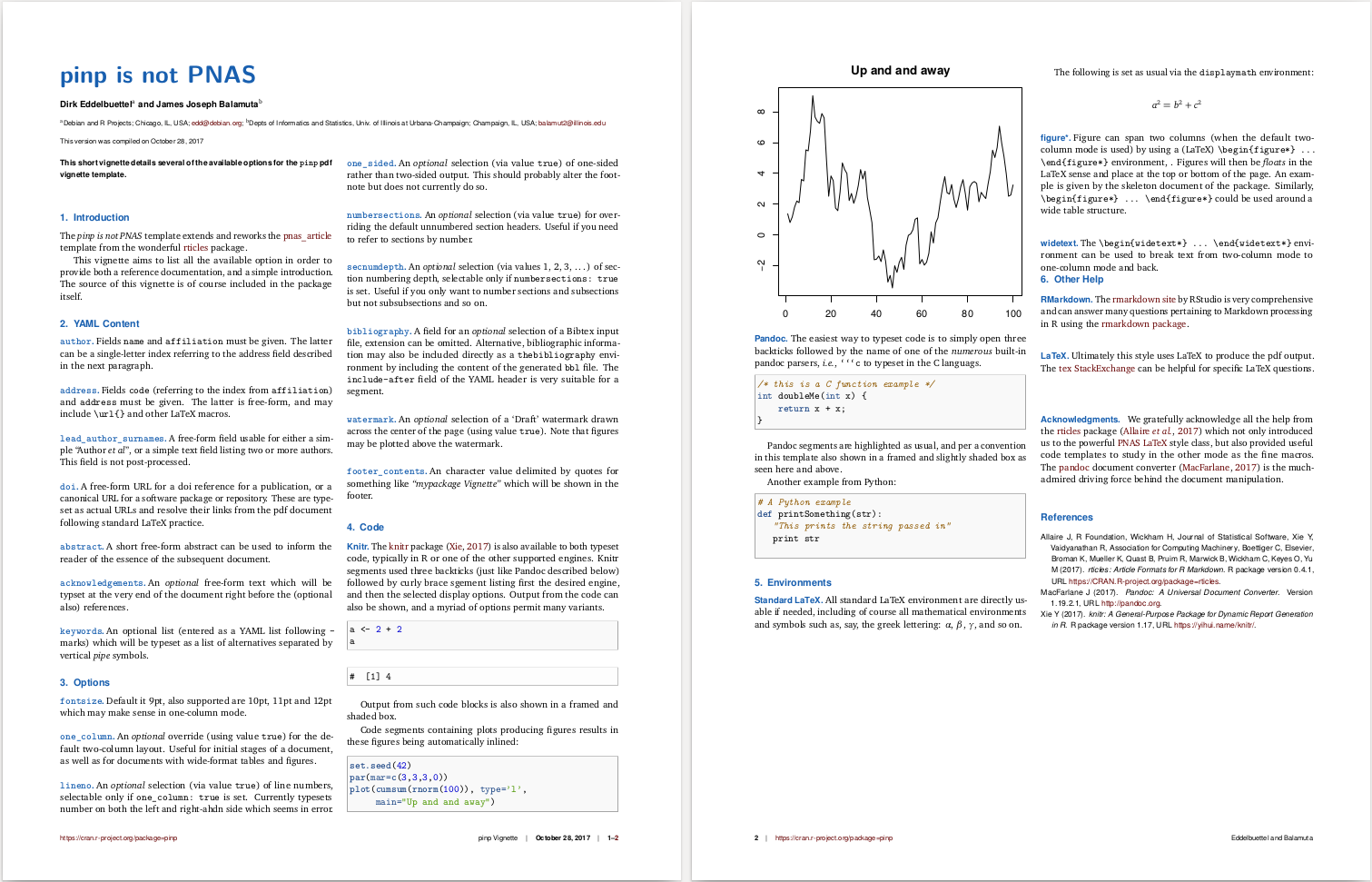
A new version of our pinp package arrived on CRAN two days ago, roughly one year after the previous release. The pinp package allows for snazzier one or two column Markdown-based pdf vignettes, and is now used by a few packages. A screenshot of the package vignette can be seen below. Additional screenshots are at the pinp page. pinp vignette This release adds another option for a customized date YAML variable suitable for e.g. a published at date thanks to Ilya Kashnitsky, has some tweaks to the README.md as well as support for pandoc columns mode (as a small extension of code from the nice repo by Grant McDermott). The NEWS entry for this release follows.

Changes in pinp version 0.0.10 (2020-10-01)
  • New document_date YAML variable to optionally set a 'Published at' or alike date (Ilya Kashnitsky in #85).
  • Small tweaks to README.md (Dirk)
  • Support pandoc columns mode (Dirk in #88)

Courtesy of my CRANberries, there is a comparison to the previous release. More information is on the tint page. For questions or comments use the issue tracker off the GitHub repo. If you like this or other open-source work I do, you can now sponsor me at GitHub. For the first year, GitHub will match your contributions.

This post by Dirk Eddelbuettel originated on his Thinking inside the box blog. Please report excessive re-aggregation in third-party for-profit settings.

Steve Kemp: Writing an assembler.

Recently I've been writing a couple of simple compilers, which take input in a particular format and generate assembly language output. This output can then be piped through gcc to generate a native executable. Public examples include this trivial math compiler and my brainfuck compiler. Of course there's always the nagging thought that relying upon gcc (or nasm) is a bit of a cheat. So I wondered how hard is it to write an assembler? Something that would take assembly-language program and generate a native (ELF) binary? And the answer is "It isn't hard, it is just tedious". I found some code to generate an ELF binary, and after that assembling simple instructions was pretty simple. I remember from my assembly-language days that the encoding of instructions can be pretty much handled by tables, but I've not yet gone into that. (Specifically there are instructions like "add rax, rcx", and the encoding specifies the source/destination registers - with different forms for various sized immediates.) Anyway I hacked up a simple assembler, it can compile a.out from this input:
.hello   DB "Hello, world\n"
.goodbye DB "Goodbye, world\n"
        mov rdx, 13        ;; write this many characters
        mov rcx, hello     ;; starting at the string
        mov rbx, 1         ;; output is STDOUT
        mov rax, 4         ;; sys_write
        int 0x80           ;; syscall
        mov rdx, 15        ;; write this many characters
        mov rcx, goodbye   ;; starting at the string
        mov rax, 4         ;; sys_write
        mov rbx, 1         ;; output is STDOUT
        int 0x80           ;; syscall
        xor rbx, rbx       ;; exit-code is 0
        xor rax, rax       ;; syscall will be 1 - so set to xero, then increase
        inc rax            ;;
        int 0x80           ;; syscall
The obvious omission is support for "JMP", "JMP_NZ", etc. That's painful because jumps are encoded with relative offsets. For the moment if you want to jump:
        push foo     ; "jmp foo" - indirectly.
        ret
:bar
        nop          ; Nothing happens
        mov rbx,33   ; first syscall argument: exit code
        mov rax,1    ; system call number (sys_exit)
        int 0x80     ; call kernel
:foo
        push bar     ; "jmp bar" - indirectly.
        ret
I'll update to add some more instructions, and see if I can use it to handle the output I generate from a couple of other tools. If so that's a win, if not then it was a fun learning experience:

Julian Andres Klode: Google Pixel 4a: Initial Impressions

Yesterday I got a fresh new Pixel 4a, to replace my dying OnePlus 6. The OnePlus had developed some faults over time: It repeatedly loses connection to the AP and the network, and it got a bunch of scratches and scuffs from falling on various surfaces without any protection over the past year.

Why get a Pixel? Camera: OnePlus focuses on stuffing as many sensors as it can into a phone, rather than a good main sensor, resulting in pictures that are mediocre blurry messes - the dreaded oil painting effect. Pixel have some of the best camera in the smartphone world. Sure, other hardware is far more capable, but the Pixels manage consistent results, so you need to take less pictures because they don t come out blurry half the time, and the post processing is so good that the pictures you get are just great. Other phones can shoot better pictures, sure - on a tripod. Security updates: Pixels provide 3 years of monthly updates, with security updates being published on the 5th of each month. OnePlus only provides updates every 2 months, and then the updates they do release are almost a month out of date, not counting that they are only 1st-of-month patches, meaning vendor blob updates included in the 5th-of-month updates are even a month older. Given that all my banking runs on the phone, I don t want it to be constantly behind. Feature updates: Of course, Pixels also get Beta Android releases and the newest Android release faster than any other phone, which is advantageous for Android development and being nerdy. Size and weight: OnePlus phones keep getting bigger and bigger. By today s standards, the OnePlus 6 at 6.18" and 177g is a small an lightweight device. Their latest phone, the Nord, has 6.44" and weighs 184g, the OnePlus 8 comes in at 180g with a 6.55" display. This is becoming unwieldy. Eschewing glass and aluminium for plastic, the Pixel 4a comes in at 144g.

First impressions

Accessories The Pixel 4a comes in a small box with a charger, USB-C to USB-C cable, a USB-OTG adapter, sim tray ejector. No pre-installed screen protector or bumper are provided, as we ve grown accustomed to from Chinese manufacturers like OnePlus or Xiaomi. The sim tray ejector has a circular end instead of the standard oval one - I assume so it looks like the o in Google? Google sells you fabric cases for 45 . That seems a bit excessive, although I like that a lot of it is recycled.

Haptics Coming from a 6.18" phablet, the Pixel 4a with its 5.81" feels tiny. In fact, it s so tiny my thumb and my index finger can touch while holding it. Cute! Bezels are a bit bigger, resulting in slightly less screen to body. The bottom chin is probably impracticably small, this was already a problem on the OnePlus 6, but this one is even smaller. Oh well, form over function. The buttons on the side are very loud and clicky. As is the vibration motor. I wonder if this Pixel thinks it s a Model M. It just feels great. The plastic back feels really good, it s that sort of high quality smooth plastic you used to see on those high-end Nokia devices. The finger print reader, is super fast. Setup just takes a few seconds per finger, and it works reliably. Other phones (OnePlus 6, Mi A1/A2) take like half a minute or a minute to set up.

Software The software - stock Android 11 - is fairly similar to OnePlus' OxygenOS. It s a clean experience, without a ton of added bloatware (even OnePlus now ships Facebook out of box, eww). It s cleaner than OxygenOS in some way - there are no duplicate photos apps, for example. On the other hand, it also has quite a bunch of Google stuff I could not care less about like YT Music. To be fair, those are minor noise once all 130 apps were transferred from the old phone. There are various things I miss coming from OnePlus such as off-screen gestures, network transfer rate indicator in quick settings, or a circular battery icon. But the Pixel has an always on display, which is kind of nice. Most of the cool Pixel features, like call screening or live transcriptions are unfortunately not available in Germany. The display is set to display the same amount of content as my 6.18" OnePlus 6 did, so everything is a bit tinier. This usually takes me a week or two to adjust too, and then when I look at the OnePlus again I ll be like Oh the font is huge , but right now, it feels a bit small on the Pixel. You can configure three colour profiles for the Pixel 4a: Natural, Boosted, and Adaptive. I have mine set to adaptive. I d love to see stock Android learn what OnePlus has here: the ability to adjust the colour temperature manually, as I prefer to keep my devices closer to 5500K than 6500K, as I feel it s a bit easier on the eyes. Or well, just give me the ability to load a ICM profile (though, I d need to calibrate the screen then - work!).

Migration experience Restoring the apps from my old phone only restore settings for a few handful out of 130, which is disappointing. I had to spent an hour or two logging in to all the other apps, and I had to fiddle far too long with openScale to get it to take its data over. It s a mystery to me why people do not allow their apps to be backed up, especially something innocent like a weight tracking app. One of my banking apps restored its logins, which I did not really like. KeePass2Android settings were restored as well, but at least the key file was not restored. I did not opt in to restoring my device settings, as I feel that restoring device settings when changing manufactures is bound to mess up some things. For example, I remember people migrating to OnePlus phones and getting their old DND schedule without any way to change it, because OnePlus had hidden the DND stuff. I assume that s the reason some accounts, like my work GSuite account were not migrated (it said it would migrate accounts during setup). I ve setup Bitwarden as my auto-fill service, so I could login into most of my apps and websites using the stored credentials. I found that often that did not work. Like Chrome does autofill fine once, but if I then want to autofill again, I have to kill and restart it, otherwise I don t get the auto-fill menu. Other apps did not allow any auto-fill at all, and only gave me the option to copy and paste. Yikes - auto-fill on Android still needs a lot of work.

Performance It hangs a bit sometimes, but this was likely due to me having set 2 million iterations on my Bitwarden KDF and using Bitwarden a lot, and then opening up all 130 apps to log into them which overwhelmed the phone a bit. Apart from that, it does not feel worse than the OnePlus 6 which was to be expected, given that the benchmarks only show a slight loss in performance. Photos do take a few seconds to process after taking them, which is annoying, but understandable given how much Google relies on computation to provide decent pictures.

Audio The Pixel has dual speakers, with the earpiece delivering a tiny sound and the bottom firing speaker doing most of the work. Still, it s better than just having the bottom firing speaker, as it does provide a more immersive experience. Bass makes this thing vibrate a lot. It does not feel like a resonance sort of thing, but you can feel the bass in your hands. I ve never had this before, and it will take some time getting used to.

Final thoughts This is a boring phone. There s no wow factor at all. It s neither huge, nor does it have high-res 48 or 64 MP cameras, nor does it have a ton of sensors. But everything it does, it does well. It does not pretend to be a flagship like its competition, it doesn t want to wow you, it just wants to be the perfect phone for you. The build is solid, the buttons make you think of a Model M, the camera is one of the best in any smartphone, and you of course get the latest updates before anyone else. It does not feel like a only 350 phone, but yet it is. 128GB storage is plenty, 1080p resolution is plenty, 12.2MP is you guessed it, plenty. The same applies to the other two Pixel phones - the 4a 5G and 5. Neither are particularly exciting phones, and I personally find it hard to justify spending 620 on the Pixel 5 when the Pixel 4a does job for me, but the 4a 5G might appeal to users looking for larger phones. As to 5G, I wouldn t get much use out of it, seeing as its not available anywhere I am. Because I m on Vodafone. If you have a Telekom contract or live outside of Germany, you might just have good 5G coverage already and it might make sense to get a 5G phone rather than sticking to the budget choice.

Outlook The big question for me is whether I ll be able to adjust to the smaller display. I now have a tablet, so I m less often using the phone (which my hands thank me for), which means that a smaller phone is probably a good call. Oh while we re talking about calls - I only have a data-only SIM in it, so I could not test calling. I m transferring to a new phone contract this month, and I ll give it a go then. This will be the first time I get VoLTE and WiFi calling, although it is Vodafone, so quality might just be worse than Telekom on 2G, who knows. A big shoutout to congstar for letting me cancel with a simple button click, and to @vodafoneservice on twitter for quickly setting up my benefits of additional 5GB per month and 10 discount for being an existing cable customer. I m also looking forward to playing around with the camera (especially night sight), and eSIM. And I m getting a case from China, which was handed over to the Airline on Sep 17 according to Aliexpress, so I guess it should arrive in the next weeks. Oh, and screen protector is not here yet, so I can t really judge the screen quality much, as I still have the factory protection film on it, and that s just a blurry mess - but good enough for setting it up. Please Google, pre-apply a screen protector on future phones and include a simple bumper case. I might report back in two weeks when I have spent some more time with the device.

Ritesh Raj Sarraf: First Telescope

Curiosity I guess this would be common to most of us. While I grew up, right from the childhood itself, the sky was always an intriguing view. The Stars, the Moon, the Eclipses; were all fascinating. As a child, in my region, religion and culture; the mythology also built up stories around it. Lunar Eclipses have a story of its own. During Solar Eclipses, parents still insist that we do not go out. And to be done with the food eating before/after the eclipse. Then there s the Hindu Astrology part, which claims its own theories and drags in mythology along. For example, you ll still find the Hindu Astrology making recommendations to follow certain practices with the planets, to get auspicious personal results. As far as I know, other religions too have similar beliefs about the planets. As a child, we are told the Moon to be addressed as an Uncle ( ). There s also a rhyme around it, that many of us must have heard. And if you look at our god, Lord Mahadev, he s got a crescent on his head
Lord Mahadev
Lord Mahadev

Reality Fast-forward to today, as I grew, so did some of my understanding. It is fascinating how mankind has achieved so much understanding of our surrounding. You could go through the documentaries on Mars Exploration, for example; to see how the rovers are providing invaluable data. As a mere individual, there s a limit to what one can achieve. But the questions flow in free.
  • Is there life beyond us
  • What s out there in the sky
  • Why is all this the way it is

Hobby The very first step, for me, for every such curiosity, has been to do the ground work, with the resources I have. To study on the subject. I have done this all my life. For example, I started into the Software domain as: A curiosity => A Hobby => A profession Same was the case with some of the other hobbies, equally difficult as Astronomy, that I developed a liking for. Just did the ground work, studied on those topics and then applied the knowledge to further improve it and build up some experience. And star gazing came in no different. As a complete noob, had to start with the A B C on the subject of Astronomy. Familiarize myself with the usual terms. As so on PS: Do keep in mind that not all hobbies have a successful end. For example, I always craved to be good with graphic designing, image processing and the likes, where I ve always failed. Never was able to keep myself motivated enough. Similar was my experience when trying to learn playing a musical instrument. Just didn t work out for me, then. There s also a phase in it, where you fail and then learn from the failures and proceed further, and then eventually succeed. But we all like to talk about the successes. :-)

Astronomy So far, my impression has been that this topic/domain will not suit most of the people. While the initial attraction may be strong, given the complexity and perseverance that Astronomy requires, most people would lose interest in it very soon. Then there s the realization factor. If one goes with an expectation to get quick results, they may get disappointed. It isn t like a point and shoot device that d give you results on the spot. There s also the expectation side of things. If you are a person more accustomed to taking pretty selfies, which always come right because the phone manufacturer does heavy processing on the images to ensure that you get to see the pretty fake self, for the most of the times; then star gazing with telescopes could be a frustrating experience altogether. What you get to see in the images on the internet will be very different than what you d be able to see with your eyes and your basic telescope. There s also the cost aspect. The more powerful (and expensive) your telescope, the better your view. And all things aside, it still may get you lose interest, after you ve done all the ground work and spent a good chunk of money on it. Simply because the object you are gazing at is more a still image, which can quickly get boring for many. On the other hand, if none of the things obstruct, then the domain of Astronomy can be quite fascinating. It is a continuous learning domain (reminds me of CI in our software field these days). It is just the beginning for us here, and we hope to have a lasting experience in it.

The Internet I have been indebted to the internet right from the beginning. The internet is what helped me be able to achieve all I wanted. It is one field with no boundaries. If there is a will, there is a way; and often times, the internet is the way.
  • I learnt computers over the internet.
  • Learnt more about gardening and plants over the internet
  • Learnt more about fish care-taking over the internet
And many many more things. Some of the communities over the internet are a great way to participation. They bridge the age gap, the regional gap and many more. For my Astronomy need, I was glad to see so many active communities, with great participants, on the internet.

Telescope While there are multiple options to start star gazing, I chose to start with a telescope. But as someone completely new to this domain, there was a long way to go. And to add to that, the real life: work + family I spent a good 12+ months reading up on the different types of telescopes, what they are, their differences, their costs, their practical availability etc. The good thing is that the market has offerings for everything. From a very basic binocular to a fully automatic Maksutov-Cassegrain scope. It all would depend on your budget.

Automatic vs Manual To make it easy for the users, the market has multiple options in the offering. One could opt-in for a cheap, basic and manually operated telescope; which would require the user to do a lot of ground study. On the other hand, users also have the option of automatic telescopes which do the hard work of locating and tracking the planetary objects. Either option aside, the end result of how much you ll be able to observe the sky, still depends on many many more factors: Enthusiasm over time, Light Pollution, Clear Skies, Timing etc. PS: The planetary objects move at a steady pace. Objects you lock into your view now will be gone out of the FOV in just a matter of minutes.

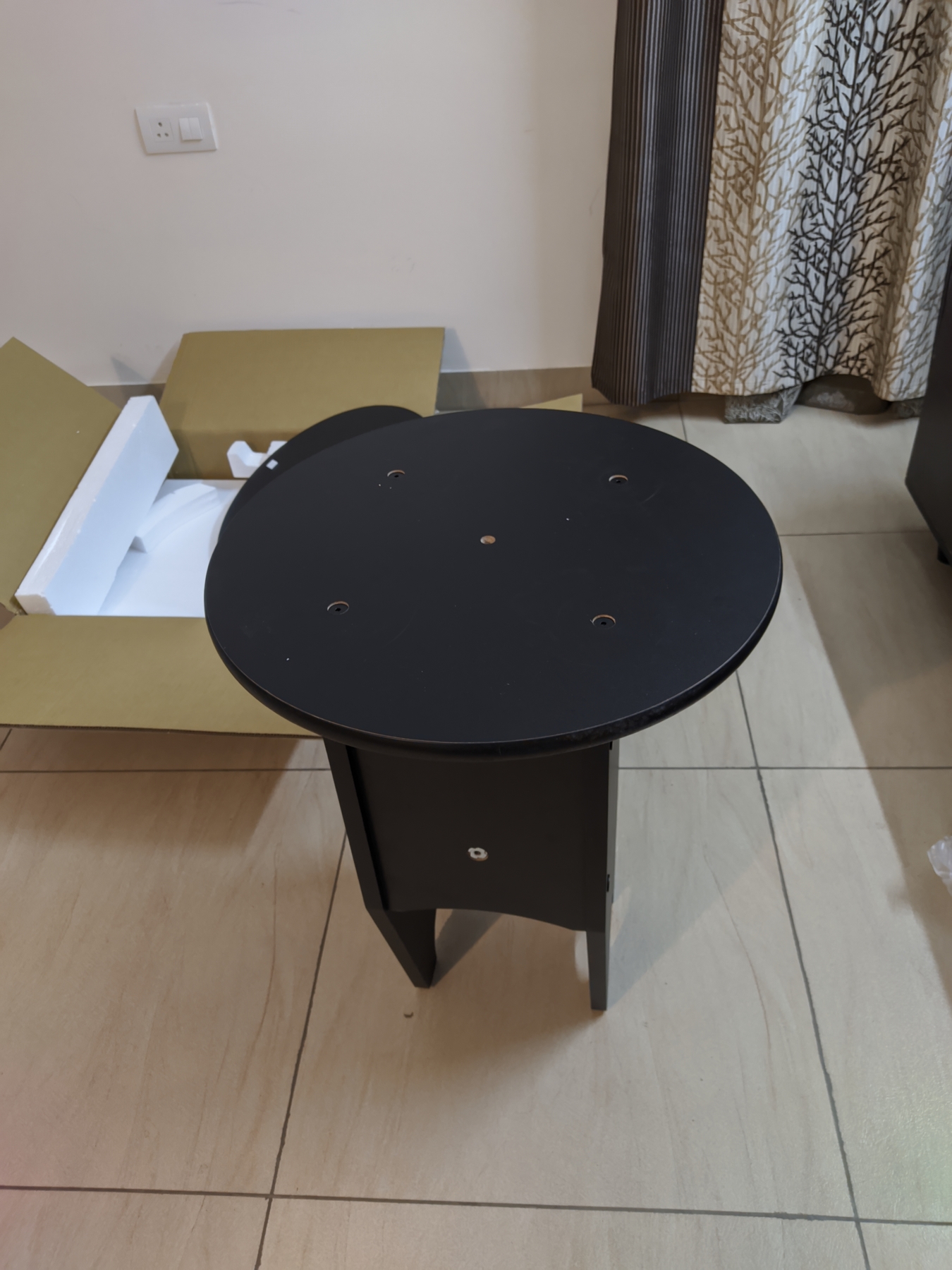
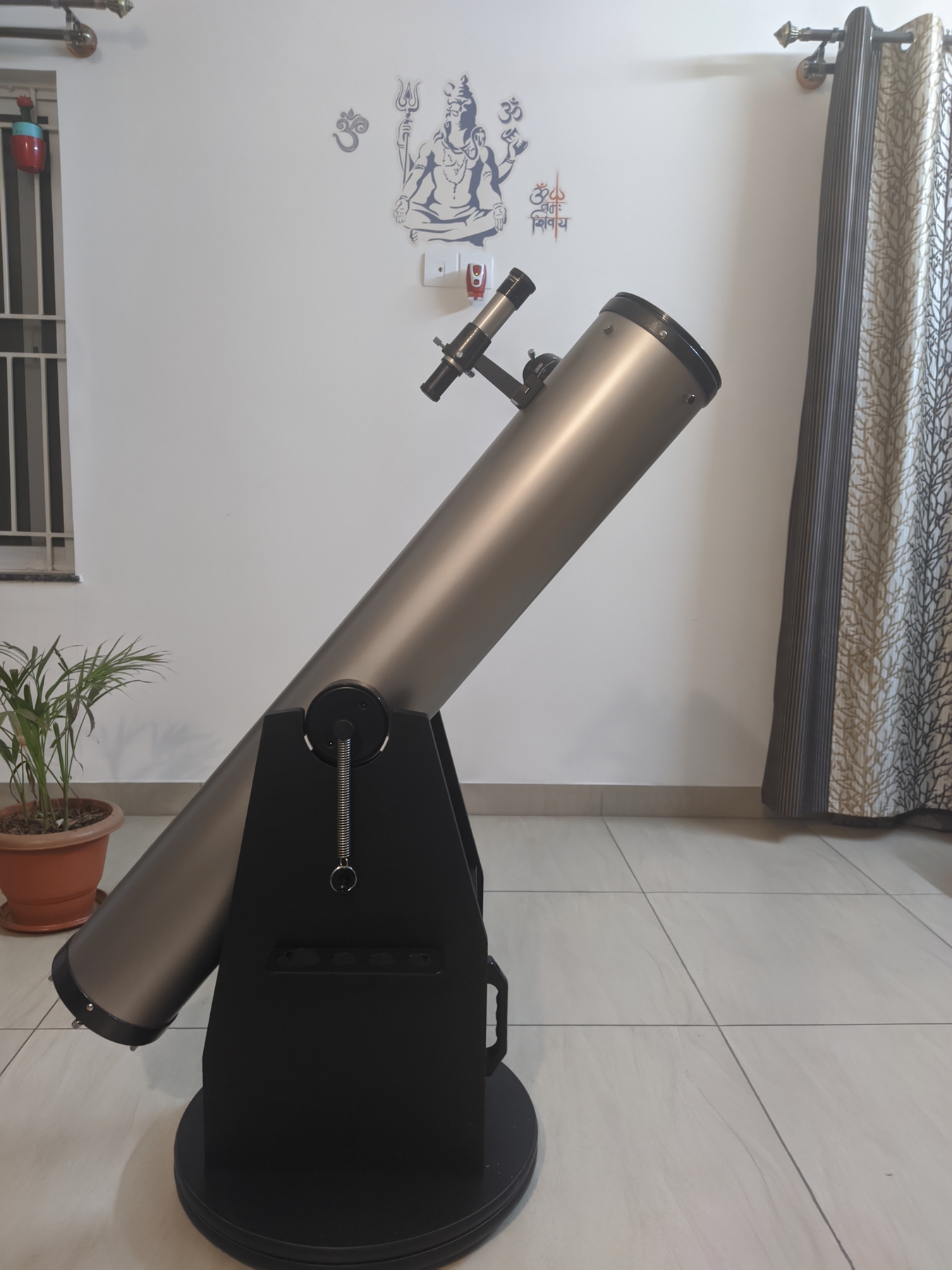
My Telescope After spending so much of the time reading up on types of telescopes, my conclusion was that a scope with high aperture and focal length was the way to go forward. This made me shorten the list to Dobsonians. But the Dobsonians aren t a very cheap telescope, whether manual or automatic. My final decision made me acquire a 6" Dobsonian Telescope. It is a Newtonian Reflecting Telescope with a 1200mm focal length and 150mm diameter. Another thing about this subject is that most of the stuff you do in Astronomy; right from the telescope selection, to installation, to star gazing; most of it is DIY, so your mileage may vary with the end result and experience. For me, installation wasn t very difficult. I was able to assemble the base Dobsonian mount and the scope in around 2 hours. But the installation manual, I had been provided with, was very brief. I ended up with one module in the mount wrongly fit, which I was able to fix later, with the help of online forums.
Dobsonian Mount
Dobsonian Mount
In this image you can see that the side facing out, where the handle will go, is wrong. If fit this way, the handle will not withstand any weight at all.
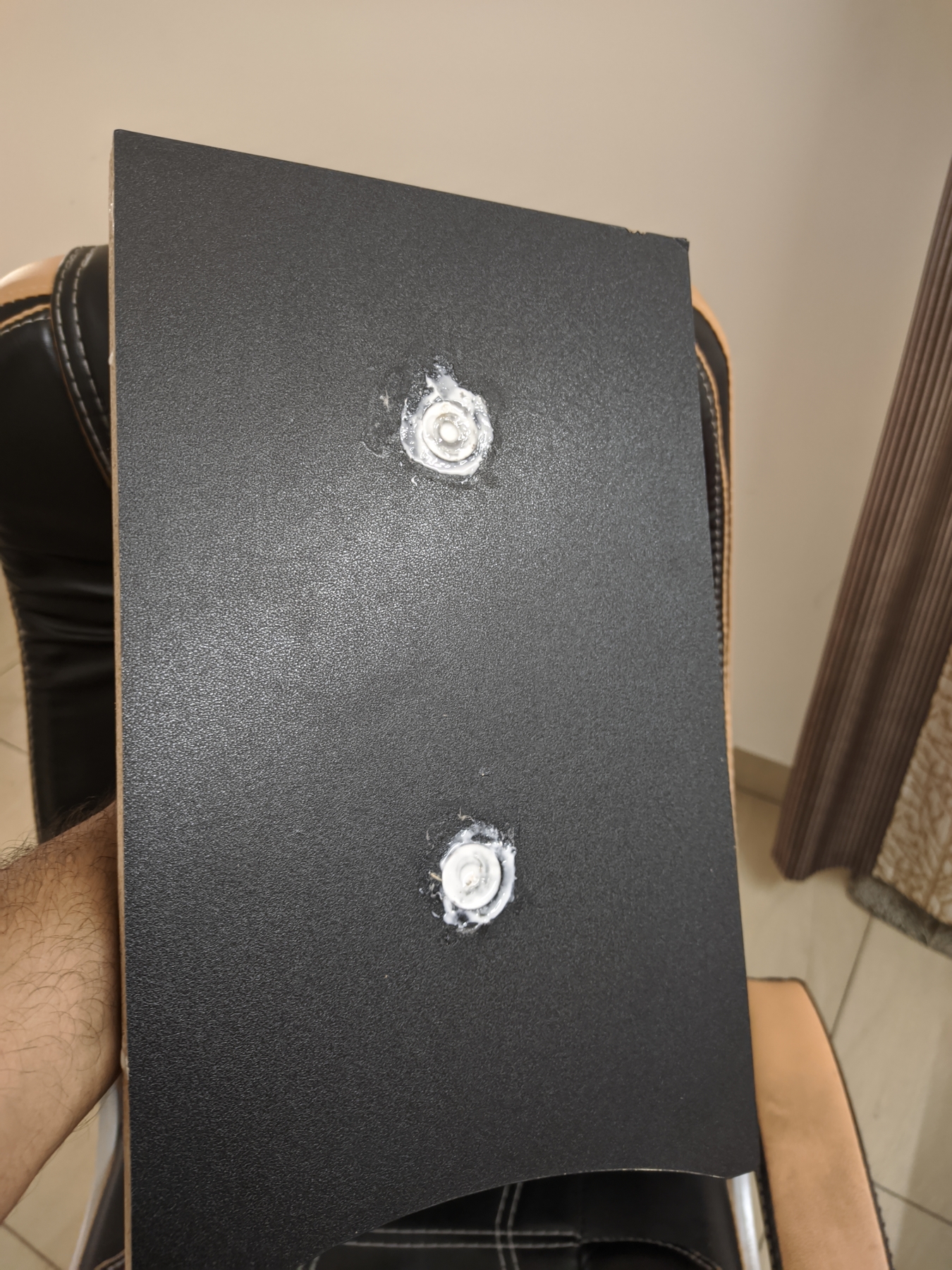
Correct Panel Side
Correct Panel Side
The right fix of the handle base board. In this image, the handle is on the other side that I m holding. Because the initial fit put in some damage to the engineered wood, I fixed it up by sealing with some adhesive. With that, this is what my final telescope looks like.
Final Telescope
Final Telescope

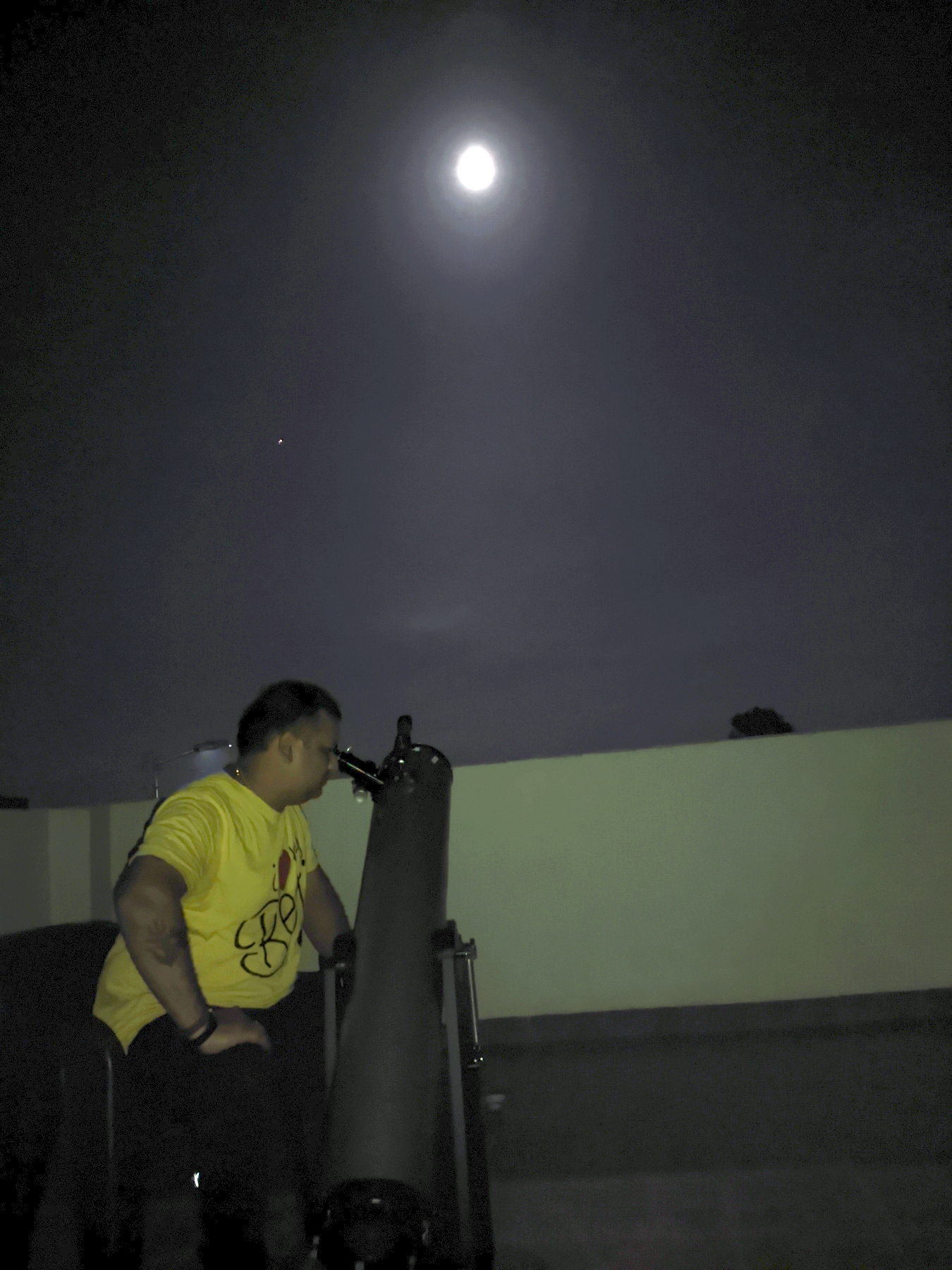
Clear Skies While the telescope was ready, the skies were not. For almost next 10 days, we had no clear skies at all. All I could do was wait. Wait so much that I had forgotten to check on the skies. Luckily, my wife noticed clear skies this week for a single day. Clear enough that we could try out our telescope for the very first time.
Me posing for a shot

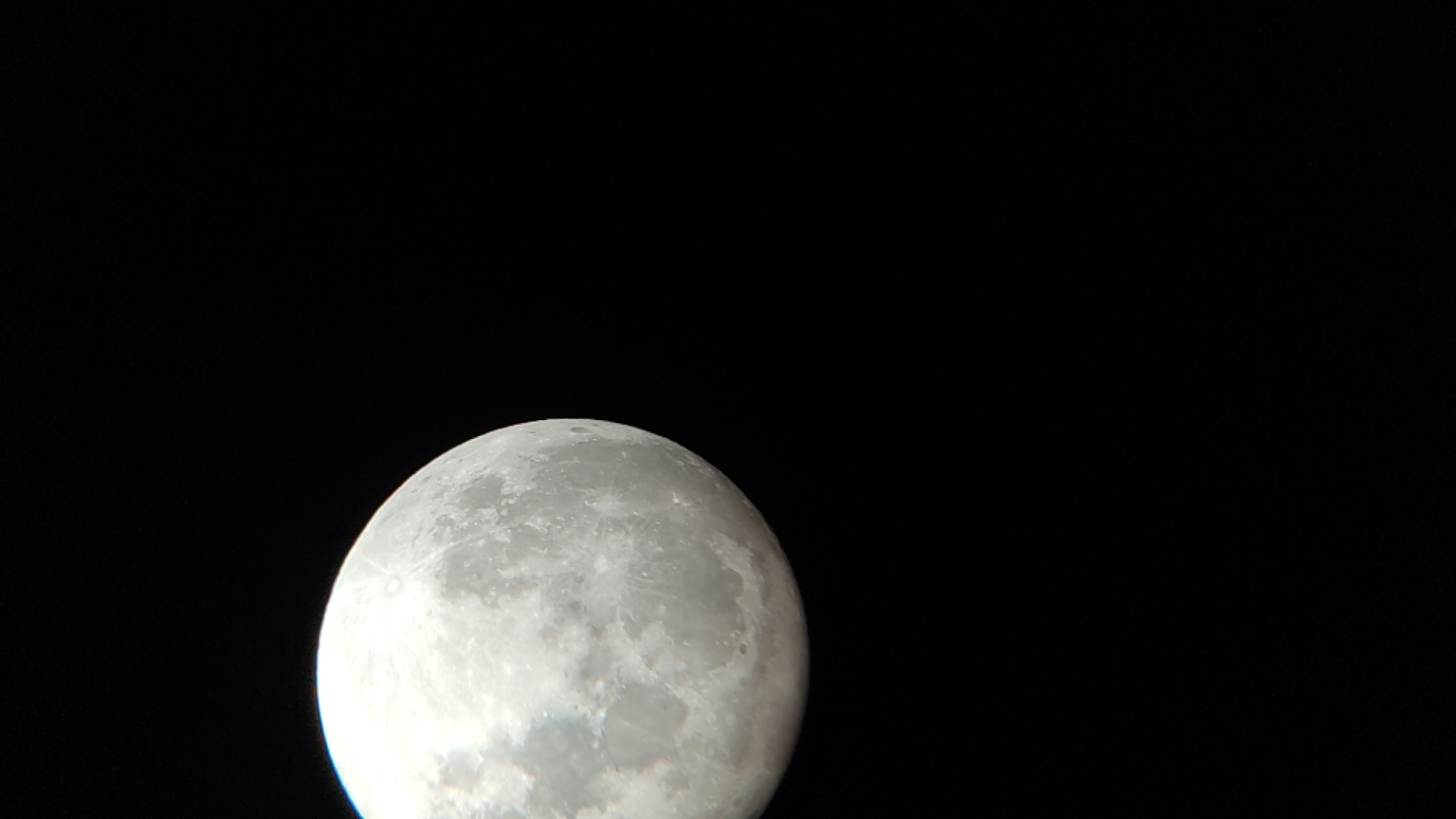
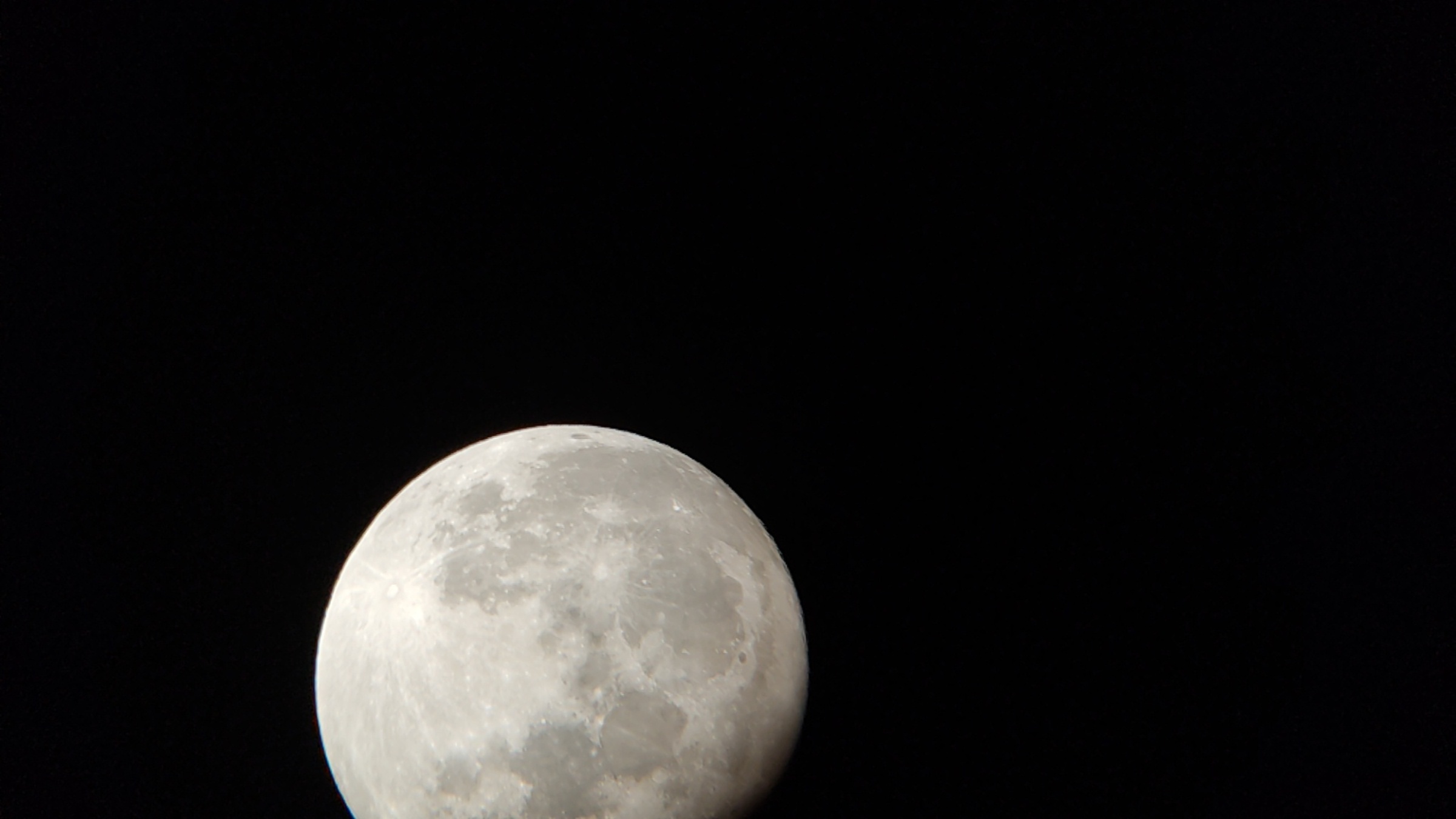
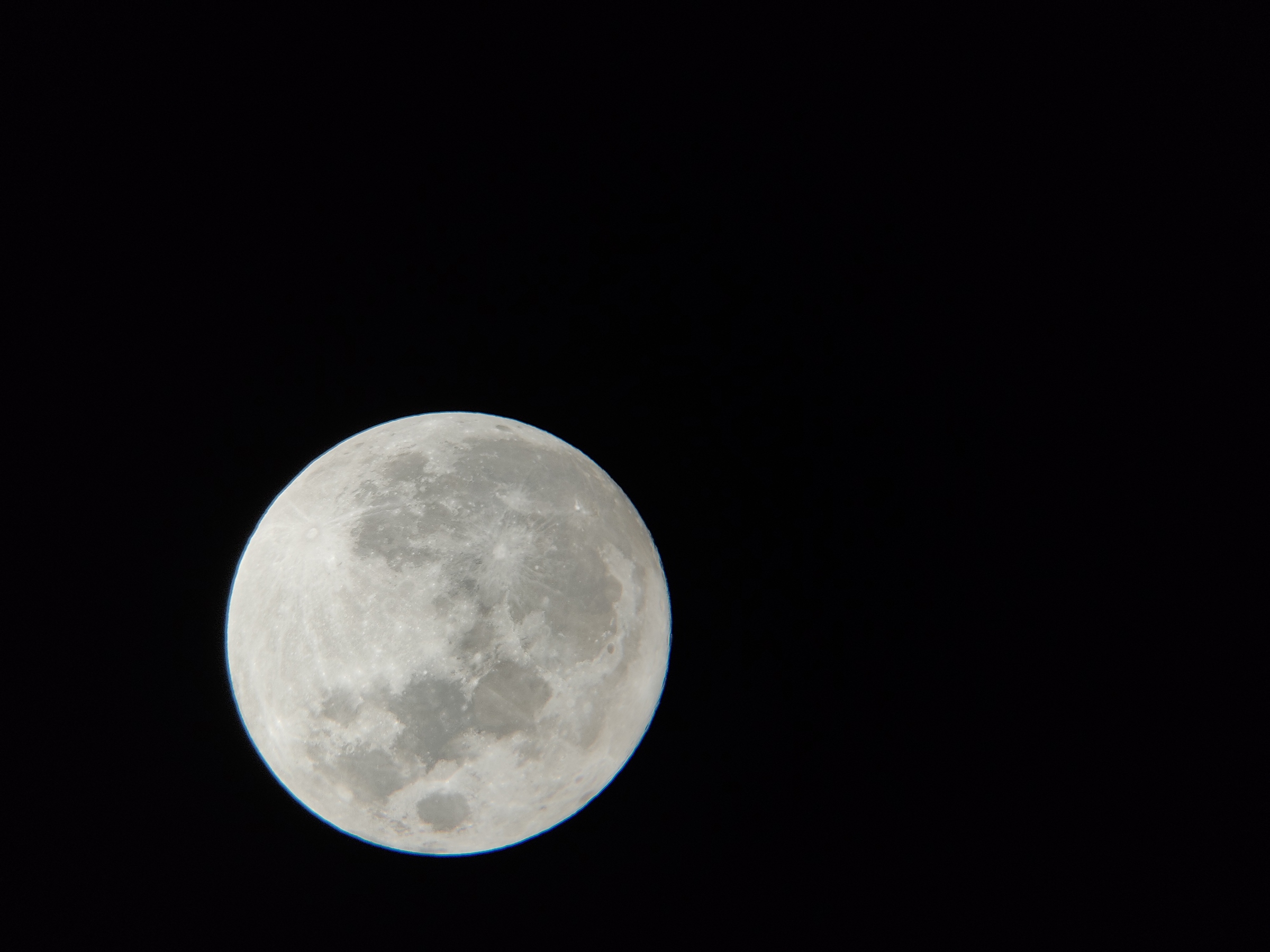
Telescope As I said earlier, in my opinion, it takes a lot of patience and perseverance on this subject. And most of the things here are DIY. To start with, we targeted the Moon. Because it is easy. I pointed the scope to the moon, then looked into the finder scope to center it, and then looked through the eyepiece. And blank. Nothing out there. Turns out, the finder scope and the viewer s angle weren t aligned. This is common and the first DIY step, when you plan to use your telescope for viewing. Since our first attempt was unplanned and just random because we luckily spotted that the skies were clear, we weren t prepared for this. Lucky enough, mapping the difference in the alignment, in the head, is not very difficult. After a couple of minutes, I could make out the point in the finder scope, where the object if projected, would show proper in the viewer. With that done, it was just mesmerizing to see the Moon, in a bit more detail, than what I ve seen all these years of my life.
Moon
Moon
Moon
Moon
Moon
Moon
Moon
Moon
The images are not exactly what we saw with our eyes. The view was much more vivid than these pictures. But as a first timer, I really wanted to capture this first moment of a closer view of the Moon. In the whole process; that of ground work studying about telescopes, installation of the telescope, astronomy basics and many other things; the most difficult part in this entire journey, was to point my phone to the viewing eyepiece, to get a shot of the object. This requirement just introduced me to astrophotography. And then, Dobsonians aren t the best model for astrophotography, to what I ve learnt so far. Hopefully, I ll find my ways to do some DIY astrophotography with the tools I have. Or extend my arsenal over time. But overall, we ve been very pleased with the subject of Astronomy. It is a different feel altogether and we re glad to have forayed into it.

2 October 2020

Ian Jackson: Mailman vs DKIM - a novel solution

tl;dr: Do not configure Mailman to replace the mail domains in From: headers. Instead, try out my small new program which can make your Mailman transparent, so that DKIM signatures survive. Background and narrative DKIM NB: This explanation is going to be somewhat simplified. I am going to gloss over some details and make some slightly approximate statements. DKIM is a new anti-spoofing mechanism for Internet email, intended to help fight spam. DKIM, paired with the DMARC policy system, has been remarkably successful at stemming the flood of joe-job spams. As usually deployed, DKIM works like this: When a message is originally sent, the author's MUA sends it to the MTA for their From: domain for outward delivery. The From: domain mailserver calculates a cryptographic signature of the message, and puts the signature in the headers of the message. Obviously not the whole message can be signed, since at the very least additional headers need to be added in transit, and sometimes headers need to be modified too. The signing MTA gets to decide what parts of the message are covered by the signature: they nominate the header fields that are covered by the signature, and specify how to handle the body. A recipient MTA looks up the public key for the From: domain in the DNS, and checks the signature. If the signature doesn't match, depending on policy (originator's policy, in the DNS, and recipient's policy of course), typically the message will be treated as spam. The originating site has a lot of control over what happens in practice. They get to publish a formal (DMARC) policy in the DNS which advises recipients what they should do with mails claiming to be from their site. As mentioned, they can say which headers are covered by the signature - including the ability to sign the absence of a particular headers - so they can control which headers downstreams can get away with adding or modifying. And they can set a normalisation policy, which controls how precisely the message must match the one that they sent. Mailman Mailman is, of course, the extremely popular mailing list manager. There are a lot of things to like about it. I choose to run it myself not just because it's popular but also because it provides a relatively competent web UI and a relatively competent email (un)subscription interfaces, decent bounce handling, and a pretty good set of moderation and posting access controls. The Xen Project mailing lists also run on mailman. Recently we had some difficulties with messages sent by Citrix staff (including myself), to Xen mailing lists, being treated as spam. Recipient mail systems were saying the DKIM signatures were invalid. This was in fact true. Citrix has chosen a fairly strict DKIM policy; in particular, they have chosen "simple" normalisation - meaning that signed message headers must precisely match in syntax as well as in a semantic sense. Examining the the failing-DKIM messages showed that this was definitely a factor. Applying my Opinions about email My Bayesian priors tend to suggest that a mail problem involving corporate email is the fault of the corporate email. However in this case that doesn't seem true to me. My starting point is that I think mail systems should not not modify messages unnecessarily. None of the DKIM-breaking modifications made by Mailman seemed necessary to me. I have on previous occasions gone to corporate IT and requested quite firmly that things I felt were broken should be changed. But it seemed wrong to go to corporate IT and ask them to change their published DKIM/DMARC policy to accomodate a behaviour in Mailman which I didn't agree with myself. I felt that instead I shoud put (with my Xen Project hat on) my own house in order. Getting Mailman not to modify messages So, I needed our Mailman to stop modifying the headers. I needed it to not even reformat them. A brief look at the source code to Mailman showed that this was not going to be so easy. Mailman has a lot of features whose very purpose is to modify messages. Personally, as I say, I don't much like these features. I think the subject line tags, CC list manipulations, and so on, are a nuisance and not really Proper. But they are definitely part of why Mailman has become so popular and I can definitely see why the Mailman authors have done things this way. But these features mean Mailman has to disassemble incoming messages, and then reassemble them again on output. It is very difficult to do that and still faithfully reassemble the original headers byte-for-byte in the case where nothing actually wanted to modify them. There are existing bug reports[1] [2] [3] [4]; I can see why they are still open. Rejected approach: From:-mangling This situation is hardly unique to the Xen lists. Many other have struggled with it. The best that seems to have been come up with so far is to turn on a new Mailman feature which rewrites the From: header of the messages that go through it, to contain the list's domain name instead of the originator's. I think this is really pretty nasty. It breaks normal use of email, such as reply-to-author. It is having Mailman do additional mangling of the message in order to solve the problems caused by other undesirable manglings! Solution! As you can see, I asked myself: I want Mailman not modify messages at all; how can I get it to do that? Given the existing structure of Mailman - with a lot of message-modifying functionality - that would really mean adding a bypass mode. It would have to spot, presumably depending on config settings, that messages were not to be edited; and then, it would avoid disassembling and reassembling the message at at all, and bypass the message modification stages. The message would still have to be parsed of course - it's just that the copy send out ought to be pretty much the incoming message. When I put it to myself like that I had a thought: couldn't I implement this outside Mailman? What if I took a copy of every incoming message, and then post-process Mailman's output to restore the original? It turns out that this is quite easy and works rather well! outflank-mailman outflank-mailman is a 233-line script, plus documentation, installation instructions, etc. It is designed to run from your MTA, on all messages going into, and coming from, Mailman. On input, it saves a copy of the message in a sqlite database, and leaves a note in a new Outflank-Mailman-Id header. On output, it does some checks, finds the original message, and then combines the original incoming message with carefully-selected headers from the version that Mailman decided should be sent. This was deployed for the Xen Project lists on Tuesday morning and it seems to be working well so far. If you administer Mailman lists, and fancy some new software to address this problem, please do try it out. Matters arising - Mail filtering, DKIM Overall I think DKIM is a helpful contribution to the fight against spam (unlike SPF, which is fundamentally misdirected and also broken). Spam is an extremely serious problem; most receiving mail servers experience more attempts to deliver spam than real mail, by orders of magnitude. But DKIM is not without downsides. Inherent in the design of anything like DKIM is that arbitrary modification of messages by list servers is no longer possible. In principle it might be possible to design a system which tolerated modifications reasonable for mailing lists but it would be quite complicated and have to somehow not tolerate similar modifications in other contexts. So DKIM means that lists can no longer add those unsubscribe footers to mailing list messages. The "new way" (RFC2369, July 1998), to do this is with the List-Unsubscribe header. Hopefully a good MUA will be able to deal with unsubscription semiautomatically, and I think by now an adequate MUA should at least display these headers by default. Sender: There are implications for recipient-side filtering too. The "traditional" correct way to spot mailing list mail was to look for Resent-To:, which can be added without breaking DKIM; the "new" (RFC2919, March 2001) correct way is List-Id:, likewise fine. But during the initial deployment of outflank-mailman I discovered that many subscribers were detecting that a message was list traffic by looking at the Sender: header. I'm told that some mail systems (apparently Microsoft's included) make it inconvenient to filter on List-Id. Really, I think a mailing list ought not to be modifying Sender:. Given Sender:'s original definition and semantics, there might well be reasonable reasons for a mailing list posting to have different From: and and then the original Sender: ought not to be lost. And a mailing list's operation does not fit well into the original definition of Sender:. I suspect that list software likes to put in Sender mostly for historical reasons; notably, a long time ago it was not uncommon for broken mail systems to send bounces to the Sender: header rather than the envelope sender (SMTP MAIL FROM). DKIM makes this more of a problem. Unfortunately the DKIM specifications are vague about what headers one should sign, but they pretty much definitely include Sender: if it is present, and some materials encourage signing the absence of Sender:. The latter is Exim's default configuration when DKIM-signing is enabled. Franky there seems little excuse for systems to not readily support and encourage filtering on List-Id, 20 years later, but I don't want to make life hard for my users. For now we are running a compromise configuration: if there wasn't a Sender: in the original, take Mailman's added one. This will result in (i) misfiltering for some messages whose poster put in a Sender:, and (ii) DKIM failures for messages whose originating system signed the absence of a Sender:. I'm going to mine the db for some stats after it's been deployed for a week or so, to see which of these problems is worst and decide what to do about it. Mail routing For DKIM to work, messages being sent From: a particular mail domain must go through a system trusted by that domain, so they can be signed. Most users tend to do this anyway: their mail provider gives them an IMAP server and an authenticated SMTP submission server, and they configure those details in their MUA. The MUA has a notion of "accounts" and according to the user's selection for an outgoing message, connects to the authenticated submission service (usually using TLS over the global internet). Trad unix systems where messages are sent using the local sendmail or localhost SMTP submission (perhaps by automated systems, or perhaps by human users) are fine too. The smarthost can do the DKIM signing. But this solution is awkward for a user of a trad MUA in what I'll call "alias account" setups: where a user has an address at a mail domain belonging to different people to the system on which they run their MUA (perhaps even several such aliases for different hats). Traditionally this worked by the mail domain forwarding incoming the mail, and the user simply self-declaring their identity at the alias domain. Without DKIM there is nothing stopping anyone self-declaring their own From: line. If DKIM is to be enabled for such a user (preventing people forging mail as that user), the user will have to somehow arrange that their trad unix MUA's outbound mail stream goes via their mail alias provider. For a single-user sending unix system this can be done with tolerably complex configuration in an MTA like Exim. For shared systems this gets more awkward and might require some hairy shell scripting etc.
edited 2020-10-01 21:22 and 21:35 and -02 10:50 +0100 to fix typos and 21:28 to linkify "my small program" in the tl;dr


comment count unavailable comments

Junichi Uekawa: Already october.

Already october. I tried moving to vscode from emacs but I have so far only installed the editor. emacs is my workflow engine, so it's hard to migrate everything.

1 October 2020

Sylvain Beucler: Debian LTS and ELTS - September 2020

Debian LTS Logo Here is my transparent report for my work on the Debian Long Term Support (LTS) and Debian Extended Long Term Support (ELTS), which extend the security support for past Debian releases, as a paid contributor. In September, the monthly sponsored hours were split evenly among contributors depending on their max availability - I was assigned 19.75h for LTS (out of my 30 max; all done) and 20h for ELTS (out of my 20 max; all done). ELTS - Jessie LTS - Stretch Documentation/Scripts

Molly de Blanc: Free Software Activities September 2020

I haven t done one of these in a while, so let s see how it goes.

Debian The Community Team has been busy. We re planning a sprint to work on a bigger writing project and have some tough discussions that need to happen.
I personally have only worked on one incident, but we ve had a few others come in.
I m attempting to step down from the Outreach team, which is more work than I thought it would be. I had a very complicated relationship with the Outreach team. When no one else was there to take on making sure we did GSoC and Outreachy, I stepped up. It wasn t really what I wanted to be doing, but it s important. I m glad to have more time to focus on other things that feel more aligned with what I m trying to work on right now.

GNOME In addition to, you know, work, I joined the Code of Conduct Committee. Always a good time! Rosanna and I presented at GNOME Onboard Africa Virtual about the GNOME CoC. It was super fun!

Digital Autonomy Karen and I did an interview on FLOSS Weekly with Doc Searls and Dan Lynch. Super fun! I ve been doing some more writing, which I still hope to publish soon, and a lot of organization on it. I m also in the process of investigating some funding, as there are a few things we d like to do that come with price tags. Separately, I started working on a video to explain the Principles. I m excited!

Misc I started a call that meets every other week where we talk about Code of Conduct stuff. Good peeps. Into it.

Russ Allbery: Review: Harrow the Ninth

Review: Harrow the Ninth, by Tamsyn Muir
Series: The Locked Tomb #2
Publisher: Tor
Copyright: 2020
ISBN: 1-250-31320-1
Format: Kindle
Pages: 510
Harrow the Ninth is a direct sequel to Gideon the Ninth and under absolutely no circumstances should you start reading here. You would be so lost. If you plan on reading this series, read the books as closely together as you can so that you can remember the details of the previous book. You may still resort to re-reading or searching through parts of the previous book as you go. Muir is doing some complex structural work with Harrow the Ninth, so it's hard to know how much to say about it without spoiling some aspect of it for someone. I think it's safe to say this much: As advertised by the title, we do get a protagonist switch to Harrowhark. However, unlike Gideon the Ninth, it's not a single linear story. The storyline that picks up after the conclusion of Gideon is interwoven with apparent flashbacks retelling the story of the previous book from Harrowhark's perspective. Or at least it might have been the story of the previous book, except that Ortus is Harrowhark's cavalier, Gideon does not appear, and other divergences from the story we previously read become obvious early on. (You can see why memory of Gideon the Ninth is important.) Oh, and one of those storylines is written in the second person. Unlike some books that use this as a gimmick, this is for reasons that are eventually justified and partly explained in the story, but it's another example of the narrative complexity. Harrow the Ninth is dropping a lot of clues (and later revelations) in both story events and story structure, many of which are likely to upend reader expectations from the first book. I have rarely read a novel that is this good at fulfilling the tricky role of the second book of a trilogy. Gideon the Ninth was, at least on the surface, a highly entertaining, linear, and relatively straightforward escape room mystery, set against a dying-world SF background that was more hinted at than fleshed out. Harrow the Ninth revisits and reinterprets that book in ways that add significant depth without feeling artificial. Bits of scenery in the first book take on new meaning and intention. Characters we saw only in passing get a much larger role (and Abigail is worth the wait). And we get a whole ton of answers: about the God Emperor, about Lyctors, about the world, about Gideon and Harrowhark's own pasts and backgrounds, and about the locked tomb that is at the center of the Ninth House. But there is still more than enough for a third book, including a truly intriguing triple cliffhanger ending. Harrow the Ninth is both satisfying in its own right and raises new questions that I'm desperate to see answered in the third book. Also, to respond to my earlier self on setting, this world is not a Warhammer 40K universe, no matter how much it may have appeared in the glimpses we got in Gideon. The God Emperor appears directly in this book and was not at all what I was expecting, if perhaps even more disturbing. Muir is intentionally playing against type, drawing a sharp contrast between the God Emperor and the dramatic goth feel of the rest of the universe and many of the characters, and it's creepily effective and goes in a much different ethical direction than I had thought. (That said, I will warn that properly untangling the ethical dilemmas of this universe is clearly left to the third book.) I mentioned in my review of Gideon the Ninth that I was happy to see more SF pulling unapologetically from fanfic. I'm going to keep beating that drum in this review in part because I think the influence may be less obvious to the uninitiated. Harrow the Ninth is playing with voice, structure, memory, and chronology in ways that I suspect the average reader unfamiliar with fanfic may associate more with literary fiction, but they would be wrongly underestimating fanfic if they did so. If anything, the callouts to fanfic are even clearer. There are three classic fanfic alternate universe premises that appear in passing, the story relies on the reader's ability to hold a canonical narrative and an alternate narrative in mind simultaneously, and the genre inspiration was obvious enough to me that about halfway through the novel I correctly guessed one of the fanfic universes in which Muir has written. (I'm not naming it here since I think it's a bit of a spoiler.) And of course there's the irreverence. There are some structural reasons why the narrative voice isn't quite as good as Gideon the Ninth at the start, but rest assured that Muir makes up for that by the end of the book. My favorite scenes in the series so far happen at the end of Harrow the Ninth: world-building, revelations, crunchy metaphysics, and irreverent snark all woven beautifully together. Muir has her characters use Internet meme references like teenagers, which is a beautiful bit of characterization because they are teenagers. In a world that's heavy on viscera, skeletons, death, and horrific monsters, it's a much needed contrast and a central part of how the characters show defiance and courage. I don't think this will work for everyone, but it very much works for me. There's a Twitter meme reference late in the book that had me laughing out loud in delight. Harrow the Ninth is an almost perfect second book, in that if you liked Gideon the Ninth, you will probably love Harrow the Ninth and it will make you like Gideon the Ninth even more. It does have one major flaw, though: pacing. This was also my major complaint about Gideon, primarily around the ending. I think Harrow the Ninth is a bit better, but the problem has a different shape. The start of the book is a strong "what the hell is going on" experience, which is very effective, and the revelations are worth the build-up once they start happening. In between, though, the story drags on a bit too long. Harrow is sick and nauseated at the start of the book for rather longer than I wanted to read about, there is one too many Lyctor banquets than I think were necessary to establish the characters, and I think there's a touch too much wandering the halls. Muir also interwove two narrative threads and tried to bring them to a conclusion at the same time, but I think she had more material for one than the other. There are moments near the end of the book where one thread is producing all the payoff revelations the reader has been waiting for, and the other thread is following another interminable and rather uninteresting fight scene. You don't want your reader saying "argh, no" each time you cut away to the other scene. It's better than Gideon the Ninth, where the last fifth of the book is mostly a running battle that went on way longer than it needed to, but I still wish Muir had tightened the story throughout and balanced the two threads so that we could stay with the most interesting one when it mattered. That said, I mostly noticed the pacing issues in retrospect and in talking about them with a friend who was more annoyed than I was. In the moment, there was so much going on here, so many new things to think about, and so much added depth that I devoured Harrow the Ninth over the course of two days and then spent the next day talking to other people who had read it, trading theories about what happened and what will happen in the third book. It was the most enjoyable reading experience I've had so far this year. Gideon the Ninth was fun; Harrow the Ninth was both fun and on the verge of turning this series into something truly great. I can hardly wait for Alecto the Ninth (which doesn't yet have a release date, argh). As with Gideon the Ninth, content warning for lots and lots of gore, rather too detailed descriptions of people's skeletons, restructuring bits of the body that shouldn't be restructured, and more about bone than you ever wanted to know. Rating: 9 out of 10

Norbert Preining: Plasma 5.20 coming to Debian

The KDE Plasma desktop is soon getting an update to 5.20, and beta versions are out for testing.
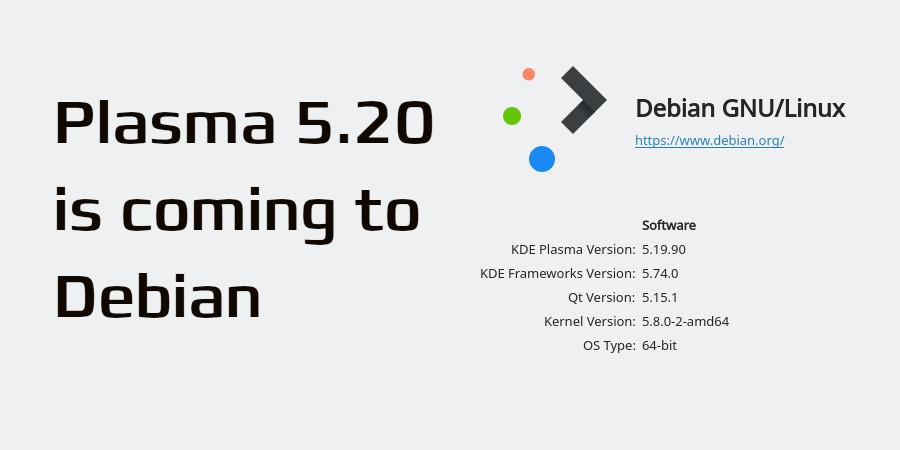
Plasma 5.20 is going to be one absolutely massive release! More features, more fixes for longstanding bugs, more improvements to the user interface!
There are lots of new features mentioned in the release announcement, I like in particular the ability that settings changed from the default can now be highlighted.
I have been providing builds of KDE related packages since quite some time now, see everything posted under the KDE tag. In the last days I have prepared Debian packages for Plasma 5.19.90 on OBS, for now only targeting Debian/experimental and amd64 architecture. These packages require Qt 5.15, which is only available in the experimental suite, and there is no way to simply update to Qt 5.15 since all Qt related packages need to be recompiled. So as long as Qt 5.15 doesn t hit unstable, I cannot really run these packages on my main machine, but I tried a clean Debian virtual machine installing only Plasma 5.19.90 and depending packages, plus some more for a pleasant desktop experience. This worked out quite well, the VM runs Plasma 5.19.90. Well, bottom line, as soon as we have Qt 5.15 in Debian/unstable, we are also ready for Plasma 5.20!

Jonathan Carter: Free Software Activities for 2020-09

This month I started working on ways to make hosting access easier for Debian Developers. I also did some work and planning for the MiniDebConf Online Gaming Edition that we ll likely announce within the next 1-2 days. Just a bunch of content that needs to be fixed and a registration bug then I think we ll be ready to send out the call for proposals. In the meantime, here s my package uploads and sponsoring for September: 2020-09-07: Upload package calamares (3.2.30-1) to Debian unstable. 2020-09-07: Upload package gnome-shell-extension-dash-to-panel (39-1) to Debian unstable. 2020-09-08: Upload package gnome-shell-extension-draw-on-your-screen (6.2-1) to Debian unstable. 2020-09-08: Sponsor package sqlobject (3.8.0+dfsg-2) for Debian unstable (Python team request). 2020-09-08: Sponsor package bidict (0.21.0-1) for Debian unstable (Python team request). 2020-09-11: Upload package catimg (2.7.0-1) to Debian unstable. 2020-09-16: Sponsor package gamemode (1.6-1) for Debian unstable (Games team request). 2020-09-21: Sponsor package qosmic (1.6.0-3) for Debian unstable (Debian Mentors / e-mail request). 2020-09-22: Upload package gnome-shell-extension-draw-on-your-screen (6.4-1) to Debian unstable. 2020-09-22: Upload package bundlewrap (4.2.0-1) to Debian unstable. 2020-09-25: Upload package gnome-shell-extension-draw-on-your-screen (7-1) to Debian unstable. 2020-09-27: Sponsor package libapache2-mod-python (3.5.0-1) for Debian unstable (Python team request). 2020-09-27: Sponsor package subliminal (2.1.0-1) for Debian unstable (Python team request).

30 September 2020

Paul Wise: FLOSS Activities September 2020

Focus This month I didn't have any particular focus. I just worked on issues in my info bubble.

Changes

Issues

Review

Administration
  • Debian wiki: unblock IP addresses, approve accounts

Communication

Sponsors The gensim, cython-blis, python-preshed, pytest-rerunfailures, morfessor, nmslib, visdom and pyemd work was sponsored by my employer. All other work was done on a volunteer basis.

Utkarsh Gupta: FOSS Activites in September 2020

Here s my (twelfth) monthly update about the activities I ve done in the F/L/OSS world.

Debian
This was my 21st month of contributing to Debian. I became a DM in late March last year and a DD last Christmas! \o/ I ve been busy with my undergraduation stuff but I still squeezed out some time for the regular Debian work. Here are the following things I did in Debian this month:

Uploads and bug fixes:

Other $things:
  • Attended the Debian Ruby team meeting. Logs here.
  • Mentoring for newcomers.
  • FTP Trainee reviewing.
  • Moderation of -project mailing list.
  • Sponsored trace-cmd for Sudip, ruby-asset-sync for Nilesh, and mariadb-mysql-kbs for William.

RuboCop::Packaging - Helping the Debian Ruby team! \o/ This Google Summer of Code, I worked on writing a linter that could flag offenses for lines of code that are very troublesome for Debian maintainers while trying to package and maintain Ruby libraries and applications! Whilst the GSoC period is over, I ve been working on improving that tool and have extended that linter to now auto-correct these offenses by itself! \o/
You can now just use the -A flag and you re done! Boom! The ultimate game-changer! Here s a quick demo for this feature: A few quick updates on RuboCop::Packaging: I ve also spent a considerable amount of time in raising awareness about this and in more general sense, about downstream maintenance.
As a result, I raised a bunch of PRs which got really good response. I got all of the 20 PRs merged upstream, fixing these issues.

Debian (E)LTS
Debian Long Term Support (LTS) is a project to extend the lifetime of all Debian stable releases to (at least) 5 years. Debian LTS is not handled by the Debian security team, but by a separate group of volunteers and companies interested in making it a success. And Debian Extended LTS (ELTS) is its sister project, extending support to the Jessie release (+2 years after LTS support). This was my twelfth month as a Debian LTS and third month as a Debian ELTS paid contributor.
I was assigned 19.75 hours for LTS and 15.00 hours for ELTS and worked on the following things:
(for LTS, I over-worked for 11 hours last month on the survey so only had 8.75 hours this month!)

LTS CVE Fixes and Announcements:

ELTS CVE Fixes and Announcements:
  • Issued ELA 274-1, fixing CVE-2020-11984, for uwsgi.
    For Debian 8 Jessie, these problems have been fixed in version 2.0.7-1+deb8u3.
  • Issued ELA 275-1, fixing CVE-2020-14363, for libx11.
    For Debian 8 Jessie, these problems have been fixed in version 2:1.6.2-3+deb8u4.
  • Issued ELA 278-1, fixing CVE-2020-8184, for ruby-rack.
    For Debian 8 Jessie, these problems have been fixed in version 1.5.2-3+deb8u4.
  • Also worked on updating the version of clamAV from v0.101.5 to v0.102.4.
    This was a bit tricky package to work on since it involved an ABI/API change and was more or less a transition. Super thanks to Emilio for his invaluable help and him taking over the package, finishing, and uploading it in the end.

Other (E)LTS Work:
  • Front-desk duty from 31-08 to 06-09 and from 28-09 onward for both LTS and ELTS.
  • Triaged apache2, cryptsetup, nasm, node-bl, plinth, qemu, rsync, ruby-doorkeeper, and uwsgi.
  • Marked CVE-2020-15094/symfony as not-affected for Stretch.
  • Marked CVE-2020- 9490,11993 /apache2 as ignored for Stretch.
  • Marked CVE-2020-8244/node-bl as no-dsa for Stretch.
  • Marked CVE-2020-24978/nasm as no-dsa for Stretch.
  • Marked CVE-2020-25073/plinth as no-dsa for Stretch.
  • Marked CVE-2020-15094/symfony as not-affected for Jessie.
  • Marked CVE-2020-14382/cryptsetup as not-affected for Jessie.
  • Marked CVE-2020-14387/rsync as not-affected for Jessie.
  • Auto EOL ed ark, collabtive, linux, nasm, node-bl, and thunderbird for Jessie.
  • Use mktemp instead of tempfile in bin/auto-add-end-of-life.sh.
  • Attended the fifth LTS meeting. Logs here.
  • General discussion on LTS private and public mailing list.

Until next time.
:wq for today.

Antoine Beaupr : Presentation tools

I keep forgetting how to make presentations. I had a list of tools in a wiki from a previous job, but that's now private and I don't see why I shouldn't share this (even if for myself!). So here it is. What's your favorite presentation tool?

Tips
  • if you have some text to present, outline keywords so that you can present your subject without reading every word
  • ideally, don't read from your slides - they are there to help people follow, not for people to read
  • even better: make your slides pretty with only a few words, or don't make slides at all
Further advice: I'm currently using Pandoc with PDF input (with a trip through LaTeX) for most slides, because PDFs are more reliable and portable than web pages. I've also used Libreoffice, Pinpoint, and S5 (through RST) in the past. I miss Pinpoint, too bad that it died. Some of my presentations are available in my GitLab.com account: See also my list of talks and presentations which I can't seem to keep up to date.

Tools

Beamer (LaTeX)
  • LaTeX class
  • Do not use directly unless you are a LaTeX expert or masochist, see Pandoc below
  • see also powerdot
  • Home page

Darkslide
  • HTML, Javascript
  • presenter notes, table of contents, Markdown, RST, Textile, themes, code samples, auto-reload
  • Home page, demo

Impress.js

Impressive
  • simply displays PDFs or images
  • page transitions, overview screen, highlighting
  • Home page

Libreoffice Impress
  • Powerpoint clone
  • Makes my life miserable
  • PDF export, presenter notes, outline view, etc
  • Home page, screenshots

Magicpoint
  • ancestor of everyone else (1997!)
  • text input format, image support, talk timer, slide guides, HTML/Postscript export, draw on slides, X11 output
  • no release since 2008
  • Home page

mdp and lookatme (commandline)

Pandoc
  • Allows converting from basically whatever into slides, including Beamer, DZSlides, reveal.js, slideous, slidy, Powerpoint
  • PDF, HTML, Powerpoint export, presentation notes, full screen background images
  • nice plain text or markdown input format
  • Home page, documentation

PDF Presenter
  • PDF presentation tool, shows presentation notes
  • basically "Keynote for Linux"
  • Home page, pdf-presenter-console in Debian

Pinpoint
  • Native GNOME app
  • Full screen slides, PDF export, live change, presenter notes, pango markup, video, image backgrounds
  • Home page
  • Abandoned since at least 2019

Reveal.js
  • HTML, Javascript
  • PDF export, Markdown, LaTeX support, syntax-highlighting, nested slides, speaker notes
  • Source code, demo

S5
  • HTML, CSS
  • incremental, bookmarks, keyboard controls
  • can be transformed from ReStructuredText (RST) with rst2s5 with python-docutils
  • Home page, demo

sent
  • X11 only
  • plain text, black on white, image support, and that's it
  • from the suckless.org elitists
  • Home page

Sozi
  • Entire presentation is one poster, zooming and jumping around
  • SVG + Javascript
  • Home page, demo

Other options Another option I have seriously considered is just generate a series of images with good resolution, hopefully matching the resolution (or at least aspect ratio) of the output device. Then you flip through a series of images one by one. In that case, any of those image viewers (not an exhaustive list) would work: Update: it turns out I already wrote a somewhat similar thing when I did a recent presentation. If you're into rants, you might enjoy the README file accompanying the Kubecon rant presentation. TL;DR: "makes me want to scream" and "yet another unsolved problem space, sigh" (refering to "display images full-screen" specifically).

Bastian Blank: Booting Debian on ThinkPad X13 AMD

Running new hardware is always fun. The problems are endless. The solutions not so much. So I've got a brand new ThinkPad X13 AMD. It features an AMD Ryzen 5 PRO 4650U, 16GB of RAM and a 256GB NVME SSD. The internal type identifier is 20UF. It runs the latest firmware as of today with version 1.09. So far I found two problems with it: Disable Secure Boot The system silently fails to boot a signed shim and grub from an USB thumb drive. I used on of the Debian Cloud images, which should properly work in this setup and do on my other systems. The only fix I found was to disable Secure Boot alltogether. Select Linux in firmware Running a Linux 5.8 with default firmware setting produces ACPI errors on each key press.
ACPI BIOS Error (bug): Could not resolve symbol [\_SB.PCI0.GPP3], AE_NOT_FOUND (20200528/psargs-330)
ACPI Error: Aborting method \_SB.GPIO._EVT due to previous error (AE_NOT_FOUND) (20200528/psparse-529)
This can be "fixed" by setting a strategic setting inside the firmware:
Config > Power > Sleep State to Linux

Chris Lamb: Free software activities in September 2020

Here is my monthly update covering what I have been doing in the free software world during September 2020 (previous month):

Reproducible Builds One of the original promises of open source software is that distributed peer review and transparency of process results in enhanced end-user security. However, whilst anyone may inspect the source code of free and open source software for malicious flaws, almost all software today is distributed as pre-compiled binaries. This allows nefarious third-parties to compromise systems by injecting malicious code into ostensibly secure software during the various compilation and distribution processes. The motivation behind the Reproducible Builds effort is to ensure no flaws have been introduced during this compilation process by promising identical results are always generated from a given source, thus allowing multiple third-parties to come to a consensus on whether a build was compromised. The project is proud to be a member project of the Software Freedom Conservancy. Conservancy acts as a corporate umbrella allowing projects to operate as non-profit initiatives without managing their own corporate structure. If you like the work of the Conservancy or the Reproducible Builds project, please consider becoming an official supporter. This month, I:

diffoscope I made the following changes to diffoscope, including preparing and uploading versions 159 and 160 to Debian:

Debian Lintian For Lintian, the static analysis tool for Debian packages, I uploaded versions 2.93.0, 2.94.0, 2.95.0 & 2.96.0 (not counting uploads to the backports repositories), as well as: Debian LTS This month I've worked 18 hours on Debian Long Term Support (LTS) and 12 hours on its sister Extended LTS project. You can find out more about the project via the following video:
Uploads Bugs filed

29 September 2020

Mike Gabriel: UBports: Packaging of Lomiri Operating Environment for Debian (part 03)

Before and during FOSDEM 2020, I agreed with the people (developers, supporters, managers) of the UBports Foundation to package the Unity8 Operating Environment for Debian. Since 27th Feb 2020, Unity8 has now become Lomiri. Recent Uploads to Debian related to Lomiri Over the past 4 months I worked on the following bits and pieces regarding Lomiri in Debian: The next two big projects / packages ahead are lomiri-ui-toolkit and qtmir. Credits Many big thanks go to Marius and Dalton for their work on the UBports project and being always available for questions, feedback, etc. Thanks to Ratchanan Srirattanamet for providing some of his time for debugging some non-thread safe unit tests (currently unsure, what package we actually looked at...). Thanks for Florian Leeber for being my point of contact for topcis regarding my cooperation with the UBports Foundation. Previous Posts about my Debian UBports Team Efforts

Next.

Previous.