Search Results: "ads"

7 July 2016

Sean Whitton: Kant and tear gas

Over the past year I ve been refining my understanding of the core claims of Kantian ethics. I ve realised that I have deeply Kantian intuitions about a lot of issues, and I understand these intuitions better now that I can put them in Kantian terms. Consider two exercises of state power: riot police suppressing protesters by non-lethal means, and soldiers shooting protesters to death. I feel more uncomfortable thinking about the first: there s something altogether more sinister about it than the second, even though the second is much more sad. I think that the reason is that non-lethal weaponry is designed to take away people s agency, and it often achieves this aim by means of emotional manipulation. Riot police use so-called baton charges to incite fearful retreat. Protesters have reasoned that in their political situation, they have a duty to resist the incumbent government. Riot police seek to unseat this conviction and cause fear to determine what the protesters will do. In Kantian terms, the riot police fail to respect the moral agency of the protesters by seeking to unseat the moral personality s determination of what the protester will do. A controversial example that Kant uses to make this point is the axe murderer case. Kant asks us to imagine that someone bangs on our front door and begs us to hide him in our house, because someone who wishes to kill him is coming up behind them. We do so. When the axe murderer arrives, he goes door-to-door and asks us whether the intended victim is in each house. Kant says that it is morally wrong to lie to the axe murderer and say that the victim is not in your house. How could this be? Surely there is a moral duty to protect the victim from being killed? Indeed there is, but when it comes into conflict with the duty not to lie, that second duty wins out. That s because respecting the moral agency of individuals is paramount. In this case, we would fail to respect the murderer s agency if we didn t allow him to take the decision to murder or not murder the victim; by lying to him we (disrespectfully) bypass his choice as to whether to do it. It s obviously crazy to say that we are morally required to give up the victim. Kant gives the wrong answer in this case. However, the case definitely reveals a requirement to respect other people s view of what they should do, and give them a chance to do it. Similarly it seems like we shouldn t give semi-automatics to our riot police, but there s something wrong with a lot of what they do. During the recent campaigns about Britain s EU referendum, some criticised Jeremy Corbyn s campaigning on the grounds that he failed to make an emotional appeal, instead asking people to make their own rational decision when they come to cast their vote. So he lost out the emotional appeals other people were making. It seems that he was successfully respecting individual agency. You ve got to give people a chance to live up to their own idea of what they should do. I m not sure how to reconcile these various ideas, and I m not sure what it says about me that I find non-lethal weaponry as uncomfortable as I do.

Daniel Pocock: Can you help with monitoring packages in Debian and Ubuntu?

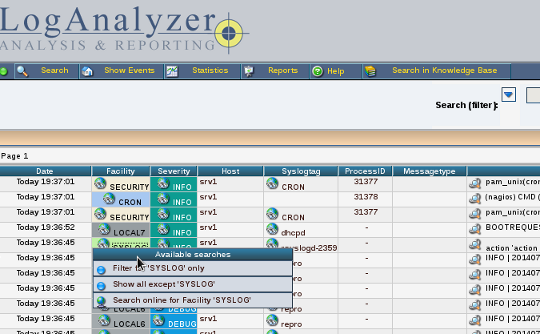
Debian (and consequently Ubuntu) contains a range of extraordinarily useful monitoring packages. I've been maintaining several of them at a basic level but as more of my time is taken up by free Real-Time Communications software, I haven't been able to follow the latest upstream releases for all of the other packages I maintain. The versions we are distributing now still serve their purpose well, but as some people would like newer versions, I don't want to stand in the way. Monitoring packages are for everyone. Even if you are a single user or developer with a single desktop or laptop and no servers, you may still find some of these packages useful. For example, after doing an apt-get upgrade or dist-upgrade, it can be extremely beneficial to look at your logs in LogAnalyzer with all the errors and warnings colour-coded so you can see at a glance whether your upgrade broke anything. If you are testing new software before a release or trying to troubleshoot erratic behavior, this type of colour-coded feedback can also help you focus on possible problems without the eyestrain of tailing a logfile. LogAnalyzer How to help A good first step is simply looking over the packages maintained by the pkg-monitoring group and discovering whether any of them are useful for your own needs. You may be familiar with alternatives that exist in Debian, if so, feel free to comment on whether you believe any of these packages should be dropped by cre
ating a wishlist bug against the package concerned. The next step is joining the pkg-monitoring mailing list. If you are a Debian Developer or Debian Maintainer with upload rights already, you can join the group on alioth. If you are not at that level yet, you are still very welcome to test new versions of the packages and upload them on mentors.debian.net and then join the mentors mailing list to look for a member of the community who can help review your work and sponsor an upload for you. Each of the packages should have a README.source file in the repository explaining more about how the package is maintained. Familiarity with Git is essential. Note that all of the packages keep their debian/* artifacts in a branch called debian/sid while the master branch tracks the upstream repository. You can clone the Debian package repositories for any of these projects from alioth and build them yourself, try building packages of new upstream versions and try to investigate any of the bug reports submitted to Debian. Some of the bugs may have already been fixed by upstream changes and can be marked appropriately. Integrating your monitoring systems Two particular packages I would like to highlight are ganglia-nagios-bridge and syslog-nagios-bridge. They are not exclusively for Nagios and could also be used with Icinga or other monitoring dashboards. The key benefit of these packages is that all the alerting is consolidated in a single platform, Nagios, which is able to display them in a colour-coded dashboard and intelligently send notifications to people in a manner that is fully configurable. If you haven't integrated your monitoring systems already, these projects provide a simple and lightweight way to start doing so.

Ben Hutchings: Debian LTS work, June 2016

I was assigned another 15 hours of work by Freexian's Debian LTS initiative and carried over 5 from last month. I worked a total of 19 hours, carrying over 1. I spent a week in the Front Desk role and triaged many new security issues for wheezy. I prepared the Linux 3.2.81 stable update, sent it out for review and finally released it. I then rebased the wheezy-security branch on top of that and added some later security fixes that were not yet suitable for a kernel.org update. I uploaded to wheezy-security and issued DLA-516-1. I started working on the next Linux stable updates (3.2.82 and the next wheezy LTS update) and on an update for imagemagick, but haven't uploaded anything for them yet.

Markus Koschany: My Free Software Activities in June 2016

My monthly report covers what I have been doing for Debian. I write it for Debian s Long Term Support sponsors but also for the wider free software community in the hope that it might inspire people to get more involved with Debian or free software in general. Debian Android Debian Games Debian Java Debian LTS This was my fifth month as a paid contributor and I have been paid to work 19,75 hours on Debian LTS. In that time I did the following: QA uploads

6 July 2016

Bits from Debian: Debian Perl Sprint 2016

Six members of the Debian Perl team met in Zurich over the weekend from May 19 to May 22 to continue the development around perl for Stretch and to work on QA across 3000+ packages. The participants had a good time, met friends from local groups and even found some geocaches. Obviously, the sprint was productive this time too: The full report was posted to the relevant Debian mailing lists. The participants would like to thank the ETH Zurich for hosting us, and all donors to the Debian project who helped to cover a large part of our expenses.

Joey Hess: twenty years of free software -- part 9 small projects

ey dad sometimes asks when I'll finish git-annex. The answer is "I don't know" because software like that doesn't have a defined end point; it grows and changes in response to how people use it and how the wider ecosystem develops. But other software has a well-defined end point and can be finished. Some of my smaller projects that are more or less done include electrum-mnemonic, brainfuck-monad, scroll, yesod-lucid haskell-mountpoints. Studies of free software projects have found that the average free software project was written entirely by one developer, is not very large, and is not being updated. That's often taken to mean it's a failed or dead project. But all the projects above look that way, and are not failures, or dead. It's good to actually finish some software once in a while! Next: twenty years of free software -- part 10 shell-monad

Daniel Pocock: Avoiding SMS vendor lock-in with SMPP

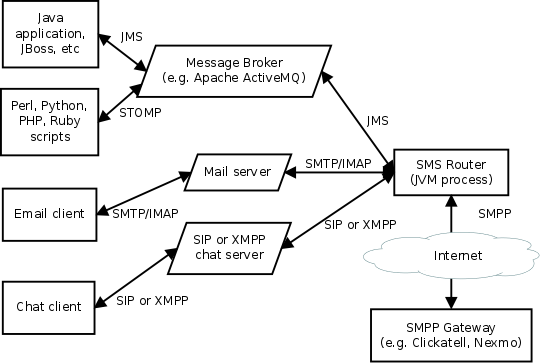
There is increasing demand for SMS notifications about monitoring alerts, trading notifications, flight delays and other events. Various companies are offering SMS transmission services to meet this demand and many of them aggressively pushing their own proprietary interfaces to the SMS world rather than using the more open and widely supported SMPP. There is good reason for this: if users write lots of of scripts to access the REST API of an SMS service, the users won't be able to change their service provider without having to change all their code. Well, that is good if you are an SMPP vendor but not if you are their customer. If an SMS gateway company goes out of business or has a system meltdown, the customers linked to their REST API will have a much bigger effort to migrate to a new provider than those using SMPP. The HTTP REST APIs offered by many vendors hide some details of the SMS protocol and payload. At first glance, this may feel easier. In fact, this leads to unpredictable results when delivering messages to users in different countries and different character sets/languages. It is better to start with SMPP from the beginning and avoid discovering those pitfalls later. The SMS Router free/open source software project helps overcome the SMPP learning curve by using APIs you are already familiar with. More troublesome for large organizations, some of the REST APIs offered by SMS gateways want to make callbacks to your own servers: this means your servers need public IP addresses accessible from the Internet. In some organizations that can take months to organize. SMPP works over one or more outgoing TCP connections initiated from your own server(s) and doesn't require any callback connections from the SMPP gateway. SMS Router lets SMS users have the best of both worlds: the flexibility of linking to any provider who supports SMPP and the convenience of putting messages into the system using any of the transports supported by an Apache Camel component. Popular examples include camel-jms (JMS) for Java and J2EE users, STOMP for scripting languages, camel-mail (SMTP and IMAP) for email integration and camel-sip (SIP) or camel-xmpp (XMPP) for chat/instant messaging systems. If you really want to, you can also create your own in-house HTTP REST API too using camel-restlet for internal applications. In all these cases, SMS Router always uses standard SMPP to reach any gateway of your choice. Architecture overview SMS Router is based on Apache Camel. Multiple instances can be operated in parallel for clustering, load balancing and high availability. It can be monitored using JMX solutions such as JMXetric. The SMPP support is based on the camel-smpp component which is in turn based on the jSMPP library, which comprehensively implements the SMPP protocol in Java. camel-smpp can be used with minimal configuration but for those who want to, many SMPP features can be tweaked on a per-message basis using various headers. The SMPP gateway settings can be configured and changed at will using the sms-router.properties file. The process doesn't require any other files or databases at runtime. The SMS Router is ready-to-run with one queue for sending messages and another queue for incoming messages. The routing logic can be customized by editing the RouteBuilder class to use other Camel components or any of Camel's wide range of functions for inspecting, modifying and routing messages. For example, you can extend it to failover to multiple SMPP gateways using Camel's load-balancer pattern. SMS Router based projects are already used successfully in production, for example, the user registration mechanism for the Lumicall secure VoIP app for Android. Getting started See the README for instructions. Feel free to ask questions about this project on the Camel users mailing list. Disclaimer SMS is not considered secure, the SMS Router developers and telecommunications industry experts discourage the use of this technology for two-factor authentication. Please see the longer disclaimer in the README file and my earlier blog about SMS logins: an illusion of security. The bottom line: if your application is important enough to need two-factor authentication, do it correctly using smart cards or tokens. There are many popular free software projects based on these full cryptographic solutions, for example, the oath-toolkit and dynalogin.

5 July 2016

Joachim Breitner: HaL deadline extended

There is this long-running workshop series Haskell in Leipzig, which is a meeting of all kinds of Haskell-interested folks (beginners, experts, developers, scientists), and for year s instance, HaL 2016, I have the honour of being the program committee chair. The original deadline passed last week, and after looking through the submissions it became clear that although the quality was good, the quantitiy was still lacking. I therefore extended the submission deadline by two weeks, until July 15th. So if you have something worth talking about, please do submit a proposal1 and come to Leipzig!. Why should you submit here? Because it gives you a platform to talk about your ideas to an audience that usually does not consist just of your fellow speakers, as it is often with purely academic workshops, but real listeners of various kinds. And it is a fun event. And why should you come to Leipzig? Because of all the interesting talks and tutorials! Of course I cannot say a lot here yet, besides that our invited speaker Alejandro Russo from Chalmers and Gothenburg University will present his work on information-flow control in Haskell (i.e., SecLib, LIO, MAC, HLIO).

  1. And if you want to save me from sleepless nights, submit the first version a few days before the deadline

Joey Hess: twenty years of free software -- part 8 github-backup

github-backup is an attempt to take something I don't like -- github's centralization of what should be a decentralized techology -- and find a constrictive way to make it at least meet my baseline requirements for centralized systems. Namely that when they go away, I don't lose data. So, it was written partly with my ArchiveTeam hat on. A recent bug filed on it, Backup fails for repositories unavailable due to DMCA takedown made me happy, because it shows github-backup behaving more or less as intended, although perhaps not in the optimal way. By the way, this is the only one of my projects that uses github for issue tracking. Intentionally ironically. It was my second real Haskell program (after git-annex) and so also served as a good exercise in applying what I'd learned about writing Haskell up to that point. Next: twenty years of free software -- part 9 small projects

Wouter Verhelst: DebConf16 videos now live

I've been tweaking the video review system which we're using here at debconf over the past few days so that videos are being published automatically after review has finished; and I can happily announce that as of a short while ago, the first two files are now visible on the meetings archive. Yes, my own talk is part of that. No, that's not a coincidence. However, the other talks should not take too long ;-) Future plans include the addition of a video RSS feed, and showing the videos on the debconf16 website. Stay tuned.

4 July 2016

Benjamin Mako Hill: Studying the relationship between remixing & learning

With more than 10 million users, the Scratch online community is the largest online community where kids learn to program. Since it was created, a central goal of the community has been to promote remixing the reworking and recombination of existing creative artifacts. As the video above shows, remixing programming projects in the current web-based version of Scratch is as easy is as clicking on the see inside button in a project web-page, and then clicking on the remix button in the web-based code editor. Today, close to 30% of projects on Scratch are remixes. Remixing plays such a central role in Scratch because its designers believed that remixing can play an important role in learning. After all, Scratch was designed first and foremost as a learning community with its roots in the Constructionist framework developed at MIT by Seymour Papert and his colleagues. The design of the Scratch online community was inspired by Papert s vision of a learning community similar to Brazilian Samba schools (Henry Jenkins writes about his experience of Samba schools in the context of Papert s vision here), and a comment Marvin Minsky made in 1984:
Adults worry a lot these days. Especially, they worry about how to make other people learn more about computers. They want to make us all computer-literate. Literacy means both reading and writing, but most books and courses about computers only tell you about writing programs. Worse, they only tell about commands and instructions and programming-language grammar rules. They hardly ever give examples. But real languages are more than words and grammar rules. There s also literature what people use the language for. No one ever learns a language from being told its grammar rules. We always start with stories about things that interest us.
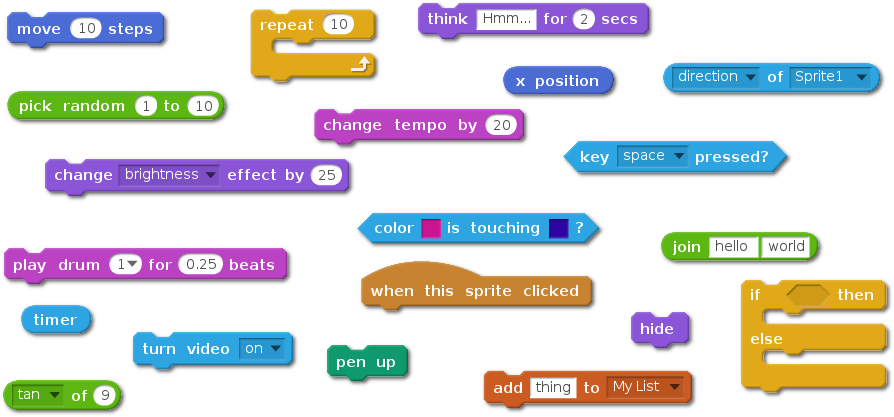
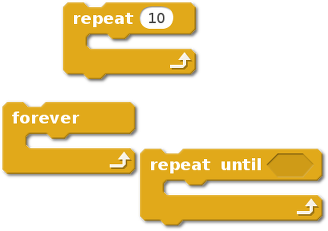
In a new paper titled Remixing as a pathway to Computational Thinking that was recently published at the ACM Conference on Computer Supported Collaborative Work and Social Computing (CSCW) conference, we used a series of quantitative measures of online behavior to try to uncover evidence that might support the theory that remixing in Scratch is positively associated with learning. scratchblocksOf course, because Scratch is an informal environment with no set path for users, no lesson plan, and no quizzes, measuring learning is an open problem. In our study, we built on two different approaches to measure learning in Scratch. The first approach considers the number of distinct types of programming blocks available in Scratch that a user has used over her lifetime in Scratch (there are 120 in total) something that can be thought of as a block repertoire or vocabulary. This measure has been used to model informal learning in Scratch in an earlier study. Using this approach, we hypothesized that users who remix more will have a faster rate of growth for their code vocabulary. Controlling for a number of factors (e.g. age of user, the general level of activity) we found evidence of a small, but positive relationship between the number of remixes a user has shared and her block vocabulary as measured by the unique blocks she used in her non-remix projects. Intriguingly, we also found a strong association between the number of downloads by a user and her vocabulary growth. One interpretation is that this learning might also be associated with less active forms of appropriation, like the process of reading source code described by Minksy. The second approach we used considered specific concepts in programming, such as loops, or event-handling. To measure this, we utilized a mapping of Scratch blocks to key programming concepts found in this paper by Karen Brennan and Mitchel Resnick. For example, in the image below are all the Scratch blocks mapped to the concept of loop . scratchblocksctWe looked at six concepts in total (conditionals, data, events, loops, operators, and parallelism). In each case, we hypothesized that if someone has had never used a given concept before, they would be more likely to use that concept after encountering it while remixing an existing project. Using this second approach, we found that users who had never used a concept were more likely to do so if they had been exposed to the concept through remixing. Although some concepts were more widely used than others, we found a positive relationship between concept use and exposure through remixing for each of the six concepts. We found that this relationship was true even if we ignored obvious examples of cutting and pasting of blocks of code. In all of these models, we found what we believe is evidence of learning through remixing. Of course, there are many limitations in this work. What we found are all positive correlations we do not know if these relationships are causal. Moreover, our measures do not really tell us whether someone has understood the usage of a given block or programming concept.However, even with these limitations, we are excited by the results of our work, and we plan to build on what we have. Our next steps include developing and utilizing better measures of learning, as well as looking at other methods of appropriation like viewing the source code of a project.
This blog post and the paper it describes are collaborative work with Sayamindu Dasgupta, Andr s Monroy-Hern ndez, and William Hale. The paper is released as open access so anyone can read the entire paper here. This blog post was also posted on Sayamindu Dasgupta s blog and on Medium by the MIT Media Lab.

Gunnar Wolf: Got the C.H.I.P.s for DebConf!

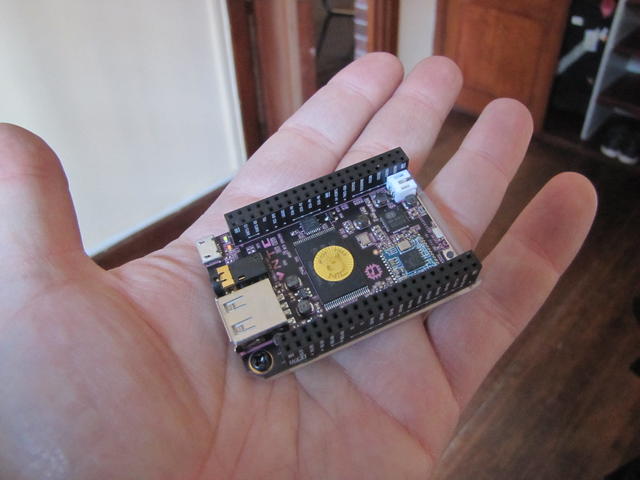
I had my strong doubts as to whether the shipment would be allowed through customs, and was happily surprised by a smiling Graham today before noon. He handed me a smallish box that arrived to his office, containing... Our fifty C.H.I.P. computers, those I offered to give away at DebConf! The little machines are quite neat. They are beautiful little devices, including even a plastic back (so you can safely work with it over a conductive surface or things like that). Quite smaller than the usual Raspberry-like format. It has more than enough GPIO to make several of my friends around here drool about the possibilities. So, what's to this machine besides a nice small ARM CPU, 512MB RAM, wireless connectivity (Wifi and bluetooth)? Although I have not yet looked into them (but intend to do so very soon!), it promises to have the freest available hardware around, and is meant for high hackability! And not that it matters But we managed to import them all, legally and completely hassle-free, into South Africa! That's right We are all used to the declaring commercial value as one dollar mindset. But... The C.H.I.P.s are actually priced at US$9 a piece. The declared commercial value is US$450. South Africans said all their customs are very hard to clear But we were able receive 50 legally shipped computers, declared at their commercial value, without any hassles! (yes, we might have been extremely lucky as well) Anyway, stay tuned By Thursday I will announce the list of people that get to take one home. I still have some left, so feel free to mail me at gwolf+chip@gwolf.org.

3 July 2016

Daniel Stender: My work for Debian in June

At least a little much more time lst month for helping to improve the operating system we're working on. I've worked on a couple of package updates, mostly they are for PAPT, DPMT, Debian Science, or pkg-go (in order of completion): New packages: Sponsored Uploads: Again some further ahead with these ones. My "new package of the month" is going to be Theano. I'm still working on the introduction, it'll come hereafter very soon.

Reproducible builds folks: Reproducible builds: week 61 in Stretch cycle

What happened in the Reproducible Builds effort between June 19th and June 25th 2016. Media coverage GSoC and Outreachy updates Toolchain fixes Other upstream fixes Emil Velikov searched on IRC for hints on how to guarantee unique values during build to invalidate shader caches in Mesa, when also no VCS information is available. A possible solution is a timestamp, which is unique enough for local builds, but can still be reproducible by allowing it to be overwritten with SOURCE_DATE_EPOCH. Packages fixed The following 9 packages have become reproducible due to changes in their build dependencies: cclib librun-parts-perl llvm-toolchain-snapshot python-crypto python-openid r-bioc-shortread r-bioc-variantannotation ruby-hdfeos5 sqlparse The following packages have become reproducible after being fixed: Some uploads have fixed some reproducibility issues, but not all of them: Patches submitted that have not made their way to the archive yet: Package reviews 139 reviews have been added, 20 have been updated and 21 have been removed in this week. New issues found: 53 FTBFS bugs have been reported by Chris Lamb, Santiago Vila and Mateusz ukasik. diffoscope development Quote of the week "My builds are so reproducible, they fail exactly every second time." Johannes Ziemke (@discordianfish) Misc. This week's edition was written by Chris Lamb (lamby), Reiner Herrmann and Holger Levsen and reviewed by a bunch of Reproducible builds folks on IRC.

Joey Hess: twenty years of free software -- part 7 git-annex

My first Haskell program, and the only software I've written that was inspired by living in a particular place, git-annex has received the lion's share of my time for five years. It was written just to solve my own problem, but in a general way, that turned out to be useful in lots of other situations. So over the first half a year or so, it started attracting some early adopters who made some very helpful suggestions. Then I did the git-annex assistant kickstarter, and started blogging about each day I worked on it. Four years of funding and seven hundred and twenty one posts later, the git-annex devblog is still going. So, I won't talk about technical details in this post, they've all been covered. One thing I wondered when starting git-annex -- besides whether I would be able to write it in Haskell at all -- was would that prevent it from getting many patches. I count roughly 65 "thanks" messages in the changelog, so it gets perhaps one patch contributed per month. It's hard to say if that's a lot or a little. Part of git-annex is supporting various cloud storage systems via "special remotes". Of those not written by me, only 1 was contributed in Haskell. Compare with 13 that use the plugin system that lets other programming languages be used. The other question about using Haskell is, did it make git-annex a better program. I think it did. The strong type system did prevent plenty of bugs, although there have still been some real howlers. The code is still not taking full advantage of the power of Haskell's type system, on the other hand it uses many Haskell libraries that do leverage the type system more. I've done more small and large refactorings of git-annex than on any other program I've written, because the strong types and referential transparency makes refactoring easier and safer in Haskell. And the code has turned out to be much more flexible, for all its static types, than the kind of code I was writing before. Examples include building the git-annex assistant, which uses the rest of git-annex as a library, and making git-annex run actions concurrently, thanks to there being no global variables to complicate things (and excellent support for concurrency and parallelism in Haskell). So: Glad I wrote it, glad I used Haskell for it, estatic that many other people have found it useful, and astounded that I've been funded to work on it for four years. Next: twenty years of free software -- part 8 github-backup

Jonathan McDowell: Confirming all use of an SSH agent

For a long time I ve wanted an ssh-agent setup that would ask me before every use, so I could slightly more comfortably forward authentication over SSH without worrying that my session might get hijacked somewhere at the remote end (I often find myself wanting to pull authenticated git repos on remote hosts). I m at DebConf this week, which is an ideal time to dig further into these things, so I did so today. As is often the case it turns out this is already possible, if you know how. I began with a setup that was using GNOME Keyring to manage my SSH keys. This isn t quite what I want (eventually I want to get to the point that I can sometimes forward a GPG agent to remote hosts for signing purposes as well), so I set about setting up gpg-agent. I used Chris excellent guide to GnuPG/SSH Agent setup as a starting point and ended up doing the following:
$ echo use-agent >> ~/.gnupg/options
$ echo enable-ssh-support >> ~/.gnupg/gpg-agent.conf
$ sudo sed -i.bak "s/^use-ssh-agent/# use-ssh-agent/" /etc/X11/Xsession.options
$ sudo rm /etc/xdg/autostart/gnome-keyring-ssh.desktop
The first 2 commands setup my local agent, and told it to do SSH agent foo. The next stopped X from firing up ssh-agent, and the final one prevents GNOME Keyring from being configured to be the SSH agent, without having to remove libpam-gnome-keyring as Chris did. After the above I logged out of and into X again, and could see ~/.gnupg/S.gpg-agent.ssh getting created and env grep SSH showing SSH_AUTH_SOCK pointing to it (if GNOME Keyring is still handling things it ends up pointing to something like /run/user/1000/keyring/ssh). [Update: Luca Capello emailed to point out this was a bad approach; there s thankfully no need to do the last 2 commands that require root. #767341 removed the need to edit Xsession.options and you can prevent GNOME Keyring starting on a per user basis with:
(cat /etc/xdg/autostart/gnome-keyring-ssh.desktop ;
 echo 'X-GNOME-Autostart-enabled=false') > \
 ~/.config/autostart/gnome-keyring-ssh.desktop
] After this it turned out all I need to do was ssh-add -c <ssh keyfile>. The -c says confirm use and results in the confirm flag being appended to the end of ~/.gnupg/sshcontrol (so if you ve already done the ssh-add you can go and add the confirm if that s the behaviour you d like). Simple when you know how, but I ve had conversations with several people in the past who wanted the same thing and hadn t figured out how, so hopefully this is helpful to others.

Joey Hess: Hacker Holler

A quiet place in which to get away and code is all I was looking for when I moved here. I found much more, but that's still the essence of the place. On returning home from the beach, I've just learned that after several years renting this house, I will soon have to leave, or buy it. The house is an EarthShip, tucked away in its own private holler (as we say here in the Appalachian Mtns of Tennessee), below a mountain that is National Forest, two miles down back roads from a river. A wonderful place to relax and code, but developing only free software for twenty years doesn't quite stretch to being able to afford buying this kind of place. But, I got to thinking of times friends were able to visit me here. Grilling over wood fires with friends from Debian. Steep hikes and river swims. Sharing dialup bandwidth between our Linux laptops. A bunch of us discussing Haskell in the living room at midnight. And too, I've many times talked about the place with someone who got a gleam in their eye, imagining themselves living there. And then there's my Yurt, my relief valve before I moved here. And a great spot I like to visit on an old logging road above a creek. Could we put all this together somehow? Might a handful of my friends be able to contribute somewhere in the range of $10 thousand to buy in? Interested? Want more details? Have ideas?

Visit the Hacker Holler website and get in touch. (Limited to folks I've met in person or spent a lot of time online with.)

Holger Levsen: I won't be going to DebConf16

With great sadness I'm acknowledging and announcing that I won't be going to DebConf16 today, due to sudden health issues (which should be ok soon). Seeing the first pictures on planet Debian a few minutes ago made me very very sad, but still didn't change my mind. Have a whole lot of fun in Cape Town, have great discussions in corridors and while hiking, enjoy the talks and the workshops and hugs to everyone who wants to be hugged. I'll follow online from the distance I('ll) miss you.

Junichi Uekawa: Looking at old code I wrote I am grumpy I used automake.

Looking at old code I wrote I am grumpy I used automake. automake / autoconf / make are three layers of historical cruft that was only necessary when commercial unices were around. When I have code that only really runs on Linux that's so redundant.

Lisandro Dami n Nicanor P rez Meyer: Upcoming KDEPIM changes in unstable (KMail, Kontact, KOrganizer, etc)

For those who care about kdepim (kmail, kontact, korganizer, etc)

Currently the latest version of kdepim is available in experimental. According to our limited tests it's working way better than kdepim 4.14 (more stable, more performant, less bugs). However migrating from one to the other is not a trivial process (distribution wise, hopefully not for our users).

Among the drawbacks in the new kdepim: knode, ktimetracker and kjots were dropped from the official kdepim components. kjots is now an independent project, not tied to the kdepim release cycle. But more importantly, knode and ktimetracker are not maintained upstream any more, we are temporarily still shipping the old KDE 4 versions, but we will drop them after stretch unless they get new upstream maintainers.

To iron out the wrinkles that are surely still there, we are now planning to start a transition for kdepim, effectively blocking all kdepim related packages in unstable until the transition is complete. This will allow us to keep the current kdepim in testing unchanged until kdepim 16.04 is ready to migrate fully to testing.

If you want to test the new kdepim versions right now, please use the version in experimental, as uploading all the packages to unstable will take some time until there is a working kdepim in unstable (mixing experimental and the unstable uploads should be fine).

If you depend on having a working kdepim, please avoid installing the new kdepim packages that will be landing in unstable in the following days, until all the components are available. We expect this will take a couple of weeks, we will post another entry when the packages are ready in unstable.

A list of the binary packages involved in the transition can be found [here].

If you find issues in the new packages, please let us know either via irc in #debian-kde, the kde mailing list debian-kde@lists.debian.org, or send us a bug report (please make sure that it wasn't reported before).

We'll send an updated note when kdepim is fully uploaded to unstable.

Happy hacking,

The Debian Qt/KDE Team.

Next.

Previous.