Search Results: "sto"

22 April 2014

Bits from Debian: Debian welcomes its 2014 GSoC students!

We're excited to announce that 19 students have been selected to work with Debian during the Google Summer of Code this year! Here is the list of accepted students and projects: As always, you will be able to follow their progress on the SoC coordination mailing-list Congratulations to all the students and let's make sure we all have an amazing summer!

Joseph Bisch: A Summer of Code

Yesterday I found out that I was accepted into the Google Summer of Code program. I was accepted by Debian and will be working on a Metrics Portal. You can view the announcement on the Debian blog. The Metrics Portal will have a database that stores historical data on Debian. It will have an interface to add/remove metrics and a web interface to show the metrics graphically. It will utilize cron jobs to update the metrics and generate graphs. The web interface will utilize JavaScript to allow the client to overlay graphs for comparison purposes. An optional task is for me to create a Debian Package of the portal code for easy deployment of the portal. I have decided to use jinja2 as the templating language, flot.js as the JavaScript graphing library, JSON for data, SQLAlchemy for database access, and marshmallow to serialize Python objects to JSON for use with flot. You can read more about the Metrics Portal by reading the project listing or by reading my proposal. To keep up to date on my progress, you can either read this blog, or you can read the soc-corrdination mailing list.

Andrew Pollock: [life] Day 84: Kindergarten Term 2 starts, I collapse on the couch for the day

Zoe had her first day back at Kindy this morning for Term 2. I couldn't believe how fast Term 1 flew by, and how little I felt I accomplished on a personal front. The two weeks of school holidays certainly put the brakes on trying to get anything much more done for myself, but Zoe and I had a great time. I was really happy with the variety of activities we were able to do, and it was nice that Zoe and Megan got to spend a reasonable amount of time together too. The weather cooperated for the majority of the time, which was the cherry on top. Zoe only had Kindergarten today this week, but Sarah has the week off, so she's going to be taking Zoe for the next couple of days, which is really convenient timing, as it'll give me time to recover from some minor surgery tomorrow without having to run around after her. I might also manage to finalise my US tax return. I'm hoping to catch a few movies with Anshu too, who also has the week off work. Zoe slept reasonably well last night. Two wake ups, but they were both quickly resolved, so we both got back to sleep quickly. I was absolutely exhausted last night, but felt positively chipper this morning. We biked to Kindergarten, and I decided to leave the trailer there to make things a bit easier for myself in the afternoon. I got home, and just felt like vegging on the couch. Then I remembered Anshu had the day off, so she came over and we hung out and had lunch. It was really nice to have a few hours during the day off. I biked back to Kindergarten, wondering if I'd have to deal with waking up Zoe from a nap, but she hadn't had a nap. We'd had a bit of a talk at breakfast about napping at Kindergarten, and I have no idea if it helped or not, but it meant we could make an orderly departure. Zoe wanted to participate in Megan's tennis class after Kindergarten, and they were down a kid, which made the warm up stuff not work so well, so the teacher was happy for Zoe to take part. I managed to extract her once the real nitty gritty of the class started. I did get a good opportunity to suss out place availability for term 3. We biked home, and I wanted to take my bike in for a service while I'm on lifting restrictions, so we drove over to Cannon Hill to drop it off. The Gold Cross bike shop has now merged into the Super Amart store, so Zoe wanted to look at everything on the way back out. We eventually emerged without buying anything. Next, we went over to Bunnings, because Zoe's been asking if we can grow some veggies and flowers from seed. That ended up being about an hour of trekking around the nursery section trying to find stuff. It was a good way to use up the afternoon. We made it out with a bag of potting mix and a few packets of seeds and a kit for growing stuff that requires a trellis. Unfortunately most of the climbing stuff (like tomatoes) are out of season now, so I'm not sure what we're going to be able to grow with the kit. We got back home, and I put dinner on and we watched a bit of TV together while it cooked. Bath time and bed time went really smoothly, as I think she was pretty tired. Here's hoping she sleeps well tonight.

Martín Ferrari: DNSSEC, DANE, SSHFP, etc

While researching some security-related stuff for a post I am currently writing, I found some interesting bits here and there that I though I should share, as they were new to me, and probably for many others.

DNSSEC The first thing is DNSSEC. I knew about it, of course, but never bothered to dig much into it. While reading about many interesting applications of DNS for key distribution, and thinking of ways to use them, it is clear that DNSSEC is a precondition for any of that to work. In case you don't know about it, it is an extension for the DNS service to make it safer, for example, to avoid the bad guys having you think that google.com points to sniffer.nsa.gov. Apart from these ber-cool applications I was thinking about, avoiding DNS-based attacks becomes more and more relevant these days. And I think Debian and the rest of the Free Software world should work on making this available to all end-users as easily as possible. While adoption still looks pretty low, there are some good news. First, Google claims its public DNS supports DNSSEC. Of course, you need to trust Google servers, and the path between your machine and them. But if your resolver supports DNSSEC, you can use their servers and validate the answers. On the other side, I am not too sure about their implementation, as half of the time, it would return a valid answer to a query for an invalid record: dig +dnssec sigfail.verteiltesysteme.net @8.8.8.8). Also, they have not published DNSSEC records for google.com, which seems crazy. Some packages included in Debian already take advantage of DNSSEC, if available (more on that later), but more importantly, there are a couple of DNSSEC-enabled recursive servers, including bind, unbound, and the more commonly-used dnsmasq (there is a wiki page summarising Debian's status). Sadly, the default configuration for dnsmasq does not enable DNSSEC, and most people will not use it, even if it installed, because DHCP-provided servers are usually preferred. It seems to me that it would be wise to have a package that would install dnsmasq with DNSSEC enabled, and make it the only valid resolver for the system. If you want to check if your resolver is correctly validating DNSSEC, you can use this test web page. Another good news is that many top-level domains already support DNSSEC, and in my case, Gandi.net has support in place to set it up. So I am going to look into enabling it for my own domain.

SSHFP One useful and simple advantage of using DNSSEC, is that you can store information there, and then trust it to be correct. One new DNS RR (resource record) that is useful in this context is the SSHFP RR, which allows the sysadmin of a host to publish the host SSH key fingerprint in the DNS zone. The ssh client, when enabling the VerifyHostKeyDNS option, will use that information to trust unknown hosts. One downside to this, is that either if you set the option to ask, or if your resolver does not support DNSSEC, you get the same message, which does not warn you about the extra risk. To help you create your DNS records, you can just run this command:
$ ssh-keygen -r brie.tincho.org
brie.tincho.org IN SSHFP 1 1 6ac93c63379828b5b75847bc37d8ab2b48983343
brie.tincho.org IN SSHFP 2 1 cf0d11515367e3aa7eeb37056688f11b53c8ef23

DANE, S/MIME and GPG Recently, while at FOSDEM, I attended talks that mentioned DANE. This proposed IETF standard introduces a mechanism to use DNS as a secure key distribution system, which could completely override the CA oligopoly, a very attractive proposition for many people. In short, it is very similar to the SSHFP mechanism, but it is not restricted to SSH host keys: it can be used to distribute public key information for any TLS-enabled service. So, instead (or in addition to) of having a CA sign your certificate, and relying on the chain of trust by means of having a local copy of all root CA certificates, you use the chain of trust embedded in DNSSEC to make sure that the DNS RRs you publish are valid. Then, the client application can trust the fingerprint published for the relevant service to verify that it is talking to the right server. This is a very exciting development, and I hope it gets widespread adoption. It is already supported in Postfix, there seem to be some work going on in Mozilla, as well as in Prosody which is a great start. Another exciting development of this, is the generalisation of DANE for other entities, like email addresses. There are two draft RFCs being worked on right now to deploy S/MIME and OpenPGP key material using DNSSEC. This could also change completely the way we manage the Web of Trust.

21 April 2014

John Goerzen: A Dry Spring

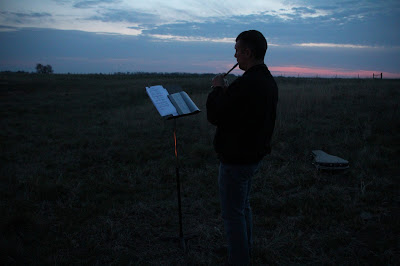
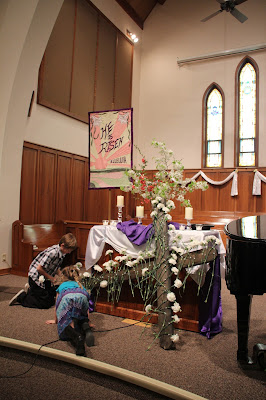
Spring in the prairie is a bit of an odd thing this year. Here and there, near ditches and creeks, a short, soft blanket of lush green grass covers the ground. A few feet away, patches of green are visible between the brown shoots of last year s grass. Some trees are already turning green, purple, red, and white, while others stand still and brown, stubbornly insisting that spring is not here yet. To look at the thermometer may not be much guide either; two days after the temperature was nearly 90, we woke to see a dusting of snow on the ground. It s been dry, terribly try in Kansas. Grass next to a gravel driveway or road often has a chalkish layer of dust on it, kicked up by passing cars or even a stiff wind. The earth thirsts. It is somehow fitting to celebrate Easter, that spring holiday, in the midst of the dry ground, to remember that water is not the only thing that can quench thirst. Easter morning began sleepily, as we got up early to head to a sunrise service. It was in a pasture just outside a small Kansas town, and we gathered there at about 6:15, wearing only light jackets against the breeze. A fire was burning, and there was water on hand to quickly douse any grass that caught first that wasn t supposed to and it was occasionally used. I was doing the prelude for the service, playing on my penny whistle. I enjoyed being able to do that, and was glad that the wind was calm enough that it didn t interfere too much with the music. We sang some hymns, listened to some Bible readings, and just stood in silence, listening to the crackle of the fire, some country dogs playing, and watching the sky to the east transform as the sun came up. Then it was on to church for breakfast, and a break before the Easter service the pipe organ ringing, piano playing with it, and deep trombone and full sanctuary of people singing our 4-part Easter hymns celebrating the day. Laura had the idea of pinning carnations onto the cross, and we got to watch everyone come up and add theirs. Jacob and Oliver enjoyed the sunrise service. They decided they would keep a watchful eye on the first and the dogs, they enjoyed muffins at breakfast and playing in the church after that. But if you are 4 or 7, what is Easter without an Easter egg hunt? And they got in several. Laura and I hid some eggs around the yard. Jacob asked me to use a radio to tell them when the eggs were ready. Here they are, bounding out the door to begin the hunt! And, of course, if you are 4 or 7 and have a geek for a dad, you will naturally think to bring radios with you to the next hunt. To tell your brother what you re finding, of course. It was a good weekend, and in fact, Jacob even volunteered to put up a wet floor sign after he spilled some water: On the last car ride of the day, Jacob decided he would write a story about his Easter. He decided he would publish a big book, and be a famous author and make other children happy. Oliver, of course, decided he needed an Easter story also. We couldn t very well publish a book in the car, but I did manage to use my phone to capture their stories. It s been a long and busy week, but there is much to be joyful about, even when tired.

Russ Allbery: Review: Hyperbole and a Half

Review: Hyperbole and a Half, by Allie Brosh
Publisher: Touchstone
Copyright: November 2013
ISBN: 1-4767-6459-X
Format: Graphic novel
Pages: 373
It's fundamentally pointless to write this review. Some number of you have already heard of Hyperbole and a Half. Most of that group already own this book and are only reading this review so that you can remember how much fun you had reading it. But, even better, you could just stop reading this review and go read the book again. Some of you who have heard of Hyperbole and a Half didn't know that Allie Brosh had published a book. If that's you, you're probably not reading this review any more, since you're now at your favorite book seller buying a copy of the book, rendering the review somewhat pointless. For those of you who have not heard of Hyperbole and a Half, there's no need to read a review, because it's a blog. So, rather than reading this review, you can just follow that link and read it for yourself. If you find yourself laughing uncontrollably (and occasionally crying) and going "where can I get more of this?", well, there's a book. Which you could have also found out from the blog itself. Like I said, not much point. If you read the blog and don't particularly care for it, well, I greatly respect your position. The diversity of taste in the human race is what leads to our wonderful variety of culture, philosophy, and art, and I appreciate your substantial contribution to that diversity. However, you should now make a mental note to never trust my humor recommendations, and you shouldn't let this review change your mind. But, since I'm here, I may as well write a review anyway. Hyperbole and a Half is, as mentioned, a blog by Allie Brosh. Most of the posts are quite long and substantial and in the form of cartoons mixed with text, usually (but not always) telling some sort of story. The cartoon style is what is often called "MS Paint," meaning that it looks like something drawn in Microsoft Paint with its most basic tools. (Other examples of this style are the Oatmeal and Homestuck, although Brosh stays consistently with a rawer art style than either of those.) It looks extremely simple, like child drawings (and early childhood inspires much of Brosh's material), but once one gets used to it, one realizes that Brosh gets amazing expressiveness and character out of the art style. As an aside, yes, I am wholeheartedly recommending a book that is full of material about young children. Brosh is that good. The subtitle of this book is "unfortunate situations, flawed coping mechanisms, mayhem, and other things that happened," and it's mostly based on (exaggerated) incidents that occurred in Brosh's life. Most of them are hilarious. Some of them are both hilarious and stunning psychological insights. She has an amazing knack for storytelling and for exaggerating just the right moments of the story, or summing up emotions in a wonderful turn of phrase or a picture. She's also amazingly good at telling embarrassing stories about herself in a way that makes you empathize rather than just cringe, and then come away feeling like you understand both her and yourself better. If you've wandered around the Internet much, you have probably run across the phrase "clean ALL the things!" and the corresponding picture. That's from Hyperbole and a Half (specifically, "This is Why I'll Never Be an Adult") and is included in this book (improved; see below). It's even better in context. But, beyond storytelling, the other thing Brosh is amazingly good at is capturing internal mental states and emotions in a way that the reader understands and those who have experienced the emotion immediately go "yes, THAT." The apex of this is her two-part post on depression, which is hands-down the best description of depression that I've ever read. That judgment has been echoed by multiple friends of mine with depression. And yes, both of those posts are included in the book as well, although you can also read them on the web. As you've probably noticed, this book is partly a collection of material that's freely available on the web. Unlike some web comics collections, it's not entirely a reprint collection; there are entirely new stories here (which for me was enough by itself to buy the book). Brosh's post on the book says that it's about 50% new material. But the ones that aren't original have been edited and improved, sometimes substantially. For example, I did a quick comparison of the book version with the web version of "This is Why I'll Never be an Adult" and found Brosh redrew all of the cartoons for the story. The book is also gorgeous, if you care about such things like I do: high quality paper, thick pages, vibrant colors, and a comfortable heft to the hardcover version. It's the sort of book that feels like it will survive for decades, which is good since I intend to re-read it for decades. Brosh has a lot of material on-line, so obviously only a small fraction made it into the book and there's more to discover on the blog. I can particularly recommend "The Alot is Better Than You at Everything" and "Boyfriend Doesn't Have Ebola. Probably.". The latter, which is mostly about creating a better pain scale, is my favorite from the blog that didn't make it into the book. And there are two more examples of the sort of thing that you'll getting here. So ends the probably pointless review. I absolutely adore Hyperbole and a Half. It is my favorite web comic, even surpassing XKCD, which is saying something. Even if there were no material, I would have bought this book in hardcover to support Brosh and to have a high-quality printing of the blog posts. The reworkings and improvements of the republished material and the brand new additions are just bonuses. But there's no need to take my word for it; the best possible advertisement for Brosh's work is on-line, from which you can easily determine if you'll enjoy this book as much as I did. Even the back cover and the inside flaps are awesome. Rating: 10 out of 10

Russell Coker: Sociological Images 2014

White Trash The above poster was on a bridge pylon in Flinders St in 2012. It s interesting to see what the Fringe Festival people consider to be associated with white trash . They claim homophobia is a white trash thing however lower class people have little political power and the fact that we still don t have marriage equality in Australia is clear evidence that homophobia is prevalent among powerful people. Toys vs Fairies Fairies look pretty while boys toys do things I took the above photo at Costco in 2012. I think it s worth noting the way that the Disney Fairies (all female and marketed to a female audience) are standing around looking pretty while the Toy Story characters (mostly male and marketed to a male audience) are running out to do things. Having those items side by side on the shelf was a clear example of a trend in toys towards girls being encouraged to be passive while boys are doing things. The Toy Story pack has one female character, so it could be interpreted as being aimed at both boys and girls. But even that interpretation doesn t remove the clear gender difference. It seems ironic to me that the descriptions on the boxes are Read, Play, and Listen for the Toy Story pack and Read, Play, and Colour on the Fairies pack. Colouring is more active than listening so the pictures don t match the contents. Make Up vs Tools Girls chocolate is make-up and boys chocolate is tools I took the above photo in an Aldi store in early 2013, today I was in Aldi and noticed that the same chocolate is still on sale. A clear and pointless gender difference. Rumor has it that some of the gender difference in kids clothing is so that a child can t wear the clothes of an older sibling of different gender, but chocolate only gets eaten once so there is no reason for this. Oath The above poster was inside the male toilet at Melbourne University in 2013. It would probably be good to have something like that on display all the time instead of just for one event. Locks Locks with inscriptions on a bridge on the Yarra River in Melbourne I took the above picture early this year, it shows hundreds of padlocks attached to a bridge across the Yarra River in Melbourne. Each padlock has a message written or inscribed in it, mostly declarations of love. I first noticed this last year, I m not sure how long it s been up. There was nothing formal about this (no signs about it), people just see it and decide that they want to add to it. I guess that the council cuts some of them off periodically as the number of locks doesn t seem to be increasing much in recent times. It would be interesting to do some research into how many locks are needed to start one of these. It would also be interesting to discover whether the nature of the inscriptions determines the speed at which it takes off, would a bunch of padlocks with messages like I Love Linux inspire others as well as messages declaring love for random people? All that is required is some old locks and an engraving tool. I wonder what the social norm might be regarding messing with those locks. If I was to use those padlocks to practice the sport of lock-picking (which I learned when in Amsterdam) I wonder whether random bystanders would try to discourage me. It seems likely that picking the locks and taking them away would get a negative reaction but I wonder whether picking them one at a time and replacing them (or maybe moving them to another wire) would get a reaction. Blackface for Schoolkids teachers choice blackface and yellowface masks A craft shop at the Highpoint shopping center in Melbourne is selling Teacher s Choice brand Multicultural Face Masks . Multicultural is a well regarded term in education, teaching children about other cultures is a good concept but can be implemented really badly. When I was in high school the subject Social Studies seemed to have an approach of look how weird people are in other places instead of teaching the kids anything useful. Sociological Images has an informative article on the Australian Hey Hey it s Saturday blackface incident in 2009 [1]. The idea of these masks seems to involve students dressing up as caricatures of other races. The mask which looks like someone s idea of a Geisha is an even bigger WTF, mixing what the package calls culture (really race) with sex work. When I visited Tokyo I got the impression that French maids fill a similar niche to Geisha for younger Japanese men and the maid cafe thing is really popular there. I think it s interesting to consider the way that a French maid costume is regarded differently to a Geisha costume. I expect that Teacher s Choice doesn t sell French maid costumes. Delicious Cow picture of a bovine named Delicious Usually meat is advertised in a way that minimises the connection to living animals. Often adverts just show cuts of meat and don t make any mention of animals and when animals are shown they are in the distance. The above picture was on the wall at a Grill d burger restaurant in Point Cook. It shows a bovine (looks like a bull even though I believe that cows are the ones that are usually eaten) with a name-tag identifying it as Delicious . The name tag personalises the animal which is an uncommon thing to do when parts of an animal are going to be eaten. Of the animals that are commonly eaten it seems that the general trend is to only show fish as complete live animals, presumably because people can identify with mammals such as cattle in a way that they can t identify with fish. Fish are also the only complete animals that are shown dead, adverts for fish that are sold as parts (EG salmon and tuna) often show complete dead fish. But I ve never seen a meat advert that shows a complete dead cow or sheep.

Matthew Garrett: Home entertainment implementations are pretty appalling

I picked up a Panasonic BDT-230 a couple of months ago. Then I discovered that even though it appeared fairly straightforward to make it DVD region free (I have a large pile of PAL region 2 DVDs), the US models refuse to play back PAL content. We live in an era of software-defined functionality. While Panasonic could have designed a separate hardware SKU with a hard block on PAL output, that would seem like unnecessary expense. So, playing with the firmware seemed like a reasonable start.

Panasonic provide a nice download site for firmware updates, so I grabbed the most recent and set to work. Binwalk found a squashfs filesystem, which was a good sign. Less good was the block at the end of the firmware with "RSA" written around it in large letters. The simple approach of hacking the firmware, building a new image and flashing it to the device didn't appear likely to work.

Which left dealing with the installed software. The BDT-230 is based on a Mediatek chipset, and like most (all?) Mediatek systems runs a large binary called "bdpprog" that spawns about eleventy billion threads and does pretty much everything. Runnings strings over that showed, well, rather a lot, but most promisingly included a reference to "/mnt/sda1/vudu/vudu.sh". Other references to /mnt/sda1 made it pretty clear that it was the mount point for USB mass storage. There were a couple of other constraints that had to be satisfied, but soon attempting to run Vudu was actually setting a blank root password and launching telnetd.

/acfg/config_file_global.txt was the next stop. This is a set of tokens and values with useful looking names like "IDX_GB_PTT_COUNTRYCODE". I tried changing the values, but unfortunately made a poor guess - on next reboot, the player had reset itself to DVD region 5, Blu Ray region C and was talking to me in Russian. More inconveniently, the Vudu icon had vanished and I couldn't launch a shell any more.

But where there's one obvious mechanism for running arbitrary code, there's probably another. /usr/local/bin/browser.sh contained the wonderful line:
export LD_PRELOAD=/mnt/sda1/bbb/libSegFault.so
, so then it was just a matter of building a library that hooked open() and launched inetd and dropping that into the right place, and then opening the browser.

This time I set the country code correctly, rebooted and now I can actually watch Monkey Dust again. Hurrah! But, at the same time, concerning. This software has been written without any concern for security, and it listens on the network by default. If it took me this little time to find two entirely independent ways to run arbitrary code on the device, it doesn't seem like a stretch to believe that there are probably other vulnerabilities that can be exploited with less need for physical access.

The depressing part of this is that there's no reason to believe that Panasonic are especially bad here - especially since a large number of vendors are shipping much the same Mediatek code, and so probably have similar (if not identical) issues. The future is made up of network-connected appliances that are using your electricity to mine somebody else's Dogecoin. Our nightmarish dystopia may be stranger than expected.

comment count unavailable comments

20 April 2014

Russell Coker: Sociological Images 2012

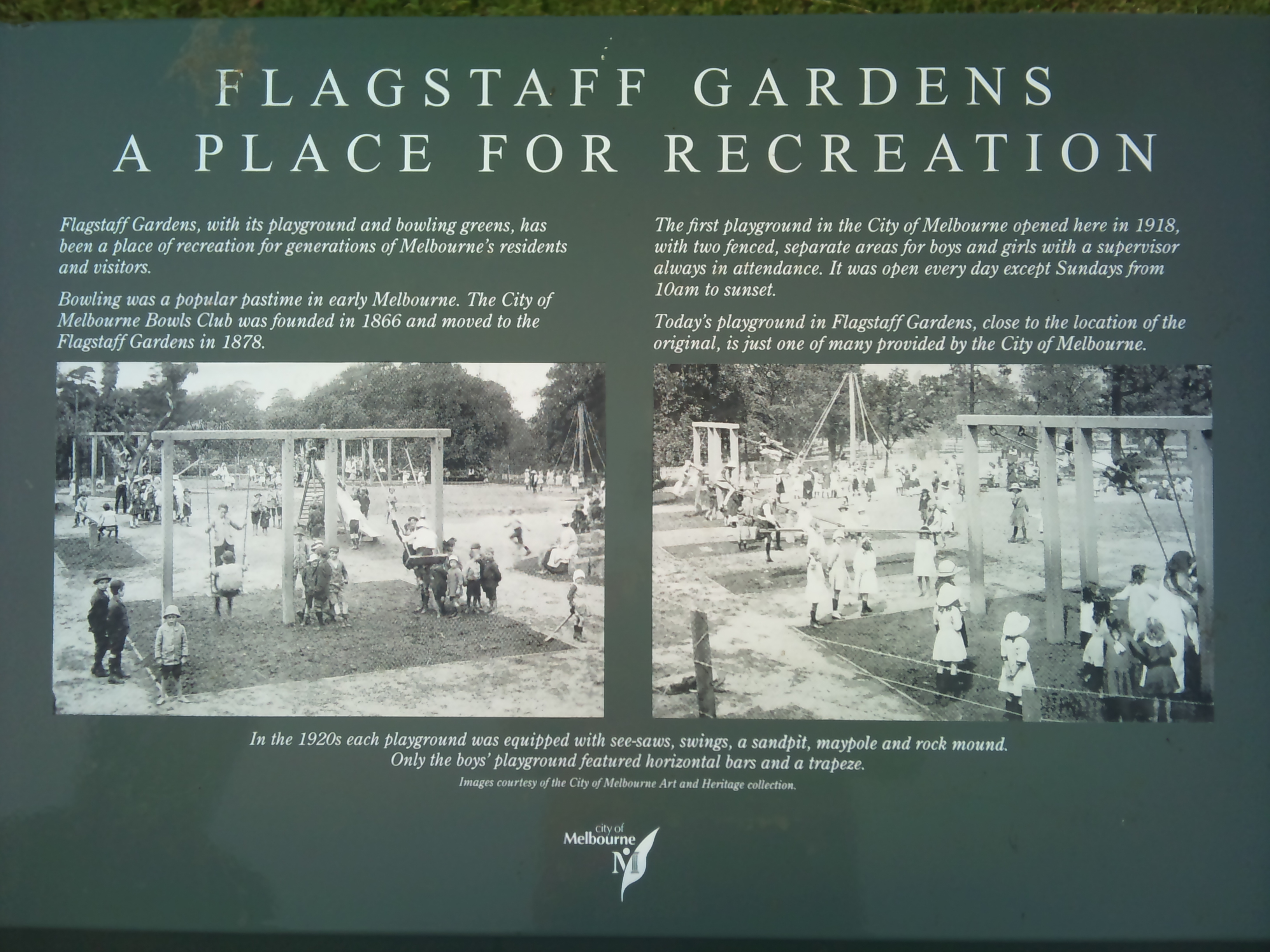
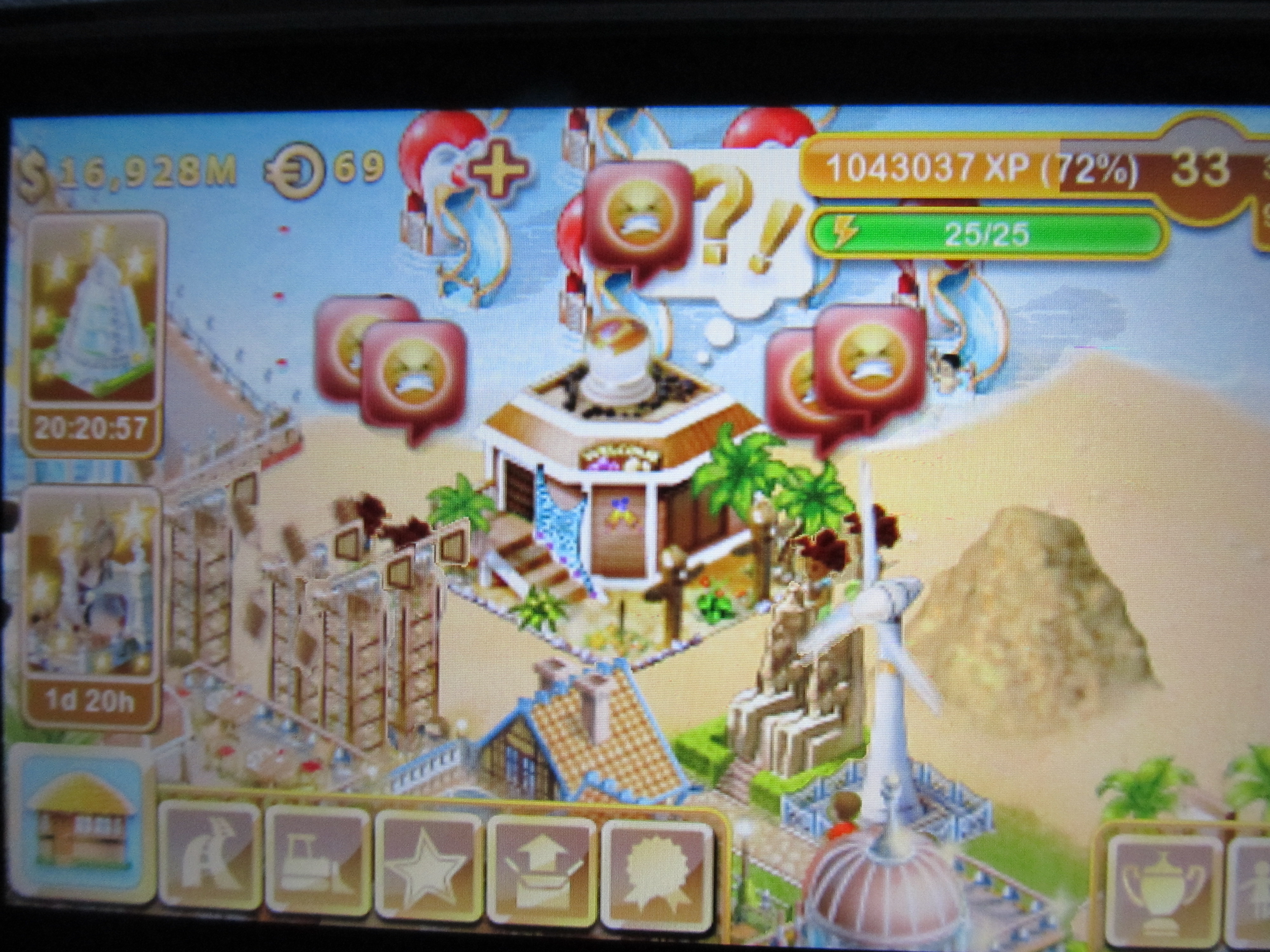
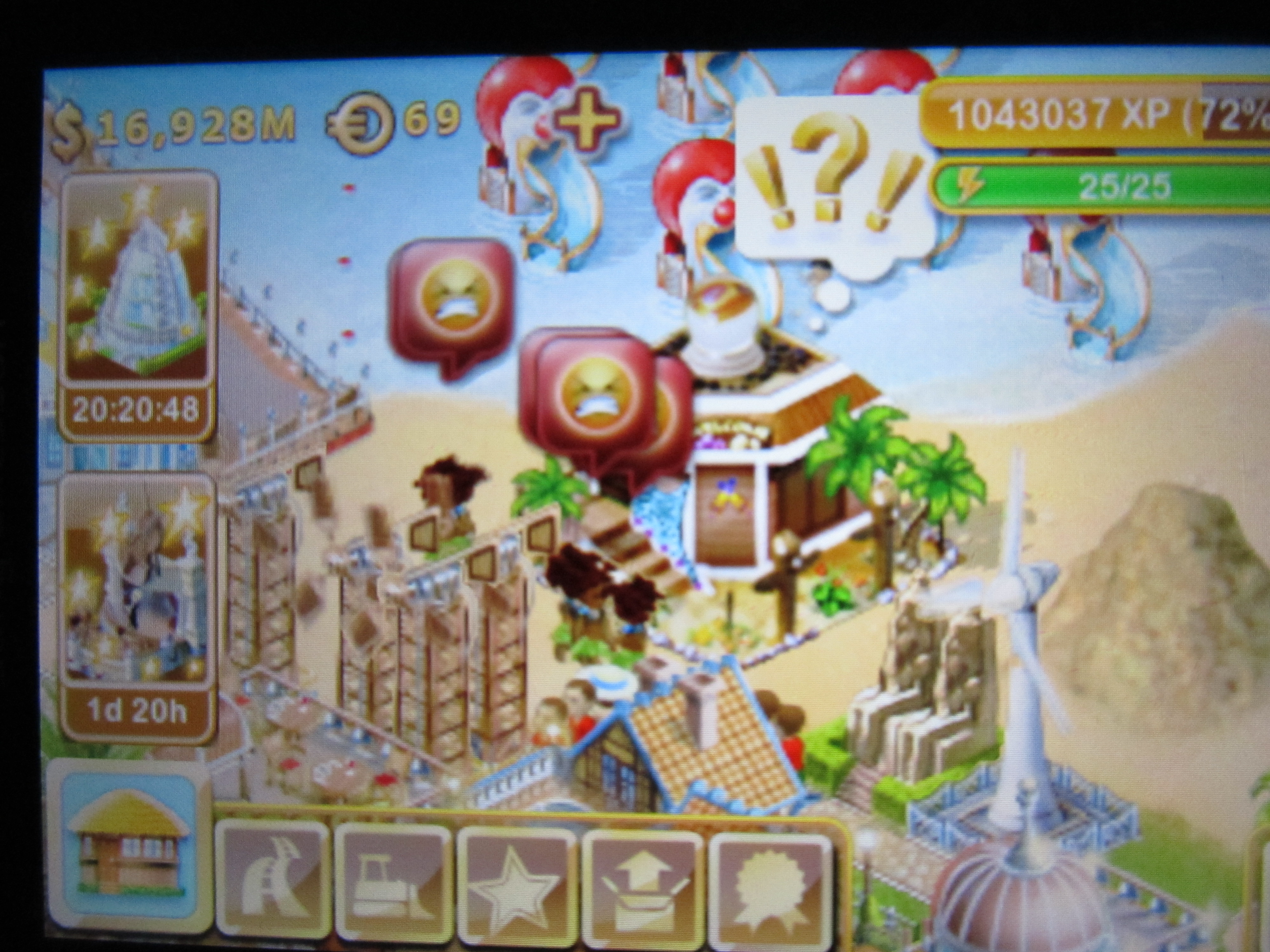
In 2011 I wrote a post that was inspired by the Sociological Images blog [1]. After some delay here I ve written another one. I plan to continue documenting such things. Playground gender segregated playground in 1918 In 2011 I photographed a plaque at Flagstaff Gardens in Melbourne. It shows a picture of the playground in 1918 with segregated boys and girls sections. It s interesting that the only difference between the two sections is that the boys have horizontal bars and a trapeze. Do they still have gender segregated playgrounds anywhere in Australia? If so what is the difference in the sections? Aborigines The Android game Paradise Island [2] has a feature where you are supposed to stop Aborigines from stealing, it plays on the old racist stereotypes about Aborigines which are used to hide the historical record that it s always been white people stealing from the people that they colonise. Angry face icons over AboriginesAborigines described as thieves There is also another picture showing the grass skirts. Nowadays the vast majority of Aborigines don t wear such clothing, the only time they do is when doing some sort of historical presentation for tourists. I took those pictures in 2012, but apparently the game hasn t changed much since then. Lemonade lemonade flavored fizzy drink Is lemonade a drink or a flavour? Most people at the party where I took the above photo regard lemonade as a drink and found the phrase Lemonade Flavoured Soft Drink strange when it was pointed out to them. Incidentally the drink on the right tastes a bit like the US version of lemonade (which is quite different from the Australian version). For US readers, the convention in Australia is that lemonade has no flavor of lemons. Not Sweet maybe gender queer people on bikes In 2012 an apple cider company made a huge advertising campaign featuring people who might be gender queer, above is a picture of a bus stop poster and there were also TV ads. The adverts gave no information at all about what the drink might taste like apart from not being as sweet as you think . So it s basically an advertising campaign with no substance other than a joke about people who don t conform to gender norms. Also it should be noted that some women naturally grow beards and have religious reasons for not shaving [3]. Episode 2 of the TV documentary series Am I Normal has an interesting interview of a woman with a beard. Revolution communist revolution Schweppes drinks A violent political revolution is usually a bad thing, using such revolutions to advertise sugar drinks seems like a bad idea. But it seems particularly interesting to note the different attitudes to such things in various countries. In 2012 Schweppes in Australia ran a marketing campaign based on imagery related to a Communist revolution (the above photo was taken at Southern Cross station in Melbourne), I presume that Schweppes in the US didn t run that campaign. I wonder whether global media will stop such things, presumably that campaign has the potential to do more harm in the US than good in Australia. Racist Penis Size Joke at Southbank racist advert in Southbank paper The above advert was in a free newspaper at Southbank in 2012. Mini Movers thought that this advert was a good idea and so did the management of Southbank who approved the advert for their paper. Australia is so racist that people don t even realise they are being racist.

19 April 2014

Joey Hess: propellor-driven DNS and backups

Took a while to get here, but Propellor 0.4.0 can deploy DNS servers and I just had it deploy mine. Including generating DNS zone files. Configuration is dead simple, as far as DNS goes:
     & alias "ns1.example.com"
        & Dns.secondary hosts "joeyh.name"
                & Dns.primary hosts "example.com"
                        (Dns.mkSOA "ns1.example.com" 100)
                        [ (RootDomain, NS $ AbsDomain "ns1.example.com")
            , (RootDomain, NS $ AbsDomain "ns2.example.com")
                        ]
The awesome thing is that propellor fills in all the other information in the zone file by looking at the properties of the hosts it knows about.
 , host "blue.example.com"
        & ipv4 "192.168.1.1"
        & ipv6 "fe80::26fd:52ff:feea:2294"
        & alias "example.com"
        & alias "www.example.com"
        & alias "example.museum"
        & Docker.docked hosts "webserver"
             requres  backedup "/var/www"
        
        & alias "ns2.example.com"
        & Dns.secondary hosts "example.com"
When it sees this host, Propellor adds its IP addresses to the example.com DNS zone file, for both its main hostname ("blue.example.com"), and also its relevant aliases. (The .museum alias would go into a different zone file.) Multiple hosts can define the same alias, and then you automaticlly get round-robin DNS. The web server part of of the blue.example.com config can be cut and pasted to another host in order to move its web server to the other host, including updating the DNS. That's really all there is to is, just cut, paste, and commit! I'm quite happy with how that worked out. And curious if Puppet etc have anything similar.
One tricky part of this was how to ensure that the serial number automtically updates when changes are made. The way this is handled is Propellor starts with a base serial number (100 in the example above), and then it adds to it the number of commits in its git repository. The zone file is only updated when something in it besides the serial number needs to change. The result is nice small serial numbers that don't risk overflowing the (so 90's) 32 bit limit, and will be consistent even if the configuration had Propellor setting up multiple independent master DNS servers for the same domain.
Another recent feature in Propellor is that it can use Obnam to back up a directory. With the awesome feature that if the backed up directory is empty/missing, Propellor will automcatically restore it from the backup. Here's how the backedup property used in the example above might be implemented:
backedup :: FilePath -> Property
backedup dir = Obnam.backup dir daily
    [ "--repository=sftp://rsync.example.com/~/webserver.obnam"
    ] Obnam.OnlyClient
     requires  Ssh.keyImported SshRsa "root"
     requires  Ssh.knownHost hosts "rsync.example.com" "root"
     requires  Gpg.keyImported "1B169BE1" "root"
Notice that the Ssh.knownHost makes root trust the ssh host key belonging to rsync.example.com. So Propellor needs to be told what that host key is, like so:
 , host "rsync.example.com"
        & ipv4 "192.168.1.4"
        & sshPubKey "ssh-rsa blahblahblah"
Which of course ties back into the DNS and gets this hostname set in it. But also, the ssh public key is available for this host and visible to the DNS zone file generator, and that could also be set in the DNS, in a SSHFP record. I haven't gotten around to implementing that, but hope at some point to make Propellor support DNSSEC, and then this will all combine even more nicely.
By the way, Propellor is now up to 3 thousand lines of code (not including Utility library). In 20 days, as a 10% time side project.

Russell Coker: Swap Space and SSD

In 2007 I wrote a blog post about swap space [1]. The main point of that article was to debunk the claim that Linux needs a swap space twice as large as main memory (in summary such advice is based on BSD Unix systems and has never applied to Linux and that most storage devices aren t fast enough for large swap). That post was picked up by Barrapunto (Spanish Slashdot) and became one of the most popular posts I ve written [2]. In the past 7 years things have changed. Back then 2G of RAM was still a reasonable amount and 4G was a lot for a desktop system or laptop. Now there are even phones with 3G of RAM, 4G is about the minimum for any new desktop or laptop, and desktop/laptop systems with 16G aren t that uncommon. Another significant development is the use of SSDs which dramatically improve speed for some operations (mainly seeks). As SATA SSDs for desktop use start at about $110 I think it s safe to assume that everyone who wants a fast desktop system has one. As a major limiting factor in swap use is the seek performance of the storage the use of SSDs should allow greater swap use. My main desktop system has 4G of RAM (it s an older Intel 64bit system and doesn t support more) and has 4G of swap space on an Intel SSD. My work flow involves having dozens of Chromium tabs open at the same time, usually performance starts to drop when I get to about 3.5G of swap in use. While SSD generally has excellent random IO performance the contiguous IO performance often isn t much better than hard drives. My Intel SSDSC2CT12 300i 128G can do over 5000 random seeks per second but for sustained contiguous filesystem IO can only do 225M/s for writes and 274M/s for reads. The contiguous IO performance is less than twice as good as a cheap 3TB SATA disk. It also seems that the performance of SSDs aren t as consistent as that of hard drives, when a hard drive delivers a certain level of performance then it can generally do so 24*7 but a SSD will sometimes reduce performance to move blocks around (the erase block size is usually a lot larger than the filesystem block size). It s obvious that SSDs allow significantly better swap performance and therefore make it viable to run a system with more swap in use but that doesn t allow unlimited swap. Even when using programs like Chromium (which seems to allocate huge amounts of RAM that aren t used much) it doesn t seem viable to have swap be much bigger than 4G on a system with 4G of RAM. Now I could buy another SSD and use two swap spaces for double the overall throughput (which would still be cheaper than buying a PC that supports 8G of RAM), but that still wouldn t solve all problems. One issue I have been having on occasion is BTRFS failing to allocate kernel memory when managing snapshots. I m not sure if this would be solved by adding more RAM as it could be an issue of RAM fragmentation I won t file a bug report about this until some of the other BTRFS bugs are fixed. Another problem I have had is when running Minecraft the driver for my ATI video card fails to allocate contiguous kernel memory, this is one that almost certainly wouldn t be solved by just adding more swap but might be solved if I tweaked the kernel to be more aggressive about swapping out data. In 2007 when using hard drives for swap I found that the maximum space that could be used with reasonable performance for typical desktop operations was something less than 2G. Now with a SSD the limit for usable swap seems to be something like 4G on a system with 4G of RAM. On a system with only 2G of RAM that might allow the system to be usable with swap being twice as large as RAM, but with the amounts of RAM in modern PCs it seems that even SSD doesn t allow using a swap space larger than RAM for typical use unless it s being used for hibernation. Conclusion It seems that nothing has significantly changed in the last 7 years. We have more RAM, faster storage, and applications that are more memory hungry. The end result is that swap still isn t very usable for anything other than hibernation if it s larger than RAM. It would be nice if application developers could stop increasing the use of RAM. Currently it seems that the RAM requirements for Linux desktop use are about 3 years behind the RAM requirements for Windows. This is convenient as a PC is fully depreciated according to the tax office after 3 years. This makes it easy to get 3 year old PCs cheaply (or sometimes for free as rubbish) which work really well for Linux. But it would be nice if we could be 4 or 5 years behind Windows in terms of hardware requirements to reduce the hardware requirements for Linux users even further.

Russell Coker: Phone Based Lectures

Early this month at a LUV meeting I gave a talk with only my mobile phone to store notes. I used Google Keep to write the notes as it s one of the easiest ways of writing a note on a PC and quickly transferring it to a phone if I keep doing this I will find some suitable free software for this task. Owncloud seems promising [1], but at the moment I m more concerned with people issues than software. Over the years I ve experimented with different ways of presenting lectures. I m now working with the theory that presenting the same data twice (by speaking and text on a projector) distracts the audience and decreases learning. Editing and Viewing Notes Google Keep is adequate for maintaining notes, it s based on notes that are a list of items (like a shopping list) which is fine for lecture notes. It probably has lots of other functionality but I don t care much about that. Keep is really fast at updating notes, I can commit a change on my laptop and have it visible on my phone in a few seconds over 3G. Most of the lectures that I ve given have involved notes on a laptop. My first laptop was a Thinkpad 385XD with a 12.1 display and all my subsequent laptops have had a bigger screen. When a laptop with a 12 or larger screen is on a lectern I can see the notes at a glance without having to lean forward when 15 or fewer lines of text are displayed on the screen. 15 lines of text is about the maximum that can be displayed on a slide for the audience to read and with the width of a computer display or projector is enough for a reasonable quantity of text. When I run Keep on my Galaxy Note 2 it displays about 20 rather short lines of text in a portrait orientation (5 points for a lecture) and 11 slightly longer lines in a landscape orientation (4 points). In both cases the amount of text displayed on a screen is less than that with a laptop while the font is a lot smaller. My aim is to use free software for everything, so when I replace Keep with Owncloud (or something similar) I will probably have some options for changing the font size. But that means having less than 5 points displayed on screen at a time and thus a change in the way I present my talks (I generally change the order of points based on how well the audience seem to get the concepts so seeing multiple points on screen at the same time is a benefit). The Samsung Galaxy Note 2 has a 5.5 display which is one of the largest displays available in a phone. The Sony Xperia X Ultra is one of the few larger phones with a 6.44 display that s a large phone but still not nearly large enough to have more than a few points on screen with a font readable by someone with average vision while it rests on a lectern. The most obvious solution to the problem of text size is to use a tablet. Modern 10 tablets have resolutions ranging from 1920*1080 to 2560*1600 and should be more readable than the Thinkpad I used in 1998 which had a 12 800*600 display. Another possibility that I m considering is using an old phone, a Samsung Galaxy S weighs 118 to 155 grams and is easier to hold up than a Galaxy Note 2 which weighs 180g. While 60g doesn t seem like much difference if I m going to hold a phone in front of me for most of an hour the smaller and lighter phone will be easier and maybe less distracting for the audience. Distributing URLs When I give a talk I often want to share the addresses of relevant web sites with the audience. When I give a talk with the traditional style lecture notes I just put the URLs on the final page (sometimes using tinyurl.com) for people to copy during question time. When I use a phone I have to find another way. I did a test with QR code recognition and found that a code that takes up most of the width of the screen of my Galaxy Note 2 can be recognised by a Galaxy S at a distance of 50cm. If I ran the same software on a 10 tablet then it would probably be readable at a distance of a meter, if I had the QR code take up the entire screen on a tablet it might be readable at 1.5m away, so it doesn t seem plausible to hold up a tablet and allow even the first few rows of the audience to decode a QR code. Even if newer phones have better photographic capabilities than the Galaxy S that I had available for testing there are still lots of people using old phones who I want to support. I think that if QR codes are to be used they have to be usable by at least the first three rows of the audience for a small audience of maybe 50 people as that would allow everyone who s interested to quickly get in range and scan the code at the end. Chris Samuel has a photo (taken at the same meeting) showing how a QR code from a phone could be distributed to a room [2]. But that won t work for all rooms. One option is to just have the QR code on my phone and allow audience members to scan it after the lecture. As most members of the audience won t want the URLs it should be possible for the interested people to queue up to scan the QR code(s). Another possibility I m considering is to use a temporary post on my documents blog (which isn t syndicated) for URLs. The WordPress client for Android works reasonably well so I could edit the URL list at any time. That would work reasonably well for talks that have lots of URLs which is quite rare for me. A final option is to use Twitter, at the end of a talk I could just tweet the URLs with suitable descriptions. A good portion of the Tweets that I have written is URLs for web sites that I find interesting so this isn t a change. This is probably the easiest option, but with the usual caveat of using a proprietary service as an interim measure until I get a free software alternative working. Any suggestions? Please comment if you have any ideas about ways of addressing these issues. Also please let me know if anyone is working on a distributed Twitter replacement. Please note that anything which doesn t support followers on multiple servers and re-tweets and tweeting to users on other servers isn t useful in this regard.

Thomas Goirand: OpenStack 2014.1, aka Icehouse, is out

The new version of OpenStack is out, and I have just finished uploading it all into Debian Sid. With a total of 38 packages that I uploaded yesterday (which was exhausting!), most, if not all, were only moving from Experimental to Sid with only tiny updates, and this represents the achievement of 6 months of packaging work. The new feature list is impressive, and I would like to highlight some part of it: For the moment, I haven t packaged Sahara (eg: Hadoop as a service), but it might come later as a customer of us might require it. There s a lot less unit tests issues in the packages I uploaded to Sid: all SQLAlchemy issues have been dealt with. I wasn t confident with the Havana release that Sid / Testing would be a good environment for OpenStack, but this time with Icehouse, I think it should be much better. Please test this brand new release and report issues on the BTS. As always, the packages are available also as Wheezy backports through the usual channels (see the official install guide).

16 April 2014

Richard Hartmann: secure password storage

Dear lazyweb, for obvious reaons I am in the process of cycling out a lot of passwords. For the last decade or so, I have been using openssl.vim to store less-frequently-used passwords and it's still working fine. Yet, it requires some manual work, not least of which manually adding random garbage at the start of the plain text (and in other places) every time I save my passwords. In the context of changing a lot of passwords at once, this has started to become tedious. Plus, I am not sure if a tool of the complexity and feature-set of Vim is the best choice for security-critical work on encrypted files. Long story short, I am looking for alternatives. I did some research but couldn't come up with anything I truly liked; as there's bound to be tools which fit the requirements of like-minded people, I decided to ask around a bit. My personal short-list of requirements is: Any and all feedback appreciated. Depending on the level of feedback, I may summarize my own findings and suggestions into a follow-up post.

David Pashley: Bad Password Policies

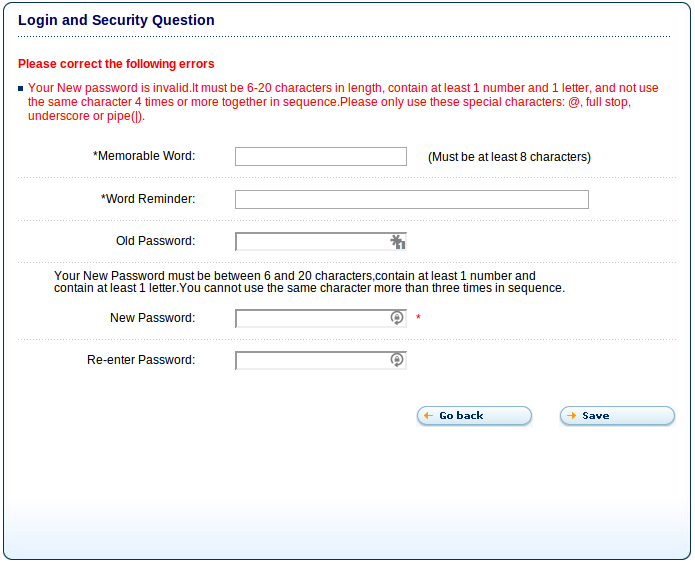
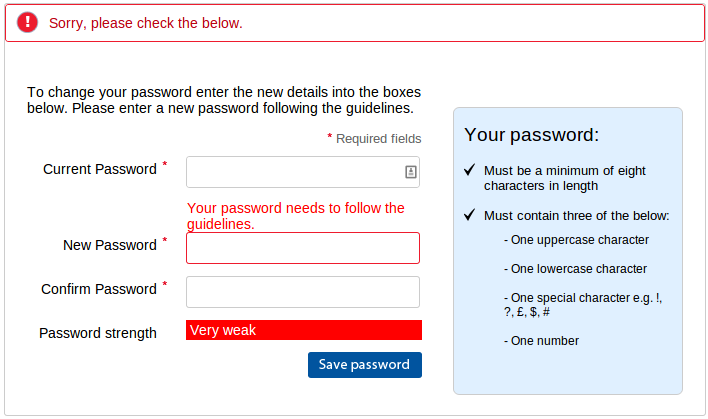
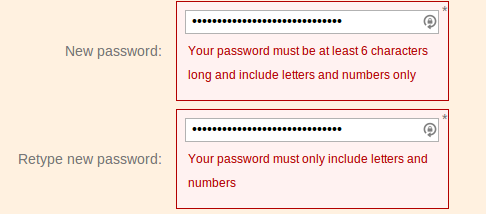
After the whole Heartbleed fiasco, I ve decided to continue my march towards improving my online security. I d already begun the process of using LastPass to store my passwords and generate random passwords for each site, but I hadn t completed the process, with some sites still using the same passwords, and some having less than ideal strength passwords, so I spent some time today improving my password position. Here s some of the bad examples of password policy I ve discovered today. First up we have Live.com. A maximum of 16 characters from the Microsoft auth service. Seems to accept any character though. Screenshot from 2014-04-15 21:36:57 This excellent example is from creditexpert.co.uk, one of the credit agencies here in the UK. They not only restrict to 20 characters, they restrict you to @, ., _ or . So much for teaching people how to protect themselves online. Screenshot from 2014-04-15 17:38:28 Here s Tesco.com after attempting to change my password to QvHn#9#kDD%cdPAQ4&b&ACb4x%48#b . If you can figure out how this violates their rules, I d love to know. And before you ask, I tried without numbers and that still failed so it can t be the three and only three thing. The only other idea might be that they meant i.e. rather than e.g. , but I didn t test that. Screenshot from 2014-04-15 16:20:17 Edit: Here is a response from Tesco on Twitter: Screenshot from 2014-04-16 07:47:58 Here s a poor choice from ft.com, refusing to accept non-alphanumeric characters. On the plus side they did allow the full 30 characters in the password. Screenshot from 2014-04-15 15:22:08 The finest example of a poor security policy is a company who will remain nameless due to their utter lack of security. Not only did they not use HTTPS, they accepted a 30 character password and silently truncated it to 20 characters. The reason I know this is because when I logged out and tried to log in again and then used the forgot my password option, they emailed me the password in plain text. I have also been setting up two-factor authentication where possible. Most sites use the Google Authenticator application on your mobile to give you a 6 digit code to type in in addition to your password. I highly recommend you set it up too. There s a useful list of sites that implement 2FA and links to their documentation at http://twofactorauth.org/. I realise that my choice LastPass requires me to trust them, but I think the advantages outweigh the disadvantages of having many sites using the same passwords and/or low strength passwords. I know various people cleverer than me have looked into their system and failed to find any obvious flaws. Remember people, when you implement a password, allow the following things: If you are going to place restrictions, please make sure the documentation matches the implementation, provide a client-side implementation to match and provide quick feedback to the user, and make sure you explicitly say what is wrong with the password, rather than referring back to the incorrect documentation. There are also many JS password strength meters available to show how secure the inputted passwords are. They are possibly a better way of providing feedback about security than having arbitrary policies that actually harm your security. As someone said to me on twitter, it s not like password is too strong was ever a bad thing. The post Bad Password Policies appeared first on David Pashley.com.

15 April 2014

Petter Reinholdtsen: FreedomBox milestone - all packages now in Debian Sid

The Freedombox project is working on providing the software and hardware to make it easy for non-technical people to host their data and communication at home, and being able to communicate with their friends and family encrypted and away from prying eyes. It is still going strong, and today a major mile stone was reached. Today, the last of the packages currently used by the project to created the system images were accepted into Debian Unstable. It was the freedombox-setup package, which is used to configure the images during build and on the first boot. Now all one need to get going is the build code from the freedom-maker git repository and packages from Debian. And once the freedombox-setup package enter testing, we can build everything directly from Debian. :) Some key packages used by Freedombox are freedombox-setup, plinth, pagekite, tor, privoxy, owncloud and dnsmasq. There are plans to integrate more packages into the setup. User documentation is maintained on the Debian wiki. Please check out the manual and help us improve it. To test for yourself and create boot images with the FreedomBox setup, run this on a Debian machine using a user with sudo rights to become root:
sudo apt-get install git vmdebootstrap mercurial python-docutils \
  mktorrent extlinux virtualbox qemu-user-static binfmt-support \
  u-boot-tools
git clone http://anonscm.debian.org/git/freedombox/freedom-maker.git \
  freedom-maker
make -C freedom-maker dreamplug-image raspberry-image virtualbox-image
Root access is needed to run debootstrap and mount loopback devices. See the README in the freedom-maker git repo for more details on the build. If you do not want all three images, trim the make line. Note that the virtualbox-image target is not really virtualbox specific. It create a x86 image usable in kvm, qemu, vmware and any other x86 virtual machine environment. You might need the version of vmdebootstrap in Jessie to get the build working, as it include fixes for a race condition with kpartx. If you instead want to install using a Debian CD and the preseed method, boot a Debian Wheezy ISO and use this boot argument to load the preseed values:
url=http://www.reinholdtsen.name/freedombox/preseed-jessie.dat
I have not tested it myself the last few weeks, so I do not know if it still work. If you wonder how to help, one task you could look at is using systemd as the boot system. It will become the default for Linux in Jessie, so we need to make sure it is usable on the Freedombox. I did a simple test a few weeks ago, and noticed dnsmasq failed to start during boot when using systemd. I suspect there are other problems too. :) To detect problems, there is a test suite included, which can be run from the plinth web interface. Give it a go and let us know how it goes on the mailing list, and help us get the new release published. :) Please join us on IRC (#freedombox on irc.debian.org) and the mailing list if you want to help make this vision come true.

B lint R czey: Proposing amd64-hardened architecture for Debian

Facing last week s Heartbleed bug the need for improving the security of our systems became more apparent than usually. In Debian there are widely used methods for Hardening packages at build time and guidelines for improving the default installations security. Employing such methods usually come at an expense, for example slower code execution of binaries due to additional checks or additional configuration steps when setting up a system. Balancing between usability and security Debian chose an approach which would satisfy the most users by using C/C++ features which only slightly decrease execution speed of built binaries and by using reasonable defaults in package installations. All the architectures supported by Debian aims using the same methods for enhancing security but it does not have to stay the same way. Amd64 is the most widely used architecture of Debian according to popcon and amd64 hardware comes with powerful CPU-s. I think there would be a significant amount of people (being one of them :-)) who would happily use a version of Debian with more security features enabled by default sacrificing some CPU power and installing and setting up additional packages. My proposal for serving those security-focused users is introducing a new architecture targeting amd64 hardware, but with more security related C/C++ features turned on for every package (currently hardening has to be enabled by the maintainers in some way) through compiler flags as a start. Introducing the new architecture would also let package maintainers enabling additional dependencies and build rules selectively for the new architecture improving the security further. On the users side the advantage of having a separate security enhanced architecture instead of a Debian derivative is the potential of installing a set of security enhanced packages using multiarch. You could have a fast amd64 installation as a base and run Apache or any other sensitive server from the amd64-hardened packages! I have sent the proposal for discussion to debian-dev, too. Please join the discussion there or leave a comment here. Update: Many of you wondered if amd64-hardened could have prevented the exploitation of the Heartbleed vulnerability. I have posted a proof of concept to show that using -fsanitize=address and disabling custom freelist would have protected systems against stealing data using the exploits. Disabling the custom freelist-like solutions and enabling-fsanitize=address would be part of amd64-hardened to make memory protection techniques work effectively thus I think if we had this architecture ready at the beginning of April, it would have been immune to Heartbleed.

Colin Watson: Porting GHC: A Tale of Two Architectures

We had some requests to get GHC (the Glasgow Haskell Compiler) up and running on two new Ubuntu architectures: arm64, added in 13.10, and ppc64el, added in 14.04. This has been something of a saga, and has involved rather more late-night hacking than is probably good for me. Book the First: Recalled to a life of strange build systems You might not know it from the sheer bulk of uploads I do sometimes, but I actually don't speak a word of Haskell and it's not very high up my list of things to learn. But I am a pretty experienced build engineer, and I enjoy porting things to new architectures: I'm firmly of the belief that breadth of architecture support is a good way to shake out certain categories of issues in code, that it's worth doing aggressively across an entire distribution, and that, even if you don't think you need something now, new requirements have a habit of coming along when you least expect them and you might as well be prepared in advance. Furthermore, it annoys me when we have excessive noise in our build failure and proposed-migration output and I often put bits and pieces of spare time into gardening miscellaneous problems there, and at one point there was a lot of Haskell stuff on the list and it got a bit annoying to have to keep sending patches rather than just fixing things myself, and ... well, I ended up as probably the only non-Haskell-programmer on the Debian Haskell team and found myself fixing problems there in my free time. Life is a bit weird sometimes. Bootstrapping packages on a new architecture is a bit of a black art that only a fairly small number of relatively bitter and twisted people know very much about. Doing it in Ubuntu is specifically painful because we've always forbidden direct binary uploads: all binaries have to come from a build daemon. Compilers in particular often tend to be written in the language they compile, and it's not uncommon for them to build-depend on themselves: that is, you need a previous version of the compiler to build the compiler, stretching back to the dawn of time where somebody put things together with a big magnet or something. So how do you get started on a new architecture? Well, what we do in this case is we construct a binary somehow (usually involving cross-compilation) and insert it as a build-dependency for a proper build in Launchpad. The ability to do this is restricted to a small group of Canonical employees, partly because it's very easy to make mistakes and partly because things like the classic "Reflections on Trusting Trust" are in the backs of our minds somewhere. We have an iron rule for our own sanity that the injected build-dependencies must themselves have been built from the unmodified source package in Ubuntu, although there can be source modifications further back in the chain. Fortunately, we don't need to do this very often, but it does mean that as somebody who can do it I feel an obligation to try and unblock other people where I can. As far as constructing those build-dependencies goes, sometimes we look for binaries built by other distributions (particularly Debian), and that's pretty straightforward. In this case, though, these two architectures are pretty new and the Debian ports are only just getting going, and as far as I can tell none of the other distributions with active arm64 or ppc64el ports (or trivial name variants) has got as far as porting GHC yet. Well, OK. This was somewhere around the Christmas holidays and I had some time. Muggins here cracks his knuckles and decides to have a go at bootstrapping it from scratch. It can't be that hard, right? Not to mention that it was a blocker for over 600 entries on that build failure list I mentioned, which is definitely enough to make me sit up and take notice; we'd even had the odd customer request for it. Several attempts later and I was starting to doubt my sanity, not least for trying in the first place. We ship GHC 7.6, and upgrading to 7.8 is not a project I'd like to tackle until the much more experienced Haskell folks in Debian have switched to it in unstable. The porting documentation for 7.6 has bitrotted more or less beyond usability, and the corresponding documentation for 7.8 really isn't backportable to 7.6. I tried building 7.8 for ppc64el anyway, picking that on the basis that we had quicker hardware for it and didn't seem likely to be particularly more arduous than arm64 (ho ho), and I even got to the point of having a cross-built stage2 compiler (stage1, in the cross-building case, is a GHC binary that runs on your starting architecture and generates code for your target architecture) that I could copy over to a ppc64el box and try to use as the base for a fully-native build, but it segfaulted incomprehensibly just after spawning any child process. Compilers tend to do rather a lot, especially when they're built to use GCC to generate object code, so this was a pretty serious problem, and it resisted analysis. I poked at it for a while but didn't get anywhere, and I had other things to do so declared it a write-off and gave up. Book the Second: The golden thread of progress In March, another mailing list conversation prodded me into finding a blog entry by Karel Gardas on building GHC for arm64. This was enough to be worth another look, and indeed it turned out that (with some help from Karel in private mail) I was able to cross-build a compiler that actually worked and could be used to run a fully-native build that also worked. Of course this was 7.8, since as I mentioned cross-building 7.6 is unrealistically difficult unless you're considerably more of an expert on GHC's labyrinthine build system than I am. OK, no problem, right? Getting a GHC at all is the hard bit, and 7.8 must be at least as capable as 7.6, so it should be able to build 7.6 easily enough ... Not so much. What I'd missed here was that compiler engineers generally only care very much about building the compiler with older versions of itself, and if the language in question has any kind of deprecation cycle then the compiler itself is likely to be behind on various things compared to more typical code since it has to be buildable with older versions. This means that the removal of some deprecated interfaces from 7.8 posed a problem, as did some changes in certain primops that had gained an associated compatibility layer in 7.8 but nobody had gone back to put the corresponding compatibility layer into 7.6. GHC supports running Haskell code through the C preprocessor, and there's a __GLASGOW_HASKELL__ definition with the compiler's version number, so this was just a slog tracking down changes in git and adding #ifdef-guarded code that coped with the newer compiler (remembering that stage1 will be built with 7.8 and stage2 with stage1, i.e. 7.6, from the same source tree). More inscrutably, GHC has its own packaging system called Cabal which is also used by the compiler build process to determine which subpackages to build and how to link them against each other, and some crucial subpackages weren't being built: it looked like it was stuck on picking versions from "stage0" (i.e. the initial compiler used as an input to the whole process) when it should have been building its own. Eventually I figured out that this was because GHC's use of its packaging system hadn't anticipated this case, and was selecting the higher version of the ghc package itself from stage0 rather than the version it was about to build for itself, and thus never actually tried to build most of the compiler. Editing ghc_stage1_DEPS in ghc/stage1/package-data.mk after its initial generation sorted this out. One late night building round and round in circles for a while until I had something stable, and a Debian source upload to add basic support for the architecture name (and other changes which were a bit over the top in retrospect: I didn't need to touch the embedded copy of libffi, as we build with the system one), and I was able to feed this all into Launchpad and watch the builders munch away very satisfyingly at the Haskell library stack for a while. This was all interesting, and finally all that work was actually paying off in terms of getting to watch a slew of several hundred build failures vanish from arm64 (the final count was something like 640, I think). The fly in the ointment was that ppc64el was still blocked, as the problem there wasn't building 7.6, it was getting a working 7.8. But now I really did have other much more urgent things to do, so I figured I just wouldn't get to this by release time and stuck it on the figurative shelf. Book the Third: The track of a bug Then, last Friday, I cleared out my urgent pile and thought I'd have another quick look. (I get a bit obsessive about things like this that smell of "interesting intellectual puzzle".) slyfox on the #ghc IRC channel gave me some general debugging advice and, particularly usefully, a reduced example program that I could use to debug just the process-spawning problem without having to wade through noise from running the rest of the compiler. I reproduced the same problem there, and then found that the program crashed earlier (in stg_ap_0_fast, part of the run-time system) if I compiled it with +RTS -Da -RTS. I nailed it down to a small enough region of assembly that I could see all of the assembly, the source code, and an intermediate representation or two from the compiler, and then started meditating on what makes ppc64el special. You see, the vast majority of porting bugs come down to what I might call gross properties of the architecture. You have things like whether it's 32-bit or 64-bit, big-endian or little-endian, whether char is signed or unsigned, that sort of thing. There's a big table on the Debian wiki that handily summarises most of the important ones. Sometimes you have to deal with distribution-specific things like whether GL or GLES is used; often, especially for new variants of existing architectures, you have to cope with foolish configure scripts that think they can guess certain things from the architecture name and get it wrong (assuming that powerpc* means big-endian, for instance). We often have to update config.guess and config.sub, and on ppc64el we have the additional hassle of updating libtool macros too. But I've done a lot of this stuff and I'd accounted for everything I could think of. ppc64el is actually a lot like amd64 in terms of many of these porting-relevant properties, and not even that far off arm64 which I'd just successfully ported GHC to, so I couldn't be dealing with anything particularly obvious. There was some hand-written assembly which certainly could have been problematic, but I'd carefully checked that this wasn't being used by the "unregisterised" (no specialised machine dependencies, so relatively easy to port but not well-optimised) build I was using. A problem around spawning processes suggested a problem with SIGCHLD handling, but I ruled that out by slowing down the first child process that it spawned and using strace to confirm that SIGSEGV was the first signal received. What on earth was the problem? From some painstaking gdb work, one thing I eventually noticed was that stg_ap_0_fast's local stack appeared to be being corrupted by a function call, specifically a call to the colourfully-named debugBelch. Now, when IBM's toolchain engineers were putting together ppc64el based on ppc64, they took the opportunity to fix a number of problems with their ABI: there's an OpenJDK bug with a handy list of references. One of the things I noticed there was that there were some stack allocation optimisations in the new ABI, which affected functions that don't call any vararg functions and don't call any functions that take enough parameters that some of them have to be passed on the stack rather than in registers. debugBelch takes varargs: hmm. Now, the calling code isn't quite in C as such, but in a related dialect called "Cmm", a variant of C-- (yes, minus), that GHC uses to help bridge the gap between the functional world and its code generation, and which is compiled down to C by GHC. When importing C functions into Cmm, GHC generates prototypes for them, but it doesn't do enough parsing to work out the true prototype; instead, they all just get something like extern StgFunPtr f(void);. In most architectures you can get away with this, because the arguments get passed in the usual calling convention anyway and it all works out, but on ppc64el this means that the caller doesn't generate enough stack space and then the callee tries to save its varargs onto the stack in an area that in fact belongs to the caller, and suddenly everything goes south. Things were starting to make sense. Now, debugBelch is only used in optional debugging code; but runInteractiveProcess (the function associated with the initial round of failures) takes no fewer than twelve arguments, plenty to force some of them onto the stack. I poked around the GCC patch for this ABI change a bit and determined that it only optimised away the stack allocation if it had a full prototype for all the callees, so I guessed that changing those prototypes to extern StgFunPtr f(); might work: it's still technically wrong, not least because omitting the parameter list is an obsolescent feature in C11, but it's at least just omitting information about the parameter list rather than actively lying about it. I tweaked that and ran the cross-build from scratch again. Lo and behold, suddenly I had a working compiler, and I could go through the same build-7.6-using-7.8 procedure as with arm64, much more quickly this time now that I knew what I was doing. One upstream bug, one Debian upload, and several bootstrapping builds later, and GHC was up and running on another architecture in Launchpad. Success! Epilogue There's still more to do. I gather there may be a Google Summer of Code project in Linaro to write proper native code generation for GHC on arm64: this would make things a good deal faster, but also enable GHCi (the interpreter) and Template Haskell, and thus clear quite a few more build failures. Since there's already native code generation for ppc64 in GHC, getting it going for ppc64el would probably only be a couple of days' work at this point. But these are niceties by comparison, and I'm more than happy with what I got working for 14.04. The upshot of all of this is that I may be the first non-Haskell-programmer to ever port GHC to two entirely new architectures. I'm not sure if I gain much from that personally aside from a lot of lost sleep and being considered extremely strange. It has, however, been by far the most challenging set of packages I've ported, and a fascinating trip through some odd corners of build systems and undefined behaviour that I don't normally need to touch.

14 April 2014

Steve Kemp: Is lumail a stepping stone?

I'm pondering a rewrite of my console-based mail-client. While it is "popular" it is not popular. I suspect "console-based" is the killer. I like console, and I ssh to a remote server to use it, but having different front-ends would be neat. In the world of mailpipe, etc, is there room for a graphic console client? Possibly. The limiting factor would be the lack of POP3/IMAP. Reworking things such that there is a daemon to which a GUI, or a console client, could connect seems simple. The hard part would obviously be working the IPC and writing the GUI. Any toolkit selected would rule out 40% of the audience. In other news I'm stalling on replying to emails. Irony.
Next.

Previous.