Search Results: "spa"

26 February 2012

Craig Small: psmisc 22.16 Released

psmisc version 22.16 was released today. It is a bugfix release that bascially fixes a problem around strings in C. Process name lengths are only supposed to be 16 characters long, so a 17 bye buffer is ok; until you have processes with brackets which means the string is 18 characters. The next wrinkle is that at times the brackets are stripped out so matches fail because the lengths don t quite line up. You ll see this with the debian 22.15-2 version of psmisc where killall won t find long-named processes. So, 22.16 fixes all that. Test Processes It really shows that psmisc needs a set of tests like procps has already. The difficulty with both is that its not simple in the DejaGNU framework to make test processes. These are not the programs within the package but other processes that the programs can work on. There really needs to be an equivalent to touch for processes just for this sort of thing. Creating processes is rather simple, but ensuring they go away is the tricky part, or they die with certain signals.

25 February 2012

Philipp Kern: gobby.debian.org

TL;DR: Since a few months Debian also hosts a Gobby server. You can find it at gobby.debian.org. To use it, install gobby-0.5.

Gobby is a realtime collaborative editor, much like Etherpad, but as a standalone desktop application. (It's also open source since the beginning.) It resembles gedit somewhat. In retrospect plugging into gedit would've made more sense than to develop yet another editor.

Sadly there's a catch: Gobby had multiple iterations at getting its protocol right. So there are two incompatible versions: Gobby 0.4 and Gobby 0.5. But to confuse you, Gobby 0.4.9x is currently called Gobby 0.5. The lead developer wants to get self-hosting (i.e. the one-click creation of a server) back into the application before he calls it stable.

So to use the aforementioned server you need to apt-get install gobby-0.5, invoke gobby-0.5 and type gobby.debian.org into the "direct connection" field in the lower left bottom. This will give you a document tree on the left, where you can create new documents and folders. Please don't be destructive.

If you have a problem, if no one else can help, and if you can find them, you might contact the admins at admin@$service.

David Bremner: First steps with Racket PLoT

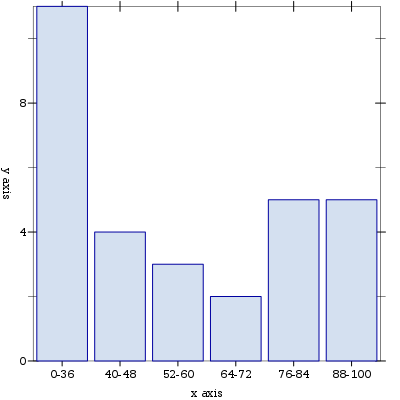
I have been in the habit of using R to make e.g. histograms of test scores in my courses. The main problem is that I don't really need (or am too ignorant to know that I need) the vast statistical powers of R, and I use it rarely enough that its always a bit of a struggle to get the plot I want. racket is a programming language in the scheme family, distinguished from some of its more spartan cousins by its "batteries included" attitude. I recently stumbled upon the PLoT graph (information visualization kind, not networks) plotting module and was pretty impressed with the Snazzy 3D Pictures. So this time I decided try using PLoT for my chores. It worked out pretty well; of course I am not very ambitious. Compared to using R, I had to do a bit more work in data preparation, but it was faster to write the Racket than to get R to do the work for me (again, probably a matter of relative familiarity). racket-hist.png
#lang racket/base
(require racket/list)
(require plot)
(define marks (build-list 30 (lambda (n) (random 25))))
(define out-of 25)
(define breaks '((0  9) (10 12) (13 15) (16 18) (19 21) (22 25)))
(define (per-cent n)
  (ceiling (* 100 (/ n out-of))))
(define (label l)
  (format "~a-~a" (per-cent (first l)) (per-cent (second l))))
(define (buckets l)
  (let ((sorted (sort l <)))
    (for/list ([b breaks])
          (vector (label b)
           (count (lambda (x) (and 
                    (<= x ( second b))
                    (>= x ( first b))))
               marks)))))
(plot
 (list
  (discrete-histogram 
  (buckets marks)))
 #:out-file "racket-hist.png")

23 February 2012

Tanguy Ortolo: Who gave my address to spammers?

For hurried readers: do not give your main email address to Moneybookers or to deviantART, since they may give it (unintentionally, I hope) to spammers.Dedicated addresses Since I have set up my own email server, when a company or an unknown individual asks for an address I give it a dedicated one. For instance, to make a payment I had to give an address to Moneybookers: instead of giving them my main address <tanguy@>, I used <tanguy+moneybookers@>. Thanks to Postfix's address extension feature (look for recipient_delimiter in postconf(5) manpage), these <tanguy+whatever@> are all implicit aliases to my main address. This practice has several benefits, since it allows me to: Working around lamers Some systems are coded by lamers that think the + sign is forbidden for email addresses, so I have to work around that. My current solution it to use a static alias <tanguy-2012@>, which I simply drop after a year to replace it by a new one. Two years report After two years collecting spam, the first noticeable thing is that, among 5.5k spams I received, only 78 are the result of an information leak from an organization. I excluded from that count the addresses I use in public mailing-lists, for instance <tanguy+debian@>. So, after some fine exclusion and checking of messages, these are the only two organizations that somehow gave my address to spammers:
  1. Moneybookers: 43 spam messages received;
  2. deviantArt: 35 spam messages received.

22 February 2012

Bartosz Fe&#324;ski: [B]ack[U]p and [R]estore [P]rogram

One of the most popular backup solution under Linux is Bacula, but it s quite complicated to setup. The same for Amanda.
Since my last sponsored upload we ve got another alternative in Debian. It s called burp. Let s enumerate its features as of version 1.3.0: Sounds good and this project is only 1 year old! Author claims that setup is much easier than with Bacula. Let s find out is that truth ;) Since we ve got this software in Debian installing it on unstable is as simple as apt-get install burp .
Both client and server came from the same binary package. Now let s configure server side. Well in fact we just have to run it, so just change RUN=no to RUN=yes in /etc/default/burp and launch it using /etc/init.d/burp start . Now the client side. If the client is on the same machine then you re ready. Yes you re ready! Let s do our first backup:
backup ~ # burp -a b
2012-02-22 17:53:03: burp[30584] Listing configured paths:
2012-02-22 17:53:03: burp[30584] include: /home
2012-02-22 17:53:03: burp[30584] Listing starting paths:
2012-02-22 17:53:03: burp[30584] /home
2012-02-22 17:53:03: burp[30584] before client
2012-02-22 17:53:03: burp[30584] begin client
2012-02-22 17:53:03: burp[30584] auth ok
2012-02-22 17:53:03: burp[30584] Compression level: 9
2012-02-22 17:53:03: burp[30584] do backup client
2012-02-22 17:53:03: burp[30584] Phase 1 begin (file system scan)
 
ddwdffffddffdfdfdddfffffdddfffffffdfffdfdfffffdfdfdffdddddfffddff 64
[...a lot of output...]
 
2012-02-22 17:53:03: burp[30584] Phase 1 end (file system scan)
2012-02-22 17:53:03: burp[30584] Phase 2 begin (send file data)
 
ffffffffffffffffffffffffffffffffffffffffffffffffffffffffffffffff 64
[...a lot of output...]
 
--------------------------------------------------------------------------------
Start time: 2012-02-22 17:53:03
  End time: 2012-02-22 17:53:07
Time taken: 00:04
                             New   Changed Unchanged     Total    Scanned
                       --------------------------------------------------
                Files:       100         0         -       100        100
          Directories:         -         -         -         -         76
           Soft links:         -         -         -         -          1
          Grand total:       100         0         -       100        177
                       --------------------------------------------------
 
             Warnings:             1
 
      Bytes estimated:      17628946 (16.81 MB)
      Bytes in backup:      17628946 (16.81 MB)
       Bytes received:             0
           Bytes sent:      17628946 (16.81 MB)
--------------------------------------------------------------------------------
2012-02-22 17:53:07: burp[30584] Phase 2 end (send file data)
2012-02-22 17:53:07: burp[30584] backup finished ok
2012-02-22 17:53:07: burp[30584] after client
backup ~ #
Yes. By default it is so extremely simple! Of course this way we can make backup of /home (that s default) to /var/spool/burp (also default location) but you can easily change this.
For the simplest scenario (backing up laptop to remote server) all I had to change was server = 127.0.0.1 in /etc/burp/burp.conf on the client side. Burp comes with handy tool called burp_ca and it simplifies setting up encrypted backups. In fact there is step by step howto in documentation.
Other options are quite self explanatory and well documented in both client and server config files that came with the package. Happy backuping!

Christian Perrier: 2012 update 11 for Debian Installer localization

Status for D-I level 1 (core D-I files): Status for D-I level 2 (packages that have localized material that may appear during default installs, such as iso-codes, tasksel, etc.): Status for D-I level 3 (packages that have localized material that may appear during non-default installs, such as win32-loader) Full 100% completeness (hall of fame) for 18 languages: Bulgarian, Czech, German, Esperanto, Spanish, Persian, French, Indonesian, Italian, Japanese, Kazakh, Dutch, Polish, Portuguese, Russian, Slovak, Turkish, Simplified Chinese

19 February 2012

Richard Hartmann: RAID sucks

Intro RAID sucks, and so do all other Free alternatives in the Linux world. Having been in exactly the same situation several times in the past, I have been following Russell Coker's posts regarding data integrity with interest. FWIW, the correct answer to "BTRFS (sic) and Xen" is: subvolumes. Now that Fedora has, once again, decided to postpone their switch to Btrfs as default file system, I decided to write up my own take on this topic. Any and all my considerations are made under the assumption that important data is backed up while semi-important data is at least living on two different machines. Beware, this is a long post, but I do like to think it's well worth reading. RAID Disk failures Let's recap the current situation for "traditional" file systems like xfs, ext 2..4 , etc. In case you need to freshen up on the technical details go here. Silent corruption All the RAID levels with redundancy are fine and dandy if you lose a whole disk and put in a new one. Of course, that does not help you the tiniest bit once you get read errors. Controllers which manage RAID 1 or 10 may or may not compare the data while it's being read and may or may not tell you about discrepancies. They can then toss a coin and give you either result. There is no way to determine which is correct. RAID 2, 3, 4, 5, and 6 could, in theory, verify the data as it's being read, but that would limit your read rate to that of a single disk so no one does that. We actually had a massive web presence fail over night, once. No one knew what the cause was as there hadn't been any kind of access logged. As that particular deployment is done directly from a VCS, we simply ran a diff and found one change. We traced the failure down to a syntax error; a one character change made everything fail. Looking at the ASCII table, it was clear that one single bit had flipped. This sucked. A lot. Mitigation So you end up scrubbing your RAID sets on a weekly basis, recovering from silent corruption with the help of your RAID 6's two parity stripes. And even though you schedule the scrubbings with the least priority, you still take a performance hit when randomly seeking a lot. ZFS Some smart people at Sun set out to fix these problems and more, and fix it they did. The "Z" in ZFS is meant to imply that this is the last file system you will ever need and if not for its license, this might have worked. Of course, "last" and "forever" mean "not now" and "10 years" respectively, in computer terms. The limits within ZFS have been chosen so that the entropy needed to create a disk able to max out a ZFS volume would, literally, require our oceans to boil. Let's just say that you won't encounter these limits any time soon. While that is a nice thing to know, it does not say anything about data integrity. There are several mechanisms ensuring data integrity built in ZFS, the most fundamental being extensive checksumming. Checksums are vastly superior to live comparisions which RAID would have to perform as it does not need to sacrifice any significant i/o reading checksum data. With HDD access, you are i/o-bound, and not CPU-bound, anyway, so performing the checksum calculations is laughably cheap when factoring in the added safety. Everything, be data, metadata, inodes, you name it, is checksummed. Every read operation must go through the checksumming functions, ensuring that all data which reaches your user space is correct. If ZFS can't verify the checksum, it will not deliver any data at all, ensuring noticeable, as opposed to silent, corruption. So how does ZFS recover when the checksum does not match the data? copies= 1..3 The easy way is to store several copies of your data within your volume. Mount a ZFS volume or subvolume with copies=2 or 3 and all data that is being written from then on will be copied twice or three times. Trivial in principle, but powerful when built into a file system. RAIDz 1..3 This is where things start to get interesting. RAIDz1, 2, and 3 will allow you to lose 1, 2, or 3 disks respectively while still retaining your data; at the obvious expense of the storage capacity of as many disks. Basically, RAIDz2 is ZFS' variant of RAID 6, but it's so much better than mere RAID 6. Moo! RAIDz will not assign fixed slices and fill them up like RAID does. It will look at the current write speeds and use appropriate slice sizes dynamically. As a direct result, data which has been written at roughly the same time will always be near other data written at the same time. This is very nice for functionality like snapshots, writeable subvolumes and other things and is called COW, ZFS' variant of super cow powers. This also enables ZFS to write data, read it back and verify the checksum and only then point to the new data. Atomic commits done right. Keep rollin' As ZFS has to keep track of what data is still in use in which volumes and subvolumes anyway, it knows which regions are free to be reclaimed. Instead of filling up random places, ZFS will roll over your disks, overwriting unused data on the fly. This bears repeating: Contrary to RAID 5 and 6, ZFS will never need to read old data in order to write new data. Write performance galore and anyone still stuck on RAID 10 can finally enjoy the increased data security. Btrfs To be completely honest, I do not know Btrfs as well as I know ZFS. If I get anything wrong, correct me. If I offend anyone with my outsider's interpretation, that is not my intention. Btrfs has been initiated by Oracle way before it ever even thought about buying Sun or history might have run a different course, for worse or a lot worse. The closing of Java, Solaris, ZFS, Hudson, OpenOffice (since then "gifted" aka thrown away), and others makes me think the latter. As there are few technological developments which caused me as much stress, overtime and pain as OCFS2, I am naturally wary of file systems sponsored by Oracle and their data focus integrity/availability. The fact that there's still no way to fsck a Btrfs volume could be birthing pain or yet another facet of Oracle's stance on this topic, I honestly don't know. Either way, it's a good idea to be wary for now. I can't say too much on Btrfs' technical underpinnings, but I know it uses COW and that it has its own variant of RAID. Toss in snapshots (writeable?), subvolumes and integrated block device management, and you have the building blocks of a decent file system. Still, Btrfs is not ready for prime time. Btrfs has been "one or two years in the future" for a few years now so I will not be holding my breath. And once the first distributions are starting to use Btrfs by default, people will lose data. A year or three after that, I will feel comfortable to use it myself and in production. Commercial solutions You can either hand a lot of money to proprietary vendors who will not tell you a thing about how things work internally (and no way to fix things directly) or you can buy solutions that employ ZFS in the back-end. I prefer my storage hardware to be relatively dumb while keeping the intelligent bits where I can see and poke them so this is not really part of these considerations. So what can you do? Test your disks before deploying them Easy, but vitally important:
disk=/dev/foo
smartctl -a $disk
smartctl -t long $disk
badblocks -swo $vendor_$model_$serial_$timestamp.badblocks.swo $disk
smartctl -a $disk

If you are lazy, get a copy of disktest, a tool I wrote to do exactly this. It should wait for the long self-test to finish, can not read out all vendor names, and does not have a way to document who ran the test, but it's a start. Patches and feedback are, obviously, welcome. And yes, I will package this soonish. Using your disks This list is surprisingly short. You can use And that's it. At work, I prefer small RAID 6 volume sets. It sucks, but there is nothing better. For personal use, I have a machine with a FUSE-based RAIDz2 mounted with copies=2. Three disks can fail and my data is still secure. While this setup is slow as molasses due to FUSE, speed is not a consideration for me here; data safety is. A migration to Debian/kFreeBSD in the medium term is still likely. If you have things to add or disagree with me, I would love to hear from you. Update: Jan Christian Kaessens pointed out that, contrary to my experience, zfsonlinux did not bring down his sytem in flames. As zfsonlinux is a kernel module, potential performance is a lot better. Also, it supports ZFS Pool Version 28 as opposed to FUSE-ZFS' 23. While the really nice features are in v 29 and 30 (which are closed thanks to Oracle) v 28 still has some nice changes.

Gregor Herrmann: RC bugs 2012/07

thanks to the Paris BSP & other activities we're seeing a nice decline in RC bugs. here are my recent contributions:

18 February 2012

Asheesh Laroia: Help a BSD developer bike across the US, and give hope to cancer communities

<style type="text/css"> @import "/pub/special-css/venk.css"; </style>
'Cancer' is a cluster of diseases, a betrayal by the majesty and power of the development program that constructed and heals us.
Support Venkatesh's bike ride, and alleviate the toll of cancer.
My friend Venkatesh, pictured above, is going to bike four thousand miles, all the way across the continental US, from Baltimore to Portland. He's doing it to raise money for the Ulman Cancer Fund for Young Adults. I'm writing this because I want you to donate money to his cause. He's a DragonFly BSD developer, loves bikes, and your donation could make a big difference. I first met Venkatesh through the Johns Hopkins computer club, an ACM chapter. I was the head of the club, and he had just started his career at Hopkins. He was looking for advice on running Brickwiki, the LEGO encyclopedia. Quickly, I became his friend; in that time, I've learned the following things about him. In the years since I graduated from Hopkins, I've been impressed by Venkatesh's ongoing curiosity and contributions to open source projects like DragonFly. I'm honored to have this chance to help him bike across the country for a good cause. Here is a quick word about the 4K for cancer effort:
Since 2002, groups of college students have undertaken a 70 day, 4000+ mile summer bike ride across the United States with the goal of offering hope, inspiration and support to cancer communities along the way. This past summer was our 10th year of cycling across the country as 76 volunteers rode along three different routes: Baltimore to San Francisco, Baltimore to Portland, and Baltimore to Seattle. Our riders raised a combined $476,000 to support organizations and individuals in the fight against cancer.
His fundraising goal is $5,000. Anything from $5 to $500 is a donation to an organization that helps young adult cancer surviers and their families get access to information and support resources. Can you help?

Dirk Eddelbuettel: Using Rcout with Rcpp / RcppArmadillo to coordinate output with R

The new RcppArmadillo release 0.2.35 now supports the Rcpp::Rcout output stream device. Based on a contributed Rcpp patch by Jelper Ypma, the Rcpp::Rcout output stream gets redirected to R's buffered output. In other words, R's own output and that eminating from C++ code using Rcpp::Rcout are now both in sync. This avoids a stern warning from Section 5.6 in the Writing R Extensions manual:
Using C++ iostreams, as in this example, is best avoided. There is no guarantee that the output will appear in the R console, and indeed it will not on the R for Windows console. Use R code or the C entry points (*note Printing) for all I/O if at all possible.
and does in fact provide exactly what is recommended: the same entry points R itself uses. Below is a sample program, once again using the wonderful inline package to compile, load and link C++ code into R from a simple text variable submitted to the cxxfunction. What is shown in R code to load the package, the definition of the C++ code as assigned to a variable src and the creation of the dynamically-loadaded R function called fun which contains the code from we compiled, link and load via a single call to cxxfunction() given src.
library
library(inline)
src <- '
  Rcpp::Rcout << "Armadillo version: " << arma::arma_version::as_string() << std::endl;
  // directly specify the matrix size (elements are uninitialised)
  arma::mat A(2,3);
  // .n_rows = number of rows    (read only)
  // .n_cols = number of columns (read only)
  Rcpp::Rcout << "A.n_rows = " << A.n_rows << std::endl;
  Rcpp::Rcout << "A.n_cols = " << A.n_cols << std::endl;
  // directly access an element (indexing starts at 0)
  A(1,2) = 456.0;
  A.print("A:");
  // scalars are treated as a 1x1 matrix,
  // hence the code below will set A to have a size of 1x1
  A = 5.0;
  A.print("A:");
  // if you want a matrix with all elements set to a particular value
  // the .fill() member function can be used
  A.set_size(3,3);
  A.fill(5.0);
  A.print("A:");
  arma::mat B;
  // endr indicates "end of row"
  B << 0.555950 << 0.274690 << 0.540605 << 0.798938 << arma::endr
    << 0.108929 << 0.830123 << 0.891726 << 0.895283 << arma::endr
    << 0.948014 << 0.973234 << 0.216504 << 0.883152 << arma::endr
    << 0.023787 << 0.675382 << 0.231751 << 0.450332 << arma::endr;
  // print to the cout stream
  // with an optional string before the contents of the matrix
  B.print("B:");
  // the << operator can also be used to print the matrix
  // to an arbitrary stream (cout in this case)
  Rcpp::Rcout << "B:" << std::endl << B << std::endl;
  // save to disk
  B.save("B.txt", arma::raw_ascii);
  // load from disk
  arma::mat C;
  C.load("B.txt");
  C += 2.0 * B;
  C.print("C:");
  // submatrix types:
  //
  // .submat(first_row, first_column, last_row, last_column)
  // .row(row_number)
  // .col(column_number)
  // .cols(first_column, last_column)
  // .rows(first_row, last_row)
  Rcpp::Rcout << "C.submat(0,0,3,1) =" << std::endl;
  Rcpp::Rcout << C.submat(0,0,3,1) << std::endl;
  // generate the identity matrix
  arma::mat D = arma::eye<arma::mat>(4,4);
  D.submat(0,0,3,1) = C.cols(1,2);
  D.print("D:");
  // transpose
  Rcpp::Rcout << "trans(B) =" << std::endl;
  Rcpp::Rcout << trans(B) << std::endl;
  // maximum from each column (traverse along rows)
  Rcpp::Rcout << "max(B) =" << std::endl;
  Rcpp::Rcout << max(B) << std::endl;
  // maximum from each row (traverse along columns)
  Rcpp::Rcout << "max(B,1) =" << std::endl;
  Rcpp::Rcout << max(B,1) << std::endl;
  // maximum value in B
  Rcpp::Rcout << "max(max(B)) = " << max(max(B)) << std::endl;
  // sum of each column (traverse along rows)
  Rcpp::Rcout << "sum(B) =" << std::endl;
  Rcpp::Rcout << sum(B) << std::endl;
  // sum of each row (traverse along columns)
  Rcpp::Rcout << "sum(B,1) =" << std::endl;
  Rcpp::Rcout << sum(B,1) << std::endl;
  // sum of all elements
  Rcpp::Rcout << "sum(sum(B)) = " << sum(sum(B)) << std::endl;
  Rcpp::Rcout << "accu(B)     = " << accu(B) << std::endl;
  // trace = sum along diagonal
  Rcpp::Rcout << "trace(B)    = " << trace(B) << std::endl;
  Rcpp::Rcout << std::endl;
'
fun <- cxxfunction(signature(), body=src, plugin="RcppArmadillo")
setwd("/tmp")                           # adjust on other OSs
fun()                                   # output to stdout
sink("rcpparma.log.txt")                # start 'sink' to output to file
fun()                                   # no output to screen
sink()                                  # stop 'sink'
We then switch to a temporary directory (as the example code, taken from one of the two examples in Conrad's Armadillo sources, creates a temporary file) and run the new function. To demontrate how it does in fact now mesh perfectly with R, we create an output 'sink' (which catches all output) and re-run. This simple example demonstrated how we can use the new Rcout output stream from Rcpp to have dynamically-loaded C++ code cooperate more cleanly with the (buffered) R output. It also demontrated some of the nice features in Armadillo which we bring to R via RcppArmadillo.

Neil Williams: Introducing ladder

We needed a new package at work and once I'd written it, I realised that it could well be useful for others, so I did the ITP and the package is now in Debian unstable.

Ladder - Stepwise repository upgrade tool

Ladder creates a local repository of packages required
to upgrade a tarball of a chroot to a new milestone or
software release.
.
The repository can be signed and includes all specified
target packages and dependencies. The repository can then
be distributed and used to upgrade multiple devices in
sequence without needing network access.


The only dependencies are some simple perl modules, reprepro for the repository, apt and gnupg for the signing. None of those need to be particularly recent versions, so once ladder has had a little time in testing, I will be doing a backport to Squeeze. Lenny is a little less likely but eminently possible if someone specifically asks for it. Not that it particularly needs a backport mind, if you want to run ladder on some other Debian-based system, it's simply a case of installing the version in unstable. reprepro was in Lenny at a suitable version for what ladder requires, so any system remotely recent should be able to run ladder without changes.

Normally, whenever you need to upgrade a device, you need to get that device onto a network, get access over the serial port or some form of pre-configured network connection, run the commands and clean up afterwards. OK, now do that again... oh and here are another 40 or 100 devices which all need precisely the same thing done and they all have to be shipped to paying customers today. What does any geek do? Script it.

Ladder is part of that process. There would need to be some scripting / programming support on the devices concerned but ladder makes it easier to put that support in place at the design stage and then automate the actual update without the device needing to get onto a network and, potentially, allowing you to decide how to offer the upgrade (automatic, user involvement, engineers only etc.) Once that is implemented, the device is simply pointed at a locally mounted filesystem which contains the ladder step for the migration. Each step is a SecureApt signed repository which is available at a deterministic location which can be easily scripted and which contains only the packages necessary (with dependencies) to upgrade any device installed at Milestone A to Milestone B. Nice and small, only the stuff you need, whatever architecture you like and if you need to migrate from Milestone A to Milestone D, then you create a few steps on the ladder and automate the migration from A to B to C to D. All you need is enough space on whatever local media you need to use to plug into the devices. Then copy the media enough times, start the interface on each device and do something useful whilst the upgrade happens. Then, when the next lot need to be upgraded, you already have the media... Oh and ladder does not need to run on the same architecture as the devices - all package handling is entirely architecture-neutral. So create the ladder steps and media on your fast x86 machines and then let the slower SSD devices take their own sweet time via automation. Simple - maybe, hopefully.

I'm expressly talking about devices here because this is where the original requirement arose - embedded devices which don't have direct / automatic / accessible network ports or even a working network configuration preset. These aren't new images to flash onto the device either, these are apt repositories, so only the stuff which needs to be changed is changed which saves a lot of time writing to slow SSD storage.

If the mechanism sounds familiar, yes, it's using the same principles as xapt, multistrap and emdebian-grip but I thought it could be useful, so I generalised the interface (a bit) and uploaded.

Let me know via the BTS if you need tweaks to the support. Ladder isn't particularly about getting desktop machines from Debian Potato to Debian Wheezy because you need to identify a target package to be the top point of the dependency chain which gets into the step repository and all devices should start with the same packages at the same versions. Normally, the kind of devices I use at work have a single top level application which is the sole user interface and which directly or indirectly depends on all the other software required for that device. Whilst the target package value could take a few carefully selected packages instead of just one and there is support for an extra packages field, it's not intended / expected to be useful for desktops. This is for use with multiple devices which all have the same package selection, are at the same milestone at the start and which all need to migrate smoothly to whatever milestone is intended - one step at a time. Ladder could be used to migrate between Debian releases and I've included example config files to support that, but the principle usage is with internal / proprietary repositories based on a common Debian stable platform where the user interface software is managed via identifiable milestones and where users have no direct control over installing packages. It's a production / manufacturing support tool more than a user / admin support tool. If you want to manage servers and desktops which allow users to install (or request to be installed) arbitrary packages, there are plenty of tools which already support this and are used by DSA in Debian for exactly these tasks. Ladder is not puppet but Linp didn't sound like a good name...

Ladder step repositories only include the binary packages, not sources - so if the migration is not going to be done in-house and you're expecting to distribute these steps to users somehow, ensure that the original source repository is available online for the Debian / free software packages concerned. If you can't do that (because the source is proprietary), you possibly shouldn't be distributing the binaries as a user update mechanism in the first place because each step will include packages from the core Debian system which need to have the sources available when distributed.

Inevitably, the ladder source package already contains two POT files for translations of the runtime messages and the POD based manpage. I expect to need to expand / clarify the manpage in due course, so don't rush to translate it yet as it's likely to change.

Mike Hommey: How to waste a lot of space without knowing

const char *foo = "foo";
This was recently mentioned on bugzilla, and the problem is usually underestimated, so I thought I would give some details about what is wrong with the code above. The first common mistake here is to believe foo is a constant. It is a pointer to a constant. In practical ELF terms, this means the pointer lives in the .data section, and the string constant in .rodata. The following code defines a constant pointer to a constant:
const char * const foo = "foo";
The above code will put both the pointer and the string constant in .rodata. But keeping a constant pointer to a constant string is pointless. In the above examples, the string itself is 4 bytes (3 characters and a zero termination). On 32-bits architectures, a pointer is 4 bytes, so storing the pointer and the string takes 8 bytes. A 100% overhead. On 64-bits architectures, a pointer is 8 bytes, putting the total weight at 12 bytes, a 200% overhead. The overhead is always the same size, though, so the longer the string, the smaller the overhead, relatively to the string size. But there is another, not well known, hidden overhead: relocations. When loading a library in memory, its base address varies depending on how many other libraries were loaded beforehand, or depending on the use of address space layout randomization (ASLR). This also applies to programs built as position independent executables (PIE). For pointers embedded in the library or program image to point to the appropriate place, they need to be adjusted to the base address where the program or library is loaded. This process is called relocation. The relocation process requires information which is stored in .rel.* or .rela.* ELF sections. Each pointer needs one relocation. The relocation overhead varies depending on the relocation type and the architecture. REL relocations use 2 words, and RELA relocations use 3 words, where a word is 4 bytes on 32-bits architectures and 8 bytes on 64-bits architectures. On x86 and ARM, to mention the most popular 32-bits architectures nowadays, REL relocations are used, which makes a relocation weigh 8 bytes. This puts the pointer overhead for our example string to 12 bytes, or 300% of the string size. On x86-64, RELA relocations are used, making a relocation weigh 24 bytes! This puts the pointer overhead for our example string to 32 bytes, or 800% of the string size! Another hidden cost of using a pointer to a constant is that every time it is used in the code, there will be pointer dereference. A function as simple as
int bar() return foo;
weighs one instruction more when foo is defined const char *. On x86, that instruction weighs 2 bytes. On x86-64, 3 bytes. On ARM, 4 bytes (or 2 in Thumb). That weight can vary depending on the additional instructions required, but you get the idea: using a pointer to a constant also adds overhead to the code, both in time and space. Also, if the string is defined as a constant instead of being used as a literal in the code, chances are it s used several times, multiplying the number of such instructions. Update: Note that in the case of const char * const, the compiler will optimize these instruction and avoid reading the pointer, since it s never going to change. The symbol for foo is also exported, making it available from other libraries or programs, which might not be required, but also adds its own overhead: an entry in the symbols table (5 words), an entry in the string table for the symbol name (strlen("foo") + 1) and an entry in the symbols hash chain table (4 bytes if only one type of hash table (sysv or GNU) is present, 8 if both are present), and possibly an entry in the symbols hash bucket table, depending on the other exported symbols (4 or 8 bytes, as chain table). It can also affect the size of the bloom filter table in the GNU symbol hash table. So here we are, with a seemingly tiny 3 character string possibly taking 64 bytes or more! Now imagine what happens when you have an array of such tiny strings. This also doesn t only apply to strings, it applies to any kind of global pointer to constants. In conclusion, using a definition like
const char *foo = "foo";
is almost never what you want. Instead, you want to use one of the following forms:

16 February 2012

Eddy Petri&#537;or: HOWTO: Git - reauthor/fix author and committer email and author name after a git cvsimport

You might find yourself at some moment when your git repository imported from CVS does not contain all the correct names and email addresses of the commits which were once in CVS but are now part of your project history in your git repo. Or you might do a cvsimport which missed a few authors.

Let's suppose you first import the cvs repo into git, but then you realise you missed some authors.

Before being able to do a git cvsimport, you need a checkout of the module or cvs subdir that you want to turn into its own git repo.

For ease of use I defined CVSCMD as
cvs -z9 -d :pserver:my_cvs_id@cvs.server.com:/root_dir
You will need to replace the items written in italics according to you situation, more exactly, you need to define 'my_cvs_id', 'cvs.server.com' and 'root_dir'. If your acces method to the server is not pserver, you should change that accordingly. This information should be available from your project admin or pages.


Check out the desired module or even subdir of a module

$CVSCMD checkout -d localdirname MODULE/path/to/subdir

git cvsimport -A ../authors -m -z 600 -C ../new-git-repo -R

How to find out the commits which do need rewriting

The way to limit yourself only to the commits that had no cvs-git author and commit information on git-cvsimport time is to use a filter like this:
git log -E --author='^[^@]*$' --pretty=format:%h
This tells git log to print only the abbreviated hashes (%h) for the commits that have NO '@' sign in the 'Author:', which happens if no cvs user id to git author and email was provided in the authors file and git cvsimport time.

We will use this command's output to tell later git filter-branch which commits need rewriting. *

But before that...

How do we find if our authors file is complete?

For this task we'll use a slighly modified form of the previous command and some shell script magic.
git log -E --author='^[^@]*$' --pretty=format:%an sort -u > all-leftout-cvs-authors
And now in all-leftout-cvs-authors we'll have a sorted list of all cvs id's which were not handled in the original git-cvsimport. In my case there are only 19 such ids:
$ wc -l all-leftout-cvs-authors
19 all-leftout-cvs-authors

Nice, that will be easy to fix. Now edit your all-leftout-cvs-authors file to add the relevant information in a format similar to this:
john = John van Code <john@code.temple.tld>
jimmy = Jimmy O'Document <jimmy@documenting.com>
In case you can't make a complete cvs-user-to-name-and-email map, you might want to use stubs of the following form in order to be able to easily identify later such commits, if you prefer (or you could let them unaltered at al ;-):
cvsid=cvsid <cvsid@cvs.server.com>

How to actually do the filtering to fix history (using git-filter-branch and a script)

After this is done, we'll need just one more piece, the command to do the altering itself which reads as follow (note that my final authors file is called new-authors and that I placed this in a script in order to be able to easily run it without trying to escape all spaces and such madness):

[ "$authors_file" ]   export authors_file=$HOME/new-authors

#git filter-branch -f --remap-cvs --env-filter '
git filter-branch -f --env-filter '

get_name ()
grep "^$1=" "$authors_file" sed "s/^.*=\(.*\)\ .*$/\1/"


get_email ()
grep "^$1=" "$authors_file" sed "s/^.*\ <\(.*\)>$/\1/"


if grep -q "^$GIT_COMMITTER_NAME" "$authors_file" ; then
GIT_AUTHOR_NAME=$(get_name "$GIT_COMMITTER_NAME") &&
GIT_AUTHOR_EMAIL=$(get_email "$GIT_COMMITTER_NAME") &&
GIT_COMMITTER_NAME="$GIT_AUTHOR_NAME" &&
GIT_COMMITTER_EMAIL="$GIT_AUTHOR_EMAIL" &&
export GIT_AUTHOR_NAME GIT_AUTHOR_EMAIL &&
export GIT_COMMITTER_NAME GIT_COMMITTER_EMAIL
fi
' -- --all
You might wonder what's up with the commented git filter-branch line with the --remap-cvs option. This script will NOT work for you as long as you have the stock git-filter-branch script and keep the option --remap-cvs while not patching your git-filter-branch script (/usr/lib/git-core/git-filter-branch), but that option will provide a file with the mappings from the old to the new commit ids. If you want that function, too, you'll want to apply this patch to git-filter-branch:

diff --git a/git-filter-branch b/git-filter-branch
old mode 100644
new mode 100755
index ae602e3..d1f7ef6
--- a/git-filter-branch
+++ b/git-filter-branch
@@ -149,6 +149,11 @@ do
prune_empty=t
continue
;;
+ --remap-cvs)
+ shift
+ remap_cvs=t
+ continue
+ ;;
-*)
;;
*)
@@ -368,6 +373,33 @@ while read commit parents; do
die "could not write rewritten commit"
done <../revs

+# Rewrite the cvs-revisions file, if requested and the file exists
+
+ORIG_CVS_REVS_FILE="$ GIT_DIR /cvs-revisions"
+if [ -f "$ORIG_CVS_REVS_FILE" ]; then
+ if [ "$remap_cvs" ]; then
+ printf "CVS remapping requested\n"
+
+ CVS_REVS_FILE="$tempdir/cvs-revisions"
+ cp "$ORIG_CVS_REVS_FILE" "$CVS_REVS_FILE"
+ printf "\nFound $ORIG_CVS_REVS_FILE; will copy and alter it as $CVS_REVS_FILE\n"
+ cvs_remap__commit_count=0
+ newcommits="$(ls ../map/ wc -l)"
+ for commit in ../map/* ; do
+ cvs_remap__commit_count=$(($cvs_remap__commit_count+1))
+ printf "\rRemap CVS commit $commit ($cvs_remap__commit_count/$newcommits)"
+
+ oldsha1="$(basename $commit)"
+ read newsha1 < $commit
+ sed -i "s@$oldsha1\$@$newsha1@" "$CVS_REVS_FILE"
+ done
+ else
+ warn "\nNo CVS remapping requested, but cvs-revisions file found. All CVS mappings will be lost.\n"
+ fi
+elif [ "$remap_cvs" ]; then
+ warn "\nWARNING: CVS remap was ignored, since no original cvs-revisions file was found\n"
+fi
+
# If we are filtering for paths, as in the case of a subdirectory
# filter, it is possible that a specified head is not in the set of
# rewritten commits, because it was pruned by the revision walker.
@@ -491,6 +523,11 @@ if [ "$filter_tag_name" ]; then
done
fi

+if [ "$remap_cvs" -a -f "$CVS_REVS_FILE" ]; then
+ mv "$ORIG_CVS_REVS_FILE" "$ORIG_CVS_REVS_FILE.original"
+ cp "$CVS_REVS_FILE" "$ORIG_CVS_REVS_FILE"
+fi
+
cd ../..
rm -rf "$tempdir"


Then, after running this script, let's call it filter, you should have a brand new git repo with the appropriate authors and their emails set.


P.S.: I have started writing this post some time ago but stopped just before the last part, the one with the filter script. I realise I might be missing something in the explanation, but if you have problems, please comment so I can help you fixing them.

P.P.S.: * I realised in the filter script at some point I wanted to do something like:
for R in $(git log -E --author='^[^@]*$' --pretty=format:%H   head -n 2) ; do
[the same git filter branch command above but ending in ...]
' $R
done
But I think I remember that $R didn't work on the whole history, but only on that revision, or some other weird of that sort. I know I ended up not filtering explicitly those revisions, but the entire history. I hope this helps.

15 February 2012

C.J. Adams-Collier: software bridge loops suck, too

I didn t realize that I had two of my machines attached to openvpn from the same l2 segment. It caused a network outage for about 24 hours. Sorry for the downtime folks. I believe that if I turn on stp for all nodes which have two legs in to the same l2, I can avoid this type of problem in the future. But I don t think the broadcast network overhead for managing the spanning tree is worth it. Especially for vlans which span counties.
Wait, I think LD1 is in the same county as the vlan hub. How about vlans which span legislative districts. http://wa-demchairs.org/kcdems/districts.php Hello from LD40, Orcas3! Reporting from F5 HQ/LD36 in Seattle.
I use the following tools to manage my vlans and bridges: vlan, bridge-utils and openvpn I verify my tls certs with perl.
#!/usr/bin/perl -wT
use strict;
use Log::Log4perl;
Log::Log4perl->init('/etc/openvpn/log4perl.conf') or die "couldn't init logger: $!";
my $logger = Log::Log4perl->get_logger('tls-verify');
$logger->debug("verifying tls cert for config [$ENV config ]");
my($network) = ($ENV config  =~ m:^/etc/openvpn/(.*?).conf$:);
my($certificate_depth) = ($ARGV[0] =~ /^(\d+)$/);
my($locality,$organization,$org_unit,$common_name) =
  ($ARGV[1] =~ m /C=US/ST=Washington/L=(.*?)/O=(.*?)/(?:OU=(.*?)/)?CN=(.*)$ );
$logger->debug("X509_NAME_oneline: [$ARGV[1]");
my %network_cn =
  (
   vl3  =>  [ 'vl3.colliertech.org',
              'Collier_Technologies_Server_CA',
              'Collier_Technologies_Root_CA',
   ],
   vl12 =>  [ 'vl12.colliertech.org',
              'Collier_Technologies_Server_CA',
              'Collier_Technologies_Root_CA',
   ],
   vl245 => [ 'vl245.colliertech.org',
              'Collier_Technologies_Server_CA',
              'Collier_Technologies_Root_CA',
   ],
  );
if( exists $network_cn $network  ) 
  exit 0 if $network_cn $network ->[$certificate_depth] eq $common_name;
  $logger->error("common name: [$common_name], network: [$network], depth: [$certificate_depth]");
 else 
  $logger->error("network: [$network]");
 
exit 1;

Kees Cook: discard, hole-punching, and TRIM

Under Linux, there are a number of related features around marking areas of a file, filesystem, or block device as no longer allocated . In the standard view, here s what happens if you fill a file to 500M and then truncate it to 100M, using the truncate syscall:
  1. create the empty file, filesystem allocates an inode, writes accounting details to block device.
  2. write data to file, filesystem allocates and fills data blocks, writes blocks to block device.
  3. truncate the file to a smaller size, filesystem updates accounting details and releases blocks, writes accounting details to block device.
The important thing to note here is that in step 3 the block device has no idea about the released data blocks. The original contents of the file are actually still on the device. (And to a certain extent is why programs like shred exist.) While the recoverability of such released data is a whole other issue, the main problem about this lack of information for the block device is that some devices (like SSDs) could use this information to their benefit to help with extending their life, etc. To support this, the TRIM set of commands were created so that a block device could be informed when blocks were released. Under Linux, this is handled by the block device driver, and what the filesystem can pass down is discard intent, which is translated into the needed TRIM commands. So now, when discard notification is enabled for a filesystem (e.g. mount option discard for ext4), the earlier example looks like this:
  1. create the empty file, filesystem allocates an inode, writes accounting details to block device.
  2. write data to file, filesystem allocates and fills data blocks, writes blocks to block device.
  3. truncate the file to a smaller size, filesystem updates accounting details and releases blocks, writes accounting details and sends discard intent to block device.
While SSDs can use discard to do fancy SSD things, there s another great use for discard, which is to restore sparseness to files. Normally, if you create a sparse file (open, seek to size, close), there was no way, after writing data to this file, to punch a hole back into it. The best that could be done was to just write zeros over the area, but that took up filesystem space. So, the ability to punch holes in files was added via the FALLOC_FL_PUNCH_HOLE option of fallocate. And when discard was enabled for a filesystem, these punched holes would get passed down to the block device as well. Take, for example, a qemu/KVM VM running on a disk image that was built from a sparse file. While inside the VM instance, the disk appears to be 10G. Externally, it might only have actually allocated 600M, since those are the only blocks that had been allocated so far. In the instance, if you wrote 8G worth of temporary data, and then deleted it, the underlying sparse file would have ballooned by 8G and stayed ballooned. With discard and hole punching, it s now possible for the filesystem in the VM to issue discards to the block driver, and then qemu could issue hole-punching requests to the sparse file backing the image, and all of that 8G would get freed again. The only down side is that each layer needs to correctly translate the requests into what the next layer needs. With Linux 3.1, dm-crypt supports passing discards from the filesystem above down to the block device under it (though this has cryptographic risks, so it is disabled by default). With Linux 3.2, the loopback block driver supports receiving discards and passing them down as hole-punches. That means that a stack like this works now: ext4, on dm-crypt, on loopback of a sparse file, on ext4, on SSD. If a file is deleted at the top, it ll pass all the way down, discarding allocated blocks all the way to the SSD: Set up a sparse backing file, loopback mount it, and create a dm-crypt device (with allow_discards ) on it:
# cd /root
# truncate -s10G test.block
# ls -lk test.block
-rw-r--r-- 1 root root 10485760 Feb 15 12:36 test.block
# du -sk test.block
0       test.block
# DEV=$(losetup -f --show /root/test.block)
# echo $DEV
/dev/loop0
# SIZE=$(blockdev --getsz $DEV)
# echo $SIZE
20971520
# KEY=$(echo -n "my secret passphrase"   sha256sum   awk ' print $1 ')
# echo $KEY
a7e845b0854294da9aa743b807cb67b19647c1195ea8120369f3d12c70468f29
# dmsetup create testenc --table "0 $SIZE crypt aes-cbc-essiv:sha256 $KEY 0 $DEV 0 1 allow_discards"
Now build an ext4 filesystem on it. This enables discard during mkfs, and disables lazy initialization so we can see the final size of the used space on the backing file without waiting for the background initialization at mount-time to finish, and mount it with the discard option:
# mkfs.ext4 -E discard,lazy_itable_init=0,lazy_journal_init=0 /dev/mapper/testenc
mke2fs 1.42-WIP (16-Oct-2011)
Discarding device blocks: done
Filesystem label=
OS type: Linux
Block size=4096 (log=2)
Fragment size=4096 (log=2)
Stride=0 blocks, Stripe width=0 blocks
655360 inodes, 2621440 blocks
131072 blocks (5.00%) reserved for the super user
First data block=0
Maximum filesystem blocks=2684354560
80 block groups
32768 blocks per group, 32768 fragments per group
8192 inodes per group
Superblock backups stored on blocks:
        32768, 98304, 163840, 229376, 294912, 819200, 884736, 1605632
Allocating group tables: done
Writing inode tables: done
Creating journal (32768 blocks): done
Writing superblocks and filesystem accounting information: done 
# mount -o discard /dev/mapper/testenc /mnt
# sync; du -sk test.block
297708  test.block
Now, we create a 200M file, examine the backing file allocation, remove it, and compare the results:
# dd if=/dev/zero of=/mnt/blob bs=1M count=200
200+0 records in
200+0 records out
209715200 bytes (210 MB) copied, 9.92789 s, 21.1 MB/s
# sync; du -sk test.block
502524  test.block
# rm /mnt/blob
# sync; du -sk test.block
297720  test.block
Nearly all the space was reclaimed after the file was deleted. Yay! Note that the Linux tmpfs filesystem does not yet support hole punching, so the exampe above wouldn t work if you tried it in a tmpfs-backed filesystem (e.g. /tmp on many systems).

2012, Kees Cook. This work is licensed under a Creative Commons Attribution-ShareAlike 3.0 License.
Creative Commons License

Dirk Eddelbuettel: Kurt Elling, Regina Carter and Anat Cohen at the CSO

Yesterday was Valentine's Day, and Kurt Elling came back to Chicago for a show at Symphony Center. He brought along guest stars Regina Carter (violin) and Anat Cohen (clarinet), as well as a small band led by Elling's long-time collaborator Laurence Hobgood on piano. The program was titled Passion World and featured songs from around the world. Quite impressively, Elling actually sang in French, Spanish, Portuguese, German and of cause English. The program lacked a little bit of cohesion at times, but it was still a most enjoyable and solid two-hour set. A similar concert will take place in Minneapolis on Saturday, so for those near the Twin Cities I would recommended looking for tickets.

Russell Coker: Links February 2012

Sociological Images has an interesting article about the attempts to apply the word Camping to OWS and framing the issues [1]. Lester Macgurdy wrote an insightful article about the snake , a new technique for OWS protesters to beat riot police [2]. Ron Barassi suggests that Australia Day be celebrated on the 27th of May to commemorate the day in 1967 when the Australian constitution was amended to not be racist [3]. The current Australia Day is often referred to as Invasion Day . IMHO Ron deserves another Best and Fairest award. Stefon Harris gave an entertaining TED talk about improv Jazz music titled There Are No Mistakes on the Bandstand [4]. It seems that his concepts can apply to some extent to many collaborative projects. John Robb wrote an interesting article about the future of drone (UAV) warfare [5]. He suggests that having one person control each drone is a temporary thing and that the future is to have a cloud of cheap autonomous drones taking strategic control from one person. His comparison of Starcraft players to future drone fighters is interesting. The OWS movement is branching out into other related areas, OccupyYourHomes.org is one of the latest ones [6]. When banks try to forclose on homes without good cause the OWS people are protesting. Cory Doctorow wrote an important article for The Guardian about corporations using the Youtube ContentID system to pirate works that other people have uploaded [7]. Matt Taibbi s description of Goldman Sachs as a great vampire squid wrapped around the face of humanity, relentlessly jamming its blood funnel into anything that smells like money will never die [8]. It has spawned many other creative descriptions of the evil and greed of Goldman Sachs and even Lloyd Blankfein of Goldman Sachs describes his company as having burned down the Reichstag, shot the Archduke Ferdinand and fired on Fort Sumter he was trying to use satire, but I don t think that Goldman Sachs people would act differently to Fritz Thyssen. Keith Packard wrote an interesting article about the Calypso CalDAV system which he uses with Android [9]. He makes lots of good points about how to improve calendaring and contacts on Android, unfortunately I lack time to fiddle with such things at the moment so I ll stick with Google in spite of the risks. Asheesh Laroia wrote a great article about the problems with short (32bit) GPG keys [10]. It seems that creating keys with matching ID numbers isn t particularly difficult and that GPG doesn t handle them as well as we would like giving the possibility of at best annoying DoS attacks and at worse security problems due to using the wrong key. Sociological Images has an interesting article about when game show audiences are trustworthy [11]. It seems that French people don t want an undeserving person to win so they will intentionally advocate the wrong answer if the contestant should know it. Paul Wayper gave a great lecture titled SE Linux for Everyone [12]. He covers the basics of SE Linux in a user-friendly way and explains some simple solutions to common problems which don t involve compromising system security. Paul Tassi wrote an insightful article for Forbes about piracy [13]. His conclusion is that the media companies should make it cheaper and easier to be a customer and not spend insane amounts of money on low quality products. The Reid Report has an interesting article about Ron Paul s racism [14]. Ron Paul is generally well regarded outside the US because he wants the US government to stop meddling in the affairs of other countries, but while he s less bad than other US politicians in terms of foreign policy that doesn t make him a good person. Anonymous hacked some mailboxes belonging to a neo-Nazi group and found links to Ron Paul [15]. I ve always been suspicious of the way Ron Paul wanted to avoid anti-racism legislation on supposed Libertarian principles. The Reid Report has an interesting summary of Ron Paul news plus some criticism of Glenn Greenwald and others who associate with him [16]. Related posts:
  1. Links February 2011 Australia s Department of Finance has mandated that the MS-Office document...
  2. Links January 2012 Cops in Tennessee routinely steal cash from citizens [1]. They...
  3. Links February 2009 Michael Anissimov writes about the theft of computers from the...

Joachim Breitner: Including full LaTeX documents in another LaTeX document

Assume the following situation: You set problem sheets for a class, and at the end of the semester, you have 13 individual LaTeX files, including the preamble (the stuff from \documentclass to \begin document ). Now you want to provide a file that contains all problems, followed by all problems with solutions. You could just concatenate the resulting PDFs, but that would waste quite a bit of paper, as most problem sheets do not fill the whole page. You could just copy n paste the LaTeX code, but that is not neat either. So you want to include the 13 individual documents in one LaTeX document. LaTeX provides \include and \input commands, but these would require that the content of the individual files, i.e. the stuff between \begin document and \end document , is put in a file of its own. You cannot just \input the full problem sheet document, as there must be only one \documentclass command, and a few preamble commands are invalid within the document. There are various solutions suggested, e.g. on Wikibooks and StackOverflow, and there are packages helping with that functionality, such as combine or subfiles. I chose a rather rough, hands-on solution that worked great in my case: The idea is to simply re-define all commands that you have in your preamble to do nothing, including the document environment, before including the other files and constraint to a group. In my case, the preambles were relatively small, as the common definitions of the problem sheets were in a file of their own. I am also using the \foreach command provided by the TikZ package for a convenient loop over all problem sheets:
\foreach \x in  0,...,13   
   
    \excludecomment solution 
    
    \DeclareDocumentCommand \documentclass om 
    \DeclareDocumentCommand \usepackage om 
    \newcommand \Blattnummer [1] 
    \DeclareDocumentCommand \FirstDueDate mmm 
    \DeclareDocumentCommand \ThisDueDate mmm 
    \newcommand \SkippedWeeks [1] 
    \renewenvironment document 
    \section* Problem Sheet \x 
    \setcounter problem 0 
    \input GraphTheoryProblems\x 
   
 
\clearpage
\label sols 
\foreach \x in  0,...,13   
   
    \newenvironment solution 
      \par\addvspace 1em 
     
     
    \DeclareDocumentCommand \documentclass om 
    \DeclareDocumentCommand \usepackage om 
    \newcommand \Blattnummer [1] 
    \DeclareDocumentCommand \FirstDueDate mmm 
    \DeclareDocumentCommand \ThisDueDate mmm 
    \newcommand \SkippedWeeks [1] 
    \renewenvironment document 
    \section* Solution Sheet \x 
    \setcounter problem 0 
    \input GraphTheoryProblems\x 
   
 
To redefine commands taking optional arguments, using the xparse package is convenient. You can see how I include every file twice, first with the solution environment turned into a comment and then again with the solution environment actually showing its content. I create a section header based on the counter of the foreach loop, but I could have easily redefined \title and use that for a header, if my problem sheets had used that command (They don t, as they calculate the problem sheet number and the due date based on the number in the filename very convenient, and maybe worth a blog post of its own). The problem counter is reset for each file, so that the problems are numbered individually. I could have left this out, then the problems would be numbered consecutively across all included problem sheets. The individual and resulting files can be found on the Graph Theory course website.
Flattr this post

14 February 2012

Petter Reinholdtsen: How to figure out which RAID disk to replace when it fail

Once in a while my home server have disk problems. Thanks to Linux Software RAID, I have not lost data yet (but I was close this summer :). But once a disk is starting to behave funny, a practical problem present itself. How to get from the Linux device name (like /dev/sdd) to something that can be used to identify the disk when the computer is turned off? In my case I have SATA disks with a unique ID printed on the label. All I need is a way to figure out how to query the disk to get the ID out. After fumbling a bit, I found that hdparm -I will report the disk serial number, which is printed on the disk label. The following (almost) one-liner can be used to look up the ID of all the failed disks:
for d in $(cat /proc/mdstat  grep '(F)' tr ' ' "\n" grep '(F)' cut -d\[ -f1 sort -u);
do
    printf "Failed disk $d: "
    hdparm -I /dev/$d  grep 'Serial Num'
done
Putting it here to make sure I do not have to search for it the next time, and in case other find it useful. At the moment I have two failing disk. :(
Failed disk sdd1:       Serial Number:      WD-WCASJ1860823
Failed disk sdd2:       Serial Number:      WD-WCASJ1860823
Failed disk sde2:       Serial Number:      WD-WCASJ1840589
The last time I had failing disks, I added the serial number on labels I printed and stuck on the short sides of each disk, to be able to figure out which disk to take out of the box without having to remove each disk to look at the physical vendor label. The vendor label is at the top of the disk, which is hidden when the disks are mounted inside my box. I really wish the check_linux_raid Nagios plugin for checking Linux Software RAID in the nagios-plugins-standard debian package would look up this value automatically, as it would make the plugin a lot more useful when my disks fail. At the moment it only report a failure when there are no more spares left (it really should warn as soon as a disk is failing), and it do not tell me which disk(s) is failing when the RAID is running short on disks.

13 February 2012

Petter Reinholdtsen: Automatic proxy configuration with Debian Edu / Skolelinux

New in the Squeeze version of Debian Edu / Skolelinux is the ability for clients to automatically configure their proxy settings based on their environment. We want all systems on the client to use the WPAD based proxy definition fetched from http://wpad/wpad.dat, to allow sites to control the proxy setting from a central place and make sure clients do not have hard coded proxy settings. The schools can change the global proxy setting by editing tjener:/etc/debian-edu/www/wpad.dat and the change propagate to all Debian Edu clients in the network. The problem is that some systems do not understand the WPAD system. In other words, how do one get from a WPAD file like this (this is a simple one, they can run arbitrary code):
function FindProxyForURL(url, host)
 
   if (!isResolvable(host)  
       isPlainHostName(host)  
       dnsDomainIs(host, ".intern"))
      return "DIRECT";
   else
      return "PROXY webcache:3128; DIRECT";
 
to a proxy setting in the process environment looking like this:
http_proxy=http://webcache:3128/
ftp_proxy=http://webcache:3128/
To do this conversion I developed a perl script that will execute the javascript fragment in the WPAD file and return the proxy that would be used for http://www.debian.org/, and insert this extracted proxy URL in /etc/environment and /etc/apt/apt.conf. The perl script wpad-extract work just fine in Squeeze, but in Wheezy the library it need to run the javascript code is no longer able to build because the C library it depended on is now a C++ library. I hope someone find a solution to that problem before Wheezy is frozen. An alternative would be for us to rewrite wpad-extract to use some other javascript library currently working in Wheezy, but no known alternative is known at the moment. This automatic proxy system allow the roaming workstation (aka laptop) setup in Debian Edu/Squeeze to use the proxy when the laptop is connected to the backbone network in a Debian Edu setup, and to automatically use any proxy present and announced using the WPAD feature when it is connected to other networks. And if no proxy is announced, direct connections will be used instead. Silently using a proxy announced on the network might be a privacy or security problem. But those controlling DHCP and DNS on a network could just as easily set up a transparent proxy, and force all HTTP and FTP connections to use a proxy anyway, so I consider that distinction to be academic. If you are afraid of using the wrong proxy, you should avoid connecting to the network in question in the first place. In Debian Edu, the proxy setup is updated using dhcp and ifupdown hooks, to make sure the configuration is updated every time the network setup changes. The WPAD system is documented in a IETF draft and a Wikipedia page for those that want to learn more.

Next.

Previous.