Search Results: "nic"

16 December 2012

Joachim Breitner: Circle Packing

For an upcoming introductory Haskell talk of mine (next Tuesday in Karlsruhe please come and join if you will) I was looking into data visualization as a example application. With libraries like gloss, getting some nice vector graphics up and running within one talk is quite possible. For some reason, I want to arrange multiple circles of varying size so that they do not overlap and use as little space as possible. My first approach was to use general purpose optimizers such as cmaes, Numeric.GSL.Minimization from the hmatrix package and force-layout. I especially liked the interface of cmaes, which is able to minimize a function of, say, type [(String, Double, Double)] -> Double by automatically finding the values of type Double in the input, as described by Takayuki Muranushi. That would have looked great in the talk. Unfortunately, none of these libraries gave sufficient good results in a reasonable amount of time for this problem. I then reviewed some of the academic literature on the circle packing problem and there were some algorithms proposed, but no simple one and none of the papers had a concise pseudo-code description that I could transfer to Haskell. So eventually I set out to implement a relatively dump and slow greedy algorithm myself: I place one circle after another, starting with the largest, and among the valid positions where a new circle touches two already placed circles, I choose the positions closest to the center of mass. The result, available in the circle-packing package, looks surprisingly well, here visualized using the diagrams library (See the documentation of Optimisation.CirclePacking for the code used to generate that image):
Now showing just this image is not a very good way to demonstrate my code. A few years ago, I might have created a CGI script that would dynamically generate images based on your input. But not in 2012: Since my code is pure Haskell without fancy features like type classes, I can use the fay compiler to generate JavaScript code from it. Add a little Haskell code to interact with the HTML5 canvas and now you can interactively try out circle-packing in your browser. Oh, and while I am talking about neat tricks: You can put vector graphics in your haddock documentation, as I have done for Optimisation.CirclePacking, using the syntax <<<data:image/svg+xml;base64,PD94bWwgdmV...c3ZnPg==>>.

15 December 2012

Thorsten Glaser: Der heilige Frieden?

(Apologies for putting this on Planet Debian, but it says the one or other non-English post is okay as long as it s an exception. I feel I need to reach more people with this, but don t feel like translating this into English right now.)
Update: Tanguy asked for a short English summary: it s me ranting against the rioting against muslims and the call for more CCTV surveillance after a possible bomb was found at the train station. In Bonn herrscht immer noch Bombenstimmung , wenn man z.B. auf die Webseite der Lokalzeitung schaut von dem Amoklauf in Connecticut, ber den sich im IRC gewunder wird, ist immer noch nichts zu sehen, daf r wird flei ig wider Islamisten gehetzt. Ich finde das besorgniserregend, mu doch jetzt jeder Angeh rige des Islams f rchten, verfolgt oder benachteiligt zu werden. Das reizt doch erst recht zum Gegenschlag, bei dem dann auch Menschen, die absolut nicht mit der hier vorherrschenden Meinung und Politik bereinstimmen, getroffen werden k nnen. Ich pers nlich habe kein Problem mit Menschen anderen Glaubens oder anderer Weltanschauung, solange wir friedlich miteinander leben k nnen. Ich teile eure Unzufriedenheit mit dem herrschenden Staat, der immer weitergehenden berwachung, Unterdr ckung von Leuten, die nicht dem vorherrschenden Menschenbild entsprechen (egal an welchen Kategori n), und bitte die, die dies lesen, nochmal nachzudenken, bevor sie etwas tun, was hinterher Unschuldige trifft oder gar in friendly fire ausartet. Hat eigentlich wer die in Bad Godesberg ausgegebenen Koran-B cher sich mal angeschaut? Als ich davon las, war ich ja zugegebenerma en neugierig, weil ich vom Koran leider eher wenig kenne, wei aber nicht, wie neutral oder eben nicht die bersetzung gehalten ist. Anhand dessen, was ich bereits mitbekam, sollte das eher friedlicher sein als was durch sp tere Theologen festgelegt wurde wie ja auch zum Beispiel im Christentum, aber ber die Horrorepisoden der christlichen Kirche will ich jetzt auch nicht mich auslassen, in der Hoffnung, da auch diese sich mit den Jahren gebessert hat. (Ist nur halt das Problem mit den Leuten, die die alten Hetzparolen jetzt noch verbreiten. Ist wie im Netz mit den Groupies von Theo de Raadt, die noch asiger zu Leuten sind als er selber.) (Au erdem mu man ja bef rchten, durch Besitz eines Korans schon vorverurteilt zu werden heutzutage *seufz* ich finde das nicht gut!) Update (ich verga ): auch der Ruf nach mehr Video berwachung ist nur Panikmache. Das geht nur zu Lasten des Normalb rgers. Vielleicht lassen sich noch Kleinstdelikte wie Taschendiebstahl damit abschrecken, aber gerade diese Bomben und dergleichen sind doch oft von Leuten, die vor Konsequenzen keine Angst haben, organisiert. Die werden dann maximal M rtyrer. Ich wiederhole nochmal f r die Politiker und die ganz langsamen unter den Lesern: berwachung verhindert keine Straftat.

Jose Luis Rivas: Why Jekyll

Why? I switched to Jekyll but it wasn't a fast decision. I really tried to give WordPress a chance, again, but I'm not getting along pretty well with PHP since like 2 years ago. In fact, is a headache to maintain on my server. In the course of the years I have had several downtimes on my PHP-based sites because of changes like PHP-FPM. Some sites just dropped working for me while others kept doing OK. This is in the same server, with the same database and the same codebase (WordPress). After a lot of time programming on Node.js and been learning more Ruby (CoffeeScript made me love the syntax) I just got tired of using more resources of what I really needed, and with a regular CMS that means a database. Why would I need a database if I just update like once a day? For a comment-system? There's Disqus already, and people can just comment you on Twitter or make a Branch for it, or just write you an email! Plain simple. Jekyll So there was Jekyll, a pretty nice tool creating static-sites very fast and easy to learn. It didn't needed a database and because all is static is pretty fast. Even the hosting requirements got lowered to the point I could (and I did) just upload this to GitHub and served it from there as a GitHub Page! One more thing One thing made me decided to upload to GitHub as well was Prose.io, a simple text-editor for GitHub with support for MarkDown made by the guys @ developmentseed.com. So while it was made for being updated on my terminal I could just do it as well from the web, from anywhere with just my GitHub account and having previews on-the-fly. The downside Since I don't control this server I couldn't setup redirections for my old feeds. Of course, I could have just copied the same pattern in a folder and put there an XML feeding the category X, but I think is easier to update the planets being feeded to the new URIs. On the bright-side I even could put pretty-permalinks to work! So the structure for my old links kept the same.

14 December 2012

Benjamin Mako Hill: Heading West

University of Washington Quad in Cherry Blossom Season This week, I accepted a job on the faculty of at the University of Washington Department of Communication. I've arranged for a post-doc during the 2013-2014 academic year which I will spend at UW as an Acting Assistant Professor. I'll start the tenure-track Assistant Professor position in September 2014. The hire is part of a "big data" push across UW. I will be setting up a lab and research projects, as well as easing into a teaching program, over the next couple years. I'm not going to try to list all the great people in the department, but UW Communication has an incredible faculty with a strong background in studying the effect of communication technology on society, looking at political communication, enagement, and collective action, and tracing out the implications of new communication technologies in addition to very strong work in other areas. Years ago, I nearly joined the department as a graduate student. I am unbelievably happy that their faculty has invited me to join as a colleague. Outside of my new department, the University of Washington has a superb group of folks working across the school on issues of quantitative and computational social science, human-computer interaction, and computer-supported cooperative work. They are hiring a whole bunch of folks, across the university, who specialize in data-driven social science. I already have a bunch of relationships with UW faculty and students and am looking forward to expanding and deepening those. On a personal level, Mika and I are also very excited to return to Seattle. I grew up in the city and I've missed it, deeply, since I left now nearly half my lifetime ago! It will be wonderful to be much closer to many of my family members. But I know that I will miss the community of friends and colleagues that I've built in Boston over the last 7+ years just as deeply. I'm going to miss the intellectual resources, and the intellectual community, that folks in Cambridge get to take for granted. That said, I plan to maintain affiliations and collaborations with folks at Harvard and MIT and will have resources that let me spend time in Boston doing that. If you are curious what I'm going to be up to and what the future is likely to hold in terms of my research you should check the material I've put online as part of the job market this year. I've posted just about everything on my academic website. This includes a little four page research statement which describes the work I've done and the directions I've been thinking about taking it. The academic job market is challenging and confusing. But it's given me a lot of opportunity to reflect, at length, on both the substance of my research and the academy and its structures and processes. I've got a list of blog topics queued up based on that thinking. I'll be posting them here on my blog over the next few months.

Roland Mas: Back to space

A long time ago, I spent many many hours playing Frontier (Elite 2) on the family Atari ST. It was nice-looking (oh, those sunrises on distant planets!), playable, varied, had ample room for progression, very different possible roles, a huge universe of which nobody could ever hope of exploring more than a tiny fraction, and it was basically the first game I encountered with no set goals. You are a spaceship pilot in a galaxy colonised left and right, and it's up to you to decide what you want the game to be. Pirate, headhunter, mercenary, trader, taxi, explorer, there's no end goal to achieve except what you fix for yourself. That was, for me as a youngster, a mind-opening experience, which I never felt as strongly since (with the possible exception of the Creatures game, but I barely tried it). Then came modernity, the PC, and the First Encounters sequel (Elite 3). It added moderate complexity to the gameplay, some sort of political evolution among the factions and a kind of plot so the galaxy was no longer quite so static, but the end results were still a bit disappointing. It felt like Frontier with a few not-exactly-overwhelming textures stuck onto the ships, a loose plot arc, and a third faction, the Alliance of Independent Systems, beyond the Federation and the Empire. Not that exciting, although the name of the Alliance's capital star system stayed in my mind. So, like many others, I came to wait for Elite 4. That wait started in 1995, more than seventeen years ago. During that time, Duke Nukem Forever was announced, promised, developed, postponed, abandoned, found again, developed again, and it was even actually released in 2011, while Elite 4 went into the same kind of hell only without the actual release (yet). At some point I started trying various substitutes to help pass time. There was Parsec which was a nice-looking space combat simulator, multiplayer and all, but never felt like finished. Development slowed down to a thin trickle, and it seems like it only recently started again as Open Parsec. Hopefully it won't wither off again, but since it's only focused on combat, it's not exactly the same spirit as Elite. There's Oolite, but it looks and feels very much like a lightly-modernised Frontier. Better textures, sure, but the UI still looks like it got taken from the times where games mentioned they required an EGA/VGA video card. There's Vega Strike. It's very promising too, and I did try it at some point, but it was crashing too often for my tastes. Development seems to have slowed down, but not stopped; maybe it's time I gave it another go. I just recently found out about Pioneer, and I admit I'm excited. Really excited. It feels like like Frontier felt at the time. It's not finished yet (the on-planet cities in particular look a bit weird), but from the alpha I tried and the videos on the website it's really impressive. I'm going to keep an eye on that, knowing I could spend quite some time in there even before it's quite finished, if only to fly a spaceship in the canyons of Europa with Jupiter rising in the distance. I'll let you know if I find a black monolith. But the main event triggering this blog post is that apparently Elite 4 is not dead (yet). Much better, it's under heavy development, under the Elite Dangerous name, and the current state seems to be rather good already. And Frontier Developments, the company behind it, opened a Kickstarter campaign to fund the project. The screenshots and the videos look impressive, and the interviews of the lead developer imply that the gameplay will be awesome. The galaxy will apparently be really dynamic, and the player's actions could really influence its geopolitical (galactopolitical?) evolution, the profitability of trade routes, the prevalence and repartition of space pirates in various sectors, and so on. Combine with a multi-player mode, and this could become the greatest game ever made (for my personal taste at least). So I'm very much hoping the funding campaign reaches its target. The release date is set to March 2014. It's going to be a long wait, fraught with incertitudes. But then again, Duke Nukem Forever was eventually released, wasn't it? [No, I never played the original Elite. I'm not that old.]

12 December 2012

Vincent Sanders: What man's mind can create, man's character can control.

I have a project that required me to programmatically control power to several devices. I have done this before using a Velleman vm8090 board which is relatively easy to control. However they are relatively expensive.

I turned to ebay and found a similar module at a substantially reduced cost. Upon receipt however I discovered that instead of being a simple serial USB interface it presented USB HID and the Debian system I was running it on has loaded the hiddev driver for me but it did not implement any of the standard HID Usage Pages leaving me with no way to control the device.
I did the obligatory
sudo lsusb -d 12bf:ff03 -vvv

Bus 003 Device 019: ID 12bf:ff03  
Device Descriptor:
bLength 18
bDescriptorType 1
bcdUSB 1.10
bDeviceClass 0 (Defined at Interface level)
bDeviceSubClass 0
bDeviceProtocol 0
bMaxPacketSize0 8
idVendor 0x12bf
idProduct 0xff03
bcdDevice 1.00
iManufacturer 1 Matrix Multimedia Ltd.
iProduct 2 Flowcode USB HID
iSerial 0
bNumConfigurations 1
Configuration Descriptor:
bLength 9
bDescriptorType 2
wTotalLength 41
bNumInterfaces 1
bConfigurationValue 1
iConfiguration 0
bmAttributes 0x80
(Bus Powered)
MaxPower 50mA
Interface Descriptor:
bLength 9
bDescriptorType 4
bInterfaceNumber 0
bAlternateSetting 0
bNumEndpoints 2
bInterfaceClass 3 Human Interface Device
bInterfaceSubClass 0 No Subclass
bInterfaceProtocol 0 None
iInterface 0
HID Device Descriptor:
bLength 9
bDescriptorType 33
bcdHID 1.10
bCountryCode 0 Not supported
bNumDescriptors 1
bDescriptorType 34 Report
wDescriptorLength 54
Report Descriptors:
** UNAVAILABLE **
Endpoint Descriptor:
bLength 7
bDescriptorType 5
bEndpointAddress 0x81 EP 1 IN
bmAttributes 3
Transfer Type Interrupt
Synch Type None
Usage Type Data
wMaxPacketSize 0x0008 1x 8 bytes
bInterval 5
Endpoint Descriptor:
bLength 7
bDescriptorType 5
bEndpointAddress 0x01 EP 1 OUT
bmAttributes 3
Transfer Type Interrupt
Synch Type None
Usage Type Data
wMaxPacketSize 0x0008 1x 8 bytes
bInterval 5
Device Status: 0x0980
(Bus Powered)
This simply showed me what I already knew and surprised me that lsusb did not dump HID report descriptor items. Some searching revealed that teh device had to be unbound so lussb could access the descriptor.

Thus a simple
echo -n 3-1.1.4:1.0   sudo dd of=/sys/bus/usb/drivers/usbhid/unbind
resulted in lussb dumping the descriptor items:

Item(Global): Usage Page, data= [ 0xa0 0xff ] 65440
(null)
Item(Local ): Usage, data= [ 0x01 ] 1
(null)
Item(Main ): Collection, data= [ 0x01 ] 1
Application
Item(Local ): Usage, data= [ 0x02 ] 2
(null)
Item(Main ): Collection, data= [ 0x00 ] 0
Physical
Item(Global): Usage Page, data= [ 0xa1 0xff ] 65441
(null)
Item(Local ): Usage, data= [ 0x03 ] 3
(null)
Item(Local ): Usage, data= [ 0x04 ] 4
(null)
Item(Global): Logical Minimum, data= [ 0x00 ] 0
Item(Global): Logical Maximum, data= [ 0xff 0x00 ] 255
Item(Global): Physical Minimum, data= [ 0x00 ] 0
Item(Global): Physical Maximum, data= [ 0xff ] 255
Item(Global): Report Size, data= [ 0x08 ] 8
Item(Global): Report Count, data= [ 0x08 ] 8
Item(Main ): Input, data= [ 0x02 ] 2
Data Variable Absolute No_Wrap Linear
Preferred_State No_Null_Position Non_Volatile Bitfield
Item(Local ): Usage, data= [ 0x05 ] 5
(null)
Item(Local ): Usage, data= [ 0x06 ] 6
(null)
Item(Global): Logical Minimum, data= [ 0x00 ] 0
Item(Global): Logical Maximum, data= [ 0xff 0x00 ] 255
Item(Global): Physical Minimum, data= [ 0x00 ] 0
Item(Global): Physical Maximum, data= [ 0xff ] 255
Item(Global): Report Size, data= [ 0x08 ] 8
Item(Global): Report Count, data= [ 0x08 ] 8
Item(Main ): Output, data= [ 0x02 ] 2
Data Variable Absolute No_Wrap Linear
Preferred_State No_Null_Position Non_Volatile Bitfield
Item(Main ): End Collection, data=none

By consulting the device class definitions document I determined the device was using the "Vendor defined" Usage page (0xff00 to 0xffff) so I would definitely have to write a program to control the device.

Linux provides a really easy interface to deal with HID devices called hiddev (gosh, such adventurous naming) which I already had to unbind to get my descriptors decoded so I am fairly sure it works ;-)

The kernel documentation and header for hiddev provide the absolute basic mechanics of the interface but no example code or guidance. The obligatory web search turned up very little and even that had to be retrieved from the internet archive. So It seems I would be forced to work it through myself.

It seems the hiddev interface is orientated around HID devices generating reports which the program is expected to read. Numerous ioctl() are provided so the program can obtain the descriptor information necessary to control and process the received reports.

However in this case we need to be able to send reports to the device, all the descriptor information revealed was that there were eight (Item Report Count = 8) values with eight bits each (Item Report Size = 8) with logical and physical values representing the whole range of the octets.

Fortunately the seller provided a website with some control programs and even source. After some time rummaging through the Visual Basic program I finally found (in FrmMain.vb:2989) that the eight bytes were largely unused and the first was simply a bitmask of the eight relays coil status, set for energised clear for off. With bit 0 controlling relay labelled 1 through to bit 7 for relay 8.

To send a report to a HID device the hiddev interface uses the HIDIOCSREPORT ioctl where the report data is first set using HIDIOCSUSAGE .

The HIDIOCSUSAGE ioctl is passed a hiddev_usage_ref structure which must be initialised with information about the report descriptor identifier (constructed from the Usage Page and Usage as set by the items in the descriptor), the index of the item (named usage) we wish to set in the report (in this case the first which is 0) and the value we actually want to set.

After a great deal of debugging the final program is very short indeed but does the job, my main problem now is that if I switch too many (more than one) relays at once the whole device resets. The scope says the supply rails are behaving very badly when this happens, looks like I need to add a load of capacitance to the power well to stabilise it during the switching events.

Oh and add in the fact Relay 1 LED doest work unless you push on it and I do wonder about the wisdom of the economy in this case. Though yet again Linux makes the software side easy.

Sylvestre Ledru: Mini Debconf 2012 - videos and feedbacks

A bit more than two weeks after the Mini Debconf in Paris, I am glad to say that the videos of the event are finally published (the sound is not very good for the 4 first presentations, sorry about that).
They will be also available on the new IRILL website with a video player when ready.
All slides are also available on the page of the event. I believe that there is a consensus about the quality of the event. We had around 150 people attending to the event, many interesting and various talks.
As usual, it was nice to meet some old and new friends from Debian. Mini debconf - group picture
Group picture by Frederic Lehobey
For those who wonder, I am confident there will be a 2013 Parisian Mini Debconf. Various feedbacks about the event:
Lucas Nussbaum
Stefano Zacchiroli
Vincent Untz
Raphael Hertzog
Pietro Abate
Logilab (Julien Cristau)
The 'official' Debian news And, once more, many thanks to the sponsors!
Logilab SmartJog
Bearstech Evolix
IRILL

11 December 2012

Francesca Ciceri: Welcome Malatesta, Goodbye Kasbah!

Kasbah, my old laptop, is almost dead. It was my first laptop, an Asus X50C, which worked like a charm and was robust like a tank. But then the screen hinges broke. Time for a new one. So, ladies and gentlemen, I'm glad to present you malatesta. Malatesta is a Lenovo Thinkpad E335. Sadly, while kasbah worked with free drivers, malatesta requires proprietary drivers both for the video card and the wifi. Which sounds a bit ironic for a laptop named after a famous anarchist. The only two problems I encountered with it were related to the video card (00:01.0 VGA compatible controller: Advanced Micro Devices [AMD] nee ATI Device 9808) and the special keys. Malatesta worked well with the kernel of Squeeze, but freezed during the boot with Wheezy. Thankfully, I stumbled upon this blogpost by Blars Blarson suggesting to use the fglrx-driver with Sid. And that solved the problem. Another little odissey was the brightness of the monitor. With kernels < 3.2.0-4-amd64 the thinkpad_acpi didn't recognize my model and I was stuck with a brightness level probably visible from the outer space. Neither xrandr nor xbacklight could help, and I was seriously considering to use sunglasses to work (a slight unusual approach to the brightness problem, I know, but I suffer of migraines and couldn't bear an hyper-bright monitor), when the upgrade to Sid solved the problem. On the bright side (pun intended) this laptop was born without Windows. (Both malatesta and kasbah were shipped with FreeDOS). Now, if you're wondering about the names: my first namescheme was "references to songs by the Clash" (and kasbah is obviously for "Rock the Casbah", with a typo). But it wasn't really scalable. Since last year, I've decided to name my systems after famous anarchists. The server is named after one of my all time favourite anarchists, Buenaventura Durruti.
madamezou@durruti:~$ cat /etc/motd
%%%%%%%%%%%%%%%%%%%%%%%%%%%%%%%%%%%%%%%%%%%%%%%%%%%%%%%%%%%%%%%%%%%%%
Llevamos un mundo nuevo en nuestros corazones;
y ese mundo est  creciendo en este instante
                        Buenaventura Durruti
%%%%%%%%%%%%%%%%%%%%%%%%%%%%%%%%%%%%%%%%%%%%%%%%%%%%%%%%%%%%%%%%%%%%%
While the new laptop's name comes from Errico Malatesta.
madamezou@malatesta:~$ cat /etc/motd 
%%%%%%%%%%%%%%%%%%%%%%%%%%%%%%%%%%%%%%%%%%%%%%%%%%%%%%%%%%%%%%%%%%%%%
We anarchists do not want to emancipate the people;
We want the people to emancipate themselves.
            Errico Malatesta, L'Agitazione (18 June 1897)
%%%%%%%%%%%%%%%%%%%%%%%%%%%%%%%%%%%%%%%%%%%%%%%%%%%%%%%%%%%%%%%%%%%%%

Russell Coker: Links December 2012

Steven Johnson gave an interesting TED talk about where good ideas come from [1]. He starts by attributing coffee replacing alcohol as a standard drink for some good ideas and then moves on to how ideas develop. Erez Lieberman Aiden and Jean-Baptiste Michel gave an interesting and amusing TED talk about the ngram analysis of books that Google scanned [2]. Here is the link for the Google Books ngram search [3]. Clay Shirky gave an insightful TED talk about how the Internet is changing the world [4]. He cites Open Source programmers as the modern day equivalent to the Invisible College based on our supposed great ability to get along with other people on the Internet. If we really are so much better than the rest of the Internet then things must be bad out there. He ends with ways of using Git to draft legislation. Hans Rosling gave an interesting TED talk about religion and the number of babies that women have [5]. His conclusion is that it s more about income and social stability and that the world s population can stabilise at 10 billion if we provide family planning to everyone. Alexis C. Madrigal wrote an interesting interview with Genevieve Bell about her work at Intel and the way people use technology [6]. Indigogo is raising funds for the Cuddle Mattress , it s a mattress with foam slats and a special fitted sheet to allow your arm to slide between the slats [7]. So you could have your arm underneath your SO for an extended period of time without risking nerve damage. They also show that when sleeping on your side your shoulder can go between the slats to avoid back problems. Nate Silver (who is famous for predicting US elections gave an interesting TED talk about racism and politics [8]. One of his main points is to show the correlation between racism and lack of contact of members of other races. Sociological Images has an interesting article by Lisa Wade about whether marriage is a universal human value [9]. In regard to historical marriage she says women were human property, equivalent to children, slaves, servants, and employees . The general trend in the comments seems to be that there are so many types of marriage that it s difficult to make any specific claims to traditional marriage unless you count a tradition of a short period in a single geographic region. Plurality is an excellent sci-fi short movie on youtube [10]. TED has an interesting interview with Hakeem Oluseyi about his research about astrophysics and how he achieved a successful career after being a gangster as a teenager [11]. He has some good ideas about helping other children from disadvantaged environments become successful. Paul Dwerryhouse wrote an interesting blog post about his work in designing and implementing a filesystem based on a Cassandra data store with FUSE [12]. Paul also wrote a post about using Apache Zookeeper to lock metadata to permit atomic operations [13]. The documentary Monumental Myths provides an interesting and insightful analysis of the processes of creating, maintaining, and explaining monuments [14]. It focusses on some significant monuments in the US and explains both sides to each story. Howard Zinn makes the insightful point that when people present a certain point of view of history it s not controversial, as soon as you present the other side they call it controversial . That happens even in debates about current issues. Howard also says to criticise whatever the government does is not anti-America, it s anti-government, it s pro-America, it s pro the people, it s pro the country . The song that plays during the closing credits is interesting too. The music video Same Love is one of the best presentations of the argument for marriage equality [15]. Chris Samuel wrote an interesting post about systems locked down for Windows 8 and options for purchasing PCs for running Linux [16]. His solution is to buy from ZaReason. I saw his laptop in action at the last LUV meeting and it looks really nice. Unfortunately a byproduct of the extremely thin form factor is the fact that it lacks a VGA port, this meant that Chris had to use my Thinkpad T61 (which is rather clunky by comparison) for his presentation.

10 December 2012

Gerfried Fuchs: BSP Essen November 2012, Report

So it happened: the Bug Squashing Party in Essen is done. And depending on your point of view at least I would call it a success. We had in total fourteen participants. The number of release-critical bugreports touched and processed is not clear, but over 100 bugreports were looked at and either got comments added for clearification, maintainer pinged, unblock requests filed or already filed ones noted down, or NMUed. Given that we are in freeze since a while now and many easy bugreports already squashed by those who aim for a daily fix, I consider this impressive. There is also the point that we managed to get some people involved that didn't consider themself techy enough to be of help. On the contrary, they were a great help on checking these bugreports with analyzing the discussions in some lengthy bugreports and upstream bug trackers, or trying to reproduce some issues. I can just hope that the weekend left an impression deep enough to keep them in the boat. All in all, I'm quite pleased of the outcome, especially in the light of several other events catching the interest of potential participants which were going on at the same weekend. Thanks to all the people that stumbled by, and I am looking forward to maybe having another BSP at some point, but then I hope to not clash with so many other events. Thanks!

/debian permanent link Comments: 0 Flattr this

8 December 2012

Eddy Petri&#537;or: Consent is needed, but not the point

Russ makes a good point about a nuance of practical jokes that makes them special, the characteristic of involving a third party which is the target of the joke, and how that relates to consent. He is right, consent is an important fact, I acknowledge that. Russ also says at the end of his post that being an asshole doesn't make you responsible for somebody else's decisions, I ackowledge that, too. I even somewhat agree to the position that the employer might fire you on assholery reasons, but in this particular case, I think that's a hypocrite position. If assholery was an issue, it should have been before, too, and I don't think the employer thought of it before this sad even, as long as it meant more money for them. I think this only shows how cynical they are, the cost analysis for them showed them they now might lose more money by not firing, than by keeping them. It's just cynical.

In spite of that, my initial post, just as I wrote, was not about the DJs, the people involved, the assholery, the taste or lack thereof of the joke. That's why I was intentionally leaving out names or specific context. It was about the bigger picture, irrational reactions and how in the face of a tragedy we surrender our thinking capabilities and react in an irrational manner to the least significant things.

I have had quite recent unfortunate events happening to people close to me, and, invariably, I observe this loss of rational faculties in the face of sad events. Even when this kind of disproportionate response is shown for what it is and how it is harmful in itself, people still refuse to give up on being irrational or they do after a long struggle with the facts.

I'll finish my article with a similar question: can we, as a species, go beyond our condition and make a conscious effort to keep calm and think things through before making decisions in the face of tragedy, or are we incapable to do that?

And no, I am not advocating to drop feelings and affection, I find it sad that I have to say that again, but I am almost sure that in spite of it, I will be wrongly understood by somebody.

Russ Allbery: Review: Peacekeeper

Review: Peacekeeper, by Laura E. Reeve
Series: Major Ariane Kedros #1
Publisher: Roc
Copyright: December 2008
ISBN: 0-451-46245-9
Format: Mass market
Pages: 324
Ariane Kedros is a pilot of a second-wave prospecting ship. Second-wave prospectors are the first explorers into new systems after slower-than-light generation ships haul in the beacons that add them to the FTL network. She's also a reserve major in the Consortium military, which is a point of ongoing tension with her business partner and employer. She disappears on missions for the intelligence branch that she can't talk about, and usually ends up drinking herself into a stupor when she returns. In actuality, Kedros is not her real name. It's a fake identity given her after the last war, a war in which humans detonated a temporal distortion warhead for the first time and possibly destroyed an entire solar system. Kedros was part of the team that launched the bomb and is, according to the Terran Expansion League (the other side of the all-human conflict), a war criminal. She's in the equivalent of a witness protection program, as are all the other people involved in the act. But someone has broken their cover and is picking them off, one by one, and her latest secret mission from the Consortium is to protect another member of the group. Peacekeeper is Reeve's first novel, and unfortunately this shows badly at the start of the book. The writing is choppy and awkward, the paragraph breaks are a bit off, and the sentence structure kept making my teeth itch. I'm not a good enough technical critic to put a finger on what's wrong, but the writing doesn't flow. I also found myself anticipating and completing sentences in my head, which is a sign of too many low-level cliches. A few dozen pages into the book, the writing was bothering me, I hadn't warmed to any of the characters, and I wasn't sure I was going to like it. Ariane grew on me, though, particularly once she got into her mission and started balancing a cover assignment and her actual work. She's hurt, suffering from what's probably post-traumatic stress disorder and self-medicating with alcohol, but she's smart and competent and the plot is sufficiently tricky to provide a lot of meat. Not only is someone after her old team, but she and her partner discovered something potentially major on their last trip, an old friend of her partner has been murdered, the Consortium and the Terrans are negotiating a peace treaty, and all this is happening under the watchful eye of a superior alien race. The Minoans are probably Reeve's best creation here (if a little too similar to Vorlons at times). They're absolutely neutral, but they do not want humanity messing with temporal distortion weapons and are trying to nudge (or push) the humans into peace and disarmament. They are sticklers for not imposing their cultural practices on others, attempting to judge humanity solely by its own rules, but they're utterly literal-minded about rules. They expect everyone to follow any stated rules exactly and to the letter, making them excellent but frustrating overseers of disarmament treaties. They also have a fascinating tendency to interact with people in roles rather than as individuals. This is clearly the first book in an ongoing series, and a lot of the setup is not resolved here. We get only glimpses of what Ariane and her partner may have found, and only a few interactions with the Minoans, while Ariane tracks down who is responsible for killing her former team. There's a bit too much torture for my taste, and the subplot of Ariane's struggle with alcoholism wasn't really what I wanted to read about, but the writing seemed to get substantially better and the plot kept me turning the pages. There's a quality to military SF written by people who have actually been in the military that I find hard to describe but that helps a book tremendously. It didn't surprise me at all to learn that Reeve served in the US Air Force, since Peacekeeper has that quality. It's less about technical accuracy and more about a feel, a sense of what it's like to be inside a military routine and interacting with other military personnel. The culture feels coherent, despite not being described in detail. I think it makes for good SF in general, since it conveys to someone like me (who has never been in the military) a semi-alien but completely coherent culture. It certainly improves this book; in general, I thought Reeve's military characters were more interesting and more believable than her non-military characters. With the rocky beginning, the unpolished writing, and a villain who wasn't entirely satisfactory, I can't quite recommend Peacekeeper, but it's not a bad read. I'm not sure if I'll pick up the sequels, but I did leave it curious about the unresolved plot threads and willing to learn more about Reeve's world. Followed by Vigilante. Rating: 6 out of 10

Eddy Petri&#537;or: Faulty logic - confusing correlation with causation

I want to start this post by saying two things:
  1. It is sad when a good person decides to commit suicide
  2. It is even sadder anyone writing on a subject like this MUST add this kind of disclaimers in the hope the message of the writing isn't distorted because we are unable to listen to each other without suspecting/blaming the other of pure evilness/lack of compassion.
Imagine you are working in an office with other colleagues and one of them makes a print screen of your desktop screen and then displays it full-screen on your computer. You struggle a little and get frustrated when nothing works, the colleagues laugh at your expense. Pretty childish, but no harm, right? You laugh it off.

Imagine a similar scenario, but your shoelaces are tied to the desk without your notice, and the colleagues tied your laces so you can't stand, so the risk of injury is null. You stumble a little when you want to leave the desk. Again, childish, funny, but no harm, right? Again, you laugh it off.

Imagine even a scenario where you are the target of a prank that doesn't injure you physically, but it happens in front of an audience of 100 people. You might feel ashamed, embarrassed, depending on the prank. But that would go away with time, with your laughs or by leaving that audience, right?

So now imagine you are just a person that unknowingly contributed to the success of a harmless prank in which somebody was duped into thinking they were talking to a very public figure about some unimportant and inconsequential stuff related to their job. You'd brush it off, wouldn't you? Most likely, you'd probably laugh at the prank and you wouldn't think the pranksters should be prosecuted or fired. Even if the famous public figure would be upset, taking into account the fact that the things discussed were inconsequential, you wouldn't worry about it. I wouldn't worry even if that famous person was my direct boss and I was the one talking about my boss.

At least, that's how I am thinking, but for some reason, many people don't think this way. And yes, I am talking about the recent sad news about the apparent suicide of a nurse who was involved in the care of the person called Kate Middleton.

I don't want to talk about names, or man-made titles, man-made concepts, or how some people forget that even the most influential people in the world are still a member of this same species that all of us are. I don't even want to talk about this particular sad situation, I just want to talk about the totally irrational reaction many people had to it.


Everybody knows that jokes are a matter of taste. What I might consider funny, some people would take offence at, but, generally speaking, there's an area of jokes that even kids would consider funny. Also, if we are honest to ourselves, a joke is not funnier or less funnier if from the total of people in the room instead of 2 people not liking it, 5 people don't. Not even if some of them are so offended by the joke they leave the room. The joke is equally funny or in poor taste with 2 or with 100 people in the room.

And there's the issue of confusing correlation with causation. If I tell somebody some good news about my aunt and the next day that somebody happens to had bought a car, it doesn't mean my good news made that person decide they want to buy a car. It could be, but it's not necessary, it could be a coincidence.

The same happens in the sad case of the nurse. She decided to take her life, as far as it seems. But that's the extent to which we know anything about the situation. We don't know if the suicide had anything to do with the prank or not. Just the fact that it happened the next day doesn't mean AT ALL the prank call is the cause of the suicide. It doesn't even mean that is "the straw that broke the camel's back", it might be totally unrelated. Or it might not. Taking into account the inconsequential and harmless nature of the call, it seems even less likely. Yet, I might be mistaken.

What I am sure of now is that jumping to the conclusion that the prank call had anything to do with the death, is wrong, as it is jumping to the opposing conclusion. I am also sure that in the absence of other information, the latter, the lack of connection, is more likely, because we know that such drastic sad decisions are not generally caused by trivial stuff.

Time proximity doesn't prove causation. Geographical proximity doesn't either. There needs to be a lot more into it than simple temporal sequence.


Which gets me to the second part of irrational reactions: terminating the show and twitter accounts of the two pranksters. What the hell? Talk about hypersensitivity and paranoid reactions! Are we this blind and willing to blame the least insignificant thing for the gravest consequences that we forget how we all make decisions and how to use our brains, as soon as some tragedy happens?

<iframe allowfullscreen="allowfullscreen" frameborder="0" height="315" src="http://www.youtube.com/embed/tbhsdlJ_MiQ" width="560"></iframe>
Australian Prime-minister Julia Gillard making fun of doomsday believers


Imagine some person who thinks the 21st of December 2012 will bring the end of the earth. Imagine that person taking as a serious declaration the obvious joke from the Australian prime-minister Julia Gillard, and would end their lives to avoid the mayhem, panic and violence they think would follow the 21st of December. I wonder, would as many people blame Julia Gillard for the suicide? I doubt it. And the irony is that for such an hypothetical case, there would be a stronger case for causation than what we now know about the previous case.


I still wonder, when will we learn to think a little more rationally than the people walking the Earth 100.000 years ago?

7 December 2012

Thorsten Glaser: Collision resolution in open addressing hashtables

Before we begin, everyone should read up on hashtables and what open addressing / closed hashing is. The context is lines 111 190 of Python s Objects/dictobject.c as of today (so we get the line numbers straight). (I ve reworded this wlog entry a bit; I originally wrote it too late at night for it to read coherent.) Basically, I ve got an application where I d like to use a hashtable for a number of things not as generic as Python, and with focus on small footprint. I d like to offer associative arrays in a scripting language, where the keys are always arbitrary byte strings excluding NUL. Also, I d like to use the hashtable as backend for indexed arrays, where the keys are uint32_t and the usual use case is sequential. Finally, I m using it for several internal tables, such as a list of keywords, one of builtins, one of special variables, etc. which is a reason for me to not use a self-balancing binary tree as data structure (reading further below might suggest that, but getting a sorted list of hashtable keys is not the focus, though not unimportant).
My questions on this are:

Why is the shift on perturb done after its first use? In my experiments (using 32-bit width everywhere), for the pathological case of an 8-element (i = 3) table with three entries 0, 0x40000000 and 0x800000000, the second round yields 1 for all three, so it cannot have to do with the upper bits. My lookup looks like:

	mask = 2  - 1;
	j = perturb = hash(key);
	goto find_first_slot;
	 find_next_slot:
	j = (j << 2) + j + perturb + 1;
	perturb >>= PERTURB_SHIFT;
	/* FALLTHROUGH */
	 find_first_slot:
	entry = table[j & mask];
	if (!match(entry)) goto find_next_empty_slot;
 

This means that my first check is always the bare hash (so only do it if needed is no reason) and, since I m using gotos, I could just move the perturb >>= PERTURB_SHIFT; line before the line recalculating the next j to use. This seems to make more sense, even in the face of Python. (I actually looked at the Python file s comments again today because I thought to use a different resolution, but they have a good rationale for using the multiplication by 5.) Why can t we just use i as the PERTURB_SHIFT? Sure, this changes a shift-right by a constant, which can possibly be encoded as immediate value in assembly (unless you re on a pre-80186, which can only do SHR AX,1 and SHR AX,CL but not SHR AX,4, but that s outside of mksh s scope) into a right-shift by a variable, but i is already known, and I think the behaviour is better (it wouldn t eat any bits; assume the same 8-entry hashtable and pathologic keys 0, 8 and 16). Again: who do I think I am to go against the wisdom of the Python people, who seem to have shed more thought on this than everyone else I saw, asked, read about (including Spammipedia). That s why I m asking here. On that reference: I don t support spammers or people nagging for donations or premium accounts, like Xing and Groundspeak/Geocaching.COM, at all. In fact, I urge others to do the same, so it really hurts them; it may be their business model, but not if they spam me. Besides, OpenCaching.DE exists. Another thing is: to avoid CVE-2011-4815, I m randomising the hash used, with one seed value per hashtable, changed before a resize operation. I originally thought to seed it with nonzero, but then I have to rehash on hashtable resize, so I ll be XORing the final hash value instead (thanks ciruZ for the idea). I m thinking of omitting that for indexed arrays, as an attacker almost certainly cannot determine the keys there. (To directly use the indexed array keys, which are already uint32_t, as hashes makes using i from even more important.) The hash I m using is a modified Jenkins one-at-a-time called NZAAT: it s my new generic standard n n-cryptographic hash, and the changes are thus: while adding a byte, another increment of the hash is done (so NUL counts), and the finaliser got prefixed with the shift-left-add+shift-right-xor sequence of the adder (but not adding any value or the +1), to get best avalanche for all bytes. I actually compiled several versions of Hash.cs on a Windows VM at work to analyse the original one-at-a-time and all of my modifications; these turned out to be the simplest ones (I originally had added 0x100 instead of 1, but the effect was the same, and +1 is usually cheaper on most CPUs). Also, to avoid people being able to get to the seed, a user will always get only a sorted list of hashtable keys (numeric for indexed arrays, ASCIIbetically otherwise; see also my thoughts on JSON from the previous wlog entry). What algorithm do I use? For strings, comparisons are much more expensive, so I d like to keep them low. Memory use is also a factor; allocating one large(r) block is better than many small ones due to the pool allocator overhead and due to portability to ancient Unic s (which is another reason for me to use a hashtable which is a small struct plus an array of pointers, and then pass the list of keys as array of string pointers, instead of a tree). For both reasons, I m thinking a relatively simple MergeSort: I need to allocate the result array anyway, so I can just get two and free the one that isn t the end result, and it s AFAICT the cheapest on comparisons other than Tree Sort (which nobody really seems to use, and which would effect to using a balanced binary tree again). Since keys are unique, stability and duplicate handling is never an issue. I d like to use only one algorithm and one data structure, not a combination, as compactness is a design goal. Please drop your thoughts on Freenode, e.g. by /msg MemoServ send mirabilos your text here or per eMail to the domains debian, freewrt or mirbsd, which are organisations, with the localpart tg. Or just contact me as usual, if you re already acquainted. Or lookup 0xE99007E0. Thanks in advance! (Especially, Python Developers thoughts are welcome.)

6 December 2012

Kurt Roeckx: iDEAL and ING

For the e-webshops site I run I started implementing iDEAL because we have a lot customers in the Netherlands. iDEAL is a standard used in the Netherlands to do online payments. We needed to open a bank account for that in the Netherlands, so we did that with ING in October. It first took them a month to reject us, stating we needed to register our company in Belgium. Of course we're already registered, we couldn't be in business in the first place if we weren't. After pointing them to the government website it seems to have sorted itself out a few days later. So once we were approved I could actually start to test the software for iDEAL. It uses XML sig which I think is a horrible standard. Once I started testing it I directly ran into a problem. They give me an error back saying that the signature wasn't valid. So I contacted them about 2 weeks ago and have yet to get answer back that's useful. So far it went like this:
So I'm now back to step 1.

5 December 2012

Russell Coker: Cheap Android Tablet from Aldi

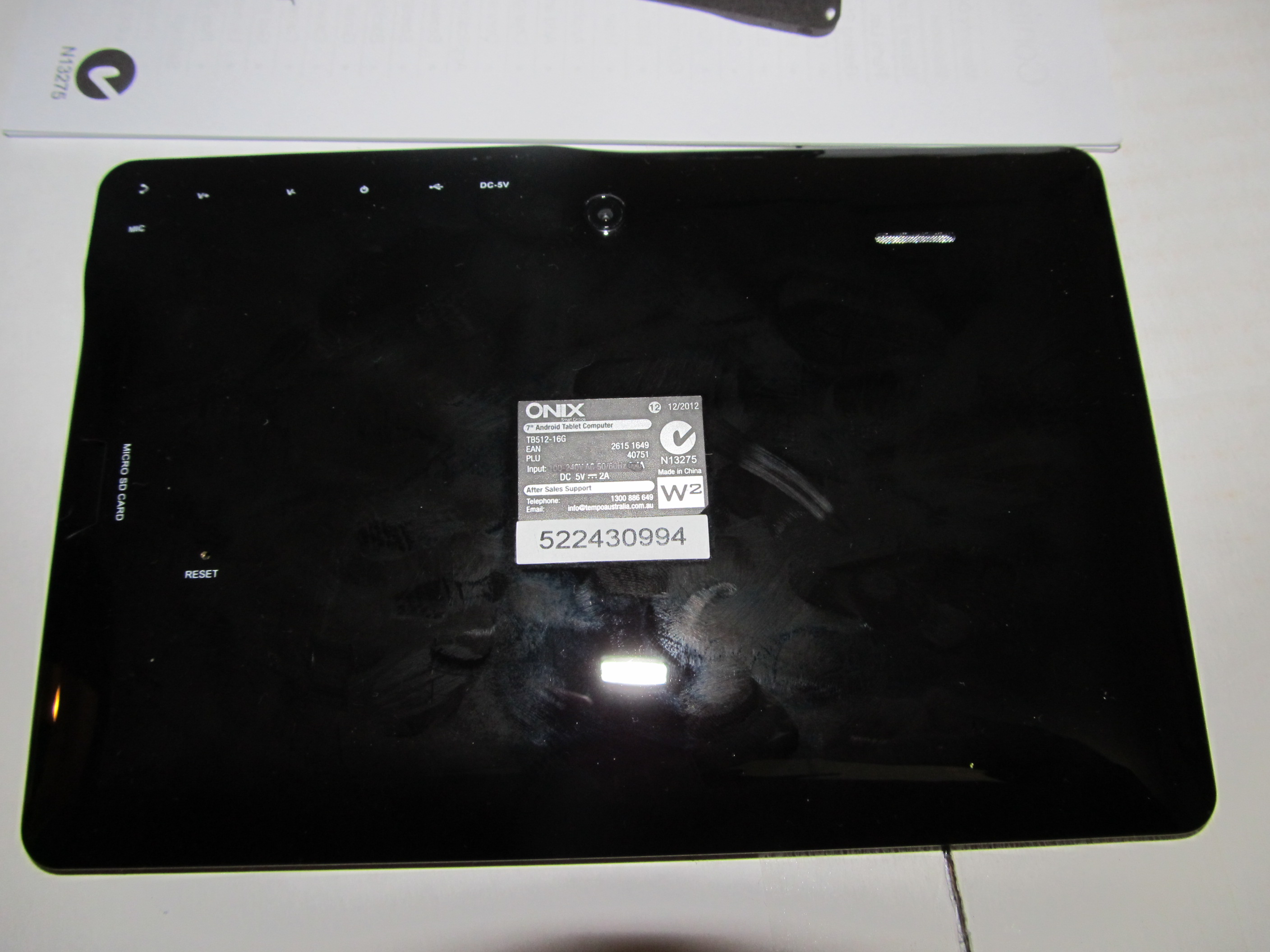
back of the onix 7 inch tabletfront of the onix 7 inch tablet and cover of manual I ve just bought a 7 Onix tablet from Aldi. It runs Android 4.0.4, has a 1GHz Cortex A8 CPU, 512M of RAM, 16G of flash storage, and a 800*480 display. They are selling rapidly and I don t know how long they will last probably you could get a returned one next week if you can t get one today. But if you like pink then you may be able to get one (the black ones are selling out first). The tablet seems like a nice piece of hardware, solid construction and it feels nice to hold. Mine has a minor screen defect, but that s the sort of
thing you expect from a cheap device, apart from that the display is good. The Wifi doesn t seem to have as good a range as some other devices (such as my phones and the more expensive 10 tablet I got from Kogan). This isn t a
problem for me (the data intensive uses for this device will be in the same room as the AP) but could be a killer for some people. If you have your phone or a dedicated 3G Wifi AP in your pocket while using the tablet then it should be fine, but if you have an AP at the wrong end of your house then you could be in trouble. I found Youtube unusable due to slow downloading even when sitting next to my AP but I can play videos downloaded from iView that are on my local web server (which is more important to me). I expect that I will be able to play local copies of TED talks too. The camera is bad by phone camera standards, fortunately I have no interest in using a tablet as a camera. I had no real problems with the Google Play store (something that caused problems for some users of an earlier Aldi Android tablet). Generally the tablet works well. The people who build Android for modern devices seem remarkably stupid when it comes to partitioning, every device I ve seen has only a small fraction of the storage usable for apps. This tablet is the worst I ve ever seen, it has 16G of storage of which there is 512M partitioned for apps of which only 400M is free when you first get the device! It comes pre-installed with outdated versions of the Facebook client and Google Maps (which isn t very useful on a Wifi device) and some other useless things. If you upgrade them to the latest versions then you ll probably lose another 100M of the 512M! Fortunately the Android feature to run apps from the VFAT partition works so I haven t been prevented from doing anything by this problem yet. In conclusion, it s not the greatest Android tablet. But you don t expect a great tablet for $100. What I hoped for was a somewhat low spec tablet that works reasonably well and that s what I got. I m happy.

4 December 2012

Andrea Veri: My favorite WordPress Plugins

It took me a while to build a complete WordPress blog with all the things I needed, from modifying the default Twenty Eleven theme to broadcasting my posts directly on Twitter. WordPress has a nice selection of plugins and given the fact I spent a few days evaluating all the possibilities, I decided to share my own setup to speed up the process in case you are willing to build a WordPress powered blog. The plugins: And a few modifications I made on my Child theme for the Twenty Eleven theme to suit my needs: Remove the navigation buttons on the header. On the Child theme s style.css:
#access, #branding .only-search #s, .entry-header .comments-link  
display: none;
 
Remove the gray line on the top of the header s banner. On the Child theme s style.css:
#branding  
border-top: none;
 
.and a little tip about WordPress itself: have you ever wondered how you could install/update/remove a WordPress theme or plugin without FTP access? Here s how! On the config.php file:
/*** Updates WordPress without FTP credentials. ***/
define('FS_METHOD','direct');
If you know any other handy WordPress Tip or Plugin, please share!

Russ Allbery: Review: The Borrowers

Review: The Borrowers, by Mary Norton
Series: The Borrowers #1
Illustrator: Beth Krush
Illustrator: Joe Krush
Publisher: Sandpiper
Copyright: 1953
Printing: 1986
ISBN: 0-15-204737-9
Format: Trade paperback
Pages: 180
Arrietty is a 14-year-old girl who lives under the clock. Well, actually, she lives under the kitchen floor, but the entrance to her family's passageway is under the clock, from which they get their name. She sleeps in an old cigar box, her living room is wallpapered with strips cut from letters (and decorated with postage stamps), and she keeps a journal in a miniature book that's half the size she is. Arrietty, and her parents Pod and Homily, are Borrowers. The Borrowers is a classic series of children's books by Mary Norton about miniature people who, at least in this first book, live in the walls and take things. Not big things, but all the little things: the blotter paper, the pins, the stray sock, old postage stamps, empty matchboxes, and the occasional thimble. With these things, they build their furniture, their clothes, and their homes, safely hidden in the walls and other secret places, always wary of the "human beans" (as Arrietty's mother tends to call them). That life is, of course, a remarkable simulation of middle-class, class-conscious British life, which is much of the fun. Arrietty's family lives in the home of an elderly woman who's confined to bed, so it's quiet, safe, and driven entirely by routine. They only have to watch out for the maid and the gardener, and they keep regular schedules. That's just the way the Borrowers like it; predictable and quiet. Which is why they get caught entirely by surprise when a boy shows up, recovering from illness in the country, and spots Pod on one of his borrowing runs. This is technically a re-read, but I read the original series so long ago that I barely remembered it. Not that there is all that much to remember, at least in the way of plot. This first book follows one of the standard plots for children's books of this type (although it follows Arrietty as the viewpoint character rather than the more common choice of the boy): boy discovers hidden creatures, hidden creatures are afraid, boy turns out to want to make friends with them, they strike up a friendship, peril nonetheless ensues. If you've read many children's books, you've probably read this before; The Mouse and the Motorcycle is an obvious example (and, in terms of plot, a somewhat better book). Arrietty is a typical protagonist, her parents are silly (and a bit flighty, particularly her mother), and the boy is, disappointingly, almost a non-entity. But you don't read The Borrowers for the plot. The brilliance of this book is in the descriptions of what they use, how they use it, and how they construct their ingenious homes. Norton captures much of the wonder of other miniaturization stories (the movie Honey, I Shrunk the Kids is an obvious example), but takes it one step further into clever and thoughtful repurposing. The book is full of off-hand descriptions of how everyday objects become different everyday objects for miniature people, giving it the same delight that one gets from descriptions of how model railroad dioramas or hand-made doll houses are constructed. The detailed (if busy) illustrations by the Krushes help tremendously with visualization and make the descriptions even more fun. This is very much a children's book based on an exploration of a single great idea, so don't expect too much in the way of plot or deep characterization. It's also not science fiction; there isn't any realistic extrapolation of culture. The Borrowers all behave like perfectly ordinary English people without any further explanation because, of course, that's what they would do. Re-reading it as an adult, I wished there was a bit more meat to it. But the ingenuity is still a delight. It's great fun to spend a couple of hours imagining how one would construct the miniature accouterments of everyday life. Followed by The Borrowers Afield. Rating: 7 out of 10

3 December 2012

Joey Hess: hledger

Apologies in advance for writing a long blog post about the dull and specialised subject of double-entry accounting from the Unix tools perspective, that ends up talking about Monads to boot. I can't believe I'm about to write such a thing, but I'm finding it an oddly interesting subject. double-entry accounting I've known of, though probably not really understood double entry accounting for a while, thanks to GnuCash. I think GnuCash did something rather special in making such a subject approachable to the layman, and I've been happy to recommend GnuCash to friends. I was stoked to find a chapter in my sister Anna's new book that happily and plausibly suggests readers use GnuCash. But for my personal use, GnuCash is clunky. I mean, I'm a programmer, but I can't bring any of my abilities to bear on it, without a deep dive into the code. The file format is opaque (and a real pain to keep checked into git with all the log files); the user interface is often confusing, but there's no benefit to its learning curve, it never seems to get better than manually entering data into its ledger, or perhaps importing data from a bank. I've never found the reports very useful. I've got perhaps a year of data in GnuCash, but it's fragmented and incomplete and not something I've been able to motivate myself to keep up with. So I have less financial data than I'd like. I'm hoping ledger will change that. ledger I've known about ledger for a while, at least since This Linux Weekly News article. It's a quintessential Unix tool, that simply processes text files. The genius of it is the simplicity of the file format, that gets the essence and full power of double entry bookeeping down to something that approaches a meme. Once you get the file format stuck in your head, you're done for.
2004/05/27 Book Store
      Expenses:Books                 $20.00
      Liabilities:Visa
starting to use hledger Now as a Haskell guy, I was immediately drawn to the Haskell clone, hledger. It's nice that there are two (mostly) compatable implementations of ledger too. So from here on, I'll be talking about hledger. I sat down and built a hledger setup for myself the other day. I started by converting the GnuCash books I have been keeping up-to-date, for a small side business (a rental property). It quickly turned into something like programming, in the best way, as I used features like: a modern unix program While I've been diving into hledger, I've been drawing all kinds of parallels between it and other modern Unix-friendly programs I use lately. I think we've gone over a bit of a watershed recently. Unix tools used to be either very simple and crude (though often quite useful), or really baroque and complex with far too many options (often due to 10-30 years of evolution). Or they were a graphical user interface, like GnuCash, and completely divorced from Unix traditions. The new unix programs have some commonalities... importing data After manually converting my GnuCash data, I imported all my PayPal history into hledger. And happily it calculates the same balance Paypal does. It also tells me I've paid PayPal $180 in transaction fees over the years, which is something PayPal certianly doesn't tell you on their website. (However, my current import from PayPal's CSV files is a hackish, and only handles USD currency, so I miss some currency conversion fees.) I also imported my Amazon Payments history, which includes all the Kickstarter transactions. I almost got this to balance, but hledger and Amazon disagree about how many hundreths of a cent remain in my account. Still, pretty good, and I know how much I paid Amazon in fees for my kickstarter, and how much was kicked back to Kickstarter as well. (Look for a cost breakdown in some future blog post.) At this point, hledger stats says I have 3700 transactions on file, which is not bad for what was just a few hours work yesterday. One problem is hledger's gotten a little slow with this many transactions. It takes 5 seconds to get a balance. The ledger program, written in C, is reportedly much faster. hledger recently had a O(n^2) slowdown fixed, which makes me think it's probably only starting to be optimised. With Haskell code, you can get lucky and get near C (language, not speed of light) performace without doing much, or less lucky and get not much better than python performance until you dive into optimising. So there's hope. harnessing haskell If there's one place hledger misses out on being a state of the art modern Unix program, it's in the rules files that are used to drive CSV imports. I found these really hard to use; the manual notes that "rules file parse errors are not the greatest"; and it's just really inflexible. I think the state of the art would be to use a Domain Specific Language here. For both my Amazon and PayPal imports I had CVS data something like:
date, description, amount, fees, gross
I want to take the feeds into account, and make a split transaction, like this:
date description
    assets:accounts:PayPal             $9.90
    expenses:transaction fees:PayPal   $0.10
    income:misc:PayPal                 -$10.00
This does not seem possible with the rules file. I also wanted to combine multiple CVS lines, to do with currency conversions, into a single transaction, and couldn't. The problem is that the rules file is an ad-hoc format, not a fully programmable one. If instead, hledger's rules files were compiled into standalone haskell programs that performed the import, arbitrarily complicated conversions like the above could be done. So, I'm thinking about something like this for a DSL.. I doubt I'll get much further than this, since I have a hacked together multi-pass importer that meets my basic needs. Still, this would be nice, and being able to think about adding thing kind of thing to a program cleanly is one of the reasons I reach for the Haskell version when possible these days. First, here's part of one of my two paypal import rules files (the other one extracts the transaction fees):
amount-field 7
date-field 0
description-field %(3) - %(4) - %(11)
base-account assets:accounts:PayPal
Bank Account
assets:accounts:checking
.*
expenses:misc:PayPal
That fills out the basic fields, and makes things with "Bank Account" in their description be categorised as bank transfers. Here's how it'd look as Haskell, carefully written to avoid the $ operator that's more than a little confusing in this context. :)
main :: IO ()
main = convert paypalConveter
paypalConverter :: [CSVLine] -> [Maybe Transaction]
paypalConverter = map convert
  where
    convert = do
        setAmount =<< field 7
        setDate =<< field 0
        setDescription =<< combine " - " [field 3, field 4, field 11]
        defaultAccounts
            "assets:accounts:PayPal" ==> "expenses:misc:PayPal"
        inDescription "Bank Account" ?
            "assets:accounts:PayPal" ==> "assets:accounts:checking"
That seems like something non-haskell people could get their heads around, especially if they didn't need to write the boilerplate function definitions and types at the top. But I may be biased. :) Internally, this seems to be using a combination Reader and Writer monad that can get at fields from a CSV line and build up a Transaction. But I really just made up a simple DSL as I went along and thew in enough syntax to make it seem practical to implement. :) Of course, a Haskell programmer can skip the monads entirely, or use others they prefer. And could do arbitrarily complicated stuff during imports, including building split transactions, and combining together multiple related CVS lines into a single transaction.

2 December 2012

Dirk Eddelbuettel: RQuantLib 0.3.9

A minor feature release RQuantLib 0.3.9 is now on CRAN and in Debian. RQuantLib combines (some of) the quantitative analytics of QuantLib with the R statistical computing environment and language. Bryan Lewis had suggested to enable another pricing engine for American Options in order to get (at least some) Greeks. This is now supported by picking engine="CrankNicolson" as shown in the default example for the AmericanOption function:
R> library(RQuantLib)
R> example(AmericanOption)
AmrcnOR> # simple call with unnamed parameters
AmrcnOR> AmericanOption("call", 100, 100, 0.02, 0.03, 0.5, 0.4)
Concise summary of valuation for AmericanOption 
  value   delta   gamma    vega   theta     rho  divRho 
11.3648      NA      NA      NA      NA      NA      NA 
AmrcnOR> # simple call with some explicit parameters
AmrcnOR> AmericanOption("put", strike=100, volatility=0.4, 100, 0.02, 0.03, 0.5)
Concise summary of valuation for AmericanOption 
  value   delta   gamma    vega   theta     rho  divRho 
10.9174      NA      NA      NA      NA      NA      NA 
AmrcnOR> # simple call with unnamed parameters, using Crank-Nicolons
AmrcnOR> AmericanOption("put", strike=100, volatility=0.4, 100, 0.02, 0.03, 0.5, engine="CrankNicolson")
Concise summary of valuation for AmericanOption 
  value   delta   gamma    vega   theta     rho  divRho 
10.9173 -0.4358  0.0140      NA      NA      NA      NA 
R> 
Thanks to CRANberries, there is also a diff to the previous release 0.3.8. Full changelog details, examples and more details about this package are at my RQuantLib page.

Next.

Previous.