Search Results: "ean"

4 June 2012

Steve McIntyre: Visiting my grandfather in Hong Kong

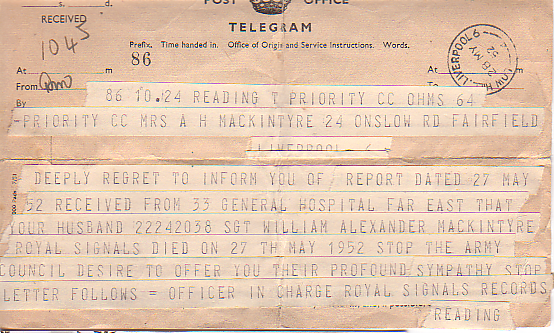
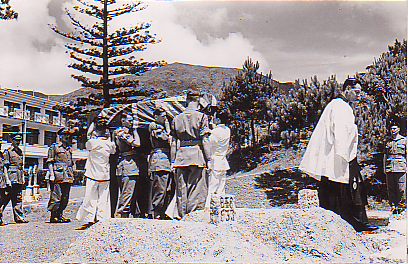
I never met my father's father, as he died many years before I was born. He was a soldier in the British Army and was killed in an accident in Burma in the 1950s. I'm told that back then the Army did not repatriate casualties as a matter of course like they do today, so none of the family got to see his funeral or even visit the grave. Like many of the military casualties in the Far East, he was buried in the Colonial Cemetery in Hong Kong. A few photographs were sent to my grandmother of the ceremony and the headstone, but that's all we ever saw.

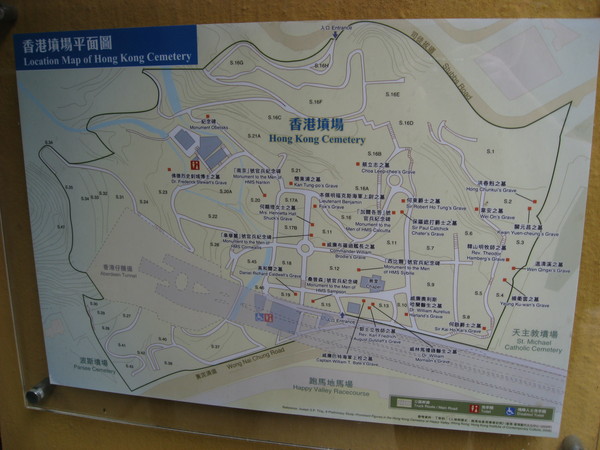
telegramfuneral Fast forward to 2012. I travelled to Hong Kong for a conference (Linaro Connect, more about that later...). I looked up the details of where grandad was laid to rest, and found a major coincidence. He was killed on 27th May 1952, almost exactly 60 years ago! I resolved to go to find him on 27th May 2012 to make the most of this lucky anniversary. Wikipedia told me that in the intervening years the Colonial Cemetery had been renamed to Happy Valley Cemetery, then simply Hong Kong Cemetery, and repurposed from military to civilian use. Jo and I bought some flowers and headed over to Happy Valley on Hong Kong Island on Sunday afternoon. We found a very large cemetery with a helpful map posted to show the different sections, but nothing to tell us where we should be looking. One of the attendants at the office on site looked at the details we had and shrugged to say "sorry, can't help". Ah well, nobody said this was going to be very easy... What we found after a few minutes was that the graves weren't laid out in any obviously logical fashion. In any given small area, you'd find people buried from roughly the same period, but people for any given period could (and would) be scattered across multiple sections at all corners of the site. Great, time for an exhaustive search then. I started combing the site, checking all the markers I could find that looked anything like the tiny grainy black and white photo we had of grandad's headstone.

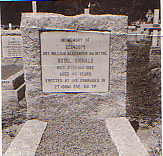
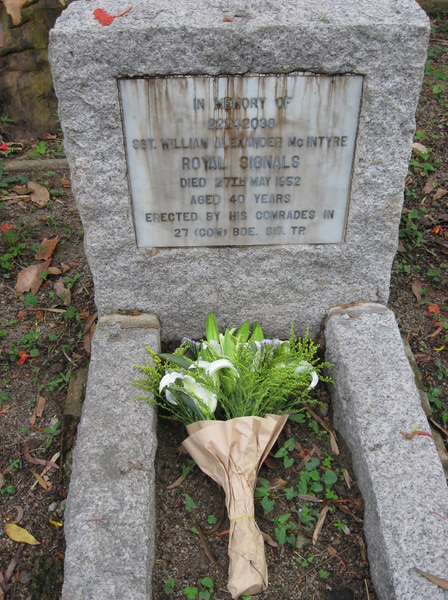
cemeteryheadstone Almost two hours later, I eventually found him. Two hours of heavy work: the cemetery is built on the side of quite a steep hill, and the prevailing weather was very hot with 100% humidity. But, I forgot all that as we eventually stumbled across the correct grave in (no exaggeration!) the very last part of the last section of the site, 20a.

grave I was relieved at this point: as things had taken so long, I had started to worry that maybe the grave had been moved or the headstone damaged and lost. But no, I found the man who had gone off to war leaving my dad and aunt as small children. We took some photos and took note of where we had found the final resting place of Sergeant William Alexander McIntyre of the Royal Signals, a man I never met in life but clearly a very important member of our family.

Benjamin Mako Hill: Why Facebook's Network Effects are Overrated

A lot of people interested in free software, and user autonomy and network services are very worried about Facebook. Folks are worried for the same reason that so many investors are interested: the networks effects brought by hundreds of millions of folks signed up to use the service. Network effects -- the concept that a good or service increases in value as more people use it -- are not a new problem for free software. Software developers target Microsoft Windows because that is where the large majority of users are. Users with no love for Microsoft and who are otherwise sympathetic to free software use Windows because programs they need will only run there. Folks worried about Facebook are afraid for similar reasons. Sure, you can close down your Facebook account and move to Diaspora. But who will you talk to there? You can already hear people complaining about Facebook the same way they've been complaining about Windows or Office for years. People feel that their hands are tied and that their software, and their social network, will be determined by what everybody is doing. I'm worried about Facebook. But I'm not too intimidated by Facebook's network effects for two reasons. First, using Facebook doesn't preclude using anything else. Twitter has enormous overlapping functionality with Facebook. Sure, people use the systems very differently. But they both ask you to create lists of friends and followers and are designed around sending and receiving short status messages. Millions of people do both and both systems are thriving. For the millions of people who use both Facebook and Twitter, the two services have had to negotiate their marginal utility in a world they share with the other one. People decide that Twitter is for certain types of short messages and Facebook is for others. But these arrangements shift over time. And the relationships between services aren't always peaceful coexistence. Remember Friendster? Remember Orkut? Remember Tribe? Remember MySpace? MySpace, and all the others, are great examples of how social networks die. They very slowly fade away. MySpace users signed up for Facebook accounts and used both. They almost never just switched. Over time, as one platform became more attractive than the other, for many complicated reasons, attention and activity shifted. People logged in on MySpace less and Facebook more and, eventually, realized they were effectively no longer MySpace users. Anyone that has been on the Internet long enough to watch a few of these shifts from one platform to another knows that they're not abrupt -- even if they can be set in motion by a particular event or action. Users of social networking sites simply don't have to choose in the way that a person choosing to boot Windows and GNU/Linux does. I'm sure the vast majority of people with Diaspora accounts use Facebook actively. This is not a problem for Diaspora. It is how Diaspora -- or whatever else eventually achieves what many of us hoped Diaspora would -- could win. Second, Facebook is for the ephemeral. Facebook is primarily used for information that was produced very recently. This week if not today. If not this hour. Facebook has an enormous amount of data that users have fed it that may be hard to get out and move somewhere else. But most people don't care very much about having any regular access to the large majority of this information. What people care deeply about is having access to the data that they and their friends created today. And that data can just as easily be created somewhere else tomorrow. Or, with the right tools, created just as easily in both places. Compare this to something like Windows where moving away would require learning, converting, and perhaps even writing, new software. Perhaps even in new programming languages that most developers don't know yet. Compared to Windows, a migration away from Facebook will be easy. Facebook's photo galleries are an example of an important place where this holds less well. Social network information -- i.e., the list of who is friends with who -- is another example of something that is persistently valuable. That said, people really enjoy the act of finding and friending. Indeed, this process was part of the initial draw of Facebook and other social networks. None of this means that Facebook is over. It doesn't even mean that its ascendancy will be slowed. What it does mean is that Facebook is vulnerable to the next thing more than many technology firms that have benefited from network effects in the past. If users are given compelling reasons to switch to something else, they can with less trouble and they will. That compelling reason might be a new social network with better features or an awesome distributed architecture that allows freedom for users and the ability of those users to benefit from new and fantastic things that Facebook's overseers would never let them have and without the things Facebook's users suffer through today. Or it might be a sexier proprietary box to store users' private information. It doesn't mean that I'm not worried about Facebook. I remain deeply worried. It's just not very hard for me to imagine the end.

3 June 2012

Gregor Herrmann: RC bugs 2012/22

since most of the gcc 4.7 bugs are fixed by now, I looked again at the general RC bugs too this week. here's the usual short report:

Sandro Tosi: How to migrate your entire Google account to a new one

I've been using a Google account since years, but having a "more serious" one along. The time has come to make the switch and elect the other as main one.

Google has a lot of services, and I'm using several of them, so changing the main account requires to migrate data of those services to the new account, given it's not possible to merge two accounts. To know the full list of services your account is signed in, go to your Account Product page. Some migrations are easy, others hell no: so I'm writing this post to keep track of the migration as it's going on.

First of all, there's a really good post about this migration at LifeHacker: it contains a lot of info I'm using here, but not all the services I need. Additionally, Google has a list of services and methods to migrate from one account to another.

Just to be generic, I'll call AccountSRC the original account and AccountDST the one I want to migrate to.

Migrate GMail

GMail is probably the most important service I have, and also the most difficult one to migrate. I have a lot of filters, so the first step is to migrate them:
  1. Login into GMail for AccountSRC
  2. Gear icon > Settings > Labs
  3. Enable the "Filter import/export" plugin
  4. Reload GMail to enable the plugin (if not done automatically)
  5. Gear icon > Settings > Filters
  6. At the bottom of the page, Select all
  7. Export: this will download an XML file with the filters in it
  8. Login into GMail for AccountDST
  9. Enable "Filter import/export" plugin
  10. Load the file containing the saved filters
  11. Import all (or select which one) filters; this will also create automatically the labels defined in the filters.
I currently have a forward rule from AccountDST to AccountSRC: so let's revert the forward direction: from AccountSRC to AccountDST. This will allow the new account to receive the mails sent to the old one.
  1. Login into GMail for AccountDST
  2. Gear icon > Forwarding and POP/IMAP > Disable forwarding: this will stop redirecting mails from AccountDST to AccountSRC
  3. Login into GMail for AccountSRC
  4. Gear icon > Forwarding and POP/IMAP > add a forwarding address
  5. Enter AccountDST as the address to forward mails to
  6. A verification code is sent to AccountDST and you'll need to enter that code in AccountSRC to verify you have access to both mailboxes
  7. Once verified, select "Forward a copy of incoming mail to" to AccountDST and to delete the GMail copy on AccountSRC
There's no automatic way to migrate all your settings from the old GMail account to the new one, so you'll have to comparing settings pages to set what you had before to AccountDST. I suggest to first enable the labs you have on AccountSRC, and then go thru every page and report the configurations.

Did I forget something? yes, the hardest part: migrate mails! There are a lot of guides about migrating mails, the way I prefer is thru IMAP and Thunderbird (as described here): you'll move IMAP folders, and since they are equivalent to GMail labels, you'll automatically get your email with the correct labels (yes, the same mail appears in several folders, one for each label, and moving an email from one folder will not remove it from all the others).
  1. Enable IMAP access on both AccountSRC and AccountDST
  2. Open Thunderbird (or Icedove if you're on Debian like me) and register both accounts
  3. You can now start moving folders/emails from AccountSRC to AccountDST
    1. Copying a (missing) folder, will automatically create a label with the same name
    2. Moving a mail from the same folders on the two accounts will add the label called with the name of the folder to that email
  4. Be ready, it's a LOOOOONG process, but it's safe and it guarantees a perfect result
With the method above you have all the labels you had before, but not the label colors (and I have a lot :( ).

Another tool that's would be interesting to evaluate for this task is Gmvault.


Migrate Contacts

Contacts are available inside GMail:
  1. Login into GMail for AccountSRC
  2. On the combobox on top-left, select Contacts
  3. More > Export
  4. Export all the contacts in Google CSV, since it's specific to be re-imported
  5. Login into GMail for AccountDST
  6. Contacts > More > Import
  7. Select the previously saved file and import it

Migrate Reader

Migrating Reader subscriptions is easy:
  1. Login into Reader for AccountSRC
  2. Reader Settings -> Import/export
  3. Export your subscriptions in OPML format
  4. Now login into Reader for AccountDST
  5. Reader Settings -> Import/export
  6. And import the saved OPML file
Sadly, that doesn't migrate your starred items, but there's a (long & manual) solution here.


Migrate Blogger

Login to Blogger for AccountSRC; then, for each blog you have there do this dance:
  1. Select the blog
  2. Go into Settings > Permissions
  3. Add AccountDST as a new author: this will send an email to AccountDST GMail account
  4. Accept the invitation (this will ask you to create a new Blogger account for AccountDST if you don't already have one)
  5. Go back to to Blogger with AccountSRC
  6. Blog > Settings > Permissions
  7. Grand admin rights to AccountDST
At this point, both AccountSRC and AccountDST have admin rights; you can leave it as it is, or remove AccountSRC and so only AccountDST will be the admin (other shares should be kept unchanged). The same procedure is described in this Google support answer.

What can't be migrated as easily are all the profile settings you've done on AccountSRC. So profile information, blogs followed and so on have to be migrated by hand: boring but they are just few things, doable in a bunch of minutes.


Migrate Android phone

Android phones require a primary Google account to work, and of course my phone uses AccountSRC. Several sources say the only way to change primary account is to factory reset the phone. But since new market app supports multiple accounts and Android 4.0 (Ice Cream Sandwich) not longer needs a primary account, I just waited for the update to ICS to come.

What you really need to do is to add a new account, AccountDST, to Settings > Account & Sync, and all the Google apps on the phone will be able to use the new account (you might need to select what to sync, and the new account from inside each app).


Migrate Calendar

Even with Calendar the settings will have to be migrated by hand: they are just in one page, so just keep two windows opened and keep switching to sync them. The calendars are easy to move over: for the main calendar:
  1. Login into Calendars for AccountSRC
  2. Go into Settings > Calendars tab
  3. Select export calendars: this will download an archive of your calendars in a zip file; you will need to extract all the ics files from that zip archive so you'll have the main calendar readily available
  4. Login into Calendars for AccountDST
  5. Settings > Calendars tab
  6. Import the main calendar
for the other calendars you can do this way:
  1. Login into Calendars for AccountSRC
  2. Settings > Calendars tab
  3. Share the calendar with AccountDST and give it "Make changes AND manage sharing" right - the new account will have full control over that calendar

Migrate Docs

The procedure to migrate documents in Google Docs (now Google Drive) is described here, and it boils down to:
  1. Login into Docs for AccountSRC
  2. Select all the documents
  3. Share them with AccountDST
  4. In the same window select AccountDST as "is owner"
and you've got all the docs as owned by the new account.


Migrate Groups

There's no way to migrate all your Groups subscriptions from one account to another (if not playing with alternate email address, but it was too risky to try it), so you'll have to migrate all of them by hand.

On the other hand, if you've created some groups, that's possible to move them to the new account:
  1. Login into Groups for AccountSRC
  2. Enter in the "manage" area for the groups you've created
  3. Manage members > Invite members
  4. Invite AccountDST
  5. Accept the invitation, clicking on the email sent to AccountDST account
  6. Go back into AccountSRC manage area
  7. Select the AccountDST account
  8. Edit the subscription and set "Membership type" to "owner": now AccountDST is the owner of the list

Migrate Analytics

The process to migrate the account on Google Analytics is similar to Groups:
  1. Login into Analytics for AccountSRC
  2. Select Admin on top-right, then for each account you have
  3. Select the account, select "Users" tab, click on "+ New User"
  4. Enter AccountDST into the "Email Address" field and give that account the "Administrator" role
  5. Save
  6. Now AccountDST is able to access the same data on Analytics as AccountSRC

Migrate Picasa

To transfer your whole Picasa account follow these steps (as also described in this support post):
  1. Login into Picasa for AccountSRC
  2. Click on the gear on top-right > Photo Settings > Privacy and permissions
  3. On the "Migrate account" line click on "Migrate my photos"
  4. Insert AccountDST into the box for destination address
  5. In case you're using picasa to store blogger photos, also select the tick below
  6. At this point, AccountSRC will receive an email: copy the link in a session where you've logged in as AccountDST and then visit the page: that will start the process
  7. Wait until the transfer is completed: you'll receive an email to AccountDST when it's done

Migrate Google+

I'm not exactly a heavy user of G+ but I have some circles I'd like to move over (also because Reader sharing now works with G+ and it's a feature I user a lot), this is a process to move circles and contacts; as stated there, there's no way to move shared items and stuff (sad!).


Migrate AdSense

It's not possible to migrate the current AdSense account: you have to register a new one. When you do, it's possible that Google notice the new account is for the same person of the first one, and will ask to close the old account on AdSense in favor of the new one.


Migrate Alert

Alerts allows to export the list of alerts you've created but it's not possible to import that list in another Google account, so you'll have to recreate them from scratch (I had just a few so it was a matter of 1 minute or so).


Migrate Zoho Notebook

If you still miss Google Notebook (why big-G you let it die? couldn't you open-sourced it? it was so awesome! anyway...), you probably know that there are two main alternatives to it: Evernote and Zoho Notebook. I decided to go with Zoho (I'm not entirely happy with it, but it's running for now), and given it allows to login with Google account, it was currently using AccountSRC, so I need to migrate that too:
  1. Login into Zoho Notebook for AccountSRC
  2. My Account > Profile > Email address
  3. "Add new email" and add AccountDST, it will send a confirmation email
  4. Then "Make Primary" on AccountDST, so now the new account can login into Zoho notebook with the Google info and have all the notes there.

Migrate Bookmarks

Google provides a guide to migrate Bookmarks from one account to another that basically is:
  1. Login into Bookmarks for AccountSRC
  2. Click on Export bookmarks and it will save an HTML file with the bookmarks in it
  3. Import the file in a browser
  4. Use the Google toolbar to import in into AccountDST
That's kinda ugly way, but it seems to work.


Re-enable Web History

If you used History, then you need to re-enable it on the new account:
  1. Login into History for AccountDST
  2. Click on "Turn Web History on" to enable Web History on the new account
but it seems to be impossible to export/import or migrate the history from one account to another, that's a shame: years and years of stats lost.


Migrate Books

Books doesn't allow to migrate the contents between accounts, so you'll have to do it by hand:
  1. Select one book from AccountSRC, copying its link
  2. Go to AccountDST and navigate to the copied link
  3. Add the book to the right category, as it was before.

Migrate Webmaster Tools

Google released a document that describes how to migrate to another account; it's similar to Analytics and Groups migration.

In addition to that, you might also want to become an owner, that will give full control on the sites.


Did I forget some services? Let me know!

Everyone has a different experience with Google products, so in case you want me to let know how you migrated from one account to another for a product I didn't mentioned, just leave a comment and I'll edit the post (to be as complete as possible).

Johannes Schauer: port bootstrap build-ordering tool report 1

A copy of this post is sent to soc-coordination@lists.alioth.debian.org as well as to debian-bootstrap@lists.mister-muffin.de. Diary May 21 May 22 May 23 May 24 May 25 May 29 May 30 May 31 June 1 June 2 Results I learned a good chunk of ocaml and how to use dose3 and libcudf. I created a gitorious project and a git repository for all the sourcecode.
git clone git://gitorious.org/debian-bootstrap/bootstrap.git
The git as of now contains 30 commits and 1197 lines of ocaml code. So far, 62 emails have been exchanged between me and Pietro and Wookey. I created a mailinglist for this project where all email exchange so far is publicly accessible in the archives. You can also download all of the email exchange in mbox format. Everybody is welcome to join and/or read the list. What seems to be finished: the program that finds the minimal amount of source packages that have to be cross compiled to end up with a minimal build system. What it does is:
  1. get all essential packages
  2. get their runtime dependencies
  3. get build-essential plus runtime dependencies
  4. get all source packages that are necessary to build 1.-3. those are the packages that have to be cross compiled
  5. get a list of all packages that are built by source packages from 4.
  6. add all packages from 1.,2.,3. and 5. plus all arch:all packages to a universe
  7. use Depsolver.trim on that universe to figure out which of those packages are actually installable
The result of 7. will then contain a list of packages that are available automatically on the foreign system due to cross compiled source packages and arch:all packages. For Debian Sid, the output of my program is:
# (1) number of packages with priority:required: 62
# (2) plus, number of dependencies of priority:required packages: 20
# (3) plus, build-essential and dependencies: 31
# number of source packages to build the above: 71
# number of additional packages built from the above source packages: 292
# (4) number of packages of those plus arch:all packages that are installable: 6421
# total number of installable packages (1)+(2)+(3)+(4): 6534
For Ubuntu Natty it is:
# (1) number of packages with priority:required: 96
# (2) plus, number of dependencies of priority:required packages: 7
# (3) plus, build-essential and dependencies: 31
# number of source packages to build the above: 87
# number of additional packages built from the above source packages: 217
# (4) number of packages of those plus arch:all packages that are installable: 2102
# total number of installable packages (1)+(2)+(3)+(4): 2236
So for Debian, 71 source packages definitely have to be made cross compilable while for Natty, the number is 87. The last two days I was toying around with these minimal systems to see how big the number of source packages is, that can be built on top of them without running into dependency cycles. After installing the binary packages that were built, I checked again until no new packages could be built. For Natty, I was only able to find 28 additional packages that can be built on top of the 2236 existing ones. This means that a number of dependency cycles prevent building anything else. In the coming two weeks I will focus on coming up with a tool that cleverly helps the user to identify packages that would be useful to have for building more packages (probably determined by how many packages depend on it - debhelper is an obvious candidate). The tool would then show why that crucial package is not available (in case of debhelper because some of its runtime dependencies are not available and require debhelper to be built) and how the situation can best be resolved. The possible methods to do so are to identify a package that is part of a cycle and either cross compile it or let it have staged build dependencies.

1 June 2012

Pietro Abate: apt-get with external solvers : call for testers

Last year we invited David to work with us for a few days to add a generic interface to apt to call external solvers. After a few iterations, this patch finally landed in master and recently (about 3 months ago), in debian unstable.
  [ David Kalnischkies ]
  * [ABI-Break] Implement EDSP in libapt-pkg so that all front-ends which
    use the internal resolver can now be used also with external
    ones as the usage is hidden in between the old API
  * provide two edsp solvers in apt-utils:
    - 'dump' to quickly output a complete scenario and
    - 'apt' to use the internal as an external resolver
Today the new version of apt-cudf was upload in unstable and with it the latest bug fixes that makes it ready for daily use. I've used it quite a lot myself to upgrade my machine and it seems working pretty well so far... The most important difference with the old version is the support for multi-arch enabled machines. This marks an important milestone in our efforts to integrate external solvers, built using different technologies, directly into apt. From a user prospective, this means that (s)he will have the possibility to check if there exists a better (best ?) solution to an installation problem then what proposed by the internal apt solver. Moreover, even if apt-get gives very satisfactory answers, there are occasions where it fails miserably, leaving the user wondering how to unravel the complex web of dependencies to accomplish his task. Available cudf solvers in debian are at the moment : aspcud, mccs and packup. From an architectural point of view this is accomplished by abstracting the installation problem via a simple textual protocol (EDSP) and using an external tool to do the heavy duty translation. Since all solvers now available in debian are not meant to be debian-specific, using them involve a two step translation. The EDSP protocol specification is for the moment "hidden" in the apt documentation. I hope to find a better place for it soon : it would be cool if other package managers as smart or cupt could add an implementation on EDSP in their code so to automatically benefit of this technology. To make it happen, Apt first creates an EDSP file that is then handled to apt-cudf that takes care of the translation to cudf and back into EDSP that is then read back by apt. Apt-cudf is the bridge between edsp and the external solvers and takes care of doing the book keeping and to select the right optimization criteria. Roberto recently wrote a very nice article explaining how to use apt-get with an external solver. In a nutshell, if you want to try this out you just need to install apt-cudf, one external solver like aspcud from the university of Pasdam and then call apt-get using the --solver option (that is not yet documented #67442 ). For example :
apt-get install -s gnome --solver aspcud
This will install gnome while using the a optimization criteria that tries to minimizing the changes on the system. Various other optimization criteria for all apt-get default actions can be specified in the apt-cudf configuration file /etc/apt-cudf.conf I hope the new release of apt-cudf make it into testing before the freeze. Time to test !!!

31 May 2012

Russell Coker: Links May 2012

Vijay Kumar gave an interesting TED talk about autonomous UAVs [1]. His research is based on helicopters with 4 sets of blades and his group has developed software to allow them to develop maps, fly in formation, and more. Hadiyah wrote an interesting post about networking at TED 2012 [2]. It seems that giving every delegate the opportunity to have their bio posted is a good conference feature that others could copy. Bruce Schneier wrote a good summary of the harm that post-911 airport security has caused [3]. Chris Neugebauer wrote an insightful post about the drinking culture in conferences, how it excludes people and distracts everyone from the educational purpose of the conference [4]. Matthew Wright wrote an informative article for Beyond Zero Emissions comparing current options for renewable power with the unproven plans for new nuclear and fossil fuel power plants [5]. The Free Universal Construction Kit is a set of design files to allow 3D printing of connectors between different types of construction kits (Lego, Fischer Technic, etc) [6]. Jay Bradner gave an interesting TED talk about the use of Open Source principles in cancer research [7]. He described his research into drugs which block cancer by converting certain types of cancer cell into normal cells and how he shared that research to allow the drugs to be developed for clinical use as fast as possible. Christopher Priest wrote an epic blog post roasting everyone currently associated with the Arthur C. Clarke awards, he took particular care to flame Charles Stross who celebrated The Prestige of such a great flaming by releasing a t-shirt [8]. For a while I ve been hoping that an author like Charles Stross would manage to make more money from t-shirt sales than from book sales, Charles is already publishing some of his work for free on the Internet and it would be good if he could publish it all for free. Erich Schubert wrote an interesting post about the utility and evolution of Favebook likes [9]. Richard Hartmann wrote an interesting summary of the problems with Google products that annoy him the most [10]. Sam Varghese wrote an insightful article about the political situation in China [11]. The part about the downside of allowing poorly educated people to vote seems to apply to the US as well. Sociological Images has an article about the increased rate of Autism diagnosis as social contagion [12]. People who get their children diagnosed encourage others with similar children to do the same. Vivek wrote a great little post about setting up WPA on Debian [13]. It was much easier than expected once I followed that post. Of course I probably could have read the documentation for ifupdown, but who reads docs when Google is available? Related posts:
  1. Links March 2012 Washington s Blog has an informative summary of recent articles about...
  2. Links April 2012 Karen Tse gave an interesting TED talk about how to...
  3. Links February 2012 Sociological Images has an interesting article about the attempts to...

Marc 'Zugschlus' Haber: atop in unstable

Eight days ago, I uploaded atop 1.26-1 to DELAYED/8, listing me as new maintainer. This means that the package has in the mean time appeared in unstable, and I hope that it ll swiftly migrate to testing.

Matthew Garrett: Implementing UEFI Secure Boot in Fedora

Edit 16:17EDT 31/5/12: Clarification of who gets the $99
Edit 02:10EDT 01/6/12: Clarification that it's a one-off payment

(Brief disclaimer - while I work for Red Hat, I'm only going to be talking about Fedora here. Anything written below represents only my opinions and my work on Fedora, not Red Hat's opinions or future plans)

Fedora 17 was released this week. It's both useful and free, and serves as a welcome addition to any family gathering. Do give it a go. But it's also noteworthy for another reason - it's the last Fedora release in the pre-UEFI secure boot era. Fedora 18 will be released at around the same time as Windows 8, and as previously discussed all Windows 8 hardware will be shipping with secure boot enabled by default. While Microsoft have modified their original position and all x86 Windows machines will be required to have a firmware option to disable this or to permit users to enrol their own keys, it's not really an option to force all our users to play with hard to find firmware settings before they can run Fedora. We've been working on a plan for dealing with this. It's not ideal, but of all the approaches we've examined we feel that this one offers the best balance between letting users install Fedora while still permitting user freedom.

Getting the machine booted
Most hardware you'll be able to buy towards the end of the year will be Windows 8 certified. That means that it'll be carrying a set of secure boot keys, and if it comes with Windows 8 pre-installed then secure boot will be enabled by default. This set of keys isn't absolutely fixed and will probably vary between manufacturers, but anything with a Windows logo will carry the Microsoft key[1].

We explored the possibility of producing a Fedora key and encouraging hardware vendors to incorporate it, but turned it down for a couple of reasons. First, while we had a surprisingly positive response from the vendors, there was no realistic chance that we could get all of them to carry it. That would mean going back to the bad old days of scouring compatibility lists before buying hardware, and that's fundamentally user-hostile. Secondly, it would put Fedora in a privileged position. As one of the larger distributions, we have more opportunity to talk to hardware manufacturers than most distributions do. Systems with a Fedora key would boot Fedora fine, but would they boot Mandriva? Arch? Mint? Mepis? Adopting a distribution-specific key and encouraging hardware companies to adopt it would have been hostile to other distributions. We want to compete on merit, not because we have better links to OEMs.

An alternative was producing some sort of overall Linux key. It turns out that this is also difficult, since it would mean finding an entity who was willing to take responsibility for managing signing or key distribution. That means having the ability to keep the root key absolutely secure and perform adequate validation of people asking for signing. That's expensive. Like millions of dollars expensive. It would also take a lot of time to set up, and that's not really time we had. And, finally, nobody was jumping at the opportunity to volunteer. So no generic Linux key.

The last option wasn't hugely attractive, but is probably the least worst. Microsoft will be offering signing services through their sysdev portal. It's not entirely free (there's a one-off $99 fee to gain access edit: The $99 goes to Verisign, not Microsoft - further edit: once paid you can sign as many binaries as you want), but it's cheaper than any realistic alternative would have been. It ensures compatibility with as wide a range of hardware as possible and it avoids Fedora having any special privileges over other Linux distributions. If there are better options then we haven't found them. So, in all probability, this is the approach we'll take. Our first stage bootloader will be signed with a Microsoft key.

Bootloaders
We've decided to take a multi-layer approach to our signing for a fairly simple reason. Signing through the Microsoft signing service is a manual process, and that's a pain. We don't want to have bootloader updates delayed because someone needs to find a copy of Internet Explorer and a smartcard and build packages by hand. Instead we're writing a very simple bootloader[2]. This will do nothing other than load a real bootloader (grub 2), validate that it's signed with a Fedora signing key and then execute it. Using the Fedora signing key there means that we can build grub updates in our existing build infrastructure and sign them ourselves. The first stage bootloader should change very rarely, and we don't envisage updating it more than once per release cycle. It shouldn't be much of a burden on release management.

What about grub? We've already switched Fedora 18 over to using grub 2 by default on EFI systems, but it still needs some work before it's ready for secure boot. The first thing is that we'll be disabling the module loading. Right now you can load arbitrary code into grub 2 at runtime, and that defeats the point of secure boot. So that'll be disabled. Next we'll be adding support for verifying that the kernel it's about to boot is signed with a trusted key. And finally we'll be sanitising the kernel command line to avoid certain bits of functionality that would permit an attacker to cause even a signed kernel to launch arbitrary code. These restrictions will all vanish if secure boot is disabled.

Kernel
Secure boot is built on the idea that all code that can touch the hardware directly is trusted, and any untrusted code must go through the trusted code. This can be circumvented if users can execute arbitrary code in the kernel. So, we'll be moving to requiring signed kernel modules and locking down certain aspects of kernel functionality. The most obvious example is that it won't be possible to access PCI regions directly from userspace, which means all graphics cards will need kernel drivers. Userspace modesetting will be a thing of the past. Again, disabling secure boot will disable these restrictions.

Signed modules are obviously troubling from a user perspective. We'll be signing all the drivers that we ship, but what about out of tree drivers? We don't have a good answer for that yet. As before, we don't want any kind of solution that works for us but doesn't work for other distributions. Fedora-only or Ubuntu-only drivers are the last thing anyone wants, and this really needs to be handled in a cross-distribution way.

Wait signed what
Secure boot is designed to protect against malware code running before the operating system. This isn't a hypothetical threat. Pre-boot malware exists in the wild, and some of it is nastier than you expect. So obviously bootloaders need to be signed, since otherwise you'd just replace the signed bootloader with an unsigned one that installed malware and booted your OS.

But what about the kernel? The kernel is just code. If I take a signed Linux bootloader and then use it to boot something that looks like an unsigned Linux kernel, I've instead potentially just booted a piece of malware. And if that malware can attack Windows then the signed Linux bootloader is no longer just a signed Linux bootloader, it's a signed Windows malware launcher and that's the kind of thing that results in that bootloader being added to the list of blacklisted binaries and suddenly your signed Linux bootloader isn't even a signed Linux bootloader. So kernels need to be signed.

And modules? Again, modules are just code. It's a little trickier, but if your signed kernel loads an unsigned module then that unsigned module can set up a fake UEFI environment and chain into a compromised OS bootloader. Now the attacker just has to include a signed kernel and a minimal initramfs that loads their malware module. It'd slow down boot by a couple of seconds, but other than that it'd be undetectable. X? If you can access the registers on a GPU then you can get the GPU to DMA over the kernel and execute arbitrary code. Trickier again, but still achievable - and if you've locked down every other avenue of attack, it's even attractive.

If we produce signed code that can be used to attack other operating systems then those other operating systems are justified in blacklisting us. That doesn't seem like a good outcome.

Customisation
A lot of our users want to build their own kernels. Some even want to build their own distributions. Signing our bootloader and kernel is an impediment to that. We'll be providing all the tools we use for signing our binaries, but for obvious reasons we can't hand out our keys. There's three approaches here. The first is for a user to generate their own key and enrol it in their system firmware. We'll trust anything that's signed with a key that's present in the firmware. The second is to rebuild the shim loader with their own key installed and then pay $99 and sign that with Microsoft. That means that they'll be able to give copies to anyone else and let them install it without any fiddling. The third is to just disable secure boot entirely, at which point the machine should return to granting the same set of freedoms as it currently does.

But I don't trust Microsoft
A system in custom mode should allow you to delete all existing keys and replace them with your own. After that it's just a matter of re-signing the Fedora bootloader (like I said, we'll be providing tools and documentation for that) and you'll have a computer that will boot Fedora but which will refuse to boot any Microsoft code. It may be a little more awkward for desktops because you may have to handle the Microsoft-signed UEFI drivers on your graphics and network cards, but this is also solvable. I'm looking at ways to implement a tool to allow you to automatically whitelist the installed drivers. Barring firmware backdoors, it's possible to configure secure boot such that your computer will only run software you trust. Freedom means being allowed to run the software you want to run, but it also means being able to choose the software you don't want to run.

You've sold out
We've been working on this for months. This isn't an attractive solution, but it is a workable one. We came to the conclusion that every other approach was unworkable. The cause of free software isn't furthered by making it difficult or impossible for unskilled users to run Linux, and while this approach does have its downsides it does also avoid us ending up where we were in the 90s. Users will retain the freedom to run modified software and we wouldn't have accepted any solution that made that impossible.

But is this a compromise? Of course. There's already inequalities between Fedora and users - trademarks prevent the distribution of the Fedora artwork with modified distributions, and much of the Fedora infrastructure is licensed such that some people have more power than others. This adds to that inequality. It's not the ideal outcome for anyone, and I'm genuinely sorry that we weren't able to come up with a solution that was better. This isn't as bad as I feared it would be, but nor is it as good as I hoped it would be.

What about ARM
Microsoft's certification requirements for ARM machines forbid vendors from offering the ability to disable secure boot or enrol user keys. While we could support secure boot in the same way as we plan to on x86, it would prevent users from running modified software unless they paid money for a signing key. We don't find that acceptable and so have no plans to support it.

Thankfully this shouldn't be anywhere near as much of a problem as it would be in the x86 world. Microsoft have far less influence over the ARM market, and the only machines affected by this will be the ones explicitly designed to support Windows. If you want to run Linux on ARM then there'll be no shortage of hardware available to you.

Is this all set in stone?
No. We've spent some time thinking about all of this and are happy that we can implement it in the Fedora 18 timescale, but there's always the possibility that we've missed something or that a new idea will come up. If we can increase user freedom without making awful compromises somewhere else then we'll do it.

[1] In fact, chances are that everything will carry the Microsoft key. Secure boot requires that UEFI drivers also be signed. The signing format only permits a single signature per binary. For compatibility, approximately all add-on hardware shipped will be signed with Microsoft's key, and that means that all system vendors have to recognise Microsoft's key in order to permit that hardware to run on their systems.
[2] Current source is here. It relies on a port of the UEFI crypto library and OpenSSL that I have building with some handholding, and which I'll upload as soon as possible.

comment count unavailable comments

30 May 2012

Christian Perrier: 12 languages to be deactivated in Debian Installer

At this very moment, it means that I would deactivate 14 languages:

29 May 2012

Jon Dowland: Debian Day

After a relatively long period of flux, I've managed to settle into a routine where I've got all the time I can dedicate to open source stuff bunched together: every Tuesday night. I've started calling it "Debian Day", although Debian won't get all that time exclusively. One evening a week doesn't sound like much, but that's unfortunately a realistic amount given my other commitments. Still, having a firm idea of how much resource I have makes planning what I can and can't do much easier. It also means I need to be quite selective about what I spend my time on. This also impacts the type of interactions I can use. I can respond to email, bugs, etc., but I cannot effectively interact with folks on IRC, for example: the period between windows is too large for it to work effectively. Therefore, I can't work reliably with any team or area of Debian that relies on IRC to get things done. Tonight, then. I have recently been ripping some CDs, a task for which I use grip, despite it long since having been dropped by Debian. It still works very well, whereas Sound Juicer, which still pops up whenever I insert an audio CD, does not. I've been interested in helping out with Debian GNOME packaging for a while, and it seems the issue has been fixed upstream, but after asking around in #debian-gnome, the root cause is that the newer musicbrainz API packages have not been uploaded to Debian. (the existing package uses the old API). Two separate people appear to have been working on a new Music Brainz package, but neither filed an ITP bug. I've spent the largest chunk of my Debian time just trying to figure out what has been going on, sadly, but at least there's the likelyhood this will be fixed for wheezy. There's also the tail end of a musicbrainz-2.1 transition finishing up. Another thing I considered this evening was the future of debgtd in Debian stable. On reflection, and after sitting on the fence for several months, I've decided I don't have the time to fix it up enough to have it ready for wheezy, so with regret I've filed a removal bug. With any luck, at some point in the wheezy cycle I'll manage to put more time towards this, because I think it addresses a genuine need and could be useful to people. Finally, whenever I sit down and look at Debian stuff to finish up, I have a strong temptation to fix some issues belonging to the games team. In particular, Gustavo Panizzo has put a lot of work into vavoom packages, but sadly his requests for sponsorship are falling on deaf ears. There's also Johey Shmit's work on packaging zdoom which needs some attention to finish removing some embedded libraries. I have to keep reminding myself I left the team for a reason, to focus on something else, and finding that something else should be the priority. So all in all not the most uplifting evening: I'm starting to think I simply couldn't work effectively with the Debian GNOME team without being able to dedicate more time to use IRC effectively; I spent more time that could be necessary figuring out a bunch of other folks have potentially wasted each other's time by working on packages and not filing ITPs; and I've removed one of my own packages from the distribution altogether. It's not all doom and gloom, though: last week I packaged Simon Howard's lhasa, a library and tool for decompressing LHA files, as used by various old DOS games. (See? I just can't escape that stuff ) I also managed to 'resolve' two bup bugs, one RC. I also finished transitioning from my old PGP key to my new one.

28 May 2012

Jonathan McDowell: Go go gadget multiarch

Multiarch has been coming RSN for an extremely lengthy meaning of the word "soon". I remember watching Tollef give a presentation about it at DebConf4 and I'm pretty sure it's been talked about at every DebConf since then as well. Deemed the "correct" answer to the issue of running i386 binaries on x86_64 machines, or old ARM ABI programs on more modern hardware, it's always seemed to be at least another Debian release away. Not so anymore. Through foolishness I ended up buying a Brother HL3040CN when I first moved to the US. It was a cheap networked laser printer and it touted Linux support. Quality wise it's been fine. I don't use it a lot, but unlike an inkjet I don't have to worry about not using it for a month and then needing to print something in a hurry and having to clean print heads etc. Where it falls down is that I failed to check that "Linux support" involved source. No. Instead it involves an i386 binary (at least packaged as a .deb, but in a horrible fashion). Up until now I've mostly been printing from my laptop, so all the drivers are installed there. I've got some guests this week and they needed to print their boarding passes, so I decided it was time to make the house server act as a print server too. It's an AMD64 box and before now I haven't had any need to run i386 code on it, so when I installed the driver deb it failed to work. Normally I'd just install ia32-libs, but this time I decided to try multiarch. So I did:
# dpkg --add-architecture i386
# apt-get update
# apt-get install libc6:i386
and magically I was now able to run the printer driver binary. I know there's a lot more work still to be done (I need to check if I can ditch ia32-libs on my laptop which runs a few more i386 only apps), but this is pretty cool - thanks to all those involved in making it happen! Update: I tried to install all the multiarch bits required for Skype on my laptop but hit an issue with libqtgui4:i386 which ends up pulling in liblcms1:i386 which isn't yet multiarch enabled. There was already a bug, #637732 filed by vorlon, and mhy did the appropriate NMU a week ago, so it should hopefully hit testing in the next week. Thanks guys.

Vincent Bernat: Integration of NetSNMP into an event loop

NetSNMP comes with its own event loop based on the select() system call. While you can build your program around it, you may prefer to use an existing event loop, either a custom one or something like libevent, libev or Twisted.

Own custom event loop Let s start with the easiest case: you have written your own event loop. This means you make a call to select(), poll(), epoll(), kqueue() or something similar. All those functions take a set of file descriptors and wait for any of them to become available in a specified time frame. Here is a typical use of select() (adapted from Quagga)
readfd = m->readfd;
writefd = m->writefd;
exceptfd = m->exceptfd;
timer_wait = thread_timer_wait (&m->timer);
num = select (FD_SETSIZE,
              &readfd, &writefd, &exceptfd,
              timer_wait);
if (num < 0)
   
    if (errno == EINTR)
      continue; /* signal received - process it */
    zlog_warn ("select() error: %s",
               safe_strerror (errno));
    return NULL;
   
if (num == 0)
   
    /* Timeout handling */
    thread_timer_process (&m->timer);
   
if (num > 0)
   
    thread_process_fd (&readfd);
    thread_process_fd (&writefd);
   
thread_process_fd (fds) function iterates on each file descriptor fd and executes the appropriate action if FD_ISSET (fds, fd) is true. Integrating NetSNMP into such an event loop is easy: NetSNMP provides the snmp_select_info() function which alters a set of file descriptors to insert its own. Here is the new code:
#if defined HAVE_SNMP
struct timeval snmp_timer_wait;
int snmpblock = 0;
int fdsetsize;
#endif
/* ... */
#if defined HAVE_SNMP
fdsetsize = FD_SETSIZE;
snmpblock = 1;
if (timer_wait)
   
    snmpblock = 0;
    memcpy(&snmp_timer_wait, timer_wait,
           sizeof(struct timeval));
   
snmp_select_info(&fdsetsize, &readfd,
                 &snmp_timer_wait, &snmpblock);
if (snmpblock == 0)
  timer_wait = &snmp_timer_wait;
#endif
num = select (FD_SETSIZE,
              &readfd, &writefd, &exceptfd,
              timer_wait);
if (num < 0)   /* ... */  
#if defined HAVE_SNMP
if (num > 0)
  snmp_read(&readfd);
else if (num == 0)
   
    snmp_timeout();
    run_alarms();
   
netsnmp_check_outstanding_agent_requests();
#endif
/* ... */
snmp_select_info() may modify the provided set of file descriptors (and therefore, its size). It may also modify the provided timer in case it needs to schedule an action before the original timeout. snmpblock is a tricky variable. While select() can be called with a timeout set to NULL, this is not the case of snmp_select_info(): you have to pass a valid pointer. snmpblock is set to 0 if the provided timeout must be considered or to 1 otherwise. snmp_select_info() will set snmpblock to 0 if and only if it alters the timeout. Here are a two examples of integration. Both are for a subagent but the code for a manager is the same:

Third-party event loop With a third party event loop, you don t have access to the select() system call anymore. Therefore, you cannot alter it with snmp_select_info(). Instead, at each iteration of the loop, a list of SNMP related file descriptors is kept up-to-date with the help of snmp_select_info(): new ones are added and old ones are removed.

libevent Let s assume that snmp_fds is the list of current SNMP related events1. A function levent_snmp_update() calls snmp_select_info() to update this list. Here is a partial implementation (error handling removed and some declarations omitted, look at the complete version from lldpd):
static void
levent_snmp_update()
 
    int maxfd = 0;
    int block = 1;
    FD_ZERO(&fdset);
    snmp_select_info(&maxfd, &fdset, &timeout, &block);
    /* We need to untrack any event whose FD is not in  fdset 
       anymore */
    for (snmpfd = TAILQ_FIRST(snmp_fds);
         snmpfd;
         snmpfd = snmpfd_next)  
        snmpfd_next = TAILQ_NEXT(snmpfd, next);
        if (event_get_fd(snmpfd->ev) >= maxfd  
            (!FD_ISSET(event_get_fd(snmpfd->ev), &fdset)))  
            event_free(snmpfd->ev);
            TAILQ_REMOVE(snmp_fds, snmpfd, next);
            free(snmpfd);
          else
            FD_CLR(event_get_fd(snmpfd->ev), &fdset);
     
    /* Invariant: FD in  fdset  are not in list of FD */
    for (int fd = 0; fd < maxfd; fd++)
        if (FD_ISSET(fd, &fdset))  
            snmpfd->ev = event_new(base, fd,
                EV_READ   EV_PERSIST,
                levent_snmp_read,
                NULL);
            event_add(snmpfd->ev, NULL);
            TAILQ_INSERT_TAIL(snmp_fds, snmpfd, next);
         
    /* If needed, handle timeout */
    evtimer_add(snmp_timeout, block?NULL:&timeout);
 
Then, replace the main loop (usually, a call to event_base_dispatch()) with this:
do  
    if (event_base_got_break(base)  
        event_base_got_exit(base))
        break;
    netsnmp_check_outstanding_agent_requests();
    levent_snmp_update();
  while (event_base_loop(base, EVLOOP_ONCE) == 0);
Here is how are defined the two callbacks:
static void
levent_snmp_read(evutil_socket_t fd, short what, void *arg)
 
    FD_ZERO(&fdset);
    FD_SET(fd, &fdset);
    snmp_read(&fdset);
    levent_snmp_update();
 
static void
levent_snmp_timeout(evutil_socket_t fd, short what, void *arg)
 
    snmp_timeout();
    run_alarms();
    levent_snmp_update();
 

Twisted reactor As a second example, here is how to integrate NetSNMP into Twisted reactor. Twisted is an event-driven network programming framework written in Python. It does not come with support for SNMP2. Because of the language mismatch, the integration of NetSNMP in Twisted needs to be done using a C extension or the ctypes module. Twisted event loop is called a reactor. Like for libevent, events need to be registered. It is possible to register file descriptor-like objects using a class implementing a handful of methods. Here is the implementation of such a class (adapted from PyNetSNMP, a subproject of Zenoss using the ctypes module):
class SnmpReader:
    "Respond to input events"
    implements(IReadDescriptor)
    def __init__(self, fd):
        self.fd = fd
    def doRead(self):
        netsnmp.snmp_read(self.fd)
    def fileno(self):
        return self.fd
Like for libevent, we have a function to update the list of SNMP related events (stored as a mapping between file descriptors and SnmpReader instances):
class Timer(object):
    callLater = None
timer = Timer()
fdMap =  
def updateReactor():
    "Add/remove event handlers for SNMP file descriptors and timers"
    fds, t = netsnmp.snmp_select_info()
    for fd in fds:
        if fd not in fdMap:
            reader = SnmpReader(fd)
            fdMap[fd] = reader
            reactor.addReader(reader)
    current = Set(fdMap.keys())
    need = Set(fds)
    doomed = current - need
    for d in doomed:
        reactor.removeReader(fdMap[d])
        del fdMap[d]
    if timer.callLater:
        timer.callLater.cancel()
        timer.callLater = None
    if t is not None:
        timer.callLater = reactor.callLater(t, checkTimeouts)
Contrary to libevent, we cannot alter the main loop to call updateReactor() at each iteration. Therefore, it must be called after each SNMP related function. For another example, have a look at my equivalent implementation as a C extension.

Miscellaneous

Lack of asynchronicity Integrating NetSNMP into an event-based program is not risk-free. I have written a fairly comprehensive article on the lack of asynchronicity in NetSNMP AgentX protocol implementation. I urge you to read it if you want to integrate a SNMP subagent into an existing program. On the manager side, you will get similar drawbacks when using SNMPv3. To retrieve or manipulate management information using SNMPv3, it is necessary to know the identifier of the remote SNMP protocol engine. This identifier can be configured directly on each manager but it is usually discovered by querying SNMP-FRAMEWORK-MIB:: snmpEngineID, as described in RFC 5343. Unfortunately, this discovery is done synchronously by NetSNMP. There is a bug report for this issue but it seems difficult to fix. I have not been able to come up with a proper patch but I have described a workaround around snmp_sess_async_send(). There is no such problem with SNMPv2.

Limitation of file descriptor sets snmp_select_info() and snmp_read() uses the fd_set type to handle a set of file descriptors. This type should be manipulated with FD_CLR(), FD_ISSET(), FD_SET() and FD_ZERO(). Those may be defined as functions but they usually are macros. Moreover, no file descriptor greater than FD_SETSIZE (which is usually set to 1024) can be handled with the fd_set type. This means that if you have a file descriptor greater than 1024, you won t be able to use snmp_select_info() with it. Starting from NetSNMP 5.5, you can use snmp_select_info2() and snmp_read2() instead of snmp_select_info() and snmp_read(). They use the netsnmp_large_fd_set. If you want to keep compatibility with NetSNMP 5.4, here is another twist. The fd_set type is usually a fixed-size array of long integers. FD_CLR(), FD_ISSET() and FD_SET() are size-independant. The size only matters for FD_ZERO() which is not used by either snmp_select_info() or snmp_read(). You can therefore allocate a larger fd_set. A common way is to compile your program with -D__FD_SETSIZE=4096. You can still use FD_ZERO() yourself. However, this is not portable (GNU C Library only). Another way is to allocate your own array of long integers and cast it to fd_set. You ll have to redefine FD_ZERO():
typedef struct  
   long int fds_bits[4096/sizeof(long int)];
  my_fdset;
#undef FD_ZERO
#define FD_ZERO(fdset) memset((fdset), 0, sizeof(my_fdset))
 
   /* ... */
   my_fdset fdset;
   FD_ZERO(&fdset);
   /* ... */
   rc = snmp_select_info(&n, (fd_set *)&fdset, &timeout, &block);
   /* ... */
 

Threads NetSNMP provides two API:
  • the traditional session API which is not thread-safe and
  • the single session API.
In the above examples, I have used the traditional session API. If you are using threads, you need to ensure that all SNMP operations are done in a single thread. Otherwise, you need to adapt the examples to use the single session API. snmp_select_info() is part of the traditional session API. You should replace it with snmp_sess_select_info() and keep a list of SNMP sessions. This API is not available for the agent side of NetSNMP.

  1. The event list is global but some code could be added to bind a different list for each base in case you use different bases. This is not needed in the case of lldpd which uses only one event base.
  2. TwistedSNMP is an SNMP protocol implementation for Twisted based on PySNMP but is not maintained anymore. PySNMP comes with examples on how to integrate with Twisted.

Thibaut Girka: Multiarch Cross-toolchains

Hi! I have been selected to work on multiarch cross-toolchains as part of the Google summer of Code. Although coding officially started last week, I have been busy with exams and other uni stuff at the time. Anyway, let's talk about the project itself, that is, multiarch cross-toolchains. What is multiarch? In order to understand what the project is about, one need to know what multiarch is. I'll quickly describe it, and I invite anyone interested to read the spec (really, it's interesting, and not that long). Basically, multiarch lets you install binary packages for multiple architectures on one system, and let package managers resolve dependencies as one would expect. This works by identifying four sets of packages: Anyway, multiarch is an amazing thing that may be of use in various cases, such as running i386-only software on an amd64 system, running armel software on an armhf system, running i386 software on an armhf system using qemu-user-static and binfmt, cross-grading (switching, for instance, from i386 to amd64 on a running system), and, in our case, easing cross-compilation. State of cross-toolchains in Debian There aren't really cross-toolchains available in Debian (although some can be built from source packages), but they are available in emdebian's repositories. However, those packages predate multiarch, and don't make use of it. Instead, they depend on special packages converted using dpkg-cross. Such packages are merely arch: all versions of foreign packages, with files moved to arch-qualified paths to prevent conflicts with normal packages. Such packages thus have to be generated from real packages, either manually or using some sort of automation. In addition, this additional step brings several issues, like keeping in sync converted packages with real packages from the archive. With multiarch, such packages are rendered useless, and may in fact bring additional problems, since converted and multiarch packages may share the same files, and thus may not be co-installable. Switching from dpkg-cross to cross-arch deps Cross-toolchains packages currently depend on a few packages converted using dpkg-cross (ex: libc6-$ARCH-cross and libc6-dev-$ARCH-cross for some packages). They need to depend on the real package with the right arch (ex: libc6:$ARCH, libc6-dev:$ARCH). The obvious way to do so is by annotating the dependency with a specific arch qualifier (ex: Depends: libc6:armhf ). This is, however, not covered by the multiarch spec. Note that some lib*-$ARCH-cross packages will remain (for instance, libgcc1-armhf-cross). Indeed, those packages are different from the packages mentioned above in that they are of the architecture of the build system and actually part of the toolchain itself.
The above isn't actually true. Indeed, those packages are runtime library cross-built during gcc's build. Likewise, cross-toolchains may build-depend on foreign packages (ex: libc6-dev). Thus, specific arch qualifiers must be handled in the Build-Depends source package field too. Changing dpkg and apt to support that should be fairly straightforward. In fact, I already have a few patches, but I need to refresh them, maybe clean them up a little, and push them a little harder to get them accepted!

27 May 2012

Bartosz Fe&#324;ski: cowbuilder with sid under Ubuntu/Mint

Just for reference cause I had to figured it out again after upgrade from Mint Lisa to Mint Maya (which in Mint world means reinstalling whole system). This is the way to create cowbuilder environment with Debian Sid/unstable under Linux Mint Maya or any Ubuntu based system:
sudo sed -ie 's/MIRRORSITE.*/MIRRORSITE=http://ftp.debian.org/debian/g' /etc/pbuilderrc
sudo apt-get install debian-archive-keyring
sudo cowbuilder --create --distribution sid --debootstrapopts --keyring=/usr/share/keyrings/debian-archive-keyring.gpg

26 May 2012

Petter Reinholdtsen: The cost of ODF and OOXML

I just come across a blog post from Glyn Moody reporting the claimed cost from Microsoft on requiring ODF to be used by the UK government. I just sent him an email to let him know that his assumption are most likely wrong. Sharing it here in case some of my blog readers have seem the same numbers float around in the UK.
Hi. I just noted your http://blogs.computerworlduk.com/open-enterprise/2012/04/does-microsoft-office-lock-in-cost-the-uk-government-500-million/index.htm comment:
"They're all in Danish, not unreasonably, but even with the help of Google Translate I can't find any figures about the savings of "moving to a flexible two standard" as claimed by the Microsoft email. But I assume it is backed up somewhere, so let's take it, and the 500 million figure for the UK, on trust."
I can tell you that the Danish reports are inflated. I believe it is the same reports that were used in the Norwegian debate around 2007, and Gisle Hannemyr (a well known IT commentator in Norway) had a look at the content. In short, the reason it is claimed that using ODF will be so costly, is based on the assumption that this mean every existing document need to be converted from one of the MS Office formats to ODF, transferred to the receiver, and converted back from ODF to one of the MS Office formats, and that the conversion will cost 10 minutes of work time for both the sender and the receiver. In reality the sender would have a tool capable of saving to ODF, and the receiver would have a tool capable of reading it, and the time spent would at most be a few seconds for saving and loading, not 20 minutes of wasted effort. Microsoft claimed all these costs were saved by allowing people to transfer the original files from MS Office instead of spending 10 minutes converting to ODF. :) See http://hannemyr.com/no/ms12_vl02.php and http://hannemyr.com/no/ms12.php for background information. Norwegian only, sorry. :)

25 May 2012

Matthew Garrett: Fedora 17 and Mac support

Fedora 17 will be shipping next week. It's got a bunch of new features, none of which I contributed to in the slightest. What I did work on was improving our support for installation on x86 Apple hardware. There's still a few shortcomings in this so it's not an announced or supported feature, but it's sufficient progress that it's worth writing about.

There's a few ways that Apple platforms differs from normal PC hardware. The first is that Apples are very much intended to be EFI first and BIOS second, while that's still not really true for commodity PC hardware. Apple launched Boot Camp shortly after they started shipping x86 Macs (and shortly after I'd got Ubuntu running on one for the first time[1]) but the focus of Boot Camp has always been to be good enough to boot Windows and not much else[2]. The other is the integration with the boot environment. You can boot Linux easily enough by setting the standard EFI boot variables, but if you ever boot back into OS X it's easy to trigger deletion of those. There's then no straightforward way of resetting them, and you're left having to recover your installation.

The other difficult bit has been actually starting the installer at all. If you're happy to use BIOS emulation than this can be done without too much misery, but you're then left with dealing with Apple's custom synchronised GPT/MBR. More modern Macs will boot via the standard EFI mechanisms, but there's a range of problems that can be caused that way. Fedora 17 is the first Linux distribution to ship install media that will EFI boot a Mac when either written to optical media or a USB stick[3]. Put the install media in your system and then either select it in the OS X Startup Disk preferences menu and reboot, or reboot and hold down the alt key. In the latter case there'll be a nice Fedora logo. Click on it and it'll boot.

The biggest difference between Apple hardware and anyone else is that we'd normally put the bootloader in a FAT partition that's shared with any other installed operating systems. That does actually work on Apples, but then you run into the earlier point I mentioned. The Apple startup picker that you get by holding down the alt key doesn't pay any attention to the standard EFI boot variables, so it won't show a FAT partition merely because it's got an EFI bootloader on it. The same is true of the OS X Startup Disk preferences. The best way to get a drive to appear in the menu is to make it look like an OS X drive.

This was problematic in a few ways, due to the requirement for an OS X drive to be HFS+. The first was that we didn't have any support for that in our installer, so work had to be done there. The second was that the state of HFS+ was woefully poor in Linux[4]. Linux will refuse to write to an HFS+ filesystem if it hasn't been cleanly unmounted or fscked, and since we can't rely on everyone always shutting their machine down cleanly that means a working fsck.hfsplus. In theory we were shipping one of those. In practice, it reliably segfaulted on 64-bit systems[5]. So I had to package the latest version of Apple's code, and doing that involved dealing with the fact that Apple now use blocks almost as much as Grub 2 uses nested functions, and that meant using Clang and that meant dealing with a bug where Clang segfaulted if it had been built with gcc 4.7[6], but finally once all of those yaks had been shaven we could trust our filesystem.

Of course, more problems existed. You can't just drop a bootloader onto an HFS+ partition and expect it to work. You need to write its inode value into the superblock. Trivial, except that if you do this from userspace then the kernel kindly overwrites your update when you unmount the disk and it updates the superblock. That required a mechanism for updating that data via the kernel, which meant adding an ioctl. This would have been fine, except the OS X Startup Disk preference looks for a bootloader in a location other than where Fedora installs it. Changing our bootloader install path wasn't a great option, so the easiest thing to do was just to link them together. Except HFS+ doesn't really support hardlinks. When you hardlink something the original file gets moved into a magic directory in the filesystem root and the links are special files that refer to it. And it turns out that it's not actually the inode that the firmware wants when finding the bootloader, it's the catalogue ID, and these aren't the same when hardlinks are involved. So, another kernel patch.

All that was left for the boot partition then was adding an icon and a drive label. We already had code for generating the icon, and the drive label wasn't that difficult. Hurrah!

Ok, so we can construct a filesystem that (a) appears in the bootpicker, and (b) appears in the OS X Startup Disk preferences. We can even put a bootloader on it. This led to the next problem. The bootloader started without any trouble. But the bootloader couldn't read any files off the boot partition, including its configuration. This should have been obvious with hindsight - the problem was simply that grub legacy[7] doesn't support HFS+. Writing an HFS+ driver seemed like an excessive amount of work, especially since the firmware already supported reading HFS+, so instead I wrote a simple grub filesystem driver that uses the UEFI interfaces to read files.

A working bootloader! One more problem there. grub looks in its startup directory to find its configuration file. We have two "copies" of grub hardlinked to each other, each looking in a different directory for configuration. Hardlinking the config files together worked fine, except that most tools that update config files have this irritating habit of writing to a temporary file and moving that over the original, thus breaking the hardlink. Easily solved by using a symlink instead, except that the UEFI filesystem semantics don't really support symlinks because UEFI only really envisaged using FAT. If you use Apple's UEFI HFS+ driver to open a symlink, you get a short file containing the target path of the symlink. Rather less than ideal, and a rather gross hack to cope with it.

All set now, other than a bug in some older Mac firmware where read would return BUFFER_TOO_SMALL without returning the real buffersize and the odd way that Apple treat CDs. Oh, and a bug in Apple's Broadcom wifi driver that could overwrite the kernel, and case-sensitivity, something that obviously isn't something you often hit on UEFI when all you usually see is FAT.

Kernel-side, we had a couple of things. Obviously there the bugs I'd mentioned in the past, but those had already been dealt with. New issues included the fact that we were frequently picking the wrong framebuffer address, especially on machines with multiple GPUs. Fixed now, along with another issue where we'd sometimes get confused by models with different GPU configurations. And at that point, most of the implementation work was done.

Of course, there was also the work of integrating this into the tools that we use to generate our install media, and I'd like to thank Will Woods, Brian Lane and Dennis Gilmore for the work they put into that, along with anyone I've forgotten. Tom Calloway handled getting the device label graphics generated right before deadline. A cast of thousands helped with testing.

So why did I mention shortcomings? First, this only works on machines with 64-bit firmware. Early 64-bit Apples still had 32-bit firmware. In theory we can support that case - in practice it's a moderate amount of writing, including some mildly awkward kernel code. But anything later than mid-2007 should have 64-bit firmware, so it's not a massive concern. Second, we seem to have fairly significant trouble with Radeon hardware on a lot of Macs. We fixed one bug there, but something's still going wrong in setup and you'll frequently end up with a black screen. And thirdly, I'm sure there's some other machines that still don't work for (as yet) undetermined reasons.

With luck we'll get these things dealt with by Fedora 18. But even with these flaws, Fedora 17 will work fine on a lot of Apple hardware, and testing it is as simple as downloading and booting a live image. Bugs go in the usual place.

[1] Note my charming belief that the Ubuntu installer would fully support this hardware via EFI in the near future. 6 years ago. It still doesn't.
[2] This can be fairly easily seen from little things like the name "Windows" being hardcoded into every UI that sees a Boot Camp drive.
[3] I cover this in more depth here
[4] To be fair, it mostly still is - there's plenty of work to be done there.
[5] Approximately nobody had noticed this, which is all kinds of unreassuring.
[6] Thanks to Kalev Lember for dealing with that
[7] Still the EFI bootloader in Fedora 17. We've already swapped Fedora 18 over to grub 2.

comment count unavailable comments

24 May 2012

Vincent Sanders: Interrupt Service Routines

Something a little low level for this post. I have been asked recently how to "test" for the maximum duration of an Interrupt Service Routine (ISR) in Linux

To do this I probably ought to explain what the heck an ISR is!

A CPU executes one instruction after another and runs your programs. However early in the history of the electronic computer it soon became apparent that sometimes there were events happening, generally caused by a hardware peripheral, that required some other code to be executed without having to wait for the running program to check for the event.

This could have been solved by having a second processor to look after those exceptional events but that would have been expensive, difficult to synchronize and the designers took the view that there was a perfectly good processor already sat there just running some users program. This Interruption in the code flow became known as, well, an Interrupt (and the other approach as polling).

The hardware for supporting interrupts started out very simply, the processor would complete execution of the current instruction and when the Program Counter (PC) was about to be incremented if an Interrupt ReQest (IRQ) was pending the PC would be stored somewhere (often a "special" IRQ stack or register) and then execution started at some fixed address.

The interrupting event would be dealt with by some code and execution returned to the original program without it ever knowing the CPU just wandered off to do something else. The code that deals with the interrupt is known as the Interrupt Service Routine (ISR).

Now I have glossed over a lot of issues here (sufficient to say there are a huge number of details in which to hide the devil) but the model is good enough for my purpose. A modern CPU has a extraordinarily complex system of IRQ controllers to deal with numerous peripherals requesting the CPU stop what its doing and look after something else.

This system of controllers will ultimately cause program execution to be delivered to an ISR for that device. If we were living in the old single thread of execution world we could measure how long execution remains within an ISR, perhaps by using a physical I/O line as a semaphore and an external oscilloscope to monitor the line.

You may well ask "Why measure this?" well historically while the ISR was running nothing else could interrupt it executing which meant even if there was an event that was more important it would not get the CPU until the first ISR was complete. This was known as IRQ latency which was undesirable if you were doing something that required an IRQ to be serviced in a timely manner (like playing audio)

This is no longer how things are done while the top half runs with IRQ disabled many are threaded interrupt handlers and are preemptable (I.e. can be interrupted themselves) which leads to the first issue with measuring ISR time in that the ISR may be executed in multiple chunks if something more important interrupts. Indeed it may appear an ISR has taken many times longer one time than another because the CPU has been off servicing multiple other IRQ.

Then we have the issue that Linux kernel drivers often do as little as possible within their ISR, often only as much as is required to clear the physical interrupt line. Processing is then continued in a "bottom half" handler this leads to ISR which take practically no time to execute but processing is still being caused elsewhere in the system.

The next issue is the world is not uniprocessor any more, how many processors does a machine have these days? even a small ARM SoC can often have two or even four cores. This makes our timing harder because it is now possible to be servicing multiple interrupts from a single peripheral on separate cores at the same time!

In summary measuring ISR execution time is not terribly enlightening and almost certainly not what you are interested in. The actual question is much more likely that you really want to be examining something that the ISR time was an historical proxy for like IRQ latency or system overheads in locking.

Junichi Uekawa: A few weeks ago, my sony VAIO type P that I have been using for the past 2 years have died.

A few weeks ago, my sony VAIO type P that I have been using for the past 2 years have died. I've now got my MacBook Air and back to being productive again. One thing is that I probably lost your mail since I recovered from my home directory backup from 5 May. Not that I read mail all that often, but your mail will certainly be lost if you've sent me a mail in the meanwhile.

Mark Brown: regulator updates in 3.4

This has been a fairly quiet release from a regulator point of view, the only real framework features added were devm support and a convenience helper for setting up fixed voltage regulators. Much more coming next time, though! The most noticeable thing in the changelog is that Axel Lin continued his relentless and generally awesome stream of fixes and cleanups.

Next.

Previous.