Search Results: "ag"

16 May 2020

Russ Allbery: C TAP Harness 4.7

This is a small bug fix release to my testing framework for C packages. It picks up a change to the test suite so that it won't break when C_TAP_VERBOSE is already set in the environment, and fixes new compilation warnings with GCC 10. You can get the latest release from the C TAP Harness distribution page.

Norbert Preining: Upgrading AMD Radeon 5700 to 5700 XT via BIOS

Having recently switched from NVIDIA to AMD graphic cards, in particular a RX 5700, I found out that I can get myself a free upgrade to the RX 5700 XT variant without paying one Yen, by simply flashing a compatible 5700 XT BIOS onto the 5700 card. Not that this is something new, a detailed explanation can be found here.
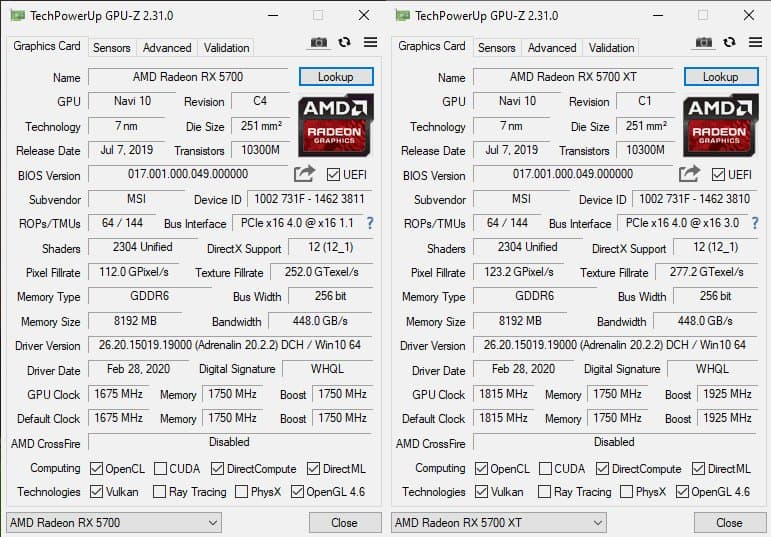
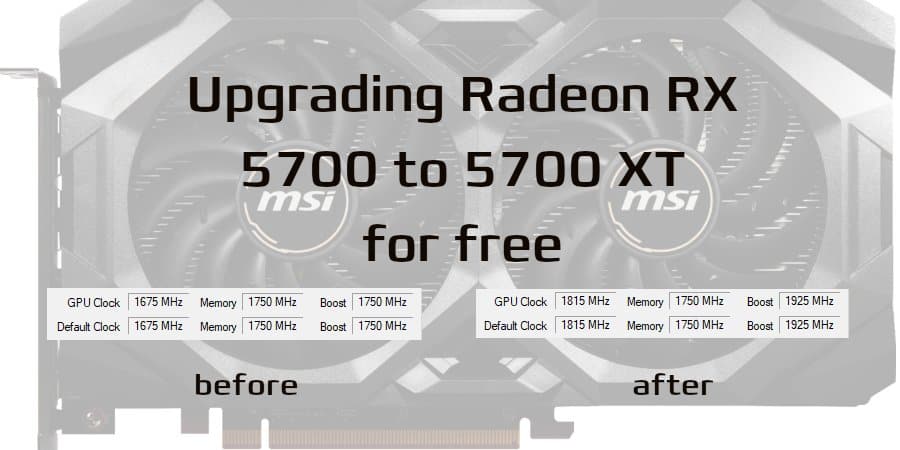
The same article also gives a detailed technical explanation on the difference between the two cards. The 5700 variant has less stream processors (2304 against 2560 in the XT variant), and lower power limits and clock speeds. Other than this they are based on the exact same chip layout (Navi 10), and with the same amount and type of memory 8 GB GDDR6. Flashing the XT BIOS onto the plain 5700 will not changes the number of stream processors, but power limits and clock speeds are raised to the same level of the 5700 XT, providing approximately a 7% gain without any over-clocking and over-powering, and potentially more by raising voltage etc. Detailed numbers can be found in the linked article above. The first step in this free upgrade is to identify ones own card correctly, best with device id and subsystem id, and then find the correct BIOS. Lots of BIOS dumps are provided in the BIOS database (link already restricting to 5700 XT BIOS). I used CPU-Z (Windows program) to determine this items, see image on the right (click to enlarge). In my case I got 1002 731F - 1462 3811 for the complete device id. The card is a MSI RX 5700 8 GB Mech OC, so I found the following alternative BIOS for MSI RX 5700 XT 8 GB Mech OC. Unfortunately, it seems that MSI is distinguishing 5700 and 5700 XT by their device id, because the XT variant gives 1002 731F - 1462 3810 for the complete device id, meaning that the last digit is 1 off compared to mine (3811 versus 3810). And indeed, trying to flash this video BIOS the normal way (using the Windows version ended in a warning that the subsystem id is different. A bit of search led to a thread in the TechPowerup Fora and this post explaining how to force the flashing in this case. Disclaimer: The following might brick your graphic card, you are doing this on your own risk! Necessary software: I did all the flashing and checking under Windows, but only because I realized too late that there is a fully uptodate flashing program for Linux that exhibits the same functionality. Also, I didn t know how to get the device id since the current AMD ROCm tools seem not to provide this data. If you are lucky and the device ids for your card are the same for both 5700 and 5700 XT variants, then you can use the graphical client (amdvbflashWin.exe), but if there is a difference, the command line is necessary. After unpacking the AMD Flash program and getting the correct BIOS rom file, the steps taken on Windows are (the very same steps can be taken on Linux): This should succeed in both cases. After that shutdown and restart your computer and you should be greeted with a RT 5700 XT card, without twisting a single screw. Starting Windows for the first time gave some flickering, because the driver for the new card was installed. On Linux the system auto-detects the card and everything works out of the box. Very smooth. Finally, a word of warning: Don t do these kind of things if you are not ready to pay the prize of a bricked GPU card in case something goes wrong! Everything is on your own risk! Let me close with a before/after image, most of the fields are identical, but the default/gpu clocks both at normal as well as boost levels see a considerable improvement

Michael Stapelberg: a new distri linux (fast package management) release

I just released a new version of distri. The focus of this release lies on: See the release notes for more details. The distri research linux distribution project was started in 2019 to research whether a few architectural changes could enable drastically faster package management. While the package managers in common Linux distributions (e.g. apt, dnf, ) top out at data rates of only a few MB/s, distri effortlessly saturates 1 Gbit, 10 Gbit and even 40 Gbit connections, resulting in fast installation and update speeds.

Lucas Kanashiro: Quarantine times

After quite some time without publishing anything here, I decided to share the latest events. It is a hard time for most of us but with all this time at home, one can also do great things. I would like to start with the wonderful idea the Debian Brasil community had! Why not create an online Debian related conference to keep people s minds busy and also share knowledge? After brainstorming, we came up with our online conference called #FiqueEmCasaUseDebian (in English it would be #StayHomeUseDebian). It started on May 3rd and will last until May 30th (yes, one month)! Every weekday, we have one online talk at night and on every Saturday, a Debian packaging workshop. The feedback so far has been awesome and the Brazilian Debian community is reaching out to more people than usual at our regular conferences (as you might have imagined, Brazil is huge and it is hard to bring people at the same place). At the end of the month, we will have the first MiniDebConf online and I hope it will be as successful as our experience here in Brazil. Another thing that deserves a highlight is the fact that I became an Ubuntu Core Developer this month; yay! After 9 months of working almost daily on the Ubuntu Server, I was able to get my upload rights to the Ubuntu archive. I was tired of asking for sponsorship, and probably my peers were tired of me too. I could spend more time here complaining about the Brazilian government but I think it isn t worth it. Let s try to do something useful instead!

15 May 2020

Dirk Eddelbuettel: Let s celebrate Anna!

Today is graduation at Washington University, and just like many other places, the ceremonies are a lot more virtual and surreal that in other years. For Anna today marks the graduation from Biomedical Engineering with a BSc. The McKelvey School of Engineering put a Zoom meeting together yesterday which was nice, and there is something more virtual here. Hopefully a real-life commencenment can take place in a year the May 30, 2021, date has been set. The university also sent out a little commencement site/video which was cute. But at end of the day online-only still falls short of the real deal as we all know too well by now. During those years, just about the only thing really I ever tweeted about appears to be soccer related. As it should because ball is life, as we all know. Here is one from 1 1/2 years ago when her Club Team three-peated in their NIRSA division: And that opens what may be the best venue for mocking Anna: this year, which her a senior and co-captain, the team actually managed to loose a league game (a shocking first in these years) and to drop the final. I presume they anticipated that all we would all talk about around now is The Last Dance and three-peats, and left it at that. Probably wise. Now just this week, and hence days before graduating with her B.Sc., also marks the first time Anna was addressed as Dr Eddelbuettel. A little prematurely I may say, but not too shabby to be in print already! But on the topic of gratulations and what comes next, this tweet was very sweet: As was this, which marked another impressive score: So big thanks from all of us to WashU for being such a superb environment for Anna for those four years, and especially everybody at the Pappu Lab for giving Anna a home and base to start a research career. And deepest and most sincere congratulations to Anna before the next adventure starts .

Ingo Juergensmann: XMPP: ejabberd Project on the-federation.info

For those interested in alternative social networks there is that website that is called the-federation.info, which collects some statistics of "The Fediverse". The biggest part of the fediverse is Mastodon, but there are other projects (or parts) like Friendica or Matrix that do "federation". One of the oldest projects doing federation is XMPP. You could find some Prosody servers for some time now, because there is a Prosody module "mod_nodeinfo2" that can be used. But for ejabberd there is no such module (yet?) so far, which makes it a little bit difficult to get listed on the-federation.info. Some days ago I wrote a small script to export the needed values to x-nodeinfo2 that is queried by the-federation.info. It's surely not the best script or solution for that job and is currently limited to ejabberd servers that use a PostgreSQL database as backend, although it should be fairly easy to adapt the script for use with MySQL. Well, at least it does its job. At least as there is no native ejabberd module for this task. You can find the script on Github: https://github.com/ingoj/ejabberd-nodeinfo2 Enjoy it and register your ejabberd server on the-federation.info! :-)
Kategorie:

Junichi Uekawa: Bought Canon TS3300 Printer.

Bought Canon TS3300 Printer. I haven't bought a printer in 20 years. 5 years ago I think I would have used Google Cloud Print which took forever uploading and downloading huge print data to the cloud. 20 years ago I would have used LPR and LPD, admiring the postscript backtraces. Configuration was done using Android app, the printer could be connected via WiFi and then configuration through the app allowed printer to be connected to the home WiFi network, feels modern. It was recognized as a IPPS device by Chrome OS (using CUPS?). No print server necessary. Amazing.

14 May 2020

Iustin Pop: New internet provider

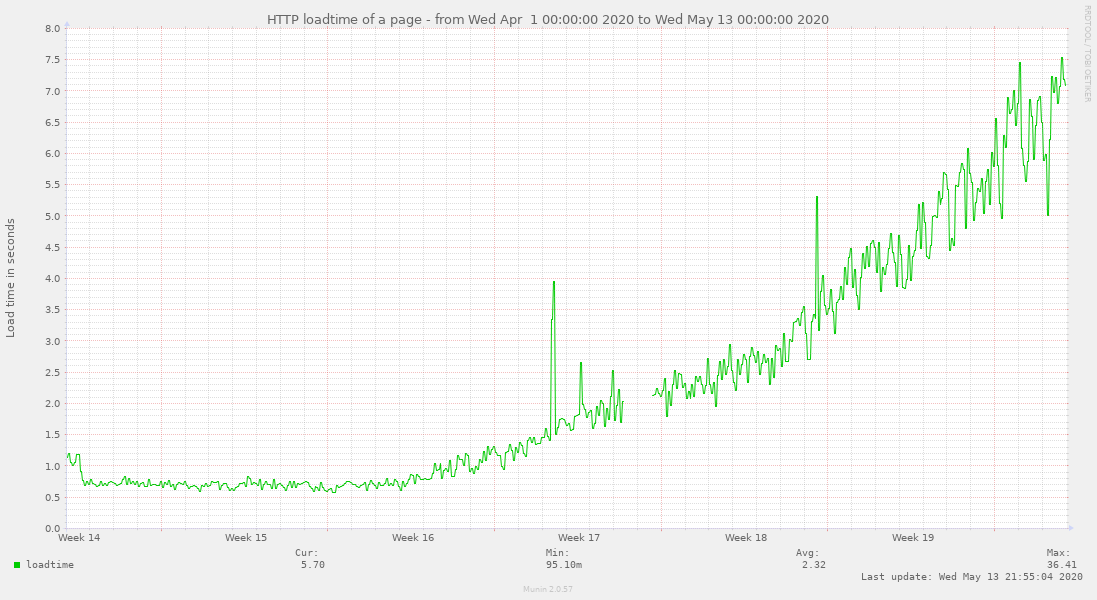
Note: all this is my personal experience, on my personal machines, and I don t claim it to be the absolute truth. Also, I don t directly call out names, although if you live in Switzerland it s pretty easy to guess who the old provider is from some hints. For a long time, I wanted to move away from my current (well, now past) provider, for a multitude of reasons. The main being that the company is very classic company, with classic support system, that doesn t work very well - I had troubles with their billing system that left me out cold without internet for 15 days, but for the recent few years, they were mostly OK, and changing to a different provider would have meant me routing a really long Ethernet cable around the apartment, so I kept postponing it. Yes, self-inflicted pain, I know. Until the entire work-from-home thing, when the usually stable connection start degrading in a very linear fashion day-by-day (this is a graph that basically reflects download bandwidth):
1+ month download bandwidth test 1+ month download bandwidth test
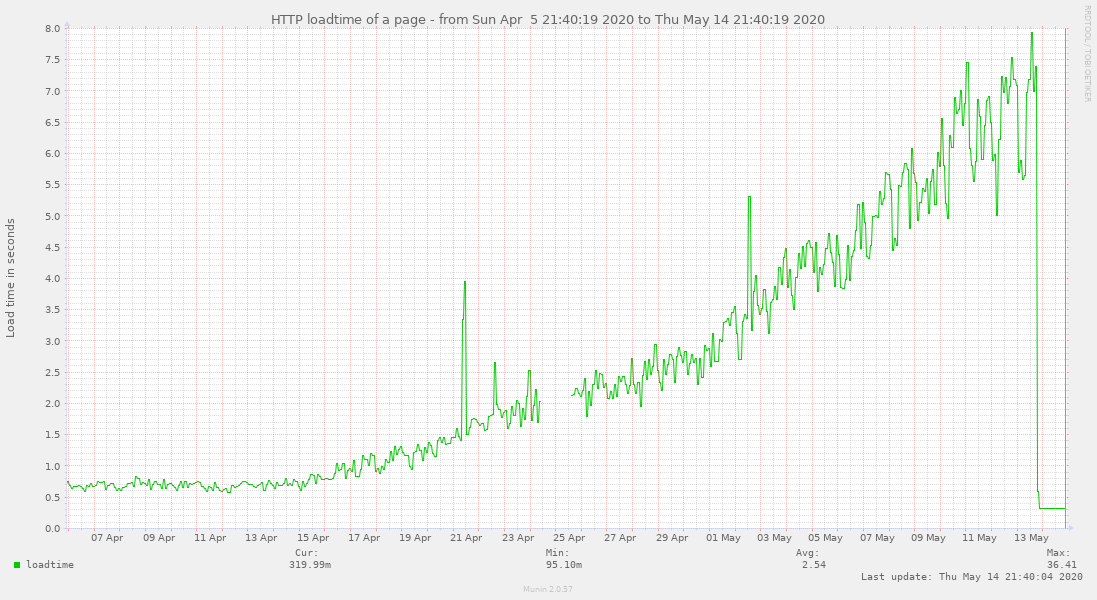
At first, I didn t realise this, as even 100Mbps is still fast enough. But once the connection went below (I believe) 50Mbps, it became visible in day to day work. And since I work daily from home yeah. Not fun. So I started doing speedtest.net - and oh my, ~20Mbps was a good result, usually 12-14Mbps. On a wired connection. On a connection that officially is supposed to be 600Mbps down. The upload speed was spot on, so I didn t think it was my router, but: Nothing helped. Once in a blue moon, speedtest would give me 100Mbps, but like once every two days, then it would be back and showing 8Mbps. Eight! It ended up as even apt update was tediously slow, and kernel downloads took ages The official instructions for dealing with bad internet are a joke: And the best part: If you are not satisfied with the results, read our internet optimisation guide. If you are still not happy, use our community forums or our social platforms. Given that it was a decline over 3-weeks, that I don t know of any computer component that would degrade this steadily but not throw any other errors, and that my upload speed was all good, I assumed it s the provider. Maybe I was wrong, but I wanted to do this anyway for a long while, so I went through the find how to route cable, check if other provider socket is good, order service, etc. dance, and less than a week later, I had the other connection. Now, of course, bandwidth works as expected:
1+ month updated bandwidth test 1+ month updated bandwidth test
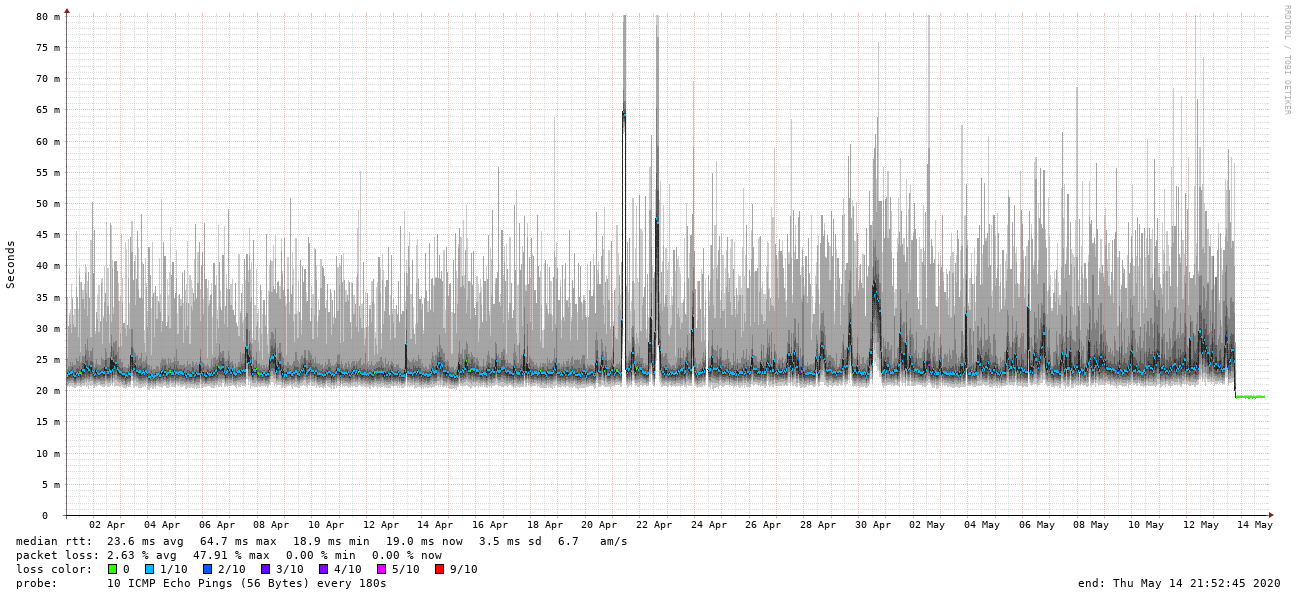
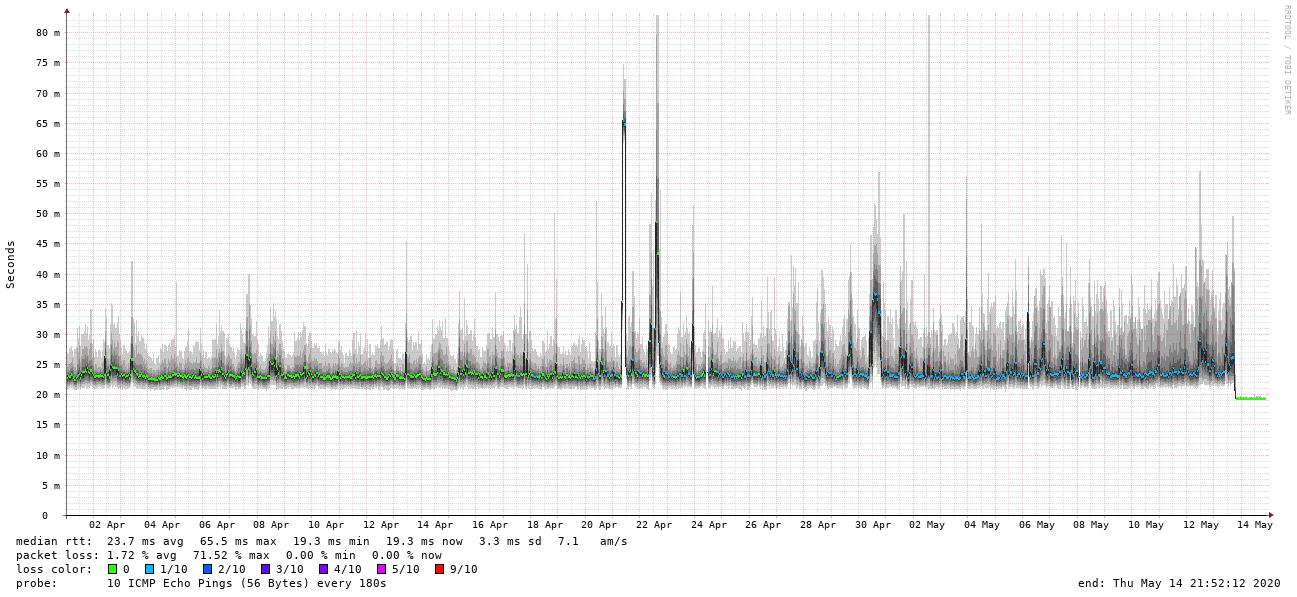
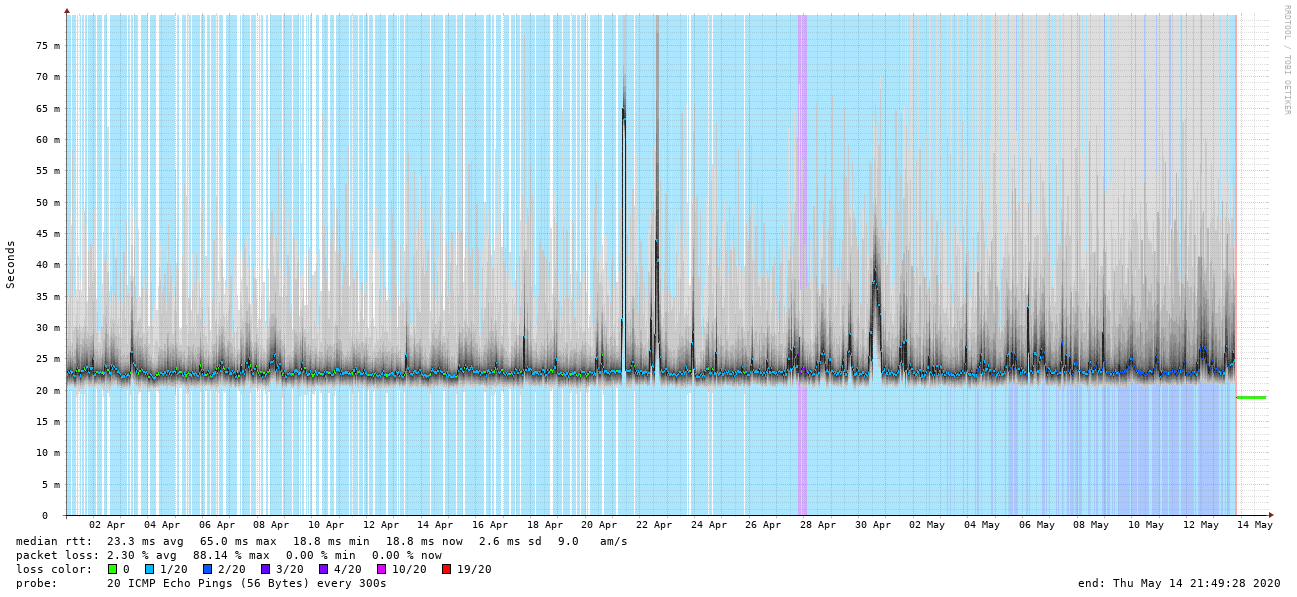
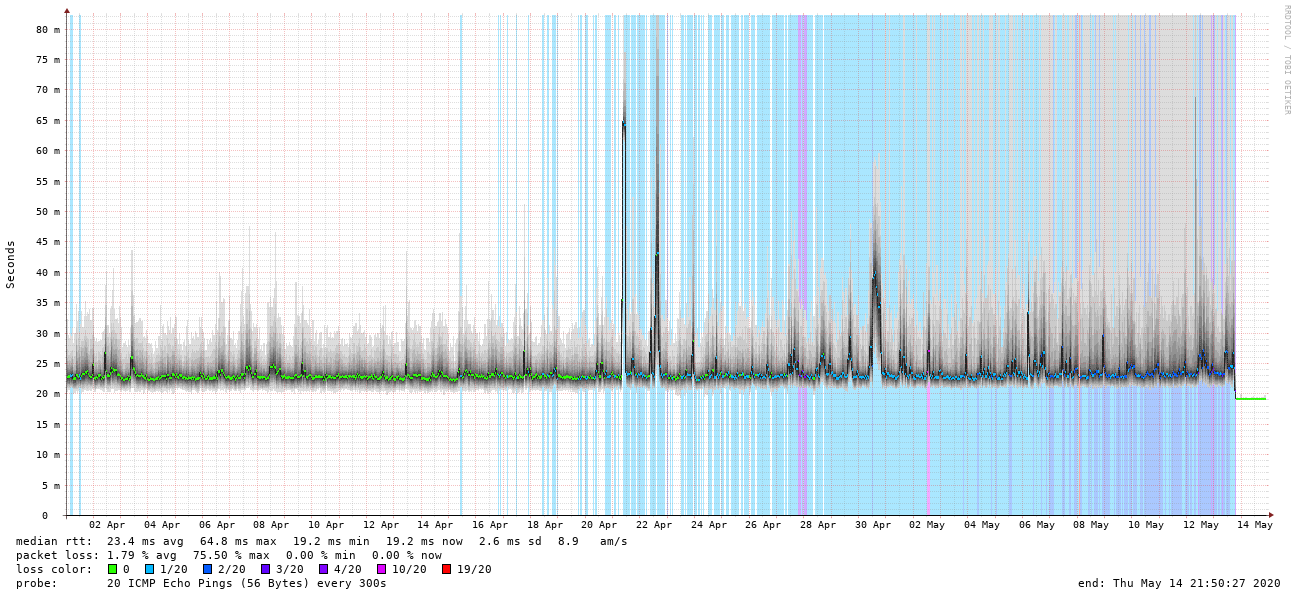
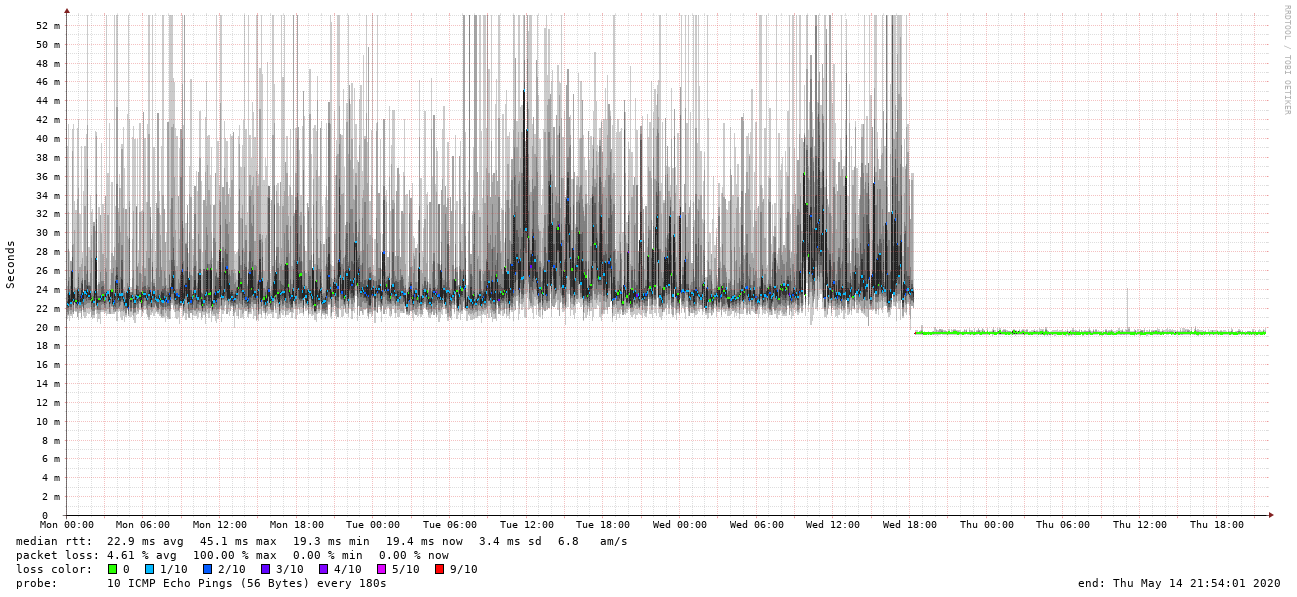
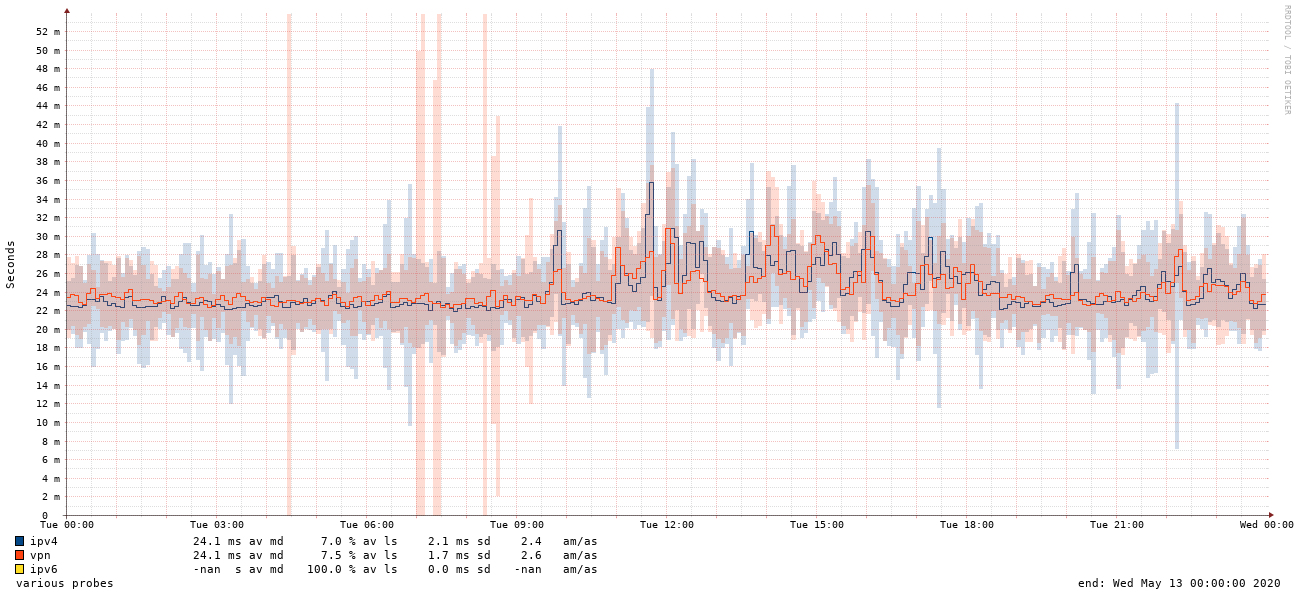
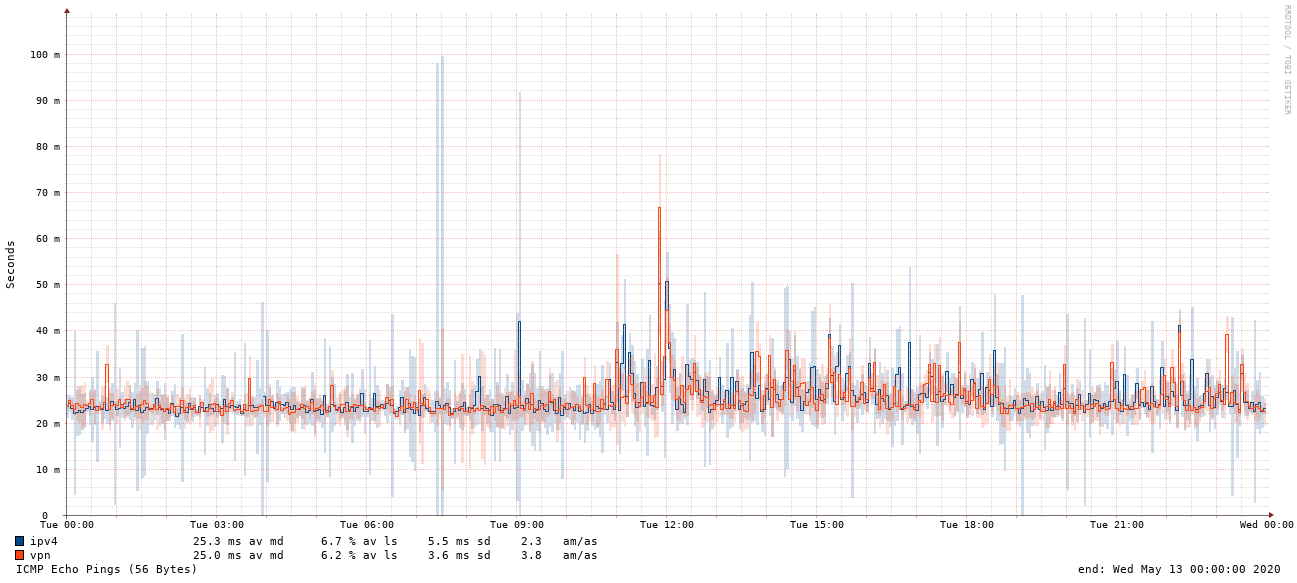
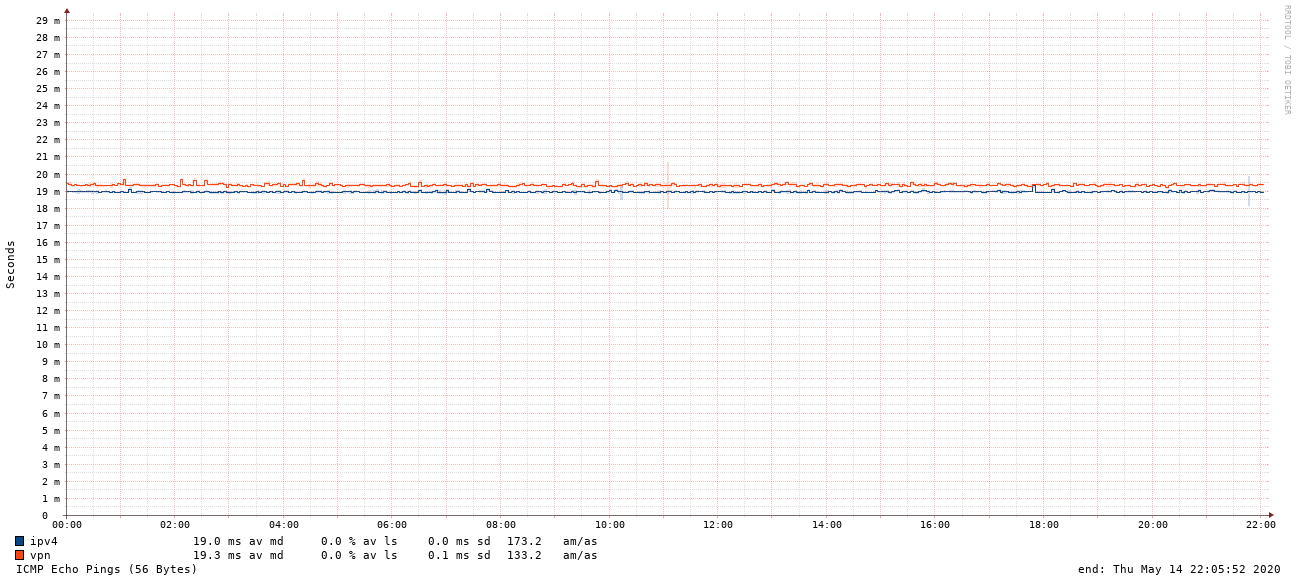
Both download and upload are fine (the graph above is just download). Latency is also much better, towards many parts of the internet that matter. But what is shocking is the difference in jitter to some external hosts I care about. On the previous provider, a funny thing was that both outgoing and incoming pings had both more jitter and packet loss when done directly (IPv4 to IPv4) than when done over a VPN. This doesn t make sense, since VPN is just overhead over IPv4, but the graphs show it, and what I think happens is that a VPN flow is cached in the provider s routers, whereas a simple ping packet not. But, the fact that there s enough jitter for a ping to a not-very-far host doesn t make me happy. Examples, outgoing:
Outgoing smokeping to public IPv4 Outgoing smokeping to public IPv4
Outgoing smokeping over VPN Outgoing smokeping over VPN
And incoming:
Incoming smokeping to public IPv4 Incoming smokeping to public IPv4
Incoming smokeping over VPN Incoming smokeping over VPN
Both incoming and outgoing show this weirdness - more packet loss and more jitter over VPN. Again, this is not a problem in practice, or not much, but makes me wonder what other shenanigans happen behind the scenes. You can also see clearly when the work from home traffic entered the picture and started significantly degrading my connection, even over the magically better VPN connection. Switching to this week s view shows the (in my opinion) dramatic improvement in consistency of the connection:
Outgoing current week smokeping to public IPv4 Outgoing current week smokeping to public IPv4
Outgoing current week smokeping over VPN Outgoing current week smokeping over VPN
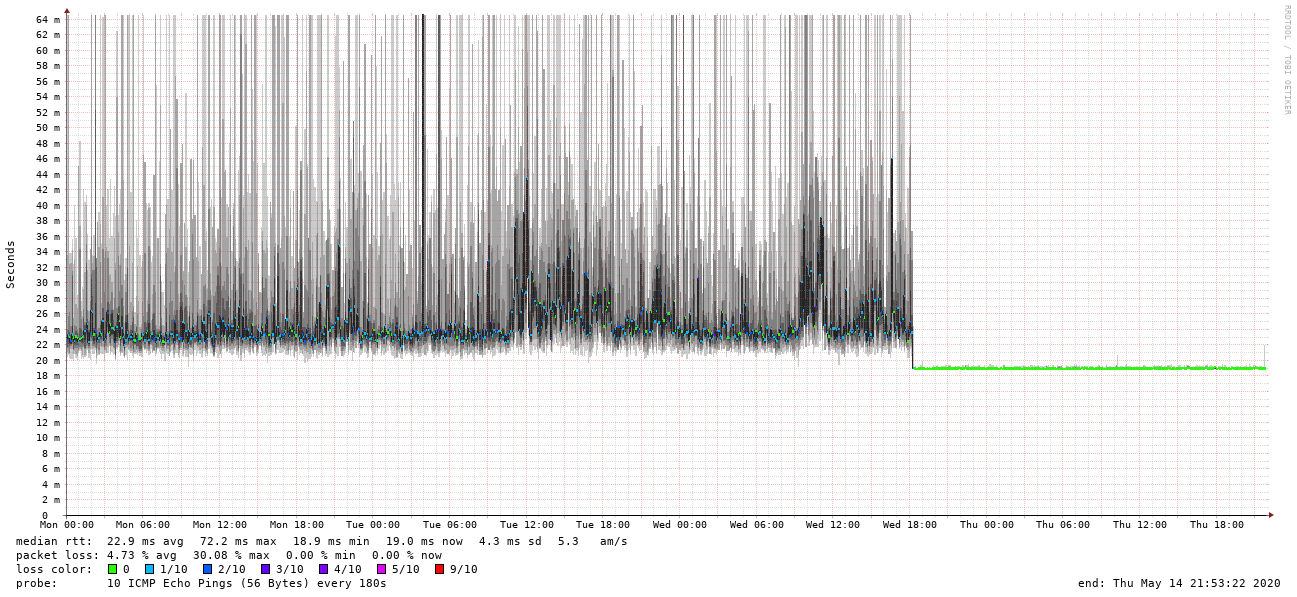
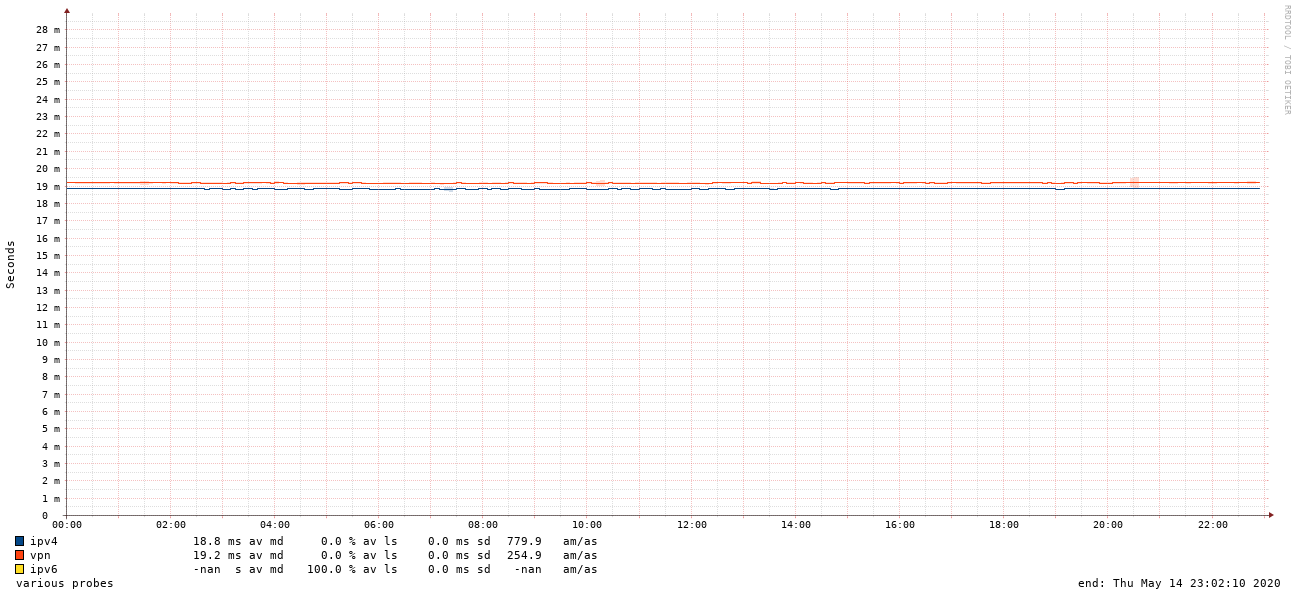
No more packet loss, no more jitter. You can also see my VPN being temporarily down during provider switchover because my firewall was not quite correct for a moment. And the last drill down, at high resolution, one day before and one day after switchover. Red is VPN, blue is plain IPv4, yellow is the missing IPv6 connection :) Incoming old:
Incoming 1-day smokeping, old provider Incoming 1-day smokeping, old provider
and new:
Incoming 1-day smokeping, new provider Incoming 1-day smokeping, new provider
Outgoing old:
Outgoing 1-day smokeping, old provider Outgoing 1-day smokeping, old provider
and new:
Outgoing 1-day smokeping, new provider Outgoing 1-day smokeping, new provider
This is what I expect, ping-over-VPN should of course be slower than plain ping. Note that incoming and outgoing have slightly different consistency, but that is fine for me :) The endpoints doing the two tests are different, so this is expected. Reading the legend on the graphs for the incoming connection (similar story for outgoing): So to my previous provider: it can be done better. Or at least, allow people easier ways to submit performance issue problems. For me, the moral of the story is that I should have switched a couple of years ago, instead of being lazy. And that I m curious to see how IPv6 traffic will differ, if at all :) Take care, everyone! And thanks for looking at these many graphs :)

Norbert Preining: Switching from NVIDIA to AMD (including tensorflow)

I have been using my Geforce 1060 extensively for deep learning, both with Python and R. But the always painful play with the closed source drivers and kernel updates, paired with the collapse of my computer s PSU and/or GPU, I decided to finally do the switch to AMD graphic card and open source stack. And you know what, within half a day I had everything, including Tensorflow running. Yeah to Open Source!
Preliminaries So what is the starting point: I am running Debian/unstable with a AMD Radeon 5700. First of all I purged all NVIDIA related packages, and that are a lot I have to say. Be sure to search for nv and nvidia and get rid of all packages. For safety I did reboot and checked again that no kernel modules related to NVIDIA are loaded. Firmware Debian ships the package amd-gpu-firmware but this is not enough for the current kernel and current hardware. Better is to clone git://git.kernel.org/pub/scm/linux/kernel/git/firmware/linux-firmware.git and copy everything from the amdgpu directory to /lib/firmware/amdgpu. I didn t do that at first, and then booting the kernel did hang during the switch to AMD framebuffer. If you see this behaviour, your firmwares are too old. Kernel The advantage of having open source driver that is in the kernel is that you don t have to worry about incompatibilities (like every time a new kernel comes out the NVIDIA driver needs patching). For recent AMD GPUs you need a rather new kernel, I have 5.6.0 and 5.7.0-rc5 running. Make sure that you have all the necessary kernel config options turned on if you compile your own kernels. In my case this is
CONFIG_DRM_AMDGPU=m
CONFIG_DRM_AMDGPU_USERPTR=y
CONFIG_DRM_AMD_ACP=y
CONFIG_DRM_AMD_DC=y
CONFIG_DRM_AMD_DC_DCN=y
CONFIG_HSA_AMD=y
When installing the kernel, be sure that the firmware is already updated so that the correct firmware is copied into the initrd. Support programs and libraries All the following is more or less an excerpt from the ROCm Installation Guide! AMD provides a Debian/Ubuntu APT repository for software as well as kernel sources. Put the following into /etc/apt/sources.list.d/rocm.list:
deb [arch=amd64] http://repo.radeon.com/rocm/apt/debian/ xenial main
and also put the public key of the rocm repository into /etc/apt/trusted.d/rocm.asc. After that apt-get update should work. I did install rocm-dev-3.3.0, rocm-libs-3.3.0, hipcub-3.3.0, miopen-hip-3.3.0 (and of course the dependencies), but not rocm-dkms which is the kernel module. If you have a sufficiently recent kernel (see above), the source in the kernel itself is newer. The libraries and programs are installed under /opt/rocm-3.3.0, and to make the libraries available to Tensorflow (see below) and other programs, I added /etc/ld.so.conf.d/rocm.conf with the following content:
/opt/rocm-3.3.0/lib/
and run ldconfig as root. Last but not least, add a udev rule that is normally installed by rocm-dkms, put the following into /etc/udev/rules.d/70-kfd.rules:
SUBSYSTEM=="kfd", KERNEL=="kfd", TAG+="uaccess", GROUP="video"
This allows users from the video group to access the GPU.
Up to here you should be able to boot into the system and have X running on top of AMD GPU, including OpenGL acceleration and direct rendering:
$ glxinfo
ame of display: :0
display: :0  screen: 0
direct rendering: Yes
server glx vendor string: SGI
server glx version string: 1.4
...
client glx vendor string: Mesa Project and SGI
client glx version string: 1.4
...
Tensorflow Thinking about how hard it was to get the correct libraries to get Tensorflow running on GPUs (see here and here), it is a pleasure to see that with open source all this pain is relieved. There is already work done to make Tensorflow run on ROCm, the tensorflow-rocm project. The provide up to date PyPi packages, so a simple
pip3 install tensorflow-rocm
is enough to get Tensorflow running with Python:
>> import tensorflow as tf
>> tf.add(1, 2).numpy()
2020-05-14 12:07:19.590169: I tensorflow/stream_executor/platform/default/dso_loader.cc:44] Successfully opened dynamic library libhip_hcc.so
...
2020-05-14 12:07:19.711478: I tensorflow/core/common_runtime/gpu/gpu_device.cc:1247] Created TensorFlow device (/job:localhost/replica:0/task:0/device:GPU:0 with 7444 MB memory) -> physical GPU (device: 0, name: Navi 10 [Radeon RX 5600 OEM/5600 XT / 5700/5700 XT], pci bus id: 0000:03:00.0)
3
>>
Tensorflow for R Installation is trivial again since there is a tensorflow for R package, just run (as a user that is in the group staff, which normally own /usr/local/lib/R)
$ R
...
> install.packages("tensorflow")
..
Do not call the R function install_tensorflow() since Tensorflow is already installed and functional! With that done, R can use the AMD GPU for computations:
$ R
...
> library(tensorflow)
> tf$constant("Hellow Tensorflow")
2020-05-14 12:14:24.185609: I tensorflow/stream_executor/platform/default/dso_loader.cc:44] Successfully opened dynamic library libhip_hcc.so
...
2020-05-14 12:14:24.277736: I tensorflow/core/common_runtime/gpu/gpu_device.cc:1247] Created TensorFlow device (/job:localhost/replica:0/task:0/device:GPU:0 with 7444 MB memory) -> physical GPU (device: 0, name: Navi 10 [Radeon RX 5600 OEM/5600 XT / 5700/5700 XT], pci bus id: 0000:03:00.0)
tf.Tensor(b'Hellow Tensorflow', shape=(), dtype=string)
>
AMD Vulkan From the Vulkan home page:
Vulkan is a new generation graphics and compute API that provides high-efficiency, cross-platform access to modern GPUs used in a wide variety of devices from PCs and consoles to mobile phones and embedded platforms.
Several games are using the Vulkan API if available and it is said to be more efficient. There are Vulkan libraries for Radeon shipped in with mesa, in the Debian package mesa-vulkan-drivers, but they look a bit outdated is my guess. The AMDVLK project provides the latest version, and to my surprise was rather easy to install, again by following the advice in their README. The steps are basically (always follow what is written for Ubuntu): All as described in the linked README. Just to make sure, I removed the JSON files /usr/share/vulkan/icd.d/radeon* shipped by Debians mesa-vulkan-drivers package. Finally I deviated a bit by not editing the file /usr/share/X11/xorg.conf.d/10-amdgpu.conf, but instead copying to /etc/X11/xorg.conf.d/10-amdgpu.conf and adding there the section:
Section "Device"
        Identifier "AMDgpu"
        Option  "DRI" "3"
EndSection
. To be honest, I did not follow the Copy driver and JSON files literally, since I don t want to copy self-made files into system directories under /usr/lib. So what I did is: With this in place, I don t pollute the system directories, and still the new Vulkan driver is available. But honestly, I don t really know whether it is used and is working, because I don t know how to check.
With all that in place, I can run my usual set of Steam games (The Long Dark, Shadow of the Tomb Raider, The Talos Principle, Supraland, ) and I don t see any visual problem till now. As a bonus, KDE/Plasma is now running much better, since NVIDIA and KDE has traditionally some incompatibilities. The above might sound like a lot of stuff to do, but considering that most of the parts are not really packaged within Debian, and all this is rather new open source stack, I was surprised that in half a day I got all working smoothly. Thanks to all the developers who have worked hard to make this all possible.
13 May 2020

Russ Allbery: Review: Gideon the Ninth

Review: Gideon the Ninth, by Tamsyn Muir
Series: The Locked Tomb #1
Publisher: Tor
Copyright: September 2019
ISBN: 1-250-31317-1
Format: Kindle
Pages: 448
Despite being raised there, Gideon Nav is an outsider in the Ninth House. Her mother, already dead, fell from the sky with a one-day-old Gideon in tow, leaving her an indentured servant. She's a grumpy, caustic teenager in a world of moldering corpses, animated skeletons, and mostly-dead adults whose parts are falling off. Her world is sword fighting, dirty magazines, a feud with the house heir Harrowhark, and a determination to escape the terms of her indenture. Gideon does get off the planet, but not the way that she expects. She doesn't get accepted into the military. She ends up in the middle of a bizarre test, or possibly an ascension rite, mingling with and competing with the nobility of the empire alongside her worst enemy. I struggled to enjoy the beginning of Gideon the Ninth. Gideon tries to carry the story on pure snark, but it is very, very goth. If you like desiccated crypts, mostly-dead goons, betrayal, frustration, necromancers, black robes, disturbing family relationships, gloom, and bitter despair, the first six chapters certainly deliver, but I was sick of it by the time Gideon gets out. Thankfully, the opening is largely unlike the rest of the book. What starts as an over-the-top teenage goth rebellion turns into a cross between a manor house murder mystery and a competitive escape room. This book is a bit of a mess, but it's a glorious mess. It's also the sort of glorious mess that I don't think would have been written or published twenty years ago, and I have a pet theory that attributes this to the invigorating influence of fanfic and writers who grew up reading and writing it. I read a lot of classic science fiction and epic fantasy as a teenager. Those books have many merits, obviously, but emotional range is not one of them. There are a few exceptions, but on average the genre either focused on puzzles and problem solving (how do we fix the starship, how do we use the magic system to take down the dark god) or on the typical "heroic" (and male-coded) emotions of loyalty, bravery, responsibility, authority, and defiance of evil. Characters didn't have messy breakups, frenemies, anxiety, socially-awkward love affairs, impostor syndrome, self-hatred, or depression. And authors weren't allowed to fall in love with the messiness of their characters, at least on the page. I'm not enough of a scholar to make the argument well, but I suspect there's a case to be made that fanfic exists partially to fill this gap. So much of fanfic starts from taking the characters on the canonical page or screen and letting them feel more, live more, love more, screw up more, and otherwise experience a far wider range of human drama, particularly compared to what made it into television, which was even more censored than what made it into print. Some of those readers and writers are now writing for publication, and others have gone into publishing. The result, in my theory, is that the range of stories that are acceptable in the genre has broadened, and the emotional texture of those stories has deepened. Whether or not this theory is correct, there are now more novels like this in the world, novels full of grudges, deflective banter, squabbling, messy emotional processing, and moments of glorious emotional catharsis. This makes me very happy. To describe the emotional payoff of this book in any more detail would be a huge spoiler; suffice it to say that I unabashedly love fragile competence and unexpected emotional support, and adore this book for containing it. Gideon's voice, irreverent banter, stubborn defiance, and impulsive good-heartedness are the center of this book. At the start, it's not clear whether there will be another likable character in the book. There will be, several of them, but it takes a while for Gideon to find them or for them to become likable. You'll need to like Gideon well enough to stick with her for that journey. I read books primarily for the characters, not for the setting, and Gideon the Ninth struck some specific notes that I will happily read endlessly. If that doesn't match your preferences, I would not be too surprised to hear you bounced off the book. There's a lot here that won't be to everyone's taste. The setting felt very close to Warhammer 40K: an undead emperor that everyone worships, endless war, necromancy, and gothic grimdark. The stage for most of the book is at least more light-filled, complex, and interesting than the Ninth House section at the start, but everything is crumbling, drowning, broken, or decaying. There's quite a lot of body horror, grotesque monsters, and bloody fights. And the ending is not the best part of the book; roughly the last 15% of the novel is composed of two running fight scenes against a few practically unkillable and frankly not very interesting villains. I got exhausted by the fighting long before it was over, and the conclusion is essentially a series cliffhanger. There are also a few too many characters. The collection of characters and the interplay between the houses is one of the strengths of this book, but Muir sets up her story in a way that requires eighteen significant characters and makes the reader want to keep track of all of them. It took me about halfway through the book before I felt like I had my bearings and wasn't confusing one character for another or forgetting a whole group of characters. That said, most of the characters are great, and the story gains a lot from the interplay of their different approaches and mindsets. Palamedes Sextus's logical geekery, in particular, is a great counterpoint to the approaches of most of the other characters. The other interesting thing Muir does in this novel that I've not seen before, and that feels very modern, is to set the book in essentially an escape room. Locking a bunch of characters in a sprawling mansion until people start dying is an old fictional trope, but this one has puzzles, rewards, and a progressive physical structure that provides a lot of opportunities to motivate the characters and give them space to take wildly different problem-solving approaches. I liked this a lot, and I'm looking forward to seeing it in future books. This is not the best book I've read, but I thoroughly enjoyed it, despite some problems with the ending. I've already pre-ordered the sequel. Followed by Harrow the Ninth. Rating: 8 out of 10

12 May 2020

Kunal Mehta: MediaWiki packages for Ubuntu 20.04 Focal available

Packages for the MediaWiki 1.31 LTS release are now available for the new Ubuntu 20.04 LTS "Focal Fossa" release in my PPA. Please let me know if you run into any errors or issues. In the future these packages will be upgraded to the MediaWiki 1.35 LTS release, whenever that's ready. It's currently delayed because of the pandemic, but I expect that it'll be ready for the next Debian release.

Evgeni Golov: Building a Shelly 2.5 USB to TTL adapter cable

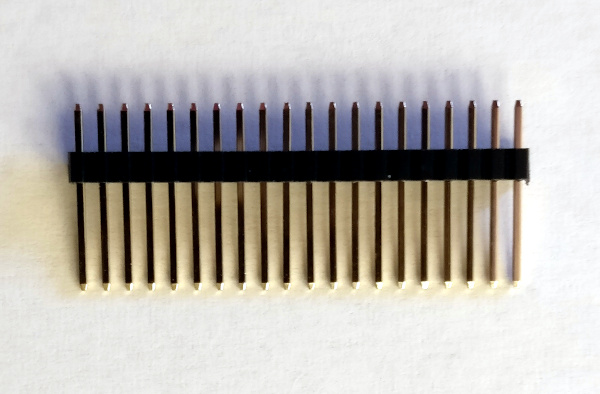
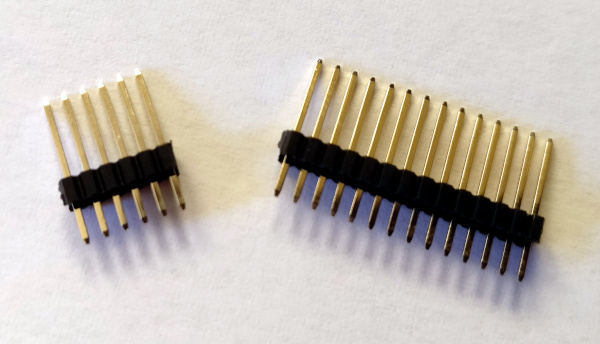
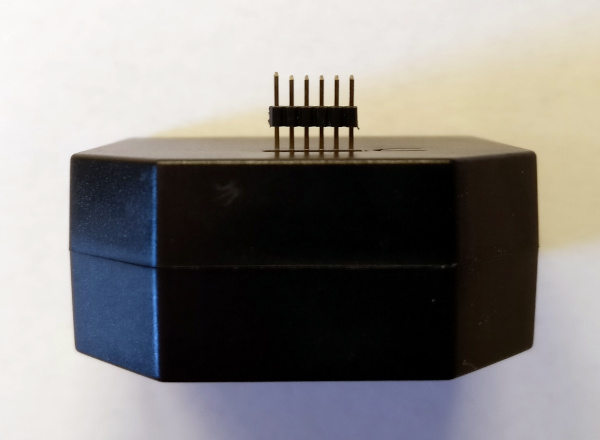
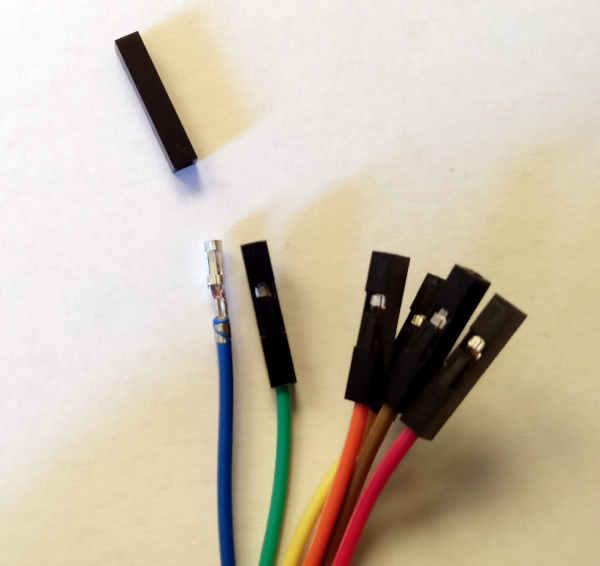
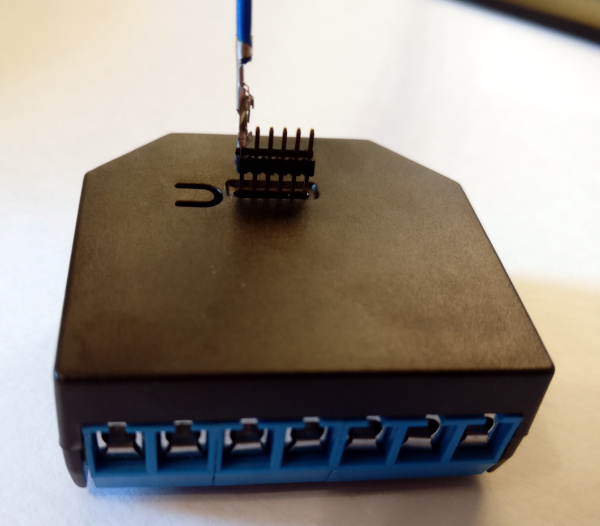
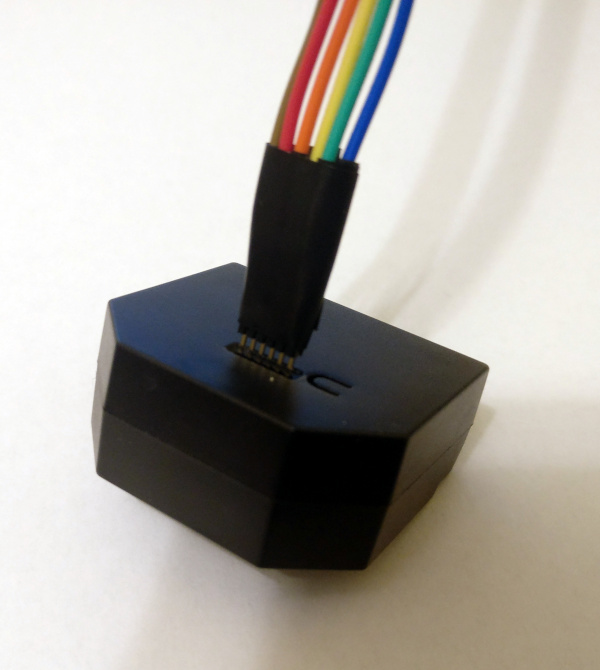
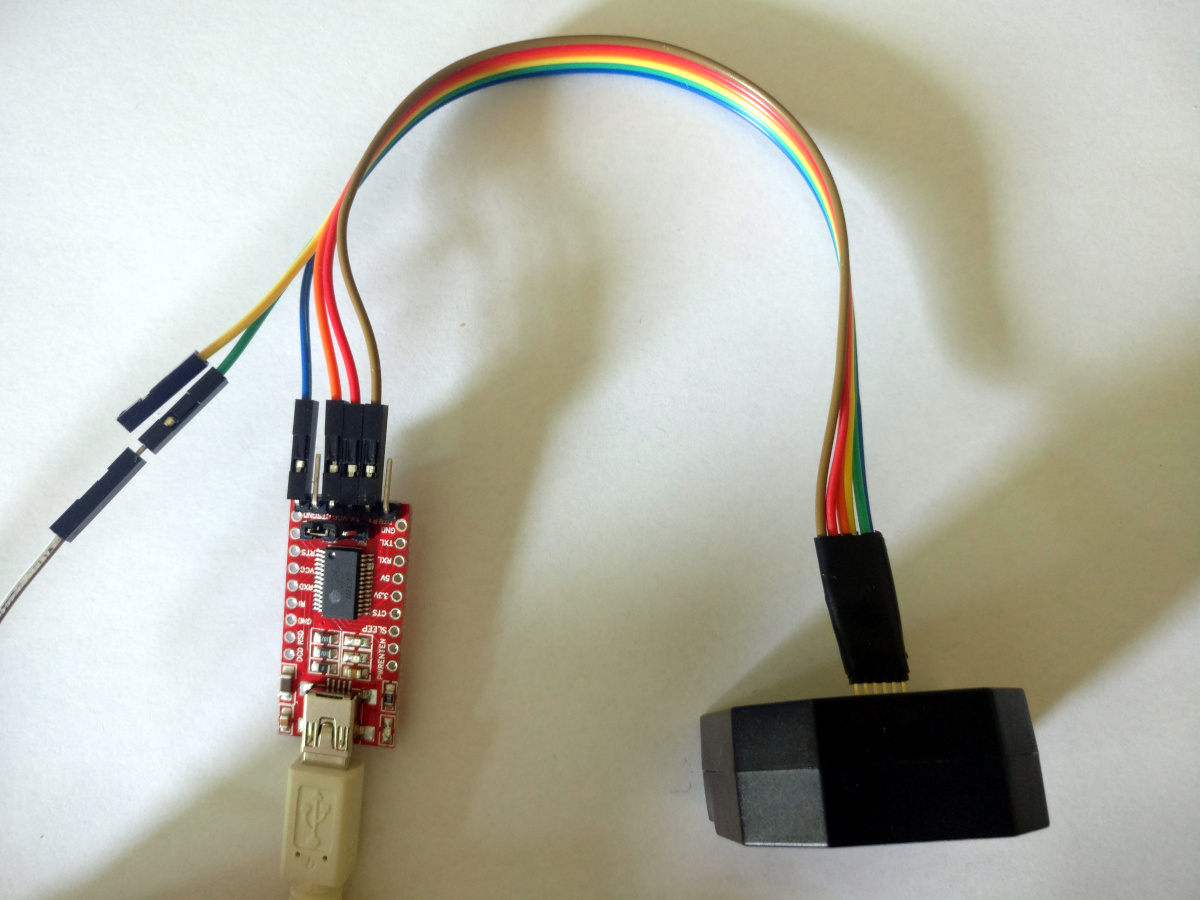
When you want to flash your Shelly 2.5 with anything but the original firmware for the first time, you'll need to attach it to your computer. Later flashes can happen over the air (at least with ESPHome or Tasmota), but the first one cannot. In theory, this is not a problem as the Shelly has a quite exposed and well documented interface: Shelly 2.5 pinout However, on closer inspection you'll notice that your normal jumper wires don't fit as the Shelly has a connector with 1.27mm (0.05in) pitch and 1mm diameter holes. Now, there are various tutorials on the Internet how to build a compatible connector using Ethernet cables and hot glue or with female header socket legs, and you can even buy cables on Amazon for 18 ! But 18 sounded like a lot and the female header socket thing while working was pretty finicky to use, so I decided to build something different. We'll need 6 female-to-female jumper wires and a 1.27mm pitch male header. Jumper wires I had at home, the header I got is a SL 1X20G 1,27 from reichelt.de for 0.61 . It's a 20 pin one, so we can make 3 adapters out of it if needed. Oh and we'll need some isolation tape. SL 1X20G 1,27 The first step is to cut the header into 6 pin chunks. Make sure not to cut too close to the 6th pin as the whole thing is rather fragile and you might lose it. SL 1X20G 1,27 cut into pieces It now fits very well into the Shelly with the longer side of the pins. Shelly 2.5 with pin headers attached Second step is to strip the plastic part of one side of the jumper wires. Those are designed to fit 2.54mm pitch headers and won't work for our use case otherwise. jumper wire with removed plastic As the connectors are still too big, even after removing the plastic, the next step is to take some pliers and gently press the connectors until they fit the smaller pins of our header. Shelly 2.5 with pin headers and a jumper wire attached Now is the time to put everything together. To avoid short circuiting the pins/connectors, apply some isolation tape while assembling, but not too much as the space is really limited. Shelly 2.5 with pin headers and a jumper wire attached and taped And we're done, a wonderful (lol) and working (yay) Shelly 2.5 cable that can be attached to any USB-TTL adapter, like the pictured FTDI clone you get almost everywhere. Shelly 2.5 with full cable and FTDI attached Yes, in an ideal world we would have soldered the header to the cable, but I didn't feel like soldering on that limited space. And yes, shrink-wrap might be a good thing too, but again, limited space and with isolation tape you only need one layer between two pins, not two.
Daniel Silverstone: The Lars, Mark, and Daniel Club

Last night, Lars, Mark, and I discussed Jeremy Kun's The communicative value of using Git well post. While a lot of our discussion was spawned by the article, we did go off-piste a little, and I hope that my notes below will enlighten you all as to a bit of how we see revision control these days. It was remarkably pleasant to read an article where the comments section wasn't a cesspool of horror, so if this posting encourages you to go and read the article, don't stop when you reach the bottom -- the comments are good and useful too.
This was a fairly non-contentious article for us though each of us had points we wished to bring up and chat about it turned into a very convivial chat. We saw the main thrust of the article as being about using the metadata of revision control to communicate intent, process, and decision making. We agreed that it must be possible to do so effectively with Mercurial (thus deciding that the mention of it was simply a bit of clickbait / red herring) and indeed Mark figured that he was doing at least some of this kind of thing way back with CVS. We all discussed how knowing the fundamentals of Git's data model improved our ability to work wih the tool. Lars and I mentioned how jarring it has originally been to come to Git from revision control systems such as Bazaar (bzr) but how over time we came to appreciate Git for what it is. For Mark this was less painful because he came to Git early enough that there was little more than the fundamental data model, without much of the porcelain which now exists. One point which we all, though Mark in particular, felt was worth considering was that of distinguishing between published and unpublished changes. The article touches on it a little, but one of the benefits of the workflow which Jeremy espouses is that of using the revision control system as an integral part of the review pipeline. This is perhaps done very well with Git based workflows, but can be done with other VCSs. With respect to the points Jeremy makes regarding making commits which are good for reviewing, we had a general agreement that things were good and sensible, to a point, but that some things were missed out on. For example, I raised that commit messages often need to be more thorough than one-liners, but Jeremy's examples (perhaps through expedience for the article?) were all pretty trite one-liners which perhaps would have been entirely obvious from the commit content. Jeremy makes the point that large changes are hard to review, and Lars poined out that Greg Wilson did research in this area, and at least one article mentions 200 lines as a maximum size of a reviewable segment. I had a brief warble at this point about how reviewing needs to be able to consider the whole of the intended change (i.e. a diff from base to tip) not just individual commits, which is also missing from Jeremy's article, but that such a review does not need to necessarily be thorough and detailed since the commit-by-commit review remains necessary. I use that high level diff as a way to get a feel for the full shape of the intended change, a look at the end-game if you will, before I read the story of how someone got to it. As an aside at this point, I talked about how Jeremy included a 'style fixes' commit in his example, but I loathe seeing such things and would much rather it was either not in the series because it's unrelated to it; or else the style fixes were folded into the commits they were related to. We discussed how style rules, as well as commit-bisectability, and other rules which may exist for a codebase, the adherence to which would form part of the checks that a code reviewer may perform, are there to be held to when they help the project, and to be broken when they are in the way of good communication between humans. In this, Lars talked about how revision control histories provide high level valuable communication between developers. Communication between humans is fraught with error and the rules are not always clear on what will work and what won't, since this depends on the communicators, the context, etc. However whatever communication rules are in place should be followed. We often say that it takes two people to communicate information, but when you're writing commit messages or arranging your commit history, the second party is often nebulous "other" and so the code reviewer fulfils that role to concretise it for the purpose of communication. At this point, I wondered a little about what value there might be (if any) in maintaining the metachanges (pull request info, mailing list discussions, etc) for historical context of decision making. Mark suggested that this is useful for design decisions etc but not for the style/correctness discussions which often form a large section of review feedback. Maybe some of the metachange tracking is done automatically by the review causing the augmentation of the changes (e.g. by comments, or inclusion of design documentation changes) to explain why changes are made. We discussed how the "rebase always vs. rebase never" feeling flip-flopped in us for many years until, as an example, what finally won Lars over was that he wants the history of the project to tell the story, in the git commits, of how the software has changed and evolved in an intentional manner. Lars said that he doesn't care about the meanderings, but rather about a clear story which can be followed and understood. I described this as the switch from "the revision history is about what I did to achieve the goal" to being more "the revision history is how I would hope someone else would have done this". Mark further refined that to "The revision history of a project tells the story of how the project, as a whole, chose to perform its sequence of evolution." We discussed how project history must necessarily then contain issue tracking, mailing list discussions, wikis, etc. There are exist free software projects where part of their history is forever lost because, for example, the project moved from Sourceforge to Github, but made no effort (or was unable) to migrate issues or somesuch. Linkages between changes and the issues they relate to can easily be broken, though at least with mailing lists you can often rewrite URLs if you have something consistent like a Message-Id. We talked about how cover notes, pull request messages, etc. can thus also be lost to some extent. Is this an argument to always use merges whose message bodies contain those details, rather than always fast-forwarding? Or is it a reason to encapsulate all those discussions into git objects which can be forever associated with the changes in the DAG? We then diverted into discussion of CI, testing every commit, and the benefits and limitations of automated testing vs. manual testing; though I think that's a little too off-piste for even this summary. We also talked about how commit message audiences include software perhaps, with the recent movement toward conventional commits and how, with respect to commit messages for machine readability, it can become very complex/tricky to craft good commit messages once there are multiple disparate audiences. For projects the size of the Linux kernel this kind of thing would be nearly impossible, but for smaller projects, perhaps there's value. Finally, we all agreed that we liked the quote at the end of the article, and so I'd like to close out by repeating it for you all... Hal Abelson famously said:
Programs must be written for people to read, and only incidentally for machines to execute.
Jeremy agrees, as do we, and extends that to the metacommit information as well.

Petter Reinholdtsen: Debian Edu interview: Yvan Masson

It has been way too long since my last interview, but as the Debian Edu / Skolelinux community is still active, and new people keep showing up on the IRC channel #debian-edu and the debian-edu mailing list, I decided to give it another go. I was hoping someone else might pick up the idea and run with it, but this has not happened as far as I can tell, so here we are This time the announcement of a new free software tool to create a school year book triggered my interest, and I decided to learn more about its author. Who are you, and how do you spend your days? My name is Yvan MASSON, I live in France. I have my own one person business in computer services. The work consist of visiting my customers (person's home, local authority, small business) to give advise, install computers and software, fix issues, and provide computing usage training. I spend the rest of my time enjoying my family and promoting free software. What is your approach for promoting free software? When I think that free software could be suitable for someone, I explain what it is, with simple words, give a few known examples, and explain that while there is no fee it is a viable alternative in many situations. Most people are receptive when you explain how it is better (I simplify arguments here, I know that it is not so simple): Linux works on older hardware, there are no viruses, and the software can be audited to ensure user is not spied upon. I think the most important is to keep a clear but moderated speech: when you try to convince too much, people feel attacked and stop listening. How did you get in contact with the Skolelinux / Debian Edu project? I can not remember how I first heard of Skolelinux / Debian Edu, but probably on planet.debian.org. As I have been working for a school, I have interest in this type of project. The school I am involved in is a school for "children" between 14 and 18 years old. The French government has recommended free software since 2012, but they do not always use free software themselves. The school computers are still using the Windows operating system, but all of them have the classic set of free software: Firefox ESR, LibreOffice (with the excellent extension Grammalecte that indicates French grammatical errors), SumatraPDF, Audacity, 7zip, KeePass2, VLC, GIMP, Inkscape What do you see as the advantages of Skolelinux / Debian Edu? It is free software! Built on Debian, I am sure that users are not spied upon, and that it can run on low end hardware. This last point is very important, because we really need to improve "green IT". I do not know enough about Skolelinux / Debian Edu to tell how it is better than another free software solution, but what I like is the "all in one" solution: everything has been thought of and prepared to ease installation and usage. I like Free Software because I hate using something that I can not understand. I do not say that I can understand everything nor that I want to understand everything, but knowing that someone / some company intentionally prevents me from understanding how things work is really unacceptable to me. Secondly, and more importantly, free software is a requirement to prevent abuses regarding human rights and environmental care. Humanity can not rely on tools that are in the hands of small group of people. What do you see as the disadvantages of Skolelinux / Debian Edu? Again, I don't know this project enough. Maybe a dedicated website? Debian wiki works well for documentation, but is not very appealing to someone discovering the project. Also, as Skolelinux / Debian Edu uses OpenLDAP, it probably means that Windows workstations cannot use centralized authentication. Maybe the project could use Samba as an Active Directory domain controller instead, allowing Windows desktop usage when necessary. (Editors note: In fact Windows workstations can use the centralized authentication in a Debian Edu setup, at least for some versions of Windows, but the fact that this is not well known can be seen as an indication of the need for better documentation and marketing. :) Which free software do you use daily? Nothing original: Debian testing/sid with Gnome desktop, Firefox, Thunderbird, LibreOffice Which strategy do you believe is the right one to use to get schools to use free software? Every effort to spread free software into schools is important, whatever it is. But I think, at least where I live, that IT professionals maintaining schools networks are still very "Microsoft centric". Schools will use any working solution, but they need people to install and maintain it. How to make these professionals sensitive about free software and train them with solutions like Debian Edu / Skolelinux is a really good question :-)

Jacob Adams: Roman Finger Counting

I recently wrote a final paper on the history of written numerals. In the process, I discovered this fascinating tidbit that didn t really fit in my paper, but I wanted to put it somewhere. So I m writing about it here. If I were to ask you to count as high as you could on your fingers you d probably get up to 10 before running out of fingers. You can t count any higher than the number of fingers you have, right? The Romans could! They used a place-value system, combined with various gestures to count all the way up to 9,999 on two hands.

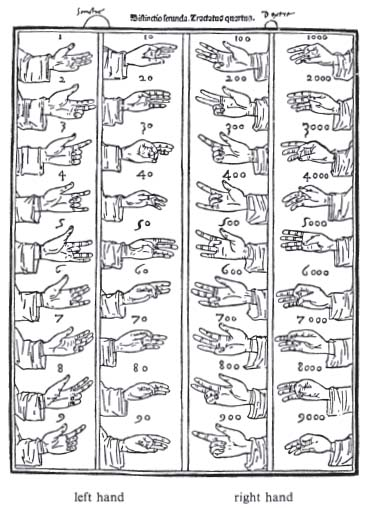
The System Finger Counting (Note that in this diagram 60 is, in fact, wrong, and this picture swaps the hundreds and the thousands.) We ll start with the units. The last three fingers of the left hand, middle, ring, and pinkie, are used to form them. Zero is formed with an open hand, the opposite of the finger counting we re used to. One is formed by bending the middle joint of the pinkie, two by including the ring finger and three by including the middle finger, all at the middle joint. You ll want to keep all these bends fairly loose, as otherwise these numbers can get quite uncomfortable. For four, you extend your pinkie again, for five, also raise your ring finger, and for six, you raise your middle finger as well, but then lower your ring finger. For seven you bend your pinkie at the bottom joint, for eight adding your ring finger, and for nine, including your middle finger. This mirrors what you did for one, two and three, but bending the finger at the bottom joint now instead. This leaves your thumb and index finger for the tens. For ten, touch the nail of your index finger to the inside of your top thumb joint. For twenty, put your thumb between your index and middle fingers. For thirty, touch the nails of your thumb and index fingers. For forty, bend your index finger slightly towards your palm and place your thumb between the middle and top knuckle of your index finger. For fifty, place your thumb against your palm. For sixty, leave your thumb where it is and wrap your index finger around it (the diagram above is wrong). For seventy, move your thumb so that the nail touches between the middle and top knuckle of your index finger. For eighty, flip your thumb so that the bottom of it now touches the spot between the middle and top knuckle of your index finger. For ninety, touch the nail of your index finger to your bottom thumb joint. The hundreds and thousands use the same positions on the right hand, with the units being the thousands and the tens being the hundreds. One account, from which the picture above comes, swaps these two, but the first account we have uses this ordering. Combining all these symbols, you can count all the way to 9,999 yourself on just two hands. Try it!
History

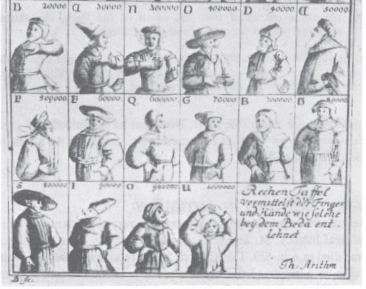
The Venerable Bede The first written record of this system comes from the Venerable Bede, an English Benedictine monk who died in 735. He wrote De computo vel loquela digitorum, On Calculating and Speaking with the Fingers, as the introduction to a larger work on chronology, De temporum ratione. (The primary calculation done by monks at the time was calculating the date of Easter, the first Sunday after the first full moon of spring). He also includes numbers from 10,000 to 1,000,000, but its unknown if these were inventions of the author and were likely rarely used regardless. They require moving your hands to various positions on your body, as illustrated below, from Jacob Leupold s Theatrum Arilhmetico-Geometricum, published in 1727: Finger Counting with Large Numbers

The Romans If Bede was the first to write it, how do we know that it came from Roman times? It s referenced in many Roman writings, including this bit from the Roman satirist Juvenal who died in 130:
Felix nimirum qui tot per saecula mortem distulit atque suos iam dextera computat annos. Happy is he who so many times over the years has cheated death And now reckons his age on the right hand.
Because of course the right hand is where one counts hundreds! There s also this Roman riddle:
Nunc mihi iam credas fieri quod posse negatur: octo tenes manibus, si me monstrante magistro sublatis septem reliqui tibi sex remanebunt. Now you shall believe what you would deny could be done: In your hands you hold eight, as my teacher once taught; Take away seven, and six still remain.
If you form eight with this system and then remove the symbol for seven, you get the symbol for six!

Sources My source for this blog post is Paul Broneer s 1969 English translation of Karl Menninger s Zahlwort und Ziffer (Number Words and Number Symbols).

11 May 2020

Markus Koschany: My Free Software Activities in April 2020

Welcome to gambaru.de. Here is my monthly report (+ the first week in May) that covers what I have been doing for Debian. If you re interested in Java, Games and LTS topics, this might be interesting for you. Debian Games

Playonlinux
Debian Java Misc Debian LTS This was my 50. month as a paid contributor and I have been paid to work 11,5 hours on Debian LTS, a project started by Rapha l Hertzog. In that time I did the following: ELTS Extended Long Term Support (ELTS) is a project led by Freexian to further extend the lifetime of Debian releases. It is not an official Debian project but all Debian users benefit from it without cost. The current ELTS release is Debian 7 Wheezy . This was my 23. month and I have been paid to work 2 hours on ELTS. Thanks for reading and see you next time.

Julien Danjou: Interview: The Performance of Python

Interview: The Performance of PythonEarlier this year, I was supposed to participate to dotPy, a one-day Python conference happening in Paris. This event has unfortunately been cancelled due to the COVID-19 pandemic.Both Victor Stinner and me were supposed to attend that event. Victor had prepared a presentation about Python performances, while I was planning on talking about profiling.Rather than being completely discouraged, Victor and I sat down (remotely) with Anne Laure from Behind the Code (a blog ran by Welcome to the Jungle, the organizers of the dotPy conference).We discuss Python performance, profiling, speed, projects, problems, analysis, optimization and the GIL.You can read the interview here.
Interview: The Performance of Python

Gunnar Wolf: Certified printer fumes

After losing a fair bit of hair due to quality and reliability issues with our home laser multifunctional (Brother DCP1600-series, which we bought after checking it was meant to work on Linux And it does, but with a very buggy, proprietary driver Besides being the printer itself of quite low quality), we decided it was time to survey the market again, and get a color inkjet printer. I was not very much an enthusiast of the idea, until I found all of the major manufacturers now offer refillable ink tanks instead of the darn expensive cartridges of past decades. Lets see how it goes! Of course, with over 20 years of training, I did my homework. I was about to buy an Epson printer, but decided for an HP Ink Tank 410 Wireless printer. The day it arrived, not wanting to fuss around too much to get to see the results, I connected it to my computer using the USB cable. Everything ran smoothly and happily! No driver hunting needed, print quality is superb I hope, years from now, we stay with this impression. Next day, I tried to print over WiFi. Of course, it requires configuration. And, of course, configuration strongly wants you to do it from a Windows or MacOS machine which I don t have. OK, fall back to Android For which an app download is required (and does not thrill me, but what can I say. Oh and the app needs location services to even run. Why Maybe because it interacts with the wireless network in WiFi Direct, non-authenticated way?) Anyway, things seem to work. But they don t My computers can identify and connect with the printer from CUPS, but nothing ever comes out. Printer paused, they say. Entering the printer s web interface is somewhat ambiguous Following the old HP practices, I tried http://192.168.1.75:9100/ (no point in hiding my internal IP), and got a partial webpage sometimes (and nothing at all othertimes). Seeing the printer got detected over ipps://, my immediate reaction was to try pointing the browser to port 631. Seems to work! Got some odd messages But it seems I ll soon debug the issue away. I am not a familiar meddler in the dark lands of cups, our faithful print server, but I had to remember my toolkit..
# cupsenable HP_Ink_Tank_Wireless_410_series_C37468_ --release
Sucess in enabling, but self-auto-disabled right away lpstat -t was not more generous, reporting only it was still paused. Some hours later (mix in attending kids and whatnot), I finally remember to try cupsctl --debug-logging, and magically, /var/log/cups/error_log turns from being quiet to being quite chatty. And, of course, my first print job starts being processed:
D [10/May/2020:23:07:20 -0500] Report: jobs-active=1
(...)
D [10/May/2020:23:07:25 -0500] [Job 174] Start rendering...
(...)
D [10/May/2020:23:07:25 -0500] [Job 174] STATE: -connecting-to-device
(...)
Everything looks fine and dandy so far! But, hey, given nothing came out of the printer keep reading one more second of logs (a couple dozen lines)
D [10/May/2020:23:07:26 -0500] [Job 174] Connection is encrypted.
D [10/May/2020:23:07:26 -0500] [Job 174] Credentials are expired (Credentials have expired.)
D [10/May/2020:23:07:26 -0500] [Job 174] Printer credentials: HPC37468 / Thu, 01 Jan 1970 00:00:00 GMT / 28A59EF511A480A34798B6712DEEAE74
D [10/May/2020:23:07:26 -0500] [Job 174] No stored credentials.
D [10/May/2020:23:07:26 -0500] [Job 174] update_reasons(attr=0(), s=\"-cups-pki-invalid,cups-pki-changed,cups-pki-expired,cups-pki-unknown\")
D [10/May/2020:23:07:26 -0500] [Job 174] STATE: -cups-pki-expired
(...)
D [10/May/2020:23:08:00 -0500] [Job 174] envp[16]="CUPS_ENCRYPTION=IfRequested"
(...)
D [10/May/2020:23:08:00 -0500] [Job 174] envp[27]="PRINTER_STATE_REASONS=cups-pki-expired"
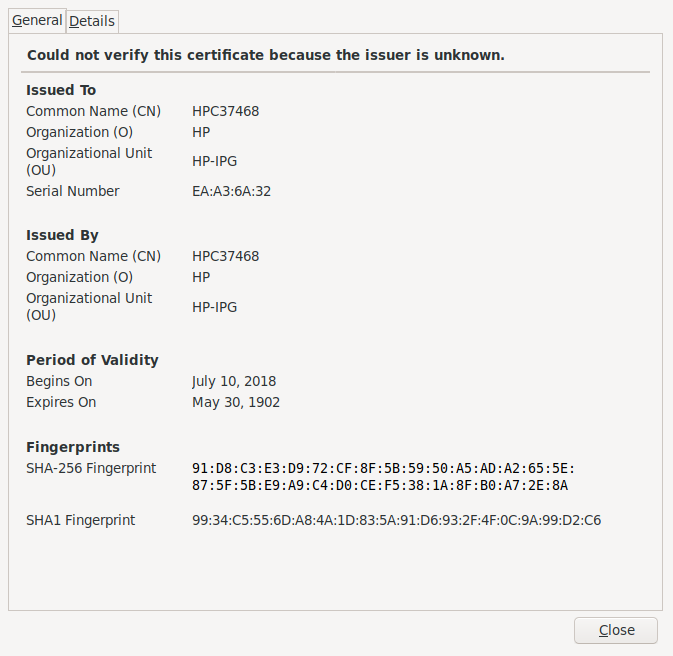
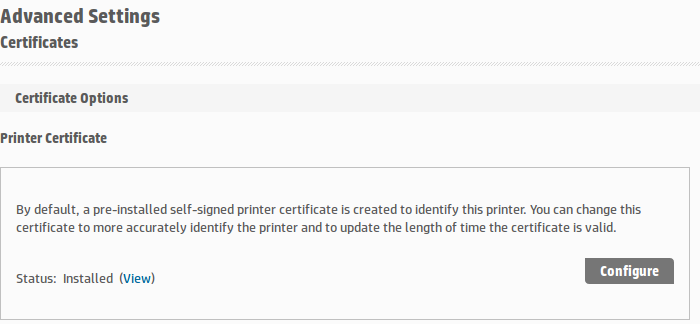
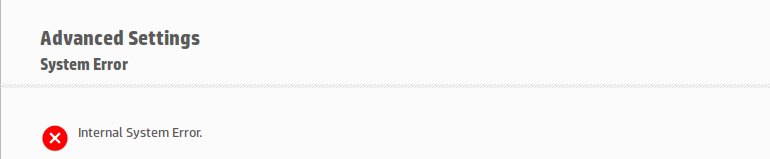
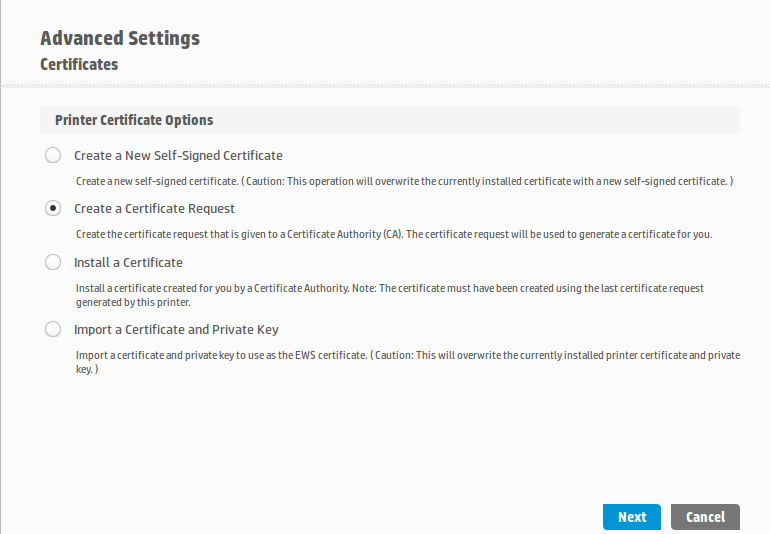
My first stabs were attempts to get CUPS not to care about expired certificates, but it seems to have been hidden or removed from its usual place. Anyway, I was already frustrated. WTF Well, yes, turns out that from the Web interface, I paid some attention to this the first time around, but let it pass (speaks wonders about my security practices!): Way, way, way too expired cert So, the self-signed certificate the printer issued at itself expired 116 years before even being issued. (is this maybe a Y2k38 bug? Sounds like it!) Interesting thing, my CUPS log mentions the printer credentials to expire at the beginning of the Unix Epoch (01 Jan 1970 00:00:00 GMT). OK, lets clickety-click away on the Web interface Didn t take me long to get to Network Advanced settings Certificates: Can manage certs! However, clicking on Configure leads me to the not very reassuring Way, way, way too expired cert I don t remember what I did for the next couple of minutes. Kept fuming Until I parsed again the output of lpstat -t, and found that:
# lpstat -t
(...)
device for HP_Ink_Tank_Wireless_410_series_C37468_: ipps://HPF43909C37468.local:443/ipp/print
(...)
Hmmmm CUPS is connecting using good ol port 443, as if it were a Web thingy What if I do the same? Now we are talking! Click on New self-signed certificate , click on Next, a couple of reloads And a very nice color print came out of the printer, yay! Now, it still baffles me (of course I checked!): The self-signed certificate is now said to come from Issuer : CN=HPC37468, L=Vancouver, ST=Washington, C=US, O=HP,OU=HP-IPG, alright not that it matters (I can import a more meaningful one if I really feel like it), but, why is it Issued On: 2019-06-14 and set to Expires On: 2029-06-11? Anyway, print quality is quite nice. I hope to keep the printer long enough to rant at the certificate being expired in the future!

Comments Jeff Epler (Adafruit) 2020-05-11 20:39:17 -0500 why is it Issued On: 2019-06-14 and set to Expires On: 2029-06-11? Because it s 3650 days Gunnar Wolf 2020-05-11 20:39:17 -0500 Nice catch! Thanks for doing the head-scratching for me

10 May 2020

Dirk Eddelbuettel: #1 T^4: Adding Some Color to the Shell

The first proper video (following last week s announcement) is up for new T^4 series of video lightning talks with tips, tricks, tools, and toys. Today we just to a little enhancement for the shell enabled color output (if not already on by default).

The slides are available here. Next week we continue on shell customization by looking at the prompt. Also of note, a new repo at GitHub to support the series: use it to open issues for comments, criticism, suggestions, or feedback. If you like this or other open-source work I do, you can now sponsor me at GitHub. For the first year, GitHub will match your contributions.

This post by Dirk Eddelbuettel originated on his Thinking inside the box blog. Please report excessive re-aggregation in third-party for-profit settings.

Enrico Zini: Fraudsters and pirates

Adelheid Luise "Adele" Spitzeder ([ a dl ha t a de l p t tse d ]; 9 February 1832 27 or 28 October 1895), also known by her stage name Adele Vio, was a German actress, folk singer, and con artist. Initially a promising young actress, Spitzeder became a well-known private banker in 19th-century Munich when her theatrical success dwindled. Running what was possibly the first recorded Ponzi scheme, she offered large returns on investments by continually using the money of new investors to pay back the previous ones. At the height of her success, contemporary sources considered her the wealthiest woman in Bavaria.
Anne Bonny (possibly 1697 possibly April 1782)[1][2] was an Irish pirate operating in the Caribbean, and one of the most famous female pirates of all time.[3] The little that is known of her life comes largely from Captain Charles Johnson's A General History of the Pyrates.
Mary Read (1685 28 April 1721), also known as Mark Read, was an English pirate. She and Anne Bonny are two of the most famed female pirates of all time, and among the few women known to have been convicted of piracy during the early 18th century, at the height of the "Golden Age of Piracy".
While piracy was predominantly a male occupation, a minority of pirates were women.[1] On many ships, women (as well as young boys) were prohibited by the ship's contract, which all crew members were required to sign.[2] :303

Next.

Previous.