Search Results: "ads"

11 July 2016

Jonathan Dowland: iPod

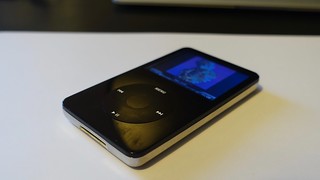
iPod iPod with rockbox
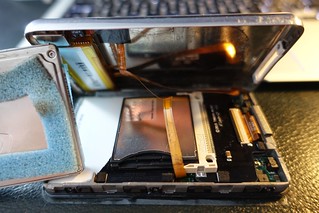
opened up open iPod with iFlash
It's been four years since I last wrote about music players. In the meantime of my Sansa Fuzes broke, and the third does not have great rockbox support. I've also been using a Sansa Clip+ (a leaving present from my last job, thanks again!) and a Sansa Clip Zip. Unfortunately Sandisk's newer Sansa devices (Sport, Jam - the only ones still in production) are not supported by Rockbox. The Clips have been very reliable and sturdy players, but I have missed the larger display of the Fuze. Since I've been exploring HD audio I've also been interested in something with an A/D converter that can handle it. I also still wish to carry my entire music library around with me, which limits my options. I decided to try an iPod. The older iPods had a Wolfson-manufacturered ADC which had a good reputation and supported (in headline terms at least) 24/48. The iPod colour (aka "4th gen") and subsequent models have a large colour display. The click-wheel interface is also very nice. Apple have now discontinued the "classic" iPod and their second hand value has greatly increased, but I managed to get an older 5th generation model ("video", with a base capacity of 30G) whilst trading in some unwanted DVDs. The case was scratched to heck but a replacement was readily and cheaply available from auction sites. Rockbox support in these iPods is pretty good, and you can mod the hardware to support CF or SD cards with kits such as the iFlash kits by Tarkan Akdam, which I picked up, along with a new 128G SD card. Unfortunately I have found writing to the iPod to be very poor with Rockbox, but it's fine for playback, and booting the iPod in OF or DFU mode is very easy and works reliably. Whilst Rockbox on the iPod works pretty well, installing it is far harder than on the Sandisk Sansa devices. The difficulty in my case is because rockbox requires a PC-formatted iPod to install, and I had a Mac-formatted one. I couldn't find a way to convert the iPod to PC format using a Mac. I tried doing so on a PC but for some reason the PC wasn't playing ball so I gave up after a few hours. In the end I assembled the filesystem by hand using dd(1) and dumps of partition tables from other people's iPods, via a Linux machine. This was enough to convince iTunes on Mac to restore it's hidden partition and boot software without reverting back to a Mac disklabel format.

Daniel Pocock: Let's Encrypt torpedoes cost and maintenance issues for Free RTC

Many people have now heard of the EFF-backed free certificate authority Let's Encrypt. Not only is it free of charge, it has also introduced a fully automated mechanism for certificate renewals, eliminating a tedious chore that has imposed upon busy sysadmins everywhere for many years. These two benefits - elimination of cost and elimination of annual maintenance effort - imply that server operators can now deploy certificates for far more services than they would have previously. The TLS chapter of the RTC Quick Start Guide has been updated with details about Let's Encrypt so anybody installing SIP or XMPP can use Let's Encrypt from the outset. For example, somebody hosting basic Drupal or Wordpress sites for family, friends and small community organizations can now offer them all full HTTPS encryption, WebRTC, SIP and XMPP without having to explain annual renewal fees or worry about losing time in their evenings and weekends renewing certificates manually. Even people who were willing to pay for a single certificate for their main web site may have snubbed their nose at the expense and ongoing effort of having certificates for their SMTP mail server, IMAP server, VPN gateway, SIP proxy, XMPP server, WebSocket and TURN servers too. Now they can all have certificates. Early efforts at SIP were doomed without encryption In the early days, SIP messages would be transported across the public Internet in UDP datagrams without any encryption. SIP itself wasn't originally designed for NAT and a variety of home routers were created with "NAT helper" algorithms that would detect and modify SIP packets to try and work through NAT. Sadly, in many cases these attempts to help actually clash with each other and lead to further instability. Conversely, many rogue ISPs could easily detect and punish VoIP users by blocking their calls or even cutting their DSL line. Operating SIP over TLS, usually on the HTTPS port (TCP port 443) has been an effective way to quash all of these different issues. While the example of SIP is one of the most extreme, it helps demonstrate the benefits of making encryption universal to ensure stability and cut out the "man-in-the-middle", regardless of whether he is trying to help or hinder the end user. Is one certificate enough? Modern SIP, XMPP and WebRTC require additional services, TURN servers and WebSocket servers. If they are all operated on port 443 then it is necessary to use different hostnames for each of them (e.g. turn.example.org and ws.example.org. Each different hostname requires a certificate. Let's Encrypt can provide those additional certificates too, without additional cost or effort. The future with Let's Encrypt The initial version of the Let's Encrypt client, certbot, fully automates the workflow for people using popular web servers such as Apache and nginx. The manual or certonly modes can be used for other services but hopefully certbot will evolve to integrate with many other popular applications too. Currently, Let's Encrypt's certbot tool issues certificates to servers running on TCP port 443 or 80. These are considered to be a privileged ports whereas any port over 1023, including the default ports used by applications such as SIP (5061), XMPP (5222, 5269) and TURN (5349), are not privileged ports. As long as certbot maintains this policy, it is generally necessary to either run a web server for the domain associated with each certificate or run the services themselves on port 443. There are other mechanisms for domain validation and various other clients supporting different subsets of them. Running the services themselves on port 443 turns out to be a good idea anyway as it ensures that RTC services can be reached through HTTP proxy servers who fail to let the HTTP CONNECT method access any other ports. Many configuration tasks are already scripted during the installation of packages on a GNU/Linux distribution (such as Debian or Fedora) or when setting up services using cloud images (for example, in Docker or OpenStack). Due to the heavily standardized nature of Let's Encrypt and the widespread availability of the tools, many of these package installation scripts can be easily adapted to find or create Let's Encrypt certificates on the target system, ensuring every service is running with TLS protection from the minute it goes live. If you have questions about Let's Encrypt for RTC or want to share your experiences, please come and discuss it on the Free-RTC mailing list.

Dirk Eddelbuettel: Rcpp now used by over 700 CRAN packages

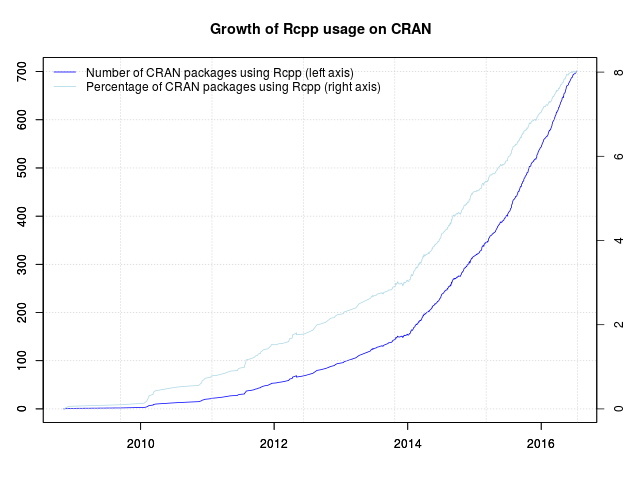
600 Rcpp packages Earlier this morning, Rcpp reached another milestone: 701 packages on CRAN now depend on it (as measured by Depends, Imports and LinkingTo declarations). The graph is on the left depicts the growth of Rcpp usage over time. Rcpp cleared 300 packages in November 2014. It passed 400 packages in June of last year (when I only tweeted about it), 500 packages in late October and 600 packages exactly four months ago in March. The chart extends to the very beginning via manually compiled data from CRANberries and checked with crandb. Then next part uses manually saved entries, and the final and largest part of the data set was generated semi-automatically via a short script appending updates to a small file-based backend. A list of packages using Rcpp is kept on this page. Also displayed in the graph is the relative proportion of CRAN packages using Rcpp. The four per-cent hurdle was cleared just before useR! 2014 where I showed a similar graph (as two distinct graphs) in my invited talk. We passed five percent in December of 2014, six percent last July, seven percent just before Christmas and now criss-crosses 8 eight percent, or a little less than one in twelve R packages. 700 user packages is a really large and humbling number. This places quite some responsibility on us in the Rcpp team as we continue to try our best try to keep Rcpp as performant and reliable as it has been. So with that a very big Thank You! to all users and contributors of Rcpp for help, suggestions, bug reports, documentation or, of course, code.

This post by Dirk Eddelbuettel originated on his Thinking inside the box blog. Please report excessive re-aggregation in third-party for-profit settings.

10 July 2016

Ritesh Raj Sarraf: Leprosy in India

During my recent travel, I had quite a long layover at the Doha International Airport in Qatar. While killing time, I watched an interesting programme on the Al Jazeera network. The program aired on Al Jazeera is Lifelines. This special episode I watched, covered about "Leprosy in India". After having watched the entire programme, I felt the urge to blog about it. First of all, it was quite depressing to me, to know through the programme, that the Govt. of India had officially marked "Leprosy" eradicated from India in 2005. As per Wikipedia, "Globally in 2012, the number of chronic cases of leprosy was 189,000, down from some 5.2 million in the 1980s. The number of new cases was 230,000. Most new cases occur in 16 countries, with India accounting for more than half." Of the data presented on Lifelines, they just covered a couple of districts from 2 States (of the 28+ States) of India. So, with many states remaining, and unserveyed, and uncounted, we are far away from making such statements. Given that the Govt., on paper, has marked Leprosy eradicated; so does WHO. Which means that there is no more funding to help people suffering from the disease. And with no Govt. (or International) funding, it is a rather disappointing situation. I come from a small town on the Indo-Nepal intl. border, named Raxaul. And here, I grew up seeing many people who suffered from Leprosy. As a child, I never much understood the disease, because as is mentioned in the programme, I was told it was a communicable disease. Those suffering, were (and are) tagged as Untouchables (Hindi: ). Of my small town, there was and still is a sub-town, named Sunderpur. This town houses patients suffering from Leprosy, from around multiple districts closeby. I've never been there, but have been told that it is run by an NGO, and helps patients fight the disease. Lifelines also reported that fresh surveys done by the Lepra society, just a 3 day campaign, resulted in 3808 new cases of people suffering from Leprosy. That is a big number, given accessibility to small towns only happens once a week on market day. And in 3 days the team hardly covered a couple of district towns. My plea to the Media Houses of India. Please spend some time to look beyond the phony stuff that you mostly present. There are real issues that could be brought to a wider audience. As for the government, it is just depressing to know how rogue some/most of your statements are.

Categories:

Keywords:

Like:

Joey Hess: twenty years of free software -- part 12 propellor

Propellor is my second big Haskell program. I recently described the motivation for it like this, in a proposal for a Linux.Conf.Au talk:
The configuration of Linux hosts has become increasingly declarative, managed by tools like puppet and ansible, or by the composition of containers. But if a server is a collection of declarative properties, how do you make sure that changes to that configuration make sense? You can test them, but eventually it's 3 AM and you have an emergency fix that needs to go live immediately. Data types to the rescue! While data types are usually used to prevent eg, combining an Int and a Bool, they can be used at a much more abstract level, for example to prevent combining a property that needs a Debian system with a property that needs a Red Hat system. Propellor leverages Haskell's type system to prove the consistency of the properties it will apply to a host.
The real origin story though, is that I wanted to finally start using configuration management, but the tools for it all seemed very complicated and built on shaky foundations (like piles of yaml), and it seemed it would be easier to write my own than deal with that. Meanwhile, I had Haskell burning a hole in my pocket, ready to be used in a second large project after git-annex. Propellor has averaged around 2.5 contributions per month from users since it got started, but increasing numbers recently. That's despite having many fewer users than git-annex, which remember gets perhaps 1 patch per month. Of course, I've "cheated" by making sure that propellor's users know Haskell, or are willing to learn some. And, propellor is very compositional; adding a new property to it is not likely to be complicated by any of the existing code. So it's easy to extend, if you're able to use it. At this point propellor has a small community of regular contributors, and I spend some pleasant weekend afternoons reviewing and merging their work. Much of my best work on propellor has involved keeping the behavior of the program the same while making its types better, to prevent mistakes. Propellor's core data types have evolved much more than in any program I worked on before. That's exciting! Next: twenty years of free software -- part 13 past and future

Paul Tagliamonte: SNIff

A while back, I found myself in need of two webservers that would terminate TLS (with different rules). I wanted to run some custom code I d written (which uses TLS peer authentication), and also nginx on port 443. The best way I figured out how to do this was to write a tool to sit on port 443, and parse TLS Client Hello packets, and dispatch to the correct backend depending on the SNI name. SNI, or Server Name Indication allows the client to announce (yes over cleartext!) what server it s looking for, similar to the HTTP Host header. Sometimes, like in the case above, the Host header won t work, since you ve already done a TLS handshake by the time you figure out who they re looking for. I also spun the Client Hello parser out into its own importable package, just in case someone else finds themselves in this same boat. The code s up on github.com/paultag/sniff!

Sune Vuorela: Let Qt models meet std::vector<std::tuple< >>

The problem So. I was stuck with a container of tuples that I wanted to see in a Qt view (QTableView, QtQuick ListView or similar). So how to do that? Another problem: I haven t been doing fun things with templates recently. A solution? After a bit of hacking, it seems like it can just be done like
typedef std::tuple<std::string, QString> Element;
typedef std::vector List;
List list =   std::make_tuple("first", "second"), 
              std::make_tuple("third", "fourth")  ;
std::unique_ptr<TableModel> magic = createTableModel(list);
QTableView view;
view.setModel(magic->model());
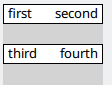
and tada:
QTableView Of course, we are also QtQuick friendly
std::unique_ptr<ListModel>List>> magic = createListModel(list);
// expose magic->model() to your quickview
and a delegate containing the following
Text  
    text: role0
 
Text  
    text: role1
 
can give:
ListView But enough about creation. Whattabout manipulation? Luckily we got you covered. Insert two extra rows at position 1?
auto lines =   std::make_tuple("extra", "extra"),
               std::make_tuple("extra2","extra2")  ;
magic->insertRows(1,lines.begin(), lines.end());
Append a row?
magic->appendRow(std::make_tuple("",""));
Remove 2 rows at position 3?
magic->removeRow(3,2);
Replace the underlying list?
List newList;
// fill list
magic->reset(newList);
Read-only looping over the elements?
for(const Element& e : magic->list())
 
    ...
 
The Qt model of course also accepts setData calls. Future? If anyone is interested I will polish the code a bit and publish it. If that s the case, how should I name this thing? And I did get around doing fun things with templates again.

Michal &#268;iha&#345;: Weblate 2.7

Slightly later than on monthly schedule but Weblate 2.7 is out today. This release brings improvements to the API and is first to officially support wlc a command line client for Weblate. Full list of changes for 2.7: If you are upgrading from older version, please follow our upgrading instructions. You can find more information about Weblate on https://weblate.org, the code is hosted on Github. If you are curious how it looks, you can try it out on demo server. You can login there with demo account using demo password or register your own user. Weblate is also being used https://hosted.weblate.org/ as official translating service for phpMyAdmin, OsmAnd, Aptoide, FreedomBox, Weblate itself and many other projects. Should you be looking for hosting of translations for your project, I'm happy to host them for you or help with setting it up on your infrastructure. Further development of Weblate would not be possible without people providing donations, thanks to everybody who have helped so far! The roadmap for next release is just being prepared, you can influence this by expressing support for individual issues either by comments or by providing bounty for them.

Filed under: Debian English SUSE Weblate 0 comments

Craig Small: procps 3.3.12

The procps developers are happy to announce that version 3.3.12 of procps was released today. This version has a mixture of bug fixes and enhancements. This unfortunately means another API bump but we are hoping this will be fixed with the new library API coming soon. procps is developed on gitlab and the new version of procps can be found at https://gitlab.com/procps-ng/procps/tree/newlib procps 3.3.12 can be found at https://gitlab.com/procps-ng/procps/tags/v3.3.12 From the NEWS file, procps 3.1.12 has the following: We are hoping this will be the last one to use the old API and the new format API ( imaginatively called newlib ) will be used in subsequent releases. Feedback for this and any other version of procps can be sent to either the issue tracker or the development email list.

Norbert Preining: OpenPHT 1.6.2 for Debian/sid

I have updated the openpht repository with builds of OpenPHT 1.6.2 for Debian/sid for both amd64 and i386 architecture. For those who have forgotten it, OpenPHT is the open source fork of Plex Home Theater that is used on RasPlex, see my last post concerning OpenPHT for details. plex-debian-new The repository also contains packages (source and amd64/i386) for shairplay which is necessary for building and running OpenPHT. sid and testing For sid use the following lines:
deb http://www.preining.info/debian/ openpht-sid main
deb-src http://www.preining.info/debian/ openpht-sid main
You can also grab the binary for amd64 directly here for amd64 and i386, you can get the source package with
dget http://www.preining.info/debian/pool/main/o/openpht/openpht_1.6.2.20160707-1.dsc
Note that if you only get the binary deps, you also need libshairplay0 from amd64 or i386. The release file and changes file are signed with my official Debian key 0x860CDC13. jessie Builds for Debian stable release jessie are available directly from the github project page of OpenPHT Now be ready for enjoying the next movie!

9 July 2016

Matthew Garrett: "I recieved a free or discounted product in return for an honest review"

My experiences with Amazon reviewing have been somewhat unusual. A review of a smart switch I wrote received enough attention that the vendor pulled the product from Amazon. At the time of writing, I'm ranked as around the 2750th best reviewer on Amazon despite having a total of 18 reviews. But the world of Amazon reviews is even stranger than that, and the past couple of weeks have given me some insight into it.

Amazon's success is fairly phenomenal. It's estimated that there's over 50 million people in the US paying $100 a year to get free shipping on Amazon purchases, and combined with Amazon's surprisingly customer friendly service there's a lot of people with a very strong preference for choosing Amazon rather than any other retailer. If you're not on Amazon, you're hurting your sales.

And if you're an established brand, this works pretty well. Some people will search for your product directly and buy it, leaving reviews. Well reviewed products appear higher up in search results, so people searching for an item type rather than a brand will still see your product appear early in the search results, in turn driving sales. Some proportion of those customers will leave reviews, which helps keep your product high up in the results. As long as your products aren't utterly dreadful, you'll probably maintain that position.

But if you're a brand nobody's ever heard of, things are more difficult. People are unlikely to search for your product directly, so you're relying on turning up in the results for more generic terms. But if you're selling a more generic kind of item (say, a Bluetooth smart bulb) then there's probably a number of other brands nobody's ever heard of selling almost identical objects. If there's no reason for anybody to choose your product then you're probably not going to get any reviews and you're not going to move up the search rankings. Even if your product is better than the competition, a small number of sales means a tiny number of reviews. By the time that number's large enough to matter, you're probably onto a new product cycle.

In summary: if nobody's ever heard of you, you need reviews but you're probably not getting any.

The old way of doing this was to send review samples to journalists, but nobody's going to run a comprehensive review of 3000 different USB cables and even if they did almost nobody would read it before making a decision on Amazon. You need Amazon reviews, but you're not getting any. The obvious solution is to send review samples to people who will leave Amazon reviews. This is where things start getting more dubious.

Amazon run a program called Vine which is intended to solve this problem. Send samples to Amazon and they'll distribute them to a subset of trusted reviewers. These reviewers write a review as normal, and Amazon tag the review with a "Vine Voice" badge which indicates to readers that the reviewer received the product for free. But participation in Vine is apparently expensive, and so there's a proliferation of sites like Snagshout or AMZ Review Trader that use a different model. There's no requirement that you be an existing trusted reviewer and the product probably isn't free. You sign up, choose a product, receive a discount code and buy it from Amazon. You then have a couple of weeks to leave a review, and if you fail to do so you'll lose access to the service. This is completely acceptable under Amazon's rules, which state "If you receive a free or discounted product in exchange for your review, you must clearly and conspicuously disclose that fact". So far, so reasonable.

In reality it's worse than that, with several opportunities to game the system. AMZ Review Trader makes it clear to sellers that they can choose reviewers based on past reviews, giving customers an incentive to leave good reviews in order to keep receiving discounted products. Some customers take full advantage of this, leaving a giant number of 5 star reviews for products they clearly haven't tested and then (presumably) reselling them. What's surprising is that this kind of cynicism works both ways. Some sellers provide two listings for the same product, the second being significantly more expensive than the first. They then offer an attractive discount for the more expensive listing in return for a review, taking it down to approximately the same price as the original item. Once the reviews are in, they can remove the first listing and drop the price of the second to the original price point.

The end result is a bunch of reviews that are nominally honest but are tied to perverse incentives. In effect, the overall star rating tells you almost nothing - you still need to actually read the reviews to gain any insight into whether the customer actually used the product. And when you do write an honest review that the seller doesn't like, they may engage in heavy handed tactics in an attempt to make the review go away.

It's hard to avoid the conclusion that Amazon's review model is broken, but it's not obvious how to fix it. When search ranking is tied to reviews, companies have a strong incentive to do whatever it takes to obtain positive reviews. What we're left with for now is having to laboriously click through a number of products to see whether their rankings come from thoughtful and detailed reviews or are just a mass of 5 star one liners.

comment count unavailable comments

Charles Plessy: Congratulations, Marga!

For the first time in our history, a woman joins the Technical Committee. Congratulations, Marga, and thanks for volunteering.

8 July 2016

Joey Hess: twenty years of free software -- part 11 concurrent-output

concurrent-output is a more meaty Haskell library than the ones I've covered so far. Its interface is simple, but there's a lot of complexity under the hood. Things like optimised console updates, ANSI escape sequence parsing, and transparent paging of buffers to disk. It developed out of needing to display multiple progress bars on the console in git-annex, and also turned out to be useful in propellor. And since it solves a general problem, other haskell programs are moving toward using it, like shake and stack. Next: twenty years of free software -- part 12 propellor

Michal &#268;iha&#345;: wlc 0.4

wlc 0.4, a command line utility for Weblate, has been just released. This release doesn't bring much changes, but still worth announcing. The most important change is that development repository has been moved under WeblateOrg organization at GitHub, you can now find it at https://github.com/WeblateOrg/wlc. Another important news is that Debian package is currently waiting in NEW queue and will hopefully soon hit unstable. wlc is built on API introduced in Weblate 2.6 and still being in development. Several commands from wlc will not work properly if executed against Weblate 2.6, first fully supported version will be 2.7 (current git is okay as well, it is now running on both demo and hosting servers). You can usage examples in the wlc documentation.

Filed under: Debian English SUSE Weblate 0 comments

Steve Kemp: I've been moving and updating websites.

I've spent the past days updating several of my websites to be "responsive". Mostly that means I open the site in firefox then press Ctrl-alt-m to switch to mobile-view. Once I have the mobile-view I then fix the site to look good in small small space. Because my general design skills are poor I've been fixing most sites by moving to bootstrap, and ensuring that I don't use headers/footers that are fixed-position. Beyond the fixes to appearances I've also started rationalizing the domains, migrating content across to new homes. I've got a provisional theme setup at steve.fi, and I've moved my blog over there too. The plan for blog-migration went well: The plan was originally to setup a HTTP-redirect, but I realized that this would mean I'd need to keep the redirect in-place forever, as visitors would have no incentive to fix their links, or update their feeds. By adding the fake-RSS-feed, pointing to the new location, I am able to assume that eventually people will update, and I can drop the dns record for blog.steve.org.uk entirely - Already google seems to have updated its spidering and searching shows the new domain already.

Russell Coker: Nexus 6P and Galaxy S5 Mini

Just over a month ago I ordered a new Nexus 6P [1]. I ve had it for over a month now and it s time to review it and the Samsung Galaxy S5 Mini I also bought. Security The first noteworthy thing about this phone is the fingerprint scanner on the back. The recommended configuration is to use your fingerprint for unlocking the phone which allows a single touch on the scanner to unlock the screen without the need to press any other buttons. To unlock with a pattern or password you need to first press the power button to get the phone s attention. I have been considering registering a fingerprint from my non-dominant hand to reduce the incidence of accidentally unlocking it when carrying it or fiddling with it. The phone won t complete the boot process before being unlocked. This is a good security feature. Android version 6 doesn t assign permissions to apps at install time, they have to be enabled at run time (at least for apps that support Android 6). So you get lots of questions while running apps about what they are permitted to do. Unfortunately there s no allow for the duration of this session option. A new Android feature prevents changing security settings when there is an overlay running . The phone instructs you to disable overlay access for the app in question but that s not necessary. All that is necessary is for the app to stop using the overlay feature. I use the Twilight app [2] to dim the screen and use redder colors at night. When I want to change settings at night I just have to pause that app and there s no need to remove the access from it note that all the web pages and online documentation saying otherwise is wrong. Another new feature is to not require unlocking while at home. This can be a convenience feature but fingerprint unlocking is so easy that it doesn t provide much benefit. The downside of enabling this is that if someone stole your phone they could visit your home to get it unlocked. Also police who didn t have a warrant permitting search of a phone could do so anyway without needing to compel the owner to give up the password. Design This is one of the 2 most attractive phones I ve owned (the other being the sparkly Nexus 4). I think that the general impression of the appearance is positive as there are transparent cases on sale. My phone is white and reminds me of EVE from the movie Wall-E. Cables This phone uses the USB Type-C connector, which isn t news to anyone. What I didn t realise is that full USB-C requires that connector at both ends as it s not permitted to have a data cable with USB-C at the device and and USB-A at the host end. The Nexus 6P ships with a 1M long charging cable that has USB-C at both ends and a ~10cm charging cable with USB-C at one end and type A at the other (for the old batteries and the PCs that don t have USB-C). I bought some 2M long USB-C to USB-A cables for charging my new phone with my old chargers, but I haven t yet got a 1M long cable. Sometimes I need a cable that s longer than 10cm but shorter than 2M. The USB-C cables are all significantly thicker than older USB cables. Part of that would be due to having many more wires but presumably part of it would be due to having thicker power wires for delivering 3A. I haven t measured power draw but it does seem to charge faster than older phones. Overall the process of converting to USB-C is going to be a lot more inconvenient than USB SuperSpeed (which I could basically ignore as non-SuperSpeed connectors worked). It will be good when laptops with USB-C support become common, it should allow thinner laptops with more ports. One problem I initially had with my Samsung Galaxy Note 3 was the Micro-USB SuperSpeed socket on the phone being more fiddly for the Micro-USB charging plug I used. After a while I got used to that but it was still an annoyance. Having a symmetrical plug that can go into the phone either way is a significant convenience. Calendars and Contacts I share most phone contacts with my wife and also have another list that is separate. In the past I had used the Samsung contacts system for the contacts that were specific to my phone and a Google account for contacts that are shared between our phones. Now that I m using a non-Samsung phone I got another Gmail account for the purpose of storing contacts. Fortunately you can get as many Gmail accounts as you want. But it would be nice if Google supported multiple contact lists and multiple calendars on a single account. Samsung Galaxy S5 Mini Shortly after buying the Nexus 6P I decided that I spend enough time in pools and hot tubs that having a waterproof phone would be a good idea. Probably most people wouldn t consider reading email in a hot tub on a cruise ship to be an ideal holiday, but it works for me. The Galaxy S5 Mini seems to be the cheapest new phone that s waterproof. It is small and has a relatively low resolution screen, but it s more than adequate for a device that I ll use for an average of a few hours a week. I don t plan to get a SIM for it, I ll just use Wifi from my main phone. One noteworthy thing is the amount of bloatware on the Samsung. Usually when configuring a new phone I m so excited about fancy new hardware that I don t notice it much. But this time buying the new phone wasn t particularly exciting as I had just bought a phone that s much better. So I had more time to notice all the annoyances of having to download updates to Samsung apps that I ll never use. The Samsung device manager facility has been useful for me in the past and the Samsung contact list was useful for keeping a second address book until I got a Nexus phone. But most of the Samsung apps and 3d party apps aren t useful at all. It s bad enough having to install all the Google core apps. I ve never read mail from my Gmail account on my phone. I use Fetchmail to transfer it to an IMAP folder on my personal mail server and I d rather not have the Gmail app on my Android devices. Having any apps other than the bare minimum seems like a bad idea, more apps in the Android image means larger downloads for an over-the-air update and also more space used in the main partition for updates to apps that you don t use. Not So Exciting In recent times there hasn t been much potential for new features in phones. All phones have enough RAM and screen space for all common apps. While the S5 Mini has a small screen it s not that small, I spent many years with desktop PCs that had a similar resolution. So while the S5 Mini was released a couple of years ago that doesn t matter much for most common use. I wouldn t want it for my main phone but for a secondary phone it s quite good. The Nexus 6P is a very nice phone, but apart from USB-C, the fingerprint reader, and the lack of a stylus there s not much noticeable difference between that and the Samsung Galaxy Note 3 I was using before. I m generally happy with my Nexus 6P, but I think that anyone who chooses to buy a cheaper phone probably isn t going to be missing a lot.

7 July 2016

Matthew Garrett: Bluetooth LED bulbs

The best known smart bulb setups (such as the Philips Hue and the Belkin Wemo) are based on Zigbee, a low-energy, low-bandwidth protocol that operates on various unlicensed radio bands. The problem with Zigbee is that basically no home routers or mobile devices have a Zigbee radio, so to communicate with them you need an additional device (usually called a hub or bridge) that can speak Zigbee and also hook up to your existing home network. Requests are sent to the hub (either directly if you're on the same network, or via some external control server if you're on a different network) and it sends appropriate Zigbee commands to the bulbs.

But requiring an additional device adds some expense. People have attempted to solve this in a couple of ways. The first is building direct network connectivity into the bulbs, in the form of adding an 802.11 controller. Go through some sort of setup process[1], the bulb joins your network and you can communicate with it happily. Unfortunately adding wifi costs more than adding Zigbee, both in terms of money and power - wifi bulbs consume noticeably more power when "off" than Zigbee ones.

There's a middle ground. There's a large number of bulbs available from Amazon advertising themselves as Bluetooth, which is true but slightly misleading. They're actually implementing Bluetooth Low Energy, which is part of the Bluetooth 4.0 spec. Implementing this requires both OS and hardware support, so older systems are unable to communicate. Android 4.3 devices tend to have all the necessary features, and modern desktop Linux is also fine as long as you have a Bluetooth 4.0 controller.

Bluetooth is intended as a low power communications protocol. Bluetooth Low Energy (or BLE) is even lower than that, running in a similar power range to Zigbee. Most semi-modern phones can speak it, so it seems like a pretty good choice. Obviously you lose the ability to access the device remotely, but given the track record on this sort of thing that's arguably a benefit. There's a couple of other downsides - the range is worse than Zigbee (but probably still acceptable for any reasonably sized house or apartment), and only one device can be connected to a given BLE server at any one time. That means that if you have the control app open while you're near a bulb, nobody else can control that bulb until you disconnect.

The quality of the bulbs varies a great deal. Some of them are pure RGB bulbs and incapable of producing a convincing white at a reasonable intensity[2]. Some have additional white LEDs but don't support running them at the same time as the colour LEDs, so you have the choice between colour or a fixed (and usually more intense) white. Some allow running the white LEDs at the same time as the RGB ones, which means you can vary the colour temperature of the "white" output.

But while the quality of the bulbs varies, the quality of the apps doesn't really. They're typically all dreadful, competing on features like changing bulb colour in time to music rather than on providing a pleasant user experience. And the whole "Only one person can control the lights at a time" thing doesn't really work so well if you actually live with anyone else. I was dissatisfied.

I'd met Mike Ryan at Kiwicon a couple of years back after watching him demonstrate hacking a BLE skateboard. He offered a couple of good hints for reverse engineering these devices, the first being that Android already does almost everything you need. Hidden in the developer settings is an option marked "Enable Bluetooth HCI snoop log". Turn that on and all Bluetooth traffic (including BLE) is dumped into /sdcard/btsnoop_hci.log. Turn that on, start the app, make some changes, retrieve the file and check it out using Wireshark. Easy.

Conveniently, BLE is very straightforward when it comes to network protocol. The only thing you have is GATT, the Generic Attribute Protocol. Using this you can read and write multiple characteristics. Each packet is limited to a maximum of 20 bytes. Most implementations use a single characteristic for light control, so it's then just a matter of staring at the dumped packets until something jumps out at you. A pretty typical implementation is something like:

0x56,r,g,b,0x00,0xf0,0x00,0xaa

where r, g and b are each just a single byte representing the corresponding red, green or blue intensity. 0x56 presumably indicates a "Set the light to these values" command, 0xaa indicates end of command and 0xf0 indicates that it's a request to set the colour LEDs. Sending 0x0f instead results in the previous byte (0x00 in this example) being interpreted as the intensity of the white LEDs. Unfortunately the bulb I tested that speaks this protocol didn't allow you to drive the white LEDs at the same time as anything else - setting the selection byte to 0xff didn't result in both sets of intensities being interpreted at once. Boo.

You can test this out fairly easily using the gatttool app. Run hcitool lescan to look for the device (remember that it won't show up if anything else is connected to it at the time), then do gatttool -b deviceid -I to get an interactive shell. Type connect to initiate a connection, and once connected send commands by doing char-write-cmd handle value using the handle obtained from your hci dump.

I did this successfully for various bulbs, but annoyingly hit a problem with one from Tikteck. The leading byte of each packet was clearly a counter, but the rest of the packet appeared to be garbage. For reasons best known to themselves, they've implemented application-level encryption on top of BLE. This was a shame, because they were easily the best of the bulbs I'd used - the white LEDs work in conjunction with the colour ones once you're sufficiently close to white, giving you good intensity and letting you modify the colour temperature. That gave me incentive, but figuring out the protocol took quite some time. Earlier this week, I finally cracked it. I've put a Python implementation on Github. The idea is to tie it into Ulfire running on a central machine with a Bluetooth controller, making it possible for me to control the lights from multiple different apps simultaneously and also integrating with my Echo.

I'd write something about the encryption, but I honestly don't know. Large parts of this make no sense to me whatsoever. I haven't even had any gin in the past two weeks. If anybody can explain how anything that's being done there makes any sense at all[3] that would be appreciated.

[1] typically via the bulb pretending to be an access point, but also these days through a terrifying hack involving spewing UDP multicast packets of varying lengths in order to broadcast the password to associated but unauthenticated devices and good god the future is terrifying

[2] For a given power input, blue LEDs produce more light than other colours. To get white with RGB LEDs you either need to have more red and green LEDs than blue ones (which costs more), or you need to reduce the intensity of the blue ones (which means your headline intensity is lower). Neither is appealing, so most of these bulbs will just give you a blue "white" if you ask for full red, green and blue

[3] Especially the bit where we calculate something from the username and password and then encrypt that using some random numbers as the key, then send 50% of the random numbers and 50% of the encrypted output to the device, because I can't even

comment count unavailable comments

Michal &#268;iha&#345;: uTidylib 0.3

Several years ago I've complained about uTidylib not being maintained upstream. Since that time I've occasionally pushed some fixes to my GitHub repository with uTidylib code, but without any clear intentions to take it over. Time has gone and there was still no progress and I started to consider becoming upstream maintainer as well. I quickly got approval from Cory Dodt, who was the original author of this code, unfortunately he is not owner of the PyPI entry and the claim request seems to have no response (if you know how to get in touch with "cntrlr" or how to take over PyPI module please let me know). Anyway the amount of patches in my repository is big enough to warrant new release. Additionally Debian bug report about supporting new HTML tidy library came in and that made me push towards releasing 0.3 version of the uTidylib. As you might guess, the amount of changes against original uTidylib is quite huge, to name the most important ones: Anyway as I can not update PyPI entry, the downloads are currently available only on my website: https://cihar.com/software/utidylib/

Filed under: Debian English uTidylib 0 comments

Joey Hess: twenty years of free software -- part 10 shell-monad

shell-monad is a small project, done over a couple days and not needing many changes since, but I'm covering it separately because it was a bit of a milestone for me. As I learned Haskell, I noticed that the libraries were excellent and did things to guide their users that libraries in other languages don't do. Starting with using types and EDSLs and carefully constrained interfaces, but going well beyond that, as far as applying category theory. Using these libraries push you toward good solutions. shell-monad was a first attempt at building such a library. The shell script it generates should always be syntactically valid, and never forgets to quote a shell variable. That's only the basics. It goes further by making it impossible to typo the name of a shell variable or shell function. And it uses phantom types so that the Haskell type checker can check the types of shell variables and functions match up. So I think shell-monad is pretty neat, and I certianly learned a lot about writing Haskell libraries making it. Including how much I still have to learn! I have not used shell-monad much, but keep meaning to make propellor and git-annex use it for some of their shell script needs. And ponder porting etckeeper to generate its shell scripts using it. Next: twenty years of free software -- part 11 concurrent-output

Next.

Previous.