Search Results: "sf"

8 September 2006

Matt Brown: $16m of Broadband Challenge Funding Announced

David Cunliffe has just announced this morning that the Government has finally decided to approve 5 of the urban Broadband Challenge applications to build urban fibre networks. Hamilton is one of the accepted proposals, getting $3.3m of government funding to help cover the start-up costs of the network. Under the conditions of the Broadband Challenge the networks must be open access and provide a full duplex transfer rate of at least 1Gbps. Should be interesting to see how this develops! Press Releases:

7 September 2006

Evan Prodromou: 21 Fructidor CCXIV

We got back from Europe 36 hours ago, and I've spent most of the time sleeping. We'd had a pretty rough flight across the Atlantic -- although of the three of us the baby was the least grumpy. I'm a terrible jet-lag victim, though, and just a few hours of time change really messes with my wp:biorhythms. Yesterday was Amita June's first birthday, and although we were all tired we had a good time just the three of us. My parents, Maj's parents and our siblings all called, and we picked up a few presents that had been shipped here while we were gone. Amita got a trip to the toy store (net haul: 1 rubber ball, one Caillou book, one crapload of block toys) and a special breakfast. Sadly, she and her papa fell asleep together before she got her birthday dinner. We're having a birthday party at our house on Saturday, "from 3PM to bathtime". It should be a little more lively than our quiet day at home. tags:

Malm I don't think I've posted anything in a little while, since before we went to wt:Malm . We had a really nice time while we were there. I had corresponded with Sean Finney, another Debian developer who lives in Malm , before we left for Europe, and he'd offered a meetup. We had a free day in wt:Copenhagen so I figured I'd take him up on the offer. Malm is only about 40 minutes from Copenhagen by train, so we were able to take a trip over quite easily. There's a beautiful bridge between wt:Zealand and wt:Scania which we crossed by train -- the water was beautiful. We managed to miss Sean at the train station -- I'd given some pretty tenuous instructions on how to meet us -- but we managed to get out and see the town a bit for ourselves. The old city has two squares -- the Stortorget or Big Square and Lille torg or Little Square -- right next to each other. The Lille torg is circled by restaurants and we had a decent lunch at a place called the Moose Bar -- Scandinavian staples like salmon with a Thai presentation. A good idea. Sean managed to catch us as we were walking around, so we had a nice coffee together at a caf on the main drag. He's been in Malm for more than a year, and is taking classes at nearby wt:Lund. We managed to exchange GPG key signature preliminaries (what Maj calls the "Debian butt-sniffing ceremony") and had a good time talking about the state of Debian and Free Software. We split up at the train station and Maj and I went off to explore the towns small castle. It has a number of museums, but it was late in the day on a Sunday, so we opted instead for a walk to the beach, looking out to the bridge and ultimately the skyline and wind turbines of Copenhagen. After a long walk circumnavigating Malm 's distinctive Twisted Tower, the tallest building in Sweden, we headed back to Copenhagen for a dinner at Tivoli Gardens (probably my favorite spot in Copenhagen). tags:

Z rich We made a special stop on the way home to Montreal through wt:Zurich. We flew on Swiss Air, which has a hub in Zurich, and they gave us a free 24-hour layover in town. Fortunately for us, we got to spend some time with our good friends Mark Jaroski and Allegra Biava. They're friends of ours from SF who moved to Switzerland around the time Maj moved there, and they now live in wt:Lausanne. Both are extremely funny, intelligent and clued-in people. They were passing through Zurich on their way back to the US for a family visit there. I'm glad we got to see them, since I got to meet No ma, their 2-year-old daughter. No was born about 8 months after we last saw Mark and Allegra -- they weren't even telling people they were pregnant at the time. She's a barrel of laughs -- a real fun little person. She and Amita June got along great. We spent most of our time walking around central Zurich, seeing some of the sights and taking it easy. There's only so much tourism you can do with one toddler, and two toddlers raises the requirements considerably. I think the big downer for Zurich for me was how many people we didn't see. I'd hoped to connect with Alex Schroeder, founder of CommunityWiki, and also Martin Krafft, another fellow Debianista. Most disappointing, we missed Marco Prestipino, who's doing work at the University of Zurich in information transfer in online communities. tags:

Philipp Kern: Some kind of vacation needed.

Sorry to all my NMs which await processing and others which expect anything of me. I often have headaches currently, possibly due to some meteorosensitivity of mine. That leads to quite some apathy, which in turn leads to unproductivity. Oh well... I should have taken a few days off home and PC in the last weeks after I left school, to regenerate. My sleep cycles are irregular and I often wake in between. (Or the mailman wakes me at 9am, when I went to bed at 3 or 4 am.) And I am even more addicted to coffee than I was before. I didn't even take the time to read a single book. This will change now, I hope. I spent the last days tracking down problems in libldap-ruby and ruby-gtk2... and I wasn't too successful: I got the first, but I am still suffering from the second. *cough* And I got started with Prolog... It is not yet entirely clear to me, but I think I will [vac] until the end of the week-end, enjoying some time with books and music. Hopefullys I can then think clearly again.

5 September 2006

Gunnar Wolf: Official: The fraud is a fact.

Today, as it was widely anticipated, the Superior Tribunal of the Judicial Power of the Federation (TEPJF) declared Felipe Calder n, of the currently right-wing governing PAN party, elected as president for the 2006-2012 period.
My regular readers will know that my political views are against his party's, and that I completely oppose him - Of course, being consequent, in June I started, together with some friends, FeCal.org.mx, a site destined to show the incongruencies and incoherences in the official version - and that evolved to a site I am quite fond of, having good and deep analysis of the political situation. Of course, it is time now to redesign and think forward for this site, now that FeCal is no longer a candidate - but lets leave it aside for now.
Today, we are mourning. We are not mourning an electoral loss - Wherever there is democracy, there are losers, and it might be right that we lost this time. Furthermore, in political systems such as ours, it is practically guaranteed that the majority of the citizens will lose (this means, it is terribly hard for any candidate to get over 50% of the votes - If Calder n wins with almost 35% of the votes, or if L pez Obrador wins by a similar amount, we will anyway have 65% of losers). But what we are mourning goes far beyond that: We lost faith in our electoral institutions, which we were so proud of a couple of years ago. They proved not to be serious, not to be adequate for a hard decision. Why am I saying this? Lets analyze a bit.
First of all, the Federal Electoral Institute (IFE)'s main function is to organize the federal elections, and to make sure they are run with neutrality. Since the early months of the formal competition (as the campaigns themselves started way too early and we Mexicans are sick of the eternal electoral climate), the IFE has not acted in time to stop a dirty campaign, made not only by the PAN party but by the nation's President himself and by groups that, being privately owned, are said to be outside the reach of the IFE's regulatory spectrum. The IFE's general council should have been built with representants of all of the main political forces, but only PRI and PAN (which means, center-right and right wing) were represented.
Secondly, over the last six years, President Fox seems to have made constant efforts not only to prove us all he is a complete fool and inept as a statesman (examples abound, there is no rush to prove Vicente Fox just cannot be trusted to run a country), but that his fight for democracy was nothing but a race for personal power. He took every oportunity he could to promote his party - while the Mexican law requires him to remain neutral during the electoral period. There are many proven examples of irregularities and corruption inside his cabinet (most notably those carried out by Josefina V zquez Mota, who was in charge of all of the federal programs to fight poverty, and was the coordinator of Calderon's campaign) leading to inject resources into the campaign. Yes, this should have been stopped by IFE as soon as they were detected - But it was not. And, thank you Mr. Fox, by doing this you severely undermined the respect there should be for the Presidential figure.
Now, IFE's role ends shortly after the elections. After that, it is TEPJF's role to qualify the elections - To ratify they complied to the required equity, legality and certainty. Many of us had more trust in TEPJF than in IFE, mainly because of the series of personal and group connections that came up between IFE and the power groups. Most of us were quite vocal on the voto por voto, casilla por casilla front - Demanding from TEPJF to request to recount all of the votes. Having only 0.58% distance between the top candidates, with lots of statistical anomalities, with tons of reports of illegal tampering of the ballots, having a wide recount would surely make many among us believe and accept the results - Of course, the PAN repeated ad nauseam that the ballots had been counted and we should not go again over the same excercise, quoting all kinds of arguments that came from a too narrow interpretation of the law. And, in the end, too narrow was the response of TEPJF - Only 9% of the booths were reinspected, and not all of them were recounted. In fact, one week ago, they decided to discard over 300 appeals (this means, 300 requests for trial on a specific booth or on a whole district), without yet disclosing which appeals were they, on what basis were they discarded, what geographical areas did they impact, or anything. They nullified about 235,000 votes - And this number is quite scary, as it practically matches the official difference between the two lead candidates (244,000 votes before this partial recount, 233,000 after it). We can now state for certain that the difference between the candidates is smaller than the error margin.
Today, with a very important portion of the country in doubt on whether their decision was legal and correct, TEPJF ratified Felipe Calder n as the elected president. This would be good news. I would like to accept Felipe as my president - Sadly, I cannot, just because all of the TEPJF's principles were violated: So... In short, what comes now? We are exhausted by this long process. As too many people, I just cannot accept the imposition of yet another fraudulent president. I had the hopes that Mexico had changed in the last 18 years - But it has not. We are still in a strong presidentialist regime, and we still don't have hopes of getting a democratic government. If we do have a democraticly elected president, perfect, I will accept it. Of course, criticizing and keeping a close eye on his government, as I don't think the social and economic principles they push, but accepting. But there are too many signs of a fraud, there are too many stinky bits in the decision. The stinkiest of them all, the refusal of their opportunity to shut us up. Is it better to have millions of angry citizens closing important streets and giving Mexico a bad name by writing about our trip back to the stone age than to allow for a legal recount? Is it too much asking giving some certainty to our elections? Is there any doubt we will keep fighting this imposition?

4 September 2006

Florian Ragwitz: Linux::Sysfs and ExtUtils::Autoconf

I recently wrote two two new Perl modules. The first is called Linux::Sysfs and is a library binding for libsysfs. It offers a convenient interface to sysfs (/sys). After releasing the first version of it for peer review and, later on, to CPAN, I received a lot of reports about test failures because of a missing or outdated libsysfs. Therefor I wished to have something like GNU autoconf for Perl modules. It would be possible to write something similar in pure Perl (someone actually tried it: Config::Autoconf), but compiling C programs from Perl in a portable way isn't much fun. Therefor I decided to write some Perl glue around autoconf and autoheader so those tools are easy to use from Makefile.PLs and such. I did so and the result is ExtUtils::Autoconf. It'll be on CPAN within the next few hours. Until then the current version is available from here. It currently has some documentation about using it from an ExtUtils::MakeMaker-based Makefile.PL. Instructions about how to use it with Module::Build and Module::Install are still missing. The Module::Install part will be done by an extension called Module::Install::Autoconf, which I'm currently about to write. For the Module::Build part I don't really have an Idea on how to do that, so any help from some Module::Build people would be very appreciated.

Branden Robinson: A good day to make World

make World is what you type when you want to do a full build of the X Window System sample implementation. With significant embroidery, it's also the heart of the xfree86 and xorg-x11 source packages' debian/rules files. Today, I got a successful package build of the xorg-x11 SVN trunk. One needs new versions of the render-dev and libxrender-dev packages to do so; the former has been accepted into unstable, and the latter is currently in queue/NEW. There's a bit of housecleaning and QA still to do before uploading to experimental, but the worst of the hurdles are cleared, and that's a mighty good feeling. Hopefully David Nusinow returns from his "forced vacation" soon. :-) There are many things to catch up on on the DPL front (and a few others), and I owe everybody an explanation of why I've been so quiet lately. Strapping on my boots to give xorg-x11 a kick in the ass has been part of it, arena-style bureaucratic combat with the Brazilian Consulate General's office in Chicago was another, and my wife's recent re-hospitalization was the most worrisome. I lost out on my trip to FISL 6.0 in Brazil, but kept my wife, which is, I think, the preferable outcome if I could only have one of the two. (Those of you who are members of SPI can also check out a report from me on recent donations and bank activity.) It's satisfying to make progress on a couple of fronts even when you're fightning an n-front war — it beats the hell out of losing ground. Yup, today was a good day to make World.

Branden Robinson: Managing Debian's Trademark

On 21 August, Don Armstrong, a Debian developer, accepted my offer to serve as my delegate in handling trademark issues vis-à-vis the DCCA. As an employee of a DCCA member company, I found it wise to avoid the perception of a conflict of interest. I should stress that any such perception would merely have been conjectural, however; at no point have I been asked by anyone to put my thumb on the scales, as it were, and deal with the DCCA or any of its member organizations in a preferential way. It is widely understood within the Debian Project that our existing trademark policy, originally formulated in 1998, is too vague, and has not scaled well to suit Debian's much greater degree of success and market penetration (on its own, and in the form of derivatives) seven years later. However, grappling with the issue has proven challenging for Debian's membership. I believe this is mainly because the Free Software hackers that comprise our organization have tended to self-educate to a far greater extent on copyright law, and even patent law, than they have on trademark law. Recently (within the past year or so), Debian gained access via its U.S.-affiliated charitable organization, Software in the Public Interest, Inc. to a pro bono legal counsel who understands the Free Software culture. Debian's difficulty with trademark management is not unique — we have been on the other side of this problem when dealing with the Firefox and AbiWord trademarks, since we customize the codebases of these software projects in our GNU/Linux distribution, but ship them with their names (and logos) intact. It so happens in these cases that the originators of the software (who hold the trademarks) approve of our modifications. One of the essential pillars of software freedom, however, is the user's right to make modifications that the authors or rights-holders in the software may not agree with. Free Software hackers can feel, with some justification, that it is misleading to uphold the freedom of a work on the one hand (by using a copyright license such as the GNU GPL), and take it away with the other (by asserting a trademark on some essential aspect of the work, such as its name). It is true that a work can be renamed, or descriptive text changed, to identify itself as distinct from an "official" version of the work, but this in turn, it is feared, can damage perceptions of the work through at least two mechanisms. Firstly, disclaimers about unofficial status may be unnerving to users who aren't schooled in the vagaries of trademark law, in which — at least in the United States — you are expected to aggressively defend your mark lest you lose a future infringement case you bring against a well-heeled defendant. Users may mistake strident proclamations of unofficial, unendorsed status in a piece of software as a warning that it is unsuitable for use, or has known severe flaws. Secondly, aggressive use of trademarks, or even just the tension observed above between giving with a copyright license and taking away with a trademark license, may lead some distributors to rename a work, obscuring its origins to the casual user. This can happen pre-emptively, before a distributor even knows whether the modifications they have made (or think they might make in the future) have met with any objection from the trademark holders in that work. The "freedom to fork" (i.e., make a derived version unendorsed by the original author) is an essential part of Free Software, and while Free Software hackers' sense of community generally leads them to eschew forking in favor of compromise and consensus, occasionally a fork ends up growing the userbase or improving the overall quality of the Free Software landscape. A hacker may fear that brash trademark assertions by an author constitute mere lip service towards the freedom to modify the work without changing its name, and may be tempted to fork it, leaving the trademark encumbrance behind. Even among those who do not guard their software freedoms quite so jealously, the fear can exist that a simple difference of opinion over some technical programming detail, such as choice of sorting algorithm or graphical toolkit, will escalate to the point where the trademark license on the work (implicit or otherwise) is withdrawn. This is the inverse of the previous situation — instead of a modifier choosing to fork a work, the original author of a work (or, at any rate, the holder of the trademark associated with it), can force the modifier to fork. The dilemma this imposes upon the people creating the modified versions — revert your existing change or be legally compelled to make an additional one — can rub people the wrong way. When forking occurs, for whatever reason, and even in the relatively benign case of "rebranding" to remove legally protected marks, the threat exists that the competitive strength of the corresponding software will be diluted. Imagine if each of four major GNU/Linux distributors rebranded their version of Mozilla Firefox, calling it instead things like "Lizardfox", "Hatfox", "Swirlfox", and "Hearstfox". How many users would deduce that the web browsers in question were all "really" Mozilla Firefox, each one with a fig leaf placed delicately over it so that the legally-minded types at the Mozilla Foundation and the distributors could wink at each other? Even the somewhat savvy GNU/Linux user may be more confused than one might expect, given that other names used for Mozilla's suite of applications include Sunbird and Thunderbird, yet there is an independent Free Software project called Firebird, which was established prior to the Mozilla Foundation's adoption of its product naming scheme. "What's in a name?", you may ask. They're important because they are simple labels we can use to refer to Free Software success stories. There's a lot of Free Software to talk about; the phenomenon of copyleft does much to ensure a competitive culture. It's difficult to achieve an unnatural monopoly in this environment, because anyone who steers a software project in a direction the users don't want to go has to cope with the prospect of seeing a group of those users organize their own community based around a derived version that does what they want. The hypothetical hydra-headed Firefox situation described above, however, is an example of false competition, because the distributors were compelled to distinguish their Web browsers for legal, rather than technical, reasons. In actuality, Mozilla Firefox is a good example of what's right about Free Software, not just because of its licensing but because a web browser is a familiar concept to nearly every computer user today. Free Software's early successes were more esoteric — GNU Make, the GNU Compiler Collection, the GNU C Library, GNU Emacs, and even the Linux kernel are not pieces of software that the general user can easily conceptualize. It is beneficial — to say nothing of convenient — to refer to the leading freely-licensed web browser as "Mozilla Firefox" rather than "a suite of mostly-compatible, similarly-named Web browsers shipped by the various GNU/Linux distributors". Those who seek to foment confusion and FUD about Free Software would doubtless capitalize on such a situation. These issues are challenging but not insuperable. A coherent policy will enable the community to establish a set of common practices, whereas now there are few conventions in the trademark arena. Ultimately, it is my hope that Debian will be able to promulgate a trademark policy that not only satisfies our needs, but serves as a model for others. To establish a successful policy, I suspect we need to build one up from basic concepts, and formulate explicit answers to fundamental questions. Originally published 2005-09-14.
Updated 2005-10-15 to add licensing in comments.
Branden Robinson: Original Intent

Courtesy of FindLaw Legal News: WASHINGTON-President George W. Bush said Wednesday that Harriet Miers' religious beliefs figured into her nomination to the Supreme Court as a top-ranking Democrat warned against any "wink and a nod" campaign for confirmation. "People are interested to know why I picked Harriet Miers," Bush told reporters at the White House. "They want to know Harriet Miers' background. They want to know as much as they possibly can before they form opinions. And part of Harriet Miers' life is her religion." Courtesy of the United States Constitution, Article VI: ...all executive and judicial Officers, both of the United States and of the several States, shall be bound by Oath or Affirmation, to support this Constitution; but no religious Test shall ever be required as a Qualification to any Office or public Trust under the United States. Oh, well, just so long as it's a criterion, not a test. I mean, it's only essential, not a qualification or something, right?

Branden Robinson: Update on Debian Security Infrastructure and Personnel

Since I got back from the Oldenburg Linux Developers' conference, I've had my attention on our security infrastructure. Despite only being there for one and a half days thanks to a badly delayed trans-Atlantic flight, I found the conversations and collaborative spirit heartening. The bad news is that what I had planned for a writeup got rendered obsolete soon after I returned to the United States. Things have been changing rapidly, but mostly for the better. We've got three machines in the DNS rotation for security.debian.org now, which is superior to the one we had before (you can use the command dig security.debian.org to inspect the DNS record). My thanks go to our security and system administration teams for recovering from the recent overload problem provoked by an xfree86 package security update. Being somewhat familiar with that package, I can understand how its large size combined with Debian's ever-growing userbase starved the security host of bandwidth. Secondly, while I was in Oldenburg, Joey Schulze gave me a lot of insight into what a challenge one particular package is — the thing sucks up at least half of his time, dwarfing all other stable security update efforts. You've probably guessed that this package is the Linux kernel. Due in part to its success, and in part due to OS kernels being inherently attractive exploitation targets, the Linux kernel is getting a significant amount of scrutiny from a security perspective. Taking Red Hat Enterprise Linux as an example, we can see two advisories in the past two weeks: one on 28 September and one on 5 October. The one on 28 September addressed eighteen (18) different vulnerabilities as catalogued by MITRE's CVE project, and the one on 5 October — that's one week later — addressed fourteen (14) vulnerabilities, of which eight (8) were distinct from the previous advisory. (There was some overlap because the earlier advisory was for Red Hat's Linux 2.4.x kernel series, and the latter was for the 2.6.x series.) Those Debian developers who have ever handled a security vulnerability in one of their own packages can likely imagine the labor burden this is. Then reflect that Debian ships and supports a lot more Linux kernel trees than Red Hat does — this only magnifies the problem. The good news is that a team of developers focused on stable kernel security updates has been established. One of its members said to me today that he has seen a "very positive increase in kernel-related security activity". It is too soon to declare this problem resolved, but I perceive no lack of talent or dedication on the part of our developers. I am there to assist them in resolving the organizational and workflow issues so that our users can see the fruits of their energy directly. Similarly, I'm interested to see how the security.debian.org round-robin arrangement holds up after a reasonable period of real-world loads, particularly since I expect kernel package updates to sock the machines about as badly as an X Window System update. These issues are not over and done with, so an announcement declaring these problems vanquished would be premature. At the same time, the developers and users at large need to know whether or not people have their attention on them. I am wary of leaders or managers who declare issues resolved too soon, or proclaim optimism that later turns out to be unfounded, and have sought to avoid this vice. I apologize if I have tacked too far in the opposite direction. I perceive progress in this area. Let me know what you think, what you need to see, and by what metrics you measure progress and accomplishment on the security front. You can reach me at leader@debian.org (the address is already blitzed with so much spam there seems little sense in obfuscating it). (After getting some feedback on this entry, it's my intention to post it with any applicable revisions to the debian-devel-announce mailing list; please take this opportunity to "patch" this "beta", if you're so inclined.)

Fumitoshi Ukai: kazehakase 0.3.1-1 uploaded

New upstream version of kazehakase has been released on day of Niku (29) and Hidetaka Iwai packaged it. It now be built with GNU TLS so that it depends on libgnutls-dev. But when I built his package in my environment, it failed because of gnutls_session_t was not defined. This is because I had installed libgnutls11-dev that provides libgnutls-dev, so it satisfied build-dependency. However, latest (or actual) libgnutls-dev is development package for libgnutls12 and this is what kazehakase should build-depends on. I wonder kazehakase should build-depends on libgnutls-dev (>= 1.2.6) or build-conflicts libgnutls11-dev. Probably, it wouldn't appear FTBFS bug on buildd, because buildd will try to install libgnutls-dev....

Benjamin Mako Hill: Defective By Design

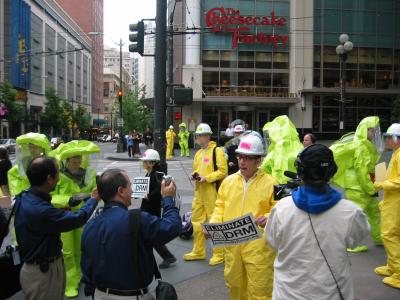
I was very happy to see that the anti-DRM protest that I suggested people go to seemed like it was a success!
/copyrighteous/images/drm_protest_seattle.jpg
It would have been nicer if even more people had gone out for it but I guess that's just one of the problems with organizing such a thing on short notice. Given the time from announcement to protest, I think it went pretty well. It seems like there were definitely enough people to make it work. Of course the Defective By Design folks let you sign up now so you won't miss the next one if its in your town. If DRM is going to be successfully opposed this decade, it will be through education and activism in the next months and year. I think that it is very important that people get involved.

Benjamin Mako Hill: A Done Deed

It's about time for a wrap-up on the recent major event in my life. On May 29th, Mika Matsuzaki and I were married. The festivities kicked off with a parade through Somerville's Davis Square. Andres Salomon kept rhythm on drums and, thanks to my new lab adviser Chris Csikszentmih lyi, we had a couple dozen other wikipedians, hackers, technologists, and biologists keeping tune on kazoos. Like all good Somerville parades, we forgot our parade permit. Which was fine.
/copyrighteous/images/marriage-parade-small.jpg
On the marginally more traditional side, we exchanged vows (written under a mathematical constraint -- Mika's idea) and rings. The marriage was made official by Oxford/Harvard professor of "Cyberlaw" -- who I once worked as teachers' assistant for many years ago -- and Massachusetts Justice of the Peace, Jonathan Zittrain.
/copyrighteous/images/marriage-vows-small.jpg
We ended the day watching the sunset with the serious party-goers from out of town, Debian, and the FSF. Then off to dinner and "happily ever after."
/copyrighteous/images/marriage-sunset-small.jpg
Lots more pictures are linked the Cambridge wedding page on our wedding wiki. If you have pictures, you should link them there or mail them to use and we'll upload them. If you want to send messages of congratulations, please visit that page for mailing instructions (best!) or a wiki page to write them up on. Just yesterday, we received (via Joey Hess) four wonderful pages of tightly packed congratulations messages from the attendees at DebConf. Although it's not a constitutional matter, I'm pretty confident we had more than 3Q developers signing that form which, in a Debian election methods sort of way, really warms my heart. Thank you everyone! It's really too bad we missed DebConf but we're both determined to make next year!

Benjamin Mako Hill: Stepping Down From Software in the Public Interest, Inc.

Three years ago, I was elected to the board of directors of Software in the Public Interest, Inc. About halfway through my three year term, I was elected by the board to the (largely ceremonial?) role of Vice President of the organization. This month, my term is up and after a good deal of soul searching over the last weeks, I've decided to not run again. With time, I've become busy with other projects including work and graduate school at the MIT Media Lab, Debian, Ubuntu, One Laptop per Child, several book projects and more. Recently, I've found that I've simply had less time to put toward SPI than I have had in the past. Of course, I continue to care very much about SPI and its mission and feel that I done a good job of fulfilling my responsibilities throughout my term. The real reason I'd like to step aside to let some new blood and energy take a more active role and to let SPI take off in new directions. Since I've served a full term, I thought I would take the opportunity to look back at my work with SPI over the last three years and to the future. SPI's Recent Past Three years ago, I ran for the SPI board on a platform that I would like to see SPI work more like a real pro-active non-profit organization and less like Debian's legal shell. SPI was at at transition point then and the board spent a lot of time thinking about it was that SPI should do and what role it should fill in the free software community. Many of these questions are still open but the following is my round up. There are two types of non-profit organizations in the free/open source community. The first is the large-project foundation. Example are the GNOME Foundation, KDE Foundation, and Plone Foundation. These support and work closely with one large and otherwise institutionally independent project. The second type is concerned with advocacy or issues of concern to many or all free software projects. The FSG/LSB, Open Source Initiative, Software Freedom International, Linux International, and the Free Software Foundation are all examples of this type (although the FSF also supports the GNU Project so can be put into both camps). Three years ago, SPI was basically the Debian Foundation under a different name. However, SPI also supported a handful of other medium-sized projects (at the time, this included Berlin and OFTC). In this way, SPI provided some of the benefits of a 501(c)(3) non-profit organization to groups that were large and important enough to care about issues like the tax-deductability of donations, but small enough that starting their own foundation didn't quite make sense. This, I am convinced, is SPI's niche and its where the organization can make the greatest difference. While Debian continues to be the driving force behind SPI, this mirrors Debian close relationship with other free software projects as a downstream and a distribution. Debian may ultimately decide its has outgrown SPI and wants its own foundation but it's role in providing an umbrella for other free software project also makes a lot of sense. Over the last years, SPI has added several new member projects including GNUStep, Drupal and PostgreSQL and members of these projects have played an increasingly important role in SPI. OFTC members including SPI secretary David Graham have continued to drive the organization. I am thrilled to see that PostgreSQL's Josh Berkus is running for a seat on the board and wish him the best of luck. He has put a huge amount of effort into SPI in the past several months and I believe he would make a great board member. Of course, not everything has been rosy. While our organization is in slightly better shape than it has been in the past, SPI still suffers from a lack of interest and activity by participants in its member projects. SPI handles Debian's money and every Debian developer should be interested and involved in SPI; yet only a relatively small percentage are. I've run SPI sessions, talks, and BOFs at three of the last four Debian conferences but haven't been able to make a satisfactory dent in either the Debian community or SPI. The next board of directors will need to work actively and creatively to help do what the last board did not accomplish. While things are currently much better than they have been in the past, SPI has continued to be mired in a number of bureaucratic issues. Simple issues like accurate, timely and transparent bookkeeping have proved more difficult than the board or those brave (or foolhardy) enough to take on the treasurer position seem to have thought. I worked with the treasurer and our lawyer to meet with a bookkeeping service in New York City. The Future In the future, I'd like see to more members projects and more active participants from all members projects. I'd like to see a more active organization in general but am beginning to conclude that a fully volunteer "staff" is only going to be able to do so much. In terms of bureaucratic issues, several board members have lobbied hard to spend money to hire full or part time help either in an administrative capacity or as some sort of combination administrator/executive director. For a number of reasons, the board has been reticent to do this but I think it's become increasingly clear that our growth and relevance as an organization is going to require this. I think hiring the bookkeeping service was a good first step. I think at the very least, SPI should "outsource" most of the non-fun administrative work to others so that the board can focus on the important work of advocating free software and helping our member projects. I'm famously concerned with introducing paid labor into voluntary free software projects but I think that, if done right, this could be a very good step. In terms of my own involvement, I'm planning to stay involved as a contributing member or perhaps even as an adviser if the board will have me. I'd like to continue work on the SPI-Trademark committee and look forward to the day that we can create a general policy for helping folks use and license the Debian mark (and other trademark SPI may hold in the future) as permissively as possible. I'd also like to see a better documented process for becoming an SPI member project. This should explain to projects what SPI expects from them (e.g., democratic decision making, an active representative to SPI, etc), what they will get from SPI, and what is necessary to make it all happen. I'd like to work with some of the recent member projects to help document their experience and make easier for the next batch. I'm looking forward to taking some time off and look forward to the possibility of running for a seat on the SPI board again at some point in the future.

Benjamin Mako Hill: Reports From the Ubuntu Developer Summit Paris

It's a bit late at this point but I thought I would point out that I recently wrote two articles on Newsforge about the most recent Ubuntu Developer Summit held at Paris' lovely Charles de Gaulle airport. I you care about the summit or the next release of Ubuntu, and you missed the summit, and then missed the articles on Newsforge. Well, then you might be interested in checking them out.

Benjamin Mako Hill: Defining Free Content and Expression

(This is mostly reposted from an Advogato article I just submitted).
About a year ago, I posted an article on Advogato entitled, Towards a Standard of Freedom: Creative Commons and the Free Software Movement. In it, I argued that Creative Commons and the free culture movement were struggling to build a cohesive freedom movement in the way that free and open source software had succeeded in doing by never stopping to define the ground rules of the commons movement. I argued that Free Software built a movement around calls for essential freedoms and against the actions of software producers who failed to live up to this standard. On the other hand, Creative Commons has argued for "some rights reserved" but never explained which rights were unreservable. In the process, they've done the invaluable service of creating a stable of powerful, internationalized licenses. But they failed to build the type social movement that some of us wanted. While this was never their goal, it left some people unsatisfied. In a later version of the essay published in Mute Magazine, I concluded by stating:
Whether in unison or cooperating in separate groups, it is time for those those of us that feel strongly about freedom to discuss, decide, and move forward with our own free information movement built upon a standard of freedom. When we have defined free information in terms of essential freedoms, a subset of Creative Commons works and a subset of Creative Commons licenses will provide tools and texts through which a social movement can be built.
I'm thrilled to say that that day is now within sight. A few weeks ago, Larry Lessig introduced me to Erik M ller, a Wikipedian who had read my article and was planning on launching the same project that I had been planning. It only seemed sensible to collaborate. Today, we have launched a draft of a Free Content and Expression Definition online at freedomdefined.org. The website is a wiki and we welcome feedback, suggestions, and alternative versions of the document. So far, we've have decided to stick closely to the freedoms of free software but are actively interested in updating these to be more relevant for other types of creative works. Of course, anything, even the name, can be changed at this point. To guide us through the project of debating and further refining a definition are four moderators who will ultimately be called upon to resolve disputes and disagreements about what the definition should and will say. These moderators are myself, Erik M ller, Creative Commons General Counsel Mia Garlick, and Wikimedia Foundation Trustee Angela Beesley. You can view the announcement of the definition, please take a look at: To view the definition itself, please visit:

Benjamin Mako Hill: Taking the "Open" out of "Open Media Commons"

There's a disturbing little press release floating around where the Sun-backed Open Media Commons announces it's release of a new DRM specification to be implemented using free software. That people are creating DRM systems under open source and free software licenses is not surprising; much of the encryption technology on which DRM is based has been free and open for a long time. What is disturbing is that it contains what appears to be an endorsement by Lawrence Lessig:
Lawrence Lessig, Chairman of the Board of Directors of Creative Commons and Professor of Law at Stanford Law School: "In a world where DRM has become ubiquitous, we need to ensure that the ecology for creativity is bolstered, not stifled, by technology. We applaud Sun's efforts to rally the community around the development of open-source, royalty-free DRM standards that support "fair use" and that don't block the development of Creative Commons ideals."
Lessig's position seems to be that DRM is bad and should not exist. But in a world where it does exist, he thinks that not-quite-so-bad DRM is better than the alternatives. Is that the sort of message we want to be sending? The fact that the software is "open source" is hardly good enough if the purpose of the software is to take away users freedom -- in precisely the way that DRM does. It doesn't help that EFF has already spoken out against this project. Lessig is on the board of directors of both EFF and FSF. I think it is smart for members of either organization who are opposed to DRM, even when it's sweetened up, to contact those organizations and let them know how you feel. On the OMC website, there is a photo of two young attractive people listening to a single pair of headphones. Apparently, the people in the picture need to share a single pair of headphones because the Open Media Commons rights management system won't allow them to share the digital media itself.
/copyrighteous/images/omc_sharing.png

Benjamin Mako Hill: Calling All Seattlites

If you're in the Seattle area and are concerned about DRM, you should be at a "flash" protest against DRM tomorrow (Tuesday May, 23) before work (8-9AM) to kick off a major anti-DRM campaign. There will be costumes and fun to be had by all. These sorts of things are great if a bunch of people participate and just seem impotent if not enough do. This is important enough that I would consider flying back to Seattle for it if I had a little more time and money to do so. It's worth it to make sure this campaign starts off on the right foot. We have a lot to lose if it doesn't. If you are in the area and can possible spare an hour or two and be in downtown Seattle tomorrow morning, I think it is really important that you do so. You can get more information from someone at the FSF by emailing action@defectivebydesign.org and announcing that you want to participate.

3 September 2006

Marc 'Zugschlus' Haber: DHCP challenges

My notebook’s DHCP setup seems to be a challenge for DHCP servers around the world. Looks like almost no server implements the standard in a decently complete way. My notebook has a wired Fast Ethernet, and a wireless 802.11bg network interface. Of course, both interfaces have their own MAC address. I want the thing to work at least at home, regardless of whether wired or wireless is in use, with preferably the same static IP address, and on the office wired network, again, with the static IP address allocated to me there. Configuring this is considerably harder than I expected. At home, I am using a Linksys WRT54G router with OpenWRT, which has dnsmasq as DHCP server. Unfortunately, dnsmasq does not support the case where multiple MAC addresses are statically assigned to the same IP address: Only the first dhcp-host statement in the configuration file is honored, all others are ignored. So we need to resort to using a dhcp client-identifier. In DHCP request option number 61, the client can send an identifier, which the Server can then use to determine the client’s identity and assign a static IP address. The client identifier, according to RFC2132, is to be treated as an opaque string by the DHCP server. This works fine with dnsmasq, solving the issue at home. But it causes more grief in the office network. My office is the kind of place where a non-Microsoft solution is rarely considered. Thus, our network is fully buzzword compliant and the network infrastructure, including DNS and DHCP servers, is based on Windows Server System. I am the only one using a non-MS operating system in my work environment. When I plugged my notebook into the network this morning, I noticed that I didn’t receive my static IP address but a different one from the dynamic pool. After verifying that the Windows guys didn’t touch the DHCP server in the last days, I began to think what I changed locally and naturally remembered configuring the DHCP client identifier. Removed it for testing, got my normal static IP address, so the client identifier was quickly pinned down as the culprit. After my Windows colleagues decided that it must be a client issue, I began investigating how to configure the Windows DHCP server to honor a client identifier. MS Knowledge Base article #172408, “Custom DHCP Client Identifiers for Windows NT”, is a high hit on Google, but is like three years old and shows that somebody at MS has badly misunderstood the DHCP standard - they think that the Client Identifier is a 4 byte number in little endian order. I couldn’t believe that and investigated further. But it looks like the Windows DHCP server really cannot handle free-form client identifiers at all. I tried coding my free-form identifier in ASCII and entering it as MAC address, big endian, little endian, to no avail. So, I have come to the conclusion that MS has - again - only partly implemented a very important protocol for their network software. “Embrace and extend”, my <censored>, DHCP wasn’t extended at all. Looks like they stopped developing after the first developer box had successfully received an IP address, and shipped the resulting code. Woah. If somebody can tell me how to configure the Windows DHCP server to properly handle a free-form string DHCP client identfier, I’ll be most graceful for that information. I finally resorted to setting the DHCP client identifier of my notebook to the MAC address of the wired ethernet interface, which has at least brought my static IP address at the office back. I hope that the dnsmasq at home will successfully grok this or I am - again - back to square one. All software sucks

2 September 2006

Aigars Mahinovs: Eternal unstable?

More and more early adopters choose to use Ubuntu instead of Debian. Ubuntu has newer versions of the software that matters (XOrg, FF, OOO, Gnome,…) than the stable Debian or, sometimes than even the unstable Debian. Early adopters are the users that are most eager to try new shiny things, do not scream too much if those things break and seem to make good bug reporters. They are the key second level - just below the developers and above most users in the pyramid of software development and use. They are also the people that have a tendency to become developers. That is why I have this feeling that capturing early adopters is essential to development of a thriving free software community. How can that be done? I do not know, but I have an idea that might just work. What I envision is a merger of development processes of Debian, Ubuntu, Knoppix, Skolelinux and all other Debian derrived distributions. The base for this merger would be an eternal unstable line where all developers would be encouraged to put the newest and greatest software - THE place to be if you want to be on the bleeding edge. I see this unstable line being much newer then Debian unstable, but retaining similar level of quality (how? it is a good question). Then there would be a set of tools available to splice packages from this unstable line into a stabilisation and stable branches for each distribution. The tools would be the same for all distributions and the packages would be the same for all distributions, the difference between distributions would be achieved by the way that the packages and their specific versions are chosen, patches applied for a particular distribution and in some ways by the assembly of the final release media. The proper Debian releases in this context would be no different then Ubuntu releases but will be created using different criteria and at different times. The tools must be powerful enough so that release preparations of any distribution (including Debian proper) would not need to slow down the progress of the flow of new features into the eternal unstable line. The infrastructure needed to operate such complex system would be immense. It would need to have some similarities to the systems Debian uses for distribution, release and bug management, it would need to have some similarities to Ubuntu’s Launchpad (just free, understandable, usable and well documented), and I think that it would also need to have some similarities to Gentoo’s Portage system (distros do want to recompile packages with different options and with their own library versions). It would also help if this unstable line could still hold few parallel versions of one package - like the latest release and the cvs version. (However I am pressed to even imagine all the complexities this would bring into apt and bug reporting/debugging.) I think that such structure will not only concentrate the scarce resource that are the early adopters in a place that will benefit all distributions, but will also provide extra dimensionality for social and technical growth for The Debian Project. The Debian Project will turn from a single great distribution to a swarm of wonderful distributions with a strong central spine - the eternal unstable line. An additional benefit to this will be that it will be possible to fork Debian if social pressures require that (like it happened with gcc vs. eggc) for the benefit of all free software users. Like, for example, the David’s steering commitee whould not disturb the Debian main line until it has been proven to work - it could be formed, it could set goals for a branch and feel in total control of their release goals and methods. After the steering commitee makes a successful release, it would be only a matter of a political decision of whether to call that release Debian proper or not. Note: As always this is just an uniformed rant of a relatively passive DD who is blissfully ignorant of pretty much everything, so please tell me if and why it can or can not be done. P.S. While I am in such writelly mood, I should probably write that free software advocacy article for a new journal that I promised them a month ago. P.P.S. If the system is written with it in mind, then each user’s computer could theoretically be a separate distribution which keeps a splice of Debian unstable line (or any subline) with local modifications and possible local compilation options. If done right, this could also provide a ground for merging up with Gentoo. P.P.P.S. After reading trough logs of several bugs on the Launchpad, I have a feeling that Ubuntu is being flooded by much more bugreports then Cannonical is designed to handle (especially for free). I am not pointing fingers here, I am just suggesting that it is another facet of the same problem and that this idea of mine could reduce this load and let Ubuntu developers concentrate on what they really want to do.

Michael Janssen: Late at night when the wires in the walls

After my iBook problems last week, I tried to install Debian on the thing. I have narrowed down the problem to something with the hard drive inside, because the machine seems to run fine and go through most of the installation without any trouble, but once I start using the hard drive, it completely freezes. I successfully ran the hardware test disc which came with it a couple times in extended mode, but I'm not sure that it uses the hard drive in it's tests long enough for it to exhibit the problem. The failure seems to be somewhat random in nature, occuring at different times in the install process. Now I have the unhappy decision of trying to save this laptop which is more than 3 years old, or to attempt to buy a new one. Right now I am leaning toward buying a new one.

Honeywell seems 1.5 times as long this week, mostly because I'm making up for a day which I missed a couple weeks ago. Things have settled down there in terms of software failure, so I'm back at the normal coding which I am doing. The code uses Ogre, which is a handy 3d engine, making it much easier than learning something like OpenGL, and as a bonus adding portability. I am considering building some play applicaitons with the toolkit at home just because it would be fun.

Tonight I need to build a couple presentations covering some papers which were in CVPR this year to present at a reading group at Honeywell. It would be fine except that I am completely unaware of any of the recent history of vision research, so it makes it much harder to build the presentations. I hope I can finish them in a reasonable amount of time so I can watch Eureka tonight.

The TiVo Diet is still working out as expected. I discovered that I don't really have anything to watch on Sunday or Monday of the week. I'm getting much more productive work done than I used to. One downside of the diet is that I tend to not want to just sit and veg at the end of the work day - I think it frustrates [info]ceilingsarecool a bit because I'm always going off to the office to do something on the computer.

I recieved and watched the Studio 60 on the Sunset Strip yesterday. Being an Aaron Sorkin fan, I am excited for another of his shows to broadcast. Judging by the pilot, it should be a decent show.

Sidenote: Planet Debian seems to like one of my weekend weeviews a little too much, and is regrabbing it for the front page every so often. I can't figure out why this is happening, so any help would be greatly appreciated. Otherwise, in a couple more posts it should be off the RSS feed.

Next.

Previous.