Search Results: "nic"

26 December 2012

Gunnar Wolf: Brazilian electronic booths hacked in a real election Surprised, anyone?

Doing my regular news scan, I stumbled across this: Hacker reveals in Rio how he rigged an election (in Portuguese; you can try the Google-translated version). Why am I reposting this? Because, even after the reported studies by Diego Aranha and the information disclosure exploited by Sergio Freitas, Brazil is still portrayed as the biggest example on how electronic voting can be 100% secure and tamper-proof. Well, in this case, Rangel (his full name ahs not yet been disclosed), a 19 year old hacker, not only demonstrated how elections could be rigged, but admitted on doing so together with a small group, and even pointed at who was benefitted from this. Rangel's attack was done during the transmission phase After ~50% of the electoral results had been sent over the Oi network. And yes, the provider will most likely close the hole that was pointed at, but this basically shows (again!) that no system can be 100% tamperproof, and that the more electronic devices are trusted for fundamental democratic processes, the more we as a society will be open to such attacks. The security-minded among us will not doubt even for a second that, as this attack was crafted, new attacks will continue to be developed. And while up to some years ago the attack surface was quite smaller (i.e. booths didn't have a communications phase, just stored the votes, and communication was done by personal means), earlier booths have been breached as well. And so will future booths be breached. So, the news of this attack are indeed very relevant for the field. The presentation I am quoting was held around two weeks ago And December will surely dillute attention from this topic. Anyway, I will look for further details on the mechanism that was used, as well as to the process that follows in the TSE (Supreme Electoral Tribunal). I hope we have news to talk about soon!

Gregor Herrmann: goodbye nanoblogger, hello chronicle

after having used nanoblogger since august 2005, I decided to switch my blog engine. the reason was mainly that nanoblogger gets terribly slow with more than a handful of entries. inspired by nhandler, I took another look at chronicle, which had caught my interest before already. it's simple, produces static html pages from text files that I can keep in git, & it's written in perl :) let's see how many years chronicle will accompany me

25 December 2012

Russ Allbery: Kindle haul

Happy winder holiday of choice to all and sundry! Enough new Kindle books have accumulated that it seems time for another post so that I can remember what I bought. Elizabeth Bear Garret Investigates (sff)
eluki bes shahar Hellflower (sff)
Elizabeth Cleghorn Gaskell Cranford (mainstream)
John Scalzi Subterranean Scalzi Super Bundle (sff) Cranford was free since it was written in the 1800s. I picked it up because of Jo Walton's review on Tor.com. The eluki bes shahar novel is from Daniel Moran's e-book site FS&, an impulse buy from browsing through his catalog while picking up the Long Run bundle for my mother. The Scalzi super-bundle is a collection of five separately-published novellas and chapbooks plus one non-fiction essay, only one of which I already owned (The God Engines), which seemed like a fairly good deal. In a separate note, the problem with watching interesting lectures on YouTube (apart from the fact that it's very easy to lose a day doing so) is that I usually end up wanting to buy the book on the topic and then read that. That happened to me today: I finally got around to watching Philip Ball's lecture on the chemistry of painting, and now Bright Earth is in my non-fiction want list. And there are three more hour-long TVO programs linked off of related material that look interesting. I fear the day may disappear.... Well, I will be rescued at least partly by being called to help decorate Christmas cookies. This is the beginning of by far my favorite two weeks of the year, although not for the reasons that people might suspect. Other than food (yum) my family doesn't do Christmas: no decorations, no huge family get-togethers, and we all give each other the freedom from guilt and stress of having to find presents. But I get two weeks of mandatory vacation from work, as does, importantly, everyone else. Which means there's nothing going on to suck me in from vacation and a very pleasant sense of resting and resetting for the new year. It's quiet, I can sit and read, I can focus on one thing at a time, and I can reorganize and order my life and revisit priorities and to-do lists with a lovely sense of perspective. Any other mandatory or at least widespread holiday would work as well, so it's unrelated to the season. (I find the commercialism somewhat distracting rather than a positive part of the experience.) But this is the one that we get, and it happens to coincide nicely with the meaningless but psychologically significant change of the year number. And it's delightful every year.

Uwe Hermann: sigrok at the 29th Chaos Communication Congress (29c3)

29c3 logo Yup, it's been a while since my last blog post, but I'm not dead yet. Most of my spare time goes into sigrok development these days (open-source signal analysis suite for logic analyzers, oscilloscopes, multimeters, and lots more), but I'll try to revive my blog too. I have various microcontroller/embedded topics and devices I want to talk about in a small blog post series in the nearer future. But more on that later. Feel free to subscribe to the sigrok-devel mailing list, join us on IRC in #sigrok (Freenode) where most of the discussions take place, or follow our new sigrok blog (RSS) if you're interested in the ongoing sigrok developments. Anyway, for now just a quick announce: Same as last year, we will be at the Chaos Communication Congress (29c3), this time in Hamburg, Germany. The conference takes place from December 27th to 30th, 2012. We'll have a sigrok "assembly", likely in area 3b of the conference building, where we'll be hanging around, working on new sigrok features, new hardware drivers, new protocol decoders and various other things. We'll have lots of gear with us for demo and development purposes, including logic analyzers, oscilloscopes, MSOs, multimeters, and lots more. Bring your own device if you own models we don't yet support or know about. We'll be happy to have a look! Chat with us, give us your suggestions which features you'd like to see, which devices you want to be supported, which protocol decoders you'd like to have, or even help us write some drivers/decoders! Hope to see you there!

Bastian Blank: New software: LMTP to UUCP gateway

I use UUCP to get my mails. It works fine but lacks support for modern SMTP features like DSN. While it may be possible to bolt support into the the rmail part, both the sendmail interface used to submit mails and the Postfix pipe daemon used to extract mail are not able to do so. So I started a small project to get around this problem. This software uses LMTP to retrieve and SMTP to send all mails. LMTP (a SMTP derivative with support for all extensions) is used to inject mail via a small daemon. The mails are transported using a format similar to batched SMTP to the remote system. It is then injected via SMTP to the local MTA.
Sender LMTP is used to supply mail. As a SMTP derivative, LMTP inherits support for all the available SMTP extensions. The only difference between LMTP and SMTP is the support for one result per recipient after end-of-data. This allow proper handling and mails with multiple recipients without a queue. Mails are supplied to a special LMTP server. This server may currently run from inetd or in foreground by itself. A real daemon mode is not yet implemented. Each mail is submitted to the UUCP queue in its own format. We need to store a lot of meta-data along with the real mail. This data is stored in a custom format.
Protocol All data is transferred using a custom protocol. It is a SMTP derivative, but it is only used in uni-directional communication, so no responses exists. It uses its own Hello command and supports the SMTP commands MAIL, RCPT and DATA. This format allows exactly one mail in each file. An EOF ends the mail transaction. Also all data must be in dot-escaped form like in SMTP.
Hello (UHLO) A sender must start the transaction with this command. It specifies the name of the sender and all requested SMTP extensions. Syntax:
uhlo = "UHLO" SP ( Domain / address-literal ) *( SP ehlo-keyword ) CRLF
The receiver must check if all requested SMTP extensions are available.
Receiver Each mail is submitted by the UUCP system. It calls the supplied receiver tool called rumtp. This tool reads the protocol stream and submits the mail to a local SMTP server. There is no error handling right now in this tool. All errors will create a mail to the local UUCP admin by the UUCP system itself.
License and distribution This package is licensed GPL 3. It is for new distributed via Alioth.

Russ Allbery: Review: A Paradise Built in Hell

Review: A Paradise Built in Hell, by Rebecca Solnit
Publisher: Penguin
Copyright: 2009
Printing: 2010
ISBN: 0-14-311807-2
Format: Trade paperback
Pages: 319
A Paradise Built in Hell is a book with an agenda. Solnit's goal is to convince the reader that nearly everything we're shown in movies and popular culture about human behavior during disasters is wrong. Not only is destructive mass panic unusual verging on nonexistent, spontaneous cooperation and acts of startling courage and resourcefulness are commonplace. The heroes that we hear about afterwards are more the norm than the exception. Disasters are far more likely to bring out the best in people than the worst. They break down barriers and form spontaneous human communities that survivors remember for a lifetime. Rather than natural disasters leading inevitably to an exacerbating human crisis in the absence of strong authority, Solnit argues that they are an amazing human opportunity, and that the most negative and destructive human behavior during crises is not from untrained victims but from the panic of the elites who are supposedly responsible for protecting the public. I think her analysis and presentation is both deeply appealing and deeply flawed. The flaws involve extrapolation and generalization beyond the applicability of her research, and I'll say more about that in a moment. But the appeal is still surprising and satisfying, and I think there's a lot of truth in this book despite its one-sided presentation. I like to tell people, half-jokingly, that I'm an anarchosyndicalist. It's my political alliegance of the heart: the political structure that I know would never work, but that matches the world I want to live in. (I suspect much of the belief in libertarianism is of this form.) Now I have a book to point people at when they ask what the appeal of anarchosyndicalism is. The sense of spontaneous community, of bonding, of reaching out to other people to do something necessary, together, that Solnit describes here in the aftermath of a disaster matches that vision of a world without imposed economic authority, where people spontaneously collaborate to solve problems. A Paradise Built in Hell is structured by disaster, providing a tour of major disasters and their aftermath interspersed with extended musings on what the human reactions mean and how disaster communities functioned. The major disasters discussed are the 1906 San Francisco earthquake, the Halifax explosion, the 1985 Mexico City earthquake, 9/11, and Hurricane Katrina. Solnit moves through them in chronological order, closing the book with Katrina, which had (at least for me) the most infuriating and uplifting mixes of community bonding and elite panic. But both of those factors are present from the beginning in the 1906 earthquake: spontaneous human organization that (from multiple first-hand accounts) transformed people's lives mixed with a military reaction and elite panic that possibly did more damage to the city than the earthquake did. Elite panic is the dark side of Solnit's celebration of human altruism and spontaneous community organization. The primary picture she paints is of ordinary people responding with great courage and creativity and finding, in their reaction, a transformative experience and a sense of purpose that often becomes the most powerful and positive experience of their life. But this is at odds with a deeply-entrenched elite belief in mass panic, in the necessity of keeping information from the public to suppress their reaction, and in the need to re-establish "order." And with that, Solnit is absolutely scathing, and with some justification. Along with detailed accounts of these major disasters, Solnit also gives the reader a tour of the research literature on disasters, research that has shown that the panic and chaos that is at the center of practically every disaster movie ever made is essentially a myth. Mass panic in disasters is not only rare, it's close to non-existent. As you might expect, the handling of Katrina by both the government and by neighboring white communities is the subject of the harshest attacks. The material on Katrina presented here is enough to make anyone want to throw out the current playbook on how we react to disasters (and lest one think Solnit is unfair, her research matches very closely with other research and journalism on Katrina that I've seen from a wide variety of sources). But Solnit shows that this is a pattern: the combination of our media-driven belief in how people will react to disasters combined with the elite need to re-establish control plays out in many major disasters, and almost always negatively. Even in 9/11, the official response in some cases hampered and undermined an already-effective unofficial response. This is very interesting and has concrete implications for public policy around disasters. But where Solnit moves onto thinner anarchosyndicalist ice is the story that she tells about disasters as dramatic upheavals of the established social order that could point to a revolution in how we interact with each other. Solnit is deeply inspired by human altruism during disasters, and her enthusiasm is somewhat contageous, but it was useful to read this book shortly after Bruce Schneier's Liars and Outliers. I think Solnit, in her understandable eagerness to find a way to extend disaster behavior to general life, does not understand the relationships between what Schneier terms moral, reputational, and institutional pressures. And that's the core of why we need to both enable spontaneous human response in disasters and have organized first responders and supporting infrastructure, and why disaster communities will break down when extended beyond the disaster. When I first mentioned A Paradise Built in Hell to my mother, her first reaction was dubiousness due to her memory of the 1977 New York City blackout. There was a disaster that resulted in widespread looting and destruction, rather than the positive reaction Solnit describes. Solnit does have a cogent argument for why looting is poorly analyzed (we don't, for example, distinguish between breaking into stores to get desperately needed supplies and doing so for personal gain) and should not be a priority in a life-threatening disaster. But it's not completely convincing; in some disasters, particularly ones like the 1977 power outage that were not particularly life-threatening, the looting has been the most destructive part of the disaster. Schneier provides what I think is the missing piece, both to this and to why the wonderful behavior during disasters doesn't last into everyday life. During a life-threatening disaster, moral pressures are massively increased. Nearly all of us have self-images and moral beliefs that provide very strong incentives to help others and collaborate in the face of life-threatening emergencies, incentives that override other motives and lead to the sort of behavior that Solnit celebrates. But moral pressures have inherent limitations. That moral reaction applies most strongly to small groups (such as bands of survivors), and will start to break down as larger society re-establishes itself. And disasters, like a power outage, that are not immediately life-threatening will not provoke the same intensification of moral pressures: we don't have strong moral beliefs and internal stories about staying quietly at home during power outages the way that we do for saving people from burning buildings or pulling them out of rubble. Once larger communities have reformed and that short-term emergency reaction has dissipated, the need for institutional pressures (police, law, and formal authority structures) will return. I wish Solnit had been able to read Schneier's book before writing hers. I think his analysis structure provides a healthy dose of realism and perspective to her desire for a self-organizing communal world, and might have blunted her enthusiastic but somewhat unrealistic hopes for finding some key to a revolution in human organization in the heart of disasters. But if A Paradise Built in Hell is unlikely to lead to a radical change in how we organize societies, it should at least provoke a radical rethinking of some of our unnecessary pessimism about our fellow humans. The evidence is substantial and compelling: crisis brings out the best in people, not the worst, and the ordinary people who happen to be around are capable of becoming some of the most amazing disaster response teams that we can imagine. This has numerous mundane implications for social policy. We should consider simple training for the general public, for example, to strengthen that reaction, should allow for it in legal structures and training of first responders (around looting, for instance), and should do everything we can to kill the destructive myth that people cannot be trusted in disasters or that mass panic will be as much of a threat as the disaster. But the best part of this book is that it provides a concrete, well-documented, and well-defended reason to let go of some of our cynicism and to extend a bit of trust to our fellow humans. There sadly aren't earth-shaking implications for everyday society, but there is a wealth of evidence that shows that we're better people in the crunch than we believe we are, or that we expect of others. And the more that we can embrace the dissolution of boundaries and social hierarchies in the middle of disasters, the more we are likely to be surprised by deep human connection and a sense of shared, focused purpose. Solnit is a bit long-winded with her agenda, but that bright hope has stuck with me. Recommended. Rating: 8 out of 10

24 December 2012

Wouter Verhelst: m68k: back from the dead

It's been a few years coming, but the day has finally arrived. Contrary to some rumours which I've had to debunk over the years, the m68k port did not go into limbo because it was kicked out of the archive; instead, it did because recent versions of glibc require support for thread-local storage, a feature that wasn't available on m68k, and nobody with the required time, willingness, and skill set could be found to implement it. This changed a few years back, when some people wrote the required support, because they were paid to do so in order to make recent Linux run on ColdFire processors again. Since ColdFire and m68k processors are sufficiently similar, that meant the technical problem was solved. However, by that time we'd fallen so far behind that essentially, we needed to rebootstrap the port all over again. Doing that is nontrivial, and most of the m68k porters team just didn't have the time or willingness anymore to work on this; and for a while, it seemed like the m68k port was well and truly dead. But then, two things happened. The first thing that happened was called "ARAnyM", short for "Atari Running on Any Machine". An atari emulator, it started supporting running Linux at some point, allowing us to work on the port while on the road, using a laptop something not possible beforehand. While there were some bugs in the emulation of early versions of aranym, these were all fairly quickly fixed, and before long we could run Debian/m68k in the emulator. However, that was still the etch-m68k port on debian-ports.org, some time after Debian etch wasn't even supported anymore; this still required work. The second "thing" that happened was called "Thorsten Glaser". A fresh DD and maintainer of the "mksh" shell, he wanted to make sure his shell would work on all Debian architectures, including the ones on debian-ports.org. When he found out that the m68k port was in a pretty bad shape, he did not, like many before him, shrug and move on; instead, he took it upon himself to start compiling things, just so he could compile his shell. How's that for dedication. Anyway, fast-forward two years, and we're now, finally, at a point where I spent most of today getting buildd up and running on arrakis, one of our oldest buildd hosts. There were some issues while trying that, but it looks like everything is in working order now; and the first package to start building on the first functioning buildd host since a long time (the build of which is still ongoing at the time of this writing) is "babl". Of course, with only one buildd, we'll have no hope whatsoever of ever catching up. But that can be remedied easily by using more than one buildd host... Update: It built! Party!

Russ Allbery: Review: Cry Wolf

Review: Cry Wolf, by Patricia Briggs
Series: Alpha and Omega #2
Publisher: Ace
Copyright: August 2008
ISBN: 0-441-01615-4
Format: Mass market
Pages: 310
Cry Wolf is a sequel to the novella Alpha and Omega. This was originally included in the anthology On the Prowl, which I had no particular interest in, but it's now available as a standalone novella if you have an ebook reader. I recommend reading it first if you have any interest in this series; it's not particularly expensive, and piecing together what happened in it while reading the beginning of Cry Wolf is not particularly enjoyable. There are some mild spoilers for Alpha and Omega here, so if you're planning on reading the novella first, you may want to do that before reading on. Anna is an Omega, an extremely rare form of werewolf who does not fall into the normal pack hierarchy. With normal werewolves, either the wolf is dominant or is submissive, and the most dominant wolf leads the pack and can force their will on the other pack members. Omegas are strange. Normal pack dominance doesn't really work on them, but neither are they dominant themselves. At the start of Cry Wolf, Anna has very little idea what any of this means. She's been rescued from a horribly abusive situation and is being brought to Montana by Charles, the enforcer and son of the leader of all North American werewolves. And, apparently, her mate, according to both of their wolf natures, but she's not entirely sure what that means either. She doesn't have a lot of time to find out, since the local pack is immediately threatened by a rogue werewolf and she's pulled into both pack politics and that hunt. Cry Wolf, despite being the first full book of the Alpha and Omega series, is set in the same world as Briggs's Mercy Thompson series. (At a guess, somewhere around Iron Kissed.) This is not just a vague link within the universe, unfortunately. The characters here refer frequently to Mercy and previous events in her series in that way that implies the reader should have read them, without explaining fully what happened. If, like me, you're more interested in this series than the Mercy Thompson series (I preferred it because there are no vampires and I'm sick of vampires), be aware that starting here will feel like starting in the middle of a series. This will be even worse if you don't read Alpha and Omega first, making the first section of the book feel like constant namedropping when you don't know any of the references. The story, otherwise, is basically hurt/comfort with a side of coming of age. Whether you will enjoy this will depend on whether you're in the mood for a fairly predictable story that hits those buttons. Anna is a mess, thrown into survival mode after years of abuse and hating what she's become. (She is, actually, somewhat less of a mess than I think she should be given what happened to her, although Briggs has both her Omega nature and her wolf as outs there.) Charles wants to comfort her and isn't sure how. She misreads things, he misreads things, there's lots of missed communication... you've probably read this story before and have a pretty good idea how it will go. They are somewhat less stupid about their communication problems than the typical novel of this type, but they still don't use words very well. The rest of the plot felt like mostly an excuse to throw Anna and Charles together doing something external to their relationship and to give Anna a chance to use her unique talents. It takes a bit to get going, since most of the early book is introductions and setting up all the connections to the Mercy Thompson stories, but there is some meat to it, including fleshing out the mythology of werewolves in Briggs's world. (And some passable descriptions of Montana wilds.) I'm not a big fan of how power struggles and combat seem binary and very hierarchical, but that seems to be the way that Briggs differentiates her werewolves, and it does form a sharp contrast with Anna's ability. I think Omegas could have been even more subtle than they are here, but the interplay between the conflict-driven approach of everyone else and Anna's inherent calm can be fun. The biggest problem I had with Cry Wolf, apart from the general predictability of the story and relationships, is that the hurt/comfort angle never felt adequately resolved. Hurting a character very badly and then having others offer comfort is a very common story technique that brings with it some reader expectations in terms of emotional payoff. The point at which the comfort finally works can be very empowering and very affecting. I don't think Briggs hit the payoff as well as she could have. Anna recovers, but she does so rather more easily than felt correct, and without the emotional punch that I was waiting for. It seems odd to complain about this sort of urban fantasy novel having too little angst, and maybe I was just hoping for a story other than the one I was reading, but I wanted a story that dug a bit deeper into Anna's psyche. I think the best word for Cry Wolf is okay. If this is the story you're in the mood for, it delivers that story. Briggs's werewolves are mildly interesting, and the Omega concept is a good one, although not as thoroughly or convincingly explored as I would have liked. I would have preferred more intensity in the hurt/comfort plot and a more difficult healing, but I still enjoyed the book. Followed by Hunting Ground. Rating: 6 out of 10

23 December 2012

Russ Allbery: Review: Alpha and Omega

Review: Alpha and Omega, by Patricia Briggs
Series: Alpha and Omega #1
Publisher: Berkley
Copyright: 2007
ISBN: 1-101-41379-4
Format: Kindle
Pages: 112
Alpha and Omega is a novella set in Briggs's Mercy Thompson universe, an urban fantasy world that started with Moon Called. There's a limited edition hardcover version which is, at this point, ridiculously expensive, but it's available relatively inexpensively on the Kindle. (The page count in the sidebar may be high, since that's from the hardcover version; the Kindle version doesn't have page numbers.) It's the prequel novella to the novel Cry Wolf. You don't have to have read any of the Mercy Thompson novels to follow the story; it stands alone fairly well. I actually read Cry Wolf first, but (as I was warned) that proved to be a mistake, so I'm publishing my reviews in the "correct" reading order. Unusually for a niche novella leading into a regular series, Cry Wolf leans heavily on Alpha and Omega and works best if you've read it first. Anna is a werewolf, but not a very happy one. She's been a werewolf for three years, cutting herself off from everything before at the insistance of her pack, and she's at the bottom of the pecking order: abused, mistreated, and ordered about (although some of the abuse has gotten mildly better). That makes it startling that, when she sees a photograph in the paper of a missing teenager that she recognizes, she's willing to call the Marrok, the ruler of all wolves in North America, to report her pack's possible involvement. The Marrok sends his enforcer, Charles, to investigate. As soon as he arrives, he can tell that far more is wrong than anyone had realized. Anna's pack is completely dysfunctional, and Anna herself... well, that's the point of the story. Alpha and Omega has one of the more appealing qualities of novellas: a clear narrative drive that goes from point A to point B without many sidetracks or digressions. It's told in alternating tight third person perspectives, a traditional choice for this sort of story. Very little here will surprise an urban fantasy reader. It's the hurt/comfort story that one expects from the early going, but it's one that moves right along and hits most of the right notes. The biggest drawback for me was that I'm not horribly fond of Briggs's werewolf mythology. There are some parts that I like, such as Anna herself and the role that she discovers, but there's rather a lot of characters wrestling with their instinctive reactions or finding pack hierarchy enforced via means that appear to be magic. Given that the sort of absolute dominance hierarchy portrayed here is now considered dubious or refuted even in wild wolves, and given that I have a knee-jerk dislike of simplified, absolute structures, that part of Briggs's world-building makes my teeth itch. But, if you can get past that, and if you're not looking for any complex plotting (it is just a novella, after all), this isn't a bad way to spend an afternoon. It's comfort reading: things go roughly as you would expect them to go, and you can have the emotional satisfaction of seeing Anna's growth with very little risk. Followed by Cry Wolf. Rating: 7 out of 10

Cyril Brulebois: d-i hacking recipe #3: Debugging debconf

Problem #3: How to find out what s going on with debconf? Slightly longer version: As reported in #679327, the grub prompt during the installation process is entitled Configuring man-db , which isn t exactly great. Given man-db is a known dpkg trigger, I suspected this would be the reason for the broken title, and here s how I debugged it. For starters, using d-i basically means asking a lot of questions, which is implemented using the debconf mechanism. One should note that two implementations are available:
  1. the historic implementation, in Perl: debconf
  2. the C reimplementation: cdebconf
d-i uses cdebconf udebs, but joy begins when packages get installed in /target: debconf is used there. We ll see why that matters. Recipe #3: Set DEBCONF_DEBUG=developer and read logs!
  1. Both implementations support the DEBCONF_DEBUG environment variable. The installer supports passing that as a kernel parameter; example from the syslinux prompt: select the Graphical install entry, press Tab , remove -- quiet and put DEBCONF_DEBUG=developer there instead.
  2. Let s look at /var/log/syslog; there s a tail -f on it in VT4, but one can run grep and friends on it in VT2 or VT3. There, one can see what happens at the debconf level (the debconf protocol is documented in debconf-devel(7)). Tiny excerpt (timestamps removed for clarity):
    frontend: --> GET preseed/early_command
    frontend: <-- 0
     
    frontend: --> GET debian-installer/framebuffer
    frontend: <-- 0 true
     
    debconf: --> GET debconf/language
    debconf: <-- 0 en
    debconf: --> SET debconf/language en
    debconf: Setting debconf/language to en
    debconf: <-- 0 value set
    debconf: --> GET debconf/priority
    debconf: <-- 0 high
    debconf: --> GET rescue/enable
    debconf: <-- 0 false
    
  3. The interesting point was titles, right? So let s look at the last TITLE occurrences:
    debconf: --> SETTITLE debian-installer/main-menu-title
    debconf: --> SETTITLE debian-installer/grub-installer/title
    in-target: debconf (developer): ----> TITLE Configuration de man-db
    debconf: --> TITLE Configuration de man-db
    in-target: debconf (developer): <-- TITLE Configuration de man-db
    in-target: debconf (developer): ----> TITLE Configuration de man-db
    in-target: debconf (developer): ----> TITLE Configuration de grub-pc
    debconf: --> TITLE Configuration de grub-pc
    in-target: debconf (developer): <-- TITLE Configuration de grub-pc
    in-target: debconf (developer): ----> TITLE Configuration de grub-pc
    in-target: debconf (developer): ----> TITLE Configuration de man-db
    debconf: --> TITLE Configuration de man-db
    in-target: debconf (developer): <-- TITLE Configuration de man-db
    in-target: debconf (developer): ----> TITLE Configuration de man-db
    in-target: debconf (developer): ----> TITLE Configuration de grub-pc
    debconf: --> TITLE Configuration de grub-pc
    in-target: debconf (developer): <-- TITLE Configuration de grub-pc
    in-target: debconf (developer): ----> TITLE Configuration de grub-pc
    debconf: --> SETTITLE debian-installer/grub-installer/title
    
    Bad news: the last one is about grub, so the title should be correct, right?
  4. At this point, it might be the Gtk frontend behaving strangely. It s shipped in cdebconf-gtk-udeb, built from the cdebconf source. Let s look:
    • src/modules/frontend/gtk/ui.c has cdebconf_gtk_update_frontend_title(), which does what the function name suggests.
    • src/modules/frontend/gtk/di.c has cdebconf_gtk_di_run_dialog(), which calls the first function.
    • src/modules/frontend/gtk/progress.c has cdebconf_gtk_show_progress() (also calls the first function), which comes with the following comments:
      /** Show the progress widgets.
        *
        * This will actually add the widgets to the corresponding containers.
        * The main title saved when starting the PROGRESS operation will be restored
        * from the value saved when START was called.  This is needed when GO is
        * called during a PROGRESS operation.
      
    Now that s something! Even if the last entry is about grub, some previous value could be restored and could be the reason for the bad behaviour (that is easily confirmed by adding some debug_printf() calls on fe->title in cdebconf, thanks to an extra "debug.h" include). Maybe that s what needs fixing!
  5. Now it s time to take a step back. A d-i environment is nice, but testing things can easily become a burden. Taking a random wheezy or sid chroot, and installing/removing a tiny package shipping a manpage should be enough to run into the man-db trigger. Exporting DEBCONF_DEBUG=developer there too, let s either install or remove x11-apps (the trigger does the same job, and the debconf trace is the same), here s the output:
    Processing triggers for man-db ...
    debconf (developer): frontend started
    debconf (developer): frontend running, package name is man-db
    debconf (developer): starting /var/lib/dpkg/info/man-db.config configure /usr/share/man
    debconf (developer): <-- VERSION 2.0
    debconf (developer): --> 0 2.0
    debconf (developer): <-- INPUT medium man-db/install-setuid
    debconf (developer): --> 30 question skipped
    debconf (developer): <-- GO
    debconf (developer): --> 0 ok
    debconf (developer): starting /var/lib/dpkg/info/man-db.postinst triggered /usr/share/man
    debconf (developer): <-- VERSION 2.0
    debconf (developer): --> 0 2.0
    debconf (developer): <-- GET man-db/auto-update
    debconf (developer): --> 0 true
    
    Even if one didn t know about the cdebconf/debconf thing, the frontend started bit in the d-i syslog would have been the key: it s only found in debconf, in the frontend script. That one has several ways to determine the package being acted on, and it finally calls:
    debug developer => "frontend running, package name is $package";
    $frontend->default_title($package) if length $package;
    
    Tada, that s likely to be the issue.
  6. Tweaking that frontend script, it s easy to make sure that the code path for this use case is:
    elsif ($ARGV[0]=~m!^.*/(.*?)\.(?:postinst postrm prerm)$!)  
            $package=$1;
     
    
    Since $ARGV[1] is the action being passed to the maintainer script, one can intercept the triggered action, and avoid emitting a title update in this case; I ve therefore reassigned #679327 to the debconf package, and proposed a patch implementing that, which Joey Hess seems to find reasonable.
In my message to the bug report I wrote I actually tested it in a d-i environment, and made sure the issue had gone away. How I did that will likely be described in the next d-i hacking recipe.

22 December 2012

John Goerzen: Faces

A couple of weeks ago, I walked in to a nice, sit-down restaurant, with a smile on my face. It s the kind of restaurant with folded cloth napkins on the tables. Table for three, please as Jacob and Oliver were with me. This much isn t unusual. I have periodically taken them out to eat for quite some time, and they enjoy it. But there were a few unusual things about this particular day. I suppose the main one is that they had just been doing this. Yes, painting your own face can be a lot of fun. And also serious business. The boys and I were in Santa Fe, NM on a train trip. It had been a year since their last train trip, and that s longer than they are typically used to. I d taken Jacob on a train trip with just the two of us before, but this was the first trip with just the two boys and me. And one of the places we visited was the excellent Santa Fe Children s Museum. It may be the best children s museum I ve ever seen. Not the largest, or the flashiest, but that s part of the reason I say best . They had chimes (and many other percussive instruments to produce different pitches, including mounted hubcaps and varying length wooden planks). They had a great magnets table with washers and nuts, so children can build their own bridges, stairs, etc. using magnetism. A giant bubble table, tunnels to crawl in outside, etc. A great place. And, apparently, the thing they were really known for I did not know this in advance is the paint your own face station. Jacob and Oliver really got into it. Oliver informed me he was a lion and I heard ROAR! ROAR! periodically all afternoon. Jacob asked me to help paint a J, and the spirals, on his cheeks. After some careful thought, he informed me that he was spiral man . Next to the paint your own face area was a clean your own face area. Most kids were being helped to clean their own face by their parents on their way out. Jacob and Oliver protested that plan, so I figured, if they want to enjoy painted faces all day, why not? And this, of course, led into lunch with self-painted faces. Nobody at the restaurant commented, but the owner had a huge grin when he saw them. (It was a Mediterranean place, and I m sure the owner would have commented had there not been a language barrier.) Incidentally, the boys became quite the fans of souvlaki. Later, as we walked around Santa Fe Plaza and another museum, they drew smiles all over the place. Several kind people asked them, Did you enjoy the children s museum? Yes, everyone in Santa Fe seemed to know precisely where kids with painted faces had been that day. Santa Fe is an amazing and beautiful city. It was warm and friendly, and the architecture and layout was fun to see and pedestrian-friendly. We walked past the Cathedral Basilica of St. Francis of Assisi several times, and went in once. For some reason I could never fully explain, I could often smell their incense even a block or two away. It added to the crisp wintry feel of the plaza. The point of the trip wasn t Santa Fe, though. It was Jacob and Oliver on Amtrak, which is the thing they were really most excited about of course. They were excited as usual, and despite the fact that the train comes through this area only at around 3AM, were plenty excited to be on the train. And, in fact, didn t fall asleep again until about 5 due to the excitement (though they did an excellent job of being quiet). Of course, 6AM was morning so they were wide awake by then. Jacob had been planning what he d eat on the train for days already, and had announced he would be having French toast for breakfast and pizza at lunch. He was a bit disappointed to see that French toast wasn t on the menu this time, but pancakes saved the day. While waiting for the dining car to open at 6:30, we went to the lounge car for awhile. I had brought along various things for them to do on the train, of course, and among them was a notebook and some markers. Jacob loved drawing suns and stars, and sometimes writing short notes. He gave notes to several friendly people that happened to be visiting with us on the train. Oliver enjoyed it too, but he was more intrigued by the cheap set of multi-colored post-it notes. There were two happy, and somewhat tired, boys getting off that train in the middle of the night when we returned.

21 December 2012

Daniel Kahn Gillmor: libasound2-plugins is a resource hog!

I run mpd on debian on "igor", an NSLU2 -- a very low-power ~266MHz armel machine, with no FPU and a scanty 32MiB of RAM. This serves nicely to feed my stereo with music that is controllable from anywhere on my LAN. When playing music and talking to a single mpd client, the machine is about 50% idle. However, during a recent upgrade, something wanted to pull in pulseaudio, which in turn wanted to pull in libasound2-plugins, and i distractedly (foolishly) let it. With that package installed, after an mpd restart, the CPU was completely thrashed (100% utilization) and music only played in stutters of 1 second interrupted by a couple seconds of silence. igor was unusable for its intended purpose. Getting rid of pulseaudio was my first attempt to fix the stuttering, but the problem remained even after pulse was all gone and mpd was restarted. Then i did a little search of which packages had been freshly installed in the recent run:
grep ' install .* <none> ' /var/log/dpkg.log
and used that to pick out the offending package. After purging libasound2-plugins and restarting mpd, the igor is back in action. Lesson learned: on low-overhead machines, don't allow apt to install recommends!
echo 'APT::Install-Recommends "0";' >> /etc/apt/apt.conf
And it should go without saying, but sometimes i get sloppy: i need to pay closer attention during an "apt-get dist-upgrade" Tags: alsa, apt, low-power, mpd

20 December 2012

Wouter Verhelst: Installing Debian to the network with NBD

As I've blogged about before, wheezy will be the first release since I've started maintaining NBD for Debian to feature NBD support in the installer. That is, you'll be able to install wheezy to the network, simply by adding "modules=partman-nbd" to the kernel command line: obligatory screenshot While I'm happy and, in fact, a bit proud about that fact, there are still a few minor issues that make the whole process a bit less smooth than it could be: In my plan to take over the world of network storage, I plan to work on that last point during the jessy release cycle, at least for x86 architectures; I envision a system which would mount /boot on NFS, and write pxelinux.cfg files, where the name of this config file would be configurable (so it can be configured to only boot the system on which the file was written, or to boot any system on the local network). If done well, it will also fix the point about installing the bootloader to local hard disk when doing a network installation, since we'll have a "install netbootloader" or some such option.

Eshat Cakar: Limbo simply amazing

limbo_game
Wow, that was nice.
I just finished this game after playing it for the last two days. When watching at the final scene, I just had to post about it, for others to read but mainly for me to remember how I enjoyed playing this masterpiece.
There is probably enough information out there about how stunning and unique the look is, so I ll skip that.
Some might complain about the short playtime (it took me about three hours) but that worked perfectly for me, so it got on my recommended games list without restrictions.

Russell Coker: Samsung Galaxy S3 First Review with Power Case

My new Samsung Galaxy S3 arrived a couple of days ago. Kogan added to the weirdness in their shipping that I documented in a previous post [1] by shipping the two phones on consecutive days with separate invoices for $789 each (as opposed to the $449 that I paid). This means that if customs were to track this down they could bust me for import duties (which apply whenever you order more than $1000 of electronics from another country) as multiple shipments in a small period of time are aggregated for tax purposes. It also means that it would be easy to defraud the tax office or an employer about the cost of the devices if I didn t blog about it Phone and Case Review back of power case with S3 installed next to back plastic of S3S3 and case next to each other To install the Samsung Galaxy S3 in the power case I bought from Kogan the back of the S3 has to be removed. One annoying implication of this is that when using the phone in it s case I will either have to carry the back of the phone with me or have no option of removing the case during the day. The phone has to slide in to the case from a small angle and if it s removed carelessly there seems to be a risk of breaking the power connector on the case. S3 on power case standedge view of S3 in power case stand The above photos show the kick-stand on the power case in use, I haven t yet had an opportunity to use the stand for anything other than photography and as it s made of thin plastic there s a reasonable chance that it will break off before I ever use it properly. One major deficiency of the power case is that it has no protection for the screen. The typical gel case will extend by about 2mm above the screen which means that you can place the phone screen-down on a table without a risk of scratching the screen. Also if a phone in a gel case is dropped on a hard surface it seems likely that the chance of the screen hitting a bump and cracking will be lower although I m not aware of any research regarding how well this theory works in practice. This combined with the fact that the power case is smooth and difficult to grip makes it quite unsuitable for regular use. I am concerned that the added mass of the power case would increase the risk of serious phone damage if it s dropped screen-down. I plan to buy a gel case ASAP which I will use most of the time. I will swap the gel case for the power case on the occasions when I expect to spend an extended period of time away from home or an office where I can charge my phone. The power case really should have been designed with a flange that extends above the level of the screen on all sites. It also shouldn t be smooth on the outside. Phone Review The Galaxy S3 equals the Galaxy S for the title of the most slippery phone I ve ever owned. This combined with the fact that the Galaxy S3 is slightly thinner and also 10% wider and longer makes it a more difficult phone to hold. It s a phone that really needs a case with a lot of grip. The camera is reasonable given the fact that any device that is 8.6mm thick will have a very small focal length and also a very small CCD for receiving light. The laws of physics just don t allow something the size of the Galaxy S3 to have a half-decent camera. My ideal mobile phone would be about the size of the Galaxy S3 with the power case, it would use the extra thickness for a big battery as well as a much longer focal length for the camera. I d like a phone to be about 16mm thick over most of it s area with a section that s 20mm for the camera. The burst shot mode (which allows you to take 20 pictures rapidly) is good for capturing certain types of relatively slow movement (EG someone s mouth moving when they talk). But it s no good at all if you try to pan the camera while doing burst mode. When I first started using the phone it gave me lots of hints about using various functions. This wasn t particularly useful for me as most things are obvious to anyone who has much experience with computers and the non-obvious things are probably going to be forgotten if you are doing something else when the help system prompts you. It will be useful for my sister in law who s getting the other phone, but the down-side of this is that I can t configure her phone before delivering it. She needs to use it first to see all the tips. The Galaxy S3 has a screen that s 4.8 diagonally which is slightly larger than the 4.0 screens of my previous Android phones (Sony Ericsson Xperia X10 and Samsung Galaxy S). That gives 44% more screen area which is a good thing. Unfortunately many apps seem to display the same amount of data, I had hoped that 44% more area and 140% more pixels would result in most apps displaying more data by default. Fortunately ConnectBot (my SSH client of choice) gives me 60 rows and 120 columns on the Galaxy S3 as opposed to the mere 31 rows and 80 columns on the Xperia X10. I don t use ConnectBot that often (a phone is a really bad ssh client no matter how you do it), but when I do it s really important and the extra space matters. The down-side of the larger screen for me is that the distance from the center of the palm of my hand to the end of my thumb is slightly less than 4.8 . This means that I can t hold the Galaxy S3 with one corner in the palm of my hand and still reach the far corner of the screen. So I am forced to hold the sides of the phone for one-handed use which means that it would be easier for it to slip out of my hand. A further complication is that the settings and back buttons are very close to the edge of the phone and can be hit by accident very easily. Hopefully a gel case will alleviate that. But I have never owned a hand-held device which was so difficult to hold in a stock configuration. According to AndroSensor (one of my favorite demo programs for showing useless things that a phone can do) the Galaxy S3 lacks support for measuring humidity and external temperature but it has all the other sensors. I think I can survive without knowing how hot and humid my pockets are, but it would still be nice to have every possible feature. The default partitioning of the phone storage is to have all internal storage used for applications and none used for a VFAT filesystem accessible over USB. It s nice that I won t run out of application storage space (a problem I ve had with every other Android device) but it does mean that I ll have to buy a micro SD card before I can use the phone properly. Micro SD storage costs about $1.50 per gig in the size range from 8G to 32G, it s not particularly expensive but it s annoying to have the phone not be fully usable right from the start. Without using a SD card I have to use gphoto2 to download pictures from the phone so it s fully usable in every way. But the cost of the power case, the gel case I m about to buy, and an SD card make the phone less of a bargain. The phone has more RAM, a faster CPU, and Android 4.1. These are all really good things, but nothing worth writing about in a review. Conclusions The power case is very poorly designed, I probably wouldn t buy it if I knew then what I know now. For one-handed phone use by someone like me with longer than average fingers a 4.0 phone is about the largest possible. This doesn t mean that phones should stay small, but it does mean that Apple weren t being entirely silly when they released all the 3.5 iPhones. Presumably a large portion of the population would find a 3.5 phone to be as usable as a 4.0 phone is for me. It now seems to me that as a 4.8 screen is going to be impractical for one-hand use by almost everyone the phone designers should concentrate more on larger phones similar to the Samsung Galaxy Note. I think that the 4.8 screen size may be ideal for some young children who could use it the way an adult might use a 7 tablet an Android phone seems to be a relatively common present for children in the 6-12 age range. Generally I think that no-one should ever buy a new phone or tablet without trying one of the same size. While I am happy with the S3 it really doesn t work in the way I expected. Having 2.9* as many characters on screen for ConnectBot is a massive benefit. If I ever write another magazine article on a hand-held device the extra size and resolution will really help if I found a suitable editor (please make suggestions in the comments). For the WordPress client to write long blog posts on it then the screen could potentially be reasonably useful, but so far it seems that it s more suited to reviewing posts and comments than to writing posts. Generally the Samsung Galaxy S3 is a good phone and I think it s great value for money when it s less than $500.

Russ Allbery: WebAuth 4.4.0

WebAuth is a site-wide web authentication system with single sign-on support. We use it extensively at Stanford for most of our user-facing web applications that need to authenticate people. This is the culmination of the last four months of work, so it's rather nice to finally get it out the door. Even if not everything I wanted to get done is done. That's always how it is with software releases. This release fixes a bug in the encoding of delegated Kerberos credentials when Heimdal is used as the Kerberos library. If you're building WebAuth against Heimdal, upgrade any mod_webauth modules that receive delegated credentials before upgrading mod_webkdc on the WebKDC. Otherwise, the flags of delegated tickets won't be sent correctly. The major new feature in this version is support for authorization identities separate from authentication identities. This can be used for testing, for administrators to proxy into an application as another user, or in other cases where there's a mismatch between the canonical concept of users and the capabilities of an application. The WebLogin server and WebKDC now support an ACL file that controls what alternative identities users can assert to specific web sites, and there is a new flow on the WebLogin side to set or change identities. All of this is disbled by default in each component. There is a new WebKDC directive to enable this support and specify the identity ACL file, and there is a new directive in mod_webauth to tell it to trust the authorization identity. There is a new environment variable that will be set to the authorization identity (trusted or not), and REMOTE_USER will be set to the authorization identity only if it is trusted. WEBAUTH_USER will always remain the authentication identity, so both identities can be logged and web applications can distinguish. To address one of the edge cases required by this support, there's a new mod_webkdc Apache directive, WebKdcLoginTimeLimit, which controls how long a multi-step login process can take, and also how recent a login has to be to contribute its authentication factors to the session factors for an authentication. This is also now used for WebAuthForceLogin, which means that forced logins won't require re-authentication if they're within the WebKdcLoginTimeLimit interval of the last login. This allows that feature to work properly in conjunction with authorization identities and with some multifactor authentication methods. Also in this release, optional replay detection and rate limiting of failed logins has been added to the WebLogin server. Either or both can be enabled in the configuration file. This support requires a memcached server (shared across any pool of WebLogin servers) be available to store the necessary state. There are new parameters in the error template to handle the error messages generated by these features. The WebLogin server also has a few more minor improvements: single sign-on cookies are now set even when displaying error pages if any are available, fixing some looping issues with some scenarios around restricting users to authenticate to specific sites, and the @REMUSER_REALMS setting has been broken into two settings so that its two properties can be changed independently. The old setting is still supported for backward compatibility. Multiple bugs in Kerberos ticket encoding have been fixed, some that were introduced in 4.3.0 and some that have been present since the first days of Heimdal support. Other fixes include the mapping of WebKDC error codes to names in WebLogin (which previously resulted in Perl warnings in the error log) and the missing documentation for the WebAuthRequireSSL directive. Finally, the thing that I'm the happiest about in this release is that I finished my complete refactoring of the libwebauth library. Most of the low-level interfaces are gone in favor of higher-level manipulation of WebAuth protocol objects. The last pieces of code that used the old token encoding system have been replaced with the new data-driven encoder. And the last parts of the library have been converted to APR, so there is no longer a mix of traditional memory management and APR pools. This comes with lots of simplification of the API and removal of old cruft from the public headers. You can get the latest release from the official WebAuth distribution site or from my WebAuth distribution pages.

18 December 2012

Raphael Geissert: Nicer, but stricter

Lately I've been working on making the redirector nicer to the mirrors and to some potential users. More specifically, those behind a caching proxy.

The redirector is now nicer to traditional web proxies by redirecting to objects that are known not to change with a "moved permanently" code (HTTP status code 301.) This applies to files in the pool/ directory and ".pdiff" files, among others.
Previously, a traditional caching web proxy would sometimes end up with multiple copies of the same object, fetched from different mirrors; and the redirection would not be cached at all. With this change, this is no longer the case.

Using a caching proxy that is aware of the Debian repository design is still more likely to yield better results, however: If my memory serves correctly, apt-cacher has the ability of updating the Packages, Sources, and similar files with the ".pdiff"s on the server side. Apt-Cacher-NG apparently can use debdelta, and so on.
Check my blog post about one APT caching proxy not being efficient for some comments related to those tools.

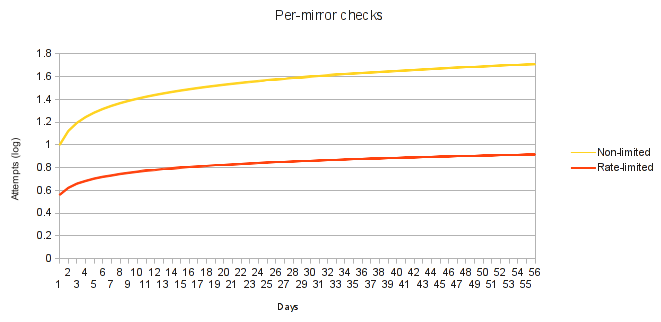
Another recent change is that mirrors that can't be used by the redirector will no longer be monitored as often as the other mirrors. For instance, if a mirror doesn't generate a trace file (used for monitoring) then the redirector will gradually limit the rate at which the mirror is checked.
This rate-limiting mechanism applies to different kinds of errors, and should reduce the amount of wasted time and bandwidth while still allowing automatic-detection of mirrors that recover.


Projection of a rate-limited mirror over six weeks. The mirror would have to fail in every attempt for that to happen.
N.b. there's a bump in the scale.

The rate limiter applies an initial exception to allow temporary errors to not affect the use of the mirror by the redirector. After that exception, it is pretty much linear. However, that chart doesn't really reflect the effect of the rate limiter, so put in comparison with the normal checking behaviour:


Comparison of the two behaviours over an 8 weeks period using a logarithmic scale.
Nice chart colours by Libreoffice.

The code to detect mirrors that don't perform a two-stages sync that I talked about in a previous post has not yet been integrated as the current implementation would be too expensive on the mirrors to just add it as-is.

While tracking down problems exposed to users, I decided to take a stricter approach as to what mirrors are used by the redirector. Suffice to say that the remaining mirrors using the obsolete anonftpsync are going to be ignored entirely. ftpsync has been around for a few years now and it is the standard tool.
Whether you are mirroring Debian, Raspbian, Ubuntu, or any other Debian-like packages repository, ftpsync is the right tool to use.

Most of the issues I've been discovering, and sometimes working around, affect direct users of the mirrors and are not related to the http.debian.net redirector. When not detected beforehand they happen to be exposed by the redirector, but like I said, I plan to be stricter in order to increase the redirector's reliability. Once a strict and reliable foundation is built, more workarounds might see their way in to better use the available resources.

That's it for now. The road is long, the challenge is great, and being an observer in an uncontrolled environment makes it even more interesting.

Russ Allbery: Review: Liars and Outliers

Review: Liars and Outliers, by Bruce Schneier
Publisher: John Wiley
Copyright: 2012
ISBN: 1-118-14330-2
Format: Hardcover
Pages: 285
One of the perils of buying a book written by a blogger one reads regularly is that the book may be little more than a rehashing of their blog, with insufficient original material to warrant the time investment. Sometimes it's still nice to support them financially, but it may not make sense to read the book. I've been following Schneier's blog for years (as should anyone with an interest in security), including through the entire process of writing Liars and Outliers, and was a bit worried that might be the case here. Thankfully, I can reassure any other worried potential readers that is not the case. This is substantial new material establishing a firm framework for thinking about incentives and controls in any society or organization. Liars and Outliers talks about security mechanisms, but it's not, at its core, a book about security. Rather, it's a book about incentives, order, and how order is established. It's a comprehensive reductionist analysis of how societies create predictability and compliance to allow us to trust other people who we have never met before and will never meet again. It's a unique (at least in my experience) combination of anthropology, sociology, security analysis, and political science. Schneier cuts across fields in an idiosyncratic but illuminating way that reminded me of (on an entirely separate topic) Jane Jacobs. This is not a prescriptive book, nor is a collection of answers, solutions, or even deep analysis of particular problems. Rather, it's an attempt to construct a general framework for analyzing societal dilemmas: conflicts between individual desires and social good, how those conflicts are resolved, and how societies can weigh the scales and influence the statistical outcomes. The closest Schneier comes to telling the reader how to solve problems is a checklist, at the end of the book, for designing effective societal pressures. Its primary contribution is vocabulary and structure. It also passes one of my litmus tests for any book about human behavior: Schneier complicates, broadens, deepens, and expands understanding, and points out complex interactions and complex feedback in effects we're inclined to consider simple, rather than simplifying or eliminating human complexity. One point I found refreshing about this book is that Schneier is scrupulous in refusing to define either society or individuals as good or bad, to the point of carefully defining terminology used in all of the social dilemmas. Following societal rules is called compliance; not following those rules is called defection. In some cases, defection is morally correct (Schneier's most frequent example is in the civil rights struggles of the 1960s in the United States). In all cases, social pressures are tools, which can be used to encourage compliance with moral or immoral systems, and which are deployed by totalitarian dictatorships and utopian communes alike. Schneier explicitly puts out of scope for this book the questions of how societal goals should be determined, how they change, and whether any given societal rule or interest is moral or immoral. He focuses, rather, only on the mechanisms, with a primary goal of informing and deepening debates over how best to encourage behavior that societies want to encourage and discourage behavior societies want to discourage. He also emphasizes discourage, as opposed to eliminate. Early on, Schneier shows some of the results of game theory, as well as basic common sense, that indicate that no healthy society can totally eliminate defection. Not only would that stifle valuable and important reform, such as changes in civil rights, but the degree of pressure required is immense. Defectors are natural and will always exist, and are sometimes valuable and necessary. Rather, the goal of a society is to reduce defectors to a level where most people can ignore their existence most of the time, a state that leads to the level of risk and trust required to have a functioning and healthy society. The word society, similarly, is intentionally broad, and can refer to just about any collection of people, from a circle of friends to a corporation, institution, or country. However, as Schneier points out early in the book, small societies rarely need much in the way of formal pressure and appear almost magically self-governing. That's the first property that he disassembles, resulting in a general classification of societal pressures into four categories: moral, reputational, institutional, and security systems. The last is an odd category that's partly orthagonal to the other three. Moral pressure is internalized conscience: the normal tendency of nearly everyone to follow their own moral code, a code that's at least partly constructed and certainly heavily influenced by the surrounding society. Reputational pressure is, in a sense, externalized morality: it's the informal reactions of others around one to one's past actions. Included in reputational pressure is shunning of every kind, from cutting off a friendship to boycotts against corporations, but it also includes confrontation from another member of one's society, the more subtle effects of our individual desires to be liked and respected, and all the various aspects of "face", honor, and respect within a community. Small communities are frequently self-governing, in Schneier's model, because they're small enough that moral and reputational pressures are sufficient and no other pressures are required. We're so used to applying moral and reputational pressure to other humans almost unconsciously that we sometimes don't even notice its existence, leading to that "magical" self-governing property. But Schneier puts pressures in a sequence: pressures that work extremely well with small groups often don't scale. Moral pressure works best with small groups and reputational pressure with somewhat larger groups, but when societies scale beyond the limits of reputational pressure when, for example, one frequently interacts with people whose reputations are unknown to you and whose subsequent opinion of you will not be relevant institutional pressure is required to force compliance. Institutional pressure is the sort of pressure that we all tend to think of first when we look for ways to enforce rules: laws, policies, contracts, and other codes of behavior that carry with them formal punishments and some enforcement mechanism. But even in societies so large that institutional pressures are frequently required, such as whole countries, moral and reputational pressures still exist and are extremely important. One of Schneier's most interesting points is his analysis of how institutional pressures can paradoxically undermine reputational and moral pressures, resulting in more defection than if the institutional pressure hadn't existed. This is just the basic framework of Schneier's analysis, hopefully giving you a feel for the structure of the book. He goes much deeper into the complicated interactions between the various levels of pressure, and then dives into an extensive look at competing societal dilemmas: cases where there is more than one society in play simultaneously, possibly demanding contradictory actions. Liars and Outliers also includes a wonderful analysis of organizational entities within the same framework, including their much-different reactions to moral, reputational, and institutional pressures. One of the most cogent analyses of the difficulties of regulating both corporations and governmental institutions falls out of that analysis, once one looks at them in light of Schneier's basic framework. Pressures quickly become complex and multi-layered, and human reactions to pressures are frequently counter-intuitive. Schneier draws extensively on game theory to show that some counter-intuitive responses are actually emergent properties of logical analysis of the situation, but that others are more uniquely human and have little or nothing to do with a mathematical cost-benefit analysis. I haven't even mentioned his discussion of security systems, and how they can extend moral, reputational, and institutional pressures, as well as add a new type of pressure (making a defecting action impossible) that scales even better than institutional pressures. Liars and Outliers has all of the supporting infrastructure you would expect in a scholarly book: notes, extensive references, and a good index. I suspect it will end up being used as at least additional reading in college classes. The notes are, unfortunately, end notes, making the full context of the book much harder to read than was necessary, but at least Schneier does separate the notes from the references so that one doesn't chase notes for further explanation and find a simple citation. As with any book like this, one always wishes it could end in a simple prescription to fix everything, but of course it doesn't. But that's also a measure of a good scholarly work. Human and organizational motivations are complex and tricky, and any framework for analyzing them needs to be able to represent that complexity. Schneier here has constructed a very powerful one, one that I started using in discussions before I'd even finished the book. Perhaps the most valuable contribution of Liars and Outliers to public discussion is clear terminology and categories, which can be of great help in finding the core components of a problem. Liars and Outliers can be slow going, particularly early on when Schneier is still defining terms and setting up the background of his analysis. One can get a bit tired of the analysis matrices of societal dilemmas. But stick with it through the groundwork, since the analyses of competing societal dilemmas and of the impact of societal pressures on organizations are exceptional. Highly recommended, particularly for anyone who is designing or implementing societal pressures: managers, political activists, or anyone in a security-related field. Rating: 8 out of 10

17 December 2012

Ian Campbell: Foreign Chroots with schroot and qemu

Since I've been working on qcontrol I've had need of a way to build packages in an ARM environment. Since all my native ARM hardware is "production" (at least so far as something can be production in a home environment) I prefer to avoid installing development tools on them. When I started looking into this all my ARM systems ran from relatively small flash devices which also ruled out the possibility of a development chroot. After search the web a bit I discovered that it is possible to use qemu-user-static together with [[!binfmt-support ]] to create cross architecture chroots which can be entered mostly transparently. It is also possible to combine this with schroot and sbuild which makes the day to day use pretty much the same as a native or biarch chroot. Since I've now had to rediscover how to do this twice (once for Sid and then again when I realized I also needed a Wheezy environment) I thought I should write it down for the benefit of my future self. First things first lets install the various packages which we need. As well as debootstrap to create the chroot we need qemu-user-static and binfmt-support to allow us to run ARM binaries:
$ sudo apt-get install debootstrap qemu-user-static binfmt-support
I'm using schroot's lvm-snapshot mode so we need an LVM volume, formatted with a filesystem and mounted in a temporary location:
$ sudo lvcreate -L8G -n sbuild-wheezy-armel /dev/VG
$ sudo mkfs.ext3 /dev/VG/sbuild-wheezy-armel
$ sudo mount /dev/VG/sbuild-wheezy-armel /mnt/
Next we need to create the chroot. For this we use debootstrap in foreign mode which does a 2 stage setup, firstly by using the --foreign option:
$ sudo debootstrap --variant=buildd --include=fakeroot,build-essential \
        --arch=armel --foreign \
        wheezy /mnt http://<DEBIAN-MIRROR>/debian/
Now we (temporarily) copy the qemu-arm-static binary into the chroot (at the place where binfmt-support expects it), change into the chroot and run debootstrap's second stage to finish the basic chroot setup:
$ sudo cp /usr/bin/qemu-arm-static /mnt/usr/bin/
$ sudo chroot /mnt
(chroot)# ./debootstrap/debootstrap --second-stage
(chroot)# exit
Now that we have a basic chroot in place it needs a little bit of tailoring. I've found the easiest way to do this is to use sbuild-createchroot and then tweak the result:
$ sudo sbuild-createchroot --arch=armel --foreign --setup-only \
    wheezy /mnt http://<DEBIAN-MIRROR>/debian/
If we were building a native chroot then we could have skipped the debootstrap stuff and let sbuild-createchroot handle things. Unfortunately this doesn't seem to play nicely with --foreign. Now we can remove the qemu-arm-static binary from the chroot. schroot will automatically bind mount the version from the host into the chroot which ensures it remains up to date. We can also unmount the chroot since we will let schroot manage that from here on:
$ sudo rm /mnt/usr/bin/qemu-arm-static
$ sudo umount /mnt
Next we need to tweak the resulting schroot/sbuild configuration since sbuild-createchroot assumes the use of schroot's directory mode. First remove the symlink to /mnt which it created:
$ sudo rm /etc/sbuild/chroot/wheezy-armel-sbuild
Lastly we need to edit /etc/schroot/chroot.d/wheezy-armel-sbuild-<SUFFIX> (where is randomly generated) and reconfigure it to use lvm-snapshot mode, by apply the following changes:
 [wheezy-armel-sbuild]
-type=directory
-directory=/mnt
+type=lvm-snapshot
+device=/dev/VG/sbuild-wheezy-armel
+lvm-snapshot-options=--size 2G
 description=Debian wheezy/armel autobuilder
 groups=root,sbuild
 root-groups=root,sbuild
 profile=sbuild
That's it, we now have a chroot which we can trivially invoke via sbuild to build armel packages:
$ sbuild --arch=armel --dist=wheezy <... other options...>
We can also use sbuild-update to keep the chroot up to date:
$ sudo sbuild-update -udcar wheezy-armel
You can also use schroot to login to the chroot directly, although for that case you'll likely want to create a different chroot using schroot's directory or block-device mode instead lvm-snapshot and drop some of the sbuild specific setup. I expect I'll blog about this configuration in some more detail at some point in the future since I'll want to document it to give a more convenient build environment for Xen on ARM than the build farm which we have at work.

Dominique Dumont: Be wary of optimised for devices

Hello This story began with linphone having a weird behavior: every now and then, the mouse pointer would become stuck: the pointer moves, but clikcking on it always activate the same widget. Since this always happened in the middle of phone conference done for work, this was infuriating. Long story short, I finally found that my plantronics USB headset was responsible for this weird behavior. This headset is connected to the USB bus and is seen by the computer as a USB sound card. The bug was triggered by pressing the mute button provided by the headset. Suspicious of this usb device, I used lsusb to find the features provided by the heaset: $ lsusb -v -s 1:3 2>&1 grep InterfaceClass
bInterfaceClass 1 Audio
bInterfaceClass 3 Human Interface Device
Audio devices were expected, but why a HID device ? This device is a headset, not a keyboard or a mouse Testing further, I also saw some number poping up on my screen whenever I pressed the the mute button. The only way to get the mouse back was to unplug the headset. A quick google search gave a solution to setup X11 to ignore the headset. Problem solved. But this did not answer the question regarding the HID device. Then I got a hint in the form of a sticker glued on the headset USB plug: Optimized for Microsoft Lync . This page gave the answer: an optimised for Lync device provides mute/unmute across PC and device . I can only guess that when the mute button is pressed, some data is sent from the HID interface. Unfortunately, the window manager does not like to be on the receiving end of this data. The moral of this story is: optimized for something actually means not standard .
ok. There s a bug somewhere. The comments of this blog have convinced me that I went too far with the moral of this story. It s now overstriked instead of plainly remvoed so the comments still make sense. Thanks everybody for the constructive comments.
All the best
Tagged: wtf

Next.

Previous.