Search Results: "ean"

16 June 2012

Wouter Verhelst: Life: general update

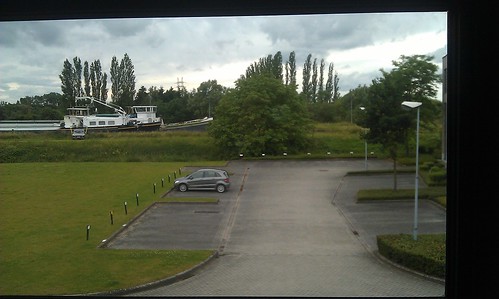
In case you were wondering what had happened to my blog over the past few weeks: the server on which it runs, samba.nixsys.be, has been down for that time, since we've just moved office. There's a story behind it, with which I won't bore you; suffice to say that we had to move out because of circumstances beyond our control. If you really do care, ask me over a beer or something (at debconf would be a good opportunity). I'll happily tell you the story. Meanwhile, the server on which this blog runs and which was located in a separate room at our office was now no longer available. But that's now over, albeit that it's behind a different IP address, and ignoring the fact that I still have some minor things to finish after the move. During this move, I found that we'd accumulated quite an amount of old unused hardware. While I've retained some of it (mostly my m68k machines, and some other machines that were given to me in order to add or improve Debian support for them), most of it has been given or thrown away. And that's even ignoring the other crap that had been in the cellar or the server/storage room. Oh my. I had severely underestimated the amount of work that would be required to clean out the office, which unfortunately also meant that I overshot the official date on which I were to leave the office by about two weeks. Luckily the landlord wasn't in a hurry or something, so no harm done. But I'll say this: if I ever say "yes" to anyone offering me some old decrepit hardware again for which I have no immediate purpose, may I be struck by lightning where I stand. Anyway. There's one significant advantage from this particular move: the view. I've gone from a dead wall to this: IMAG0004 Which is clearly an improvement... Additionally, now just over a month ago, my bother's fianc e gave birth to a boy, which makes me an uncle for the first time ever. Scary.

Brett Parker: Things that piss me off #1

You know what really pisses me off? Idiots in takeaways... More to the point, racist, idiotic, drunken idiots in takeaways - having just been to one of the few places still open at "silly o'clock" i.e. a place that's open after the pub has shut, it's really annoying and disappointing in the human race, to hear someone refer to the staff as a "paki bastard". I'm disgusted with the customer in question. I mean, WTF, how absolutely fucking stupid have you got to be to both be racist and do it loud enough to not only piss off the staff, but piss off any customer that actually just views people as people - we're in this world together ffs, stop being such fucking moronic, racist cunts. It's not difficult. People are people. All of them. The whole world. (apologies for bad language in the post, it's just, well, as the title says, something that really pisses me off).

15 June 2012

Erich Schubert: Dritte Startbahn - 2 gewinnt!

Usually I don't post much about politics. And this even is a highly controversial issue. Please do not feel offended.
This weekend, there is an odd election in Munich. Outside of Munich, nearby the cities of Freising and Erding, there is the Munich airport. The company operating the airport is owned partially by the city of Munich, which gives the city a veto option.
The Munich airport has grown a lot. Everybody who has been flying a bit knows that big airports (such as Heathrow) are oft the worst. If anything goes wrong, you are busted, because it will take them a long time to resume operations. This just happened to me in Munich, where the luggage system was down, and no luggage arrived at the airplanes.
Yet, they want to take the airport further down this road, and make it even bigger: add two satellite terminals, and a third runway. I'm convinved that this will make the airport much worse for anybody around here. The security checkpoints will be even more crowded, the lines for the baggage drop-off too, and you will have to walk much further on the airport.
Up to now, the Munich airport was pretty good compared to others. In particular given that is is one of the largest in Europe! It is because it had been designed from the ground up for this size. Now they plan to screw it up.
But there are other arguments against this, not the egoist view of a traveller. The first is the money issue. The airport is continuously making losses. It's the taxpayer that has to pay for all of this - and the current cost estimation is 1200 million. This is not appropriate, in particular since history shows that you can take this x2 to x10 to get the real number. They should first get the airport into a financial stable condition, then plan on making it even bigger.
Then there are the numbers. Just like with any polticial large-scale project, the numbers are all fake. The current airport was planned to cost 800 million, in the end it was about 8550 million. The politicians happily lie to us. Because they want to push their pet projects. We must no longer accept such projects based on fake numbers and old predictions.
If you are already one of the 10 largest airports in Europe, can you really expect to grow even further?!? There is a natural limit to growth, unless you want to have every single passenger on the world first travel to Munich multiple times, then go to his final destination ...
One thing they seem to have completely neglected is that Berlin is currently getting a brand new airport. And very likely, this is going to divert quite some traffic away from Munich. Just like the Munich airport diverted a lot of traffic away from Frankfurt. To some extend because many people actually want to go to Berlin, not Munich, but they currently have to change planes here or in Frankfurt. So when Berlin finally is operational, this will have an impact on Munich.
And speaking of the Berlin airport, this is a good example to not trust the numbers and our politicians. It is another example of a way-over-budget, way-behind-time project the politicians screwed up badly and where they lied to us. If we should not have trusted them with Berlin, why should we trust them with the Munich addon?
A lot of people whose families have been living there for years will have to be resettled. Whole towns are going to disappear. An airport is huge. Yet, they cannot vote against it, because their small towns do not own shares of the airport. The polticians don't even talk to them, not even to their poltical representatives.
Last but not least, the airport is in a sensitive ecological area. The directly affected area is an European special protection area for wild birds. There are nature preserves nearby, and all this area already suffers badly from airport drainage, pollution and noise. When they built the airport originally, the replacement areas they setup were badly done, and are mostly inhabited by nettles and goldenrod (which is not even native to Europe). See this article in S ddeutsche Zeitung on the impact on nature. You can't replace the loss of the original habitats just by digging some pools and filling them with water ...
If you want more information, go to this page, by Bund Naturschutz.
This is not about progress ("Fortschritt"). That is a killer argument the politicians love, but it doesn't hold. Nobody is trying to shut down the airport. Munich will be better of by keeping the balance having both a reasonably sized airport (and in fact, the airport is already one of the 10 largest in Europe!) and preserving some nature to make it worth living here.
If you are located in Munich, please go vote against the airport extension, and enjoy the DEN-GER soccer game afterwards. Thank you.

Matthew Garrett: No, really, secure boot does add security

Carla Schroder wrote a piece for linux.com on secure boot, which gives a reasonable overview of the technology and some of the concerns. It unfortunately then encourages everyone to ignore those legitimate concerns by making the trivially false claim that secure boot is just security theatre.

Security isn't some magic binary state where you're either secure or insecure and you can know which. Right now I'd consider my web server secure. If someone finds an exploitable bug in Apache then that would obviously no longer be the case. I could make it more secure by ensuring that Apache runs in a sufficiently isolated chroot that there's no easy mechanism for anyone to break out, which would be fine up until there's also a kernel exploit that allows someone to escalate their privileges enough to change their process root. So it's entirely possible that someone could right now be breaking into my system through bugs I don't even know exist. Am I secure? I don't know. Does that mean I should just disable all security functionality and have an open root shell bound to a well known port? No. Obviously.

Secure boot depends on the correctness of the implementation and the security of the signing key. If the implementation is flawed or if control of the signing key is lost then it stops providing security, and understanding that is important in order to decide how much trust you place in the technology. But much the same is true of any security technique. Kernel flaws make it possible for an unprivileged user to run with arbitrary privileges. Is user/admin separation security theatre? SSL certificate authorities have leaked keys. Is it security theatre for your bank to insist that you use SSL when logging in?

Secure boot doesn't instantly turn an insecure system into a secure one. It's one more technology that makes it more difficult for attackers to take control of your system. It will be broken and it will be fixed, just like almost any other security. If it's security theatre, so is your doorlock.

Why is this important? Because if you tell anyone that understands the technology that secure boot adds no security, they'll just assume that you're equally uninformed about everything else you're saying. It's a perfect excuse for them to just ignore discussion of market restrictions and user freedoms. We don't get anywhere by arguing against reality. Facts are important.

comment count unavailable comments

14 June 2012

Russell Coker: The Financial Value of a University Degree

I ve read quite a few articles about the value of a degree. Most of them come from the US where the combination of increasing tuition fees and uncertain job market makes a degree seem like a risky investment. I think that most analysis of the value of a degree are missing some important points. The Value of Money at Different Times The value of money is different at various stages of your life. The impression that I get is that when a married couple have their house fully paid off and they either don t/won t have children or their children are old enough to leave home the amount of money that they earn seems to matter a lot less. Doing a university degree involves 3 or 4 years not earning money (or more if doing post-graduate studies), which is usually starting at the age of 18. Effectively getting a degree involves giving up some money while young for the opportunity to earn more when older. Any analysis based on directly comparing the money spent on the degree to the amount of financial return without considering when money is needed is not very useful. I think that a reasonable analysis would exclude income earned after the age of about 45. By that age most people have either achieved a solid financial position and learned to live within their means or messed up their finances so badly that they won t live long enough to recover. A Degree as a Signal The Wikipedia page on economic signalling gives education as an example of a signal. A signal in this case means something that doesn t inherently mean anything but which signifies something else. So completing a degree doesn t necessarily mean that you learned anything relevant to work, but if you are able to do it then it means that you can probably also do things which are economically useful for an employer. This raises the question of how else one might signal their ability to work. One obvious answer is by working, someone who has remained steadily employed for 3 or 4 years has demonstrated their ability to work reliably and get along with other people which should be at least as useful as a signal. It s Not Only the Degree Most analysis seem to compare average income of people with degrees with the average of income with people who didn t attend university. That is based on the assumption that the degree was the only difference. When I was young my parents spent a moderate amount of money on a full set of paper encyclopedias (about 2 meters of shelf space). I m sure that this gave me some educational benefit as they intended, and it was something that was apparently quite rare I don t recall seeing a full encyclopedia in anyone else s house before the Wikireader [1]. My parents also bought me quite a lot of computer gear (back when hardware was really expensive), were always available to drive me to computer users group meetings etc, and did everything else that seemed likely to have an educational benefit. The value of such learning opportunities is significant. I think that almost everyone who had similar learning opportunities to me when they were young will probably have experienced similar support and pressure to attend university. I also think that almost everyone who receives such opportunities will be able to earn more than the median income even if they don t attend university. To a large extent people who are going to be successful attend university. A university degree doesn t make anyone successful if they couldn t succeed without a degree. There are some careers that just aren t options if you don t have a relevant degree (such as medicine and law). But I believe that anyone who is capable of completing a difficult course such as medicine or law (or any other career that has legal requirements for a degree) is capable of being successful without a degree in many other fields. So comparing the wages of a doctor or a lawyer to an average person doesn t make sense, it makes more sense to try and compare their wages to someone of similar skill who didn t have such a qualification. Conclusion It seems to me that the question is, of the people who had great learning opportunities when they were young and who wanted to succeed, would they have earned much less if they hadn t attended university? The next question is, of the people who might earn significantly less without getting a degree, would that salary difference really have mattered, or would it just be a matter of earning some luxury money when they are too old to really need it? Related posts:
  1. Ideas for a Home University There seems to be a recent trend towards home-schooling. The...
  2. university degrees Recently someone asked me for advice on what they can...
  3. Microsoft Hires University Drop-Out for Recruiting Campaign news.com.au reports that MS has hired former Miss Australia Erin...

12 June 2012

Brett Parker: Mira Grant - Countdown

Hmm, so, at the end of Deadline, there appears to be the first chunk of the novella Countdown - and a notice "If you enjoyed Blackout look out for Countdown, an ebook only Newflesh novella also by Mira Grant" - it then seems to have the first chunk of that in print, I'm reasonably certain that it's not the full novella (it doesn't end cleanly enough for that). Now, last year (way back when Countdown was originally announced I commented asking when the UK release was going to happen for it (there's a US release, after all) - that was August 2nd 2011 - 10 months later, we've still not got any news on the UK release, and now we've even got a teaser at the end of Blackout. There's also notes that there's going to be some more novella for the series soon - which will be fantastic, if we ever get them in the UK :/ Ah well, hopefully we'll get it soon!

11 June 2012

Petter Reinholdtsen: Debian Edu - some ideas for the future versions

During my work on Debian Edu based on Squeeze, I came across some issues that should be addressed in the Wheezy release. I finally found time to wrap up my notes and provide quick summary of what I found, with a bit explanation. I guess we will discover more as we continue to work on the Wheezy version.

10 June 2012

Philipp Kern: s390x accepted as release architecture

Yay, so we made it: s390x got added as a release architecture. What this means:
This will also help other 64bit big-endian ports (like powerpc64 and sparc64) to enter the archive more easily, as most issues left are indeed related to endianness, not to specialities of the System z hardware.
Many thanks go to Aur lien Jarno, without whom this would not have been possible. I also want to take this opportunity to thank all our s390(x) machine sponsors: ZIVIT, IIC@KIT and Marist College. There are not many mainframe owners who let free software projects work on their machines.

9 June 2012

Christian Perrier: [Running] Caen "Courants de la Libert " marathon

I'm about to leave today for St-Aubin sur Mer close to the start line of the Courants de la Libert marathon. This race, meant to celebrate the June 6th 1944 D-Day, arrives at Caen, close to the WW2 memorial. We'll spend a night in a hotel in St-Aubin and as of tomorrow 9h French time, I'll be on my way to try breaking my best time (3h4029"). Training has been as expected: no injury, all 32 trainings completed, with many many interval training (and some of them really though!). So, I'm going there with great confidence. The only minor problem are weather conditions as the forcast announces some rain and 20-30km/h wind, from South (which we should be facing from km 20 to 25 and in the last kilometers). I'll have my Runtastic and Endomondo Android apps running, so, in case looking at a blue spot on a French map for over 3 hours sounds interesting, you can go there or there (and send cheers, etc...but I'll switch off my phone's loudspeaker to avoid looking silly during the race!). See you tomorrow for the outcome!

Stefano Zacchiroli: bits from the DPL for May 2012

Just posted to d-d-a, here are the monthly DPL bits.
Dear project members,
here's the periodic report of what has happened in DPL land, this time during May 2012. It's briefer than usual, as this year I've enjoyed the lovely French habit of frequent holidays during the month of May. Highlight First highlight for this month is an invitation to us all. We're now in June and the Wheezy freeze is literally a few days away. The RC bugs count is moving in the right direction, but it's still stellar if we want to ensure a short freeze. And a short freeze is of paramount importance: it'll reduce the time during which we can't implement great plans for the future, increase the "freshness" of software we'll ship with Wheezy, and reduce the inconveniences for those who run the testing suite due to its nice "rolling" feature. So please set out some regular time to do RC bug squashing, by providing patches and doing NMUs. Releasing Wheezy is not something that could be outsourced to the Release Team, it's a collective responsibility that kicks in as soon as our own packages are RC bug free (which they already are, right? :-)) The second highlight is more on the internal structure camp. As mentioned last month, I've discussed with the tech-ctte insisting a bit to set up periodic IRC meetings, to ensure outstanding issues get periodically reviewed. At the end of May the first IRC meeting has happened, and has been very productive. See the minutes. Another one has been scheduled, trying to setup a monthly cadence, for the end of June. Many thanks to all tech-ctte members who have took part in and helped with the meeting organization. Communication I've given an interview to iTWire, answering a number of questions about several past and future Debian challenges. Discussions The ongoing discussion to harmonize packaging of multimedia software between the official Debian archive and the unofficial debian-multimedia.org archive (dmo) has progressed. I've tried to help the two groups reaching an agreement on which packages belong where, so that both duplicate packaging efforts and user inconveniences are minimized. That seems not to have worked and dmo maintainers have simply announced that they will move away from the current domain name to a new one that does not include "debian" in its name. Sprints There will be a Debian Science sprint in June, co-located with the broader Debian Science event organized by European Synchrotron Radiation Facility (ESRF) in Grenoble. I've confirmed my attendance for the opening talk of the conference day. ESRF organizers have kindly sponsored travel for all Debian attendees, many thanks to them! Another sprint will happen next week-end in Paris, this time by the i18n/l10n team. I've approved the corresponding tentative budget for travel sponrship for ~2'000 EUR. Other expenses Hardware replacement plans go on. We've ordered SSDs (for ~3'000 CAD) for recently bought machines meant to replace bugs-mirror, bugs-master, and udd. On the "small emergencies" front, we also had to replace failing disks on wagner (1/2 of alioth), for as little as 100 GBP. Miscellanea Happy Wheezy freeze,
and RC bugs squashing!
PS the boring day-to-day activity log for May is available at master:/srv/leader/news/bits-from-the-DPL.txt.201205

Christian Perrier: 9 languages to be deactivated in Debian Installer

Re-publishing this today, as a number was wrong in previous post. Thanks also to Kumar Appaiah who, even though he's not a Tamil native speaker (he's the Hindi translator) fixed the few strings in Tamil that theoretically made it unsuitable for being in wheezy's installer. At this very moment, it means that I would deactivate 9 languages: Update: Kumard Appaih *is* a Tamil native speaker. Sorry for the misunderstanding!

8 June 2012

Lars Wirzenius: Obnam 1.0 (backup software); a story in many words

tl;dr: Version 1.0 of Obnam, my snapshotting, de-duplicating, encrypting backup program is released. See the end of this announcement for the details. Where we see the hero in his formative years; parental influence From the very beginning, my computing life has involved backups. In 1984, when I was 14, my father was an independent telecommunications consultant, which meant he needed a personal computer for writing reports. He bought a Luxor ABC-802, a Swedish computer with a Z80 microprocessor and two floppy drives. My father also taught me how to use it. When I needed to save files, he gave me not one, but two floppies, and explained that I should store my files one one, and then copy them to the other one every now and then. Later on, over the years, I've made backups from a hard disk (30 megabytes!) to a stack of floppies, to a tape drive installed into a floppy interface (400 megabytes!), to a DAT drive, and various other media. It was always a bit tedious. The start of the quest; lengthy justification for NIH In 2004, I decided to do a full backup, by burning a copy of all my files onto CD-R disks. It took me most of the day. Afterwards, I sat admiring the large stack of disks, and realized that I would not ever do that again. I'm too lazy for that. That I had done it once was an aberration in the space-time continuum. Switching to DVD-Rs instead CD-Rs would reduce to the number of disks to burn, but not enough: it would still take a stack of them. I needed something much better. I had a little experience with tape drives, and that was enough to convince me that I didn't want them. Tape drives are expensive hardware, and the tapes also cost money. If the drive goes bad, you have to get a compatible one, or all your backups are toast. The price per gigabyte was coming down fast for hard drives, and it was clear that they were about to be very competitive with tapes for price. I looked for backup programs that I could use for disk based backups. rsync, of course, was the obvious choice, but there were others. I ended up doing what many geeks do: I wrote my own wrapper around rsync. There's hundred, possibly thousands, of such wrappers around the Internet. I also got the idea that doing a startup to provide online backup space would be a really cool thing. However, I didn't really do anything about that until 2007. More on that later. The rsync wrapper script I wrote used hardlinked directory trees to provide a backup history, though not in the smart way that backuppc does it. The hardlinks were wonderful, because they were cheap, and provided de-duplication. They were also quite cumbersome, when I needed to move my backups to a new disk the first time. It turned out that a lot of tools deal very badly with directory trees with large numbers of hardlinks. I also decided I wanted encrypted backups. This led me to find duplicity, which is a nice program that does encrypted backups, but I had issues with some of its limitations. To fix those limitations, I would have had to re-design and possibly re-implement the entire program. The biggest limitation was that it treated backups as full backup, plus a sequence of incremental backups, which were deltas against the previous backup. Delta based incrementals make sense for tape drives. You run a full backup once, then incremental deltas for every day. When enough time has passed since the full backup, you do a new full backup, and then future incrementals are based on that. Repeat forever. I decided that this makes no sense for disk based backups. If I already have backed up a file, there's no point in making me backup it again, since it's already there on the same hard disk. It makes even less sense for online backups, since doing a new full backup would require me to transmit all the data all over again, even though it's already on the server. The first battle I could not find a program that did what I wanted to do, and like every good NIHolic, I started writing my own. After various aborted attempts, I started for real in 2006. Here is the first commit message:
revno: 1
committer: Lars Wirzenius <liw@iki.fi>
branch nick: wibbr
timestamp: Wed 2006-09-06 18:35:52 +0300
message:
  Initial commit.
wibbr was the placeholder name for Obnam until we came up with something better. We was myself and Richard Braakman, who was going to be doing the backup startup with me. We eventually founded the company near the end of 2006, and started doing business in 2007. However, we did not do very much business, and ran out of money in September 2007. We ended the backup startup experiment. That's when I took a job with Canonical, and Obnam became a hobby project of mine: I still wanted a good backup tool. In September 2007, Obnam was working, but it was not very good. For example, it was quite slow and wasteful of backup space. That version of Obnam used deltas, based on the rsync algorithm, to backup only changes. It did not require the user to do full and incremental backups manually, but essentially created an endless sequence of incrementals. It was possible to remove any generation, and Obnam would manage the deltas as necessary, keeping the ones needed for the remaining generations, and removing the rest. Obnam made it look as if each generation was independent of each other. The wasteful part was the way in which metadata about files was stored: each generation stored the full list of filenames and their permissions and other inode fields. This turned out to be bigger than my daily delta. The lost years; getting lost in the forest For the next two years, I did a little work on Obnam, but I did not make progress very fast. I changed the way metadata was stored, for example, but I picked another bad way of doing it: the new way was essentially building a tree of directory and file nodes, and any unchanged subtrees were shared between generations. This reduced the space overhead per generation, but made it quite slow to look up the metadata for any one file. The final battle; finding cows in the forest In 2009 I decided to leave Canonical and after that, my Obnam hobby picked up in speed again. Below is a table of the number of commits per year, from the very first commit (bzr log -n0 awk '/timestamp:/ print $3 ' sed 's/-.*//' uniq -c awk ' print $2, $1 ' tac):
2006 466
2007 353
2008 402
2009 467
2010 616
2011 790
2012 282
During most of 2010 and 2011 I was unemployed, and happily hacking Obnam, while moving to another country twice. I don't recommend that as a way to hack on hobby projects, but it worked for me. After Canonical, I decided to tackle the way Obnam stores data from a new angle. Richard told me about the copy-on-write (or COW) B-trees that btrfs uses, originally designed by Ohad Rodeh (see his paper for details), and I started reading about that. It turned out that they're pretty ideal for backups: each B-tree stores data about one generation. To start a new generation, you clone the previous generation's B-tree, and make any modifications you need. I implemented the B-tree library myself, in Python. I wanted something that was flexible about how and where I stored data, which the btrfs implementation did not seem to give me. (Also, I worship at the altar of NIH.) With the B-trees, doing file deltas from the previous generation no longer made any sense. I realized that it was, in any case, a better idea to store file data in chunks, and re-use chunks in different generations as needed. This makes it much easier to manage changes to files: with deltas, you need to keep a long chain of deltas and apply many deltas to reconstruct a particular version. With lists of chunks, you just get the chunks you need. The spin-off franchise; lost in a maze of dependencies, all alike In the process of developing Obnam, I have split off a number of helper programs and libraries: I have found it convenient to keep these split off, since I've been able to use them in other projects as well. However, it turns out that those installing Obnam don't like this: it would probably make sense to have a fat release with Obnam and all dependencies, but I haven't bothered to do that yet. The blurb; readers advised about blatant marketing The strong points of Obnam are, I think: Backups may be stored on local hard disks (e.g., USB drives), any locally mounted network file shares (NFS, SMB, almost anything with remotely Posix-like semantics), or on any SFTP server you have access to. What's not so strong is backing up online over SFTP, particularly with long round trip times to the server, or many small files to back up. That performance is Obnam's weakest part. I hope to fix that in the future, but I don't want to delay 1.0 for it. The big news; readers sighing in relief I am now ready to release version 1.0 of Obnam. Finally. It's been a long project, much longer than I expected, and much longer than was really sensible. However, it's ready now. It's not bug free, and it's not as fast as I would like, but it's time to declare it ready for general use. If nothing else, this will get more people to use it, and they'll find the remaining problems faster than I can do on my own. I have packaged Obnam for Debian, and it is in unstable, and will hopefully get into wheezy before the Debian freeze. I provide packages built for squeeze on my own repository, see the download page. The changes in the 1.0 release compared to the previous one: The future; not including winning lottery numbers I expect to get a flurry of bug reports in the near future as new people try Obnam. It will take a bit of effort dealing with that. Help is, of course, welcome! After that, I expect to be mainly working on Obnam performance for the foreseeable future. There may also be a FUSE filesystem interface for restoring from backups, and a continous backup version of Obnam. Plus other features, too. I make no promises about how fast new features and optimizations will happen: Obnam is a hobby project for me, and I work on it only in my free time. Also, I have a bunch of things that are on hold until I get Obnam into shape, and I may decide to do one of those things before the next big Obnam push. Where; the trail of an errant hacker I've developed Obnam in a number of physical locations, and I thought it might be interesting to list them: Espoo, Helsinki, Vantaa, Kotka, Raahe, Oulu, Tampere, Cambridge, Boston, Plymouth, London, Los Angeles, Auckland, Wellington, Christchurch, Portland, New York, Edinburgh, Manchester, San Giorgio di Piano. I've also hacked on Obnam in trains, on planes, and once on a ship, but only for a few minutes on the ship before I got seasick. Thank you; sincerely SEE ALSO

Christian Perrier: 9 languages to be deactivated in Debian Installer

Re-publishing this today, as a number was wrong in previous post. Thanks also to Kumar Appaiah who, even though he's not a Tamil native speaker (he's the Hindi translator) fixed the few strings in Tamil that theoretically made it unsuitable for being in wheezy's installer. At this very moment, it means that I would deactivate 9 languages:

Matthew Garrett: The security of Secure Boot

The other complaint about UEFI Secure Boot is that it doesn't add any security. There's two aspects to this - people either think it'll be quickly broken, or people think that the public availability of signing services will render it useless.
Will Secure Boot be broken?Almost certainly, yes. I'd put a significant amount of money on it. The most obvious avenue of attack is probably a malformed FAT on a USB stick, or alternatively a programmable USB device that can trigger undesired behaviour in the USB stack. If you're really lucky then you might be able to corrupt the filesystem on the EFI system partition in such a way that this happens on every boot, even if there's no USB hardware connected. It's possible that there'll be a bug in the binary validation process and a cleverly designed binary may be able to validate even though it contains unsigned code. Various vendors will probably manage to produce signed option ROMs that rely on unsigned data in such a way that they can be forced to misbehave. But most of these attacks will either involve physical access or depend on the target machine having a specific piece of hardware installed, and I'd also put money on each of them being quickly fixed once they're found. And, eventually, people will run out of new attacks.

People desperately want to believe that the Secure Boot implementation is fundamentally broken, and that's just not true. It's based on well-tested encryption technology. You calculate a SHA256 of the binary you want to sign. You encrypt that hash with the private half of a 2048-bit RSA key. You embed the encrypted hash in the binary. When someone tries to run the binary you decrypt the hash with the public key in your firmware. You then calculate the hash of the binary and compare the two. If they match then you know that (a) whoever signed the binary had access to the private half of a key you trust, and (b) the binary hasn't been modified since then.

The difference between Secure Boot and things like CSS or WEP is that Secure Boot uses existing cryptographic techniques and has been designed by people who actually understand how they work. Precisely the same technology is used in Microsoft's driver signing, and people decided it was easier to steal a key from Realtek than it was to break the underlying technology. Unless there's a crippling bug in the implementation that nobody's noticed yet, the only real way to attack this is to either force a SHA256 collision (achievable with current technology, as long as you're willing to spend many orders of magnitude more time than the universe has existed) or break RSA (which would also mean that SSL is broken). If anyone can do either of these things then we are so unbelievably fucked that Secure Boot should not be the thing you're most worried about.

So, in summary: Yes, Secure Boot will be broken. And then it will be fixed. And after this happens a few times, there will be no further breaks.
Everyone can sign, so what's the pointAnyone can pay $99 and get their binaries signed. So why won't malware authors just do that? For starters, you'll need to provide some form of plausible ID for Verisign to authenticate you and hand over access. So, sure, you provide some sort of fake ID. That's the kind of thing that tends to irritate local authorities - not only are you talking about breaking into a bunch of computers, you're talking about committing the sort of crime that results in genuinely bad things happening to you if you get caught. And secondly, the only way you get access to the system is using some physical smartcards that Verisign send you. So you've also had to hand over an actual physical address, and even if you've used some sort of redirection service that's still going to make it easier to track you down. You're taking some fairly significant real-world risks.

But ok, you're willing to do that and you obtain a signing key and you sign some malware. You'll infect some number of machines. But eventually you'll be noticed, and then Microsoft produce a key revocation blob and vendors push it out via their OS update mechanisms. If your malware was basically harmless then that's probably the end of it, but if you were using it as the basis for an attack on people's banking details then a lot of people are suddenly going to be very interested in the person who bought that key, and also your malware isn't going to be able to infect any more machines.

To put this in perspective - Windows is the dominant desktop operating system. If you want to run a botnet or steal people's bank details then Windows is the obvious thing to attack. Windows security has now improved to the point where it's not massively straightforward to do that from userspace, so the logical thing to do would be to run your malware in the kernel. The easiest way to do that would be to load a driver, but Windows won't load unsigned drivers. So you'd need a signed driver. How do you get one? With the same $99 access to the Microsoft signing service that you'd use for signing an EFI binary.

Anyone could already use the signing service to attack Windows. But people haven't. The Stuxnet authors thought it was easier to steal a key from a real hardware vendor than it was to buy their own key. So, yes, in theory an attacker could obtain signing services. But the real world evidence suggests that that's not how they behave.
SummarySecure Boot is unlikely to be broken via fundamental flaws in its implementation, and there's no evidence that public availability of the signing service will result in an explosion of boot level malware.

comment count unavailable comments

7 June 2012

Rog rio Brito: I am not going to DebConf 12

Due to some real life impediments (including a beautiful one with just over 2 months of life called Daniel), I will not be able to go to this year's DebConf, even though it seems that this DebConf will exceed many expectations with the support that the governement of Nicaragua just offered. Things that I would like to have worked on Unfortunately, this means that I will not be working with some fellows that may be there, like people from the pkg-multimedia team. In particular, as I am working on some packages that are not that well suited to distributions (especially regarding HandBrake), it would be highly productive to have a hacking session or two with other people interested in having this popular and easy-to-use video ripper/transcoder on Debian. I would also like to be able to talk in person with other people (including Joey Hess) about controversial packaging of some programs, like GNU Parallel, which I maintain in Debian. There are many things else that I would love to work on, besides helping a bit with some of the still pending transitions of the the Debian Fonts Task Force umbrella, meeting friends and other social stuff. Oh, well. I guess that working at home will be the solution for some time.

Christian Perrier: 10 languages to be deactivated in Debian Installer

At this very moment, it means that I would deactivate 14 languages:

6 June 2012

Jon Dowland: Debian Day #2

One interesting side-effect of setting aside a regular slot of time for a task is that you are guaranteed to spend some time, perhaps not much, thinking about that task, every week. As a consequence, even one evening a week is enough for me to think about my Debian work at other times. This means I am in a better position to use any unplanned free time more effectively. This Tuesday was a bank holiday which I spent on DIY, lounging in a chocolate shop and catching up on The Apprentice, so there wasn't a 'Debian Day' per se. However, I did upload a few versions of lhasa. Following on from last week's thoughts on sound-juicer, I'm pleased to report that the two folks working on a more recent musicbrainz update were in fact working together, and after some discussion Michael Biebl sponsored an upload. Thanks Michael! Once that had gone in I was free to sponsor flactag, which was packaged by the same folks. There's some follow-on work to do for musicbrainz5. In Debian, gnome-mplayer, gnome-sushi, goobox, kdemultimedia, rhythmbox and sound-juicer need updating; I'm fairly sure Michael sorted out a patch for gnome-sushi at least but upstream want a patch that implements falling back to version 4 if version 5 doesn't exist. Finally, I sponsored Gustavo's vavoom package.

Matthew Garrett: "Why not just use Coreboot?"

Why not just avoid the entire Secure Boot problem by using Coreboot? Because the reason we have the Secure Boot problem is because Microsoft's Windows 8 certification requirements mean vendors have to ship a UEFI implementation with Secure Boot. You could satisfy that by using Coreboot with a Tiano payload, but it'll still have Secure Boot enabled so you still have the same set of problems. But maybe you could just reflash your system with Coreboot? No, because another part of the requirements states that all firmware updates have to be cryptographically signed now. The only way to reflash will be to attach a flash programmer directly to your motherboard.

So why not just use Coreboot? Because it doesn't help solve this problem in any way.

comment count unavailable comments

Craig Small: pam bugs hurt

I did some upgrades of what seemed like a million packages today on my debian sid computer. I was doing this remotely and when I tried to ssh back in I got kicked out after entering my password, hmmm. OK, so I waited until I could get in front of it and tried to login to the console and was greeted with the message Cannot make/remove an entry and kicked out, even as root; double hmmm. So it was boot into single user time which, thankfully worked. bash loaded ok so it wasn t a shell problem. However su failed which means we are into pam problem territory. I found a bug report that sounded like my problem, but with no clear solution except upgrade in Ubuntu. The solution was pretty simple for me. It s something funky with /etc/pam.d/common-sesssion and a simple /usr/sbin/pam-auth-update fixed it for me.

5 June 2012

Lars Wirzenius: errno lookups on the command line

I've had a little command line tool called errno for many years now. It's a short Python script, and lets me look up Unix errno names and values given values or names.
$ errno 2
ENOENT 2 No such file or directory
$ errno EEXIST
EEXIST 17 File exists
$
This is occasionally very useful when reading logs from various programs. I thought it might be useful for others as well, so I decided to rewrite it in C so I can offer it to become part of moreutils. It is now in the master branch of moreutils. Today I added a couple of options: --list lists all the errno values, and --search does a full text (case insensitive) search of all descriptions. I also added a script that lets you do the search in all installed locales. (These changes are waiting for Joey to merge them. Meanwhile, they're at gitorious.)
$ errno-all onnistu   sort -u
EDEADLOCK 0 Onnistui
ENOMEM 12 Muistin varaaminen ei onnistu
ENOTSUP 0 Onnistui
EWOULDBLOCK 0 Onnistui
$ 
(That's Finnish.) Hopefully others will find this useful as well.

Next.

Previous.