Search Results: "az"

26 November 2006

Russell Coker: supporting an electrion campaign

Yesterday I handed out "how to vote" cards for the Greens at the state election. It did seem to be a significant waste to have so much paper produced. Slightly more than half the voters who visited my polling booth took cards from all parties, which was obviously of little use. There is some useful information to be gained from reading the cards from all parties, but nothing that you can analyse during the short period spent waiting in line. I expect that most people decide who to vote for before they get anywhere near the polling booth and just accept the cards because they feel that it may be rude to reject them. While ironically some people who didn't like the Greens refused to accept a card from me and told me that they didn't want it with the impression that they would offend me, I'd rather save the trees and not give cards to people who don't want to use them...

I spoke to a representative of the Family First party who tried to convince me that the Greens should be against homosexuality because the Greens are "against unnatural things", he also claimed that people who choose not to have children (being gay is apparently choosing not to have children) are selfish - unless of course they are a celibate priest. He also managed to offend a supporter of the ALP in two different ways which led to an amusing heated debate and then left before I could have any more fun. For the reference of other Family First people, I've pasted in the dictionary definitions of "homo" and "hetero", when used as prefixes those Greek derived words mean "like attracting like" and "opposites attract". An example of such usage is the term "homo-charged electrets" used in electronics.

From The Collaborative International Dictionary of English v.0.48 [gcide]:
Hetero- \Het"er*o-\ [Gr. "e teros other.]
A combining form signifying other, other than usual,
different; as, heteroclite, heterodox, heterogamous.
[1913 Webster]

From The Collaborative International Dictionary of English v.0.48 [gcide]:
Homo- \Ho"mo-\
A combining form from Gr. "omo s, one and the same, common,
joint.
[1913 Webster]

From Bouvier's Law Dictionary, Revised 6th Ed (1856) [bouvier]:
HOMO. This Latin word, in its most enlarged sense, includes both man and
woman. 2 Inst. 45. Vide Man.


The ALP (usually known as Labor) supporters had unfortunately believed the lies of their own apparatchiks. They were convinced that the Greens were directing preferences to the Liberal party, even though in most districts the Greens actually directed preferences to the ALP! The only exceptions were a small number of districts with split preferences (favoring neither Liberal nor ALP). It continually amazes me that while helping the ALP they were attacking us! Once I showed the ALP supporters the cards I was distributing they became quite friendly, as the Greens had a very low chance of winning the lower house in the districts for the polling place in question the preferences would go to the ALP.

It was interesting to talk to a Liberal supporter, he supports the workplace reforms implemented by the Federal government (Liberal) because he was hired for his current job because his employer can easily get rid of him if the business has a down-turn. It is hard to argue with someone who has only got a job because of the policy in question, but I did point out that continuity of employment is a major factor when applying for a mortgage. I recently bought a house and had a significant amount of hassle from the banks due to the fact that I work as a contractor. I had previously enquired about borrowing twice as much money while at my last permanent position and had much fewer problems from the banks.

I mentioned some of the other bad things the Liberal government has done (such as invading Iraq for no good cause), but the Liberal supporter was too sensible to comment on any of the issues where he would only lose. This however left him with not very much to say.

Most of the work of handing out the cards was quite boring and very tiring. Fortunately a friend decided to visit and help out so there were three people handing out Greens cards instead of the scheduled two which made it easier work. The ALP apparently had four people which seems to be an optimal number as there were voters arriving from two directions and no matter where they came from at least two ALP supporters would be able to intercept them.

Surprisingly the work was easier at the most busy times. When the queue stretched out into the street I could stoll along the queue and give the cards to the voters. When the queue disappeared later in the day the voters were walking past at high speed and I had to move quickly to get to them.

Now it's time to start planning for the next Federal election.

Evan Prodromou: 4 Frimaire CCXV

It was a pretty day in Montreal today, and since I was taking care of Amita today I knew I wasn't going to get any computer stuff done. So I decided to take care of some tasks that needed doing around the house -- cleaning up our storage room, changing some light bulbs, fixing some furniture and putting plastic on the windows for winter. This is one of my least favorite jobs for preparing for winter. Probably the biggest sink of heat for an apartment is the windows and doors, so we do our best to insulate them. Doors get insulated foam around the cracks, and windows get covered in a thin film of clear plastic, which forms a pocket of air and provides an extra insulating barrier from the outside. It sounds crazy, but it's remarkably effective -- it really makes the difference between a cold house and a cozy home. It's extremely labor-intensive, though: it involves putting up lots of double-sided tape, cutting just-right rectangles of gossamer micron-thin plastic sheeting, climbing up and down ladders, hanging, measuring, moving. Probably the silliest part is that you blow on the plastic with a hot hair drier to make it contract tightly over the window so it's easier to see out. That takes like 10 minutes to do. Last year I waited until mid-January to do the job, and we were all walking around the house shivering and wheezing. This year I'm getting it done before winter's really upon us, but that doesn't mean I like it any better. I guess I'll just be happy when it's done. tags:

My JavaScript workbench So, I've been working on making a Wikiwyg plugin for PmWiki. Wikiwyg is an ingenious Javascript library for doing WYSIWYG editing in the browser, but keeping all communications with the server in wiki syntax. Every wiki engine should be using it, but for some reason it's not well-implemented. I think it's mostly a community-marketing problem, but that's a separate subject. I want to eventually get it working on Wikitravel, which runs MediaWiki, but I wanted to give it a try on an little more deterministic wiki syntax. So I started an extension for PmWiki. I've learned a lot so far; I'm far from done, but if you use darcs you can see my work so far by running:
darcs get http://evan.prodromou.name/darcs/pmwikiwyg/
Since the code's mostly in Javascript, I've been getting my JS workbench back into shape. By "workbench", of course, I mean "loose collection of tools for documentation, debugging, and editing". For documentation, I've been using the excellent JavaScript and DOM docs from Mozilla Developer Center -- itself a wiki. The docs are (almost) complete, well-written, and well organized. And, of course, Free -- it's all under the CC attribution-sharealike. For debugging, I've been using the Venkman JavaScript debugger for Firefox. It's been a while since I've worked with a half-decent debugger, so it's been a pleasure to use. And for editing, I'm sticking to my favorite programmer's editor, JED. I first started using JED because it had the same name as the founder of Spock Mountain Research Labs, but eventually I've grown to like it on its own merits. I was a longtime Emacs addict, and JED has been my editorial methadone. It's got all of Emacs's advantages -- same keyset, different but valuable extensibility -- without the long load times and heavy weight on system resources. I'm at the point where JED is my only editor. One nice thing about JED is that writing language modes is pretty easy, so there are a lot of them out there. I found a half-decent one for JavaScript floating around on the Internet a few years ago, and it seems to still be the best there is. As mentioned above, I've pretty much transitioned fully to Darcs as my version control system for whatever projects I can help it. It's a great piece of software -- all the strengths of GNU arch without the idiosyncratic naming conventions. And that's my workbench. It's no Eclipse, but I'm having fun working with these tools. tags:

25 November 2006

Biella Coleman: Play Money by Julian Dibbel

A few months ago I finished Play Money by Julian Dibbel and like his My Tiny Life before it, the writing style is simple yet sumptuous, or I guess just simply sumptuous. Like the travel writings that pre-figured anthropological writing, Dibbel takes us to a far-away exotic land (but only a click or two away) that are populated by a motley crew of wizard (or is lizard)? slayers, gold-diggers, money-makers, and virtual-world-builders. For many, these MMOGsare no strange-lands but are becoming weaved firmly and intimately into the fabric of everyday life, whether as entertainment, sociality, and or for a cadre of folks, as a source of income generation. I think the book has gotten enough coverage that I don’t need to rehearse its content in any detail but the basic story is that Julian embarks on a real world quest in the virtual land of quests to try to make enough money (to be specific make a little more than his monthly salary as a freelance writer) from trading and selling a slew of virtual objects and gold. In taking us along, he gives a compelling entry into the imaginative and morally complex world of these games. And better is that whether you know nothing about them or are a seasoned player, the book has much to offer. One of the reasons I respect Julian Dibbel is because he takes his sweeeet time to churn out a book-length manuscript. In a day and age when there is so much pressure to release quick and often, especially when writing about anything in the so-called virtual plane of existence, he waited nearly 8 years from the publication of his last book on gaming, My Tiny Life before publishing on a considerably higher-tech phenomenon. Following him on his most recent adventure, you learn that he threw himself into a variety of gaming environments persistently and consistently and did at least 3 years of research and writing (at one point in the book he confesses how excruciating writing for him, which is hard to believe as the words slip so nicely off the paper but whatever the extent of his writing angst is, he clearly spends a lot of care in crafting his sentences). And I am starting to think that if more people followed this ethic of long-term immersion, coupled with slow-brewed productive sparsity, we would get higher quality products (Yes, kinda like the Debian release cyclce). Like any good ethnographer, he gives an intimate portrait of life in these worlds of copious play where various types of real world economies have mushroomed apace with new technological developments. That is, he gives us a taste of what it is like, as he cleverly puts it to own unreality. Couched within tales of gaming gone real world economic, are hearty reflections on the place of play in social and economic life, the close resemblance and conceptual affinity between computers and games (and not just computer games, and here he does a fantastic job at explaining the Turing Test), self-doubts about writing in general and in particular about this topic, commodity fetishism, and the changing nature of capitalism in a world of ever-greater abstractions. All of this makes for an enjoyable read that if used in the classroom (which like A Tiny Life, I am sure will become standard for courses on Virtual Worlds) allows you to bring in some good supplemental material whether Edward Castranova’s Synthetic Worlds, Greg Lastowka and Dan Hunter’s The Laws of Virtual Worlds and or older heavy-hitters like Max Weber and Karl Marx. The only topic I think I would have liked to seen included is that of capitalist finance, because there are, I think, some real affinities, phenomenologically and conceptually, between finance capitalism and gaming the virtual game. Otherwise some of my favorite sections were on hackers and the object of the computer, but of course, I am biased that way. So here I leave you with a tasty morsel of something that was sumptuous to ingest: It is this endlessly repeatable collusion of freedom and determinism-the warp and woof of fixed rules and free play, of running code and variable input that sets both games and computers apart, together from the larger universe of information technologies they inhabit…. But only games share the universal machine’s game’s thoroughgoing commitment to the principle of recursion: the chained repetition of simple operations, each building on both the input of the moment and the outcomes of preceding steps. And only games, therefore, come close to capturing that precise mi of unpredictability and inevitability that makes the computer such a powerful simulator of our lived experience of the world. p. 104

24 November 2006

Lars Wirzenius: Random thought: Bzr book outline

While cleaning up my hard disk, I found the beginning of an outline for a book on Bazaar (bzr), the version control system. I wrote it one weekend this summer, when I felt I had lots of free time. I don't, and won't, for the foreseeable future. Therefore I'll dump the outline here in my web log, so that perhaps someone will be inspired to write it for me. The Bazaar distributed version control system For most of the 1990s, the free software world relied on CVS for version control. It was the best free system for the purpose. During the early 2000s, a number of new systems started getting into public knowledge. One such system is Bazaar. This is the outline for a book to explain how Bazaar is used in different kinds of scenarios. The book is not a reference manual: the software's own documentation is best suitable for that; this avoids having to constantly update the book. The book is structured as a series of case studies of common scenarios, starting with the simplest one, and getting increasingly more complicated. This approach allows the reader to quickly learn the things they need for a particular kind of situation. Introduction This chapter explains what version control systems are, and gives a summary of their history so far. It explains various basic concepts, such as centralized versus distributed, but briefly; these will be expounded on later in the book. It compares Bazaar to other well-known systems. It explains the cumbersome naming history of Bazaar. It explains how to install Bazaar by referring to the website and to the package repositories of various Linux distributions. Quick overview This chapter is intended for those with some experience with other version control systems, such as Subversion. It gives a quick run-through of the central concepts of Bazaar, and how to do common tasks on the command line. The web page project This is the first case study chapter. It explains how to use Bazaar to keep track of changes to a web site. A web site only changes linearly: only one version exists at a time. My little program This chapter explains how to use Bazaar to maintain the source code for a one-person programming project. The program has a stable version, which gets bug fixes, but no new features. There is also a development version, which gets the new features. Sometimes a bug needs to be fixed in both, and Bazaar can help with this. Additionally, sometimes it is not clear whether a new feature can be implemented cleanly, or there are several possible approach to how it can be implemented. Thus, the chapter also explains these so called feature branches. Further topics for this chapter include making releases, and using repositories to avoid excessive disk usage. Tight teamwork This chapter explains how to use Bazaar when the one-person program becomes an internal project in a company, with a well-defined set of developers. Thus, we discuss how to set up a centralized branch in a way that all the developers can commit to it. Distributed free software development This chapter concentrates on a typical successful free software project, with contributors from all over the world, and the problems that this involves. Thus, we discuss how to publish a branch for anyone to see (but not change); how to share changes (patches/bundles) between developers; how to co-ordinate the development of the whole project (at least from the version control point of view). Switching a project to Bazaar That's it. If you write it, please send me a note when it's published so that I can get a copy. Thanks.

Gunnar Wolf: Honest spammers

Wow...This time I'm truly amazed. A spam just hit my debian-devel mailbox. That's sadly not strange at all, I know. Only that I started reading it. It says:
Spammers don't seem to target us for their random alias generation
tools, or        maybe they haven't got to the letter 'o' yet. com
for subsequent posts, but that whole barn door thing comes to mind.
In so doing, values are overlooked often and mistakes are made. Maybe
Microsoft will let me        change my alias.
Maybe some of it would actually be useful to me. For whatever reason, my
Microsoft email address didn't ever get        spam.
Then it goes on talking nonsense splattered with all kinds of garbage talk, some news (or whatever) about stock options of a China Health thing, and goes on throwing nonsense blabber.
Sorry, I'm not linking to it (I'll probably later update this entry), it's still not available in the Web archive of debian-devel.">

23 November 2006

Pierre Habouzit: Firefox 2.0, two time worse than the previous ?

When I started firefox 2.0 for the first time, well, my reaction was "woah, it's amazingly fast", meaning that it took it really less than 10seconds to launch, like its predecessor. But my joy ended way too soon. After many releases, firefox is still completely unable to be a decent application in many trivial points, that separately are completely insignificant, but put together make me freak out: But you know what's the worse ? I've had a SINGLE firefox instance to type that blog post. a top revealed me that this instance ended up with: Guys, what are you writing ? I remember days when a browser could run in less than 16megabytes of RAM. Oh yeah, I do use firefox a lot for web developpement, it has a lot of very nice and full featured extensions (like the web developper one). But please, with the years, none of the itchy and frustrating problems of firefox have been fixed, making it completely unsuited for my daily use. Firefox is completely poorly integrated in the standard Unix environment, and its memory consumption is a real shame[1]. Well, at least firefox is now vista-ready I presume. EDIT: just for the sake of it: children, close your firefox when you go to sleep, else it makes your computer explode. I've let a firefox run for more than 10minutes now, at least it's what my kernel pretends, and I dare to belive it. firefox now is the most greedy application on my system, it eats no less than 10.8% of my 1Go of RAM. with that incredible result:
3  PID %MEM  VIRT SWAP  RES CODE DATA  SHR nFLT nDRT COMMAND
 12524 10.8  309m 209m 108m  14m 180m  23m  287    0 firefox-bin
So my recomendation of the day: children, don't do this at home!!!
Notes [1] Just for the record, since the moment where I copied the top output, the firefox instance now uses: 269, 191, 78, 14, 135 and 22m for the same numbers, meaning that it managed to leak - yes leak how can typing 200 characters use so many memory ? - more than 2Meg of RAM, damn the time it too me to write that footnote it leaked 3 more Megs.

Biella Coleman: Hay Papito, que cold it is!

So it is hard to believe that in less than a month I will be somewhere, to be exact, Puerto Rico, that will be 80 degrees warmer than it is right now. And after weekend, it will be 100-105 degrees warmer. Yep, the cold (frikken) snap has arrived to Edmonton and it is preety intimidating. So long as there is no wind, it is tolerable but so long as there is some wind, it is unbearable. And I will park myself at home if that is the case. We were going to make a big trip to the mountains this weekend but with that type of weather, that may have been the end of me. And being that I think I am the only person in Edmonton from Puerto Rico…. that would be a shame. And speaking of the RICO… WikiTravel has chosen La Isla del Encanto as the spot for the Wiki Travel Get-Together. HAY Mamita y Papito, que HOT, as one would say… Evan Prodromou a.ka. MrBad, also a Debian developer, kick started the travelpedia and is going to be lucky enough to go. I am not sure if I can make it but I hearby promise to provide a detailed “map” of where the travelpedias should venture as I know the really good goods.. And they range from the Nuyorican cafe in El Viejo San Juan to hitting a couple of beaches on the amazing island of Culebra, going to Pinones Sunday night to listen to Rumba and anyway the list goes ON AND ON… I will be inspired while baking in 86 degrees (as opposed to freezing in-20 of Edmonton) and will provide le map.

22 November 2006

Erich Schubert: JSF XML syntax for c:url in attributes?

Dear Lazyweb, What is the JSF 1.2 XML-Syntax equivalent for
<img src="<c:url value='/static/foo.png' />" />
(this will make the URL relative to your application root, not to your web server; so if the app is installed in /foobar, the resulting URL will be /foobar/static/foo.png) My preferred solution would have a useful src= value so an XHTML browser can still display the page. Same for CSS stylesheets, links and similar. Please send me an email at erich@debian.org, I'll update the entry. (Comments are intentially not enabled.) Thanks. [Update: at least in apache myfaces, this should work (untested):
<c:url value="/static/foo.png" var="url" />
<img src="$ url " />
However, the template file won't render approximately in a regular browser. For easy-to-edit templates it would be nice to have an actual value in the src property. I have an idea how that could work with custom tags...]

Steve Kemp: You and I should get along so awfully

I spent a good few hours fixing a security problem in the Debian Administration website over the past few days. (A theoretical hole, rather than one being actively exploited. Of course “theoretical” doesn’t mean it wasn’t real!) Now its time for everybody else to test/fix their sites ;) Still behind, although less so than previously. Right now I’m in a happy daze after an amazingly wonderful romantic meal last night - and a fair amount of wine. I like to go eating out at posh restaurants once a month or so. That way it is regular, but still novel enough to be exciting. I guess I’m just a sucker for fancy food and people calling me Sir. (And only rarely adding “… you’re making a scene.”)

Edd Dumbill: Three things I would be doing if we had Thanksgiving in the UK

Working as much with the US as with the UK, Thanksgiving is always a noticeable holiday for me, even if I still have to work. If I had the luxury of the holiday this year, I'd be
  1. Staying up all night to follow The Ashes. Sporting competitions founded in the 1880s don't have much regard for television and radio audience hours, alas.
  2. Going to evensong at York Minster. The intimate and historic choir is an amazing experience at this time of year, as the candles take over from the weak winter sun.
  3. Encouraging people to use the holiday to prepare their submissions for XTech 2007. Springtime in Paris and top technology seems like something to look forward to.
As it happens, I'll do No. 3 anyway and reluctantly miss out on the others. Happy Thanksgiving to my friends and colleagues in the US.

21 November 2006

Dann Frazier: Debian/ProLiant support active

As announced in August, HP has now gone live with support for ProLiant. More information is available at http://hp.com/go/debian. Admittedly its odd to announce sarge support right before etch releases, but hey - we had to start somewhere. On a similar topic, I started a wiki a while ago to track the status of sarge and etch on various ProLiant models. I think it'd be cool to have similar pages for various vendors. By linking to d-i installation reports, I hope this will reduce duplicate information.

Adam Rosi-Kessel: Climate Dread

Via mariuss’ weblog (discovered accidentally, provides an unusually high signal-to-noise ratio for a random blog), this Canadian article entitled Coping with Climate Dread. Read it. Then read Elizabeth Kolbert’s article, “The Darkening Sea: Carbon Emissions and the Ocean” in last week’s New Yorker Magazine. (Sadly, the content does not appear to be online — if the New Yorker put only one article online, it should have been that one. As a consolation, there’s a short excerpt here, and a related article is available from last year.) It’s become a lot harder to think about this problem since I had a kid.

20 November 2006

Benjamin Mako Hill: Hard Work

Our ice cream was out of the freezer a bit too long and got soft. When I went to extract it from its container, the ease with which I could scoop it led me to spoon out two or three times what I might normally have served myself. It's interesting to consider that perhaps my thinness is due at least in part to my laziness and frugality in obtaining food.

19 November 2006

Todd Troxell: De-Scheming MIT

I am amazed by MIT's decision to move it's EECS curriculum away from scheme, doubly so at the fact that they're swapping it for Python. It has been part of their definition, at least in my mind. It makes sense to me, but I suppose I have some bias. I see it as a move from a language with deeper cognitive benefits to a language with stronger pragmatic benefits-- a move towards actually building things. Of course, it's just a language, and the same course could be taught with either one.

Eric Dorland: Why is video conferencing so hard?

Dear LazyWeb,

Why is Linux to Windows video conferencing so hard? I'm trying to communicate with [info]ndusart and we can't seem to make a go of it. For me under Debian, ekiga seems like the best bet, but the windows port sounds a bit scary and hard to install, considering I'm not there to do it for her. We also tried WengoPhone, which seems very promising, but was crashing a lot for me and although we appeared to be placing calls to each other, no sound or video was heard or seen by either of us.

So, has anyone done this and had success?

Update: I also tried Skype, but the Linux version doesn't appear to do video.

18 November 2006

Evan Prodromou: 27 Brumaire CCXV

Amita June got her 12-month vaccinations two days ago. She had to get four shots -- two in each chubby little thigh. She's really building up a phobia about going to the doctor's office, screaming her head off each time we go in. Maj thinks it's a bad memory from the time she was sick and Maj took her to the nurse for an emergency checkup, which required getting her temperature taken... from the wrong direction. After her 12-month appointment (earlier last week), Maj bought her the book about Caillou going to visit the doctor, and a little doctor's bag that she waddles around the apartment clutching. We did some practice "shots" with the syringe from the toy doctor's bag, and played with the stethoscope and such. I think it helped a little bit, but still... 4 shots in one day is too much for anybody. Chuck Norris doesn't get 4 shots in one day without a few tears. The worst part, I think, is that the vaccinations give her a little bit of a fever, and she's supposed to get some chicken-pox spots next week sometime. She's been a bit irritable -- easy to understand -- which has made everyone in the house a little tense. When the baby's mad, we're alllllll mad. She's not sleeping well? We're not sleeping well, then. Anyways, hopefully this passes soon. tags:

Web server twiddling for dummies Two fun things I did on my server today. First, I finally got around to installing mod_redir_to_servname, which turns out to be rockingly simple and useful. Thanks to Simon Richter for the good insight. The other thing I did was set up awstats for each of the domains hosted on the server. Much more fantastic than my grungy old Webalizer configuration, that's for sure. Even if it doesn't give me everything I want, it's pretty darn good. tags:

PmWiki upgrade Another thing I did today was move the SonaUiki to my main server, and upgrade it from PmWiki 1.0 to version 2.1. That's something I've been waiting to do for a while -- the site has been really carpet-bombed by spammers, and I haven't been able to add any anti-spam extensions since the version was so old. The upgrade process was pretty painless, and the site is now cookin' with gas. I'd like to go back and update some of the PmWiki Cookbook extensions I wrote a few years ago, like the 404-caching extension and the Dublin Core metadata one. PmWiki's a neato piece of software -- well-crafted, compact, easy to extend and use. If someone bothered to configure Wikiwyg to work with it, I'd give it a serious thumbs-up. tags:

Video interview in The Deal I forgot to mention that there's an interview with me in the The Deal Blogs, the blog network for The Deal magazine. It's a pretty tough crowd at The Deal, so I'm pretty glad I came out looking as good as I did. We'll see how the print article looks, but for now I think I'm pretty OK. tags:

Martin F. Krafft: Online in the skies

I am sitting on Singapore Airlines flight SQ 25 from Frankfurt to Singapore and have wireless connectivity, reasonable for SSH usage. The service provider ConnexionByBoeing is phasing out of business, and in a move to appease the passengers, made the service free of charge in October, throughout the end of the year. This is definitely a first for me, to be able to "surf" several thousand metres above the ground. And while it certainly makes the next twelve hours seem like a lot less [*], I do wonder whether I'd even want broadband on every (long-distance) flight. Flying has always been relaxation to me, time off to read or watch movies I'd otherwise never see, to sleep, dream, stare at clouds, talk, think, be, drift. With the Internet available, work could creep into this time for those who lack control over their use of time. While I tend to disagree that I fall into this group, my dear friend Hanspeter seems to think otherwise. And isn't it great how in such situations, denial does nothing but reconfirm the position of the proponents? It's like smoking, which I do on the occasion. Tell someone that you're "only an occasional smoker" and you'll likely earn an expression of pity and averseness as your peer marks you down as a smoke addict.
[*]

Singapore Airlines is making this a very enjoyable experience. Asian hospitality really amazes and captures me every time. I only wish I had more time than a few days in Singapore.

We're flying in a Boeing 747-400, either very new or completely redone. The in-flight entertainment spans 80 on-demands movies, 90 TV shows, about 200 audio CDs, and several documentaries and live news channels. Add the Internet and those long hours are history.

17 November 2006

Biella Coleman: The Politics of (lyme) bacteria

Recently I read an amazing review of patient advocacy and health (counter)movements by Steven Epstein from the STS program at UCSD. It is still a draft but bound to be published in the New Handbook of Science and Technology Studies and when it is, anyone who works in this area will gain so much from reading the review. It was stunningly broad yet highly specific. He is able to synthesize an enormous literature on patient advocacy, a field that has seen a blizzard of activity, especially in the last twenty years. Along with providing points of entry and departure into the field, he also examines who the burgeoning interest in the field of STS. What I found interesting is that there is very little work being done on a topic I happen to know a lot about, lyme disease and whose politics I have been following since at least 1999. I am not sure why the lacuna but it is an odd disease dripping and screaming with controversy and seems to stand apart from many illnesses, in part because of its odd dual existence. On the one hand, it is an illness that the medical establishment totally recognize as real (and thus in some respects is unlike the class of syndromes from MCS to chronic fatigue, which another STS researcher, Joe Dumit provocatively describes as illnesses you have to fight to get ). But that is only half the picture because mainstream medicine tends think that lyme is not only easy to diagnose but also to treat, so much so that if a person thinks they have lyme (even after a round of antibiotics or lacking diagnostic markers), the are either seen as suffering from something else (and usually then told they have one of those highly contested syndromes), or more often just crazy. So it exists dually: at once recognized but only narrowly, so that in another form, that of chronicty, lyme cannot exist. It is this dual quality of lyme that defines and shapes its politics and just recently, new developments have fueled the controversy. Namely it follows from the Infectious Diseases Society of America new guidelines for the diagnosis and treatment of lyme, published last month. In a nutshell, they basically re-reduce lyme to a very easily diagnosable and treatable illness, calling for even more strict guidelines for its diagnosis than now exist. They sanction a small range of blood tests and thus totally nullify the role for clinical diagnosis, which even the CDC had acknowledged as vital in times past. Unsurprisingly this has thrown the chronic lyme community in a total tizzy and they have not taken this sitting down. A petition has been launched and protests have been planned. And amid the controversy, politicians have already heard the call to arms. In the state where lyme is a famous entity for it was first discovered there, Connecticut, its Attorney General is calling for an anti-trust investigation into the Infectious Diseases Society of America, in essence for using their clout and prestige to legitimate a gold standard in diagnosis and treatment, when it seems far from obvious that this should be the standard. According to the LDA press release:
The national non-profit Lyme Disease Association (LDA), representing more Lyme disease patients than any organization in the United States, applauds Connecticut State Attorney General Richard Blumenthal for beginning an investigation into the Infectious Diseases Society of America (IDSA) Lyme disease guidelines development process. In an unprecedented move, the Attorney General’s office filed a Civil Investigative Demand (CID) to look into possible anti-trust violations by the IDSA in connection with exclusionary conduct and monopolization in the development of the Lyme guidelines
What I find so interesting is that this latest chapter in the grungy and torrid politics of lyme encapsulates the very nature of the politics of lyme, which really is about the agency of bacteria and in the Latourian sense. If Pasteur had to put a lot of effort into making credible the bacteriological model of disease as Brunto Latour covers in The Pasteurization of France and if there was plenty of future prostelyzing needed to bring credibility to the bacteria to more general publics, as Nancy Tomes illustrates in The Gospel of Germs, well now, I think we are in an era where we think we have such intimacy with the biological ins and outs of bacteria, it is almost impossible for the scientific community to imagine bacteria as such complex organisms that they can be in fact very difficult to diagnose, eradicate and treat. It is just no longer part of the basic conceptual universe of most doctors and medical researchers to think of bacteria in this way. The LDA press release acknowledges this very fact in the following way:
The October 2006 guidelines do not acknowledge that a complex bacterium such as the Lyme disease spirochete could possibly survive in the body and the brain, evading the immune system and short-term courses of antibiotics.
For many lyme researchers and doctors, since lyme is a bacteria and we know how to treat those pesky critters, it is frivolous to even imagine or contemplate otherwise. I would call this a hubris that arises not from the arrogance of doctors and the medical establishment but following the heels of success that medicine has indeed had with conquering the bacteria with antibiotics. Even new forms of poweful and highly resistanant TB are still treatable with a potent cocktail. That is, at a cultural level, I understand the blinders. At a political level, however, because people are suffering and because it is plausible that lyme can exist chronically, it is imperative to unseat this cultural comfort borne from past success to get the ball of research rolling anew. I think bacteria (and parasites for that matter as a recent smattering of articles demonstrate) are a lot more savvy creatures that should be treated as novel, wondorous creatures, once again. I would dare say the medical establishment, by refocusing energies on that which they think they have solved, would find themselves quite surprised. updateHere is an article discussing the issues.

16 November 2006

Mario Iseli: Microsoft and Novell - Support for opensource projects?

Right now I sit in my office and read the magazine “InfoWeek”. This is a magazine for IT professionals and IT companies, almost everbody in Switzerland who works as a sysadmin or programmer read it. Generally I really like this magazine, because you find stories about almost everything, opensource, closedsource, new technologies, routers, databases etc. Sometimes there are also good tutorials about how to exchange something in a company with an opensource pendant. Today I found this bad article, the title is “Microsoft unterst tzt Linux” (means in english something like “MS supports Linux”). There’s a picture with Steve Ballmer and Ron Hovsepian shaking their hands. Hmmm, for me the title is just completely wrong. Because this would mean “Linux ==Novell” and nothing more. There’s written that they got a lot of money from Microsoft which is dedicated for opensource projects. Now a question to everyone: Did someone of you got money from Microsoft/Novell for your free software project? I think not really, otherwise I would be very confused. Dear reporters of IT magazines: Linux is a free operating kernel and not “a desktop system developed by Novell”. And by buying money _FOR_ Linux you would have to give this money to the community or whatever because opensource products in general are not developed by companies as Microsoft. Sorry in a way for this article, I hope that the !Free-Software-People reading my blog will learn anything, I really hate this “Linux == Novell product”, because Novell is in my eyes a very proprietary company which destroys parts of the community. :-(

Zak B. Elep: Ubuntu-PH Release Party for 6.10 (Edgy Eft)


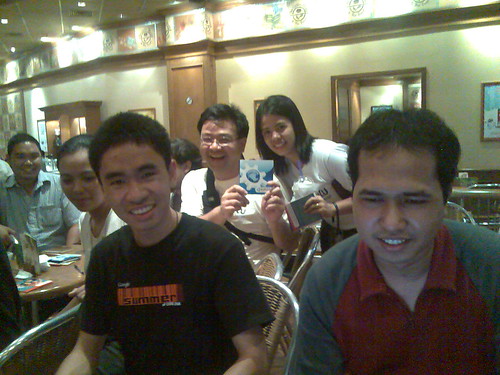
Last night I called Ubunteros nearby Manila for the Edgy Eft (belated) release party at the Coffee Bean and Tea Leaf at Greenbelt 3. Little did I know that there will be a lot of folks coming from the just-concluded FOSS@work workshop joining in the fun, thanks to Yolynne Medina and Eric Pareja. Diane Gonzales and I got to the venue first, then followed by the FOSS@Work folks. Dominique Cimafranca, Migs Paraz, Ranulf Goss, Jopes Gallardo, and Joel Bryan Juliano were there too, and all in all we were easily the noisiest group in the coffee shop, seemingly occupying the entirety of the place. I originally planned to move the group to have dinner somewhere, but along the way everybody seemed to forgot dinner and we quite engaged in talking to everyone else. It was terrific. The 2 boxes of Edgy ,K,Ed Ubuntu CDs I brought were easily given away to everyone; we even had them exchanged and autographed (naks!) reminiscent of what Ealden and I did last February when Mark came here. As a finale, we had a group photo of everyone with their CDs; Dominique remarks that in his informal’ study, more and more women prefer Ubuntu (and I sure do think he’ll be blogging more about this soon. ;) Needless to say, the above photo doesn’t do great justice to what happened last night; it came from my elric which I didn’t get use much as a camera since I too was happily chatting away. That said, I expect RJ Ian will be posting his photos from his brand-spanking-new Kodak camera to the Ubuntu-PH site once he gets back to Mindanao with Yolynne and company. I also think the FOSS@Work folks also have their own photosite or wiki to post more photos, which we’ll be seeing sooner. Jerome Gotangco and Ealden Esca an, the guys whom we all owe Ubuntu-PH to, were unfortunately unable to attend last night, as Jerome was off to Cebu to participate in the ICT congress there, while Ealden was quite busy at work. Hopefully they (as well as last night’s attendees!) can attend the next Release Party for 7.04 (aka Feisty Fawn,) and hopefully it will be just as fun, and be more meaningful if more Ubuntu-PH folks get involved in its development! Update: Yolynne and RJ just posted pics fresh from their arrival to home. Expect more pics later, nicely tagged too…

Next.

Previous.