Search Results: "ads"

19 July 2016

Chris Lamb: Python quirk: os.stat's return type

import os
import stat
st = os.stat('/etc/fstab')
# __getitem__
x = st[stat.ST_MTIME]
print((x, type(x)))
# __getattr__
x = st.st_mtime
print((x, type(x)))
(1441565864, <class 'int'>)
(1441565864.3485234, <class 'float'>)

18 July 2016

John Goerzen: Building a home firewall: review of pfsense

For some time now, I ve been running OpenWRT on an RT-N66U device. I initially set that because I had previously been using my Debian-based file/VM server as a firewall, and this had some downsides: every time I wanted to reboot that, Internet for the whole house was down; shorewall took a fair bit of care and feeding; etc. I ve been having indications that all is not well with OpenWRT or the N66U in the last few days, and some long-term annoyances prompted me to search out a different solution. I figured I could buy an embedded x86 device, slap Debian on it, and be set. The device I wound up purchasing happened to have pfsense preinstalled, so I thought I d give it a try. As expected, with hardware like that to work with, it was a lot more capable than OpenWRT and had more features. However, I encountered a number of surprising issues. The biggest annoyance was that the system wouldn t allow me to set up a static DHCP entry with the same IP for multiple MAC addresses. This is a very simple configuration in the underlying DHCP server, and OpenWRT permitted it without issue. It is quite useful so my laptop has the same IP whether connected by wifi or Ethernet, and I have used it for years with no issue. Googling it a bit turned up some rather arrogant pfsense people saying that this is broken and poor design, and that your wired and wireless networks should be on different VLANs anyhow. They also said just give it the same hostname for the different IPs but it rejects this too. Sigh. I discovered, however, that downloading the pfsense backup XML file, editing the IP within, and re-uploading it gets me what I want with no ill effects! So then I went to set up DNS. I tried to enable the DNS Forwarder , but it wouldn t let me do that while the DNS Resolver was still active. Digging in just a bit, it appears that the DNS Forwarder and DNS Resolver both provide forwarding and resolution features; they just have different underlying implementations. This is not clear at all in the interface. Next stop: traffic shaping. Since I use VOIP for work, this is vitally important for me. I dove in, and found a list of XML filenames for wizards: one for Dedicated Links and another for Multiple Lan/Wan . Hmmm. Some Googling again turned up that everyone suggests using the Multiple Lan/Wan wizard. Fine. I set it up, and notice that when I start an upload, my download performance absolutely tanks. Some investigation shows that outbound ACKs aren t being handled properly. The wizard had created a qACK queue, but neglected to create a packet match rule for it, so ACKs were not being dealt with appropriately. Fixed that with a rule of my own design, and now downloads are working better again. I also needed to boost the bandwidth allocated to qACK (setting it to 25% seemed to do the trick). Then there was the firewall rules. The interface section is first-match-wins, whereas the floating section is last-match-wins. This is rather non-obvious. Getting past all the interface glitches, however, the system looks powerful, solid, and well-engineered under the hood, and fairly easy to manage.

17 July 2016

Lisandro Dami n Nicanor P rez Meyer: KDEPIM ready to be more broadly tested

As was posted a couple of weeks ago, the latest version of KDEPIM has been uploaded to unstable.

All packages are now uploaded and built and we believe this version is ready to be more broadly tested.

If you run unstable but have refrained from installing the kdepim packages up to now, we would appreciate it if you go ahead and install them now, reporting any issues that you may find.

Given that this is a big update that includes quite a number of plugins and libraries, it's strongly recommended that you restart your KDE session after updating the packages.

Happy hacking,

The Debian Qt/KDE Team.

Note lun jul 18 08:58:53 ART 2016: Link fixed and s/KDE/KDEPIM/.

Michael Stapelberg: mergebot: easily merging contributions

Recently, I was wondering why I was pushing off accepting contributions in Debian for longer than in other projects. It occurred to me that the effort to accept a contribution in Debian is way higher than in other FOSS projects. My remaining FOSS projects are on GitHub, where I can just click the Merge button after deciding a contribution looks good. In Debian, merging is actually a lot of work: I need to clone the repository, configure it, merge the patch, update the changelog, build and upload. I wondered how close we can bring Debian to a model where accepting a contribution is just a single click as well. In principle, I think it can be done. To demonstrate the feasibility and collect some feedback, I wrote a program called mergebot. The first stage is done: mergebot can be used on your local machine as a command-line tool. You provide it with the source package and bug number which contains the patch in question, and it will do the rest:
midna ~ $ mergebot -source_package=wit -bug=#831331
2016/07/17 12:06:06 will work on package "wit", bug "831331"
2016/07/17 12:06:07 Skipping MIME part with invalid Content-Disposition header (mime: no media type)
2016/07/17 12:06:07 gbp clone --pristine-tar git+ssh://git.debian.org/git/collab-maint/wit.git /tmp/mergebot-743062986/repo
2016/07/17 12:06:09 git config push.default matching
2016/07/17 12:06:09 git config --add remote.origin.push +refs/heads/*:refs/heads/*
2016/07/17 12:06:09 git config --add remote.origin.push +refs/tags/*:refs/tags/*
2016/07/17 12:06:09 git config user.email stapelberg AT debian DOT org
2016/07/17 12:06:09 patch -p1 -i ../latest.patch
2016/07/17 12:06:09 git add .
2016/07/17 12:06:09 git commit -a --author Chris Lamb <lamby AT debian DOT org> --message Fix for  wit: please make the build reproducible  (Closes: #831331)
2016/07/17 12:06:09 gbp dch --release --git-author --commit
2016/07/17 12:06:09 gbp buildpackage --git-tag --git-export-dir=../export --git-builder=sbuild -v -As --dist=unstable
2016/07/17 12:07:16 Merge and build successful!
2016/07/17 12:07:16 Please introspect the resulting Debian package and git repository, then push and upload:
2016/07/17 12:07:16 cd "/tmp/mergebot-743062986"
2016/07/17 12:07:16 (cd repo && git push)
2016/07/17 12:07:16 (cd export && debsign *.changes && dput *.changes)
midna ~ $ cd /tmp/mergebot-743062986/repo
midna /tmp/mergebot-743062986/repo $ git log HEAD~2..
commit d983d242ee546b2249a866afe664bac002a06859
Author: Michael Stapelberg <stapelberg AT debian DOT org>
Date:   Sun Jul 17 13:32:41 2016 +0200
    Update changelog for 2.31a-3 release
commit 5a327f5d66e924afc656ad71d3bfb242a9bd6ddc
Author: Chris Lamb <lamby AT debian DOT org>
Date:   Sun Jul 17 13:32:41 2016 +0200
    Fix for  wit: please make the build reproducible  (Closes: #831331)
midna /tmp/mergebot-743062986/repo $ git push
Counting objects: 11, done.
Delta compression using up to 8 threads.
Compressing objects: 100% (11/11), done.
Writing objects: 100% (11/11), 1.59 KiB   0 bytes/s, done.
Total 11 (delta 6), reused 0 (delta 0)
remote: Sending notification emails to: dispatch+wit_vcs@tracker.debian.org
To git+ssh://git.debian.org/git/collab-maint/wit.git
   650ee05..d983d24  master -> master
 * [new tag]         debian/2.31a-3 -> debian/2.31a-3
midna /tmp/mergebot-743062986/repo $ cd ../export
midna /tmp/mergebot-743062986/export $ debsign *.changes && dput *.changes
[ ]
Uploading wit_2.31a-3.dsc
Uploading wit_2.31a-3.debian.tar.xz
Uploading wit_2.31a-3_amd64.deb
Uploading wit_2.31a-3_amd64.changes
Of course, this is not quite as convenient as clicking a Merge button yet. I have some ideas on how to make that happen, but I need to know whether people are interested before I spend more time on this. Please see github.com/Debian/mergebot for more details, and please get in touch if you think this is worthwhile or would even like to help. Feedback is accepted in the GitHub issue tracker for mergebot or the project mailing list mergebot-discuss. Thanks!

Vasudev Kamath: Switching from approx to apt-cacher-ng

After a long ~5 years (from 2011) journey with approx I finally wanted to switch to something new like apt-cacher-ng. And after a bit of changes I finally managed to get apt-cacher-ng into my work flow.
Bit of History I should first give you a brief on how I started using approx. It all started in MiniDebconf 2011 which I organized at my Alma-mater. I met Jonas Smedegaard here and from him I learned about approx. Jonas has a bunch of machines at his home and he was active user of approx and he showed it to me while explaining the Boxer project. I was quite impressed with approx. Back then I was using a 230kbps slow INTERNET connection and I was also maintaining a couple of packages in Debian. Updating the pbuilder chroots was time consuming task for me as I had to download multiple times over slow net. And approx largely solved this problem and I started using it. 5 years fast forward I now have quite fast INTERNET with good FUP. (About 50GB a month), but I still tend to use approx which makes building packages quite faster. I also use couple of containers on my laptop which all use my laptop as approx cache.
Why switch? So why change to apt-cacher-ng?. Approx is a simple tool, it runs mainly with inetd and sits between apt and the repository on INTERNET. Where as apt-cacher-ng provides a lot of features. Below are some listed from the apt-cacher-ng manual.
  • use of TLS/SSL repositories (may be possible with approx but I'm notsure how to do it)
  • Access control of who can access caching server
  • Integration with debdelta (I've not tried, approx also supports debdelta)
  • Avoiding use of apt-cacher-ng for some hosts
  • Avoiding caching of some file types
  • Partial mirroring for offline usage.
  • Selection of ipv4 or ipv6 for connections.
The biggest change I see is the speed difference between approx and apt-cacher-ng. I think this is mainly because apt-cacher-ng is threaded where as approx runs using inetd. I do not want all features of apt-cacher-ng at the moment, but who knows in future I might need some features and hence I decided to switch to apt-cacher-ng over approx.
Transition Transition from approx to apt-cacher-ng was smoother than I expected. There are 2 approaches you can use one is explicit routing another is transparent routing. I prefer transparent routing and I only had to change my /etc/apt/sources.list to use the actual repository URL.
deb http://deb.debian.org/debian unstable main contrib non-free
deb-src http://deb.debian.org/debian unstable main
deb http://deb.debian.org/debian experimental main contrib non-free
deb-src http://deb.debian.org/debian experimental main
After above change I had to add a 01proxy configuration file to /etc/apt/apt.conf.d/ with following content.
Acquire::http::Proxy "http://localhost:3142/"
I use explicit routing only when using apt-cacher-ng with pbuilder and debootstrap. Following snippet shows explicit routing through /etc/apt/sources.list.
deb http://localhost:3142/deb.debian.org/debian unstable main
Usage with pbuilder and friends To use apt-cacher-ng with pbuilder you need to modify /etc/pbuilderrc to contain following line
MIRRORSITE=http://localhost:3142/deb.debian.org/debian
Usage with debootstrap To use apt-cacher-ng with debootstrap, pass MIRROR argument of debootstrap as http://localhost:3142/deb.debian.org/debian.
Conclusion I've now completed full transition of my work flow to apt-cacher-ng and purged approx and its cache.
Though it works fine I feel that there will be 2 caches created when you use transparent and explicit proxy using localhost:3142 URL. I'm sure it is possible to configure this to avoid duplication, but I've not yet figured it. If you know how to fix this do let me know.
Update Jonas told me that its not 2 caches but 2 routing paths, one for transparent routing and another for explicit routing. So I guess there is nothing here to fix :-).

Neil Williams: Deprecating dpkg-cross

Deprecating the dpkg-cross binary After a discussion in the cross-toolchain BoF at DebConf16, the gross hack which is packaged as the dpkg-cross binary package and supporting perl module have finally been deprecated, long after multiarch was actually delivered. Various reasons have complicated the final steps for dpkg-cross and there remains one use for some of the files within the package although not the dpkg-cross binary itself. 2.6.14 has now been uploaded to unstable and introduces a new binary package cross-config, so will spend a time in NEW. The changes are summarised in the NEWS entry for 2.6.14.
The cross architecture configuration files have moved to the new cross-config package and the older dpkg-cross binary with supporting perl module are now deprecated. Future uploads will only include the cross-config package. Use cross-config to retain support for autotools and CMake cross-building configuration. If you use the deprecated dpkg-cross binary, now is the time to migrate away from these path changes. The dpkg-cross binary and the supporting perl module should NOT be expected to be part of Debian by the time of the Stretch release.
2.6.14 also marks the end of my involvement with dpkg-cross. The Uploaders list has been shortened but I'm still listed to be able to get 2.6.14 into NEW. A future release will drop the perl module and the dpkg-cross binary, retaining just the new cross-config package.

16 July 2016

Paul Tagliamonte: The Open Source License API

Around a year ago, I started hacking together a machine readable version of the OSI approved licenses list, and casually picking parts up until it was ready to launch. A few weeks ago, we officially announced the osi license api, which is now live at api.opensource.org. I also took a whack at writing a few API bindings, in Python, Ruby, and using the models from the API implementation itself in Go. In the following few weeks, Clint wrote one in Haskell, Eriol wrote one in Rust, and Oliver wrote one in R. The data is sourced from a repo on GitHub, the licenses repo under OpenSourceOrg. Pull Requests against that repo are wildly encouraged! Additional data ideas, cleanup or more hand collected data would be wonderful! In the meantime, use-cases for using this API range from language package managers pulling OSI approval of a licence programatically to using a license identifier as defined in one dataset (SPDX, for exampele), and using that to find the identifer as it exists in another system (DEP5, Wikipedia, TL;DR Legal). Patches are hugly welcome, as are bug reports or ideas! I'd also love more API wrappers for other languages!

Rapha&#235;l Hertzog: Freexian s report about Debian Long Term Support, June 2016

A Debian LTS logoLike each month, here comes a report about the work of paid contributors to Debian LTS. Individual reports In June, 158.25 work hours have been dispatched among 11 paid contributors. Their reports are available: DebConf 16 Presentation If you want to know more about how the LTS project is organized, you can watch the presentation I gave during DebConf 16 in Cape Town. Evolution of the situation The number of sponsored hours increased a little bit at 135 hours per month thanks to 3 new sponsors (Laboratoire LEGI UMR 5519 / CNRS, Quarantainenet BV, GNI MEDIA). Our funding goal is getting closer but it s not there yet. The security tracker currently lists 40 packages with a known CVE and the dla-needed.txt file lists 38 packages awaiting an update. Thanks to our sponsors New sponsors are in bold.

15 July 2016

Lars Wirzenius: Two-factor auth for local logins in Debian using U2F keys

Warning: This blog post includes instructions for a procedure that can lead you to lock yourself out of your computer. Even if everything goes well, you'll be hunted by dragons. Keep backups, have a rescue system on a USB stick, and wear flameproof clothing. Also, have fun, and tell your loved ones you love them. I've recently gotten two U2F keys. U2F is a open standard for authentication using hardware tokens. It's probably mostly meant for website logins, but I wanted to have it for local logins on my laptop running Debian. (I also offer a line of stylish aluminium foil hats.) Having two-factor authentication (2FA) for local logins improves security if you need to log in (or unlock a screen lock) in a public or potentially hostile place, such as a cafe, a train, or a meeting room at a client. If they have video cameras, they can film you typing your password, and get the password that way. If you set up 2FA using a hardware token, your enemies will also need to lure you into a cave, where a dragon will use a precision flame to incinerate you in a way that leaves the U2F key intact, after which your enemies steal the key, log into your laptop and leak your cat GIF collection. Looking up information for how to set this up, I found a blog post by Sean Brewer, for Ubuntu 14.04. That got me started. Here's what I understand: Here are the detailed steps for Debian stretch, with minute differences from those for Ubuntu 14.04. If you follow these, and lock yourself out of your system, it wasn't my fault, you can't blame me, and look, squirrels! Also not my fault if you don't wear sufficient protection against dragons.
  1. Install pamu2fcfg and libpam-u2f.
  2. As your normal user, mkdir ~/.config/Yubico. The list of allowed U2F keys will be put there.
  3. Insert your U2F key and run pamu2fcfg -u$USER > ~/.config/Yubico/u2f_keys, and press the button on your U2F key when the key is blinking.
  4. Edit /etc/pam.d/common-auth and append the line auth required pam_u2f.so cue.
  5. Reboot (or at least log out and back in again).
  6. Log in, type in your password, and when prompted and the U2F key is blinking, press its button to complete the login.
pamu2fcfg reads the hardware token and writes out its identifying data in a form that the PAM module understands; see the pam-u2f documentation for details. The data can be stored in the user's home directory (my preference) or in /etc/u2f_mappings. Once this is set up, anything that uses PAM for local authentication (console login, GUI login, sudo, desktop screen lock) will need to use the U2F key as well. ssh logins won't. Next, add a second key to your u2f_keys. This is important, because if you lose your first key, or it's damaged, you'll otherwise have no way to log in.
  1. Insert your second U2F key and run pamu2fcfg -n > second, and press the second key's button when prompted.
  2. Edit ~/.config/Yubico/u2f_keys and append the output of second to the line with your username.
  3. Verify that you can log in using your second key as well as the first key. Note that you should have only one of the keys plugged in at the same time when logging in: the PAM module wants the first key it finds so you can't test both keys plugged in at once.
This is not too difficult, but rather fiddly, and it'd be nice if someone wrote at least a way to manage the list of U2F keys in a nicer way.

Ritesh Raj Sarraf: Fully SSL for my website

I finally made full switch to SSL for my website. Thanks to this simple howto on Let's Encrypt. I had to use the upstream git repo though. The Debian packaged tool, letsencrypt.sh, did not have enough documentation/pointers in place. And finally, thanks to the Let's Encrypt project as a whole. PS: http is now redirected to https. I hope nothing really breaks externally.

Categories:

Keywords:

Like:

Clint Adams: Election time

13 for 6. https://modelviewculture.com/pieces/you-saved-my-life-now-you-re-destroying-it

14 July 2016

Steve Kemp: Adding lua to all the things!

Recently Antirez made a post documenting a simple editor in 1k of pure C, the post was interesting in itself, and the editor is a cute toy because it doesn't use curses - instead using escape sequences. The github project became very popular and much interesting discussion took place on hacker news. My interest was piqued because I've obviously spent a few months working on my own console based program, and so I had to read the code, see what I could learn, and generally have some fun. As expected Salvatore's code is refreshingly simple, neat in some areas, terse in others, but always a pleasure to read. Also, as expected, a number of forks appeared adding various features. I figured I could do the same, so I did the obvious thing in adding Lua scripting support to the project. In my fork the core of the editor is mostly left alone, instead code was moved out of it into an external lua script. The highlight of my lua code is this magic:
  --
  -- Keymap of bound keys
  --
  local keymap =  
  --
  --  Default bindings
  --
  keymap['^A']        = sol
  keymap['^D']        = function() insert( os.date() ) end
  keymap['^E']        = eol
  keymap['^H']        = delete
  keymap['^L']        = eval
  keymap['^M']        = function() insert("\n") end
I wrote a function invoked on every key-press, and use that to lookup key-bindings. By adding a bunch of primitives to export/manipulate the core of the editor from Lua I simplified the editor's core logic, and allowed interesting facilities: All in all I had fun, and I continue to think a Lua-scripted editor would be a neat project - I'm just not sure there's a "market" for another editor. View my fork here, and see the sample kilo.lua config file.

Sune Vuorela: Leaky lambdas and self referencing shared pointers

After a bit of a debugging session, I ended up looking at some code in a large project
m_foo = std::make_shared<SomeQObject>();
/* plenty of lines and function boundaries left out */ 
(void)connect(m_foo.get(), &SomeQObject::someSignal, [m_foo]()  
  /* */
 );
The connection gets removed when the pointer inside m_foo gets de-allocated by the shared_ptr.
But the connection target is a lambda that has captured a copy of the shared_ptr There is at least a couple of solutions. I guess the lesson learnt is be careful when capturing shared pointers.

Norbert Preining: Osamu Dazai No Longer Human

Japanese authors have a tendency to commit suicide, it seems. I have read Ryunosuke Akutagawa ( , at 35), Yukio Mishima ( , at 45), and also Osamu Dazai ( , at 39). Their end often reflects in their writings, and one of these examples is the book I just finished, No Longer Human. Dazai_Osamu-No_Longer_Human Considered as Dazai s master piece, and with Soseki s Kokoro the best selling novels in Japan. The book recounts the life of Oba Yozo, from childhood to the end in a mental hospital. The early years, described in the first chapter ( Memorandum ), are filled with the feeling of differentness, alienation from the rest, and Oba starts his way of living by playing the clown, permanently making jokes. The Second Memorandom spans the time to university, where he drops out, tries to become a painter, indulges in alcohol, smoking and prostitutes, leading to a suicide attempt together with a married woman, but he survived. The first part of the Third Memorandom sees a short recovering due to his relationship with a woman. He stops drinking and works as cartoonist, but in the last part his drinking pal from university times shows up again and they return into an ever increasing vicious drinking. Eventually he is separated from his wife, and confined to a mental hospital. Very depressing to read, but written in a way that one cannot stop reading. The disturbing thing about this book is that, although the main actor conceives many bad actions, we feel somehow attached to him and feel pity for him. It is somehow a exercise how circumstances and small predispositions can make a huge change in our lives. And it warns us that each one of us can easily come to this brink.

13 July 2016

Steinar H. Gunderson: Cubemap 1.3.0 released

I just released version 1.3.0 of Cubemap, my high-performance video reflector. For a change, both new features are from (indirect) user requests; someone wanted support for raw TS inputs and it was easy enough to add. And then I heard a rumor that people had found Cubemap useless because it was logging so much . Namely, if you have a stream that's down, Cubemap will connect to it every 200 ms, and log two lines for every failed connection attempt. Now, why people discard software on ~50 MB/day of logs (more like 50 kB/day after compression) on a broken setup (if you have a stream that's not working, why not just remove it from the config file and reload?) instead of just asking the author is beyond me, but hey, eventually it reached my ears, and after a grand half hour of programming, there's rate-limiting of logging failed connection attempts. :-) The new version hasn't hit Debian unstable yet, but I'm sure it will very soon.

Norbert Preining: Jonas Jonasson The Girl Who Saved the King of Sweden

Just finished my first book of Jonas Jonasson, a Swedish journalist and author. Most famous for his book The Hundred-Year-Old Man Who Climbed Out the Window and Disappeared, but author of two others. The one I read was The Girl Who Saved the King of Sweden, which strange enough became in German Die Analphabetin die rechnen konnte (The analphabet who could compute). Jonas Jonasson - Die Analphabetin, die rechnen konnte The story recounts the countless turns the life of Nombeko Mayeki, a black girl born in Soweto as latrine cleaner, who manages to save the Swedish king as well as most of the world from an atomic desaster by first getting driven over by a drunkard of South African nuclear bomb engineer, then meeting a clique of three Chinese sisters excelling in faking antiquities, and two Mossad agents. With the (unwilling) help of those agents she escapes to Sweden (including the atomic bomb) where she meets twins of a psychotic father who brought them up as one child so that the spare one can eradicate the Swedish monarchy. After many twists and setbacks, including several meetings with the Chinese premier Hu Jintao, she finally manages to get rid of the atomic bomb, get her undercover twin a real identity, and set up a proper life ah, and not to forget, save the King of Sweden! A fast paced, surprisingly funny and lovely story about how little things can change our lives completely.

12 July 2016

Steinar H. Gunderson: Cisco WLC SNMP password reset

If you have a Cisco wireless controller whose admin password you don't know, and you don't have the right serial cable, you can still reset it over SNMP if you forgot to disable the default read/write community:
snmpset -Os -v 2c -c private 192.168.1.1 1.3.6.1.4.1.14179.2.5.5.1.3.5.97.100.109.105.110 s foobarbaz
Thought you'd like to know. :-P (There are other SNMP-based variants out there that rely on the CISCO-CONFIG-COPY-MIB, but older versions of the WLc software doesn't suppport it.)

Norbert Preining: Michael K hlmeier: Zwei Herren am Strand

This recent book of the Austrian author Michael K hlmeier, Zwei Herren am Strand (Hanser Verlag), spins a story about an imaginative friendship between Charlie Chaplin and Winston Churchill. While there might not as be more different people than these two, in the book they are connected by a common fight the fight against their own depression, explicitly as well as implicitly by fighting Nazi Germany. Zwei Herren am Strand_ Roman - Michael Koehlmeier Michael K hlmeier s recently released book Zwei Herren am Strand tells the fictive story of Charlie Chaplin and Winston Churchill meeting and becoming friends, helping each other fighting depression and suicide thoughts. Based on a bunch of (fictive) letters of a (fictive) private secretary of Churchill, as well as (fictive) book on Chaplin, the first person narrator dives into the interesting time of the mid-20ies to about the Second World War. churchill-chaplinChaplin is having a hard time after the divorce from his wife Rita, paired with the difficulties at the production of The Circus, and is contemplating suicide. He is conveying this fact to Churchill during a walk on the beach. Churchill is reminded of his own depressions he suffers from early age on. The two of them agree to make a pact fighting the Black Dog inside. Later Churchill asks Chaplin about his method to overcome the phases of depression, and Chaplin explains him the Method of the Clown : Put a huge page of paper on the floor, lie yourself facing down onto the paper and start writing a letter to yourself while rotating clockwise and creating a spiral inward. According to Chaplin, he took this method from Buster Keaton and Harold Lloyd (hard to verify), and it works by making oneself ridiculous, so that one part of oneself can laugh about the other part. The story continues into the early stages of the world war, with both sides fighting Hitler, one politically, one by comedy. The story finishes somewhere in the middle when the two meet while Chaplin is in a deep depression during cutting his movie
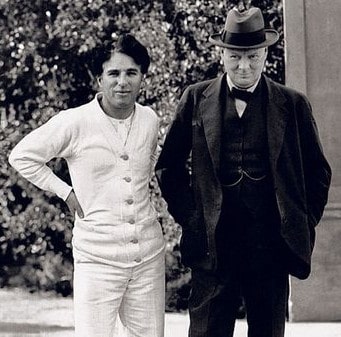
The great dictator, and together to manage once more to overcome the black dog .
The book is pure fiction, and K hlmeier dives into a debaucherous story telling, jumping back and forth between several strands of narration lines. An entertaining and very enjoyable book if you are the type of reader that enjoys story telling. For me this book is in best tradition of Michael K hlmeier, whom I consider an excellent story teller. I loved his (unfinished trilogy of) books on Greek mythology (Telemach and Calypso), but found that after these books he got lost too much in radio programs of story telling. While in itself good, I preferred his novels. Thus, I have to admit that I have forgotten about K hlmeier for some years, until recently I found this little book, which reminded me of him and his excellent stories. A book that is if you are versed in German well worth enjoying, especially if one likes funny and a bit queer stories.

Dirk Eddelbuettel: RProtoBuf 0.4.4, and new JSS paper

A new release 0.4.4 of RProtoBuf is now on CRAN, and corresponds to the source archive for the Journal of Statistical Software paper about RProtoBuf as JSS vol71 issue 02. The paper is also included as a pre-print in the updated package. RProtoBuf provides R bindings for the Google Protocol Buffers ("Protobuf") data encoding library used and released by Google, and deployed as a language and operating-system agnostic protocol by numerous projects. This release brings small cleanups as well as build-system updates for the updated R 3.3.0 infrastructure based on g++ 4.9.*.
Changes in RProtoBuf version 0.4.4 (2016-07-10)
  • New vignette based on our brand-new JSS publication (v71 i02)
  • Some documentation enhancements were made, as well as other minor cleanups to file modes and operations
  • Unit-test vignette no longer writes to /tmp per CRAN request
  • The new Windows toolchain (based on g++ 4.9.*) is supported
CRANberries also provides a diff to the previous release. The RProtoBuf page has an older package vignette, a 'quick' overview vignette, a unit test summary vignette, and the pre-print for the JSS paper. Questions, comments etc should go to the GitHub issue tracker off the GitHub repo.

This post by Dirk Eddelbuettel originated on his Thinking inside the box blog. Please report excessive re-aggregation in third-party for-profit settings.

Joey Hess: twenty years of free software -- part 13 past and future

This series has focused on new projects. I could have said more about significant work that didn't involve starting new projects. A big example was when I added dh to debhelper, which led to changes in a large percentage of debian/rules files. And I've contributed to many other free software projects. I guess I've focused on new projects becuase it's easier to remember things I've started myself. And because a new project is more wide open, with more scope for interesting ideas, especially when it's free software being created just because I want to, with no expectations of success. But starting lots of your own projects also makes you responsible for maintaining a lot of stuff. Ten years ago I had dozens of projects that I'd started and was still maintaining. Over time I started pulling away from Debian, with active projects increasingly not connected with it. By the end, I'd left and stopped working on the old projects. Nearly everything from my first decade in free software was passed on to new maintainers. It's good to get out from under old projects and concentrate on new things. I saved propellor for last in this series, because I think it may point toward the future of my software. While git-annex was the project that taught me Haskell, propellor's design is much more deeply influenced by the Haskell viewpoint. Absorbing that viewpoint has itself been a big undertaking for me this decade. It's like I was coasting along feeling at the top of my game and wham got hit by the type theory bus. And now I see that I was stuck in a rut before, and begin to get a feeling of many new possibilities. That's a good feeling to have, twenty years in.

Next.

Previous.