Search Results: "reg"

6 May 2011

Asheesh Laroia: I'm going to Libre Graphics Meeting 2011

This is just a quick note to say: Next week, I am going to be at: My goals for the conference: I'm going to arrive in Montreal at 6:30am on Tuesday on an overnight Greyhound bus from Boston. So another goal: If you want to say hi to me during the conference, email me and make sure we meet up!

5 May 2011

Gunnar Wolf: I am going to DebConf11 Banja Luka, Bosnia & Herzegovina

Yay! I'm going to DebConf11 As others have started posting in Planet Debian, I'll do my part: Yesterday I finished booking our flights, so if everything goes as planned, Reg and me will be arriving to Zagreb (Croatia) at 21:30, Monday July 18, to take part of the 12th Debian development conference, DebConf11, in Banja Luka, Bosnia & Herzegovina! Of course, reiterating this will never hurt: Do you want to support a global-scale, well-recognized, community-based Free Software project development? Be a sponsor for DebConf11!" Be a sponsor for DebConf11! Want some more DebConf11 banners and posters?

Michael Prokop: I am going to DebConf11

* Just registered myself for DebConf11, see you in Banja Luka.

Meike Reichle: Finally finished my registration for DC11

Let's see ... ... I guess I am going to DebConf :D I am going to DebConf 11

4 May 2011

Daniel Kahn Gillmor: test-driven development: refactoring, difficulties

liw recently wrote about test-driven development:
This all sounds like a lot of bureaucratic nonsense, but what I get out of this is this: once all tests pass, I have a strong confidence that the software works. As soon as I've added all the features I want to have for a release, I can push a button to push it out
To my mind, this is only one of the benefits. He doesn't describe another major benefit, which is the confidence with which you can take on re-factoring in projects with well-developed test infrastructure. If your project has no test infrastructure at all, and you make a deep and/or potentially invasive change, you might well produce something that is heinously broken for users who have a different pattern of using the tool than you do. But if you have a well-developed, reasonable test suite with fairly wide coverage, you can make a deep or invasive change, and be confident that -- if the tests all pass -- the stuff you release isn't going to be too horrific. And if you do break something with a change which the test suite didn't cover, that's an indication that the test suite is lacking. Hopefully, you can factor out a problem report into its own test, so that future changes will ensure that the behavior doesn't regress too. The upshot of more-confident re-factoring is that your development can be much bolder, you can roll out new features more quickly, and you can spend less time agonizing about whether you've got the various abstraction layers exactly right the first time through. These are all good things (though i do think the agony of abstraction perfectionism is well-warranted in some contexts, like API definitions, and wouldn't want test-driven development to make people give up on that necessary task). when testing can't cover everything Some things are just hard to test well. for example, if you have 20 different boolean options to a command-line tool, you can't realistically test them in all combinations and permutations; that would be over a million tests. User experience is also notoriously difficult to test, as are tools that rely heavily on network interaction, which can be flakey and unpredictable. other downsides Test suites themselves require maintenance, as the components they rely on can change over time. More than once, i've had a test suite failure that was really a failure of the test infrastructure, not the code itself. But in those same projects, that's usually followed or preceded by a test suite failure that picks out a particularly nasty or subtle bug in the tested code that might have persisted for quite a while unnoticed. So the test suite does in some sense create more work all around. more and better testing is good for Debian Even when we know that coverage isn't perfect, and even with its additional overhead, well-integrated tests (at the unit level and more generally) are worth the tradeoffs. It's worth doing because of the robustness and guarantees that we can give each other with regularly-tested code. It's a more stable foundation which surprisingly also gives us more flexibility going forward. This is good for free software in general. It also helps us find our bugs before our users do, so it's better for our users. So more and better testing directly supports the two main priorities outlined in the Debian Social Contract.

Gerfried Fuchs: Different Interpretations

Mostly everything in life boils down to the same troublesome issue: people are reading different things into what they read, and interpret them regularly in a way it wasn't meant to. It seems that in certain areas a culture of interpreting things in a bad way instead of good or asking how they were actually meant has established the rules of (not) working together but rather against each other and around each other. At times I would like to account it to language barriers, or cultural differences, but it happens with people from all areas so that reasoning would be too easy. Even artists manage to do that, and in that certain area it creates something extremely creative and thoughtful. This blog entry thus contains three songs and six videos: Two different interpretations of the same lyrics. Maybe this is able to stir some thinking process whether the interpretation that one found for a given situation might be biased or even just looking from the wrong angle. Enjoy! One thing I'd like to mention, and that is two cross references to former blog entries. For the first song, James Iha played as guitarist in The Smashing Pumpkins before he joined A Perfect Circle. The second cross reference is with respect to my former blog entry about the Wise Guys: They did also cover Mad World, in the Gary Jules' interpretation but of course in a capella.

/music permanent link Comments: 6 Flattr this

3 May 2011

Craig Small: IPv6 and address translation

We re in that in-between place where there is plenty of IPv4 out there, but sometimes you either need or want to get to IPv6 addresses. With the IPv4 address allocations out of ARIN now empty there is going to be an increased need of NAT either between the address families or within it. This is a quick overview of the different sorts of systems that do this address translations. 6tunnel The best way to describe this is port forwarding across the address families. You can have a IPv4 port on your local device that when you connect to it forwards the connection via IPv6 to a remote device, perhaps on a different port. You can also do it the other way, so connecting to a local IPv6 port will connect to a remote IPv4 port. Of course remote could be another port on the same computer. Squid You could replace squid with any other sort of proxy server that can work as a reverse proxy and understands IPv6. From the deployments I ve heard of, this arrangement where the IPv4 only webservers are front-ended with a dual stack IPv4/IPv6 squid (or other) reverse proxy server or set of servers. It is a real simple way of getting your webserver onto IPv6, if you cannot do it in the webserver itself. The usual advantages and disadvantages of using a reverse proxy apply here. The better long-term solution is to have the servers just run IPv6 natively, but this is a reasonable stop-gap. That s a brief overview of the various packages out there that can help with address translation to either get your servers understanding IPv6 or a client to get to an IPv6 server. Ideally these are only temporary measures but as some methods people use to write programs (the latest I ve seen has weird hard-coded 4 byte offset tree-table with 256 long list inside good luck fixing that!) they may be temporary for some time. Tayga This program implements NAT64 which is a 1:1 address translation. It can work both ways so IPv6 clients can connect to IPv4 servers and vice-versa. You would normally use this for your own hosts, rather than for connecting to the internet as you need to specify prefixes. It works like the old style static nat ranges in IPv4 where 1.1.1.10-100 would map to 2.2.2.10-100 tnat64 Now this package is a little back-to-front to the others in that it takes an existing IPv4 only application and makes it able to connect, at least at the socket level, to a IPv6 server. It works by preloading a library which overloads the socket functions like socket() and connect() so it can attempt to find IPv6 servers. totd This is a small DNS proxy which can be used to translate IPv4 A records to IPv6 AAAA records. You often use it with translation technologies like Tayga.
totd This is a small DNS proxy which can be used to translate IPv4 A records to IPv6 AAAA records. You often use it with translation technologies like Tayga.

Pietro Abate: On the apt-get installation plan

One important aspect of the mancoosi project is to build a model of the installation process in order to simulate packages upgrades before committing the changes on the machine. This work described here and here (and in upcoming publications) relays on the availability installation plan of the meta-installer (the exact order in which packages will be installed, configured and removed ) to run a simulation of maintainers scripts and check for potential problems accordingly to the model. Thanks to the help of Julian Andres Klode upstream and maintainer of the python-apt bindings it is now possible to extract the installation plan from apt-get without resorting to debug printout or other hacks. A forthcoming integration with mpm (Mancoosi-Package-Manager, our testbed meta-installer) will give us the possibility to hook the model checker to the meta-installer and to run it before every upgrade. The two important changes in the python-apt bindings that will make this possible are the new bindings to the class OrderList and the sub-classing of the class package manager. PackageManager . Regarding the latter, this is a small example (thanks again Julien !) that you can use to get the installation plan as computed by apt-get. In theory, this will also allow to experiment with different back-ends (like rpm - blah ! :) ) easily without the need to hack the c++ code.
import apt_pkg, sys
import apt

class PkgManager(apt_pkg.PackageManager):

parent = apt_pkg.PackageManager
depcache = apt_pkg.DepCache(apt_pkg.Cache())
installionplan = []

def install(self, pkg, file):
#print "Installing", pkg.get_fullname(True)
self.installionplan.append((pkg,"Inst"))
return True

def configure(self, pkg):
#print "Configuring", pkg.get_fullname(True)
self.installionplan.append((pkg,"Conf"))
return True

def remove(self, pkg, purge):
#print "Removing", pkg.get_fullname(True)
self.installionplan.append((pkg,"Rem"))
return True

def go(self, fd):
for (p,a) in self.installionplan :
if a == "Inst" or a == "Conf" :
ver = self.depcache.get_candidate_ver(p)
else :
ver = p.current_ver
print a, p.name, ver.ver_str, ver.arch

return True

apt_pkg.PackageManager = PkgManager


cache = apt.Cache()
pkg = cache["python"]
if pkg.is_installed:
pkg.mark_delete()
else:
pkg.mark_install()

apt_pkg.config.set("APT::Get::Simulate","true")
apt_pkg.config.set("dir::cache","/tmp")

print "COMMIT"
cache.commit(install_progress=apt.progress.base.InstallProgress())
And this is the result on my machine :
abate@zed.fr:~$python pkgmanager-test.py
Reading package lists... Done
Building dependency tree
Reading state information... Done
COMMIT
Rem alacarte 0.13.2-1 all
Rem apt-listchanges 2.85.7 all
Rem apt-xapian-index 0.41 all
Rem gnome-accessibility 1:2.30+7 all
Rem gok 2.30.0-1 amd64
Rem dasher 4.11-1 amd64
Rem gnome-orca 2.30.2-2 all
Rem python-pyatspi 1.30.1-3 all
Rem at-spi 1.30.1-3 amd64
Rem bluetooth 4.91-1 all
Rem gnome-bluetooth 2.30.0-2 amd64
Rem bluez 4.91-1 amd64
Rem brasero 2.30.3-2 amd64
Rem gthumb 3:2.13.1-1 amd64
Rem libbrasero-media0 2.30.3-2 amd64
Rem brasero-common 2.30.3-2 all
Rem bzr 2.3.1-2 all
Rem gnome-core 1:2.30+7 amd64
Rem gnome-control-center 1:2.30.1-3 amd64
Rem capplets-data 1:2.30.1-3 all
Rem cheese 2.30.1-2 amd64
Rem cheese-common 2.30.1-2 all
Rem cython 0.14.1-5 amd64
Rem dasher-data 4.11-1 all
Rem deluge 1.3.1-1 all
Rem deluge-gtk 1.3.1-1 all
Rem deluge-common 1.3.1-1 all
Rem deskbar-applet 2.32.0-1+b1 amd64
Rem dia 0.97.1-8 amd64
Rem dia-common 0.97.1-8 all
Rem doxygen 1.7.4-1 amd64
Rem doxygen-latex 1.7.4-1 all
Rem dput 0.9.6.2 all
Rem duply 1.5.4.2-1 all
Rem duplicity 0.6.13-1 amd64
Rem edos-debcheck 1.0-9 all
Rem edos-distcheck 1.4.2-12 amd64
Rem eog 2.30.2-1 amd64
Inst libxp6 1:1.0.1-1 amd64
Inst lesstif2 1:0.95.2-1 amd64
Inst xpdf 3.02-12 amd64
Conf libxp6 1:1.0.1-1 amd64
Conf lesstif2 1:0.95.2-1 amd64
Conf xpdf 3.02-12 amd64
[ ... ]

Josselin Mouette: Rolling release

Since this has been a major request from users for a long time, I can only cool with the idea of seeing the Debian project support a rolling release. However I m not pleased with the proposed ideas, since they don t actually include any serious plan to make this happen. Sorry guys, but a big GR that says We want a pony rolling release to happen doesn t achieve anything. Let me elaborate. First of all, discussions have focused a lot on what to do when we re in a freeze phase. Numerous cool ideas have been proposed, including PPAs (which again, won t happen until someone implements them). This is all good, but this is only the tip of the iceberg. Above all, before wondering what can happen in a freeze that lasts 20% of the time, let s wonder what can happen for the 80% remaining time. Once you have something that works in the regular development phase, you can tune it to make it happen, even if in a less optimal way, when the distribution is frozen. So let s not put the cart before the horse. There are three options if you want to make a rolling release happen.
  1. Make unstable usable. to make it happen, you have to prevent the disasters that rarely but unavoidably happen here. You don t want to make all rolling systems unusable because someone broke grub or uploaded a new version of udev that doesn t work with the kernel.
  2. Make testing usable. This sounds easy since RC-buggy packages are already prevented from migrating, but actually it is not. A large number of RC bugs are discovered at the time of testing migration, when some packages migrate and others don t. Worst of all, they require several days to be fixed, and it is very often that they require several months, when one of the packages gets entangled in a transition.
  3. Create a new suite for rolling usage.
The proponents of the CUT project obviously believe in option 2. Unfortunately, I haven t seen many things that could make it happen. A possible way to fix the situation would be to run large-scale regression testing on several upgrade paths. I don t know if there are volunteers for this, but that won t be me. That would also imply to make a lot of important bugs RC, since they could have a major effect on usability, but the release team will not be keen to make it happen. Because of the testing situation, when someone asks me for a rolling release, I point her to unstable with apt-listbugs. As of today, this is the closest thing we have to a rolling release, so we should probably examine more deeply option 1. Is it that complicated to write a tool to prevent upgrades to broken packages? A 2-day delay in mirror propagation and a simple list of broken packages/versions (like the #debian-devel topic, would be enough. Add an overlay archive, that works like experimental, and you can now handle freezes smoothly. Wait isn t that aptosid? We would probably gain a lot of insight from the people who invented this, instead of trying to reinvent the wheel. Finally, option 3 could open new horizons. There s a risk that it might drive users away from the testing and unstable suites, and this makes us wonder how we could have proper testing for our packages. Still, build a process that would (and that s really only an example) freeze unstable every month, give people 10 days to fix the most blatant issues, add a way to make security updates flow in from unstable, and you have a really nice rolling distribution. So overall, it only requires people to make things happen. You want option 2 to happen? Instead of working on GR drafts, start working with maintainers and release managers on ways to avoid breakage in testing. You want option 3 to happen? Start it as a new .debian.net service and see how it works. Personally, I d be in favor of offering aptosid developers to become DDs and offer their solution as a Debian service. It would bring in new people rather than driving away existing developers from working on our releases.

2 May 2011

Russell Coker: This Event Will be Photographed

sign saying This event will be photographed. Images may be used in Banyule City Council promotional material (posters, website, flyers etc).  If you do not want your image used, please go to Event Control staff and tell them. The above sign was prominently displayed at a fair that was recently run by the Banyule Council. We have had some discussions in the Linux community about what policies should be used in regard to photography at events, it seems that this is a precedent for being able to opt-out of public photography.

30 April 2011

Russell Coker: Autism Awareness and the Free Software Community

It s Autism Awareness Month April is Autism Awareness month, there are lots of articles about Autism, most of them are at best misleading if not wrong. The most common error seems to be describing non-verbal Autistic children and then claiming that Autistic people comprise about 1% of the population. The number of non-verbal Autistic children is a lot less than 1% of the population, and at least 1/3 of the people on the Autism Spectrum have good verbal skills and often talk more than average. To be precise, they are describing the symptoms of people who would be diagnosed with Severity 3 according to the American Psychiatric Association s Diagnostic and Statistical Manual (the DSM) as applying to all people who are on the Autism Spectrum even though of the currently diagnosed people probably about 1/3 might be classified as Severity 2 and 1/3 as Severity 1. It seems that severity 1 Autism is going to be the replacement for Asperger Syndrome in the new DSM-5. The problem with misleading information in regard to what comprises Autism is that parents really don t want to have a child who s abnormal and search for evidence to make their wishes come true. At the extreme there are parents who can convince themselves that a 4yo non-verbal child isn t on the Autism Spectrum. When people are given the impression that Autism is only about non-verbal children then they will probably think that a 6yo who can give a half-hour lecture on a topic of interest (regardless of whether the audience is interested) isn t on the Autism Spectrum. There is also a similar issue with undiagnosed adults, I would have probably got assessed at least a decade earlier if I had learned more about Autism instead of believing some of the stories. In a quick Google search for Autism Awareness Month I haven t found any clear and accurate information on what Autism is or what should be done about it, so it seems to me that the awareness project has largely been a failure. The Autism page on Wikipedia [1] and the page for Asperger Syndrome [2] are good places to start reading. By merely pointing to those two Wikipedia pages I ve made this post a lot more useful than every article I ve seen in the mainstream media. To find some useful and insightful posts about Autism awareness you have to add some search terms such as neurodiversity, which turns up posts such as a post by Leah Jane about Autism Acceptance [3]. It seems that the Autism Awareness articles that are most useful at informing people will only be found by people who are already aware of some of the issues. Most People Who Read this are Geeks The majority of the readers for my blog come from aggregators that cater to fairly geeky people. Geek culture is largely Aspie culture. So I think that most people who read my blog have a good general knowledge of what people who might be diagnosed with Asperger Syndrome or High Functioning Autism are like they just think that such people are merely a bit more geeky than is typical for the Free Software community. So it s not as if all Autistic people are hidden away somewhere because they can t live independently. Many of us work in the computer industry and in academia. Probably the majority of people who have a university degree related to science or engineering have had a professor who was on the Autism Spectrum, probably most people who have any significant experience in the computer industry have had colleagues who are on the Spectrum. After having become used to the geek culture I initially found it difficult to believe that I could be on the Autism Spectrum because I knew heaps of people in the Free Software community who are at least as geeky as me but apparently weren t on the Autism Spectrum. I now think that the majority of people who are as geeky as me would get diagnosed with Asperger Syndrome (or High Functioning Autism under DSM-5) if they were assessed. Adult Diagnosis If you are wondering whether you might be on the Autism Spectrum then it s worth reading the pages linked from the DSM 5 draft process have the full diagnostic criteria (both for DSM-4 and DSM-5) [4]. Also Glenn Rowe has a web page with tests designed by Professor Simon Baron-Cohen [5] and Leif Ekblad has a project to do long-term analysis of changes to personality test scores which starts with a quick Aspie quiz [6] (and also has lots of links to other relevant sites). If you think that you might be on the Autism Spectrum (which means Asperger Syndrome in the case of most people who read my blog) then I recommend that you get assessed if possible. As assessment by a psychologist isn t cheap there is the option of self-diagnosis in which case Chaotic Idealism s post about self-diagnosis is worth reading [7].

Julien Blache: forked-daapd: v0.16

forked-daapd v0.16 is a bugfix release, mainly addressing a bad regression introduced in v0.15. Fixes: The DAAP bug is what causes an incorrect display and sorting in iTunes, the tags issue could cause a segfault in some cases, and finally fixing the file size in the HTTP streaming code may or may not fix some issues but was a bad bug anyway. Tarballs available at http://alioth.debian.org/~jblache/forked-daapd/ ; GPG signatures made with my Debian key F5D65169.

28 April 2011

Russell Coker: What is Valid SE Linux Policy?

Guido Trentalancia started an interesting discussion on the SE Linux policy development list about how to manage the evolution of the policy [1]. The Problem The SE Linux policy is the set of rules that determine what access is granted. It assigns types to files and domains to processes and has a set of rules that specify all the permitted interactions between processes and files (among many other things). The policy evolves over time to match the requirements of programs (applications and daemons). As a program evolves the things that it does will change and the SE Linux policy will tend to evolve to permit the set of all operations that were requested by all versions because people only complain when things stop working not when excessive privilege is granted. So we need to periodically remove old allow rules from the policy. One difficulty in this regard is the fact that multiple versions of programs are often available for use at the same time. Debian in particular has a good history of providing separate packages for the old and new versions of programs such as Apache to meet the needs of users who want the tried and tested version and of users who want the newer version with better performance, more features, better documentation, or something else good. There is also a demand to have the same policy work with multiple versions of a distribution without excessive effort. Finally all the distributions that have SE Linux support have different people deciding when the new version of a daemon is ready for inclusion and therefore there is a need to support multiple versions for multiple distributions. So support for older versions of daemons can t be removed easily. One of the things I do to make these things a little easier to manage is to put ifdef( distro_debian', before any Debian specific bits of policy. When policy is conditional and only used in Debian I can freely remove it at any future time if Debian works well without it. Also it doesn t matter if such Debian specific policy allows access that is not needed or desired in other distributions, the only down-side to this is that sometimes other distributions need to repeat work that I did, they determine what access is needed for their configuration and discover that it was already enabled for Debian. What is Valid Policy? We went to only have Valid Policy (as described by Christopher J. PeBenito), so the challenge is determining what is Valid Policy. It seems to me that there are three type of access granted by valid policy (it is debatable whether type #3 is valid):
  1. Access that is needed for an application to perform it s minimal designed task.
  2. Access that is needed for the application to perform all the optional configurations, EG an ftpd running from inetd or as a daemon, and daemons like http server being granted access to ssl keys or not.
  3. Access that is needed to perform all the operations the application requests, but which the application doesn t require or shouldn t require if it worked correctly.
Some common operations that aren t required include opening utmp for write, searching /root, and many other relatively innocuous access attempts which don t affect the program operation if they are denied. There are also many things such as writing temporary files to /root that don t seem unusual if the application developer is not considering SE Linux (but which are often considered bad practice anyway). Some of these things (like using /root for stuff that belongs in /var/lib) have the potential to break things (for the daemon or for other system processes) even if you don t consider SE Linux. How to deal with those types:
  1. In most cases this can be determined without too much effort. For example a web server needs to listen on port 80 and read files and directories that relate to data. When writing policy I can write a lot of the allow rules without even testing the application because I know from the design what it will do. A large part of the other access is obvious in a I can t believe I didn t realise it would need this sense.
  2. The main question here is whether we have booleans (settings which can be tuned at run-time by the sysadmin which determine how the policy works) to specify which optional tasks or whether we allow all access for optional configurations by default. The secondary question is when certain unusual corner cases should be not supported at all such that the people who do such unusual corner cases need to use audit2allow to generate local policy to allow their operations.
  3. Sometimes we have to allow things that we really don t like. Even when we write policy to allow a daemon to do unusual things (such as using /root instead of /var/lib) it s still a lot better than running without SE Linux. Also SE Linux policy to allow such obviously broken things stands out and is a constant reminder that the daemon needs fixing, this is better than allowing symptoms of broken design to be forgotten.
How to Improve the Situation We could have comments in the policy source for everything that is in category 3. If the comments had a fixed format so that a recursive grep could find them all then it would allow us to more easily remove the gross things from the policy at a later date. But it seems to me that the main problem is a lack of people working on this. I am not aware of any people actively testing Debian policy for excessive privilege in regard to such issues.

Raphaël Hertzog: No freeze of Debian s development, what does it entail?

The main feature of rolling is that it would never freeze. This is not without consequences. Possible consequences It can divert developers from working on the release No freeze means developers are free to continue their work as usual in unstable. Will it be more difficult to release because some people will spend their time working on a new upstream version instead of fixing RC bugs in the version that is frozen? Would we lose the work of the people who do lots of NMU to help with the release? It makes it more difficult to cherry-pick updates from unstable No freeze also means that unstable is going to diverge sooner from testing and it will be more difficult to cherry-pick updates from unstable into testing. And the release team likes to cherry-pick updates that have been tested in unstable because updates that comes through testing-proposed-updates have often not been tested and need thus a more careful review. Frozen earth My responses to the objections Those are the two major objections that we ll have to respond to. Let s try to analyze them a bit more. It s not testing vs rolling On the first objection I would like to respond that we must not put testing and rolling/unstable in opposition. The fact that a contributor can t do its work as usual in unstable does not mean that he will instead choose to work on fixing RC bugs in testing. Probably that some do, but in my experience we simply spend our time differently, either working more on non-Debian stuff or doing mostly hidden work that is then released in big batches at the start of the next cycle (which tends to create problems of its own). I would also like to argue that by giving more exposure to rolling and encouraging developers to properly support their packages in rolling, it probably means that the overall state of rolling should become gradually better compared to what we re currently used to with testing. The objection that rolling would divert resources from getting testing in a releasable shape is difficult to prove and/or disprove. The best way to have some objective data would be to setup a questionnaire and to ask all maintainers. Any volunteer for that? Unstable as a test-bed for RC bugfixes? It s true that unstable will quickly diverge from testing and that it will be more difficult to cherry-pick updates from unstable into testing. This cannot be refuted, it s a downside given the current workflow of the release team. But I wonder if the importance of this workflow is not overdone. The reason why they like to cherry-pick from unstable is because it gives them some confidence that the update has not caused other regressions and ensures that testing is improving. But if they re considering to cherry-pick an update, it s because the current package in testing is plagued by an RC bug. Supposing that the updated package has introduced a regression, is it really better to keep the current RC bug compared to trading it for a new regression? It sure depends on the precise bugs involved so that s why they prefer to know up-front about the regression instead of making a blind bet. Given this, I think we should use testing-proposed-updates (tpu) as a test-bed for RC bug fixes. We should ask beta-testers to activate this repository and to file RC bugs for any regression. And instead of requiring a full review by a release manager for all uploads to testing-proposed-updates, uploads should be auto-accepted provided that they do not change the upstream version and that they do not add/remove binary packages. Other uploads would still need manual approval by the release managers. On top of this, we can also add an infrastructure to encourage peer-reviews of t-p-u uploads so that reviews become more opportunistic instead of systematic. Positive reviews would help reduce the aging required in t-p-u before being accepted into testing. This changes the balance by giving a bit more freedom to maintainers but still keeps the safety net that release managers need to have. It should also reduce the overall amount of work that the release team has to do. Comments welcome Do you see other important objections beside the two that I mentioned? Do you have other ideas to overcome those objections? What do you think of my responses? Does your experience infirm or confirm my point of view?

18 comments Liked this article? Click here. My blog is Flattr-enabled.

Patrick Schoenfeld: On Debian discussions

In my article "Last time I've used network-manager" I made a claim for which I've been criticized by some people, including Stefano, our current (and just re-elected) DPL. I said that a certain pattern, which showed up in a certain thread, were a prototype for discussions in the Debian surroundings.

Actually I have to commit, that this was a very generalizing statement, making my own point against the discussion point back directly at myself.
Because as Stefano said correctly there has been some progress in the Debian discussion cult.
Indeed, there are examples of threads, were discussions followed another scheme.
But to my own advocacy I have to say that such changes are like little plants (in the botanical sense). They take their time to grow and as long as they are so very new, they are very vulnerable to all small interruptions. Regardless of how tiny those interruptions may seem.

I've been following Debian discussions for 6 or 7 years. That scheme I was describing was that which had the most visibility of all Debian discussions. Almost every discussion which were important for a broader audience followed that scheme. It has a reason that Debian is famous for flamewars.
In a way its quiet similar to the network-manager perception, some people have. Negative impressions manifest themselves. Especially if they have years of time.
Positive impressions does not have a chance to manifest themselves as long as the progress is not visible enough to survive small interruptions.

I hope that I didn't cause to much damage with my comment, which got cited (context-less) on other sites. Hopefully the Debian discussion cult will improve further to a point where there is no difference between the examples of very good, constructive discussions we already have in some parts of the project and the project-wide decision-making-discussions which affect a broad audience and often led to flamewars.

27 April 2011

Kees Cook: non-executable kernel memory progress

The Linux kernel attempts to protect portions of its memory from unexpected modification (through potential future exploits) by setting areas read-only where the compiler has allowed it (CONFIG_DEBUG_RODATA). This, combined with marking function pointer tables const , reduces the number of easily writable kernel memory targets for attackers. However, modules (which are almost the bulk of kernel code) were not handled, and remained read-write, regardless of compiler markings. In 2.6.38, thanks to the efforts of many people (especially Siarhei Liakh and Matthieu Castet), CONFIG_DEBUG_SET_MODULE_RONX was created (and CONFIG_DEBUG_RODATA expanded). To visualize the effects, I patched Arjan van de Ven s arch/x86/mm/dump_pagetables.c to be a loadable module so I could look at /sys/kernel/debug/kernel_page_tables without needing to rebuild my kernel with CONFIG_X86_PTDUMP. Comparing Lucid (2.6.32), Maverick (2.6.35), and Natty (2.6.38), it s clear to see the effects of the RO/NX improvements, especially in the Modules section which has no NX markings at all before 2.6.38:
lucid-amd64# awk '/Modules/,/End Modules/' /sys/kernel/debug/kernel_page_tables   grep NX   wc -l
0
maverick-amd64# awk '/Modules/,/End Modules/' /sys/kernel/debug/kernel_page_tables   grep NX   wc -l
0
natty-amd64# awk '/Modules/,/End Modules/' /sys/kernel/debug/kernel_page_tables   grep NX   wc -l
76
2.6.38 s memory region is much more granular, since each module has been chopped up for the various segment permissions:
lucid-amd64# awk '/Modules/,/End Modules/' /sys/kernel/debug/kernel_page_tables   wc -l
53
maverick-amd64# awk '/Modules/,/End Modules/' /sys/kernel/debug/kernel_page_tables   wc -l
67
natty-amd64# awk '/Modules/,/End Modules/' /sys/kernel/debug/kernel_page_tables   wc -l
155
For example, here s the large sunrpc module. RW is read-write, ro is read-only, x is executable, and NX is non-executable:
maverick-amd64# awk '/^'$(awk '/^sunrpc/  print $NF ' /proc/modules)'/','!/GLB/' /sys/kernel/debug/kernel_page_tables
0xffffffffa005d000-0xffffffffa0096000         228K     RW             GLB x  pte
0xffffffffa0096000-0xffffffffa0098000           8K                           pte
natty-amd64# awk '/^'$(awk '/^sunrpc/  print $NF ' /proc/modules)'/','!/GLB/' /sys/kernel/debug/kernel_page_tables
0xffffffffa005d000-0xffffffffa007a000         116K     ro             GLB x  pte
0xffffffffa007a000-0xffffffffa0083000          36K     ro             GLB NX pte
0xffffffffa0083000-0xffffffffa0097000          80K     RW             GLB NX pte
0xffffffffa0097000-0xffffffffa0099000           8K                           pte
The latter looks a whole lot more like a proper ELF (text segment is read-only and executable, rodata segment is read-only and non-executable, and data segment is read-write and non-executable). Just another reason to make sure you re using your CPU s NX bit (via 64bit or 32bit-PAE kernels)! (And no, PAE is not slower in any meaningful way.)

Raphaël Hertzog: Towards Debian rolling: my own Debian CUT manifesto

As you might know, I m of one the people who promote the idea of having a Constantly Usable Testing (CUT). I will post a set of articles on this topic to help me clarify my ideas and to get some early feedback of other Debian contributors. I plan to use the result of this process to kickstart a broader discussion on debian-devel (where I hope to get the release team involved). Let s start by defining my own objectives with Debian CUT. I won t speak of the part of Debian CUT that plans to make regular snapshots of testing with installable media because that s not where I will invest my time. I do hope other people will do it though. Instead I will concentrate on changes that would improve Debian testing for end-users. I consider that testing (in its current form) is largely usable already but there are two main obstacles to overcome. Testing without freezes = rolling The first one is that testing is no longer testing during freezes. The regular flow of new upstream versions that makes testing so interesting for many users is stalled because we re using testing to finalize the next stable version. That s why I d like to introduce a new suite called rolling that would work like the current testing except that it never freezes. Testing would no longer be a permanent suite, it would only exist during the freeze and it would be branched off from rolling. Rolling should be a supported distribution The second obstacle is not really technical. We must advertise rolling as a distribution that ordinary people can use but we should make it clear that it s never going to have the same level of polish that a stable release can have. And to back up this assertion, we must empower Debian developers to be able to provide good support of their software in rolling, this probably means using rolling-proposed-updates more often to push fixes and security updates when the natural flow of updates is blocked by transitions or other problems. Some maintainers won t have the time required to provide the same level of support as they currently do for a stable release and that s okay, it s not worse than the current testing. The goal is to treat it on a best-effort basis and to try to gradually improve the situation. My goal for wheezy This is the the minimal implementation of CUT that I would like to target in the wheezy timeframe. Having testing as a temporary branch of rolling is not a strict requirement, although I d argue that it s important to not waste resources towards maintaining two separate yet very similar distributions. Should Debian embrace those goals? Ignoring all possible problems that will surface while trying to implement those goals, can we agree that Debian should embrace those goals because it means providing a better service to a class of users that is not satisfied by the current stable release? I will come back to the expected problems in a subsequent post and we will have the opportunity to discuss them. Here I just want to see whether we can have broad buy-in on the principles behind Debian rolling and CUT.

23 comments Liked this article? Click here. My blog is Flattr-enabled.

26 April 2011

Julien Danjou: Why not Lua

Since my latest announcement of the Lua workshop, I received a couple of emails asking why I discourage the use of Lua. Actually, I already wrote out many of the things I dislike about Lua. I won't come back on this technical issues here, but since Lua 5.2 is not yet released (it's still at alpha stage), they are still relevant nowadays. Stack based API is harder

The ease of integration of Lua into a C program is one of the point of Lua. They claim it's very easy to integrate Lua into your C application, because it does not use pointer, nor reference counting, nor anything that requires a minimum amount of skills to be used. It uses a virtual stack based approach. You push or pop things on a stack, and refers to them using a relative or absolute index. In order to people who never wrote Lua code to understand, here's a quick example on how this work. The L pointer is a Lua environment.

/* Create a table on the stack: index 1 */
lua_newtable(L);
/* Push a string on the stack: index 2 */
lua_pushstring(L, "hello");
/* Push a number on the stack: index 3 */
lua_pushnumber(L, 123);
/* Set newtable["hello"] = 123 */
lua_settable(L, -3);
You first push a table (in Lua, a table is almost equivalent to what you'd call a hash table in other language), then push the key, the value, and do the assignment operation. In the settable, we use -3 as index, meaning the "3rd item on the stack counting from top". We could also have written lua_settable(L, 1), since the table is also the first item on the stack from the bottom. So far, so good. Problems arise when you do more complicated stuff. My previous example is what you would typically find in a tutorial, but of course, real life is different, and usually more complex. If you cut the things in different parts, it can start to be more complicated. Let's take a look at the following:
/* Create a table on the stack: index 1 */
lua_newtable(L);
/* Push a string on the stack: index 2 */
lua_pushstring(L, "hello");
/* Push a number on the stack: index 3 */
lua_pushnumbe(L, mycomputingfunction());
/* Set newtable["hello"] = 123 */
lua_settable(L, -3);
Here, we do exactly the same thing, but we do not push 123 directly: we compute it. And here's the trick: if your computing function is also using the Lua stack, things can become very messy. As long as your computing function use the stack cleanly by pushing and poping all its item, and returning the stack in the same state it was before, you're safe. The problem is that in a complex program, you also write bugs. You do not chose to, but you do. And sometimes, you forget to pop one of the item you fetched from a table. Imagine that mycomputingfunction is:
int
mycomputingfunctiong(void)
 
  /* Just push the table we want to fetch
     the number from on the stack */
  pushatableonstack(L);
  lua_pushstring(L, "mykey");
  lua_gettable(L, -2);
  return lua_tonumber(L, -1);
 
This function works perfectly. It pushes a table, then a key ("mykey"), then fetches mytable["mykey"] and pops the key (lua_gettable does push value/pop key itself), and then returns the numeric value of the last item (the fetched one) of the stack. However, this function has a bug: it does not pop the table! This does not prevent the function to work. It does not raise a segmentation fault. It does not show any problem under gdb. It does not show any leak under Valgrind. It does now show any problem under any standard C debugging tool. But when you'll start using it, your program will start to do weird things, and you'll have to spend a huge amount of time debugging it manually, dumping the stack content at each step of your program to watch out what's wrong. Another bad thing, that can happen, is some code poping accidentally an item from the stack, or worst, from an empty stack. This does not raise any error on the Lua side, but will break your program in very unfunny way. Even if I've been very meticulous writing awesome, but we hit that problem regularly. The easiest workaround is to use lua_settop(L, 0) to reset the stack to 0 element. Doing this regularly (like after each program event or treatment) can remove left-over items and avoid the never ending stack grow you may experience if your left-over items continue to pile up. Did I tell you I dislike work-around? You could also use lua_call(), which would avoid such an error, but this would require a huge amount of indirection, and would make write more (useless) code. This kind of problem does not exists with pointer based API. If you screw things up, the problem will cause a segmentation fault or leak memory, or cause things you can (easily) debug with standard tools like gdb or Valgrind. No reference counting is a pain in the ass

Userdata objects are variable Lua size objects embedding a C struct you define. It's the equivalent of an object in object oriented language. Lua does not provide any reference counting for the userdata objects. That means you can push this objects on the stack, use them, but they cannot directly reference each others. If you have a "car" userdata and a "wheel" one, the car cannot hold directly a reference to the wheel. This is not possible because userdata are allocated and garbage collected by Lua, and there's no way to increase the reference counting yourself. So the common hack is to store the wheel into a table as a value, and store the table index as an integer into the car data structure. This obviously makes memory leaks tracking harder, add huge level of reference indirection in usage (still more code), and does not make the whole process less error prone (at least in my opinion). No paradigm makes you lose time

Lua is proud to come with no paradigm and to provide metatables. I already showed 3 years ago that it has big flaws. To me, this ain't no good. Lua is not functional, nor it is object oriented. Most people, including me, want one of this paradigm, or any else. Plain old imperative is not enough. So you'll start to build more, or to use something like LOOP, which implements an object model. You'll implement your paradigm. I say life is too short to (re)write a paradigm. In awesome we wanted to have an object oriented approach (this is kind of typical in such a graphical application context), so we tried to build one. To me, this started to be a show stopper when I realized that I've ended writing Python object model into Lua while developing awesome (which aims to be a window manager, not a language). This is one of the reason I stopped hacking on Lua things. I liked Python object model and wanted to have it in Lua, and spending time rewriting Python is just not worth it. I probably should have chose Python, not Lua. YMMV. Embedding may not be a good choice

This is not Lua related, but I want to mention it. Googling for "embedding vs extending" will probably tell you more about why you should double check that you really need to embed Lua rather than to extend it. Being small is not an excuse

One common argument to choose Lua is that it has a small footprint. Yeah, that's true, but that's useless. Bummer! When I program, I don't have any resource usage pressure. People who have such pressure are either paranoids or playing in the world of embedded computers. This is also a no more existing conception since quad core processors equiped phones are coming into the market. I'm rather confident that what we used to call embedded devices are just dead and are now plain computers. But as usual, YMMV. So start to forget about it, run in your underpants and yelling "yay we killed that shit!", and then use real computers stuff. :-) Even if benchmarks show how Lua is damn fast, remember what a benchmark proves: that you can do useless things very fast. Too few extension modules

This is not directly Lua's fault, but there's too few extension modules for Lua. The community is quite small compared to other big languages' ones. So think twice

before you choose Lua (or any other language). My recommendations these days would be not to embed, but to extend. If you really have no choice and need to embed a language into your application, GNU Guile is probably worth considering, because it's a Scheme and therefore a functional language :-), and because it can provides also different languages. Including Lua. Flattr this

25 April 2011

Christian Perrier: East Turkestan

In the announcement of availability of D-I in Uyghur, I made a mistake : Xinjiang is also known (indeed named by the Uyghur people) as "East Turkestan" and not Eastern Turkmenistan. These things can be sensitive, so apologies to Uyghur people for misnaming their region.

Mirco Bauer: Amazon MP3 Downloader and 64-bit Linux

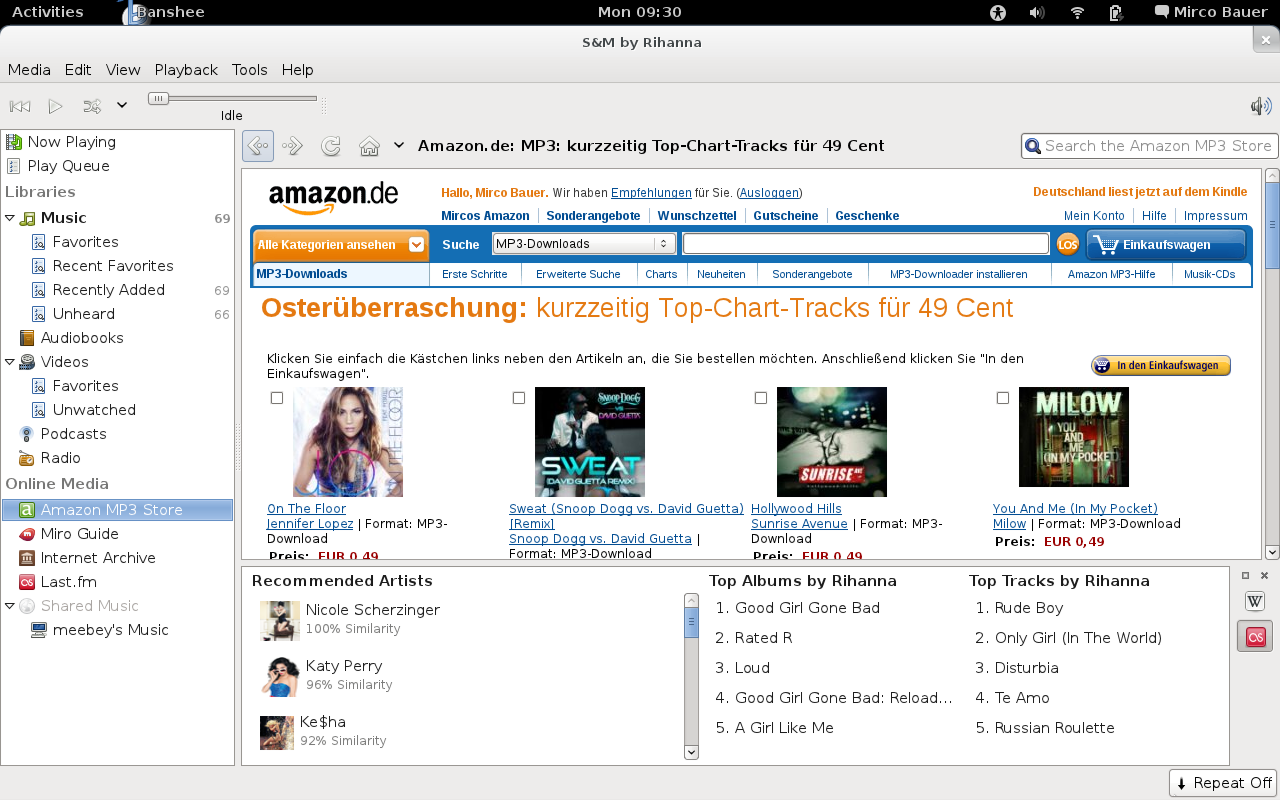
Last night I wanted to buy an album on Amazon and I couldn't do the checkout as the site required me to install the Amazon MP3 Downloader to make the purchase and download of the album. The downloader is not needed for a single song though, but buying each song separately would be more expensive and more work. The good news is that it automatically offered me packages for different Linux distros: Ubuntu, Debian, Fedora and OpenSUSE instead of telling me off for using Linux and leaving me behind with a Windows only download. But here comes the catch, all offered packages are only for the Intel 32-bit architecture. Now this is a showstopper for me, as I am running an AMD64 Debian which is a 64-bit architecture. I first tried to download and run the 32-bit debian package nonetheless as there was some hope with the ia32-libs and ia32-libs-gtk package. But this was not working as the application needs gtkmm libraries like libglademm and bailed when I tried to run it. So I filed a wishlist bug report against ia32-libs-gtk for inclusion of gtkmm and possibly other needed libraries to run the Amazon MP3 downloader on AMD64. So I bought the album using MusicLoad instead which simply puts all songs in a single archive on-the-fly and let me download that archive. When I tweeted my frustration on Twitter I was hinted by Jo Shields and also by Gabriel Burt that there would have been a much simpler solution to this issue by using Banshee which includes an Amazon MP3 Store plugin: Banshee screenshot showing the Amazon MP3 Store plugin This plugin allows you to log into your Amazon account browse their store like the regular Amazon store, plays the song samples directly, purchase songs, downloads the songs and imports them into Banshee's database so you can play them right away. And as if this wasn't good enough yet, with the the purchase of MP3 songs on Amazon using Banshee automatically makes a donation to the GNOME foundation. As I am the only one who forgot or wasn't aware of this awesome solution this deserved some blogging. Update: some people pointed out that clamz is also available to make MP3 purchases on Amazon.

Next.

Previous.