Old laptop
I ve been meaning to get a new laptop for a while now. My ThinkPad X250 is now 5 years old and even though it s still adequate in many ways, I tend to run out of memory especially when running a few virtual machines. It only has one memory slot, which I maxed out at 16GB shortly after I got it. Memory has been a problem in considering a new machine. Most new laptops have soldered RAM and local configurations tend to ship with 8GB RAM. Getting a new machine with only a slightly better CPU and even just the same amount of RAM as what I have in the X250 seems a bit wasteful. I was eyeing the Lenovo X13 because it s a super portable that can take up to 32GB of RAM, and it ships with an AMD Ryzen 4000 series chip which has great performance. With Lenovo s discount for Debian Developers it became even more attractive. Unfortunately that s in North America only (at least for now) so that didn t work out this time.
Enter Tongfang
I ve been reading a bunch of positive reviews about the Tuxedo Pulse 14 and KDE Slimbook 14. Both look like great AMD laptops, supports up to 64GB of RAM and clearly runs Linux well. I also noticed that they look quite similar, and after some quick searches it turns out that these are made by Tongfang and that its model number is PF4NU1F.
I also learned that a local retailer (Wootware) sells them as the Wootbook. I ve seen one of these before although it was an Intel-based one, but it looked like a nice machine and I was already curious about it back then. After struggling for a while to find a local laptop with a Ryzen CPU and that s nice and compact and that breaks the 16GB memory barrier, finding this one that jumped all the way to 64GB sealed the deal for me.
This is the specs for the configuration I got:
This configuration cost R18 796 ( 947 / $1122). That s significantly cheaper than anything else I can get that even starts to approach these specs. So this is a cheap laptop, but you wouldn t think so by using it.
I used the Debian netinstall image to install, and installation was just another uneventful and boring Debian installation (yay!). Unfortunately it needs the firmware-iwlwifi and firmare-amd-graphics packages for the binary blobs that drives the wifi card and GPU. At least it works flawlessly and you don t need an additional non-free display driver (as is the case with NVidia GPUs). I haven t tested the graphics extensively yet, but desktop graphics performance is very snappy. This GPU also does fancy stuff like VP8/VP9 encoding/decoding, so I m curious to see how well it does next time I have to encode some videos. The wifi upgrade was nice for copying files over. My old laptop maxed out at 300Mbps, this one connects to my home network between 800-1000Mbps. At this speed I don t bother connecting via cable at home.
I read on Twitter that Tuxedo Computers thinks that it s possible to bring Coreboot to this device. That would be yet another plus for this machine.
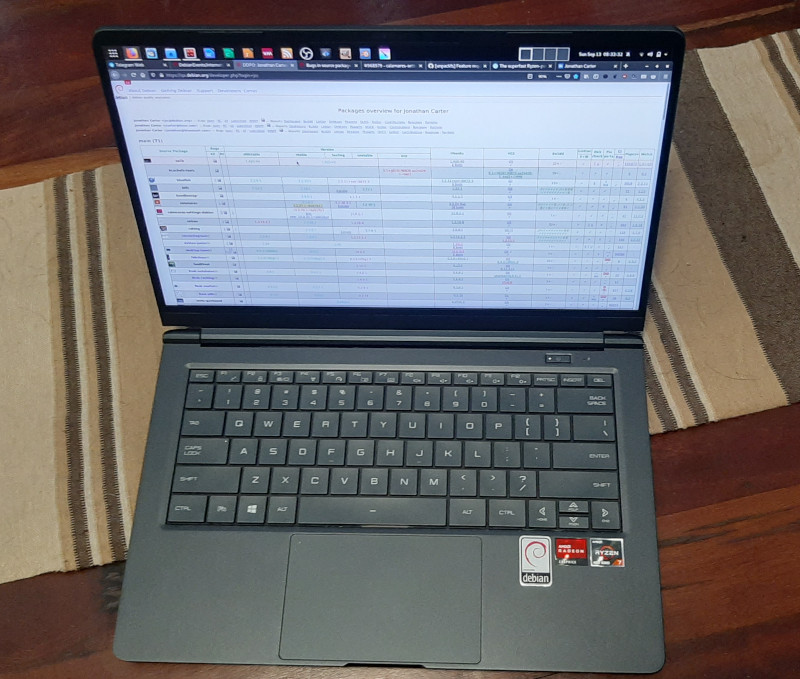
I ll try to answer some of my own questions about this device that I had before, that other people in the Debian community might also have if they re interested in this device. Since many of us are familiar with the ThinkPad X200 series of laptops, I ll compare it a bit to my X250, and also a little to the X13 that I was considering before. Initially, I was a bit hesitant about the 14 form factor, since I really like the portability of the 12.5 ThinkPad. But because the screen bezel is a lot smaller, the Wootbook (that just rolls off the tongue a lot better than the PF4NU1F ) is just slightly wider than the X250. It weighs in at 1.1KG instead of the 1.38KG of the X250. It s also thinner, so even though it has a larger display, it actually feels a lot more portable. Here s a picture of my X250 on top of the Wootbook, you can see a few mm of Wootbook sticking out to the right.
Card Reader
One thing that I overlooked when ordering this laptop was that it doesn t have an SD card reader. I see that some variations have them, like on this Slimbook review. It s not a deal-breaker for me, I have a USB card reader that s very light and that I ll just keep in my backpack. But if you re ordering one of these machines and have some choice, it might be something to look out for if it s something you care about.
Keyboard/Touchpad
On to the keyboard. This keyboard isn t quite as nice to type on as on the ThinkPad, but, it s not bad at all. I type on many different laptop keyboards and I would rank this keyboard very comfortably in the above average range. I ve been typing on it a lot over the last 3 days (including this blog post) and it started feeling natural very quickly and I m not distracted by it as much as I thought I would be transitioning from the ThinkPad or my mechanical desktop keyboard. In terms of layout, it s nice having an actual Insert button again. This is things normal users don t care about, but since I use mc (where insert selects files) this is a welcome return :). I also like that it doesn t have a Print Screen button at the bottom of my keyboard between alt and ctrl like the ThinkPad has. Unfortunately, it doesn t have dedicated pgup/pgdn buttons. I use those a lot in apps to switch between tabs. At leas the Fn button and the ctrl buttons are next to each other, so pressing those together with up and down to switch tabs isn t that horrible, but if I don t get used to it in another day or two I might do some remapping. The touchpad has en extra sensor-button on the top left corner that s used on Windows to temporarily disable the touchpad. I captured it s keyscan codes and it presses left control + keyscan code 93. The airplane mode, volume and brightness buttons work fine.
I do miss the ThinkPad trackpoint. It s great especially in confined spaces, your hands don t have to move far from the keyboard for quick pointer operations and it s nice for doing something quick and accurate. I painted a bit in Krita last night, and agree with other reviewers that the touchpad could do with just a bit more resolution. I was initially disturbed when I noticed that my physical touchpad buttons were gone, but you get right-click by tapping with two fingers, and middle click with tapping 3 fingers. Not quite as efficient as having the real buttons, but it actually works ok. For the most part, this keyboard and touchpad is completely adequate. Only time will tell whether the keyboard still works fine in a few years from now, but I really have no serious complaints about it.
Display
The X250 had a brightness of 172 nits. That s not very bright, I think the X250 has about the dimmest display in the ThinkPad X200 range. This hasn t been a problem for me until recently, my eyes are very photo-sensitive so most of the time I use it at reduced brightness anyway, but since I ve been working from home a lot recently, it s nice to sometimes sit outside and work, especially now that it s spring time and we have some nice days. At full brightness, I can t see much on my X250 outside. The Wootbook is significantly brighter even (even at less than 50% brightness), although I couldn t find the exact specification for its brightness online.
Ports
The Wootbook has 3x USB type A ports and 1x USB type C port. That s already quite luxurious for a compact laptop. As I mentioned in the specs above, it also has a full-sized ethernet socket. On the new X13 (the new ThinkPad machine I was considering), you only get 2x USB type A ports and if you want ethernet, you have to buy an additional adapter that s quite expensive especially considering that it s just a cable adapter (I don t think it contains any electronics).
It has one hdmi port. Initially I was a bit concerned at lack of displayport (which my X250 has), but with an adapter it s possible to convert the USB-C port to displayport and it seems like it s possible to connect up to 3 external displays without using something weird like display over usual USB3.
Overall remarks
When maxing out the CPU, the fan is louder than on a ThinkPad, I definitely noticed it while compiling the zfs-dkms module. On the plus side, that happened incredibly fast. Comparing the Wootbook to my X250, the biggest downfall it has is really it s pointing device. It doesn t have a trackpad and the touchpad is ok and completely usable, but not great. I use my laptop on a desk most of the time so using an external mouse will mostly solve that.
If money were no object, I would definitely choose a maxed out ThinkPad for its superior keyboard/mouse, but the X13 configured with 32GB of RAM and 128GB of SSD retails for just about double of what I paid for this machine. It doesn t seem like you can really buy the perfect laptop no matter how much money you want to spend, there s some compromise no matter what you end up choosing, but this machine packs quite a punch, especially for its price, and so far I m very happy with my purchase and the incredible performance it provides.
I m also very glad that Wootware went with the gray/black colours, I prefer that by far to the white and silver variants. It s also the first laptop I ve had since 2006 that didn t come with Windows on it.
The Wootbook is also comfortable/sturdy enough to carry with one hand while open. The ThinkPads are great like this and with many other brands this just feels unsafe. I don t feel as confident carrying it by it s display because it s very thin (I know, I shouldn t be doing that with the ThinkPads either, but I ve been doing that for years without a problem :) ).
There s also a post on Reddit that tracks where you can buy these machines from various vendors all over the world.
I ve just got a Dell T710 server for LUV and I ve been playing with the configuration options. Here s a list of what I ve done and recommendations on how to do things. I decided not to try to write a step by step guide to doing stuff as the situation doesn t work for that. I think that a list of how things are broken and what to avoid is more useful.
BIOS
Firstly with a Dell server you can upgrade the BIOS from a Linux root shell. Generally when a server is deployed you won t want to upgrade the BIOS (why risk breaking something when it s working), so before deployment you probably should install the latest version. Dell provides a shell script with encoded binaries in it that you can just download and run, it s ugly but it works. The process of loading the firmware takes a long time (a few minutes) with no progress reports, so best to plug both PSUs in and leave it alone. At the end of loading the firmware a hard reboot will be performed, so upgrading your distribution while doing the install is a bad idea (Debian is designed to not lose data in this situation so it s not too bad).
IDRAC
IDRAC is the Integrated Dell Remote Access Controller. By default it will listen on all Ethernet ports, get an IP address via DHCP (using a different Ethernet hardware address to the interface the OS sees), and allow connections. Configuring it to be restrictive as to which ports it listens on may be a good idea (the T710 had 4 ports built in so having one reserved for management is usually OK). You need to configure a username and password for IDRAC that has administrative access in the BIOS configuration.
Web Interface
By default IDRAC will run a web server on the IP address it gets from DHCP, you can connect to that from any web browser that allows ignoring invalid SSL keys. Then you can use the username and password configured in the BIOS to login. IDRAC 6 on the PowerEdge T710 recommends IE 6.
To get a ssl cert that matches the name you want to use (and doesn t give browser errors) you have to generate a CSR (Certificate Signing Request) on the DRAC, the only field that matters is the CN (Common Name), the rest have to be something that Letsencrypt will accept. Certbot has the option --config-dir /etc/letsencrypt-drac to specify an alternate config directory, the SSL key for DRAC should be entirely separate from the SSL key for other stuff. Then use the --csr option to specify the path of the CSR file. When you run letsencrypt the file name of the output file you want will be in the format *_chain.pem . You then have to upload that to IDRAC to have it used. This is a major pain for the lifetime of letsencrypt certificates. Hopefully a more recent version of IDRAC has Certbot built in.
When you access RAC via ssh (see below) you can run the command racadm sslcsrgen to generate a CSR that can be used by certbot. So it s probably possible to write expect scripts to get that CSR, run certbot, and then put the ssl certificate back. I don t expect to use IDRAC often enough to make it worth the effort (I can tell my browser to ignore an outdated certificate), but if I had dozens of Dells I d script it.
SSH
The web interface allows configuring ssh access which I strongly recommend doing. You can configure ssh access via password or via ssh public key. For ssh access set TERM=vt100 on the host to enable backspace as ^H. Something like TERM=vt100 ssh root@drac . Note that changing certain other settings in IDRAC such as enabling Smartcard support will disable ssh access.
There is a limit to the number of open sessions for managing IDRAC, when you ssh to the IDRAC you can run racadm getssninfo to get a list of sessions and racadm closessn -i NUM to close a session. The closessn command takes a -a option to close all sessions but that just gives an error saying that you can t close your own session because of programmer stupidity. The IDRAC web interface also has an option to close sessions. If you get to the limits of both ssh and web sessions due to network issues then you presumably have a problem.
I couldn t find any documentation on how the ssh host key is generated. I Googled for the key fingerprint and didn t get a match so there s a reasonable chance that it s unique to the server (please comment if you know more about this).
Don t Use Graphical Console
The T710 is an older server and runs IDRAC6 (IDRAC9 is the current version). The Java based graphical console access doesn t work with recent versions of Java. The Debian package icedtea-netx has has the javaws command for running the .jnlp command for the console, by default the web browser won t run this, you download the .jnlp file and pass that as the first parameter to the javaws program which then downloads a bunch of Java classes from the IDRAC to run. One error I got with Java 11 was Exception in thread Timer-0 java.util.ServiceConfigurationError: java.nio.charset.spi.CharsetProvider: Provider sun.nio.cs.ext.ExtendedCharsets could not be instantiated , Google didn t turn up any solutions to this. Java 8 didn t have that problem but had a connection failed error that some people reported as being related to the SSL key, but replacing the SSL key for the web server didn t help. The suggestion of running a VM with an old web browser to access IDRAC didn t appeal. So I gave up on this. Presumably a Windows VM running IE6 would work OK for this.
Serial Console
Fortunately IDRAC supports a serial console. Here s a page summarising Serial console setup for DRAC [1]. Once you have done that put console=tty0 console=ttyS1,115200n8 on the kernel command line and Linux will send the console output to the virtual serial port. To access the serial console from remote you can ssh in and run the RAC command console com2 (there is no option for using a different com port). The serial port seems to be unavailable through the web interface.
If I was supporting many Dell systems I d probably setup a ssh to JavaScript gateway to provide a web based console access. It s disappointing that Dell didn t include this.
If you disconnect from an active ssh serial console then the RAC might keep the port locked, then any future attempts to connect to it will give the following error:
/admin1-> console com2
console: Serial Device 2 is currently in use
So far the only way I ve discovered to get console access again after that is the command racadm racreset . If anyone knows of a better way please let me know. As an aside having racreset being so close to racresetcfg (which resets the configuration to default and requires a hard reboot to configure it again) seems like a really bad idea.
Host Based Management
deb http://linux.dell.com/repo/community/ubuntu xenial openmanage
The above apt sources.list line allows installing Dell management utilities (Xenial is old but they work on Debian/Buster). Probably the packages srvadmin-storageservices-cli and srvadmin-omacore will drag in enough dependencies to get it going.
Here are some useful commands:
# show hardware event log
omreport system esmlog
# show hardware alert log
omreport system alertlog
# give summary of system information
omreport system summary
# show versions of firmware that can be updated
omreport system version
# get chassis temp
omreport chassis temps
# show physical disk details on controller 0
omreport storage pdisk controller=0
RAID Control
The RAID controller is known as PERC (PowerEdge Raid Controller), the Dell web site has an rpm package of the perccli tool to manage the RAID from Linux. This is statically linked and appears to have different versions of libraries used to make it. The command perccli show gives an overview of the configuration, but the command perccli /c0 show to give detailed information on controller 0 SEGVs and the kernel logs a vsyscall attempted with vsyscall=none message. Here s an overview of the vsyscall enmulation issue [2]. Basically I could add vsyscall=emulate to the kernel command line and slightly reduce security for the system to allow system calls from perccli that are called from old libc code to work, or I could run code from a dubious source as root.
Some versions of IDRAC have a racadm raid command that can be run from a ssh session to perform RAID administration remotely, mine doesn t have that. As an aside the help for the RAC system doesn t list all commands and the Dell documentation is difficult to find so blog posts from other sysadmins is the best source of information.
I have configured IDRAC to have all of the BIOS output go to the virtual serial console over ssh so I can see the BIOS prompt me for PERC administration but it didn t accept my key presses when I tried to do so. In any case this requires downtime and I d like to be able to change hard drives without rebooting.
I found vsyscall_trace on Github [3], it uses the ptrace interface to emulate vsyscall on a per process basis. You just run vsyscall_trace perccli and it works! Thanks Geoffrey Thomas for writing this!
Here are some perccli commands:
# show overview
perccli show
# help on adding a vd (RAID)
perccli /c0 add help
# show controller 0 details
perccli /c0 show
# add a vd (RAID) of level RAID0 (r0) with the drive 32:0 (enclosure:slot from above command)
perccli /c0 add vd r0 drives=32:0
When a disk is added to a PERC controller about 525MB of space is used at the end for RAID metadata. So when you create a RAID-0 with a single device as in the above example all disk data is preserved by default except for the last 525MB. I have tested this by running a BTRFS scrub on a disk from another system after making it into a RAID-0 on the PERC.
Part of the continuing saga to clean up CPAN testing failures with this
module. Test reports uncovered a tighter version dependency for the flags
I was using for GnuPG v2 (2.1.23) and a version dependency for GnuPG v1
(1.4.20). As with the previous release, I'm now skipping tests if the
version is too old, since this makes the CPAN test results more useful to
me.
I also took advantage of this release to push the Debian packaging to
Salsa (and the upstream branch as well since it's easier) and update the
package metadata, as well as add an
upstream metadata file
since interest in that in Debian appears to have picked up again.
You can get the latest release from CPAN or from the
PGP::Sign distribution page.
A few weeks ago I configured a road warrior VPN setup. The
remote end is on a VPS running OpenBSD and OpenIKED, the VPN is
an IKEv2 VPN using x509 authentication, and the local end is
StrongSwan. I also configured an IKEv2 VPN between my VPSs. Here
are the notes for how to do so.
In all cases, to use x509 authentication, you will need to
generate a bunch of certificates and keys:
a CA certificate
a key/certificate pair for each client
Fortunately, OpenIKED provides the ikectl utility to help you do
so. Before going any further, you might find it useful to edit
/etc/ssl/ikeca.cnf to set some reasonable defaults for your
certificates.
Begin by creating and installing a CA certificate:
# ikectl ca vpn create
# ikectl ca vpn install
For simplicity, I am going to assume that the you are managing
your CA on the same host as one of the hosts that you want to
configure for the VPN. If not, see the bit about exporting
certificates at the beginning of the section on persistent
host-host VPNs.
Create and install a key/certificate pair for your server.
Suppose for example your first server is called
server1.example.org:
# ikectl ca vpn certificate server1.example.org create
# ikectl ca vpn certificate server1.example.org install
Persistent host-host VPNs
For each other server that you want to use, you need to also
create a key/certificate pair on the same host as the CA
certificate, and then copy them over to the other server.
Assuming the other server is called server2.example.org:
# ikectl ca vpn certificate server2.example.org create
# ikectl ca vpn certificate server2.example.org export
This last command will produce a tarball
server2.example.org.tgz. Copy it over to server2.example.org and
install it:
# tar -C /etc/iked -xzpvf server2.example.org.tgz
Next, it is time to configure iked. To do so, you will need to
find some information about the certificates you just generated.
On the host with the CA, run
$ cat /etc/ssl/vpn/index.txt
V       210825142056Z           01      unknown /C=US/ST=Pennsylvania/L=Pittsburgh/CN=server1.example.org/emailAddress=rak@example.org
V       210825142208Z           02      unknown /C=US/ST=Pennsylvania/L=Pittsburgh/CN=server2.example.org/emailAddress=rak@example.org
Pick one of the two hosts to play the active role (in this
case, server1.example.org). Using the information you gleaned
from index.txt, add the following to /etc/iked.conf, filling in
the srcid and dstid fields appropriately.
ikev2 'server1_server2_active' active esp from server1.example.org to server2.example.org \
	local server1.example.org peer server2.example.org \
	srcid '/C=US/ST=Pennsylvania/L=Pittsburgh/CN=server1.example.org/emailAddress=rak@example.org' \
	dstid '/C=US/ST=Pennsylvania/L=Pittsburgh/CN=server2.example.org/emailAddress=rak@example.org'
On the other host, add the following to /etc/iked.conf
ikev2 'server2_server1_passive' passive esp from server2.example.org to server1.example.org \
	local server2.example.org peer server1.example.org \
	srcid '/C=US/ST=Pennsylvania/L=Pittsburgh/CN=server2.example.org/emailAddress=rak@example.org' \
	dstid '/C=US/ST=Pennsylvania/L=Pittsburgh/CN=server1.example.org/emailAddress=rak@example.org'
Note that the names 'server1_server2_active' and
'server2_server1_passive' in the two stanzas do not matter and
can be omitted. Reload iked on both hosts:
# ikectl reload
If everything worked out, you should see the negotiated security
associations (SAs) in the output of
# ikectl show sa
On OpenBSD, you should also see some output on success or errors
in the file /var/log/daemon.
For a road warrior
Add the following to /etc/iked.conf on the remote end:
ikev2 'responder_x509' passive esp \
	from 0.0.0.0/0 to 10.0.1.0/24 \
	local server1.example.org peer any \
	srcid server1.example.org \
	config address 10.0.1.0/24 \
	config name-server 10.0.1.1 \
	tag "ROADW"
Configure or omit the address range and the name-server
configurations to suit your needs. See iked.conf(5) for details.
Reload iked:
# ikectl reload
If you are on OpenBSD and want the remote end to have an IP
address, add the following to /etc/hostname.vether0, again
configuring the address to suit your needs:
inet 10.0.1.1 255.255.255.0
Put the interface up:
# ifconfig vether0 up
Now create a client certificate for authentication. In my case,
my road-warrior client was client.example.org:
# ikectl ca vpn certificate client.example.org create
# ikectl ca vpn certificate client.example.org export
A few weeks ago I configured a road warrior VPN setup. The
remote end is on a VPS running OpenBSD and OpenIKED, the VPN is
an IKEv2 VPN using x509 authentication, and the local end is
StrongSwan. I also configured an IKEv2 VPN between my VPSs. Here
are the notes for how to do so.
In all cases, to use x509 authentication, you will need to
generate a bunch of certificates and keys:
a CA certificate
a key/certificate pair for each client
Fortunately, OpenIKED provides the ikectl utility to help you do
so. Before going any further, you might find it useful to edit
/etc/ssl/ikeca.cnf to set some reasonable defaults for your
certificates.
Begin by creating and installing a CA certificate:
# ikectl ca vpn create
# ikectl ca vpn install
For simplicity, I am going to assume that the you are managing
your CA on the same host as one of the hosts that you want to
configure for the VPN. If not, see the bit about exporting
certificates at the beginning of the section on persistent
host-host VPNs.
Create and install a key/certificate pair for your server.
Suppose for example your first server is called
server1.example.org:
# ikectl ca vpn certificate server1.example.org create
# ikectl ca vpn certificate server1.example.org install
Persistent host-host VPNs
For each other server that you want to use, you need to also
create a key/certificate pair on the same host as the CA
certificate, and then copy them over to the other server.
Assuming the other server is called server2.example.org:
# ikectl ca vpn certificate server2.example.org create
# ikectl ca vpn certificate server2.example.org export
This last command will produce a tarball
server2.example.org.tgz. Copy it over to server2.example.org and
install it:
# tar -C /etc/iked -xzpvf server2.example.org.tgz
Next, it is time to configure iked. To do so, you will need to
find some information about the certificates you just generated.
On the host with the CA, run
$ cat /etc/ssl/vpn/index.txt
V       210825142056Z           01      unknown /C=US/ST=Pennsylvania/L=Pittsburgh/CN=server1.example.org/emailAddress=rak@example.org
V       210825142208Z           02      unknown /C=US/ST=Pennsylvania/L=Pittsburgh/CN=server2.example.org/emailAddress=rak@example.org
Pick one of the two hosts to play the active role (in this
case, server1.example.org). Using the information you gleaned
from index.txt, add the following to /etc/iked.conf, filling in
the srcid and dstid fields appropriately.
ikev2 'server1_server2_active' active esp from server1.example.org to server2.example.org \
	local server1.example.org peer server2.example.org \
	srcid '/C=US/ST=Pennsylvania/L=Pittsburgh/CN=server1.example.org/emailAddress=rak@example.org' \
	dstid '/C=US/ST=Pennsylvania/L=Pittsburgh/CN=server2.example.org/emailAddress=rak@example.org'
On the other host, add the following to /etc/iked.conf
ikev2 'server2_server1_passive' passive esp from server2.example.org to server1.example.org \
	local server2.example.org peer server1.example.org \
	srcid '/C=US/ST=Pennsylvania/L=Pittsburgh/CN=server2.example.org/emailAddress=rak@example.org' \
	dstid '/C=US/ST=Pennsylvania/L=Pittsburgh/CN=server1.example.org/emailAddress=rak@example.org'
Note that the names 'server1_server2_active' and
'server2_server1_passive' in the two stanzas do not matter and
can be omitted. Reload iked on both hosts:
# ikectl reload
If everything worked out, you should see the negotiated security
associations (SAs) in the output of
# ikectl show sa
On OpenBSD, you should also see some output on success or errors
in the file /var/log/daemon.
For a road warrior
Add the following to /etc/iked.conf on the remote end:
ikev2 'responder_x509' passive esp \
	from 0.0.0.0/0 to 10.0.1.0/24 \
	local server1.example.org peer any \
	srcid server1.example.org \
	config address 10.0.1.0/24 \
	config name-server 10.0.1.1 \
	tag "ROADW"
Configure or omit the address range and the name-server
configurations to suit your needs. See iked.conf(5) for details.
Reload iked:
# ikectl reload
If you are on OpenBSD and want the remote end to have an IP
address, add the following to /etc/hostname.vether0, again
configuring the address to suit your needs:
inet 10.0.1.1 255.255.255.0
Put the interface up:
# ifconfig vether0 up
Now create a client certificate for authentication. In my case,
my road-warrior client was client.example.org:
# ikectl ca vpn certificate client.example.org create
# ikectl ca vpn certificate client.example.org export
Welcome to gambaru.de. Here is my monthly report (+ the first week in September) that covers what I have been doing for Debian. If you re interested in Java, Games and LTS topics, this might be interesting for you.
Debian Games
I packaged a new upstream release of teeworlds, the well-known 2D multiplayer shooter with cute characters called tees to resolve a Python 2 bug (although teeworlds is actually a C++ game). The update also fixed a severe remote denial-of-service security vulnerability, CVE-2020-12066. I prepared a patch for Buster and will send it to the security team later today.
I sponsored updates of mgba, a Game Boy Advance emulator, for Ryan Tandy, and osmose-emulator for Carlos Donizete Froes.
I worked around a RC GCC 10 bug in megaglest by compiling with -fcommon.
Thanks to Gerardo Ballabio who packaged a new upstream version of galois which I uploaded for him.
Also thanks to Reiner Herrmann and Judit Foglszinger who fixed a regression (crash) in monsterz due to the earlier port to Python 3. Reiner also made fans of supertuxkart happy by packaging the latest upstream release version 1.2.
I was contacted by the upstream maintainer of privacybadger, a privacy addon for Firefox and Chromium, who dislikes the idea of having a stable and unchanging version in Debian stable releases. Obviously I can t really do much about it although I believe the release team would be open-minded for regular point updates of browser addons though. However I don t intend to do regular updates for all of my packages in stable unless there is a really good reason to do so. At the moment I m willing to make an exception for ublock-origin and https-everywhere because I feel these addons should be core browser functionality anyway. I talked about this on our Debian Mozilla Extension Maintainers mailinglist and it seems someone is interested to take over privacybadger and prepare regular stable point updates. Let s see how it turns out.
Finally this month saw the release of ublock-origin 1.29.0 and the creation of two different browser-specific binary packages for Firefox and Chromium. I have talked about it before and I believe two separate packages for ublock-origin are more aligned to upstream development and make the whole addon easier to maintain which benefits users, upstream and maintainers.
imlib2, an image library, and binaryen also got updated this month.
Debian LTS
This was my 54. month as a paid contributor and I have been paid to work 20 hours on Debian LTS, a project started by Rapha l Hertzog. In that time I did the following:
DLA-2303-1. Issued a security update for libssh fixing 1 CVE.
DLA-2327-1. Issued a security update for lucene-solr fixing 1 CVE.
DLA-2369-1. Issued a security update for libxml2 fixing 8 CVE.
Triaged CVE-2020-14340, jboss-xnio as not-affected for Stretch.
Triaged CVE-2020-13941, lucene-solr as no-dsa because the security impact was minor.
Triaged CVE-2019-17638, jetty9 as not-affected for Stretch and Buster.
squid3: I backported the patches for CVE-2020-15049, CVE-2020-15810, CVE-2020-15811 and CVE-2020-24606 from squid 4 to squid 3.
ELTS
Extended Long Term Support (ELTS) is a project led by Freexian to further extend the lifetime of Debian releases. It is not an official Debian project but all Debian users benefit from it without cost. The current ELTS release is Debian 8 Jessie . This was my 27. month and I have been paid to work 14,25 hours on ELTS.
ELA-271-1. Issued a security update for squid3 fixing 19 CVE. Most of the work was already done before ELTS started, only the patch for CVE-2019-12529 had to be adjusted for the nettle version in Jessie.
ELA-273-1. Issued a security update for nss fixing 1 CVE.
ELA-276-1. Issued a security update for libjpeg-turbo fixing 2 CVE.
ELA-277-1. Issued a security update for graphicsmagick fixing 1 CVE.
ELA-279-1. Issued a security update for imagemagick fixing 3 CVE.
ELA-280-1. Issued a security update for libxml2 fixing 4 CVE.
The Debian Janitor is an automated
system that commits fixes for (minor) issues in Debian packages that can be
fixed by software. It gradually started proposing merges in early
December. The first set of changes sent out ran lintian-brush on sid packages maintained in
Git. This post is part of a series about the progress of the
Janitor.
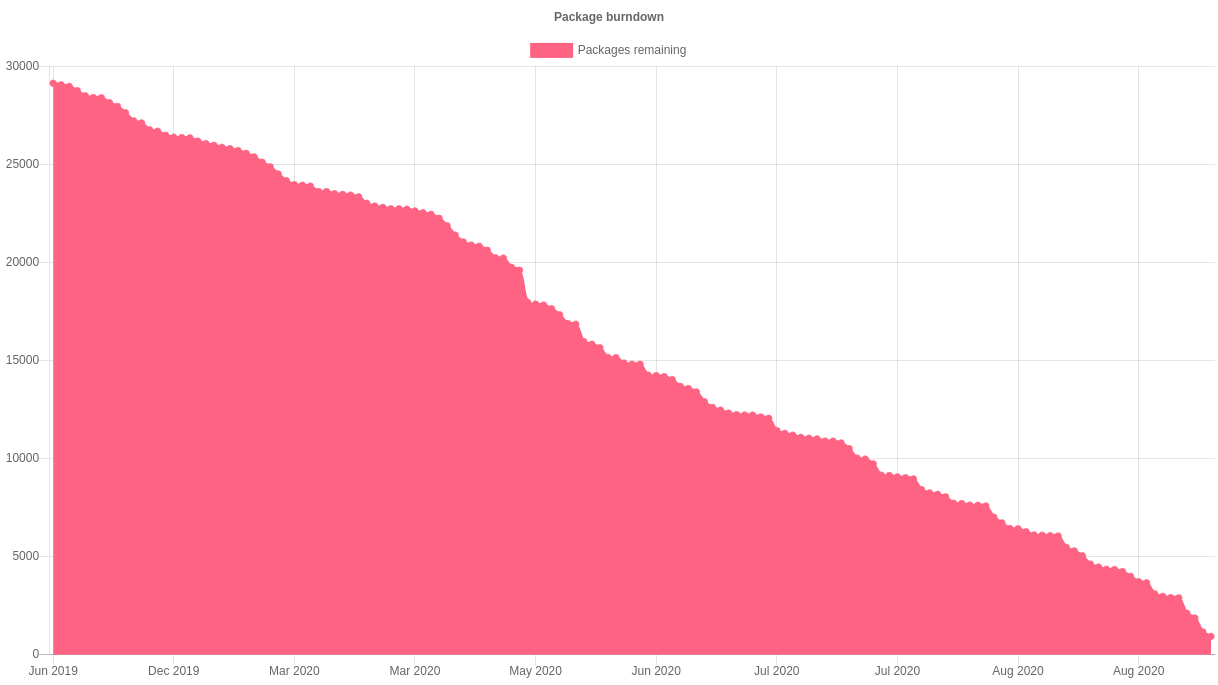
On 12 July 2019, the Janitor started fixing lintian issues in packages in the
Debian archive. Now, a year and a half later, it has processed every one of the
almost 28,000 packages at least once.
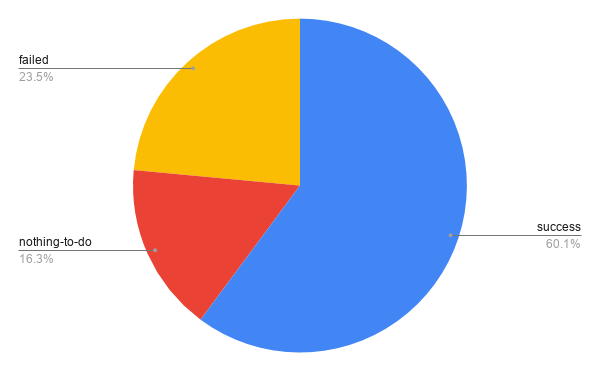
As discussed two weeks ago, this has resulted in roughly
65,000 total changes. These 65,000 changes were made to
a total of almost 17,000 packages. Of the remaining packages,
for about 4,500 lintian-brush could not make any improvements.
The rest (about 6,500) failed to be processed for one
of many reasons they are e.g. not yet migrated off
alioth, use uncommon formatting
that can't be preserved or failed to build for one reason or another.
Now that the entire archive has been processed, packages
are prioritized based on the likelihood of a change being
made to them successfully.
Over the course of its existence, the Janitor has slowly
gained support for a wider variety of packaging methods.
For example, it can now edit the templates for some of
the generated control files. Many of the packages that
the janitor was unable to propose changes for the first
time around are expected to be correctly handled when they
are reprocessed.
If you re a Debian developer, you can find the list of improvements
made by the janitor in your packages by going to
https://janitor.debian.net/m/.
For more information about the Janitor's lintian-fixes efforts, see the landing page.
Thanks to the good work of several volunteers, the updated edition
of the Norwegian translation for
"The Debian Administrator's
Handbook" is now almost completed. After many months of proof
reading, I consider the proof reading complete enough for us to move
to the next step, and have asked for the print version to be prepared
and sent of to the print on demand service lulu.com. While it is
still not to late if you find any incorrect translations on
the
hosted Weblate service, but it will be soon. :) You can check out
the Buster
edition on the web until the print edition is ready.
The book will be for sale on lulu.com and various web book stores,
with links available from the web site for the book linked to above.
I hope a lot of readers find it useful.
As usual, if you use Bitcoin and want to show your support of my
activities, please send Bitcoin donations to my address
15oWEoG9dUPovwmUL9KWAnYRtNJEkP1u1b.
I'm happy to announce I handed out my Master's Thesis last Monday. I'm not
publishing the final copy just yet1, as it still needs to go through
the approval committee. If everything goes well, I should have my Master of
Economics diploma before Christmas!
It sure hasn't been easy, and although I regret nothing, I'm also happy to be
done with university.
Looking for a job
What an odd time to be looking for a job, right? Turns out for the first time
in 12 years, I don't have an employer. It's oddly freeing, but also a little
scary. I'm certainly not bitter about it though and it's nice to have some time
on my hands to work on various projects and read things other than academic
papers. Look out for my next blog posts on using the NeTV2 as an OSHW HDMI
capture card, on hacking at security tokens and much more!
I'm not looking for anything long term (I'm hoping to teach Economics again next
Winter), but for the next few months, my calendar is wide open.
For the last 6 years, I worked as Linux system administrator, mostly using a
LAMP stack in conjunction with Puppet, Shell and Python. Although I'm most
comfortable with Puppet, I also have decent experience with Ansible, thanks to
my work in the DebConf Videoteam.
I'm not the most seasoned Debian Developer, but I have some experience
packaging Python applications and libraries. Although I'm no expert at it,
lately I've also been working on Clojure packages, as I'm trying to get Puppet
6 in Debian in time for the Bullseye freeze. At the rate it's going though, I
doubt we're going to make it...
If your company depends on Puppet and cares about having a version in Debian 11
that is maintained (Puppet 5 is EOL in November 2020), I'm your guy!
Oh, and I guess I'm a soon-to-be Master of Economics specialising in Free and
Open Source Software business models and incentives theory. Not sure I'll ever
get paid putting that in application, but hey, who knows.
If any of that resonates with you, contact me and let's have a chat! I promise
I don't bite :)
The title of the thesis is What are the incentive structures of
Free Software? An economic analysis of Free Software's specific development
model. Once the final copy is approved, I'll be sure to write a longer blog
post about my findings here.
The diffoscope maintainers are pleased to announce the release of diffoscope
version 160. This version includes the following changes:
* Check that pgpdump is actually installed before attempting to run it.
  Thanks to Gianfranco Costamagna (locutusofborg). (Closes: #969753)
* Add some documentation for the EXTERNAL_TOOLS dictionary.
* Ensure we check FALLBACK_FILE_EXTENSION_SUFFIX, otherwise we run pgpdump
  against all files that are recognised by file(1) as "data".
Broccoli Sync Conversation
A number of days ago (I know, I'm an awful human who failed to post this for over a week), myself, Lars, Mark, and Vince discussed Dropbox's article about Broccoli Sync. It wasn't quite what we'd expected but it was an interesting discussion of compression and streamed data.
Vince observed that it was interesting in that it was a way to move storage compression cost to the client edge. This makes sense because decompression (to verify the uploaded content) is cheaper than compression; and also since CPU and bandwidth are expensive, spending the client CPU to reduce bandwidth is worthwhile.
Lars talked about how even in situations where everyone has gigabit data connectivity with no limit on total transit, bandwidth/time is a concern, so it makes sense.
We liked how they determined the right compresison level to use available bandwidth (i.e. not be CPU throttled) but also gain the most compression possible. Their diagram showing relative compression sizes for level 1 vs. 3 vs. 5 suggests that the gain for putting the effort in for 5 rather than 1. It's interesting in that diagram that 'documents' don't compress well but then again it is notable that such documents are likely DEFLATE'd zip files. Basically if the data is already compressed then there's little hope Brotli will gain much.
I raised that it was interesting that they chose Brotli, in part, due to the availability of a pure Rust implementation of Brotli. Lars mentioned that Microsoft and others talk about how huge quantities of C code has unexpected memory safety issues and so perhaps that is related. Daniel mentioned that the document talked about Dropbox having a policy of not running unconstrained C code which was interesting.
Vince noted that in their deployment challenges it seemed like a very poor general strategy to cope with crasher errors; but Daniel pointed out that it might be an over-simplified description, and Mark suggested that it might be sufficient until a fix can be pushed out. Vince agreed that it's plausible this is a tiered/sharded deployment process and thus a good way to smoke out problems.
Daniel found it interesting that their block storage sounds remarkably like every other content-addressible storage and that while they make it clear in the article that encryption, client identification etc are elided, it looks like they might be able to deduplicate between theoretically hostile clients.
We think that the compressed-data plus type plus hash (which we assume also contains length) is an interesting and nice approach to durability and integrity validation in the protocol.
And the compressed blocks can then be passed to the storage backend quickly and effectively which is nice for latency.
Daniel raised that he thought it was fun that their rust-brotli library is still workable on Rust 1.12 which is really quite old.
We ended up on a number of tangential discussions, about Rust, about deployment strategies, and so on. While the article itself was a little thin, we certainly had a lot of good chatting around topics it raised.
We'll meet again in a month (on the 28th Sept) so perhaps we'll have a chunkier article next time. (Possibly this and/or related articles)
Welcome to the August 2020 report from the Reproducible Builds project.
In our monthly reports, we summarise the things that we have been up to over the past month. The motivation behind the Reproducible Builds effort is to ensure no flaws have been introduced from the original free software source code to the pre-compiled binaries we install on our systems. If you re interested in contributing to the project, please visit our main website.
This month, Jennifer Helsby launched a new reproduciblewheels.com website to address the lack of reproducibility of Python wheels.
To quote Jennifer s accompanying explanatory blog post:
One hiccup we ve encountered in SecureDrop development is that not all Python wheels can be built reproducibly. We ship multiple (Python) projects in Debian packages, with Python dependencies included in those packages as wheels. In order for our Debian packages to be reproducible, we need that wheel build process to also be reproducible
Reproducible builds at DebConf20
There were a number of talks at the recent online-only DebConf20 conference on the topic of reproducible builds.
Holger gave a talk titled Reproducing Bullseye in practice , focusing on independently verifying that the binaries distributed from ftp.debian.org are made from their claimed sources. It also served as a general update on the status of reproducible builds within Debian. The video (145 MB) and slides are available.
There were also a number of other talks that involved Reproducible Builds too. For example, the Malayalam language mini-conference had a talk titled , ? ( I want to join Debian, what should I do? ) presented by Praveen Arimbrathodiyil, the Clojure Packaging Team BoF session led by Elana Hashman, as well as Where is Salsa CI right now? that was on the topic of Salsa, the collaborative development server that Debian uses to provide the necessary tools for package maintainers, packaging teams and so on.
Jonathan Bustillos (Jathan) also gave a talk in Spanish titled Un camino verificable desde el origen hasta el binario ( A verifiable path from source to binary ). (Video, 88MB)
Development work
After many years of development work, the compiler for the Rust programming language now generates reproducible binary code. This generated some general discussion on Reddit on the topic of reproducibility in general.
Paul Spooren posted a request for comments to OpenWrt s openwrt-devel mailing list asking for clarification on when to raise the PKG_RELEASE identifier of a package. This is needed in order to successfully perform rebuilds in a reproducible builds context.
In openSUSE, Bernhard M. Wiedemann published his monthly Reproducible Builds status update.
Chris Lamb provided some comments and pointers on an upstream issue regarding the reproducibility of a Snap / SquashFS archive file. []
Debian
Holger Levsen identified that a large number of Debian .buildinfo build certificates have been tainted on the official Debian build servers, as these environments have files underneath the /usr/local/sbin directory []. He also filed against bug for debrebuild after spotting that it can fail to download packages from snapshot.debian.org [].
This month, several issues were uncovered (or assisted) due to the efforts of reproducible builds.
For instance, Debian bug #968710 was filed by Simon McVittie, which describes a problem with detached debug symbol files (required to generate a traceback) that is unlikely to have been discovered without reproducible builds. In addition, Jelmer Vernooij called attention that the new Debian Janitor tool is using the property of reproducibility (as well as diffoscope when applying archive-wide changes to Debian:
New merge proposals also include a link to the diffoscope diff between a vanilla build and the build with changes. Unfortunately these can be a bit noisy for packages that are not reproducible yet, due to the difference in build environment between the two builds. []
56 reviews of Debian packages were added, 38 were updated and 24 were removed this month adding to our knowledge about identified issues. Specifically, Chris Lamb added and categorised the nondeterministic_version_generated_by_python_param and the lessc_nondeterministic_keys toolchain issues. [][]
Holger Levsen sponsored Lukas Puehringer s upload of the python-securesystemslib pacage, which is a dependency of in-toto, a framework to secure the integrity of software supply chains. []
Lastly, Chris Lamb further refined his merge request against the debian-installer component to allow all arguments from sources.list files (such as [check-valid-until=no]) in order that we can test the reproducibility of the installer images on the Reproducible Builds own testing infrastructure and sent a ping to the team that maintains that code.
Upstream patches
The Reproducible Builds project detects, dissects and attempts to fix as many currently-unreproducible packages as possible. We endeavour to send all of our patches upstream where appropriate. This month, we wrote a large number of these patches, including:
diffoscopediffoscope is our in-depth and content-aware diff utility that can not only locate and diagnose reproducibility issues, it provides human-readable diffs of all kinds. In August, Chris Lamb made the following changes to diffoscope, including preparing and uploading versions 155, 156, 157 and 158 to Debian:
New features:
Support extracting data of PGP signed data. (#214)
Try files named .pgp against pgpdump(1) to determine whether they are Pretty Good Privacy (PGP) files. (#211)
Support multiple options for all file extension matching. []
Bug fixes:
Don t raise an exception when we encounter XML files with <!ENTITY> declarations inside the Document Type Definition (DTD), or when a DTD or entity references an external resource. (#212)
pgpdump(1) can successfully parse some binary files, so check that the parsed output contains something sensible before accepting it. []
Temporarily drop gnumeric from the Debian build-dependencies as it has been removed from the testing distribution. (#968742)
Correctly use fallback_recognises to prevent matching .xsb binary XML files.
Correct identify signed PGP files as file(1) returns data . (#211)
Logging improvements:
Emit a message when ppudump version does not match our file header. []
Don t use Python s repr(object) output in Calling external command messages. []
Include the filename in the not identified by any comparator message. []
Codebase improvements:
Bump Python requirement from 3.6 to 3.7. Most distributions are either shipping with Python 3.5 or 3.7, so supporting 3.6 is not only somewhat unnecessary but also cumbersome to test locally. []
Drop some unused imports [], drop an unnecessary dictionary comprehensions [] and some unnecessary control flow [].
Correct typo of output in a comment. []
Release process:
Move generation of debian/tests/control to an external script. []
Add some URLs for the site that will appear on PyPI.org. []
Update author and author email in setup.py for PyPI.org and similar. []
Testsuite improvements:
Update PPU tests for compatibility with Free Pascal versions 3.2.0 or greater. (#968124)
Mark that our identification test for .ppu files requires ppudump version 3.2.0 or higher. []
Add an assert_diff helper that loads and compares a fixture output. [][][][]
Misc:
Duplicate docker instructions in the Get diffoscope section of the diffoscope website. []
In addition, Mattia Rizzolo documented in setup.py that diffoscope works with Python version 3.8 [] and Frazer Clews applied some Pylint suggestions [] and removed some deprecated methods [].
Clarify & fix a few entries on the who page [][] and ensure that images do not get to large on some viewports [].
Clarify use of a pronoun re. Conservancy. []
Use View all our monthly reports over View all monthly reports . []
Move a is a suffix out of the link target on the SOURCE_DATE_EPOCH age. []
In addition, Javier Jard n added the freedesktop-sdk project [] and Kushal Das added SecureDrop project [] to our projects page. Lastly, Michael P hn added internationalisation and translation support with help from Hans-Christoph Steiner [].
Testing framework
The Reproducible Builds project operate a Jenkins-based testing framework to power tests.reproducible-builds.org. This month, Holger Levsen made the following changes:
System health checks:
Improve explanation how the status and scores are calculated. [][]
Update and condense view of detected issues. [][]
Query the canonical configuration file to determine whether a job is disabled instead of duplicating/hardcoding this. []
Detect several problems when updating the status of reporting-oriented metapackage sets. []
Detect when diffoscope is not installable [] and failures in DNS resolution [].
Mark that the u-boot Universal Boot Loader should not build architecture independent packages on the arm64 architecture anymore. []
Finally, build node maintenance was performed by Holger Levsen [], Mattia Rizzolo [][] and Vagrant Cascadian [][][][]
Mailing list
On our mailing list this month, Leo Wandersleb sent a message to the list after he was wondering how to expand his WalletScrutiny.com project (which aims to improve the security of Bitcoin wallets) from Android wallets to also monitor Linux wallets as well:
If you think you know how to spread the word about reproducibility in the context of Bitcoin wallets through WalletScrutiny, your contributions are highly welcome on this PR []
Julien Lepiller posted to the list linking to a blog post by Tavis Ormandy titled You don t need reproducible builds. Morten Linderud (foxboron) responded with a clear rebuttal that Tavis was only considering the narrow use-case of proprietary vendors and closed-source software. He additionally noted that the criticism that reproducible builds cannot prevent against backdoors being deliberately introduced into the upstream source ( bugdoors ) are decidedly (and deliberately) outside the scope of reproducible builds to begin with.
Chris Lamb included the Reproducible Builds mailing list in a wider discussion regarding a tentative proposal to include .buildinfo files in .deb packages, adding his remarks regarding requiring a custom tool in order to determine whether generated build artifacts are identical in a reproducible context. []
Jonathan Bustillos (Jathan) posted a quick email to the list requesting whether there was a list of To do tasks in Reproducible Builds.
Lastly, Chris Lamb responded at length to a query regarding the status of reproducible builds for Debian ISO or installation images. He noted that most of the technical work has been performed but there are at least four issues until they can be generally advertised as such . He pointed that the privacy-oriented Tails operation system, which is based directly on Debian, has had reproducible builds for a number of years now. []
If you are interested in contributing to the Reproducible Builds project, please visit our Contribute page on our website. However, you can get in touch with us via:
So Finally, kernel 5.8 entered the Debian
Unstable
repositories. This means that I got my Raspberry image from their
usual location and was able to type the
following, using only my old trusty USB keyboard:
So finally, the greatest and meanest Raspberry is fully supported with
a pure Debian image! (only tarnished by the nonfree
raspi-firmware
package.
Oh, in case someone was still wondering The images generated follow
the stable release. Only the kernel and firmware are installed from
unstable. If / when kernel 5.8 enters
Backports, I will reduce the noise of
adding a different suit to the sources.list.
Need I say more? OK, I will
Still wanting some more details? Well
I have had many cats through my life. When I was about eight years
old, my parents tried to have a dog but the experiment didn t work,
and besides those few months, I never had one.
But as my aging cats spent the final months of their last very long
lifes, it was clear to us that, after them, we would be adopting a
dog.
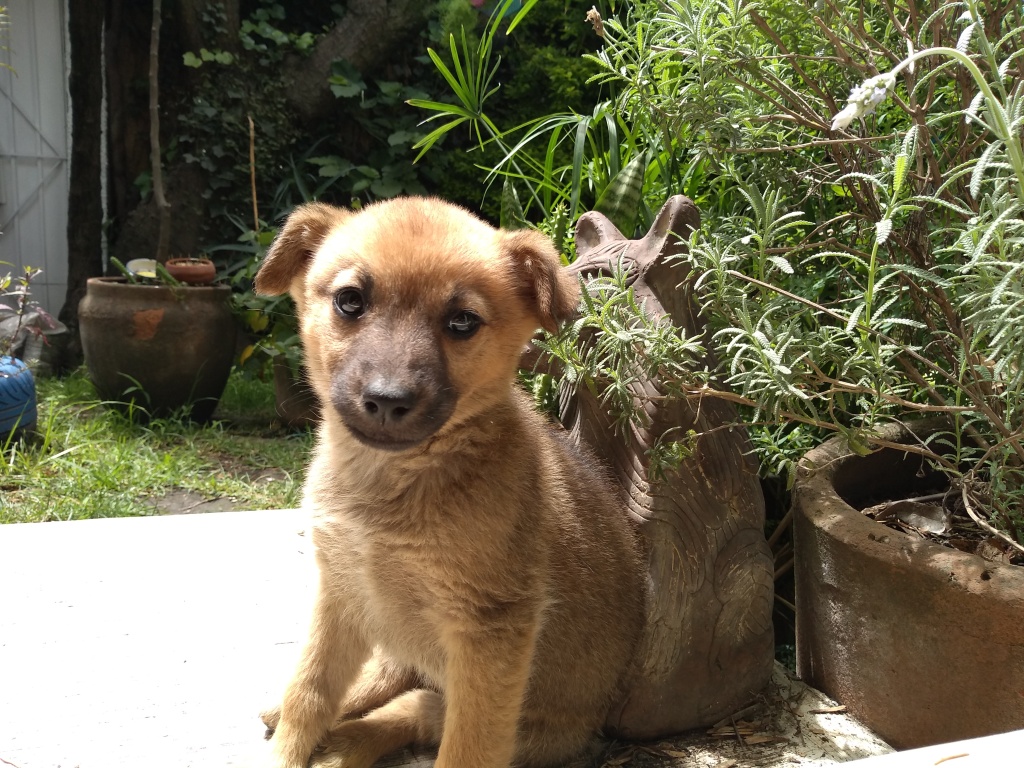
Last Saturday was the big day. We had seen some photos of the mother
and the nine (!) pups. My children decided almost right away her
name; they were all brownish, so the name would be corteza (tree
bark. They didn t know, of course, that dogs also have a bark! )
Anyway, welcome little one!
This is just a "warn your brothers" post for those who use
Cloudflare Bot Management, and have customers which use MITM boxes
to break up TLS 1.3 connections.
Be aware that right now some heuristic rules in the Cloudflare Bot
Management score TLS 1.3 requests made by some MITM boxes with 1 -
which equals "we're 99.99% sure that this is none human browser
traffic". While technically correct - the TLS connection hitting
the Cloudflare Edge node is not established by a browser -
that does not help your customer if you block those requests.
If you do something like blocking requests with a BM score of
1 at the Cloudflare Edge, you might want to reconsider that
at the moment and sent a captcha challenge instead. While that
is not a lot nicer, and still pisses people off, you might find
a balance there between protecting yourself and still having
some customers.
I've a confirmation for this happening with Cisco WSA, but it's
likely to be also the case with other vendors. Breaking up TLS 1.2
seems to be stealthy enough in those appliances that it's not detected,
so this issue creeps in with more enterprises rolling out modern browser.
You can now enter youself here a rant about how bad the client-server
internet of 2020 is, and how bad it is that some of us rely on Cloudflare,
and that they have accumulated a way too big market share. But the world
is as it is.
Debconf2020 took place when I was on personal vacations time. But anyway I m lucky enough that my
company, the Wikimedia Foundation, paid the conference registration fee for me and allowed me to
take the time (after my vacations) to watch recordings from the conference.
This is my first time attending (or watching) a full-online conference, and I was curious to see
first hand how it would develop. I was greatly surprised to see it worked pretty nicely, so kudos
to the organization, video team, volunteers, etc!
What follows is my summary of the conference, from the different sessions and talks I watched
(again, none of them live but recordings).
The first thing I saw was the Welcome to Debconf 2020 opening session. It is obvious
the video was made with lots of love, I found it entertaining and useful.
I love it :-)
Then I watched the BoF Can Free Software improve social equality. It was introduced
and moderated by Hong Phuc Dang. Several participants, about 10 people, shared their visions
on the interaction between open source projects and communities. I m pretty much aware of the
interesting social advancement that FLOSS can enable in communities, but sometimes is not so easy,
it may also present challenges and barriers. The BoF was joined by many people from the Asia
Pacific region, and for me, it has been very interesting to take a step back from the usual western
vision of this topic. Anyway, about the session itself, I have the feeling the participants may
have spent too much time on presentations, sharing their local stories (which are interesting,
don t get me wrong), perhaps leaving little room for actual proposal discussions or the like.
Next I watched the Bits from the DPL talk. In the session, Jonathan Carter goes over
several topics affecting the project, both internally and externally. It was interesting to know
more about the status of the project from a high level perspective, as an organization, including
subjects such as money, common project problems, future issues we are anticipating, the social
aspect of the project, etc.
The Lightning Talks session grabbed my attention. It is usually very funny to watch and
not as dense as other talks. I m glad I watched this as it includes some interesting talks, ranging
from HAM radios (I love them!), to personal projects to help in certain tasks, and even some
general reflections about life.
Just when I m writing this very sentence, the video for the
Come and meet your Debian Publicity team! talk has been uploaded. This team does an
incredible work in keeping project information flowing, and social networks up-to-date and alive.
Mind that the work of this team is mostly non-engineering, but still, is a vital part of the
project. The folks in session explain what the team does, and they also discuss how new people can
contribute, the different challenges related to language barriers, etc.
I have to admit I also started watching a couple other sessions that turned out to don t be
interesting to me (and therefore I didn t finish the video). Also, I tried to watch a couple more
sessions that didn t publish their video recording just yet, for example the
When We Virtualize the Whole Internet talk by Sam Hartman. Will check again in a couple of
days.
It is a real pleasure the video recordings from the conference are made available online.
One can join the conference anytime (like I m doing!) and watch the sessions at any pace at any
time. The video archive is big, I won t be able to go over all of it. I won t lie, I still have
some pending videos to watch from last year Debconf2019 :-)
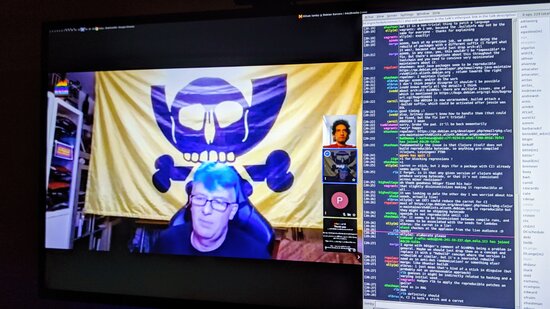
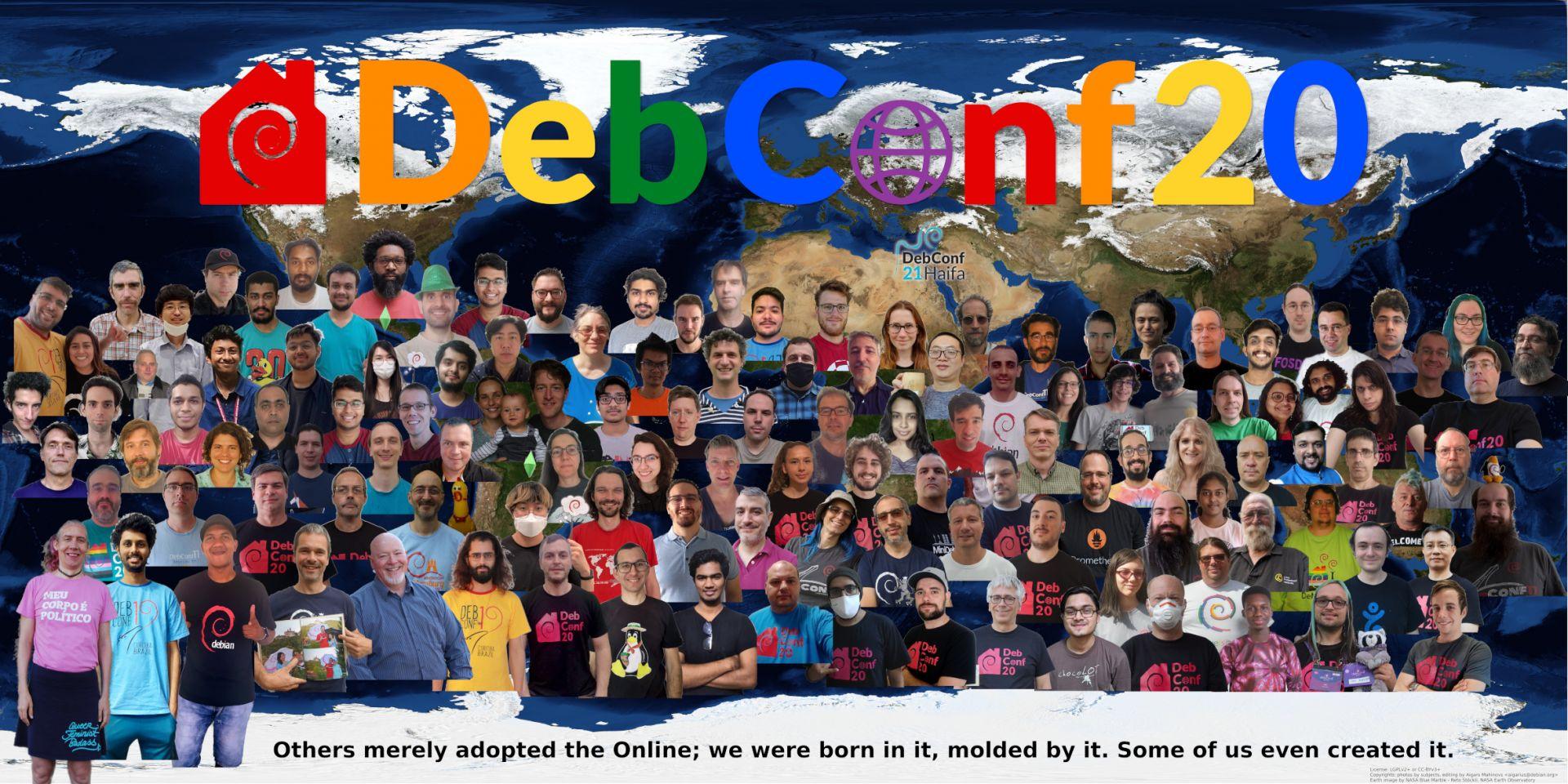
This week,last week, Last month, I attended DebConf 20 Online. It was the first DebConf to be held entirely online, but it s the 7th DebConf I ve attended from home.
My first one was DebConf7. Initially I mostly started watching the videos because I wanted to learn more about packaging. I had just figured out how to create binary packages by hand, and have read through the new maintainers guide, but a lot of it was still a mystery. By the end of DebConf7 my grasp of source packages was still a bit thin, but other than that, I ended up learning a lot more about Debian during DebConf7 than I had hoped for, and over the years, the quality of online participation for each DebConf has varied a lot.
I think having a completely online DebConf, where everyone was remote, helped raise awareness about how important it is to make the remote experience work well, and I hope that it will make people who run sessions at physical events in the future consider those who are following remotely a bit more.
During some BoF sessions, it was clear that some teams haven t talked to each other face to face in a while, and I heard at least 3 teams who said This was nice, we should do more regular video calls! . Our usual communication methods of e-mail lists and IRC serve us quite well, for the most part, but sometimes having an actual conversation with the whole team present at the same time can do wonders for dealing with many kind of issues that is just always hard to deal with in text based mediums.
There were three main languages used in this DebConf. We ve had more than one language at a DebConf before, but as far as I know it s the first time that we had multiple talks over 3 languages (English, Malayalam and Spanish).
It was also impressive how the DebConf team managed to send out DebConf t-shirts all around the world and in time before the conference! To my knowledge only 2 people didn t get theirs in time due to customs.
I already posted about the new loop that we worked on for this DebConf. It was an unintended effect that we ended up having lots of shout-outs which ended up giving this online DebConf a much more warmer, personal feel to it than if we didn t have it. I m definitely planning to keep on improving on that for the future, for online and in-person events. There were also some other new stuff from the video team during this DebConf, we ll try to co-ordinate a blog post about that once the dust settled.
Thanks to everyone for making this DebConf special, even though it was virtual!
FTP master
This month I accepted 159 packages and rejected 16. The overall number of packages that got accepted was 172.
Debian LTS
This was my seventy-fourth month that I did some work for the Debian LTS initiative, started by Raphael Hertzog at Freexian.
This month my all in all workload has been 21.75h. During that time I did LTS uploads of:
[DLA 2336-1] firejail security update for two CVEs
[DLA 2337-1] python2.7 security update for nine CVEs
[DLA 2353-1] bacula security update for one CVE
[DLA 2354-1] ndpi security update for one CVE
[DLA 2355-1] bind9 security update for two CVEs
[DLA 2359-1] xorg-server security update for five CVEs
I also started to work on curl but did not upload a fixed version yet. As usual, testing the package takes up some time.
Last but not least I did some days of frontdesk duties.
Debian ELTS
This month was the twenty sixth ELTS month.
During my allocated time I uploaded:
ELA-265-1 for python2.7
ELA-270-1 for bind9
ELA-272-1 for xorg-server
Like in LTS, I also started to work on curl and encountered the same problems as in LTS above.
Last but not least I did some days of frontdesk duties.
Other stuff
This month I found again some time for other Debian work and uploaded packages to fix bugs, mainly around gcc10:
All package called *osmo* are developed by the Osmocom project, that is about Open Source MObile COMmunication. They are really doing a great job and I apologize that my uploads of new versions are mostly far behind their development.
Some of the uploads are related to new packages:
A new minor release of the inline package just arrived on CRAN. inline facilitates writing code in-line in simple string expressions or short files. The package is mature and stable, and can be considered to be in maintenance mode: Rcpp used it extensively in the vrey early days before Rcpp Attributes provided an even better alternative. Seveal other package still rely on inline.
One of these package is rstan, and Ben Goodrich updated our use of system() to system2() allowing for better error diagnostics. We also did a bit of standard maintenance to Travis CI and the README.md file.
See below for a detailed list of changes extracted from the NEWS file.
Changes in inline version 0.3.16 (2020-09-06)
Maintenance updates to README.md standardizing badges (Dirk).
Maintenance update to Travis CI setup (Dirk).
Switch to using system2() for better error diagnostics (Ben Goodrich in #12).

 Welcome to gambaru.de. Here is my monthly report (+ the first week in September) that covers what I have been doing for Debian. If you re interested in Java, Games and LTS topics, this might be interesting for you.
Debian Games

 Now that the entire archive has been processed, packages
are prioritized based on the likelihood of a change being
made to them successfully.
Over the course of its existence, the Janitor has slowly
gained support for a wider variety of packaging methods.
For example, it can now edit the templates for some of
the generated control files. Many of the packages that
the janitor was unable to propose changes for the first
time around are expected to be correctly handled when they
are reprocessed.
If you re a Debian developer, you can find the list of improvements
made by the janitor in your packages by going to
 I'm happy to announce I handed out my Master's Thesis last Monday. I'm not
publishing the final copy just yet











 So Finally,
 So finally, the greatest and meanest Raspberry is fully supported with
a pure Debian image! (only tarnished by the nonfree


 Debconf2020 took place when I was on personal vacations time. But anyway I m lucky enough that my
company, the Wikimedia Foundation, paid the conference registration fee for me and allowed me to
take the time (after my vacations) to watch recordings from the conference.
This is my first time attending (or watching) a full-online conference, and I was curious to see
first hand how it would develop. I was greatly surprised to see it worked pretty nicely, so kudos
to the organization, video team, volunteers, etc!
What follows is my summary of the conference, from the different sessions and talks I watched
(again, none of them live but recordings).
The first thing I saw was the
 A new minor release of the