Search Results: "ana"

3 March 2012

Andrew Cater: Raspberry Pi - order

Farnell did take note of the pre-order: I've just had an email asking me to confirm an order. I've just put one in for 30 days delivery ...

A work colleague has also added me to a list he's putting together - this means I might get two :(

Torrent was running at 5.90 sharing ratio a couple of days ago when I stopped it. It's now running at 1.4 share ratio - there's a lot of interest

I put up most of the Debian AMD64 DVDs plus a couple of netinsts at the same time - only a couple of those have reached 1.0 share ratio or better and been deleted.

UPDATE - Using instructions on how to run the image in QEMU, I have managed to get the basic Debian image meant for the RaspberryPI to run on my small i686 laptop.

Well done to the folks at the University of Cambridge who've been using this as a development distribution: Fedora from University of Toronto will follow.
LXDE, compilers - and all running in 256M :)

Ingo Juergensmann: Goodbye Google, hello Diaspora!

Well, at least in Germany there was lot of press coverage about Google changing its data protection policies and joining the user profiles of their services like Youtube, GMail, Google+ and so on. There were even HowTos to delete some tracking relevant data and history before of March 1st. like on German Spiegel Online news magazine. Because I'm no big fan of Google and being a strong privacy advocate, I tried to follow the steps mentioned there and got some surprises. First of all I discovered in Googles Dashboard that Google already joined my private account or email address with the one I used at work when I was testing some Android phones for some reasons. The mail address from work was considered as primary address and I couldn't change this. I could delete my private mail address from that account, but not the primary address from work. So, time was pressing because 1st of March was coming near, only one hour left, but what to do know? I'm already using plugins like Ghostery and AdBlockPlus for some time now to minimize the chance of being tracked and such. I registered with Google+ to have a look onto it and to reserve my name and account there, but I was not actively using it for privacy reasons nor do I use Facebook. Therefor the decision was simple and easy: deleting my Google account was probably the best idea I got on that day. That was easy and a quick win for my privacy concerns! On the other hand having some sort of a social network can be nice. And I'm a fan of decentralized solutions like Jabber, which I prefer over AIM/ICQ. I'm running my own Jabber server for some years now, so it was a natural thought to me to make this step for a social network as well. Diaspora* started as a distributed social network in 2010 after some students listened to a speech by Eben Moglen about "Freedom in the Cloud" and is currently still in Alpha stage of development. But it is working and it is running on free software. That's a fairly good reason alone to prefer, support and use Diaspora* over other proprietary social networks like G+ or Facebook, isn't it? So, give it a try! Everyone can run a Diaspora* node, called "pod", on their own server. There are some good installation guides available at Github.com Wiki even covering installation on Debian! Although these installation HowTo is quite good there are some pitfalls left. For example you'll need good SSL cert from an CA authority that is wildly installed on all systems. CAcert seems not to be supported and self-signed certs and CAs doesn't work either. Without a good SSL cert you won't be able to interconnect with other Diaspora* pods. Another pitfall for Debian seems to be the installation of Ruby. First I used the Debian Ruby packages, but got some errors when starting the server that some CSS files couldn't be found. After using the RVM installation metioned in the installation guide these problems were solved (please note that the described way of using RVM didn't work for me either and I got help from some really helpful people on #diaspora-de@freenode). But anyway, I managed to get Diaspora* up and running on my own server and get it to interconnect with other pods. Although installing Diaspora* from source is currently a little pain compared with the ease and comfort of pre-built Debian packages, it's worth the effort! Everyone who consider Google evil and Facebook bad should consider switching to Diaspora*! The more people join, the better the social network will get! Help to fight against the AOL-ism of the Internet by using open and non-proprietary APIs and software like Jabber and Diaspora*! You can find my Diaspora* pod at: http://nerdwind.de/ where my account is "ij".
Kategorie:
File attachments:

2 March 2012

Paul Tagliamonte: Syn rewrite

I m thinking of rewriting Syn, but this time, with the lessons learned from Syn1, 2, and 3. While I don t want to rewrite it (again), it ll be a nice time to simplify the project, and give it a chance to actually function (well) as a LFS-esque package manager. Hopefully, this can be the final rewrite.

29 February 2012

Joey Hess: leap day

This leap day saw me driving along the river on a rainy, with 4 chickens in the car's trunk, and 3 terabytes of disk (and a half a bale of straw) in the back seat. I may have not been blogging much lately about life, because these situations can be hard to explain. (Or because "joined the Debian haskell team and spent two days working on rebuilds for the ghc 7.4 transition" is not thrilling reading.)
hens in a car
The Light Sussex chickens are my sister's spare flock, which are "too tame". They're now cozily installed into a coop we built last weekend. In return I gave her a 6 foot long APC power strip, which had been mounted on the wall of my office. I'm preparing my house in town to be rented, and have little need for two dozen power outlets here in solar power land. Google <3s Your Work Indeed, today is a gift economy day all around -- when I arrived at the cabin, there on the porch was an unexpected package from Google. Particularly surprising since I never get deliveries here, since the driveway is a mile long and often seems like it could dead-end into the woods at any moment. The combination of technological wackiness (I also debugged a laptop whose USB hub hangs when a particular trackball is plugged in) and in your face country texture (including coal trains, being stuck behind a tractor, and miles of amazing tree-height mist) made this a memorable day.

Antonio Terceiro: Thesis submitted

Last Friday, after 5 long years, I have finally submitted my PhD thesis. It was quite a relief, more or less as if an elephant was taken off my back. An English title for my thesis would be Structural Complexity Characterization in Software Systems. Here is an abstract:
This thesis proposes a theory to characterize structural complexity in software systems. This theory aims to identify (i) the contribution of several factors to the structural complexity variation and (ii) the effects of structural complexity in software projects. Possible factors in the structural complexity variation include: human factors, such as general experience of the developers and their familiarity with the different parts of the system; factors related to the changes performed on the system, such as size variation and change diffusion; and organizational factors, such as the maturity of the software development process and the communication structure of the project. Effects of structural complexity include higher effort, and consequently higher cost, in software comprehension and maintenance activities. To test the validity of the proposed theory, four empirical studies were performed, mining data from free software project repositories. We analyzed historical data from changes performed in 13 systems from different application domains and written in different programming languages. The results of these studies indicated that all the factors studied influenced the structural complexity variation significantly in at least one of the projects, but different projects were influenced by different sets of factors. The models obtained were capable of describing up to 93% of the structural complexity variation in the projects analyzed. Keywords: Structural Complexity, Software Maintainance, Human factors in Software Engineering, Mining Software Repositories, Theories in Software Engineering, Empirical Software Engineering, Free/Open Source Software Projects.
Those who read Portuguese can check out the actual thesis text as a PDF file. Most of the studies discussed in the thesis are presented in English in papers I have published during the last years. My defense is going to be on March 23rd. If you happen to be at Salvador at that day, please feel cordially invited.

Sylvestre Ledru: Rebuild of the Debian archive with clang

Recently, I have been working on a side project for Debian. The goal was to rebuild of the Debian archive (the distribution) with clang, a new C/C++ compiler. clang is now ready to build software for production (either for C, C++ or Objective-C). This compiler is providing many more warnings and interesting errors than the gcc suite while not carrying the same legacy as gcc.
This rebuild has several goals. The first one is to prove (or not) that clang is a viable alternative. Second, building a software with different compilers improves the overall quality of code by providing different checks and alerts. The result are detailed and explained here:
http://clang.debian.net/ Conclusions
When I had the idea to rebuild Debian with a new compiler, I was expecting many issues and bugs caused by clang but I have been surprised to notice that most of the issues are either difference in C standard supported, difference of interpretation or corner cases.
My personal opinion is that clang is now stable and good enough to rebuild most of the packages in the Debian archive, even if many of them will need minor tweaks to compile properly.
In the next few years, coupled with better static analysis tools, clang might replace gcc/g++ as the C/C++ compiler used by default in Linux and BSD distributions.
The clang developers are progressing very fast: 14.5% of the packages were failing with version 2.9 against 8.8% with version 3.0.
Several major steps in the clang adoptions have been made like chromium/chrome being built by default with clang, Xcode providing clang by default, FreeBSD working on the gcc -> clang switch, etc.
However, on the Debian point of view, one of the important step would be to make sure that clang manages all the Debian architecture/kernel (11 official, 6 unofficial)

28 February 2012

Jon Dowland: Budgeting

I'm seeking advice on budgeting. Historically, I've been crap at managing money. Things have improved in recent years. My main tool is Martin Lewis' Money Saving Expert budget planner. It's simply a spreadsheet, into which you feed your income and outgoings. You can supply each line item as either a daily, monthly or annual income or expense. The sheet works out both a monthly and an annual total for each and the difference (be it positive or negative). The monthly summary is a useful benchmark against which you can compare your monthly bank statements, but it's not sufficient. Consider a one-off annual expense, such as a holiday payment. On the budget planner, the expense will be divided up into monthly chunks and deducted from your monthly income. However, the expense won't be on your bank statements, unless you've made a special arrangement to pay out a monthly sum to another account, such as savings account, for every annual expense. Therefore you can't just compare the planner's monthly summary against your bank statement summary and hope the two match. I really need to see what my monthly outgoings should total to, rather than what all my outgoings are, presented monthly, in order to meaningfully compare the two. How should I handle this? Should I do as I suggested there and total up my annual one-offs, divide by twelve and make a monthly payment for that sum to a savings account? I'd still want to be able to quickly look at my main statement and judge the overall figure as either 'good' or 'bad'. Perhaps I should feed my various statements into one place, perhaps a finance tool, in which case, which one? How do you manage your finances?

27 February 2012

Iustin Pop: doc-rfc update

Thanks to Thomas' help and gentle reminder, I finally managed to upload a new version of doc-rfc. Why is this noteworthy? It's not really, I just wanted to say: any package for which running lintian on it takes around 5 times the build time, is special .

Leandro G&oacute;mez: DebConf needs you!

The 13th Debian Conference is just around the corner. DebConf12 will be held in Managua, Nicaragua, July 8-14, 2012, and we need your help! Why should I care? DebConf is the annual conference for Debian contributors and interested users. Previous Debian Conferences have featured speakers and attendees from around the world (DebConf11 had attendees from 46 different countries). DebConf helps share the knowledge and experiences of individual developers with the entire community. It also helps promote enthusiasm for specialized areas of development and encourages discussions about Debian s future. The benefits that DebConf brings to the Debian project as a whole, and the larger Free Software community, will improve Debian and by extension will help improve GNU/Linux for everyone, whether they use Debian (or a Debian derivative), or any other distribution. How can I help? DebConf is a lot to organize and pay for. We invite you to help that this is going to be a successfull event.

26 February 2012

John Goerzen: Timelessness of an Old Pickup

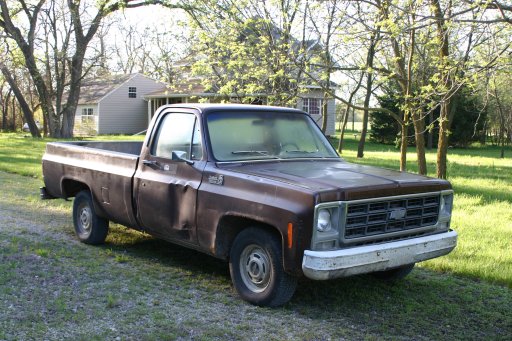
Our society is one that is pretty well defined by timeliness. TV programs start at a precise time, down to the second. Schools have elaborate timekeeping systems. Even church services are carefully timed. We know how fast we re going, and our GPS or phones tell us when we ll get there. And we re pretty confident that we will, in fact, get there. Somehow this doesn t apply to our pickup. This pickup, in case you re wondering, is a thing of stories, shall we say. After a particularly frustrating experience with it one week (oh yes, the battle extended several days), I likened it to the Greek gods. And Terah had a good laughing fit when I began a sentence with The reason there s a towel connecting the brake pedal to the steering wheel But I guess the thrifty side of me won out, and somewhere along the line, I relented. My brother fixed up the carburetor. I got it a new battery. The flat tire is repaired. The starter broke, and I got it replaced. And I even got an oil change. Fancy, I know. So today, when I needed to take some backbreaking junk off the yard, I was hoping the pickup would work. I hadn t driven it in months, and any manner of catastrophe could have struck it in that time. So I was mildly relieved when it started on the 6th try. That is, quite seriously, quite the improvement, and shows how skilled a mechanic my brother is. The speedometer, of course, isn t working. The odometer stupidly reads 21531 or something like that (it was only a 5-digit odometer, broke long ago, so who knows how many miles it really has.) And I like to keep things like grease and heavy ancient air conditioners (one of the things I was hauling) away from my watch, so I wasn t wearing it. The result: I have no idea what time it is, how fast I m going, when I ll get there, IF I ll get there, or all those things. I set out, and made it a good half mile before it died as I was rounding a corner at the bottom of the hill. Always a great place for a finicky old stick-shift vehicle to die, right? Anyhow, a few random adjustments to the choke later, and the thing sputtered then roared (and I do mean roared) back to life. A little lurching up the hill and I was back on my way. Now, I was stuck there in the middle of the road, but it was a country road, so I d have probably had a good hour to get it fixed before worrying about blocking anybody s way. My first stop: my great uncle s place. He has a scrap metal for charity project going on. He is looking for old motors, air conditioners, dehumidifiers, etc. He takes them apart, separates out the metals, sells them, and donates the result to MCC, a world relief agency. I knew I had an old dehumidifier in the basement, and thought I remembered seeing an old window air conditioner in the elevator. That thing is probably the single heaviest object I have ever moved without help. I have a bandaid to prove it. It was way too heavy to carry, so I kind of rolled it, side to side, from the side of the elevator on to the pickup. If you were watching, you d have heard me making struggling noises, followed by BANG rattle rattle rattle pause struggling noises . BANG rattle rattle rattle as I rolled it along the ground, and waited for the internal bits to settle after each quarter turn. So anyway, eventually I got it to the pickup, and then had the sickening realization: I have no way to get this thing up there. Oops. I eventually placed it on top of an old tire rim, balanced it there as I knelt down, and somehow still not quite sure how managed to lift the entire thing a few feet until I could get some leverage to shove it onto the pickup. I later commented to my dad that it was a Chrysler brand air conditioner, somewhat to my surprise, and he said that it was probably my great-grandpa s. That was a surprise. Anyhow, back to the pickup. I drove down the few miles to my great grandpa s place, not really knowing how fast I was going. I smelled the familiar smells of the old pickup: exhaust fumes, oil on hot surfaces it shouldn t be on, a touch of hot antifreeze. You never have any doubt about whether the engine is running. It was sort of nice to not know, or particularly care, how fast I was going, or what time it was. Sometimes I d idly wonder, but you know, it didn t really matter and there wasn t a thing I could do about it anyhow. I got to uncle s place, unloaded the junk sorta dropped the air conditioner off the back of the pickup with a terrific BANG, then rolled it all the way to his trailer and got back in. On to town. I hadn t put gas in the pickup in a few years, and I suspected it was getting low. (The gas gauge, you guessed it, doesn t work right either.) Plus we had some large recyclables built up and it was time to get rid of them. And for that, I had to drive on the highway a ways. The speed limit there is 65MPH. I have no idea how fast I was going, but it wasn t 65. Maybe it was 45. I got passed a lot, but nobody looked particularly surprised that a pickup that looks like mine wasn t going 65. Partway there, I smelled a different smoke smell. Not an oil smoke, but more of a grassy or wood smoke. Hmm, I thought. That s odd. Hope it s not coming from the pickup. I didn t really see smoke anywhere else, so I just drove on until I couldn t smell it anymore. I unloaded the recyclables, then went to the gas station. As the pump readout neared $50, I decided: 1) the gas tank really was pretty empty, and 2) I just can t put more gas in it anymore. That would be more than the truck s worth. So I drove home. The drive home was into the wind. My face got pretty cold I always drive with the windows open to prevent carbon monoxide poisoning (remember the fumes?) I got home and prepared to pack up the pickup close the windows, replace the bungee cord holding the brake pedal up, etc. I then thought I d have a look under the hood to see if there was anything, well, on fire. Nope, but there was a packrat nest that fell down as soon as the wind hit it. Source of grassy-smelling smoke identified. It s amazing what difference simple lack of knowledge makes sometimes. Not knowing what time it is or how fast I m going means I don t have to worry about those things. I wonder how society has changed simply because accurate and cheap watches are available. I kind of like driving the old truck. It s a bit of an adventure, a bit of a challenge, a bit of randomness, and a bit of an escape from the normal and predictable. Not a bad deal for a $75 vehicle.
25 February 2012

Andreas Barth: Traveling to DebConf 11 - M nchen to Zagreb

These articles cover my way to DebConf 11 through Hrvatska and Bosna i Hercegovina. After telling my initial plans to go by train (mostly) and bus (where it couldn't be avoided) on IRC, I was warned that public transport is quite bad and unreliable. Also, as I live in M nchen, of course this part of Europe was always known as "near" and "could be visited any time" (which means "one never gets to it"; and I can still remember the time when it was Yugoslavia - there are and always were many people living here from that part of Europe; in fact, it's nearer than some parts of Germany). I plan to publish more parts of my way within the next days. Already at home I also learned that most trains in Hrvatska (and all in Bosna i Hercegovina) are not part of the usual train information system, so it was a bit more advanced to find out the appropriate connections. And in both countries there are only a few trains running, so one shouldn't miss a train ("few" means e.g. two per day and direction - but one at most unappropriate times, so really only one suiteable). The first day saw me boarding the Suburban train (S-Bahn) at my usual station, changing platforms and trains at M nchen Ost station and then I was sitting in a train to Zagreb. Nothing strange there, except that the coach I had an seat reserved in was missing. I learned later on that it happens more often that the coach from Serbia is not there because it's technically too unfit to send it to Germany -- and usually, there will be more coaches added in Ljubljana. Border checks were uneventfull but at the slovenijan border my passport was stamped (not sure why, didn't happen on the way back).
Train in sterreich After arriving in Zagreb and dropping off my luggage in the hotel, I first got some Kunas and then bought my ticket to Split for the next day (as a direct ticket from M nchen to Split was not available). After having done that, I took a brief tour through Zagreb until it became dark, with visiting some of the tourist places.
Zagreb

24 February 2012

Guido G nther: Iodine plugin for network-manager

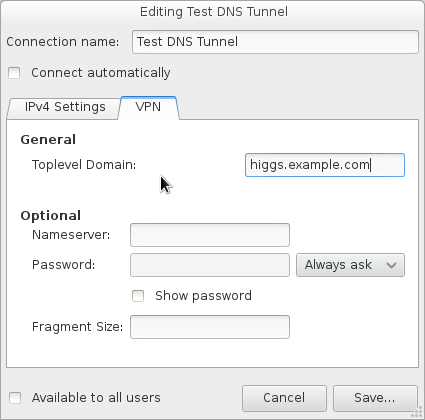
During FOSDEM I finally got around to hack on a iodine plugin for network manager. Given a suitably prepared server on the other end this allows you to tunnel connections over DNS when all other traffic is firewalled. The basic configuration only needs the domain name set: Network Manager Iodine Configuration You can grab the sources from git.gnome.org, a Debian package is also available. This blog is flattr enabled.

Richard Hartmann: zsh pound-insert

Ben Hutchings writes:
There is an alternative to using C-c, and that is M-#. This adds a '#' to the start of the line, commenting it out, and then behaves as if you pressed Return. The result is that the command is cancelled but still remains on-screen and in your history. You can then copy the command later using the mouse or keyboard.
Naturally, there is a zsh equivalent for this (there always is...): pound-insert. Quoth the manpage:
pound-insert
If there is no # character at the beginning of the buffer, add one to the beginning of each line. If there is one, remove a # from each line that has one. In either case, accept the current line. The INTERACTIVE_COMMENTS option must be set for this to have any usefulness.
So if you want the same for zsh, a simple
bindkey '^[#' pound-insert

is all you need. Update: Clint Adams noted another way to do (almost) the same.

Richard Hartmann: apt-get install vcsh

apt-get install vcsh I finally got around to package vcsh and David Bremner was kind enough to sponsor it. vcsh is available in testing, unstable, and squeeze-backports. Also, Ubuntu seems to have copied it over into their repositories automagically. As you probably don't know, vcsh is a tool to manage config files in git. Say you want to maintain one repository for zsh, one for vim, one for ssh, one for mplayer, and one for mr, but obviously there can only be one .git in $HOME. vcsh helps by moving $GIT_DIR into $XDG_CONFIG_HOME/vcsh/repo.d/ but keeping $GIT_WORK_TREE in $HOME. The splitting of configuration sets into separate repositories allows you avoid checking out, say, mplayer's config on your servers, or checking out your ssh config at work. If this sounds complicated, it's not; vcsh hides all of the dirty details from you. vcsh integrates nicely with mr by means of a plugin, making handling your configurations even more trivial. If you do get stuck along the way, simply drop into #vcs-home on irc.oftc.net or send email to the vcs-home mailing list. popcon tells me that there are more users than I know about directly, so pipe up if you're one of them. And if you are one of the people who have it installed but don't use it, I am even more interested. I would love to know why so I can improve it. Long story short, if you care about the integrity and/or history of your configuration, or if you use one or more computers, you should definitely give vcsh a try. Any kind of feedback appreciated :)

Julien Danjou: 10 years as a Debian developer

Ten years ago, I joined the Debian project as a developer. At that time, I was 18 and in my first year at university, hanging out with the TuxFamily system administrators, which included 3 french Debian developers (sjg, igenibel and creis). I was learning Debian packaging while working on VHFFS, and decided to package one or two non-yet-packaged software for Debian. My friends pushed me into the NM process, and less than 2 months later I was a Debian developer. One have to admit that back in the days, the NM process was really fast if you were able to reply to the questions quickly. :-) I think I became the youngest developer among Debian's ones. That was my first steps in a Free Software project, and it was really exciting. In 10 years, I've been doing a lot of different things for Debian. Sure, I've been using it all the years long, but let's recap a bit what I did, from what I recall. My first Debian only project was apt-build around 2003, and later rebuildd in 2007. I built the Xen packaging team in 2005, I've been a Stable Release Manager for a year in 2006, and did heavy bug squashing to release Etch that same year. I also was an Application Manager in 2006 and managed the application of 2 Debian developers (Jose Parrella and Dami n Viano). I admit I've been less active in Debian after 2007, mainly because I was busy working on awesome, GNU Emacs and others software. Since 2011, I joined the OpenStack packaging team and I'm working on OpenStack on a (almost) daily basis. I don't know how many packages I touched, managed or updated, but that should be one or two hundreds. I still maintain 53 of them. After all, the adventure has been really pleasant, and I had the chance to work with and meet fabulous and smart people. I always liked this project and what it's trying to do. After all these years, I'm definitively staying! See you in another 10 years, folks! :)

MJ Ray: Signed the PDFreaders Petition

We, the undersigned, hereby state that we expressly and unequivocally oppose the advertising of proprietary software products on government websites. Such advertising breaches impartiality and encourages citizens to employ technologies that unnecessarily restrict their freedom. The role of government is not to support certain market participants and not others, particularly when doing so works to maintain the monopolies of global software companies. In explanations of how to use digital resources that they provide, government agencies should clarify that multiple methods are available, and favour technologies which do not restrict users digital rights; by linking to PDFreaders.org, for example. Free Software guarantees the users right to use (for any purpose), study (without secrets), share (with anyone), and improve the software that they use. Public institutions should publish their documents in formats that can be read with Free Software. Indeed, many Free Software applications exist for reading such documents. Governments should lead citizens to freedom, and encourage them to make use of these applications. Sincerely,
Our co-op and 56 other businesses, 69 organisations and over 2200 individuals so far. How about adding your signature? Surely it s time for our governments to stop giving free adverts to Adobe? It was particularly annoying in the Digital Britain report, I thought.

23 February 2012

Michal &#268;iha&#345;: Yet another project...

Okay, I'm probably really incorrigible. Not long ago, I've publicly complained that I have too many projects to work on and now I just got commit access to another one (after bothering Richard too much with my patches). Anyway I don't expect to contribute much to colorhug client, but somehow it happened that I needed to fix few bits and that lead to finding another bits to fix. Also I hope I won't have to touch much of other software in color management stack. Playing with Little CMS was nice experience, though I'd still prefer to be user in this area :-).

Filed under: English Life 0 comments Flattr this!

22 February 2012

Bartosz Fe&#324;ski: [B]ack[U]p and [R]estore [P]rogram

One of the most popular backup solution under Linux is Bacula, but it s quite complicated to setup. The same for Amanda.
Since my last sponsored upload we ve got another alternative in Debian. It s called burp. Let s enumerate its features as of version 1.3.0: Sounds good and this project is only 1 year old! Author claims that setup is much easier than with Bacula. Let s find out is that truth ;) Since we ve got this software in Debian installing it on unstable is as simple as apt-get install burp .
Both client and server came from the same binary package. Now let s configure server side. Well in fact we just have to run it, so just change RUN=no to RUN=yes in /etc/default/burp and launch it using /etc/init.d/burp start . Now the client side. If the client is on the same machine then you re ready. Yes you re ready! Let s do our first backup:
backup ~ # burp -a b
2012-02-22 17:53:03: burp[30584] Listing configured paths:
2012-02-22 17:53:03: burp[30584] include: /home
2012-02-22 17:53:03: burp[30584] Listing starting paths:
2012-02-22 17:53:03: burp[30584] /home
2012-02-22 17:53:03: burp[30584] before client
2012-02-22 17:53:03: burp[30584] begin client
2012-02-22 17:53:03: burp[30584] auth ok
2012-02-22 17:53:03: burp[30584] Compression level: 9
2012-02-22 17:53:03: burp[30584] do backup client
2012-02-22 17:53:03: burp[30584] Phase 1 begin (file system scan)
 
ddwdffffddffdfdfdddfffffdddfffffffdfffdfdfffffdfdfdffdddddfffddff 64
[...a lot of output...]
 
2012-02-22 17:53:03: burp[30584] Phase 1 end (file system scan)
2012-02-22 17:53:03: burp[30584] Phase 2 begin (send file data)
 
ffffffffffffffffffffffffffffffffffffffffffffffffffffffffffffffff 64
[...a lot of output...]
 
--------------------------------------------------------------------------------
Start time: 2012-02-22 17:53:03
  End time: 2012-02-22 17:53:07
Time taken: 00:04
                             New   Changed Unchanged     Total    Scanned
                       --------------------------------------------------
                Files:       100         0         -       100        100
          Directories:         -         -         -         -         76
           Soft links:         -         -         -         -          1
          Grand total:       100         0         -       100        177
                       --------------------------------------------------
 
             Warnings:             1
 
      Bytes estimated:      17628946 (16.81 MB)
      Bytes in backup:      17628946 (16.81 MB)
       Bytes received:             0
           Bytes sent:      17628946 (16.81 MB)
--------------------------------------------------------------------------------
2012-02-22 17:53:07: burp[30584] Phase 2 end (send file data)
2012-02-22 17:53:07: burp[30584] backup finished ok
2012-02-22 17:53:07: burp[30584] after client
backup ~ #
Yes. By default it is so extremely simple! Of course this way we can make backup of /home (that s default) to /var/spool/burp (also default location) but you can easily change this.
For the simplest scenario (backing up laptop to remote server) all I had to change was server = 127.0.0.1 in /etc/burp/burp.conf on the client side. Burp comes with handy tool called burp_ca and it simplifies setting up encrypted backups. In fact there is step by step howto in documentation.
Other options are quite self explanatory and well documented in both client and server config files that came with the package. Happy backuping!

Cyril Brulebois: Wrench days

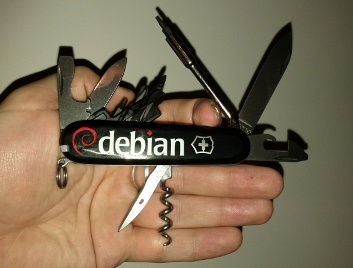
Fixing hardware Thanks to the nice Debian Swiss Knives initiative! Fixing software Besides trying to maintain the whole X stack as usual, and preparing the funky wayland, mesa, and weston trio for experimental, I got myself into other areas. Debugging gzip Jakup Wilk noticed a while ago that some multiarchified packages couldn t be co-installed due to gzipped files being different between architectures. That was reported as #647522 against the gzip package. While some developers consider the lack of determinism (as in: it s not in the gzip specification, and the current implementation generates different packages anyway!) as a dead-end for the multiarch experiment, it didn t look like undebuggable or unfixable. And indeed, as confirmed by a quick analysis: a lack of clean-up when several files are processed at once can lead to different results, depending on the order in which files are specified on the command line; the patch for that is trivial, and was later made smaller and the need for it was explained. Working in the Release Team I reviewed/approved a few packages for squeeze, but also took care of handling or finishing a few transitions (as seen in my hints file), among which the funny iceweasel9/libmozjs ones; release tools are nice, but one gets to learn lots of stuff at once (which isn t a negative aspect). I hacked a tiny collision detector so that packages involved in several transitions can be easily spotted. Given the huge number of ongoing transitions we had lately, that didn t look overkill. Squashing bugs It had been a very long time since my last working on totally random RC bugs. The Bug Squashing Party organized at IRILL was a very nice opportunity to get back to totally crazy bugs in unknown packages, but also to meet with other Debian contributors; sponsoring maintainers with good patches on their first try was nice, but walking other contributors through their first patches sent to the BTS or through their first NMUs was nice too. Waving good bye to yada Back in the M rida QA meeting I attended in 2007, there were already jokes about how bad yada was, and how it should die in a fire etc. When I started looking at the RC bug list, I quickly switched to scrolling it backwards, and I wondered how much work was left. The details can be seen in #660548, and the result is: yada is gone! sanity++; packages.debian.org Both long descriptions and translations for packages in some suites disappeared after the switch to Description-md5. Thanks to a quick and reduced packages.debian.org setup (mostly: en+de for squeeze+sid+experimental), I managed to find my way through Perl and DB files to propose patches for #657557. I m still waiting for a confirmation, but in case it works fine, we could even get a fix for DDTP/DDTSS.

20 February 2012

Gunnar Wolf: Left Google Reader for rssLounge

Ben mentions he left Google Reader and went back to Liferea, but mentions a series of bugs that keep him from being happy. After pondering it a bit, a couple of months ago I also left Google Reader, but I turned to a free webapp: rssLounge aggregator. Although it does not fully cover Ben's wishlist (I'll get to it now), I am happy using it as it covers my main need: Being able to read my stuff from just about everywhere, without installing even a ssh client (that would make public Windows machines a liability for me, as they could sniff my keystrokes while authenticating to my ssh server). So, for me, a webapp is basically a must. Well, as for Ben's list:
  1. MAY be a desktop or web application.
    Check. Well, I don't know what would fail this :)
  2. If it's a web application, it MUST be reasonably secure, e.g. it must not be written in PHP.
    Fail. It's PHP. And that's my main reason for not uploading it to Debian I use and enjoy this app every day, but it has some bugs I don't really feel like looking into. And yes, maintaining PHP code is ugly.
  3. If it's a web application, it MUST allow for multiple independent users on the same server.
    Don't really remember, I set it up just for myself. But in any case, you could install a different instance per user?
  4. If it's a desktop application, it MUST embed a browser engine (presumably Gecko or WebKit) so I can follow links without having to switch windows.
    N/A
  5. MUST support organisation of feeds by folders or tags, including combined item lists.
    Pass.
  6. MUST keep track of which items have been read.
    Pass.
  7. MUST support a global 'unread items' list. SHOULD only remove items from this list when I refresh it, not as soon as I move away from an item.
    Pass. In fact, given that storage is cheap, I have set it to never expire old entries. I don't know if it will ever be useful, but as long as it does not hurt me...
  8. SHOULD support a three-pane (folder/list/item) view or something similar. Google Reader's list view with expanding items is perhaps even better, though it means links must be opened in a separate tab.
    It's more like Google Reader's
  9. SHOULD support folder and item navigation by keyboard.
    Pass.
  10. SHOULD have some way to flag/bookmark items for later attention.
    Pass.
  11. If it's a desktop application, it SHOULD have some sort of download manager to support podcasts.
    N/A
So, Ben, with only one (big) fail, it might be a good candidate for you. PS- And hard as it might seem, I am leading an almost-Google-free life now! :) But don't let them hear this, as we want them to keep sponsoring Summer of Code and DebConf.

Next.

Previous.