Search Results: "tim"

24 May 2016

Alberto Garc a: I/O bursts with QEMU 2.6

QEMU 2.6 was released a few days ago. One new feature that I have been working on is the new way to configure I/O limits in disk drives to allow bursts and increase the responsiveness of the virtual machine. In this post I ll try to explain how it works. The basic settings First I will summarize the basic settings that were already available in earlier versions of QEMU. Two aspects of the disk I/O can be limited: the number of bytes per second and the number of operations per second (IOPS). For each one of them the user can set a global limit or separate limits for read and write operations. This gives us a total of six different parameters. I/O limits can be set using the throttling.* parameters of -drive, or using the QMP block_set_io_throttle command. These are the names of the parameters for both cases:
-drive block_set_io_throttle
throttling.iops-total iops
throttling.iops-read iops_rd
throttling.iops-write iops_wr
throttling.bps-total bps
throttling.bps-read bps_rd
throttling.bps-write bps_wr
It is possible to set limits for both IOPS and bps at the same time, and for each case we can decide whether to have separate read and write limits or not, but if iops-total is set then neither iops-read nor iops-write can be set. The same applies to bps-total and bps-read/write. The default value of these parameters is 0, and it means unlimited. In its most basic usage, the user can add a drive to QEMU with a limit of, say, 100 IOPS with the following -drive line:
-drive file=hd0.qcow2,throttling.iops-total=100
We can do the same using QMP. In this case all these parameters are mandatory, so we must set to 0 the ones that we don t want to limit:
     "execute": "block_set_io_throttle",
     "arguments":  
        "device": "virtio0",
        "iops": 100,
        "iops_rd": 0,
        "iops_wr": 0,
        "bps": 0,
        "bps_rd": 0,
        "bps_wr": 0
      
    
I/O bursts While the settings that we have just seen are enough to prevent the virtual machine from performing too much I/O, it can be useful to allow the user to exceed those limits occasionally. This way we can have a more responsive VM that is able to cope better with peaks of activity while keeping the average limits lower the rest of the time. Starting from QEMU 2.6, it is possible to allow the user to do bursts of I/O for a configurable amount of time. A burst is an amount of I/O that can exceed the basic limit, and there are two parameters that control them: their length and the maximum amount of I/O they allow. These two can be configured separately for each one of the six basic parameters described in the previous section, but here we ll use iops-total as an example. The I/O limit during bursts is set using iops-total-max , and the maximum length (in seconds) is set with iops-total-max-length . So if we want to configure a drive with a basic limit of 100 IOPS and allow bursts of 2000 IOPS for 60 seconds, we would do it like this (the line is split for clarity):
   -drive file=hd0.qcow2,
          throttling.iops-total=100,
          throttling.iops-total-max=2000,
          throttling.iops-total-max-length=60
Or with QMP:
     "execute": "block_set_io_throttle",
     "arguments":  
        "device": "virtio0",
        "iops": 100,
        "iops_rd": 0,
        "iops_wr": 0,
        "bps": 0,
        "bps_rd": 0,
        "bps_wr": 0,
        "iops_max": 2000,
        "iops_max_length": 60,
      
    
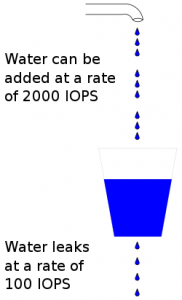
With this, the user can perform I/O on hd0.qcow2 at a rate of 2000 IOPS for 1 minute before it s throttled down to 100 IOPS. The user will be able to do bursts again if there s a sufficiently long period of time with unused I/O (see below for details). The default value for iops-total-max is 0 and it means that bursts are not allowed. iops-total-max-length can only be set if iops-total-max is set as well, and its default value is 1 second. Controlling the size of I/O operations When applying IOPS limits all I/O operations are treated equally regardless of their size. This means that the user can take advantage of this in order to circumvent the limits and submit one huge I/O request instead of several smaller ones. QEMU provides a setting called throttling.iops-size to prevent this from happening. This setting specifies the size (in bytes) of an I/O request for accounting purposes. Larger requests will be counted proportionally to this size. For example, if iops-size is set to 4096 then an 8KB request will be counted as two, and a 6KB request will be counted as one and a half. This only applies to requests larger than iops-size: smaller requests will be always counted as one, no matter their size. The default value of iops-size is 0 and it means that the size of the requests is never taken into account when applying IOPS limits. Applying I/O limits to groups of disks In all the examples so far we have seen how to apply limits to the I/O performed on individual drives, but QEMU allows grouping drives so they all share the same limits. This feature is available since QEMU 2.4. Please refer to the post I wrote when it was published for more details. The Leaky Bucket algorithm I/O limits in QEMU are implemented using the leaky bucket algorithm (specifically the Leaky bucket as a meter variant). This algorithm uses the analogy of a bucket that leaks water constantly. The water that gets into the bucket represents the I/O that has been performed, and no more I/O is allowed once the bucket is full. To see the way this corresponds to the throttling parameters in QEMU, consider the following values:
  iops-total=100
  iops-total-max=2000
  iops-total-max-length=60
bucket The bucket is initially empty, therefore water can be added until it s full at a rate of 2000 IOPS (the burst rate). Once the bucket is full we can only add as much water as it leaks, therefore the I/O rate is reduced to 100 IOPS. If we add less water than it leaks then the bucket will start to empty, allowing for bursts again. Note that since water is leaking from the bucket even during bursts, it will take a bit more than 60 seconds at 2000 IOPS to fill it up. After those 60 seconds the bucket will have leaked 60 x 100 = 6000, allowing for 3 more seconds of I/O at 2000 IOPS. Also, due to the way the algorithm works, longer burst can be done at a lower I/O rate, e.g. 1000 IOPS during 120 seconds. Acknowledgments As usual, my work in QEMU is sponsored by Outscale and has been made possible by Igalia and the help of the QEMU development team. igalia-outscale Enjoy QEMU 2.6!

23 May 2016

Enrico Zini: I chipped in

I clicked on a random link and I found myself again in front of a wired.com popup that wanted to explain to me what I have to think about adblockers. This time I was convinced, and I took my wallet out. I finally donated $35 to AdBlock. (And then somebody pointed me to uBlock Origin and I switched to that.)

Petter Reinholdtsen: Discharge rate estimate in new battery statistics collector for Debian

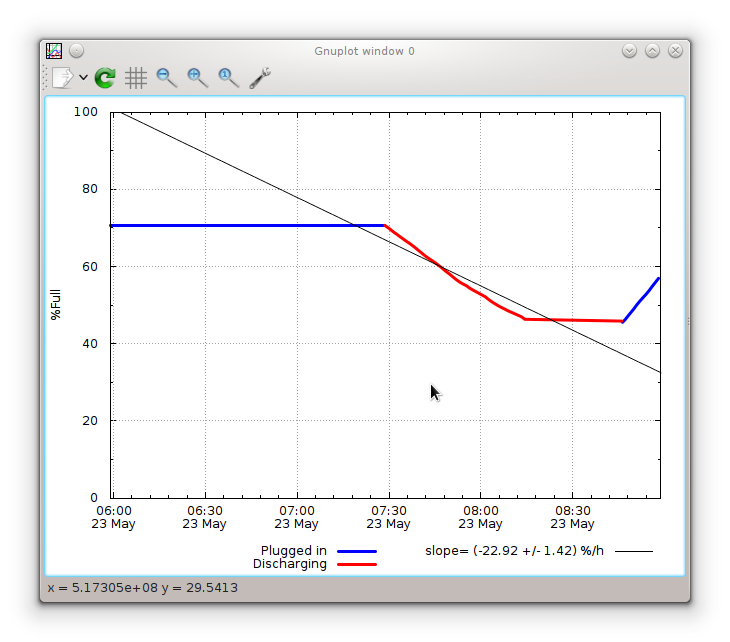
Yesterday I updated the battery-stats package in Debian with a few patches sent to me by skilled and enterprising users. There were some nice user and visible changes. First of all, both desktop menu entries now work. A design flaw in one of the script made the history graph fail to show up (its PNG was dumped in ~/.xsession-errors) if no controlling TTY was available. The script worked when called from the command line, but not when called from the desktop menu. I changed this to look for a DISPLAY variable or a TTY before deciding where to draw the graph, and now the graph window pop up as expected. The next new feature is a discharge rate estimator in one of the graphs (the one showing the last few hours). New is also the user of colours showing charging in blue and discharge in red. The percentages of this graph is relative to last full charge, not battery design capacity.

The other graph show the entire history of the collected battery statistics, comparing it to the design capacity of the battery to visualise how the battery life time get shorter over time. The red line in this graph is what the previous graph considers 100 percent:
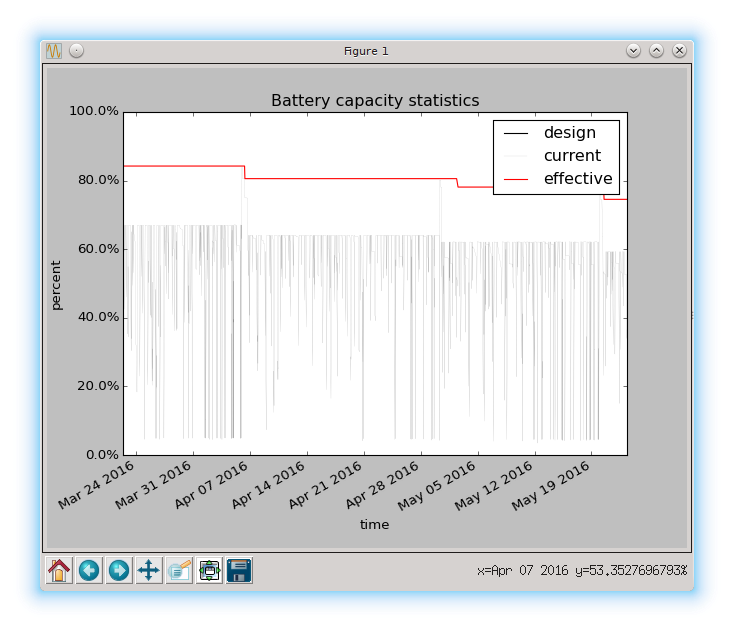
In this graph you can see that I only charge the battery to 80 percent of last full capacity, and how the capacity of the battery is shrinking. :( The last new feature is in the collector, which now will handle more hardware models. On some hardware, Linux power supply information is stored in /sys/class/power_supply/ACAD/, while the collector previously only looked in /sys/class/power_supply/AC/. Now both are checked to figure if there is power connected to the machine. If you are interested in how your laptop battery is doing, please check out the battery-stats in Debian unstable, or rebuild it on Jessie to get it working on Debian stable. :) The upstream source is available from github. Patches are very welcome. As usual, if you use Bitcoin and want to show your support of my activities, please send Bitcoin donations to my address 15oWEoG9dUPovwmUL9KWAnYRtNJEkP1u1b.

22 May 2016

Reproducible builds folks: Reproducible builds: week 56 in Stretch cycle

What happened in the Reproducible Builds effort between May 15th and May 21st 2016: Media coverage Blog posts from our GSoC and Outreachy contributors: Documentation update Ximin Luo clarified instructions on how to set SOURCE_DATE_EPOCH. Toolchain fixes Other upstream fixes Packages fixed The following 18 packages have become reproducible due to changes in their build dependencies: abiword angband apt-listbugs asn1c bacula-doc bittornado cdbackup fenix gap-autpgrp gerbv jboss-logging-tools invokebinder modplugtools objenesis pmw r-cran-rniftilib x-loader zsnes The following packages have become reproducible after being fixed: Some uploads have fixed some reproducibility issues, but not all of them: Patches submitted that have not made their way to the archive yet: Reproducibility-related bugs filed: Package reviews 51 reviews have been added, 19 have been updated and 15 have been removed in this week. 22 FTBFS bugs have been reported by Chris Lamb, Santiago Vila, Niko Tyni and Daniel Schepler. tests.reproducible-builds.org Misc. This week's edition was written by Reiner Herrmann and Holger Levsen and reviewed by a bunch of Reproducible builds folks on IRC.

Antonio Terceiro: Adopting pristine-tar

As of yesterday, I am the new maintainer of pristine-tar. As it is the case for most of Joey Hess creations, it is an extremely useful tool, and used in a very large number of Debian packages which are maintained in git. My first upload was most of a terrain recognition nature: I did some housekeeping tasks, such as making the build idempotent and making sure all binaries are built with security hardening flags, and wrote a few automated test cases to serve as build-time and run-time regression test suite. No functional changes have been made. As Joey explained when he orphaned it, there are a few technical challenges involved in making sure pristine-tar stays useful in the future. Although I did read some of the code, I am not particularly familiar with the internals yet, and will be more than happy to get co-maintainers. If you are interested, please get in touch. The source git repository is right there.

19 May 2016

Matthew Garrett: Your project's RCS history affects ease of contribution (or: don't squash PRs)

Github recently introduced the option to squash commits on merge, and even before then several projects requested that contributors squash their commits after review but before merge. This is a terrible idea that makes it more difficult for people to contribute to projects.

I'm spending today working on reworking some code to integrate with a new feature that was just integrated into Kubernetes. The PR in question was absolutely fine, but just before it was merged the entire commit history was squashed down to a single commit at the request of the reviewer. This single commit contains type declarations, the functionality itself, the integration of that functionality into the scheduler, the client code and a large pile of autogenerated code.

I've got some familiarity with Kubernetes, but even then this commit is difficult for me to read. It doesn't tell a story. I can't see its growth. Looking at a single hunk of this diff doesn't tell me whether it's infrastructural or part of the integration. Given time I can (and have) figured it out, but it's an unnecessary waste of effort that could have gone towards something else. For someone who's less used to working on large projects, it'd be even worse. I'm paid to deal with this. For someone who isn't, the probability that they'll give up and do something else entirely is even greater.

I don't want to pick on Kubernetes here - the fact that this Github feature exists makes it clear that a lot of people feel that this kind of merge is a good idea. And there are certainly cases where squashing commits makes sense. Commits that add broken code and which are immediately followed by a series of "Make this work" commits also impair readability and distract from the narrative that your RCS history should present, and Github present this feature as a way to get rid of them. But that ends up being a false dichotomy. A history that looks like "Commit", "Revert Commit", "Revert Revert Commit", "Fix broken revert", "Revert fix broken revert" is a bad history, as is a history that looks like "Add 20,000 line feature A", "Add 20,000 line feature B".

When you're crafting commits for merge, think about your commit history as a textbook. Start with the building blocks of your feature and make them one commit. Build your functionality on top of them in another. Tie that functionality into the core project and make another commit. Add client support. Add docs. Include your tests. Allow someone to follow the growth of your feature over time, with each commit being a chapter of that story. And never, ever, put autogenerated code in the same commit as an actual functional change.

People can't contribute to your project unless they can understand your code. Writing clear, well commented code is a big part of that. But so is showing the evolution of your features in an understandable way. Make sure your RCS history shows that, otherwise people will go and find another project that doesn't make them feel frustrated.

(Edit to add: Sarah Sharp wrote on the same topic a couple of years ago)

comment count unavailable comments

Antoine Beaupr : My free software activities, May 2016

Debian Long Term Support (LTS) This is my 6th month working on Debian LTS, started by Raphael Hertzog at Freexian. This is my largest month so far, for which I had requested 20 hours of work.

Xen work I spent the largest amount of time working on the Xen packages. We had to re-roll the patches because it turned out we originally just imported the package from Ubuntu as-is. This was a mistake because that package forked off the Debian packaging a while ago and included regressions in the packaging itself, not just security fixes. So I went ahead and rerolled the whole patchset and tested it on Koumbit's test server. Brian May then completed the uploaded, which included about 40 new patches, mostly from Ubuntu.

Frontdesk duties Next up was the frontdesk duties I had taken this week. This was mostly uneventful, although I had forgotten how to do some of the work and thus ended up doing extensive work on the contributor's documentation. This is especially important since new contributors joined the team! I also did a lot of Debian documentation work in my non-sponsored work below. The triage work involved chasing around missing DLAs, triaging away OpenJDK-6 (for which, let me remind you, security support has ended in LTS), raised the question of Mediawiki maintenance.

Other LTS work I also did a bunch of smaller stuff. Of importance, I can note that I uploaded two advisories that were pending from April: NSS and phpMyAdmin. I also reviewed the patches for the ICU update, since I built the one for squeeze (but didn't have time to upload before squeeze hit end-of-life). I have tried to contribute to the NTP security support but that was way too confusing to me, and I have left it to the package maintainer which seemed to be on top of things, even if things mean complete chaos and confusion in the world of NTP. I somehow thought that situation had improved with the recent investments in ntpsec and ntimed, but unfortunately Debian has not switched to the ntpsec codebase, so it seems that the NTP efforts have diverged in three different projects instead of closing into a single, better codebase.

Future LTS work This is likely to be my last month of work on LTS until September. I will try to contribute a few hours in June, but July and August will be very busy for me outside of Debian, so it's unlikely that I contribute much to the project during the summer. My backlog included those packages which might be of interest to other LTS contributors:
  • libxml2: no upstream fix, but needs fixing!
  • tiff ,3 : same mess
  • libgd2: maintainer contacted
  • samba regression: mailed bug #821811 to try to revive the effort
  • policykit-1: to be investigated
  • p7zip: same

Other free software work

Debian documentation I wrote an detailed short guide to Debian package development, something I felt was missing from the existing corpus, which seems to be too focus in covering all alternatives. My guide is opinionated: I believe there is a right and wrong way of doing things, or at least, there are best practices, especially when just patching packages. I ended up retroactively publishing that as a blog post - now I can simply tag an item with blog and it shows up in the blog. (Of course, because of a mis-configuration on my side, I have suffered from long delays publishing to Debian planet, so all the posts dates are off in the Planet RSS feed. This will hopefully be resolved around the time this post is published, but this allowed me to get more familiar with the Planet Venus software, as detailed in that other article.) Apart from the guide, I have also done extensive research to collate information that allowed me to create workflow graphs of the various Debian repositories, which I have published in the Debian Release section of the Debian wiki. Here is the graph: It helps me understand how packages flow between different suites and who uploads what where. This emerged after I realized I didn't really understand how "proposed updates" worked. Since we are looking at implementing a similar process for the security queue, I figured it was useful to show what changes would happen, graphically. I have also published a graph that describes the relations between different software that make up the Debian archive. The idea behind this is also to provide an overview of what happens when you upload a package in the Debian archive, but it is more aimed at Debian developers trying to figure out why things are not working as expected. The graphs were done with Graphviz, which allowed me to link to various components in the graph easily, which is neat. I also prefered Graphviz over Dia or other tools because it is easier to version and I don't have to bother (too much) about the layout and tweaking the looks. The downside is, of course, that when Graphviz makes the wrong decision, it's actually pretty hard to make it do the right thing, but there are various workarounds that I have found that made the graphs look pretty good. The source is of course available in git but I feel all this documentation (including the guide) should go in a more official document somewhere. I couldn't quite figure out where. Advice on this would be of course welcome.

Ikiwiki I have made yet another plugin for Ikiwiki, called irker, which enables wikis to send notifications to IRC channels, thanks to the simple irker bot. I had trouble with Irker in the past, since it was not quite reliable: it would disappear from channels and not return when we'd send it a notification. Unfortunately, the alternative, the KGB bot is much heavier: each repository needs a server-side, centralized configuration to operate properly. Irker's design is simpler and more adapted to a simple plugin like this. Let's hope it will work reliably enough for my needs. I have also suggested improvements to the footnotes styles, since they looked like hell in my Debian guide. It turns out this was an issue with the multimarkdown plugin that doesn't use proper semantic markup to identify footnotes. The proper fix is to enable footnotes in the default Discount plugin, which will require another, separate patch. Finally, I have done some improvements (I hope!) on the layout of this theme. I made the top header much lighter and transparent to work around an issue where followed anchors would be hidden under the top header. I have also removed the top menu made out of the sidebar plugin because it was cluttering the display too much. Those links are all on the frontpage anyways and I suspect people were not using them so much. The code is, as before, available in this git repository although you may want to start from the new ikistrap theme that is based on Bootstrap 4 and that may eventually be merged in ikiwiki directly.

DNS diagnostics Through this interesting overview of various *ping tools, I got found out about the dnsdiag tool which currently allows users to do DNS traces, tampering detection and ping over DNS. In the hope of packaging it into Debian, I have requested clarifications regarding a modification to the DNSpython library the tool uses. But I went even further and boldly opened a discussion about replacing DNSstuff, the venerable DNS diagnostic tools that is now commercial. It is somewhat surprising that there is no software that has even been publicly released that does those sanity checks for DNS, given how old DNS is. Incidentally, I have also requested smtpping to be packaged in Debian as well but httping is already packaged.

Link checking In the process of writing this article, I suddenly remembered that I constantly make mistakes in the various links I post on my site. So I started looking at a link checker, another tool that should be well established but that, surprisingly, is not quite there yet. I have found this neat software written in Python called LinkChecker. Unfortunately, it is basically broken in Debian, so I had to do a non-maintainer upload to fix that old bug. I managed to force myself to not take over maintainership of this orphaned package but I may end up doing just that if no one steps up the next time I find issues in the package. One of the problems I had checking links in my blog is that I constantly refer to sites that are hostile to bots, like the Debian bugtracker and MoinMoin wikis. So I published a patch that adds a --no-robots flag to be able to crawl those sites effectively. I know there is the W3C tool but it's written in Perl, and there's probably zero chance for me to convince those guys to bypass robots exclusion rules, so I am sticking to Linkchecker.

Other Debian packaging work At my request, Drush has finally been removed from Debian. Hopefully someone else will pick up that work, but since it basically needs to be redone from scratch, there was no sense in keeping it in the next release of Debian. Similarly, Semanticscuttle was removed from Debian as well. I have uploaded new versions of tuptime, sopel and smokeping. I have also file a Request For Help for Smokeping. I am happy to report there was a quick response and people will be stepping up to help with the maintenance of that venerable monitoring software.

Background radiation Finally, here's the generic background noise of me running around like a chicken with his head cut off: Finally, I should mention that I will be less active in the coming months, as I will be heading outside as the summer finally came! I somewhat feel uncomfortable documenting publicly my summer here, as I am more protective of my privacy than I was before on this blog. But we'll see how it goes, maybe you'll hear non-technical articles here again soon!

Petter Reinholdtsen: I want the courts to be involved before the police can hijack a news site DNS domain (#domstolkontroll)

I just donated to the NUUG defence "fond" to fund the effort in Norway to get the seizure of the news site popcorn-time.no tested in court. I hope everyone that agree with me will do the same. Would you be worried if you knew the police in your country could hijack DNS domains of news sites covering free software system without talking to a judge first? I am. What if the free software system combined search engine lookups, bittorrent downloads and video playout and was called Popcorn Time? Would that affect your view? It still make me worried. In March 2016, the Norwegian police seized (as in forced NORID to change the IP address pointed to by it to one controlled by the police) the DNS domain popcorn-time.no, without any supervision from the courts. I did not know about the web site back then, and assumed the courts had been involved, and was very surprised when I discovered that the police had hijacked the DNS domain without asking a judge for permission first. I was even more surprised when I had a look at the web site content on the Internet Archive, and only found news coverage about Popcorn Time, not any material published without the right holders permissions. The seizure was widely covered in the Norwegian press (see for example Hegnar Online and ITavisen and NRK), at first due to the press release sent out by kokrim, but then based on protests from the law professor Olav Torvund and lawyer Jon Wessel-Aas. It even got some coverage on TorrentFreak. I wrote about the case a month ago, when the Norwegian Unix User Group (NUUG), where I am an active member, decided to ask the courts to test this seizure. The request was denied, but NUUG and its co-requestor EFN have not given up, and now they are rallying for support to get the seizure legally challenged. They accept both bank and Bitcoin transfer for those that want to support the request. If you as me believe news sites about free software should not be censored, even if the free software have both legal and illegal applications, and that DNS hijacking should be tested by the courts, I suggest you show your support by donating to NUUG.

18 May 2016

Jonathan McDowell: First steps with the ATtiny45

1 port USB Relay
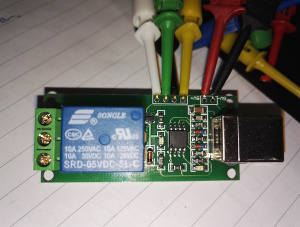
These days the phrase embedded usually means no console (except, if you re lucky, console on a UART for debugging) and probably busybox for as much of userspace as you can get away with. You possibly have package management from OpenEmbedded or similar, though it might just be a horrible kludged together rootfs if someone hates you. Either way it s rare for it not to involve some sort of hardware and OS much more advanced than the 8 bit machines I started out programming on. That is, unless you re playing with Arduinos or other similar hardware. I m currently waiting on some ESP8266 dev boards to arrive, but even they re quite advanced, with wifi and a basic OS framework provided. A long time ago I meant to get around to playing with PICs but never managed to do so. What I realised recently was that I have a ready made USB relay board that is powered by an ATtiny45. First step was to figure out if there were suitable programming pins available, which turned out to be all brought out conveniently to the edge of the board. Next I got out my trusty Bus Pirate, installed avrdude and lo and behold:
$ avrdude -p attiny45 -c buspirate -P /dev/ttyUSB0
Attempting to initiate BusPirate binary mode...
avrdude: Paged flash write enabled.
avrdude: AVR device initialized and ready to accept instructions
Reading   ##################################################   100% 0.01s
avrdude: Device signature = 0x1e9206 (probably t45)
avrdude: safemode: Fuses OK (E:FF, H:DD, L:E1)
avrdude done.  Thank you.
Perfect. I then read the existing flash image off the device, disassembled it, worked out it was based on V-USB and then proceeded to work out that the only interesting extra bit was that the relay was hanging off pin 3 on IO port B. Which led to me knocking up what I thought should be a functionally equivalent version of the firmware, available locally or on GitHub. It s worked with my basic testing so far and has confirmed to me I understand how the board is set up, meaning I can start to think about what else I could do with it

Andy Simpkins: OpenTAC sprint, Cambridge

Last weekend saw a small group get togeather in Cambridge to hack on the OpenTAC. OpenTAC is an OpenHardware OpenSoftware test platform, designed specificly to aid automated testing and continious intergration. Aimed at small / mobile / embedded targets OpenTAC v1 provides all of the support infrastructure to drive up to 8 DUTs (Device Under Test) to your test or CI system.
Each of the 8 EUT ports provides: All ports on the EUT interface are relay issolated, this means that cables to your EUT can be unplugged under software control (we are aware of several SoC development boards that latch up if there is a serial port connected before power is applied). Additionly there are 8 GPIO lines that can be used as switch controls to any EUT (perhaps to put a specific EUT into a programming mode, reboot it or even start it) Anyway, back to the hacking weekend. .. Joining Steve McIntyre and myself were Mark Brown, and Michael Grzeschik (sorry Michael, I couldn t find a homepage). Mark traveled down from Scotland whilst Michael flew in from Germany for the weekend. Gents we greatly apprecate you taking the time and expence to join us this weekend. I should also thank my employer Toby Churchill Ltd. for allowing us to use the office to host the event. A lot of work got done, and I beleive we have now fully tested and debugged the hardware. We have also made great progress with the device tree and dvice drivers for the platform. Mark got the EUT power system working as proof of concept, and has taken an OpenTAC board back with him to turn this into suitable drivers and hopfully push them up stream. Meanwhile Michael spent his time working on the system portion of the device tree; OpenTAC s internal power sequancing, thermal managment subsystem, and USB hub control. Steve got to grips with the USB serial converters (including how to read and program their internal non-volatile settings). Finally I was able to explain hardware sequancing to everyone, and to modify boards to overcome some of my design mistakes (the biggest was by far the missing sence resistors for the EUT power managment)

Steve Kemp: Accidental data-store ..

A few months back I was looking over a lot of different object-storage systems, giving them mini-reviews, and trying them out in turn. While many were overly complex, some were simple. Simplicity is always appealing, providing it works. My review of camlistore was generally positive, because I like the design. Unfortunately it also highlighted a lack of documentation about how to use it to scale, replicate, and rebalance. How hard could it be to write something similar, but also paying attention to keep it as simple as possible? Well perhaps it was too easy.
Blob-Storage
First of all we write a blob-storage system. We allow three operations to be carried out:
  • Retrieve a chunk of data, given an ID.
  • Store the given chunk of data, with the specified ID.
  • Return a list of all known IDs.
API Server
We write a second server that consumers actually use, though it is implemented in terms of the blob-storage server listed previously. The public API is trivial:
  • Upload a new file, returning the ID which it was stored under.
  • Retrieve a previous upload, by ID.
Replication Support
The previous two services are sufficient to write an object storage system, but they don't necessarily provide replication. You could add immediate replication; an upload of a file could involve writing that data to N blob-servers, but in a perfect world servers don't crash, so why not replicate in the background? You save time if you only save uploaded-content to one blob-server. Replication can be implemented purely in terms of the blob-servers:
  • For each blob server, get the list of objects stored on it.
  • Look for that object on each of the other servers. If it is found on N of them we're good.
  • If there are fewer copies than we like, then download the data, and upload to another server.
  • Repeat until each object is stored on sufficient number of blob-servers.
My code is reliable, the implementation is almost painfully simple, and the only difference in my design is that rather than having an API-server which allows both "uploads" and "downloads" I split it into two - that means you can leave your "download" server open to the world, so that it can be useful, and your upload-server can be firewalled to only allow a few hosts to access it. The code is perl-based, because Perl is good, and available here on github: TODO: Rewrite the thing in #golang to be cool.

17 May 2016

Reproducible builds folks: Reproducible builds: week 55 in Stretch cycle

What happened in the Reproducible Builds effort between May 8th and May 14th 2016: Documentation updates Toolchain fixes Packages fixed The following 28 packages have become newly reproducible due to changes in their build dependencies: actor-framework ask asterisk-prompt-fr-armelle asterisk-prompt-fr-proformatique coccinelle cwebx d-itg device-tree-compiler flann fortunes-es idlastro jabref konclude latexdiff libint minlog modplugtools mummer mwrap mxallowd mysql-mmm ocaml-atd ocamlviz postbooks pycorrfit pyscanfcs python-pcs weka The following 9 packages had older versions which were reproducible, and their latest versions are now reproducible again due to changes in their build dependencies: csync2 dune-common dune-localfunctions libcommons-jxpath-java libcommons-logging-java libstax-java libyanfs-java python-daemon yacas The following packages have become newly reproducible after being fixed: The following packages had older versions which were reproducible, and their latest versions are now reproducible again after being fixed: Some uploads have fixed some reproducibility issues, but not all of them: Patches submitted that have not made their way to the archive yet: Package reviews 344 reviews have been added, 125 have been updated and 20 have been removed in this week. 14 FTBFS bugs have been reported by Chris Lamb. tests.reproducible-builds.org Misc. Dan Kegel sent a mail to report about his experiments with a reproducible dpkg PPA for Ubuntu. According to him sudo add-apt-repository ppa:dank/dpkg && sudo apt-get update && sudo apt-get install dpkg should be enough to get reproducible builds on Ubuntu 16.04. This week's edition was written by Ximin Luo and Holger Levsen and reviewed by a bunch of Reproducible builds folks on IRC.

Sean Whitton: seoulviasfo

I spent last night in San Francisco on my way from Tucson to Seoul. This morning as I headed to the airport, I caught the end of a shouted conversation between a down-and-out and a couple of middle school-aged girls, who ran away back to the Asian Art museum as the conversation ended. A security guard told the man that he needed him to go away. The wealth divide so visible here just isn t something you really see around Tucson. I m working on a new module for Propellor that s complicated enough that I need to think carefully about the Haskell in order to write produce a flexible and maintainable module. I ve only been doing an hour or so of work on it per day, but the past few days I wake up each day with an idea for restructuring yesterday s code. These ideas aren t anything new to me: I think I m just dredging up the understanding of Haskell I developed last year when I was studying it more actively. Hopefully this summer I can learn some new things about Haskell. Riding on the Bay Area Rapid Transit (BART) feels like stepping back in time to the years of Microsoft s ascendency, before we had a tech world dominated by Google and Facebook: the platform announcements are in a computerised voice that sounds like it was developed in the nineties. They ll eventually replace the old trains apparently some new ones are coming in 2017 so I feel privileged to have been able to ride the older ones. I feel the same about the Tube in London. I really appreciate old but supremely reliable and effective public transport. It reminds me of the Debian toolchain: a bit creaky, but maintained over a sufficiently long period that it serves everyone a lot better than newer offerings, which tend to be produced with ulterior corporate motives.

Mike Gabriel: NXv3 Rebase: Build nxagent against X.org 7.0

As already hinted in my previous blog post, here comes a short howto that explains how to test-build nxagent (v3) against a modularized X.org 7.0 source tree. WARNING: Please note that mixing NX code and X.org code partially turns the original X.org code base into GPL-2 code. We are aware of this situation and work on moving all NXv3 related GPL-2 code into the nxagent DDX code (xserver-xorg/hw/nxagent) or--if possible--dropping it completely. The result shall be a range of patches against X.org (licensable under the same license as the respective X.org files) and a GPL-2 licensed DDX (i.e. nxagent). How to build this project For the Brave and Playful
$ git clone https://git.arctica-project.org/nx-X11-rebase/build.git .
$ bash populate.sh sources.lst
$ ./buildit.sh
You can find the built tree in the _install/ sub-directory. Please note that cloning Git repositories over the https protocol can be considerably slow. If you want to speed things up, consider signing up with our GitLab server. For Developers... ... who have registered with our GitLab server.
$ git clone git@git.arctica-project.org:nx-X11-rebase/build.git .
$ bash populate.sh sources-devs.lst
$ ./buildit.sh
You will find the built tree in the _install/ sub-directory. The related git repositories are in the repos/ sub-directory. All repos modified for NX have been cloned from the Arctica Project's GitLab server via SSH. Thus, you as a developer can commit changes on those repos and push back your changes to the GitLab server. Required tools for building Debian/Ubuntu and alike In a one-liner command:
$ sudo apt-get install build-essential automake gawk git pkg-config libtool libz-dev libjpeg-dev libpng-dev
Fedora If someone tries this out in a clean Fedora chroot environment, please let us know about build dependent packages. openSUSE If someone tries this out in a clean openSUSE chroot environment, please let us know about build dependent packages. Testing the built nxagent and nxproxy The tests/ subdir contains some scripts which can be used to test the compile results. Notes on required X.org changes (NX_MODIFICATIONS) For this build workflow to work, we (i.e. mostly Ulrich Sibiller) had to work several NoMachine patches into original X.org 7.0 code. Here is a list of modified X11 components with URLs pointing to the branch containing those changes:
xkbdata                            xorg/data/xkbdata                       rebasenx  1.0.1     https://git.arctica-project.org/nx-X11-rebase/xkbdata.git
libfontenc                         xorg/lib/libfontenc                     rebasenx  1.0.1     https://git.arctica-project.org/nx-X11-rebase/libfontenc.git
libSM                              xorg/lib/libSM                          rebasenx  1.0.0     https://git.arctica-project.org/nx-X11-rebase/libSM.git
libX11                             xorg/lib/libX11                         rebasenx  1.0.0     https://git.arctica-project.org/nx-X11-rebase/libX11.git
libXau                             xorg/lib/libXau                         rebasenx  1.0.0     https://git.arctica-project.org/nx-X11-rebase/libXau.git
libXfont                           xorg/lib/libXfont                       rebasenx  1.3.1     https://git.arctica-project.org/nx-X11-rebase/libXfont.git
libXrender                         xorg/lib/libXrender                     rebasenx  0.9.0.2   https://git.arctica-project.org/nx-X11-rebase/libXrender.git
xtrans                             xorg/lib/libxtrans                      rebasenx  1.0.0     https://git.arctica-project.org/nx-X11-rebase/libxtrans.git
kbproto                            xorg/proto/kbproto                      rebasenx  1.0.2     https://git.arctica-project.org/nx-X11-rebase/kbproto.git
xproto                             xorg/proto/xproto                       rebasenx  7.0.4     https://git.arctica-project.org/nx-X11-rebase/xproto.git
xorg-server                        xorg/xserver                            rebasenx  1.0.1     https://git.arctica-project.org/nx-X11-rebase/xserver.git
mesa                               mesa/mesa                               rebasenx  6.4.1     https://git.arctica-project.org/nx-X11-rebase/mesa.git
Credits Nearly all of this has been achieved by Ulrich Sibiller. Thanks a lot for giving your time and energy to that. As the rebasing of NXv3 is currently a funded project supported by the Qindel Group, we are currently negotiating ways of monetarily appreciating Ulrich's intensive work on this. Thanks a lot, once more!!! Feedback If anyone of you feels like trying out the test build as described above, please consider signing up with the Arctica Project's GitLab server and reporting your issues there directly (against the repository nx-X11-rebase/build). Alternatively, feel free to contact us on IRC (Freenode): #arctica or subscribe to our developers' mailing list. Thank you. light+love
Mike Gabriel

Raphaël Hertzog: Freexian s report about Debian Long Term Support, April 2016

A Debian LTS logoLike each month, here comes a report about the work of paid contributors to Debian LTS. Individual reports In April, 116.75 work hours have been dispatched among 9 paid contributors. Their reports are available: Many contributors did not use all their allocated hours. This is partly explained by the fact that in April Wheezy was still under the responsibility of the security team and they were not able to drive updates from start to finish. In any case, this means that they have more hours available over May and since the LTS period started, they should hopefully be able to make a good dent in the backlog of security updates. Evolution of the situation The number of sponsored hours reached a new record with 132 hours per month, thanks to two new gold sponsors (Babiel GmbH and Plat Home). Plat Home s sponsorship was aimed to help us maintain Debian 7 Wheezy on armel and armhf (on top of already supported amd64 and i386). Hopefully the trend will continue so that we can reach our objective of funding the equivalent of a full-time position. The security tracker currently lists 45 packages with a known CVE and the dla-needed.txt file lists 44 packages awaiting an update. This is a bit more than the 15-20 open entries that we used to have at the end of the Debian 6 LTS period. Thanks to our sponsors New sponsors are in bold.

No comment Liked this article? Click here. My blog is Flattr-enabled.

16 May 2016

Steinar H. Gunderson: stretch on ODROID XU4

I recently acquired an ODROID XU4. Despite being 32-bit, it's currently at the upper end of cheap SoC-based devboards; it's based on Exynos 5422 (which sits in Samsung Galaxy S5), which means 2 GHz quadcore Cortex-A15 (plus four slower Cortex-A7, in a big.LITTLE configuration), 2 GB RAM, USB 3.0, gigabit Ethernet, a Mali-T628 GPU and eMMC/SD storage. (My one gripe about the hardware is that you can't put on the case lid while still getting access to the serial console.) Now, since I didn't want it for HTPC or something similar (I wanted a server/router I could carry with me), I didn't care much about the included Ubuntu derivative with all sorts of Samsung modifications, so instead, I went on to see if I could run Debian on it. (Spoiler alert: You can't exactly just download debian-installer and run it.) It turns out there are lots of people who make Debian images, but they're still filled with custom stuff here and there. In recent times, people have put down heroic efforts to make unified ARM kernels; servers et al can now enumerate hardware using ACPI, while SoCs (such as the XU4) have a device tree file (loaded by the bootloader) containing a functional description of what hardware exists and how it's hooked up. And lo and behold, the 4.5.0 armmp kernel from stretch boots and mostly works! Well except for that there's no HDMI output. :-) There are two goals I'd like to achieve by this exercise: First, it's usually much easier to upgrade things if they are close to mainline. (I wanted support for sch_fq, for instance, which isn't in 3.10, and the vendor kernel is 3.10.) Second, anything that doesn't work in Debian is suddenly exposed pretty harshly, and can be filed bugs for and fixed which benefits not only XU4 users (if nothing else, because the custom distros have to carry less delta), but usually also other boards as most issues are of a somewhat more generic nature. Yet, the ideal seems to puzzle some of the more seasoned people in the ODROID user groups; I guess sometimes it's nice to come in as a na ve new user. :-) So far, I've filed bugs or feature requests to the kernel (#823552, #824435), U-Boot (#824356), grub (#823955, #824399), and login (#824391) and yes, that includes for the aforemented lack of HDMI output. Some of them are already fixed; with some luck, maybe the XU4 can be added next to the other Exynos5 board at the compatibility list for the armmp kernels at some point. :-) You can get the image at http://storage.sesse.net/debian-xu4/. Be sure to read the README and the linked ODROID forum post.

Russ Allbery: Review: Gentleman Jole and the Red Queen

Review: Gentleman Jole and the Red Queen, by Lois McMaster Bujold
Series: Vorkosigan #15
Publisher: Baen
Copyright: 2015
Printing: February 2016
ISBN: 1-4767-8122-2
Format: Kindle
Pages: 352
This is very late in the Vorkosigan series, but it's also a return to a different protagonist and a change of gears to a very different type of story. Gentleman Jole and the Red Queen has Cordelia as a viewpoint character for, I believe, the first time since Barrayar, very early in the series. But you would still want to read the intermediate Miles books before this one given the nature of the story Bujold is telling here. It's a very character-centric, very quiet story that depends on the history of all the Vorkosigan characters and the connection the reader has built up with them. I think you have to be heavily invested in this series already to get that much out of this book. The protagonist shift has a mildly irritating effect: I've read the whole series, but I was still a bit adrift at times because of how long it's been since I read the books focused on Cordelia. I only barely remember the events of Shards of Honor and Barrayar, which lay most of the foundations of this story. Bujold does have the characters retell them a bit, enough to get vaguely oriented, but I'm pretty sure I missed some subtle details that I wouldn't have if the entire series were fresh in memory. (Oh for the free time to re-read all of the series I'd like to re-read.) Unlike recent entries in this series, Gentleman Jole and the Red Queen is not about politics, investigations, space (or ground) combat, war, or any of the other sources of drama that have shown up over the course series. It's not even about a wedding. The details (and sadly even the sub-genre) are all spoilers, both for this book and for the end of Cryoburn, so I can't go into many details. But I'm quite curious how the die-hard Baen fans would react to this book. It's a bit far afield from their interests. Gentleman Jole is all about characters: about deciding what one wants to do with one's life, about families and how to navigate them, about boundaries and choices. Choices about what to communicate and what not to communicate, and, partly, about how to maintain sufficient boundaries against Miles to keep his manic energy from bulldozing into things that legitimately aren't any of his business. Since most of the rest of the series is about Miles poking into things that appear to not be his business and finding ways to fix things, it's an interesting shift. It also cast Cordelia in a new light for me: a combination of stability, self-assurance, and careful and thoughtful navigation around others' feelings. Not a lot happens in the traditional plot sense, so one's enjoyment of this book lives or dies on one's investment in the mundane life of the viewpoint characters. It worked for me. There is also a substantial retcon or reveal about an aspect of Miles's family that hasn't previously been mentioned. (Which term you use depends on whether you think Bujold has had this in mind all along. My money is on reveal.) I suspect some will find this revelation jarring and difficult to believe, but it worked perfectly for me. It felt like exactly the sort of thing that would go unnoticed by the other characters, particularly Miles: something that falls neatly into his blind spots and assumptions, but reads much differently to Cordelia. In general, one of the joys of this book for me is seeing Miles a bit wrong-footed and maneuvered by someone who simply isn't willing to be pushed by him. One of the questions the Vorkosigan series has been asking since the start is whether anyone can out-maneuver Miles. Ekaterin only arguably managed it, but Gentleman Jole makes it clear that Miles is no match for his mother on her home turf. This is a quiet and slow book that doesn't feel much like the rest of the series, but it worked fairly well for me. It's not up in the ranks of my favorite books of this series, partly because the way it played out was largely predictable and I never quite warmed to Jole, but Cordelia is delightful and seeing Miles from an outside perspective is entertaining. An odd entry in the series, but still recommended. Rating: 7 out of 10

15 May 2016

Bits from Debian: What does it mean that ZFS is included in Debian?

Petter Reinholdtsen recently blogged about ZFS availability in Debian. Many people have worked hard on getting ZFS support available in Debian and we would like to thank everyone involved in getting to this point and explain what ZFS in Debian means. The landing of ZFS in the Debian archive was blocked for years due to licensing problems. Finally, the inclusion of ZFS was announced slightly more than a year ago, on April 2015 by the DPL at the time, Lucas Nussbaum who wrote "We received legal advice from Software Freedom Law Center about the inclusion of libdvdcss and ZFS in Debian, which should unblock the situation in both cases and enable us to ship them in Debian soon.". In January this year, the following DPL, Neil McGovern blogged with a lot of more details about the legal situation behind this and summarized it as "TLDR: It s going in contrib, as a source only dkms module." ZFS is not available exactly in Debian, since Debian is only what's included in the "main" section archive. What people really meant here is that ZFS code is now in included in "contrib" and it's available for users using DKMS. Many people also mixed this with Ubuntu now including ZFS. However, Debian and Ubuntu are not doing the same, Ubuntu is shipping directly pre-built kernel modules, something that is considered to be a GPL violation. As the Software Freedom Conservancy wrote "while licensed under an acceptable license for Debian's Free Software Guidelines, also has a default use that can cause licensing problems for downstream Debian users".

Sven Hoexter: Failing with F5: ASM default ruleset vs curl

Not sure what to say on days when the default ruleset of a "web application firewall" denies access for curl, and the circumvention is as complicated as:
alias curl-vs-asm="curl -A 'Mozilla'"
It starts to feel like wasting my lifetime when I see something like that. Otherwise I like my job (that's without irony!). Update: Turns out it's even worse. They specifically block curl. Even
curl -A 'A' https://wherever-asm-is-used.example
works.

Norbert Preining: Foreigners in Japan are evil

at least what Tokyo Shinjuku ward belives. They have put out a very nice brochure about how to behave as a foreigner in Japan: English (local copy) and Japanese (local copy). Nothing in there is really bad, but the tendency is so clear that it makes me think what on earth do you believe we are doing in this country?
foreigners Now what is so strange on that? And if you have never lived in Japan you will probably not understand. But reading through this pamphlet I felt like a criminal from the first page on. If you don t want to read through it, here a short summary: So if you count up, we have 23 pages of warnings, and 1 (as in *one*) page of practical information. Do I need to add more about how we foreigners are considered in Japan? Just a few points about details: I accept the good intention of the Shinjuku ward to bring forth a bit of warnings and guidance. But the way it was done it speaks volumes about how we foreigners are treated second class.

Next.

Previous.