Search Results: "spa"

3 April 2012

Rémi Vanicat: When to be supicious.

Every day I receive email from my server resuming what have been logged for the day. From time to time (but really rarely) there is no attempt at break in on my web server. The eternal question is :

2 April 2012

Michal Čihař: phpMyAdmin translations status

phpMyAdmin 3.5 should be released this weekend, so let's look at translations status for last time before release. Here comes seventh round of translation status update. Since last update we have one more translation and one less (due to some not translated strings in it) summing up to 11 translations at 100%: There are few which are really close to 100% and I hope they will get there till release: As you can see, there is still lot of languages missing, this might be your opportunity to contribute to phpMyAdmin. Also you are welcome to translate phpMyAdmin 3.5 using translation server.

Filed under: English Phpmyadmin 0 comments Flattr this!

Julian Andres Klode: Currying in the presence of mutable parameters

In the language introduced yesterday, mutable parameters play the important role of representing the side effects of actions in the type system and thus ensure referential transparency. One of the questions currently unaddressed is how to handle currying in the presence of mutable parameters. In order to visualise this problem, consider a function
    printLn(mutable IO, String line)
If we bind the the first parameter, what should be the type of the function, and especially important how do we get back the mutable parameter? Consider the partially applied form printLn1:
    printLn1(String line)
The mutability parameter would be lost and we could not do any further I/O (and the curried form would appear as a pure function, so a good compiler would not even emit a call to it) An answer might be to put the thing into the result when currying:
    printLn2(String line) -> mutable IO
But how can we explain this? In the end result, do we maybe have to use a signature like:
    printLn(String, mutable in IO io1, mutable out IO io2)
We could then introduce syntax to call that as
    printLn(string, mutable io)
Where as the mutable io argument basically expands to io and io1 for the first call, and for later calls to io1, io2 , and so on. It can also be easily curried by allowing currying to take place on variables not declared as output parameters. We can then curry the function as:
    printLn3(mutable in IO io1, mutable out IO io2)
    printLn4(mutable out IO io2)
If so, we can rename mutable back to unique and make that easier by introducing the unary operator & for two locations, just like Mercury uses ! for it. We could then write calls looking like this:
    printLn("Hello", &io);
    printLn("Hello", io, io1);
How out parameters are explained is a different topic; we could probably say that an out parameter defines a new variable. Another option is to forbid currying of mutable parameters entirely. This would have the advantage of maintaining the somewhat simple one parameter style. The programming language Clean does not provide any special syntactic sugar for having mutable variables. In Clean, the function gets a unique object and returns a unique object (noted by *). For example, the main entry point in a Clean program (with state) looks like this:
    Start:: *World -> *World
In short, the function Start gets a abstract world passed that is unique and at the end returns a new unique world. In Clean syntax, our example function would most likely have the signature:
    printLn :: String *IO -> *IO
You know have to either maintain one additional variable for the new unique object, which gets a bit complicated with time. On the other hand, you can do function composition on this (if you have a function composition operator that preserves uniqueness when available, as should be possible in Clean):
    printTwoLines :: *IO -> *IO
    printTwoLines = (printLn "World") o (printLn "Hello")
Function composition on mutable things however, does not seem like it is needed often enough in a functional programming language with a C syntax. People might also ask why monads are not used instead. Simon L Peyton Jones and Philip Wadler described monadic I/O in their paper Imperative Functional Programming (http://research.microsoft.com/en-us/um/people/simonpj/papers/imperative.ps.Z) in 1993, and it is used in Haskell (the paper was about the implementation in Haskell anyway), one of the world s most popular and successful functional programming languages. While monadic I/O works for the Haskell crowd, and surely some other people, the use of Monads also limits the expressiveness of code, at least as far as I can tell. At least as soon as you want to combine multiple monads, you will have to start lifting stuff from one monad to another (liftIO and friends), or perform all operations in the IO monad, which prevents obvious optimizations (such as parallelizing the creation of two arrays) in short dependencies between actions are more strict than they have to be. For a functional language targeting imperative programmers, the lifting part seems a bit too complicated. One of the big advantages of monads is that they are much easier to implement, as they do not require extensions to the type system and the Hindley-Milner type inference algorithm used by the cool functional programming languages. If you want uniqueness typing however, you need to modify the algorithm or infer the basic types first and then infer uniqueness in a second pass (as Clean seems to do it).
Filed under: General

1 April 2012

Raphaël Hertzog: My Debian Activities in March 2012

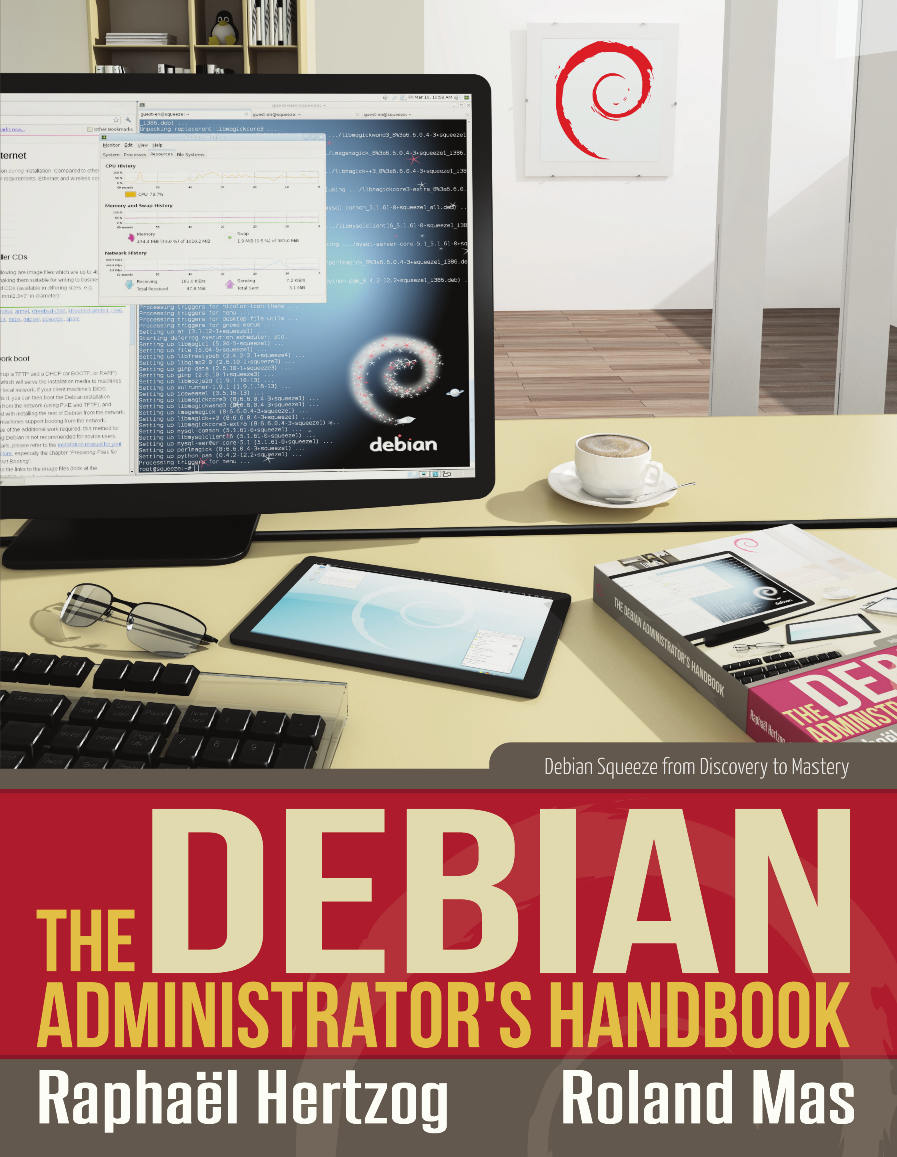
This is my monthly summary of my Debian related activities. If you re among the people who made a donation to support my work (227.83 , thanks everybody!), then you can learn how I spent your money. Otherwise it s just an interesting status update on my various projects. Dpkg Thanks to Guillem, dpkg with multiarch support is now available in Debian sid. The road has been bumpy, and it has again been delayed multiple times even after Guillem announced it on debian-devel-announce. Finally, the upload happened on March 19th. I did not appreciate his announce because it was not coordinated at all, and had I been involved from the start, we could have drafted it in a way that sounded less scary for people. In the end, I provided a script so that people can verify whether they were affected by one of the potential problems that Guillem pointed out. While real, most of them are rather unlikely for typical multiarch usage. Bernhard R. Link submitted a patch to add a new status command to dpkg-buildflags. This command would print all the information required to understand which flags are activated and why. It would typically be called during the build process by debian/rules to keep a trace of the build flags configuration. The goal is to help debugging and also to make it possible to extract that information automatically from build logs. I reviewed his patch and we made several iterations, it s mostly ready to be merged but there s one detail where Bernhard and I disagree and I solicited Guillem s opinion to try to take a decision. Unfortunately neither Guillem nor anyone else chimed in. On request of Alexander Wirt, I uploaded a new backport of dpkg where I dropped the DEB_HOST_MULTIARCH variable from dpkg-architecture to ensure multi-arch is never accidentally enabled in other backports. One last thing that I did not mention publicly at all yet, is that I contacted Lennart Poettering to suggest an improvement to the /etc/os-release file that he s trying to standardize across distributions. It occurred to me that this file could also replace our /etc/dpkg/origins/default file (and not only /etc/debian_version) provided that it could store ancestry information. After some discussions, he documented new official fields for that file (ID_LIKE, HOME_URL, SUPPORT_URL, BUG_REPORT_URL). Next step for me is to improve dpkg-vendor to support this file (as a fallback or as default, I don t know yet). Packaging I packaged quilt 0.60 (we re now down to 9 Debian-specific patches, from a whopping 26 in version 0.48!) and zim 0.55. In prevision of the next upstream version of Publican, I asked the Perl team to package a few Perl modules that Publican now requires. Less than two weeks after, all of them were in Debian Unstable. Congrats and many thanks to the Perl team (and Salvatore Bonaccorso in particular, which I happen to know because we were on the same plane during last Debconf!). On a side note, being the maintainer of nautilus-dropbox became progressively less fun over the last months, in particular because the upstream authors tried to override some of the (IMO correct) packaging decisions that I made and got in touch with Ubuntu community managers to try to have their way. Last but not least, I keep getting duplicates of a bug that is not in my package but in the official package and that Dropbox did not respond to my query. Book update The translation is finished and we re now reviewing the whole book. It takes a bit more time than expected because we re trying to harmonize the style and because it s difficult to coordinate the work of several volunteer reviewers. The book cover is now almost finalized (click on it to view it in higher definitions): We also made some progress on the interior design for the paperback. Unfortunately, I have nothing to show you yet. But it will be very nice and made with just a LaTeX stylesheet tailored for use with dblatex. The liberation fundraising slowed down with only 41 new supporters this month but it made a nice bump anyway thanks to a generous donation of 1000 EUR by Offensive security, the company behind Backtrack Linux. They will soon communicate on this, hopefully it will boost the operation. It would be really nice if we managed to raise the remaining 3000 EUR in the few weeks left until the official release of the book! The work on my book dominated the month and explains my relative inactivity on other fronts. I worked much more than usual, and my wife keeps telling me that I look tired and that I should go in bed earlier but I see the end of the tunnel: if everything goes well, the book should be released in a few weeks and I will be able to switch back to a saner lifestyle. Thanks See you next month for a new summary of my activities.

One comment Liked this article? Click here. My blog is Flattr-enabled.

Joey Hess: ls: the missing options

I'm honored and pleased to be the person who gets to complete ls. This project, begun around when I was born, was slow to turn into anything more than a simple for loop over a dirent. It really took off in the mid and late 80's, when Richard Stallman added numerous features, and the growth has been steady ever since. But, a glance at the man page shows that ls has never quite been complete. It fell to me to finish the job, and I have produced several handy patches to this end: The only obvious lack now is a -z option, which should make output filenames be NULL terminated for consuption by other programs. I think this would be easy to write, but I've been extermely busy IRL (moving lots of furniture) and didn't get to it. Any takers to write it? Due to the nature of these patches, they conflict with each other. Here's a combined patch suitable to be applied and tested.
diff -ur orig/coreutils-8.13/src/ls.c coreutils-8.13/src/ls.c
--- orig/coreutils-8.13/src/ls.c    2011-07-28 06:38:27.000000000 -0400
+++ coreutils-8.13/src/ls.c 2012-04-01 12:41:56.835106346 -0400
@@ -270,6 +270,7 @@
 static int format_group_width (gid_t g);
 static void print_long_format (const struct fileinfo *f);
 static void print_many_per_line (void);
+static void print_jam (void);
 static size_t print_name_with_quoting (const struct fileinfo *f,
                                        bool symlink_target,
                                        struct obstack *stack,
@@ -382,6 +383,7 @@
    many_per_line for just names, many per line, sorted vertically.
    horizontal for just names, many per line, sorted horizontally.
    with_commas for just names, many per line, separated by commas.
+   jam to fit in the most information possible.
 
    -l (and other options that imply -l), -1, -C, -x and -m control
    this parameter.  */
@@ -392,7 +394,8 @@
     one_per_line,      /* -1 */
     many_per_line,     /* -C */
     horizontal,            /* -x */
-    with_commas            /* -m */
+    with_commas,       /* -m */
+    jam            /* -j */
    ;
 
 static enum format format;
@@ -630,6 +633,11 @@
 
 static bool immediate_dirs;
 
+/* True means when multiple directories are being displayed, combine
+ * their contents as if all in one directory. -e */
+
+static bool entangle_dirs;
+
 /* True means that directories are grouped before files. */
 
 static bool directories_first;
@@ -705,6 +713,10 @@
 
 static bool format_needs_type;
 
+/* Answer "yes" to all prompts. */
+
+static bool yes;
+
 /* An arbitrary limit on the number of bytes in a printed time stamp.
    This is set to a relatively small value to avoid the need to worry
    about denial-of-service attacks on servers that run "ls" on behalf
@@ -804,6 +816,7 @@
    "escape", no_argument, NULL, 'b' ,
    "directory", no_argument, NULL, 'd' ,
    "dired", no_argument, NULL, 'D' ,
+   "entangle", no_argument, NULL, 'e' ,
    "full-time", no_argument, NULL, FULL_TIME_OPTION ,
    "group-directories-first", no_argument, NULL,
    GROUP_DIRECTORIES_FIRST_OPTION ,
@@ -849,12 +862,12 @@
 static char const *const format_args[] =
  
   "verbose", "long", "commas", "horizontal", "across",
-  "vertical", "single-column", NULL
+  "vertical", "single-column", "jam", NULL
  ;
 static enum format const format_types[] =
  
   long_format, long_format, with_commas, horizontal, horizontal,
-  many_per_line, one_per_line
+  many_per_line, one_per_line, jam
  ;
 ARGMATCH_VERIFY (format_args, format_types);
 
@@ -1448,6 +1461,9 @@
       print_dir_name = true;
      
 
+  if (entangle_dirs)
+      print_current_files ();
+
   if (print_with_color)
      
       int j;
@@ -1559,6 +1575,7 @@
   print_block_size = false;
   indicator_style = none;
   print_inode = false;
+  yes = false;
   dereference = DEREF_UNDEFINED;
   recursive = false;
   immediate_dirs = false;
@@ -1644,7 +1661,7 @@
      
       int oi = -1;
       int c = getopt_long (argc, argv,
-                           "abcdfghiklmnopqrstuvw:xABCDFGHI:LNQRST:UXZ1",
+                           "abcdefghijklmnopqrstuvw:xyABCDFGHI:LNQRST:UXZ1",
                            long_options, &oi);
       if (c == -1)
         break;
@@ -1667,6 +1684,10 @@
           immediate_dirs = true;
           break;
 
+   case 'e':
+          entangle_dirs = true;
+     break;
+
         case 'f':
           /* Same as enabling -a -U and disabling -l -s.  */
           ignore_mode = IGNORE_MINIMAL;
@@ -1697,6 +1718,10 @@
           print_inode = true;
           break;
 
+   case 'j':
+     format = jam;
+     break;
+
         case 'k':
           human_output_opts = 0;
           file_output_block_size = output_block_size = 1024;
@@ -1765,6 +1790,10 @@
           format = horizontal;
           break;
 
+   case 'y':
+     yes = true;
+     break;
+
         case 'A':
           if (ignore_mode == IGNORE_DEFAULT)
             ignore_mode = IGNORE_DOT_AND_DOTDOT;
@@ -2510,7 +2539,7 @@
       DEV_INO_PUSH (dir_stat.st_dev, dir_stat.st_ino);
      
 
-  if (recursive   print_dir_name)
+  if ((recursive   print_dir_name) && ! entangle_dirs)
      
       if (!first)
         DIRED_PUTCHAR ('\n');
@@ -2526,7 +2555,8 @@
   /* Read the directory entries, and insert the subfiles into the  cwd_file'
      table.  */
 
-  clear_files ();
+  if (! entangle_dirs)
+     clear_files ();
 
   while (1)
      
@@ -2615,7 +2645,7 @@
       DIRED_PUTCHAR ('\n');
      
 
-  if (cwd_n_used)
+  if (cwd_n_used && ! entangle_dirs)
     print_current_files ();
  
 
@@ -3464,6 +3494,10 @@
       print_with_commas ();
       break;
 
+    case jam:
+      print_jam ();
+      break;
+
     case long_format:
       for (i = 0; i < cwd_n_used; i++)
          
@@ -4418,6 +4452,24 @@
   putchar ('\n');
  
 
+static void
+print_jam (void)
+ 
+  size_t filesno;
+  size_t pos = 0;
+
+  for (filesno = 0; filesno < cwd_n_used; filesno++)
+     
+      struct fileinfo const *f = sorted_file[filesno];
+      size_t len = length_of_file_name_and_frills (f);
+
+      print_file_name_and_frills (f, pos);
+      pos += len;
+     
+  putchar ('\n');
+ 
+
+
 /* Assuming cursor is at position FROM, indent up to position TO.
    Use a TAB character instead of two or more spaces whenever possible.  */
 
@@ -4627,11 +4679,13 @@
   -D, --dired                generate output designed for Emacs' dired mode\n\
 "), stdout);
       fputs (_("\
+  -e, --entangle             display multiple directory contents as one\n\
   -f                         do not sort, enable -aU, disable -ls --color\n\
   -F, --classify             append indicator (one of */=>@ ) to entries\n\
       --file-type            likewise, except do not append  *'\n\
       --format=WORD          across -x, commas -m, horizontal -x, long -l,\n\
                                single-column -1, verbose -l, vertical -C\n\
+                               jam -j\n\
       --full-time            like -l --time-style=full-iso\n\
 "), stdout);
       fputs (_("\
@@ -4667,6 +4721,8 @@
   -i, --inode                print the index number of each file\n\
   -I, --ignore=PATTERN       do not list implied entries matching shell PATTERN\
 \n\
+  -j                         jam output together, makes the most of limited\n\
+                             space on modern systems (cell phones, twitter)\n\
   -k                         like --block-size=1K\n\
 "), stdout);
       fputs (_("\
@@ -4733,6 +4789,7 @@
   -w, --width=COLS           assume screen width instead of current value\n\
   -x                         list entries by lines instead of by columns\n\
   -X                         sort alphabetically by entry extension\n\
+  -y                         answer all questions with \"yes\"\n\
   -Z, --context              print any SELinux security context of each file\n\
   -1                         list one file per line\n\
 "), stdout);
It remains to be seen if multi-option enabled coreutils will be accepted into Debian in time for the next release. Due to some disagreements with the coreutils maintainer, the matter has been referred to the Technical Committee (Flattr me) Traditionally new ls contributors stop once enough options have been added that they can spell their name, in the best traditions of yellow snow. Once ls -richard -stallman worked, I'm sure RMS moved on other other more pressing concerns. The current maintainer, David MacKenzie, was clearly not done yet, since only ls -david -mack worked. But he was being slow to add these last few features, and ls was very deficient in the realm of spelling my name (ls -o -hss .. srsly?), so I took matter into my own hands in the best tradition of free software.

Craig Small: JFFNMS 0.9.3 1st release candidate

I have been putting a lot of testing into jffnms lately. I have been very lucky to have had someone with the time and patience to try out various sub versions and give me access to their results. The end-result of all this testing is a much, much less buggy JFFNMS. There have been a strack of problems with caching results, for example, where status would not be updated or even worse the status of one device impacted on another. The poller parent scheduler had a problem too where it would almost always sit in the first child starving the others of work which slowed things down. The scheduler now is a lot fairer across the children giving a speed up. I ve heard speed-ups of 15x for this one change alone. I also had a curious bug where if a device was set to not gather state it still did and created events but not alerts. This meant your event table was spammed with down interface alerts even on interface you know are down and you turned state checking off. 0.9.3 now does it the right way. The first RC is now uploaded and can be found at https://sourceforge.net/projects/jffnms/files/jffnms%20RC/ to try out. I m a little worried that the pollers now run too fast and could overwhelm the usually crummy control stack found in network devices for parsing SNMP. I m interested to hear how people find it.

31 March 2012

Christian Perrier: Languages to be deactivated in Debian Installer

If I follow the policy we chose in D-I, I should deactivate languages that are not complete for what we call "sublevel 1" and "sublevel 2" in code Debian Installer. At this very moment, it means that I would deactivate (stats in parenthesis are those in these sublevels, respectively): For several of these, the fix is easy! So, even if you're not the person in charge officially for the said language, please get in touch with me (bubulle@d.o) if you want to complete the translation. For some of these languages, where contact with the translator in charge has apparently been lost, it could be their only chance to stay in wheezy.

30 March 2012

Joey Hess: podcasts that don't suck

My public radio station is engaged in a most obnoxious spring pledge drive. Good time to listen to podcasts. Here are the ones I'm currently liking.

Andreas Barth: Traveling to DebConf 11 - back to Zagreb and M nchen

Back from Banja Luka was the DebConf bus trip to Zagreb. Even though the train connection should allow to catch the night train to M nchen, the time in Zagreb was too short to be sure (as with the other Bosnian track, two trains per day - taking a earlier train was not possible if I wanted to get at least a bit of sleep). So, I went on the DebConf-bus to Zagreb, and arrived there on time. Border checks into Hrvatska were a bit more time consuming then in the other direction - too much traffic but nothing else. In Zagreb, I dropped off my luggage at the train station again, and then went by tram to the parts of the city I hadn't been before (and which were more normal parts, and not the tourist-areas). Incidently I also experienced tram track works, and so had to switch to the bus; however, information was so bad that not only I didn't notice it (which wasn't too bad and unexpected - I plan with enough time as tourist) but also locals were taken by surprise. (Many parts of) Zagreb appears to have many too wide roads, with pedestrians pushed away. Not too uncommon for some cities here as well. But sad to see if public space is not created with humans in mind. This used to be modern in the 60ies, whereas it should have now advanced to center around humans again. If one compares the situation how one feels while standing in a too far road (where the wind blows easily cold) with a decent road in any city center, one could see the difference. But as said, many german cities make the same mistake. After arriving back at the train station, this was in time for taking the night train. Obviously there were many DDs on board. Passport checks in Hravatska went smooth but with many boarder guards. The train had an extra stop not in the official timetable so that they didn't leave their territory armed. On arriving in Slovenija the train had to stop some time. Border checks were quite strict (as this was entering the european union) and time consuming, e.g. partly cover sheets of the train were removed. After entering Slovenija the reminder of the trip was uneventful (or at least: ignored while sleeping), so the trip ended in M nchen as planned. Summarising it was an interesting and nice trip. I had no problem using public transport in spite of the warnings before. Of course, as always while traveling in foreign countries one should expect the country to be more different to home than just temperature and language - i.e. one should expect a bit of the unexpected, and be able to cope with. But that's true for any place one is going to. And these areas are worth another visit another time. I also learned more about "local" history (whereas local covers everything within 1000 kilometers around M nchen). However, the really bad thing is when comparing Hrvatska and Bosna i Hercegovina to see how much more Bosna i Hercegovina could have advanced within the last 16 years, but didn't due to incompetent management. Thinking that the same ways of obstructing decision-making happens in this country (and the european union as a whole) as well (but isn't as visible - we hadn't had a war, but also not much advances in our infrastructure) makes me more sad. Having said this, I still enjoyed the tour quite much - it was a good decision to have done it.

Russell Coker: The Security Benefits of Automation

Some Random WTFs The Daily WTF is an educational and amusing site that recounts anecdotes about failed computer projects. One of their stories titled Remotely Incompetent concerns someone who breaks networking on a server and is then granted administrative access to someone else s server by the Data Center staff [1]! In one of the discussions about that I saw people make various claims about Data Center security, such as claiming that having their own locked room helps. My experience indicates that such things don t do much good, I have often been granted access to server rooms without appropriate checks. My experience is that security guards on site generally don t directly do any good. I once had a guard hold a door for me when I was removing a server from a DC without even bothering to ask for ID! On another occasion in the Netherlands I had a security guard who didn t speak English unlock the wrong server room for me, I used hand gestures to inform him that I needed access to the room with the big computers and he gave me the access I needed! It seems that the benefit of security guards is solely based on scaring people who don t have the confidence needed to bluff their way in. Preventing children from thieving is a good thing, On another occasion I showed ID and signed in for access to a DC owned by my employer and I used my security key to go through a locked door with a sign that promised many bad consequences if I failed to lock the door behind me. Then I discovered that the back door was wide open for the benefit of some electricians who were working in the building. Presumably the electricians who had no security training were expected to act as ad-hoc security guards if someone tried to enter through the back door presumably they would not have been good at it. When a company uses part of their own office for a server room then many of these problems disappear. But a common issue in such ad-hoc DCs is the lack of planning and procedures, I have lost count of the number of times I ve seen doors (and even windows) propped open to allow ventilation because there were too many servers for the air-conditioning to cope. The most ironic example of this is the company that had a walk-in safe (think of a small bank vault with concrete walls and thick solid steel door) used for storing servers but with it s door propped open to allow cooling. The advantage of a serious hosting company is that they will have procedures for cooling etc and will be very unlikely to do strange and silly things. Having a locked room in a DC makes some sense, but if security guards have the master keys and are allowed to use them then it might not do much good. The one time I locked my keys in such a room I had a guard let me in without verifying my ID or the claim that there were actually keys locked in the room. Presumably anyone could just claim to have forgotten their keys and get the door unlocked just like a cheap hotel. Locking a rack sounds like a good idea, but the racks I ve seen have had locks which are quite easy to pick. On the one occasion when I had to pick a lock on a rack (due to keys being too difficult to manage for the relevant people) the security guards didn t investigate, so either the security cameras were not supervised or they just didn t care about people picking locks in a shared server room. Also if you allow people to do things freely in a shared server room they could install devices to monitor network traffic. A locked cage in a server room should work well. In the one case where I worked for a company that used such a cage I found it to mostly work well apart from the few weeks when the lock was broken. One company that I worked for had scales before the door between a server room and the car-park to prevent people from stealing heavy servers. Of course that wouldn t stop people stealing hard drives full of data which is worth more than the servers! Also an over-weight colleague had to have the scales disabled for him (as they were based on absolute mass not unexpected changes in an individual s mass) which presumably means that any skinny employee could steal a 2RU server and still be below the mass threshold. How to Solve some of these Problems Computers are subject to all manner of security problems. But they tend not to do arbitrary things for no apparent reason and they will never give in to someone who is charming, attractive, or aggressive unlike humans. I have servers running on Hetzner, Linode, and the Rackspace Cloud. I am always concerned about possible security compromises. But I am not worried about someone climbing in a window of a server room or convincing a security guard to let them in through the door. All three of those hosting companies have the vast majority of interactions automated. I can change many aspects of the servers without involving ANY human interaction. Out of the three of those companies I have had some human interaction with Hetzner (who provide managed servers) when a hard drive needed to be replaced obviously replacing a disk in the wrong server would have been a significant system integrity issue even though everyone would be running RAID-1 and if Hetzner improperly disposed of the broken disk then there could be security issues but this is an unlikely mistake in the face of a rare occurrence. With Linode and the Rackspace Cloud (and the previous Slicehost hosting that was purchased by Rackspace) the most common interactions I have with employees of those companies are when my clients don t pay their bills on time and that s an administrative not a technical issue. When I do have to contact the support people about a technical issue it s usually something that s not immediately connected to the virtual server (EG a loss of routing to the DC). It seems most likely that there are a fairly small number of people who are allowed in the DCs for companies like Hetzner, Linode, and Rackspace. Those people would probably be recognised by the security guards and their work would be restricted to replacing failing hardware and not involve granting access requests. There are some unusual requests that they can process (EG one of my clients recently transferred a virtual server between business units) but even in those cases the administrative software controls who gets access. This is much better than just handing hardware access to what seems to be the correct physical server to a client. If you have software running a few computers and operating correctly then you can probably scale it up to run thousands of computers and have it still work correctly. But if you have a team of people controlling access requests and want to scale it up significantly then there are huge problems in hiring skilled people and training them correctly. There is a real risk of security flaws in such administrative software, if someone managed to exploit the automated management system for one of those three companies then they could probably gain access to the private data of any of their customers. But the risk of this seems a lot less than the risk of general incompetence among humans who perform routine and boring tasks which have the potential for great errors. Related posts:
  1. The Security Benefits of Being Unimportant A recent news item is the hacking of the Yahoo...
  2. Security Lessons from a Ferry On Saturday I traveled from Victoria to Tasmania via the...
  3. Public Security Cameras There is ongoing debate about the issue of security cameras,...

29 March 2012

Pablo Lorenzzoni: Using Gmail anti-spam with mutt

OK, this is not another post on how to use Mutt and Gmail. This is just to comment on a feature I found in Mutt that was not obvious, and that helped me to stop running my own anti-spam tool. So, for a number of reasons, my company stop filtering spams. I was setting up dspam to take over that job when I decided that it was just too much pain for a single account. Besides, although I am spammed a lot, I would never possibly be more efficient than Gmail anti-spam, given the load of emails their users classify everyday. I am not migrating my old emails over to Gmail, though. And I am pretty comfortable with my current email work-flow I am simply not going to use a webmail (even one as powerful as Gmail). OK, I am using GNOME 3 after being a Fluxbox and Bluetile user, but everything has a limit But how to keep the best of both worlds? And, more important, how to do that with minimum disruption of what I already have (my own IMAP server and Mutt managing my account there as spoolfile)? The answer is a little known trick using the mailboxes directive in .muttrc. This directive accepts a fully-qualified imap mailbox address. So I just added something like:
mailboxes 'imaps://gmail-user:gmail-password@imap.gmail.com:993/[Gmail]/Spam'
and added some shortcuts to save email from my inbox to that mailbox (the same as train-as-spam) and to rescue email from it (the same as train-as-ham):
macro index <F3> ";Wo;Wn;simaps://gmail-user:gmail-password@imap.gmail.com:993/[Gmail]/Spam\n" "Train as SPAM"
macro index <F4> ";Wo;Wn;simaps://gmail-user:gmail-password@imap.gmail.com:993/INBOX\n" "Train as HAM"
and that was it. In my IMAP machine I got a fetchmail downloading emails from Gmail s INBOX so I can get trained-as-ham and new emails (all emails arrive first in my Gmail account) into my IMAP server. All my sieve rules are in place and nothing changed in my email work-flow. It s been working flawlessly for a week now. The only drawbacks are (1) Gmail knowing everything that arrives to me (not a big deal, since unencrypted emails aren t private anyway), and (2) not getting the spam-count once Mutt is run: I have to change into that mailbox to log-in to Gmail. Update: Mar 30, 2012 @ 18:15: I just found out that drawback number (2) above can be fixed by adding the following to .muttrc:
unset imap_passive

Vincent Sanders: Failing to avoid the spotlight

I am usually fortunate at conferences and aside from the obligatory "group photo" manage to completely avoid being in photos and videos of the event. However recently I attended the Linaro connect event in San Francisco and somehow got volunteered to be on a panel.

Now usually such panels are fine and you get a bit of notice and can at least get some basic ideas and no-one bothers to film them. This time though I was not so fortunate and with no notice the overweight greying old fart has been captured on video.

So here for your viewing pleasure is the panel discussion on "Is the GNU user space dying?". I should warn readers of a sensitive disposition that I appear fully dressed and awake(ish) in this video so viewer discretion is advised.
<object class="BLOGGER-youtube-video" classid="clsid:D27CDB6E-AE6D-11cf-96B8-444553540000" codebase="http://download.macromedia.com/pub/shockwave/cabs/flash/swflash.cab#version=6,0,40,0" data-thumbnail-src="http://3.gvt0.com/vi/_HGrCdFA7L8/0.jpg" height="266" width="320"><param name="movie" value="http://www.youtube.com/v/_HGrCdFA7L8&amp;fs=1&amp;source=uds"><param name="bgcolor" value="#FFFFFF"><embed height="266" src="http://www.youtube.com/v/_HGrCdFA7L8&amp;fs=1&amp;source=uds" type="application/x-shockwave-flash" width="320"></embed></object>

Kurt Roeckx: Getting frustrated by Google

I recently started working on a webshop called e-webshops which mainly sells e-books. If I want to attract customers there are various things to do so that people can actually find you. So I started using various services from Google, looking at my results in queries and things like that, and noticed that some queries didn't return the expected results. One of the problems is that I can spell and a lot people can't, and Google doesn't consider the words to be synonyms. The proper way to spell e-book in Dutch is either e-boek (preferred) or e-book, but lots of people write it as ebook (or eBook). I of course use the preferred spelling everywhere. So what do I do? I contact Google asking them to make them synonyms. Almost 2 weeks later I get a mail back from someone that doesn't seem to be getting what I'm asking for, so I reply back. Finally after an other month I get a mail back pointing me to a blog post, which suggest posting it to a forum or tweeting about it. I don't think either form is good way to contact a company about such a thing, which is why I contacted them by email in the first place. I have strong doubts that the right people would actually read all the forum posts. How hard can it be to forward an email to the right people? At the same time I have various other problems with Google, like things that don't work as advertised, broken documentation links, incorrect documentation, no way to contact them about the topic you want and you need to select a random other one, asking me to rate a help page I visited that day and then give an obviously broken URL, and a whole bunch more.

27 March 2012

Timo Jyrinki: On brands, marketing and technical details

I have a few thoughts based on the yet another round of debate where marketing clashes with free software advocation and technical details. Nothing new in the debate itself, but I'm adding a couple of insights.

Marketing is not highly respected by many technical people, and neither by the people wanting more advocating than the messing up with facts and feelings that the marketing does. I'm all for advocating free software, but it's currently not something you can use for marketing to win big markets. If we advance to a world where free software is as wanted as the green values today are, it can be used in marketing as well similar to all the ecological (according to the market department at least) products today, but alas the benefits of free software are not yet as universally known. Since it doesn't say much that touches the masses, advocating has a negative marketing effect since it takes space away from the potentially "hitting" marketing moves, in those cases where you target the big masses in the first place. "Open" this and that has some marketing power in it nowadays, but it's a mess of different meanings that probably doesn't advance libre software freedoms as such. Wikipedia has probably been the biggest contributor to advancing general knowledge of software and culture libre. Disclaimer: I'm not a proper marketing person, some more professional might have better insights in this area. If I'd be a proper marketing person, I'd decorate this blog post with fancy pictures so that more people would actually read it.

Some of the marketing can be done without sacrificing any of the advocation. The fabulous Fedora campaigns, graphics, slogans and materials are a great example of those and do an important job, even though Fedora isn't reaching the big masses with it (and Fedora isn't targeted for OEMs to ship to millions either). But they do hopefully reach a lot of level people on the grassroots level. I hope as a Debian Developer that more people valuing the freedoms of free software would help also Debian as a project to reach more of its advocation potential and developers from the more proprietary world. But I'm happy that at least some free software projects have nowadays true graphical and marketing talent. Even though not as widely known, freedoms of the software users including for example privacy aspects are a potential good marketing tool toward a portion of the developer pool.

Let's not forget that Android conquered the mobile market without using the brand power of Linux. The 30+ million people who know Linux a bit deeper than just "I've heard it" already run a Linux distribution like Ubuntu, but we need hotter brands than a project name of a kernel to reach the bigger masses. Call it Ubuntu, Fedora, or something, but no matter do what it needs to ship it to millions. AFAIK mostly Ubuntu and SUSE are shipping currently via desktop/notebook OEMs, and more Ubuntu than SUSE. Others aren't concentrating on the market, which is a very difficult one. Ubuntu is doing a lot more mass population advocating for free software than Android has ever done. Note for example the time any user tries to play a video for the first time in a non-free format - Ubuntu will tell the user about the problems related to those formats and asking a permission to install a free software player for those (or buy licensed codecs), and the Ubuntu Help texts describe a lot of details about restricted formats, DRM et cetera. Not to mention what happens if the person actually wanders into the community, discovering Debian, other free software projects, free software licenses and so on. Meanwhile Android users never notice anything being wrong while watching H.264 videos or watching DRM Flash videos. Granted, like Boot2Gecko debate shows, it may be a partially similar situation on shipping desktop Linux variants as well, in order to actually ship them via partners.

Anyway, the best example of brands is MeeGo. Even the LWN editor does not get into dissecting the meaning of MeeGo on Nokia N9, because "there has been no real agreement on that in the past", but just uses the brand name as is. That is the power of brands. Technical people debate that it's not really MeeGo, it's maemo GNU/Linux with a special permission from Linux Foundation to use the MeeGo brand name, and then counter-argument with that the MeeGo is an API and maemo matches the MeeGo 1.2 API which is actually just Qt 4.7 API. And actually, as proven by the LWN example, it's not even "technical people". For most of technical people Nokia N9 is MeeGo as well. Only the people who have actually worked on it plus the couple of other people migrated from maemo and MeeGo.com communities to Mer project understand the legacy, history and the complete difference between the Maemo Harmattan platform and what MeeGo.com was. Yet at the same time like all GNU/FreeDesktop.org/Linux distributions, they are 95% same code, just all the infrastructure and packaging and polishing and history is different.

For 99.9% of people who know what MeeGo is, MeeGo is the cool Nokia smartphone, one of its kind and not sold in some of the major western markets, and/or the colorful sweet characters of meego.com shown at one time on a couple of netbooks. That is the brand, and the technical details do not matter even to the technical people unless they actually get into working on the projects directly.

To most people, the Linux brand is a mess of a lot of things, while other brands have the possibility at least to have a more differentiating and unique appearance.

26 March 2012

Vincent Sanders: NetSurf Developer Workshop

NetSurf DevelopersOver the weekend we held the NetSurf developer workshop. The event was kindly hosted by Collabora at their Cambridge offices. The provided facilities were agreed to be excellent and contributed to the success of the event.

Five developers managed to attend from around the UK John-Mark Bell, Vincent Sanders, Michael Drake, Daniel Silverstone and Rob Kendrick. In addition James Shaw, one of the project founders, made a special appearance on Saturday.

Starting from Friday afternoon we each put in over 25 hours of actual useful work and made almost 170 commits changing over 350 files, added 10,000 new lines of code and altered another 18,000.

The main aim of the event was to make the transition from using libxml2 to our own libdom library for the browser DOM tree. This was done to improve the browsers performance and size when manipulating the DOM but also gives us the ability to extend the browsers features to include dynamic rendering and Javascript

We also took the opportunity to discuss and plan other issues including:
  • User interface message handling and translation.
  • User preference handling.
  • Toolchain support.
  • Disc caching.
  • Javascript binding
  • Electronic book content handler.
Rob tackled the first parts of the messages conversion from numerous separate files into a single easy to handle file which will in future allow for easier translation and reduce message proliferation.

We made decisions on the ongoing rework of user preference handling which will be implemented in future.

The decision on the toolchain was slightly changed to be that any core or library code (non frontend/toolkit specific parts) are required to conform to the C99 standard. Frontends are permitted to recommend and use whatever tools their maintainer selects but they cannot enforce those restrictions on core code. This issue is principly because the BeOS maintainer is compiling NetSurf with g++ 2.95 which is missing several important language features we wish to use.

Developers at workThe recurring issue of disc caching was raised again and we have come up with what we hope is a reasonably elegant solution to be implemented over the forthcoming months.

Now there is a suitable DOM to bind against, the existing Javascript engine support will be properly integrated and should result in basic script support before the 3.0 release. This support will remain a build time option so NetSurf can continue to be used on platforms where the interpreter is too resource intensive to be used.

A short discussion about the possibility of integrating a basic page based content handler for epub and mobi type documents was discussed and while the idea was well received no decisions on implementation were made.

Overall the event was a resounding success and we are left with only a small handful of regressions which appear straightforward to solve. We also have a clear set of decisions on what we need to do to improve the browser.

Michal &#268;iha&#345;: phpMyAdmin translations status

phpMyAdmin 3.5 should be released on April 7, 2012, so let's again look at translations status. Here comes sixth round of translation status update. Since last update we have two more translations summing up to 11 translations at 100%: There are few which are really close to 100% and I hope they will get there soon: As you can see, there is still lot of languages missing, this might be your opportunity to contribute to phpMyAdmin. Also you are welcome to translate phpMyAdmin 3.5 using translation server.

Filed under: English Phpmyadmin 0 comments Flattr this!

25 March 2012

Y Giridhar Appaji Nag: Moving to 4096 bit RSA GPG key AA544AA1

This is an annoucement that I am moving to my 4096 bit RSA GPG key AA544AA1, henceforth please try and use this.

I created and have (sparingly) been using this key ever since SHA1 was found to be weak, and larger RSA keys and stronger signatures began to be the norm. There weren't many signatures on the key and the WOT was not strong but it looks good now. The older key in the Debian keyring (1D389887) has also been replaced with the new key and I will revoke it when the number of signatures on the new key crosses those on the old key (that might be in an year or two, I suppose).

Fingerprint information:

Current key:

pub 1024D/1D389887 2006-04-08
Key fingerprint = 5B6B F223 B769 63E9 E2CB 0A3F E1EB BEA5 1D38 9887
uid Y Giridhar Appaji Nag <giridhar@appaji.net>
sub 2048g/73EAF0B5 2006-04-08
sub 2048R/DBBECADC 2009-04-04


New 4096R key:

pub 4096R/AA544AA1 2009-05-22
Key fingerprint = BF81 3A99 E07C D0F8 653D 9666 A8D2 CD13 AA54 4AA1
uid Y Giridhar Appaji Nag <giridhar@appaji.net>
sub 4096R/843A5776 2009-08-08

24 March 2012

Dirk Eddelbuettel: Initial release 0.1.0 of package RcppSMC

Hm, I realized that I announced this on Google+ (via Rcpp) as well as on Twitter, on the r-packages list, wrote a new and simple web page for it, but had not put it on my blog. So here is some catching up. Sequential Monte Carlo / Particle Filter is a (to quote the Wikipedia page I just linked to) sophisticated model estimation technique based on simulation. They are related to both Kalman Filters, and Markov Chain Monte Carlo methods. Adam Johansen has a rather nice set of C++ classes documentated in his 2009 paper in the Journal of Statistical Software (JSS). I started to play with these classes and realized that, once again, this would make perfect sense in an R extension built with the Rcpp package by Romain and myself (and in JSS too). So I put a first prototype onto R-Forge and emailed Adam who, to my pleasant surprise, was quite interested. And a couple of emails, and commits later, we are happy to present a very first release 0.1.0. I wrote a few words on a RcppSMC page on my website where you can find a few more details. But in short, we already have example functions demonstrating the backend classes by reproducing examples from
Johansen (2009)
and his example 5.1 via pfLineartBS() for a linear bootstrap example;
Doucet, Briers and Senecal (2006)
and their (optimal) block-sampling particle filter for a linear Gaussian model (serving as an illustration as the setup does of course have an analytical solution) via the function blockpfGaussianOpt()
Gordon, Salmond and Smith (1993)
and their ubiqitous nonlinear state space model via the function pfNonlinBS().
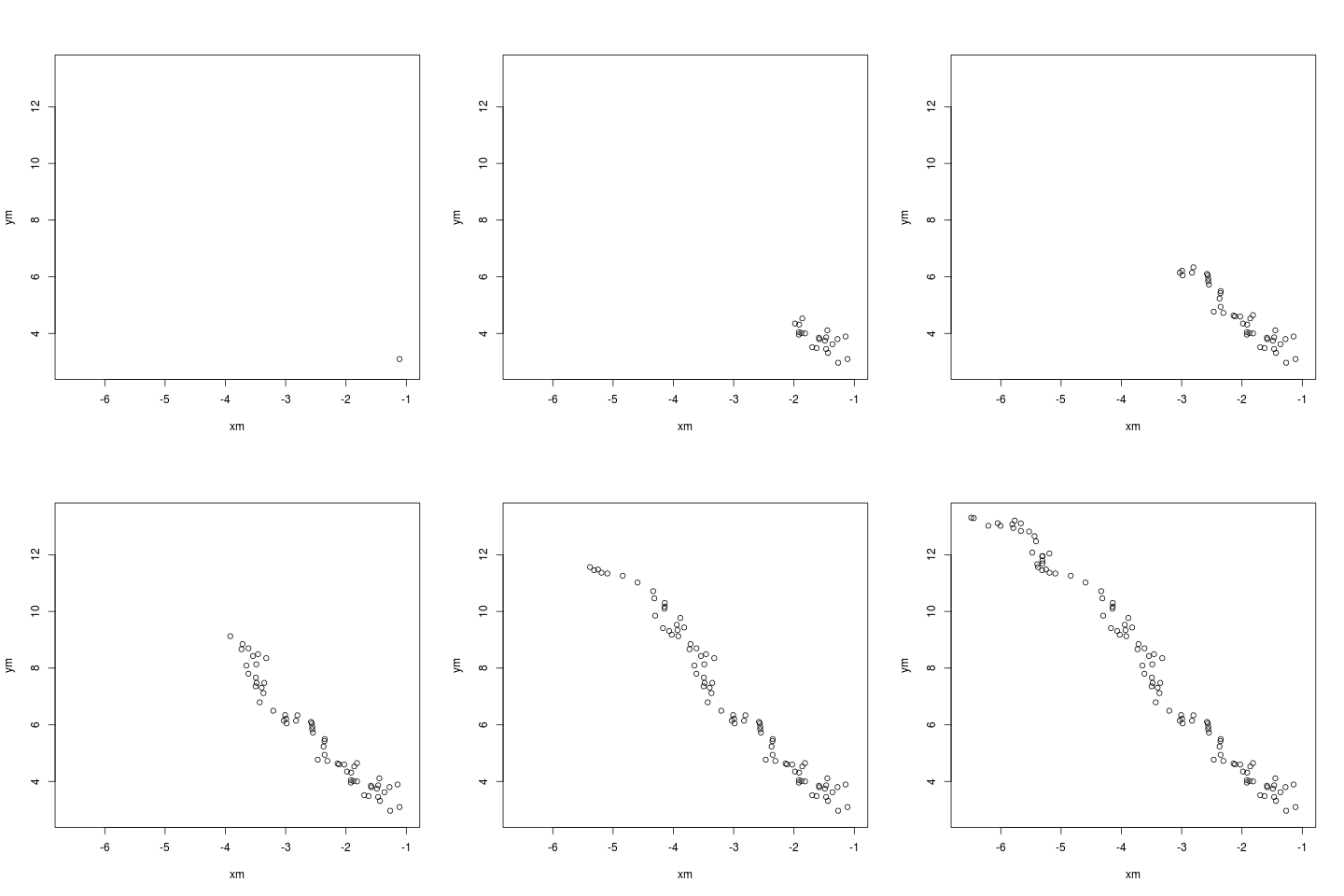
And to illustrate just why Rcpp is so cool for this, here is a little animation of a callback from the C++ code when doing the filtering on Adam's example 5.1. By passing a simple plotting function, written in R, to the C++ code, we can get a plot updated on every iteration. Here I cheated a little and used our old plot function with fixed ranges, the package now uses a more general function: Example of RcppSMC callback to R plot when estimation example 5.1 from Johansen (2009) The animation is of course due to ImageMagick glueing one hundred files into a single animated gif. More information about RcppSMC is on its page, and we intend to add more examples and extensions over time.

John Goerzen: German: Suprisingly Hilarious for a 2-Year-Old

The other night, I was tucking the boys into bed. I occasionally use a few German words with them (I don t know all that many myself, but hey). They d been rather bored with it, so I had dropped it for a few months. I said to Oliver, Gute Nacht, Oliver. That means good night in German. Oliver laughed. I said it a few more times. He laughed some more. Jacob peeked down from his top bunk to see what the fun was, and pretty soon was getting into it also. Apparently I m quite the comedian, because when I said Auf Wiedersehen, Oliver burst out laughing uncontrollably. Finally he d say, Say it again! AGAIN!! And I would, and he d laugh and laugh some more. And then, I happened to say tsch ss. Jacob loved that one. He said it over and over, much to Oliver s delight. Finally I closed the door, and heard the laughter still going on behind me, as Jacob would yell out a mangled German word, and Oliver would fill the room with laughter. I was a little surprised, but figured it d end there. Not so much. The next night, I tucked them into bed like usual. I left their room, and about 10 seconds later, I heard frantic yelling from the boys room. I went back in, and poor Oliver was so upset he couldn t even say what he wanted. I finally figured out he was pleading, DAD! Say gute Nacht again! So we went through some German words again, and I left the boys much relieved. Phew. The next night, I almost repeated my horrid mistake of no German at bedtime, but Jacob stopped me before I left their room. Dad! You forgot to say tsch ss! So I did, with the boys prompting me on what words they wanted to hear. Then Jacob started asking me how to say these things in other languages. He was rather disappointed, and I think also didn t really believe me, when I only knew a few of those phrases in Spanish and French. Though he was surprised that I could come up with them in Greek. (Kali sp ra / good evening) was a hit. By this point, another day or two later, Jacob says tsch ss when I leave. Oliver wishes me gute Nacht at breakfast time. We ll have to work on that one. So, if you ever walk in the door at our house some morning, don t be surprised if our 2-year-old wishes you good night, our 5-year-old says goodbye, and they both start laughing.

Pablo Lorenzzoni: Annoyed by F10 key in gnome-terminal?

I am one of those people that like to map Fx keys to special functions. After all, that s what F-unction keys are for, right? So, one of the first things I do once I have to configure a new Desktop is disable F10-capture by gnome-terminal. It has been working flawlessly, until I begin using GNOME3. No matter what, F10 was still being captured. I found that this is a bug and that adding the following:
@binding-set NoKeyboardNavigation  
	unbind "<shift>F10"
 
 
*  
	gtk-key-bindings: NoKeyboardNavigation
 
to ~/.config/gtk-3.0/gtk.css serves as a workaround. Hope this helps people with the same problem.

Next.

Previous.