Evgeni Golov: Automatically renaming the default git branch to "devel"

It seems GitHub is planning to rename the default brach for newly created repositories from "master" to "main". It's incredible how much positive PR you can get with a one line configuration change, while still working together with the ICE.
However, this post is not about bashing GitHub.
Changing the default branch for newly created repositories is good. And you also should do that for the ones you create with
git init locally. But what about all the repositories out there? GitHub surely won't force-rename those branches, but we can!
Ian will do this as he touches the individual repositories, but I tend to forget things unless I do them immediately
Oh, so this is another "automate everything with an API" post? Yes, yes it is!
And yes, I am going to use GitHub here, but something similar should be implementable on any git hosting platform that has an API.
Of course, if you have SSH access to the repositories, you can also just edit HEAD in an for loop in bash, but that would be boring ;-)
I'm going with devel btw, as I'm already used to develop in the Foreman project and devel in Ansible.
acquire credentials
My GitHub account is 2FA enabled, so I can't just use my username and password in a basic HTTP API client. So the first step is to acquire a personal access token, that can be used instead. Of course I could also have implemented OAuth2 in my lousy script, but ain't nobody have time for that.
The token will require the "repo" permission to be able to change repositories.
And we'll need some boilerplate code (I'm using Python3 and requests, but anything else will work too):
#!/usr/bin/env python3
import requests
BASE='https://api.github.com'
USER='evgeni'
TOKEN='abcdef'
headers =  'User-Agent': '@ '.format(USER)
auth = (USER, TOKEN)
session = requests.Session()
session.auth = auth
session.headers.update(headers)
session.verify = True
This will store our username, token, and create a
requests.Session so that we don't have to pass the same data all the time.
get a list of repositories to change
I want to change all my own repos that are not archived, not forks, and actually have the default branch set to master, YMMV.
As we're authenticated, we can just list the repositories of the currently authenticated user, and limit them to "owner" only.
GitHub uses pagination for their API, so we'll have to loop until we get to the end of the repository list.
repos_to_change = []
url = ' /user/repos?type=owner'.format(BASE)
while url:
    r = session.get(url)
    if r.ok:
        repos = r.json()
        for repo in repos:
            if not repo['archived'] and not repo['fork'] and repo['default_branch'] == 'master':
                repos_to_change.append(repo['name'])
        if 'next' in r.links:
            url = r.links['next']['url']
        else:
            url = None
    else:
        url = None
create a new
devel branch and mark it as default
Now that we know which repos to change, we need to fetch the SHA of the current master, create a new devel branch pointing at the same commit and then set that new branch as the default branch.
for repo in repos_to_change:
    master_data = session.get(' /repos/evgeni/ /git/ref/heads/master'.format(BASE, repo)).json()
    data =  'ref': 'refs/heads/devel', 'sha': master_data['object']['sha']
    session.post(' /repos/ / /git/refs'.format(BASE, USER, repo), json=data)
    default_branch_data =  'default_branch': 'devel'
    session.patch(' /repos/ / '.format(BASE, USER, repo), json=default_branch_data)
    session.delete(' /repos/ / /git/refs/heads/ '.format(BASE, USER, repo, 'master'))
I've also opted in to actually delete the old
master, as I think that's the safest way to let the users know that it's gone. Letting it rot in the repository would mean people can still pull and won't notice that there are no changes anymore as the default branch moved to devel.
So
announcement
I've updated all my (those in the evgeni namespace) non-archived repositories to have devel instead of master as the default branch.
Have fun updating!
code
#!/usr/bin/env python3
import requests
BASE='https://api.github.com'
USER='evgeni'
TOKEN='abcd'
headers =  'User-Agent': '@ '.format(USER)
auth = (USER, TOKEN)
session = requests.Session()
session.auth = auth
session.headers.update(headers)
session.verify = True
repos_to_change = []
url = ' /user/repos?type=owner'.format(BASE)
while url:
    r = session.get(url)
    if r.ok:
        repos = r.json()
        for repo in repos:
            if not repo['archived'] and not repo['fork'] and repo['default_branch'] == 'master':
                repos_to_change.append(repo['name'])
        if 'next' in r.links:
            url = r.links['next']['url']
        else:
            url = None
    else:
        url = None
for repo in repos_to_change:
    master_data = session.get(' /repos/evgeni/ /git/ref/heads/master'.format(BASE, repo)).json()
    data =  'ref': 'refs/heads/devel', 'sha': master_data['object']['sha']
    session.post(' /repos/ / /git/refs'.format(BASE, USER, repo), json=data)
    default_branch_data =  'default_branch': 'devel'
    session.patch(' /repos/ / '.format(BASE, USER, repo), json=default_branch_data)
    session.delete(' /repos/ / /git/refs/heads/ '.format(BASE, USER, repo, 'master'))
 I was wondering: What happens if I have a Haskell module with Template Haskell that embeds some information from the environment (time, environment variables). Will such a module be reliable recompiled? And what if it gets recompiled, but the source code produced by Template Haskell is actually unchanged (e.g., because the environment variable has not changed), will all depending modules be recompiled (which would be bad)?
Here is a quick experiment, using GHC-8.8:

 Also this was the last month before shifting suites: goodbye to Jessie LTS and Wheezy ELTS, welcome Stretch LTS and Jessie ELTS.
ELTS - Wheezy

 Last month, I got selected as a


 Here is my monthly update covering what I have been doing in the free software world during June 2020 (

 I can t believe I spent all these years using only grep. Most of us know how to use
 More than a month has passed since the last update of TeX Live packages in Debian, so here is a new checkout!
 All arch all packages have been updated to the tlnet state as of 2020-06-29, see the detailed update list below.
Enjoy.
New packages
 developer-reference challenge: get the bug count down to 0
As of now, the
 And thank you, it's awesome to be in this together.

 The twelveth release of
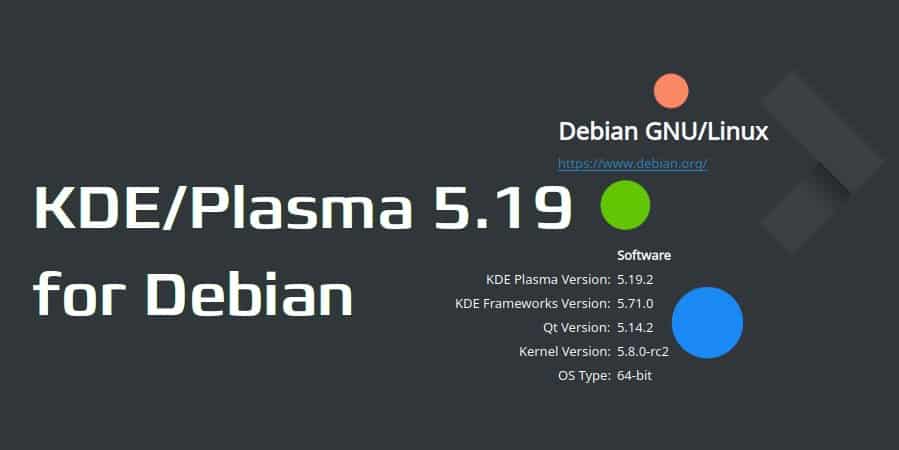 I have been preparing this release for quite some time, but due to Qt 5.12 I could only test it in a virtual machine using Debian/experimental. But now, finally, a full upgrade to Plasma 5.19(.2) has arrived.
Unfortunately, it turned out that the OBS build servers are either overloaded, incapable, or broken, but they do not properly build the necessary packages. Thus, I make the Plasma 5.19.2 (and framework) packages available via my server, for amd64. Please use the following apt line:
 This is a fairly self-indulgent post, sorry!
Encouraged by

 I released version 2.3 of