Search Results: "nic"

18 January 2013

Russ Allbery: Review: Soulless

Review: Soulless, by Gail Carriger
Series: Parasol Protectorate #1
Publisher: Orbit
Copyright: October 2009
ISBN: 0-316-07165-X
Format: Kindle
Pages: 357
Alexia Tarabotti is a spinster in London society in the time of Queen Victoria. She is possessed of a hopelessly overwrought and society-focused mother, two half-sisters whose only thoughts are for fashion and gossip, a mixed Italian heritage, an unpopular body shape and complexion, and a secret. In a world in which vampire hives, werewolf packs, and the occasional ghost are out of hiding and openly participating in society, and where the Bureau of Unnatural Registry (headed by a particularly intimidating werewolf who is also an earl) keeps track of the undead, Alexia is something still rarer, and not entirely acceptable. She is preternatural, able to draw the supernatural out of the undead with a touch. She has no soul. In Carriger's Victorian urban fantasy, laced with a gentle helping of steampunk, vampires, werewolves, and ghosts all have similar conditions. All three are undead; even the change for werewolves happens after normal death. But the change doesn't happen to everyone killed by the corresponding type of undead. The requirements are quite exacting and include the quantity of soul in the person being changed. Only those with a surfeit of soul, too much to stay dead, can be successfully changed. Vampires and werewolves both are surrounded by hopeful humans, called drones and clavigers respectively, who hope to be transformed and gain immortality. But no one can tell in advance how much soul someone has. Alexia is the precise opposite of the undead. Rather than a surfeit of soul, she has none at all, a condition inherited from her father but unknown to the rest of her family. Her kind, the preternatural, make up the vampire and werewolf hunters of legend, called soul-suckers, curse-breakers, and exorcists by the supernatural set. She's viewed with great suspicion by most, but with fascination by some for her ability to revert them to humanity with physical contact. Not that this has been helpful in finding a husband, or, really, for much of anything else in her life. Soulless opens with Alexia being accousted by a rogue vampire in the library, where she went for refuge from a private ball. Not only does he not know who she is, despite every hive in the area telling all of their new vampires about her, but he doesn't seem to even know what a preternatural is, and she has to kill him with her parasol. That is the first unusual occurance in an escalating mystery involving new vampires appearing from nowhere, loner vampires and werewolves disappearing, and a truly prodigious use of chloroform. Not to mention quite a few encounters with Lord Maccon, Earl of Woolsey, the Alpha werewolf who runs the Bureau of Unnatural Registry. The start of Soulless feels a bit uneven and stilted until the story gets moving and the reader gets used to Carriger's voice. It's written in the style of a comedy of manners and takes delight in long words and a semi-formal style. For example:
The vampire recovered his equanimity quickly enough. He reared away from Alexia, knocking over a nearby tea trolley. Physical contact broken, his fangs reappeared. Clearly not the sharpest of prongs, he then darted forward from the neck like a serpent, diving in for another chomp. "I say!" said Alexia to the vampire. "We have not even been introduced!"
Sometimes this works. Sometimes it doesn't. The frequency with which it works seemed to me to increase as the book went along. The best thing this book has going for it is the character of Alexia Tarabotti. Rather than the typical kick-ass female protagonist of a modern urban fantasy novel, Alexia is not cynical, battle-hardened, or courageously sarcastic. Her attitude for most of the book is something closer to bemusement crossed with exasperation. She sees herself as an outsider, has largely given up on fitting into any sort of proper society, and has little use for the expectations of her family. But she's still embedded within her culture, still shocked (at least momentarily) by breaches in etiquette, and quite able to fit in, if a bit uncomfortably. Her delightfully logical tone and constant open-minded self-analysis is what made this book for me. The plot is fairly straightforward (and has a bit too much anti-science flavor for me). The romance angle, which is reasonably obvious from early on in the book, was entertaining mostly in Alexia's combination of thoughtful analysis (based in part on her father's extensive and not entirely acceptable library) and runaway physical reactions, although I thought the latter was slightly overdone. But all the elements of the story improve noticably towards the end of the book. I was unenthused by the halfway point, but by the time I finished Soulless, I decided I would probably read the sequel. This is more in the enjoyably fun reading pile than a book that I would go to great effort to acquire, and it has a somewhat rocky start, but I enjoyed it and would mildly recommend it. Followed by Changeless. Rating: 7 out of 10

17 January 2013

Craig Small: Pre-selecting ToscaWidgets jqgrid values in TurboGears

My Turbogears project has recently reached an important milestone; one of the back-end processes now runs pretty much continuously and the plugins it use (or at least the ones I can see) are also working. That means I can turn to the front-end which displays the data the back-end collected. For some of the data I am using a ToscaWidgets (or TW2) widget called a jqGridWidget which is a very nice jquery device that separates the presentation and data using a json query. I ve mentioned previously about how to get a jqGridWidget working but left the pre-filtering out until now. This meant that my grid showed all the items in the database, not just the ones I wanted to see, but it was a start. Now this widget displays things called Attributes which are basically children of another model called Hosts. Basically, Attributes are things you want to check or track about a Host. My widget used to show all Attributes but often on a Host screen, I want to see its hosts only. So, this is how I got my widget to behave; I m not sure this is THE CORRECT way of doing it, but it does work. First, in the Hosts controller you need to create the widget and pass along the host_id that the controller has obtained. I was not able to use the sub-classing trick you see in some TW2 documentation but actually make a widget instance.
class HostsController(BaseController):
    # other stuff here
    class por2(portlets.Portlet):
        title = 'Host Attributes'
        widget = AttributeGrid()
        widget.host_id = host_id
Next, the prepare() method in the Widget needs to get hold of the host_id and put it into the postData list. I needed to do it before calling super() because the options become one long string in the sub-class.
class AttributeGrid(jqgrid.jqGridWidget):
    def prepare(self, **kw):
        if self.host_id is not None:
            self.options['postData'] =  'hostid': self.host_id 
        super(AttributeGrid, self).prepare()
This means the jqgrid when it asks for its JSON data will include the hostid parameter as well. We need that method to see the host ID so we can filter the database access. Finally in the JSON method for the Attribute we pick up and filter on the hostid.
    @expose('json')
    @validate(validators= 'hostid':validators.Int() )
    def jqsumdata(self, hostid=0, page=1, rows=1, *args, **kw):
        conditions = []
        if hostid > 0:
            conditions.append(model.Attribute.host_id == hostid)
        attributes =model.DBSession.query(model.Attribute).filter(and_(*conditions))
From there you run through the attributes variable and build your JSON reply.

Michal Čihař: Winter in Prague

There is finally winter in Prague. And even more special - I've managed to wake up early to get some nice pictures from downtown. Most of them are from this week, but the first one is from December: Prague bridges Charles bridge Chales bridge Kampa

Filed under: English Photography 0 comments Flattr this!

Russ Allbery: A few last thoughts on Aaron Swartz

Daniel Kahn Gillmor has a very good blog post. You should read it. It includes a thoughtful rebuttal to some of my earlier thoughts about activism. I think I'm developing a richer understanding of where I see boundaries here, but after my last post, I also realized that by focusing on the specific details of what should have been a minor alleged crime, I'm derailing. Swartz did so much else. I made a note to come back to the more theoretical discussion in six months; now isn't the time. Now is the time to celebrate open content and all of the things Swartz achieved. (But thank you very much to the multiple people who have pointed out flaws in my reasoning and attempted approach.) Hopefully, it's also an opportunity to keep the pressure on for a saner and less abusive judicial system that doesn't threaten people with ridiculous and disproportional punishment in order to terrify them into unwarranted plea bargains. The petition I mentioned has reached nearly 40,000 signatures and passed the threshold (at the time it was posted) for forcing a White House response. Probably more importantly, it also seems to be creating the feedback cycle that I was hoping to see: the popularity of the petition is causing this story to stay in the news cycle and continue to be written about, which in turn drives more signatures to the petition. I'm not particularly hopeful that the Obama administration cares about the vast and deep problems with our criminal justice system, but I'm somewhat more hopeful that they, like most politicians, hate news cycles that they don't control. The longer this goes on, the stronger the incentive to find some way to make it go away, which could lead to real disciplinary action. A key committee in the US House of Representatives is starting a formal investigation. One of my local representatives has proposed modifying the US federal law on computer fraud and abuse to remove violations of terms of service from the definition of the crime. (I don't have much hope that this will pass when proposed by the minority party in a fairly hostile House, but the mere act of proposing it keeps the news focus on.) Glenn Greenwald has a (typically long-winded) round-up of news in the Guardian. Note that both Greenwald and Declan McCullagh link directly to the petition in articles in mainstream news outlets. One thing that slacktivism can do is perpetuate a news cycle until it gets more uncomfortable for people in power. It's still nowhere near as effective as the types of activism that Swartz was so good at, but in this specific case I think one gets a reasonable return on one's five-minute investment of effort. I'm going to stop talking about this now, since other people are a lot better at this sort of post than I am. But one last link: the medical community has a related open content problem, and theirs is also killing people. Possibly people you know. If all of this has inspired you, as it has me, to care even more about open content, be watching the push for open access to clinical trial data. More background is in Ben Goldacre's TED talk.

Benjamin Mako Hill: 1-800-INTERNET.COM

I just returned home from Aaron Swartz s funeral in Chicago. Aaron was a good friend. The home I ve returned to is an apartment that was Aaron s before it was mine, that I have lived in with Aaron during several stints, and that I still share with many of his old books and posters. Although, I ve spent what feels like most of the last five days reading things that people have written about Aaron, I m still processing and digesting myself. Right now, I m very sad and at a loss for words. While I reflect, I wanted to share this video recently put online by Finne Boonen. The video was made in 2006 at a Web 1.0 Elevator Pitch Competition held at Wikimania 2006 about a year after that both Aaron and I moved to Cambridge and met. The goal of the contest was to pitch Web 1.0 DotCom business ideas to a team of real Web 1.0 investors like it was still 1999. Aaron and I formed a team along with SJ Klein (who I traveled to the funeral with this week), and Wikimania general counsel and interim executive director Brad Patrick. The video shows how as Danny O Brien has reminded us Aaron was funny. He came up with many our teams best lines in addition to checking our Web 1.0 boxes for tech guru and Stanford dropout. Our pitch for 1-800-INTERNET.COM is in the video below. The transcript was done by Phoebe Ayers in Facebook and the video is also available in WebM. <iframe allowfullscreen="" frameborder="0" height="315" src="http://www.youtube.com/embed/NzFjWY6Fd_g" width="420"></iframe>
SJ: You know, Mako and I had some pretty good ideas for improving connectivity to the internet, and we think we can reach 90% of the world s population. So think about this. You re sitting in a Starbucks, and you need to connect to the internet. But you can t, because there s no internet. But what is there, near every Starbucks? There s a payphone! You pick up the payphone, and you call . 1-800-INTERNET. You can connect to our bank of researchers on our fast T1 connections and get any information you need! So, we don t actually have 1-800-INTERNET yet, we have 1-800-225-3224, so the first thing we need to do is buy the number. So here s Mako, who is our web designer from UC Santa Cruz and Bradford, our financial guru, and Aaron, who s handling all of our technical implementation. But Mako, you should explain the earballs. Mako: So, so, so yeah, so most people on the Internet are going for the eyeballs, but they ve just left all of these earballs. So I have some experience in web design, and it s true that this isn t really a website, but we still need good web design. So, so, I ve actually got a really experienced team, we can go into later, and we have some really great earcons not icons, but earcons.. And it s going to be all together, not apart like some of the websites. It s going to be together. Brad: so how does this work technically? Aaron: Well, I mean, so I only spent one year at Stanford but that s Ok, because there are new developmental technologies, we re going to throw away all that old stuff, we re going to use really reliable and efficient well-designed code that everyone can clearly understand, and write the whole thing in Perl. I know this is a risk, but I am confident that Perl is going to destroy those old C websites. No one will write websites in C anymore once we do this, it s going to be so much faster, and so dynamic, everythings going to be like, on top of everything. It s going to be great. Bradford: So here s the business model. It s really really simple, and it s a really really great idea. It s all about the licensing. Because what we re going to have are these underlying audio ads, While you re on the phone you re going to hear this subliminal advertising message. And the way it works is really really cool, because it s really really low volume, it s high impact! And it s even better, because we license it, and the way it works is when a caller calls 1-800-Internet, they re hearing the ad, but so is the representative, so we get to bill em twice! So that s it: All: 1-800-INTERNET.COM
We did not win and I still believe that we were robbed.

15 January 2013

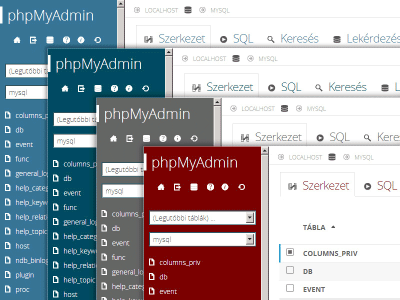
Michal &#268;iha&#345;: New theme for phpMyAdmin

phpMyAdmin just got a new theme. It's available for download on our themes page. New theme reflects look of new Windows and I have to admit it looks quite nice: Metro theme screenshot As you can see, it also offers four color variants, configurable in it's layout.inc.php file. PS: More details on theme can be found on deviantART.

Filed under: English Phpmyadmin 0 comments Flattr this!

Daniel Kahn Gillmor: in memory of Aaron Swartz

I was upset to learn about Aaron Swartz's death last week. I continue to be upset about his loss, and about our loss. He didn't just show promise of great things to come in the future -- he had already done more work for the public good than many of us will ever do. I'd only met him IRL a couple times, but (like many others) i had encountered him on the 'net in many places. He was a good person, someone i didn't need to always agree with to respect. I read Russ Allbery's posts about Aaron and "slacktivism" with much appreciation. I had been ambivalent about signing the whitehouse.gov petition asking for the removal of the prosecutor for overreach, because I generally distrust the effectiveness of online petitions (and offline petitions, for that matter). But Russ's analysis convinced me to go ahead and sign it. The petition is concrete, clear (despite wanting a grammatical proofread), and actionable. For people willing to go beyond petition signing to civil disobedience, The Aaron Swartz Memorial JSTOR Liberator is an option. It makes it straightforward to potentially violate the onerous JSTOR terms of service by re-publishing a public-domain article from JSTOR to archive.org, where it will be accessible to anyone directly. As someone who builds and maintains information/communications infrastructure, i have very mixed feelings about most online civil disobedience, since it often takes the form of a Distributed Denial of Service (DDoS) attack of some sort. DDoS attacks of public services are notoriously difficult to defend against without having huge resources to throw at the problem, so encouraging participation in a DDoS often feels a little bit like handing out cans of gasoline when you know that everyone is living in a house of straw. However, the JSTOR Liberator is not a DDoS at all -- it's simply a facilitation of people breaking the JSTOR Terms of Service (ToS), some of the same terms that Aaron was facing charges for violating. So it is a well-targeted way to demonstrate that the prosecutions were overreaching. I wanted to take issue with one of Russ' statements, though. In his second post about the situation, Russ wrote:
Social activism and political disobedience are important and often valuable things, but performing your social activism using other people's stuff is just rude. I think it can be a forgivable rudeness; people can get caught up in the moment and not realize what they're doing. But it's still rude, and it's still not the way to go about civil disobedience.
While i generally agree with Russ' thoughtful consideration of consent, I have to take issue with this elevation of some sort of hyper-extended property right over the moral agency that drives civil disobedience. To use someone else's property for the sake of a just cause without damaging the property or depriving the owner of its use is not "forgivable rudeness" -- it's forgivable, laudable even, because it is just. And the person using the property doesn't need to be "caught up in the moment and not realize what they're doing" for it to be acceptable. Civil disobedience often involves putting some level of inconvenience or discomfort on other people, including innocent people. It might be the friends and family of the activist who have to deal with the jail time; it might be the drivers stuck in a traffic jam caused by a demonstration; it might be the people forced to shop elsewhere because the store's doors are barricaded by protestors. All of these people could be troubled by the civil disobedience more than MIT's network users and admins were troubled by Aaron's protest, and that doesn't make the protests described worse or "not the way to go about civil disobedience." The trouble highlights a more significant injustice, and in its troubling way does what it can to help right it. Aaron was a troublemaker, and a good one. He will be missed. Tags: aaronsw

Russ Allbery: More on Aaron Swartz

I got some feedback that the analogy I used in my last post was a bit confusing, and indeed I blew the phrasing of the analogy (also now corrected). So let me try this again, since I think there's a subtlety here that may be missed. I should note for the record that my understanding of what Swartz did that started the process is apparently somewhat based on the description from the prosecution, so it may not be the complete or accurate facts. Since there will now be no trial, we may never find out what the defense was, and whether those facts would be challenged. So it may be best to think of this as a hypothetical. We never established, or will establish, in court exactly what happened. Swartz was, generally speaking, charged with two things that I consider quite distinct, at least from an ethical perspective. Most of the focus is on the copyright part: downloading JSTOR articles with an intent (never acted upon) to distribute them to the world. There are a bunch of reasons why this may or may not be justified, which are tied into the origin of those articles (many of them were publicly funded) and the legitimacy of copyright licensing agreements. I think there is significant room to hold a variety of opinions on this, although I don't believe that "crime worth 35 years in prison" is even remotely close to justifiable under any interpretation. However, there is a second part of what he was charged with, and that's primarily what I was commenting on, not the copyright part. He allegedly hooked up a laptop in an unlocked MIT wiring closet without permission and then used MIT's network and JSTOR license to download information. This is, to me, a subtlely but entirely distinct act from the question of whether taking JSTOR's data was ethically or legally wrong. Whether or not one believes that JSTOR's copyrights are not legitimate, it's still not okay to use someone else's network and license or to trespass in their wiring closets without permission. (I work in central IT for a university, so this strikes closer to home.) And this is where the analogy came in, which I flubbed. I had originally said that this was akin to "traipsing into someone's barn or backyard shed without their permission and taking some of their tools because you want to use them." The word "taking" was wrong; it falsely implies that you weren't going to return the tools. I had been thinking "taking and then returning" when I wrote that, and the important second part didn't make it into the post. So let's try this again: Swartz's actions at MIT, as I understand them (and many things could change this, such as a revelation that he had MIT's prior permission), are akin to going onto someone's property and into their barn without permission, borrowing their hedge trimmer for a while because you want to use it, and returning the hedge trimmer without any damage when you're done (and without them noticing it was gone). I'm quite fond of this analogy, since I think it clearly establishes two things:
  1. Most people are going to be unhappy about this happening and will intuitively feel like it should probably be illegal. Not everyone; there are folks who don't believe in personal property, or at least wouldn't extend it to tools in a barn. But most people will feel that someone should ask first before they come borrow your tools. Even if they don't damage them, even if they return them before you notice they're gone, you might have wanted to use the tool at the same time or they might have damaged them without intending to, and they should just ask first. It's common politeness, and depending on the circumstances, someone who doesn't ask and is covert about borrowing tools might be worth calling the police over.
  2. There is absolutely no way in any reasonable moral system that doing this should result in 35 years in prison. Or even 10, or even 1. Yes, most people would consider this a crime, but most people would consider it a minor crime. It's the sort of thing where you might have to impose some consequences just to make sure the message of "knock it off" is delivered firmly, but someone doing this is rude and inconsiderate, not evil.
The JSTOR copyright stuff is more complex to analyze and is more politically divisive, but for me the key points are (a) Swartz never released the data, and (b) JSTOR declined to press charges. To me, that means the deeper copyright questions, which are quite interesting, were never actually reached in this particular case. The crime that did apparently happen was the trespass at MIT, for which I think the above analogy is the right way to think about it. The point I do want people to take away from this is that one should not overlook the trespass at MIT even if one wants to celebrate the undermining of the copyright regime and doesn't believe JSTOR's data should be considered their private property. Social activism and political disobedience are important and often valuable things, but performing your social activism using other people's stuff is just rude. I think it can be a forgivable rudeness; people can get caught up in the moment and not realize what they're doing. But it's still rude, and it's still not the way to go about civil disobedience. For both ethical and tactical reasons, involving bystanders in your act of social activism without their consent is a bad approach. ETA: The problem, of course, with discussing all of this is that while it's relevant and possibly even somewhat important in the broader sense of how our community acts going forward, it also doesn't capture the fact that this was only one incident in a remarkable life. One of the worst problems with the abusive prosecution of Swartz is that it blew this incident completely out of proportion. A moment of arguable judgement should not dominate one's life or cast a shadow over all of one's other accomplishments; the prosecution tried to make it do just that. That's part of what I'm arguing, but ironically that partly feeds into the lack of proportionality in the discussion. I've gotten kind of far afield here, so let me go back and say explicitly: Swartz was a remarkable person who did much to admire and respect, and the world is a worse place without him.

14 January 2013

Russell Coker: Promoting Enthusiasm

Rusty wrote an insightful post titled What Can I Do To Help? about reactions to new ideas [1]. He suggests that people make an effort to have a positive approach when someone talks about a new idea, it s quite common for people to point out reasons why the new idea might not work out which is discouraging for the person who had the idea. I think that is a really good point. I probably haven t done too well in that regard in the past and will try to do better in future. Code Written by Assholes Rusty previously wrote a post titled If you didn t run code written by assholes, your machine wouldn t boot which implies that we should just let assholes be assholes [2]. That doesn t go well with his What Can I Do To Help? post. Note that I m not accusing Rusty of hypocrisy here, giving advice to help people who want to get along well with others is not in contradiction with refraining from giving unsolicited advice and encouragement to difficult people who have expressed no interest in improving their behavior. A comment on the latter post by Doctor Whom says If I had seen this kind of talk when I was a teenager, I would have thought twice about picking up coding , presumably given the number of people who read Rusty s blog there are some teenagers who experienced some discouragement towards a career in computers (or a hobby in FOSS) from Rusty s post. I ve already written a response to the If you didn t run code written by assholes post, among other things I suggested that people who are minor assholes should be assisted to be less difficult and major assholes should be excluded [3]. In that post I was working on the assumption that for every significant task that needs to be completed (such as making a popular OS bootable) someone will do it, if the person working on it disappears then someone else will take over there is a community of programmers who will work on whatever needs to be done. The Importance of Individuals But in terms of new ideas it really comes down to individuals. Most projects which are significant and important now probably started out as one person or a small group who had an idea that seemed unlikely to succeed at the time. So while any big and successful project can have people replaced (which is among other things a requirement of long-term success) there are situations in which individuals with ideas matter. Another important factor is that even ideas which turn out to be impractical are still useful. Someone who has an impractical idea about a technical issue and investigates it fully will learn a lot and may end up working on the less radical ways of solving similar problems this is good for the individual and the community. Another Way of Promoting Enthusiasm In terms of promoting enthusiasm it seems that one thing that can be done by high profile people is to avoid writing posts like If you didn t run code written by assholes, your machine wouldn t boot . When people in positions of power and influence appear to have no interest in promoting good behavior it really discourages people who are vulnerable to the assholes which among other things means most members of minority groups. Obviously Rusty could t stamp out all asshole behavior, but if he announced a plan to try and make things better in that regard then it would help. It s difficult to be enthusiastic when faced with discrimination from a minority and disinterest from the majority. Of course with the way the Internet works I m sure someone will say what about the assholes who have great ideas, shouldn t we nurture their enthusiasm by letting them keep doing asshole things? . I think that for the major assholes this won t be a problem, for example anyone who s racist will be well aware that many people disagree strongly with them and thus won t be particularly discouraged when they meet more people who disagree. For the minor assholes (people who don t want to be assholes) it will be somewhat discouraging to be corrected, but that could be a learning experience for them that s worth more than support in implementing their latest technical idea. Update: Why Rusty is Important In response to a comment by private mail I ve added this section after publication. Firstly I think that the opinions of all members of the community matter as they all affect the social environment which determines what types of behavior are encouraged and discouraged. But Rusty is more important than most people. Firstly Rusty has a Wikipedia page [4], that alone is an objective criteria indicating his importance. But in terms of influencing people in the FOSS community the most important things are that he s a high profile Linux kernel programmer (which alone gives significant status and influence) and that he s the founder of the first Linux conference in Australia (which is now known as Linux.conf.au AKA LCA). When issues such as the anti-harassment policy for LCA are being discussed any opinion that Rusty offered would be taken very seriously. But so far he doesn t seem to be involved in any of the public discussions.

13 January 2013

Thorsten Glaser: PSA: Unicode codepoints, referring to

PSA: Referring to Unicode codepoints. If your Unicode codepoint is, numerically, between 0 and 65533, inclusive, convert it to hexadecimal and zero-pad it to four nibbles. For example, the Euro sign is Unicode codepoint #8364 which is 20AC hex; the Eszett is 223 which is DF hex, padded 00DF.
Then write an uppercase U , a plus sign + , and the four nibbles: U+20AC U+00DF
In mksh, JSON, etc. it s a backslash \ , a lower-case u and four nibbles. Otherwise, your Unicode codepoint will be, numerically, between 65536 and 1114111, inclusive, that is hex 10000 to 10FFFF. (There s nothing on 65534 and 65535, nor above these figures.) In this case, convert it to hex, zero-pad it to eight nibbles and write it as an uppercase U , a hyphen-minus - and the eight nibbles. In C-like escapes for environments supporting the Unicode SMP, that s a backslash \ , an upper-case U and eight nibbles. Do not, in either case, use less (or more) hex digits than specified here. For example, there s a famous Unicode codepoint U-0001F4A9 PILE OF POO . That s not the same as U+1F4A9. The latter reads as U+1F4A GREEK CAPITAL LETTER OMICRON WITH PSILI AND VARIA and a digit 9 ( 9). Be educated.

Neil Williams: Status of klibc on AArch64

With significant assistance from Steve McIntyre and some judicious delving into the ARM Information Centre, I've now got the assembly portions of klibc sorted (but untested) for AArch64 (arm64).

Andy & I started by copying the old ARM support as a new directory and one of the final steps was to remove a whole bunch of legacy code from the days before Thumb and all the #ifdef lines which went with it. Some files disappeared entirely. setjmp.S was the largest amount of work as the load&store multiple support of ARMv7 has gone in ARMv8, so the stmia mnemonic had to be expanded to multiple stp calls but that makes it more explicit, so it's not a bad thing.

Steve & I borrowed from the glibc AArch64 code from upstream by Marcus Shawcroft, simplifying the glibc macros for klibc and also got clues about what extra registers needed handling compared to ARMv7.

I've now got to look at some traditional cross-compilation issues because the Linaro AArch64 toolchain doesn't install to typical Debian cross-building paths and the build now moves past the AArch64-specific assembly and fails later when the C code gets the wrong include path and ends up including /usr/include/i386-linux-gnu/asm/byteorder.h with predictable results.

If someone has an AArch64 toolchain already set up, feel free to clone my modified klibc tree and let me know if there are subsequent build errors. Of course, if you fancy testing a build in the Foundation Model for ARMv8, that would be good too! (Report issues via github.)

Whilst I'm sorting out the toolchain, I've also been updating perl-cross-debian (which has also seen some more upstream testing and improvement).

Russell Coker: Android Multitasking

My new Samsung Galaxy S3 has support for Multi Window Mode , here is a video which shows how to use this, Multi Window Mode starts at about 2:30 [1]. A common complaint about Android is the lack of multitasking, which is partly true and only slightly alleviated by Multi Window Mode. Running Multiple Programs Traditionally Android has multitasked with a similar ability to a Unix shell session, you can have applications running in the background and switch between them but you can t see multiple applications running at the same time (apart from seeing notification messages at the top of the screen). The new Multi Window Mode allows two or more applications to share a screen. But it only applies to a small number of applications which support it, on my phone that is applications shipped by Samsung and Google Chrome. Also I can t have multiple copies of Chrome open at the same time which means I can t do the things that I do on every PC that runs Chromium (the non-Google build of Chrome). I have not yet found a situation where Multi Window Mode has been useful to me, the applications I use for most tasks don t support it. So while Android being based on Linux does multitask really well in the technical computer-science definition it doesn t do so well in the user-centric definition. In practice Android multitasking is mostly about task switching and doing things like checking email in the background. Having multiple programs running at once is particularly difficult due to the Android model of applications sometimes terminating when they aren t visible. A common task is to view a message in a MUA and switch between that and another window (EG a web browser). K9 is my preferred MUA for Android which seems to have no option to switch back and still be viewing the same message as before the task switch so at least three actions need to be taken to get back to the same message after I resume K9. One major feature to make multitasking on Android more usable would be a way of rapidly switching between two applications and being certain that each one would be in the same state when the user switches back to it. Copy and Paste Another problem with Android multitasking is the difficulty in copying and pasting text. While copy/paste is not strictly required for multitasking it is a logical requirement when you have multiple applications running on behalf of a single user. For PCs everyone knows that you select text by holding down the SHIFT key while using the cursor control keys or by holding down the mouse button and swiping the mouse cursor over the text and you then use CTRL-C or the Edit menu to copy text. On Android it s a long press to select text which then gives you markers for the start and end, you drag those markers around and then select that you want to copy the text. This is at best a lot more inconvenient than using a high resolution input device like a mouse to select text. At worst it doesn t seem particularly reliable, K9 Mail for example won t let me copy text from a message for unknown reasons on a desktop OS such problems are vanishingly rare such that I can t think of an example of it happening. IO and Multitasking Multitasking for a user (as opposed to the multitasking needed to host dozens or hundreds of concurrent users) on Unix servers was very limited in the days of VT100 terminals and similar devices. Programs such as GNU Screen [2] allowed a text display to perform windowing functions that are similar to a modern GUI. But generally it seems that the ability for a user to run multiple programs at once is largely limited by their ability to see the output and to rapidly switch between programs or sessions. As a keyboard with ~100 keys and a text display with 80*25 characters is a major limitation it s obviously going to be a comparable (and often greater) limitation to have an on-screen keyboard that takes half the screen space, a single program taking all the screen, and a drop-down status bar that might be useful for multitasking. With Android 4.0 and above you can activate a task switcher by holding down the home button for two seconds [3]. There are also a variety of third party task switching programs on the Google Play store which all seem to start by holding down the home button. One problem with these options is that they require an extended press of the home button where the ideal is something that is as quick as ALT-TAB or a single mouse movement on a desktop system. One possible input action would be to switch between the most recent tasks with a palm swipe on the screen an operation that is quick and easy. Currently a palm swipe is used for a screen capture, but as there are four possible directions for swiping the screen one of them could be used for screen capture and another two for task switching. But this wouldn t do a lot of good without the ability to switch tasks without losing the context that either requires Android application changes or having the OS not tell an application that it was occluded. The iPaQ had interesting capabilities for input, it had a main button on the front that could be pushed in four directions (usually for cursor control) as well as being pushed in, four extra buttons on the front, and a button on the side [4]. I don t recall the methods that Familiar Linux on the iPaQ [5] used for task switching, but it was less of an issue as the iPaQ had less RAM, no Internet access and no telephony functions. I think that adding a bunch of extra buttons to an Android phone would make it a lot more useful. The iPaQ method of cursor control is one that could be considered (it could alleviate the copy/paste problems among other things). As an aside in two years of using Android phones I ve done less serious writing on Android than I did in my first two years of using Familiar on the iPaQ largely due to the lack of keys and a stylus on my Android phones. The screen size on Android phones is also a limit for multitasking. The earlier/cheaper phones that have small screens with resolutions such as 320*480 have very limited ability to display two programs at once. The 720*1280 display in the Galaxy S3 has a lot more potential in this regard and the Galaxy Note 2 and the HTC J Butterfly AKA Droid DNA have even more potential. In the future it seems that screen size limitations on phone multitasking will be a solved problem for everyone who can afford one of the high end phones which incidentally are much cheaper than the iPaQ was 10 years ago. Conclusion Checking email in the background etc is very useful on Android systems. But in terms of the user running two programs at once it seems very limited, and that situation seems likely to remain until the vendors adopt multi-window support. This could be difficult given that Google applied a lot of pressure to CyanogenMod to stop them from doing it [6]. Even when a system with a large display (particularly a tablet) runs a version of Android that supports multi-window mode that still won t entirely solve the problem. No matter how big your display is there are occasions when you need to use it all for a single application while still having the ability to rapidly switch to another application. User interface tweaks to allow rapid task switching without losing application context are necessary. Finally for the past two years that I ve been using Android devices I have been disappointed in the ways that they compare poorly to the iPaQ running Familiar I used 10 years ago. I once wrote a feature article for a magazine on an iPaQ while so far I haven t even written a blog post on an Android device. I think that some of the earlier Android devices might have been better in some ways, the trackball on the HTC Nexus One might have made it more suitable for writing long articles than more recent Android devices.

12 January 2013

Russ Allbery: Review: Asimov's, April/May 2011

Review: Asimov's Science Fiction, April/May 2011
Editor: Sheila Williams
Issue: Volume 35, No. 4 & 5
ISSN: 1065-2698
Pages: 192
Williams's editorial this issue is about the tendency of SF to take a rose-colored view of the world, which on the surface seems odd given the tendency of recent SF towards dystopia. But she makes a good point that the portrayal of the past is rose-colored, linking that into the current steampunk trend. She doesn't take the argument quite as far as I'd like, but I'm glad to see editorials raising points like this. I'm inclined to think that a lot of the rose-colored frame of the past is because few of us want to read about real historic conditions at any length, even for edification, because the stench and discomfort isn't fun to read about. Silverberg's column is another discussion of programmatic plot generators, which mostly makes the point that plot ideas are the easy part of writing. James Gunn contributes an extended biography of Isaac Asimov that probably won't be new to long-time genre readers but may fill in some details (although it politely sticks to mostly flattering material). Spinrad's book review column is one of his better ones; it looks at two novels by China Mi ville and two by Ian McDonald and explores differences in world-building. Spinrad predictably makes the case in favor of science fiction with rules and against the New Weird, but the discussion along the way was worth reading. "The Day the Wires Came Down" by Alexander Jablokov: Speaking of steampunk, here's an example. There is even an airship, although the primary technological focus is suspended street cars. Jablokov postulates a city-wide transportation network of suspended carriages called telpher cars, along with a city built around the telpher cables: stores on roofs, windows displaying merchandise to passing cars, and even a history of heated competition and dirty tricks between competing telpher networks. The story is set, as the title would indicate, on the last day of the network. It's being shut down for cost, with some hints that progress is destroying something precious. There is a plot here, revolving around some mysteries of the history of the telpher network and the roles of several people in that history. But the story is primarily a celebration of old technology. It's a rail fan's story recast with a steampunk technology, featuring the same mix of fascination with mechanics and a sense that the intricate details are falling out of common knowledge (and perhaps usefulness). As a story, it's a bit slow-moving, but I enjoyed the elegiac tone. (7) "An Empty House with Many Doors" by Michael Swanwick: This is a very short story, more of an emotional profile, involving a man's reaction to the death of his wife. Oh, and parallel universes. It's sort of the inverse of Niven's classic "All the Myriad Ways." Similar to Niven's story, I found the idea vaguely interesting but the conclusion and emotional reaction unbelievable and alien. (5) "The Homecoming" by Mike Resnick: Resnick tends to yank on the heart-strings rather sharply in his stories, so I knew roughly what to expect when a father comes home to find his son is visiting. A son who, rather against his father's wishes, has been significantly altered to be able to live with aliens. Throw in a mother with serious dementia, and you can probably predict what Resnick does with this. Still, most of the story is a two-sided conversation, and I thought he succeeded in doing justice to both sides, even though one of them was destined to lose. (6) "North Shore Friday" by Nick Mamatas: Illegal Greek immigrants, a family-run system for getting them married off before the INS catch them, government psi probes and eavesdropping on thoughts, joint projects between computer and religion departments, secret government experiments, and even ghosts... this story is a complex mess, with numerous thoughts stuck into small boxes and scattered through the surface story. It's one of those stories where figuring out what's going on, and even how to read the story in a sensible way, is much of the fun. If you find that fun, that is; if not, it will probably be frustrating. I wished there was a bit more plot, but there's something delightful about how much stuff Mamatas packs into it. (6) "Clockworks" by William Preston: This is a prequel to Preston's earlier "Helping Them Take the Old Man Down". Like that story, it's primarily a pulp adventure, but layered with another level of analysis and thoughtfulness that tries to embed the pulp adventure in our understanding of human behavior and the nature of the world, although this one stays a bit more pulp than its predecessor. As with Preston's other story, we don't get directly in the head of the Old Man (here, just called the man, but identifiable from clues in both stories as Doc Savage); instead, the protagonist is a former villain named Simon Lukic who the man hopes to have fixed by operating on his brain. The undercurrent that lies beneath a more typical pulp adventure is the question of whether Lukic is actually healed. I think there was a bit too much daring-do and human perfection, but it's a perfectly servicable pulp story with some depth. (6) "The Fnoor Hen" by Rudy Rucker: If you've read any of Rucker's work before, you probably know what to expect: a mind-boggling blizzard of mathematically-inspired technobabble that turns into vaguely coherent surrealism. (You can probably tell that I'm not much of a fan, although the clear good humor in these stories makes it hard to dislike them too much.) There's a mutated chicken and some sort of alternate mathematical space and then something that seems like magic... I'd be lying if I said that I followed this story. If you like Rucker, this seems like the sort of thing that you'd like. (4) "Smoke City" by Christopher Barzak: At the start of this story, I thought it was going to be an emotional parable about immigration. The progatonist lives two lives: one in our world, and one in the Smoke City of industry, a world of hard labor, pollution, and little reward, with families in both. But nearly all of the story is set within Smoke City, and the parable turns out to be a caustic indictment of industry and its exploitation of labor. I kind of wish Barzak hadn't used rape as a metaphor, but when the captains of industry show up, I can't argue with how deeply and accurately the story shoves in the knife. There isn't much subtlety here, but it's still one of the better stories in this issue. (7) "A Response from EST17" by Tom Purdom: I'm very happy to see Purdom's writing appearing regularly. His stories are always quiet and matter-of-fact, and at first seem to miss emotional zest, but they almost always grow on me. He lets the reader fill in their own emotional reactions to events, and there's always a lot going on. This story is a first-contact story, except that the "humans" here are not human at all. They're automated probes sent by two separate human civilizations, with different programming and different governance algorithms, and they quickly start competing negotiations. The aliens they've discovered similarly have factions, who start talking to the different probes in an elaborate dance of gathering information without giving too much away. The twist is that this pattern has replayed itself many times in the past, and information itself can be a weapon. I enjoyed this one from start to finish. (7) "The One That Got Away" by Esther M. Friesner: Friesner is best known, at least to me, for humorous fantasy, and this story is advertised as such from early on. The first-person protagonist is a prostitute in a seaside town. She's bemused to finally be invited over by a sailor who's been eyeing her all evening, but that sailor has something else in mind than normal business. For much of this story, the fantasy element is unclear; when it finally comes, it was an amusing twist. (7) "The Flow and Dream" by Jack Skillingstead: This is a mildly interesting variation on the old SF story of hibernating humans (on a generation ship or elsewhere) waking up to a transformed world. Here, it's not a ship, it's a planet, and the hiberation was to wait for terraforming rather than for transit. The twist comes from an excessively literal computer and the fun of putting together the pieces. Sadly, the story trails off at the end without much new to say. (5) "Becalmed" by Kristine Kathryn Rusch: "Becalmed" takes place immediately before "Becoming One with the Ghosts" and explains the incident that created the situation explored in that story. The first-person protagonist of "Becalmed" is a linguist, an expert in learning alien languages so that the Fleet can understand the civilizations that it runs across. But something went horribly wrong at their last stop, something that she's largely suppressed, and now she's confined to quarters and possibly in deep trouble. As is the ship; they're in foldspace, and they have been for days. "Becalmed" is structed like a mystery, centered around recovering the protagonist's memories. It's also a bit of a legal procedural; the ship is trying to determine what to do with her and to what degree she's responsible. But the heart of the story is a linguistic and cultural puzzle. This is another great SF story from Rusch, whose name on a cover will make me eager to start reading a new magazine. I love both angles on the universe she's built, but I think I like the Fleet even better than the divers. The Fleet captures some of the magic of the original Star Trek, but with much more mature characters, more believable situations, and a more sensible and nuanced version of the Prime Directive. Rusch writes substantial, interesting plots that hold my interest. I'd love to see more like this. (8) Rating: 7 out of 10

11 January 2013

Benjamin Mako Hill: Goodbye PyBlosxom, Hello WordPress

Since 2004, I ve used the blogging software PyBlosxom. Over that time, the software has served me well and I have even written a series of patches and plugins. PyBloxsom is blog software designed for hackers. It assumes you already have a text editor you love and relies on features of a POSIX filesystem instead of a relational database. It s designed so you can keep your blog under revision control (since 2004 I ve used GNU Arch, baz, bzr and now git). It is also hackers software in the sense that you should expect to write code to use it (e.g., the configuration is pure Python). I love it. What PyBlosxom does not have is a large community. This summer, the most recent long-time maintainer of the project, Will Kahn-Greene, stepped down. Although the project eventually found a new maintainer, the reality is the project entered maintenance mode years ago and many features available in more popular blogging platforms are unlikely to make it PyBlosxom. The situation with comment spam is particularly dire. I ve written several antispam plugins but time has shown that I don t have the either the expertise or the time to make them as awesome as they need to be to really work in today s web. So, after many months of weighing, waffling, and planning I ve switched to WordPress a great piece of free software with an enormous and established community As you ll know if you ve read my interview on The Setup, I think a lot about the technology I surround myself with. I considered WordPress when I started my blog back in 2004 and rejected it soundly. Eight years ago, I would have laughed at you if you told me I d be using it today; If PyBlosxom is for hackers, WordPress is designed for everyone else. But the way I evaluate software has changed over that period. In the nineties, I used to download every new version of the Linux kernel to compile it it took hours! to try out the latest features. Configurabilty, hackability, and the ability to write my own features was after a point more important than the features the software came with. Today, I m much more aware of the fact that for all the freedom that my software gives me, I simply do not have the time, energy, or inclination to take advantage of that freedom to hack very often. Today, I give much more value to software that is not just free, but that is maintained by a community of people who can do all the work that I would do if I had unlimited time. Although I don t have the time or experience to make WordPress do everything I would like, the collective of all WordPress users does. And they ve done a lot of it already! The flip side matters as well: Today, I give more value to other people using my software. When WordPress doesn t do something and I write a plugin or patch, there are tons of people ready to pick it up and use it and perhaps even to collaborate on it with me. Want to guess how many patches my PyBlosxom plugins have received? None, if my memory serves me. In the past, I ve written about how free software is a victory even when it doesn t build a community. I still believe that. But the large communities at the heart of the most successful free software communities (the promise of open source ) are deeply important in a way that I increasingly value. In that spirit: If you want to make the jump from PyBlosxom to WordPress, I ve shared a Git repository with the scripts I used and wrote for the transition.

Russ Allbery: release 1.45 and multiple PGP signatures

release is the tool that I use to manage software releases. This version adds support for signing a tarball with multiple PGP keys at once. For WebAuth, we have an official signing key, but I also wanted to add my personal signature. The minimum supported version of Python was also bumped to 2.5 (see below for why). You can get the latest version from my scripts page. Normally, I wouldn't announce this to everyone, since it's a fairly minor change, except I had a question and a quick Python note. The question: how does one get GnuPG to verify multiple signatures? When I run GnuPG on the resulting detached *.asc file created by this new code, I get the following:
gpg: WARNING: multiple signatures detected.  Only the first will be checked.
gpg: Signature made Thu 10 Jan 2013 03:58:43 PM PST using RSA key ID 5736DE75
gpg: Good signature from "Russ Allbery <rra@stanford.edu>"
gpg:                 aka "Russ Allbery <rra@debian.org>"
gpg:                 aka "Russ Allbery <eagle@windlord.stanford.edu>"
gpg:                 aka "Russ Allbery <eagle@eyrie.org>"
That's nice, I suppose, but it's not as helpful as it could be. Why not verify both signatures and report all of the results? I searched both the gpg man page and the Internet for some option I'm missing, without any luck. (Searching Google for that exact message amusingly turns up lots of verbatim output from Debian repository verification and almost nothing else.) If anyone knows, send me email (rra@stanford.edu or any other convenient address), and I'll update this post with the answer. UPDATE: gpg can currently only verify multiple signatures if the signatures are from keys with the same class and digest. I was attempting this with a 2048-bit RSA key and a 1024-bit DSA key, which gpg does not support. (Yet another reason to replace the WebAuth signing key with a newly-generated key.) Thanks to Philip Martin and Bernhard R. Link for the information! The note is that, way back when I was first learning Python, one of the things that bothered me the most was the lack of safe program execution. The best available was os.spawnv(), which left something to be desired. If you too were bothered by this but don't program in Python enough to keep track of the current state of the art, there's now a subprocess module that has much saner interfaces that work properly, do reasonable things, and avoid the shell. It was added in Python 2.4, with some nicer interfaces added in Python 2.5, so it's fairly safe to use at this point.

8 January 2013

Bastian Venthur: Shiny new iPod Nano 6G fffffffuuuuuuuuuuuu

So I got an iPod Nano (6th generation) for Christmas this year, just in time since my trusty old iPod Mini started beg for retirement after almost 8 years of usage. Since my old iPod was working like a charm all those years I expected a smooth sailing when I plugged in my new iPod Nano. Gnome recognized it correctly and mounted the device. The iPod showed up in Rhythmbox as I was used to and I started to fill it with some music. Everything worked as expected: Rhythmbox copied the music to the iPod without complaining and after unmounting the iPod and starting it it was emtpy. Whait, what? Why is it empty? Didn t I just So I tried again, and again with the same result. Half an hour later I found out that libgpod (the iPod driver for Linux) supports all iPods except the iPod Nano 6G. Bummer. Apparently Apple changed the algorithm to calculate the checksums of the files on the device and since that algorithm is unknown you cannot successfully write on it with free software. That means technically this device is unusable for Linux users since iTunes doesn t run on Linux. However, there seems to be a way to use the iPod Nano with libgpod if you are trusting this guy and willing to use his binary (only!) file with libgpod (which I am not). And somehow the guys over at Spotify managed to get the iPod Nano running in their Linux client but they don t provide the code either. Being already more than two years old, I don t have much hope that the iPod Nano will work on Linux with libgpod in the foreseeable future. On the bright side I can say the device is not totally useless as it comes with FM radio

7 January 2013

Russ Allbery: faq2html 1.31 and VCS migrations

faq2html is my version of that script that so many different people have written: a tool to convert text files into HTML for the web. This script is specifically tuned to the way that I format text files and has a lot of special logic to deal with my eccentricities, so I have no idea how well it would work for anyone else. This release adds a new -l option, which says to add a subheading to the HTML output giving the last modified date based on the file modification timestamp. Previously, these subheadings were only added in some situations and based on RCS/CVS-style Id keywords in the file. Since I'm converting my personal repositories to Git, that was going to stop working. You can get the current version of faq2html from my web tools distribution page. With this update, I was able to convert my FAQs repository from Subversion to Git, which means that I only have one personal repository left in Subversion (PGP::Sign, which I will probably convert to Git shortly). That leaves a few CVS repositories, and therein lies a problem. There are a few places where I'm still using CVS for a conventional package or for some random files, and those can move to Git without much trouble whenever I get around to it. But most of my remaining use of CVS is for storing individual scripts that, if I distribute them at all, I distribute individually. And, for that, CVS seems to have a lot of advantages that are hard to implement with Git: I'm not at all sure what I'm going to do about this. Some of my scripts currently maintained in CVS, such as all the AFS tools, should move into larger packages that are more conventionally distributed, with a separate README file and similar machinery, and I'm slowly in the process of doing that. But many of my scripts are small programs that don't fit into any larger whole and don't warrant that sort of treatment. Honestly, I'm moderately tempted to just keep using CVS for scripts, since everything newer goes to repository-wide instead of per-file version numbers (for exceptionally good reasons when working on a unified piece of software, rather than a conglomeration of individual scripts), and I'm unenthused about writing my own machinery using Git hooks and smart Git log and diff parsing. But the CVS command-line interface is awful and the CVS repository format is even worse. If there are any brilliant ideas that I'm missing, I'd be interested in hearing about them in email (or other blog posts on Planet Debian or somewhere else I read). If I come up with some solution or get any great advice, I'll post a follow-up.

6 January 2013

Neil Williams: bootstrapping arm64

I'm still working on perl-cross-debian (just uploaded 0.0.2) and there's more to do on that with upstream but part of the reason to work on perl cross-building is to do what I can to help with the ARM64 port.

So, I went back to Wookey's talk at DebConf12 which leads to the current list of cross-build results for arm64 and started through the list.

coreutils is listed as failing but that was an archive error (MD5sum hash mismatch), so that just needs a retry. I don't have access to that buildd, yet, so nothing I can do there.

Next on the list (excluding those just waiting for build-deps) was klibc.

aarch64-linux-gnu-gcc -Wp,-MD,usr/klibc/.__static_init.o.d -nostdinc -iwithprefix
include -I/ PKGBUILDDIR /usr/include/arch/x86_64 -Iusr/include/arch/x86_64
-I/ PKGBUILDDIR /usr/include/bits64
-Iusr/include/bits64 -I/ PKGBUILDDIR /usr/klibc/../include
-Iusr/klibc/../include -I/ PKGBUILDDIR /usr/include -Iusr/include
-I/ PKGBUILDDIR /linux/include -Ilinux/include
-I/ PKGBUILDDIR /linux/arch/x86/include -Ilinux/arch/x86/include
-D__KLIBC__=2 -D__KLIBC_MINOR__=0 -D_BITSIZE=64 -fno-stack-protector -fwrapv -m64 -Os
-fno-asynchronous-unwind-tables -fomit-frame-pointer -falign-functions=1 -falign-jumps=1 -falign-loops=1
-W -Wall -Wno-sign-compare -Wno-unused-parameter -c -o usr/klibc/__static_init.o usr/klibc/__static_init.c
aarch64-linux-gnu-gcc: error: unrecognized command line option '-m64'
make[4]: *** [usr/klibc/__static_init.o] Error 1


Turns out that this is a build failure I understood, at least initially. A little digging and a trivial patch was begun:

--- a/usr/klibc/arch/arm/MCONFIG
+++ b/usr/klibc/arch/arm/MCONFIG
@@ -30,6 +30,13 @@
ifeq ($(CONFIG_AEABI),y)
KLIBCREQFLAGS += -mabi=aapcs-linux -mno-thumb-interwork
else
+# aarch64
+ifeq ($(CONFIG_AARCH64),y)
+KLIBCREQFLAGS +=
+KLIBCOPTFLAGS += -mgeneral-regs-only
+else
KLIBCREQFLAGS += -mabi=apcs-gnu -mno-thumb-interwork
endif
endif
+endif
+

Alongside a trivial change to debian/rules

ifeq ($(DEB_HOST_ARCH),arm64)
DEB_MAKE_ENVVARS := ARCH=arm CONFIG_AARCH64=y CPU_ARCH=armv8-a CPU_TUNE=generic
endif

OK, then things get a bit more awkward,

....
code/debian/cross/klibc/klibc-2.0.1/linux/arch/arm/include -Ilinux/arch/arm/include -D__KLIBC__=2
-D__KLIBC_MINOR__=0 -D_BITSIZE=32 -fno-stack-protector -fwrapv -fno-exceptions -Os
-march=armv8-a -mtune=generic -mgeneral-regs-only -W -Wall -Wno-sign-compare -Wno-unused-parameter
-c -o ../foo.o usr/klibc/arch/arm/crt0.S
usr/klibc/arch/arm/crt0.S: Assembler messages:
usr/klibc/arch/arm/crt0.S:19: Error: operand 1 should be an integer register -- mov r0,sp'
usr/klibc/arch/arm/crt0.S:20: Error: operand 1 should be an integer register -- mov r1,#0'

Hmm. Assembly, well, yes, I've done assembly before, I know what mov should normally do, sp is likely to be the stack pointer .... where's my AARCH64 assembly PDF again... PRD03-GENC-010197 ...

OK, so maybe the r0 and r1 should be x0 and x1, hmm, that at least doesn't raise assembly errors. So a tentative change:

--- a/usr/klibc/arch/arm/crt0.S
+++ b/usr/klibc/arch/arm/crt0.S
@@ -15,9 +15,13 @@
#ifdef __thumb__
.thumb_func
#endif
-
+#ifdef __aarch64__
+_start: mov x0, sp
+ mov x1, #0
+ bl __libc_init
+#else
_start: mov r0, sp
mov r1, #0
bl __libc_init
-
+#endif
.size _start,.-_start

Next stage, however, leaves me quite a bit more lost:

....
klibc-2.0.1/linux/arch/arm/include -Ilinux/arch/arm/include
-D__KLIBC__=2 -D__KLIBC_MINOR__=0 -D_BITSIZE=32 -fno-stack-protector -fwrapv -fno-exceptions -Os
-march=armv8-a -mtune=generic -mgeneral-regs-only -W -Wall -Wno-sign-compare -Wno-unused-parameter
-c -o usr/klibc/arch/arm/setjmp.o usr/klibc/arch/arm/setjmp.S
usr/klibc/arch/arm/setjmp.S: Assembler messages:
usr/klibc/arch/arm/setjmp.S:32: Error: unknown mnemonic stmia' -- stmia r0, r4,r5,r6,r7,r8,r9,r10,fp,sp,lr '
usr/klibc/arch/arm/setjmp.S:33: Error: operand 1 should be an integer register -- mov r0,#0'
usr/klibc/arch/arm/setjmp.S:34: Error: operand 1 should be an integer register -- mov pc,lr'
usr/klibc/arch/arm/setjmp.S:42: Error: unknown mnemonic ldmia' -- ldmia r0, r4,r5,r6,r7,r8,r9,r10,fp,sp,lr '
usr/klibc/arch/arm/setjmp.S:43: Error: unknown mnemonic movs' -- movs r0,r1'
usr/klibc/arch/arm/setjmp.S:44: Error: unknown mnemonic moveq' -- moveq r0,#1'
usr/klibc/arch/arm/setjmp.S:45: Error: operand 1 should be an integer register -- mov pc,lr'
make[5]: *** [usr/klibc/arch/arm/setjmp.o] Error 1


So now I'm out of my depth of AARCH64 assembly (apart from the recurrence of mov r0 vs mov x0 etc.). If the above is useful then maybe someone can work out what is wrong with setjmp.S or whether AARCH64 just means that klibc needs to gain a arch/arm64/ directory and not try to duplicate each entire assembly block within #ifdef clauses.

I don't really know where else to put an incomplete investigation like this, so it's here for anyone to find.

(Oh, and if you're reading those arm64 cross-build logs, then a few hundred occurrences of ldconfig: /usr/lib/aarch64-linux-gnu/*.so is for unknown machine 183. in every build log (success or fail) is apparently entirely normal until more packages get fixed. Really slows down scanning the build log. :-(

I may try busybox or libusb next. libusb looks like a classic "you might have told me to cross-compile but I'm going to use g++ anyway because I know best" cross-building problem, indicative of yet another BDBS. sigh.

Resources:
Getting started with 64-bit ARM development
ARMv8 images for developers
AArch64 for everyone, Marcin Juszkiewicz
Howto/HelloAarch64 - Linaro wiki
AArch64 gcc options

5 January 2013

Jan Wagner: Brainfucked intellectual property rights

This issue is about a bit specific situation in Germany and it's (mainly tax-financed) public service broadcasting. If you think you are not interested, please skip this entry. :) Just beginning from scratch... In Germany we have (like most european countries) a public service broadcasting. Starting with 2013 the system collecting the funding of the public service broadcasting changed from GEZ to Beitragsservice.
To make it short (and a bit simplified) ... it changed from "most 'families' have to pay" to "every menage has to pay". This means, even if you don't have any device to use the service of the german public service broadcasting but are a menage, you have to pay for it. This sitiation is even more worse than pay-TV. Don't get me wrong ... I'm neither against public service broadcasting nor against paying for it in principle. In the rare cases I'm watching TV, this is most likely a channel of the public service broadcasting. Same counts for the rest of my small family. Mostly we are watching news and documentations ... also some movies are watched. The kids are watching KiKA, which we like cause it's Ads-free and it's not just some cartoons with hidden violence. So we most likely benefit from public service broadcasting. Anyways ... in common we are not using "TV" as most of the others may do. We still like some sort of the broadcast, but we are missing it cause various reasons. For our luck there is a service called 'Mediathek' provided by the most german public service broadcasting channels. If you missed a broadcast or are prevented for any reason, you may watch the broadcast there. Unfortunately the timeframe you can access the broadcast is very short, in most cases 7 days. This is manifested in the so called Rundfunkstaatsvertrag, more precisely in the 12. Rundfunk nderungsstaatsvertrag. The 'Tagesschau' has a good explanation about the issue. This means, in simple words, the tax payed broadcasts needs to be deleted after a (in my eyes) short time. WTF?!? Why do we wipe work we all payed for it? Guess what ... it was implemented by lobbying from commercial print media and private (e.g. ads-financed) TV-channels. A comment about a related problem, which I agree, can be found here. Another challenge ... How do you know there is a broadcasting your are interested in? How do you know when it is broadcasted? I remember, my parents was subscribed to a daily newspaper, which included an additional TV paper, my parents-in-law bought also one.
As we are neither subscribed to a daily newspaper nor buying a TV paper, we have to solve that differently (beside that a printed paper won't help us I think). When we use the opportunity to watch TV at the evening, I just use an electronical TV paper (-app). If we find something which fits, we are fine .. if not, we do other things. This sounds a bit like an old school behaviour and it is not, how I would like to use a media today. I like using a feedreader. You can subscribe differnt 'channels' of information feeds and it is a way I would love to use TV. In the past I used a tool called 'Mediathek', which is a tool for Mac OSX. With this tool it was easily possible to find broadcasts, you could subscribe to so called 'channels', which means broadcasts of a same series for example. You could also mark them as "unread" und "read" .. something like a feedreader.
On the other way, it was also possible to list recent broadcast per genres and popular broadcast of the recent and the last week. This was very comfortable as this was working for several mediathek sites for german public service broadcasting channels in one central place. For every broadcast you could just view it or download it to view it later. You could even download subscribed channels automatically. After using the Mediathek-App and being satisfied by the Mediathek sites of the german public service broadcasting channels for several years, this week the server(s) behind the App was shut down. What the f....?!? On Twitter the author stated that the shutdown was cause by problems with the copyright law. Das Erste, ZDF and WDR denied that they has anything todo with this recent issue. The question is ... what is the direct cause for shutting down such a good service. This smells a bit like the PirateBay issue, but in this case the content which is Mediathek providing access to isn't pirated, but legal hosted. So where is the real issue? In my mind, the german citizen has payed to produce this content and should have the right to access the content is an usable way. The Mediathek App did provide such a way and it is really pissing me off that this access isn't available anymore, at least for this reason. Actually I don't see any solution to access our payed content in a decent way. Footnote: I think it's obscenely, that publishing houses and commercial broadcaster trying to gain their turnover at the expense of the german citizen by forcing the german legislature to implement Depublication,.

Next.

Previous.