Search Results: "nate"

16 November 2008

Bdale Garbee: Level 3!

I wrote last month about my failed first attempt to achieve a "level 3" high power rocketry certification. Last week, I learned that one of the commercial altimeters I flew for control of the ejection sequence has a firmware bug, which can cause premature ejection of the main parachute on flights above 10k feet! So it may in fact be the case that everything I did was perfect and I was simply the victim of a bug in software... how ironic! Yesterday, on my second certification attempt, I was successful! The rocket I flew this time was based on a Polecat Aerospace ten inch Goblin kit. I incorporated several modifications in my build, including additional fiberglass and carbon fiber reinforcement, and a payload bay in the nose cone. Once again, my wife Karen graced me with a parachute sewn from the Team Vatsaas design, this time a slightly larger one in burgundy and black rip-stop nylon. She incorporated several design tweaks based on her experiences sewing the first one which we'll try to write up at some point, that allowed her to sew this one in less time. The motor selected was again an Aerotech M1297W reload. The launch went perfectly, and the ascent was impressive. At apogee, the nose cone separated as planned and the drogue parachute deployed. Unfortunately, when the backup charge fired two seconds later, the main parachute also deployed. That wasn't intended... the main was supposed to deploy much lower, at 1300 feet. Luckily, the winds were light enough that the rocket touched down only about a mile downrange from the launch rail, well within the waiver distance, and was easily recovered without damage. There are three things I'll consider changing before flying this rocket again. First, the chute size calculator used to design the main parachute seems way off. The actual descent rate was around 32 feet per second, while our goal was 20. Other than that, the parachute performed admirably! Second, the premature deployment of the main at apogee could be cured by replacing the paper taped over that parachute bay with another piston capping the bay and held in with a pair of shear pins. Finally, the hard touch down snapped some of the nylon wire ties holding the batteries in place in the avionics bay. While no damage was done, and reducing the descent rate might prevent it happening again, improving the battery mounting would be an easy upgrade. For more information, see my project page for this rocket. James Russell took some pictures at the launch, including a great one of the rocket under boost just leaving the launch rail. And Jeff Lane captured video of the ascent and descent. It was a great flight and a great day, and represents a major milestone in our hobby rocket activities!

Steve Kemp: We should just deal with nice people

For various reasons I've recently been thinking about forums. Many technical users dislike forums, because they are things that are hard to follow. Even with RSS feeds & etc you need to keep a login and remember to return to see if your post(s) have been answered. However non-technical users love forums, and from a community-building perspective they're very cheap and easy. Particularly if you manage to appoint moderators from within the comunity. I currently find myself in a position where I'd kinda like to have a forum package. Something that I can integrate into existing site easily. Unfortunately most of the "best" forum packages are PHP-based, and have their own complex login, group, and admin facilities. That makes it hard to update them to authenticate against my existing MySQL table(s). (We'll leave my PHP-allergy in the background) So, once more, I've been contemplating the bad route; create my own forum software. I'm well aware that down that path lies badness madnesss. Let us recap. What is a forum? Sound familiar? It should if you use email: So, the unthinkable, could we convert (bi/uni-directinally?) from a Maildir hierarchy to an online forum? Would that make sense? On the face of it. Yes. There are implementation details - the forum index would be essentially a list of Maildir folders (perhaps "~/Maildir/topic1/.title" would be require to give it a pretty name). Each thread topic would be a rendered display of the messages in the folder. So, what are the drawbacks? Well reading Maildir folders gives us threading, and subjects, bodies, etc. But it does mean a fair bit of overhead parsing messages. (Times like this I remember Hughe. Every time we've gotten together for beer & geekery the topic of an extensible perl-based IMAP server comes up. I'm sure it should be written ..) I'll wrap this up now. I'm sure I've made the point. There are some details which have impact - Should the forum accept new posts online? Or only via gated email-delivery? Will it work? Should it be Maildir, or IMAP based? Still at least filtering your SPAM would be easy ;) More questions. Some questions have no answers. Some answers we ignore because we don't like. I need to sleep. ObFilm: 007: Quantum of Solace Bad film. Don't waste your pennies.

15 November 2008

Matthew Garrett: Adventures in PCI hotplug

I played with an Eee for a bit last time I was in Boston, culminating in a patch to make the eeepc-laptop driver use standard interfaces rather than just having random files in /sys that people need to write custom scripts to use. The world became a better place.

However. Asus implemented the rfkill control on the Eee in a slightly odd way. Disabling the wifi actually causes the entire card to drop off the bus, similar to how Bluetooth is normally handled. The difference is that the Bluetooth dongles are almost exclusively USB, while the Eee's wifi is PCI. Linux supports hotplugging of PCI devices, but nothing seemed to work out of the box on the Eee. Another case of this was the SD reader in the Acer Aspire One. Unless a card was present in the slot during boot, it simply wouldn't appear on the PCI bus. It turned out that Acer have implemented things in such a way that removing the card results in the entire chip being unplugged. This was when I started looking more closely into how this functionality is implemented.

The two common cases of PCI hotplug are native PCIe hotplug and ACPI mediated hotplug. In the former case, the chipset generates an interrupt when a hotplug event occurs and the OS then rescans the bus. This is a mildly complicated operation, requiring enabling the slot, checking whether there's a card there, powering the card and all its functions up, waiting for the PCIe link to settle and then announcing the new PCI device to the rest of the OS. ACPI-mediated hotplugging puts more of the load on the firmware rather than the OS - the hotplug event generates a notify message that is caught by the ACPI interpreter in the OS, allowing the OS to check for device presence by calling another ACPI method. If the device is present it's then a simple matter of telling the PCI layer about it.

Native PCIe hotplug has the advantage that there's much less vendor code involved. ACPI is still involved to an extent - an _OSC method on the PCIe bridge is called to allow the OS to tell the firmware that it supports handling hotplug events. This allows the firmware to stop sending any ACPI notifications. ACPI hotplugging requires more support in the firmware, but can work for PCI as well as PCIe.

The general approach taken to getting the Eee's wifi hotplugging to work has been to load the pciehp driver with the pciehp_force=1 argument. This tells the driver to listen for hotplugging events even when there's no _OSC method to tell the firmware that the OS is handling things now. Since the hardware will generate the event anyway, things work. However, this is non-ideal. Some hardware exists where ACPI hotplugging will work, but due to quirks in the hardware design native PCIe hotplugging control will fail. This has been handled in their firmware by having the _OSC method fail, signalling to the pciehp driver that it shouldn't bind to the port. Using pciehp_force overrides that, leading to a situation where hardware could potentially be removed from a port that's powered up. Unfortunate.

My first approach was to add a new argument to pciehp called pciehp_passive. This would indicate to the pciehp driver that it should only listen for notifications from the hardware. User-triggered events would not be supported, avoiding the situation where anyone could remove the card by accident. This worked on my test machine (an Eee 901 somewhere in Ottawa, since I don't actually have one myself...) but was reported to work less well on a 700. Since the 700 didn't claim to have any support for power control, the code was forced to wait a second on every operation to see whether the link powered up or not. This resulted in long pauses during boot and suspend/resume operations.

The final issue that convinced me that this was the wrong approach was reading a document on Microsoft's site on how PCIe hotplugging is implemented in Windows. It turns out that XP doesn't support native PCIe hotplugging at all - that feature was added in Vista. Both the Eee and the Aspire One are available with XP, but things work there. So PCIe native hotplugging was clearly not the right answer. Time to look further.

Armed with a disassembly of the Aspire One's DSDT, I figured out why the ACPI hotplug driver didn't work on it. The first thing the driver does is walk the list of ACPI devices, looking for any that are removable. That was being implemented by looking for an _EJ0 method. _EJ0 indicates that the device can be ejected under the control of the OS. The Aspire One doesn't have an _EJ0 method on its SD readers. However, it did have an _RMV method. This can be used to indicate that a device is removable but not ejectable - that is, the device can be removed (by physically pulling it out or by the hardware taking it away itself), but there's no standard way to ask the OS to logically disconnect it. A quick patch to acpiphp later and the Aspire One now worked without any forcing or spec contravention. This also has the nice side effect of making expresscard hotplug work on a bunch of machines where it otherwise wouldn't.

But back to the Eee. acpiphp still wasn't binding, and a closer examination revealed why. There's nothing to indicate that the Eee's ports are hotpluggable, and there's no topological data in the ACPI tables that ties the wifi function to the PCIe root bridges. However, the Eee firmware was sending an ACPI notification on wifi hotplug. But it was only sending this to the PCIe root bridges, and there's no way to then tell which device had potentially appeared or vanished.

In the end, I gave up on trying to solve this generically. Instead I've got a patch that implements the hotplugging entirely in eeepc-laptop. In an ideal world nobody else will have implemented this in the same way as Asus and we can all be happy.

Stefano Zacchiroli: from Vim to Emacs - part 2

One month with Emacs and counting - Part 2
Other posts in the from Vim to Emacs series: part 1
A while ago I've blogged about my switch from Vim to Emacs, promising a blog post series, quite a mouthful :-) nevertheless, it's time to continue the series. The first part was about why I think that nowadays Emacs is ready to be switching to. This second part is about flawed Vim design choices which substantially contributed to my choice. (Of course all this post is under a IMO-/rant-disclaimer, it can't be otherwise, so take it cum grano salis) Flawed Vim design choices Vim started as a wonderful editor, following the path of Vi, which in turn has got right a good deal of design choices. One is the often debated modality. In spite of being a HCI PITA in general, modality is not a problem at all for software you are using every single day (and the editor is the 2nd program I use the most, with the terminal being the 1st), because you learn it as a habit. In the case of Vim, modality is good because it let you use powerful yet simple motions in command mode, which can be easily combined with operator-pending commands. This can be considered yet another incarnation of the UNIX philosophy, casted inside the editor itself. ... which brings us to the good old joke which describes Emacs as a great operating system, lacking only a decent editor. In fact, Vim is no longer the nice Unix philosophy player which it used to be, and Emacs plays much more nicely with external tools than Vim. As arguments, let's consider a few (not so) recent Vim evolutions: Well, I acknowledge that Emacs got this choice right, and that it's an important one: Emacs supports interaction with external processes, and plugin authors have been happy to exploit it to create really cool stuff (sticking to the UNIX philosophy). Please welcome: Flyspell, M-x grep (shameless smartass plug: same number of keystroke of :grep), Grand Unified Debugger, a sampling of language-specific major modes with top-level support. (But I recommend having a look at least once at the coolness of other stuff built-on top of external process support, like Flymake, mentioned by dancer not a long ago.) Even in this respect, I acknowledge that Emacs got this right. It has chosen a single, now full-fledged, programming language (Elisp), which is offered both to the final user (fact: the average Emacs user knows much better how to program her own editor than the average Vim user) and to extensions developer. The standard library of the language is organized with a consistent naming (even though not always intuitive) and documented in an organized manner. You might not like the language, but at least is has been taken seriously and managed as such. Finally, being a Lisp dialect, you might need what you learn with Elisp elsewhere. Vim script is too committing: it is useful only inside Vim. I believe that contributed significantly in its scarce diffusion among Vim users. The fact that Elisp was born together with Emacs and that it is also used internally for the editor implementation is not relevant here: I do care about what is offered to me as an user and as an extension developer. What I see on the Emacs side in this respect is much better that what I see on the Vim side. Moreover, from the point of view of the users, is the difference between what is inside the editor and what is outside (i.e., the extensions) that relevant? I think it is not, and that brings me to the final Vim choice which I consider flawed and which has the potential of seriously limit its future evolutions: Where to from here in this blog post series? For sure some tips on how to migrate for hard-core Vim users, then we'll see ... If you did enjoy the read please let me know commenting in the discussion page (as you did in the last post, thanks!).

Yves-Alexis Perez: Xfce 4.6 Beta 2 Hopper

Hey, Xfce 4.6 Beta 2 Hopper has just been released and, guess what, packages are already available. Still not in unstable (or even experimental), that will wait post-lenny. You can install it from my repository, and, as usual, there's no Debian support on them. The known_issue page is currently quite empty, and this beta looks really quite polished. Packages currently available are i386 and amd64, powerpc will be available when I have time to put the mac at build. This beta features mostly bug fixing, and some features too: The official announcement can be found there.
Have fnu!

14 November 2008

John Goerzen: Education

One of the speakers at OSCon this year — I forget which one — made a point that ran something like this, heavily paraphrased:
Education used to be an end in itself, not a means. It wasn’t about having a high-paying career. It was about knowing the world, about having knowledge and wisdom for its own sake. It was, quite bluntly, the accumulation of useless knowledge by the elite — those that could afford to spend time on such things, knowing that useless knowledge has a way of becoming useful in the most unexpected of ways. How fortunate we are to live in an age where the accumulation of useless knowledge is available to so many, and how sad it is that so few take advantage of it.
What a powerful statement, and it rings true to me. I remember in high school, when people from the local liberal arts college would come and talk. They’d talk about the value throughout a lifetime of knowledge in a broad range of disciplines: English, history, political science, religion, science, and the arts. They’d talk about how their graduates went on to lead distinguished lives, how this broad core of knowledge serves a person well through life. I guess I didn’t believe them, because due to their lack of a computer science major, I went elsewhere. That local school may not have been the best choice for me for other reasons, but as I look back on it, I think they had a much stronger message than I realized back then. Here I am, just two math classes, one computer science class, and one biology class away from a degree. Yet I have had not one class covering the history of east Asia, not one class on different world cultures or religions, and only a very basic understanding of one foreign language (German). This hits me in the face almost every day. Yesterday I was wondering about the history of slavery and racism in Europe. Today I’m curious about China’s history as an economic powerhouse. Last week I was curious about Roman law and daily life. The fact is, everything from philosophy to calculus is screamingly relevant to daily, modern life. We hear talk of “an American revolution” in Washington, of a shift of power in the Senate. It seems we forget that the notion of a Senate is considerably older than the United States is — and that we have such a thing because our founders were aware of this. Macroeconomic theory is thrust in our faces on an almost daily basis these days, yet I’ve never had a class on economics at all. We might feel fear of terrorist attacks, or see our fellow citizens lash out at “the Arabs.” Our own short memories fail to remind us of the light in which we are seen, fail to put the really quite minor terrorist threat in context of what London or Dresden endured in World War II. We demand our government to make us safer, and our government responds by making us less safe but making us *feel* safer at airports. In my own field, I see some universities buckling to pressure from Business to turn out large numbers of mediocre programmers that know the Java or .NET standard library well, but have no sense of the theory behind computer science, and would be utterly lost if asked to, say, write a recursive QuickSort. I find myself almost completely baffled that some companies that want to hire the world’s best programmers are only looking for people that are already fluent in $LANGUAGE — not ones that are good programmers, and so well-versed in computer science that they can easily pick up any language. I think there is a lot to the argument that a good, broad, classical education can serve a person well in any career. I wish I had realized that a little earlier.

10 November 2008

Matthew Garrett: Android

As a brief introduction to this - I first read through the Android code when interviewing with Google for an opening with the Android kernel team. I didn't get the job, and while I don't think anything that follows here is as a result of residual bitterness you might want to take some of it with a pinch of salt.

Anyway. Android is a Linux kernel with a heavily customised user layer that bears little resemblance to any traditional Linux system. I write in C because using pointer arithmetic lets people know that you're virile so this Java-like thing is of little interest to me and I'm going to ignore it and just look at the kernel, because after all that's what I'm paid to be good at.

The short summary of the rest of this post is that I'm not planning on giving up my iphone yet.

The Android kernel source lives in a git tree here. It can pretty much be logically split into two parts - the port to Qualcomm's MSM7xxx series chips and the special Android customisations. A bunch of the MSM7xxx port code has been merged through the ARM tree and is now upstream, and Brian Swetland seems to have been fairly active in looking after that. Full marks to Google there. This code is handy outside the Android world and benefits anyone wanting to run Linux on similar devices.

The Android-specific code is more... interesting.

As I mentioned, the Android application layer isn't Unix in any real sense. The kernel reflects this. It ranges from pragmatic (if hacky) approaches like encoding security policy and capabilities in group IDs that are hardcoded into the kernel through to implementing an in-kernel IPC mechanism (apparently related to the OpenBinder implementation from Palm, but judging by the copyrights a complete rewrite). To an extent, I'm fine with this. Something like Binder is pretty clearly not going upstream, so the fact that it engages in bizarre design decisions like sticking chunks of its interface in /proc is pretty irrelevant. What's more interesting is the code that should be generalisable.

I work on power management, so I'm always interested in what kind of power management functionality and interfaces people want. Plumbers included a nice discussion with someone from an embedded company I can't remember, culminating in us deciding that the existing cpufreq interface did what they wanted and so no new interfaces needed to be defined. Google was going to be an interesting case of a large company hiring people both from the embedded world and also the existing Linux development community and then producing an embedded device that was intended to compete with the very best existing platforms. I had high hopes that this combination of factors would result in the Linux community as a whole having a better idea what the constraints and requirements for high-quality power management in the embedded world were, rather than us ending up with another pile of vendor code sitting on an FTP site somewhere in Taiwan that implements its power management by passing tokenised dead mice through a wormhole.

To a certain extent, my hopes were fulfilled. We got a git server in California.

Android contains something called the android_power driver (ignore the references to CSMI, which is a piece of OMAP-specific hardware for communicating with the baseband - I'm not sure what they're doing in there). As far as I can tell, this is an interface that handles the device being locked and unlocked, and associated powering down of certain bits of hardware. Except it's shit. Devices register device handlers and a level where they wish to be suspended. There's no direct concept of intra-device dependencies so you end up with stuff like:
android_early_suspend_t early_suspend;
android_early_suspend_t slightly_earlier_suspend;
to deal with the fact that the MSM framebuffer driver depends on the MDDI driver having brought the link bank up and so needs its suspend method called before the MDDI driver but its resume method to be called after, and the only way to handle that is to register two methods - the "slightly earlier" one which has a suspend method but no resume, and the "early" one which has a resume method but no suspend one.

Of course, this also means that all of your device runtime power management policy ends up in the kernel. Userspace indicates what state it wants to go to and the kernel decides what's going to get powered down. This kind of coarse grained approach means that as your hardware setup becomes more complex you hit combinatorial explosion. Expressing all the useful combinations of hardware state simply becomes impractical if all you're exposing is a single variable. What would be more useful is the ability for userland to interact with individual pieces of hardware.

The amusing thing is that in many cases Linux already has this. Take a look at the backlight and LCD class drivers, for instance. They provide a trivial mechanism for userspace to indicate its desires and then modify the device power state. It's true that there are other pieces of hardware that don't currently have interfaces to provide this kind of information. And that's where cooperation with the existing community comes in. We've already successfully fleshed out interfaces for runtime power management for several hardware classes, with the main thing blocking us being a lack of awareness of what the use cases for the remaining classes are. But linux-pm has seen nobody from the Android team, and so we end up with a lump of code solving a problem that shouldn't exist.

When Robert Love gave his presentation on Android at Lugradio Live in SF back in April, he talked about how one of the reasons that Google weren't releasing the source for their userland stack until they shipped phones was to prevent it being seen as throwing unfinished code over the wall and then ignoring the community. It's unfortunate that this is almost exactly what's happened with their kernel. Right now the fact that Android is based on Linux is doing almost nothing to benefit the larger Linux community. What could have been a valuable opportunity for us to gain understanding of an interesting problem has instead ended up as yet another embedded vendor kernel, despite all the assurances I got from various people at Google.

Disappointing.

Wouter Verhelst: Belgian Griffins - Lille Vikings: 30-0

Soccer fans will see the above score as immense, but this isn't soccer; it's American Football. Yesterday, the Belgian National American Football team played a practice match against the Lille Vikings, and won by four touchdowns and a field goal. Unfortunately they missed one of their conversions, hence 30 points rather than 31. They actually even scored a safety in the final seconds of the match, but the officials did not count it. Still, that's a good score, so congratulations go out to all Griffins. The game took place on the new field of the city of Andenne, in Namur—in fact, it was part of the official opening ceremony—and will be the home field of the Andenne Bears team that plays in the LFFAB, the french-languaged American Football league of Belgium. This field is now probably the best field of its type in all of Belgium, and I imagine we will be seeing it more often from now on. Anyway, the main reason I was there was bifold. The first was called Joris Verhelst: Number 85, my brother. The second was my D50. Unfortunately I didn't get a chance to get a good action shot of my brother. He's a Tight End, and did get his share of the game; but when he did, either I was too far away, or someone else was in the picture, or—as happened all too often yesterday, since the lighting was rather dim—the picture was too blurry to make out anything interesting. All in all, it was a nice day, and the ending was really great: Sundown See you next time, Griffins!

9 November 2008

Simon McVittie: Implementing D-Bus services with telepathy-glib

(Part 1 of an ongoing series: shiny things in telepathy-glib)
16:46 < epmf> tp-glib is made of magic

—#telepathy, 2008-04-15

Rob pointed out today that I'd been promising to blog about telepathy-glib for several months and still haven't done so. I think there's too much to cover in one blog post, so I'll start with the oldest part - implementing a service (typically a Telepathy connection manager).

While telepathy-glib is (obviously) intended for Telepathy implementors, I think the ideas we've been implementing are likely to be useful for any D-Bus API, particularly flexible/complex APIs where an object implements many interfaces.

Introduction to telepathy-glib telepathy-glib started out as a collection of code extracted from our XMPP connection manager, telepathy-gabble, but at some point it grew beyond that into a wrapper around/partial replacement for dbus-glib. We've been quite pleased with it, really :-) My first major round of work on telepathy-glib, during the first half of 2007, was to split it out from telepathy-gabble (versions up to 0.5.9 were released as part of Gabble 0.5.x tarballs, in fact), leading to the release of the 0.6.x stable branch in late September. This was very helpful for implementing connection managers - Salut, Idle and telepathy-sofiasip (our connection managers for link-local XMPP, IRC and SIP) all started off by forking/cargo-culting from Gabble, and achieved huge code reductions by porting to telepathy-glib. Also, Will Thompson used it in his Summer of Code project, telepathy-haze, to go from nothing to a working and useful Telepathy implementation based on libpurple in a matter of a few months. The second major round of work, which I'll discuss in a later article, added client code to telepathy-glib, obsoleting the older/worse libtelepathy and allowing client programs like Empathy and telepathy-stream-engine to be written using telepathy-glib. In the process, I accidentally reinvented DBusGProxy :-) More details to come later!
Some background: service-side code generation
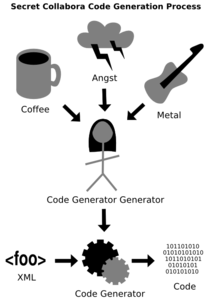
The secret Collabora code-generation process

(credit: daf)

Supporting D-Bus in the GObject world has always involved quite a lot of code generation. The core API of dbus-glib is heavily reliant on varargs functions, which aren't type-safe and are easy to get wrong. dbus-glib contains a program called dbus-binding-tool, which is meant to generate reasonably sane GObject APIs for D-Bus objects. Unfortunately, it seems to be intended to generate a whole GObject at a time. Early versions of telepathy-gabble used dbus-binding-tool plus a script called gengobject.py to generate API stubs for the exported objects; developers then filled in the blanks, and hey presto, we had a GObject on D-Bus. This was fine up to a point, but had a couple of major drawbacks. Whenever we changed the D-Bus API (quite common during the early development of Telepathy), there was a very laborious and error-prone merging process. We ended up with the following process:
  • copy the D-Bus introspection XML from the telepathy-spec repository into a directory xml/pristine (actually, the canonical form for the spec was Python for a while, and we had a script that exported a contrived object onto D-Bus and introspected itself to get the XML - but that's another story!)
  • preprocess the introspection XML to add the dbus-glib CFunctionName annotation, resulting in a directory xml/modified
  • run dbus-binding-tool and a Python script gengobject.py to generate C source in xml/src
  • three-way-diff the old version of xml/src, the new version of xml/src, and the real C code in src to create a new version of src
  • pray that the diff process hadn't randomly exchanged functions' implementations
  • update the resulting code in src so it worked
  • check the whole mess back into darcs
  • hope that nobody else had made changes that would result in darcs conflicts
If you haven't yet gathered, this was a bit of a nightmare. Also, it was very easy to return the wrong thing from a method without noticing - because all the APIs were varargs, the compiler didn't notice, and the first we'd know about it was a mysterious segfault under certain circumstances.
How telepathy-glib fixes code generation telepathy-glib improves on this by taking advantage of this innocuous-looking feature in dbus-glib:
commit 355ef78d98d6fc65715845d56232199162cab12a
Author: Steve Fr cinaux <steve istique net>
Date:   Thu Aug 17 11:48:20 2006 +0200
    Interface support for bindings.
Instead of running dbus-binding-tool or creating GObjects with D-Bus interfaces, we put the entire Telepathy spec through glib-ginterface-gen.py, a distant descendant of Gabble's gengobject.py. For each interface in the spec, we generate a GInterface that mirrors the D-Bus interface. Any GObject that implements the GInterface automatically gets the D-Bus interface if it's exported onto D-Bus. There are a few non-obvious refinements, though:
  • The signature of the method implementation is always in the mode that dbus-glib calls "asynchronous", where the method implementation can either send a reply message before or after it returns. For "slow" methods, this is the only thing you can do. For instance, many Telepathy D-Bus methods can't return anything until some TCP round-trips to the server have happened. This is also the only thing you can do if you want to extract extra information, like the sender's unique name, from the method-call message (dbus-glib's "synchronous" API doesn't allow this to be done). For "fast" methods, sending a reply message before returning is just as easy as using the "synchronous" API (it's just a difference of syntax), and has an API consistent with that of the "slow" methods, making it easier for service authors.

  • The layout of the GInterface vtable is private, and (auto-generated) accessor functions are used to fill in implementations. This means our ABI doesn't change just because we re-ordered functions in the spec.

  • If no implementation is provided for a method, we just raise an appropriate error (org.freedesktop.Telepathy.Errors.NotImplemented), rather than suffering an assertion failure. This means we can safely add methods to an interface.

  • While we're generating code anyway, we generate some static inline wrapper functions which wrap dbus_g_method_return(), to have type-safe method returns. You can easily check that a method replies with correct types, by checking that the implementation of Foo() replies by calling tp_svc_some_interface_return_from_foo().

  • Similarly, we generate wrapper functions to emit signals, to get type-safe signal emission.

Not all interfaces are stable enough to be included in telepathy-glib's stable API and ABI, so some of our other projects include a copy of the telepathy-glib code-generation tools, and generate their own "mini-telepathy-glib" (traditionally in a /extensions/ directory) for their implementation-specific (drafts of) interfaces. This isn't yet as polished as it ought to be (mainly because we don't want to freeze the augmented-introspection-XML format that we write the Telepathy spec in, because it's rather ad-hoc and hackish in places) but it works quite well in practice. To see what this looks like in practice, have a look at the examples in telepathy-glib, or at a Telepathy connection manager like telepathy-gabble.
Mixins and base classes Another feature of telepathy-glib which makes life easier for connection manager authors is that it provides "mixins" and base classes which implement some of the GInterfaces. There's absolutely nothing magic about the base classes - they don't have any access to private implementation details of the GInterfaces, they just implement them like everyone else does. The "mixins" are only slightly more magical - they store some extra state inside the structures representing GObjects and their classes, and use it to provide default implementations of some or all of the methods on a particular interface (or two interfaces, in the case of the new TpMessageMixin). I'll leave it up to Rob to explain those in greater detail, since I seem to remember that he invented them :-P The examples and regression tests in telepathy-glib are quite good examples of how these work in practice.

Sylvain Le Gall: OCaml meeting 2008 participants

Unfortunately I forget to post the last year participant pictures. Here is the official picture. Thanks to R.W.M Jones for reminding me.

8 November 2008

Joerg Jaspert: Debian mirror scripts

With a small mail to our mirrors-announce list, I just opened the work of more than one month to the public. Even better, I strongly encourage every mirror admin to use my scripts, or at least scripts that follow a minimal set of rules I wrote down… Some long time (somewhere in April or May this year) I got added to the Debian mirroradm group. First it was only to get some problems with packages.debian.org solved, but later on I started doing more. This group is basically the one that handles the archvsync user on .debian.org machines and also manages the official Debian mirrors listing. As the archvsync user exists on multiple .debian.org machines, and many of them do mirror a copy of our archive for various reasons, all of them had some version of a mirroring script, and sometimes also a version of a pushmirror script. Unfortunately, as they all had been maintained mostly on their own per machine - they sometimes had evolved a bit different. Additionally all of them had a few problems which could leave us with a broken mirror behind, despite it looking all well. So on Sept. 26 I decided to trash it all and rewrite the script and put it all in a VCS (and selected git). For that I set myself a few goals, like (in no particular order) Now, 109 commits and more than a month later, I was finally able to open the scripts to the wide public. (Had multiple people test them before this, but thats always different than a real “release”). The scripts are in use on all .debian.org machines and some other mirrors already, so I’m fairly sure they work.
As I already wrote, Debian mirror admins are strongly encouraged to use this scriptset and not to invent their own. In case you miss a feature either send me a mail describing it, or better, a patch implementing it. I’m happy to implement as much as possible (and sensible :) ) And while it is discouraged to use own scripts, sometimes people have reasons to have their own, so there is now a minimal set of functionality that such a script MUST support. All of those requirements are easy to fulfill. Well, at least the MUST ones. The first one is basically a given, all scripts I know are doing this already. The second one sounds more complicated, but actually might just be about 4 lines of actual code changes. Just touch an extra file before you gain a lockfile (to avoid two scripts running at the same time) and then rerun rsync as long as that extra file is around. (It helps to rm this trigger file right before you call rsync :) ). The should directive is actually a little more work to implement correctly. I won’t show source here, read the ftpsync script if you want to see it, but I try some small explanation. Background: Debian mirror synchronisation is usually done by scripts that get started via ssh. As mirror operators (understandably) do not like their upstream mirror to be able to login, this is done using “ssh triggers”, a feature I wrote about earlier. Those are sshkeys using a forced command, so nothing else than this command will be run, ever. SSH, if used with such forced commands, has the helpful feature that it sets the environment variable SSH_ORIGINAL_COMMAND containing the original arguments. Which means that, if the mirror pushes you with “ssh yourhost -l mirror sleep 1” you will see *sleep 1 in that variable. It is what many mirror operators currently use when pushing their downstreams. Now, we can use that to tell the receiving end all things we want it to know. If you look in my script you will see that I defined a little more than the minimal arguments. But none of the additional ones are a requirement, they only make life much easier. My script currently understands, additional to the 3 minimal ones:
As if that wasn’t enough, I also had to rewrite the runmirrors script. The old 10-line one just didn’t cope with the more general approach. This script is used to “push” your downstream mirrors, telling them that they need to update. (Which is the only sane way to run a mirror. cron is just not made for mirrors that can update at random times!). One nice new feature of it is the ability to update multiple mirrors nearly at the same time. This is extremely helpful in case of DNS Round Robin entries like security.debian.org (multiple hosts offering the same archive under one hostname). You do not want to have such hosts out of sync. Not even for a minute, if you can avoid that. So we now push the mirrors with sync:stage1 as argument. Then we wait until all of them have finished the stage1 sync before we push them all again, this time with sync:stage2 as argument. This will erase any update delays thanks to network latency / low bandwidth one of the security mirrors might have, as the large transfers (all the binary and source packages) are done in stage1. They can take time, a normal user won’t notice it - the Package and Source indices are not transferred yet. They arevery small and as such transfered pretty fast whenever stage1 is done everywhere and we tell mirrors to do stage2.
All in all it was a pretty nice exercise writing those scripts. Comments: 0

7 November 2008

Ian Wienand: Spot the bug!

See if you can spot the bug in this code!
#include <stdio.h>
#include <stdlib.h>
int main(void)
 
	union  
		unsigned char raw[8];
		struct  
			char one;
			int two;
			char three;
			char four;
			char five;
		  formatted __attribute__((packed));
	  test;
	printf("one   : %d\n", (int)&test.formatted.one - (int)&test);
	printf("two   : %d\n", (int)&test.formatted.two - (int)&test);
	printf("three : %d\n", (int)&test.formatted.three - (int)&test);
	printf("four  : %d\n", (int)&test.formatted.four - (int)&test);
	printf("five  : %d\n", (int)&test.formatted.five - (int)&test);
	return 0;
 
$ gcc -Wall  -o packing packing.c
$ ./packing
one   : 0
two   : 4
three : 8
four  : 9
five  : 10
Here's the relevant bit from the gcc manual:
For an enum, struct or union type, you may specify attributes either between the enum, struct or union tag and the name of the type, or just past the closing curly brace of the definition. The former syntax is preferred.
By getting the packed attribute in the wrong place (if it's not clear, it should be before formatted), it is applied to the variable rather than the type. The compiler (both gcc and icc do this) has already laid out the structure, so misses the packing directive, and unfortunately doesn't warn (that may be a bug?). I can tell you from experience this can be hard to track down!

6 November 2008

Pablo Lorenzzoni: Bash prompts: the essential

Bash is probably the most common command-line shell in the GNU/Linux world. Although a lot of people use alternate shells (such as Zsh), Bash is still shipped with most mainstream distros as the default. Once you have a lot of different remote machines, all running Bash as the shell, it becomes increasingly difficult to pay attention to the prompt, and typing reboot in a machine different from the one you wanted becomes more likely. I deal with that problem by changing Bash prompts First of all, the basics: Bash prompts are just environment variables with special characters you can set and export. Bash has four of these variables: PS1 to PS4, but usually only the first two matters (actually, just PS1 for a reference on the others, check the manpage). The most common PS1 string is:

spectra@home:~$ echo $PS1
\u@\h:\w\$
spectra@home:~$
This has 4 special characters, escaped with a backslash: \u informing us the username; \h informing us the hostname; \w, informing us the working directory; and \$, which gives us the $ in the end of the prompt (more on this later). So, essentially, one can change that string to anything else

spectra@home:~$ PS1="my_shell_prompt\$ " 
my_shell_prompt$
Pretty easy. You can check a complete reference of the special characters at the section PROMPTING of bash manpage, but the most useful IMHO are the following: Also, as part of the prompt string, one can use ANSI Colors enclosed as non-printing characters (that is between \[ and \]). ANSI sequences always begin with an ESC[ and end with an m . (Yes Really arbitrary but that s the way it is ). ESC can be represented as \e Here is a list of the most common colors in ANSI sequences: Now, notice that there are two numbers separated by a semi-colon the first is always 0 (zero) in the colors I pointed above, but it actually refers to an ANSI attribute called Select Graphic Rendition You can use 0 (zero) to normal colors, 1 for bold, 2 to faint, etc. So \e[0;30m refers to BLACK, \e[1;30m refers to DARK GREY. The Wikipedia has a good article on these escape sequences. Once you re satisfied with something printed in a color, to go back to the default (to reset), you issue the \e[0m escape sequence. So, back to my problem Each different machine gets a different color for the hostname. On hospital machine, for instance, my PS1 looks like:

spectra@hospital:~$ PS1="\[\e[1;33m\]\u\[\e[0m\]@\[\e[0;35m\]\h\[\e[0m\]:\[\e[0;32m\]\w\[\e[0m\]\$ " 
spectra@hospital:~$
With \e[0;35m (Purple) for the hostname. On home machine, it may be \e[0;34m (Blue)... On server , it may be \e[0;36m (Cyan), and so on After a while, you get used to the color and end up linking the color to the machine so that typing reboot on a machine with the wrong color gets harder than before. To make the changes permanent, put export PS1 in one of the config script of bash (.bashrc, .bash_profile, etc). On some systems, /etc/environment holds lots of environment variables definitions. I just scratched the surface That s just what works for me The Bash-Prompt-HOWTO has some interesting examples, and I actually have a friend who uses more esoterical stuff, such as fancybash or bashish, but I ll leave this up to you

Eddy Petri&#537;or: Coordinating localization via git

Note: this is quite long and might not be interesting for people not involved with /in either of: debian i18n, debian l10n, git, shell scripting.


For some time now I have been the de-facto coordinator of the Romanian localization team. During this time I was faced multiple times with problems related to motivation of the team members, setting goals for a release, coordination of the changes inside the team, integration of new translators in the team, loosing team members, my lack of time on some occasions and other problems.

I thought a lot about how to improve on those points and I was never satisfied with the answers I got. What I think was the worst problem in the team was the inability to set clear goals, especially during lenny's development cycle.

During sarge's and etch's development cycles we were in an infancy state and setting as the goal to have a fully translated installation process was really enough to keep people motivated. For sarge we missed by a small margin, but the translations were of poor quality, while for etch we worked more on improving the translations.


But during lenny it was bad, really bad. My free time had been shrinking for a while, starting with etch's release, and we were unable to set clear goal, since for etch we managed to have the installation process fully translated and a few other translations. There was no way for us to reach 100% translations during lenny's development cycle, so setting that as a goal was really unrealistic. Percents by themselves don't mean anything for people, and as long as there's no substance to those numbers, there's no motivation to reach for one arbitrary percent.

I tried to set as a goal translating the packages installed by default in a new installation, but that hit the eternal question How do we know easily which are those packages?. This remained sometimes unanswered or got an unsatisfying answer. Also, there was a goal to have correct diacritics for Romanian in lenny, to have aspell-ro that uses the correct diacritics.

I even got to a point that I, myself, lost my motivation and set myself a personal goal of overrunning the level the translations that the language just above Romanian had in the po-debconf l10n statistics (ranking between languages). This was nice way for me to keep myself motivated, but I had my reserves in making this motivation public out of fear of being misinterpreted, because, by a strange coincidence, that next language was Hungarian, and in Romania's history there was some friction between Hungaria and Romania, while there are still some tensions with the Hungarian minority in Romania, in areas where they represent the local majority.

I managed to reach my personal goal, but this wasn't addressing the big picture.


So, sometime around the start of this year I started thinking about ways to coordinate the Romanian localization team in order to have:
For short, a tool that would allow the team to work more efficiently while having the possibility to set clear goals in order to keep people motivated.


So after some pondering, I thought that creating a repository with the translations and the helper tools that would do the funky sync, checks, stats would be the best way to do that. So I started hacking on that somewhere around July-August and I published the result, but without much publicity, since it is still incomplete.

Some of the technical details are still in a haze, but I have a general idea and I got some basic functionality.


Today I decided that I should announce this semi-officially though my blog, maybe I get some input, ideas, or even contributions (I really should write a TODO).


I give you the Debian L10n Romanian coordination repository.

This is a git repository that has some tools to facilitate translation coordination and the translations that are current in the distro for the team.


Can be cloned with:

git clone git://git.debian.org/git/users/eddyp-guest/debian-ro-repo.git

or, if you're behind a restrictive firewall:

git clone http://git.debian.org/git/users/eddyp-guest/debian-ro-repo.git


Currently the work flow for updating a translation is as follows:
  1. source _bin/polibs (. _bin/polibs)
  2. cd foo
  3. po_refresh
  4. complete the translation
  5. po_rearrange "ro.po"
  6. git add "ro.po" && git commit -m "updated translation for foo"
  7. send the translation ("git format-patch origin" and send the patches by mail, or, alternatively, just "git push")


Features:
Planned features:

Problems:

I was hoping that the release notes for lenny would facilitate from this infrastructure, but unfortunately I was lately in a really inactive period wrt Debian.


Questions, suggestions, ideas are welcome.

Russell Coker: EC2 and IP Addresses

One of the exciting things about having a cloud computing service is how to talk to the rest of the world. It’s all very well to have a varying number of machines in various locations, but you need constant DNS names at least (and sometimes constant IP addresses) to do most useful things. I have previously described how to start an EC2 instance and login to it - which includes discovering it’s IP address [1]. It would not be difficult (in theory at least) to use nsupdate to change DNS records after an instance is started or terminated. One problem is that there is no way of knowing when an instance is undesirably terminated (IE killed by hardware failure) apart from polling ec2-describe-instances so it seems impossible to remove a DNS name before some other EC2 customer gets a dynamic IP address. So it seems that in most cases you will want a constant IP address (which Amazon calls an Elastic IP address) if you care about this possibility. For the case of an orderly shutdown you could have a script remove the DNS record, wait for the timeout period specified by the DNS server (so that all correctly operating DNS caches have purged the record) and then terminate the instance. One thing that interests me is the possibility of running front-end mail servers on EC2. Mail servers that receive mail from the net can take significant amounts of CPU time and RAM for spam and virus filters. Instead of having the expense of running enough MX servers to sustain the highest possible load even while one of the servers has experienced a hardware failure there is a possibility of running an extra EC2 instance at peak times with the possibility of running a large instance for a peak time when one of the dedicated servers has experienced a problem. The idea of having a mail server die and have someone else’s server take the IP address and receive the mail is too horrible to contemplate, so an Elastic IP address is required. It is quite OK to have a set of mail servers of which not all servers run all the time (this is why the MX record was introduced to the DNS) so having a server run periodically at periods of high load (one of the benefits of the EC2 service) will not require changes to the DNS. I think it’s reasonably important to minimise the amount of changes to the DNS due to the possibility of accidentally breaking it (which is a real catastrophe) and the possibility of servers caching DNS data for longer than they should. The alternative is to change the MX record to not point to the hostname of the server when the instance is terminated. I will be interested to read comments on this issue. The command ec2-allocate-address will allocate a public IP address for your use. Once the address is allocated it will cost $0.01 per hour whenever it is unused. There are also commands ec2-describe-addresses (to list all addresses allocated to you), ec2-release-address (to release an allocated address), ec2-associate-address to associate an IP address with a running instance, and ec2-disassociate-address to remove such an association. The command “ec2-associate-address -i INSTANCE ADDRESS” will associate an IP address with the specified instance (replace INSTANCE with the instance ID - a code starting with “i-” that is returned from ec2-describe-instances. The command “ec2-describe-instances grep ^INSTANCE cut -f2” will give you a list of all instance IDs in use - this is handy if your use of EC2 involves only one active instance at a time (all the EC2 API commands give output in tab-separated lists and can be easily manipulated with grep and cut). Associating an IP address with an instance is documented as taking several minutes, while Amazon provides no guarantees or precise figures as to how long the various operations take it seems that assigning an IP address is one of the slower operations. I expect that is due to the requirement for reconfiguring a firewall device (which services dozens or maybe hundreds of nodes) while creating or terminating an instance is an operation that is limited in scope to a single Xen host. One result that I didn’t expect was that associating an elastic address is that the original address that was assigned to the instance is removed. I had a ssh connection open to an instance when I assigned an elastic address and my connection was broken. It makes sense to remove addresses that aren’t needed (IPv4 addresses are a precious commodity) and further reading of the documentation revealed that this is the documented behavior. One thing I have not yet investigated is whether assigning an IP address from one instance to another is atomic. Taking a few minutes to assign an IP address is usually no big deal, but having an IP address be unusable for a few minutes while in the process of transitioning between servers would be quite inconvenient. It seems that a reasonably common desire would be to have a small instance running and to then transition the IP address to a large (or high-CPU) instance if the load gets high, having this happen without the users noticing would be a good thing.

Josselin Mouette: Security by incompetence

Hey Romain, you d be impressed by the number of upstreams whose knowledge of security measures is similarly close to the absolute zero. Since bad guys are always digging through commits for suspicious things, hiding the relevant commits is the best thing you can do to help them. Given things like this exist, It s likely that they have even automated tools to do this search for them. This way, distributors and security engineers have to do the same job, hoping to never miss a change that was actually a security fix. Unfortunately, two small scale projects that we happen to use have exactly the policy Romain described regarding security updates. I m amazed by the fantastic job the distributions security teams manage to achieve in these conditions.

5 November 2008

Decklin Foster: Hello America, I missed you

As we walked back toward Mass Ave to catch the bus last night, fresh from the euphoria of my friend Josef's election-night party, I thought about how fortunate we are to be here, now. We cheered, we screamed, we sang the national anthem at the top of our lungs, popped champagne, and danced. I'm on some stranger's facebook somewhere, at the edge of a crowd of people smiling for what felt like the first time in years. I knew I'd remember, but I wanted to write something down. I'd been following along on Twitter all night, but I didn't know what to say when the good news finally came. I thought about our friends in California, where Prop 8 looked like it was going to win. Despite how far we've come, it's likely three states are about to write discrimination into their laws or constitutions rather than out of them. So I picked up my phone and just typed in, "charged." Everyone was excited, yes. I haven't felt electrified by the possibility of change like that in a very long time. But we also haven't automatically won change by changing our leaders. We have won a responsibility to make that change happen. "Yes we did", we joked to each other, and I emailed to my parents in the morning. But no one actually meant, "yes we can win an election". That's just the starting line. Now, we are charged with making America better. We are charged with protecting the liberties of everyone. I wanted to remember that too. That's why it matters that we won. Eight years from now, this could be a nation where the whole idea of "banning gay marriage" sounds as antiquated and offensive as segregated schools or not letting women vote. We have the ability to change our culture, nothing more. Mandates don't do that; people do. And yes, we can.

4 November 2008

Russell Coker: Basics of EC2

I have previously written about my work packaging the tools to manage Amazon EC2 [1]. First you need to login and create a certificate (you can upload your own certificate - but this is probably only beneficial if you have two EC2 accounts and want to use the same certificate for both). Download the X509 private key file (named pk-X.pem) and the public key (named cert-X.pem). My Debian package of the EC2 API tools will look for the key files in the ~/.ec2 and /etc/ec2 directories and will take the first one it finds by default. To override the certificate (when using my Debian package) or to just have it work when using the code without my package you set the variables EC2_PRIVATE_KEY and EC2_CERT. This Amazon page describes some of the basics of setting up the client software and RSA keys [2]. I will describe some of the most important things now: The command “ec2-add-keypair gsg-keypair > id_rsa-gsg-keypair” creates a new keypair for logging in to an EC2 instance. The public key goes to amazon and the private key can be used by any ssh client to login as root when you creat an instance. To create an instance with that key you use the “-k gsg-keypair” option, so it seems a requirement to use the same working directory for creating all instances. Note that gsg-keypair could be replaced by any other string, if you are doing something really serious with EC2 you might use one account to create instances that are run by different people with different keys. But for most people I think that a single key is all that is required. Strangely they don’t provide a way of getting access to the public key, you have to create an instance and then copy the /root/.ssh/authorized_keys file for that. This Amazon page describes how to set up sample images [3]. The first thing it describes is the command ec2-describe-images -o self -o amazon which gives a list of all images owned by yourself and all public images owned by Amazon. It’s fairly clear that Amazon doesn’t expect you to use their images. The i386 OS images that they have available are Fedora Core 4 (four configurations with two versions of each) and Fedora 8 (a single configuration with two versions) as well as three other demo images that don’t indicate the version. The AMD64 OS images that they have available are Fedora Core 6 and Fedora Core 8. Obviously if they wanted customers to use their own images (which seems like a really good idea to me) they would provide images of CentOS (or one of the other recompiles of RHEL) and Debian. I have written about why I think that this is a bad idea for security [4], please make sure that you don’t use the ancient Amazon images for anything other than testing! To test choose an i386 image from Amazon’s list, i386 is best for testing because it allows the cheapest instances (currently $0.10 per hour). Before launching an instance allow ssh access to it with the command “ec2-authorize default -p 22“. Note that this command permits access for the entire world. There are options to limit access to certain IP address ranges, but at this stage it’s best to focus on getting something working. Of course you don’t want to actually use your first attempt at creating an instance, I think that setting up an instance to run in a secure and reliable manner would require many attempts and tests. As all the storage of the instance is wiped when it terminates (as we aren’t using S3 yet) and you won’t have any secret data online security doesn’t need to be the highest priority. A sample command to run an instance is “ec2-run-instances ami-2b5fba42 -k gsg-keypair” where ami-2b5fba42 is a public Fedora 8 image available at this moment. This will give output similar to the following: RESERVATION r-281fc441 999999999999 default
INSTANCE i-0c999999 ami-2b5fba42 pending gsg-keypair 0 m1.small 2008-11-04T06:03:09+0000 us-east-1c aki-a71cf9ce ari-a51cf9cc The parameter after the word INSTANCE is the serial number of the instance. The command “ec2-describe-instances i-0c999999” will provide information on the instance, once it is running (which may be a few minutes after you request it) you will see output such as the following: RESERVATION r-281fc441 999999999999 default
INSTANCE i-0c999999 ami-2b5fba42 ec2-10-11-12-13.compute-1.amazonaws.com domU-12-34-56-78-9a-bc.compute-1.internal running gsg-keypair 0 m1.small 2008-11-04T06:03:09+0000 us-east-1c aki-a71cf9ce ari-a51cf9cc The command “ssh -i id_rsa-gsg-keypair root@ec2-10-11-12-13.compute-1.amazonaws.com” will then grant you root access. The part of the name such as 10-11-12-13 is the public IP address. Naturally you won’t see 10.11.12.13, it will instead be public addresses in the Amazon range - I replaced the addresses to avoid driving bots to their site. The name domU-12-34-56-78-9a-bc.compute-1.internal is listed in Amazon’s internal DNS and returns the private IP address (in the 10.0.0.0/8 range) which is used for the instance. The instance has no public IP address, all connections (both inbound and outbound) run through some sort of NAT. This shouldn’t be a problem for HTTP, SMTP, and most protocols that are suitable for running on such a service. But for FTP or UDP based services it might be a problem. The part of the name such as12-34-56-78-9a-bc is the MAC address of the eth0 device. To halt a service you can run shutdown or halt as root in the instance, or run the ec2-terminate-instances command and give it the instance ID that you want to terminate. It seems to me that the best way of terminating an instance would be to run a script that produces a summary of whatver the instance did (you might not want to preserve all the log data, but some summary information would be useful), and give all operations that are in progress time to stop before running halt. A script could run on the management system to launch such an orderly shutdown script on the instance and then uses ec2-terminate-instances if the instance does not terminate quickly enough. In the near future I will document many aspects of using EC2. This will include dynamic configuration of the host, dynamic DNS, and S3 storage among other things.

3 November 2008

Isaac Clerencia: Not again

Every Democrat was pretty sure Al Gore was going to win in 2000. Most polls said John Kerry was going to win in 2004. And yet both times they managed to snatch defeat from the jaws of victory. Just remember how you felt then and try your best so it doesn’t happen again. There is so much at stake … the US and the world can’t afford 4 more years of a Republican US President. Even if the GOP seems to be defeated, shattered and panicking, Republican voters always end up voting for their guy on election day, while Democrats have great problems closing the deal. It has to be different this time. We need Obama to win tomorrow, and we need him to win big. And a Democratic wave to get a filibuster-proof Senate majority and a comfortable victory in the House of Representatives, so they can enact a progressive agenda in the upcoming years and restore some of the damage from the last two Bush terms. We also need a solid ‘no’ to Proposition 8 in California and similar ones in other states, so no excuse to stay at your place just because you are in one of the bluest states. I would like to ask you to do your best tomorrow, but probably Larry Lessig does a better job at it. Once we are past this, the hard work starts, trying to hold every elected representative accountable, draft better candidates for future elections, spot DINOs, …, but for now, let’s focus on tomorrow. I am hoping for the best, and I wish I could do more about it, but it’s up to you Americans. Do the right thing and leave everything on the road, you don’t want to regret it tomorrow.

2 November 2008

Clint Adams: Third-party affirmative action

I have no good reason to participate in a system I believe to be so flawed it should be replaced entirely. However, I am still going to vote, and since people have already threatened to pay me to vote for Obama, I have concocted this little solicitation scheme to justify my trip to the polls. I don't believe in the free market any more than I believe in the crap that is Keynesianism, so the following offsets will be subtracted from the final totals.
$0.00 Barr / Root
$0.00 Calero / Kennedy
$0.00 La Riva / Puryear
$0.00 McKinney / Clemente
$0.00 Nader / Gonzalez
$0.01 Obama / Biden
$1,000,001 McCain / Palin
Bribes will be kept anonymous, and should there be an inquest, I will deny all of this. Everything must be prepaid to count. Should there be any ties after the adjustments, decisions will be made through a game of mumblety-peg with an effeminate Texan. Whining and FUD about how not voting for one of the two mainstream parties causes simultaneously global warming and the heat death of the universe will be met with the skepticism appropriate for the PR drivel paid for by those two parties. If you want something inspirational instead, read John Goerzen.

Next.

Previous.