Joerg Jaspert: Debian NEW Queue, Rust packaging
Debian NEW Queue
So for some reason I got myself motivated again to deal with some
packages in Debians NEW Queue.
We had 420 source packages waiting for some kind of processing when I
started, now we are down to something around
10. (Silly, people keep
uploading stuff )
That s not entirely my own work, others from the team have been active
too, but for those few days I went through a lot of stuff waiting. And
must say it still feels mostly like it did when I somehow stopped
doing much in NEW.
Except - well, I feel that maintainers are much better in preparing
their packages, especially that dreaded task of getting the copyright
file written seems to be one that is handled much better. Now, thats
not supported by any real numbers, just a feeling, but a good one, I
think.
Rust
Dealing with NEW meant I got in contact with one part that currently
generates some friction between the FTP Team and one group of package
maintainers - the Rust team.
Note: this is, of course, entirely written from my point of view.
Though with the intention of presenting it as objective as possible.
Also, I know what rust is, and have tried a Hello world in it, but
that s about my deep knowledge of it
The problem
Libraries in rust are bundled/shipped/whatever in something called
crates, and you manage what your stuff needs and provides with a tool
called cargo.
A library (one per crate) can provide multiple features, say a TLS lib
can link against gnutls or openssl or some other random
implementation. Such features may even be combinable in various
different ways, so one can have a high number of possible feature
combinations for one crate.
There is a tool called debcargo which helps creating a
Debian package out of a crate. And that tool generates so-called
feature-packages, one per feature / combination thereof.
Those feature packages are empty packages, only containing a symlink
for their /usr/share/doc/ directory, so their size is smaller
than the metadata they will produce. Inside the archive and the files
generated by it, stuff that every user everywhere has to download
and their apt has to process. Additionally, any change of those feature
sets means one round through NEW, which is also not ideal.
So, naturally, the FTP Team dislikes those empty feature packages.
Really, a lot.
There appears to be a different way. Not having the feature packages,
but putting all the combinations into a Provides header. That
sometimes works, but has two problems:
- It can generate really long Provides: lines. I mean, REALLY
REALLY REALLY long. Somewhat around 250kb is the current
record. Thats long enough that a tool (not dak itself) broke on it.
Sure, that tool needs to be fixed, but still, that s not nice.
Currently preferred from us, though.
- Some of the features may need different dependencies (say, gnutls
vs openssl), should those conflict with each other, you can not
combine them into one package.
Solutions
Currently we do not have a good one. The rust maintainers and the ftp
team are talking, exploring various ideas, we will see what will come
out.
Devel archive / Component
One of the possible solutions for the feature package problem would be
something that another set of packages could also make good use of, I
think. The introduction of a new archive or component, meant only for
packages that are needed to build something, but where users are
discouraged from ever using them.
What?
Well, take golang as an example. While we have a load of
golang-something packages in Debian, and they are used for building
applications written in go - none of those golang-something are meant
to be installed by users. If you use the language and develop in it,
the go get way is the one you are expected to use.
So having an archive (or maybe component like main or contrib) that,
by default, won t be activated for users, but only for things like
buildds or archive rebuilds, will make one problem (hated metadata
bloat) be evaluated wildly different.
It may also allow a more relaxed processing of binary-NEW (easier
additions of new feature packages).
But but but
Yes, it is not the most perfect solution. Without taking much energy
to think about, it requires
- an adjustment in how main is handled. Right now we have the golden
rule that main is self contained, that is, things in it may not
need anything outside it for building or running. That would need
to be adjusted for building. (Go as well as currently rust are
always building static binaries, so no library dependencies there).
- It would need handling for the release, that is, the release team
would need to deal with that archive/component too. We haven t,
yet, talked to them (still, slowly, discussing inside FTP Team).
So, no idea how many rusty knives they want to sink into our nice
bodies for that idea
Final
Well, it is still very much open. Had an IRC meeting with the rust
people, will have another end of November, it will slowly go forward.
And maybe someone comes up with an entire new idea that we all love.
Don t know, time will tell.
- an adjustment in how main is handled. Right now we have the golden rule that main is self contained, that is, things in it may not need anything outside it for building or running. That would need to be adjusted for building. (Go as well as currently rust are always building static binaries, so no library dependencies there).
- It would need handling for the release, that is, the release team would need to deal with that archive/component too. We haven t, yet, talked to them (still, slowly, discussing inside FTP Team). So, no idea how many rusty knives they want to sink into our nice bodies for that idea
 So here's an interesting thing. Certain commit hashes
are rapidly heading toward being


 A new
 The KDE Bugzilla handles a lot of projects and they often match with the repo name, but not always.
For instance we have ancient products and components at Bugzilla, as projects have a lifecycle from playground into Release Service, or Frameworks, sometimes with a change of name.
So you may end up searching Bugzilla quite awhile for the correct product and component to be able to confirm or create bug reports against an application.
Let's have a look at
 Back in 2017 I announced that the


 I'm playing more computer games recently.
Splatoon2, Ring Fit Adventure, Fit Boxing, and NieR Automata.
 Here is my monthly update covering what I have been doing in the free software world during October 2020 (

 Another month, another bunch of uploads. The freeze for Debian 11 (bullseye) is edging closer, so I ve been trying to get my package list in better shape ahead of that. Thanks to those who worked on fixing lintian.debian.org and the lintian reports on the QA pages, those are immensely useful and it s great to have that back!
2020-10-04: Upload package gnome-shell-extension-draw-on-your-screen (8-1) to Debian unstable.
2020-10-05: Sponsor package flask-restful (0.3.8-4) for Debian unstable (Python Team request).
2020-10-05: Sponsor package python-potr (1.0.2-3) for Debian unstable (Python Team request).
2020-10-06: Sponsor package python-pyld (2.0.3-1) for Debian unstable (Python Team request).
2020-10-06: Sponsor package flask-openid (1.2.5+dfsg-4) for Debian unstable (Python Team request).
2020-10-06: Sponsor package qosmic (1.6.0-4) for Debian unstable (E-mail request).
2020-10-07: File removal for gnome-shell-extension-workspace-to-dock (RC Buggy, no longer maintained:
 I frequently see a pattern in image build/refresh scripts where a set of packages is installed, and then all packages are updated:

 We all know these situations when we receive an email asking Can you
check the design of X, I need a reply by tonight. Or an instant
message: My website went down, can you check? Another email: I
canceled a plan at the hosting company, can you restore my website as
fast as possible? A phone call: The TLS certificate didn t get
updated, and now we can t access service Y. Yet another email: Our
super important medical advice website is suddenly being censored in
country Z, can you help?
Everyone knows those messages that have URGENT in capital letters in
the email subject. It might be that some of them really are urgent.
Others are the written signs of someone having a hard time properly
planning their own work and passing their delays on to someone who comes
later in the creation or production chain. And others again come from
people who are overworked and try to delegate some of their tasks to a
friendly soul who is likely to help.
 So we found ourselves in the need to delete a considerable amount of files (around 500000, amounting to 1.6T) from an S3 bucket. With the list of files in hand my first shot was calling
 Show

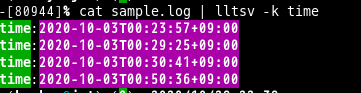
 Original version of lltsv doesn't specify background color, so it is hard to recognize texts in dark background.
I've fixed this issue by specifying background color explicitly.
Here is the screenshot of fixed version. Yay!