Search Results: "ed"

19 September 2020

Jelmer Vernooij: Debian Janitor: Expanding Into Improving Multi-Arch

The Debian Janitor is an automated system that commits fixes for (minor) issues in Debian packages that can be fixed by software. It gradually started proposing merges in early December. The first set of changes sent out ran lintian-brush on sid packages maintained in Git. This post is part of a series about the progress of the Janitor. As of dpkg 1.16.2 and apt 0.8.13, Debian has full support for multi-arch. To quote from the multi-arch implementation page:

Multiarch lets you install library packages from multiple architectures on the same machine. This is useful in various ways, but the most common is installing both 64 and 32- bit software on the same machine and having dependencies correctly resolved automatically. In general you can have libraries of more than one architecture installed together and applications from one architecture or another installed as alternatives.
The Multi-Arch specification describes a new Multi-Arch header which can be used to indicate how to resolve cross-architecture dependencies. The existing Debian Multi-Arch hinter is a version of dedup.debian.net that compares binary packages between architectures and suggests fixes to resolve multi-arch problems. It provides hints as to what Multi- Arch fields can be set, allowing the packages to be safely installed in a Multi-Arch world. The full list of almost 10,000 hints generated by the hinter is available at https://dedup.debian.net/static/multiarch-hints.yaml. Recent versions of lintian-brush now include a command called apply-multiarch-hints that downloads and locally caches the hints and can apply them to a package maintained in Git. For example, to apply multi-arch hints to autosize.js:
 $ debcheckout autosize.js
 declared git repository at https://salsa.debian.org/js-team/autosize.js.git
 git clone https://salsa.debian.org/js-team/autosize.js.git autosize.js ...
 Cloning into 'autosize.js'...
 [...]
 $ cd autosize.js
 $ apply-multiarch-hints
 Downloading new version of multi-arch hints.
 libjs-autosize: Add Multi-Arch: foreign.
 node-autosize: Add Multi-Arch: foreign.
 $ git log -p
 commit 3f8d1db5af4a87e6ebb08f46ddf79f6adf4e95ae (HEAD -> master)
 Author: Jelmer Vernoo  <jelmer@debian.org>
 Date:   Fri Sep 18 23:37:14 2020 +0000
     Apply multi-arch hints.
     + libjs-autosize, node-autosize: Add Multi-Arch: foreign.
     Changes-By: apply-multiarch-hints
 diff --git a/debian/changelog b/debian/changelog
 index e7fa120..09af4a7 100644
 --- a/debian/changelog
 +++ b/debian/changelog
 @@ -1,3 +1,10 @@
 +autosize.js (4.0.2~dfsg1-5) UNRELEASED; urgency=medium
 +
 +  * Apply multi-arch hints.
 +    + libjs-autosize, node-autosize: Add Multi-Arch: foreign.
 +
 + -- Jelmer Vernoo  <jelmer@debian.org>  Fri, 18 Sep 2020 23:37:14 -0000
 +
  autosize.js (4.0.2~dfsg1-4) unstable; urgency=medium
    * Team upload
 diff --git a/debian/control b/debian/control
 index 01ca968..fbba1ae 100644
 --- a/debian/control
 +++ b/debian/control
 @@ -20,6 +20,7 @@ Architecture: all
  Depends: $ misc:Depends 
  Recommends: javascript-common
  Breaks: ruby-rails-assets-autosize (<< 4.0)
 +Multi-Arch: foreign
  Description: script to automatically adjust textarea height to fit text - NodeJS
   Autosize is a small, stand-alone script to automatically adjust textarea
   height to fit text. The autosize function accepts a single textarea element,
 @@ -32,6 +33,7 @@ Package: node-autosize
  Architecture: all
  Depends: $ misc:Depends 
   , nodejs
 +Multi-Arch: foreign
  Description: script to automatically adjust textarea height to fit text - Javascript
   Autosize is a small, stand-alone script to automatically adjust textarea
   height to fit text. The autosize function accepts a single textarea element,
The Debian Janitor also has a new multiarch-fixes suite that runs apply-multiarch-hints across packages in the archive and proposes merge requests. For example, you can see the merge request against autosize.js here.

For more information about the Janitor's lintian-fixes efforts, see the landing page.

18 September 2020

Daniel Lange: Fixing the Nextcloud menu to show more than eight application icons

I have been late to adopt an on-premise cloud solution as the security of Owncloud a few years ago wasn't so stellar (cf. my comment from 2013 in Encryption files ... for synchronization across the Internet). But the follow-up product Nextcloud has matured quite nicely and we use it for collaboration both in the company and in FLOSS related work at multiple nonprofit organizations. There is a very annoying "feature" in Nextcloud though that the designers think menu items for apps at the top need to be limited to eight or less to prevent information overload in the header. The whole item discussion is worth reading as it it an archetypical example of design prevalence vs. user choice. And of course designers think they are right. That's a feature of the trade.
And because they know better there is no user configurable option to extend that 8 items to may be 12 or so which would prevent the annoying overflow menu we are seeing with 10 applications in use: Screenshot of stock Nextcloud menu Luckily code can be changed and there are many comments floating around the Internet to change const minAppsDesktop = 8. In this case it is slightly complicated by the fact that the javascript code is distributed in compressed form (aka "minified") as core/js/dist/main.js and you probably don't want to build the whole beast locally to change one constant. Basically
const breakpoint_mobile_width = 1024;

const resizeMenu = () =>
const appList = $('#appmenu li')
const rightHeaderWidth = $('.header-right').outerWidth()
const headerWidth = $('header').outerWidth()
const usePercentualAppMenuLimit = 0.33
const minAppsDesktop = 8
let availableWidth = headerWidth - $('#nextcloud').outerWidth() - (rightHeaderWidth > 210 ? rightHeaderWidth : 210)
const isMobile = $(window).width() < breakpoint_mobile_width
if (!isMobile)
availableWidth = availableWidth * usePercentualAppMenuLimit

let appCount = Math.floor((availableWidth / $(appList).width()))
if (isMobile && appCount > minAppsDesktop)
appCount = minAppsDesktop

if (!isMobile && appCount < minAppsDesktop)
appCount = minAppsDesktop


// show at least 2 apps in the popover
if (appList.length - 1 - appCount >= 1)
appCount--


$('#more-apps a').removeClass('active')
let lastShownApp
for (let k = 0; k < appList.length - 1; k++)
const name = $(appList[k]).data('id')
if (k < appCount)
$(appList[k]).removeClass('hidden')
$('#apps li[data-id=' + name + ']').addClass('in-header')
lastShownApp = appList[k]
else
$(appList[k]).addClass('hidden')
$('#apps li[data-id=' + name + ']').removeClass('in-header')
// move active app to last position if it is active
if (appCount > 0 && $(appList[k]).children('a').hasClass('active'))
$(lastShownApp).addClass('hidden')
$('#apps li[data-id=' + $(lastShownApp).data('id') + ']').removeClass('in-header')
$(appList[k]).removeClass('hidden')
$('#apps li[data-id=' + name + ']').addClass('in-header')


// show/hide more apps icon
if ($('#apps li:not(.in-header)').length === 0)
$('#more-apps').hide()
$('#navigation').hide()
else
$('#more-apps').show()

gets compressed during build time to become part of one 15,000+ character line. The relevant portion reads:
var f=function() var e=s()("#appmenu li"),t=s()(".header-right").outerWidth(),n=s()("header").outerWidth()-s()("#nextcloud").outerWidth()-(t>210?t:210),i=s()(window).width()<1024;i (n*=.33);var r,o=Math.floor(n/s()(e).width());i&&o>8&&(o=8),!i&&o<8&&(o=8),e.length-1-o>=1&&o--,s()("#more-apps a").removeClass("active");for(var a=0;a<e.length-1;a++) var l=s()(e[a]).data("id");a<o?(s()(e[a]).removeClass("hidden"),s()("#apps li[data-id="+l+"]").addClass("in-header"),r=e[a]):(s()(e[a]).addClass("hidden"),s()("#apps li[data-id="+l+"]").removeClass("in-header"),o>0&&s()(e[a]).children("a").hasClass("active")&&(s()(r).addClass("hidden"),s()("#apps li[data-id="+s()(r).data("id")+"]").removeClass("in-header"),s()(e[a]).removeClass("hidden"),s()("#apps li[data-id="+l+"]").addClass("in-header"))) 0===s()("#apps li:not(.in-header)").length?(s()("#more-apps").hide(),s()("#navigation").hide()):s()("#more-apps").show()
Well, we can still patch that, can we? Continue reading "Fixing the Nextcloud menu to show more than eight application icons"

Sven Hoexter: Avoiding the GitHub WebUI

Now that GitHub released v1.0 of the gh cli tool, and this is all over HN, it might make sense to write a note about my clumsy aliases and shell functions I cobbled together in the past month. Background story is that my dayjob moved to GitHub coming from Bitbucket. From my point of view the WebUI for Bitbucket is mediocre, but the one at GitHub is just awful and painful to use, especially for PR processing. So I longed for the terminal and ended up with gh and wtfutil as a dashboard. The setup we have is painful on its own, with several orgs and repos which are more like monorepos covering several corners of infrastructure, and some which are very focused on a single component. All workflows are anti GitHub workflows, so you must have permission on the repo, create a branch in that repo as a feature branch, and open a PR for the merge back into master. gh functions and aliases
# setup a token with perms to everything, dealing with SAML is a PITA
export GITHUB_TOKEN="c0ffee4711"
# I use a light theme on my terminal, so adjust the gh theme
export GLAMOUR_STYLE="light"
#simple aliases to poke at a PR
alias gha="gh pr review --approve"
alias ghv="gh pr view"
alias ghd="gh pr diff"
### github support functions, most invoked with a PR ID as $1
#primary function to review PRs
function ghs  
    gh pr view $ 1 
    gh pr checks $ 1 
    gh pr diff $ 1 
 
# very custom PR create function relying on ORG and TEAM settings hard coded
# main idea is to create the PR with my team directly assigned as reviewer
function ghc  
    if git status   grep -q 'Untracked'; then
        echo "ERROR: untracked files in branch"
        git status
        return 1
    fi
    git push --set-upstream origin HEAD
    gh pr create -f -r "$(git remote -v   grep push   grep -oE 'myorg-[a-z]+')/myteam"
 
# merge a PR and update master if we're not in a different branch
function ghm  
    gh pr merge -d -r $ 1 
    if [[ "$(git rev-parse --abbrev-ref HEAD)" == "master" ]]; then
        git pull
    fi
 
# get an overview over the files changed in a PR
function ghf  
    gh pr diff $ 1    diffstat -l
 
# generate a link to a commit in the WebUI to pass on to someone else
# input is a git commit hash
function ghlink  
    local repo="$(git remote -v   grep -E "github.+push"   cut -d':' -f 2   cut -d'.' -f 1)"
    echo "https://github.com/$ repo /commit/$ 1 "
 
wtfutil I have a terminal covering half my screensize with small dashboards listing PRs for the repos I care about. For other repos I reverted back to mail notifications which get sorted and processed from time to time. A sample dashboard config looks like this:
github_admin:
  apiKey: "c0ffee4711"
  baseURL: ""
  customQueries:
    othersPRs:
      title: "Pull Requests"
      filter: "is:open is:pr -author:hoexter -label:dependencies"
  enabled: true
  enableStatus: true
  showOpenReviewRequests: false
  showStats: false
  position:
    top: 0
    left: 0
    height: 3
    width: 1
  refreshInterval: 30
  repositories:
    - "myorg/admin"
  uploadURL: ""
  username: "hoexter"
  type: github
The -label:dependencies is used here to filter out dependabot PRs in the dashboard. Workflow Look at a PR with ghv $ID, if it's ok ACK it with gha $ID. Create a PR from a feature branch with ghc and later on merge it with ghm $ID. The $ID is retrieved from looking at my wtfutil based dashboard. Security Considerations The world is full of bad jokes. For the WebUI access I've the full array of pain with SAML auth, which expires too often, and 2nd factor verification for my account backed by a Yubikey. But to work with the CLI you basically need an API token with full access, everything else drives you insane. So I gave in and generated exactly that. End result is that I now have an API token - which is basically a password - which has full power, and is stored in config files and environment variables. So the security features created around the login are all void now. Was that the aim of it after all?

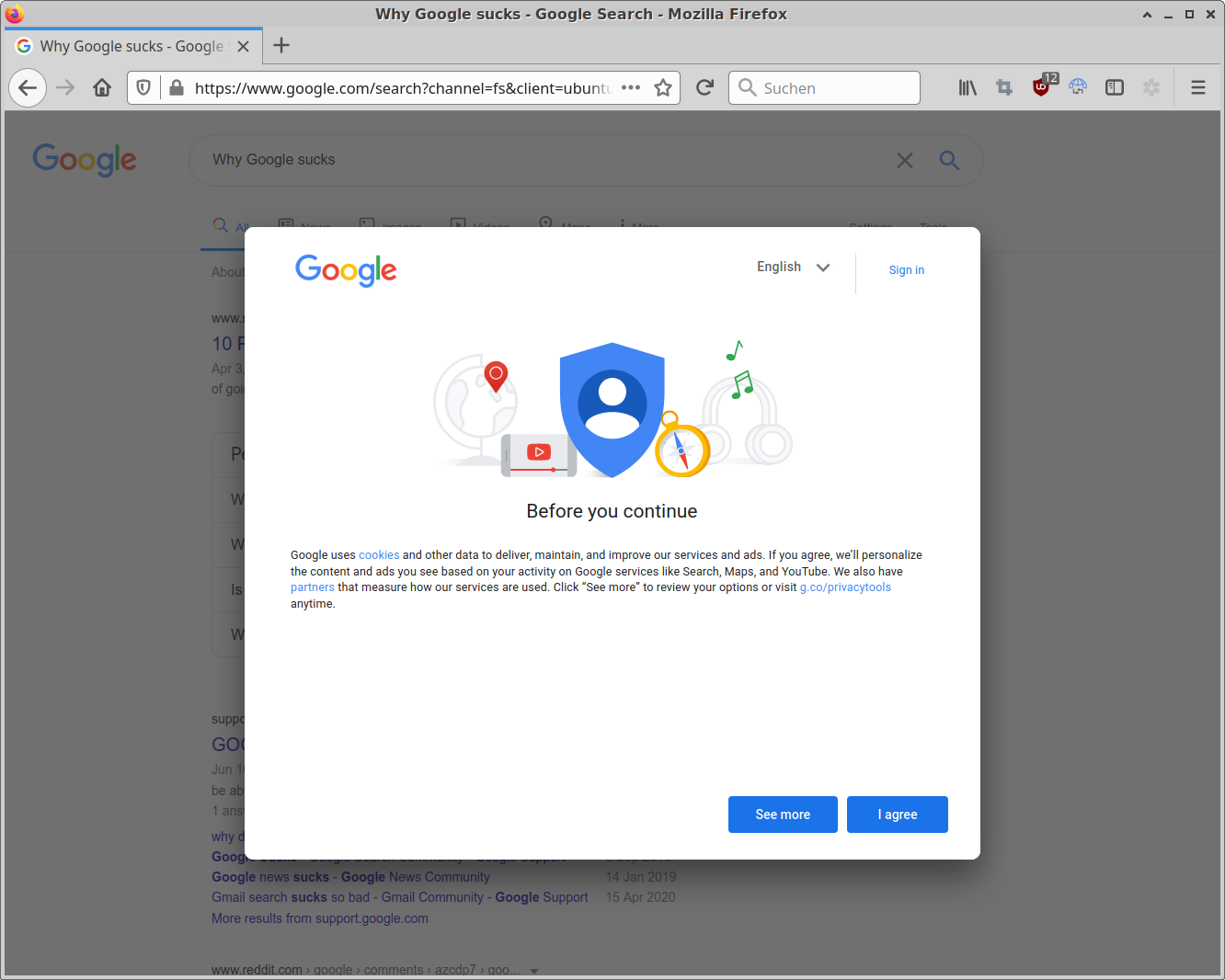
Daniel Lange: Getting rid of the Google cookie consent popup

If you clear your browser cookies regularly (as you should do), Google will annoy you with a full screen cookie consent overlay these days. And - of course - there is no "no tracking consent, technically required cookies only" button. You may log in to Google to set your preference. Yeah, I'm sure this is totally following the intent of the EU Directive 2009/136/EC (the "cookie law"). Google cookie consent pop-up Unfortunately none of the big "anti-annoyances" filter lists seem to have picked that one up yet but the friendly folks from the Computerbase Forum [German] to the rescue. User "Sepp Depp" has created the following filter set that WFM: Add this to your uBlock Origin "My filters" tab:
! Google - remove cookie-consent-popup and restore scroll functionality
google.*##.wwYr3.aID8W.bErdLd
google.*##.aID8W.m114nf.t7xA6
google.*##div[jsname][jsaction^="dg_close"]
google.*##html:style(overflow: visible !important;)
google.*##.widget-consent-fullscreen.widget-consent

17 September 2020

Russell Coker: Dell BIOS Updates

I have just updated the BIOS on a Dell PowerEdge T110 II. The process isn t too difficult, Google for the machine name and BIOS, download a shell script encoded firmware image and GPG signature, then run the script on the system in question. One problem is that the Dell GPG key isn t signed by anyone. How hard would it be to get a few well connected people in the Linux community to sign the key used for signing Linux scripts for updating the BIOS? I would be surprised if Dell doesn t employ a few people who are well connected in the Linux community, they should just ask all employees to sign such GPG keys! Failing that there are plenty of other options. I d be happy to sign the Dell key if contacted by someone who can prove that they are a responsible person in Dell. If I could phone Dell corporate and ask for the engineering department and then have someone tell me the GPG fingerprint I ll sign the key and that problem will be partially solved (my key is well connected but you need more than one signature). The next issue is how to determine that a BIOS update works. What you really don t want is to have a BIOS update fail and brick your system! So the Linux update process loads the image into something (special firmware RAM maybe) and then reboots the system and the reboot then does a critical part of the update. If the reboot doesn t work then you end up with the old version of the BIOS. This is overall a good thing. The PowerEdge T110 II is a workstation with an NVidia video card (I tried an ATI card but that wouldn t boot for unknown reasons). The Nouveau driver has some issues. One thing I have done to work around some Nouveau issues is to create a file ~/.config/plasma-workspace/env/nouveau-broken.sh (for KDE sessions) with the following contents:
export LIBGL_ALWAYS_SOFTWARE=1
I previously wrote about using this just for Kmail to stop it crashing [1]. But after doing that I still had other problems with video and disabling all GL on the NVidia card was necessary. The latest problem I ve had is that even when using that configuration things don t go well. When I run the reboot command I end up with a kernel message about the GPU not responding and then it doesn t reboot. That means that the BIOS update doesn t apply, a hard reboot signals to the system that the new BIOS wasn t good and I end up with the old BIOS again. I discovered that disabling sddm (the latest xdm program in Debian) from starting on boot meant that a reboot command would work. Then I ran the BIOS update script and it s reboot command worked and gave a successful BIOS update. So I ve gone from a 2013 BIOS to a 2018 BIOS! The update list says that some CVEs have been addressed, but the spectre-meltdown-checker doesn t report any fewer vulnerabilities.

Dirk Eddelbuettel: RcppSpdlog 0.0.1: New and Exciting Logging Package

Very thrilled to announce a new package RcppSpdlog which is now on CRAN in its first release 0.0.1. We had tweeted once about the earliest version which had already caught the eyes of Gabi upstream. RcppSpdlog bundles spdlog, a wonderful header-only C++ logging library with all the bells and whistles you would want that was written by Gabi Melman, and also includes fmt by Victor Zverovic. I had meant to package this for a few years now but didn t find an (easy, elegant) way to completely lift stdout / stderr and related uses which R wants us to remove for smoother operations from R itself including synchronized input/output. It was only a few weeks ago that I realized I should subclass a logger (or, more concretely, a sink for a logger) which could then use R input/output. With the right idea the implementaton was easy, and [Gabi]((https://github.com/gabime) was most helpful in making sure R CMD check would not see one or two remaining C++ i/o operations (which we currently do by not activating a default logger, and substituing REprintf() in one call). So this is now clean and sween and a simple use is included in an example in the package we can show here too (in slightly shorter form minus the documentation header):
// this portmanteau include also defines the r_sink we use below, and which
// diverts all logging to R via the Rcpp::Rcout replacement for std::cout
#include <RcppSpdlog>

// [[Rcpp::export]]
void exampleRsink()  

    std::string logname = "fromR";                          // fix a name for this logger
    auto sp = spdlog::get(logname);                         // retrieve existing one
    if (sp == nullptr) sp = spdlog::r_sink_mt(logname);     // or create new one if needed

    // change log pattern (changed from [%H:%M:%S %z] [%n] [%^---%L---%$] )
    sp->set_pattern("[%H:%M:%S.%f] [%n] [%^%L%$] [thread %t] %v");

    sp->info("Welcome to spdlog!");
    sp->error("Some error message with arg:  ", 1);

    sp->warn("Easy padding in numbers like  :08d ", 12);
    sp->critical("Support for int:  0:d ;  hex:  0:x ;  oct:  0:o ; bin:  0:b ", 42);
    sp->info("Support for floats  :03.2f ", 1.23456);
    sp->info("Positional args are  1   0 ..", "too", "supported");
    sp->info(" :<30 ", "left aligned");

 
The NEWS entry for the first release follows.

Changes in RcppSpdlog version 0.0.1 (2020-09-08)
  • Initial release with added R/Rcpp logging sink example

The only sour grapes, if any, are over the CRAN processing. This was originally uploaded three weeks ago. As a new package, it got extra attention and some truly idiosyncratic attention to two details that were already supplied in the first uploaded version. Yet it needed two rounds of going back and forth for really no great net gain, yet wasting a week each time. I am not all that impressed by this, and not particularly pleased either, but I presume is the tax we all pay in order to enjoy the unsurpassed richness of the CRAN repository system which continues to work just flawlessly. If you like this or other open-source work I do, you can now sponsor me at GitHub. For the first year, GitHub will match your contributions.

This post by Dirk Eddelbuettel originated on his Thinking inside the box blog. Please report excessive re-aggregation in third-party for-profit settings.

16 September 2020

Steve Kemp: Implementing a FORTH-like language ..

Four years ago somebody posted a comment-thread describing how you could start writing a little reverse-polish calculator, in C, and slowly improve it until you had written a minimal FORTH-like system: At the time I read that comment I'd just hacked up a simple FORTH REPL of my own, in Perl, and I said "thanks for posting". I was recently reminded of this discussion, and decided to work through the process. Using only minimal outside resources the recipe worked as expected! The end-result is I have a working FORTH-lite, or FORTH-like, interpreter written in around 2000 lines of golang! Features include: To give a flavour here we define a word called star which just outputs a single start-character:
: star 42 emit ;
Now we can call that (NOTE: We didn't add a newline here, so the REPL prompt follows it, that's expected):
> star
*>
To make it more useful we define the word "stars" which shows N stars:
> : stars dup 0 > if 0 do star loop else drop then ;
> 0 stars
> 1 stars
*> 2 stars
**> 10 stars
**********>
This example uses both if to test that the parameter on the stack was greater than zero, as well as do/loop to handle the repetition. Finally we use that to draw a box:
> : squares 0 do over stars cr loop ;
> 4 squares
****
****
****
****
> 10 squares
**********
**********
**********
**********
**********
**********
**********
**********
**********
**********
For fun we allow decompiling the words too:
> #words 0 do dup dump loop
..
Word 'square'
 0: dup
 1: *
Word 'cube'
 0: dup
 1: square
 2: *
Word '1+'
 0: store 1.000000
 2: +
Word 'test_hot'
  0: store 0.000000
  2: >
  3: if
  4: [cond-jmp 7.000000]
  6: hot
  7: then
..
Anyway if that is at all interesting feel free to take a peak. There's a bit of hackery there to avoid the use of return-stacks, etc. Compared to gforth this is actually more featureful in some areas: Find the code here:

Bastian Blank: Salsa hosted 1e6 CI jobs

Today, Salsa hosted it's 1,000,000th CI job. The price for hitting the target goes to the Cloud team. The job itself was not that interesting, but it was successful.

Bits from Debian: Debian Local Groups at DebConf20 and beyond

There are a number of large and very successful Debian Local Groups (Debian France, Debian Brazil and Debian Taiwan, just to name a few), but what can we do to help support upcoming local groups or help spark interest in more parts of the world? There has been a session about Debian Local Teams at Debconf20 and it generated quite a bit of constructive discussion in the live stream (recording available at https://meetings-archive.debian.net/pub/debian-meetings/2020/DebConf20/), in the session's Etherpad and in the IRC channel (#debian-localgroups). This article is an attempt at summarizing the key points that were raised during that discussion, as well as the plans for the future actions to support new or existent Debian Local Groups and the possibility of setting up a local group support team. Pandemic situation During a pandemic it may seem strange to discuss offline meetings, but this is a good time to be planning things for the future. At the same time, the current situation makes it more important than before to encourage local interaction. Reasoning for local groups Debian can seem scary for those outside. Already having a connection to Debian - especially to people directly involved in it - seems to be the way through which most contributors arrive. But if one doesn't have a connection, it is not that easy; Local Groups facilitate that by improving networking. Local groups are incredibly important to the success of Debian since they often help with translations, making us more diverse, support, setting up local bug squashing sprints, establishing a local DebConf team along with miniDebConfs, getting sponsors for the project and much more. Existence of a Local Groups would also facilitate access to "swag" like stickers and mugs, since people not always have the time to deal with the process of finding a supplier to actually get those made. The activity of local groups might facilitate that by organizing related logistics. How to deal with local groups, how to define a local group Debian gathers the information about Local Groups in its Local Groups wiki page (and subpages). Other organisations also have their own schemes, some of them featuring a map, blogs, or clear rules about what constitutes a local group. In the case of Debian there is not a predefined set of "rules", even about the group name. That is perfectly fine, we assume that certain local groups may be very small, or temporary (created around a certain time when they plan several activities, and then become silent). However, the way the groups are named and how they are listed on the wiki page sets expectations with regards to what kinds of activities they involve. For this reason, we encourage all the Debian Local Groups to review their entries in the Debian wiki, keep it current (e.g. add a line "Status: Active (2020)), and we encourage informal groups of Debian contributors that somehow "meet", to create a new entry in the wiki page, too. What can Debian do to support Local Groups Having a centralized database of groups is good (if up-to-date), but not enough. We'll explore other ways of propagation and increasing visibility, like organising the logistics of printing/sending swag and facilitate access to funding for Debian-related events. Continuation of efforts Efforts shall continue regarding Local Groups. Regular meetings are happening every two or three weeks; interested people are encouraged to explore some other relevant DebConf20 talks (Introducing Debian Brasil, Debian Academy: Another way to share knowledge about Debian, An Experience creating a local community on a small town), websites like Debian flyers (including other printed material as cube, stickers), visit the events section of the Debian website and the Debian Locations wiki page, and participate in the IRC channel #debian-localgroups at OFTC.

Joey Hess: comically bad shipping estimates and middlemen

My inverter has unfortunately died, and I wanted to replace it with the same model. Ideally before I lose the contents of the fridge. It's a 24v inverter, which is not at all as easy to find a replacement for as a 12v inverter would be. Somehow Walmart was the only retailer that had it available with a delivery estimate: Just 2 days. It's the second day now, with no indication they've shipped it. I noticed the "sold and shipped by Zoro", so went and found it on that website. So, the reality is it ships direct from China via container ship. As does every product from Zoro, which all show as 2 day delivery on Walmart's website. I don't think this is a pandemic thing. I think it's a trying to compete with Amazon and failing thing.
My other comically bad shipping estimate this pandemic was from Amazon though. There was a run this summer on Kayaks, because social distancing is great on the water. I found a high quality inflatable kayak. Amazon said "only 2 left in stock" and promised delivery in 1 week. One week later, it had not shipped, and they updated the delivery estimate forward 1 week. A week after that, ditto. Eventually I bought a new model from the same manufacturer, Advanced Elements. Unfortunately, that kayak exploded the second time I inflated it, due to a manufacturing defect. So I got in touch with Advanced Elements and they offered a replacement. I asked if, instead, they maybe still had any of the older model of kayak I had tried to order. They checked their warehouse, and found "the last one" in a corner somewhere. No shipping estimate was provided. It arrived in 3 days.

15 September 2020

Molly de Blanc: Actions, Inactions, and Consequences: Doctrine of Doing and Allowing W. Quinn

There are a lot of interesting and valid things to say about the philosophy and actual arguments of the Actions, Inactions, and Consequences: Doctrine of Doing and Allowing by Warren Quinn. Unfortunately for me, none of them are things I feel particularly inspired by. I m much more attracted to the many things implied in this paper. Among them are the role of social responsibility in making moral decisions. At various points in the text, Quinn makes brief comments about how we have roles that we need to fulfill for the sake of society. These roles carry with them responsibilities that may supersede our regular moral responsibilities. Examples Quinn makes include being a private life guard (and being responsible for the life of one particular person) and being a trolley driver (and your responsibility is to make sure the train doesn t kill anyone). This is part of what has led to me brushing Quinn off as another classist. Still, I am interested in the question of whether social responsibilities are more important than moral ones or whether there are times when this might occur. One of the things I maintain is that we cannot be the best versions of ourselves because we are not living in societies that value our best selves. We survive capitalism. We negotiate climate change. We make decisions to trade the ideal for the functional. For me, this frequently means I click through terms of service, agree to surveillance, and partake in the use and proliferation of oppressive technology. I also buy an iced coffee that comes in a single use plastic cup; I shop at the store with questionable labor practices; I use Facebook. But also, I don t give money to panhandlers. I see suffering and I let it pass. I do not get involved or take action in many situations because I have a pass to not. These things make society work as it is, and it makes me work within society. This is a self-perpetuating, mutually-abusive, co-dependent relationship. I must tell myself stories about how it is okay that I am preferring the status quo, that I am buying into the system, because I need to do it to survive within it and that people are relying on the system as it stands to survive, because that is how they know to survive. Among other things, I am worried about the psychic damage this causes us. When we view ourselves as social actors rather than moral actors, we tell ourselves it is okay to take non-moral actions (or in-actions); however, we carry within ourselves intuitions and feelings about what is right, just, and moral. We ignore these in order to act in our social roles. From the perspective of the individual, we re hurting ourselves and suffering for the sake of benefiting and perpetuating an caustic society. From the perspective of society, we are perpetuating something that is not just less than ideal, but actually not good because it is based on allowing suffering.[1] [1] This is for the sake of this text. I don t know if I actually feel that this is correct. My goal was to make this only 500 words, so I am going to stop here.

Jonathan Dowland: Come Together

Primal Scream   Come Together
This one rarely returns to its proper place, instead living in the small pile of records permanently next to my turntable. I'm a late convert to Primal Scream: I first heard the 10 minute Andrew Weatherall mix of Come Together on Tom Robinson's 6Music show. It's a remarkable record, more so to think that it's quite hard, in isolation, to actually hear Primal Scream's contribution. This is very much Weatherall's track, and (to me, at least) it does a great job of encapsulating the house music explosion of the time. It's interesting to hear Terry Farley's mix, partially because the band's contribution is more evident, so you can get a glimpse of the material that Weatherall had to work with. RIP Andrew Weatherall, 1963-2020.

Rapha&#235;l Hertzog: Freexian s report about Debian Long Term Support, August 2020

A Debian LTS logo Like each month, here comes a report about the work of paid contributors to Debian LTS. Individual reports In August, 237.25 work hours have been dispatched among 14 paid contributors. Their reports are available: Evolution of the situation August was a regular LTS month once again, even though it was only our 2nd month with Stretch LTS.
At the end of August some of us participated in DebConf 20 online where we held our monthly team meeting. A video is available.
As of now this video is also the only public resource about the LTS survey we held in July, though a written summary is expected to be released soon. The security tracker currently lists 56 packages with a known CVE and the dla-needed.txt file has 55 packages needing an update. Thanks to our sponsors Sponsors that recently joined are in bold.

No comment Liked this article? Click here. My blog is Flattr-enabled.

Russell Coker: More About the PowerEdge R710

I ve got the R710 (mentioned in my previous post [1]) online. When testing the R710 at home I noticed that sometimes the VGA monitor I was using would start flickering when in some parts of the BIOS setup, it seemed that the horizonal sync wasn t working properly. It didn t seem to be a big deal at the time. When I deployed it the KVM display that I had planned to use with it mostly didn t display anything. When the display was working the KVM keyboard wouldn t work (and would prevent a regular USB keyboard from working if they were both connected at the same time). The VGA output of the R710 also wouldn t work with my VGA->HDMI device so I couldn t get it working with my portable monitor. Fortunately the Dell front panel has a display and tiny buttons that allow configuring the IDRAC IP address, so I was able to get IDRAC going. One thing Dell really should do is allow the down button to change 0 to 9 when entering numbers, that would make it easier to enter 8.8.8.8 for the DNS server. Another thing Dell should do is make the default gateway have a default value according to the IP address and netmask of the server. When I got IDRAC going it was easy to setup a serial console, boot from a rescue USB device, create a new initrd with the driver for the MegaRAID controller, and then reboot into the server image. When I transferred the SSDs from the old server to the newer Dell server the problem I had was that the Dell drive caddies had no holes in suitable places for attaching SSDs. I ended up just pushing the SSDs in so they are hanging in mid air attached only by the SATA/SAS connectors. Plugging them in took the space from the above drive, so instead of having 2*3.5 disks I have 1*2.5 SSD and need the extra space to get my hand in. The R710 is designed for 6*3.5 disks and I m going to have trouble if I ever want to have more than 3*2.5 SSDs. Fortunately I don t think I ll need more SSDs. After booting the system I started getting alerts about a fault in one SSD, with no detail on what the fault might be. My guess is that the SSD in question is M.2 and it s in a M.2 to regular SATA adaptor which might have some problems. The data seems fine though, a BTRFS scrub found no checksum errors. I guess I ll have to buy a replacement SSD soon. I configured the system to use the nosmt kernel command line option to disable hyper-threading (which won t provide much performance benefit but which makes certain types of security attacks much easier). I ve configured BOINC to run on 6/8 CPU cores and surprisingly that didn t cause the fans to be louder than when the system was idle. It seems that a system that is designed for 6 SAS disks doesn t need a lot of cooling when run with SSDs. Update: It s a R710 not a T710. I mostly deal with Dell Tower servers and typed the wrong letter out of habit.

Norbert Preining: GIMP washed out colors: Color to Alpha and layer recombination

Just to remind myself because I keep forgetting it again and again: If you get washed out colors when doing color to alpha and then recombine layers in GIMP, that is due to the new default in GIMP 2.10 that combines layers in linear RGB.
This creates problems because Color to Alpha works in perceptual RGB, and the recombination in linear creates washed out colors. The solution is to right click on the respective layer, select Composite Space , and there select RGB (perceptual) . Here is the bug report that has been open since 2 years. Hoping that for next time I remember it.

14 September 2020

Jonathan McDowell: onak 0.6.1 released

Yesterday I did the first release of my OpenPGP compatible keyserver, onak, in 4 years. Actually, 2 releases because I discovered my detection for various versions of libnettle needed some fixing. It was largely driven by the need to get an updated package sorted for Debian due to the removal of dh-systemd, but it should have come sooner. This release has a number of clean-ups for dealing with the hostility shown to the keyserver network in recent years. In particular it implements some of dkg s Abuse-Resistant OpenPGP Keystores, and finally adds support for verifying signatures fully. That opens up the ability to run a keyserver that will only allow verifiable updates to keys. This doesn t tie in with folk who want to run PGP based systems because of the anonymity, but for those of us who think PGP s strength is in the web of trust it s pretty handy. And it s all configurable to taste; you can turn off all the verification if you want, or verify everything but not require any signatures, or even enable v3 keys if you feel like it. The main reason this release didn t come sooner is that I m painfully aware of the bits that are missing. In particular: Anyway. Available locally or via GitHub.
0.6.0 - 13th September 2020
  • Move to CMake over autoconf
  • Add support for issuer fingerprint subpackets
  • Add experimental support for v5 keys
  • Add read-only OpenPGP keyring backed DB backend
  • Move various bits into their own subdirectories in the source tree
  • Add support for full signature verification
  • Drop v3 keys by default when cleaning keys
  • Various code cleanups
  • Implement pieces of draft-dkg-openpgp-abuse-resistant-keystore-03
  • Add support for a fingerprint blacklist (e.g. Evil32)
  • Deprecate the .conf configuration file format
  • Drop version info from armored output
  • Add option to deny new keys and only allow updates to existing keys
  • Various pieces of work removing support for 32 bit key IDs and coping with colliding 64 bit key IDs.
  • Remove support for libnettle versions that lack the full SHA2 suite
0.6.1 - 13th September 2020
  • Fixes for compilation without nettle + with later releases of nettle

Emmanuel Kasper: Quick debugging of a Linux printer via cups command line tools

Step by step cups debugging ( here with a network printer)

Which printer queue do I have configured ?
lpstat -p
printer epson is idle. enabled since Sat Dec 24 13:18:09 2017
#here I have a printer called 'epson", doing nothing, that the cups daemon considers as enabled

Which connection am I using to get to this printer ?
lpstat -v
device for epson: lpd://epson34dea0.local:515/PASSTHRU
# here the locally configured 'epson' printer queue is backed by a network device at the adress epson34dea0.local, to which I am sending my print jobs via the lpd protocol

Is my printer ready ?
lpq
epson is ready
no entries

# here my local print queue 'epson' is accepting print jobs ( which does not say anything about the physical device, it might be offline

If here you local print queue 'epson' is not ready, you can try to reenable it in the cups system with:

sudo cupsenable epson

If you notice that the printer is disabled all the time, because for instance of a flaky network, you can edit /etc/cups/printers.conf and change the ErrorPolicy for each printer from stop-printer to retry-job.
It should be also possible to set this parameter in cupsd.conf

Finally you can print a test page with
lpr /usr/share/cups/data/testprint

Emmanuel Kasper: Using Debian and RHEL troubleshootings containers on Kubernetes & OpenShift

You can connect to a running pod with oc/kubectl rsh pod_name, or start a copy of a running pod with oc debug pod_name, but as best practises recommend unprivileged, slim container images, where do you get sosreport, kdump, dig and nmap for troubleshooting ? Fortunately you can start either a transient Debian troubleshooting container with:oc run troubleshooting-pod --stdin --tty --rm --image=docker.io/library/debian:busteror a Red Hat Entreprise Linux:
oc run troubleshooting-pod --stdin --tty --rm --image=registry.access.redhat.com/rhel7/rhel-tools

Russ Allbery: Review: Who Do You Serve, Who Do You Protect?

Review: Who Do You Serve, Who Do You Protect?, edited by Maya Schenwar, et al.
Editor: Maya Schenwar
Editor: Joe Macar
Editor: Alana Yu-lan Price
Publisher: Haymarket Books
Copyright: June 2016
ISBN: 1-60846-684-1
Format: Kindle
Pages: 250
Who Do You Serve, Who Do You Protect? is an anthology of essays about policing in the United States. It's divided into two sections: one that enumerates ways that police are failing to serve or protect communities, and one that describes how communities are building resistance and alternatives. Haymarket Books (a progressive press in Chicago) has made it available for free in the aftermath of the George Floyd killing and resulting protests in the United States. I'm going to be a bit unfair to this book, so let me start by admitting that the mismatch between it and the book I was looking for is not entirely its fault. My primary goal was to orient myself in the discussion on the left about alternatives to policing. I also wanted to sample something from Haymarket Books; a free book was a good way to do that. I was hoping for a collection of short introductions to current lines of thinking that I could selectively follow in longer writing, and an essay collection seemed ideal for that. What I had not realized (which was my fault for not doing simple research) is that this is a compilation of articles previously published by Truthout, a non-profit progressive journalism site, in 2014 and 2015. The essays are a mix of reporting and opinion but lean towards reporting. The earliest pieces in this book date from shortly after the police killing of Michael Brown, when racist police violence was (again) reaching national white attention. The first half of the book is therefore devoted to providing evidence of police abuse and violence. This is important to do, but it's sadly no longer as revelatory in 2020, when most of us have seen similar things on video, as it was to white America in 2014. If you live in the United States today, while you may not be aware of the specific events described here, you're unlikely to be surprised that Detroit police paid off jailhouse informants to provide false testimony ("Ring of Snitches" by Aaron Miguel Cant ), or that Chicago police routinely use excessive deadly force with no consequences ("Amid Shootings, Chicago Police Department Upholds Culture of Impunity" by Sarah Macaraeg and Alison Flowers), or that there is a long history of police abuse and degradation of pregnant women ("Your Pregnancy May Subject You to Even More Law Enforcement Violence" by Victoria Law). There are about eight essays along those lines. Unfortunately, the people who excuse or disbelieve these stories are rarely willing to seek out new evidence, let alone read a book like this. That raises the question of intended audience for the catalog of horrors part of this book. The answer to that question may also be the publication date; in 2014, the base of evidence and example for discussion had not been fully constructed. This sort of reporting is also obviously relevant in the original publication context of web-based journalism, where people may encounter these accounts individually through social media or other news coverage. In 2020, they offer reinforcement and rhetorical evidence, but I'm dubious that the people who would benefit from this knowledge will ever see it in this form. Those of us who will are already sickened, angry, and depressed. My primary interest was therefore in the second half of the book: the section on how communities are building resistance and alternatives. This is where I'm going to be somewhat unfair because the state of that conversation may have been different in 2015 than it is now in 2020. But these essays were lacking the depth of analysis that I was looking for. There is a human tendency, when one becomes aware of an obvious wrong, to simply publicize the horrible thing that is happening and expect someone to do something about it. It's obviously and egregiously wrong, so if more people knew about it, certainly it would be stopped! That has happened repeatedly with racial violence in the United States. It's also part of the common (and school-taught) understanding of the Civil Rights movement in the 1960s: activists succeeded in getting the violence on the cover of newspapers and on television, people were shocked and appalled, and the backlash against the violence created political change. Putting aside the fact that this is too simplistic of a picture of the Civil Rights era, it's abundantly clear at this point in 2020 that publicizing racist and violent policing isn't going to stop it. We're going to have to do something more than draw attention to the problem. Deciding what to do requires political and social analysis, not just of the better world that we want to see but of how our current world can become that world. There is very little in that direction in this book. Who Do You Serve, Who Do You Protect? does not answer the question of its title beyond "not us" and "white supremacy." While those answers are not exactly wrong, they're also not pushing the analysis in the direction that I wanted to read. For example (and this is a long-standing pet peeve of mine in US political writing), it would be hard to tell from most of the essays in this book that any country besides the United States exists. One essay ("Killing Africa" by William C. Anderson) talks about colonialism and draws comparisons between police violence in the United States and international treatment of African and other majority-Black countries. One essay talks about US military behavior oversees ("Beyond Homan Square" by Adam Hudson). That's about it for international perspective. Notably, there is no analysis here of what other countries might be doing better. Police violence against out-groups is not unique to the United States. No one has entirely solved this problem, but versions of this problem have been handled with far more success than here. The US has a comparatively appalling record; many countries in the world, particularly among comparable liberal democracies in Europe, are doing far better on metrics of racial oppression by agents of the government and of law enforcement violence. And yet it's common to approach these problems as if we have to develop a solution de novo, rather than ask what other countries are doing differently and if we could do some of those things. The US has some unique challenges, both historical and with the nature of endemic violence in the country, so perhaps such an analysis would turn up too many US-specific factors to copy other people's solutions. But we need to do the analysis, not give up before we start. Novel solutions can lead to novel new problems; other countries have tested, working improvements that could provide a starting framework and some map of potential pitfalls. More fundamentally, only the last two essays of this book propose solutions more complex than "stop." The authors are very clear about what the police are doing, seem less interested in why, and are nearly silent on how to change it. I suspect I am largely in political agreement with most of the authors, but obviously a substantial portion of the country (let alone its power structures) is not, and therefore nothing is changing. Part of the project of ending police violence is understanding why the violence exists, picking apart the motives and potential fracture lines in the political forces supporting the status quo, and building a strategy to change the politics. That isn't even attempted here. For example, the "who do you serve?" question of the book's title is more interesting than the essays give it credit. Police are not a monolith. Why do Black people become police officers? What are their experiences? Are there police forces in the United States that are doing better than others? What makes them different? Why do police act with violence in the moment? What set of cultural expectations, training experiences, anxieties, and fears lead to that outcome? How do we change those factors? Or, to take another tack, why are police not held accountable even when there is substantial public outrage? What political coalition supports that immunity from consequences, what are its fault lines and internal frictions, and what portions of that coalition could be broken off, pealed away, or removed from power? To whom, institutionally, are police forces accountable? What public offices can aspiring candidates run for that would give them oversight capability? This varies wildly throughout the United States; political approaches that work in large cities may not work in small towns, or with county sheriffs, or with the FBI, or with prison guards. To treat these organizations as a monolith and their motives as uniform is bad political tactics. It gives up points of leverage. I thought the best essays of this collection were the last two. "Community Groups Work to Provide Emergency Medical Alternatives, Separate from Police," by Candice Bernd, is a profile of several local emergency response systems that divert emergency calls from the police to paramedics, mental health experts, or social workers. This is an idea that's now relatively mainstream, and it seems to be finding modest success where it has been tried. It's more of a harm mitigation strategy than an attempt to deal with the root problem, but we're going to need both. The last essay, "Building Community Safety" by Ejeris Dixon, is the only essay in this book that is pushing in the direction that I was hoping to read. Dixon describes building an alternative system that can intervene in violent situations without using the police. This is fascinating and I'm glad that I read it. It's also frustrating in context because Dixon's essay should be part of a discussion. Dixon describes spending years learning de-escalation techniques, doing hard work of community discussion and collective decision-making, and making deep investment in the skills required to handle violence without calling in a dangerous outside force. I greatly admire this approach (also common in parts of the anarchist community) and the people who are willing to commit to it. But it's an immense amount of work, and as Dixon points out, that work often falls on the people who are least able to afford it. Marginalized communities, for whom the police are often dangerous, are also likely to lack both time and energy to invest in this type of skill training. And many people simply will not do this work even if they do have the resources to do it. More fundamentally, this approach conflicts somewhat with division of labor. De-escalation and social work are both professional skills that require significant time and practice to hone, and as much as I too would love to live in a world where everyone knows how to do some amount of this work, I find it hard to imagine scaling this approach without trained professionals. The point of paying someone to do this work as their job is that the money frees up their time to focus on learning those skills at a level that is difficult to do in one's free time. But once you have an organized group of professionals who do this work, you have to find a way to keep them from falling prey to the problems that plague the police, which requires understanding the origins of those problems. And that's putting aside the question of how large the residual of dangerous crime that cannot be addressed through any form of de-escalation might be, and what organization we should use to address it. Dixon's essay is great; I wouldn't change anything about it. But I wanted to see the next essay engaging with Dixon's perspective and looking for weaknesses and scaling concerns, and then the next essay that attempts to shore up those weaknesses, and yet another essay that grapples with the challenging philosophical question of a government monopoly on force and how that can and should come into play in violent crime. And then essays on grass-roots organizing in the context of police reform or abolition, and on restorative justice, and on the experience of attempting police reform from the inside, and on how to support public defenders, and on the merits and weaknesses of focusing on electing reform-minded district attorneys. Unfortunately, none of those are here. Overall, Who Do You Serve, Who Do You Protect? was a disappointment. It was free, so I suppose I got what I paid for, and I may have had a different reaction if I read it in 2015. But if you're looking for a deep discussion on the trade-offs and challenges of stopping police violence in 2020, I don't think this is the place to start. Rating: 3 out of 10

13 September 2020

Enrico Zini: Travel links

A few interesting places to visit. Traveling could be complicated, and internet searches could be interesting enough. For example, churches: Or fascinating urbanistic projects, for which it's worth to look up photos: Or nature, like Get Lost in Mega-Tunnels Dug by South American Megafauna

Next.

Previous.