Search Results: "dom"

24 November 2006

Lars Wirzenius: Random thought: Bzr book outline

While cleaning up my hard disk, I found the beginning of an outline for a book on Bazaar (bzr), the version control system. I wrote it one weekend this summer, when I felt I had lots of free time. I don't, and won't, for the foreseeable future. Therefore I'll dump the outline here in my web log, so that perhaps someone will be inspired to write it for me. The Bazaar distributed version control system For most of the 1990s, the free software world relied on CVS for version control. It was the best free system for the purpose. During the early 2000s, a number of new systems started getting into public knowledge. One such system is Bazaar. This is the outline for a book to explain how Bazaar is used in different kinds of scenarios. The book is not a reference manual: the software's own documentation is best suitable for that; this avoids having to constantly update the book. The book is structured as a series of case studies of common scenarios, starting with the simplest one, and getting increasingly more complicated. This approach allows the reader to quickly learn the things they need for a particular kind of situation. Introduction This chapter explains what version control systems are, and gives a summary of their history so far. It explains various basic concepts, such as centralized versus distributed, but briefly; these will be expounded on later in the book. It compares Bazaar to other well-known systems. It explains the cumbersome naming history of Bazaar. It explains how to install Bazaar by referring to the website and to the package repositories of various Linux distributions. Quick overview This chapter is intended for those with some experience with other version control systems, such as Subversion. It gives a quick run-through of the central concepts of Bazaar, and how to do common tasks on the command line. The web page project This is the first case study chapter. It explains how to use Bazaar to keep track of changes to a web site. A web site only changes linearly: only one version exists at a time. My little program This chapter explains how to use Bazaar to maintain the source code for a one-person programming project. The program has a stable version, which gets bug fixes, but no new features. There is also a development version, which gets the new features. Sometimes a bug needs to be fixed in both, and Bazaar can help with this. Additionally, sometimes it is not clear whether a new feature can be implemented cleanly, or there are several possible approach to how it can be implemented. Thus, the chapter also explains these so called feature branches. Further topics for this chapter include making releases, and using repositories to avoid excessive disk usage. Tight teamwork This chapter explains how to use Bazaar when the one-person program becomes an internal project in a company, with a well-defined set of developers. Thus, we discuss how to set up a centralized branch in a way that all the developers can commit to it. Distributed free software development This chapter concentrates on a typical successful free software project, with contributors from all over the world, and the problems that this involves. Thus, we discuss how to publish a branch for anyone to see (but not change); how to share changes (patches/bundles) between developers; how to co-ordinate the development of the whole project (at least from the version control point of view). Switching a project to Bazaar That's it. If you write it, please send me a note when it's published so that I can get a copy. Thanks.
Gunnar Wolf: Honest spammers

Wow...This time I'm truly amazed. A spam just hit my debian-devel mailbox. That's sadly not strange at all, I know. Only that I started reading it. It says:
Spammers don't seem to target us for their random alias generation
tools, or        maybe they haven't got to the letter 'o' yet. com
for subsequent posts, but that whole barn door thing comes to mind.
In so doing, values are overlooked often and mistakes are made. Maybe
Microsoft will let me        change my alias.
Maybe some of it would actually be useful to me. For whatever reason, my
Microsoft email address didn't ever get        spam.
Then it goes on talking nonsense splattered with all kinds of garbage talk, some news (or whatever) about stock options of a China Health thing, and goes on throwing nonsense blabber.
Sorry, I'm not linking to it (I'll probably later update this entry), it's still not available in the Web archive of debian-devel.">

23 November 2006

MJ Ray: Driving a car? Give us your prints!

After registering children and alcohol drinkers, now they're going to fingerprint drivers at roadside checks, according to Motorists to give fingerprints [BBC News]. The report says
"Officers promise prints will not be kept on file"
but as Mark Wallace of civil liberties group the Freedom Association told them:
"I don't think we should be reassured by the fact that at the moment it's voluntary and at the moment they won't be recorded. Both of those things are actually only happening in the trial because the laws haven't been passed to do this on a national basis compulsorily and with recording."
ken lewis commented:
"My response to being asked for my fingerprints will be to say no and ask to prove my identity at the police station. That's non-violent resistance to this liberty-threatening move." "And that reminds me -- as a lurker on Planet Debian, I'm struck by the references to mailing-list flamewars. Why are people so keen on freedom able to discuss so violently that freedom?"

21 November 2006

Benjamin Mako Hill: Writing and Writing Code

Over the years, I've published some of the articles I am most proud of on Advogato. As you can imagine, I was sad to see demise of Advogato announced early September and thrilled to see that by the end of the month, Steve Rainwater had stepped up to save the site. For a belated welcome of Advogato back from the edge of the grave, I've published a short essay about the effectiveness of an analogy of software and writing on the site. In it, I introduce the analogy and argue that it is useful in advocating free software and programming education and in justifying the disproportionately large amount of programming related projects in the free software world. Here's the intro:
Advocates of free and open source software, myself included, like to talk about the "democratizing" effect of free software. Others, especially non-programmers, are quick to point out that the only technical people can take advantage of half of the enumerated freedoms in FOSS. The freedoms to modify and collaborate mean little if you don't know to program. Over time, I have come to the conclusion that the only good solution to this problem -- and one that I was initially quite opposed to -- is to teach everyone to program. In considering this position, the processes of reading and writing provide a useful analogy when considering the processes of using and creating computer software. Additionally, the analogy provides an powerful justification for the fact that FOSS programmers produce a disproportionately large amount of software that is primarily of interest to FOSS programmers.
Please check it out on Advogato and feel free to leave a comment on my blog if you don't have an Advogato account.

Joachim Breitner: Unicode Hack

(No, this is not security related. Some people call screensavers hacks . But I did get your attention, didn t I?) Whenever I happen to run gucharmap, I like to just browse and have a look at all those weird characters other people, especially asian, are using: A lot of them look really cool. So I thought: This would be a great screensaver.After some API digging I created that screensaver. It uses fontconfig to open the FreeSans and the DejaVu Sans fonts, selects a random glyph from these and display s it full screen. Below, the unicode code point and characer name are printed. After a few seconds, the next character is displayed nothing else, nothing hectic, quite relaxing.When you download the code, you will find a file uncode.c , which is the hack itself, a file unicode-names.h , which is taken from gucharmap and only slightly modified, as well as a buch of files from the xscreensaver distribution. To re-compile the binary, use the script compile , which runs gcc with flags I stole from the xscreensaver Makefile. I know this build system is everything but correct or sensible, but it works for me...Unfortunately I don t think it can be included in xscreensaver, as it depends on libfontconfig. If someone would rewrite it using only libX11, this might be possible, so if you like it, feel free to steal the idea.

Adam Rosi-Kessel: Climate Dread

Via mariuss’ weblog (discovered accidentally, provides an unusually high signal-to-noise ratio for a random blog), this Canadian article entitled Coping with Climate Dread. Read it. Then read Elizabeth Kolbert’s article, “The Darkening Sea: Carbon Emissions and the Ocean” in last week’s New Yorker Magazine. (Sadly, the content does not appear to be online — if the New Yorker put only one article online, it should have been that one. As a consolation, there’s a short excerpt here, and a related article is available from last year.) It’s become a lot harder to think about this problem since I had a kid.

20 November 2006

Ben Armstrong: Towards a Debian Jr. Live CD

Debian Jr. development revived Recently there has been some lively discussion on the Debian Jr. list about how to arrange an account for a child of 1 to 3 years of age. Suggestions included using set-top box software like Freevo, tailoring DEs with panels and large buttons, using simpler WMs like fvwm, or using an “activity centre” app like Gcompris. Now, I respect those parents who hold that a child this young should interact more with the “real world”. While I wouldn’t go so far as to outright prohibit my young ones from computer use, I can see the wisdom in keeping it to a minimum. But, for better or worse, our family is one of several who have some experience helping our youngest members use our Debian systems. We would like to share what we’ve learned through the Debian Jr. project. Getting started with live.debian.net To that end, last week I was inspired to follow the Debian Live ISO Howto to produce my first rough draft of a Debian Jr. live CD built from scratch on Etch. For the final product, we’ll want to use a local partial Debian archive mirror, as it not only optimizes fetching packages for several build iterations, but also can be kept stable, which is important as we near release. But for this draft, I ran into trouble building the complete package list to populate the partial mirror, as cdebootstrap, which make-live uses, has no handy --print-debs switch like debootstrap does. So for now, I rely on approx to cache packages for optimization only. A straightforward process to create a working live CD The rest of the process was straightforward: using live-package, I created a package list1 containing Gnome and the Debian Jr. metapackages, I configured /etc/make-live.conf to point at my proxy, and then I ran the make-live script on the package list. The end result was ./debian-live/binary.iso, which successfully booted under qemu. At this stage, there is not much to show. To be truly useful, the live CD needs to be set up so that children and their guides can immediately find and use the material intended for them. We will need not only one live CD user, but four, varying in age range and role. (More about this in a future article.) However, it is an encouraging start, and shows that we may be able to produce something usable by the time Etch releases.

1 For this exercise, I simply combined /usr/share/make-live/lists/gnome with the junior-* metapackages in Etch, and added mozilla-firefox-gnome-support to satisfy Gnome’s web browser dependency and cut down on redundancy, resulting in the following list.

junior-art
junior-doc
junior-games-card
junior-games-gl
junior-games-net
junior-games-sim
junior-games-text
junior-gnome
junior-internet
junior-kde
junior-math
junior-programming
junior-puzzle
junior-sound
junior-system
junior-toys
junior-typing
junior-writing
mozilla-firefox-gnome-support
eject sudo
console-common locales
gdm gdm-themes gnome-desktop-environment gnome-cups-manager gnome-screensaver
gnome-themes-extras
rhythmbox synaptic
x-window-system-core

19 November 2006

Jos Parrella: Elections in Venezuela

In two weeks (Dec 3rd) there will be presidential elections in Venezuela. This will be the third time where Hugo Chavez, the current President, will be participating in the elections. The first time, in 1998, he won by 62%, then dropped to 59% in 2000 and currently some polls are giving him between 50 and 60 percent of vote intention. Since 1998, we’ve got a very active electoral movement and controversial situations which have raised very diverse opinions about our electoral system. If I recall correctly, in 1998 people voted using optic forms. In that moment, spanish Indra was the company in charge for the machines and most of the technology used in the elections. That was the time where the Supreme Electoral Council depended on the Executive power, i.e., the President. In 1999, Chavez proposed to rewrite the Constitution, and the National Electoral Council became an independent power. This Constitution was approved in two referenda in 1999, where touchscreen machines were used. In 2000, after the new Constitution was approved, new presidential elections were made. The same touchscreen machines were used and we made a transition between Indra and a multinational holding named Smartmatic. In 2004, after two millions and a half of signatures were gathered to recall Chavez presidency, the revocatory referendum was made, using the Smartmatic machines. Almost six million people voted to maintain Chavez in power. Of course, after eight years of the same party in the power, as well as other problems (namely a national strike and a Coup d’Etat in 2002), several ideas arised regarding the legitimacy of the election process.
Today, the National Electoral Council released a flyer in the press, where they try to issue these topics. I must recognize that, being a newbie voter, I was unaware of several of the things they published today. For example, 8 of every 10 venezuelans over 18 are signed for voting in the elections. That’s one of the higher percentages of public awareness about elections in Latin America, higher than, for example, Colombia. That means 16 million people are able to vote, and we’re used to get around 60 percent of participation. We do vote with touchscreen machines, and the results are completely computerized. The military guards all the equipment, and provides security to the randomly elected civilian which work as temporary personnel. Members of every involved party are present in all the election centers, as well as national and international observers. After you’re checked to vote, you have to give your fingerprint in a special biometric device. This is transmitted live, were possible, avoiding two people voting in the same day. After you vote, your finger is marked with silver nitrate, which goes away after two days or so. Of course, you’re only allowed to vote if you don’t have the mark in your fingers. The touchscreen machines prints a paper which you put into the traditional box. After the voting has concluded, more than half of the boxes will be opened and checked against the information in the machine. The boxes subject to this check are randomly selected, as well. A brief thought about the software used in the machines. In 2004 or so, we (the Free Software Community in Venezuela) struggled and made pressure to the National Electoral Council to reveal the code and publish it wide open. This has been achieved until some point, since every interested person or organization is allowed to take a peek at the code. Dozens of organizations have already done so and are impressed by the features that are now present in the code. Before the first vote is registered, the machine prints a zero-vote confirmation, and then subsequently randomizes the order of the votes registered in memory. Only after all the election centers are closed, the machines start transmitting information. This year, three hours past the closing time we’ll have the results. The final and most important, from my point of view, argument held to support our election system is the random queue organization at the election centres. The registry is sorted by ID number, the votes are randomly stored in the memory and the biometric device is used in a per-arrival basis. Therefore, since nobody takes the same time to vote, the queues will be unarranged therefore making it quite difficult to determine a possible vote sequence. This has been certified lately by the European Union, the Organization of American States and other organizations. Whoever wins this election, I’m quite confident about our election system. I just hope that other institutions in our Country start using reliable systems (for example, the national ID office) in order to give at least the feeling of being in a rightful State.

Jeff Bailey: Google for your Domain

I've been playing with Google for your Domain over the past couple of weeks for Angie and my's email. A few observations so far:

1) Still a bit worried that Google now has a pile of my data. I don't know that there's a way to resolve this. I'm wondering if there's a way of doing GPG overlays onto gmail? For the most part I don't really care, but it would be nice to preserve the option of doing a local decryption.

2) It's nice to use my email address for my Jabber account finally. No more having to remember to check the gmail account from time to time to see if someone decided sending an email there would be a good idea. I should probably do the same with my hotmail account.

3) Google talk and Orkut don't play along with GfyD.

4) Google's incremental improvements are cool. In the past week they added customised start pages, which means that I can see my mail and calendar from a start page. The start page isn't as fully featured as the original start page (historical searches, various customer applets, etc. don't work), but looks alot like it did awhile ago.

5) gmail doesn't have a way of filtering on mailing lists. This annoyed me at first, but now is more of a reminder that I should unsubscribe from lists that I don't actually read anyway. The volume on the rest is low enough that I can continue to filter by hand.

Update: It seems that gmail *can* filter on mailing lists, it's just not documented. I've just setup a filter for listid:bug-gnulist.gnu.org and it seems to work. Use it in the "Has the words" section of the filter. Bug #83778177 filed with gmail for an update to http://mail.google.com/support/bin/answer.py?answer=7190

Andreas Metzler: cheapskate HD upgrade

As the hard-disk of my PC exhibited its first hard error after months of strange noises I was forced to replace it. This machine dual-boots WinXP (on NTFS) and Debian, Windows' boot manager invokes grub and I absolutely did not want to re-install either Windows or Debian or try to figure how to resurrect a broken WinXP bootmanager. So I used the the dd-method again:
  1. Plugin new disk as hdc
  2. dd_rescue -b 512k -A /dev/hda /dev/hdc (I had to use -b 1 for copying the almost broken sectors.)
  3. Either re-partion or simply add more partitions at the end. (The new disk is always bigger.) Don't touch the first partition, which is NTFS and take care that the partion containing /boot gets the same partition number/position. - This way grub will grub will continue to work. Use cp -ax to acually copy the data to the new partitions. (cp is dog slow for copying directories containing many files, like ~/mail or ~/.ccache. - Two tar instances talking to each other over a pipe would probably be a lot faster but I cannot remember the 42 options needed to replicate cp -ax behavior.)
  4. Power off, switch disks, power on.
  5. Verify that your data is still there and clean the old disk, using shred(1) and openssl rand -rand /dev/urandom -out /dev/hdc1 somereallybignumber.
The process would be smoother if I knew of a sane way of copying NTFS (preserving ACLs) and could be bothered to actually remember how I setup grub in the first place. ;-)

18 November 2006

Evan Prodromou: 27 Brumaire CCXV

Amita June got her 12-month vaccinations two days ago. She had to get four shots -- two in each chubby little thigh. She's really building up a phobia about going to the doctor's office, screaming her head off each time we go in. Maj thinks it's a bad memory from the time she was sick and Maj took her to the nurse for an emergency checkup, which required getting her temperature taken... from the wrong direction. After her 12-month appointment (earlier last week), Maj bought her the book about Caillou going to visit the doctor, and a little doctor's bag that she waddles around the apartment clutching. We did some practice "shots" with the syringe from the toy doctor's bag, and played with the stethoscope and such. I think it helped a little bit, but still... 4 shots in one day is too much for anybody. Chuck Norris doesn't get 4 shots in one day without a few tears. The worst part, I think, is that the vaccinations give her a little bit of a fever, and she's supposed to get some chicken-pox spots next week sometime. She's been a bit irritable -- easy to understand -- which has made everyone in the house a little tense. When the baby's mad, we're alllllll mad. She's not sleeping well? We're not sleeping well, then. Anyways, hopefully this passes soon. tags:

Web server twiddling for dummies Two fun things I did on my server today. First, I finally got around to installing mod_redir_to_servname, which turns out to be rockingly simple and useful. Thanks to Simon Richter for the good insight. The other thing I did was set up awstats for each of the domains hosted on the server. Much more fantastic than my grungy old Webalizer configuration, that's for sure. Even if it doesn't give me everything I want, it's pretty darn good. tags:

PmWiki upgrade Another thing I did today was move the SonaUiki to my main server, and upgrade it from PmWiki 1.0 to version 2.1. That's something I've been waiting to do for a while -- the site has been really carpet-bombed by spammers, and I haven't been able to add any anti-spam extensions since the version was so old. The upgrade process was pretty painless, and the site is now cookin' with gas. I'd like to go back and update some of the PmWiki Cookbook extensions I wrote a few years ago, like the 404-caching extension and the Dublin Core metadata one. PmWiki's a neato piece of software -- well-crafted, compact, easy to extend and use. If someone bothered to configure Wikiwyg to work with it, I'd give it a serious thumbs-up. tags:

Video interview in The Deal I forgot to mention that there's an interview with me in the The Deal Blogs, the blog network for The Deal magazine. It's a pretty tough crowd at The Deal, so I'm pretty glad I came out looking as good as I did. We'll see how the print article looks, but for now I think I'm pretty OK. tags:

17 November 2006

Evan Prodromou: 25 Brumaire CCXV

Interesting Techcrunch article about aboutus.org, the wiki about every domain on the Internet. It was started by Ray King, an extremely nice guy that we've met at a couple of Wiki events, and it seems to be doing really well. I guess he just closed an initial round of investments, which is great. There was an article about Aboutus in the Portland Business Journal. Although I don't think it's a "potential Google" (!), as the reporter does (gotta love the home town crowd), Aboutus is a neat idea and it's a good group of people, too. tags:

Puck Quebecois Speaking of things that are rocking, I just got an invite to Le Puck Quebecois. It's the Montreal tournament of the Hocky Association of the Arts, a group of artists and musicians nationwide who love to play hockey against each other. The organizer is Jeff Waye of Ninjatune, who combines in one person an unhealthy obsession with music with an unhealthy addiction to hockey. It should be a really fun amateur hockey tournament. All proceeds go to charity, of course. tags:

Not only but also Next week, 30 Brumaire, (or 22 November for those of you who need some math help) there's a meeting of MSLUG, the Montreal Scheme/Lisp Users Group. I have get to get out to an MSLUG meeting, but I think this one will be my first. It's admirable that the group has pulled off so many meetings in the last 3 years. tags:

Lenny So, at the bottom of this release message, we get the name of the post-etch Debian release: Lenny. Is Debian now using codenames from The Simpsons? I think Lenny Leonard is as nice as the next guy, but we're still going through the minor characters in Toy Story. I've scoured the Toy Story credits and Toy Story 2 credits, and "Lenny" is the name of the little binoculars character, which gets about 12 seconds of screen time, if I remember correctly. Man, we're really scraping the bottom of the barrel on this naming convention. tags:

Hey Doc! Don Marti's intro to OpenID for Doc Searls is cracking me up. I'd mentioned in my articles for LinuxWorld last week that I'd written an OpenID extension for MediaWiki, and I guess now Doc wants to know how to use it. tags:

16 November 2006

Evan Prodromou: 24 Brumaire CCXV

Interesting Techcrunch article about aboutus.org, the wiki about every domain on the Internet. It was started by Ray King, an extremely nice guy that we've met at a couple of Wiki events, and it seems to be doing really well. I guess he just closed an initial round of investments, which is great. There was an article about Aboutus in the Portland Business Journal. Although I don't think it's a "potential Google" (!), as the reporter does (gotta love the home town crowd), Aboutus is a neat idea and it's a good group of people, too. tags:

Puck Quebecois Speaking of things that are rocking, I just got an invite to Le Puck Quebecois. It's the Montreal tournament of the Hocky Association of the Arts, a group of artists and musicians nationwide who love to play hockey against each other. The organizer is Jeff Waye of Ninjatune, who combines in one person an unhealthy obsession with music with an unhealthy addiction to hockey. It should be a really fun amateur hockey tournament. All proceeds go to charity, of course. tags:

Not only but also Next week, 30 Brumaire, (or 22 November for those of you who need some math help) there's a meeting of MSLUG, the Montreal Scheme/Lisp Users Group. I have get to get out to an MSLUG meeting, but I think this one will be my first. It's admirable that the group has pulled off so many meetings in the last 3 years. tags:

Lenny So, at the bottom of this release message, we get the name of the post-etch Debian release: Lenny. Is Debian now using codenames from The Simpsons? I think Lenny Leonard is as nice as the next guy, but we're still going through the minor characters in Toy Story. I've scoured the Toy Story credits and Toy Story 2 credits, and "Lenny" is the name of the little binoculars character, which gets about 12 seconds of screen time, if I remember correctly. Man, we're really scraping the bottom of the barrel on this naming convention. tags:

Hey Doc! Don Marti's intro to OpenID for Doc Searls is cracking me up. I'd mentioned in my articles for LinuxWorld last week that I'd written an OpenID extension for MediaWiki, and I guess now Doc wants to know how to use it. tags:

David Welton: Random Rants

Edge Eft breaks ldap At work, we decided to test upgrading to Ubuntu's Edgy Eft on a spare machine. CRUNCH... that didn't go so well. The bug is here: https://launchpad.net/distros/ubuntu/+source/libnss-ldap/+bug/51315 Also, it's no longer possible to boot with init=/bin/bash, you have to use init=/bin/dash. Single user mode brings up so much stuff that it's not really viable as a rescue mode, IMO. require_gem ? What is the deal with having a separate command to require gem-installed packages in Ruby. Perhaps there is a logical reason for it, but it's ugly looking to me. Rubyforge is down...again Ruby's popular these days, isn't there someone who could invest a bit of money in setting up a system that stays up? Harumph!

Benjamin Mako Hill: Dare to DReaM?

I went to a talk today by Sun scientist Susan Landau on Sun's DReaM/Open Media Commons DRM system that I've mentioned in the past. Landau used a variant of these slides to do a rough overview of the Sun system and the problems that it is trying to solve. Halfway through her talk, Landau showed a slide titled, "Users Matter: Creative Commons." Elaborating, Landau mentioned that she had been talking to a number of people -- both at CC and outside -- about the possibility of using DReaM to enforce the terms of CC licenses. I interrupted Landau to point out that CC licenses had an anti-DRM clause that, as far I knew, would make her system unusable on CC content. The CC anti-DRM clause, plus the resistance of the CC and iCommons community to accept parallel distribution language, are why it's impossible to play CC-licensed works on an unmodified PlayStation or XBox (these systems only play signed disks) -- even if you include an unencumbered copy alongside! Landau reassured me that I must be mistaken and that she had talked about DReaM in depth with CC leadership, lawyers, and technical advisory board members and she was sure her system was at least possible. Puzzled, I shut up. For most of the rest of her talk, Landau talked about fair use and how a DRM system might go about respecting it. In his qualified endorsement of the DRM system, Lessig mentioned that DReaM, "would be implemented to allow individuals to assert 'fair use,' and unlock DRM'd content, with a tag to trace misuse." At the time, I had a hard time imagining how fair use could be built into such a system -- separating fair from unfair use is remarkably resistant to technical solutions. Even bright light cases like verbatim copies every page of the Encyclopedia Britannica might be fair use if I were to make them into a paper m ch bust of Johann Gutenburg or use them to wallpaper a gallery wall. Landau's acknowledged the trickiness around fair use and suggested a compromise:
By default, works might be encumbered in the ways and to the degrees that the copyright holder wish. However, users could petition for an unencumbered "fair use copy" by identifying themselves and then checking some boxes and explaining (briefly) why they think their use for the work qualifies as fair. Once they've done this, the system would present the user with an unencumbered, watermarked, and fully traceable piece of media.
Conceivably, requests would be subject to some sort of review (at the very least to prevent automated requests) and non-fair uses of watermarked goods would be strictly tracked. If a "fair use" copy is found in the wild, the watermark would be traced and the originator would be held liable. Of course, anonymous fair use becomes impossible but, as Simson Garfinkel pointed out at Landau's talk, users may have a right to anonymous speech and to fair use but not to anonymous fair use. "Fair" enough. It is perhaps important to point out that DReaM does not currently implement this "fair use" system and that, one can only assume, the vast majority of DReaM users (e.g., Hollywood movie studios and their ilk) would have no little interest in giving their users a blanket ability to make "fair use copies" and would in most cases choose not to enable such an option. But let's return to the issue of DRM enforcement of CC license terms. While I was initially quite confused by the idea of DRM enforcement of CC license terms, it made much more sense when I looked at the CC anti-DRM clause itself:
You may not distribute, publicly display, publicly perform, or publicly digitally perform the Work with any technological measures that control access or use of the Work in a manner inconsistent with the terms of this License Agreement.
The emphasis (mine) points to the crux of the issue. The CC anti-DRM clause only blocks technological measures that overstep the boundaries set in the rest of the licensee. For the free licenses, that's a wide boundary that leaves little room for DRM. But as I've pointed out before, CC is a lot more than just free licenses. Landau mentioned that her group was primarily interested in using the DReaM system to enforce attribution and non-derivative work clauses in CC licenses -- a wise choice as non-commercial use is hard enough for humans to discern. As a result, the DReaM system might be used to make it impossible to remove attribution from CC works or might block modification to works marked as "ND." The catch that led me to believe that CC license blocked all DRM was the fact that I didn't think it would be possible for a DRM system to respect fair use. After all, each CC license includes an explicit affirmation that, "nothing in this license is intended to reduce, limit, or restrict any rights arising from fair use." The question that the possibility of a CC DRM scheme like DReaM hangs on is: to what degree does Landau's suggestion live up to the fair use legal bargain? Landau pointed out that a number of lawyers including Pam Samuelson and CC's technical advisory board and legal staff have been generally positive about her fair use permission-asking compromise. Honestly and on CC's own terms, it's hard to see why they wouldn't be. The loss of anonymous fair use was only ever a right we enjoyed by a fortunate accident. Watermarks are only there to "keep honest people honest." If you are not doing anything wrong, what do you have to hide? But DReaM enforcement of CC licenses is a bad thing and the bad taste that it inevitably leaves in many commoners mouths is not hard to explain:
  • Many commoners are not comfortable with the idea of DRM because it shifts power over users' computing devices away from the users and makes computers obey the will of a copyright holder. That's true of DReaM just as much as as it is of Apple iTunes or Microsoft DRM.
  • Many commoners are not completely comfortable with all CC licenses, so the idea of technical protection measures enforcing these terms, even those allowing for fair use lines and in line with the will of the author, is seen as dangerous.
To solve the first issue, CC needs a more strongly worded anti-DRM clause -- ideally one tied to a parallel distribution clause. To solve the second, we will ultimately need a new banner under which only truly free cultural works will reside. Susan Landau doesn't have it easy but she does seem to have the genuine best interest of consumers and users at heart. That's more than I can say about the vast majority of people in the DRM business. She's trying to walk a fine line and she's almost certainly being abused and heckled by folks in the industry who call her "communist" and by folks like me who feel that she's sacrificing essential principles in an attempt to compromise. The one thing we all agree on is that the ground she's treading is mine field. Yet while I sympathize with her, I must speak out against both her and DReaM. A DRM compromise at this stage would be insanity. This is a fight we have to win.

Zak B. Elep: Ubuntu-PH Release Party for 6.10 (Edgy Eft)


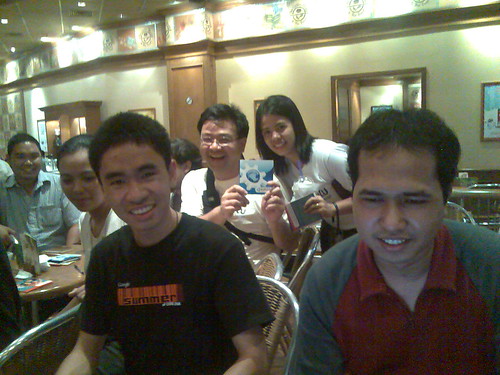
Last night I called Ubunteros nearby Manila for the Edgy Eft (belated) release party at the Coffee Bean and Tea Leaf at Greenbelt 3. Little did I know that there will be a lot of folks coming from the just-concluded FOSS@work workshop joining in the fun, thanks to Yolynne Medina and Eric Pareja. Diane Gonzales and I got to the venue first, then followed by the FOSS@Work folks. Dominique Cimafranca, Migs Paraz, Ranulf Goss, Jopes Gallardo, and Joel Bryan Juliano were there too, and all in all we were easily the noisiest group in the coffee shop, seemingly occupying the entirety of the place. I originally planned to move the group to have dinner somewhere, but along the way everybody seemed to forgot dinner and we quite engaged in talking to everyone else. It was terrific. The 2 boxes of Edgy ,K,Ed Ubuntu CDs I brought were easily given away to everyone; we even had them exchanged and autographed (naks!) reminiscent of what Ealden and I did last February when Mark came here. As a finale, we had a group photo of everyone with their CDs; Dominique remarks that in his informal’ study, more and more women prefer Ubuntu (and I sure do think he’ll be blogging more about this soon. ;) Needless to say, the above photo doesn’t do great justice to what happened last night; it came from my elric which I didn’t get use much as a camera since I too was happily chatting away. That said, I expect RJ Ian will be posting his photos from his brand-spanking-new Kodak camera to the Ubuntu-PH site once he gets back to Mindanao with Yolynne and company. I also think the FOSS@Work folks also have their own photosite or wiki to post more photos, which we’ll be seeing sooner. Jerome Gotangco and Ealden Esca an, the guys whom we all owe Ubuntu-PH to, were unfortunately unable to attend last night, as Jerome was off to Cebu to participate in the ICT congress there, while Ealden was quite busy at work. Hopefully they (as well as last night’s attendees!) can attend the next Release Party for 7.04 (aka Feisty Fawn,) and hopefully it will be just as fun, and be more meaningful if more Ubuntu-PH folks get involved in its development! Update: Yolynne and RJ just posted pics fresh from their arrival to home. Expect more pics later, nicely tagged too…

15 November 2006

Uwe Hermann: Google sponsors the LinuxBIOS project [Update]

Mainboard As announced yesterday, Google has sponsored some work on the LinuxBIOS project, a Free Software (GPL) BIOS/firmware implementation for various architectures (x86, PowerPC, Alpha, and others). LinuxBIOS currently supports more than 100 different mainboards from various vendors. A list of supported chipsets, CPUs, and Super I/O chips is also available, so you can easily estimate how hard it will be to add support for a new mainboard. Most of the mainboards currently supported are high-end server-type mainboards (e.g. from Tyan) and embedded boards. There are not too many cheap, mainstream motherboards supported, yet, but that is about to change soonish. I've been contributing for a while now to the LinuxBIOS project in various areas (e.g. adding support for a bunch of Super I/O chips, which are required if you want to get LinuxBIOS debug output over the serial port). But one of my personal main goals for the project is to support a reasonably high number of cheap, standard desktop mainboards, and I'll concentrate my efforts in this area in the future. Any help from further developers with experience in the hardware, embedded, or low-level firmware area is very appreciated! If you're interested, checkout the website and say hi on the mailling list. But I digress. The Google funding was used to create an automated, distributed test infrastructure, which will help...
...to significantly improve the project's Quality Assurance process by creating a completely automated and distributed testing environment. Every single commit results in BIOS images being built for all mainboards, and tested on real hardware located all over the world. So whenever you want to download a LinuxBIOS image, you can now know that it works on a reference machine before flashing it to your system. A per-revision overview is available, as are test results for specific revisions, and you can even get detailed reports that include extensive logs for each motherboard. Developers can also use the build and test system without checking their code into the LinuxBIOS repository. The automatic build client has an option to submit BIOS images to the test system manually; you can see an overview of manually triggered builds. Anyone with a spare board supported by LinuxBIOS is welcome to put it into the automated test system, thus helping the LinuxBIOS project increase their quality on your hardware.
LinuxBIOS QA 1
LinuxBIOS QA 2
This is a great thing, and something which not many projects out there can claim to have. Automated test-suites in the software development "scene" are used seldomly enough (which is bad), but in the low-level hardware/embedded area you're usually stuck... (See also Golem and Heise if you speak German) Update 2006-11-15: Ok, the site is slashdotted right now. Maybe you can try archive.org or the Google cache...

Wouter Verhelst: #include <stdarg.h>

The stdarg API, which allows you to use a variable number of arguments to a function in C, is pretty fun. However, it's also pretty limited in what it allows, to a degree that it invites people to try and find workarounds to things you can't do with the API as it is documented. Unfortunately, this almost always breaks when the software is compiled on hardware that happens to be not your own, as there is a reason why stdarg is implemented the way it is: portability. A (not so) recent discussion on #debian-devel on OFTC showed to me how this confuses many people. Don't worry—it confused me too, the first time I had to think about it. The problem is that in order for stdarg to be able to do what it does, it needs to read function arguments from whereever they are stored. Where that actually is depends on the operating system and the hardware you're using; it could be on the stack, but e.g., the SPARC architecture actually has a mechanism to pass parameters using processor registers (although those are most likely not used when stdarg is in use, since the number of parameters that can be passed that way is obviously pretty limited). If parameters are on the stack, then you may be able to just access the memory as you would access any random variable; but it could also be the case that you need to take some specific steps to access the stack, or perhaps your architecture or operating system has some protection for stack-based security attacks, which would make it impossible to directly access memory on the stack that is actually part of another subroutine. So if you try to do anything that isn't defined in the stdarg api (like trying to figure out the number of arguments by peeking inside the va_list data type, or passing a va_list to another function without using the C99 va_copy macro) will break. Yes. Very sorry.

13 November 2006

Wouter Verhelst: #include <stdarg.h>

The stdarg API, which allows you to use a variable number of arguments to a function in C, is pretty fun. However, it's also pretty limited in what it allows, to a degree that it invites people to try and find workarounds to things you can't do with the API as it is documented. Unfortunately, this almost always breaks when the software is compiled on hardware that happens to be not your own, as there is a reason why stdarg is implemented the way it is: portability. A (not so) recent discussion on #debian-devel on OFTC showed to me how this confuses many people. Don't worry—it confused me too, the first time I had to think about it. The problem is that in order for stdarg to be able to do what it does, it needs to read function arguments from whereever they are stored. Where that actually is depends on the operating system and the hardware you're using; it could be on the stack, but e.g., the SPARC architecture actually has a mechanism to pass parameters using processor registers (although those are most likely not used when stdarg is in use, since the number of parameters that can be passed that way is obviously pretty limited). If parameters are on the stack, then you may be able to just access the memory as you would access any random variable; but it could also be the case that you need to take some specific steps to access the stack, or perhaps your architecture or operating system has some protection for stack-based security attacks, which would make it impossible to directly access memory on the stack that is actually part of another subroutine. So if you try to do anything that isn't defined in the stdarg api (like trying to figure out the number of arguments by peeking inside the va_list data type, or passing a va_list to another function without using the C99 va_copy macro) will break. Yes. Very sorry.

MJ Ray: The Wikipedia Example

Another example of similar problems with Wikipedia's randomly-biased editing was given in Toto, I Don't Think We're in Wikipedia Anymore [Adam Rosi-Kessel's Fair and Balanced Weblog]. I didn't try editing Wikipedia back in 2001, so I can't comment on whether this is a recent problem, as suggested, but it is a problem.

Next.

Previous.