Search Results: "cas"

22 January 2012

Kees Cook: fixing vulnerabilities with systemtap

Recently the upstream Linux kernel released a fix for a serious security vulnerability (CVE-2012-0056) without coordinating with Linux distributions, leaving a window of vulnerability open for end users. Luckily: Still, it s a cross-architecture local root escalation on most common installations. Don t stop reading just because you don t have a local user base attackers can use this to elevate privileges from your user, or from the web server s user, etc. Since there is now a nearly-complete walk-through, the urgency for fixing this is higher. While you re waiting for your distribution s kernel update, you can use systemtap to change your kernel s running behavior. RedHat suggested this, and here s how to do it in Debian and Ubuntu: In this case, the systemtap script is changing the argument containing the size of the write to zero bytes ($count = 0), which effectively closes this vulnerability. UPDATE: here s a systemtap script from Soren that doesn t require the full debug symbols. Sneaky, put can be rather slow since it hooks all writes in the system. :)

2012, Kees Cook. This work is licensed under a Creative Commons Attribution-ShareAlike 3.0 License.
Creative Commons License

Jon Dowland: bugs

[pic]
Bugs I've hit in GNOME 3, in the last 5 minutes: I didn't set out to bug-hunt this morning, I'm actually trying to get some work done. Whilst this is a particularly bad case of stacked-bugs, it's unfortunately, pretty representative of what it's like to try and use a Linux desktop at the moment. Every day I go through a similar experience. I've just had to give up and log out and back in again. The shell path bug above has re-surfaced in a new session. Great. I'm waiting on a delayed laptop at work. I'm very tempted to cancel the order and just use a Mac Air instead (we have one spare). It seems I'm walking the inevitable path of F/OSS desktop frustration and the end for many people seems to be the Mac perhaps I should spare myself the pain of the journey. In the mean time, It's bye-bye to GNOME and off to Xfce for me.

21 January 2012

Andrew Pollock: [debian] Bits from the ISC DHCP Maintainer

I really should write these a bit more often. Wow, I can't believe it was over 4 years ago that I started having occasional face to face meetings with the ISC DHCP folks. The entire ISC DHCP team (of 5) was in town for an all-hands meeting, and Larissa Shapiro, the Product Manager for DHCP (and BIND) suggested it would be a good opportunity for another catch up. Given the current (bad) state of DHCP 4.2 in unstable, I thought this was an excellent idea, and so we all had lunch on Tuesday. I pretty much set the agenda, and it was The general state of 4.2.2 in Debian In a nutshell, it's a bit of a mess. We've got release critical bugs, build failures, the whole cat and kaboodle. It makes me very sad, because 4.2.2 was the first 4.2 series that I had a chance to upload, and I was very excited to do so, because it contains the hotly desired LDAP patches merged upstream. Unfortunately, it's also got the beginnings of the BIND/DHCP merger that's going to be BIND 10, and that is all a bit of a mess. It's directly responsible for the kFreeBSD FTBFS and the introduction of the RFCs, which are both keeping 4.2.2 out of testing. I gave the ISC folks a high-level overview of how Debian development works, and the normal progression of packages from unstable to testing to stable, and the release process and whatnot, and impressed upon them the implications of the current release critical bugs. I also showed them how Ubuntu development fitted into the picture. Finally, I showed them the popcon statistics for DHCP. I think they found it useful. FTBFS issues on kFreeBSD This was a good segue to #643569. The issue is actually with the embedded BIND sources. I'd already forwarded this bug upstream when it first happened, but I don't know what had happened to it. They seemed to act as if this was the first they'd heard of it. I'm hoping that they can get this fixed in 4.2.3, which is due around the end of the quarter. Embedded BIND sources Since we were already talking about an issue caused by the embedded BIND sources, we moved on to talking about #645760 and the existence of the embedded BIND sources in general. It should be pretty straightforward for them to strip the RFCs out of the source. They've already done it in the past for the DHCP sources, so I'm also hopeful that this will get resolved in 4.2.3. The issue of the embedded BIND sources is apparently a bit more complicated, although the day before our meeting, Michael Gilbert filed #643569 and #645760, so I hope that the ISC folks can take a look at these patches and see if it's feasible to adopt them. Patches for GNU/Hurd Finally we talked about #616290, which I know is near and dear to the GNU/Hurd porters' hearts. We probably spent the most time talking about this. The DHCP developers have concerns about accepting a patch for an OS that they do absolutely no testing on, and also questioned the viability of the OS in general. They stressed that they're fairly thin in numbers relative to what they have on their plate to achieve this year, and so pushed back pretty firmly on accepting the current patch. I relayed the frustration that the Hurd folks were having about a lack of dialogue around the patch (most of the interaction has been via an ISC support person). There was actually a bit of a split between the developers, with one of them appreciating that the Hurd was unlikely to go anywhere as a platform without a working DHCP client, so in some regards, they were condemning the platform by taking the position they were taking. They're going to go away and take another look at the patch and try to come back with some actionable feedback on what needs to change to make it more acceptable to them, so we'll see what comes of this. I'm not particularly optimistic that anything acceptable to the GNU/Hurd folks is likely to happen any time soon, but maybe if the patch gets cleaned up a bit more, I'll just bite the bullet and start applying it to the Debian package. BIND 10 One of the guys is more involved in BIND 10 than DHCP, and asked if I could help out with the packaging of a build dependency for BIND 10. It seemed like #578387 was languishing so I offered to pick it up. I've not packaged a library before, mainly because the library packaging guide has scared me off it (I feel I lack the deep C fu that seems necessary), but I figured that this would be a good learning opportunity, so I'm going to dive in.

20 January 2012

Eddy Petrișor: HOWTO: GIMP - create a text-with-halo effect

A small tutorial I made about an effect I used in the previous interviews (in English), so, for consistency, I had to recreate it, even after Kino was no longer available in Debian Wheezy.

<iframe allowfullscreen="allowfullscreen" frameborder="0" height="360" src="http://www.youtube.com/embed/6y-6V1Dj1p0" width="480"></iframe>

I'll probably upload more videos like this about cinelerra, pitivi, gimp, audacity and other software I use for the work I do for our Sceptici n Rom nia / Skeptics in Romania podcast (The podcast is in Romanian, but we are preparing also a project for the international audience, too).

And in case you are wondering, yes, this podcast is part of the reasons I wasn't able to do any work for Debian lately!

19 January 2012

Obey Arthur Liu: Google Summer of Code 2009 at Debian needs you


In case you've been living under a rock these past years, I shouldn't have to tell you what this is about :). Well, just in case.
The Google Summer of Code (GSoC) is an international program that offers student developers stipends to write code for various open source software projects. Debian has participated since 2006, mentoring dozens of students on Debian projects.

The important part of the 2009 edition of the Google Summer of Code is going to start next week with the Organizations application period (March 9th). By that time, we should have listed a reasonable number of ideas on the dedicated wiki page.

We will try this year to improve on the performance of the previous years, starting first with more and more dedicated manpower. If you have some time to spare to help manage our Summer of Code bid this year, we can make it a much better experience for the students and for Debian.

Help is immediately needed in many areas. Some examples:

By mid-March, we will need:

Further in the spring:

In the summer:

As you can see, there is much work ahead. It's time to pitch out your favorite pet project :)
Remember! The Summer of Code has become a prominent outreach forum for open source organizations. It puts a spotlight on each of them to provide a well-rounded and deep experience of open source development.

Right now, you can help with the Wiki, join us on IRC on #debian-soc on OFTC or join the mailing-list at soc-coordination on alioth.

The short "flyers-friendly" URL for the Summer of Code at Debian is : <http://wiki.debian.org/gsoc>. Publicize it!

See you this summer!

18 January 2012

Tanguy Ortolo: Debian buttons for Firefox/Iceweasel

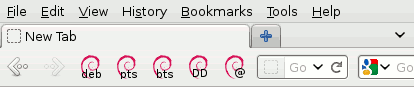
As a Debian administrator, power user or contributor, one often goes to look for information about a package, a bug, a developer or a message from the mailing lists. If you are in this case, you may be interested in the Firefox/Iceweasel extension Debian buttons , written by Damyan Ivanov and packaged by myself.
An Iceweasel toolbar with five Debian-related buttons
Description When installed, this extension provides five buttons, that you can place in your Firefox or Iceweasel toolbar. These buttons take the text from the X11 PRIMARY selection and act as shortcuts to the web pages corresponding to: Typical use case Let us imagine you see the following sentence on IRC:
12:42 < Tanguy> I am packaging a cool Firefox/Iceweasel extension (ITP #654896)!
If you want to check out the corresponding ITP report, just double-click on the bug number to select it (do not worry about the leading hash or even the possible trailing bracket, it will be handled), and click on the BTS button on your browser toolbar: here you are! Depending on your needs and habits, this extension may considerably speed up and simplify your quests for information. At least, it does for me, so I hope you will enjoy it too!

16 January 2012

Eddy Petri&#537;or: What's common between Windows 7 and GNOME 3 / gnome-shell?

Update: I managed to make sound work. For some weird reason, a mute switch option of some the many (and who knows how useful) switches of my sound card was enabled. Now the damn thing works. Did I mention that since I did the upgrade all my sound cards (I have a USB sound card, too) have listed as available inputs all the inputs of my internal sound card (mic, front mic, line in, CD, etc.) in Audacity? That makes for a very confusing and loooong sound input sources list! The upside is that I can finally record clips from televisions that do not provide such a feature and FastVideoDownload doesn't handle.

I also seem to have found a possible fix for the caps-ctrl issue in Xfce4 (obviously, setting "-option ctrl:swapcap" in ~/.Xkbmap, instead of that Alt modifier).


As I said in my previous post, I will tell you what do GNOME 3 and Windows 7 have in common.

Before everything else, I want to make it clear that when I am saying GNOME 3, I am referring to Debian Wheezy's GNOME 3, since I recently upgraded from Squeeze on my laptop. I'll probably drop a line or two about that, too.

First, I'll tell you about the (boring, probably for many) experience with Windows 7. As I said before, my new job requires me to use a Windows machine, so up until a few months ago I was using Windows XP with some additional software and tweaks to make it usable. Then came the Windows 7 upgrade . I am using quotes since the more appropriate term would be fresh installation on a new partition , not even close to what Debian users are used to call an upgrade.

So after a fresh Windows 7 installation, my first shock was the fact there was NO Quick Launch*. Some of you might be laughing, but I had never used Windows 7 up until then, just saw it on a laptop of a friend of mine (Ovidiu, one of the guys with whom I am doing this podcast, went to Denkfest with, and made these interviews). That was the first shock. Initial discussions about this with Windows users lead me to believe Quick Launch was dead and for some unexplained reason, I believed them. Later, much later, a week ago, to be precise, I found out that you can bring back the Quick Launch through some convoluted way**. Up until that point I had to have some icons pinned to the task bar, but some others on the desktop (and I hate that) because some of them, like Cygwin, if pinned, would start a cmd console, since Win 7 pins the process, not the starting script.

Among other things which broke in Win 7 and used to work fine in XP, the Virtual Dimension application which provides me with a virtual desktop, was the first one which was broken. I have been using a liniar 4 desktops-wide virtual desktop for over 5 years and I am worthless and inefficient if all my apps are on the same desktop. Mail application is always on the first desktop, work and file managers are on the second, the third is for extras and multimedia editing while the fourth is my gateway to the internet, containing the browser, instant messenger, or whatever.

The shortcuts I use to get to the various desktops are Win+1 ... Win+4 keyboard shortcuts, but the M$ Evil Empire decided that those shortcuts are going to start or bring foreward the first, second and so on applications pinned on the task bar. And you can't change those shortcuts***. Nor is disabling just those possible since they are all disabled through a huge switch which disables ALL Win+x keyboard shortcuts, among which Win+E (file expolrer) and Win+D (Show Desktop) were also. Luckly, Win+L (lock screen) was not disabled. So I disabled al those Win+ shortcuts, since I need virtual desktops.

Now, imagine if I had to start a Cygwin console and I had all sorts of apps open! Win+D was disabled, so I had to minimize the apps covering the desktop shortcut for Cygwin, click on the icon to start it, bring back the minimized windows and go on with my work. What a waste of clicks, mouse movement, energy and time, just because some dudes thought a Quick Launch-like feature was useless****.


You might wonder already what do those '*' sings mean. Well, sadly, that's what GNOME 3 / gnome-shell and Windows 7 have in common.

Gnome 3 was a shock for me. An empty desktop right after upgrade. No panels, no shortcuts*, no power indicators, no wicd indicator, no virtual desktops, no desktop icons, (I have a few dirs and docs there). Sounds like an Evil Empire decision, doesn't it?

Luckly I have been using Tilda as my always-ready console and I could fire up iceweasel from the console in order to understand where my panel disappeared.

I then realised that the upgrade brought me Network Manager, that app which wicd replaced. As a consequence, I had no working wlan since Network Manager made sure to mess up with the network manager I chose.

After looking through the documentation of Network Manager and realising I either had it set up to leave wlan0 alone or I didn't understood NM's documentation, I simply stopped the service, which let Wicd its job flawlessly.

The first thing I searched was Gnome 3 panel or something of that sort and I was confronted with the obvious option to appeal to the Forced Fallback Mode which was disabled. I figured I either had an old version, or Debian disabled this feature (hoping they provided an alternative). There was also the option to conform to this convoluted way of working** with Actions and such uselessness like that. I still wonder, what is the purpose of the Favourites bar on the left side, since it's accessible only after wasting a lot of mouse movement and time? For Joe's Pesci sake, I use focus under mouse just to avoid needless mouse and keyboard manipulation. Why? Why? WHY would I want every time I need to start or SWITCH to another application to move the mouse to the upper-left corner then take my hands off the mouse to type, move the mouse downwards or move across the whole width of the screen to get to my beloved virtual desktops and pick the app I want?

Making a long story short, after even trying XFCE4 (which for some unknown reason resets almost immediately my keyboard layout to the default layout with the Caps on Caps, instead of my preferred and set Ctrl on Caps - yes, it's global), I managed to find GNOME Shell Frippery** which made the experience better.

Later I found out that GNOME 3's file manager, Nautilus, has decided that an up on level button is useless, since the default is to use that uncopy-pastable button location bar instead of a sane text location bar. And it seems the GNOME developers decided this*** and I should conform to it.

To add insult to injury, those icons on my old panel are apparently useless**** and even in the fallback version I can't get them back. Or so the GNOME developers decided.

At some point this sunday, don't know how or why this change happened, producing sound was impossible. I know the problem is pulseaudio since when I kill the pulseaudio daemon from the console I can play audio. BTW, great timing, just when I needed sound the most, before releasing episode 32 of our podcast (yay, I reaslised that xfce just decided to reset my caps to be caps, after setting to ctrl a few minutes ago).

I know I praised pulseaudio when I first tried it, but failing to make it work out of the box or after some tinkering is a deal breaker for me, so I removed it. Now I find it that is a default in GNOME, yet all it manages to do is prevent audio from working. At least on my machine.

Other problems? Gnome Power Manager manages to hang and block my session, GNOME managed somehow to fail to start at some point. Yeah, and that sound problem which I didn't fix yet, didn't went away after removing all the pulseaudio packages which could be removed (e.g.: ryhtmbox depends on libpulse0, same do some other apps like audacity, so I couldn't remove all pulse related packages).

I got involved with Debian and GNU/Linux because it was tweakable and customisable, didn't use to force all sorts of option on me and now I find with its increasing popularity it becomes more and more like a product of a corporation which decides to change some things just to change and totally disregadring user experience and uses.

So, in the light of all of these problems I think it's time to probably consider trying KDE. Is it any good lately?

Yves-Alexis Perez: Advocating people for hardware sponsoring

Our Dear Project Leader, Stefano Zacchiroli, regularly mentions the fact that there's an amount of Debian money available for hardware sponsoring of Debian developers, but it seems that not much people benefit from it. Each time I saw one of this reminder, I wonder if I should apply, and the anser is usually no. The fact is that I don't think any new laptop or desktop to do my Debian stuff, and the last time I bought a box (my x201s last summer) it was not really specifically for Debian tasks so I didn't dare to ask (not to mention the fact I bought it because I did have the money to do so). And I think this is mostly the problem. I might be wrong, but I think that most people which could benefit from this just don't dare asking or don't estimate themselves eligible for it. When I saw Ben Hutchings post, where the first thing he says is about how hardware is expensive, I thought hey, he should get some Debian money for buying new hardware: building kernel is really time consuming and having multiple powerful cores, more ram and fast disks/SSDs really helps . Turns out that Ben just didn't really want to spend too much money there, but the case still stands. We also see from time to time people saying they'll be offline for a while because of broken laptop or something like that. Once again, maybe those people wouldn't mind some help from the Debian project, and maybe they just don't think about asking, or they don't dare. So thinking about it a bit more, I think I wouldn't dare asking money for myself, but maybe I could dare asking money for other people (this is a bit like the flattr posts by Rapha l Hertzog, where he incited people to give money to projects he liked). If I'm not alone in this case, maybe those Debian developers who think some of their peers would benefit some hardware could drop them a mail with leader@ on copy, to propose just that. No need for huge publicity on that (in order to not embarass people), though the transparency rules still apply when it comes to Debian money.

What do you think? It's not really a formal proposal (thus the post on my blog and not a mail to -project), but if that fits you, then nobody prevents you to start yourself. And if you consider it a bad idea, well, nothing forces you to do anything.

Amaya Rodrigo: Life update

I moved 600km away from Madrid, I quit my job because with all the coming and going I was barely making any money, and in order to keep a healthy, active mind, I'll keep working for Debian. I also started occasionally helping kandinski with sysadmin stuff for Barrapunto (the Spanish SlashDot), also for love, and because of incredible timing.

We also now have a new cat (an orange tabby named named gato, not very original nor practical as it's our fifth cat in the household). We also now have a small garden the cats love, even in bad, evil rain. I also now have a bright new horizon where a vegetable garden, civil marriage, quitting smoking, and motherhood will be slowly making it into my life as the dust settles down.

Last, but not least, I'll try to get back in touch with all the people I lost contact with because of, you know me, another one of my falls through the rabbithole I call depression. I missed two Debconfs in a row, this time it was bad. But I found the way out and I am back. So hurry up and drop me a line before three years (that's when i believe the rabbithole will eat me again). At least now I understand the cycles. It still sucks, but helps feel in control. Or something.

Anyway, if you ever show up close to Seville, I am up for keysigning, beers and rl spammer harassing, as always.

15 January 2012

John Sullivan: At FOSDEM in February

I will be helping to represent the FSF at FOSDEM next month in Brussels. I'm speaking in the Legal Issues Devroom on Saturday 2012-02-04. The presentation is called "Is copyleft being framed?":
This short talk will address the following questions, to inspire discussion and contemplation about how we frame descriptions of the state of licensing in free software.
  • Numbers are increasingly being cited to show that the use of copyleft licenses, specifically the GPL, is declining. What do these numbers actually show, who is propagating them, and why? What do or might other numbers show?
  • Is the "percentage of free software projects which use copyleft licenses" a useful way to judge the success of copyleft? Does an increase in the percentage of projects using non-copyleft permissive licenses indicate a failure of copyleft?
  • As a small related case study, what role have the licensing terms of popular mobile application stores played in this debate, and how have those terms changed the frame of the discussion?
Let me know if you'll be there too!

Roland Mas: Looking for the ultimate distributed filesystem

(This is not quite a Dear lazyweb post. If anything, it's Dear lazyweb, I've done my homework, now what? ) I'm looking for the ultimate distributed filesystem. Something that's simple to use, redundant, fault-tolerant, and still smart enough to avoid the more obvious performance chokepoints. Ideally, it should work for all of the following sets of files: The requirements on the ultimate distributed filesystem (which I'll call UDFS for short, otherwise you'll get bored and go look at pictures of kittens) are as follows: Quite a few constraints, eh? I have a feeling they are not mutually incompatible though, so I had a look at several candidates. I started with Wikipedia, and I followed the links to Tahoe-LAFS, XtreemFS and Ceph. The following is my evaluation of these candidates based on much reading of docs and websites and wikis, some questioning on IRC, and very little testing. The overall picture seems full of good things scattered across different solutions, but unfortunately none of the existing ones seems to address the whole problem; at least, not my whole problem. It would be good if each focused on one layer and did that layer well, but that seems not to be the case either, so they can't be combined to get the best of all worlds. It may be that I'm missing something, or that I failed to read some docs properly, or that I misunderstood the docs, or that the docs themselves are simply lacking; but my ideal UDFS currently doesn't seem to exist as a turn-key solution. However, the main pieces are available, and implementing the remaining parts may be doable. My humble idea of a way forward would be based on Tahoe-LAFS, with the following three changes: Also nice to have would be a way to work with multiple introducer nodes, but that seems to be in the works already. This would be pretty damn close to my UDFS; read/write performance would certainly be far from what can be obtained on native filesystems stored on local disks, but my use cases involve reasonably small files for which instant access is not compulsory, and the filesystem cache would probably absorb most of the access times. In case anyone is looking for ideas of things to do in their spare time, here are rough sketches of other possible UDFS implementations I thought of. These are wild ideas, and I'm not even sure they could be doable in practice: Such is the state of my research so far. I would welcome feedback, pointers to things I neglected to read, corrections for things I misread or misunderstood, comments on the ideas and so on. I'll probably post an update if my search goes significantly forward. Update: I've already received two pieces of feedback, including a lengthy one with corrections about Tahoe-LAFS. For the sake of fairness, I'll solicit (and wait for) the same from the other candidates I looked at. I was also pointed at HekaFS, GlusterFS and git-annex, which I'll have to look at in more details. Other suggestions are still welcome, but the more I get, the more the full update will be delayed. Thanks already!

14 January 2012

Ben Hutchings: Installing Debian GNU/Linux and Windows dual-boot under UEFI

I thought it was about time to get a faster machine for... well, mostly for compiling kernels faster, but I'm sure I will find other applications for it. I was originally intending to upgrade my laptop (Thinkpad T61, 1.8 GHz Core 2 Duo) but it seems that in the 3 years since I bought it second-hand laptop prices have not dropped in line with Moore's law. So instead I decided to upgrade (well, replace most of) a desktop PC. The last time I got a new desktop at home was in 2002. It has an Athlon XP, PATA drives and a huge CRT monitor. It has had some upgrades since then (DVD writer, more RAM, slightly faster CPU, replacement fan and PSU). Obviously it was time to replace motherboard, CPU and RAM. Not so obviously, the PSU needed changing again as modern CPUs apparently need more 12V electrons (?!). The DVD writer was salvageable via a USB adapter and its local HD is currently a laptop drive (the only spare SATA HD I had). The monitor is of course reusable, though the firmware setup program doesn't entirely agree with it. Windows Yes, I do sometimes run Windows. It's for games, and also seems to be needed for streaming video with stupid DRM. On the assumption that Windows is less likely to play nice with an existing installation, I tried installing it first. The firmware appear to allow me to boot the DVD in either BIOS or UEFI mode, so I selected the UEFI option. This worked so far as loading the initramfs (or whatever the Windows equivalent is) but then Windows was lacking a driver to access the DVD. This stumped me for a day or so until I realised I had plugged the drive into a USB 3 (XHCI) port. Apparently Windows 7 SP1 still doesn't include an XHCI driver in the installer (but neither does Debian 6.0.3 - we should fix that). The installation was mostly uneventful after this. The Windows installer includes a reasonably capable partition editor. Debian Installation of files was entirely uneventful. The installer correctly detected the GPT (GUID partition table) created by Windows. However, it was not able to install a boot loader. Currently it only includes support for the LILO and GRUB-PC boot loaders that run under BIOS. After much experimentation and cursing, I found instructions for installing Debian Squeeze on XServe 3.1 by Jan Peter Alexander Rajagukguk, which put me on the right track. It seems that the grub-install script for GRUB-EFI in squeeze (and maybe other parts of the package) doesn't actually work. However. JP's direction to build GRUB from source is no longer necessary. Here's what I did (minus the mis-steps):

  1. Boot the installer in rescue mode and open a shell on the installed system:
    # # We start in dash, so switch to bash.
    # exec bash
    # mkdir -p /boot/efi
    # # Mount the EFI boot partition by UUID.
    # # It's probably called sda1 now, but is subject to change.
    # ls -l /dev/disk/by-uuid
    ...
    # echo >>/etc/fstab 'UUID=efi-boot-uuid /boot/efi vfat defaults 0 0'
    # mount /boot/efi
    # # Enable unstable sources, but use stable by default
    # echo >>/etc/apt/apt.conf 'APT::Default-Release "squeeze";'
    # echo >>/etc/apt/sources.list 'deb http://cdn.debian.net/debian/ sid main'
    # apt-get update
    ...
    # # Install unstable grub-efi-amd64
    # apt-get install -t unstable grub-efi-amd64
    ...
    # # Install GRUB to the EFI partition.  The '--removable' options
    # # inhibits setting EFI variables, which won't work because we booted
    # # through BIOS emulation.  Instead, it installs as the default boot
    # # loader.
    # grub-install --bootloader-id=GRUB --removable
    # # On the AMI/ASUS firmware, you cannot select a new bootloader
    # # directly but can invoke a 'shell'.  So I made GRUB the shell:
    # cp /boot/efi/boot/grub/grub.efi /boot/efi/shellx64.efi
    # exit
    
  2. Reboot and select GRUB as the boot loader if necessary. In my case I had to enter the setup program and select 'EFI shell'. Debian should now boot from the hard drive.
  3. Add a non-volatile boot option for GRUB (and make it the default):
    # apt-get install efibootmgr
    ...
    # modprobe efivars
    # efibootmgr -c -l '\efi\grub\grubx64.efi' -L GRUB
    

Ben Hutchings: IGMP denial of service in Linux (CVE-2012-0207)

The bug report Simon McVittie reported in Debian bug #654876 that his laptop running Linux 3.0 or 3.1 would sometimes crash (panic) while idle. He initially suspected a driver bug, but the screen did not show any information about where the original fault occurred. However, using netconsole, he was able to capture a full log of the crash. This showed that a packet received through the wireless interface was being processed by IGMP, which then divided by zero. IGMP IGMP is part of the IPv4 protocol suite, supporting multicast routing. Every multicast address corresponds to a dynamic set of hosts, called a multicast group. Multicast routers can send query messages asking which hosts belong to which groups, and hosts using multicast report back at intervals. Routers can then limit forwarding of multicast packets to the interfaces where the group has members. More sophisticated switches can also snoop IGMP and use it to limit their multicast forwarding. There are unfortunately three different versions with semi-compatible message formats. In version 1, the maximum reporting interval (Max Response Time) is fixed as 10 seconds, but from version 2 it is specified in query messages. The Linux IGMP implementation supports all three versions. It distinguishes query messages as specified in RFC 3376 section 7.1: v3 messages are longer than v1 or v2; v2 messages have a non-zero Max Response Time whereas v1 messages always have zero. It is possible to force use of a specific protocol version, but normally if there are multiple multicast routers using different protocol versions it will respond according to the earliest protocol version in use so that all routers can understand its responses. Source and fix for the bug Linux 2.6.36 included two fixes to the version selection logic. Unfortunately, the second of these introduced the bug in question. While v2 query messages cannot possibly have zero Max Response Time (as that would make them v1), v3 query messages can. What this means is unspecified, but the Linux IGMP code previously treated it as the minimum valid value of 1/10 second. But in the case where a v3 query is received and a v2 query has also recently been received, this is no longer done. This results in a reporting interval of 0 seconds and a division by zero when deciding the initial random delay. The fix for this is pretty obvious. It is included in Linux 3.0.17, 3.1.9, 3.2.1, and the Debian package version 3.1.8-2. Security impact This is easily exploitable for denial of service within a local network. Linux does not check the destination address of IGMP queries, so it may also be possible to attack a target through its unicast address from several hops away. The attacker only needs to send a single IGMPv2 query followed by a single IGMPv3 query with zero Max Response Time. All systems running Linux 2.6.36 or later (up to the above fixed versions) with any active IPv4 multicast listeners (other than for the 'all hosts' address) are vulnerable.

Christian Perrier: Aptitude revival

Maybe many people have missed this: Aptitude package manager is undergoing a revival. Two fellows, Daniel Hartwig and Manuel A. Fernandez Montecelo, started triaging bugs and preparing a possible new version. Daniel Burrows, who maintained it for years (and did a really good job in this, given the high exposure of aptitude, which happened to be the recommended package managers during a few years), has currently less free time for doing the work. So, this is really great to see people motivated in taking the job over. In case you want to help, please joing the "aptitude-devel" mailing list on lists.alioth.debian.org. There is an Alioth project but Daniel is currently the only administrator. I might ask for admin privileges so that I can validate new team members. Of course, I personnally can't do much in this (C++ programming, coding, ah ah ah...things that are black magic for me), except my usual help for i18n/l10n. But, at minimum, I can make noise about this effort to encourage the volunteers who commit themselves to revive the project. And, I can certainly help by sponsoring their work (none of them is DD as of now) even if I am not skilled enough to review everything. I don't want to see good work wasted because people insist on nitpicking each and every commit line before "approving" it (any idea what I'm talking about, here? :-)).

13 January 2012

Jon Dowland: vi

As seen on reddit: an old Bill Joy quote often banded about as part of the (largely synthetic) vi-vs.-emacs holy war starts as follows:
vi was written for a world that doesn't exist anymore
The context of that quote is:
I was trying to make it usable over a 300 baud modem. That's also the reason you have all these funny commands. It just barely worked to use a screen editor over a modem. It was just barely fast enough. 9600 baud is faster than you can read. 1200 baud is way slower. So the editor was optimized so that you could edit and feel productive when it was painting slower than you could think.
(source: the register). Furthermore:
unless you decide to get a satellite phone and use it to connect to the Net at 2400 baud, in which case you'll realize that the Net is not usable at 2400 baud.
You don't need anything as esoteric as a satellite phone: a cellular mobile phone will suffice. I've no idea what the effective/equivalent baud rate of GPRS is (or EDGE), but I have a new-found appreciation for vi's design goals having tried to run an SSH session over such a connection.

Rapha&#235;l Hertzog: People Behind Debian: Steve McIntyre, debian-cd maintainer, former Debian Project Leader

Steve McIntyre has been contributing to Debian since 1996, 2 years before I joined! But I quickly stumbled upon Steve: in 1999, he was struggling with getting his debian-cd script to produce 2 ISO images (it was the first time that Debian did no longer fit on a single CD), I helped him by rewriting debian-cd with a robust system to split packages on as many ISO images as required. I remember those times very well because Steve was very supportive of my efforts and it was a real pleasure to get this done. His friendly nature probably also explains why he got elected Debian Project Leader twice! Anyway, enough history, check out his interview to learn more about the great work he s doing nowadays. My questions are in bold, the rest is by Steve. Raphael: Who are you? Steve: I m a professional software engineer, 37, living in Cambridge (England) with my new wife Jo. I studied for the EIST degree at the University of Cambridge, then (like many people here, it seems) I just forgot to go home again afterwards and settled here. I spent more of my study time playing with Linux than working on my degree, so I guess I m lucky that it worked and I found a career in that area! Raphael: How did you start contributing to Debian? Steve: During my time in college, I started hacking on software in my free time, using Slackware as my first Linux distribution from the middle of 1994. After encountering more and more problems with Slackware, I was encouraged by a number of friends to make the jump over to Debian and in October 1996 I did. The installation process back then was much harder than anything people see today, but after a long weekend I finally had my Debian system up and running. I was already one of the main upstream developers for the Mikmod music player at that time, so that very same weekend I applied to be a DD so I could maintain it in Debian too. Back then, the NM process was much simpler: I just mailed a key to Bruce and he set me up with an account almost immediately! I then found that Joey Hess had beaten me to it and already packaged Mikmod. Grrr! :-) Raphael: What s your biggest achievement within Debian? Steve: Without a doubt, my proudest achievement within Debian is being elected Project Leader for 2 years by the other developers. It s a great feeling to have earned the trust of your friends and peers, and also a great responsibility to go and help Debian where needed: talking to the press about Debian, assisting wherever problems crop up, etc. The DPL job is certainly a lot of hard work, and I have nothing but respect for anybody who volunteers for it.
It s a great feeling to have earned the trust of your friends and peers.
Elsewhere, I ve been leading the Debian CD team for years too, both doing most of the maintenance of the debian-cd package and producing and testing the regular installation CDs and DVDs that we ship to the world. Again, this is a time-consuming job but it needs doing and it s worthwhile. Raphael: You re currently employed by ARM. What are you working on and are they supportive of your Debian involvement? Steve: The situation within ARM is very interesting; I m employed in PDSW (Processor Division, SoftWare), a new group founded just a couple of years back to help improve the state of software on ARM. Most of the people in the group are working on Free Software at this stage (e.g. toolchains, browsers, Linux kernel), which is lovely. Some of the engineers have also been seconded into a new non-profit company Linaro, which is a collaboration between ARM and a number of other companies investing in core Linux software and tools for ARM-based CPUs. I m one of the ARM engineers in Linaro, and I m a Technical Architect in the Office of the CTO. My role includes looking at future projects for Linaro to help with (e.g. ARM servers), but for the last few months I ve been concentrating on the new armhf architecture in Debian, Ubuntu and elsewhere. armhf is a new architecture in Debian and Ubuntu terms, but it s not strictly a new type of hardware. Instead, it s a new ABI. We have two reasons for doing this work:
  1. It targets the latest version of 32-bit ARM CPUs (v7) and makes better use of the hardware, for better performance. Compare targetting i686 instead of i386, for example. We ll still support the older armel port for the foreseeable future for users with older hardware that can t run armhf.
  2. More importantly: we are standardising on the ABI / compiler options / hardware support for future users.
In the past, there has been a huge amount of specialisation (aka fragmentation) in the ARM Linux environment, and that worked OK for specialised devices that only ever ran the software shipped with them. ARM CPUs are now becoming more and more mainstream, so people will expect to be able to install generic software on their machines. That gives a requirement for a standard base platform, and armhf (arm-linux-gnueabihf in GNU triplet terms) is that standard that we are pushing in the community. Debian, Ubuntu, Fedora, Suse and others are all going to use this, making compatibility possible. I ve been working with a small team of people to make armhf happen, helping where needed: putting together build machines; patching Debian packages directly; discussing and fixing toolchain issues with Ubuntu folks; agreeing ABI specifications with people from Fedora; advising people from other distros bootstrapping their new ARM ports. ARM and Linaro are very supportive of this work, and it s been lovely being sponsored to work directly on Free Software like this. It s work that will directly benefit ARM and its partners (of course!), but it s also helping out more generally too: Debian QA work, cross-build support, bootstrapping efforts, multi-arch. More and more of the ARM market is driven by Free Software, and companies are acknowledging that. I should probably also mention that we re hiring ! :-) Raphael: What are your plans for Debian Wheezy? Steve: There are three main tracks here. Obviously, I m interested in seeing armhf release with Wheezy. We ve just been added to Testing last weekend, so that s going well. We ve got over 90% of the archive built now, and we re mopping up the remaining issues. I m the primary maintainer of cdrkit at this point, but I d prefer to have it go away. Xorriso and the associated software in libisoburn is almost capable of replacing all the aging cdrtools-derived software that we have in Debian, The only missing feature that I m aware of is creating the HFS hybrid filesystems that we use for installations on Mac systems. I ve been talking with the upstream folks about this for some time already, and I m hoping we can finish this soon enough that we can get it into Wheezy. Finally, I ve got the ever-growing wishlist of things for debian-cd. We ve got the beginnings of an automated test suite that Mart n Ferrari has written, but it needs integrating and improving. I want to help get regular weekly/daily/release debian-live builds running on the main CD build machine. There s work needed if we want to make good installation media for the new multi-arch world, too. The Emdebian people are asking for help making CD images The list goes on :-) Raphael: The ARM community seems to be very interested in multi-arch. Can you explain why? Steve: There are a number of reasons for ARM people to be interested in multi-arch; two really stand out for me:
This is potentially the killer app for multi-arch: simply install the libraries for the target architecture [ ], install a simple cross-gcc package [ ] and you re all set.
Raphael: What s the biggest problem of Debian? Steve: For me, Debian s biggest problem has been the same for a long time: we are forever short of enough people to do the work that we re trying to do. That might sound like a weird thing to claim when Debian is one of the largest Free Software projects on the planet, but it s more a statement of just how huge our goals are. Many of the largest things in Debian are developed or controlled by very small teams working very hard, and there s always a risk of losing people due to burnout in those situations.
We are forever short of enough people to do the work that we re trying to do.
Some of the tasks that should be easy given our large membership (e.g. large-scale packaging transitions) can often instead take a very long time. We are fortunate to have more people wanting to join in Debian s work all the time, but we also need to be careful to keep on promoting what we re doing and recruiting new contributors, encouraging them to get more and more involved in core work. Debian gets ever bigger in terms of the size and the number of packages we distribute; we re not currently matching that growth rate elsewhere. Raphael: What motivates you to continue to contribute year after year? Steve: This one is much easier to answer! The thing that first attracted me to Debian was the fact that I could help to develop it, help to decide how things could and should be done within it. Instead of being forced to accept what some corporation decided I could do with my computer, I could change the software to suit my needs and preferences. Alongside that, I could get involved with a strong community of similar people all over the world, all with their own strong opinions about how software should work. I joined in and found it was great fun and very rewarding. That hasn t changed for me in the intervening years, and that s why I m still around. I work on Debian because it helps me to get the OS that I want to use. It seems that lots of people around the world find it useful too, and that s awesome. :-) Raphael: Do you believe that Stefano Zacchiroli will be the first DPL who managed to stay 3 consecutive years on the seat? Would you like him to candidate again? Steve: To be honest, I would be very surprised if Zack stood again for DPL this year. He told me himself that he wasn t planning on it, and I can understand that decision. He s been an awesome DPL in my opinion, and I m glad that he took the job. But: it is also a very difficult and time-consuming task that would be enough to wear down anybody. If Zack does decide to stand again, I would support him 100%. But I know that we also have lots of other good people in Debian who would be ready to take up the challenge next. Raphael: Is there someone in Debian that you admire for their contributions? Steve: There are lots of people I admire in Debian, so many so that I almost don t want to list individuals here for fear of missing people out. But :-) Bdale Garbee has been an inspiration to many of us, for many years. He s technically excellent, a great friend to many of us, an endless source of sage advice and (last but not least) he has some wonderful stories to tell about his experiences over the years. On top of that, he s just cool. :-) Christian Perrier is another exceptional developer, in my eyes he s great at co-ordinating people in translations, working tirelessly to make this very important part of Debian work better and better with every release. He s also a really nice guy and we all love him. I also have to mention Joey Hess here, whether he likes it or not. *grin* He s been responsible for so many good things in Debian over the years, even if he did steal my first package Finally, the teams of people who make sure that Debian is always working: the security team and DSA. The rest of us can choose to take time off from Debian to go and do other things, but these people need to cover things every day. That s a major responsibility, and I salute them for taking on that challenge.
Thank you to Steve for the time spent answering my questions. I hope you enjoyed reading his answers as I did. Note that you can find older interviews on http://wiki.debian.org/PeopleBehindDebian.

Subscribe to my newsletter to get my monthly summary of the Debian/Ubuntu news and to not miss further interviews. You can also follow along on Identi.ca, Google+, Twitter and Facebook.

One comment Liked this article? Click here. My blog is Flattr-enabled.

Michal &#268;iha&#345;: Looking forward to FOSDEM

I just got confirmed my flight bookings for FOSDEM 2012, so I'm looking to meet all great people there again. This year we've again arranged there meeting of phpMyAdmin developers, now it also includes three new faces from last years GSoC. As for my schedule I did not yet find time to check all the schedule, but what definitely sounds interesting for me is Open Mobile Linux Devroom and some talks in MySQL and Friends Devroom. Rest will be (as usual) scheduled on the fly as I meet people there. This year I decided to deliberately skip keysigning as last year I anyway did not manage to attend it and I expect this year to be equally busy. In case you want to meet me there, just let me know, we can try to arrange something in free slots :-).

Filed under: Debian English Gammu Phpmyadmin Suse 0 comments Flattr this!

Russ Allbery: git-pbuilder 1.27

Two changes in this release. First, Guido G nther submitted a patch (which I then mangled) to notice if the DIST ends in -backports and git-pbuilder is calling the builder with an action like create and, in that case, passing --othermirror with the Debian backports mirror. This lets one create new build chroots for squeeze-backports with just:
    env DIST=squeeze-backports git-pbuilder create
without any additional configuration required. Second, Rafa D ugo cki pointed out the cause of the weird error message that I'd been noticing for years: "W: /root/.pbuilderrc does not exist". git-pbuilder runs the builder with sudo when performing an action like login or create, but sudo resets the environment including HOME, so it tries to load .pbuilderrc from root's home directory. This isn't very useful, so now git-pbuilder checks if a .pbuilderrc exists in the user's home directory and loads it with an explicit --configfile option if it does. You can get the latest version from my scripts distribution page, and I expect it will turn up in the git-buildpackage package before long.

Dirk Eddelbuettel: RInside 0.2.6

A new version of RInside, now at 0.2.6, is now available via CRAN. RInside provides a set of convenience classes which facilitate embedding of R inside of C++ applications and programs, using the classes and functions provided by the Rcpp R and C++ integration package. This release has an additional fix for the Windows use case, adds cmake support files for the examples, switches to using the same RNG initialization of time and process id that R uses, and other minor fixes. All changes since the last release are summarized below:
2012-01-11  Dirk Eddelbuettel  <edd>
        * DESCRIPTION: Release 0.2.6
        * DESCRIPTION: Updated Description: text 
2012-01-08  Dirk Eddelbuettel  <edd>
        * src/RInside.cpp: Correct console writer on Windows to not use
        Rprintf (with thanks to both James Bates and John Brzustowski)
        * src/RInside.cpp: Update RNG seeding to same scheme now used by
        R which blends both (millisecond) time and process id
        * src/RInside.cpp: Replace fprintf(stderr,...) with Rf_error(...)
        * src/setenv/setenv.c: Idem
        
        * inst/examples/*: Added CMake build support for all example
        directories kindly provided by Peter Aberline; this helps when coding
        inside of IDEs such as Eclipse, KDevelop or Code::Blocks
        * inst/examples/standard/Makefile.win: Allow for an R_ARCH variable
        to be set to enforce either i386 or x64 builds
CRANberries also provides a short report with changes from the previous release. More information is on the RInside page. Questions, comments etc should go to the rcpp-devel mailing list off the Rcpp R-Forge page.

Next.

Previous.