Search Results: "agi"

15 January 2008

Joey Hess: high country

The past few weekends I've been drawn to the mountains. Two weeks ago I went up on Holston mtn after the snow had melted down here, and enjoyed a snowy hike on the AT. From there I drove over to Shady valley, and found the only gas station I've seen with a wood stove in it. I've never enved a gas station attendant their workplace before, but that was nice. Last weekend Maggie and I went up to Roan mtn. On road up we began to get glimpses of the peak in between the fog, and it looked strange, almost like there was snow, but not as white as you'd expect. While the ground was clear of snow, the windward side of each pine, rhododendron, and leaf of grass in the balds was outlined in a thick coat of frost. Gorgeous. As a sheltered Southerner, I've never seen anything like it, but I think it was soft rime, formed from the fog. We wished we'd brought a camera, but thanks to the magic of the 'net, here's a similar rime on Roan: rimeonroan.jpg

Andrew Pollock: [tech] zomg Zonbu!

Zonbu I've been quietly coveting the Zonbu for a number of months now. I finally caved in and ordered one when we got back from Australia, with the intention of using it to replace minotaur, the computer that exports my RAID10 via ATA over Ethernet to my MythTV box. minotaur is the old daedalus, which I bought back around 2000. It's a VA Linux Pentium III. It's old, noisy, and has no idea what power management is. The Zonbu has more grunt than it (in terms of BogoMIPS), and it's a fraction of the size. Our linen cupboard is now significantly quieter (and hopefully cooler). Heck, hopefully the power bill will be lower as well. Anyway, I put the order in when we returned from Australia, with the expectation that it'd turn up some time while Sarah was in hospital, or shortly afterwards, and I could use the rest of the month that I was off work to play with it. Well, I got an email on the 31st of December, telling me they were out of stock, and unless I wanted to pay $29 more for one with built-in WiFi, I'd have to wait until mid-January. As I just couldn't see the point of having WiFi (or spending more money) and not needing the thing in a hurry anyway, because I had more important things to worry about in the meantime, I opted to wait. This morning, I emailed them to enquire about whether or not more stock had arrived, and they emailed back to say that they were still waiting, but they'd found one they could sell to me anyway. The company happens to be close by in Menlo Park, so I picked it up today in our travels. Let me just say that it is a very cool little computer, just if you use it for its intended purpose. It's running a customised Gentoo Linux, with a 2.6.22 kernel. I'm a bit surprised about their choice of Gentoo. I think they'd be better off partnering with Canonical, given that Mark Shuttleworth is trying to make a Linux distribution easy enough for his grandmother to use. That'd take the work of engineering the operating system out of the equation, then they could just focus on the hardware and a bit of integration with Amazon's S3. The thing I have to give them mad props for is documenting how to hack the tripe out of the box. They tell you how to enable root. They tell you how to enable PXE booting. So once I figured out that the front USB port seems to get treated slightly differently for a USB keyboard than the back ones, it was very easy to PXE boot it and install Debian. I initially started with trying to install Etch, but I kept getting missed interrupts on the CompactFlash device, which resulted in the filesystems panicking. So I gave up and went with Lenny, and presumably because it also uses 2.6.22, everything seemed to go fine. The box comes with a 4Gb CompactFlash card, which is ample for my needs. It's running the 686-optimised kernel, which is probably not ideal, but works. We'll see how things go. Interestingly, I blew another hard drive power supply, exactly like last time. I've no idea if it's the act of plugging everything back in again that's causing the problem, or they're generally flaky, and they don't fail until they're powered off and back on again. Maybe that IEC Y-cable wasn't such a good idea after all. I've now run out of spare power supplies, so I'm going to have to get some more for when these two inevitably fry themselves. Overall, I'm very pleased with this purchase, but it's a bit early to see how it's going to perform. I can't imagine it's going to perform worse than the computer it's replacing, but it was probably never intended for what I'm using it for either... Oh, and I discovered vblade-persist, which seems to be a very nice framework for managing ATA over Ethernet exports. Now I just need to get my hands on a big tub of Lego to build a nice chassis for the whole thing.

David Moreno Garza: ##debian-offtopic

It’s incredible how one troll can split a channel up. It’s incredible how the sexist shit can be spread all over the place. It’s incredible, not wait, not incredible, it’s sad, sadder and sadder, to see what Debian has become. The Debian social life has become a center for dramas of all kinds, since sexist traumas, transgenders issues, people with too much free time, real good technical people leaving, freaking big farts in Debian thinking on leaving the project, elitist dolls clubs, small wannabes who think they can treat other people unrespectful. Debian itself is now its own slow killer. There has always been old people, new people, people leaving and people entering, but when you see other projects just as good as we were, some of us remain because of the social side of Debian. But is it really worthwhile? Perhaps not anymore. And because of the non-sense shit from the debian-women mailing list thread, here are a few random greps on my old logs:
Jun 11 07:19:29 <directhex work> timgoh0, for the same reason a woman in skimpy lingerie is sexier than a women in the nude, lesbians are sexier to watch than a threesome. it’s the *potential* being presented. the thinly veiled chance for the imagination to run wild Sep 13 00:23:27 <tech> women are mostly useless Sep 12 23:28:10 <tech> nvz: just stay away from women, it’s easier Mar 04 20:12:32 <nvz> women like to be refluffled Jan 13 12:50:07 <toresbe> rcox: Some idiot got out on the debian-women mailing list and said #debian-offtopic was “sexist”.
Of course we are sexists, just like we are men and women unfriendly, we laugh about nationalities, we like fluffling, make fun of others and we like to be nipple smited. Love it or get the fuck out of there. We’re an unofficial community now. Who would want to be official after all?

Ross Burton: Selecting Quoting

As we all know, the Express are a load of xenophobic racist ignorant misleading cocks. Thanks to Iain who pointed me at this glorious post entitled something I won't repeat for fear of offending the children, I discovered what is probably the best example of selective quoting in the Express. They said:
The Government's equality chief Trevor Phillips recently said the fear that migrants are jumping council queues for homes is fuelling tensions.
Well if the government are scared that migrants magically jump up the council house queue, then it must be true. Or is it. The Guardian has the full quote:
Mr Phillips [chairman of the Commission for Equality and Human Rights] said tensions were driven by a widespread perception that newcomers often received unfair advantages. "Specifically, that white families are cheated out of their right to social housing by newly-arrived migrants," he told the [Local Government Association]. "I have never seen any reliable evidence to back up this claim. And there can be no doubt that much of the public feeling is driven by the careless media and racist parties."
If you ever wonder how low the Express and co. will go to get a quote or statistic, this is a good example. In a quote where the essence of the message is that the scum-class tabloids and racist parties are fueling anti-immigration views, they managed to get a quote to support a story against immigration. Well done, Tom Whitehead, you really do deserve a special place in hell. NP: Skreamizm Volume 4, Skream

13 January 2008

Christian Perrier: Shadow 4.1.0 in unstable

A new version of shadow packages (login, passwd, useradd and all other low-level user management utilities) hit unstable this week-end. That release is quite a major update as this is the first release where Nicolas Fran ois introduced numerous changes meant to make the versions of shadow used in various distros reconverge. So that version now really says "hey, Debian took shadow over". He thus incorporated lots of patches from Gentoo and Fedora as well as a few Debian ones (Debian packages were apparently closer to upstream code than others). He also added support for SHA256 and SHA512 encryption methods. Careful users will read /usr/share/doc/login/NEWS.gz to get an idea of these changes. After a small hiccup with 4.1.0-1 (The "Bleu d'Auvergne" release) which was hitting our German-speaking users (login is now providing a German version of su(1) which is also provided by manpages-de, therefore making the package uninstallable), 4.1.0-2 (the "Bleu des Causses" release) is there sitting in unstable waiting for testing. Nicolas is already working on 4.1.1, now focusing on code cleaning. That version should be out pretty soon. Also note that we'll soon be short of "Appellation d'Origine Contr l e" cheeses names for the releases and we more and more have to make our imagination work. General de Gaulle was wrong: there are not 50 million cheeses in France.

Holger Levsen: Running Etch on the XO-1

As blogged on friday, it's quite easy to run Etch on the OLPC XO-1 laptop. I've now put my notes describing the neccessary steps on my own webspace - the OLPC page on the wiki needs some more cleanup to make it more useful again and I created that webpage of mine anyway, to document my backports for the XO. So this was just an easy step to share my notes with the world.

Before creating a d-i image for the XO, I'll probably finish the sugar-base packaging and upload it, as this is more urgent (or relevant for development) than having a(nother) native installation method. ("Another" because I think there is some debootstrap based shell script somewhere...)

Biella Coleman: On Losing a Mother, on Losing Memories

For the last four years, I have left my life and home to return to my mother’s far more precarious and fragile life in Puerto Rico. I do so to visit. But I also do so to give her caretaker, Milagro, a much needed break. I returned on December 18th and found my mother nearly in the same state as she was in October. Far worse than a year ago, but she still struck me as my mother, if nothing else because she knew I was her daughter. Over the course of a week, all of that changed. After a series of howling fits, by the end of my first week there, she no longer knew she was my mother. While I knew this would eventually happen, I was still caught off guard. You see, prior to my arrival, and since my last visit in late October, she asked me on the phone, and my sister and Milagro in PR, *nearly everyday,* when I was coming back. So even though she asked when her daughter, who she knew lived and worked in the city of New York, was coming back over and over again for 8 weeks, this seemingly hard-wired thought quickly vaporized thanks to what is a disease of the brain, but what strikes experientially as a cruel disease of the soul and personality. So while 2007 was overall a pretty good year, it is also the year when in certain respects my mother died, at least for me in so far she has morphed into someone remarkably different from the person I once knew. Now she only remembers small scraps of her life. She knows she is from Russia, she knows that she lives in the Casa de Vera (which she thinks is her bed), she knows she loves the dog, she knows that she had parents (and she would like to return to them but does not know where they are), she knows she has a good friend who is a painter (I think she had a massive crush on him if she still remembers him and not me ;-) but otherwise, everything is so twisted, so jumbled or so gone, it is beyond stunning. She certainly knew I was around and helping for she got upset when she knew I was leaving, often bursting in tears, asking me to take her to New York. But she just knew me as Gabriella from Nueva York who brought her novio bueno to PR and not as anyone else. It is certainly not easy to see this, to experience it day in and out but it is what it is and there is no running from it. Logistically it is also beyond hard to take care of my mom. To get her to eat, to calm down after one of her morning fits (she always, always, always had a raging fit in the morning, the afternoon and evenings being far more calm periods), to convince her to wear her dentures (which is the only remedy to stop her from spitting all over the place), to dress her, to deal with her in the middle of the night, often twice, are all extraordinarily challenging. Very quickly, your waking hours fill up with seemingly endless tasks and this I guess is, in some respects, a hidden blessing; there is just a lot less time to ruminate over how all of this, frankly, sucks. It is only later, late at night, early in the morning, or on the plane ride home where the darkness of her life would set deeply into my own. It may be obvious why this state and experience is tough but there are two parts that I find particularly rough. If my mother’s state is one of near total chaos and entropy, there is one thing that is utterly clear. She knows she is suffering and she wants out. On particularly bad days, she would mutter or sometimes yell loudly that she wants to die and would ask for the medicine that would accomplish this. She would even sometimes call me mala for not giving her this medicine. It is certainly not the case that everyone with Alzheimers goes through what my mother does. Apparently, some experience the illness quietly and peacefully. This is so not the case for my mother, who lived a particularly hard yet vibrant life. Donning a difficult personality, she lived lived as fully as she could and it is clear that as life leaves her, she would rather not be around to experience what is a cruel exorcism of self. Thankfully, she is not constantly or not even mostly in a suicidal state. I think she at times forgets how lousy she feels and rather enjoys the rather limited life she has. And at this point, I just hope that she continues to have calm or even happy moments. The second surprise concerns my own memories. My mother has had this rare form of Alzheimers, Posterior Cortical Atrophy, for at least 6, possible 7 years now, though we only received the official diagnosis 2003, which is the year when when I first started to write the occasional post about my experiences with her. In 2003 and 2004, she was pretty functionally in tact and it has only been the last 2.5 years when the persistent decline has set in, whittling her capacities and memories to what seems to be a bare minimum. But because her presence and reality is nothing short of totally enveloping and drowning, I am starting to lose my own memory of my mother prior to her illness. If Alzheimers robs people of their memories, I have come to realize, that if you are not careful, it is a thief that can also rob your own memories. I think it is for this reason that I have become so attached to my mother’s stuff her furniture, her paintings some of which I have taken back with me. They are material vehicles that transport me back to the past when my mother was in a different state and place. Now it is clear that if the challenge is to deal with the emotional toll this illness causes, it as much summoning the will and performing the labor to retain and recall my older memories of her.

11 January 2008

Holger Levsen: about Debian on the OLPC and OLPC Europe and more

Originally I planned to post this with the title "Last night I slept with 300 people" but this night happened two weeks ago... It was the night before the fourth and last day of the 24C3 were I slept in the gym :-) Actually I also planned to blog on the third day but then this day turned out to be really busy... and then I arrived home on new years eve and suddenly it was a week later and now it's the 10th of January. Time flies when you're having fun. And as you might have noticed it's not even the 10th anymore...

Timewarp back to the chaos communication congress! I think it's safe to say that the Debian booth at the 24C3 was a success. It was a nice meeting (and storage) point for Debian people, we collected quite some donations for t-shirts and stuff (the exact amount needs to be examined still) and we were able to help various users and contributors answering Debian specific questions of both kinds: how to install/configure/fix foo and packaging and other development questions from a number of people.. And we had a babelbox setup which was much better understood and perceived, once I added a sign explaining it :-)

Thanks a lot to the 24C3 organizers and the angels (thats how the congress volunteers are called) for making such a smooth and interesting conference as well as giving such a great space to the Debian booth! And equally thanks a lot to all the people operating our booth! For those who are interested to attend next year: roughly 64 talks were held in english, and 26 in german. I saw about five events live...


The sign hung for about an hour unmodified...

On the third day of the congress we had an OLPC.de meeting, which was quite productive and resulted in us founding OLPC Germany this monday. In the aftermath of this meeting I came up with the idea of having an OLPC Europe event at FOSDEM in Brussels in February, which by now has been accepted and scheduled by the FOSDEM organizers. Yay! So if you are in Europe and involved or interested in the OLPC, please mark the 23rd of February 15-17 localtime in your calendar :-) The idea of these projects is probably best summarized with "think global, act local and global", for more detail please read our vision. (And keep in mind this is in its very early stages.) OLPC Europe should also become an interface for all those european OLPC efforts which have been popping up recently and which all take up ressources in Cambridge, the OLPC "mothership", taking ressources away from the children of the world.

Then on the last day of the 24C3 congress I also gave the DebConf7 "thank you, Sponsor"-package to those four people from the freifunk community, who helped us out with accesspoints for Edinburgh. Much to my surprise and joy, they were really happy about it! Funnily two of those four are also among the three OpenWRT developers who ported OpenWRT to the OLPC laptop, which I borrowed to them somewhat in return :-) And now we work together in OLPC.de and .eu. Networking is sometimes really really fun.

Fast forward to 2008. Two days ago I finanlly had the time to to run etch, lenny and sid on the OLPC laptop (with wireless (including WPA), xorg and sound working and dualbooting with the original fedora install) and then yesterday I've created a usbstick which successfully booted a "d-i prototype". Yay! And best of all (for me), most of the actual work was done by other people, I just had to collect the pieces. My next steps will be documenting what I did and prepare a d-i image which actually works. I don't have pics yet (it's Debian running on a laptop, I guess you can imagine this), so for now I will just post another picture I received some three months ago and which made me incredibly happy at that time:


When I have a working d-i running on it, I'll post more pics.

10 January 2008

Christine Spang: MIT Athena: Not Dead Yet

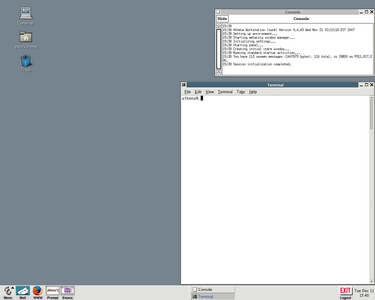
(Disclaimer: I work for MIT Information Services & Technology blah blah blah I am a student blah blah these are only my words and do not represent the opinion(s) of my employer.) Way back in the day in 1983, MIT started something it called Project Athena, which had the goal of investigating how computers could be used to enhance education at MIT. This project became the origin of such pieces of software as the X Window System and Kerberos, as well as a campus-wide network of workstations all running similar software. In 1991, Project Athena ended, but the Athena system continued on, taken over by MIT Information Systems. It’s 2008, and Athena still exists at MIT—walk into a computing cluster, and chances are all the machines will be running Athena software. (Unless that particular cluster has been taken over be Athena’s evil sibling, often referenced as “WinAthena”, which often seems to be maintained by no one, and whose existence is sometimes denied by those who maintain and support Real Athena. Not many machines have suffered this agonizing fate, luckily.) Unfortunately, as the years have progressed recently, fewer and fewer resources have been put into the development of Athena. In many ways it is no longer on the cutting edge of things as it has been in the past, though it is certainly still useful. Some students these days, however, even think of Athena as only “their MIT email” or maybe use it occasionally to print something in a cluster on the way to class. I’ve seen people grow frustrated and storm out of a cluster due to things like instructions for using a flash drive that involve more steps than just plugging it in. While on the one hand it’s easy to laugh at people for a lack of patience or being open to a computing system that is not either Windows or Mac and perhaps a bit more complicated on the surface, on the other hand, some of these things really should just work by now, and on other UNIX-based systems they do—but Athena has lagged behind. When you log into an Athena workstation for the first time, you are confronted with what looks like this: Clean MIT Athena login That’s GNOME 2.8, and it looks kind of like the GNOME 2.8 default but uglier. When you look under the hood, there are pieces of the system that obviously originated in a time where nothing better existed and so something new had to be created—the “xlogin” login system doesn’t support PAM, and the login path involves a hairy maze of scripts that perform various tasks. Under the hood, the base OS is currently RHEL 4 or Solaris 10. I still can’t remember what the right options are to feed RPM whenever I need some information that I think I should be able to get from it. These things were once necessary but today just look crufty. Some people have tossed around the idea that everyone has a laptop these days and thus clusters are uselessly expensive, but it’s been met with a lot of resistance. I’m all for progress, but I use clusters all the time! They’re one thing that makes it an easy choice for me to have a really portable laptop, because when I really need computing power or screen space on campus away from my room, there is always a cluster nearby. They’re also nice isolated places that can be associated with “work mode”, which is good for productivity. Beyond all this, Athena provides a common platform that all technical classes can depend on, from providing standard and specialized academic software to standing as a baseline of “make sure your code works on this before handing it in because that is how it will be graded”. At any rate, things are finally happening on this front. Athena can’t stay RHEL 4 forever—while AFS allows non-system software to be easily updated for all machines without requiring any OS release, hardware moves on and compatibility is lost, and the rest of the world is coming up with new awesome things that Athena machines are missing out on. A student group that I am vaguely involved with, SIPB, took the early initiative with this and created DebAthena, which takes stock Debian and Ubuntu and allows it to closely resemble an Athena environment. We even run a campus Linux dialup using the packages. (I won’t claim to have done much work on DebAthena myself because, well, I didn’t.) Amazingly, the Athena release team has decided to work with the SIPB on the next release of Athena. So, what I really just wasted over 600 words prepping for is to say that Athena 10 will be based on Ubuntu. This is only relatively new news, but I am lame about finishing blog posts. There are a variety of reasons why Ubuntu was chosen over Debian. Some of them are lame and some of them are not. Even so, I am excited about this prospect—and it should be possible to peripherally support Debian in such a way that was not possible with Athena 9.4. I really like Athena. Even coming to MIT with a background in Linux there has been a steep learning curve, though, and I think that things could be better. Lots of people here have their first encounter with a ‘nix system in the form of Athena, and we should strive to make that experience as good as possible. I’m kind of skeptical on the expected release date of this upcoming summer, but as long as it happens soon it will be a big step forward. In some ways it’s kind of sad that I’m excited about a big part of a research institution catching up with others—but inertia is a strong force, and dealing with thousands of workstations is no trivial task. I kind of long for the exciting days of creating new big pieces of free software like X. I bet I imagine those days as being better than they actually were.
9 January 2008

Cameron Dale: DebTorrent 0.1.5: Now With Status Updates

It's been a while, but a new update to DebTorrent is available in unstable. There is also a new version of the helper apt-transport-debtorrent (0.2.0) to go with it, which was mostly the cause of the long delay (due to a pending apt transition to testing). It is now highly recommended to install both, read below for new reasons why. One of the previous problems with debtorrent was the incorrect status updates displayed by apt, due to it not being aware of pieces of large files that have already downloaded. Using these new versions together will help to improve the update status messages shown during a download. Now, apt-get update will display a status at the bottom that will look something like:
DebTorrent: 837MiB left at 319 KiB/s (46m03s)
You may not be able to see it all if there are multiple updates to different mirrors under way. In aptitude, the status will appear on a line by itself at the bottom of the list of downloaded files. The status line will update about once per second, and should give a good indication of how much time is really left. The other (incorrect) status information presented by apt/aptitude will still be there but you can ignore it. I've only tested apt and aptitude, so I'm not sure how (or if) synaptic, adept or gnome-apt will display these messages, though they are general apt status messages, usually used for displaying the status while logging into an FTP server. This should also fix another problem that debtorrent can have with downloading large files (usually on slower connections). Since apt can't see the download happening for a long time, the connection would sometimes time out. With these status updates the connection is constantly active, so the timeouts shouldn't be a problem when downloading large packages (although they may still occur when doing an apt-get update, as there are no status updates during that process). I did implement a better solution, as suggested by Micha Politowski on the wiki. This solution uses the creation of sparse files to let apt know how much of a file has actually been downloaded. However, apt doesn't understand how a single process can download multiple files in prarallel, so it only follows the last file that was started, and complains when a file finishes that was not the last one that started. I've disabled that for now while I see if it's possible to modify apt to work better in this situation. Here are the changes for debtorrent: And for apt-transport-debtorrent:

Simon Richter: Magic versus more magic

At casa Geier, there is a slightly broken Asus A3G laptop, formerly known as salmiakki. The symptom is that upon pressing the power button, the machine ponders for a few seconds, then decides to turn off again. Since these laptops come with CD playback function keys on the outside, I think this is the safety feature against accidentally powering on; it just turns off again when the lid is closed. Which makes me suspect that only the lid switch is broken. Trouble is, there is no switch. This thing uses black magic to find out if it's open. There are no wires going to the hinges, there is no magnet either, or anything else that looks like it could be used in this way. So dear lazyweb, I'm interested in any hints how this might work. Pure speculation is also fine.

8 January 2008

Joey Hess: ship in a bottle

I'm about to release debhelper 6.0.0. But this blog is really about CDBS, and why it's entirely unlike debhelper despite being based on it.
With CDBS you're building a ship in a bottle. You have all the same tools available, but there's this bottle in the way, which doesn't let you bring any of them fully to bear, and requires all your techniques be changed around to fit its limited interface. This is a beautiful example of the kind of fun you're setting yourself up for by chosing CDBS. With debhelper, two commands can be easily reordered. With CDBS, you need three magic environment variables and either a hardcoded package name or some grody Makefile code: http://lists.debian.org/debian-python/2008/01/msg00039.html

Simon Huggins: Books (part 2)

[ Apologies for Debian planet readers expecting something pithy and Debian related. This isn't. But then pkg-xfce packaging just continues. We get more bugs, we fix some of them (if you have a dual-headed setup and want to help us fix or reproduce more we'd love to hear from you). Corsac became a DD at last and has made me more or less redundant in a good way. I should probably investigate libburnia again and prod George Danchev about #450873 since basically it seems to just need the ubuntu packaging brought across into Debian to replace libburn etc. But anyway, on with the irrelevant stuff... ] Books part 1 was back in April and I've since found myself with some time on my hands before I get a new job so here we go again.
Making Money - Terry Pratchett
This was a Christmas present and I quite enjoyed it and enjoyed the character but didn't really think it lived up to the laugh a minute Pratchett books that I remembered from the good old days.
The Lovely Bones - Alice Seebold
This is quite a weird concept for a book given that it's from the point of view of a dead girl in heaven but it seems to work. It's very well done and I enjoyed it.
Alex Rider series - Anthony Horowitz
I had seen Stormbreaker and wanted to read some more of these as light holiday reading. They work well for that. There's enough plot to keep me interested but not enough to make them at all hard to read. I read a couple of them in French when I was in France (in between traipsing between different bits of Paris since the m tro workers were on strike). I wish they'd been around when I was younger.
My Sister's Keeper - Jodi Picoult
Ooh this is a really, really good book. I loved it except perhaps for the very end but I can forgive it that. The idea is that she's suing her parents for the rights to her own body because she was conceived as a donor for her sister to fight off her sister's leukaemia. It's a very thought provoking read with several interesting characters with their own stories woven together.
The Language Instinct - Steven Pinker
This book is fascinating to me. It takes ideas mainly from linguistics, evolution and psychology and explains a theory that seems to hold together and is well illustrated and explained. The central point is that we all are born with the ability to develop a universal grammar from an early age which can be adapted to any human language and which sticks around in the young child and then disappears. If you have any interest in language at all read this book.
A Spot of Bother - Mark Haddon
I found this a bit hard to get into as essentially it's about the normal lives of a family (albeit quite a special family). It doesn't really grab you. Towards the end though I was interested to find out how it would all unravel and was pleased with it.
The Mephisto Club - Tess Gerritsen
This is a nice, honest thriller that does what you expect. It keeps you flicking the pages wanting to know what happens next.
The God Delusion - Richard Dawkins
I quite enjoyed this and did find new arguments against religion but I don't think he's going to convert anyone with this book. Of course I'd recommend anyone read it because it raises lots of interesting points but it's polemic essentially.
The Blind Watchmaker - Richard Dawkins
I enjoyed this though it builds on previous work I'd read. I guess if you're just interested in evolution then read this and not the God Delusion.
The Raw Shark Texts - Steven Hall
I was recommended this by a friend. It's very surreal possibly a bit too surreal for me but I enjoyed it nonetheless.
Do Androids Dream of Electric Sheep? - Philip K Dick
I hadn't read the book and saw it at a friend's and borrowed it. You probably all know what it's like. I'm glad I read it because of the references to it but it's not my normal reading material.
Harry Potter and the Deathly Hallows - J K Rowling
I had to read this of course to finish off the series but I thought it was a lot better than some of the others. I think I enjoyed the first, the one with the tri-wizarding championship and this one the most.
Love in Idleness - Charlotte Mendelson
This is well written and you really get into the character that's painted for you. I really liked some of the descriptions of justifying things to yourself and coping with boredom.
Blood, Sweat & Tea - Tom Reynolds
This was an interesting look at the life of a paramedic and if you don't already read Random acts of reality then read the book first and start reading the blog.
Telling Lies - Paul Ekman
This came from my Blink/Tipping Point reading and I found it hard going. It was interesting but quite detailed and not really a book for late night reading. The theories in it are very interesting though and explain why you probably aren't as good at detecting things as you think you might be and how to look for factors that will help you.
The Man Who Mistook His Wife for a Hat - Oliver Sacks
I read this ages ago and it was fascinating. It's about a number of different cases of problems with the brain. Often physical defects in various areas of the brain that cause odd problems and how it sheds light on how things relate. I really enjoyed it.
As always, do please punt your own recommendations at me.

7 January 2008

David Nusinow: Finally

A few years back I asked Branden Robinson for access to the X Strike Force SVN repository in order to improve the X server's autodetection, with the goal of stealing what I could from knoppix. At the time, users were constantly wandering in to #debian saying that they had used knoppix to create an XF86Config-4 and then they used that file on their Debian installations. They were also constantly whining about how Debian wasn't doing as good a job. So I decided to do something about it, and took a look at what knoppix was actually doing so much better than us, and I was surprised to find that they pretty much just wrote a skeleton configuration file and let the X server fill in the details. I had no idea the server was capable of such things. So Branden graciously gave me SVN access and I began comparing the knoppix method to the script called by "dpkg-reconfigure xserver-xfree86" and realized that we probably couldn't adopt the same method because we had tons of checks for portability. So I put the problem on the backburner for few weeks and worked on something else for a while.

Well, somewhere in between then and now I got sucked in to transitioning Debian to X.org (using the aforementioned SVN access) and then working on all the things that went along with maintaining X in Debian, some well and others less so. Between transitioning to Xorg, and then transitioning to a modular Xorg, even with the ability to steal Ubuntu's packages it still took about two full years with me being a rookie and all that. There were tons of people who worked on this with me, but it was just a damn big job. Eventually though, etch released with modular X packages, and we were running at a pretty good pace with upstream, so it was time to revisit the problem of configuration again after the two year detour.

The problem of configuration had been reframed for me by having looked at what knoppix was doing and discussions with upstream. Upstream was starting to come to the conclusion that we shouldn't have a config file at all, and that the server should be smart enough to do everything by itself. It was already partially there, it just needed a push in the right direction. This was a major shift in how I thought of it. Coming from a Debian background, where the answer is to always just regenerate or edit your config file, having the server work things out for you was a totally alien idea. But I have my deepest roots in the Macintosh world, so immediately fell in love with it. The problem was that the server had a whole body of code to use if you had no config file at all, and another, with far less automagic goodness, if you had a config file, even if it was a 0 byte file. The goal became to have the server work really well with a minimal config file, so you could override what you don't like in the defaults and let the server figure things out for itself at boot. The way forward was to translate as much of the logic in our configure script in to the X server itself as possible.

Ubuntu had put in a lot of work in to the configuration setup that we automatically benefitted from, so given that most users were happy with things as they were, I was able to carve away at the problem without disrupting anything. And there was a lot to carve out, as the script that runs the config is an absolute mess that was slated by Branden for a rewrite all those years ago. Early on I picked off the low hanging fruits like the font path and modules. Similarly, Redhat's Adam Jackson had also been working on this problem, and he killed off the ServerLayout section as well as putting in lots of critical fixes all over the place elsewhere. More recently, I've gone and cut explicit modesetting out of the configure script. Hardcoding this information is generally a bad idea in the randr 1.2 world, and most of the drivers will do as good or better job of figuring out the modes than our config script would. This let us jettison using the xresprobe program to ask the monitor for the settings to use. This cut out a lot of the code that we had to deal with, simplifying the configure script and letting us all benefit from upstream's work. This leaves a big gaping hole in user configuration, which is something I'm looking to address in a few weeks, but for now there are workarounds like editing your xorg.conf manually to make things work.

Finally, yesterday I was able to upload a version of the script that no longer uses the discover program to figure out what driver to load. I've patched the server to do this at runtime. If there's no driver listed it simply scans the PCI bus, picks out your primary video card, and loads the first driver that claims to support that PCI ID. This let us jettison the last external dependency that the configure script had, so now we have a relatively small chunk of shell script with no external C code and a simplified setup. At this point we're now shipping a more skeletal config file than knoppix ever did simply because it wasn't possible to ship something like this before and have the server work at all. This is a huge milestone for me because finally, after over three years, the problem I originally set out to work on with X is done. There's still bugs to uncover and fix with all of this, but I'm convinced that what we have now is superior to our old method. Eventually, with any luck, xorg.conf will just fade away for most people. There's a lot to work on before that happens though, but I'm happy to have finally gotten here.

Amaya Rodrigo: Back to life, back to blogging

Since September 19th I have been mostly offline and unreachable. This was due to having started a new job in a wonderful new project: soitu.es, an online newspaper with a strong focus on Citizen Journalism: citizens playing an active role in the process of collecting, reporting, analyzing and disseminating news and information, I must mention the master mind behind this all: Gumersindo Lafuente, one very well known journalist in Spain. On the other hand, working with Ra l Rivero, not the Cuban poet but the technical soul of the project, is something I would pay for, and I get actually paid to learn from him! Too bad he doesn t digg Debian :)


The site was finally launched during Xmas, and we are all less busy, so despite having what I call the weekend flu (that only affects me during the weekends, but I never feel so bad that I need to miss work during the week), I am back to normal, If you thought I was quite MIA, keep in mind I was not one of busiest ones at work! Launching such a project takes a toll on everyone, though. I set up a Flick set for my new workplace: Amayita s Soitu.es Flickr photo Set, in case you are curious. There is also an official Soitu.es Flickr Photo Pool.

Today is a holiday in Spain, due to D a de Reyes, when kids usually get their Xmas presents here. As I am fully recovered from this weekend s flu (today is Monday after all), I had some spare time and my cats got a nice present too: A DIY scratching post. There is a WTF column in the effing middle of my kitchen, so after some cardboard, a wall stapler, sisal rope and a bit of round and round the column... This pic shows the result:


Two happy cats and a sisal scratching post.


I couldn t resist filming a video, available on YouTube: This scratching post is now mine! - No! Mine! - I ll get you!

6 January 2008

David Nusinow: First In A Totally Disconnected Series of Posts

I want to echo what Brice has said so well already. X is full of interesting problems and important things to work on. When you consider the free software that's out there, very little of it comes close to the importance of X in your day to day life. When we've done our job well, you don't even think about it because it just works, but when X fails it's like a minor catastrophe. Working on the kernel is largely considered to be something glorious and grand, but people tend to ignore X even though it plays very much in the same domain as the kernel. So working on X you not only get to play with interesting problems that are similar to the ones that the kernel folks get to play with, but you also get to work on software that's critically important and makes a significant difference in people's day to day lives.

Furthermore, X.org is a great organization to work in. The number of core contributers is very few (maybe 20 all told) so everyone knows who everyone else is and people are willing to help others out by answering questions about how things work. Reflecting this, the XSF has turned in to a fantastic team over the past few years, and it's one I couldn't be prouder to be a part of. Julien and Brice are doing insanely fantastic work, and we're constantly pushing to do a better job at just about everything, from collaborating with Ubuntu to using the best cutting edge tools out there for our work.

Despite all this though, as Brice said, we're overwhelmed by everything. We're still carrying hundreds of bugs in the Debian BTS alone, most of which we'll never have a chance to look at again. As mentioned elsewhere on planet upstream is totally swamped as well. There's just too many critical projects that need doing (new drivers, fixed drivers, adding capabilities to the server, and that's ignoring day to day needs like documentation and patch review) and too few people to do them effectively. We have a wonderful set of things to do and a great group of people to mentor motivated people to do them, and yet we're still lacking contributers to this critically important set of software.

So as Brice said, if you want to get involved in something that's essentially important to Linux and Free Software, if you want to get involved in something with great problems and really fantastic opportunities to make a difference, you can't do much better than getting involved in X. Brice's method of getting involved in processing bug reports is a perfect way to start. Another is to write much needed documentation. Another is to simply help the XSF maintain some small piece of the Xorg stack, be it a driver for some hardware that you own (the XSF only really runs two or three video drivers collectively so we badly need driver maintainers), or just start poking at something you're curious but mystified about like how mesa or the X server work. There's no magic to any of it, and while it can get complicated I promise that you will become a better coder or maintainer by working on something as challenging as X. You don't have to understand it all from the start, just picking a small thing to work on will be greatly appreciated. So drop us a note on the debian-x list or drop in to #debian-x on oftc and we'll help you get going.

Christian Perrier: Number of bugs reported in Debian per year

This week-end, among other things, I played a little to get the number of bugs reported overs years in the Debian BTS. Here are the results:
2007: 53337
2006: 59665
2005: 57436
2004: 62327
2003: 50836
2002: 47618
2001: 46289
2000: 27181
1999: 22448
1998: 15002
1997:  9987
1996:  4205
1995: 2158
First bug for each year:
2008: 458489 Petter Reinholdtsen -> sysqrd Closed (in unstable)
2007: 405152 Martin-Eric Racine -> myspell-lv Closed
2006: 345487 Erich Schubert -> lintian Opened
2005: 288051 Nick Sillik -> gstreamer-misc Closed
2004: 225724 Peter van Rossum -> mldonkey-server Closed
2003: 174888 Chris Garguzi -> hotkeys Closed
2002: 127270 root@ttimo.net ->libapache-mod-auth-pam Closed
2001: 80981  William Steve Applegate -> php4 Closed
2000: 53800  Hamish Moffatt -> sattrack Closed
1999: 31352  Richard Stallman -> dselect Opened LOOK THIS ONE
1998: 16350  Joey Hess -> xbase-clients Closed
1997:  6363  Andreas Jellinghaus -> mgetty-fax Closed
1996:  2158  Ian Jackson -> ncurses3.0 Closed
1995:   563  Ian Jackson -> tar Closed
A few interesting things there: Anyone feeling like doing the same for Launchpad? And, for those who wonder, I of course did all this by hand. No fancy automated script, just my hands and some (little) hammering of the BTS.

Brice Goglin: Debian X.org notes - One year of X.org BTS maintenance

One year ago, I started triaging the X.org BTS (by replying to #163057 iirc). I closed almost 1600 bugs since then, bringing the remaining ones to about 900 today. I am kind of proud of Ender's graph (when the URL works...). Even if the actual BTS triaging is done now, I still try to take care of X.org bugs. And it's not that easy unfortunately... Almost 650 new bugs were opened this year against X.org packages. 250 of them are already fixed, more than one hundred have been forwarded upstream. It doesn't mean that 300 bugs still apply to our packaging. Most of our X packages are simple (apart from the xserver-xorg postinst mess that David is cleaning). But, there are lots of problems that we have no clue about, or that miss some info because people can't upgrade to unstable, ... I am sometimes tired of getting so many bugs without being able to do much about them. Maybe because upstream doesn't care enough about some problems (lots of drivers are unmaintained and get broken more and more when new features are added for a couple more important drivers). So, I sometimes tend to concentrate my work on what I like and trust. Some people noticed that xserver-xorg-video-ati get very often updated these days (6 uploads in the last 20 days). Of course, the reason is that I own a r300 board :) But also because its upstream devs are very good, it's very nice and easy to work with them. Of course, we have a lot of work and few people to do it. That's kind of sad since playing with X is very interesting. Most users are very happy when discovering things like RandR 1.2 or Compiz. Getting a chance to test them early and understand their internals is very cool. But, as said in some other posts, hacking on X.org doesn't seem to look fun. If you're interested anyway, taking care of the bugs is a very easy way to learn a lot. I had no clue about X one year ago and I learned a lot by taking care of the BTS. I would be glad to get some help now :)
(Permanent link) 

5 January 2008

Andrew Pollock: [life] Post-op, Day 2

"Day Two Downers" be damned, Sarah's powering along like a freight train. Neither of us had a terribly fantastic night's sleep. Her chest drain is attached to this big box thing that has some sort of water seal in it, and with the suction going through it, it bubbles and makes noise like a massive aquarium. But she did get some sleep, and said she felt better this morning for it. The doctor came by at 8am, and took the incision dressing off, and we got our first good look at it. It's big (i.e. long). It runs from about the top of her breastbone to the bottom of her sternum. 20cm at my estimation. She said that she thought the chest tube could come out today, and sure enough it came out at about 12:30pm. They also took her urinary catheter out at that time, so now all she's hooked up to is oxygen. Her blood sugar levels were acceptable at breakfast time. Oh, the reason the incision ran so high was because they elected to do the bypass attachment to an artery in her neck, rather than further around the aorta, because the tissue was fragile and they didn't want to risk a dissection. Not doing the bypass in the aorta also left them the option of removing some of the transcending arch if they determined it still ended up being necessary. Sarah got up and had breakfast in a chair again, and was generally feeling pretty mobile. She moved between the chair and a wheelchair (and back) when they came to get her for another x-ray, without requiring any assistance. She took her first walk around the ward at 11am. I'd popped home for a shower and to check on the cats, and so I missed it. Doctor Miller dropped in at around 12:30pm to see how she was doing, and that was good as Sarah got a chance to talk directly to him about how the procedure had gone. He was very positive and said she could put this whole thing behind her now. At 2pm, she went for another walk, this time sans two thirds of the tubes from her first walk, and got in and out of bed unassisted. She took her last walk of the day at 4pm. Apparently her blood sugar is still on the high side, but within the range that they don't feel the need to give her insulin. Her chest is apparently looking better on the x-ray they took this morning. They took a second one after they removed the chest drain, but we haven't heard anything about how that looks yet. She's continuing to do extremely well, most of this less than 48 hours out of surgery.

Randall Donald: 32-bit userland with 64-bit amd64 kernel confguration

If anybody is running the amd64 kernel in the i386 port (i.e the 32bit/64bit mix) could you please send me the output of 'uname -a' as well as dpkg-architecture to rdonald@debian.org. I'm working on a detection routine for nvidia-kernel-source to use the correct nv-kernel.o file. Oh and by the way I'm still looking for new packaging team members.

(update: thanks I got what I needed)

Next.

Previous.