Search Results: "spa"

11 April 2012

Erich Schubert: Are likes still worth anything?

When Facebook became "the next big thing", you had the "like" buttons pop up on various web sites. An of course "going viral" was the big thing everybody talked about, in particular SEO experts (or those that would like to be that).
But things have changed. In particular Facebook has. In the beginning, any "like" would be announced in the newsfeed to all your friends. This was what allowed likes to go viral, when your friends re-liked the link. This is what made it attractive to have like buttons on your web pages. (Note that I'm not referring to "likes" of a single Facebook post; they are something quite different!)
Once that everybody "knew" how important this was, everbody tried to make the most out of it. In particular scammers, viruses and SEO people. Every other day, some clickjacking application would flood Facebook with likes. Every backwater website was trying to get more audience by getting "liked". But at some point Facebook just stopped showing "likes". This is not bad. It is the obvious reaction when people get too annoyed by the constant "like spam". Facebook had to put an end to this.

But now that a "like" is pretty much worthless (in my opinion). Still, many people following "SEO Tutorials" are all crazy about likes. Instead, we should reconsider whether we really want to slow down our site loading by having like buttons on every page. A like button is not as lightweight as you might think it is. It's a complex JavaScript that tries to detect clickjacking attacks, and in fact invades your users' privacy, up to the point where for example in Germany it may even be illegal to use the Facebook like button on a web site.
In a few months, the SEO people will realize that the "like"s are a fad now, and will likely all try to jump the Google+ bandwagon. Google+ is probably not half as much a "dud" as many think it is (because their friends are still on Facebook and because you cannot scribble birthday wishes on a wall in Google+). The point is that Google can actually use the "+1" likes to improve everyday search results. Google for something a friend liked, and it will show up higher in the search results, and Google will show the friend who recommended it. Facebook cannot do this, because it is not a search engine (well, you can use it for searching people, although Ark probably is better at this, and one does nowhere search as many people as one does regular web searches). Unless they go into a strong partnership with Microsoft Bing or Yahoo, the "like"s can never be as important as Google "+1" likes. So don't underestimate the Google+ strategy on the long run.
There are more points where Facebook by now is much less useful as it used to be. For example event invitations. When Facebook was in full growth, you could essentially invite all your friends to your events. You could also use lists to organize your friends, and invite only the appropriate subset, if you cared enough. The problem again was: nobody cared enough. Everybody would just invite all their friends, and you would end up getting "invitation spam" several times a day. So again Facebook had to change and limit the invitation capabilities. You can no longer invite all, or even just all on one particular list. There are some tools and tricks that can work around this to some extend, but once everybody uses that, Facebook will just have to cut it down even further.
Similarly, you might remember "superpoke" and all the "gift" applications. Facebook (and the app makers) probably made a fortune on them with premium pokes and gifts. But then this too reached a level that started to annoy the users, so they had to cut down the ability of applications to post to walls. And boom, this segment essentially imploded. I havn't seen numbers on Facebook gaming, and I figure that by doing some special setup for the games Facebook managed to keep them somewhat happy. But many will remember the time when the newsfeed would be full of Farmville and Mafia Wars crap ... it just does no longer work this way.

So when working with Facebook and such, you really need to be on the move. Right now it seems that groups and applications are more useful to get that viral dream going. A couple of apps such as Yahoo currently require you to install their app (which then may post to your wall on your behalf and get your personal information!) to follow a link shared this way, and then can actively encourage you to reshare. And messages sent to a "Facebook group" are more likely to reach people that aren't direct friends of yours. When friends actually "join" an event, this is currently showing up in the news feed. But all of this can change with 0 days notice.
It will be interesting to see if Facebook can on the long run keep up with Googles ability to integrate the +1 likes into search results. It probably takes just a few success stories in the SEO community to become the "next big thing" in SEO to get +1 instead of Facebook likes. Then Google just has to wait for them to virally spread +1 adoption. Google can wait - its Google Plus growth rates aren't bad, and they have a working business model already that doesn't rely on the extra growth - they are big already and make good profits.
Facebook however is walking on a surprisingly thin line. They need a tight control on the amount of data shared (which is probably why they try to do this with "magic"). People don't want to have the impression that Facebook is hiding something from them (although it is in fact suppressing a huge part of your friends activity!), but they also don't want to get all this data spammed onto them. And in particular, it needs to give the web publishers and app developers the right amount of that extra access to the users, while in turn keeping the major spam away from the users.

Independent of the technology and actual products, it will be really interesting to see if we manage to find some way to keep the balance in "social" one-to-many communication right. It's not a fault of Facebook that many people "spam" all their friends with all their "data". Googles Circles probably isn't the final answer either. The reason why email still works rather well was probably because it makes one-to-one communication easier than one-to-many, because it isn't realtime, and because people expect you to put enough effort into composing your mails and choosing the right receipients for the message. Current "social" communication is pretty much posting everything to everyone you know adressed as "to whoever it may concern". Much of it is in fact pretty non-personal or even non-social. We have definitely reached the point where more data is shared than is being read. Twitter is probably the most extreme example of a "write-only" medium. The average number a tweet is read by a human except the original poster must be way below 1, and definitely much less than the average number of "followers".
So in the end, the answer may actually be a good automatic address book, with automatic groups and rich clients, to enable everybody to easily use email more efficiently. On the other hand, separting "serious" communication from "entertainment" communication may be well worth having a separate communications channel, and email definitely is dated and is having spam problems.

10 April 2012

Bernd Zeimetz: working on spacewalk support for and in debian

With the latest release of Spacewalk PostgreSQL seems to be supported properly - finally. Also there are efforts to support Debian as a client system. So I'm thinking about using the upcoming BugSquashingParty in Salzburg to in the hope that you (yes, you!) are joining me! Please let me know if you are interested to work on Spacewalk related packages, even if you are not able to come to Salzburg.

MJ Ray: DLT is better than CAPTCHA

Stop using CAPTCHAs. It s time to switch to DLT: Design, Limit and Trapdoor.

[a certain website] has the evil bad wrong Google reCaptcha on the edit page to stop disabled users, so screw it. Google s reCaptcha seems to be spreading again, obstructing more people when accessing more websites. Is there a reason for that? The re in reCaptcha stands for replace with real anti-spam, please!
I wrote the above about two years ago and it s not getting any better. I ve written similar things over the last ten years, as have many others, and I ve always sought to avoid using physical ability tests as a way to cut down spammers. Why do people keep reaching for the reCaptcha non-captcha or things that use similar bad eyetests like Mollom? So most online messages may be spam, but those physical ability tests do nothing to test for spam. They re trying to detect computer submissions (the TCHA in CAPTCHA is meant to be Telling Computers and Humans Apart), but that s really bad when the computer is helping someone with a disability to access the internet. People from the home of the CAPTCHA describe access for sight and hearing-impaired users as an important open problem for the project (Luis von Ahn, Manuel Blum and John Langford. Telling Humans and Computers Apart Automatically. In Communications of the ACM). Until that problem is closed, CAPTCHAs should be considered defective and removed whenever possible. What webmasters should do instead is DLT:
  1. Design it well: Set up sites so the spammers cannot get a quick win in the first place. Configure permissions and things like that so people have to do some work before they are trusted to post links. This is similar to the basic theory behind my Open Activism paper Fighting in the Shadows. This is much easier to do if the system is Free and Open Source Software (FOSS), too.
  2. Limit the damage: include rate limits to stop one person causing you lots of work: even with computer-assistance, few people need to post 10 forum messages every minute. Join up in co-operative anti-spam networks like blogspam.net so if they hurt you, others can see them coming. Again, it s easier to hook into a network if you re using FOSS.
  3. Trapdoor: keep a way for people to contact you if they are really blocked by your design decisions and limitation and keep a way to exempt them from the limits if needed. Make it welcoming because disabled users are tired of reporting barriers to webmasters who don t care and will never fix the web. A good multi-step eyetest-free contact form is a basic way to do this.
Have you tried this? Have your experiences been as good as our co-op s? Are there sites you don t think it would work for? A comments form is on the original of this article, as ever.

9 April 2012

Russell Coker: Guest/Link Post Spam

I ve been getting a lot of spam recently from people wanting to write guest posts or have their site included in a future links post. Guest Posts For guest posts the social convention for the planets which aggregate my blog seems to be that random guest posts are unacceptable. I could change my blog feed to have some posts excluded from the planet feeds but that s too much effort and I don t want random guest posts anyway. The only situations in which I will accept guest posts are when someone is writing what I might have written (IE they generally agree with me) or if they are a member of the free software community who doesn t have their own blog but has something relevant to say. Any applicant for a guest post who runs a business that is useless and/or evil IMHO (EG anything related to the TSA) is going to get rejected firmly. Any applicant who tells me that they can write on a wide variety of topics probably isn t capable of making me an offer that I would accept. Tell me that you can write about Linux programming or computer security and I ll be interested, but you have to provide links to your previous work. An application to write a guest post that starts with something like I liked your recent post at the above URL but I think you missed some important points, as I have some experience in that field I think I could write a guest post that would help educate your readers may be accepted. Probably the best thing to do however is to write comments on my blog, if you can write informative comments and offer to make a longer comment into a guest post then there s a good chance that I ll be interested. Generally though I will only offer the opportunity to write a guest post to someone who writes something really informative in private email or on a closed mailing list. If you can solve a technical problem about Linux that has me stumped then I will almost certainly be willing to accept a guest post about it! Links Posts There are many sites which consist of nothing but links to other sites. In the 90 s such sites were really useful but since the rise of Google their value has declined dramatically. As an aside when I ran an Internet Cafe in the 90 s I had every web browser start with the main page of my Hot Stuff list, the purpose of this was to increase the hit rate of my Squid cache by having most of the customers visit the same sites. Even back then I probably wouldn t have bothered if it wasn t for Squid hits. It must seem like an easy way to make money to create pages of links to articles with short summaries and then hope for advertising revenue, a domain sale, or the launch of some sort of profitable business once people start using the site. I wonder whether that ever works out for people. It doesn t seem like a good business model, doing something that requires little skill, which can be done by almost anyone, and which is done by many people. Maybe there are sweat-shops dedicated to this. Anyway my links posts are unlikely to ever link to any such links pages, I don t think that the people who read my blog want double indirection. I won t entirely rule out linking to a links page, but it would have to be of very high quality and related to something very technical about computers. Basically anyone who reads this should give up on the idea of submitting a links page to me, if it s good enough to make me break my policy of not linking to such things then I ll probably find it myself. Conclusion As a general rule if you want someone to publish your work then you need to look at what they are publishing and make sure that your work fits. With the recent requests for links and guest posts I ve been getting I have to wonder whether the people making the requests have even read my blog. That method of operating is unlikely to give any success at a blog that has any reasonable number of readers. I ll probably link to this from my about page or something. It might discourage some of the spammers. Related posts:
  1. Link Within Good Things about LinkWithin For the last 10 weeks I ve...
  2. Feedburner Item Link Clicks For a while I used the Item Link Clicks feature...
  3. Can you run SE Linux on a Xen Guest? I was asked Can you run SELinux on a XEN...

Steve Kemp: Bye-bye AOL

Today I took that final step:
touch /srv/_global_/blacklisted/domains/aol.com
I remember, even a couple of years ago, I had friends who would mail me from their @aol.com email addresses. These days people have moved on. The two single biggest mail-providers I see in terms of spam are: I'd like to drop @yahoo.com but I have some (misguided) friends who continue to use it to mail me. I might start dropping non-friend mails from that domain, but that's a bigger job. Yes, this is a dull entry. Sorry. My existing bathroom has been ripped out and turned into this as a stepping stone into its new incarnation. I'm trapped in my office. Dust almost everywhere. Noise everywhere else. ObQuote: "There can be no understanding between the hand and the brain unless the heart acts as mediator. " - Metropolis

Craig Sanders: getting the terminal size in python

I m finally getting around to making myself learn python as more than just a read-only language. Working with Openstack kind of requires it. So far, I like it. Much more than I thought I would as an unrepentant sh and perl using systems geek. And getting over my distaste for the white-space issue is also proving to be much easier than I thought it would (although I still think that block-delimiters like make the code easier to read PyHeresy, I know) While hacking the /usr/bin/glance command to have less ugly output, and adding a csv option to list the image index in a usefully parseable format, I needed to figure out how to get the terminal size (height,width). This, cobbled together from various google search results, seems to work. It s probably not strictly-correct python idiom, and there s probably a better way of doing it. Comments and critique are welcome.
def get_terminal_size(fd=1):
    """
    Returns height and width of current terminal. First tries to get
    size via termios.TIOCGWINSZ, then from environment. Defaults to 25
    lines x 80 columns if both methods fail.
 
    :param fd: file descriptor (default: 1=stdout)
    """
    try:
        import fcntl, termios, struct
        hw = struct.unpack('hh', fcntl.ioctl(fd, termios.TIOCGWINSZ, '1234'))
    except:
        try:
            hw = (os.environ['LINES'], os.environ['COLUMNS'])
        except:  
            hw = (25, 80)
 
    return hw
 
def get_terminal_height(fd=1):
    """
    Returns height of terminal if it is a tty, 999 otherwise
 
    :param fd: file descriptor (default: 1=stdout)
    """
    if os.isatty(fd):
        height = get_terminal_size(fd)[0]
    else:
        height = 999
 
    return height
 
def get_terminal_width(fd=1):
    """
    Returns width of terminal if it is a tty, 999 otherwise
 
    :param fd: file descriptor (default: 1=stdout)
    """
    if os.isatty(fd):
        width = get_terminal_size(fd)[1]
    else:
        width = 999
 
    return width
getting the terminal size in python is a post from: Errata

8 April 2012

Christian Perrier: 2012 update 19 for Debian Installer localization

Status for D-I level 1 (core D-I files): Status for D-I level 2 (packages that have localized material that may appear during default installs, such as iso-codes, tasksel, etc.): Status for D-I level 3 (packages that have localized material that may appear during non-default installs, such as win32-loader) Full 100% completeness (hall of fame) for 21 languages: Belarusian, Bulgarian, Catalan, Czech, German, Esperanto, Spanish, French, Indonesian, Italian, Japanese, Kazakh, Khmer, Dutch, Polish, Portuguese, Russian, Slovak, Swedish, Turkish, Simplified Chinese

Tim Retout: Bye, Mark.

I've finally got around to deleting my Facebook account. I'd love to claim that this was a grand gesture against privacy-invading apps, or a bid to recoup vast amounts of my spare time... but it's not, really. I rarely logged in to the site, these days, so Facebook has very little of my personal data.

Luca Falavigna: Spam review: mass-tagging nominations

If you are one of those brave souls chasing off spam from Debian mailing lists, you will probably get bored of clicking on the Spam radio buttons a lot of times, and will probably look for a quick shortcut. I submitted a patch in bug #640309, but as of today, it has not been applied yet. Waiting for the patch to be applied, I prepared a little Greasemonkey script called Debian Mass Spam that allows to mark every message as Unsure , Ham , Inappropriate , or Spam by clicking the correspondent key on the keyboard: Spam review Just press Z (for Unsure ), X (for Ham ), C (for Inappropriate ), or V (for Spam ), and you will see every radio button to change its status. I tested it on Chromium, Iceweasel (with xul-ext-greasemonkey package) and Epiphany (with epiphany-extensions package), and it seems to work properly. Too many words and no actions so far, go and kill some spam now! ;)

Olly Betts: Xapian GSoC Applications for 2012

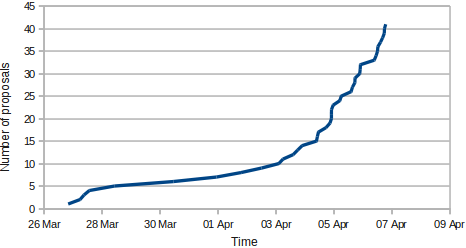
Student applications for GSoC closed a day or so ago, and we've done an initial pass through Xapian's applications, so I thought I should post another overview, similar to last year's. We received a total of 41 applications this year (very close to last year's total of 42). Here's a graph of applications against time: Graph of student applications to Xapian in GSoC 2012 If you're an admin or a mentor, you can produce a similar graph for your own org(s) - just download this OpenDocument spreadsheet and follow the instructions inside. That total of 41 includes one duplicate and one application withdrawn by the student (we had one of each last year too). I've also gone through and marked nine spam proposals as invalid (similar to the seven we had last year). Spam proposals are things like proposals with no connection at all to Xapian, and proposals which are just a title and/or paste from our ideas list with a generic biography. So that leaves us with 30 proposals (compared to 33 last year). It's hard to really measure, but my feeling is that the average quality is higher than last year (and it was already pretty impressive last year).

Ingo Juergensmann: Grub2 fails booting from second VG

I just got a new harddisk, because my old RAID of 3x 1 TB disks are getting filled and I'm running out of space. In the end I'll have replaced my old disks by 3x 4 TB disks. Currently the setup is as this:
Kategorie:

7 April 2012

Ritesh Raj Sarraf: Kscope 1.6

In the 3.x days of KDE, there were some wonderful applications. One of them I still admire, is kscope. Recently, I stumbled upon this blog entry and thought of sharing my living with kscope.The move from KDE 3 to KDE 4 was a big one. During that move, the kscope author decided to port kscope to a Qt only application. That is what we have as the latest kscope, 1.9x version. But, on personal taste, it is not as good as the 1.6x series.With no viable replacement to my knowledge, making use of kscope 1.6x on Debian (and Ubuntu) was the choice. Thanks to the way it is all packaged by the KDE, it is easy.Kscope depends on 2 packages for its functionlity: kdelibs4c2a and kate. kdelibs4c2a is unsupported, but for the dire needs, you live with it. The library can be easily pulled from the snapshot website, or just get the package from the old distribution URLs. The same goes for kate and kscope (1.6x)Install the kdelibs4c2a package.

16:55:27 rrs@champaran:~$ apt-cache policy kdelibs4c2a

kdelibs4c2a:

Installed: 4:3.5.10.dfsg.1-5

Candidate: 4:3.5.10.dfsg.1-5

Version table:

*** 4:3.5.10.dfsg.1-5 0

100 /var/lib/dpkg/status

You can't do the same with kate because the same package name is carried forward. Simply unpack the old kate deb package and copy the following libraries to /usr/local/:
libkateinterfaces.so.0@ libkateutils.so.0@
libkateinterfaces.so.0.0.0 libkateutils.so.0.0.0
Since the kscope package has a dependency defined on the kate pacakge, use equivs to create a dummy package to satisfy kscope.
With that, it is all done. Just make sure to put your kscope, kate and kdelibs4c2a packages on hold.
For the eyes:
kscope running on kde4 on debian

Bastian Blank: Booting Debian via AoE (ATA over Ethernet) and PXE

AoE is one of the protocols supported by Linux to access storage via network. It uses plain Ethernet for communication and includes a discovery mechanism to find all available targets. I use it to provide disk space to VMs running on different machines. Next step is to boot via AoE. It is no real problem to use AoE in running systems. However with some help it is even possible to actually boot disk-less machines via AoE. The PXE implementation iPXE provides the AoE support to actually boot from. I will describe the necessary parts.
Setup vblade The AoE target used it vblade. vblade needs access to raw sockets. As I prefer to not have run anything as root if it is not necessary, I use filesystem capabilities to allow it access to the network.
setcap cap_net_raw+ep /usr/sbin/vblade
vblade gets the mac address of the initiator, the shelf and slot number, the network device and the block device.
/usr/sbin/vblade -m $mac 0 0 eth0 $dev
Setup a tftp server and iPXE
apt-get install atftpd ipxe
ln -s /usr/lib/ipxe/undionly.kpxe /var/lib/tftpboot
Setup ISC dhcpd The dhcp server needs to be configured. It needs to hand out two distinct parameter sets. The first is used to chain-load iPXE into the normal PXE stack. The second is for iPXE and sets the root path to the AoE device. They are selected on the iPXE marker in the request.
if exists user-class and option user-class = "iPXE"  
  filename "";
  option root-path "aoe:e0.0";
  else  
  filename "undionly.kpxe";
 
Support AoE via initramfs-tools The initramfs needs to initialize AoE support. It needs to enable the network device used for communication with the AoE server and wait until it is up. After that it needs to load the aoe module and run aoe-discover. We should have all devices now. The root device can now be used like any other normal device. After the AoE device is initialized, it can be found via UUID and all the other ways. So no further modifications are necessary over the usage of local disks. The initramfs finds the device as usual and boots from it. The initramfs support is still a prototyp, but seems to work. For initramfs-tools it needs a hook to include all necessary stuff in the initramfs and a script to actually do the work. Both are shown here. /etc/initramfs-tools/hooks/aoe:
#!/bin/sh
case $1 in
prereqs)
  echo "udev"
  exit 0
  ;;
esac
. /usr/share/initramfs-tools/hook-functions
copy_exec /sbin/aoe-discover
manual_add_modules aoe
/etc/initramfs-tools/scripts/local-top/aoe:
#!/bin/sh
case $1 in
prereqs)
  echo "udev"
  exit 0
  ;;
esac
ifconfig eth0 up
sleep 10
modprobe aoe
aoe-discover
udevadm settle --timeout=30
Problems Not all parts of this works 100%. Some parts works not for all hardware.
  • My old notebook is not able to run Linux with this setup. grub loads the kernel via AoE and nothing comes later.
  • The network may need more time. Especially in large environments with spanning tree enabled, it may need half a minute until any packets will flow.
Some of the problems can be addressed later. Some can't.

6 April 2012

Vasudev Kamath: Packaging Falcon Programming Language for Debian

Falcon is a programming language which is not yet packaged for Debian. I saw that the ITP#460591 is owned by my Debian mentor and good friend Kartik Mistry. So I jumped in to help him finish this package. Ok enough of introduction now directly to point. We thought its better to base the Debian package on upstream Git repository itself so we can do snapshot release like Go Language package is doing. So in this post I'm going to give steps we used to do this and also guidelines on future packaging of Falcon.
    1. First step we need to clone the upstream Falcon's git repo. Then duplicate *master* branch into *upstream* branch.
      git clone http://git.falconpl.org/falcon.git
      git checkout -b upstream
      
    
    2. Now by staying on *upstream* branch we made it track the upstream's git repo using following commands
       git remote add upstream-falcon http://git.falconpl.org/falcon.git
       git branch --set-upstream upstream-falcon
       
    
    3. We made the master branch point to origin which is our collab-maint git repository.
       git checkout master
       git remote set-url origin git.debian.org:/git/collab-maint/falconpl.git
       
    
    4. Next is creating the pristine-tar branch so that it will be easy for us to build using *git-buildpackage* tools. We just took snapshot of upstream's head and created a tarball and then used *pristine-tar* utility to commit it. Then we tagged upstream version
       git checkout upstream
       git archive --format=tar HEAD   gzip -9 > ../falconpl_0.9.6.8-git20120403.orig.tar.gz
       git tag upstream/0.9.6.8-git20120403
       pristine-tar commit ../falconpl_0.9.6.8-git20120403.orig.tar.gz
       
    
    5. And finally we copied **debian** directory from Ubuntu's falconpl package into our master branch and modified the debian changelog to match our new snapshot version. To release a new version all we need to do is follow step 4 and then additionally merge the upstream with master
So our repo is now in proper shape to be built using git-buildpackage. But we are left with many things to clean and fix. So things which are currently pending are
  1. Make copyright file in Debian copyright format 1.0
  2. Separate out each module falcon builds into separate package. Looks like Ubuntu doesn't install any of modules
  3. Last but not the least upload it to Debian ( Kartik's task :-) )
Even though I'm packaging Falcon for Debian I'm not a Falcon programmer so if there are any Falcon programmer reading this post and want to help you are always welcome :-).

5 April 2012

Steve Kemp: So I want a backup solution

I look after a lot of systems, and most of them want identical and simple backups taking of their filesystems. Currently I use backup2l which works but suffers from a couple of minor issues. In short I want to take a full filesystem backup (i.e. Backup "/"). I wish to only exclude a few directories and mounted filesystems. So my configuration looks like this:
# List of directories to make backups of.
# All paths MUST be absolute and start with a '/'!
SRCLIST=(  / /boot -xdev )
# The following expression specifies the files not to be archived.
SKIPCOND=( -path '/var/backups/localhost' -o -path '/var/run/' -o \
    -path '/tmp'  -o -path '/var/tmp' \
    -o -path '/dev' -o -path '/spam' \
    -o -path '/var/spool/' )
The only surprising thing here is that I abuse the internals of backup2l because I know that it uses "find" to build up a list of files - so I sneakily add int "-xdev" to the first argument. This means I don't accidentally backup any mounted gluster filesystem, mounted MySQL binary/log mounts, etc. backup2l then goes and does its jobs. It allows me to define things to run before and after the backup runs via code like this:
# This user-defined bash function is executed before a backup is made
PRE_BACKUP ()
 
   if [ -d /etc/backup2l/pre.d/ ]; then
      run-parts /etc/backup2l/pre.d/
   fi
 
So what is my gripe? Well I get a daily email, per-system, which shows lots of detail - but the key thing. The important thing. The thing I care about more than anything else, the actual "success" or "fail" result is only discoverable by reading the mail. If the backup fails, due to out of disk, I won't know unless I read the middle of the mail. If the pre/post-steps fail I won't know unless I examine the output. As I said to a colleague today in my view the success or failure of the backup is the combination of each of three distinct steps: If any of the three fail I want to know. If they succeed then ideally I don't want a mail at all - but if I get one it should have:
Subject: Backup Success - $(hostname) - $(date)
So I've looked around at programs such as backup-ninja, backup-manager and they seem similar. It is a shame as I mostly like backup2l, but in short I want to do the same thing on about 50-250 hosts: In my case it is usually the rsync-step that fails. Which is horrific if you don't notice (quota exceeded. connection reset by peer. etc). The local backups are good enough for 95% of recovery times - but if the hardware is fried having the backups be available, albeit slowly, is required. Using GNU Tar incrementally is trivial. If it weren't such a messy program I'd probably be inclined to hack on backup2l - but in 2012 I can't believe I need to. (Yes, backuppc rocks. So does duplicity. So does amanda. But they're not appropriate here. Sadly.) ObQuote: "Oh, I get it. I see now. You've been training for two years to take me out, and now here I am. Whew! " - Blade II - An example of a rare breed, a sequel that doesn't suck. No pun intended.

MJ Ray: Debian Project Leader Election 2012

Voting is open in the Debian Project Leader Elections 2012 So now I need to figure out who to vote for. This year I didn t take part in the discussions (all my spare time was bought, basically). The platforms are linked from the Debian Project Leader Elections 2012 page above and the key discussions were: Thanks to everyone who asked these great questions. So, what do you think?

Jon Dowland: Greg Bear Hull Zero Three

In (roughly) 2008 I read "Blood Music" my first Greg Bear novel and devoured it in a weekend, in only two or three reading sessions. That happens very rarely, and when it does I often wonder whether it's the quality of the writing or some combination of that and your personal moods and tastes at the time that is responsible. My next Bear was "Darwin's Radio" in mid-2010 which, whilst good, did not provoke the same feverish read. I might write short reviews for both at some point in the future, but right now I can't remember either well enough to do so. In the last few weeks I read "Hull Zero Three" which was quite a different beast. The novel first captured my attention due to the unusual way it was promoted: via a video, which was created using a modified Quake 2 engine. It wasn't a great video but the novelty made it interesting. The story begins with a first-person narrator waking up from a sort-of hyper sleep on a generation starship that has clearly had some serious problems. He has to run to escape danger before he has an opportunity to figure out exactly what has happened and what he is running from, or to. Something has gone horribly wrong on the ship: it's nowhere near where it should be going and nobody should be awake. The narrator's memory is fractured, fabricated and unreliable; the ship is hostile, and whilst it's mechanical, it cyclically changes and re-arranges it's hulls in an almost organic way. He is joined by a rotating cast of similarly confused refugees of varying shapes and sizes. Language and cultural barriers serve to further magnify the sense of alienation that you experience on behalf of the story teller. The troupe are persued through the corridors by a collection of lethally efficient killer "things", contrasting with the background by being organic in nature but mechanical in behaviour and appearance. The scale of the ship is necessarily massive, and Bear does an impressive job of capturing the awe you might feel when considering it. Three huge, cigar-shaped hulls, joined by "spars" to an enormous chunk of ice captured from the Oort cloud on exodus from the solar system. The ice serves as a mixture of "fuel" for the biological ship systems and as part of a shield system for the hulls from cosmic rays. However, in part due to the narrator's confusion, it was hard to follow the very abstract descriptions of the environment in the earlier stages of the story. I found myself re-reading passages to try and understand the comparisons being offered and scales presented. In common with the two earlier Bears I've read, 'body horror' features prominently in this story. It feels like a "Dead Space" or "Resident Evil" in space in a hard SF novel which seriously attempt to capture real speculative science. Like "Blood Music", I found myself compelled to read "Hull Zero Three" at every available opportunity. I finished it off in a very enjoyable reading session outdoors in the spring sunshine. It was an enjoyable read, well written but not beyond criticism, with some interesting takes on well-worn themes. Very reminiscent of the movie "Pandorum" (which was a surprisingly good movie).

Paul Tagliamonte: Processing Geo-location data

I m in the middle of plotting and designing a library to handle loading, processing and interpreting Geo-location data. I have a fairly substantial corpus of data (latitude data since 2010-ish, on and off), and a bit of motivation to hack something up. So far, I would like to see a lib to do most (or all) of the following: Not everything is settled, but this is on my list for 1.0, I think.

4 April 2012

Bernhard R. Link: The wonders of debian/rules build-arch

It has taken a decade to get there, but finally the buildds are able to call debian/rules build-arch. Compare the unfinished old build
 Finished at 20120228-0753
 Build needed 22:25:00, 35528k disc space
with the new one on the same architecture finally only building what is needed
 Finished at 20120404-0615
 Build needed 00:11:28, 27604k disc space

Christian Perrier: 2012 update 18 for Debian Installer localization

Status for D-I level 1 (core D-I files): Status for D-I level 2 (packages that have localized material that may appear during default installs, such as iso-codes, tasksel, etc.): Status for D-I level 3 (packages that have localized material that may appear during non-default installs, such as win32-loader) Full 100% completeness (hall of fame) for 19 languages: Belarusian, Bulgarian, Catalan, Czech, German, Spanish, French, Indonesian, Italian, Japanese, Kazakh, Dutch, Polish, Portuguese, Russian, Slovak, Swedish, Turkish, Simplified Chinese

Next.

Previous.