Michael Stapelberg: Debian Code Search: positional index, TurboPFor-compressed
See the Conclusion for a summary if you re impatient :-)
Motivation
Over the last few months, I have been developing a new index format for Debian
Code Search. This required a lot of careful refactoring, re-implementation,
debug tool creation and debugging.
Multiple factors motivated my work on a new index format:
Motivation
Over the last few months, I have been developing a new index format for Debian
Code Search. This required a lot of careful refactoring, re-implementation,
debug tool creation and debugging.
Multiple factors motivated my work on a new index format:
- The existing index format has a 2G size limit, into which we have bumped a
few times, requiring manual intervention to keep the system running.
- Debugging the existing system required creating ad-hoc debugging tools, which
made debugging sessions unnecessarily lengthy and painful.
- I wanted to check whether switching to a different integer compression
format would improve performance
(it does not).
- I wanted to check whether storing positions with the posting lists would
improve performance of identifier queries (= queries which are not using any
regular expression features), which make up 78.2% of all Debian Code Search
queries (it does).
I figured building a new index from scratch was the easiest approach, compared
to refactoring the existing index to increase the size limit (point ).
I also figured it would be a good idea to develop the debugging tool in lock
step with the index format so that I can be sure the tool works and is useful
(point ).
Integer compression: TurboPFor
As a quick refresher, search engines typically store document IDs (representing
source code files, in our case) in an ordered list ( posting list ). It usually
makes sense to apply at least a rudimentary level of compression: our existing
system used variable integer encoding.
TurboPFor, the self-proclaimed Fastest
Integer Compression library, combines an advanced on-disk format with a
carefully tuned SIMD implementation to reach better speeds (in micro benchmarks)
at less disk usage than Russ Cox s varint implementation in
github.com/google/codesearch.
If you are curious about its inner workings, check out my TurboPFor: an
analysis .
Applied on the Debian Code Search index, TurboPFor indeed compresses integers better:
Disk space
8.9G
codesearch varint index
5.5G
TurboPFor index
Switching to TurboPFor (via cgo) for storing and reading the index results in a
slight speed-up of a dcs replay benchmark, which is more pronounced the more
i/o is required.
Query speed (regexp, cold page cache)
18s
codesearch varint index
14s
TurboPFor index (cgo)
Query speed (regexp, warm page cache)
15s
codesearch varint index
14s
TurboPFor index (cgo)
Overall, TurboPFor is an all-around improvement in efficiency, albeit with a
high cost in implementation complexity.
Positional index: trade more disk for faster queries
This section builds on the previous section: all figures come from the TurboPFor
index, which can optionally support positions.
Conceptually, we re going from:
type docid uint32
type index map[trigram][]docid
to:
type occurrence struct
    doc docid
    pos uint32 // byte offset in doc

type index map[trigram][]occurrence
The resulting index consumes more disk space, but can be queried faster:
- We can do fewer queries: instead of reading all the posting lists for all
the trigrams, we can read the posting lists for the query s first and last
trigram only.
This is one of the tricks described in the paper
AS-Index: A
Structure For String Search Using n-grams and Algebraic Signatures
(PDF), and goes a long way without incurring the complexity, computational
cost and additional disk usage of calculating algebraic signatures.
- Verifying the delta between the last and first position matches the length
of the query term significantly reduces the number of files to read (lower
false positive rate).
- The matching phase is quicker: instead of locating the query term in the
file, we only need to compare a few bytes at a known offset for equality.
- More data is read sequentially (from the index), which is faster.
Disk space
A positional index consumes significantly more disk space, but not so much as
to pose a challenge: a Hetzner EX61-NVME dedicated server ( 64 /month)
provides 1 TB worth of fast NVMe flash storage.
6.5G
non-positional
123G
positional
93G
positional (posrel)
The idea behind the positional index (posrel) is to not store a (doc,pos)
tuple on disk, but to store positions, accompanied by a stream of doc/pos
relationship bits: 1 means this position belongs to the next document, 0 means
this position belongs to the current document.
This is an easy way of saving some space without modifying the TurboPFor
on-disk format: the posrel technique reduces the index size to about .
With the increase in size, the Linux page cache hit ratio will be lower for
the positional index, i.e. more data will need to be fetched from disk for
querying the index.
As long as the disk can deliver data as fast as you can decompress posting
lists, this only translates into one disk seek s worth of additional
latency. This is the case with modern NVMe disks that deliver thousands of MB/s,
e.g. the Samsung 960 Pro (used in Hetzner s aforementioned EX61-NVME server).
The values were measured by running dcs du -h /srv/dcs/shard*/full
without and with the -pos argument.
Bytes read
A positional index requires fewer queries: reading only the first and last
trigram s posting lists and positions is sufficient to achieve a lower (!) false
positive rate than evaluating all trigram s posting lists in a
non-positional index.
As a consequence, fewer files need to be read, resulting in fewer bytes required
to read from disk overall.
As an additional bonus, in a positional index, more data is read sequentially
(index), which is faster than random i/o, regardless of the underlying disk.
21.0G
regexp queries
15.0G
identifier queries
The values were measured by running iostat -d 25 just before running
bench.zsh
on an otherwise idle system.
Query speed
Even though the positional index is larger and requires more data to be read at
query time (see above), thanks to the C TurboPFor library, the 2 queries on a
positional index are roughly as fast as the n queries on a non-positional index
( 4s instead of 3s).
This is more than made up for by the combined i/o matching stage, which shrinks
from 18.5s (7.1s i/o + 11.4s matching) to 1.3s.
21.8s
regexp queries
5.22s
identifier queries
Note that identifier query i/o was sped up not just by needing to read fewer
bytes, but also by only having to verify bytes at a known offset instead of
needing to locate the identifier within the file.
Conclusion
The new index format is overall slightly more efficient. This disk space
efficiency allows us to introduce a positional index section for the first
time.
Most Debian Code Search queries are positional queries (78.2%) and will be
answered much quicker by leveraging the positions.
Bottomline, it is beneficial to use a positional index on disk over a
non-positional index in RAM.
github.com/google/codesearch.
If you are curious about its inner workings, check out my TurboPFor: an
analysis .
Applied on the Debian Code Search index, TurboPFor indeed compresses integers better:
Disk space
8.9G
codesearch varint index
5.5G
TurboPFor index
Switching to TurboPFor (via cgo) for storing and reading the index results in a
slight speed-up of a dcs replay benchmark, which is more pronounced the more
i/o is required.
Query speed (regexp, cold page cache)
18s
codesearch varint index
14s
TurboPFor index (cgo)
Query speed (regexp, warm page cache)
15s
codesearch varint index
14s
TurboPFor index (cgo)
Overall, TurboPFor is an all-around improvement in efficiency, albeit with a
high cost in implementation complexity.
Positional index: trade more disk for faster queries
This section builds on the previous section: all figures come from the TurboPFor
index, which can optionally support positions.
Conceptually, we re going from:
type docid uint32
type index map[trigram][]docid
to:
type occurrence struct
doc docid
pos uint32 // byte offset in doc
type index map[trigram][]occurrence
The resulting index consumes more disk space, but can be queried faster:
- We can do fewer queries: instead of reading all the posting lists for all
the trigrams, we can read the posting lists for the query s first and last
trigram only.
This is one of the tricks described in the paper
AS-Index: A
Structure For String Search Using n-grams and Algebraic Signatures
(PDF), and goes a long way without incurring the complexity, computational
cost and additional disk usage of calculating algebraic signatures.
- Verifying the delta between the last and first position matches the length
of the query term significantly reduces the number of files to read (lower
false positive rate).
- The matching phase is quicker: instead of locating the query term in the
file, we only need to compare a few bytes at a known offset for equality.
- More data is read sequentially (from the index), which is faster.
Disk space
A positional index consumes significantly more disk space, but not so much as
to pose a challenge: a Hetzner EX61-NVME dedicated server ( 64 /month)
provides 1 TB worth of fast NVMe flash storage.
6.5G
non-positional
123G
positional
93G
positional (posrel)
The idea behind the positional index (posrel) is to not store a (doc,pos)
tuple on disk, but to store positions, accompanied by a stream of doc/pos
relationship bits: 1 means this position belongs to the next document, 0 means
this position belongs to the current document.
This is an easy way of saving some space without modifying the TurboPFor
on-disk format: the posrel technique reduces the index size to about .
With the increase in size, the Linux page cache hit ratio will be lower for
the positional index, i.e. more data will need to be fetched from disk for
querying the index.
As long as the disk can deliver data as fast as you can decompress posting
lists, this only translates into one disk seek s worth of additional
latency. This is the case with modern NVMe disks that deliver thousands of MB/s,
e.g. the Samsung 960 Pro (used in Hetzner s aforementioned EX61-NVME server).
The values were measured by running dcs du -h /srv/dcs/shard*/full
without and with the -pos argument.
Bytes read
A positional index requires fewer queries: reading only the first and last
trigram s posting lists and positions is sufficient to achieve a lower (!) false
positive rate than evaluating all trigram s posting lists in a
non-positional index.
As a consequence, fewer files need to be read, resulting in fewer bytes required
to read from disk overall.
As an additional bonus, in a positional index, more data is read sequentially
(index), which is faster than random i/o, regardless of the underlying disk.
21.0G
regexp queries
15.0G
identifier queries
The values were measured by running iostat -d 25 just before running
bench.zsh
on an otherwise idle system.
Query speed
Even though the positional index is larger and requires more data to be read at
query time (see above), thanks to the C TurboPFor library, the 2 queries on a
positional index are roughly as fast as the n queries on a non-positional index
( 4s instead of 3s).
This is more than made up for by the combined i/o matching stage, which shrinks
from 18.5s (7.1s i/o + 11.4s matching) to 1.3s.
21.8s
regexp queries
5.22s
identifier queries
Note that identifier query i/o was sped up not just by needing to read fewer
bytes, but also by only having to verify bytes at a known offset instead of
needing to locate the identifier within the file.
Conclusion
The new index format is overall slightly more efficient. This disk space
efficiency allows us to introduce a positional index section for the first
time.
Most Debian Code Search queries are positional queries (78.2%) and will be
answered much quicker by leveraging the positions.
Bottomline, it is beneficial to use a positional index on disk over a
non-positional index in RAM.
type docid uint32
type index map[trigram][]docid
type occurrence struct
doc docid
pos uint32 // byte offset in doc
type index map[trigram][]occurrence
- We can do fewer queries: instead of reading all the posting lists for all
the trigrams, we can read the posting lists for the query s first and last
trigram only.
This is one of the tricks described in the paper AS-Index: A Structure For String Search Using n-grams and Algebraic Signatures (PDF), and goes a long way without incurring the complexity, computational cost and additional disk usage of calculating algebraic signatures. - Verifying the delta between the last and first position matches the length of the query term significantly reduces the number of files to read (lower false positive rate).
- The matching phase is quicker: instead of locating the query term in the file, we only need to compare a few bytes at a known offset for equality.
- More data is read sequentially (from the index), which is faster.
Disk space
A positional index consumes significantly more disk space, but not so much as
to pose a challenge: a Hetzner EX61-NVME dedicated server ( 64 /month)
provides 1 TB worth of fast NVMe flash storage.
6.5G
non-positional
123G
positional
93G
positional (posrel)
The idea behind the positional index (posrel) is to not store a (doc,pos)
tuple on disk, but to store positions, accompanied by a stream of doc/pos
relationship bits: 1 means this position belongs to the next document, 0 means
this position belongs to the current document.
This is an easy way of saving some space without modifying the TurboPFor
on-disk format: the posrel technique reduces the index size to about .
With the increase in size, the Linux page cache hit ratio will be lower for
the positional index, i.e. more data will need to be fetched from disk for
querying the index.
As long as the disk can deliver data as fast as you can decompress posting
lists, this only translates into one disk seek s worth of additional
latency. This is the case with modern NVMe disks that deliver thousands of MB/s,
e.g. the Samsung 960 Pro (used in Hetzner s aforementioned EX61-NVME server).
The values were measured by running dcs du -h /srv/dcs/shard*/full
without and with the -pos argument.
Bytes read
A positional index requires fewer queries: reading only the first and last
trigram s posting lists and positions is sufficient to achieve a lower (!) false
positive rate than evaluating all trigram s posting lists in a
non-positional index.
As a consequence, fewer files need to be read, resulting in fewer bytes required
to read from disk overall.
As an additional bonus, in a positional index, more data is read sequentially
(index), which is faster than random i/o, regardless of the underlying disk.
21.0G
regexp queries
15.0G
identifier queries
The values were measured by running iostat -d 25 just before running
bench.zsh
on an otherwise idle system.
Query speed
Even though the positional index is larger and requires more data to be read at
query time (see above), thanks to the C TurboPFor library, the 2 queries on a
positional index are roughly as fast as the n queries on a non-positional index
( 4s instead of 3s).
This is more than made up for by the combined i/o matching stage, which shrinks
from 18.5s (7.1s i/o + 11.4s matching) to 1.3s.
21.8s
regexp queries
5.22s
identifier queries
Note that identifier query i/o was sped up not just by needing to read fewer
bytes, but also by only having to verify bytes at a known offset instead of
needing to locate the identifier within the file.
Conclusion
The new index format is overall slightly more efficient. This disk space
efficiency allows us to introduce a positional index section for the first
time.
Most Debian Code Search queries are positional queries (78.2%) and will be
answered much quicker by leveraging the positions.
Bottomline, it is beneficial to use a positional index on disk over a
non-positional index in RAM.
iostat -d 25 just before running
bench.zsh
on an otherwise idle system.
 I've make a presentation about "How to hack debexpo (mentors.
 In some ways it is sad and interesting to see how personal liberty is viewed in India. And how it differs from those having the highest fame and power can get a different kind of justice then the rest cannot.
 Justice Chandrachud If you don t like a channel then don t watch it. 11th November 2020 .
 Information and Broadcasting Ministry bringing OTT services as well as news within its ambit.
 Unfortunately, in Debian in particular, libgit2 is undergoing a

 Like


 Best wishes to the entire Debian world for a happy, prosperous and safe Gujarati new year, Vikram Samvat 2077 named Paridhawi.
 A few days ago I wrote a quick patch and missed a dumb mistake that made the
program crash. When reviewing the merge request on Salsa, the problem became
immediately apparent; Gitlab's diff is much better than what
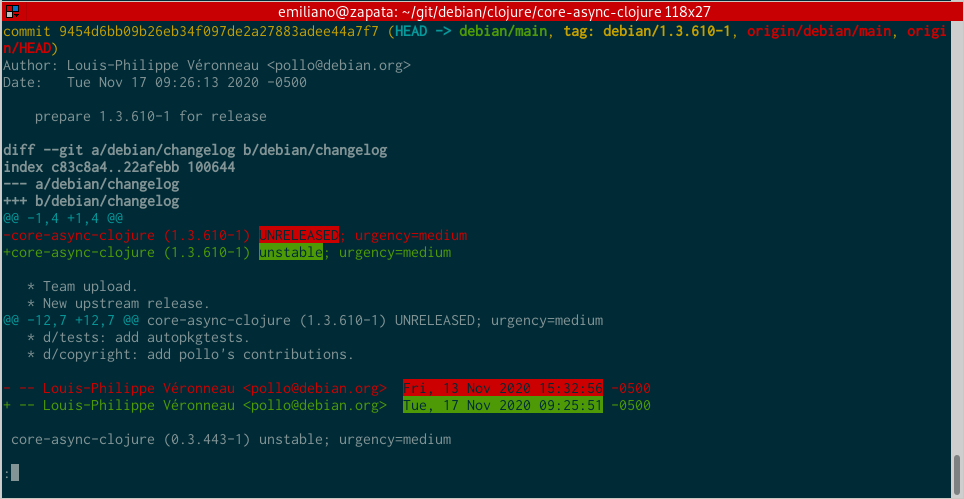 Sadly, even though


 A new release 0.0.17 of
 The following contributors got their Debian Developer accounts in the last two months:
 TL;DRVisit degiro-trading-tracker on Github I was always interested in stocks and investing. While I wanted to get into trading for long time, I could never...
The post
 Rewrote my build system in C++.
I used to write build rules in Nodejs, but I figured if my projects are mostly C++ I should probably write them in C++.
I wanted to make it a bit more like BUILD files but couldn't really and ended up looking more C++ than I wanted to.
Seems like key-value struct initialization isn't available until C++20.
 I released version 1.3 of

