Search Results: "ana"

24 March 2012

Pablo Lorenzzoni: Annoyed by F10 key in gnome-terminal?

I am one of those people that like to map Fx keys to special functions. After all, that s what F-unction keys are for, right? So, one of the first things I do once I have to configure a new Desktop is disable F10-capture by gnome-terminal. It has been working flawlessly, until I begin using GNOME3. No matter what, F10 was still being captured. I found that this is a bug and that adding the following:
@binding-set NoKeyboardNavigation  
	unbind "<shift>F10"
 
 
*  
	gtk-key-bindings: NoKeyboardNavigation
 
to ~/.config/gtk-3.0/gtk.css serves as a workaround. Hope this helps people with the same problem.

23 March 2012

Russell Coker: Cheap NAS Devices Suck

There are some really good Network Attached Storage (NAS) devices on the market. NetApp is one company that is known for making good products [1]. The advantage of a NAS is that you have a device with NVRAM for write-back caching, a filesystem that supports all the necessary features for best performance (NetApp developed their own filesystem WAFL to provide the features they needed), and a set of quality hardware that has been tested and certified to work together. If you want a cheap NAS then you end up with something running Linux with GPL filesystems. This isn t a bad thing as such, but some of the best performance and data integrity features are available in ZFS (which isn t GPL) and BTRFS (which isn t ready for production use). Not to mention WAFL which has been providing ZFS/BTRFS type features for more than a decade. A cheap NAS will generally be sold without disks as this is the best way to keep costs down. Selling with disks either means selling lots of different variations (which means it can t be sold off the shelf) or selling packages that don t quite suit some customers (thus causing people to buy the device and replace the disks which means extra costs). This means that the vendors can t provide the guarantees about disk quality and suitability that NetApp can provide. One major problem with a NAS is that you typically can t get shell access. Commands such as rm -rf and cp -rl which are typically rather quick when performed locally can take ages when run over NFS. Also commands such as grep -R which can perform reasonably well over NFS will always perform better when run locally. Also tasks such as compiling big programs which require good disk speed as well as some CPU time can be run locally if you have a file server system that also has local accounts (IE a typical multi-user Unix server configuration), but a dedicated NAS will prevent that. I have never used a NetApp device due to my clients deciding (sometimes correctly and sometimes incorrectly IMHO) that they are too expensive. But when considering what my clients do the down-sides of lacking local code execution on a NetApp would be more than compensated in many cases by the significant performance and reliability advantages that they offer (see my post about the reliability issues in standard RAID implementations [2]). A server class system (with ECC RAM as a minimum criteria) running RAID-6 can be a fairly decent file server. That requires hardware RAID with NVRAM for the write-back cache for decent write performance, but when write performance isn t required software RAID does the job quite well. A Dell tower system will typically hold at least 4 disks which means 6TB of RAID-6 storage and is quite cheap it can be under $2000. also such a system can be easily expanded with extra Ethernet ports etc. NetApp doesn t sell products directly and doesn t list prices, but they do have some adverts for products being under $7500 . That s not really cheap but not THAT expensive when you consider the features. A hidden cost in running a NAS is having someone perform sysadmin work on it. For a relatively expensive device that offers significant features such as a NetApp Filer this expense probably isn t too great. But for a device that does what any PC running Linux can do it s noteworthy that more training or experimenting time is required. There are some special cases where small and cheap NAS appliances really make sense, such as the Apple Time Capsule for home network backups. But apart from that I don t think that cheap NAS appliances make sense. It seems that cheap NAS devices provide the biggest down-sides of expensive NAS devices (in terms of lacking local access and having a different administration interface to servers) while also having the biggest down-sides of PC servers (lacking the advanced features of WAFL and performance of a NetApp). Earlier today I started a process of reorganising some backups which included backups to a cheap NAS. I have been very unimpressed by the time taken to copy and rm files over NFS. I m sure that the job would have been completed hours ago if I had local root access to the NAS. Related posts:
  1. big and cheap USB flash devices It s often the case with technology that serious changes occur...
  2. Insider Threats and Small Storage Devices Danny Angus writes about the potential threat posed by small...
  3. Some RAID Issues I just read an interesting paper titled An Analysis of...

Rapha&#235;l Hertzog: People behind Debian: J rg Jaspert, FTPmaster, Debian Account Manager, and more

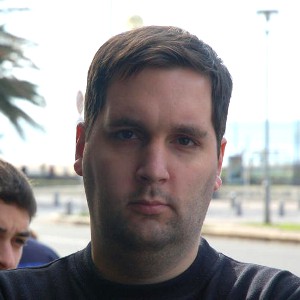
Photo by Wouter Verhelst

J rg is a very active contributor within Debian, and has been for a long time. This explains why he holds so many roles (FTPmaster and Debian Account Manager being the 2 most important ones) Better known as Ganneff (his IRC nick), he s not exactly the typical hacker. He has no beard and used to drink milk instead of beers. :-) Check out his interview to learn more about some of the numerous ways one can get involved in Debian, managing its infrastructure and without having to be a packager. Raphael: Who are you? J rg: My name is J rg Jaspert and I m 35 years old working for a small company doing system administration and consulting work for our customers. I m married for a little while now and sometime soon a little Ganneff will be crawling out of my wife. (Whoever didn t think of the movie Alien now is just boring). Raphael: How did you start contributing to Debian? J rg: I started using Debian somewhere around 2000, 2001. Before that I had the misfortune to try SuSE and RedHat, both with a user experience that let me fully understand why people think Linux is unusable. (Due to my work I m in the unfortunate situation to have to use RedHat on two machines. Funny how they are still utter crap and worse than bad toys). And all of this lets get a Linux running here came up because I was trying to find a replacement for my beloved OS/2 installation, which I had for some years. So after I got Debian installed, good old Potato, I got myself active on our mailing lists, starting with the German user one. A bit later I replied to a question if someone can help as staff for a Debian booth somewhere. It was the most boring event I ever visited (very nice orga, unfortunately no visitors), but I got a few important things there: The software I packaged, found me a sponsor and voila, maintainer I was. Some more packages got added and at some point my sponsor turned out to be my advocate. The NM process run around 2 months, and mid April 2002 I got THE MAIL. Raphael: Some Debian developers believe that you have too many responsibilities within Debian (DAM, FTPMaster, Debconf, Partners, Planet Debian, Mirrors, ). Do you agree that it can be problematic, and if yes, are you trying to scale down? J rg: It s DebConf, tssk. And yes, I do have some extra groups and roles. And you even only list some, leaving out all I do outside Debian. But simply counting number of roles is a plain stupid way to go. Way more interesting is how much work is behind a role and how many other people are involved. And looking at those you listed I don t see any I am a SPOF. Let s look at those you listed: DAM: Here I did start out assisting James to get the huge backload down which had accumulated over time. Nowadays I am merely the one with the longest term as DAM. Christoph Berg joined in April 2008 and Enrico Zini followed during October 2010, both very active. Especially Enrico, lately with the redesign of the NM webpages. FTPMaster: The basic outline of the FTPMaster history is similar to the DAM one. I joined as an assistant, after the oh-so-famous Vancouver meeting in 2004. Together with Jeroen, we both then got the backload down which had accumulated there. He did most of the removals while I had a fun time cleaning up NEW. And we both prepared patches for the codebase. And in 2007, as the last action as DPL, Sam made me FTPMaster. Since then I haven t been alone either. In fact we have much more rotation in the team than ever before, which is a good thing. Today we are 3 FTPMasters, 4 FTP Assistants and 1 Trainee. Though we always like new blood and would welcome more volunteers. DebConf: I am very far outside the central DebConf team. I am not even a delegate here. Currently I am merely an admin, though there are 4 others with the same rights on the DebConf machines. I ve not taken any extra jobs this year, nor will I. Probably for next year again, but not 2012. Planet: I am one of three again, but then Planet is mostly running itself. Debian developers can just edit the config, cron is doing the work, not much needed here. Occasional cleanups, every now and then a mail to answer, done. In short: No real workload attached. Mirrors: My main part here is the ftpsync scriptset. Which is a small part of the actual work. The majority of it, like checking mirrors, getting them to fix errors, etc. is done by Simon Paillard (and since some time, Raphael Geissert is active there too, you might have heard about his http.debian.net). Having said that, there is stuff I could have handled better or probably faster. There always is. Right now I have 2 outstanding things I want to do a (last) cleanup on and then give away. Raphael: You got married last year. I know by experience that entertaining a relationship and/or a family takes time. How do you manage to combine this with your Debian involvement? J rg: Oh well, I first met my wife at the International Conference on OpenSource 2009 in Taiwan. So OpenSource, Debian and me being some tiny wheel in the system wasn t entirely news to her. And in the time since then she learned that there is much more behind when you are in a community like Debian, instead of just doing it for work. Even better that she met Debian people multiple times already, and knows with who I am quarreling Also, she is currently attending a language school having lots of homework in the evening. Gives me time for Debian stuff. :) How that turns out with the baby I have no idea yet. I do want to train it to like pressing the M key, so little-Ganneff can deal with NEW all on its own (M being Manual reject), but it might take a day or twenty before it gets so far. :) Raphael: Thanks to the continuous work of many new volunteers, the NEW queue is no longer a bottleneck. What are the next challenges for the FTPmaster team? J rg: Bad link, try this one. :) Also, no longer sounds like its recent. It s not, it s just that people usually recognize the negative only and not the positive parts. Well, there are a few challenges actually. The first one, even if it sounds simple, is an ongoing one: We need Debian Developers willing to do the work that is hidden behind those simple graphs. Yes, we are currently having a great FTP Team doing a splendid work in keeping that queue reasonably small this is a/THE sisyphean task per excellence. There will always be something waiting for NEW, even if you just cleaned the queue, you turn around and there is something else back in already. Spreading this workload to more people helps not burning one out. So if one or more of the readers is interested, we always like new volunteers. You simply need to be an uploading DD and have a bit of free time. For the rest we do have training procedures in place. Another one is getting the multi-archive stuff done. The goal is to end up with ONE host for all our archives. One dak installation. But separate overrides, trees, mirrors, policies and people (think RMs, backports team, security team). While this is halfway easy to think of in terms of merging backports into main it gets an interesting side note when you think of merging security into main . The security archive does have information that is limited to few people before public release of a security announce, and so we must make sure our database isn t leaking information. Or our filesystem layer handling. Or logs. Etc. Especially as the database is synced in (near) realtime to a DD accessible machine. And the filesystem data too, just a little less often. There is also a discussion about a good way to setup a PPA for Debian service. We do have a very far developed proposal here how it should work, and I really should do the finishing touches and get it to the public. Might even get a GSoC project on it. So far for some short to middle term goals. If you want to go really long term, I do think that we should get to the point where we get rid of the classical view of a source package being one (or more) tarballs plus the Debian changes. Where a new version requires the full upload of one or more of those parts of the source package. I don t know exactly where it should end up. Sure, stuff like one central DVCS, maintainers push there, the archive generates the source tarballs and prepares the mirrors do sound good for a quick glance. But there are lots of trouble and pitfalls and probably some dragons hidden here. Raphael: The Debian repositories are managed by DAK (Debian Archive Kit) which is not packaged. Thus Debian users pick tools like reprepro to manage their package repositories. Is that how things should be? J rg: Oh, Mark Hymers wants to do a package again. More power to him if he does, though yes, DAK is not exactly a quick-and-easy thing to install. But nowadays it is a trillion times easier than the past thanks to Mark s work people can now follow the instructions, scripts and whatever they find inside the setup directory. Still, it really depends on the archive size you are managing. A complex tool like dak does not make sense for someone who wants to publish one or a dozen of his own packages somewhere. Thats just like doing a finger amputation with a chainsaw it certainly works and is fun for the one with the chainsaw but you probably end up a little overdoing it. I myself am using dpkg-scan[packages sources] from a shell script but also mini-dinstall in places (never got friend with reprepro when I looked at it). Works, and for the few dozen packages those places manage it is more than enough. Also, using dak forces you into some ways of behaviour that are just what Debian wants but might not be what a user wants. Like inability to overwrite an existing file. One of the reasons why mentors.debian.net won t work with dak. Or the use of a postgres database. Or that of gpg. Sure, if you end up having more than just a dozen packages, if you have many suites and also movement between them, then dak is sure a thing to look at. And how should things be : however the user and admins of that certain install of reprepro, mini-dinstall, dak, whatever want it. This is not one-tool-for-all land :) Raphael: What is the role of Debian Account Managers (DAM)? Do you believe that DAMs have a responsibility to shape Debian by defining limits in terms of who can join and what can be done within Debian? J rg: Quote from https://lists.debian.org/debian-devel-announce/2010/10/msg00010.html:
The Debian Account Managers (DAM) are responsible for maintaining the list of members of the Debian Project, also known as Debian Developers. DAMs are authoritative in deciding who is a member of the Debian Project and can take subsequent actions such as approving and expelling Project members.
Now, aside from this quote, my OWN PERSONAL OPINION, without wearing anything even vaguely resembling a DAM hat: DAM is the one post that is entitled to decide who is a member or not. Usually that is in the way of joining (or not), which is simple enough. But every now and then this also means acting on a request to do something about whatever behaviour of a Debian Project member. I hate that (and i think one can easily replace I with WE there). But it s our job. We usually aren t quick about it. And we don t act on our own initiative when we do, we always have (numerous) other DDs complain/appeal/talk/whatever to us first. The expulsion procedure , luckily not invoked that often, does guarantee a slow process and lots of input from others. Are we the best for it? Probably not, we are just some people out of a thousand who happen to have a very similar hobby Debian. We aren t trained in dealing with the situations that can come up. But we are THE role inside Debian that is empowered to make such decisions, so naturally it ends up with us. Raphael: You did a lot of things for Debian over the years. What did bring you the most joy? Are there things that you re still bitter about? J rg: The most joy? Hrm, without being involved in Debian and SPI I would never have met my wife.
Or my current job. Or a GR against me. Not many running around with that badge, though I m still missing my own personal Serious problems with Mr. Jaspert thread. Bad you all.
Or visited so many places. Think of all the DebConfs, QA meetings, BSPs and whatever events.
Or met so many people.
Or learned so many things I would never even have come near without being DD. Raphael: Is there someone in Debian that you admire for their contributions? J rg: Yes.
Thank you to J rg for the time spent answering my questions. I hope you enjoyed reading his answers as I did. Note that older interviews are indexed on wiki.debian.org/PeopleBehindDebian.

Subscribe to my newsletter to get my monthly summary of the Debian/Ubuntu news and to not miss further interviews. You can also follow along on Identi.ca, Google+, Twitter and Facebook.

One comment Liked this article? Click here. My blog is Flattr-enabled.

Mark Brown: ASoC updates in 3.3

Linux 3.3 was released earlier this week. Aside from a few regmap related updates it was an extremely quiet release for the ASoC framework, the next few releases look like they will be much more active:

22 March 2012

Don Armstrong: Introducing Sweavealike

I use R a lot. It's one of the primary tools I use in my day job as a scientist analyzing large datasets. If you use LaTeX with R (as I often do), you probably use Sweave to interleave R output and figures with your text describing those figures using the noweb method of literate programming. Sweavealike is a plugin for IkiWiki that tries to do some of the useful things for IkiWiki that sweave does for R and LaTeX. You use it like the following:
[[!sweavealike  echo=1 code="""
a <- 1
a <- a + 10
print(a)
"""]]
which produces this result when run:
> a <- 1
> a <- a + 10
> print(a)
[1] 11
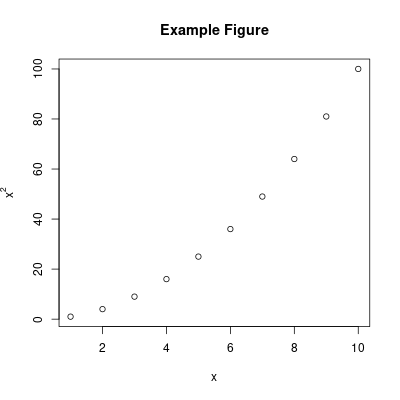
You can also generate figures with it:
[[!sweavealike  fig=1 echo=1 results="hide" code="""
plot(1:10,(1:10)^2,xlab="x",ylab=expression(x^2),main="Example Figure")
"""]]
> plot(1:10,(1:10)^2,xlab="x",ylab=expression(x^2),main="Example Figure")
The plugin itself uses the neat Statistics::R perl module to handle all of the heavy lifting. I personally plan on using this plugin to help write some more entries in my learning R series of posts that I'm beginning to work on. Hopefully I'll find and fix most of the bugs as I embark on that process so anyone else who uses the plugin won't, but feel free to e-mail me if something isn't working as it should. Finally, you shouldn't run this plugin on a publicly editable IkiWiki instance, because that would be a trivial local user exploit as R can run arbitrary code, read and write to arbitrary files, exhaust all memory, etc.

Brett Parker: Awesome, Gnome Power Manager and ACPI

I use awesome as my window manager, without a gnome session around it - as gnome-power-manager now depends on having a gnome-session running, I had a choice to make - I don't need or want to run a gnome-session, so I went on the hunt for a different battery monitor for my laptop. I've ended up using fdpowermon as it does just what I need and nothing more - then I edited the default acpi scripts to do what I had gnome-power-manager doing before hand, i.e. if I've unplugged the AC and I close the lid, the laptop does a s2both. Slightly more configuration, but it now does what I expect all the time (yay!). I wanted some extra keybinding from the default config of awesome in Debian, so I also created a very small rc.lua file as follows:
dofile("/etc/xdg/awesome/rc.lua")
mylayouts =  
    layouts[2],
    layouts[10],
    layouts[2],
    layouts[2],
    layouts[2],
    layouts[2],
    layouts[1],
    layouts[1],
    layouts[1]
 
for s = 1, screen.count() do
    for t = 1, 9 do
        awful.tag.setproperty(tags[s][t], "layout", mylayouts[t])
    end
end
globalkeys = awful.util.table.join(globalkeys,
    awful.key( "Control", "Mod1"  , "l", function () awful.util.spawn("/home/brettp/bin/lock-screen.sh") end)
)
root.keys(globalkeys)
This basically overrides parts of the default config and makes it so that my "tags" are vsplit for tags 1 and 3-6, maximised for tag 2 (where my browser lives) and floating for 7-9 (where the IM client sits, and I do anything involving GIMP). It does mean that I'm at the whim of the default config mostly, but as that seems to be fairly sane most of the time, that's not a problem... it also means that I'm only maintaining a small change set rather than a full rc file, and so new "features" can come in without me having to touch anything (well, other than restarting awesome...). I do need to either unmap the minimise key combo, or create an unminimise key combo that pops up a menu with the list of minimised windows in it at some point, though - because it's all too easy to press Meta4-n when you meant Meta4-m.

Pablo Lorenzzoni: GNOME 3 is like Vim.

You might know that I am testing GNOME 3. So far, so good. I was a little annoyed by the not-obvious and undocumented have-to-add-user-to-pulse-and-pulse-access procedure and the keyboard-shortcut-settings-bad-design-bug, but now sound works and my usual shortcuts are in-place I found myself liking the environment, but not sure about why I was liking it. I was always a minimalist user. At one time I convinced myself X11 (or Xorg) served as a terminal multiplexer but now, GNOME 3 is changing that with its unobstructiveness (is there such a word?). One thing that might be selling GNOME 3 to me is that it resembles Vim, my beloved text-editor and multipurpose IDE. Just think about the Overview mode as a command-mode in Vim. While working in Vim, I focus in one thing at a time, and everytime I want to do some meta thing, I Escape to the command-mode. It s just the same in GNOME 3: Overview let me do meta things and gives me the whole power of the Desktop in one screen. I am not sure I am going to keep GNOME 3 But thinking it s like Vim is a compelling argument.

Richard Hartmann: Lenovo service quality

As there has been a lot of feedback to my post regarding Lenovo's hardware quality, I thought it would only be fair to follow this up now that my laptop returned from Lenovo. After waiting about 15 minutes on the phone, I got to speak to an actual human. While I really do not have a problem with foreigners and love to talk to people from other cultures, I do firmly believe that someone working in a telephone support position should have at least basic language skills, both spoken and written. This was not the case and communicating my issues, and making sure that they would be written down correctly, took a long time and was generally frustrating. I put four things into the returns package: In said letter, I specified all my issues with the laptop, how removing the UMTS card will improve, but not fix the situation, and that the power brick will deliver power for a split second and then go off for a second; rinse repeat. Not having heard from them for a week, I decided to follow up on the status. As Lenovo's web interface claimed my ticket number did not exist, I spent a total of 1 hour 47 minutes in the waiting loop, not counting the menu selections. I never even managed to even reach a human. The day before I left for Open Source Days, the laptop arrived. The ticket number still did not exist according to the web interface and they never sent email even though they had my address, but at least my issue was fixed. Or so I thought. The repair slip claimed they switched out the mainboard, a claim I can not prove/disprove. It's OK not to find a bug in the first try, especially when it's not as simple as "display cracked". It's not quite as OK to not properly test a machine before sending it back. It's definitely not OK to not care in the least and just send back a machine which you obviously did not even try to debug. How they could not replace the power brick is beyond me. Thankfully, I ordered three separate ones and that was just my on-desk one so I have two others. Still. Overall, I am not impressed.

20 March 2012

Dirk Eddelbuettel: R / Finance 2012 Open for Registration

The annoucement below just went to the R-SIG-Finance list. More information is as usual the the R / Finance page:

Now open for registrations: R / Finance 2012: Applied Finance with R
May 11 and 12, 2012
Chicago, IL, USA
The registration for R/Finance 2012 -- which will take place May 11 and 12 in Chicago -- is NOW OPEN! Building on the success of the three previous conferences in 2009, 2010, and 2011, we expect more than 250 attendees from around the world. R users from industry, academia, and government will join 40+ presenters covering all areas of finance with R. This year's conference will start earlier in the day on Friday, to accommodate the tremendous line up of speakers for 2012, as well as to provide more time between talks for networking. We are very excited about the four keynotes by Paul Gilbert, Blair Hull, Rob McCulloch, and Simon Urbanek. The main agenda includes nineteen full presentations and eighteen shorter "lightning talks". We are also excited to offer six optional pre-conference seminars on Friday morning. Once again, we are hosting the R/Finance conference dinner on Friday evening, where you can continue conversations while dining and drinking atop a West Loop restaurant overlooking the Chicago skyline. More details of the agenda are available at:
http://www.RinFinance.com/agenda/
Registration information is available at
http://www.RinFinance.com/register/
and can also be directly accessed by going to
http://www.regonline.com/RFinance2012
On behalf of the committee and sponsors, we look forward to seeing you in Chicago!
Gib Bassett, Peter Carl, Dirk Eddelbuettel, Brian Peterson,
Dale Rosenthal, Jeffrey Ryan, Joshua Ulrich
Our 2012 Sponsors:
International Center for Futures and Derivatives at UIC Revolution Analytics
Sybase
MS-Computational Finance at University of Washington Google
lemnica
OpenGamma
OneTick
RStudio
Tick Data
See you in Chicago in May!!

19 March 2012

Petter Reinholdtsen: Debian Edu interview: John Ingleby

Debian Edu / Skolelinux users are spread all across the globe. The second inteview after the Squeeze release was publised is with John Ingleby, a teacher and long time Linux user in United Kingdom. Who are you, and how do you spend your days? I teach ICT part time at the Rudolf Steiner School in Kings Langley, near London, UK. Previously I worked as a technical author/trainer while my children attended the school, and I also contributed to the Schoolforge UK community with the aim of encouraging UK schools to adopt free/open source software. Five or six years ago we had about 50 schools interested in some way, but we weren't able to convert many of them into sustainable installations. How did you get in contact with the Skolelinux/Debian Edu project? Skolelinux had two representatives at an early Edubuntu meeting in London which I attended. However at that time our school network had just been installed using CentOS, LTSP 4 and GNOME. When LTSP 5 came along we switched to Edubuntu thin client servers so now we have a mixed environment which includes Windows PCs and student laptops, as well as their MacBooks and iPads. However, the proprietary systems have always been rather problematic, and we never built a GUI for the LDAP server, so when I discovered Skolelinux is configured for all these things we decided to try it. What do you see as the advantages of Skolelinux/Debian Edu? By far the biggest advantage is the Debian Edu community. Apart from that I have always believed in the same "sustainable computing" goals that Skolelinux is built on: installing Linux on computers which would otherwise be thrown away, to provide a reliable, secure and low-cost IT environment for schools. From my own experience I know that a part-time person can teach and manage a network of about 25 Linux computers, but it would take much more of my time if we had proprietary software everywhere. What do you see as the disadvantages of Skolelinux/Debian Edu? As a newcomer I'm just finding out who's who in the community and how you're organised, and what your procedures are for dealing with various things such as editing manual pages and so-on. The only English language mailing list seems to be for developers as well as users, so my inbox needs heavy pruning each day! Which free software do you use daily? Besides the software already mentioned at school we use Samba, OpenLDAP, CUPS, Nagios and Dansguardian for the network, and on the desktops we have LibreOffice, Firefox, GIMP and Inkscape. At home I use Ubuntu and an Android 4 eePad Transformer (but I'm not sure if that counts...) Which strategy do you believe is the right one to use to get schools to use free software? That's a tough question! For very many years UK schools installed and taught only proprietary software, so that at the highest levels the notion of "computer" means simply "proprietary office applications". However, schools today are experiencing budget constraints, and many are having to think hard about upgrading Windows XP. At the same time, we have students showing teachers how to use iPads, MacBooks and Android, so the choice of operating system is no longer quite so automatic. What is more, our government at last realised that we need people with programming skills, so they're putting coding back in the curriculum! And it's encouraging that the first 10,000 Raspberry Pi units sold out in 2 hours. I don't really know what strategy is going to get UK schools to use free software, but building an active community of Skolelinux/Debian Edu users in this country has to be part of it.

Jan Wagner: Chemnitzer Linuxtage 2012

As announced 3 weeks ago, the Debian project was present at Chemnitzer Linuxtage. Several talks and workshops where held by people related to the Debian project. At the booth we had talks and discussions with exhibitors and visitors, unfortunately I didn t had much time to visit more than small parts of two lectures. Unfortunately (for the visitors) we didn t had any merchandising on board, while we received several requests. On Sunday Axel surprised us with some leftovers from fosdem of debian.ch merch. At the booth we had a demo machine running Babelbox and xpenguins, which attracted visitors very well. Booth Babelbox We received also more than one Just thank you by satisfied users. :) Four different talks and one workshop were held by Debian people, but they were not specific to the Debian. The workshop was about OpenStreetMap, lectures was about commandline helpers, grep everything, quality analyzing and team management in opensource projects and Conkeror and other keyboard based webbrowsers. Many thanks to Jan Dittberner, Andreas Tille, Christian Hoffmann, Florian Baumann, Christoph Egger, Axel Beckert, Adam Schmalhofer, Markus Schnalke, Sebastian Harl and Patrick Matth i for running the booth, answering a wide range of questions or just chatting with visitors . A special thank to TMT GmbH & Co. KG for providing the complete equipment and sponsoring it s transportation. At the end we have to send a big thank to the organizing team of the Chemnitzer Linuxtage. It was fun and a pleasure to find new friends and meet old ones of the Free Software community. A small sidenote was anybody aware that OpenSuSE Package search is using screenshots.debian.net?

18 March 2012

Aurelien Jarno: 10 years ago

Date: Mon, 18 Mar 2002 18:22:10 +0000
From: James Troup <troup@samosa.debian.org>
To: Aurelien Jarno <aurelien@aurel32.net>
Cc: da-manager@debian.org
Subject: New Debian maintainer Aurelien Jarno [ This is a long (automatically-generated) mail, but it contains
important information, please read it all carefully. ] Dear Aurelien Jarno! An account has been created for you on developer-accessible machines with username aurel32 . The password for this account can be found encrypted with your PGP or GPG key and appended to this message. A list of machines available to Debian developers can be found at <URL:http://db.debian.org/machines.cgi>. Please take a minute now to familiarize yourself with the Debian Machine Usage Policy, available at <URL:http://www.debian.org/devel/dmup> You have been subscribed to the debian-private mailing list as <aurel32@debian.org>. Please respect the privacy of that list and don t forward mail from it elsewhere. E-mail to <aurel32@debian.org> will be forwarded to <aurelien@aurel32.net>. To change this, please see <URL:http://db.debian.org/forward.html> Also, please subscribe to debian-devel-announce, if you haven t done so already. We strongly suggest that you use your aurel32@debian.org address for the maintainer field in your packages, because that one will be valid as long as you are a Debian developer, even if you change jobs, leave university or change Internet Service providers. If you do so, please add that address to your PGP/GPG key(s) (using gpg edit-key YOUR USER ID ) and send it to the keyring server at keyring.debian.org with gpg keyserver keyring.debian.org send-keys YOUR USER ID . You can find more information useful to developers at <URL:http://www.debian.org/devel/> (in particular, see the subsection titled Debian Developer s reference ). We suggest that you subscribe to debian-mentors@lists.debian.org. This list is for new maintainers who seek help with initial packaging and other developer-related issues. Those who prefer one-on-one help can also post to the list, and an experienced developer may volunteer to help you. You can get online help on IRC, too, if you join the channel #debian-devel on irc.debian.org. Take a look at the support section on www.debian.org in order to find out more information. You should have read these documents before working on your packages. o The Debian Social Contract
<URL:http://www.debian.org/social_contract.html> o The Debian Policy Manual
<URL:http://www.debian.org/doc/debian-policy/> If you have some spare time and want to contribute it to Debian you may wish to take a look at the Work-Needing and Prospective Packages for Debian GNU/Linux also known as WNPP that can be found at <URL:http://www.debian.org/devel/wnpp/> If you plan to make a Debian package from a not yet packaged piece of software you *must* announce your intention on the debian-devel mailing list to make sure nobody else is working on them. The machine ftp-master.debian.org is our main archive server. Every uploaded package finds it s way there (except for Packages covered by US crypto laws which go to non-us.debian.org) eventually. master.debian.org is the home of our bug tracking system. Project web pages and CVS archives are hosted on klecker.debian.org (aka cvs/www.debian.org), klecker is also our general shell server. Web pages should be placed in public_html on klecker and refered to by http://people.debian.org/~aurel32 You should use ssh to log into the machines instead of regular telnet or rlogin. Our LDAP directory is able to share ssh RSA keys among machines, please see <URL:http://db.debian.org/doc-mail.html> Otherwise when you first login a ~/.ssh directory will be created with the appropriate permissions. Please be aware of the security implications of using RSA authentication and ssh agents. Finally, please take a minute to visit <URL:http://db.debian.org/>.
Login using the password information appended to this email, and update your personal information. The information is used to maintain your accounts on various Debian machines, and also to allow other developers and general users to find out more about you. Many of the fields are only visible to other registered Debian developers. This is also the only way to change your password. The passwd program does not yet work. Welcome to the project!
The Debian New Maintainer Team

Pablo Lorenzzoni: Time to change Window Manager again?

Ten years ago I was a fan of NEXTSTEP desktops and a die hard user of Window Maker. I love dockapps, and used to collect them. Things changed, and, as I moved from Desktops to Laptops, I began using simpler Window Managers. The powerful keyboard-shortcuts Fluxbox along with its capability to join windows with tabbing won me over and I began using it in my Laptop, while preserving Window Maker in my Desktop. In time, Fluxbox were used in both sides. Then the netbooks came and I bought an EeePC. The screen was so small that even the non-obstructive nature of Fluxbox were not enough. I began to try tiling window managers and I settle for Awesome. I was using Fluxbox in my Desktop and my Laptop, but Awesome was running in my Netbook. Tiling was making a lot of more sense and I could be productive, even in a small Netbook. Eventually, I started using Bluetile in my Laptop. Also, Bluetile was written in Haskell, and I was interested in Functional Languages by that time Now I got a new Laptop, and, since it features a Realtek 8191SE Wi-fi card, I had to install Wheezy (in my laptop, I usually run stable). Wheezy comes with the new GNOME 3 desktop, of which I read a lot. I decided to give it a try. I am missing advanced tiling (it seems that GNOME3 tiling works just in the side-by-side approach) and I also think that creating custom launchers should be improved but so far I am not disliking it, which is a good step toward adopting it. I ll give it a week to convince me. Let s see how it works its charm on me :-)

Andrew Pollock: [life] Guantanamo: My Journey

I first learned that David Hicks had written an autobiography when I saw some press coverage of there being an attempt by the Australian Government to ban the sale of it, so I asked my sister if she could get me a copy for my birthday before any ban happened. The book doesn't appear to be available on Amazon. I sat down and tried to read it almost immediately, but at the time found his writing style to be rather inarticulate, so I put the book down for a month or so. When I next had a platelet donation to make, I took it along with me, and forced myself to read it for duration of the donation. On the second reading, I managed to engage with the book, and from that point on, once I made it through his early years in that initial forced reading session, it ended up being quite enthralling. I plugged my way through the 456 pages in a bit over a month I guess. We'll never truly know the full story of David Hicks, because I'm sure that unless there's some sort of inquiry (and even then, there's multiple country's governments involved), the full story won't come out. I was always sympathetic to Hicks' plight, since I don't believe that anyone should be held without due process let alone for anywhere near as long as he was. Certainly, the way the book reads, Hicks comes across as a very young, naive, but principled individual. Like many Australians, he got the travel bug, and by way of it, got to interact with some different cultures, which awakened a hunger for social justice in him (at least that's my interpretation of his portrayal). I guess I have a different mental image of torture than Hicks did, because I didn't really find any incidences of what I'd consider torture in his story. There was plenty of despicable, inhumane treatment though, so I can see how the line might get blurry, particularly if you're the one experiencing it. Specifically on the (mis)treatment of the detainees: it was pretty bad, based on the book. I'm surprised there haven't been more whistle blowers that have come out. I can't believe that the many soldiers who were stationed there could treat detainees the way Hicks says they were treated and then can look themselves in the mirror. The ICRC seemed well apprised of the detainees conditions (since they seemed to have the most access to them of any non-military people). I don't know what confidentiality is imposed on them in return for that access, though. The fact that he's able to string a sentence together at all after the treatment he describes for the length of time he received it, I think is pretty amazing. I couldn't imagine having to endure what he says he went through. I did feel quite appalled by my own country's complete disregard for his plight, and similarly in the way the US Government treated these detainees for as long as they did. Given there are still 171 detainees in Guantanamo today, it makes me wonder what the conditions and treatment are like there now. It certainly seems to have fallen out of the mainstream press. Overall, not the most well written book, but a fascinating and shocking account of what happened to one person. I think Hicks should be congratulated for the courage to relive his experiences to get them down on paper, and Random House should also be congratulated for publishing his work, which I'm sure put them under some political pressure. I have no idea how well the book has sold, or how widely it has been read, but I certainly recommend it.

Soeren Sonnenburg: Shogun got accepted at Google Summer of Code 2012

SHOGUN has been accepted for Google Summer of Code 2012. SHOGUN is a machine learning toolbox, which is designed for unified large-scale learning for a broad range of feature types and learning settings. It offers a considerable number of machine learning models such as support vector machines for classification and regression, hidden Markov models, multiple kernel learning, linear discriminant analysis, linear programming machines, and perceptrons. Most of the specific algorithms are able to deal with several different data classes, including dense and sparse vectors and sequences using floating point or discrete data types. We have used this toolbox in several applications from computational biology, some of them coming with no less than 10 million training examples and others with 7 billion test examples. With more than a thousand installations worldwide, SHOGUN is already widely adopted in the machine learning community and beyond. SHOGUN is implemented in C++ and interfaces to all important languages like MATLAB, R, Octave, Python, Lua, Java, C#, Ruby and has a stand-alone command line interface. The source code is freely available under the GNU General Public License, Version 3 at http://www.shogun-toolbox.org. During Summer of Code 2012 we are looking to extend the library in three different ways:
  1. Improving accessibility to shogun by developing improving i/o support (more file formats) and mloss.org/mldata.org integration.
  2. Framework improvements (frameworks for regression, multiclass, structured output problems, quadratic progamming solvers).
  3. Integration of existing and new machine algorithms.
Check out our ideas list and if you are a talented student, consider applying!

17 March 2012

Matthew Garrett: More ways for firmware to screw you

Some of my recent time has been devoted to making our boot media more Mac friendly, which has entailed rather a lot of rebooting. This would have been fine, if tedious, except that some number of boots would fall over with either a clearly impossible kernel panic or userspace segfaulting in places that made no sense. Something was clearly wrong. Crashes that shouldn't happen are generally an indication of memory corruption. The question is how that corruption is being triggered. Hunting that down wasn't terribly easy.

My first thought was that we were possibly managing to load the kernel over a region used by UEFI code. UEFI defines two types of code - boot services and runtime services. While runtime services code and data must be preserved by the OS, in theory boot services code and data is available to the OS once the firmware has exited. In practice, that's not true. It seemed entirely possible that the kernel might be ending up on top of some of that boot services code or data and getting trodden on. Grub now has code to avoid putting the kernel on boot services, so testing the latest code seemed like a good plan. But no, crashes still happened.

That pretty much ruled out the bootloader. My next thought was that executing some of the firmware code was triggering a write to some other memory that contained the kernel. Josh Boyer suggested the next trick, which was to try marking the kernel read-only to see whether anything was hitting it. x86 lets you mark pages as read-only - any attempt to write to them should take a fault. UEFI functions are executed in the context of the kernel, so share the same page tables. That let me rule this out, since everything still went just as wrong and I wasn't taking an extra fault first.

However, at this point I was reasonably happy that it wasn't the kernel itself being overwritten - faults were occurring in userspace code as well. That was a pretty strong indication that what was happening was continuing to happen once userspace had started, so it wasn't a direct response to a firmware call. I made sure of that by stubbing out all the calls that could be triggered after kernel initialisation, and saw the same failures. Once all attempts to be clever have failed, it's time to just start using brute force. The kernel lets you reserve areas of RAM by passing arguments like memmap=0xlength$0xstart to block length bytes starting at start from being used. It took a while, but I finally found a 256MB range that made a difference - reserving it resulted in the machine booting reliably, letting the OS use it resulted in occasional crashes.

Definite progress. Comparing that memory range to the EFI memory map was helpful. There were several blocks of UEFI boot services data present there, which really seemed like too much of a coincidence. By reserving each of them in turn, I'd traced it down to a single 31MB region of boot service data - that is, memory reserved by the firmware for use by the UEFI boot services. Per spec, this is available to the OS once the boot environment has been exited. Nothing other than the OS should be touching this after boot, but something clearly was. Tracking down what was far easier than I expected, although the first attempt was a failure. Setting it read-only should have triggered a fault, but didn't. That was rather confusing. But, rather than give up, I patched the kernel to fill the region with 0xff at kernel init. Then I booted the system, read it back and looked for values that weren't 0xff. I got this:
00000000  ff ff ff ff ff ff ff ff  ff ff ff ff ff ff ff ff   ................ 
*
001568a0  ff ff ff ff ff ff ff ff  ff ff ff ff 84 00 00 00   ................ 
001568b0  00 20 a7 ac 46 00 00 00  00 00 00 00 00 00 06 01   . ..F........... 
001568c0  c2 0b 0c 00 ff ff ff ff  ff ff ff ff ff ff ff ff   ................ 
001568d0  ff ff 0a 04 f0 03 82 0d  40 00 00 00 ff ff ff ff   ........@....... 
001568e0  ff ff 00 21 00 36 9a 80  ff ff ff ff ff ff 00 7e   ...!.6.........~ 
001568f0  00 09 43 48 41 2d 47 75  65 73 74 01 04 02 04 0b   ..CHA-Guest..... 
00156900  16 32 08 0c 12 18 24 30  48 60 6c 2d 1a 0e 18 1a   .2....$0H l-.... 
00156910  ff ff 00 00 00 00 00 00  00 00 00 00 00 00 00 00   ................ 
00156920  00 00 00 00 00 00 00 dd  09 00 10 18 02 00 10 01   ................ 
00156930  00 00 dd 1e 00 90 4c 33  0e 18 1a ff ff 00 00 00   ......L3........ 
00156940  00 00 00 00 00 00 00 00  00 00 00 00 00 00 00 00   ................ 
00156950  00 00 bd ea f8 b3 ff ff  ff ff ff ff ff ff ff ff   ................ 
00156960  ff ff ff ff ff ff ff ff  ff ff ff ff ff ff ff ff   ................ 
*
022fb000
That's a lot of 0xffs (around 31MB of them) with one small section that contains an 802.11 probe packet with the SSID of the hospital across the road from my house. Apple support network booting off wireless networks. It seems that the firmware brought up the wireless card, associated with this network (it's the only public one nearby) and then left the card DMAing packets into RAM. The read-only page attribute only applies to CPU-initiated accesses, so it could do this without triggering a page fault. It also explained why it was so random - whether memory corruption occurred would depend on whether a packet appeared between that memory being used by the OS and the kernel reinitialising the wireless card. It certainly explains why I couldn't reproduce it when I left the machine repeatedly rebooting on the bus home.

How do we fix this? Unsure. With luck disconnecting the UEFI driver in the bootloader should quiesce the hardware, but without testing I'm not sure of that yet. For now it's just another example of firmware managing to break expectations in deeply strange ways.

comment count unavailable comments

DebConf team: Make DebConf12 a success: donate or become a sponsor (Posted by Leandro Gomez)

The Debian Project s annual conference is slowly coming closer. Visiting places around the world since 2000, DebConf will take place this year in Managua, Nicaragua, in July and will again provide an opportunity for people who contribute to Debian to meet in person for face-to-face collaboration and discussions. At DebConf we try to bring together as many Debian contributors as possible, including those who could not afford to attend from their own resources. You can help make DebConf12 a success by your organisation becoming a sponsor, or by donating money as an individual. Individual donations can be made online in either US dollars or euros. If you are interested in becoming a sponsor, you can find more information about DebConf12 sponsor page or directly contact <sponsors@debconf.org>. In addition to monetary donations, sponsorship can be provided in the form of in-kind donations, or by lending equipment for the conference period.

Ana Beatriz Guerrero Lopez: Debian accepted for the Google Summer of Code 2012. Students wanted!

Great news! Debian has been accepted into the Google Summer of Code (GSoC) program this year for the seventh time. Now we are looking for students to work this summer with us in one of our exciting projects. If you are interested, now would be a good time to get in touch with the mentors; remember that discussing your application before submitting it is always recommended so that you can get feedback from the community.
Please also read the FAQ and timeline in the Google Summer of Code website. Besides contacting with the mentors, you can also get in touch with us on our IRC channel #debian-soc (in irc.debian.org) and the soc-coordination mailing list if you have any questions. I am hoping to see many great applications from students wainting to improve Debian :)

16 March 2012

Matt Brown: Kindle Reading Stats

I ve written before about my initial investigations into the Kindle, and I ve learnt much more about the software and how it communicates with the Amazon servers since then, but it all requires detailed technical explanation which I can never seem to find the motivation to write down. Extracting reading data out of the system log files is however comparatively simple. I m a big fan of measurement and data so my motivation and goal for the Kindle log files was to see if I could extract some useful information about my Kindle use and reading patterns. In particular, I m interested in tracking my pace of reading, and how much time I spend reading over time. You ll recall from the previous post that the Kindle keeps a fairly detailed syslog containing many events, including power state changes, and changes in the Booklet software system including opening and closing books and position information. You can eyeball any one of those logfiles and understand what is going on fairly quickly, so the analysis scripts are at the core just a set of regexps to extract the relevant lines and a small bit of logic to link them together and calculate time spent in each state/book. You can find the scripts on Github: https://github.com/mattbnz/kindle-utils Of course, they re not quite that simple. The Kindle doesn t seem to have a proper hardware clock (or mine has a broken hardware clock). My Kindle comes back from every reboot thinking it s either at the epoch or somewhere in the middle of 2010, the time doesn t get corrected until it can find a network connection and ping an Amazon server for an update, so if you have the network disabled it might be many days or weeks of reading before the system time is updated to reality. Once it has a network connection it uses the MCC reported by the 3G modem to infer what timezone it should be in, and switches the system clock to local time. Unfortunately the log entries all look like this:
110703:193542 cvm[7908]: I TimezoneService:MCCChanged:mcc=310,old=GB,new=US:
110703:193542 cvm[7908]: I TimezoneService:TimeZoneChange:offset=-25200,zone=America/Los_Angeles,country=US:
110703:193542 cvm[7908]: I LipcService:EventArrived:source=com.lab126.wan,name=localTimeOffsetChanged,arg0=-25200,arg1=1309689302:
110703:193542 cvm[7908]: I TimezoneService:LTOChanged:time=1309689302000,lto=-25200000:
110703:183542 system: I wancontrol:pc:processing "pppstart"
110703:193542 cvm[7908]: I LipcService:EventArrived:source=com.lab126.wan,name=dataStateChanged,arg0=2,arg1=:
110703:183542 cvm[7908]: I ConnectionService:LipcEventArrived:source=com.lab126.cmd,name=intfPropertiesChanged,arg0=
,arg1=wan:
110703:183542 cvm[7908]: W ConnectionService:UnhandledLipcEvent:event=intfPropertiesChanged:
110703:193542 wifid[2486]: I wmgr:event:handleWpasupNotify(<2>CTRL-EVENT-DISCONNECTED), state=Searching:
110703:113542 wifid[2486]: I spectator:conn-assoc-fail:t=374931.469106, bssid=00:00:00:00:00:00:
110703:113542 wifid[2486]: I sysev:dispatch:code=Conn failed:
110703:183542 cvm[7908]: I LipcService:EventArrived:source=com.lab126.wifid,name=cmConnectionFailed,arg0=Failed to connect to WiFi network,arg1=
:
Notice how there is no timezone information associated with the date/time information on each line. Worse still the different daemons are logging in at least 3 different timezones/DST offsets all interspersed within the same logfile. Argh!! So our simple script that just extracts a few regexps and links them together nearly doubles in size to handle the various time and date convolutions that the logs present. Really, the world should just use UTC everywhere. Life would be so much simpler. The end result is a script that spits out information like:

B000FC1PJI: Quicksilver: Read 1 times. Last Finished: Fri Mar 16 18:30:57 2012
- Tue Feb 21 11:06:24 2012 => Fri Mar 16 18:30:57 2012. Reading time 19 hours, 29 mins (p9 => p914)
... Read 51 books in total. 9 days, 2 hours, 29 mins of reading time
I haven t got to the point of actually calculating reading pace yet, but the necessary data is all there and I find the overall reading time stats interesting enough for now. If you have a jailbroken Kindle, I d love for you to have a play and let me know what you think. You ll probably find logs going back at least 2-3 weeks still on your Kindle to start with, and you can use the fetch-logs script to regularly pull them down to more permanent storage if you desire.

Paul Wise: Report from the recent Debian bug squashing party in Perth

We recently held a Debian bug squashing party (BSP) in Perth, Western Australia. Over the weekend we had about 10 or so people show up to participate, learn about fixing bugs in Debian and try to fix some. The BSP co-incided with a weekend heat wave with temperatures reaching 38 C and the venue lacked air conditioning. Most of the attendees were new to Debian development but were Debian users. Our focus was on release critical bugs highlighted by rc-alert and the UDD bugs list, but we also discussed IPv6 bugs in CUPS and some bugs that were affecting UCC infrastructure. The UCC president also worked on fixing their door-locking system, replacing the broken system based on an ancient modem with an Arduino board. We managed to fix, work on or investigate 12 or more bugs. I was hoping we would get through more, but the weather and the average experience level conspired against us. After we were done on Sunday a few of us went down to the local pub to have a meal, a beer and some geeky conversation. All in all we had a good time and got some bugs fixed. The UCC president seemed to be keen on doing another BSP, hopefully we can do another one before the freeze happens. There were a few people who missed the BSP so it would be good to give them a chance to work on some bugs. Thanks go to the UCC folks for the venue and to PLUG folks for helping with organisation and promotion of the event.

Next.

Previous.