Search Results: "will"

2 April 2015

Michal Čihař: GSoC 2015 applications for phpMyAdmin

As usual, I look at the application stats for phpMyAdmin just after student application period of Google Summer of Code is over. First of all we got way more proposals than in last years, but also number of bogus proposals went up (you can see them as ignored in the chart). Same as in past years, people leave the submission to the last moment, even though we encourage them to submit early so that they can adjust the application based on our feedback. But still we got more than half of the proposals in last three days. Number of applications over time Anyway we're just working on evaluation and will finalize it in upcoming days. Of course you will know the results from Google on April 27th. PS: You can compare to our 2014, 2013 and 2012 numbers.

Filed under: English phpMyAdmin SUSE 0 comments

1 April 2015

Holger Levsen: 20150401-reproducible-jessie

Testing jessie for reproducibility or "here, have some 8 cores and 25 GB RAM extra..." So three weeks ago it occurred to me that it would be useful to test the reproducibility of Jessie too (until then we only tested unstable and experimental), as this will give us a nice data point to compare future developments against and also because we wanted to test "testing" in future anyway, so we could as well start while "testing" is still jessie... (because then we will have to test less once stretch development has started, as in the beginning stretch will be jessie anyway.) Quite quickly I then realized that building all packages twice on the current, quite heavily loaded jenkins.debian.net machine, would take 4-6 weeks and that it might well happen that we'll release Jessie before this has finished. (And I do want a Jessie release rather sooner than later!) So I've asked Profitbricks, who have been sponsoring the jenkins.debian.net setup since October 2012, for some more resources temporarily, and once again they quickly helped out and the next day I could add eight cores and 25 GB of RAM to the existing VM, for a total of 23 Cores and 75 GB RAM. So currently jenkins.d.n runs eight reproducible build jobs simultaneously, each of them is pbuilding packages in tmpfs in RAM. Thus these builds are really fast: for small packages without additional build depends build times as low as 40 seconds can be seen, which doesn't sound impressive at first, but this includes the source download and building twice and it includes untar'ing the base.tgz twice as well as running debbindiff on the resulting binary packages. (And all this is while quite many other jobs continue to hammer the machine as well.) (BTW: I doubt using LVM snapshots is faster then running this in tmpfs, but if you think LVM is faster I'd be curious to see some numbers.) Interestingly this rebuild also discovered a rather unexpected result as we found an RC bug in jessie, which caused build failures for >20 packages: "#781076 cdbs: perlmodule-vars.mk LDDLFLAGS quoting problem". And then there were some unexpected but really expectable results: testing turned out to "only" give reproducible results for 79.4% of all packages in main, while unstable has 82.6% reproducible packages. This was unexpected, as our (few) fixed packages in our repo are also used for testing testing and as testing is smaller than sid, I at first believed the reproducible percentage should be higher, as testing has 1000 packages less. So why was the lower percentage to be expected? This is due to two factors: since FOSDEM we have introduced a number of new variations for the second build, that is we now build with a.) a different domainname, b.) with a different umask, c.) a different timezone and d.) a different kernel version (using 'linux64 --uname-2.6'). And secondly, most packages in sid haven't been rebuild since FOSDEM. Thus we'll now reschedule all packages in testing which are unreproducible in unstable, which should decrease the current reproducibility of sid a bit... For those wondering about the 622 packages failing to build in testing: at least 453 are due to our test setup, categorized in (currently) three issues: timestamps_from_cpp_macros, ftbfs_werror_equals and ocaml_configure_not_as_root. The ones in this third issue category are rather trivial to fix, so this leaves 622-453=169 minus those fixed by #781076, so roughly 150 packeges which fail to build in our setup which need to be investigated... And for those wondering about other missing variations, there is at least one big one missing: changing the build date. Current guestimate is that this will make 1-2000 packages unreprdoucible again but we'll only know for sure once we tested them. So I would like to once again thank Profitbricks for supporting jenkins.d.n in the last 2.5 years and making reproducible.d.n possible so smoothly. Being able to painlessly add more resources when we needed them was incredible useful and I hope we can count on their support in the future. (I have some more ideas how to burn resources usefully in future. Stay tuned and btw, if you know how to put more hours in the day, please do tell me. ;) And, of course: thanks for your work on Debian, no matter whether you've been working on Jessie, reproducibility or something totally different! To finish this post I'd like to remind everyone that currently all this is just about the prospects of reproducible builds for Debian. Debian is not 80% reproducible yet - but it easily could be! And I certainly hope it will be "soon", and hopefully "soon" will only mean a few months. We will rebuild and see.

Benjamin Mako Hill: RomancR: The Future of the Sharing-Your-Bed Economy

romancer_logo Today, Aaron Shaw and I are pleased to announce a new startup. The startup is based around an app we are building called RomancR that will bring the sharing economy directly into your bedrooms and romantic lives. When launched, RomancR will bring the kind of market-driven convenience and efficiency that Uber has brought to ride sharing, and that AirBnB has brought to room sharing, directly into the most frustrating and inefficient domain of our personal lives. RomancR is Uber for romance and sex. Here s how it will work: Of course, there are many existing applications like Tinder and Grindr that help facilitate romance, dating, and hookups. Unfortunately, each of these still relies on old-fashion intrinsic ways of motivating people to participate in romantic endeavors. The sharing economy has shown us that systems that rely on these non-monetary motivations are ineffective and limiting! For example, many altruistic and socially-driven ride-sharing systems existed on platforms like Craigslist or Ridejoy before Uber. Similarly, volunteer-based communities like Couchsurfing and Hospitality Club existed for many years before AirBnB. None of those older systems took off in the way that their sharing economy counterparts were able to! The reason that Uber and AirBnB exploded where previous efforts stalled is that this new generation of sharing economy startups brings the power of markets to bear on the problems they are trying to solve. Money both encourages more people to participate in providing a service and also makes it socially easier for people to take that service up without feeling like they are socially in debt to the person providing the service for free. The result has been more reliable and effective systems for proving rides and rooms! The reason that the sharing economy works, fundamentally, is that it has nothing to do with sharing at all! Systems that rely on people s social desire to share without money projects like Couchsurfing are relics of the previous century. RomancR, which we plan to launch later this year, will bring the power and efficiency of markets to our romantic lives. You will leave your pitiful dating life where it belongs in the dustbin of history! Go beyond antiquated non-market systems for finding lovers. Why should we rely on people s fickle sense of taste and attractiveness, their complicated ideas of interpersonal compatibility, or their sense of altruism, when we can rely on the power of prices? With RomancR, we won t have to! Note: Thanks to Yochai Benkler whose example of how leaving a $100 bill on the bedside table of a person with whom you spent the night can change the nature of the a romantic interaction inspired the idea for this startup.

Benjamin Mako Hill: RomancR: The Future of the Sharing-Your-Bed Economy

romancer_logo Today, Aaron Shaw and I are pleased to announce a new startup. The startup is based around an app we are building called RomancR that will bring the sharing economy directly into your bedrooms and romantic lives. When launched, RomancR will bring the kind of market-driven convenience and efficiency that Uber has brought to ride sharing, and that AirBnB has brought to room sharing, directly into the most frustrating and inefficient domain of our personal lives. RomancR is Uber for romance and sex. Here s how it will work: Of course, there are many existing applications like Tinder and Grindr that help facilitate romance, dating, and hookups. Unfortunately, each of these still relies on old-fashion intrinsic ways of motivating people to participate in romantic endeavors. The sharing economy has shown us that systems that rely on these non-monetary motivations are ineffective and limiting! For example, many altruistic and socially-driven ride-sharing systems existed on platforms like Craigslist or Ridejoy before Uber. Similarly, volunteer-based communities like Couchsurfing and Hospitality Club existed for many years before AirBnB. None of those older systems took off in the way that their sharing economy counterparts were able to! The reason that Uber and AirBnB exploded where previous efforts stalled is that this new generation of sharing economy startups brings the power of markets to bear on the problems they are trying to solve. Money both encourages more people to participate in providing a service and also makes it socially easier for people to take that service up without feeling like they are socially in debt to the person providing the service for free. The result has been more reliable and effective systems for proving rides and rooms! The reason that the sharing economy works, fundamentally, is that it has nothing to do with sharing at all! Systems that rely on people s social desire to share without money projects like Couchsurfing are relics of the previous century. RomancR, which we plan to launch later this year, will bring the power and efficiency of markets to our romantic lives. You will leave your pitiful dating life where it belongs in the dustbin of history! Go beyond antiquated non-market systems for finding lovers. Why should we rely on people s fickle sense of taste and attractiveness, their complicated ideas of interpersonal compatibility, or their sense of altruism, when we can rely on the power of prices? With RomancR, we won t have to! Note: Thanks to Yochai Benkler whose example of how leaving a $100 bill on the bedside table of a person with whom you spent the night can change the nature of the a romantic interaction inspired the idea for this startup.

Raphaël Hertzog: My Free Software Activities in March 2015

My monthly report covers a large part of what I have been doing in the free software world. I write it for my donators (thanks to them!) but also for the wider Debian community because it can give ideas to newcomers and it s one of the best ways to find volunteers to work with me on projects that matter to me. Debian LTS This month I have been paid to work 15.25 hours on Debian LTS. In that time I did the following: That s it for the paid work. But still about LTS, I proposed two events for Debconf 15: A Debian LTS logoIn my last Freexian LTS report, I mentioned briefly that it would be nice to have a logo for the LTS project. Shortly after I got a first logo prepared by Damien Escoffier and a few more followed: they are available on a wiki page (and the logo you see above is from him!). Following a suggestion of Paul Wise, I registered the logo request on another wiki page dedicated to artwork requests. That kind of collaboration is awesome! Thanks to all the artists involved in Debian. Debian packaging Django. This month has seen no less than 3 upstream point releases packaged for Debian (1.7.5, 1.7.6 and 1.7.7) and they have been accepted by the release team into Jessie. I m pleased with this tolerance as I have argued the case for it multiple times in the past given the sane upstream release policy (bugfix only in a given released branch). Python code analysis. I discovered a few months ago a tool combining the power of multiple Python code analysis tools: it s prospector. I just filed a Request for Package for it (see #781165) and someone already volunteered to package it, yay \o/ update-rc.d and systemd. While working on a Kali version based on Jessie, I got hit by what boils down to a poor interaction between systemd and update-rc.d (see #746580) and after some exchanges with other affected users I raised the severity to serious as we really ought to do something about it before release. I also opened #781155 on openbsd-inetd as its usage of inetd.service instead of openbsd-inetd.service (which is only provided as a symlink to the former) leads to multiple small issues. Misc Debian France. The general assembly is over and the new board elected its new president: it s now official, I m no longer Debian France s president. Good luck to Nicolas Dandrimont who took on this responsibility. Salt s openssh formula. I improved salt s openssh formula to make it possible to manage the /etc/ssh/ssh_known_hosts file referencing the public SSH keys of other managed minions. Tendenci.com. I was looking for a free software solution to handle membership management of a large NPO and I discovered Tendenci. It looked very interesting feature wise and written with a language/framework that I enjoy (Python/Django). But while it s free software, there s no community at all. The company that wrote it released it under a free software license and it really looks like that they did intend to build a community but they failed at it. When I looked their development forums were web-based and mostly empty with only initial discussion of the current developers and no reply from anybody there s also no mention of an IRC channel or a mailing list. I sent them a mail to see what kind of collaboration we could expect if we opted for their software and got no reply. A pity, really. What free software membership management solution would you use when you have more than 10000 members to handle and when you want to use the underlying database to offer SSO authentication to multiple external services? Thanks See you next month for a new summary of my activities.

2 comments Liked this article? Click here. My blog is Flattr-enabled.

Benjamin Mako Hill: More Community Data Science Workshops

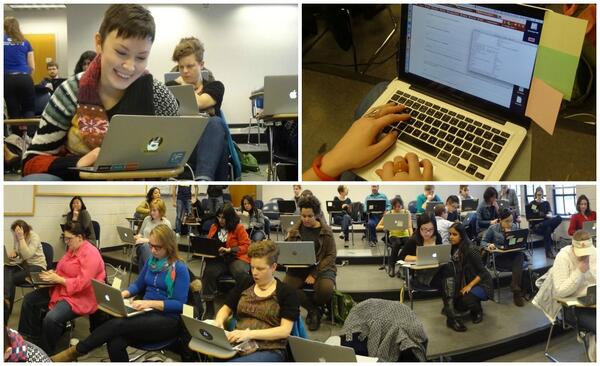
Pictures from the CDSW sessions in Spring 2014Pictures from the CDSW sessions in Spring 2014
After two successful rounds in 2014, I m helping put on another round of the Community Data Science Workshops. Last year, our 40+ volunteer mentorss taught more than 150 absolute beginners the basics of programming in Python, data collection from web APIs, and tools for data analysis and visualization and we re still in the process of improving our curriculum and scaling up. Once again, the workshops will be totally free of charge and open to anybody. Once again, they will be possible through the generous participation of a small army of volunteer mentors. We ll be meeting for four sessions over three weekends: If you re interested in attending, or interested in volunteering as mentor, you can go to the information and registration page for the current round of workshops and sign up before April 3rd.

Lars Wirzenius: Obnam 4.1 released

It is with great pleasure and satisfaction that I release version 4.1 of Obnam, my backup program. This version includes a radically innovative approaches to data compression and de-duplication, as well as some other changes and bug fixes. Major user-visible changes: Minor user-visible changes: Bug fixes:

31 March 2015

Zlatan Todori : Interviews with FLOSS developers: Francesca Ciceri

Debian and FLOSS community don't only occupy coding developers. They occupy people who write news, who talk about FLOSS, who help on booths and conferences, who create artistic forms of the community and so many others that contribute in countless ways. A lady, that is doing many of that is Francesca Ciceri, known in Debian as MadameZou. She is non-packaging Debian Developer, a fearless warrior for diversity and a zombie fan. Although it sounds intimidating, she is deep caring and great human being. So, what has MadaZou to tell us? Picture of MadameZou Who are you? My name is Francesca and I'm totally flattered by your intro. The fearless warrior part may be a bit exaggerated, though. What have you done and what are you currently working on in FLOSS world? I've been a Debian contributor since late 2009. My journey in Debian has touched several non-coding areas: from translation to publicity, from videoteam to www. I've been one of the www.debian.org webmasters for a while, a press officer for the Project as well as an editor for DPN. I've dabbled a bit in font packaging, and nowadays I'm mostly working as a Front Desk member. Setup of your main machine? Wow, that's an intimate question! Lenovo Thinkpad, Debian testing. Describe your current most memorable situation as FLOSS member? Oh, there are a few. One awesome, tiring and very satisfying moment was during the release of Squeeze: I was member of the publicity and the www teams at the time, and we had to pull a 10 hours of team work to put everything in place. It was terrible and exciting at the same time. I shudder to think at the amount of work required from ftpmaster and release team during the release. Another awesome moment was my first Debconf: I was so overwhelmed by the sense of belonging in finally meeting all these people I've been worked remotely for so long, and embarassed by my poor English skills, and overall happy for just being there... If you are a Debian contributor I really encourage you to participate to Debian events, be they small and local or as big as DebConf: it really is like finally meeting family. Some memorable moments from Debian conferences? During DC11, the late nights with the "corridor cabal" in the hotel, chatting about everything. A group expedition to watch shooting stars in the middle of nowhere, during DC13. And a very memorable videoteam session: it was my first time directing and everything that could go wrong, went wrong (including the speaker deciding to take a walk outside the room, to demonstrate something, out of the cameras range). It was a disaster, but also fun: at the end of it, all the video crew was literally in stitches. But there are many awesome moments, almost too many to recall. Each conference is precious on that regard: for me the socializing part is extremely important, it's what cements relationships and help remote work go smoothly, and gives you motivation to volunteer in tasks that sometimes are not exactly fun. You are known as Front Desk member for DebConf's - what work does it occupy and why do you enjoy doing it? I'm not really a member of the team: just one of Nattie's minions! You had been also part of DebConf Video team - care to share insights into video team work and benefits it provides to Debian Project? The video team work is extremely important: it makes possible for people not attending to follow the conference, providing both live streaming and recording of all talks. I may be biased, but I think that DebConf video coverage and the high quality of the final recordings are unrivaled among FLOSS conferences - especially since it's all volunteer work and most of us aren't professional in the field. During the conference we take shifts in filming the various talks - for each talk we need approximately 4 volunteers: two camera operators, a sound mixer and the director. After the recording, comes the boring part: reviewing, cutting and sometimes editing the videos. It's a long process and during the conference, you can sometimes spot the videoteam members doing it at night in the hacklab, exhausted after a full day of filming. And then, the videos are finally ready to be uploaded, for your viewing pleasure. During the last years this process has become faster thanks to the commitment of many volunteers, so that now you have to wait only few days, sometimes a week, after the end of the conference to be able to watch the videos. I personally love to contribute to the videoteam: you get to play with all that awesome gear and you actually make a difference for all the people who cannot attend in person. You are also non-packaging Debian Developer - how does that feel like? Feels awesome! The mere fact that the Debian Project decided - in 2009 via a GR - to recognize the many volunteers who contribute without doing packaging work is a great show of inclusiveness, in my opinion. In a big project like Debian just packaging software is not enough: the final result relies heavily on translators, sysadmins, webmasters, publicity people, event organizers and volunteers, graphic artists, etc. It's only fair that these contributions are deemed as valuable as the packaging, and to give an official status to those people. I was one of the firsts non-uploading DD, four years ago, and for a long time it was just really an handful of us. In the last year I've seen many others applying for the role and that makes me really happy: it means that finally the contributors have realized that they deserve to be an official part of Debian and to have "citizenship rights" in the project. You were the leading energy on Debian's diversity statement - what gave you the energy to drive into it? It seemed the logical conclusion of the extremely important work that Debian Women had done in the past. When I first joined Debian, in 2009, as a contributor, I was really surprised to find a friendly community and to not be discriminated on account of my gender or my lack of coding skills. I may have been just lucky, landing in particularly friendly teams, but my impression is that the project has been slowly but unequivocally changed by the work of Debian Women, who raised first the need for inclusiveness and the awareness about the gender problem in Debian. I don't remember exactly how I stumbled upon the fact that Debian didn't have a Diversity Statement, but at first I was very surprised by it. I asked zack (Stefano Zacchiroli), who was DPL at the time, and he encouraged me to start a public discussion about it, sending out a draft - and helped me all the way along the process. It took some back and forth in the debian-project mailing list, but the only thing needed was actually just someone to start the process and try to poke the discussion when it stalled - the main blocker was actually about the wording of the statement. I learned a great deal from that experience, and I think it changed completely my approach in things like online discussions and general communication within the project. At the end of the day, what I took from that is a deep respect for who participated and the realization that constructive criticism does require certainly a lot of work for all parts involved, but can happen. As for the statement in itself: these things are as good as you keep them alive with best practices, but I think that are better stated explicitly rather than being left unsaid. You are involved also with another Front Desk, the Debian's one which is involved with Debian's New Members process - what are tasks of that FD and how rewarding is the work on it? The Debian Front Desk is the team that runs the New Members process: we receive the applications, we assign the applicant a manager, and we verify the final report. In the last years the workflow has been simplified a lot by the re-design of the nm.debian.org website, but it's important to keep things running smoothly so that applicants don't have too lenghty processes or to wait too much before being assigned a manager. I've been doing it for a less more than a month, but it's really satisfying to usher people toward DDship! So this is how I feel everytime I send a report over to DAM for an applicant to be accepted as new Debian Developer: Crazy pic How do you see future of Debian development? Difficult to say. What I can say is that I'm pretty sure that, whatever the technical direction we'll take, Debian will remain focused on excellence and freedom. What are your future plans in Debian, what would you like to work on? Definetely bug wrangling: it's one of the thing I do best and I've not had a chance to do that extensively for Debian yet. Why should developers and users join Debian community? What makes Debian a great and happy place? We are awesome, that's why. We are strongly committed to our Social Contract and to users freedom, we are steadily improving our communication style and trying to be as inclusive as possible. Most of the people I know in Debian are perfectionists and outright brilliant in what they do. Joining Debian means working hard on something you believe, identifying with a whole project, meeting lots of wonderful people and learning new things. It ca be at times frustrating and exhausting, but it's totally worth it. You have been involved in Mozilla as part of OPW - care to share insights into Mozilla, what have you done and compare it to Debian? That has been a very good experience: it meant have the chance to peek into another community, learn about their tools and workflow and contribute in different ways. I was an intern for the Firefox QA team and their work span from setting up specific test and automated checks on the three version of Firefox (Stable, Aurora, Nightly) to general bug triaging. My main job was bug wrangling and I loved the fact that I was a sort of intermediary between developers and users, someone who spoke both languages and could help them work together. As for the comparison, Mozilla is surely more diverse than Debian: both in contributors and users. I'm not only talking demographic, here, but also what tools and systems are used, what kind of skills people have, etc. That meant reach some compromises with myself over little things: like having to install a proprietary tool used for the team meetings (and getting crazy in order to make it work with Debian) or communicating more on IRC than on mailing lists. But those are pretty much the challenges you have to face whenever you go out of your comfort zone . You are also volunteer of the Organization for Transformative Works - what is it, what work do you do and care to share some interesting stuff? OTW is a non profit organization to preserve fan history and cultures, created by fans. Its work range from legal advocacy and lobbying for fair use and copyright related issues, developing and maintaining AO3 -- a huge fanwork archive based on open-source software --, to the production of a peer-reviewed academic journal about fanworks. I'm an avid fanfiction reader and writer, and joining the OTW volunteers seemed a good way to give back to the community - in true Debian fashion . As a volunteer, I work for the Translation Committee: we are more than a hundred people - divided in several language teams - translating the OTW website, the interface of AO3 archive, newsletter, announcements and news posts. We have a orga-wide diversity statement, training for recruits, an ever growing set of procedures to smooth our workflow, monthly meetings and movie nights. It's an awesome group to work with. I'm deeply invested in this kind of work: both for the awesomeness of OTW people and for the big role that fandom and fanworks have in my life. What I find amazing is that the same concept we - as in the FLOSS ecosystem - apply to software can be applied to cultural production: taking a piece of art you love and expand, remix, explore it. Just for the fun of it. Protect and encourage the right to play in this cultural sandbox is IMO essential for our society. Most of the participants in the fandom come from marginalised group or minorities whose point of view is usually not part of the mainstream narratives. This makes the act of writing, remixing and re-interpreting a story not only a creative exercise but a revolutionary one. As Elizabeth Minkel says: "My preferred explanation is the idea that the vast majority of what we watch is from the male perspective authored, directed, and filmed by men, and mostly straight white men at that. Fan fiction gives women and other marginalised groups the chance to subvert that perspective, to fracture a story and recast it in her own way." In other words, "fandom is about putting debate and conversation back into an artistic process". On a personal side - you do a lot of DIY, handmade works. What have you done, what joy does it bring to you and share with us a picture of it? I like to think that the hacker in me morphs in a maker whenever I can actually manipulate stuff. The urge to explore ways of doing things, of create and change is probably the same. I've been blessed with curiousity and craftiness and I love to learn new DIY techniques: I cannot describe it, really, but if I don't make something for a while I actually feel antsy. I need to create stuff. Nowadays, I'm mostly designing and sewing clothes - preferably reproductions of dresses from the 40s and the 50s - and I'm trying to make a living of that. It's a nice challenge: there's a lot of research involved, as I always try to be historically accurate in design, sewing tecniques and material, and many hours of careful attention to details. I'm right in the process of make photoshoots for most of my period stuff, so I'll share with you something different: a t-shirt refashion done with the DebConf11 t-shirt! (here's the tutorial) T-shirt pic

Laura Arjona: Upgrading my home server (HP Microserver N54L G7) to Debian Jessie

Note: this is a long overdue post. I upgraded some months ago but I promised myself to blog about my selfhosting adventures, so here you are.
You may know the story TL;DR After searching a bit for information about my problem and not finding anything helpful, I began to think that maybe upgrading to Jessie could fix it (recent versions of kernel and cryptsetup ). And the Jessie freeze was almost there, and I also thought that trying to make my MediaGoblin work in Jessie now that I still didn t upload lots of content, would be a nice idea And, I wanted to feel the adventure! Whatever. I decided to upgrade to Jessie. This is the glory of free software at home : you only waste your time (and probably not, because you can learn something, at least, what not to do). Upgrading my system to Jessie, and making it boot! I changed sources.list, updated, did a safe-upgrade, and then upgrade. Then reboot and the system didn t boot. What happened? I m not sure, everything looked ok during the upgrade But now, my system even was not asking for the passphrase to unlock the encrypted disk. It was trying to access the physical volume group as if it was in an unencrypted disk, and so, failing. The boot process left me in a initramfs console in which I didn t know what to do. I asked help from @luisgf, the system administrator of mipump.es (a Pump.io public server) and mijabber.es (an XMPP public server). We met via XMPP and with my thinking aloud and his patient listening and advice, we solved the problem, as you will see: I tried to boot my rescue system (a complete system installed in different partitions in a different disk) and it booted. I tried then to manually unencrypt the encrypted disk (cryptsetup luksopen /dev/xxx), and it worked, and I could list the volume group and the volumes, and activate them, and mount the partitions. Yay! my (few) data was safe. I rebooted and in the initramfs console I tried to do the same, but cryptsetup was not present in my initramfs. Then I tried to boot in the old Wheezy kernel: it didn t asked for the passphrase to unencrypt the disk, but in that initramfs console, cryptsetup was working well. So after manually unencrypt the system, activate the volumes and mount the partitions, I could exit the console and the system was booting #oleole! So, how to tell the boot process to ask for the encryption password? Maybe reinstalling the kernel was enough I tried to reinstall the 3.16 kernel package. It (re)generated /boot/initrd.img-3.16.0-4-amd64 and then I restarted the system, and the problem was solved. It seems that the first time, the kernel didn t generate the initrd image correctly, and I didn t notice about that. Well, problem solved. My system was booting again! No other boot problems and Jessie seemed to run perfectly. Thanks @luisgf for your help! In addition to that, since then, my password has been accepted in every reboot, so it seems that the original problem is also gone. A note on systemd After all the noise of last months, I was a bit afraid that any of the different services that run on my system would not start with the migration to systemd.
I had no special tweaks, just two handmade init scripts (for MediaGoblin, and for NoIP), but I didn t write them myself (I just searched about systemd init scripts for the corresponding services), so if it was any problem there I was not sure that I could solve it. However, everything worked fine after the migration. Thanks Debian hackers to make this transition as smooth as possible! Reinstalling MediaGoblin My MediaGoblin was not working, and I was not sure why. Maybe it was just that I need to tune nginx or whatever, after the upgrade But I was not going to spend time trying to know what part of the stack was the culprit, and my MediaGoblin sites were almost empty So I decided to follow again the documentation and reinstall (maybe update would be enough, who knows). I reused the Debian user(s), the PostgreSQL users and databases, and the .ini files and nginx configuration files. So it was quick, and it worked. Updating Jessie I have updated my Jessie system several times since then (kernel updates, OpenSSL, PostgreSQL, and other security updates and RC bugs fixes, with the corresponding reboots or service restarts) and I didn t experience the cryptsetup problem again. The system is working perfectly. I m very happy. Using dropbear to remotely provide the cryptsetup password The last thing I made in my home server was setting up dropbear so I can remotely provide the encryption password, and then, remotely reboot my system. I followed this guide and it worked like a charm. Some small annoyances and TODO list
[  0.203617] [Firmware Bug]: ACPI: BIOS _OSI(Linux) query ignored
[  0.214828] ACPI: Dynamic OEM Table Load:
[  0.214841] ACPI: OEMN 0xFFFF880074642000 000624 (v01 AMD  NAHP  00000001 INTL 20051117)
[  0.226879] \_SB_:_OSC evaluation returned wrong type
[  0.226883] _OSC request data:1 1f 
[  0.227055] ACPI: Interpreter enabled
[  0.227062] ACPI Exception: AE_NOT_FOUND, While evaluating Sleep State [\_S1_] (20140424/hwxface-580)
[  0.227067] ACPI Exception: AE_NOT_FOUND, While evaluating Sleep State [\_S2_] (20140424/hwxface-580)
[  0.227070] ACPI Exception: AE_NOT_FOUND, While evaluating Sleep State [\_S3_] (20140424/hwxface-580)
[  0.227083] ACPI: (supports S0 S4 S5)
[  0.227085] ACPI: Using IOAPIC for interrupt routing
[  0.227298] HEST: Table parsing has been initialized.
[  0.227301] PCI: Using host bridge windows from ACPI; if necessary, use "pci=nocrs" and report a bug
And this one
[  1.635130] ERST: Failed to get Error Log Address Range.
[  1.645802] [Firmware Warn]: GHES: Poll interval is 0 for generic hardware error source: 1, disabled.
[  1.645894] GHES: APEI firmware first mode is enabled by WHEA _OSC.
And this one, about the 250GB disk (it came with the server, it s not in the RAID):
[    3.320913] ata6: SATA link up 3.0 Gbps (SStatus 123 SControl 300)
[    3.321551] ata6.00: failed to enable AA (error_mask=0x1)
[    3.321593] ata6.00: ATA-8: VB0250EAVER, HPG9, max UDMA/100
[    3.321595] ata6.00: 488397168 sectors, multi 0: LBA48 NCQ (depth 31/32)
[    3.322453] ata6.00: failed to enable AA (error_mask=0x1)
[    3.322502] ata6.00: configured for UDMA/100
A note about RAID Some people commented about the benefits of the software RAID (mainly, not to depend on a particular, proprietary firmware, what happens if my motherboard dies and I cannot find a compatible replacement?). Currenty I have a RAID 1 (mirror) using the capabilities of the motherboard. The problem is that, frankly, I am not sure about how to migrate the current setup (BIOS RAID + cryptsetup + LVM + partitions) to the new setup (software RAID + cryptsetup + LVM + partitions, or better other order?). As you see, lots of things to read/think/try I hope I can find time for my home server more often! Comments? You can comment on this pump.io thread.
Filed under: My experiences and opinion Tagged: Debian, encryption, English, Free Software, libre software, MediaGoblin, Moving into free software, N54L, selfhosting, sysadmin

Dirk Eddelbuettel: R / Finance 2015 Open for Registration

The annoucement below just went to the R-SIG-Finance list. More information is as usual at the R / Finance page.
Registration for R/Finance 2015 is now open! The conference will take place on May 29 and 30, at UIC in Chicago. Building on the success of the previous conferences in 2009-2014, we expect more than 250 attendees from around the world. R users from industry, academia, and government will joining 30+ presenters covering all areas of finance with R. We are very excited about the four keynote presentations given by Emanuel Derman, Louis Marascio, Alexander McNeil, and Rishi Narang.
The conference agenda (currently) includes 18 full presentations and 19 shorter "lightning talks". As in previous years, several (optional) pre-conference seminars are offered on Friday morning. There is also an (optional) conference dinner at The Terrace at Trump Hotel. Overlooking the Chicago river and skyline, it is a perfect venue to continue conversations while dining and drinking. Registration information and agenda details can be found on the conference website as they are being finalized.
Registration is also available directly at the registration page. We would to thank our 2015 sponsors for the continued support enabling us to host such an exciting conference: International Center for Futures and Derivatives at UIC Revolution Analytics
MS-Computational Finance and Risk Management at University of Washington Ketchum Trading
OneMarketData
RStudio
SYMMS On behalf of the committee and sponsors, we look forward to seeing you in Chicago! For the program committee:
Gib Bassett, Peter Carl, Dirk Eddelbuettel, Brian Peterson,
Dale Rosenthal, Jeffrey Ryan, Joshua Ulrich
See you in Chicago in May!

This post by Dirk Eddelbuettel originated on his Thinking inside the box blog. Please report excessive re-aggregation in third-party for-profit settings.

30 March 2015

Carl Chenet: Verify the backups of backup-manager

Follow me on Identi.ca or Twitter or Diaspora*diaspora-banner Backup-manager is a tool creating backups and storing them locally. It s really usefult to keep a regular backup of a quickly-changing trees of files (like a development environment) or for traditional backups if you have a NFS mount on your server. Backup-managers is also able to send backup itself to another server by FTP. In order to verify the backups created by backup-manager, we will use also Backup Checker (stars appreciated :) ), the automated tool to verify backups. For each newly-created backup we want to control that: Installing what we need We install backup-manager and backup checker. If you use Debian Wheezy, just use the following command:
apt-key adv --keyserver pgp.mit.edu --recv-keys 2B24481A \
&& echo "deb http://debian.mytux.fr wheezy main" > /etc/apt/sources.list.d/mytux.list \
&& apt-get update \
&& apt-get install backupchecker backup-manager
Backup Checker is also available for Debian Squeeze, Debian Sid, FreeBSD. Check out the documentation to install it from PyPi or from sources. Configuring Backup-Manager Backup-manager will ask what directory you want to store backups, in our case we choose /home/joe/dev/wip In the configuration file /etc/backup-manager.conf, you need to have the following lines:
export BM_BURNING_METHOD="none"
export BM_UPLOAD_METHOD="none"
export BM_POST_BACKUP_COMMAND="backupchecker -c /etc/backupchecker -l /var/log/backupchecker.log"
Configuring Backup Checker In order to configure Backup Checker, use the following commands:
# mkdir /etc/backupchecker && touch /var/log/backupchecker.log
Then write the following in /etc/backupchecker/backupmanager.conf:
[main]
name=backupmanager
type=archive
path=/var/archives/laptop-home-joe-dev-wip.%Y%m%d.master.tar.gz
files_list=/etc/backupchecker/backupmanager.list
You can see we re using placeholders for the path value, in order to match each time the latest archive. More information about Backup Checker placeholders in the official documentation. Last step, the description of your controls on the backup:
[files]
wip/data  type d
wip/config/accounts  md5 27c9d75ba5a755288dbbf32f35712338
wip/dump/dump.sql  >100mb
Launch Backup Manager Just launch the following command:
# backup-manager
After Backup Manager is launched, Backup Checker is automatically launched and verify the new backup of the day where Backup Manager stores the backups. Possible control failures Lets say the dump does not have the expected size. It means someone may have messed up with the database! Backup Checker will warn you with the following message in /var/log/backupchecker.log:
$ cat /var/log/backupchecker.log
WARNING:root:1 file smaller than expected while checking /var/archives/laptop-home-joe-dev-wip-20150328.tar.gz: 
WARNING:root:wip/dump/dump.sql size is 18. Should have been bigger than 104857600.
Other possible failures : someone created an account without asking anyone. The hash sum of the file will change. Here is the alert generated by Backup Checker:
$ cat /var/log/backupchecker.log
WARNING:root:1 file with unexpected hash while checking /var/archives/laptop-home-joe-dev-wip-20150328.tar.gz:
WARNING:root:wip/config/accounts hash is 27c9d75ba5a755288dbbf32f35712338. Should have been 27c9d75ba3a755288dbbf32f35712338.
Another possible failure: someone accidentally (or not) removed the data directory! Backup Checker will detect the missing directory and warn you:
$ cat /var/log/backupchecker.log
WARNING:root:1 file missing in /var/archives/laptop-home-joe-dev-wip-20150328.tar.gz: 
WARNING:root:wip/data
Awesome isn t it? The power of a backup tool combined with an automated backup checker. No more surprise when you need your backups. Moreover you spare the waste of time and efforts to control the backup by yourself. weneedyou What about you? Let us know what you think of it. We would be happy to get your feedbacks. The project cares about our users and the outdated feature was a awesome idea in a feature request by one of the Backup Checker user, thanks Laurent!

Matthias Klumpp: Limba Project: Another progress report

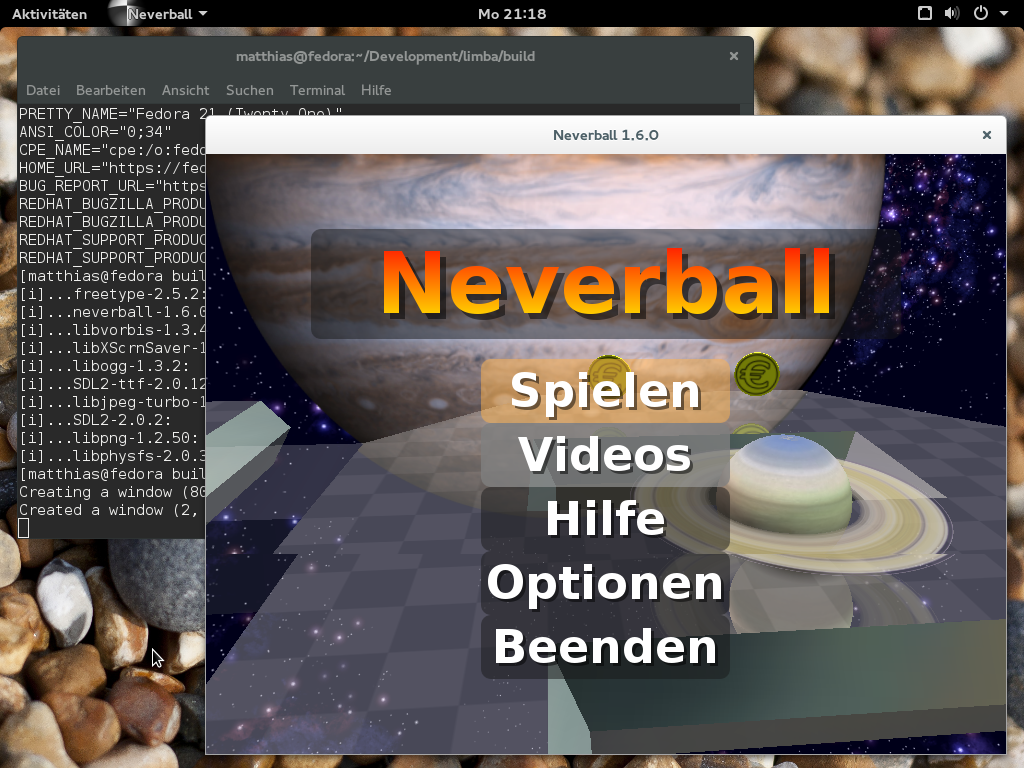
And once again, it s time for another Limba blogpost :-)limba-small Limba is a solution to install 3rd-party software on Linux, without interfering with the distribution s native package manager. It can be useful to try out different software versions, use newer software on a stable OS release or simply to obtain software which does not yet exist for your distribution. Limba works distribution-independent, so software authors only need to publish their software once for all Linux distributions. I recently released version 0.4, with which all most important features you would expect from a software manager are complete. This includes installing & removing packages, GPG-signing of packages, package repositories, package updates etc. Using Limba is still a bit rough, but most things work pretty well already. So, it s time for another progress report. Since a FAQ-like list is easier to digest. compared to a long blogpost, I go with this again. So, let s address one important general question first: How does Limba relate to the GNOME Sandboxing approach? (If you don t know about GNOMEs sandboxes, take a look at the GNOME Wiki Alexander Larsson also blogged about it recently) First of all: There is no rivalry here and no NIH syndrome involved. Limba and GNOMEs Sandboxes (XdgApp) are different concepts, which both have their place. The main difference between both projects is the handling of runtimes. A runtime is the shared libraries and other shared ressources applications use. This includes libraries like GTK+/Qt5/SDL/libpulse etc. XdgApp applications have one big runtime they can use, built with OSTree. This runtime is static and will not change, it will only receive critical security updates. A runtime in XdgApp is provided by a vendor like GNOME as a compilation of multiple single libraries. Limba, on the other hand, generates runtimes on the target system on-the-fly out of several subcomponents with dependency-relations between them. Each component can be updated independently, as long as the dependencies are satisfied. The individual components are intended to be provided by the respective upstream projects. Both projects have their individual up and downsides: While the static runtime of XdgApp projects makes testing simple, it is also harder to extend and more difficult to update. If something you need is not provided by the mega-runtime, you will have to provide it by yourself (e.g. we will have some applications ship smaller shared libraries with their binaries, as they are not part of the big runtime). Limba does not have this issue, but instead, with its dynamic runtimes, relies on upstreams behaving nice and not breaking ABIs in security updates, so existing applications continue to be working even with newer software components. Obviously, I like the Limba approach more, since it is incredibly flexible, and even allows to mimic the behaviour of GNOMEs XdgApp by using absolute dependencies on components. Do you have an example of a Limba-distributed application? Yes! I recently created a set of package for Neverball Alexander Larsson also created a XdgApp bundle for it, and due to the low amount of stuff Neverball depends on, it was a perfect test subject. One of the main things I want to achieve with Limba is to integrate it well with continuous integration systems, so you can automatically get a Limba package built for your application and have it tested with the current set of dependencies. Also, building packages should be very easy, and as failsafe as possible. You can find the current Neverball test in the Limba-Neverball repository on Github. All you need (after installing Limba and the build dependencies of all components) is to run the make_all.sh script. Later, I also want to provide helper tools to automatically build the software in a chroot environment, and to allow building against the exact version depended on in the Limba package. Creating a Limba package is trivial, it boils down to creating a simple control file describing the dependencies of the package, and to write an AppStream metadata file. If you feel adventurous, you can also add automatic build instructions as a YAML file (which uses a subset of the Travis build config schema) This is the Neverball Limba package, built on Tanglu 3, run on Fedora 21: Limba-installed Neverball Which kernel do I need to run Limba? The Limba build tools run on any Linux version, but to run applications installed with Limba, you need at least Linux 3.18 (for Limba 0.4.2). I plan to bump the minimum version requirement to Linux 4.0+ very soon, since this release contains some improvements in OverlayFS and a few other kernel features I am thinking about making use of. Linux 3.18 is included in most Linux distributions released in 2015 (and of course any rolling release distribution and Fedora have it). Building all these little Limba packages and keeping them up-to-date is annoying Yes indeed. I expect that we will see some bigger Limba packages bundling a few dependencies, but in general this is a pretty annoying property of Limba currently, since there are so few packages available you can reuse. But I plan to address this. Behind the scenes, I am working on a webservice, which will allow developers to upload Limba packages. This central ressource can then be used by other developers to obtain dependencies. We can also perform some QA on the received packages, map the available software with CVE databases to see if a component is vulnerable and publish that information, etc. All of this is currently planned, and I can t say a lot more yet. Stay tuned! (As always: If you want to help, please contact me) Are the Limba interfaces stable? Can I use it already? The Limba package format should be stable by now since Limba is still Alpha software, I will however, make breaking changes in case there is a huge flaw which makes it reasonable to break the IPK package format. I don t think that this will happen though, as the Limba packages are designed to be easily backward- and forward compatible. For the Limba repository format, I might make some more changes though (less invasive, but you might need to rebuilt the repository). tl;dr: Yes! Plase use Limba and report bugs, but keep in mind that Limba is still in an early stage of development, and we need bug reports! Will there be integration into GNOME-Software and Muon? From the GNOME-Software side, there were positive signals about that, but some technical obstancles need to be resolved first. I did not yet get in contact with the Muon crew they are just implementing AppStream, which is a prerequisite for having any support for Limba[1]. Since PackageKit dropped the support for plugins, every software manager needs to implement support for Limba.
So, thanks for reading this (again too long) blogpost :) There are some more exciting things coming soon, especially regarding AppStream on Debian/Ubuntu! [1]: And I should actually help with the AppStream support, but currently I can not allocate enough time to take that additional project as well this might change in a few weeks. Also, Muon does pretty well already!

Dimitri John Ledkov: Boiling frog, or when did we loose it with /etc ?

$ sudo find /etc -type f wc -l
2794

StatelessWhen was the last time you looked at /etc and thought - "I honestly know what every single file in here is". Or for example had a thought "Each file in here is configuration changes that I made". Or for example do you have confidence that your system will continue to function correctly if any of those files and directories are removed?

Traditionally most *NIX utilities are simple enough utilities, that do not require any configuration files what's so ever. However most have command line arguments, and environment variables to manipulate their behavior. Some of the more complex utilities have configuration files under /etc, sometimes with "layer" configuration from user's home directory (~/). Most of them are generally widely accepted. However, these do not segregate upstream / distribution / site administrator / local administrator / user configuration changes. Most update mechanisms created various ways to deal with merging and maintaining the correct state of those. For example both dpkg & RPM (%config) have elaborate strategies and policies and ways to deal with them. However, even today, still, they cause problems: prompting user for whitespace changes in config files, not preserving user changes, or failing to migrate them.

I can't find exact date, but it has now been something like 12 years since XDG Base directory specification was drafted. It came from Desktop Environment requirements, but one thing it achieves is segregation between upstream / distro / admin / user induced changes. When applications started to implement Base directory specification, I started to feel empowered. Upstream ships sensible configs in /usr, distribution integrators ship their overlay tweaks packaged in /usr, my site admin applies further requirements in /etc, and as I user I am free to improve or brake everything with configs in ~/. One of the best things from this setup - no upgrade prompts, and ease of reverting each layer of those configs (or at least auditing where the settings are coming from).

However, the uptake of XDG Base directory spec is slow / non-existing among the core components of any OS today. And at the same time /etc has grown to be a dumping ground for pretty much everything under the sun:
  • Symlink farms - E.g. /etc/rc*.d/*, /etc/systemd/system/*.wants/*, /etc/ssl/certs/*
  • Cache files - E.g. /etc/ld.so.cache
  • Empty (and mandatory) directories
  • Empty (and mandatory) "configuration" files. - E.g. whitespace & comments only
Let's be brutally honest and say that none of the above belongs in /etc. /etc must be for end-user configuration only, made by the end user alone and nobody else (or e.g. an automation tool driven by the end-user, like puppet).

Documentation of available configuration options and syntax to specify those in the config files should be shipped... in the documentation. E.g. man pages, /usr/share/doc, and so on. And not as the system-wide "example" config files. Absence of the files in /etc must not be treated as fatal, but a norm, since most users use default settings (especially for the most obscure options). Lastly compiled-in defaults should be used where possible, or e.g. layer configuration from multiple locations (e.g. /usr, /etc, ~/ where appropriate).

Above observations are not novel, and shared by most developers and users in the wider open source ecosystem. There are many projects and concepts to deal with this problem by using automation (e.g. puppet, chef), by migrating to new layouts (e.g. implementing / supporting XDG base dir spec), using "app bundles" (e.g. mobile apps, docker), or fully enumerating/abstracting everything in a generic manner (e.g. NixOS). Whilst fixing the issue at hand, these solutions do increase the dependency on files in /etc to be available. In other words we grew a de-facto user-space API we must not break, because modifications to the well known files in /etc are expected to take effect by both users and many administrator tools.

Since August last year, I have joined Open Source Technology Center at Intel, and have been working on Clear Linux* Project for Intel Architecture. One of the goals we have set out is to achieve stateless operation - that is to have empty /etc by default, reserved for user modification alone, yet continuing to support all legacy / well-known configuration paths. The premise is that all software can be patched with auto-detection, built-in defaults or support for layered configuration to achieve this. I hope that this work would interest everyone and will be widely adopted.

Whilst the effort to convert everything is still on going, I want to discuss a few examples of any core system.

ShadowThe login(1) command, whilst having built-in default for every single option exits with status 1, if it cannot stat(2) login.defs(5) file.

The passwd(1) command will write out the salted/hashed password in the passwd(5) file, rather than in shadow(5), if it cannot stat the shadow(5) file. There is similar behavior with gshadow. I found it very ironic, that upstream project "shadow" does not use shadow(5) by default.

Similarly, stock files manipulated by passwd/useradd/groupadd utilities are not created, if missing.

Some settings in login.defs(5) are not applicable, when compiled with PAM support, yet present in the default shipped login.defs(5) file.

Patches to resolve above issues are undergoing review on the upstream mailing list.
DBusIn xml based configuration, includedir' elements are mandatory to exist on disk, that is empty directory must be present, if referenced. If these directories are non-existant, the configuration fails to load and the system or session bus are not started.

Similarly, upstream have general agreement with the stateless concept and patches to move all of dbus default configurations from /etc to /usr are being reviewed for inclusion at the bug tracker. I hope this change will make into the 1.10 stable release.

GNU Lib CToday, we live in a dual-stack IPv4 and IPv6 world, where even the localhost has multiple IP addresses. As a slightly ageist time reference, the first VCS I ever used was git. Thus when I read below, I get very confused:
$ cat /etc/host.conf
# The "order" line is only used by old versions of the C library.
order hosts,bind
multi on
Why not simply do this:
--- a/resolv/res_hconf.c
+++ b/resolv/res_hconf.c
@@ -309,6 +309,8 @@ do_init (void)
if (hconf_name == NULL)
hconf_name = _PATH_HOSTCONF;

+ arg_bool (ENV_MULTI, 1, "on", HCONF_FLAG_MULTI);
+
fp = fopen (hconf_name, "rce");
if (fp)

There are still many other packages that needed fixes similar to above. Stay tuned for further stateless observations about Glibc, OpenSSH, systemd and other well known packages.

In the mean time, you can try out https://clearlinux.org/ images that implement above and more already. If you want to chat about it more, comment on G+, find myself on irc - xnox @ irc.freenode.net #clearlinux and join our mailing list to kick the conversation off, if you are interested in making the world more stateless.

ps.
I am a professional Linux Distribution developer, currently employed by Intel, however the postings on this site are my own and don't necessarily represent Intel's or any other past/present/future employer positions, strategies, or opinions.

* Other names and brands may be claimed as the property of others


29 March 2015

Zlatan Todori : Its all about fun

The percentage that women in Debian occupy as DDs is ~2%. Yes, just ~2% ladies that are DDs! So that means ~98% of DDs are gentelmen. some picture with rage meme I know there are more of ladies in Debian, so I firstly urge you, for love of Debian, to apply if you are contributing to this project, love its community and want to see Debian taking over the universe (okay, it seems that we conquered outer space so we need a help on Earth). So why is the number this low? Well maybe it's too precious to us currently inside that we want to prevent it being spoiled from outside. Also there seems to be not that much of younger DDs. Why is that important - well, young people like to do it and not to think about it. Many time they just break it, but many time they also do a breakthrough. Why is difference important and why should we embrace it? It's very important because it breaks a monopoly on view and behavior. It brings views not just from a larger number of people, but also from people from different backgrounds, and in constructive conversation it can put even more pluses on current workflow or it can counter it with good arguments. In a project of its size and worldwide geolocation of its developers, this is true for Debian more then any other projects I know. We need more women so we can balance our inner workings and have a better understanding of humanity and how is it moving, what and why does it need and where is it steering. That way we can produce a community which will improve quality of OS that we produce - because of sheer number of different people working on the same thing bringing to it its own personal touch. So, ladies and youth all over the world, unite and join in Debian because without diversity Debian can't grow beyond its current size. Also, no, Debian is not about code only, it needs painters, musicians, people that want to talk about Debian, people that share love and happiness, people that want to build better communities, UI/UX designers, makers, people who know how to repair a bike, athletes, homebrew beer producers, lawyers (just while world gets rid of laws, then we don't need you), actors, writters... Why, well because world and communities are made up from all that diversity and that's what makes it a better and not a monotone place. But I just use Debian. Well, do you feel love towards Debian and its work? Would you like to feel more as integral part of community? If the answer is big fat YES, then you should be a DD too. Every person that feels it's part of Debians philosophy about freedom and behaving in good manner should join Debian. Every person that feels touched and enhanced by Debian's work should become part of community and share its experience how Debian touched their soul, impacted their life. If you love Debian, you should be free to contribute to it in whatever manner and you should be free to express your love towards it. If you think lintian is sexy, or shebang is a good friends of yours, or you enjoy talking to MadameZou about Debian and zombies (yeah, we do have all kinds of here), or you like Krita, or you hate the look of default XFCE theme, or you can prove that you a more crazy developer then paultag - just hop into community and try to integrate in it. You will meet great folks, have a lot of conversation about wine and cheese, play some dangerous card games and even learn about things like bokononism (yeah I am looking at you dkg!). Now for the current Debian community - what the hell is packaging and non-packaging Debian Developer? Are one better then others? Do others stink? They don't know to hug? WHAT? Yes I know that inexperienced person shouldn't have a permission to access Debian packaging infrastructure, but I have the feeling that even that person knows that. Every person should have a place in Debian and acknowledge other fields. So yes, software developers need access to Debian packaging infrastructure, painters don't. I think we can agree on this. So lets abolish the stupid term and remove the difference in our community. Lets embrace the difference, because if someone writes a good poem about Debian heroism I could like it more then flashplugin-nonfree! Yep, I made that comparison on purpose so you can give a thought about it. Debian has excellent community regarding operating system that it's producing. And it's not going away, not at least anytime soon. But it will not go forward if we don't give additional push as human beings, as people who care about their fellow Debianites. And we do care, I know that, we just need to push it more public. We don't hide bugs, we for sure shouldn't hide features. It will probably bring bad seeds too, but we have mechanisms and will to counter that. If we, on average 10 bad seeds, get some crazy good hacker or crazy lovely positive person like this lady, we will be on right path. Debian is a better place, it should lead in effort to bring more people into FLOSS world and it should allow people to bring more of diversity into Debian. draw a picture where it says next year 3 dpl candidates should be only women and at least one of them not involved in packaging

28 March 2015

Matt Zimmerman: What I think about thought

Only parts of us will ever
touch o n l y parts of others
one s own truth is just that really one s own truth.
We can only share the part that is u n d e r s t o o d b y within another s knowing acceptable t o t h e o t h e r t h e r e f o r e so one
is for most part alone.
As it is meant to be in
evidently in nature at best t h o u g h perhaps it could make
our understanding seek
another s loneliness out.
unpublished poem by Marilyn Monroe, via berlin-artparasites This poem inspired me to put some ideas into words this morning, an attempt to summarize my current working theory of consciousness. Ideas travel through space and time. An idea that exists in my mind is filtered through my ability to express it somehow (words, art, body language, ), and is then interpreted by your mind and its models for understanding the world. This shifts your perspective in some way, some or all of which may be unconscious. When our minds encounter new ideas, they are accepted or rejected, reframed, and integrated with our existing mental models. This process forms a sort of living ecosystem, which maintains equilibrium within the realm of thought. Ideas are born, divide, mutate, and die in the process. Language, culture, education and so on are stable structures which form and support this ecosystem. Consciousness also has analogues of the immune system, for example strongly held beliefs and models which tend to reject certain ideas. Here again these can be unconscious or conscious. I ve seen it happen that if someone hears an idea they simply cannot integrate, they will behave as if they did not hear it at all. Some ideas can be identified as such a serious threat that ignoring them is not enough to feel safe: we feel compelled to eliminate the idea in the external world. The story of Christianity describes a scenario where an idea was so threatening to some people that they felt compelled to kill someone who expressed it. A microcosm of this ecosystem also exists within each individual mind. There are mental structures which we can directly introspect and understand, and others which we can only infer by observing our thoughts and behaviors. These structures communicate with each other, and this communication is limited by their ability to speak each other s language . A dream, for example, is the conveyance of an idea from an unconscious place to a conscious one. Sometimes we get the message, and sometimes we don t. We can learn to interpret, but we can t directly examine and confirm if we re right. As in biology, each part of this process introduces uncountable errors , but the overall system is surprisingly robust and stable. This whole system, with all its many minds interacting, can be thought of as an intelligence unto itself, a gestalt consciousness. This interpretation leads to some interesting further conclusions: Naturally, this is by no means an original idea (can such a thing exist?). It is my own take on the subject, informed both consciously and unconsciously by my own study, first-hand experience, conversations I ve had with others, and so on. It s informed by the countless thinkers who have influenced me. Its expression is limited by my ability to write about it in a way that makes sense to other people.
Maybe some of this makes sense to you, and maybe I seem insane, or maybe both. Hopefully you don t find that you have an inexplicable unconscious desire to kill me!

27 March 2015

Michal Čihař: Porting python-gammu to Python 3

Over the time I started to get more and more requests to have python-gammu working with Python 3. Of course this request makes sense, but I somehow failed to find time for that. Also for quite some time python-gammu has been distributed together with Gammu sources. This was another struggle to overcome when supporting Python 3 as in many cases users will want to build the module for both Python 2 and 3 (at least most distributions will want to do so) and with current CMake based build system this did not seem to be easy to achieve. So I've decided it's time to split python module out of the library. The reasons for having that together are no longer valid (libGammu has quite stable API these days) and having standard module which can be installed by pip is a nice thing. Once the code has been put into separate git module, I've slowly progressed on porting to Python 3. Most of the problems were on the C side of the code, where Python really does not make it easy to support both Python 2 and 3. So the code ended up with many #ifdefs, but I see no other way. While doing these changes, many points in the API were fixed to accept unicode stings in Python 2 as well. Anyway, today we have first successful build of python-gammu working on both Python 2 and 3. I'm afraid there is still some bug leading to occasional segfaults on Travis, but not reproducible locally. But hopefully this will be fixed in upcoming weeks and we can release separate python-gammu module again.

Filed under: English Gammu python-gammu Wammu 0 comments

26 March 2015

Daniel Pocock: WebRTC: DruCall in Google Summer of Code 2015?

I've offered to help mentor a Google Summer of Code student to work on DruCall. Here is a link to the project details. The original DruCall was based on SIPml5 and released in 2013 as a proof-of-concept. It was later adapted to use JSCommunicator as the webphone implementation. JSCommunicator itself was updated by another GSoC student, Juliana Louback, in 2014. It would be great to take DruCall further in 2015, here are some of the possibilities that are achievable in GSoC:
  • Updating it for Drupal 8
  • Support for logged-in users (currently it just makes anonymous calls, like a phone box)
  • Support for relaying shopping cart or other session cookie details to the call center operative who accepts the call
Help needed: could you be a co-mentor? My background is in real-time and server-side infrastructure and I'm providing all the WebRTC SIP infrastructure that the student may need. However, for the project to have the most impact, it would also be helpful to have some input from a second mentor who knows about UI design, the Drupal way of doing things and maybe some Drupal 8 experience. Please contact me ASAP if you would be keen to participate either as a mentor or as a student. The deadline for student applications is just hours away but there is still more time for potential co-mentors to join in. WebRTC at mini-DebConf Lyon in April The next mini-DebConf takes place in Lyon, France on April 11 and 12. On the Saturday morning, there will be a brief WebRTC demo and there will be other opportunities to demo or test it and ask questions throughout the day. If you are interested in trying to get WebRTC into your web site, with or without Drupal, please see the RTC Quick Start guide.

Zlatan Todori : Random bits

Gogs I installed today Gogs and configured it with mysql (yes, yes, I know - use postgres you punk!). I will not post details of how I did it because:
  • It still has "weird" coding as pointed already by others
  • It doesn't have fork and pull request ability yet
And there was end of journey. When they code in fork/PR , I will close my eyes on other coding stuff and try it again because Gitlab is not close to my heart and installing their binary takes ~850MB of space which means a lot of ruby code that could go wrong way. It would be really awesome to have in archive something to apt install and have github-like place. It would be great if Debian infrastructure would have the possibility to have that.

Diaspora* Although I am thrilled about it finally reaching Debian archive, it still isn't ready. Not even closely. I couldn't even finish installation of it and it's not suitable for main archive as it takes files from github repo of diaspora. Maybe poking around Bitnami folks about how they did it.

The power of Free software Text Secure is was an mobile app that I thought it could take on Viber or WhatsUp. Besides all its goodies it had chance to send encrypted SMS to other TS users. Not anymore. Fortunate, there is a fork called SMSSecure which still has that ability.

Trolls So there is this Allwinner company that does crap after crap. Their latest will reach wider audience and I hope it gets resolved in a matter how they would react if some big proprietary company was stealing their code. It seems Allwinner is a pseudo for Alllooser. Whoa, that was fun!

A year old experiment So I had a bet with a friend that I will run for a year Debian Unstable mixed with some packages from experimental and do some random testings on packages of interest to them. Also I promised to update aggressively so it was to be twice a day. This was my only machine so the bet was really good as it by theory could break very often. Well on behalf of Debian community, I can say that Debian hasn't had a single big breakage. Yay! The good side: on average I had ~3000 packages installed (they were in range from 2500-3500). I had for example xmonad, e17, gnome, cinnamon, xfce, systemd from experimental, kernels from experimental, nginx, apache, a lot of heavy packages, mixed packages from pip, npm, gems etc. So that makes it even more incredible that it stayed stable. There is no bigger kudos to people working on Debian, then when some sadist tries countless of ways to break it and Debian is just keeps running. I mean, I was doing my $PAID_WORK on this machine! The bad side: there were small breakages. It's seems that polkit and systemd-side of gnome were going through a lot of changes because sometimes system would ask password for every action (logout, suspend, poweroff, connect to network etc), audio would work and would not work, would often by itself just mute sound on every play or it would take it to 100% (which would blow my head when I had earplugs), bluetooth is almost de facto not working in gnome (my bluetooth mice worked without single problem in lenny, squeeze, in wheezy it maybe had once or twice a problem, but in this year long test it's almost useless). System would also have random hangs from time to time. The test: in the beginning my radeon card was too new and it was not supported by FLOSS driver so I ended up using fglrx which caused me a lot of annoyance (no brightness control, flickering of screen) but once FLOSS driver got support I was on it, and it performed more fluid (no glitches while moving windows). So as my friends knew that I have radeon and they want to play games on their machines (I play my Steam games on FLOSS driver) they set me the task to try fglrx driver every now end then. End result - there is no stable fglrx driver for almost a year, it breaks graphical interface so I didn't even log into DE with it for at least 8 months if not more. On the good side my expeditions in flgrx where quick - install it, boot into disaster, remove it, boot into freedom. Downside seems to be that removing fglrx driver, leaves a lot of its own crap on system (I may be mistaking but it seems I am not). Debian with love Well, that's all for today. I think so. You can never be sure.

Zlatan Todori : Random bits

Gogs I installed today Gogs and configured it with mysql (yes, yes, I know - use postgres you punk!). I will not post details of how I did it because:
  • It still has "weird" coding as pointed already by others
  • It doesn't have fork and pull request ability yet
And there was end of journey. When they code in fork/PR , I will close my eyes on other coding stuff and try it again because Gitlab is not close to my heart and installing their binary takes ~850MB of space which means a lot of ruby code that could go wrong way. It would be really awesome to have in archive something to apt install and have github-like place. It would be great if Debian infrastructure would have the possibility to have that.

Diaspora* Although I am thrilled about it finally reaching Debian archive, it still isn't ready. Not even closely. I couldn't even finish installation of it and it's not suitable for main archive as it takes files from github repo of diaspora. Maybe poking around Bitnami folks about how they did it.

The power of Free software Text Secure is was an mobile app that I thought it could take on Viber or WhatsUp. Besides all its goodies it had chance to send encrypted SMS to other TS users. Not anymore. Fortunate, there is a fork called SMSSecure which still has that ability.

Trolls So there is this Allwinner company that does crap after crap. Their latest will reach wider audience and I hope it gets resolved in a matter how they would react if some big proprietary company was stealing their code. It seems Allwinner is a pseudo for Alllooser. Whoa, that was fun!

A year old experiment So I had a bet with a friend that I will run for a year Debian Unstable mixed with some packages from experimental and do some random testings on packages of interest to them. Also I promised to update aggressively so it was to be twice a day. This was my only machine so the bet was really good as it by theory could break very often. Well on behalf of Debian community, I can say that Debian hasn't had a single big breakage. Yay! The good side: on average I had ~3000 packages installed (they were in range from 2500-3500). I had for example xmonad, e17, gnome, cinnamon, xfce, systemd from experimental, kernels from experimental, nginx, apache, a lot of heavy packages, mixed packages from pip, npm, gems etc. So that makes it even more incredible that it stayed stable. There is no bigger kudos to people working on Debian, then when some sadist tries countless of ways to break it and Debian is just keeps running. I mean, I was doing my $PAID_WORK on this machine! The bad side: there were small breakages. It's seems that polkit and systemd-side of gnome were going through a lot of changes because sometimes system would ask password for every action (logout, suspend, poweroff, connect to network etc), audio would work and would not work, would often by itself just mute sound on every play or it would take it to 100% (which would blow my head when I had earplugs), bluetooth is almost de facto not working in gnome (my bluetooth mice worked without single problem in lenny, squeeze, in wheezy it maybe had once or twice a problem, but in this year long test it's almost useless). System would also have random hangs from time to time. The test: in the beginning my radeon card was too new and it was not supported by FLOSS driver so I ended up using fglrx which caused me a lot of annoyance (no brightness control, flickering of screen) but once FLOSS driver got support I was on it, and it performed more fluid (no glitches while moving windows). So as my friends knew that I have radeon and they want to play games on their machines (I play my Steam games on FLOSS driver) they set me the task to try fglrx driver every now end then. End result - there is no stable fglrx driver for almost a year, it breaks graphical interface so I didn't even log into DE with it for at least 8 months if not more. On the good side my expeditions in flgrx where quick - install it, boot into disaster, remove it, boot into freedom. Downside seems to be that removing fglrx driver, leaves a lot of its own crap on system (I may be mistaking but it seems I am not). Debian with love Well, that's all for today. I think so. You can never be sure.

Patrick Matth i: More wheezy-backports work

Hello, now you can install the following package versions from wheezy-backports: geoip-database introduces a new package geoip-database-extra, which includes the free GeoIP City and GeoIP ASNum databases. glusterfs will get an update in a few days ago to fix CVE-2014-3619.

Next.

Previous.