The Debian package of the Linux kernel is based on Linux 3.2, but
has some additional features. This continues from parts
1,
2
and
3,
and covers new and improved hardware support.
DRM drivers from Linux 3.4 (proposed)
Some recent Intel and AMD graphics chips were not supported well or
at all by the DRM (Direct Rendering Manager) drivers in Linux 3.2.
Although many bug fixes have been included in 3.2.y stable updates,
we are considering updating them to the versions found in Linux 3.4.
(We did something similar for Debian 6.0 'squeeze'.)
Julien Cristau has been working on this and has prepared binary
packages. To install, run as root:
Please test these and report your results to bug #687442. I would suggest testing suspend/resume (if applicable), use of internal and external displays on laptops, and 3D accelerated graphics (games and compositing window managers such as GNOME Shell). Remember that AMD/ATI graphics chips require the firmware from the firmware-linux-nonfree package for 3D acceleration and many other features. amilo-rfkill driver I wrote a standard rfkill driver for the Fujitsu-Siemens Amilo A1655 and M7440, based on the out-of-tree fsaa1655g and fsam7440 drivers. Unlike those, it should work with the rfkill command, Network Manager, etc. ALPS touchpads Newer touchpads made by ALPS use different protocols for reporting scroll and pinch gestures. Jonathan Nieder backported the changes to support these. Wacom tablets Jonathan Nieder updated the wacom driver to the version in Linux 3.5, adding support for the Intuos5, Bamboo Connect, Bamboo 16FG and various other models. Emulex OneConnect 'Skyhawk' Sarveshwar Bandi at Emulex contributed a backport of the be2net driver from Linux 3.5, adding support for their 'Skyhawk' chip. Marvell Kirkwood Marvell's Kirkwood SoCs have been supported upstream for some time and in Debian since release 6.0 'squeeze'. However new models and boards generally require specific support. Arnaud Patard backported support for the 6282 rev A1 chip found in QNAP TS-x19P II models, and for the Marvell Dreamplug and Iomega Iconnect. Miscellaneousgpg --no-default-keyring --keyring /usr/share/keyrings/debian-keyring.gpg --export 310180050905E40C apt-key add - echo deb http://people.debian.org/~jcristau/wheezy-drm34/ ./ > /etc/apt/sources.list.d/jcristau-wheezy-drm34.list apt-get update apt-get install linux-image-3.2.0-4.drm-amd64 # or -486, or -686-pae
secring.gpgid_rsaid_dsaknown_hosts (not hashed and in combination with
the above...)cert.pem.my.cnf.zsh_history.bash_historyENV
variables setting passwords, hosts, etc.
Ironically, having the SSH identity files means anyone is able
to change pretty much anything about a person's repositories on
github. This includes files like .zshrc which
basically allows complete takeover of any account and often machine
that file is sourced from.
Which reminds me that I still need to add a way for vcsh to only merge commits
that have a tag signed with a trusted key and warn for everything
else, but I digress.
None of this is a problem with github specifically, it's a
problem with users who don't think their actions through. And this
is non-trivial for github or anyone else to fix as there are
potentially endless sources of otherwise secret information.
Initially, I sent email to github's quite responsive security
team asking them to forbid certain queries and to email users who
checked in their private data by accident and left it at that. They
got back to me extremely fast, promising to do their best (as of
right now, no queries I tried work any more) and after some
conversation asked me to link to their help
article on removing sensitive data if I were to blog about
this.
The topic itself has been covered extensively, github did their
best to keep user data private, and so the above could have been
done without, but...
...I have gotten word of 4chan's
/g/ sleuthing their way through various files and at least one
incident of people finding direct evidence of child pornography in
a Zsh history file. Sadly, this story found its way to me without a
link and the person who saw the thread read it on a tablet,
preserving neither the URL nor local cache. They saw it on
2013-01-24 at around 2200 UTC.
If you, or someone you know, saw anything plainly illegal,
immoral, and simply wrong... please report it to the relevant
authorities or at least github. As I suspect that there's some
overlap between the subscribers of the various planets I am
aggregated on and /g/, this may reach the right eyes. Between the
account name, a verified email address, access logs with IPs, and
possibly a real name, it should be comparatively easy to find
anyone you report.
You probably know reCAPTCHA already: for the webmasters and the end user, it is an antispam system which asks you to read distorted words in order to prove that you are a human and not a spamming bot. This service has another end: instead of generating its distorted texts, it takes them from printed books to help digitalizing them.The problem In theory, this is an excellent idea, which should help preserving and distributing parts of the human culture. And, in the beginning, it was used in such a way, with reCAPTCHA participating in the Gutenberg project which digitalizes books from the public domain to offer them freely (as in free speech) to everyone. In 2009 however, reCAPTCHA was bought by Google. Now they do not participate in the Gutenberg project any more, instead they are digitalizing stuff from the New York Times and from Google Books. They do not provide much detail about that, but it does not seem that they distribute them in a free way afterwards . To put it boldly: they use people's brain power to digitalize books for their own exploitation monopoly, which is wrong. These books should be made available under a free license. Suggestion Do not help reCAPTCHA. If you are a webmaster, try to use another more ethical system. If you are an end user, and you are facing a reCAPTCHA test, avoid putting the exact answer but try inserting small mistakes (not big ones, which get detected and make you fail the test). And ask Google to free the books they digitalized using your brain. Notes
After this announcement about the future of GNOME in Debian, I received several requests to look at SolusOS and their Consort fork of GNOME.
On the paper, this doesn t look like a too bad idea, since they only forked gnome-panel and metacity, the two key components that are no longer maintained upstream. Still, starting a plain fork at the very moment when the former maintainer decided to give the key to anyone who wanted to, looked like a very destructive way of acting. Even if the fork gains momentum (which remains speculative), the amount of effort to rename packages makes you think twice before such a switch. I decided to go talk about it with them on IRC nevertheless. Mind you, they work on a GNOME fork and a Debian derivative, but deliberately use their own IRC server (you ll soon understand why). Just in case you would want to cooperate with SolusOS, you d have to use their infrastructure.
It is an euphemism to say that the conversation didn t go well. This could have ended there, but thankfully for your already widening eyes, Ikey (the charming person I had the opportunity to discuss with) made the log public, in an attempt at public shaming that would soon gather his followers, chanting out loud how the revolutionary SolusOS would quickly replace every other Linux distribution. (As a side note, of the hundreds of such claims that were made public in the last 10 years, only one came true, and it was from a billionnaire who hired dozens of developers. Just saying.) Then you can understand why the specific IRC server: it is to K-line people who don t behave with enough deference to Ikey, because kickban is not enough.
This log and the claims made in the comments look very ironical, if only for presenting a person working in a team of 10+ on the most popular desktop on one of the most popular desktop distributions, as a beggar. Even more ironical when it is the person who spent the most time on making GNOME Classic available and working nicely for wheezy. So when a dozen kids go chanting that Consort is so much better than GNOME and will replace it, while it just re-does the work I already did, let me at least smile.
So what is SolusOS, after all?
If you want to see where this story is going, there s a place that tells you: the consortium and consort-panel repositories. Here you will find interesting things:
This post is about the port bootstrap build ordering tool (naming suggestions
welcome) which was started as a Debian Google Summer of Code project in
2012 and continued to be developed afterwards. Sources are available
through gitorious.
In the end of November 2012, I managed to put down an approximation algorithm
to the feedback arc set problem which allowed to break the dependency
graph into a directed acyclic graph with only few removed build dependencies. I
wrote about this effort on our mailinglist but didnt mention it here
because it was still too much of a proof-of-concept. Later, in January 2013, I
mentioned the result of this algorithm in an email wookey and me wrote to
debian-devel mailinglist.
Many things happened since November 2012:
grep-dctrl(1) and there exist many tools which can read, analyze and
manipulate GraphML. It is a big improvement over the old, monolithic tools
which did not allow to manipulate any intermediate result by external, existing
tools. Currently, a shell script (native.sh) will execute all tools in a
meaningful order, connecting them together correctly. The same tools will be
used for a future cross.sh but they will be connected differently.
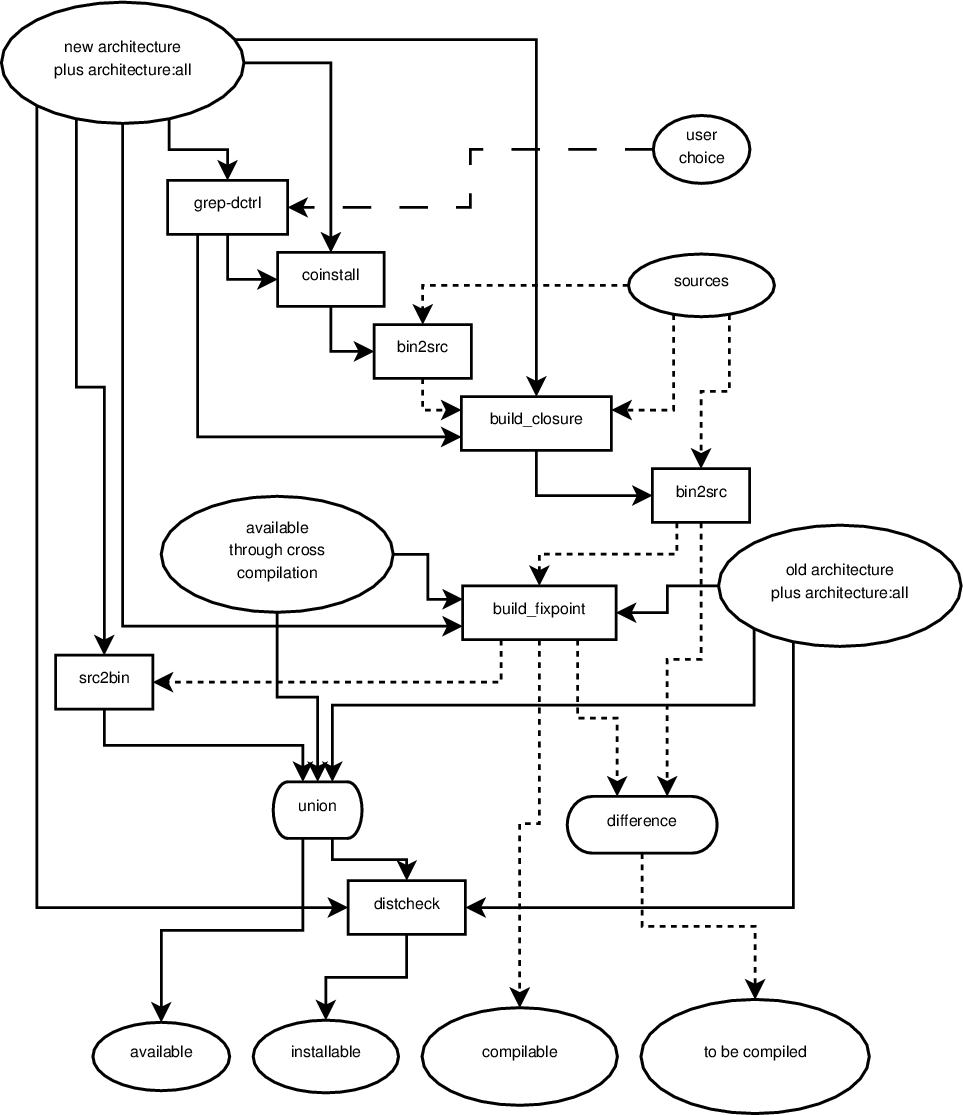
I wrote about a first proposal of what the individual tools should do and how
they should be connected in this email from which I also linked a
confusing overview of the pipeline. This overview has recently been
improved to be even more confusing and the current version of the lower half
(the native part) now looks like this:
native.sh.
./native.sh shell
script. Its final output is a list of source packages which have to be profile
built and a build order. Using the resulting build order, starting from a
minimal build system (essential:yes, build-essential and debhelper), all source
packages will be compiled which are needed to compile all binary packages in
the system. The result will therefor be a list of source and binary packages
which fulfill the following property:
native.sh.
If above assumptions should not be too far from the actual situation, then not
more than 73 source packages have to be modified to bootstrap a reduced
distribution. This reduced distribution even includes dependency-wise "big"
packages like webkit, metacity, iceweasel, network-manager, tracker,
gnome-panel, evolution-data-server, kde-runtime, libav and nautilus. By
changing one line in native.sh one could easily develop a build order which
generates gnome-desktop or really any given (meta-)package selection.
All of native.sh takes only 80 seconds to execute on my system (Core i5, 2.5
GHz, singlethreaded). Here is the final build order which creates 2044 binary
packages from 613 source packages.
I moved to Boston in 2005 at the same time that Aaron Swartz did and we were introduced by a mutual friend. Aaron was one of my first friends in Boston and we became close. When Aaron moved to San Francisco, I moved into his apartment in Somerville where he kept a room for a year or so. Mika and I still live there. His old posters remain on our walls and his old books remain on our shelves. Aaron s brothers Ben and Noah both lived with us and remain close friends.

I have spent hours (days?) reading and thinking about Aaron over the last two weeks. It has been disorienting but beautiful to read the descriptions of, and commentaries on, Aaron s life. Although I suspect I may never feel ready, there are several things I want to say about Aaron s death, about Aaron s work, and about what Aaron means to me.
1. Aaron s Death
The reaction to Aaron s death has been overwhelming and inspirational. At some point in the near future I plan to join some of the important campaigns already being waged in his name.
There are many attempts to understand why Aaron died and many attempts to prevent it from happening to others in the future. Unfortunately, I am familiar with the process of soul-searching and second-guessing that happens when a friend commits suicide. I m sure that every one of his friends has asked themselves, as I have, What could I have done differently?
I don t know the answer, but I do know this: Aaron was facing the real risk of losing half his life to prison. But even if one believed that he was only facing the likely loss of ten percent or even one percent of his life I wish that we all, and I wish that I in particular, had reacted with the passion, time, anger, activity, and volume proportional to how we have reacted in the last two weeks when he lost the whole thing.
2. Aaron s Work
Of course, Aaron and I worked on related projects and I followed his work. And despite all the incredible things that have been said about Aaron, I feel that Aaron s work was more focused, more ambitious, more transformative, more innovative, and more reckless (in a positive sense) than the outpour online suggests.
Although discussion of Aaron has focused his successes, achievements, and victories, the work that inspired me most was not the projects that were most popular or successful. Much of Aaron s work was deeply, and as it turned out overly, ambitious. His best projects were self-conscious attempts to transform knowledge production, organization, and dissemination. Although he moved from project to project, his work was consistently focused on bringing semantic-web concepts and technologies to peer production, to the movement for free culture, and to progressive political activism and on the meta-politics necessary to remove barriers to this work.
For example, Aaron created an online collaborative encyclopedia project called the TheInfoNetwork (TIN) several years before Wikipedia was started. I talked to Aaron at length about that project for a research project I am working on. Aaron s work was years ahead of its time; in 2000, TIN embraced more of the Wikimedia Foundation s current goals and principles than Wikipedia did when it was launched. While Wikipedia sought to create a free reference work online, Aaron s effort sought to find out what a reference work online could look like. It turned out to be too ambitious, perhaps, but it taught many, including myself, an enormous amount in that process.
When I met Aaron, he was in the process starting a company, Infogami, that was trying to chase many of TIN s goals. Infogami was conceived of as a wiki aware of the structure of data. The model was both simple and profound. Years later, Wikimedia Deutschland s WikiData project is beginning to bring some of these ideas to the mainstream. Infogami merged with Reddit as equal halves of a company with a shared technological foundation based on some of Aaron s other work. But when Reddit took off, Infogami was rarely mentioned, even by Aaron.
I think that is too bad. Reddit got traction because it made the most popular stuff more visible; Reddit is popular, fundamentally, because popular things are popular. But popular is not necessary positive. For that reason, Reddit never struck me as either surprising or transformative. But what started as Aaron s half the company, on the other hand, aimed to create a powerful form of democratized information production and dissemination. And although Infogami didn t take off, the ideas and code behind the project found life at the heart of Open Library and will continue to influence and inspire countless other projects. I believe that Infogami s lessons and legacy will undergird a generation of transformative peer production technologies in a way that the Reddit website important as it is will not.
3. What Aaron Means to Me
A lot of what has been written about Aaron speaks to his intelligence, his curiosity, his generosity, his ethics and his drive. Although I recognize all these qualities in the Aaron I knew, I ve felt alienated by how abstract some of the discussion of Aaron has been my memories are of particularities.
I remember the time Aaron was hospitalized and I spent two hours on the phone going through my bookshelves arguing with him about the virtues of the books in my library as we tried to decide which books I would bring him. I remember Aaron confronting Peter Singer intellectual founder of the modern animal rights movement at the Boston Vegetarian Food Festival to ask if humans had a moral obligation to stop animals from killing each other. I lurked behind, embarrassed about the question but curious to hear the answer. (Singer sighed and said yes sort of and complemented Aaron on the enormous Marxist commentary he was carrying.) I remember 1-800-INTERNET.com. I remember talking with Aaron about whether being wealthy could be ethical. I argued it could not but Aaron argued uncharacteristically I thought that it could. Aaron told Mika she should slap him if he ever became wealthy. The very next day, it was announced that his company had been acquired and that Aaron was a millionaire. I remember the standing bets I had with Aaron and how he would email me every time news reports favored his claims (but never when they did not). And I remember that I won t hear from him again.Aaron was a friend and inspiration. I miss him deeply and I am very sad.
net-snmp (5.7.2~dfsg-1~0.1) UNRELEASED; urgency=low* Non-maintainer upload.
ITWire ran a story on the 12th of January entitled "Fedora still has problems with secure boot". It ends up discussing two issues with the author's experience with the Fedora installer - that he can't reclaim any free space on existing drives, and that the installer didn't automatically add entries for Windows to the grub menu. These are certainly legitimate issues, and I don't want to suggest that it's reasonable for people to have to manually alter their configuration in order to support dual boot. But they're not issues with Fedora's support for secure boot, despite the enthusiasm with which certain people have jumped on the story. We've received one credible report of a secure boot related problem with Fedora on a couple of Toshiba laptops, which appears (and I want to stress that we're still working on diagnosing it) to be a firmware bug rather than any kind of problem with Fedora.git clone http://anonscm.debian.org/git/collab-maint/isenkram.git cd isenkram && git-buildpackage -us -ucI have not yet adjusted all files to use the new name yet. If you want to hack on the source or improve the package, please go ahead. But please talk to me first on IRC or via email before you do major changes, to make sure we do not step on each others toes. :) If you wonder what 'isenkram' is, it is a Norwegian word for iron stuff, typically meaning tools, nails, screws, etc. Typical hardware stuff, in other words. I've been told it is the Norwegian variant of the German word eisenkram, for those that are familiar with that word. Update 2013-01-26: Added -us -us to build instructions, to avoid confusing people with an error from the signing process. Update 2013-01-27: Switch to HTTP URL for the git clone argument to avoid the need for authentication.
Recently I recieved a MyAudio Tablet Series9 as a gift. From the factory it runs some version of Android, but I already got enough Android devices. Instead I wanted to play a bit with a basic Linux install.
This tablet is based on the AllWinner A10 System on a Chip. Some of these instructions might work for other systems based on the same chip set:
Step 1: Install the rescue system from http://forum.doozan.com/read.php?6,9396 on a SD-card.
You can configure network settings in rescue/interfaces and rescue/wpa_supplicant.conf.
Step 2: Boot the rescue system.
The MyAudio table will boot from the SD-card if it contains a bootable system, so this is quite easy. The first time you boot the rescue system tries to locate a system.bin file from the tablet. this file contains the hardware configuration and is needed for initializing all the hardware. This means that the screen can t be initialized the first time you boot and will just appear off.
Unless the system automatically boots again you need to locate the system.bin yourself from the tablet. It is usually located on /dev/nanda and have names like system.bin, script.bin, or evb.bin. To find the file you can use the log the rescue system places in log/deviceinfo.log on the SD-card during boot.
You should now have console access to the tablet and using a USB keyboard you should be able to work in the console.
Step 3: Setting up the network
Having configured rescue/interfaces and rescue/wpa_supplicant.conf the network ought to work. I am experiencing some problems getting it to connect to my Access Point (using WPA2). Patience works, but you might need to monitor the status with wpa_cli(8) and then run udhcp -i wlan0 when it succeeds.
Step 4: Install Debian using the installer at http://forum.doozan.com/read.php?6,8906
This just worked fine
Step 5: Getting the touch screen to work.
The system.bin file can be decoded with the fexc utility either available on the rescue system (compiled for arm) of from https://github.com/linux-sunxi/sunxi-tools. Finding the ctp_para section we can see that this tablet uses a ft5x touch screen.
Adding ft5x_ts to /etc/modules on our installed system will make sure that the correct kernel module gets loaded on boot time. But for some reason the kernel driver and the X11 evdev driver will not talk together. So we need to compile our own kernel patched as described on https://www.miniand.com/forums/forums/development/topics/how-do-i-get-the-lcd-display-and-touch-screen-working-on-an-a10-tablet#post-1225.
I have made kernel packages for Debian available at http://hacking.dk/files/linux-image-3.0.57-sun4i+_1.0+nomultitouch_armhf.deb or http://hacking.dk/files/linux-image-3.4.24-sun4i+_1.0+nomultitouch_armhf.deb.
Install the kernel package you want and run this as root:
# KERNEL_VERSION=3.4.24-sun4i+ # /usr/bin/mkimage -A arm -O linux -T kernel -C none -a 0x40008000 -e 0x40008000 -n Linux-$KERNEL_VERSION -d /boot/vmlinuz-$KERNEL_VERSION /boot/uImage # /usr/bin/mkimage -A arm -O linux -T ramdisk -C gzip -a 0x00000000 -e 0x00000000 -n initramfs-$KERNEL_VERSION -d /boot/initrd.img-$KERNEL_VERSION /boot/uInitrdAfter a reboot X11 will respond to the touch screen, but Step 6: Configure the touch screen the pointer does not point where I touch the screen. The transformation between the points are wrong. This is fixed by adding this to your xorg.conf:
Section "InputClass"
Identifier "touchscreen"
MatchProduct "ft5x_ts"
Option "TransformationMatrix" "0 1 0 1 0 0 0 0 1"
Option "Calibration" "0 768 0 1024"
EndSection
or more dynamically by running:
$ xinput set-prop ft5x_ts "Coordinate Transformation Matrix" 0 1 0 1 0 0 0 0 1 $ xinput set-prop ft5x_ts "Evdev Axis Calibration" 0 768 0 1024For more information about the Transformation Matrix, see the X.Org Wiki Step 7: Install a on-screen keyboard. I have not found the perfect keyboard application yet. Currently I am using matchbox-keyboard
Re-implement ikiwiki, or something like it, in
go. See how much the language's features and philosophy
colour the design. In particular I'm wondering how much the first-class
treatment of concurrency might change how you structure things: one thread per
page, or hot pages... you'd want to approach it with lots of micro-locks
rather than one big lock to rule them all. I can see some future ikiwiki
refactoring work being a bit like the Linux Kernel's efforts to get rid of
their big kernel
lock.
See also: Joey's proposed Haskell ikiwiki
rewrite. I may be
remembering wrong, but I thought he had some beginning code up somewhere.
Perhaps I'm conflating it with John Goerzen's one-time OfflineIMAP rewrite,
which might also be lost to the sands of time...
In a pipeline, a black cat can become a white cat with the help of
some middleware.
[pipeline:main]
pipeline = catch_errors healthcheck cache ratelimit tempauth proxy-logging proxy-server
>>> import pyclamd
>>> pyclamd.init_unix_socket('/var/run/clamav/clamd.ctl')
>>> print pyclamd.scan_stream(pyclamd.EICAR)
'stream': 'Eicar-Test-Signature(44d88612fea8a8f36de82e1278abb02f:68)'
>>> print pyclamd.scan_stream("safe!")
None
class SwiftClamavMiddleware(object):
"""Middleware doing virus scan for Swift."""
def __init__(self, app, conf):
# app is the final application
self.app = app
def __call__(self, env, start_response):
return self.app(env, start_response)
def filter_factory(global_conf, **local_conf):
conf = global_conf.copy()
conf.update(local_conf)
def clamav_filter(app):
return SwiftClamavMiddleware(app, conf)
return clamav_filter
import unittest
from webob import Request
class FakeApp(object):
def __call__(self, env, start_response):
return Response(body="FAKE APP")(env, start_response)
class TestSwiftClamavMiddleware(unittest.TestCase):
def setUp(self):
self.app = SwiftClamavMiddleware(FakeApp(), )
def test_simple_request(self):
resp = Request.blank('/',
environ=
'REQUEST_METHOD': 'GET',
).get_response(self.app)
self.assertEqual(resp.body, "FAKE APP")
import pyclamd
from webob import Response
class SwiftClamavMiddleware(object):
"""Middleware doing virus scan for Swift."""
def __init__(self, app, conf):
pyclamd.init_unix_socket('/var/run/clamav/clamd.ctl')
# app is the final application
self.app = app
def __call__(self, env, start_response):
if env['REQUEST_METHOD'] == "PUT":
# We have to read the whole content in memory because pyclamd
# forces us to, but this is a bad idea if the file is huge.
scan = pyclamd.scan_stream(env['wsgi.input'].read())
if scan:
return Response(status=403,
body="Virus %s detected" % scan['stream'],
content_type="text/plain")(env, start_response)
return self.app(env, start_response)
def filter_factory(global_conf, **local_conf):
conf = global_conf.copy()
conf.update(local_conf)
def clamav_filter(app):
return SwiftClamavMiddleware(app, conf)
return clamav_filter
import unittest
from cStringIO import StringIO
from webob import Request, Response
class FakeApp(object):
def __call__(self, env, start_response):
return Response(body="FAKE APP")(env, start_response)
class TestSwiftClamavMiddleware(unittest.TestCase):
def setUp(self):
self.app = SwiftClamavMiddleware(FakeApp(), )
def test_put_empty(self):
resp = Request.blank('/v1/account/container/object',
environ=
'REQUEST_METHOD': 'PUT',
).get_response(self.app)
self.assertEqual(resp.body, "FAKE APP")
def test_put_no_virus(self):
resp = Request.blank('/v1/account/container/object',
environ=
'REQUEST_METHOD': 'PUT',
'wsgi.input': StringIO('foobar')
).get_response(self.app)
self.assertEqual(resp.body, "FAKE APP")
def test_put_virus(self):
resp = Request.blank('/v1/account/container/object',
environ=
'REQUEST_METHOD': 'PUT',
'wsgi.input': StringIO(pyclamd.EICAR)
).get_response(self.app)
self.assertEqual(resp.status_code, 403)
[filter:clamav]
paste.filter_factory = swiftclamav:clamav_filter
[pipeline:main]
pipeline = catch_errors healthcheck cache ratelimit tempauth clamav proxy-logging proxy-server
when it s a prediction .
In the 4th January edition of the Guardian Weekly , the front page story,
entitled Meet the world s new boomers 1 contained this little gem:
Back in 2006, [PricewaterhouseCoopers] made some forecasts about what the global economy might look like in 2050, and it has now updated the predictions in the light of the financial crisis and its aftermath.Delightful. They made some forecasts about what the global economy might look like. Given that they clearly didn t include any impact of the GFC in their forecasts, it clearly wasn t a particularly accurate forecast. Y know what an inaccurate prediction is called? Guesswork. Let s call a spade a spade here. I see this all the time, and it s starting to shit me. People making predictions and forecasts and projections hither and yon, and they re almost always complete bollocks, and they never get called on it. I read the Greater Fool blog now and then, and that blog is chock full of examples of people making predictions which have very little chance of being in any way accurate. While Dr Ben Goldacre and others are making inroads into requiring full disclosure in clinical trials, I m not aware of anyone taking a similar stand against charlatans making dodgy-as-hell predictions over and over again, with the sole purpose of getting attention, without any responsibility for the accuracy of those predictions. Is anyone aware of anyone doing work in this area, or do I need to register
badpredictions.net and start calling out dodginess?
Next.