Search Results: "ema"

20 January 2011

Alexander Reichle-Schmehl: Myths and Facts about Firmwares and their non-removal from Debian

Debian's announcement to release Squeeze with a completely free Linux kernel caused quite some attention, which is actually a good thing. However, it also seems to have caused quite some uncertainty and was often partially misunderstood and miss quoted. I'll try to summarize and answer some of them in this blog post: So, one question remains: What is to bad about non-free firmware files? Aren't they just some tiny programs executed in the CPU of the device? Why care about them Good question! Let's take possible legal issues aside, and just look the practical side. The core problem is: Without source (and tool chain to use the source) firmware files are just some random numbers for us. We don't know what they are doing, we can't analyse and improve them. We can't change them, we can't support them. Maybe you already followed the link above to comment of the Fedora developer. I cite him here again, because I think he summarized the problem so well:
Updated qlogic 2400 and 2500 firmware to 5.03.13. What does 5.03.13 do? No one knows, except for QLogic, and they're not telling. I asked, and they told me that information was only available under NDA. So, I encourage you to imagine what this firmware does, and the bugs it fixes. While you're at it, imagine a world where vendors release source code for their firmware.
So, now that we established the fact, that we can't support firmware files, one could wonder, if we actually need to do so. What harm can a simple, tiny program in a peripheral device do to your computer? Well, scientist already managed to created trojaned firmwares for some network cards. So it is a problem, and can even under some circumstanced lead to security problems! So, to summarise: Yes, Debian changed something in the Kernels. No, it will continue to work as well as usual. Some users might need to enable the non-free repository in their sources list, but those who won't, don't have to. Firmware files needed during installation are also available, and can be loaded by the installation system. So, what's all the fuss about? BTW: Those of you, who can't remember links very well, but fear, they still might need the links to the non-free images and tarballs. just remember two things: wiki and Firmware, as you'll find all you need on the Firmware page of Debian's wiki.

Richard Darst: The DebConf talk selection and scheduling process

The DebConf talk selection process is in charge of selecting the talks at DebConf. Some of the reasons for having a talks team are to help ensure a high quality of talks, maintain a somewhat academic feeling for the conference, and to let attendees know what talks can be expected to be good.Even though there is a big talk selection process in advance, DebConf has always allowed attendees to schedule new talks during the conference - at DebConf10, these were called "ad-hoc" talks. At DC10, attendees could sign up for a room+time slot on a wiki page, and each night they would be added to the main schedule. In past years, this distinction had been called "official" (pre-selected) vs "non-official" (new ideas during DebConf) talks, which was extremely confusing to people. "Ad-hoc" talks are a very important part of DebConf: not all development meetings are pre-planned.Since we pretty much always surplus of talk rooms and times and we let people schedule talks during DebConf, people have asked: what is the purpose of talk selection? Are we going to let all talks be given? Are we going to reject talks just to say we selected them? When talks were "rejected" in the past, the speakers were told to just ask for a room during DebConf if they still wanted to give it. This question was raised on our mailing list. Even if there is a surplus of talk rooms, there are reasons for talk selection: it allows attendees to know what is most prepared, helps the video team to capture the best talks, lets talks be scheduled in the best room. You could also say it helps to organize talks into tracks and to collect abstracts for proceedings.For DebConf10, we introduced a "conference track" concept, a set of related talks which would be scheduled in the same room in sequence. This allowed a more structured conference for attendees, and perhaps recruiting speakers to fill in requested talks for the tracks. Example tracks from DebConf10 are Science, Enterprise, and Community Outreach. I would have liked to see some tracks more Debian related, such as: project infrastructure, project communication, project social issues, ..., but what we had was a good start that can be improved on, if the new team desires to.As for scheduling, there are two main parts: one phase before DebConf, assigning the selected talks to rooms and making the advance schedule. The other phase happens during DebConf and handles assigning rooms to people who want to do "ad-hoc" talks. The two phases aren't always done by the same person. The schedulers need to balance the expected audience and room capacity, need for video coverage, BOF vs auditorium style seating, not making talks overlap that are likely to appeal to the same audience, ... . The scheduling team works with the talk team, but doesn't necessarily have to be the same people.I'm very happy that there was good discussion about the selection and scheduling process for DebConf10. In the end, a talk selection and scheduling wiki page was created. This page had two main purposes. First, it discussed and documented the selection and scheduling process, so that it was transparent to people that year and provides a reference for future teams. Secondly, other people have added their proposed talks workflows, that they can be considered in future years.
Talk selection has many competing demands - because of the completeness of the wiki page, I'll just refer you there. The rest of this post mainly frames the types of questions the talks team has to face. If you have thoughts on the DebConf talk selection process, feel free to add your ideas to the talk selection process wiki page, or better yet, help out with the team this year.

19 January 2011

Gunnar Wolf: Mandate for what?

I lived in Israel between 1994 and 1996 This was just after the signature of the Oslo agreements, the Rabin-Arafat signature. 1994-95 was a beautiful time to be in Israel; there was the excitement of a prospect of real peace with the Palestinians, something that had been just seen as unattainable for the past 50 years. But we also saw the buildup of a huge tension, of real hatred. And the dream of the end of the conflict, of two people living in peace side by side was heavily shattered on November 4 1995, when prime minister Rabin was assassinated. But for the sake of where I'm trying to get to (this post is meant to be about current Mexico, not of Israel 15 years ago), lets go a couple of months back. The Israeli society is a deeply democratic one (although I understand many people feel it is losing that trait). Lots of political propaganda of all sorts, many of it very creative, are posted on the streets And not by the government or by political parties, but by citizen movements. I tried to follow it... I remember a particular sticker that I started seeing very often: Rabin has no mandate over the Golan . At first, I understod that the Golan residents rejected Rabin's authority (but, why was it posted all over the country? And what specifically was it about?), until a friend explained to me that it meant that it rather meant that the right wing all over the country felt that Rabin had no right to push for negotiations involving in any way the Golan heights return to Syria because that was not his electoral platform. So, fast-forward in time, and 12500Km to the west. If you have followed my ramblings for the past ~five years, you are aware of what I think about Mexico's government It is an illegitimate government, which got the power thanks to a dirty and illegal (as per Mexico's legal system) campaign and to voting fraud. And, according to what I have read, around 30% of the population still believe firmly the elections were stolen. But even if they were legal, valid and legitimate What has happened since 2006 should not be seen as valid. In Mexico, we don't have such a democratic culture. The society is not used to demanding anything from the politicians. We often see, as an example, that when talking about political organs, there is a divide everybody understands although makes no sense: We talk about citizens as people unaffiliated to political parties (v.gr. the 1996 Federal Electoral Institute was very well regarded as it was "el IFE ciudadano", and has since then been overtaken by the parties). Why are the parties' members not seen as citizens? Well, maybe because of the same distortion field that makes us believe our de-facto president when he stated that, from the (then) over 28000 people killed in the war campaign against crime (he oficially declared he never used the term war... Of course, he was proved wrong), only ~10% were civilians. In my book, that would mean that ~25000 soldiers have been killed But no, he means mostly drug trafficants. So, as they are not innocent bystanders, they somehow stopped being civilians? But again, I'm straying off the topic. Let us assume for a minute that the 2006 elections were clean legal, and that the campaigns were not diffamatory, and all that. And tha we had a modern government, with the stated separation between the three powers and all that. By today, the Legislative power would have surely called for the government's disolution. Why? Again, we Mexicans are not used to what a democratic system means. We can see over and over examples of people who have been voted to power and forgot/betrayed everything they campaigned for. And we are used to that being... Normal. But, who did we vote for? Given the suposition of this last paragraphs (clean elections led to our current government), did the majority of the population vote for Felipe Calder n, the person? Or did it vote for Partido Acci n Nacional, the abstract entity organized as a party? No. The vote was (should have been) for the political campaign, for the things he promised he would work for, the priorities in the direction he would give the nation. Not too long ago, we took pride of living in a peaceful country. Yes, everybody feared the crime rate in the streets, everybody knew big cities such as the one I live in (and love living in) have deep problems. But the country had good relations and good respect from the international players, and it was mostly safe. And, I don't think any of the few readers that have read this far (regardless of where they live or how much they know me) has that opinion of Mexico anymore. What is now heard inside and outside is that we have a huge organized crime (mostly due to drug traffic), and that it's taking over the country. Why did this happen? The fact is, Calder n lacked legitimacy when he reached the presidency in December 2006. And although his campaign was centered on pushing work generation (his slogan was El presidente del empleo, The president of the jobs), lifting restrictions to entreprises, opening borders, getting more money in our economy... He knew he had to please the people that would protect him from any (then, probable) insurrection: Military and police. Our army has always been more a joke than an army... But they still have their guns. So, contrary to everything he promised, the first things he signed was a salary increase to all order-keeping forces in the country, and an all-out attack against drug traffic cartels. He had to make the order-keeping forces protagonist, useful and loyal. Now, fast-forward again to 2011. The country is living the worst violence since the end of the 1910-1920 revolution. Over 30,000 people have been killed. Economy has fallen as it had not for many years (this was the worst-performing country in America in 2009). Work generation was said to be high, but then corrected to indicate it was mediocre (just about the baseline of population growth). So, the balance so far of four years of... Government? Economic disaster. Social disaster. Promises unachieved. Starting actions he had no mandate to do. Felipe Calder n has no mandate to get us in this war. Even if he had been democratically elected, he would have to step down.

Raphaël Hertzog: What I publish on Planet Debian and Planet Ubuntu

Up to now, Planet Debian and Planet Ubuntu were syndicating the main feed of my blog. I changed this recently (remember, I explained how I created my custom WordPress feed). Read on to learn why and subscribe to the main feed now if you want to get all my Debian/Ubuntu articles in the future. Planet Debian/Ubuntu are supposed to be windows into the lives of the contributors. Whatever they are doing. Obviously you get a lot of infos about Debian and Ubuntu since most contributors spend a lot of time working on those distributions. Due to this, those planets have also become dedicated medias to exchange between contributors. The problem I had is that my blog is more than just a place where I speak of what I do within Debian. As part of my evil plan, I set out my blog to become a great documentation resource for Debian/Ubuntu users. So when I wrote articles for users and/or beginners (like 5 reasons why a Debian package is more than a simple file archive or How to rebuild Debian packages), I got some remarks that it was odd to have those articles on Planet Debian because most contributors knew those things already. The bottom line is that from now on I ll decide on a case by case whether the article is suitable for Planet Debian&Ubuntu based on my feelings (and the feedback I get by email). But if you enjoyed my articles for users, I invite you to directly subscribe to my blog to make sure you ll get them all in the future: By the way I would like to thank you all. This blog has been created last July and I m glad to have already more than 1400 regular followers (spread over RSS/email/Twitter/Identi.ca/Facebook, not counting the thousands that read me via Planet Debian/Ubuntu). I hope you ll enjoy 2011 with me, and continue sharing the articles you like.

6 comments Liked this article? Click here. My blog is Flattr-enabled.

Russell Coker: Free Amazon EC2 Servers

Amazon is providing free EC2 access for new customers (who have never been customers before) for one year [1]. It is 750 hours per month (enough to run non-stop for an entire month) of access to a Linux micro instance which has 613M of RAM and the ability to burst to two ECUs of compute power. The main EC2 web page [2] describes an ECU as the equivalent CPU capacity of a 1.0-1.2 GHz 2007 Opteron or 2007 Xeon processor and they also describe a single core of a modern CPU as having 3.5 ECUs. So a micro instance could burst to half the CPU power of a single core. The DomU that runs my blog (as well as some web sites for friends) has been averaging less than 1% use of a CPU core over the last few months, so the CPU capacity of a micro instance should be more than adequate for most things that run on the net.The free offering only provides 15G of free data transmission and 15G of free data reception per month. For my blog server that would be more than adequate as it has sent 24.5G and received 14G over the last 75 days.The Cost of Disk IOThe offer requires that you sign up with a credit card so if you use more than the free capacity then you have to start paying. It seems that the main issue in this regard is disk IO.The only storage that is available for a micro instance is the Elastic Block Store (EBS) [3]. The main way that EC2 operates is that when you create a new virtual machine it copies the data from an existing image so you can easily create dozens or hundreds of virtual machines with local disk performance and the data is removed when the instance is shut down. EBS is essentially SAN based storage, it s persistent and operates like a regular disk.The pricing for EBS is $0.10 per allocated GB per month plus $0.10 per million IOs. Unfortunately they don t define what an IO is apart from mentioning that you can use IOSTAT to measure them. According to iostat the server running my blog is doing 0.99 tps, so that means in a 30 day month I would expect 30*24*3600*0.99 = 2.56M transactions. Iostat also tells me that my blog server has read 62075330 blocks and written 91683344 blocks over the last 75 days 16 hours of uptime, that means it would do about (62075330+91683344)/75.66*30 = 61M block transfers in a 30 day month. So if I was to run my blog server on EC2 I could be spending either $0.15 or $6.00 per month on disk IO depending on how they count it (or maybe something in between, something larger than a 512 byte block but smaller than a transaction as reported by iostat could be used). Given that the last time I checked the prices one could rent a DomU for less than $6 per month [4] the difference in possible ways of measuring IOs is very significant!The MySQL server that is the backend to my blog (as well as a few other things) seems to be averaging about 3 writes per second (and no reads during operation because the databases are small). So it might be another 5 million IOs per month for the database.It s unfortunate that Amazon haven t clearly specified what they mean when measuring IO for billing purposes. Some aspects of measurement such as whether the bills for bandwidth include Ethernet headers can be ignored as a 26 byte Ethernet header won t make much difference to the bill when the average packet size is around 400 bytes or more (from ifconfig output it seems that my blog server sends packets of an average size of 459 bytes and receives packets of an average size of 1250 bytes). But the methods of measuring disk IO could give a factor of 20 difference in the bill.Optimising for EC2If I was going to put my blog on EC2 then I would start by configuring Apache to log to a fifo and then write a daemon that stores the log data and allows my home server to poll it and get the log data. As the filesystem is already mounted with noatime it seems that writing logs is the cause of all the disk writes so if they were stored in RAM (which shouldn t be a problem with 4M of logs per day) then all those writes could be avoided. Another possible solution to this would be to make /var/log be a tmpfs and then rsync the files periodically to my home server. I don t really need to have all the logs remain on the server I just need them to remain somewhere.Amazon also offers 100,000 messages on their Simple Queue Service (SQS) for free [5]. The messages can be up to 8K in size and are stored for up to 4 days. So it seems possible to put Apache logs into SQS messages in bundles of less than 8K and then get them out later for transfer to a server outside EC2.If I was able to get my disk writes to almost zero then there s a good chance that I could get into the free zone for one year.ConclusionWould I use this service? If I was looking for new hosting for my blog then I would seriously consider it. EC2 is quite fast and well connected and depending on how they work out the billing for disk IO I could probably keep the cost close to zero.EC2 is a different way of running things so you can t just have a virtual server running and expect it to automatically restart if it goes down for any reason (a standard feature of virtual hosting companies). Amazon does have a range of tools for managing EC2 instances and they all seem to be available in the free trial. So after spending the time to learn those tools the result should be good.I think that there are two groups of people who could benefit from using this. One is hobbyists, this is a great way to learn some skills related to high-end server stuff and EC2 experience should look good on a CV. The other is companies who want to use EC2 anyway and who will just save some money that they would otherwise pay. I ve seen someone recommend the free offering from EC2 for a company that needed a small server, I think that isn t a good option as a company that only wants a single small server will be better off paying something between $5 and $20 per month for a DomU from one of the virtual hosting providers.After a year you have to pay regular prices. A micro instance costs $0.02 per hour which is $14.40 per month, SQS costs $0.10 per month for sending up to 1G of data in and at $0.01 per 10,000 SQS requests would costs $0.03 (the 4M of log data I generate per day would be 1000 requests to write and read it which would be 30,000 requests per month), the EBS for MySQL would cost $0.10 for 1G of storage and maybe $0.50 for IOs. That means $15.13 before counting bandwidth.My blog server averages just under 10G of transmitted data per month, the first Gig is free so that would cost $0.15 for each subsequent Gig which is $1.35 per month. It receives just under 6G per month which at $0.10 per gig would be $0.60. So including data transfer it would be about $17.08 per month.This is a lot more expensive than some of the cheaper virtual server offerings but admittedly the cheaper virtual offerings don t have as much RAM. Also with a blog instance running on EC2 I could easily configure it so that I could create some big instances that use the same MySQL database if a lot of extra traffic suddenly started arriving. A micro instance running MySQL on it s own could cope with a heap of load a lot more easily than the PHP code for my blog. So using bigger servers to run the PHP code while running MySQL on the same server would be a good option particularly if the bigger servers use caching.Finally if you want to run an EC2 instance for a year then you can get a reserved instance, you pay $54 per annum and the cost drops to $0.007 per hour instead of $0.02 per hour. Using a reserved instance for my blog would give a cost of $54+365*24*0.007+12*(0.10+0.03+0.10+0.50) or about $124.08 per annum. $10 per month isn t too bad. So if I migrated my blog to EC2 then I would probably keep it there after the free period expired. The ability to expand rapidly when necessary is worth paying extra. Of course I am making some assumptions such as that the performance of a micro instance doesn t totally suck as Amazon don t specify what bursting to 2ECU really means it could have some performance problems.Note that all prices in this post are in US Dollars.

18 January 2011

Eddy Petrișor: Back to coding and similar stuff soon

There has been a quite long hiatus in my Debian activity, first due to my involvement in OpenStreeMap and later due to some personal reasons. This has left the packages I was responsible for basically without a maintainer, even in the case of the game packages which should have been taken care by the Debian Games Team. Sadly, it seems the principle there are other people which can get involved was at work in this case.

The good news is that I foresee a period when I will be able to get involved again in Debian work, although I don't know yet how long will it take to start and how long will it last.

The first thing on the agenda should be the Womux - Warmux rename and packaging the latest version of the game.

And yes, currently I am totally clueless about the state of squeeze release and the RC bug count. If I get fast enough back in the Debian work wagon, I'll probably try to help fix a couple of RC bugs here and there.

Russell Coker: Conferences and People on the Autism Spectrum

There have been some recent discussions about issues related to the treatment of women at Free Software conferences, I ve written posts about Aspie Social Skills and Free Software [1] and Empathy, Autism, and Geeks [2] about this. But of course discussion continued on how Aspies supposedly cause problems that no-one seems to be noticing.Lisa of Chaotic Idealism wrote an interesting post about the NT social bias [3]. In summary NTs seem to think that Autism Spectrum Disorders are only about socialisation, not realising that for many people on the Spectrum it s sensory issues that are their main problem. Social problems are exacerbated by sensory issues and other causes of stress, so I think it s worth considering ways in which conferences can be planned to be less stressful for people on the Autism Spectrum, people who have SPD [4] that isn t associated with an ASD, and NTs who just get annoyed by loud noises etc.What Autism Conferences DoAutscape is one of only two conferences for people on the Autism Spectrum and the only one which clearly documents how they plan their conference [5]. The first noteworthy thing that they do is have badge colors to indicate what level of social interaction is desired by each delegate, I don t think that this is relevant to Free Software conferences as people who don t have sufficient social skills to suit at least a green badge probably won t be attending. But I think that when attending a conference about Free Software or any other equally geeky topic (if there is an equally geeky topic) it s worth keeping in mind the fact that there are probably a lot of people who would like to talk to you but lack the social skills to start a conversation.
No initiationRedPlease do not initiate any interaction with me.
Prior PermissionYellowPlease do not initiate unless I have already given you permission to approach me on a yellow badge.
Please initiateGreenI would like to socialise, but I have difficulty initiating. Please initiate with me.
NeutralWhite (or no badge)I am able to regulate my own interaction.
The next thing that they document is a black circle badge which indicates that the wearer shouldn t be photographed. Prior to reading that web site I wasn t aware of this being an Autistic issue, I was only aware of it being an issue for women who don t want zoomed-in pictures of themselves appearing on guys web sites (even pictures that aren t up-skirt or down-blouse can be unwelcome). A conference policy that prohibited photographs that zoom in on one person without that person s consent (or parental consent in the case of minors) would probably be a good idea.Another thing about badges is that it s a really good idea to have the delegate s name on both sides of the badge if the badge is attached in a way that permits it to turn. People on the Autism Spectrum tend to have some difficulty in recognising people and in remembering names. I find it inconvenient when someone expects me to recognise them but has their badge turned around so I can t see their name. Some people get really unhappy if they think that someone doesn t recognise them.Autscape has long breaks between activities and a leisure session each afternoon to allow delegates to recover from the stress of dealing with people. It seems to me that computer conferences in some cases could do with longer breaks between sessions. I find that a lot of the benefit of a conference is in what happens outside sessions and the standard practice of publishing videos of presentations makes personal meetings a more important part of the conference.Autscape has designated quiet spaces. I think that for computer conferences which have hack-labs (which seems to be most Free Software conferences nowadays even if they aren t labelled as such) it would be good to have some lab areas designated as quiet zones. I think that it is a really good thing to meet people you ve only known by email and then play some LAN based games against them and that this should be encouraged as part of a conference, but having that sort of thing separated from people who want to do some quiet coding is a really good idea. Whether people want to do quiet coding, read email, or just escape from the stress of a conference a quiet hack-lab would be a good place for it.An issue that s related to quiet spaces is the ability to escape from social situations. One of my pet hates is corporate meetings on boats, when the boat is in motion there is no escape. Corporate meetings that are only accessible by coach are also bad. Fortunately most conferences aren t like that.The Autscape web site states that they prohibit people from wearing perfume or aftershave to help people who are sensitive to smell. My observation of Free Software conferences is that encouraging everyone to have a shower every morning would be a good idea as there are stronger smells from unwashed people than from perfume.One thing that s interesting about the Autscape web site is that they have different color schemes available and have tested it in multiple web browsers including Safari and Konqueror (which apparently don t work so well). It s interesting to note that they test with such a variety of browsers including free software ones most corporations don t do that.Sensory Processing IssuesThe main SPD issues related to conferences seem to be noise and light related.For social events one difficulty that most people on the Spectrum seem to face is in listening to one person in a noisy crowded room. As well as that sudden noises and loud background noises can be very stressful. While it s sometimes impossible to avoid crowds (which can be another problem) it is often possible to select venues that have less noise problems. A venue with carpet on the floor and soft walls (anything other than brick or concrete) will be a lot quieter than one with hard surfaces that reflect noise. It seems that a quiet venue will benefit NTs as well, there seems to be a strong correlation between the price of food at restaurants and the amount of sound absorbing material on the floor and walls people who can afford a good dining experience seem to want it quiet.In terms of visual issues the relevant problems seem to be related to sudden transitions and lecture halls that are extremely dark. The only thing that can be done by conference organisers is to seek to have the lights in the lecture halls as bright as possible without preventing the viewing of the projector screen, this is usually done anyway.For social events the whole binge drinking at crowded bars thing doesn t work too well due to noise, poor lighting, crowds, and the smell of vomit. But there s no shortage of reasons to discourage binge drinking at conferences.FoodPsychology Today has a good article about preferences for food and picky eaters [6]. Lots of people on the Autism Spectrum have similar issues. The thing to do when arranging a conference meal is to have things neat and without needless combinations. Think about making food look more like what you would expect to see in a Japanese restaurant and less like Paella. Also having some very plain food on offer is a good thing, I think that bread-rolls for dinner and ice-cream for desert makes a viable meal. But any dish with a word like hash or mixed in it s name isn t a good option. Finally some combinations are really bad, I always find rare steak and potatoes on the same plate to be rather disgusting potato that s blood-stained doesn t appeal. The majority of conference meals satisfy these criteria.Autscape provides options of eating outside the main dining hall for people who can t tolerate the noise. For a Free Software conference it might be a better idea to provide seating outside the main area for people who are going to make noise. I don t mind people who want to get really drunk at the conference dinner, but I would prefer them to be in a separate room. Also when assisting a drunk friend to leave the venue before they cause more problems it would be convenient if there was a good place to take them to. The one occasion when I had to strongly encourage a friend to leave a conference dinner to reduce his embarrassment the next day (and reduce the annoyance for everyone else) there was no good place to take him so he just came back!ConclusionI don t expect that anyone will make any significant changes to conference plans after reading this post. I have tried to focus on things that would benefit NTs as well, but there are practical issues that get in the way such as the cost and availability of venues that are large enough. But there are some smaller ideas that can be implemented with relative ease.I hope that the people who are making claims about Autism and conference behavior will refer to this in future. If you think that there is a problem with the way people on the Spectrum act at conferences then the solution will more likely involve the suggestions I make here than anything else.

17 January 2011

Dirk Eddelbuettel: Keeping simple things simple

My friend Jeff deserves a sincere congratulation for finally unveiling his rebranded R consultancy Lemnica. One notable feature of the new website is a section called esoteric R which discusses less frequently-visited corners of the R world. It even boasts its own CRAN package esotericR with the example sources. esoteric R currently holds two articles. Jeff had sent me the one about introducing closures a while back, and I like it and may comment at another time. What caught me by surprise when Lemnica finally opened was the other article: R calling C. It is a fine article motivated by all the usual reasons that are e.g. mentioned in the Google Tech Talk which Romain and I gave last October about our work around Rcpp. But it is just not simple. Allow me to explain. When Jeff showed this C language file
#include <R.h>
#include <Rinternals.h>
SEXP esoteric_rev (SEXP x)  
  SEXP res;
  int i, r, P=0;
  PROTECT(res = allocVector(REALSXP, length(x))); P++;
  for(i=length(x), r=0; i>0; i--, r++)  
     REAL(res)[r] = REAL(x)[i-1];
   
  copyMostAttrib(x, res);
  UNPROTECT(P);
  return res;
 
and then needs several paragraphs to explain what is going on, what is needed to compile and then how to load it --- I simply could not resist. Almost immediately, I emailed back to him something as simple as this using both our Rcpp package as well as the wonderful inline package by Oleg which Romain and I more or less adopted:
library(inline)  ## for cxxfunction()
src <- 'Rcpp::NumericVector x = Rcpp::NumericVector(xs);
        std::reverse(x.begin(), x.end());
        return(x);'
fun <- cxxfunction(signature(xs="numeric"), body=src, plugin="Rcpp")
fun( seq(0, 1, 0.1) )
Here we load inline, and then define a three-line C++ program using facilities from our Rcpp package. All we need to revert a vector is to first access its R object in C++ by instantiating the R vector as a NumericVector. These C++ classes then provide iterators which are compatible with the Standard Template Library (STL). So we simply call the STL function reverse pointing the beginning and end of the vector, and are done! Rcpp then allows us the return the C++ vector which it turns into an R vector. Efficient in-place reversal, just like Jeff had motivated, in three lines. Best of all, we can execute this from within R itself:
R> library(inline)  ## for cxxfunction()
R> src <- 'Rcpp::NumericVector x = Rcpp::NumericVector(xs);
+         std::reverse(x.begin(), x.end());
+         return(x);'
R> fun <- cxxfunction(signature(xs="numeric"), body=src, plugin="Rcpp")
R> fun( seq(0, 1, 0.1) )
 [1] 1.0 0.9 0.8 0.7 0.6 0.5 0.4 0.3 0.2 0.1 0.0
R>
Lastly, Jeff shows a more complete example wherein a new vector is created, and any potential attributes are copied as well. Naturally, we can do that too. First, we used clone() to make a deep copy (ie forcing creation of a new object rather than a mere proxy) and use the same R API function he accessed---but it our case both prefixed with ::Rf_ for R remapping (to protect clashed with other functions with identical names) and a global namespace identifier (as it is a global C function from R).
R> library(inline)
R> src <- 'Rcpp::NumericVector x = Rcpp::clone<Rcpp::NumericVector>(xs);
+         std::reverse(x.begin(), x.end());
+         ::Rf_copyMostAttrib(xs, x);
+         return(x);'
R> fun <- cxxfunction(signature(xs="numeric"), body=src, plugin="Rcpp")
R> obj <- structure(seq(0, 1, 0.1), obligatory="hello, world!")
R> fun(obj)
 [1] 1.0 0.9 0.8 0.7 0.6 0.5 0.4 0.3 0.2 0.1 0.0
attr(,"obligatory")
[1] "hello, world!"
R> obj
 [1] 0.0 0.1 0.2 0.3 0.4 0.5 0.6 0.7 0.8 0.9 1.0
attr(,"obligatory")
[1] "hello, world!"
R>
Both the obj variable and the new copy contain the desired data attribute, the new copy is reversed, the original is untouched---and all in four lines of C++ called via one inline call. I have now been going on for over one hundred lines yet I never had to mention memory management, pointers, PROTECT or other components of the R API for C. Hopefully, this short writeup provided an idea of why Romain and I think Rcpp is the way to go for creating C/C++ functions for extending and enhancing R.

Rapha&#235;l Hertzog: Review of my Debian related goals for 2010

Last year I shared my Debian related goals for 2010 . I announced that I would not be able to complete them all and indeed I have not, but I have still done more than what I expected. Let s have a look. Translate my Debian book into English and get it published: NOT DONE Or rather not yet done. It s still an important project of mine and I will do it this year. When I wrote this last year, I expected to find a publisher that would take care of everything but we failed to find a suitable one so we re going to do it ourselves. Cleanup the dpkg perl API and create libdpkg-perl: DONE libdpkg-perl has been introduced with dpkg 1.15.6. Create dpkg-buildflags: DONE dpkg-buildflags has been introduced with dpkg 1.15.7. It s not widely used yet and it won t really be until debhelper 7 supports it (see #544844). It would be nice to see progress on this front this year. Ensure the new source formats continue to gain acceptance: DONE The adoption rate has been steady, it clearly slowed down since the freeze though. I have implemented quite a few features to satisfy the needs of users, like the possibility to unapply the patches after the build, or the possibility to fail in case of unwanted upstream changes. Design a generic vcs-buildpackage infrastructure to be integrated in dpkg-dev: NOT DONE I believe it s something important on the long term but it never made it to my short-term TODO list and it s unlikely to change any time soon. Continue fixing dpkg bugs faster than they are reported: PARTLY DONE We have dealt with many bugs over the year, but we still have 20 more bugs than at the start of last year (370 vs 350). We re not doing bad compared to many other Debian teams but we can still benefit from some help. Start here if you re interested. Enhance our infrastructure to ease interaction between contributors and to have a better view of how each package is maintained: NOT DONE I am convinced that we need something to have a clearer idea of the commitments made by each contributor. I don t put the same amount of care in maintaining smarty-gettext that I do on dpkg. If we had a database of the stuff that we know we don t do well enough, it s easier to point new contributors towards those. Anyway, this project is still unlikely to come to the top of my priorities any time soon. Work on the developers-reference: NOT DONE We have switched the Maintainer field to debian-policy@lists.debian.org to have more review of the changes suggested through the bug tracking system but that has not changed much on the global situation. I still hope to become more active on it sometimes this year. Maybe by trying to make it more fun and creating the text for some of the wishlist bugs as blog articles first. Rewrite in C the last Perl scripts provided by the dpkg binary package: DONE Dpkg 1.15.8 was the first version working without Perl, I announced it in July. Integrate the 3-way merge tool for Debian changelogs in dpkg-dev: DONE dpkg-mergechangelogs is part of dpkg-dev since 1.15.7. I enjoy it regularly. Unfortunately it doesn t work well for cherry-picks. Would be nice to see this fixed, anyone up to the task? :-)
Click here to subscribe to my free newsletter and get my monthly analysis on what s going on in Debian and Ubuntu. Or just follow along via the RSS feed, Identi.ca, Twitter or Facebook.

One comment Liked this article? Click here. My blog is Flattr-enabled.

16 January 2011

Dirk Eddelbuettel: Plotting overbought / oversold regions in R

The good folks at Bespoke Investment Group frequently show charts of so-called overbought or oversold levels; see e.g. here for the most recent global markets snapshot. Classifying markets as overbought or oversold is a popular heuristic. It starts from computing a rolling smoothed estimate of the prices, usually via a (exponential or standard) moving average over a suitable number of days (where Bespoke uses 50 days, see here). This is typically coupled with a (simple) rolling standard deviation. Overbought and oversold regions are then constructed by taking the smoothed mean plus/minus one and two standard deviations. Doing this is in R is pretty easy thanks to the combination of R's rich base functions and its add-on packages from CRAN. Below is a simply function I wrote a couple of months ago---and I figured I might as well release. It relies on the powerful packages quantmod and TTR by my pals Jeff Ryan and Josh Ulrich, respectively.
## plotOBOS -- displaying overbough/oversold as eg in Bespoke's plots
##
## Copyright (C) 2010 - 2011  Dirk Eddelbuettel
##
## This is free software: you can redistribute it and/or modify it
## under the terms of the GNU General Public License as published by
## the Free Software Foundation, either version 2 of the License, or
## (at your option) any later version.
suppressMessages(library(quantmod))     # for getSymbols(), brings in xts too
suppressMessages(library(TTR))          # for various moving averages
plotOBOS <- function(symbol, n=50, type=c("sma", "ema", "zlema"), years=1, blue=TRUE)  
    today <- Sys.Date()
    X <- getSymbols(symbol, src="yahoo", from=format(today-365*years-2*n), auto.assign=FALSE)
    x <- X[,6]                          # use Adjusted
    type <- match.arg(type)
    xd <- switch(type,                  # compute xd as the central location via selected MA smoother
                 sma = SMA(x,n),
                 ema = EMA(x,n),
                 zlema = ZLEMA(x,n))
    xv <- runSD(x, n)                   # compute xv as the rolling volatility
    strt <- paste(format(today-365*years), "::", sep="")
    x  <- x[strt]                       # subset plotting range using xts' nice functionality
    xd <- xd[strt]
    xv <- xv[strt]
    xyd <- xy.coords(.index(xd),xd[,1]) # xy coordinates for direct plot commands
    xyv <- xy.coords(.index(xv),xv[,1])
    n <- length(xyd$x)
    xx <- xyd$x[c(1,1:n,n:1)]           # for polygon(): from first point to last and back
    if (blue)  
        blues5 <- c("#EFF3FF", "#BDD7E7", "#6BAED6", "#3182BD", "#08519C") # cf brewer.pal(5, "Blues")
        fairlylight <- rgb(189/255, 215/255, 231/255, alpha=0.625) # aka blues5[2]
        verylight <- rgb(239/255, 243/255, 255/255, alpha=0.625) # aka blues5[1]
        dark <- rgb(8/255, 81/255, 156/255, alpha=0.625) # aka blues5[5]
      else  
        fairlylight <- rgb(204/255, 204/255, 204/255, alpha=0.5)         # grays with alpha-blending at 50%
        verylight <- rgb(242/255, 242/255, 242/255, alpha=0.5)
        dark <- 'black'
     
    plot(x, ylim=range(range(xd+2*xv, xd-2*xv, na.rm=TRUE)), main=symbol, col=fairlylight) 		# basic xts plot
    polygon(x=xx, y=c(xyd$y[1]+xyv$y[1], xyd$y+2*xyv$y, rev(xyd$y+xyv$y)), border=NA, col=fairlylight) 	# upper
    polygon(x=xx, y=c(xyd$y[1]-1*xyv$y[1], xyd$y+1*xyv$y, rev(xyd$y-1*xyv$y)), border=NA, col=verylight)# center
    polygon(x=xx, y=c(xyd$y[1]-xyv$y[1], xyd$y-2*xyv$y, rev(xyd$y-xyv$y)), border=NA, col=fairlylight) 	# lower
    lines(xd, lwd=2, col=fairlylight)   # central smooted location
    lines(x, lwd=3, col=dark)           # actual price, thicker
    invisible(NULL)
 
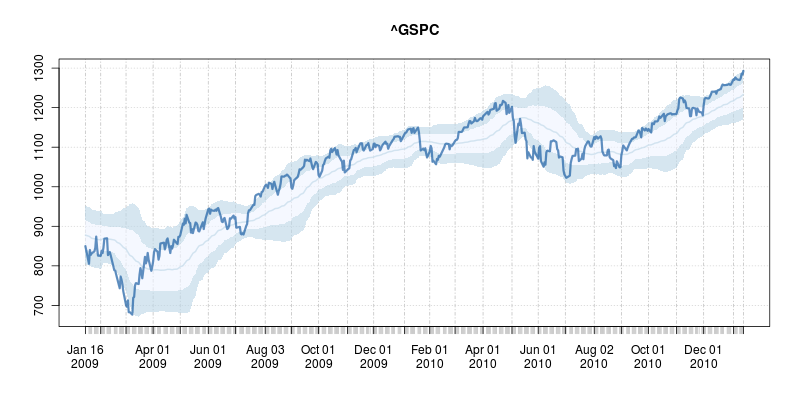
After downloading data and computing the rolling smoothed mean and standard deviation, it really is just a matter of plotting (appropriate) filled polygons. Here I used colors from the neat RColorBrewer package with some alpha blending. Colors can be turned off via an option to the function; ranges, data length and type of smoother can also be picked. To call this in R, simply source the file and the call, say, plotOBOS("^GSPC", years=2) which creates a two-year plot of the SP500 as shown here: Example chart of overbought/oversold levels from plotOBOS() function This shows the market did indeed bounce off the oversold lows nicely on a few occassions in 2009 and 2010 --- but also continued to slide after hitting the condition. Nothing is foolproof, and certainly nothing as simple as this is, so buyer beware. But it may prove useful in conjunction with other tools. The code for the script is here and of course available under GPL 2 or later. I'd be happy to help incorporate it into some other finance package. Lastly, if you read this post this far, also consider our R / Finance conference coming at the end of April.

Edit: Corrected several typos with thanks to Josh.

Nikita Youshchenko: Render PDFs on GPU?

Recently I tried once more to read a pdf file on n900. And as usual, it worked bad. Not only because of small screen that particular pdf had two-column formatting, and n900 s screen is wide enough to display one of these two columns with a readable font. Much worse was extremely slow redrawing. Finger scrolling on a touch screen is cool but only if system has enough power to immediately show content as it is scrolled to be visible. In practice I try to scroll with finger, then a second or two pass, then page on the screen starts to move, replaying all my finger movement during that second or two (which was not very direct because of no quick visual feedback), by the way text at borders goes out of screen for a moment, and that area becomes broken and is redrawn only after several more seconds. And then, in less than a minute (after reading displayed content), all that has to be repeated. In total, this makes UI almost unusable. While looking at this, I thought why not use GPU here? This device has a powerful GPU, enough even for non-trivial games. So why not convert a pdf page into a scene description for GPU, and then get zero-delay scrolling and scaling at least? This could be useful even on desktops sometimes pdf viewers do have interactivity problems, especially at very-large scale (400% or more) which is needed to view board schematics diagrams. Anyone ever implemented this? Or maybe wants to implement?.. :)

Daniel Kahn Gillmor: resetting passphrases for mapped LUKS volumes

Let's say you set up a machine using an encrypted disk with LUKS (debian-installer's partman makes this wonderfully easy!). You choose an initial passphrase, get the machine working, and it's working great. Then, you need to restart it, and realize that (for whatever reason) you've forgotten or lost the passphrase for the volume. oops! (i'm sure this has never happened to you -- let's just pretend it's your less-fortunate friend). If your system is still running, and you have superuser access to it, you can actually set a new passphrase for the LUKS volume using information that the dm-crypt kernel module has about the in-use mapping. In my examples, i'll imagine that the source volume is /dev/XXX2 and the exported cleartext volume is known by the device-mapper as XXX2_crypt In the bigger picture, this should serve as a reminder that even though your disk is encrypted, if someone gets live access to the superuser account on a system with the encryption keys loaded, your data is no longer secret. Before you do any tweaking, you might want to back up your LUKS header, just in case:
0 root@example:~# umask 077
0 root@example:~# cryptsetup luksHeaderBackup /dev/XXX2 --header-backup-file XXX2.luksheader.backup
0 root@example:~# 
Maybe also copy that off the machine, since a copy of the LUKS header stored within its own volume isn't terribly useful for a backup-recovery situation. You might also be interested in looking at the contents of the LUKS header:
0 root@example:~# cryptsetup luksDump /dev/XXX2
LUKS header information for /dev/XXX2
Version:       	1
Cipher name:   	aes
Cipher mode:   	cbc-essiv:sha256
Hash spec:     	sha1
Payload offset:	2056
MK bits:       	256
MK digest:      93 51 6c 66 ec ce 32 54 6f 6b 52 d1 27 9b 5a 62 6f 6b 52 d1
MK salt:       	b2 ca 20 49 9f 78 49 c2 fe 15 b4 0f 74 11 23 49
               	64 9e 61 bb f2 82 60 47 a5 76 fa a4 24 0e 5a 7e
MK iterations: 	10
UUID:          	052f1da0-21a1-11e0-ac64-0800200c9a66
Key Slot 0: ENABLED
	Iterations:         	218733
	Salt:               	f2 ae 8c 53 48 a5 f0 bf e1 2c 06 5f 5a bd ff d9
	                      	9a 2e d1 49 3a 63 f8 49 82 ed ae 86 7b 7b 7e 76 
	Key material offset:	8
	AF stripes:            	4000
Key Slot 1: DISABLED
Key Slot 2: DISABLED
Key Slot 3: DISABLED
Key Slot 4: DISABLED
Key Slot 5: DISABLED
Key Slot 6: DISABLED
Key Slot 7: DISABLED
0 root@example:~# 
Now, the fix: We pull the live "master key" from the running device map, and fill a new luksKeySlot from it (this example uses bash's <() syntax for process substitution -- if you use a different shell, i'm sure you can find a different way to do it):
0 root@example:~# cryptsetup --master-key-file <( 
> dmsetup --showkeys table   awk '/^XXX2_crypt: /  print $6  '   tr -d '\n'   perl -e 'print pack("H*", <STDIN>);' 
> ) luksAddKey /dev/XXX2
Enter new passphrase for key slot: abc123
Verify passphrase: abc123
2 root@example:~# 
(note that the luksAddKey invocation above returned an error code of 2 even though it succeeded. I think this is a bug in cryptsetup's return code, not a bug in the password resetting -- it should have returned 0 instead of 2). You can check to see that a new key slot was enabled by re-running cryptsetup luksDump And if you really want to double-check before you reboot, you can try enabling a third keyslot using the passphrase you just added, since this would not succeed if your new passphrase failed to unlock any of the existing keyslots:
0 root@example:~# cryptsetup luksAddKey /dev/XXX2
Enter any passphrase: abc123
Enter new passphrase for key slot: anotherpassphrase
Verify passphrase: anotherpassphrase
0 root@example:~# 
You can also get rid of the original keyslot (which you don't know the passphrase to) like this:
0 root@example:~# cryptsetup luksKillSlot /dev/XXX2 0
Enter any remaining LUKS passphrase: abc123
0 root@example:~# 
(the above commands were all demonstrated using debian testing, with cryptsetup 2:1.1.3-4 and dmsetup 2:1.02.48-4) Tags: cryptsetup, dmsetup, luks, tip

15 January 2011

Biella Coleman: Gazed deeply into the abyss

Someone by the name of lobster described my recent work in terms of its potential and damaging psychological effects (on me):
As for Ms. Coleman, I appreciate the work she s doing but I would not want to be locked in a room with her. She has gazed deeply into the abyss. Who knows what horrors have taken root in her mind, and lie sleeping, waiting to unleash unfathomable nightmares for the lulz?
(Yes I loled; captures beautifully a bit of the trauma that can ensue from working on the abyss)

Petter Reinholdtsen: The video format most supported in web browsers?

The video format struggle on the web continues, and the three contenders seem to be Ogg Theora, H.264 and WebM. Most video sites seem to use H.264, while others use Ogg Theora. Interestingly enough, the comments I see give me the feeling that a lot of people believe H.264 is the most supported video format in browsers, but according to the Wikipedia article on HTML5 video, this is not true. Check out the nice table of supprted formats in different browsers there. The format supported by most browsers is Ogg Theora, supported by released versions of Mozilla Firefox, Google Chrome, Chromium, Opera, Konqueror, Epiphany, Origyn Web Browser and BOLT browser, while not supported by Internet Explorer nor Safari. The runner up is WebM supported by released versions of Google Chrome Chromium Opera and Origyn Web Browser, and test versions of Mozilla Firefox. H.264 is supported by released versions of Safari, Origyn Web Browser and BOLT browser, and the test version of Internet Explorer. Those wanting Ogg Theora support in Internet Explorer and Safari can install plugins to get it. To me, the simple conclusion from this is that to reach most users without any extra software installed, one uses Ogg Theora with the HTML5 video tag. Of course to reach all those without a browser handling HTML5, one need fallback mechanisms. In NUUG, we provide first fallback to a plugin capable of playing MPEG1 video, and those without such support we have a second fallback to the Cortado java applet playing Ogg Theora. This seem to work quite well, as can be seen in an example from last week. The reason Ogg Theora is the most supported format, and H.264 is the least supported is simple. Implementing and using H.264 require royalty payment to MPEG-LA, and the terms of use from MPEG-LA are incompatible with free software licensing. If you believed H.264 was without royalties and license terms, check out "H.264 Not The Kind Of Free That Matters" by Simon Phipps. A incomplete list of sites providing video in Ogg Theora is available from the Xiph.org wiki, if you want to have a look. I'm not aware of a similar list for WebM nor H.264. Update 2011-01-16 09:40: A question from Tollef on IRC made me realise that I failed to make it clear enough this text is about the <video> tag support in browsers and not the video support provided by external plugins like the Flash plugins.

Jordi Mallach: Hiking through the Pyrenean GR 11

Tomorrow, at this time, I'll probably be unsuccessfully trying to find a comfortable position on a seat of the Bilmanbus to Irun. Very early on Saturday, as soon as we get off the bus, Maria and I will quickly head to Hondarribia's beach in Cape Higer to symbolically wet our feet in the waters of the Cantabrian Sea. We won't have much time to enjoy the cold waters of the ocean, though. Soon after that, we'll have to take a deep breath, look East, and start walking if we want to achieve our utmost objective: take a bath in the beautiful beaches of the Cap de Creus, in the Mediterranean sea. In between, 30 days and 840 kilometres of thick woods, deep valleys, high peaks and cold waters, all of which shape incredible landscapes.


The Portella de Baiau, during our 2008 trip For a whole month, we'll be mostly disconnected from everything else that isn't our knee ache, our blisters, the Sun over our heads or where to get food. It's the first time I leave on a hiking trip as long and tough as this one, and I feel both uncertainty and eagerness. We've been so busy during the last few months that we've been unable to train at all for this, and I'm probably in the worst physical condition in a decade. It's too late to take care of that now, so we'll try to take good care of our legs and spine. In order to get back home in the Mediterranean, we'll have to be fast, some days joining two stages and skipping a few that we know are not that interesting (sections over asphalt, etc.). It's hard to make it in just one month, but we'll try our best. The plan is going to sleep not long after sunset, getting up at dawn, to be able to walk for a decent time before the heat starts being a handicap and just resting at midday, when the Sun is strongest. Of course, this means that I'm missing, yet again, this year's edition of DebConf in New York City, which is really sad because I was looking forward hanging around with Mako, Mika, Biella, micah, Clint and the rest of the NYC/ Boston gang, but when the idea of doing a long trip this summer popped up around January, it was clear DebConf seemed unlikely this year. I hope all of you have a lot of fun, and see you in a few weeks!

14 January 2011

Jordi Mallach: New project to discuss

Reading Scott's recent announcement on his move to Google was both surprising and a pleasure. Surprising, because it'll take time to stop associating his name to Ubuntu, Canonical, and the nice experiences I had while I worked with them. A pleasure, because his blog post was full of reminiscences of the very early days of a project that ended up being way more successful in just a few years than probably anyone in the Oxford conference could imagine. Scott, best of luck for this new adventure! Scott's write-up includes a sentence that made me remember I had been wanting to write a blog post related to all of this, but was pending Mark Shuttleworth's permission for posting:
Ok, Mark wasn t really a Nigerian 419 scammer, but some people did discard his e-mail as spam! Scott James Remnant
Many know the story of how I ended not being part of the Super-Secret-Debian-Startup Scott mentions. I even wrote about it in a blog post, 3 years ago:
[...] nothing beats the next email which sat for some dramatic 6 months in my messy inbox until I found out in the worst of the possible scenarios. Let's go back to late February, 2004, when I had no job, and I didn't have a clue on what to do with my life.
From: Mark Shuttleworth <mark@hbd.com>
Subject: New project to discuss
To: Jordi Mallach <jordi@debian.org>
Date: Sun, 29 Feb 2004 18:33:51 +0000
[...]
I'm hiring a team of debian developers to work full time on a new
distribution based on Debian. We're making internationalisation a prime
focus, together with Python and regular release management. I've discussed
it with a number of Debian leaders and they're all very positive about it.
[...]
I'm not sure if I totally missed it as it came in, or I skimmed through it and thought WTF?! Dude on crack or I just forgot I need to reply to this email , but I'd swear it was the former. Not long after, no-name-yet.com popped up, the rumours started spreading around Debian channels. Luckily, I got a job at LliureX two months later, where I worked during the following 2 years, but that's another story. I guess it was July or so when Ubuntu was made public, and Mark and his secret team organised a conference (blog entries [1] [2] [3] [4] [5]), just before the Warty release, and I was invited to it, for the same reasons I got that email. During that conference, probably because Mark sent me some email and I applied a filter to get to it, I found the lost email, and felt like digging a hole to hide for a LONG while. I couldn't believe the incredible opportunity I had missed. I went to Mark and said "hey, you're not going to believe this", and he did look quite surprised about someone being such an idiot. I wonder if I should reply to his email today...
When the usual suspects in the secret Spanish Debian Cabal channel read this blog post, they decided Mark deserved a reply, even if it would hit his inbox more than three and a half years late. :) With great care, we crafted an email that would look genuinely stupid in late 2007, but just arrogant and idiotic in 2004, when Ubuntu was just an African word, and the GNU/Linux distribution landscape was quickly evolving at the time, Gentoo Linux had the posh distribution crown, that Debian had held for quite a few years. I even took enough care to forge the X-Operating-System and User-Agent headers so they matched whatever was current in Debian in February 2004, and of course, top-posting seemed most appropriate. So Mark woke up that Monday, fired up his email client, and got... this:
Date: Mon, 1 Mar 2004 09:47:55 +0100
From: Jordi Mallach <jordi@sindominio.net>
To: Mark Shuttleworth <mark@hbd.com>
Subject: Re: New project to discuss
Organization: SinDominio
X-Operating-System: Debian GNU/Linux sid (Linux 2.6.3 i686)
User-Agent: Mutt/1.5.5.1+cvs20040105i
Hi Mark,
Thanks for your email. I nearly deleted this e-mail because for some
reason I thought it was targetted spam.
Your project looks very interesting, almost like a dream come true.
However, I feel a bit uneasy about your proposal. Something just doesn't
fit.
Why would someone start a company to work on /yet another/ Debian
derivative? Have you heard about Progeny's sad story? I think it's a
great example to show that Debian users don't want Debian-based distros,
they want people to work on the "real thing". Besides, I don't think
there's much more place for successful commercial distros, with Red Hat
and SuSE having well-established niches in the US and Europe.
Also, why focus on Debian specifically, Why not, for example, Gentoo,
which has a lot of buzz these days, and looks poised to be the next big
distribution?
To be honest, I think only a few people have the stamina or financial
stability to undertake a project like this, so I'd like to know
a bit more about you, and details on how you plan to sustain the
expenses.
Those are the main issues that worry me about your project. Other than
that, I would be interested in taking part in it, as I'm currently
unemployed and working on something Debian-based would be just too good
to miss.
You can reach me at +34 123 45 67 89, or if you feel like flying people
around Europe, I probably can be in the UK whenever it fits you.
Thanks, and hoping to hear from you again,
Jordi
On Sun, Feb 29, 2004 at 06:33:51PM +0000, Mark Shuttleworth wrote:
> Hi Jordi
>
> We haven't met, but both Jeff Waugh and Martin Michelmayr recommended that
> I get in touch with you in connection with a new project that I'm starting.
>
> I'm hiring a team of debian developers to work full time on a new
> distribution based on Debian. We're making internationalisation a prime
> focus, together with Python and regular release management. I've discussed
> it with a number of Debian leaders and they're all very positive about it.
>
> Would you be available to discuss it by telephone? I'm in the UK, so we
> could probably find a good timezoine easily enough ;-) Let me knof if
> you're keen to discuss it, when and what number to call.
>
> Cheers,
> Mark
>
> --
> Try Debian GNU/Linux. Software freedom for the bold, at www.debian.org
> http://www.markshuttleworth.com/
As you can imagine, his reaction was immediate:
Date: Mon, 22 Oct 2007 11:13:54 +0100
From: Mark Shuttleworth <mark@hbd.com>
To: Jordi Mallach <jordi@sindominio.net>
Subject: Re: New project to discuss
Jordi! I just got this now! Did you recently flush an old mail queue?
With thanks to all the Spanish Cabal members who were involved!

Jo Shields: The phantom fifth freedom

Not for the first time, I ve seen the suggestion in the echo chamber that Mono packages should be moved from Debian into the non-free repository, which is not formally part of Debian. The reason, as it so often is, is patents specifically this time, the searing risk posed to Debian and its users that Mono s packaging does not (and technically could not without forking from upstream) provide base class libraries which implement only the content of ECMA-335 4th Edition. As I understand it, this implies three things about the suggestion/demand: firstly, that the individual in question believes that Mono end users are at risk from patent litigation from Microsoft Corp because Mono s implementation of Microsoft.NET beyond the content of ECMA 334/335 infringes on Microsoft patents; secondly, that the Microsoft Community Promise which promises not to assert legal claims over third party implementations of ECMA-335 4th Edition (and ECMA-334 4th Edition which defines the C# language) would render a pure ECMA-only runtime safe if it existed (which it does not); thirdly that without the protection offered by the Microsoft Community Promise, the source code licenses of Mono are irrelevant the patent risk renders the software non-Free. It appears, unfortunately, that the community of Free Software Advocates don t actually understand what Free Software actually IS. That explains an awful lot, but should surprise nobody. So here s a lesson on what, exactly, is being advocated for. The Free Software Foundation defines four Software Freedoms these are the minimum criteria required for something to be considered Free Software by the FSF: Other groups have their own variants on these, but those are really just clarifications on the FSF definition - for example, the Debian Free Software Guidelines mostly line up, but have some additional clauses such as clause 4 which allows software to be considered Free if source code may be redistributed without modifications, as long as patches may be shipped alongside. These four freedoms are offered to you by the software s copyright holders only, and apply regardless of their choice of license any Free license, from a lengthy legal tome like the MPL to the completely-Free WTFPL, will offer you these four basic freedoms as a minimum, and any additional clauses in their licenses cannot seek to restrict these freedoms. These four freedoms represent the beginning, and end, of whether a piece of software is Free or not. Software does not need to be developed in the open, in a community-responsive way, in order to qualify as Free projects such as Google s Android, which are developed under a throw a final release over the wall, bugs and all, and expect people to thank you for it model, are still free, even if contribution is difficult. Actually, on a related note, software does not need to solicit upstream contribution of any kind in order to qualify as Free as long as you personally can redistribute the code with changes, then that s enough. Software does not need to serve a fully or even partially legal purpose in order to qualify as Free the favoured tool for causing distributed denial of service attacks, Low Orbit Ion Cannon, is Free Software, even though realistically it serves no legal purpose. DeCSS, the code initially used to allow DVD media to play on Linux (by breaking the CSS encryption mechanism) is Free Software. Software does not need to be useful or tasteful in order to qualify as Free the Last Measure Operating System, a minimalist OS primarily designed to loudly display the famous shock site images from goatse and related, is Free Software. Even in somewhat less clear-cut cases of taste, your personal opinion of software has no bearing on whether it is Free Software, as long as the four freedoms are guaranteed by the author(s). Software does not need to have only Free dependencies to qualify as Free Software it is entirely permissible to write software which relies upon a non-Free framework or library, and release your code under a Free license. It is the downstream recipient s problem to provide the dependencies, including their choice to craft a Free replacement for any non-Free code you make use of. Debian has a special repository called contrib, where Free software which only works with non-Free data, lives for example, Free game engines which require the insertion of proprietary game data in order to operate. You could write Free addons for expensive proprietary software such as Matlab, and as long as your code is Free, your responsibilities are met. Software does not need to avoid patents software, algorithmic, or otherwise in order to qualify as Free. The Freetype font library was still entirely Free Software when Apple were slinging threats around regarding font hinting data. FFmpeg, the Swiss Army knife of media codec libraries, is Free Software regardless of the number of codec patents it breaks. Software does not need any third party approval to be Free Software the rights of Free Software can only be offered by the copyright holders, and the opinion of third parties is an irrelevance as to whether software is Free. The GPL d clone of Blizzard Entertainment s Battle.net servers, bnetd, is Free Software, regardless of legal takedown notices. Third parties cannot influence whether or not a piece of software is Free. They can influence tangentially related topics, such as whether the software can be legally used, but that s the limit. And even within a given piece of software, where copyright is shared by contributors, the author of one component has no say on other components. And you can t make code which is already released as Free, suddenly un-Free you can, if you hold all the copyrights, close up future versions, but your existing code remains Free forever. Reasonably, you can opt to avoid using a piece of software because you have requirements beyond it merely being Free Software Cdrtools has been avoided in Debian for a long time due to the upstream author s legal threats and rambling but that is a side issue as to the question of whether or not the software is Free. Patents are simply not involved in the question of whether or not something is Free Software, except for one narrow case: where Free Software is released by somebody who also holds related patents, and uses a license such as Ms-PL or Apache 2.0 or GPLv3 which requires them to also release those patents to those using/distributing the software. Outside that narrow situation, patents do not relate to the question of whether something is Free Software even if a company releases some source code under a license like BSD then demands patent fees from end users. So, on to the original topic of Mono. Every piece of Mono s source code is released by its authors under a license which guarantees the FSF s Four Freedoms. Whether or not you find Mono useful or tasteful does not affect that Free status. Whether or not Mono infringes upon any laws or patents does not affect that Free status. That Mono contains some libraries whose upstream author is Microsoft does not give Microsoft even the remotest claim to a single line of code outside the code they wrote and even then, it wouldn t be an issue, since the licenses they use are Free. In fact, both the licenses used in the Microsoft portions of the source base make patent grants to all users, in addition to guaranteeing the FSF s Four Freedoms and any license contamination would decrease, not increase, any risk of legal attack from Microsoft. There s even plenty of Microsoft code available for re-use at a lower level than the currently re-used libraries: The Microsoft.NET Micro Framework (for use on embedded platforms direct to the metal) is under the Free Software Apache 2.0 license, and would provide access to some of Microsoft s runtime and class library code, complete with a patent grant, if it were desired. Please try to keep your thought processes straight. If you want to argue that you re all for Free Software, please remember that there s plenty of Free Software you might not approve of and don t claim to be a Free Software advocate then use bogus arguments to claim that Free Software is not Free. Free Software includes LMOS and LOIC and Mono, whether you like it or not.

Alexander Reichle-Schmehl: Release Critical Bug report for Week 02

The bug webinterface of the Ultimate Debian Database currently knows about the following release critical bugs:
In Total:620
Affecting Squeeze:82
Squeeze only:36
Remaining to be fixed in Squeeze:46
Of these 46 bugs, the following tags are set:
Pending in Squeeze:4
Patched in Squeeze:9
Duplicates in Squeeze:8
Can be fixed in a security Update:1
Contrib or non-free in Squeeze:0
Claimed in Squeeze:0
Delayed in Squeeze:0
Otherwise fixed in Squeeze:8
Ignoring all the above (multiple tags possible) 20 bugs need to be fixed by Debian Contributors to get Debian 6.0 Squeeze released. However, with the view of the Release Managers, 65 need to be dealt with for the release to happen. Please see Interpreting the release critical bug statistics for an explanation of the different numbers.

13 January 2011

Dominique Dumont: Debian copyright DEP5 parser/editor/validator/migrator is released

Hello The new version of libconfig-model-perl 1.229 is now available in Debian/Sid. This new version provides a model of Debian s DEP-5 copyright file specification updated according to the CANDIDATE version. (Among other features, like editor/validator for debian/control). The DEP-5 editor must be run in the source package directory (I ll provide an example below) with the following command:
config-edit -application dpkg-copyright
Features: Known issues: Example: The copyright file of libconfig-model-backend-augeas-perl needs to be updated: Here s the original copyright file (slightly edited to protect my mail box and save electrons) :
$ cat debian/copyright
Format-Specification: http://wiki.debian.org/Proposals/CopyrightFormat?action=recall&rev=196 Upstream-Maintainer: Dominique Dumont (ddumont at cpan.org)
Upstream-Source: http://search.cpan.org/dist/Config-Model-Backend-Augeas/
Upstream-Name: Config-Model-Backend-Augeas Copyright: 2008-2009, Dominique Dumont (ddumont at cpan.org)
License: LGPL-2+ Files: debian/*
Copyright: 2009, Dominique Dumont
License: LGPL-2+ License: LGPL-2+
This program is free software; you can redistribute it and/or
[snip]
First, let s just check issues:
$ config-edit -application dpkg-copyright -ui none
Element Upstream-Maintainer of node Debian::Dpkg::Copyright is deprecated
Element Upstream-Source of node Debian::Dpkg::Copyright is deprecated
Element Upstream-Name of node Debian::Dpkg::Copyright is deprecated
Missing Files: specification at top of section number 2. Adding Files: * spec
Then, let s see what s config-edit can fix all by itself:
$ config-edit -application dpkg-copyright -ui none -save
[ same warnings displayed ]
Let s check the result of the migration:
$ config-edit -application dpkg-copyright -ui none
[ good: no more warnings ]
And here s the content of the upgraded file (drum rolls, please):
$ cat debian/copyright
Format: http://dep.debian.net/deps/dep5/
Upstream-Name: Config-Model-Backend-Augeas
Upstream-Contact: Dominique Dumont (ddumont at cpan.org)
Source: http://search.cpan.org/dist/Config-Model-Backend-Augeas/ Files: *
Copyright: 2008-2009, Dominique Dumont (ddumont at cpan.org)
License: LGPL-2+ Files: debian/*
Copyright: 2009, Dominique Dumont
License: LGPL-2+ License: LGPL-2+
This program is free software; you can redistribute it and/or
[snip]
You can see that: Please provide feedback! If you have problem migrating DEP5 files, yell, and we ll fix them. If this migration works fine, don t be shy, please say so. Under the hood:

Most of the migration work is specified in DEP-5 model [2]. Using config-model s GUI [3] to update DEP-5 model, about one hour was spent to: This shows one important feature of Config::Model: maintenance and evolution of a model is not a huge task. Even though copyright files are not configuration files, the same approach can be used to specify model and migration of other configuration files. Now comes the question of the migration as seen by the user. Well, it s your turn now. Try it and tell us how it works! Hopefully, encouraged by your feedback, other people will apply config-model to other specifications or other configuration. All the best (*) E.g, in the text format produced by the model editor GUI: 'Upstream-Contact',

'value_type' => 'string',
'migrate_from' =>
'formula' => '$old_maintainer',
'variables' =>
'old_maintainer' => '- Maintainer'

,
'type' => 'leaf',
'description' => '* Syntax: line based list [snip]'
,

12 January 2011

Mike Hommey: Attempting to track I/O with systemtap

There are several ways a program can hit the disk, and it can be hard to know exactly what s going on, especially when you want to take into account the kernel caches. This includes, but is not limited to: There are various ways to track system calls (e.g. strace) allowing to track what a program is doing with files and directories, but that doesn t tell you if you re actually hitting the disk or not. There are also various ways to track block I/O (e.g. blktrace) allowing to track actual I/O on the block devices, but it is then hard to back-track what part of which files or directories these I/O relate to. To the best of my knowledge, there are unfortunately no tools to do such tracking easily. Systemtap, however, allows to access the kernel s internals and to gather almost any kind of information from any place in a running kernel. The downside is that it means you need to know how the kernel works internally to gather the data you need ; that will limit the focus of this post. I had been playing, in the past, with Taras script, which he used a while ago to track I/O during startup. Unfortunately, it became clear something was missing in the picture, so I had to investigate what s going on in the kernel. Setting up systemtap On Debian systems, you need to install the following packages: That should be enough to pull all the required dependencies. You may want to add yourself to the stapdev and stapusr groups, if you don t want to run systemtap as root. If, like in my case, you don t have enough space left for all the files in /usr/lib/debug, you can trick dpkg into not unpacking files you don t need:
# echo path-exclude /usr/lib/debug/lib/modules/*/kernel/drivers/* > /etc/dpkg/dpkg.cfg.d/kernel-dbg
The file in /etc/dpkg/dpkg.cfg.d can obviously be named as you like, and you can adjust the path-exclude pattern to what you (don t) want. In the above case, kernel drivers debugging symbols will be ignored. Please note that this feature requires dpkg version 1.15.8 or greater. Small digression One of the first problems I had with Taras script is that systemtap would complain that it doesn t know the kernel.function("ext4_get_block") probe. It is due to a very unfortunate misfeature of systemtap, where the kernel.* probes refer to whatever is in the vmlinux image. Modules probes have a separate namespace, namely module("name").*. So for the ext4_get_block() function, this means you need to set a probe for either kernel.function("ext4_get_block") or module("ext4").function("ext4_get_block"), depending how your kernel was compiled. And you can t even use both in your script, because systemtap will complain about either being an unknown probe Tracking the right thing I was very recently pointed to a Red Hat document containing 4 useful systemtap scripts ported from dtrace, which gives me a good occasion to explain the issue at hand with the first of these scripts. This script attempts to track I/O by following read() and write() system calls. Which is not tracking I/O, it is merely tracking some system calls (Taras script had the same kind of problem with read()/write() induced I/O). You could just do the very same with existing tools like strace, and that wouldn t even require some system privileges. To demonstrate the script doesn t actually track the use of storage devices as the document claims, consider the following source code:
#include <fcntl.h>
#include <sys/stat.h>
#include <unistd.h>
/* Ensure the resulting binary is decently sized */
const char dummy[1024 * 1024] = "a";
int main(int argc, char *argv[])  
  struct stat st;
  char buf[65536];
  int i, fd = open(argv[0], O_RDONLY);
  for (i = 0; i < 100000; i++)  
    read(fd, buf, 65536);
    lseek(fd, 0, SEEK_SET);
    read(fd, buf, 65536);
    lseek(fd, 512 * 1024, SEEK_SET);
   
  close(fd);
  return 0;
 
All it does is reading some parts of the executable a lot of times (notice the trick to make the executable size at least 1MB). Not a lot of programs will actually do something as bold as reading the same data again and again (though we could probably be surprised), but this easily points the problem. Here is what the output of the systemtap script looks like for this program (stripping other unrelevant processes):
         process     read   KB tot    write   KB tot
            test   400002 25600001        0        0
Now, do you really believe 25MB have actually been read from the disk? (Note that the read() count seems odd as well, as there should only be around 200000 calls) Read-ahead, page cache and mmap() What the kernel actually does is that a read() on a file is going to check the page cache first. If there is nothing corresponding to the read() request in the page cache, then it goes down to the disk, and fills page cache. But as loading only a few bytes or kilobytes from the disk could be wasteful, the kernel also reads a few more blocks ahead, apparently with some heuristic. But read() and write() aren t the sole way a program may hit the disk. On UNIX systems, a file can be mapped in memory with the mmap() system call, and all accesses in the memory range corresponding to this mapping will be reflected on the file. There are exceptions, depending on how the mapping is established, but let s keep it simple. There is a lot of litterature on the subject if you want to document yourself on mmap(). The way the kernel will read from the file, however, is quite similar to that of read(), and uses page cache and read ahead. The systemtap script debunked above doesn t track these. I ll skip write accesses, because for now, they haven t been in my scope. Tracking some I/O with systemtap What I ve been trying to track so far has been limited to disk reads, which happen to be the only accesses occurring on shared library files. Programs and shared libraries are first being read() from, so that the dynamic linker gets the ELF headers and knows what to load, and then are mmap()ed following PT_LOAD entries in these headers. As far as my investigation in the Linux kernel code goes, fortunately, both accesses, before they end up actually hitting the disk, go through the __do_page_cache_readahead kernel function (this function was tracked in Taras script). Unfortunately, while it is called with an offset and a number of pages to read for a given file, it turns out the last pages in that number are not necessarily being read from the disk. I don t know for sure, because the latter had an effect on my observations, but some might even already be in the page cache. Going further down, we reach the VFS layer, which ends up being file-system specific. But fortunately, a bunch of (common) file-systems actually share page mapping code, and commonly use the mpage_readpage and mpage_readpages functions, both calling do_mpage_readpage to do the actual work. And this function seems to be properly called only once for each page not in the page cache already. If my reading of the kernel source is right, this however is not really where it ends, and do_mpage_readpage doesn t actually hit the disk. It seems to only gather some information (basically, a mapping between storage blocks and memory) that is going to be submitted to the block I/O layer, which itself may do some fancy stuff with it, such as reordering the I/Os depending on other requests it got from other processes, the position of the disk heads, etc. And when I say do_mpage_readpage doesn t actually hit the disk, I m again simplifying the issue, because it actually might, as there might be a need to read some metadata from the disk to know where some blocks are located. But tracking metadata reads is much harder, and I haven t investigated it. Anyways, skipping metadata, going further down after do_mpage_readpage is hard because it s difficult to back-track which block I/O is related to which read-ahead, corresponding to what read at what position in which file. do_mpage_readpage already has part of this problem because it is not called with any reference to the corresponding file. But __do_page_cache_readahead is. So knowing all the above, here is my script, the one I used to get the most recent Firefox startup data you can find in my last posts:
global targetpid;
global file_path;
probe begin  
  targetpid = target();
 
probe kernel.function("__do_page_cache_readahead")  
  if (targetpid == pid())
    file_path[tid()] = d_path(&$filp->f_path);
 
probe kernel.function("do_mpage_readpage")  
  if (targetpid == pid() && (tid() in file_path))  
    now = gettimeofday_us();
    printf("%d %s %d\n", now, file_path[tid()], $page->index*4096);
   
 
probe kernel.function("__do_page_cache_readahead").return  
  if (targetpid == pid())
    delete file_path[tid()];
 
This script needs to be used with a command given to systemtap, with the -c option, such as in the following command line:
# stap readpage.stp -c firefox
Each line of output represents a page (i.e. 4,096 bytes) being read, and contains a timestamp, the name of the file being read, and the offset in the file. As discussed above, do_mpage_readpage is not really the place the I/O actually occurs, so the timestamps are not entirely accurate, and the actual read order from disk might be slightly different, but it still is a quite reliable view in that the result should be reproducible with the same files even when they re not located on the same blocks on disk, and provided their page cache status is the same when starting the program. This systemtap script ignores writes, as well as metadata accesses (including but not limited to inodes, dentries, bitmap blocks and indirect blocks). It also doesn t account accesses to files opened with the O_DIRECT flag or similar constructs (raw devices, etc.) Read-ahead in action Back to the small example program, my systemtap script records 102 page accesses, that is, 417,792 bytes, much less than the actual binary size on my system (1,055,747 bytes). We are still far from the 25MB figure from the other systemtap script. But we are also far from the 128KiB the program actively reads (64KiB twice, leaving a hole between the two blocks). At this point, it is important to note that the ELF headers and program code all fit within a single page (4 KiB), and following the 1MiB section corresponding to the dummy variable, there are only 5,219 bytes of other ELF sections, including the .dynamic section. So even counting everything the dynamic linker needs to read, and the program code itself, we re still far from what my systemtap script records. Grouping consecutive blocks with consecutive timestamps, here is what can be observed:
Offset Length
0 16,384
983,040 73,728
16,384 262,144
524,288 65,536
(By now, you should have guessed why I wanted that big hole between the read()s ; if you want to reproduce at home, I suggest you also use my page cache flush helper) As earlier investigations showed, the first accesses by the dynamic loader are to read the ELF headers and .dynamic section. As mentioned above, these are really small. Yet, the kernel actually reads much more: 16KiB at the beginning of the file when reading the ELF headers, and 72KiB at the end when reading the .dynamic section. Subsequent accesses from the dynamic loader are obviously already covered by these accesses. Next accesses are those due to the program itself. The program actively reads 64KiB at the beginning of the file, then 64KiB starting at offset 524,288. For the first read, the kernel already had 16KiB in the page cache, so it didn t read them again, but instead of reading the remainder, it reads 256KiB. For the second read, however, it only reads the requested 64KiB. As you can see, this is far from being something like you wanted n KiB, I ll read that fixed amount now . Further testing with different read patterns (e.g. changing the hole size, read size, or reading from the dummy variable directly instead of read()ing the binary) is left as an exercise to the reader.

Next.

Previous.