Search Results: "ana"

3 April 2012

Michal Čihař: Weblate 0.8

After quite big delay, Weblate 0.8 is finally ready. There are many fixes and improvements like grouping of Git commits, improved checks or activity logging. All in all this should be feature complete for 1.0 release. Now it's time to stabilize all the features and release 0.9 (AKA 1.0rc) and then we'll be ready to fire 1.0. Full list of changes for 0.8: You can find more information about Weblate on it's website, the code is hosted on Github. If you are curious how it looks, you can try it out on demo server. You can login there with demo account using demo password or register your own user. Weblate is also being used https://l10n.cihar.com/ as official translating service for phpMyAdmin, Gammu, Weblate itself and others. PS: If you're about to use Weblate, rather use Git version than tagged 0.8, you will get bunch of bug fixes for free :-).

Filed under: English Weblate 0 comments Flattr this!

1 April 2012

Raphaël Hertzog: My Debian Activities in March 2012

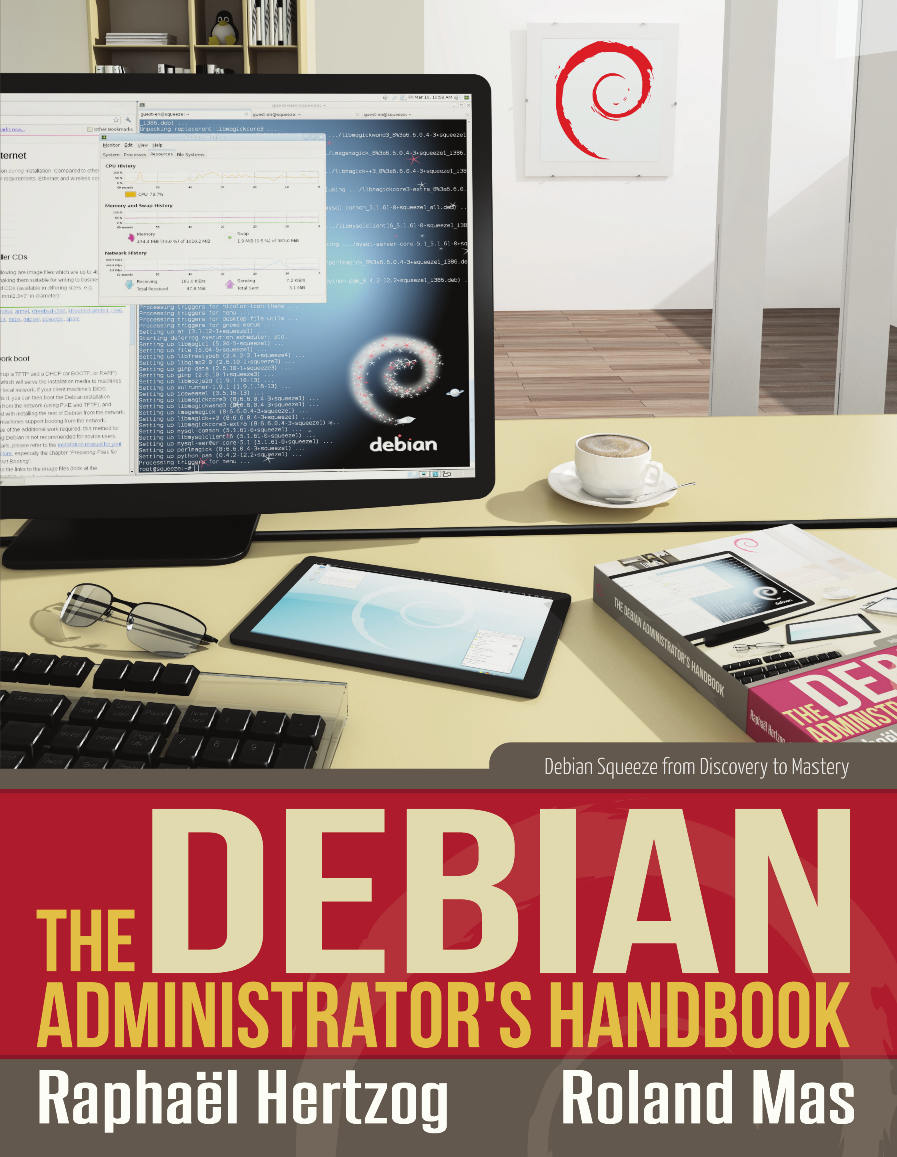
This is my monthly summary of my Debian related activities. If you re among the people who made a donation to support my work (227.83 , thanks everybody!), then you can learn how I spent your money. Otherwise it s just an interesting status update on my various projects. Dpkg Thanks to Guillem, dpkg with multiarch support is now available in Debian sid. The road has been bumpy, and it has again been delayed multiple times even after Guillem announced it on debian-devel-announce. Finally, the upload happened on March 19th. I did not appreciate his announce because it was not coordinated at all, and had I been involved from the start, we could have drafted it in a way that sounded less scary for people. In the end, I provided a script so that people can verify whether they were affected by one of the potential problems that Guillem pointed out. While real, most of them are rather unlikely for typical multiarch usage. Bernhard R. Link submitted a patch to add a new status command to dpkg-buildflags. This command would print all the information required to understand which flags are activated and why. It would typically be called during the build process by debian/rules to keep a trace of the build flags configuration. The goal is to help debugging and also to make it possible to extract that information automatically from build logs. I reviewed his patch and we made several iterations, it s mostly ready to be merged but there s one detail where Bernhard and I disagree and I solicited Guillem s opinion to try to take a decision. Unfortunately neither Guillem nor anyone else chimed in. On request of Alexander Wirt, I uploaded a new backport of dpkg where I dropped the DEB_HOST_MULTIARCH variable from dpkg-architecture to ensure multi-arch is never accidentally enabled in other backports. One last thing that I did not mention publicly at all yet, is that I contacted Lennart Poettering to suggest an improvement to the /etc/os-release file that he s trying to standardize across distributions. It occurred to me that this file could also replace our /etc/dpkg/origins/default file (and not only /etc/debian_version) provided that it could store ancestry information. After some discussions, he documented new official fields for that file (ID_LIKE, HOME_URL, SUPPORT_URL, BUG_REPORT_URL). Next step for me is to improve dpkg-vendor to support this file (as a fallback or as default, I don t know yet). Packaging I packaged quilt 0.60 (we re now down to 9 Debian-specific patches, from a whopping 26 in version 0.48!) and zim 0.55. In prevision of the next upstream version of Publican, I asked the Perl team to package a few Perl modules that Publican now requires. Less than two weeks after, all of them were in Debian Unstable. Congrats and many thanks to the Perl team (and Salvatore Bonaccorso in particular, which I happen to know because we were on the same plane during last Debconf!). On a side note, being the maintainer of nautilus-dropbox became progressively less fun over the last months, in particular because the upstream authors tried to override some of the (IMO correct) packaging decisions that I made and got in touch with Ubuntu community managers to try to have their way. Last but not least, I keep getting duplicates of a bug that is not in my package but in the official package and that Dropbox did not respond to my query. Book update The translation is finished and we re now reviewing the whole book. It takes a bit more time than expected because we re trying to harmonize the style and because it s difficult to coordinate the work of several volunteer reviewers. The book cover is now almost finalized (click on it to view it in higher definitions): We also made some progress on the interior design for the paperback. Unfortunately, I have nothing to show you yet. But it will be very nice and made with just a LaTeX stylesheet tailored for use with dblatex. The liberation fundraising slowed down with only 41 new supporters this month but it made a nice bump anyway thanks to a generous donation of 1000 EUR by Offensive security, the company behind Backtrack Linux. They will soon communicate on this, hopefully it will boost the operation. It would be really nice if we managed to raise the remaining 3000 EUR in the few weeks left until the official release of the book! The work on my book dominated the month and explains my relative inactivity on other fronts. I worked much more than usual, and my wife keeps telling me that I look tired and that I should go in bed earlier but I see the end of the tunnel: if everything goes well, the book should be released in a few weeks and I will be able to switch back to a saner lifestyle. Thanks See you next month for a new summary of my activities.

One comment Liked this article? Click here. My blog is Flattr-enabled.

Jamie McClelland: Property is Theft

I've recently been making my way through the Proudhon Reader, a collection of writings by Pierre-Joseph Proudhon recently published by AK Press. Proudhon, known as the father of Anarchism is most famous for his declaration: "Property is theft." The simple declaration is based on pages of explanation which, simplistically, can be boiled down to the idea that workers should all equally share in the fruits of their labor. While Proudhon's influence on Marx is hotly debated, this idea is fundamental to Marx's idea around the alienation of labor. If we are working to produce a product that is then owned by the proprietor, rather than the worker, we are alienated from our labor. Many May First/People Link members, such as Palante Tech, Openflows, Union Web Services, and Agaric Design are all committed to fighting this alienation by organizing as worker-run cooperatives. Nobody is the boss, all workers share in all profits. However, Proudhon got me thinking about free software shops that aren't worker-run cooperatives. If you are employed by a for-profit corporation as a worker and your only job is to write code that is released under a free software license, are you alienated from your labor in the Marxist sense? The fruits of your labor might be owned by your company, but they are freely licensed to the world (which, of course, includes you). There is still surplus value accrued to your company (if you do good work for your company, you will be contributing to their reputation from which they will profit). However, if you are primarily writing code, the vast majority of your labor is producing a product that you are fundamentally not alienated from. Proudhon, while sprinkling the word revolution throughout his writings, was notably not particularly revolutionary in his calls for action. He was reformist. Rather than calling for a direct confrontation with capitalism, he called for worker-run collectives to be formed throughout the world to make capitalism irrelevant. While many people point to corporate use of free software as an argument for why free software and capitalism are perfectly compatible, the truth may be more complicated. Fundamentally, and in a non-confrontational way, free software seems to undermine one of the basic tenants of capitalist: worker alienation. Now we just need to work on all the other ways corporate work places are alienating...

Petter Reinholdtsen: Debian Edu interview: Wolfgang Schweer

Germany is a core area for the Debian Edu and Skolelinux user community, and this time I managed to get hold of Wolfgang Schweer, a valuable contributor to the project from Germany. Who are you, and how do you spend your days? I've studied Mathematics at the university 'Ruhr-Universit t' in Bochum, Germany. Since 1981 I'm working as a teacher at the school "Westfalen-Kolleg Dortmund", a second chance school. Here, young adults is given the opportunity to get further education in order to do the school examination 'Abitur', which will allow to study at a university. This second chance is of value for those who want a better job perspective or failed to get a higher school examination being teens. Besides teaching I was involved in developing online courses for a blended learning project called 'abitur-online.nrw' and in some other information technology related projects. For about ten years I've been teacher and coordinator for the 'abitur-online' project at my school. Being now in my early sixties, I've decided to leave school at the end of April this year. How did you get in contact with the Skolelinux/Debian Edu project? The first information about Skolelinux must have come to my attention years ago and somehow related to LTSP (Linux Terminal Server Project). At school, we had set up a network at the beginning of 1997 using Suse Linux on the desktop, replacing a Novell network. Since 2002, we used old machines from the city council of Dortmund as thin clients (LTSP, later Ubuntu/Lessdisks) cause new hardware was out of reach. At home I'm using Debian since years and - subscribed to the Debian news letter - heard from time to time about Skolelinux. About two years ago I proposed to replace the (somehow undocumented and only known to me) system at school by a well known Debian based system: Skolelinux. Students and teachers appreciated the new system because of a better look and feel and an enhanced access to local media on thin clients. The possibility to alter and/or reset passwords using a GUI was welcomed, too. Being able to do administrative tasks using a GUI and to easily set up workstations using PXE was of very high value for the admin teachers. What do you see as the advantages of Skolelinux/Debian Edu? It's open source, easy to set up, stable and flexible due to it's Debian base. It integrates LTSP out-of-the-box. And it is documented! So it was a perfect choice. Being open source, there are no license problems and so it's possible to point teachers and students to programs like OpenOffice.org, ViewYourMind (mind mapping) and The Gimp. It's of high value to be able to adapt parts of the system to special needs of a school and to choose where to get support for this. What do you see as the disadvantages of Skolelinux/Debian Edu? Nothing yet. Which free software do you use daily? At home (Debian Sid with Gnome Desktop): Iceweasel, LibreOffice, Mutt, Gedit, Document Viewer, Midnight Commander, flpsed (PDF Annotator). At school (Skolelinux Lenny): Iceweasel, Gedit, LibreOffice. Which strategy do you believe is the right one to use to get schools to use free software? Some time ago I thought it was enough to tell people about it. But that doesn't seem to work quite well. Now I concentrate on those more interested and hope to get multiplicators that way.

Kai Wasserb ch: kvpm in Debian now

Just a short announcement: kvpm (short for "KDE volume and partition manager") is now a part of Debian's unstable distribution, Sid, and should enter testing (Wheezy) soon. The big thank you for this goes to Benjamin, upstream author of kvpm who has become also the Debian Maintainer of his software! The story behind packaging kvpm started with Benjamin writing an e-mail to pkg-kde-extras, in which he asked for inclusion of kvpm into Debian. After an initial answer by myself about filing a RFP bug, in case he wouldn't like to package kvpm himself, a discussion in private ensued. There I explained that Debian is a do-ocracy, where things get packaged if some maintainer uses something herself or if the requesting party does the work. Benjamin took up the challenge and packaged kvpm, I helped only with feedback and finally sponsoring the upload. Why do I tell this story? Because I hope it encourages other people to do the same as Benjamin did: package the software they'd like to see become a part of Debian. We, the Debian Developers around the world, are more than happy to assist you. Just ask us (e.g. by e-mail or through IRC (#debian-mentors)).

Russ Allbery: Review: Agile Project Management with Scrum

Review: Agile Project Management with Scrum, by Ken Schwaber
Publisher: Microsoft
Copyright: 2004
ISBN: 0-7356-1993-X
Format: Trade paperback
Pages: 153
Ken Schwaber is one of the two original developers of Scrum and one of the signatories to the Agile Manifesto. Agile Project Management with Scrum is an introduction to Scrum by him that feels aimed primarily at business people (project managers, executives, line managers) rather than at technical people. There's very little about agile software development in general; the emphasis is on business process, team organization, and how the Scrum process looks to the rest of the organization. After an introductory chapter laying out the basics of Scrum, the remainder of the book is primarily case studies. Schwaber presents some principle and then discuss an anonymized case study that illustrates the principle. Each major Scrum role (ScrumMaster, Product Owner, and Team Member) gets their own chapter, interspersed with chapters on planning, reporting, and scaling. Finally, there are some concluding appendices laying out the rules of Scrum in more detail, adding a brief (and very disappointing) discussion of fixed-term, fixed-price contracts, and providing some other supplemental information. This is only the second regular book that I've read about Scrum, but my reading has been a bit out of order. We've been using Scrum for various projects for about a year and a half, I've played both team member and product owner roles, and we've been thinking hard about how to integrate Scrum more into the way we do development. My impression of this book is that it's intended as more of an introduction for people who aren't yet comfortable with Scrum or who are still struggling to make the pieces fit together. I'm therefore possibly not the target audience. Much of this book is a rehash of things someone who has studied Scrum will already know. I'm of two minds about the case study presentation style of this book. On one hand, it does help to make the points Schwaber discusses more concrete, and it's difficult to talk about business process in any other way. They're also more interesting and engaging than Schwaber's straight rule descriptions. But I had difficulty digging into most of the ones here. They're very simple and a little shallow, and I had trouble applying many of them to practical situations I might be in. I would have liked somewhat more detailed stories with more analysis and possible alternatives within the situation, rather than simple illustrations of how Scrum solves the problem that Schwaber had just said it would solve. What I did like about this book is that it provides the background and theory of Scrum as empirical process control much more clearly than any material I'd previously read. Schwaber is good at explaining what empirical process control is and why it's a superior approach, and he gave me new vocabulary and basic concepts to use to talk about Scrum. I also liked the high-level look from a management perspective without getting into the details of story points and velocity estimation (Schwaber doesn't use them at all in this book, relying instead on traditional "days of work" estimates). Much of my previous experience with Scrum was tightly focused on its advantages for estimation and responsiveness to changes, and it's nice to see some of the other advantages of Scrum (developer job satisfaction, improved focus, incremental deployment) highlighted more. Another part of this book I appreciated was the discussion of sprint length. Schwaber doesn't go into the possible alternatives, largely assuming that a month is the best interval, but the discussion of the impact and implications of a month sprint length helped me see the advantages of longer sprints. (To date, we've been doing either one week or two week sprints.) I came away with the feeling that a hybrid model where longer sprints are used for business purposes and then subdivided into shorter sprints for developer coordination might be particularly effective, although that's not an idea that Schwaber presents. This is not a particularly compelling read, particularly if, like me, you're not a huge fan of genericized case studies. Schwaber's writing is clear, but wooden and occasionally awkward, and the book is often dry. But it talks about Scrum from a management angle instead of a developer angle, which is an additional perspective that I found valuable. Possibly worth taking a look if you want more detail about Scrum from a high-level management perspective, although I don't think you're missing a lot by not reading it. Rating: 6 out of 10

30 March 2012

Andreas Barth: Traveling to DebConf 11 - back to Zagreb and M nchen

Back from Banja Luka was the DebConf bus trip to Zagreb. Even though the train connection should allow to catch the night train to M nchen, the time in Zagreb was too short to be sure (as with the other Bosnian track, two trains per day - taking a earlier train was not possible if I wanted to get at least a bit of sleep). So, I went on the DebConf-bus to Zagreb, and arrived there on time. Border checks into Hrvatska were a bit more time consuming then in the other direction - too much traffic but nothing else. In Zagreb, I dropped off my luggage at the train station again, and then went by tram to the parts of the city I hadn't been before (and which were more normal parts, and not the tourist-areas). Incidently I also experienced tram track works, and so had to switch to the bus; however, information was so bad that not only I didn't notice it (which wasn't too bad and unexpected - I plan with enough time as tourist) but also locals were taken by surprise. (Many parts of) Zagreb appears to have many too wide roads, with pedestrians pushed away. Not too uncommon for some cities here as well. But sad to see if public space is not created with humans in mind. This used to be modern in the 60ies, whereas it should have now advanced to center around humans again. If one compares the situation how one feels while standing in a too far road (where the wind blows easily cold) with a decent road in any city center, one could see the difference. But as said, many german cities make the same mistake. After arriving back at the train station, this was in time for taking the night train. Obviously there were many DDs on board. Passport checks in Hravatska went smooth but with many boarder guards. The train had an extra stop not in the official timetable so that they didn't leave their territory armed. On arriving in Slovenija the train had to stop some time. Border checks were quite strict (as this was entering the european union) and time consuming, e.g. partly cover sheets of the train were removed. After entering Slovenija the reminder of the trip was uneventful (or at least: ignored while sleeping), so the trip ended in M nchen as planned. Summarising it was an interesting and nice trip. I had no problem using public transport in spite of the warnings before. Of course, as always while traveling in foreign countries one should expect the country to be more different to home than just temperature and language - i.e. one should expect a bit of the unexpected, and be able to cope with. But that's true for any place one is going to. And these areas are worth another visit another time. I also learned more about "local" history (whereas local covers everything within 1000 kilometers around M nchen). However, the really bad thing is when comparing Hrvatska and Bosna i Hercegovina to see how much more Bosna i Hercegovina could have advanced within the last 16 years, but didn't due to incompetent management. Thinking that the same ways of obstructing decision-making happens in this country (and the european union as a whole) as well (but isn't as visible - we hadn't had a war, but also not much advances in our infrastructure) makes me more sad. Having said this, I still enjoyed the tour quite much - it was a good decision to have done it.

Russell Coker: The Security Benefits of Automation

Some Random WTFs The Daily WTF is an educational and amusing site that recounts anecdotes about failed computer projects. One of their stories titled Remotely Incompetent concerns someone who breaks networking on a server and is then granted administrative access to someone else s server by the Data Center staff [1]! In one of the discussions about that I saw people make various claims about Data Center security, such as claiming that having their own locked room helps. My experience indicates that such things don t do much good, I have often been granted access to server rooms without appropriate checks. My experience is that security guards on site generally don t directly do any good. I once had a guard hold a door for me when I was removing a server from a DC without even bothering to ask for ID! On another occasion in the Netherlands I had a security guard who didn t speak English unlock the wrong server room for me, I used hand gestures to inform him that I needed access to the room with the big computers and he gave me the access I needed! It seems that the benefit of security guards is solely based on scaring people who don t have the confidence needed to bluff their way in. Preventing children from thieving is a good thing, On another occasion I showed ID and signed in for access to a DC owned by my employer and I used my security key to go through a locked door with a sign that promised many bad consequences if I failed to lock the door behind me. Then I discovered that the back door was wide open for the benefit of some electricians who were working in the building. Presumably the electricians who had no security training were expected to act as ad-hoc security guards if someone tried to enter through the back door presumably they would not have been good at it. When a company uses part of their own office for a server room then many of these problems disappear. But a common issue in such ad-hoc DCs is the lack of planning and procedures, I have lost count of the number of times I ve seen doors (and even windows) propped open to allow ventilation because there were too many servers for the air-conditioning to cope. The most ironic example of this is the company that had a walk-in safe (think of a small bank vault with concrete walls and thick solid steel door) used for storing servers but with it s door propped open to allow cooling. The advantage of a serious hosting company is that they will have procedures for cooling etc and will be very unlikely to do strange and silly things. Having a locked room in a DC makes some sense, but if security guards have the master keys and are allowed to use them then it might not do much good. The one time I locked my keys in such a room I had a guard let me in without verifying my ID or the claim that there were actually keys locked in the room. Presumably anyone could just claim to have forgotten their keys and get the door unlocked just like a cheap hotel. Locking a rack sounds like a good idea, but the racks I ve seen have had locks which are quite easy to pick. On the one occasion when I had to pick a lock on a rack (due to keys being too difficult to manage for the relevant people) the security guards didn t investigate, so either the security cameras were not supervised or they just didn t care about people picking locks in a shared server room. Also if you allow people to do things freely in a shared server room they could install devices to monitor network traffic. A locked cage in a server room should work well. In the one case where I worked for a company that used such a cage I found it to mostly work well apart from the few weeks when the lock was broken. One company that I worked for had scales before the door between a server room and the car-park to prevent people from stealing heavy servers. Of course that wouldn t stop people stealing hard drives full of data which is worth more than the servers! Also an over-weight colleague had to have the scales disabled for him (as they were based on absolute mass not unexpected changes in an individual s mass) which presumably means that any skinny employee could steal a 2RU server and still be below the mass threshold. How to Solve some of these Problems Computers are subject to all manner of security problems. But they tend not to do arbitrary things for no apparent reason and they will never give in to someone who is charming, attractive, or aggressive unlike humans. I have servers running on Hetzner, Linode, and the Rackspace Cloud. I am always concerned about possible security compromises. But I am not worried about someone climbing in a window of a server room or convincing a security guard to let them in through the door. All three of those hosting companies have the vast majority of interactions automated. I can change many aspects of the servers without involving ANY human interaction. Out of the three of those companies I have had some human interaction with Hetzner (who provide managed servers) when a hard drive needed to be replaced obviously replacing a disk in the wrong server would have been a significant system integrity issue even though everyone would be running RAID-1 and if Hetzner improperly disposed of the broken disk then there could be security issues but this is an unlikely mistake in the face of a rare occurrence. With Linode and the Rackspace Cloud (and the previous Slicehost hosting that was purchased by Rackspace) the most common interactions I have with employees of those companies are when my clients don t pay their bills on time and that s an administrative not a technical issue. When I do have to contact the support people about a technical issue it s usually something that s not immediately connected to the virtual server (EG a loss of routing to the DC). It seems most likely that there are a fairly small number of people who are allowed in the DCs for companies like Hetzner, Linode, and Rackspace. Those people would probably be recognised by the security guards and their work would be restricted to replacing failing hardware and not involve granting access requests. There are some unusual requests that they can process (EG one of my clients recently transferred a virtual server between business units) but even in those cases the administrative software controls who gets access. This is much better than just handing hardware access to what seems to be the correct physical server to a client. If you have software running a few computers and operating correctly then you can probably scale it up to run thousands of computers and have it still work correctly. But if you have a team of people controlling access requests and want to scale it up significantly then there are huge problems in hiring skilled people and training them correctly. There is a real risk of security flaws in such administrative software, if someone managed to exploit the automated management system for one of those three companies then they could probably gain access to the private data of any of their customers. But the risk of this seems a lot less than the risk of general incompetence among humans who perform routine and boring tasks which have the potential for great errors. Related posts:
  1. The Security Benefits of Being Unimportant A recent news item is the hacking of the Yahoo...
  2. Security Lessons from a Ferry On Saturday I traveled from Victoria to Tasmania via the...
  3. Public Security Cameras There is ongoing debate about the issue of security cameras,...

29 March 2012

Carl Chenet: Debian developer

I received the email yesterday and was like wow, I m in . I would like to thank: Sorry for the other readers who will find this post boring, but it means a lot to me :)

Pablo Lorenzzoni: Using Gmail anti-spam with mutt

OK, this is not another post on how to use Mutt and Gmail. This is just to comment on a feature I found in Mutt that was not obvious, and that helped me to stop running my own anti-spam tool. So, for a number of reasons, my company stop filtering spams. I was setting up dspam to take over that job when I decided that it was just too much pain for a single account. Besides, although I am spammed a lot, I would never possibly be more efficient than Gmail anti-spam, given the load of emails their users classify everyday. I am not migrating my old emails over to Gmail, though. And I am pretty comfortable with my current email work-flow I am simply not going to use a webmail (even one as powerful as Gmail). OK, I am using GNOME 3 after being a Fluxbox and Bluetile user, but everything has a limit But how to keep the best of both worlds? And, more important, how to do that with minimum disruption of what I already have (my own IMAP server and Mutt managing my account there as spoolfile)? The answer is a little known trick using the mailboxes directive in .muttrc. This directive accepts a fully-qualified imap mailbox address. So I just added something like:
mailboxes 'imaps://gmail-user:gmail-password@imap.gmail.com:993/[Gmail]/Spam'
and added some shortcuts to save email from my inbox to that mailbox (the same as train-as-spam) and to rescue email from it (the same as train-as-ham):
macro index <F3> ";Wo;Wn;simaps://gmail-user:gmail-password@imap.gmail.com:993/[Gmail]/Spam\n" "Train as SPAM"
macro index <F4> ";Wo;Wn;simaps://gmail-user:gmail-password@imap.gmail.com:993/INBOX\n" "Train as HAM"
and that was it. In my IMAP machine I got a fetchmail downloading emails from Gmail s INBOX so I can get trained-as-ham and new emails (all emails arrive first in my Gmail account) into my IMAP server. All my sieve rules are in place and nothing changed in my email work-flow. It s been working flawlessly for a week now. The only drawbacks are (1) Gmail knowing everything that arrives to me (not a big deal, since unencrypted emails aren t private anyway), and (2) not getting the spam-count once Mutt is run: I have to change into that mailbox to log-in to Gmail. Update: Mar 30, 2012 @ 18:15: I just found out that drawback number (2) above can be fixed by adding the following to .muttrc:
unset imap_passive

Vincent Sanders: Failing to avoid the spotlight

I am usually fortunate at conferences and aside from the obligatory "group photo" manage to completely avoid being in photos and videos of the event. However recently I attended the Linaro connect event in San Francisco and somehow got volunteered to be on a panel.

Now usually such panels are fine and you get a bit of notice and can at least get some basic ideas and no-one bothers to film them. This time though I was not so fortunate and with no notice the overweight greying old fart has been captured on video.

So here for your viewing pleasure is the panel discussion on "Is the GNU user space dying?". I should warn readers of a sensitive disposition that I appear fully dressed and awake(ish) in this video so viewer discretion is advised.
<object class="BLOGGER-youtube-video" classid="clsid:D27CDB6E-AE6D-11cf-96B8-444553540000" codebase="http://download.macromedia.com/pub/shockwave/cabs/flash/swflash.cab#version=6,0,40,0" data-thumbnail-src="http://3.gvt0.com/vi/_HGrCdFA7L8/0.jpg" height="266" width="320"><param name="movie" value="http://www.youtube.com/v/_HGrCdFA7L8&amp;fs=1&amp;source=uds"><param name="bgcolor" value="#FFFFFF"><embed height="266" src="http://www.youtube.com/v/_HGrCdFA7L8&amp;fs=1&amp;source=uds" type="application/x-shockwave-flash" width="320"></embed></object>

28 March 2012

Jordi Mallach: GNOME 3.4

The GNOME project released today GNOME 3.4, the second major update to the GNOME 3 platform. Congrats! I know there's lots of polish and improvements to some of the major rough edges in GNOME 3.2, but I think that of all changes in this release, Epiphany really stands out, as you can see in blog posts by Xan and Diego.

Work to bring GNOME 3.4 to Debian wheezy users has been underway for a few weeks already, and some bits and pieces have been hitting unstable since the tarballs were released a pair of days ago. We still need more base work to be done before some exciting components like GNOME Shell can hit our archive, and we want to fix as many FTBFS with GLib 2.32 bugs as possible before pushing it to unstable, but all in all, hopefully this time, shepherding a major GNOME release to Debian testing won't be as painful as it was not so long ago. However, we have already identified some fun bits involving clutter, cogl and mutter in our initial analysis, but nothing that hopefully can't be dealt with in a civilised way. As always, if you think you can help us, we're reachable at #debian-gnome at OFTC!

Andrew Pollock: [life/americania] Four days in New Orleans

Sarah's Mum had accrued too much annual leave and had to take some time off work, so Sarah did some (very mild) arm twisting and convinced her to come over for 3 weeks, and do a 5 day cruise to Mexico out of New Orleans. Unfortunately, my annual leave situation wasn't quite so abundant, and I had a lot going on at work, so regretfully I didn't join them on the cruise, and instead went to New Orleans for a four day weekend when they returned. From all reports, the cruise was very good. Zoe handled it well, although she did say "home" a lot. One of the two stops in Mexico was to check out some Mayan ruins, which looked awesome from the photos. The other stop involved a dolphin encounter. I was incredibly envious of all that they got to do, and would have loved to have gone with them, as I've never been on a cruise ship either. I can also report that no cats were lost during this bachelor stint. I had a night flight on the Wednesday evening to get there, which was scheduled to get in at around midnight, and I'd booked a motel room near the airport for that night, and we'd booked a vacation rental home for Thursday to Sunday nights. Unfortunately, my flight ended being delayed something like 2.5 hours, so I didn't get into New Orleans until around 2am. The house we rented did the trick nicely. It was a small "shotgun" duplex in what looked like a nice neighbourhood. It was advertised as being close to the street car line, but they were doing some work on the tracks, so the street car didn't seem to be running as far down the line as it usually did, so it ended up being a bit more of a trek to get to it. It was also extremely slow, and there was a marathon on the Sunday, which closed everything down for a long time, making it a generally pretty unreliable form the transport. We ended up renting a car for Saturday and Sunday, which was something of a saga in itself, as Enterprise didn't have any cars at the location we'd booked one, so after a couple of hours cooling our heels there (Zoe was incredibly well-behaved, all things considered), they shuttled us over to another location and we ended up with a minivan instead of a compact, which for the same price, allayed our concerns about being able to transport all of our luggage to the airport on Monday morning. We had a very early morning flight on Monday morning to come back, which got into SFO at around 9am, and I went directly to work from there. Thursday We all arrived at the house, separately. It ended up taking them 2 hours to disembark the ship when it came back into port, with Customs taking an eternity to process everyone. I think we went exploring the local area that afternoon, and took a street car into the city to check out Bourbon Street, having a Cajun dinner at Remoulade. Friday In the morning, we went to check out Lafayette Cemetery Number 2. Sarah took Zoe back to the house for a nap, and Sarah's Mum and I continued back to explore the French Quarter some more, walking down the length of Royal Street (which was vastly different from Bourbon Street, just one block over). We had lunch at the French Market. The cemetery was interesting, as pretty much all of the graves were these huge above ground tombs, that seemed to have multiple family members interred in them. Apparently the cemetery filled up quite quickly courtesy of a Yellow Fever outbreak. After lunch, Sarah's Mum and I continued wandering around the French Quarter. We went and took a look at the Mississippi River, and I had an encounter with a grifter who was so good at his job I couldn't bring myself to argue with him over the $20 he diddled me out of. We tried to get to the Civil War Museum, but it closed at 4pm. We looked at the Robert E. Lee Monument, which seemed to be draped in drunks, and then I think we rendezvoused with Sarah and Zoe back on Canal Street for dinner at The Court of Two Sisters (which apparently we were under-dressed for, as Sarah and her Mum said we were getting a lot of dirty looks from other patrons). Saturday On Saturday morning, we had the aforementioned car rental experience from hell, and by the time we had the car it was lunchtime, so Zoe napped in the car after lunch on the way out to Oak Alley Plantation, where we were introduced to the delightful beverage known as the mint julep, and took a tour of the house and wandered the grounds. Sunday On Sunday, Sarah and her Mum did a swamp tour, and Zoe and I went to the zoo. As I said earlier, there was a marathon that completely closed down Saint Charles Avenue, which is where the street cars run, so after walking down to where the street cars started operating (which ended up being most of the way down South Carrollton Avenue), the driver informed me that the street cars were queuing up at the corner of South Carrollton and Saint Charles, and I should get off her street car and get on the one at the front of the queue. I did this, but the driver of the front street car informed me that she wouldn't be leaving for an hour and half. At this point, I started considering a bus instead. Zoe and I went to check out the Mississippi River, which was quite close to where we were, and then I went back, and despite a street car having left (without any passengers) the driver of the current street car couldn't tell me when she'd be leaving, so I started walking down Saint Charles Avenue. Unfortunately, Zoe's going through a phase where she wants to be carried everywhere, so I was lugging her all over the place on my hip. Sarah didn't take a stroller with her, and instantly regretted it. Lesson learned. Eventually we managed to get onto a bus, which dropped us off at Audubon Park, which had Audubon Zoo at the other end of it. There was a playground near the Saint Charles Avenue end of the park, so Zoe had a bit of a play on that, and then we continued through the park to the zoo. Mercifully, the zoo had dodgy strollers for rent, and there was no way in the world I wasn't going to rent one of them, so that made getting around with Zoe a lot easier on my back. We had a really good time at the zoo. There was some sort of a music festival on in the parklands within the zoo grounds, and that included a jumping castle, which Zoe expressed a desire to have a go on. She had a fabulous time on it. I think she probably spent about 15 minutes in there, without any tears. I was very impressed. I took a brief video of some of her antics. It was getting close to Zoe's nap time, and she was getting tired, but fortunately Sarah and her Mum were able to pick us up from the zoo after their swamp tour and Zoe got to nap back at the house. Monday We had a very early start. Unfortunately, our flight (with United) was a couple of days after United and Continental officially merged, and despite having checked in online, we had to queue up with everyone else (for an extended period of time) to drop off our checked luggage. Then there was a 45 minute line for security screening. We pulled the "toddler going to melt down" card and jumped to the head of the line, but Sarah's Mum had to wait. The flight ended up being delayed because people were stuck in the security line. Overall impressions of New Orleans Fabulous architecture. There were so many gorgeous houses on Saint Charles Avenue and the surrounding area. I'd have loved to do an architecture tour. Crap (but cheap) public transport. $3 gets you a day pass. The street cars are cute, but slow and unpredictable. The drivers were remarkably unhelpful. The buses were okay. Great food. Zoe seemed to have a liking for the spicy stuff. I gave her some fresh alligator jerky, and after some initial coughing and spluttering at the spiciness of it, she came back for more. Post-Katrina recovery. We really only saw a very small part of the city, but there were still some houses with boarded up windows, and some vacant blocks where buildings had been demolished, but largely you'd not have been able to tell that large parts of the city had been underwater, from casual inspection. I really enjoyed the trip, even though it was brief, I feel like I got a good feel for the place. We were there just after Mardi Gras, and there were still beads everywhere. Draped all over fences. Over power lines. Trees on the parade route were absolutely covered in beads. I'd have loved to have been there for Mardi Gras. My friend Brandon, who is an excellent street photographer, took some great photos that capture some of it. Photos from Sarah's cruise and our time in New Orleans are here.

27 March 2012

Anand Kumria: An apology.

And a personal reboot. <article> All my life, so far, I've always prided myself on not having any regrets. I've told people that if I had to live my life over again, I would not change how I had acted or anything I had done. Over the last few days I've come to regret my actions. They have caused me to hurt a dear friend and, then, ultimately lose them. It all stems with not being honest. To my friend. And to myself. By not telling myself the truth about how I feel, or what I want, it has meant I have not told others the truth either. They have then acted on what I said, and when I've changed my tune or wanted more (or less), they are rightly upset. I wish I could say that this was a new thing. Like some kind of habit I picked up because it was shiny. Unfortunately as I review my life, and the various people who have come into and out of it, I can see that my inability to be truthful has been mostly constant. To be unable to articulate my needs has caused various amounts of pain to others. Sometimes that pain has come back to me, as with my friend, magnified. Other times I have escaped it. This is a personal apology from me to all that I've hurt. Some of those people are (now) deceased. Some of them no longer talk to me / interact with me at all. For what it is worth. Sorry. For those of you who are still with me, on this journey, thank you for putting up with how I have been in the past. The journey is not over but I hope the rest of it will be more truthful and, ultimately, less hurtful. Anand </article>

Diego Escalante Urrelo: All the new cool stuff in Epiphany, alias, Web

Today we released Epiphany 3.4. It includes all the fixes, enhancements and new cool features that we build since September 2011. That is 6 months of cool stuff! Xan already explained the bigger picture but I want to highlight some details in the spirit of Every Detail Matters. Improved location bar, and the new history backend The location bar suggestions now load extra-extra-fast, thanks to our new SQLite backend. Besides being extra fast, SQLite allows us to make complex queries to offer better results in the completion. Goal for 3.6: to successfully handle searches like that page, with the dog, you know, that one with the funny one . This also makes possible to have a cool Overview start page for 3.6. Much like Chrome or Opera do. An awesome UI: cleaner toolbar, loading progress That is all the chrome you are getting, kid! Less distractions, more web! All the usual tools are still available in the gear menu: Oh, and this other one is a pretty one. Check out the new load progress indicator: You might have already noticed the combined stop/reload button. Some other niceties like the new link tooltips are all over the place. I will not ruin the surprise :-) . Reliable download icons This is my friend Juanjo:
He is always happy. One day he said: Diego, my PDF documents are shown as boxes while downloading. It makes me mad! I want Juanjo to keep that happy hacker smile. So I decided to fix this. Downloads now have a better idea of the icon they should show: Page icons, now a WebKitGTK+ feature Do you notice something? Yeah, icons for every of the loaded pages. The support for this is now in WebKitGTK+, available to other applications. This means it is better supported and maintained! Redesigned about: pages For a time now we have had some geeky about: pages. One for memory (about:memory), one for plugins (about:plugins), and perhaps the most useful one, one to manage applications (about:applications): And, last but not least Less lines:
$ git diff --shortstat 3.2.0..3.4.0
328 files changed, 73211 insertions(+), 104528 deletions(-)
Unlike other browsers, Epiphany does not have dozens of engineers behind the project. This means that the more code we have to maintain, the less time we have to develop new features and to even maintain that code! Also, this makes Xan happy. But luckily Igalia has hackers like Martin Robinson who are willing to show us how hacking should be done: Epiphany 3.4.0, alias, Web. Is an awesome release. It will soon be in your distro of choice. Thanks Allan for the screenshot help!

26 March 2012

Vincent Sanders: NetSurf Developer Workshop

NetSurf DevelopersOver the weekend we held the NetSurf developer workshop. The event was kindly hosted by Collabora at their Cambridge offices. The provided facilities were agreed to be excellent and contributed to the success of the event.

Five developers managed to attend from around the UK John-Mark Bell, Vincent Sanders, Michael Drake, Daniel Silverstone and Rob Kendrick. In addition James Shaw, one of the project founders, made a special appearance on Saturday.

Starting from Friday afternoon we each put in over 25 hours of actual useful work and made almost 170 commits changing over 350 files, added 10,000 new lines of code and altered another 18,000.

The main aim of the event was to make the transition from using libxml2 to our own libdom library for the browser DOM tree. This was done to improve the browsers performance and size when manipulating the DOM but also gives us the ability to extend the browsers features to include dynamic rendering and Javascript

We also took the opportunity to discuss and plan other issues including:
  • User interface message handling and translation.
  • User preference handling.
  • Toolchain support.
  • Disc caching.
  • Javascript binding
  • Electronic book content handler.
Rob tackled the first parts of the messages conversion from numerous separate files into a single easy to handle file which will in future allow for easier translation and reduce message proliferation.

We made decisions on the ongoing rework of user preference handling which will be implemented in future.

The decision on the toolchain was slightly changed to be that any core or library code (non frontend/toolkit specific parts) are required to conform to the C99 standard. Frontends are permitted to recommend and use whatever tools their maintainer selects but they cannot enforce those restrictions on core code. This issue is principly because the BeOS maintainer is compiling NetSurf with g++ 2.95 which is missing several important language features we wish to use.

Developers at workThe recurring issue of disc caching was raised again and we have come up with what we hope is a reasonably elegant solution to be implemented over the forthcoming months.

Now there is a suitable DOM to bind against, the existing Javascript engine support will be properly integrated and should result in basic script support before the 3.0 release. This support will remain a build time option so NetSurf can continue to be used on platforms where the interpreter is too resource intensive to be used.

A short discussion about the possibility of integrating a basic page based content handler for epub and mobi type documents was discussed and while the idea was well received no decisions on implementation were made.

Overall the event was a resounding success and we are left with only a small handful of regressions which appear straightforward to solve. We also have a clear set of decisions on what we need to do to improve the browser.

25 March 2012

Steve Kemp: So I have a new camera. Again.

Until recently I've had a Canon EOS 1000D, my starter-camera, and a Canon EOS 40D which is my real-camera. The 40D is older, but it probably counts as a "semi-pro" body, albeit an old mid-range one. From an image size point of view there isn't too much to tell them apart - both produce 10MP images. But from a hardware and ease of use sense the 40D has several key features which made it a compelling upgrade: Anyway both these cameras have been my friends for the past year or two, although I did buy a toy camera for those times when I didn't want to carry the DLSR around. I've made sure I only bought "posh" lens, including the fabulous and horrifically expensive 70-200 f/2.8 MK 2 lens (Just short of 2000) and I'd been wanting to use those on a full-frame camera. Now it is upgrade time once more and I've just bought the EOS 5D MK II - a full-frame camera which means I don't have to worry about crop-factors any more. So far I've only had it a couple of days but I'm in love. The output images are 21MP so I get far fewer to a (CF) card. But the detail is sublime. Future portraits and photos of people will be wonderful - although I hope they already are to a large degree! This upgrade was a hard choice. The 5D is a full-frame, but a little slow. (Faster than my 40D by a hairs-bredth) The alternative would have been a 7D which is fast, and wonderful, but still uses a cropped sensor. Given that I have fast lenses and don't do sports (often) the 5D seemed like the sanest approach. For my reference - my Canon serial numbers:
EOS 1000D1780312242
EOS 40D1230734041
EOS 5D MK II4131916951
ObQuote: "Courage is only required when facing that which you fear. " -Stargate: The Ark Of Truth

Christian Perrier: [life] [running] Ecotrail: done!

Everything is here. Indeed not: one can't write about the feeling you get when climbing the Old Lady stairs after 78 kilometers suffering in the woods. I was close to resigning at km55 when cramps were showing up and my left ankle (which I twisted a week before) was nothing but a big ball of pain. And I finally managed to put the head lamp and resume running in the now desert woods of western Paris. Given the probably very high rate of resigns in this race (cause by an unusual heat), this is already a great result. Now...recovering....and looking forward to the next goal: Caen marathon in early June.

24 March 2012

Dirk Eddelbuettel: Initial release 0.1.0 of package RcppSMC

Hm, I realized that I announced this on Google+ (via Rcpp) as well as on Twitter, on the r-packages list, wrote a new and simple web page for it, but had not put it on my blog. So here is some catching up. Sequential Monte Carlo / Particle Filter is a (to quote the Wikipedia page I just linked to) sophisticated model estimation technique based on simulation. They are related to both Kalman Filters, and Markov Chain Monte Carlo methods. Adam Johansen has a rather nice set of C++ classes documentated in his 2009 paper in the Journal of Statistical Software (JSS). I started to play with these classes and realized that, once again, this would make perfect sense in an R extension built with the Rcpp package by Romain and myself (and in JSS too). So I put a first prototype onto R-Forge and emailed Adam who, to my pleasant surprise, was quite interested. And a couple of emails, and commits later, we are happy to present a very first release 0.1.0. I wrote a few words on a RcppSMC page on my website where you can find a few more details. But in short, we already have example functions demonstrating the backend classes by reproducing examples from
Johansen (2009)
and his example 5.1 via pfLineartBS() for a linear bootstrap example;
Doucet, Briers and Senecal (2006)
and their (optimal) block-sampling particle filter for a linear Gaussian model (serving as an illustration as the setup does of course have an analytical solution) via the function blockpfGaussianOpt()
Gordon, Salmond and Smith (1993)
and their ubiqitous nonlinear state space model via the function pfNonlinBS().
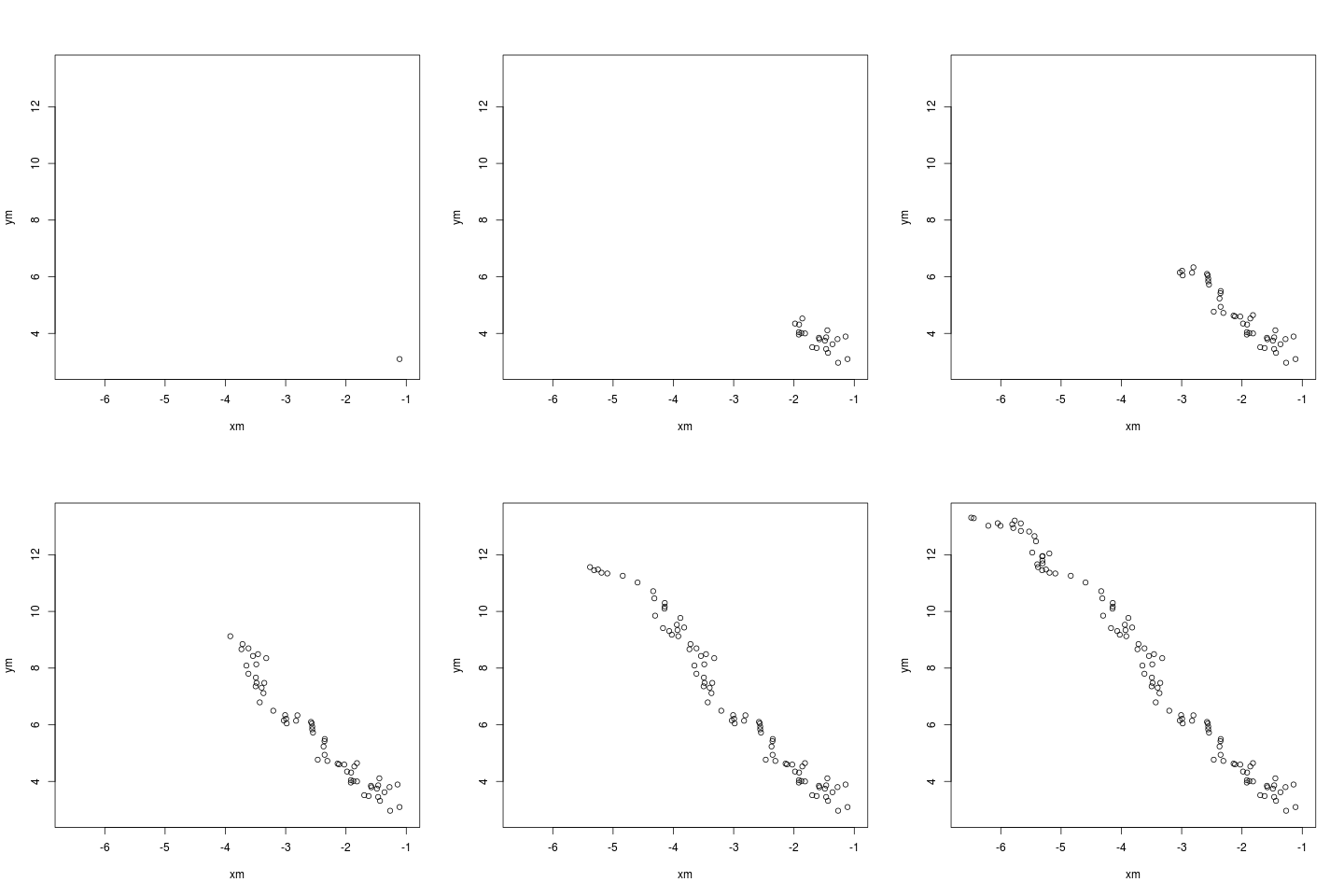
And to illustrate just why Rcpp is so cool for this, here is a little animation of a callback from the C++ code when doing the filtering on Adam's example 5.1. By passing a simple plotting function, written in R, to the C++ code, we can get a plot updated on every iteration. Here I cheated a little and used our old plot function with fixed ranges, the package now uses a more general function: Example of RcppSMC callback to R plot when estimation example 5.1 from Johansen (2009) The animation is of course due to ImageMagick glueing one hundred files into a single animated gif. More information about RcppSMC is on its page, and we intend to add more examples and extensions over time.

Alessio Treglia: LADI Tools: first stable release is out!

During the last month I worked as upstream maintainer of LADI Tools and now I m happy to introduce the first stable release! So, to answer the usual question What s new? , here is a short description of the changes introduced (taken from the NEWS file included in the release tarball): Laditools 1.0 Lady O Apart from wladi and g15ladi, most of ladi* tools have been renamed: Moreover, a new component has joined the LADI Tools suite: ladi-player. LADI Player is a convenient, graphical VLC-style application providing an all-in-one control interface to start, stop and monitor JACK as well as the session handler. It also provides basic controls for managing studios. Goodbye PyGTK! All the code was ported to GTK+ 3 and the new GObject Introspection mechanism. Code refactoring and cleanup The code has been reorganized in order to allow the use of Python objects by 3rd party applications. To start writing code using the classes provided by laditools, simply do the following: from laditools import * Two-in-one solution for LADI System Tray Formerly laditray was an implementation of GtkStatusIcon to put a nice right-clickable icon into the system tray to allow users access JACK controls easy way. It s been mostly rewritten and now it shows an AppIndicator icon (if the library is available), or fall back to the Freedesktop.org s old-fashioned System Tray Protocol Spec-compliant icon. Project s new homepage The project s homepage is now hosted by Launchpad.net, the code is hosted by repo.or.cz and it s available here for browsing.
Please use the following links to contact the development team: New up-to-date packages will hit both Debian and Ubuntu soon!

Next.

Previous.