Search Results: "reg"

22 June 2011

Martin Zobel-Helas: How YOU can help Debian!

I recently had been ask how persons usually not involved in Debian's development process can help Debian. This is a question that pops up quite often, so I thought I should write down a bit of that.

Help to make Debian a better OS
If you are using Debian, and you want something of your OS changed, open a bug report. This varies from wishlist bugs if you want to have an enhancement of a package over normal bugs for stuff that you think is a real bug up to serious or grave bug, if you found a security bug. Send a mail to submit@bugs.debian.org or use the tool reportbug and describe the problem you have found. Find more information here. Be as verbose as possible when explaining your problem. This will make it easier for the package maintainer to help you and to understand the problem. If you are not sure which package to report the bug against, report it against unknown. The bug will be taken care of, there are guys redirecting those bug reports to the appropriate package!
You could also help to verify bug reports. There are dozens of packages around, that have hundred of open bug reports. It will help the Debian package maintainer if you can tell him a "me too", esp for complex problems, or if you found out how to reproduce a bug.

Help by spreading the word
If you are using Debian, speak about it! If you have problems with Debian, speak about it! If you like Debian, speak about it. Read the debian-user mailing list (or a localized one) and jump in if users have the same problem you had, and help them.
All sort of publicity will help Debian. If there is a small exhibition near to your living, speak there about Debian, and how you are using it. Speak also to Debian, we can help you to announce your presence at that exhibition and provide you with information material in various languages. Good contact point for that is events@debian.org, or one of the debian-events-* mailing lists on lists.debian.org. If you need help, ask for it. Also, you can help Debian manning an exhibition. If you see events in your area, offer to help and don't be shy. Other way to help is working with the publicity team and prepare press announcements, the Debian Project News (DPN), contact journalists or press media if interesting things happen in Debian.

Help Debian to organize stuff
There are many ways to help Debian organize itself. For example the annual Debian Conference DebConf is a big organisation monster, and you don't need to be developer to help with that. Sometimes it's as easy as helping in the video team taping the conference, help at the front desk with registration, sorting badges or speaking to the caterer about needed foods. We also have miniDebConf or so called Debian Bug Squashing parties from time to time. Your company could provide office rooms, you could provide crash space for developers to sleep or even by sponsoring some beverages or food. Also helping around exhibition is a good idea. If your company is willing to print some flyers or posters this can help us.

Help by translating or writing documentation
Debian's website and all of the software Debian delivers should be available in all languages around the world! Good starting point for that is http://www.debian.org/international/ and the Debian Internationalization Mailing list. Also writing or extending documentation is a job everyone can do. If you are using a piece of software heavily and miss documentation, speak to the Debian package maintainer (you can find our at http://packages.debian.org/$yourpackage) and start submitting bugs with documentation.

Help by donating
There are actually many ways to help by donating (not only by money). Surely Debian will accept money donations via one of it's official representation (ffis, SPI, debian.ch, ...). On the other hand donating can be as simple as allowing your employees to work some specified time on the week on Debian! Or you donate machine hardware (probably not your old ones that you used five years and which are not under warranty now any more, sorry...), bandwith or colocation in your datacenter. Speak to the hardware donations team if you want to know the current needs.

Conclusion
I only wrote down a very few areas where you can help Debian, and there are plenty more! Don't hesitate to jump in to help. If you don't understand stuff: ask! But be prepared that you will be pointed to URLs where the stuff you ask for is documented. Helping Debian sometimes starts with reading tons of documentation (and i am sure you will find errors in that documentation to fix!), but after a while it makes a lot of fun to work for and with Debian. Find your own area to work on within Debian, and don't think you can't help. Even graphic designers, lawyers or clerks can help Debian!

I started using Debian around 15 years ago and became Debian Developer around 6 years ago. Within the last six years I had been in various positions inside Debian (listmaster team member, volatile team member, release team member and Stable Release Manager, Debian Sysadmin Team member) and got to those just by jumping in where help needed.


21 June 2011

Julien Blache: forked-daapd: v0.17, libav 0.7, GCD codebase

forked-daapd v0.17 is out; the main purpose of this release is to add support for libav 0.7. There are also a few bugfixes that made it into this release, but nothing earth-shattering. One More Thing You ll notice an extra tarball and tag in this release, both marked 0.17gcd. With this release, the GCD (Grand Central Dispatch / libdispatch) codebase is making its debut. libdispatch replaces libevent and allows for greater concurrency inside forked-daapd. This makes forked-daapd snappier, which shows when using Remote or a SoundBridge. The filescanner also benefits from this; it now scans several directories concurrently, reducing the time needed for a rescan by making better use of the machine resources. Thanks to Mark Heily s efforts on libdispatch/libkqueue/libpthread_workqueue over the past year, we now have a Linux version of libdispatch that works well enough to support forked-daapd. This codebase will become the primary codebase for forked-daapd once the database performance issue will be fixed. After this point, the current libevent 1.4 codebase will be legacy and won t see any further development (we ll discuss bugfixes in due time). This new codebase comes with new requirements: libdispatch and its dependencies are available in Debian unstable; it s best and easier to use whatever is in unstable, instead of mixing and matching the libdispatch/libkqueue/libpthread_workqueue versions until they all work together. Due to platform support in Clang, the GCD codebase can only be built for and will only run on i386 and amd64, as far as Linux is concerned. Other architectures will have to wait until support for them is added to Clang. FreeBSD is untested and will probably require some modifications to work; recent enough versions of FreeBSD have a native pthread_workqueue implementation and do not need libpthread_workqueue. Packages are available in experimental for Debian users; they ll end up in unstable in a few weeks, before the libevent2 migration happens there. Tarballs available at http://alioth.debian.org/~jblache/forked-daapd/ ; GPG signatures made with my Debian key F5D65169.

20 June 2011

Joachim Breitner: gtk-vector-screenshot code published

After my post about the vector screenshots two days ago stirred quite some interest, I was hard-pressed to push the code out in proper form. So here you are: You can get release tarballs which can be installed with the usual configure && make && sudo make install. You can also get the code via git from the gitorious project page. Freshmeat and ohloh registration will follow soon. I don t think though that I need more infrastructure, e.g. a mailing list would be overkill, unless the project becomes much larger than I expect at the moment. After all, I do prefer small projects.
Over the version that you saw in the screencast two days ago (which almost broke my server, as I included the video via the <video> tag, and every reader of my blog entry automatically started downloading the 2MB file), I have added support for SVG, PostScript and (hear hear) PNG, made the button much more visible and improved minor usability things. Since Saturday, the work was covered in ycombinator s hacker news and on golem.de. If the interest stays high and I get positive feedback from users of the above code, I ll also upload it to Debian. I would really like to have this as a stand-alone program that can take screenshots of any running gtk-3 application, but I m not sure if this is possible in a clean fashion. Can I somehow hook into a running glib application and call object methods there, maybe similar to how gdb would do it? Alternatively, I could install the module system wide, so that it is loaded into every application, and then somehow triggered (e.g. using a signalling mechanism based on X window s property). Ideas and patches welcome!

Rapha&#235;l Hertzog: apt-get, aptitude, pick the right Debian package manager for you

This is a frequently asked question: What package manager shall I use? . And my answer is the one that suits your needs . In my case, I even use different package managers depending on what I m trying to do. APT vs dpkg, which one is the package manager? In the Debian world, we re usually thinking of APT-based software when we re referring to a package manager . But in truth, the real package manager is dpkg. It s the low-level tool that takes a .deb file and extracts its content on the disk, or that takes the name of a package to remove the associated files, etc. APT is better known because it s the part of the packaging infrastructure that matters to the user. APT makes collection of software available to the user and does the dirty work of downloading all the required packages and installing them by calling dpkg in the correct order to respect the dependencies. But APT is not a simple program, it s a library and several different APT frontends have been developed on top of that library. The most widely known is apt-get since it s the oldest one, and it s provided by APT itself. Graphical APT front-ends update-manager is a simple frontend useful to install security updates and other trivial daily upgrades (if you re using testing or sid). It s the one that you get when you click in the desktop notification that tells you that updates are available. In cases, where the upgrade is too complicated for update-manager, it will suggest to run synaptic which is full featured package manager. You can browse the list on installed/available packages in numerous ways, you can mark packages for installation/upgrade/removal/purge and then run in one go all the recorded actions. software-center aims to be an easy to use application installer, it will hide most of the packaging details and will only present installed/available applications (as defined by a .desktop file). It s very user friendly and has been developed by Ubuntu. Of the graphical front-ends, I use mainly synaptic and only when I m reviewing what I have installed to trim the system down. Console-based GUI APT front-ends In this category, I ll cite only aptitude. Run without parameter, it will start a powerful console-based GUI. Much like synaptic, you can have multiple views of the installed/available packages and mark packages for installation/upgrade/removal/purge before executing everything at once. Command-line based package managers and APT front-ends This is where the well known apt-get fits, but there are several other alternatives: aptitude, cupt, wajig. Wajig and cupt are special cases as they don t use libapt: the former wraps several tools including apt-get, and the latter is a (partial) APT reimplementation (versions 1.x were in Perl, 2.x are now is C++). You re welcome to try them out and find out which one you prefer, but I have never felt the need to use something else than apt-get and aptitude. apt-get or aptitude? First I want to make it clear that you can use both and mix them without problems. It used to be annoying when apt-get did not track which packages were automatically installed while aptitude did, but now that both packages share this list, there s no reason to avoid switching back and forth. I would recommend apt-get for the big upgrades (i.e. dist-upgrade from one stable to the next) because it will always find quickly a relatively good solution while aptitude can find several convoluted solutions (or none) and it s difficult to decide which one should be used. On the opposite for regular upgrades in unstable (or testing), I would recommend aptitude safe-upgrade . It does a better job than apt-get at keeping on hold packages which are temporarily broken due to some not yet finished changes while still installing new packages when required. With aptitude it s also possible to tweak dynamically the suggested operations while apt-get doesn t allow this. And aptitude s command line is probably more consistent: with apt-get you have to switch between apt-get and apt-cache depending on the operation that you want to do, aptitude on the other hand does everything by itself. Take some time to read their respective documentation and to try them.

Click here to subscribe to my free newsletter and get my monthly analysis on what s going on in Debian and Ubuntu. Or just follow along via the RSS feed, Identi.ca, Twitter or Facebook.

11 comments Liked this article? Click here. My blog is Flattr-enabled.

Rudy Godoy: Compute Clusters Integration for Debian Development and Building Report 2

Hello, this is the 2nd report regarding my project. I'll offer a brief
summary of how are we doing and then the details, so you don't have to
read everything at all.
I have to start saying that over the last two weeks I made a lot of
progress on the project. The most important part: Debian ARM image
integration with Eucalyptus is now cleared. The work to be done for the
next two weeks is pretty much fully coding to achieve what we've committed:
supporting Debian ARM images for Eucalyptus.
What was done so far
--------------------
- I've have identified and mapped what needs to be modified over the
  eucalyptus source for supporting ARM. I'm puting the details on the
  next section. I think this is the most crucial part that is now
  sucessfully achieved.
- I started a Project Log[1] on the wiki, so anyone can check and
  eventyally use the information I've already gathered. The log is being
  updated constantly. You can also check what I've done and what I'm
  working on.
- We got feeback[2] from Eucalyptus developers and packaging
  team regarding developers and packaging team regarding the ultimate
  source for debian/ packaging bits. This was quite important because
  in the past I've managed to build Eucalyptus from source using the debian/
  included in the upstream tarball. However the people in charge
  told us that they were using a different one, which indeed was
  different and resulted in different output than I expected. I'm
  still working on fixing the bits to get a clean build.
- I've joined the pkg-eucalyptus team and I've been given commit rights
  to the repo[2].
1- http://wiki.debian.org/SummerOfCode2011/BuildWithEucalyptus/ProjectLog
2- http://lists.alioth.debian.org/pipermail/pkg-eucalyptus-maintainers/2011-June/000289.html
What I'll be working over the next two weeks
--------------------------------------------
- Heavily code on the different bits that I've identified and need to be
  changed. They are:
  C code:
  - node/handlers_kvm. c,h  - handles nc creation. nc's are node
  clusters for Eucalyptus, the code is in charge of node creation. It
  prepares the "machine" that is able to run a compatible image.
  - util/data. c,h  - handles instance creation. The code over there
  implements the functions node/handlers_* use, like instance creation
  and libvirt's API parameter passing. Since libvirt's parameters for
  ARM vary from x86's ones, we need to support that.
  Perl code:
  - tools/gen_kvm_libvirt_xml - wrapper tool for creating KVM/QEMU
  libvirt's XML Domain definition. This needs to be heavily
  changed/updated - redesigned, to support ARM architecture.
- Depending on the previous task progress: Modify the Debian packaging
  bits for Eucalyptus and push them to the pkg-eucalyptus's team
  repository. This is not crucial for my project's success but I'd like
  to work with Debian official builds. I've yet to commit the
  Eucalyptus team version to the debian/ dir. I expect to have fixed
  the bits to get a successful and clean build, then commit.
Other plans
-----------
- I expect a slow down on the work pace over the second week due end of
  semester exams on the week from July 3 to July 9. After that week I'm
  on vacations and will be fully dedicated to the project.
- Code changes to Eucalyptus source will be pushed upstream. I would
  not like to keep a separate repo for this. I'll talk about this with
  Steffen. Changes to Debian bits will be pushed to the appropiate repos.
Other bits
----------
When the project started I noted it was too vague for some people and
it's results/output were unclear. This concerned me. However, while the
project started and we got lot of feedback things got much clear and I'd
like to take the opportunity to explain it a bit.
Currently, developers targeting ARM devices are struggling[1] with having
a development environment. There are missing bits that sometimes are not
in place and result on hard time for them. Also, due mobile devices
growth and vendors using Linux-based[2] operating systems it's a nice
opportunity for Debian to keep it's well known fame of: supporting every
arch over the sun. How this project fits, well by offering the ability
for developers to run ARM-based Debian images over x86/x86_64 CPU's
would impact the way they could be more productive and for Debian to be
more adopted as development environment.
I can say that I'm very enthusiast of this opportunity and I'm
certain that the outcome will result in more adoption. Even the Ubuntu
people is now pushing more and more efforts for ARM official support,
due the facts I've stated.
1- http://lists.debian.org/debian-arm/2011/06/msg00020.html
2- http://events.linuxfoundation.org/events/android-builders-summit/back

19 June 2011

Philipp Kern: Call for testing: Upcoming Squeeze point release 6.0.2

I just posted a call for testing to the not yet well-known debian-stable-announce mailing list. Please test the packages in squeeze-proposed-updates on some stable machines if possible, so that we don't screw up your production machines with bad updates in a week. The point release is scheduled for June 25th, i.e. next Saturday. Don't forget to copy the debian-release mailing list when you encounter regressions. Thanks for your efforts.

18 June 2011

Joachim Breitner: Better PDF screenshots with gtk 3

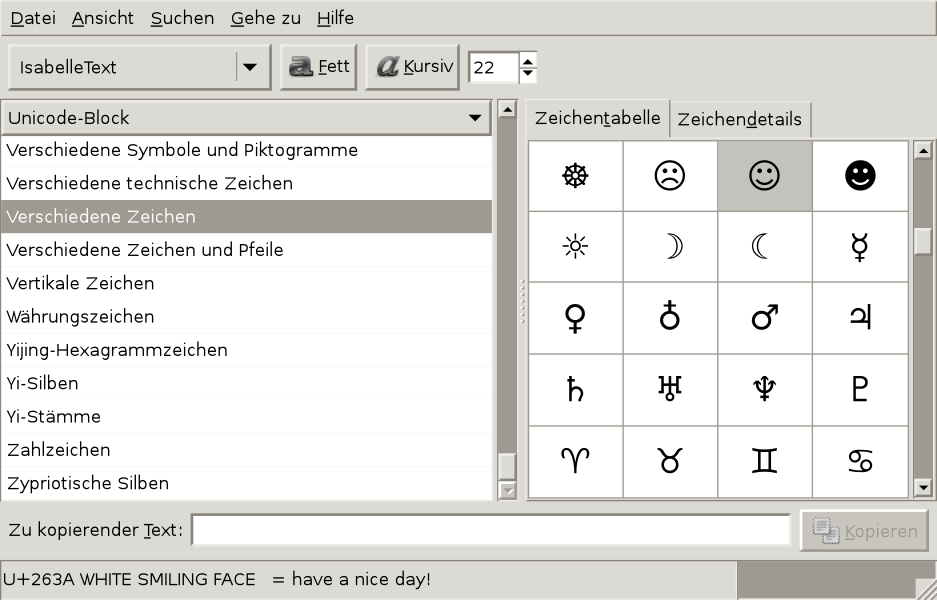
Half a year ago, I experimented with gtk+ and cairo to extract a PDF screenshot out of a progam, i.e. a screenshot of the window that is not a table of colored dots as a regular PNG file would be, but rather a vector graphic that scales perfectly and has selectable text. The main use that I see is documentation: A scalable screenshots looks much better in print, and even in an online-PDF-file, having the full-text-search also find the text in the images is useful. My experiments back then were successful in a proof-of-concept way, but they were very ugly hacks. With the new version 3 of gtk+, though, things become much easier, as only one cairo context is used, instead of each widget creating its own context to draw on. By now, the first gtk-3 applications have reached Debian unstable, so I thought it would be time to re-do the experiment. And the result is very pleasing: The pdf screenshot program comes as a gtk module that you can load by setting an environment variable before launching a gtk-3 program. The application will run as usual, but there is an additional PDF screenshot button. If you click it, you get a Save File dialog (with a nice, live-updated preview of the screenshot, as an additional gimmick) that lets you save a PDF file. Its as easy as that. You can check out the resulting PDF file of gucharmap and a screencast of me creating that file, including copy n pasting from the resulting document.
<video controls="true" height="592" preload="none" src="http://www.joachim-breitner.de/various/pdf_screenshot_3.ogv" tabindex="0" width="800"> Your browser does not support the video tag, but you can still download and view the screencast with the above link. </video>
PS: I would offer the video as well on YouTube, but it seems it does not accept Ogg Theora videos. I hope all of you can make use of the above links. Update: By popular demand, I also created a SVG version. It even looks better because the embedded pixmaps have a higher resolution probably gtk is confused by the resolution of the PDF cairo surface. The code is almost trivially the same. I guess I could add other formats (PNG, PS) as well. Now I just have to find out how to tame GtkFileChooser to offer this feature better.

Joachim Breitner: Better PDF screenshots with gtk 3

Half a year ago, I experimented with gtk+ and cairo to extract a PDF screenshot out of a progam, i.e. a screenshot of the window that is not a table of colored dots as a regular PNG file would be, but rather a vector graphic that scales perfectly and has selectable text. The main use that I see is documentation: A scalable screenshots looks much better in print, and even in an online-PDF-file, having the full-text-search also find the text in the images is useful. My experiments back then were successful in a proof-of-concept way, but they were very ugly hacks. With the new version 3 of gtk+, though, things become much easier, as only one cairo context is used, instead of each widget creating its own context to draw on. By now, the first gtk-3 applications have reached Debian unstable, so I thought it would be time to re-do the experiment. And the result is very pleasing: The pdf screenshot program comes as a gtk module that you can load by setting an environment variable before launching a gtk-3 program. The application will run as usual, but there is an additional PDF screenshot button. If you click it, you get a Save File dialog (with a nice, live-updated preview of the screenshot, as an additional gimmick) that lets you save a PDF file. Its as easy as that. You can check out the resulting PDF file of gucharmap and a screencast of me creating that file, including copy n pasting from the resulting document.
<video controls="true" height="592" preload="none" src="http://www.joachim-breitner.de/various/pdf_screenshot_3.ogv" tabindex="0" width="800"> Your browser does not support the video tag, but you can still download and view the screencast with the above link. </video>
PS: I would offer the video as well on YouTube, but it seems it does not accept Ogg Theora videos. I hope all of you can make use of the above links.

Guillaume Mazoyer: Status report Jigsaw num. 2 for GSoC 2011

code.pngMy internship is now finished, this means that I will be able to work on my GSoC project a lot more than the previous weeks. I hope to make some good progress in the next days.

This last 2 weeks, I was still studying how Jigsaw works. Even if there is no progress on the Jigsaw packaging I have done some packages that will help later.

I ve spend a lot of time trying to package JT Harness and JTReg.
I ve successfully built JT Harness using CDBS but I ve finally rewritten the package using only debhelper and javahelper. Javahelper was really useful to build JAR files, move them to the right directory, put the Javadoc in the right place as well as the examples. The Debian directory of JT Harness can be found on the Java team SVN.

svn co svn+ssh://$ SVN_USER @svn.debian.org/svn/pkg-java/trunk/libjtharness-java

The source package of jtharness build 2 binary packages: libjtharness-java and libjtharness-java-doc. You can see that by looking at the control file in the debian directory. There are some interesting files in this package, let s take a look at them.

First of all, some of the source files needed to be patched for the package to build. So to accomplish this, there is a couple of patches in debian/patches : To generate these patches, I ve used the edit-patch command which is a really awesome tool. This command uses a temporary shell where we can edit files we want to patch. When the job is done, CTRL + D terminates the temporary shell and the patch is generated.

There are 4 interesting files which are used to build the binary packages and put the files in the right directories. These files are: Of course rules is the most important one. This file tells us how packages are built. A good thing is that rules is quite simple in the jtharness case.

#!/usr/bin/make -f
JAVA_HOME = /usr/lib/jvm/default-java

override_dh_auto_build:
ant -f build/build.xml

%:
dh $@ --with javahelper


We just tell where Java is and to use javahelper ( with javahelper). Overriding dh_auto_build is interesting because since the JT Harness uses Ant as build system we need to give to Ant where the build.xml file is. By default Ant is searching it in the current directory but in jtharness the file is in the build directory. Since the Ant build file is correctly written, the build generates JAR files, Javadoc and examples code. And libjtharness-java* files are here to put the generated things in the right places.
The job of libjtharness-java.jlibs is to tell where to find the JAR libraries. In this case, the intesresting JAR files were javatest.jar and jt-junit.jar . So in the .jlibs file we just give where those files are after being built.
The job of libjtharness-java-doc.javadoc is to tell where the Javadoc is and where to put it. So there is only one line that says the generated Javadoc is in jar-build/javadoc and put it in /usr/share/doc/libjtharness-java/api .
And finally, libjtharness-java-doc.install is used to move the examples. The syntax is same as libjtharness-java-doc.javadoc .

The JT Harness package can be found in Sid now thanks to Sylvestre Ledru who uploaded it for me. So the ITP bug that I created is now closed.

Building the package for jtreg is quite similar. In fact, it probably easier but I m still facing a problem. jtharness is just a library, jtreg does have main classes and generate some binaries. The difficulty here is to generate the man pages for the 2 generated binaries: jtdiff and jtreg. These 2 files are shell scripts which just use jtreg.jar with the correct parameters.

I tried several tools to generate the man pages of each script. Sadly, I can t find a way that does not causes any problems.
My first choice was to use help2man. This tool looked like to be perfect for the job. But I couldn t find how to launch the scripts correctly. The scripts needs jtreg.jar but they also need javatest.jar from the libjtharness-java package. The classpath cannot be set correctly due how the scripts are written. So to use help2man I ll probably have to patch and completely rewrite jtdiff.sh and jtreg.sh in the sources.
My second choice was to use txt2man. During the build of jtreg there is a usage.txt file which is generated and which can be used as a man page. txt2man can take this text file and output a man page based on the text. I thought it was working but when building the package, lintian threw some warnings about syntax errors in the man pages.

W: jtreg: manpage-has-bad-whatis-entry usr/share/man/man1/jtdiff.1.gz
W: jtreg: manpage-has-errors-from-man usr/share/man/man1/jtdiff.1.gz 292: warning [p 4, 3.3i]: cannot adjust line


Finally, few days ago I decided to try rst2man. This tool looks cool and easy to use. But the text that I have to convert into a man page is not a reStructured text so it cannot without patching the usage.txt file for example. I was going to do it but there is no such file in the sources of jtreg. Actually this file is generated during the build but the text had to come from somewhere. And it was from two properties files in the source code.
I m still looking for a good solution to generate the man pages. If someone has any idea just let me know ;-)

The debian packaging of jtreg is not in the Java team SVN yet because of the man pages problem. I opened an ITP bug so people know that someone is working on jtreg.

My goal for the next two weeks is to finish the jtreg package, understand how jpkg (which is supposed to create Debian packages) works in Jigsaw and write more examples using the modular JVM.

17 June 2011

Timo Jyrinki: Kernel Mode-Setting (KMS) on Neo FreeRunner + Debian

Edit Aug 18th: video available (ogv, also on youtube)

Forget AMD, Intel, NVIDIA! Thomas White's incredible work with Neo FreeRunner's puny graphics dec...accelerator, Smedia Glamo 3362 is starting to bear fruits. Not listening to such comments as the chip will never be used anywhere else and why not spend your time doing something more relevant , he has chosen to actually do what he likes and sees as an interesting challenge. And that's often the spirit of free software, so I don't really agree with the naysayers.

The camera shot on the right, running KMS-enabled X.org driver for the glamo chip on my Debian installation (visible software matchbox-window-manager, fbpanel, zhone), is a bit optimistic looking since Zhone happens to draw correctly. A lot of the drawing is not yet synced correctly, which shows as all text and images in eg. GTK applications being garbled. But as little as two days ago one couldn't yet much launch applications without X crashing, so the newest commits by Thomas were a big step forwards. I'm using Debian, and he's not, so I try to find time to help in debugging even though I really can't much help with the driver code.

The driver is not just one piece of code, but consists of a kernel drm driver (direct rendering manager) using GEM, libdrm support for the kernel driver and finally the X.org driver supporting these other components and offering buzz-words like DRI2. There is also a beginning of a Mesa 3D driver, though it is so far just a skeleton driver since the 2D/KMS/EXA/DRM parts are what should be done first before dwelling into the OpenGL realm.

Openmoko the company is basically nowadays just producing new Neo FreeRunners to resellers, but the community of the so far only Free phone is thriving. The final (Openmoko produced, from where gta02-core continues) version of the phone, with the famous buzzing problem fixed, appeared on store shelves some time ago, offering better out-of-the-box phone functionality in addition to all the mini computer features. It was also offered to Debconf visitors on discount.

It's not only cool to have kernel mode-setting, though it is indeed very cool as well. The reason for much sorrow in the whole OM project has been the graphics chip, and some of the problems with the chip are only finally solvable with the kernel doing the mode-setting. So it's both a very modern thing to use KMS, but there are also clear potential benefits of having accurate control over this very sensitive piece of silicon. The current non-KMS X.org driver for example busy loops in order to try to feed the chip at a correct pace, causing CPU usage every time there is any drawing going on.

This is somehow reminding me about getting the best out of 8-bit computers and other hardware with some specific limitations. The glamo chip is very limited in some ways, but also capable in some other ways like theoretically offering MPEG-4 decoding, OpenGL ES 3D support. It's a mixed bag of things, and I can very well imagine it's indeed an interesting challenge to work on it, if you just have the skills (I don't) and nerves (proper debugging tools help).

It's so nerdy to drool over lines in the X.org log, but I just can help it:
X.Org X Server 1.6.3
Release Date: 2009-7-31
X Protocol Version 11, Revision 0
Build Operating System: Linux 2.6.28 armv5tel Debian
Current Operating System: Linux neo 2.6.29-GTA02_mydrm #2 PREEMPT Mon Aug 17 18:24:39 EEST 2009 armv4tl
...
II) Using KMS!
...
(WW) Glamo(0): EXA hardware acceleration initialising
(II) EXA(0): Driver allocated offscreen pixmaps
(II) EXA(0): Driver registered support for the following operations:
(II) Solid
(II) Copy
(II) Glamo(0): Initialized EXA acceleration
...
(II) Glamo(0): RandR 1.2 enabled, ignore the following RandR disabled message.
...
(II) Glamo(0): [glamo-dri] Name of DRM device is '/dev/dri/card0'
(WW) Glamo(0): [DRI2] Version 1 API (broken front buffer rendering)
(II) Glamo(0): [DRI2] Setup complete
...
(II) AIGLX: enabled GLX_MESA_copy_sub_buffer
(II) AIGLX: Loaded and initialized /usr/lib/dri/glamo_dri.so
(II) GLX: Initialized DRI2 GL provider for screen 0
(II) Glamo(0): Adding framebuffer....!
(II) Glamo(0): 8 480 640 16 16 960
(II) Glamo(0): rootPixmap = 0x1d0a00
(II) Glamo(0): Done

Timo Jyrinki: Ubuntu 10.04 and 3G modems usb-modeswitch or not?

I'm writing a blog entry instead of just replying to myself on a mailing list, since this subject might be interesting to a largish portion of the community. Most people assume things just magically work out by themselves and then after a release wonder why it wasn't so.

So, I raised a question on ubuntu-devel-discuss mailing list about whether usb-modeswitch should be included in the default Ubuntu 10.04 LTS installation instead of it only being in the universe repository. Reason was simply that firstly, I've read some general wonderings from the community about why it isn't already so. Secondly, without it my 3G modem (Huawei E1552) was first not functional, but right after installing usb-modeswitch package Network Manager worked smoothly with it.

Since I didn't get much discussion going on besides some statements that it doesn't work for everybody and even has caused extra problems for some others (in 9.10), I asked for a small round of comments on the subject on IRC. The channels are logged so I believe I can quote those a bit.

Colin Watson said among else:
"surely we just want the kernel to DTRT [do the right thing] by default ... this is the upstream trend ... it already DTRT for quite a few devices"
"I'd be very concerned about advertising that it's the Way to get things to work, and thus undermining getting things fixed in the kernel"
"I agree that usb-modeswitch is often a way to get otherwise non-working hardware to work ... I'm just not very convinced it's a real properly supportable option"
"but I'm just another user from this point of view, albeit one who ended up in quite a few discussions with various appropriate upstreams last time round :)"
Later on Paul Sladen continued a bit, among else:
"usb-modeswitch is a very long-winded way of sending a single usb-mass-storage command to the device's first profile"
"grep -hr MessageContent usb_modeswitch.d/ sort -n uniq -c sort -rn shows the level of duplication in the configuration files"
"...I do like that it is done in userspace though, as so easy to disable if you wanted something else".
Meanwhile I also IM:d a bit with Antti Kaijanm ki from whom I probably originally coined the idea of following whether usb-modeswitch is integrated into Ubuntu or not. He mainly said that he doubts the feasibility of updating kernel's USB storage quirks in a stable release, compared to having stable release upgrades about the usb-modeswitch-data udev rules. He also proposed discussing maintainability and usability by distros with the Debian maintainer and upstream, although it sounds like Colin might have had some talks already.

So there we are now. Apparently at this point it is hoped that as many quirks as possible are inserted in the kernel, see for example drivers/usb/storage/unusual_devs.h in the kernel. But if you have concerns about if 10.04 LTS will be kept up-to-date regarding 3G modems and want to somehow participate in bringing usb-modeswitch into Ubuntu default installation or simply discuss how to handle the kernel SRUs properly, it's time to stand up and do something.

Should there perhaps be a process with which the usb-modeswitch developers would get the information they are gathering more easily to the upstream kernel _and_ (older) distribution kernels? Is this simply a case of being easier to address an issue with a "hackish" approach, or is the usb-modeswitch actually the right way to go?

Note that I'm no expert in this area, I simply become interested in various subject from time to time :)

-Timo, going to figure out a kernel quirk for his 3G modem

16 June 2011

Paul Wise: Announcing Planet Debian Derivatives!

The first concrete outcome from the Debian derivatives census is the creation of Planet Debian Derivatives. For those of you who are interested in the activities of distributions derived from Debian, it aggregates the blogs and planets of all the distributions represented in the derivatives census. The list of feeds will be expanded semi-automatically as more distributions participate in the census and maintainers of census pages add new blog and planet URLs. Many thanks to Joerg Jaspert for doing the necessary setup procedures for the addition of the new sub-planet to Planet Debian. I'm glad that it was accepted alongside the sole language-based sub-planet (Planet Debian Spanish). I plan further integration of information about derivatives with Debian infrastructure. My next target will be integration of information about the packages in Debian derivatives into Debian. I hope to work on getting that information into UDD (and rmadison) and the packages.d.o site during DebConf11 and DebCamp. If you are interested in helping out, please add your ideas to the integration wiki page, check out the code and add more scripts to it. If you have any comments or questions about this or any other activities related to Debian derivatives, please direct them to the debian-derivatives list and the #debian-derivatives IRC channel on OFTC. Those of you interested in the other side of the software stream might want to take a look at Planet Debian Upstream, which is run by the excellent Joey Hess. He is also on the lookout for interesting blogs by people writing software that is packaged in Debian. The site is created using ikiwiki, hosted on branchable and editable with an OpenID account.

14 June 2011

Cyril Brulebois: mesa: a disturbance in the Force?

Just a quick heads-up: I ve just uploaded mesa 7.10.2-4, which is multiarch-enabled, thanks to Steve Langasek. As explained in its changelog, this breaks the X server currently in testing and in unstable, but a rebuild is already pending, which will make everyone upgradable. For curious people, those commands took care of scheduling the binNMU, with a proper dep-wait:
wb nmu xorg-server . ALL . -m 'Rebuild against new (multiarch-enabled) mesa.'
wb dw xorg-server . ALL . -m 'libgl1-mesa-dev (>= 7.10.2-4)'
In the meanwhile, if your mirror gets a new mesa without the rebuilt server, your package manager should bail out and refuse to upgrade mesa (or propose to remove the server). So wait a bit, upgrade everything, and enjoy! mesa 7.10.3 (released a few hours ago) should reach unstable tomorrow, so that we can ask our users to track (possible) regressions between 7.10.2-3 and 7.10.3-1 to either 7.10.2-4 (multiarchification), or to 7.10.3-1 (the stable upgrade), thanks to the excellent http://snapshot.debian.org/ service.

13 June 2011

Russell Coker: Parsing Daemontools/Multilog dates in Shell Script

I run some servers that use the DJB Daemontools to manage their daemons [1]. This is something I would have changed years ago if given a chance because DJB software always seems to do things in a different way to other Unix software and causes pain. Unfortunately when you have a lot of semi-embedded systems that have intermittent net access it s really not easy to change things, and having staff who aren t computer experts who have been trained to use certain DJB software makes it even more difficult. Daemontools uses multilog [2] to manage it s logging, this gives dates of the format @400000004deedcea1e4a18d4. While DJB has written a tool to parse this it s not always convenient, and I don t want to install DJB software on every system that might be used for reading logs (among other things DJB software is not included in any popular distribution). George Bernard Shaw says that All progress depends on the unreasonable man [3], of course he never participated in a large-scale software development project. In the modern age progress usually depends on people who can work with others, which is why DJB software doesn t get used much for every DJB program there is a similar program written by someone else that works about equally well on it s own and is more than 10* more popular because of better interoperability. So I wrote the following script to convert DJB dates to regular dates. It takes a DJB format date as the first command-line parameter as I generally just paste the relevant date into a different window. At some future time I may write a program to parse an entire log file and convert all the dates but I haven t had a need for it yet. I think that I ve done the hardest work involved in writing such a parser so someone else can use this as a starting point if they have such a need. #!/bin/bash
set -e
DATE=$(echo $1 cut -c 10-17)
SECS=$(echo -e ibase=16\\n$(echo $DATE tr "[a-z]" "[A-Z]") bc)
exec date -d "1970-01-01 $SECS sec utc"

Vincent Bernat: Anycast DNS

In a recently published article, Paul Vixie, past author and architect of BIND, one of the most popular internet domain server, explains why DNS servers should use anycast for increased reliability and faster answers. The main argument against unicast is that some resolvers may not be smart enough to select the best server to query and therefore, they may select a server on the other side of the planet. Since, you cannot go faster than light, you get a penalty of about 100 milliseconds in this case.

Unicast & anycast Most addresses that you handle are unicast addresses, i.e. the address of a single receiver. Any time you send a packet to an unicast address, it will be forwarded to this single receiver. Another common network addressing system is multicast (which happens to include broadcast). When you send a packet to a multicast address, several receivers may get it. The packet is copied as needed by some nodes. Anycast addresses allow you to send a packet to a set of receivers but only one of them will receive it. The packet will not be copied. Usually, the idea behind anycast is that the packet is sent to the nearest receiver. There is no universal way to determine if an IP address is an unicast address or an anycast address just by looking at it. For example 192.5.5.241 is an anycast address while 78.47.78.132 is an unicast address. ISC, which maintains BIND, operates the F root domain server, one of the 13 Internet root name servers. This server is queried by using 192.5.5.241 IPv4 anycast address or 2001:500:2f::f IPv6 anycast address. ISC has published a document explaining how anycast works. Several nodes around the globe announces the same subnet using BGP. When one router running BGP has to send a query to the anycast address, it will have several choices in its BGP table. It will usually select the shortest path and route the query to the corresponding router. Some nodes may choose to restrict the announcement about the subnet containing the anycast address. They are called local nodes (by opposition to other global nodes). This allows them to serve query only from their clients and use cheaper connectivity and hardware.

Lab Let s play with anycast by setting up a lab to experiment with it. We want to setup an IPv6 anycast DNS service using two global nodes, G1 and G2, and one local node, L1. We build some kind of mini-Internet. See : Anycast lab

Setting up the lab This lab will use UML guests for all nodes. For more details on how this works, look at my previous article about network labs with User Mode Linux. You first need to grab the lab:
$ git clone https://vincentbernat@github.com/vincentbernat/network-lab.git
$ cd network-lab/lab-anycast-dns
$ ./setup
You will need to install the dependencies needed by the script on your host system. The script was tested on Debian unstable. If some of the dependencies do not exist in your distribution, if they don t behave as in Debian or if you don t want to install them on your host system, you can use debootstrap to create a working system:
$ sudo debootstrap sid ./sid-chroot http://ftp.debian.org/debian/
[...]
$ sudo chroot ./sid-chroot /bin/bash
# apt-get install iproute zsh aufs-tools
[...]
# apt-get install bird6
[...]
# exit
$ sudo mkdir -p ./sid-chroot/$HOME
$ sudo chown $(whoami) ./sid-chroot/$HOME
$ ROOT=./sid-chroot ./setup
We are running a lot of UML guests in this lab. We assign 64 MB to each host. UML guests do not use host memory until they need it but because of cache subsystem, you can expect that each guest will use 64 MB of memory. This means that you need about 2 GB of RAM to run this lab. Moreover, each guest will create a file representing its memory. Therefore, you need about 2 GB of free space in /tmp too. Routers are named after their AS number. The router of AS 64652 is just 64652. Paris, NewYork and Tokyo are the exception. The lab will use only one switch but we will use VLAN to create several L2 networks. Each link in our schema is an L2 network. Each link will get its own L3 network. Those networks are prefixed with 2001:db8:ffff:. Leaf AS have their own L3 network 2001:db8:X::/48 where X is the AS number minus 60000. Look at /etc/hosts on each host to get the IP of all hosts.

Mini-Internet routing AS 64600 is some kind of Tier-1 transit network (like Level 3 Communications). It has three points of presence: Paris, New York and Tokyo. AS 64650 is an European regional transit network, AS 64640 is an East Asian regional transit network and AS 64610, 64620 and 64630 are North American regional transit network which are peering each other. Other leaf AS are local ISP. This is not really what Internet looks like but shaping our lab like a tree allows us to not deal with a lot of BGP stuff: we ensure that the shortest path (in number of BGP hops) from one client to one server is the best path. Each BGP router will get a basic BGP configuration containing only the list of peers. Since Paris, Tokyo and NewYork are in the same AS, they will use iBGP. They are fully meshed for this purpose but this does not provide redundancy because iBGP routes are not redistributed inside iBGP. A more complex setup would be needed to provide redundancy inside AS 64600. We don t use an IGP inside leaf AS as we should: for the sake of simplicity, we redistribute directly connected routes into BGP. While in my previous lab, I used Quagga, I will use BIRD in this one. It is a more modern daemon with a clean design on how routing tables may interact. It also performs better. However, it lacks several features from Quagga. The configuration for BIRD is autogenerated from /etc/hosts. We use only one routing table inside BIRD. This table will be exported to the kernel and to any BGP instance. Some directly connected routes will be imported (those representing client networks) as well as all routes from BGP instances. Here is an excerpt of 64610 s configuration:
protocol direct  
   description "Client networks";
   import filter  
     if net ~ [ 2001:db8:4600::/40 40,48  ] then accept;
     reject;
    ;
   export none;
 
protocol kernel  
   persist;
   import none;
   export all;
 
protocol bgp  
   description "BGP with peer NewYork";
   local as 64610;
   neighbor 2001:db8:ffff:4600:4610::1 as 64600;
   gateway direct;
   hold time 30;
   export all;
   import all;
 
We do not export inter-router subnets to keep our routing tables small. This also means that those IP addresses are not routable in spite of the use of public IP addresses. Here is the routing table as seen by 64610 (use birdc6 to connect to BIRD):
bird> show route
2001:db8:4622::/48 via 2001:db8:ffff:4610:4620::2 on eth3 [bgp4 18:52] * (100) [AS64622i]
                   via 2001:db8:ffff:4600:4610::1 on eth0 [bgp1 18:52] (100) [AS64622i]
2001:db8:4621::/48 via 2001:db8:ffff:4610:4620::2 on eth3 [bgp4 18:52] * (100) [AS64621i]
                   via 2001:db8:ffff:4600:4610::1 on eth0 [bgp1 18:52] (100) [AS64621i]
2001:db8:4612::/48 via 2001:db8:ffff:4610:4612::2 on eth2 [bgp3 18:52] * (100) [AS64612i]
2001:db8:4611::/48 via 2001:db8:ffff:4610:4611::2 on eth1 [bgp2 18:52] * (100) [AS64611i]
As you can notice, it knows several paths to the same network, however, it only selects the best one (based on the length of the AS path):
bird> show route 2001:db8:4622::/48 all
2001:db8:4622::/48 via 2001:db8:ffff:4610:4620::2 on eth3 [bgp4 18:52] * (100) [AS64622i]
        Type: BGP unicast univ
        BGP.origin: IGP
        BGP.as_path: 64620 64622
        BGP.next_hop: 2001:db8:ffff:4610:4620::2 fe80::e05f:a3ff:fef2:f4e0
        BGP.local_pref: 100
                   via 2001:db8:ffff:4600:4610::1 on eth0 [bgp1 18:52] (100) [AS64622i]
        Type: BGP unicast univ
        BGP.origin: IGP
        BGP.as_path: 64600 64620 64622
        BGP.next_hop: 2001:db8:ffff:4600:4610::1 fe80::3426:63ff:fe5e:afbd
        BGP.local_pref: 100
Let s check that everything works with traceroute6 on C1:
# traceroute6 G2.lab
traceroute to G2.lab (2001:db8:4612::2:53), 30 hops max, 80 byte packets
 1  64652-eth1.lab (2001:db8:4652::1)  -338.277 ms  -338.449 ms  -338.502 ms
 2  64650-eth2.lab (2001:db8:ffff:4650:4652::1)  -338.324 ms  -338.363 ms  -338.384 ms
 3  Paris-eth2.lab (2001:db8:ffff:4600:4650::1)  -338.191 ms  -338.329 ms  -338.282 ms
 4  NewYork-eth0.lab (2001:db8:ffff:4600:4600:1:0:2)  -338.144 ms  -338.182 ms  -338.235 ms
 5  64610-eth0.lab (2001:db8:ffff:4600:4610::2)  -338.078 ms  -337.958 ms  -337.944 ms
 6  64612-eth0.lab (2001:db8:ffff:4610:4612::2)  -337.778 ms  -338.103 ms  -338.041 ms
 7  G2.lab (2001:db8:4612::2:53)  -338.001 ms  -338.045 ms  -338.080 ms
Let s see what happens if we shut the link between NewYork and 64610. This link is VLAN 10. Since vde_switch does not allow to shut a port, we will change the VLAN of port 9 to VLAN 4093. After at most 30 seconds, the BGP session between NewYork and 64610 will be torn down and packets from C1 to G2 will take a new path:
# traceroute6 G2.lab
traceroute to G2.lab (2001:db8:4612::2:53), 30 hops max, 80 byte packets
 1  64652-eth1.lab (2001:db8:4652::1)  -338.382 ms  -338.499 ms  -338.503 ms
 2  64650-eth2.lab (2001:db8:ffff:4650:4652::1)  -338.284 ms  -338.317 ms  -338.151 ms
 3  Paris-eth2.lab (2001:db8:ffff:4600:4650::1)  -337.954 ms  -338.031 ms  -337.924 ms
 4  NewYork-eth0.lab (2001:db8:ffff:4600:4600:1:0:2)  -337.655 ms  -337.751 ms  -337.844 ms
 5  64620-eth0.lab (2001:db8:ffff:4600:4620::2)  -337.762 ms  -337.507 ms  -337.611 ms
 6  64610-eth3.lab (2001:db8:ffff:4610:4620::1)  -337.531 ms  -338.024 ms  -337.998 ms
 7  64612-eth0.lab (2001:db8:ffff:4610:4612::2)  -337.860 ms  -337.931 ms  -337.992 ms
 8  G2.lab (2001:db8:4612::2:53)  -337.863 ms  -337.768 ms  -337.808 ms

Setting up anycast DNS Our anycast DNS service has three nodes. Two global ones, located in Europe and North America and one local one targeted at customers of AS 64620 only. The IP address of this anycast DNS server is 2001:db8:aaaa::53/48. We assign this address to G1, G2 and L1. We also assign 2001:db8:aaaa::1/48 to 64651, 64612 and 64621. BIRD configuration is adapted to advertise this network:
protocol direct  
   description "Client networks";
   import filter  
     if net ~ [ 2001:db8:4600::/40 40,48  ] then accept;
     if net ~ [ 2001:db8:aaaa::/48 ] then accept;
     reject;
    ;
   export none;
 
We use NSD as a name server. This is an authoritative only name server. The configuration is pretty simple. We just ensure that it is bound to the IPv6 anycast address (otherwise, it may answer with the wrong address). The zone file is customized to answer the name of the server:
#(C1) host -t TXT example.com 2001:db8:aaaa::53
Using domain server:
Name: 2001:db8:aaaa::53
Address: 2001:db8:aaaa::53#53
Aliases:
example.com descriptive text "G1"
#(C5) host -t TXT example.com 2001:db8:aaaa::53
Using domain server:
Name: 2001:db8:aaaa::53
Address: 2001:db8:aaaa::53#53
Aliases:
example.com descriptive text "G2"
If we try from C3, we may be redirected to L1 while we are not a customer of AS 64620. A common way to handle this is to let 64621 tag the route with a special community that will let know 64620 that the route should not be exported.
protocol direct  
   description "Client networks";
   import filter  
     if net ~ [ 2001:db8:4600::/40 40,48  ] then accept;
     if net ~ [ 2001:db8:aaaa::/48 ] then  
          bgp_community.add((65535,65281));
          accept;
      
     reject;
    ;
   export none;
 
The community used is known as the no-export community. BIRD knows how to handle it. However, we hit here some limitations of BIRD:
  1. The correct way to let 64622 knows about this route is to build a BGP confederation for AS 64620 and let AS 64622 and AS 64621 be part of it. This means that those three AS will be seen as AS 64200 from outside of the confederation. Moreover, the no-export community would allow to export the route only within the confederation. This is exactly what we need but BIRD does not support confederations.
  2. BIRD first selects the best route to export then apply filtering. This means that even if 64620 knows non-filtered route to 2001:db8:aaaa::/48, it will select the route to L1, filter it out and export nothing to 64622.
Therefore, we need to fallback to ask BIRD to not export the route to AS 64600, 64610 and 64630 on 64620. We could use a special community to filter out the route but we keep it simple and just filter the route directly.
filter keep_local_dns  
   if net ~ [ 2001:db8:aaaa::/48 ] then reject;
   accept;
 
protocol bgp  
   description "BGP with peer NewYork";
   local as 64620;
   neighbor 2001:db8:ffff:4600:4620::1 as 64600;
   gateway direct;
   hold time 30;
   export filter keep_local_dns;
   import all;
 
Voil . Only C4 will be able to query L1. If AS 64621 is missing, it will query G2 instead. One major point about anycast is to know that redundancy is done at the AS level only. If the name server on L1 does not work correctly, requests will still be routed to it. Therefore, with anycast, you still need to provide redundancy inside each AS (or stop advertising the anycast network as soon as there is a failure).

Beyond DNS Anycast can be used to serve HTTP requests too. This is less commonly used because your connection may be rerouted to another node while it is still running. This is not a problem with DNS because there is no connection (you send a query, you receive an answer). There are at least two CDN (MaxCDN and CacheFly) which uses anycast to ensure low roundtrip time and very high reliability. Setting up an HTTP server with an anycast address is no different than setting up a DNS server. However, you need to ensure maximum stability of the routing path to avoid the connection to be dropped while running. I suppose that this is done by hiring some high-level BGP expert. You can also mix unicast and anycast:
  • anycast DNS answers the IP address of a nearby unicast HTTP server, or
  • anycast DNS answers the IP address of an anycast HTTP server that will issue a redirect to an unicast HTTP server when downloading or streaming large files.

11 June 2011

Martin Zobel-Helas: I am going to DebConf11

DC11_web_120x240_03.pngI am going to DebCamp11 and DebConf11. I hope I can do some productive work with the website team, as well for the DSA team. Maybe I can find someone for a little skill-exchange regarding pylons.

During DebCamp I will most probably helping setting up the local infrastructure, esp for video streaming. Maybe I will also find some time for OpenStreetMap during DebCamp.

Let's hope for a good and productive DebConf with all the other DDs I haven't seen for years.

Clint Adams: Debian on the DreamPlug

The DreamPlug is like a GuruPlug Server-Plus with a few notable differences: So let's say you want to put Debian on your DreamPlug. You do, of course, because running some other operating system is in poor taste, and you'd be embarrassed telling your friends. How do you do it? You can't use d-i. Let me back up. In the onboard SPI flash, there is a copy of Das U-Boot. This is a fork of mainline U-Boot, with no complete and corresponding source available. To the casual observer, this might look like an egregious GPL violation, but, on the other hand, no one seems to know how to rewrite the SPI flash except from U-Boot itself, so if you happen to corrupt said flash, your plug is bricked and openocd can't save you. I would be happy to be proven wrong on this last point, but for not let's assume that you're screwed and unable to replace your boot loader with free software. The next problem is the kernel, which lives on the microSD card. This is potentially free software, though I can't swear that complete and corresponding source code is available. What I can claim is that linux-2.6.33.6.tar.bz2 on Google Code will build a Linux that works on the plug. I will also point out that this doesn't match Linux 2.6.33.6 from kernel.org. Some other time I should rant about ARM Linux but for now I will just say that if you use the U-Boot of questionable provenance and either the Linux that's shipped with the plug or the one at the above link, you will be able to boot a mostly Debian system. I'll mention the third exception later. One thing you can do is to take the plug apart, remove the microSD card from its slot, and then stick it into a reader that you can then manipulate on another machine. If you're choosing this route and wish to take this opportunity to replace the microSD card with something larger than 2 gigs, keep in mind that you'll have to either preserve the uImage file from the first partition or build a new one. I am not fond of cross-architecture anything. I prefer to do things natively rather than cross-compile or foreign-debootstrap, and I own enough armel boxes that I can do this easily. So at this point I would just debootstrap a new Debian base onto the second partition of the microSD card. The first partition contains the uImage (which is your Linux image in a wrapper), and must be a FAT filesystem since you can't replace your boot loader with something that can read a better filesystem. The second partition will be your rootfs and can be whichever filesystem your Linux can read. If you do not have another armel system to play with, you might want to familiarize yourself with Marco's Sheevaplug instructions. You can install to a USB stick as well. Just remember that U-Boot needs a FAT filesystem containing the uImage on it and that you can't use a kernel in Debian yet. You'll also want to ignore the instructions regarding U-Boot, since that must be done differently. I'll be back later with some more details.

10 June 2011

Gunnar Wolf: Reading revolutions: Online digital text and implications for reading in academe A (very informal) review

It's been a long time since I last took some time to read First Monday A great online publication, if you are not familiar with it, that I would categorize (and no, I'm not probably well-informed in it to be authoritative) as dealing with social, psychological aspects of the cultural shifts the online world has brought upon us (often dealing with topics related to Free Software communities, the reason I first met the publication). Firstmonday is an Open Access champion from early on. It follows an approachable but academic format (this means, it is peer-reviewed, its articles give extensive lists of references, and the articles are not the short reads we have got used to finding on the net, but, quoting from their audience profile, English is not the first language of many First Monday readers; A large percentage of First Monday readers are not a part of academia; Cultures, educational backgrounds, and fields of study vary greatly among First Monday readers.) This means, it's at least a great publication for me to follow :) Anyway After a long time not following it, I have just read Reading revolutions: Online digital text and implications for reading in academe, by Barry W. Cull; First Monday, Volume 16, Number 6 - 6 June 2011 Nice, interesting read. As I was planning on telling about the article to a couple of friends more into the subjects than myself, I'll comment+quote some bits on it. Before going any further: The article makes several references to Maryanne Wolf. No relation to her I'm not lulling my (two? are you both still reading?) readers towards her work ;-) The article talks about the differences social, even dips into some physiological aspects that the activity of reading is sustaining due to the shift from an activity done mainly from books (or other similar printed material) to the computer screen. Of course, we all know from our own experience many of the basic traits Shorter attention spans, a different reading pattern (skimming instead of reading; browsing through several related items instead of in-depth reading a single text as a knowledge unit). The article begins with an overview of reading and humankind. Cull quotes Maryanne Wolf's phrase, despite the fact that it took our ancestors about 2,000 years to develop an alphabetic code, children are regularly expected to crack this code in about 2,000 days . An interesting point I never thaught of is the start of reading as a purely mental activity, detaching reason from verbalization, ~1200 years ago:

Interestingly, these early scribes first did their work by reading out loud to themselves. Not until the ninth century did monastic regulations begin requiring silent reading. By the thirteenth century the practice of men reading silently and alone became commonplace. This shift to silent reading was a profound change, one that Darnton suggested involved a greater mental adjustment than the shift to printed text
. One last important point in this older history, that I'm quoting because I know I'll need the reference later on for one of my texts is about reading as a social activity Yes, also related to the quietness I just mentioned:
Interestingly, with the democratization of the printed text, there was a return to reading aloud. Reading was a solitary silent process only for the educated elite who could afford to buy books. For the rest of the population, as Darnton pointed out, reading was a social activity which took place in workshops, barns, and taverns [and] while children played, women sewed, and men repaired tools.
After this introduction (obviously one of the most interesting parts to me), Cull gives numbers showing how reading is evolving (in the USA and Canada), and quotes some prediction on how the future will end up adapting. Of course, I live in a place with a very different society, so I cannot comment much. Then he confronts some studies regarding specifically leisure reading, as it is a much more trustable factor than just literacy (in a world as highly literate as ours is, many people only read when they have to and have never or very seldom experienced the pleasure of reading just for the sake of it), bringing into the discussion the Internet (and computers in general) usage patterns. I found also very interesting the next section, regarding the pattern changes many libraries are facing now, specially academic/research-oriented libraries:
For several millennia, right up until just two decades ago, the central role of a library was to collect and house physical texts: from clay tablets, to scrolls, to printed books (Battles, 2003; Manguel, 2006). While printed text remains essential to most academic libraries, today s libraries have also become a core conduit via which researchers access scholarly texts online. Just within the last few years, Canadian academic libraries, in a situation similar to libraries throughout the Western world, have reached an interesting tipping point librarians now spend the majority of their collections budgets on electronic instead of printed texts.
( )
Libraries are convinced that digital text, now in its infancy, is likely to have a long future. Not only do they purchase electronic texts, but most academic libraries have also become publishers of electronic texts, whether they are digitizing large portions of their book holdings, or focusing on scanning a relatively small number of archival documents from their unique special collections.
And yes, doing some work with our Institute's library, I can confirm this trend. About e-books: I have got quite into that topic since the Kindle won my heart (and my money!) half a year ago. The little device completly changed my reading habits, I have read lots more since I carry it. And yes, I have never considered a full tablet-like device The article talks long about the difference, about the disadvantage that multitasking means to the human brain (oh, do I suffer from it!) I liked this snippet, quoting Steve Jobs a couple of years ago, regarding an Apple e-book reader question:
When Apple was rumoured to be working on an e book reader a few years ago, CEO Steve Jobs expressed his lack of interest: It doesn t matter how good or bad the product is, the fact is that people don t read anymore, he reportedly said, continuing by stating that 40 percent of the people in the U.S. read one book or less last year. The whole conception is flawed at the top because people don t read anymore (Markoff, 2008). Nicholas Carr (2010) has summed up Apple s involvement in the tablet phenomenon this way: Jobs is no dummy. As a text delivery system, the iPad is perfectly suited to readers who don t read anymore .
The issue for me is, I do enjoy reading, but I am an information addict. I know that if I have parallel information flows, my attention will surely dilute between them. Of course, as I read this article on-screen, it was hard for me to take the needed discipline not to be distracted by IMs or IRC highlights during the whole reading (which was also as an excercise for myself ;-) ). I am surprised to see this on student preferences (and even more surprised to see this data comes from my university):
In a study of students at the Universidad Nacional Aut noma de M xico (UNAM), the majority of students preferred print, and 63 percent reported that they could bear reading a document on a computer screen for no more than one hour (Ram rez Leyva, 2003). When it comes to course textbooks, a marked student preference for paper over e books has recently been found (Woody, 2010).
As we approach the end, it talks about another important topics I have often tried (and often failed) to communicate to my users: That of paratext, the meaning of the different texts, covers, items, layouts, etc. that are not part of the text itself but do shape the way we face it. To some of us, this seems obvious. To others, it is so hard to understand It closes with two more topics I will refer to. One is the permanent connectivity. All the time, more people are connected virtually all of their waking time. This affects not only learning habits but priorities. Will this near constant access to information interfere with students desire to comprehend and remember information, necessary to the educational process of turning it into knowledge? Author and university business school lecturer Don Tapscott recently suggested that students might not have to stress about the details those you can check Finally, regarding the continuity and ellaboration found in texts that are each time more common He quotes Maryanne Wolf:
I am worried about kids who are immersed in digital culture. They will get to college and they will have been Twittering so much that they won t have the patience to read those really long cognitively convoluted and complex sentences. They may not have developed those rich networks which are required in order to read at a high level of sophistication. The effort is what we are going to lose. They are becoming not so much a lazy reader, but an atrophied reader
As you can see, not only this post is meant to tell my couple-of-interested-friends to read the article, but it's mainly meant as a mental placeholder for myself. I will be surely refering to some of these items.

Rapha&#235;l Hertzog: People behind Debian: Philipp Kern, Stable Release Manager

Philipp is a Debian developer since 2005 and a member of the release team since 2008. Since he took the responsibility of Stable Release Manager, the process has evolved for the best. I asked him to explain how the release team decides what s fit for stable or not. His work on the buildd infrastructure is also admirable but I ll let him describe that. My questions are in bold, the rest is by Philipp. Who are you? I m a 24 year old Computer Science student, living in Karlsruhe, Germany. As a student assistant I m currently in two jobs: one is taking care of getting our university IPv6 network in shape, or rather generally getting fringe technologies into the network. The second is taking care of a s390x machine in the basement which my faculty got sponsored recently. In my spare time I tend my Debian duties and I m active in the student council (Fachschaft) as a sys-admin, software developer and until recently as treasurer. I got accepted as a Debian Developer in 2005. I m only really active since I was invited to join the Release Team in early 2008 after I contributed rewrites of some scripts that got lost in a disk crash of ftp-master. In late 2008 I also took on wanna-build/buildd duties. What s your notable achievement within Debian? For one I worked on the deployment of a single buildd/sbuild combination over all of our buildds and I rebased it on the sbuild in the archive several times already. All buildds basically look the same on all architectures, with only few variations. The chroots are now also created in a mostly predictable manner. Then we finally got build autosigning after years of constant poking. However the policy decision to allow it was made by the ftp-masters anyway, for which I m grateful, as it eases the workload of the buildd maintainers, the Security Team and the Release Team quite a bit. On the release side there s the integration of volatile into the proper structures of Debian. But there I m guilty for choosing the bad name squeeze-updates is, in comparision with security s squeeze/updates. Let s see if we can improve that for wheezy. The policy for stable updates have changed over time. Can you summarize what kind of updates are allowed nowadays? All the changes that were made to the policy were driven by the aim to keep stable (and to some lesser degree oldstable) usable throughout its lifetime. I have to admit that we got slightly more liberal in what we accept since I took over. The previous stable update policy included the fixes of critical bugs that break the system in interesting ways and security fixes. We also opened up the possibility of including important fixes for annoying bugs on a case-by-case basis. The whole don t update that much part of the stable release management is rooted in let s don t change the behaviour of a running system and let s have as few regressions as possible . We currently try to counter that with a review process that only allows self-contained fixes that were tested in unstable first, if applicable. In the future I d also like to have a feedback process that includes the users of the packages to report problems more early. In fact that s also why we now send calls for testing to debian-stable-announce one week in advance (see this mail as an example). So stable is updated through point releases that happen roughly every two months for stable and roughly every four for oldstable. They are accompanied by announcements and new CD/DVD sets. To be able to push some updates with less delay to our users and to avoid that they have to pick them from proposed-updates, there is stable-updates. The current policy for this suite is available in this post on debian-devel-announce. It boils down to everything urgent like tzdata, regression fixes and volatile packages. We noticed that some packages in stable just weren t useful anymore when they got updated through volatile. Hence those are folded into stable, too. We also relaxed the rules a bit so that leaf packages like clive, that rely on external websites not to change their URLs, can be updated too. If somebody wonders what happened to the and a half releases Those were intended to mark the inclusion of new hardware support (mostly by including a co-installable new kernel version). This kind of flag point release is thankfully no longer needed because our marvellous kernel team now backports certain hardware drivers to the kernel version in stable. They have some trouble soliciting test feedback for them, though. It would be cool if more people using stable could respond to their calls for testing. What are your plans for Debian Wheezy? Luckily the wanna-build/buildd side isn t much dependent on release cycles. The stable release management also just takes care of what gets dumped on them by the testing RMs. ;-) The near-term goals are certainly: Apart from that my work is mainly squashing the bugs on buildd.debian.org for the wanna-build part, so if you want something fixed, you need to report it, I m afraid. You have several roles within Debian, in particular stable release manager and member of the wanna-build team. Which role do you enjoy more and why? So the regular duties of the SRM, apart from setting up policies, are reviewing requests for uploads to proposed-updates, accepting them, chasing builds and scheduling point releases. It s mainly steady work. As for the Release Team it s working in a fabulous team where everyone s doing an awesome job. For me the wanna-build role is holding the things together and fixing up stuff that breaks while the world continues to evolve. And occassionally taking a stab at the ftp-masters. So rather different. My heart is probably siding with the buildd side because it s infrastructure but release work is fun, too. What s the biggest problem of Debian? Mainly that we re not quick in picking up new technologies and that we got slow on innovation. Distro-wide changes are usually a very big effort to coordinate and to finally complete. I guess people should be able to push fixes for release goals more eagerly into the archive. Also it seems to me that many DDs are actually disengaging from the release process, especially during the freeze but also before, which makes me a bit sad. However I m still not sure how we could counter that. As we re all volunteers you can t suddenly make others love the idea of releasing something together, I guess. Do you have wishes for Debian Wheezy? It s getting old, but there s certainly multiarch. Also a usable Python 3 is something I d really appreciate. Is there someone in Debian that you admire for their contributions? Peter Palfrader did an awesome job of getting a nicely working team together for DSA and got many tasks as automated as they are now. It s a pleasure to work with them and setting up a new buildd is, for example, a real breeze. He also developed a sane archive snapshot service, kudos for that.
Thank you to Philipp for the time spent answering my questions. I hope you enjoyed reading his answers as I did. Subscribe to my newsletter to get my monthly summary of the Debian/Ubuntu news and to not miss further interviews. You can also follow along on Identi.ca, Twitter and Facebook.

3 comments Liked this article? Click here. My blog is Flattr-enabled.

9 June 2011

Gerfried Fuchs: Reinhard Mey

This is a very special person. He is a very well known songwriter, at least in German language countries because he sings in German. He was that special kind of person with his lyrics when I was still a kid, and is still around continuing to write his songs in his very own special way. This person is Reinhard Mey, and if you understand German and have missed him so far, you have missed a lot. The songs that I present to you are special in the way that they are all contained in the special compilation titled Mein Apfelb umchen. The dedication he wrote for the album is also very special:
Ich glaube, Kinder zu haben ist das aufregendste Abenteuer, das wir erleben k nnen. Es ist der schwerste Beruf und die gr te Herausforderung, die ich mir denken kann, und die gl cklichste Erfahrung zugleich. Ich bin dankbar daf r! Dies sind die Lieder, die ich bis heute daf r geschrieben habe. Mein Anteil aus dem Erl s dieser Schallplatte gebe ich der Hilfe f r krebskranke Kinder.
Rough translation: I believe that having kids is the most exciting adventure that we can undergo. It is the hardest job and the biggest challenge that I can think of, and at the same time the happiest experience. I'm thankful for it! These are the songs that I wrote up to today for it. My part of the revenues of this record go to Help for children with cancer. So here are the songs: Enjoy! And if you feel like it, support these kind of special people.

/music permanent link Comments: 2 Flattr this

Next.

Previous.
