Search Results: "nic"

14 February 2013

Ian Campbell: FOSDEM 2013

So as previously mentioned I gave a talk at FOSDEM this year on the future of paravirtualisation under Xen. I thought the talk was reasonably well attended despite being at six o'clock in the evening. In the end I underran my half hour slot but fortunately people had plenty of interesting questions! I've posted my slides on my xenbits space. I spent a fair chunk of the rest of the time on the Xen.org booth, which is hard work but it is always nice to speak to users and other developers. I also managed to catch up with various friends from other projects and managed to meet a few folks who I've only ever met in email before. I didn't get to see as many talks as I wanted (for example I missed pretty much all of the ARM track :-() due to clashes with my stints on the booth, my own talk, and talks clashing with each other. Still it was all in all a worthwhile, hopefully I'll be able to make it again next year! Next up: LinaroConnect in Hong Kong!

Robert Collins: Time to revise the subunit protocol

Subunit is seven and a half years old now Conrad Parker and I first sketched it up at a CodeCon camping and coding, a brilliant combination in mid 2005.
revno: 1
committer: Robert Collins <robertc@robertcollins.net>
timestamp: Sat 2005-08-27 15:01:20 +1000
message:  design up a protocol with kfish
It has proved remarkably resilient as a protocol the basic nature hasn t changed at all, even though we ve added tags, timestamps, support for attachments of arbitrary size. However a growing number of irritations have been building up with it. I think it is time to design another iteration of the protocol, one that will retain the positive qualities of the current protocol, while helping it become suitable for the next 7 years. Ideally we can keep compatibility and make it possible for a single stream to be represented in any format. Existing design The existing design is a mostly human readable line orientated protocol that can be sniffed out from the regular output of make or other build systems. Binary attachments are done using HTTP chunking, and the parser has to maintain state about the current test, tags, timing data and test progression [a simple stack of progress counters]. How to arrange subunit output is undefined, how to select tests to run is undefined. This makes writing a parser quite easy, and the tagging and timestamp facility allow multiplexing streams from two or more concurrent test runs into one with good fidelity but also requires that state be buffered until the end of a test, as two tests cannot be executing at once. Dealing with debuggers The initial protocol was intended to support dropping into a debugger just pass each line read through to stdout, and connect stdin to the test process, and voila, you have a working debugger connection. This works, but the current line based parsers make using it tedious the line buffered nature of it makes feedback on what has been typed fiddly, and stdout tends to be buffered, leading to an inability to see print statements and the like. All in-principle fixable, right ? When running two or more test processes, which test process should stdin be connected to? What if two or more drop into a debugger at once? What is being typed to which process is more luck than anything else. We ve added some idioms in testrepository that control test execution by a similar but different format one test per line to list tests, and have runners permit listing and selecting by a list. This works well, but the inconsistency with subunit itself is a little annoying you need two parsers, and two output formats. Good points The current protocol is extremely easy to implement for emitters, and the arbitrary attachments and tagging features have worked extremely well. There is a comprehensive Python parser which maps everything into Python unittest API calls (an extended version of the standard, with good backwards compatibility). Pain points The debugging support was a total failure, and the way the parser depraminates it s toys when a test process corrupts an outcome line is extremely frustrating. (other tests execute but the parser sees them as non-subunit chatter and passes the lines on through stdout). Dealing with concurrency The original design didn t cater for concurrency. There are three concurrency issues the corruption issue (see below for more detail) and multiplexing. Consider two levels of nested concurrency: A supervisor process such as testrepository starts 2 (or more but 2 is sufficient to reason about the issue) subsidiary worker processes (I1 and I2), each of which starts 2 subsidiary processes of their own (W1, W2, W3, W4). Each of the 4 leaf processes is outputting subunit which gets multiplexed in the 2 intermediary processes, and then again in the supervisor. Why would there be two layers? A concrete example is using testrepository to coordinate test runs on multiple machines at once, with each machine running a local testrepository to broker tests amongst the local CPUs. This could be done with 4 separate ssh sessions and no intermediaries, but that only removes a fraction of the issues. What issues? Well, consider some stdout chatter that W1 outputs. That will get passed to I1 and from there to the supervisor and captured. But there is nothing marking the chatter as belonging to W1: there is no way to tell where it came from. If W1 happened to fail, and there was a diagnostic message printed, we ve lost information. Or at best muddled it all up. Secondly, buffering imagine that a test on W1 hangs. I1 will know that W1 is running a test, but has no way to tell the supervisor (and thus the user) that this is the case, without writing to stdout [and causing a *lot* of noise if that happens a lot]. We could have I1 write to stdout only if W1 s test is taking more than 5 seconds or something but this is a workaround for a limitation of the protocol. Adding to the confusion, the clock on W1 and W3 may be very skewed, so timestamps for everything have to be carefully synchronised by the multiplexer. Thirdly, scheduling if W1/W2 are on a faster machine than W3/W4 then a partition of equal-timed tests onto each machine will lead one idle before the other finishes. It would be nice to be able to pass tests to run to the faster machine when it goes idle, rather than having to start a new runner each time. Lastly, what to do when W1 and W2 both wait for user input on stdin (e.g. passphrases, debugger input, $other). Naively connecting stdin to all processes doesn t work well. A GUI supervisor could connect a separate fd to each of I1 and I2, but that doesn t help when it is W1 and W2 reading from stdin. So additional requirement over baseline subunit:
  1. make it possible for stdout and stderr output to be captured from W1 and routed through I1 to the supervisor without losing its origin. It might be chatter from a noisy test, or it might be build output. Either way, the user probably will benefit if we can capture it and show it to them later when they review the test run. The supervisor should probably show it immediately as well the protocol doesn t need to care about that, just make it possible.
  2. make it possible to pass information about tests that have not completed through one subunit stream while they are still incomplete.
  3. make it possible (but optional) to pass tests to run to a running process that accepts subunit.
  4. make it possible to route stdin to a specific currently process like W1. This and point 3 suggest that we need a bidirectional protocol rather than the solely unidirectional protocol we have today. I don t know of a reliable portable way to tell when some process is seeking such input, so that will be up to the user I think. (e.g. printing (pdb) to stdout might be a sufficiently good indicator.)
Dealing with corruption Consider the following subunit fragment:
test: foo
starting serversuccess:foo
This is a classic example of corruption: the test foo started a server and helpfully wrote to stdout explaining that it did that, but missed the newline. As a result the success message for the test wasn t printed on a line of its own, and the subunit parser will believe that foo never completed. Every subsequent test is then ignored. This is usually easy to identify and fix, but its a head-scratcher when it happens. Another way it can happen is when a build tool like make runs tests in parallel, and they output subunit onto the same stdout file handle. A third way is when a build tool like make runs two separate test scripts serially, and the first one starts a test but errors hard and doesn t finish it. That looks like:
test: foo
test: bar
success: bar
One way that this sort of corruption can be mitigated is to put subunit on it s own file descriptor, but this has several caveats: it is harder to tunnel through things like ssh and it doesn t solve the failing test script case. I think it is unreasonable to require a protocol where arbitrary interleaving of bytes between different test runner streams will work so the make -j2 case can be ignored at the wire level though we should create a simple way to safely mux the output from such tests when the execute. The root of the issue is that a dropped update leaves bad state in the parser and it never recovers. So some way to recover, or less state to carry in the parser, would neatly solve things. I favour reducing parser state as that should shift stateful complexity onto end nodes / complex processors, rather than being carried by every node in the transmission path. Dependencies Various suggestions have been made JSON, Protobufs, etc A key design goal of the first subunit was a low barrier to entry. We keep that by being backward compatible, but being easy to work with for the new revision is also a worthy goal. High level proposal A packetised length prefixed binary protocol, with each packet containing a small signature, length, routing code, a binary timestamp in UTC, a set of UTF8 tags (active only, no negative tags), a content tag one of (estimate + number, stdin, stdout, stderr, test- + test id), test status (one of exists/inprogress/xfail/xsuccess/success/fail/skip), an attachment name, mime type, a last-block marker and a block of bytes. The content tags: Test status values are pretty ordinary. Exists is used to indicate a test that can be run when listing tests, and inprogress is used to report a test that has started but not necessarily completed. Attachment names must be unique per routing code + testid. So how does this line up? Interleaving and recovery We could dispense with interleaving and say the streams are wholly binary, or we can say that packets can start either after a \n or directly after another packet. If we say that binary-only is the approach to take, it would be possible to write a filter that would apply the newline heuristic (or even look for packet headers at every byte offset. I think mandating adjacent to a packet or after \n is a small concession to make and will avoid tools like testrepository forcing users to always configure a heuristic filter. Non-subunit content can be wrapped in subunit for forwarding (the I1 in W1->I1->Supervisor chain would do the wrapping). This won t eliminate corruption but it will localise it and permit the stream to recover: the test that was corrupted will show up as incomplete, or with incomplete attachment data. listing Test listing would emit many small non-timestamped packets. It may be useful to have a wrapper packet for bulk amounts of fine grained data like listing is, or for multiplexers with many input streams that will often have multiple data packets available to write at once. Selecting tests to run Same as for listing while passing regexes down to the test runner to select groups of tests is a valid use case, thats not something subunit needs to worry about : if the selection is not the result of the supervisor selecting by test id, then it is known at the start of the test run and can just be a command line parameter to the backend : subunit is relevant for passing instructions to a runner mid-execution. Because the supervisor cannot just hand out some tests and wait for the thing it ran to report that it can accept incremental tests on stdin, supervisor processes will need to be informed about that out of band. Debugging Debugging is straight forward . The parser can read the first 4 or so bytes of a packet one at a time to determine if it is a packet or a line of stdout/stderr, and then either read to end of line, or the binary length of the packet. So, we combine a few things; non-subunit output should be wrapped and presented to the user. Subunit that is being multiplexed and forwarded should prepend a routing code to the packet (e.g. I1 would append 1 or 2 to select which of W1/W2 the content came from, and then forward the packet. S would append 1 or 2 to indicate I1/I2 the routing code is a path through the tree of forwarding processes). The UI the user is using needs to supply some means to switch where stdin is attached. And stdin input should be routed via stdin packets. When there is no routing code left, the packet should be entirely unwrapped and presented as raw bytes to the process in question. Multiplexing Very straight forward unwrap the outer layer of the packet, add or adjust the routing code, serialise a header + adjusted length + rest of packet as-is. No buffering is needed, so the supervisor can show in-progress tests (and how long they have been running for). Parsing / representation in Python or other languages The parser should be very simple to write. Once parsed, this will be fundamentally different to the existing Python TestCase->TestResult API that is in used today. However it should be easy to write two adapters: old-style <-> this new-style. old-style -> new-style is useful for running existing tests suites and generating subunit, because thats way the subunit generation is transparent. new-style->old-style is useful for using existing test reporting facilities (such as junitxml or html TestResult objects) with subunit streams. Importantly though, a new TestResult style that supports the features of this protocol would enable some useful features for regular Python test suites: The API might be something like:
class StreamingResult(object):
    def startTestRun(self):
        pass
    def stopTestRun(self):
        pass
    def estimate(self, count, route_code=None):
        pass
    def stdin(self, bytes, route_code=None):
        pass
    def stdout(self, bytes, route_code=None):
        pass
    def test(self, test_id, status, attachment_name=None, attachment_mime=None, attachment_eof=None, attachment_bytes=None):
        pass
This would support just-in-time debugging by wiring up pdb to the stdin/stdout handlers of the result object, rather than actual stdin/stdout of the process a simple matter once written. Alternatively, the test runner could replace sys.stdin/stdout etc with thunk file-like objects, which might be a good idea anyway to capture spurious output happening during a test run. That would permit pdb to Just Work (even if the test process is internally running concurrent tests.. until it has two pdb objects running concurrently :) Generation new streams Should be very easy in anything except shell. For shell, we can have a command line tool that when invoked outputs a subunit stream for one instruction. E.g. test foo completed + some attachments or test foo starting .

13 February 2013

Lars Wirzenius: Public libraries bad for authors and publishers?

Brett points at a Guardian article on Terry Deary and his opinion that libraries are no longer relevant. In fact, Mr. Deary goes further: he thinks libraries are destroying the book business by preventing authors, publishers, and bookshops from getting paid. From the article:
As one of the most popular library authors his books were borrowed more than 500,000 times during 2011/12 Deary will have received the maximum amount possible for a writer from the Public Lending Right scheme, which gives authors 6.2p every time one of their books is borrowed, up to a cap of 6,600. "If I sold the book I'd get 30p per book. I get six grand, and I should be getting 180,000. But never mind my selfish author perception what about the bookshops? The libraries are doing nothing for the book industry. They give nothing back, whereas bookshops are selling the book, and the author and the publisher get paid, which is as it should be. What other entertainment do we expect to get for free?" he asked.
He's making several of the same false claims that people in the media business always make whenever they see people enjoying any kind of cultural products without paying for them.
  1. Every loan from a library is not a lost sale. More than 500 thousand loans does not mean 500 thousand lost sales. When borrowing a book is free, people will do it even if they aren't sure if they're going to like a book. The cheapest book by Mr. Deary I Amazon UK is 4.27 when sold as new by amazon (I'll ignored used books for the moment). The threshold for buying a book at that price is much, much higher than borrowing on for free.
  2. Letting people have stuff for free does not automatically mean they won't pay for other stuff. Indeed, they may well pay for the very stuff they got for free. See the several experiments to let customers set their own price for music, books, or computer games, or the success Cory Doctorow has letting people download e-books of his novels for free, and then letting people donate one or more hardcopies of the book to schools and libraries. This is not a model that will work well for everyone, but it proves the point: charging people money for each copy is not necessary to make good profit. In fact, studies of "Internet pirates", or people who download music and movies (and books) more or less illegally from the Internet, show that such people tend to spend more money on music and movies (and books!) than the average person. That's not something the publishers want to talk about, or hear. (I am talking here about real research, not the propganda material that lobbying organisations produce.)
  3. Why would people buy a book in the first place? They need to know they'll like it, but more importantly, they need to like reading in the first place. See point 1: if books cost any amount of money, the threshold for getting one is high. If you don't have easy, convenient access to books when you're a child, you're unlikely to be a reader of books when you're an adult. Public libraries are the perfect way to give people access to a wide variety of literature. In fact, they're about the most perfect marketing ploy in the history of media: the libraries pay for the books, and they pay each time they loan out a book, and every time a new future customer is brainwashed that much more into getting more stuff in the future. Libraries are not just for children, of course. Adult readers use them as well, and they're just as important as children, as far as the marketing ploy is concerned.
It's a bit sad that bookshops are dying out. Public libraries have, however, nothing to do with it. Online booksellers are usually cheaper, and have vastly larger catalogues, and that's a much more likely culprit. Also, bookshops have no intrinsic right to exist: they're middle-men who make a living by making it more convenient for customers to get what they want, and if they get out-competed, that's business life. Now, I neglected above to consider the possibility of buying used books. The reason for that is that media companies, and their lobbying organisations, would like to make selling of used books, music recordings, movies, and computer games not happen anymore. For example, Sony, and files patents for, stopping people from playing used games on its game consoles, even without Internet access. Mr. Deary seems to be following the MPAA and RIAA checklist on how to talk about those evil people who enjoy something without paying for it every time. It can't be long before he starts asking for a ban on selling used books. Let's hope, however, that reality and facts and sense win this time, and that we can let Mr. Deary live alone in his little horrible hallucination.

Jan Wagner: Searching painting: Strawberry and Man on Pumps with Sparkling wine

We are searching a motive for a painting or a painting itself for a quite while now. This should find it's place in our living room. Unfortunately we didn't found one, which matched our both prospect and/or wasn't compatible with the rest of our living room. Yesterday we stumbled upon a motive which was quite nice, but was too small and it was neighter possible to get it in a bigger size nor to find out who was the origin painter of the picture. Now we are searching for the name of the picture and/or the painter. Any hints appreciated at 'blog - at - waja - dot - info'. A photo with higher resolution can be found here Update: Okay ... an unknown people (many thanks) hinted me, that google image search is the tool that could be very usefull. Google revealed that the painter is Inna Panasenko. P.S. Is it noticeable that I'm in vacation mode? ;)

12 February 2013

John Goerzen: Catching the mudball

Dad, can I bring my mudball inside? Jacob Ooo, dad, I need a mudball too! Oliver You d have to have been there to see how excited Jacob was about his mudball. We had been out hiking down by the creek a day after a rain, and he, well, made a mudball and carried it around with him. I m not used to finding mud all that exciting. To me, mud is something that my car can get stuck in, that my boots can drag into the house, that needs to be suppressed by a little gravel on top. But to Jacob, he was holding a ball of excitement, of adventure, of discovery. And Oliver wanted in on the fun! Jacob wasn t thinking about consequences of bringing a mudball indoors, because he didn t need to. He wasn t visualizing the damage it could cause, the time of cleaning it up, or even the fact that a mudball doesn t really stay a mudball permanently. He just wanted to carry his ball of excitement with him. Being a parent means being a teacher, an example, and a leader. It is fine for Jacob to not think about the consequences of bringing a mudball into the house at age 6, but part of my duty as a parent is to make sure he thinks about consequences by the time he gets behind the wheel of a car. As we grow up, we are shown, taught, and prodded into thinking about consequences of our choices: getting good grades in school, thinking about the impression the clothes we wear to a job interview might leave, worrying about what people think about us when we talk in front of a group. We take on real responsibilities when we leave childhood, and the consequences of our actions become more significant. But where s the off switch? Shouldn t there be a way for us to wonder about bringing the mudball indoors, too? There was a time in our lives when we didn t care one bit about whether we were wearing fashionable clothes, making a good impression, or doing things the right way. After being in the mindset of taking careful responsibility over life for so many years, it s hard to re-discover that earlier time. A colleague forwarded a little speech about Thanksgiving. It contained, Those who live in thanksgiving daily have a way of opening their eyes and seeing the wonders and beauties of this world as though seeing them for the first time. This is something children know how to do, and we adults have often forgotten, because we are too busy worrying about dirty floors and stained curtains to see the potential for fun in mud. I am convinced that, just as important as being responsible, is learning how to let go, to let our hearts feel peace and joy as if a child. We can t open our eyes and see the wonders of this world if we re too busy worrying about convincing someone else to vote for our preferred candidate, about saying things perfectly, about being right. There s beauty in that daily commute in a car or subway. Look around, and you might see kids with their noses pressed to the window, even if it s mostly black tunnel outside. There s wonder in that business flight, in the mud, in the doctor s office waiting room. When I see people using insults in a discussion thread on the Internet, I am saddened, because it means they have lost sight of the wonder of being able to communicate with and understand a person thousands of miles away, instantly, and are more worried about their position looking good, or are unable to see the beauty in a person that thinks differently. I once had this conversation with Jacob in an airplane, probably surrounded by people impatiently waiting to turn on their electronic devices:
Jacob, we are in the air! Woooooooow! Jacob, we re flying! Dad, I don t know that I ve ever been a butterfly before!
I hope we can all find ways to be a butterfly more often.

Martin Pitt: umockdev: record and mock hardware for debugging and testing

What is this? umockdev is a set of tools and a library to mock hardware devices for programs that handle Linux hardware devices. It also provides tools to record the properties and behaviour of particular devices, and to run a program or test suite under a test bed with the previously recorded devices loaded. This allows developers of software like gphoto or libmtp to receive these records in bug reports and recreate the problem on their system without having access to the affected hardware, as well as writing regression tests for those that do not need any particular privileges and thus are capable of running in standard make check. After working on it for several weeks and lots of rumbling on G+, it s now useful and documented enough for the first release 0.1! Component overview umockdev consists of the following parts: Example: Record and replay PtP/MTP USB devices So how do you use umockdev? For the debug a problem use case you usually don t want to write a program that uses libumockdev, but just use the command line tools. Let s capture some runs from libmtp tools, and replay them in a mock environment: Example: using the library to fake a battery If you want to write regression tests, it s usually more flexible to use the library instead of calling everything through umockdev-run. As a simple example, let s pretend we want to write tests for upower. Batteries, and power supplies in general, are simple devices in the sense that userspace programs such as upower only communicate with them through sysfs and uevents. No /dev nor ioctls are necessary. docs/examples/ has two example programs how to use libumockdev to create a fake battery device, change it to low charge, sending an uevent, and running upower on a local test system D-BUS in the testbed, with watching what happens with upower --monitor-detail. battery.c shows how to do that with plain GObject in C, battery.py is the equivalent program in Python that uses the GI binding. You can just run the latter like this:
  umockdev-wrapper python3 docs/examples/battery.py
and you will see that upowerd (which runs on a temporary local system D-BUS in the test bed) will report a single battery with 75% charge, which gets down to 2.5% a second later. The gist of it is that you create a test bed with
  UMockdevTestbed *testbed = umockdev_testbed_new ();
and add a device with certain sysfs attributes and udev properties with
    gchar *sys_bat = umockdev_testbed_add_device (
            testbed, "power_supply", "fakeBAT0", NULL,
            /* attributes */
            "type", "Battery",
            "present", "1",
            "status", "Discharging",
            "energy_full", "60000000",
            "energy_full_design", "80000000",
            "energy_now", "48000000",
            "voltage_now", "12000000",
            NULL,
            /* properties */
            "POWER_SUPPLY_ONLINE", "1",
            NULL);
You can then e. g. change an attribute and synthesize a change uevent with
  umockdev_testbed_set_attribute (testbed, sys_bat, "energy_now", "1500000");
  umockdev_testbed_uevent (testbed, sys_bat, "change");
With Python or other introspected languages, or in Vala it works the same way, except that it looks a bit leaner due to proper object semantics. Packages I have a packaging branch for Ubuntu and a recipe to do daily builds with the latest upstream code into my daily builds PPA (for 12.10 and raring). I will soon upload it to Raring proper, too. What s next? The current set of features should already get you quite far for a range of devices. I d love to get feedback from you if you use this for anything useful, in particular how to improve the API, the command line tools, or the text dump format. I m not really happy with the split between umockdev (sys/dev) and ioctl files and the relatively complicated CLI syntax of umockdev-record, so any suggestion is welcome. One use case that I have for myself is to extend the coverage of ioctls for input devices such as touch screens and wacom tablets, so that we can write some tests for gnome-settings-daemon plugins. I also want to find a way to pass ioctls back to the test suite/calling program instead of having to handle them all in the preload library, which would make it a lot more flexible. However, due to the nature of the ioctl ABI this is not easy. Where to go to The code is hosted on github in the umockdev project; this started out as a systemd branch to add this functionality to libudev, but after a discussion with Kay we decided to keep it separate. But I kept it in git anyway, given how popular it is today. For the bzr lovers, Launchpad has an import at lp:umockdev. Release tarballs will be on Launchpad as well. Please file bugs and enhancement requests in the git hub tracker. Finally, if you have questions or want to discuss something, you can always find me on IRC (pitti on Freenode or GNOME). Thanks for your attention and happy testing!

Petter Reinholdtsen: "Electronic" paper invoices - using vCard in a QR code

Here in Norway, electronic invoices are spreading, and the solution promoted by the Norwegian government require that invoices are sent through one of the approved facilitators, and it is not possible to send electronic invoices without an agreement with one of these facilitators. This seem like a needless limitation to be able to transfer invoice information between buyers and sellers. My preferred solution would be to just transfer the invoice information directly between seller and buyer, for example using SMTP, or some HTTP based protocol like REST or SOAP. But this might also be overkill, as the "electronic" information can be transferred using paper invoices too, using a simple bar code. My bar code encoding of choice would be QR codes, as this encoding can be read by any smart phone out there. The content of the code could be anything, but I would go with the vCard format, as it too is supported by a lot of computer equipment these days. The vCard format support extentions, and the invoice specific information can be included using such extentions. For example an invoice from SLX Debian Labs (picked because we ask for donations to the Debian Edu project and thus have bank account information publicly available) for NOK 1000.00 could have these extra fields:
X-INVOICE-NUMBER:1
X-INVOICE-AMOUNT:NOK1000.00
X-INVOICE-KID:123412341234
X-INVOICE-MSG:Donation to Debian Edu
X-BANK-ACCOUNT-NUMBER:16040884339
X-BANK-IBAN-NUMBER:NO8516040884339
X-BANK-SWIFT-NUMBER:DNBANOKKXXX
The X-BANK-ACCOUNT-NUMBER field was proposed in a stackoverflow answer regarding how to put bank account information into a vCard. For payments in Norway, either X-INVOICE-KID (payment ID) or X-INVOICE-MSG could be used to pass on information to the seller when paying the invoice. The complete vCard could look like this:
BEGIN:VCARD
VERSION:2.1
ORG:SLX Debian Labs Foundation
ADR;WORK:;;Gunnar Schjelderups vei 29D;OSLO;;0485;Norway
URL;WORK:http://www.linuxiskolen.no/slxdebianlabs/
EMAIL;PREF;INTERNET:sdl-styret@rt.nuug.no
REV:20130212T095000Z
X-INVOICE-NUMBER:1
X-INVOICE-AMOUNT:NOK1000.00
X-INVOICE-MSG:Donation to Debian Edu
X-BANK-ACCOUNT-NUMBER:16040884339
X-BANK-IBAN-NUMBER:NO8516040884339
X-BANK-SWIFT-NUMBER:DNBANOKKXXX
END:VCARD
The resulting QR code created using qrencode would look like this, and should be readable (and thus checkable) by any smart phone, or for example the zbar bar code reader and feed right into the approval and accounting system. The extension fields will most likely not show up in any normal vCard reader, so those parts would have to go directly into a system handling invoices. I am a bit unsure how vCards without name parts are handled, but a simple test indicate that this work just fine. Update 2013-02-12 11:30: Added KID to the proposal based on feedback from Sturle Sunde.

10 February 2013

Stefano Zacchiroli: bits from the DPL for January 2013

(insert here: I've been to FOSDEM, I got a nasty flu, and other $lame_excuses for the delay in sending out this report) Dear Project Members, here's the monthly DPL activity report, this time for January 2013. About the next DPL This is the last DPL report before the start of the election process for the next term: around early March, about 20 days from now, the Secretary will send out the call for nominations. I'd like to respond (also) here to inquiries I'm receiving these days: I will not run again as DPL. So you have about 20 days to mob^Wconvince other DDs to run, or decide to run yourself. Do not to wait for the vary last minute, as that makes for lousy campaigns. I'm available to give feedback about my DPL experience to prospective candidates, ... and also to join mobbing^Wconvincing actions toward potential candidates. Just contact me. Call for helps Assets Cloud Images Work has gone on also on the front of supporting Debian installation in public "clouds". Thanks to Arnaud Patard, Jose Miguel Parrella Romero, Pierre Couzy, and Gianugo Rabellino, we now have Debian testing images for Microsoft Azure. Together with Amazon EC2, this is the second large provider supporting Debian via images maintained by Debian Developers. More providers are welcome, exactly as more hardware/CD vendors shipping Debian are always welcome. If you want to contribute support for other providers just show up on the -cloud mailing list and say so. Some documentation effort in view of Wheezy are in need of help too, in order to let our users know about "cloud" options, see #695681. DPL helpers The DPL helpers experiment goes on. We have had 2 more IRC meetings in January (see the minutes). Documentation of the "team" communication channels (mailing list, IRC, Git, etc.) is now available from the DPL wiki page. Talks I've given an invited Debian talk at Polytech'Grenoble, as part of a free software event organized for students of local universities. Slides of the talk are available. I'd like to thank Vincent Danjean for the event organization. Let's release Wheezy now!
Cheers.
PS the day-to-day activity log for January 2013 is available at the usual place master:/srv/leader/news/bits-from-the-DPL.txt.201301

Matthew Garrett: Linux Foundation Secure Boot support released - what does it mean?

The UEFI bootloader that the Linux Foundation have been working on has just been released. That means we now have two signed bootloaders available - this one and shim.
Does this mean Linux distributions can now support Secure Boot?They've actually been able to for a while. Ubuntu shipped with Secure Boot support last October, and Fedora shipped with Secure Boot support in January. Both used Shim rather than the Linux Foundation loader, and Shim's also being used by a variety of smaller distributions. The LF loader is a different solution to the same problem.
Is the Linux Foundation the preferred loader for distributions?Probably not in most cases. One of the primary functional differences between Shim and the LF loader is that the LF loader is based around cryptographic hashes rather than signing keys. This means that the user has to explicitly add a hash to the list of permitted binaries whenever a distribution updates their bootloader or kernel. Doing that involves being physically present at the machine, so it's kind of a pain.
Why use it at all, then?Being hash based means that you don't need to maintain any signing infrastructure. This means that distributions can support Secure Boot without having to change their build process at all. Shim already supports this use case (and some distributions are using it), but the LF loader has nicer UI for managing it.
Any other reasons?Actually, yes. Shim implements Secure Boot loading in a less than entirely ideal way - it duplicates the firmware's entire binary loading, validation, relocation and execution code. This is necessary because the UEFI specification doesn't provide any mechanism for adding additional authentication mechanisms. The main downside of this is that the standard UEFI LoadImage() and StartImage() calls don't work under Shim. The LF loader hooks into the low-level security architecture and installs its own handlers, which means the standard UEFI interfaces work. The upshot is that you can use bootloaders like Gummiboot or efilinux without having to modify them to call out to Shim.
Why doesn't Shim do the same?The UEFI architecture is slightly complicated. The UEFI specification itself defines the upper layers of the firmware, basically covering everything that UEFI applications and operating systems need. It doesn't define the lower layers of a UEFI implementation. Those are contained in the UEFI Platform Initialization spec, and that's what defines the security architecture interfaces that the LF loader hooks into. The problem is that it's completely valid to implement the UEFI specification without implementing the Platform Initialization specification, and if anyone does that then the LF loader will fail.
Can't you try both approaches?Yes, and that's actually pretty much the plan now. I'm working on integrating the LF loader's UI and security code into Shim with the aim of producing one loader that'll satisfy the full set of use cases, and James is happy with this.
Which should I use?Depends. If you want to support gummiboot (and aren't willing to patch it to call out to Shim), you'll need to use the LF loader. If you want to use key-based signing setups to avoid forcing re-enrolment on updates, you'll need to use Shim. If you're somewhere in the middle, you can probably use either. Once we've got the code merged, you won't have to make a choice.

comment count unavailable comments

Bernhard R. Link: Debian version strings

As I did not find a nice explanation of Debian version numbers to point people at, here some random collection of information about: All our packages have a version. For the package managers to know which to replace with which, those versions needs an ordering. As version orderings are like opinions (everyone has one), none of them would match any single one chosen for our tools to implement. So maintainers of Debian packages sometimes have to translate those versions into something the Debian tools understand. But first let's start with some basics: A Debian version string is of the form: [Epoch:]Upstream-Version[-Debian-Revision] To make this form unique, the Upstream-Version may not contain an colon if there is no epoch and not contain a minus, if there is no Debian-Revision. The Epoch must be an integer (so no colons allowed). And the Debian-Revision may not contain a minus sign (so the Debian-Revision is everything right of the right-most minus sign, or empty if there is no such sign). Two versions are compared by comparing all three parts. If the epochs differ, the biggest epoch wins. With same epochs, the biggest upstream version wins. With same epochs and same upstream versions, the biggest revision wins. Comparing first the upstream version and then the revision is the only sensible thing to do, but it can have counter-intuitive effects if you try to compare versions with minus signs as Debian versions:
$ dpkg --compare-versions '1-2' '<<' '1-1-1' && echo true   echo false
true
$ dpkg --compare-versions '1-2-1' '<<' '1-1-1-1' && echo true   echo false
false
To compare two version parts (Upstream-Version or Debian-Revision), the string is split into pairs of digits and non digits. Consecutive digits are treated as a number and compared numerrically. Non-digit parts are compared just like ASCII strings with the exception that letters are sorted before non-letters and the tilde is treated specially (see below). So 3pl12 and 3pl3s are slit into (3, 'pl', 12, '') and (3, 'pl', 3, 's') and the first is the larger version. Comparing digits as characters makes not sense at least at the beginning of the string (otherweise version 10.1 would be smaller than 9.3). For digits later in the string there are two different version schemes competing here: There is GNU style 0.9.0 followed by 0.10.0 and decimal fractions like 0.11 < 0.9. Here a version comparison algorithm has to choose one and the one chosen by dpkg is both the one supporting the GNU numbering and also the one easier supporting the other scheme: Imagine one software going 0.8 0.9 0.10 and one going 1.1 1.15 1.2. With out versioning scheme the first just works, while the second has to be translated into 1.1 1.15 1.20 to still be monotonic. The other way around, we would have to translate the first form to 0.08 0.09 0.10, or better 0.008 0.009 0.010 as we do not know how big those numbers will be, i.e. one would have to know beforehand where the numbers will end up, while adding zeros as needed for our scheme can be done with only knowing the previous numbers. Another decision to be taken is how to treat non-numbers. The way dpkg did this was assuming adding stuff to the end increases numbers. This has the advantage to not needing to special case dots, as say 0.9.6.9 will be bigger than 0.9.6 naturally. I think back then this decision was also easier as usually anything attached was making the version bigger and one often saw versions like 3.3.bl.3 to denote some patches done atop of 3.3 in the 3th revision. But this scheme has the disadvantage that version schemes like 1.0rc1 1.0rc2 1.0 do not map naturally. The classic way to work arround this is to translate that into 1.0rc1 1.0rc2 1.0.0 which works because the dot is a non-letter (it also works with 1.0-rc1 and 1.0+rc1 as the dot has a bigger ASCII number than minus or plus). The new way is the specially treated tilde character. This character was added some years ago to sort before anything else, including an empty string. This means that 1.0~rc1 is less than 1.0:
dpkg --compare-versions '1.0~rc1-1' '<<' '1.0-1' && echo true   echo false
This scheme is especially useful if you want to create a package sorting before a package already there, as you for example do want with backports (as a user having a backport installed upgrading to the next distribution should get the backport replaced with the actual package). That's why backport usually having versions like 1.0-2~bpo60+1. Here 1.0-2 is the version of the un-backported version; bpo60 is a note that this is backported to Debian 6 (AKA squeeze) and the +1 is the number of the backport in case there are multiple tries necessary. (Note the use of the plus sign as the minus sign is not allowed in revisions and would make the part before a part of the upstream version). Now, when to use which technique? Some common examples:

Petter Reinholdtsen: Sleep until morning - home automation for the kids

With kids in the house, one challenge is getting them to sleep during the night and wake up when it is morning. I mean, when I believe it is morning, and not two hours earlier. In our household we have decided that 07:00 is the turning point, but getting the kids to sleep until 07:00 is a small challenge every day. They have adapted quite well, and rarely wake up at 05:00 any more, but some times wake up at times like 05:50, 06:15, 06:30 or 06:45, and it is hard to put the awake one to bed again without disturbing and waking the rest. And I understand perfectly well that they fail to sleep until 07:00 some times, as there is no way for them to know if it is before or after the magic moment without coming and asking us parents. But yesterday I came up with a method to solve this problem. It involve home automation. A few years ago I bought a Tellstick and RF switches at the local Clas Ohlson shop, allowing me to control lights and other electrical gadgets using my Linux server. When I moved from the old flat to a small house, I put away all this equipment as most of the lighting in the house was not using wall sockets and thus not easy to connect to the gadgets I had. But recently I bought a Tellstick Net to be able to read sensor input as well as control power sockets. I want to control ovens in the basement to avoid the pipes to freeze, and monitor the humidity to detect flooding. The default setup for Tellstick Net is to be controlled by the vendor web service, which to me is a security problem, but it is also possible to build ones own firmware with local access instead of being controlled by a Swedish company, thanks to the release of the GPL licensed firmware source code. I plan to get that running before I let it control anything important. But while working on this, one idea to make it easier for the kids came to me yesterday. We can set up a night light controlled by the computer, and turn it automatically on at 07:00. The kids can then check the light in the morning to know if they are supposed to get up or not. They joined me in setting everything up, and I repeated the concept several times before bed times to make sure they remembered to check the light before getting up in the morning. We tested it this morning, and all the kids stayed in bed until after 07:00, and every one of them commented on the fact that the "morning light" was turned on and signalled that the morning had arrived. So this look like a success, and I am excited to see how this develops the next few days. :) I really hope this can allow us all to sleep a bit longer in the morning. A nice advantage of this setup is that we can remote control when to tell the kids to get up. We do not have to wait until 07:00, and can also delay it if we want to.

8 February 2013

Olivier Berger: RDF development in PHP with a PostGreSQL triple store thanks to the LibRDF OO wrapper for redland/librdf

Redland/librdf offers powerful features like being able to persist an RDF model to a relational database (only PostGreSQL seems to work on my setup with 1.0.16, but I may have misconfigured it). You can then do SPARQL queries over the model, and lots of other nice things. Unfortunately, the default PHP bindings are not really object-oriented, so the code isn t looking so good. But thanks to a gentleman named David Shea, there is an object-oriented library named LibRDF (case is sensitive), that helps write nice looking PHP. I discovered it via the blog post of Felix Ostrowski, who took over the maintenance of the LibRDF library (still the docs live on the original author s site). In his post, Felix illustrates how you may use it to parse Richard Cyganiak s FOAF profile. But the examples he gives don t illustrate the full potential of persistence of the RDF graph into the DB. Here s my contribution in 2 examples that will hopefully help : first, one that load Richard s FOAF to the DB, and one, that later retrieve the saved model and perform the same query (both pushed to my github clone of the library). There may be some problems with the use of librdf, including its availability, as it is not full PHP of course and I ve heard of memory management problems, but, depening on your needs, this may be quite handy for writing Linked Data applications.

Russ Allbery: Still here

Well, I had a very nice run at the start of this year in writing journal entries nearly every day, and then I seem to have gotten much quieter. This is not actually because less stuff is going on, but I started working on larger projects without meaningful daily progress, and I also got drawn into some very rewarding creative work that has kicked my schedule in the ass. Schedules are something that I've always struggled with. I'm fairly convinced that I have even more than the natural human tendency towards a longer than 24-hour schedule. (I lived in 28-hour days and 6-day weeks for one full quarter when I was a college student and rather liked it, but it wasn't practical enough to stay with.) This means that, without applying a lot of discipline, I tend to stay up later and later because I'm engaged in interesting things and don't want to stop, and then drift further and further out of sync with the world. When I was just out of college and working as just another member of a team that wasn't very close-knit, I just shrugged and let it happen. I used to get into work at about two or three in the afternoon and work until well past midnight. It had some lovely properties, such as getting to work most of my "day" after everyone else had left and the building was quiet. Unfortunately, it's really not compatible with a lead position that requires interaction with people and quite a few meetings and other types of coordination. Given that I can't just let my schedule go wherever, I realized a year or two ago that I do much better if I can stick to a fairly reliable and consistent schedule and go to bed at a regular time, even if I'm involved in something. It cuts off my evenings in a way I don't like, but it makes mornings much more pleasant and it makes it easier to schedule and stick with various chores like exercise. But it's remarkably hard to get back into that mode once I've gotten out of it, particularly when I get caught up in things in the evenings. This meander is mostly my way of getting these thoughts out of my head and on a screen in front of me so that I'll think about them and build up enough willpower to go back to a regular schedule. It really is worth it; I was keeping one through most of January and it had a lot to do with why January was awesome. Hopefully a more sustantive update tomorrow.

7 February 2013

Ian Wienand: Shared libraries and execute permissions

In the few discussions you can find on the web about shared-libraries and execute-permissions, you can find a range of various opinions but not a lot about what goes when you execute a library. The first thing to consider is how the execute-permission interacts with the dynamic loader. When mapping a library, the dynamic-loader doesn't care about file-permissions; it cares about mapping specific internal parts of the .so. Specifically, it wants to map the PT_LOAD segments as-per the permissions specified by the program-header. A random example:
 $ readelf --segments /usr/lib/x86_64-linux-gnu/libcrypto.so.1.0.0
Elf file type is DYN (Shared object file)
Entry point 0x77c00
There are 7 program headers, starting at offset 64
Program Headers:
  Type           Offset             VirtAddr           PhysAddr
                 FileSiz            MemSiz              Flags  Align
  LOAD           0x0000000000000000 0x0000000000000000 0x0000000000000000
                 0x00000000001b5ea4 0x00000000001b5ea4  R E    200000
  LOAD           0x00000000001b6b60 0x00000000003b6b60 0x00000000003b6b60
                 0x0000000000028dc4 0x000000000002c998  RW     200000
The permissions to load the code and data segments are given the Flags output. Code has execute-permissions, and data has write-permissions. These flags are mapped into flags for the mmap call, which the loader then uses to map the various segments of the file into memory. So, do you actually need execute-permissions on the underlying file to mmap that segment as executable? No, because you can read it. If I can read it, then I can copy the segment to another area of memory I have already mapped with PROT_EXEC and execute it there anyway. Googling suggests that some systems do require execute-permissions on a file if you want to directly mmap pages from it with PROT_EXEC (and if you dig into the kernel source, there's an ancient system call uselib that looks like it comes from a.out days, given it talks about loading libraries at fixed addresses, that also wants this). This doesn't sound like a terrible hardening step; I wouldn't be surprised if some hardening patches require it. Maximum compatability and historical-features such as a.out also probably explains why gcc creates shared libraries with execute permissions by default. Thus, should you feel like it, you can run a shared-library. Something trivial will suffice:
int function(void)  
      return 100;
 
$ gcc -fPIC -shared -o libfoo.so foo.c
$ ./libfoo.so
Segmentation fault
This is a little more interesting (to me anyway) to dig into. At a first pass, why does this even vaguely work? That's easy -- an ELF file is an ELF file, and the kernel is happy to map those PT_LOAD segments in and jump to the entry point for you:
$ readelf --segments ./libfoo.so
Elf file type is DYN (Shared object file)
Entry point 0x570
There are 6 program headers, starting at offset 64
Program Headers:
  Type           Offset             VirtAddr           PhysAddr
                 FileSiz            MemSiz              Flags  Align
  LOAD           0x0000000000000000 0x0000000000000000 0x0000000000000000
                 0x000000000000070c 0x000000000000070c  R E    200000
  LOAD           0x0000000000000710 0x0000000000200710 0x0000000000200710
                 0x0000000000000238 0x0000000000000240  RW     200000
What's interesting here is that the shared-library has an entry point (e_entry) at all. ELF defines it as:
This member gives the virtual address to which the system first transfers control, thus starting the process. If the file has no associated entry point, this member holds zero.
First things first, where did that entry point come from? The ld manual tells us that the linker will set the entry point based upon the following hierarchy:
  • the -e entry command-line option;
  • the ENTRY(symbol) command in a linker script;
  • the value of a target specific symbol
  • the address of the first byte of the .text section, if present;
  • The address 0.
We know we're not specifying an entry point. The ENTRY command is interesting; we can check our default-link script to see if that is specified:
$ ld --verbose   grep ENTRY
ENTRY(_start)
Interesting. Obviously we didn't specify a _start; so do we have one? A bit of digging leads to the crt files, for C Run-Time. These are little object files automatically linked in by gcc that actually do the support-work to get a program to the point that main is ready to run. So, if we go and check out the crt files, one can find a definition of _start in crt1.o
$ nm /usr/lib/x86_64-linux-gnu/crt1.o
crt1.o:
0000000000000000 R _IO_stdin_used
0000000000000000 D __data_start
                 U __libc_csu_fini
                 U __libc_csu_init
                 U __libc_start_main
0000000000000000 T _start
0000000000000000 W data_start
                 U main
But do we have that for our little shared-library? We can get a feel for what gcc is linking in by examining the output of -dumpspecs. Remembering gcc is mostly just a driver that calls out to other things, a specs file is what gcc uses to determine which arguments pass around to various stages of a compile:
$ gcc -dumpspecs
...
*startfile:
% !shared: % pg p profile:gcrt1.o%s;pie:Scrt1.o%s;:crt1.o%s 
 crti.o%s % static:crtbeginT.o%s;shared pie:crtbeginS.o%s;:crtbegin.o%s 
The format isn't really important here (of course you can read about it); but the gist is that various flags, such as -static or -pie get passed different run-time initailisation helpers to link-in. But we can see that if we're creating a shared library we won't be getting crt1.o. We can double-confirm this by checking the output of gcc -v (cut down for clarity).
$ gcc -v -fPIC -shared -o libfoo.so foo.c
Using built-in specs.
 ...
/usr/lib/gcc/x86_64-linux-gnu/4.4.5/collect2 -shared -o libfoo.so
/usr/lib/gcc/x86_64-linux-gnu/4.4.5/../../../../lib/crti.o
/usr/lib/gcc/x86_64-linux-gnu/4.4.5/crtbeginS.o
/tmp/ccRpsQU3.o
/usr/lib/gcc/x86_64-linux-gnu/4.4.5/crtendS.o
/usr/lib/gcc/x86_64-linux-gnu/4.4.5/../../../../lib/crtn.o
So this takes us further down ld's entry-point logic to pointing to the first bytes of .text, which is where the entry-point comes from. So that solves the riddle of the entry point. There's one more weird thing you notice when you run the library, which is the faulting address in kern.log:
libfoo.so[8682]: segfault at 1 ip 0000000000000001 sp 00007fffcd63ec48 error 14 in libfoo.so[7f54c51fa000+1000]
The first thing is decoding error; 14 doesn't seem to have any relation to anything. Of course everyone has the Intel 64 Architecture Manual (or mm/fault.c that also mentions the flags) to decode this into 1110 which means "no page found for a user-mode write access with reserved-bits found to be set" (there's another post in all that someday!). So why did we segfault at 0x1, which is an odd address to turn up? Let's disassemble what actually happens when this starts.
00000000000004a0 <call_gmon_start>:
 4a0:   48 83 ec 08             sub    $0x8,%rsp
 4a4:   48 8b 05 2d 03 20 00    mov    0x20032d(%rip),%rax        # 2007d8 <_DYNAMIC+0x190>
 4ab:   48 85 c0                test   %rax,%rax
 4ae:   74 02                   je     4b2 <call_gmon_start+0x12>
 4b0:   ff d0                   callq  *%rax
 4b2:   48 83 c4 08             add    $0x8,%rsp
 4b6:   c3                      retq
We're moving something in rax and testing it; if true we call that value, otherwise skip and retq. In this case, objdump is getting a bit confused telling us that 2007d8 is related to _DYNAMIC; in fact we can check the relocations to see it's really the value of __gmon_start__:
$ readelf --relocs ./libfoo.so
Relocation section '.rela.dyn' at offset 0x3f0 contains 4 entries:
  Offset          Info           Type           Sym. Value    Sym. Name + Addend
000000200810  000000000008 R_X86_64_RELATIVE                    0000000000200810
0000002007d8  000200000006 R_X86_64_GLOB_DAT 0000000000000000 __gmon_start__ + 0
0000002007e0  000300000006 R_X86_64_GLOB_DAT 0000000000000000 _Jv_RegisterClasses + 0
0000002007e8  000400000006 R_X86_64_GLOB_DAT 0000000000000000 __cxa_finalize + 0
Relocation section '.rela.plt' at offset 0x450 contains 1 entries:
  Offset          Info           Type           Sym. Value    Sym. Name + Addend
000000200808  000400000007 R_X86_64_JUMP_SLO 0000000000000000 __cxa_finalize + 0
Thus call_gmon_start, rather unsurprisingly, checks the value of __gmon_start__ and calls it if it is set. Presumably this is set as part of profiling and called during library initialisation -- but it is clearly not an initialiser by itself. The retq ends up popping a value off the stack and jumping to it, which in this case just happens to be 0x1 -- which we can confirm with gdb by putting a breakpoint on the first text address and examining the stack-pointer:
(gdb) x/2g $rsp
0x7fffffffe7d8:        0x0000000000000000      0x0000000000000001
So that gives us our ultimate failure. Of course, if you're clever, you can get around this and initalise yourself correctly and actually make your shared-library do something when executed. The canonical example of this is libc.so itself:
$ /lib/x86_64-linux-gnu/libc-2.13.so
GNU C Library (Debian EGLIBC 2.13-37) stable release version 2.13, by Roland McGrath et al.
Copyright (C) 2011 Free Software Foundation, Inc.
This is free software; see the source for copying conditions.
...
You can trace through how this actually does work in the same way as we traced through why the trivial example doesn't work. If you wondering my opinion on executable-bits for shared-libraries; I would not give them execute permissions. I can't see it does anything but open the door to confusion. However, understanding exactly why the library segfaults the way it does actually ends up being a fun little tour around various parts of the toolchain!

6 February 2013

Aigars Mahinovs: Pensijas prognoze 18.43

Update: I apologise for spamming all the nice people on Planet Debian with this unrelated post in foreign language it got mis-tagged and (although I tried classifying it correctly and removing it from the separate Debian-only RSS feed going to the Debian Planet) Planet software just keeps it around until admins get a spare moment to remove it manually. The basic idea of the post is that there is a e-government service by the Latvian government that provides any citizen a way to check what their pension would be, but it is kinda useless, because it calculates what you pension would be if you decided to retire right now. So in the post below I provide a few simple steps on how to estimate what the real pension could be (in todays currency values) if a person kept paying into the system at the same rate until the normal retirement age. Latvija.lv ir r ks savas n kotnes pensijas prognoz anai, ta u tas ir, maigi izsakoties, bezj dz gs tiem, kas nepl no iet pensij tuv k gada laik . tri apskatoties atteic gos likumus un noteikumus es nonacu pie lietder g kas metodes. Vispirms m s varam dro i ignor t pensiju indeks ciju un visas ar to saist t s pensiju kapit la p rr in anas vai iemaksu palielin anos ir skaidrs, ka gadiem ejot uz priek u b s kaut k ds infl cijas procents, kura d palielin sies algas, palielin sies iemaksas pensiju kapit l un tiks p rr in tas vis das izmaksas, ta u t pati infl cija tie i ietekm s ar to cik v rt gs b s katrs gala pensijas lats taj br d , kad pensija tiks sa emta, l dz ar to infl cijas efekts tiek neitraliz ts, ja m s v rt jam gala ciparu br a cenu kontekst t.i. ja gal san ks, ka pensija b s 400Ls, tad to vai tas ir daudz vai maz j dom br a cen s, nevis m inot izdom t k das b cenas p c 30 gadiem. To visu emot v r pensijas apr ins stipri vienk r ojas:
  1. Pa emam atskaiti no t Latvija.lv pakalpojuma. Tas mums dos uz o br di uzkr to pensijas kapit lu (U) un aptuvenu ciparu par to k ds ir kapit la ikgad jais piaugums (P)
  2. Apr inam cik v l gadi ir paliku i l dz pension an s vecumam (t) t.i. l dz 62 gadiem. Es pat r in tos ar to, ka ap to laiku m r a vecums jau b s 65.
  3. Sar inam to cik b s aptuvenais pensijas kapit ls pension anas vecuma, ja m s turpinam iemaksas k tagad K = U + ( P * t )
  4. Apr inam k da san k ikm ne a pensija no da pensijas kapit la Pensija = K / G / 12, kur G ir emts no pension an s vecumam atbilsto s rindi as MK noteikumos, piem ram 62 gadiem tas ir 18.43
Piez me: G ir statisti u apr in ta prognoze par to cik vid ji gadus Latvijas iedz vot ji nodz vo ja vi i ir sasniegu i attiec go pension an s vecumu, t.i. t ir prognoze par to cik gadus vid ji jums b s tas prieks baud t pensiju. Ja rezult ts san k par k mazs, tad j em v r , ka summa neiek auj dividendes no 2 un 3 pensijas l me a, kas p ris gadu desmitu laik var b t t ri iespaid gs. Da as prognozes ir t das, ka 2ais un 3ais pensijas l menis kop var tu dod v l aptuveni t du pa u pensiju kl t k 1ais l menis. Ta u tas ir stipri atkar gs no fondu tirgus ilglaic gas dinamikas. Man to visu apr inot san k ap 400 Ls pensijas prognoze. Ja piepild s paredz jumi par 2o un 3o pensijas l meni, tad, ja es iedom jos sevi tagad k pension ru ar 600-800 Ls pensiju zin nav ne vainas. :)

Biella Coleman: Edward Tufte was a phreak

It has been so very long since I have left a trace here. I guess moving to two new countries (Canada and Quebec), starting a new job, working on Anonymous, and finishing my first book was a bit much. I miss this space, not so much because what I write here is any good. But it a handy way for me to keep track of time and what I do and even think. My life feels like a blur at times and hopefully here I can see its rhythms and changes a little more clearly if I occasionally jot things down here. So I thought it would nice to start with something that I found surprising: famed information designer, Edward Tufte, a professor emeritus at Yale was a phone phreak (and there is a stellar new book on the topic by former phreak Phil Lapsley. He spoke about his technological exploration during a sad event, a memorial service in NYC which I attended for the hacker and activist Aaron Swartz. I had my wonderful RA transcribe the speech, so here it is [we may not have the right spelling for some of the individuals so please let us know of any mistakes]:
Edward Tufte s Speech From Aaron Swartz s Memorial
Speech starts 41:00 [video cuts out in beginning]
We would then meet over the years for a long talk every now and then, and my responsibility was to provide him with a reading list, a reading list for life and then about two years ago Quinn had Aaron come to Connecticut and he told me about the four and a half million downloads of scholarly articles and my first question is, Why isn t MIT celebrating this? .
[Video cuts out again]
Obviously helpful in my career there, he then became president of the Mellon foundation, he then retired from the Mellon foundation, but he was asked by the Mellon foundation to handle the problem of JSTOR and Aaron. So I wrote Bill Bullen(sp?) an email about it, I said first that Aaron was a treasure and then I told a personal story about how I had done some illegal hacking and been caught at it and what happened. In 1962, my housemate and I invented the first blue box, that s a device that allows for free, undetectable, unbillable long distance telephone calls. And we got this up and played around with it and the end of our research came when we concluded what was the longest long distance call ever made, which was from Palo Alto to New York time-of-day via Hawaii, well during our experimentation, AT&T, on the second day it turned out, had tapped our phone and uh but it wasn t until about 6 months later when I got a call from the gentleman, AJ Dodge, senior security person at AT&T and I said, I know what you re calling about. and so we met and he said You what you are doing is a crime that would , you know all that. But I knew it wasn t serious because he actually cared about the kind of engineering stuff and complained that the tone signals we were generating were not the standard because they record them and play them back in the network to see what numbers they we were that you were trying to reach, but they couldn t break though the noise of our signal. The upshot of it was that uh oh and he asked why we went off the air after about 3 months, because this was to make long distance telephone calls for free and I said this was because we regarded it as an engineering problem and we made the longest long distance call and so that was it. So the deal was, as I explained in my email to Bill Bullen, that we wouldn t try to sell this and we were told, I was told that crime significance would pay a great deal for this, we wouldn t do any more of it and that we would turn our equipment over to AT&T, and so they got a complete vacuum tube isolator kit for making long distance phone calls. But I was grateful for AJ Dodge and I must say, AT&T that they decided not to wreck my life. And so I told Bill Bullen that he had a great opportunity here, to not wreck somebody s life, course he thankfully did the right thing.
Aaron s unique quality was that he was marvelously and vigorously different. There is a scarcity of that. Perhaps we can be all a little more different too.
Thank you very much.

5 February 2013

DebConf team: DebConf13 venue and dates (Posted by Moray Allan, Didier Raboud and the DebConf team)

This post is a quick status update on DebConf13, for those who aren t following the debconf-team mailing list. As you may know, this year s DebConf will be held at Le Camp, in Vaumarcus, Switzerland. Our concept for this DebConf is to hold it in a natural environment, away from distractions. We hope you will enjoy spending time together with other Debian collaborators in this beautiful part of Switzerland, on the shore of Lake Neuch tel. Dates DebConf13 will take place from Sunday 11. August 2013 to Sunday 18. August 2013. (We will use Saturday 10. August 2013 to prepare the venue for the conference.) You may notice that the dates don t cover two weeks like in the last few years (there is no separate DebCamp week). For budget reasons, current plans are to merge the two weeks activities into an 8 day period. If you think that s a pity, it s not too late to change it just join the fundraising team and start working quickly! Travel If you want to start arranging your travel to attend DebConf, some initial travel suggestions may be useful: The DebConf13 map shows the venue and the bus line (with some stops). Registration We expect to open registration around the start of March. Currently we are still evaluating some possible new conference management systems, which we hope might avoid the frustrations some attendees have had in the past with Pentabarf. Help welcome As always, the DebConf team is looking for volunteers. Some jobs need technical skills (e.g. testing conference management system setups, working on the website), but many DebConf tasks are about working to deadlines on non-technical issues (e.g. fundraising, budgeting, talk scheduling). You can see more information about some of the jobs to be done on the DebConf wiki. Please do think about getting involved and sharing your ideas with us, to help us make DebConf an even more useful event for Debian in the future. We look forward to welcoming you to Vaumarcus!

Michal &#268;iha&#345;: FOSDEM 2013 summary (Sunday)

FOSDEM 2013 is over and it's time to look what interesting I have seen there on Sunday. Sunday was supposed to start for me with L20N, but it was postponed to 13:00 as the presenters weren't on time. I could have used one more hour of sleep, but at least I spent some time on coding. Detect merge conflicts in realtime was quite interesting talk, though I was pretty surprised that the conflict detecting does not at all care about underlying version control system, but does purely file based guesses. The Hardening MySQL talk pretty much described why security in MySQL sucks and what you should do to make it secure. Quite good introduction to the topic, but not much new information for me. Introduction of Firefox OS, was quite nice demo showing they have something working, though it had some problems with flaky network on FOSDEM. Looking forward to see phone being sold, though it will probably not be something I'd buy. To add some fun, I've stayed on systemd, Two Years Later presentation, which gave some summary of what is currently in systemd and where it wants to go. Still it did not move systemd from category of "I don't care as long as it works". Now followed delayed L20N talk - it showed new Mozilla's effort for localization. Which is quite powerful and has nice features, on the other side it put's quite more load to translators - now they would have to understand some basics of programming as well to be able to use the new features (or not so new ones as plurals). Their motivation is to remove localization effort from developers, but I'm not really convinced it will work nicely. After some meetings and lunch, I went to LibreOffice: cleaning and re-factoring a giant code-base, which showed some challenges LibreOffice has to take and how they dealt with that. I think it's pretty great job done and I'm looking forward to new releases. Being GNOME user, I could not skip Has the GNOME community gone crazy?. It of course tried to tell that they did not :-). Last, but not least my friend Dieter from phpMyAdmin had talk Present and future of phpMyAdmin. He listed some of the new features, demoed 3.5 and 4.0 version (of course the demo of 4.0 version broke due to some caching). Even when the talk had quite unpleasant timing, it has attracted some people and they even asked few questions. This years FOSDEM was again great and looking forward to be there next year.

Filed under: Debian English Phpmyadmin Suse Weblate 2 comments Flattr this!

Wouter Verhelst: Video at FOSDEM 2013

For the second year in a row, I've led the team that organized video at FOSDEM. This year, most things went pretty smoothly; more so than last year. We definitely learned from some of our mistakes, and although I can't say that everything went better than it did last year, after having done a first look at things I can certainly say that overall, the result is better now than it was last year. Our setup was very similar to what it was last year. However, there were some key differences: Unfortunately, that didn't mean all was well. The internal server would transcode the DV stream into WebM, which was then sent on to the Flumotion platform where it was going to be transcoded to Ogg Theora, before being streamed in both formats. Due to an issue which we could not track down (possibly something incorrect in my configuration), the transcoding into Ogg Theora did not work smoothly, and even had the unwanted effect of disrupting the WebM streaming. Since this made it difficult to debug without disrupting service, eventually we decided to give up on Ogg Theora and only provide WebM streams; I considered that to be a better solution than no streaming at all. In addition, apparently in the year since FOSDEM 2012, libav and gstreamer have changed significantly enough that the scripts that I used then had to be somewhat revisited in order to be able to transcode the existing recordings into WebM ready for video.fosdem.org. Oh well, I had to add in normalisation anyway; only it would've been nice if I didn't have to revisit it from scratch. Meh. At any rate, our streams seem to have been very popular. Some statistics:
Saturday

Sunday

Served traffic by country (over the whole weekend)
Served sessions by country (over the whole weekend)
As you can see from these graphs, watching the streams from Belgium seems to be happening fairly often; I suspect much of that is people at the conference watching a stream in a different room. Additionally, we peaked at 212 viewers, which is slightly more than the peak of 206 that we had last year. The final conclusion we can take home from these statistics is that the most popular talk on Saturday (at least according to people watching the streams) was the eudev one in the cross-distro room (with 68 viewers); on sunday, the talks in Janson were all fairly equally popular. The peak of 102 viewers was reached around 15:45. Overall, I'm quite happy with the result. Yesterday, Thomas Eug ne of NamurLUG (who used to do video for several years before I took over last year) helped me do the first review. What's left now is to do some transcoding and uploading; this will happen over the next few days and weeks.

Joey Hess: LCA2013 wrapup

After 27 hours of travel, I'm finally back from my first Linux.conf.au. This was a great conference! Some of my favorite highlights:
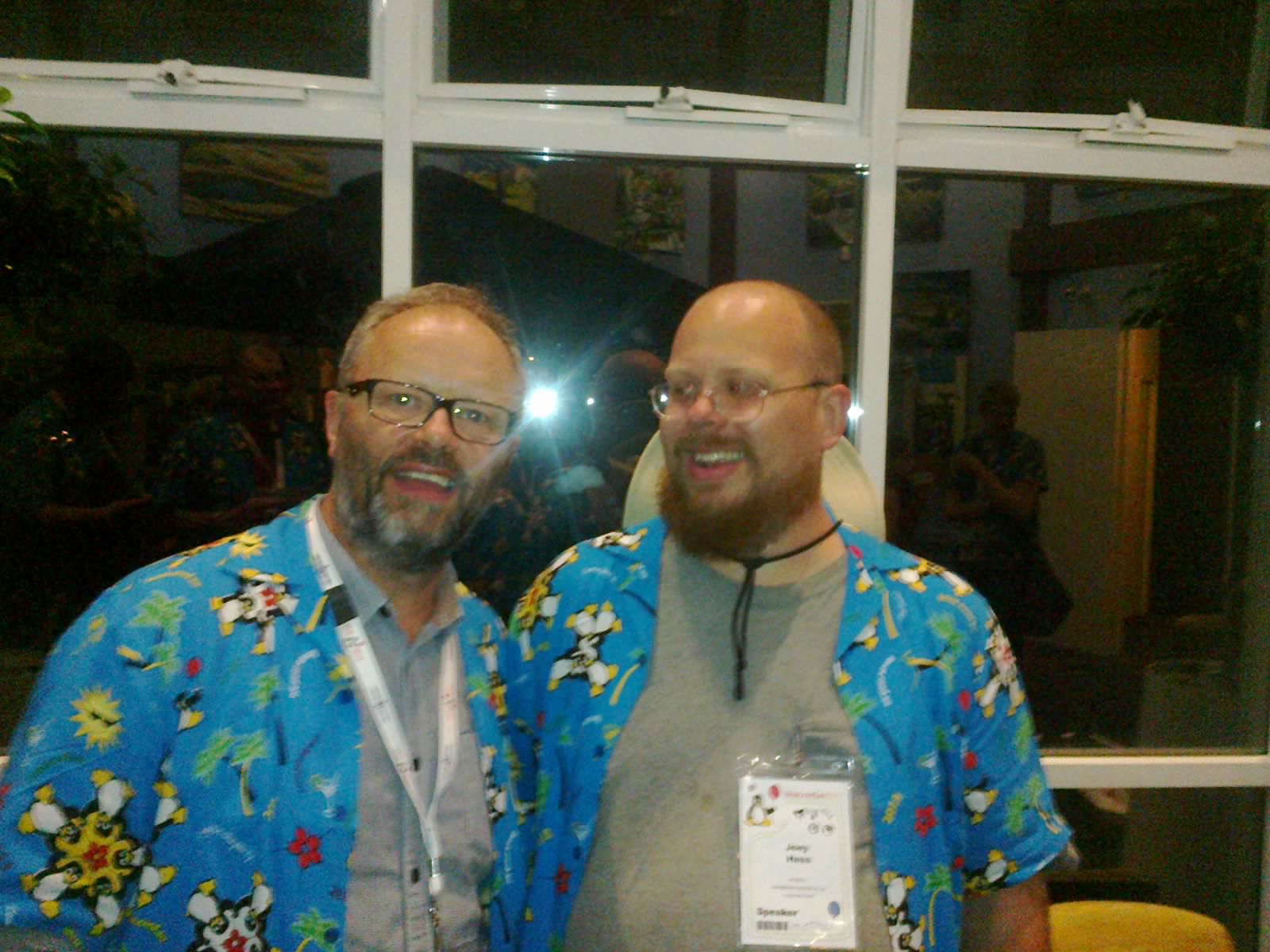
My git-annex talk went ok, despite technical problems with the video output, which the video team did a great job of working around. The first demo went well, and the Q&A was excellent. The demo of the git-annex assistant webapp was marred by, apparently, a bad build of the webapp -- which I ironically used rather than my usual development build because I assumed it'd be less likely to fail. At least I may have a way to reproduce that hang somewhat reliably now, so I can get on with debugging it. I will be redoing a demo of the webapp as a screencast.
Here are some of the best talks I attended. (I have quite a lot more queued up to watch still, and had to cut several due to space.) Click titles for videos, or browse all the videos.

Next.

Previous.