Search Results: "willi"

13 March 2013

Lars Wirzenius: cliapp 1.20130313 released (Python command line utility framework)

I've just released, to code.liw.fi, version 1.20130313 of cliapp, my Python framework for Unix-like command line programs. It contains the typical stuff such programs need to do, such as parsing the command line for options, and iterating over input files. Version 1.20130313 Bug fixes:

12 March 2013

Richard Hartmann: Gitify your life

These Open Source Days were kind of a mixed experience. The social part Things started off quite nicely; the speaker dinner was very pleasant and the people at my table interesting to talk with. The way back to the hotel and breakfast on Saturday were even more interesting; talking with Amelia Andersdotter, a member of the European Parliament for the Swedish Pirate Party, about anti-trust measures, privacy protection, lobbyists, and creating the right incentives for companies to actually protect user data was fun and engaging. My own claim to fame is that I told her that while Microsoft is willing to sign UEFI payloads for x86, they refuse to do so for ARM which she didn't know. From my understanding, their interpretation is that any anti-trust rulings apply to PCs only, and not general computing devices like tablets. It will be interesting to see how that plays out in the long run, especially once ARM processors start appearing in laptops and desktops as main CPUs where Microsoft clearly still has a near monopoly. It was fascinating to discuss all those issues with someone who's actively involved with legislation, mainly because her style of talking was markedly different from what I am used to. One point which she stressed repeatedly is that the most important skill within the context of political work in the EU is to be able to track down, read, and then reference all the content that's being produced in Brussels and Strasbourg. Maybe that tidbit is useful to people who want to try themselves at political activism. She nicely, and maybe unknowingly, emphasized that point by always referring to specific papers, directives, and studies after making any point. Statement of opinion, reference to supporting document. Statement of opinion, reference to supporting document. Statement of opinion, reference to supporting document. Rinse, repeat. It's no secret that I'm continuously disappointed by the political process in general and politicians in particular. Yet, I have to say that this encounter had a lasting and positive impression on me. Amelia has an incredible amount of energy and genuinely cares about the issues which too many other politicians ignore completely. It's good to know someone like this is on our side. If you're Swedish, please inform yourself about her and consider voting in her favour. Other than that, I met several other people, new and old. This year's OSD felt a lot more relaxed and there were more informal and spontaneous conversations going on in hallways and at tables. Even though I failed to have any intense discussion of Mercurial vs git this year, all those conversation were still really interesting. The "workshop" I already knew that the room assignment for my workshop on Saturday afternoon would be a last-minute thing. What I didn't expect was that the final confirmation by Copenhagen Business School would be given on Friday evening. Mixed with a very cumbersome process to update the slides of the CBS-owned and -operated information beamer in the lobby, this resulted in the official schedule showing my room as "Workshop" instead of "SP 214". The official schedule repeatedly stated that people had to pre-register for the workshop which was a left-over from last year where they actually had to plan the amount of hardware kits needed; the registration itself was was very well hidden behind a rather generic link you saw exactly once after purchasing your ticket. Add to this that my room was literally in the farthest corner of the building and on the top floor and things start to turn sour real quick. All other rooms were either close to the main entrance or on the ground floor. Helpers at the front desk had a lot of people asking where my room was and gave out directions, yet... ...the grand total of six people who arrived were all telling me how they couldn't find the room and almost gave up on finding it. As more people asked for directions than turned up at the workshop, this means that even with directions, the room was really hard to find. Myself, it took me two attempts to find the room after which I was led there by one of the helpers who wasn't completely sure we were going in the right direction, himself. Still, I managed to get everyone who had a laptop and access to a UNIX-based system set up with working mr and vcsh repositories they can work from as well as a demo git-annex repository to play with. Sadly, not everyone had a laptop, or access to UNIX, or the tools installed, or even an idea where to install them from, even though I had noted these "requirements" in the description. Next time I do this workshop, I will need to make sure to include information on what distributions have the relevant packages and how to find and install the software on Max OS X in the workshop description. Feedback from the very few people who actually managed to find me was very good and one of the attendants asked if I would be willing to hold the workshop again at another conference in Denmark. I am still awaiting details on this, but I would obviously enjoy having the chance to reach more people. At least I fared better than the guys who did the workshop on "Binary exploitation 101" in yet another room. Two guys held a workshop with a total attendance of... one... I know the organizers of OSD were really unhappy with how this turned out and I believe them when they say that something like this will never happen again. It's the second year that this team is running the conference, running conferences is an incredible amount of work, and things were smoother this year than last year. Iterate and improve, etc. The talk Saturday evening, Alex offered me the chance to hold a reparation talk on Sunday morning to compensate for the botched workshop. Said talk was scheduled for the first slot and not really announced (but the schedule on both www and the beamer was changed over night). Additionally, this was merely an updated and extended version of the talk which I already held at OSD 2012 so at least part of the visitors knew most of what I had to say, already. To be honest I didn't expect too much, but more than twenty people turned up which is a very decent turnout, all things considered. Same as with the workshop, feedback was extremely positive and I was told afterwards by Bryan that several people mentioned my talk as one of the highlights, or even the highlight, of OSD when he was talking to them. To make things even better this talk has, finally, been videotaped; I will update this blog with a link as soon as the video is online.

8 March 2013

Paul Tagliamonte: Ubuntu: The Community

Alas. The blogosphere has been slammed with discontent. Count me as one of them. It s been a long time since the last position (I ve held) of significance in Ubuntu, a LoCo Council Member, which I left with a heavy heart. I felt, at the time, that Ubuntu, The Community was no longer in control of Ubuntu The Distro . Technical opinions of Ubuntu community members started to get disregarded (starting with the gawd-awful Yahoo search switch), and it continued to get worse as Canonical stopped becoming a contributor to Ubuntu and started becoming it s sole guiding force. In comes the mess called Ubuntu One which, for the record, is a wrong name, it s not Ubuntu in any sense, it s not Community driven, it just uses Ubuntu as one of it s platforms. Trading on Ubuntu s good name started this mess. Slowly, like the ship of theseus, Canonical started to swap out bit by bit until nothing was left without Canonical assignment. I always assumed it was so that selling the code for another company to use the code for non-free purpose was the reason. Oh well. Look at us now: Starting off on an ill-thought out path because others are unwilling to say they just didn t understand the whole problem. This is a long way of saying: Ex-Ubuntu ers: You re welcome in Debian. I ve set up #ubuntu-expats on oftc. Please join us. You re welcome there. Working in Debian has been an absolute dream; it feels like contributing to Ubuntu in the early days. Come. Have a say. Re-join a Community that isn t just Like us on Facebook . I still consider myself an Ubuntu Community Member, but I don t think there s any community left.

2 March 2013

Russ Allbery: Review: Asimov's, June 2011

Review: Asimov's Science Fiction, June 2011
Editor: Sheila Williams
Issue: Volume 35, No. 6
ISSN: 1065-2698
Pages: 112
Sheila Williams's editorial is about a new ebook-only anthology of Asimov's stories, with some discussion of electronic sales. This sort of business editorial is what she's best at writing, although in this case I'm far enough in my reading that I'm reading it through a bit of a time machine. Silverberg's essay is about popular bubbles and is mildly interesting, although I've read quite a lot about this at greater length. I think he misses the plot at the end, though, where he brings in the 2008 collapse and works on focusing the blame on speculators rather than those selling the fraudulent investments. James Patrick Kelly has a surprisingly graceful introduction to fanfic that does a better job at conveying the underlying enthusiasm than most mainstream coverage. The review column this month is Peter Heck's workman-like survey of recently released books of interest. "The Cold Step Beyond" by Ian R. MacLeod: Most of MacLeod's writing I've read has focused on lush world-building, usually with a mix of magic and industrial revolution. This felt like a departure: a character study of a heavily-modified warrior and monster hunter against a clearly science-fictional background. The protagonist has no memory of her past beyond her training in a religious institution, and is as much machine as woman. She is on one of her first missions to hunt dangerous monsters. But she's given almost no direction, and rather than encountering a monster, she encounters a feral woman with an ancient ray gun. MacLeod has a very SFnal twist waiting in the wings, but what I liked best were the character dynamics and the interplay of duty and self-determination. (8) "All the News That's Fit" by Carol Emshwiller: This story follows Emshwiller's normal pattern of telling the story of an outsider and representative of outsider culture trying to understand a society, but her protagonist here is both more alone and more proactive than her average protagonist. She lives in a distant mountain village only rarely visited by a traveling reporter who brings news from outside. When he doesn't come, she goes out looking for him, at first to rescue him if he ran into trouble and later to find the news herself. Much of the story has the reader worrying nervously for her as she observes the large city while clearly having no idea how to live there. The ending provides an interesting and (at least for me) unexpected twist on the rural person coming to the big city, but it was marred by a level of anger from the protagonist that I never thought was well-motivated. (6) "Walking Stick Fires" by Alan DeNiro: There is a science fiction subgenre that, for lack of a better term, I'll call post-apocalyptic surrealism. This is an entry in that strange subgenre, featuring two alien bikers having mostly unmotivated adventures with strange objects and even stranger creatures on an Earth that's apparently been invaded and mostly devastated by multiple parties. Like a lot of post-apocalyptic surrealism, it never makes much sense. It reminded me of Rucker but with a bit more characterization and less hand-waving math. (4) "Apocalypse Daily" by Felicity Shoulders: I really liked the premise for this story. The protagonist is a concept designer for a social-oriented MMORPG, but one where only scores and resources carry over rather than the whole world. The goal of the game is survival: the world ends regularly, globally or locally, in a huge variety of ways, and one scores points and earns resources for further iterations by finding ways to survive that catastrophe. The game is structured to encourage cooperation, at least at first. But Katrina gets into a mildly paranoid workplace conflict with someone else on her team, leading to some significant changes in the underlying expectations of the game. Unfortunately, while the background and idea are quite solid, the direction the story goes is predictable pessimism, the conclusion doesn't say much that I found interesting, and I ended up detesting the protagonist. I would have preferred a more unique psychological twist. (6) "The Fighter" by Colin P. Davies: This is a rather short story, essentially an idea study in the context of a police stop of a futuristic entertainment fighter. This is another one of those depressing takes on a common SF trope. I didn't entirely follow the world-building, but it was all dark and pointless enough that I didn't really want to dig further. (4) "Kiss Me Twice" by Mary Robinette Kowal: I've read a few police procedurals featuring AIs before, but this is by far the best one I've read. Huang is a detective, and like all the detectives he makes extensive use of the police department AI. Unlike most of the detectives, though, he treats her as a full partner and close to human, and she reciprocates with a Mae West persona and a closer relationship with him than most of the department. They're in the middle of investigating a murder when there is a raid on the police department and the AI herself is stolen. The rest of the story entangles their investigation with the theft of the AI. The police AI is, of course, restored from backup, but that's the first time that's ever happened to her, and she's shaken by it, and more disturbed by the knowledge that there are two copies of her running. The mystery angle of the story is reasonably satisfying, but the AI characterization and Huang's careful feeling-out of their relationship and appropriate behavior on his part is the best part of the story. This is a great story: long, satisfying, and thoroughly excellent. I'd happily read more fiction in this universe. (8) Rating: 7 out of 10

27 February 2013

Matthew Garrett: Supporting third-party keys in a Secure Boot world

It's fairly straightforward to boot a UEFI Secure Boot system using something like Shim or the Linux Foundation's loader, and for distributions using either the LF loader or the generic version of Shim that's pretty much all you need to care about. The physically-present end user has had to explicitly install new keys or hashes, and that means that you no longer need to care about Microsoft's security policies or (assuming there's no exploitable flaws in the bootloader itself) fear any kind of revocation.

But what about if you're a distribution that cares about booting without the user having to install keys? There's several reasons to want that (convenience for naive users, ability to netboot, that kind of thing), but it has the downside that your system can now be used as an attack vector against other operating systems. Do you care about that? It depends how you weigh the risks. First, someone would have to use your system to attack another. Second, Microsoft would have to care enough to revoke your signature. The first hasn't happened yet, so we have no real idea how likely the second is. However, it doesn't seem awfully unlikely that Microsoft would be willing to revoke a distribution signature if that distribution were being used to attack Windows.

How do you avoid that scenario? There's various bits of security work you need to do, but one of them is to require that all your kernel modules be signed. That's easy for the modules in the distribution, since you just sign them all before shipping them. But how about third party modules? There's three main options here:

  1. Don't support third party modules on Secure Boot systems
  2. Have the distribution sign the modules
  3. Have the vendor sign the modules

The first option is easy, but not likely to please users. Or hardware vendors. Not ideal.

The second option is irritating for a bunch of reasons, and a pretty significant one is license-related. If you sign a module, does that mean you're endorsing it in some way? Does signing the nvidia driver mean that you think there's no license concerns? Even ignoring that, how do you decide whose drivers to sign? We can probably assume that companies like AMD and nvidia are fairly reputable, but how about Honest John's Driver Emporium? Verifying someone's identity is astonishingly expensive to do a good job of yourself, and not hugely cheaper if you farm it out to a third party. It's also irritating for the driver vendor, who needs a separate signature for every distribution they support. So, while possible, this isn't an attractive solution.

The third option pushes the responsibility out to other people, and it's always nice to get other people to do work instead of you. The problem then is deciding whose keys you trust. You can push that off to the user, but it's not the friendliest solution. The alternative is to trust any keys that are signed with a trusted key. But what is a trusted key? Having the distribution sign keys just pushes us back to option (2) - you need to verify everyone's identity, and they need a separate signing key for every distribution they support. In an ideal world, there'd be a key that we already trust and which is owned by someone willing to sign things with it.

The good news is that such a key exists. The bad news is that it's owned by Microsoft.

The recent discussion on LKML was about a patchset that allowed the kernel to install new keys if they were inside a PE/COFF binary signed by a trusted key. It's worth emphasising that this patchset doesn't change the set of keys that the kernel trusts - the kernel trusts keys that are installed in your system firmware, so if your system firmware trusts the Microsoft key then your kernel already trusts the Microsoft key. The reasoning here is pretty straightforward. If your firmware trusts things signed by Microsoft, and if a bad person can get things signed by Microsoft, the bad person can already give you a package containing a backdoored bootloader. Letting them sign kernel modules doesn't alter the power they already have over your system. Microsoft will sign PE/COFF binaries, so a vendor would just have to sign up with Microsoft, pay $99 to Symantec to get their ID verified, wrap their key in a PE/COFF binary and then get it signed by Microsoft. The kernel would see that this object was signed by a trusted key and extract and install the key.

Linus is, to put it mildly, unenthusiastic about this idea. It adds some extra complexity to the kernel in the form of a binary parser that would only be used to load keys from userspace, and the kernel already has an interface for that in the form of X509 certificates. The problem we have is that Microsoft won't sign X509 certificates, and there's no way to turn a PE/COFF signature into an X509 signature. Someone would have to re-sign the keys, which starts getting us back to option (2). One way around this would be to have an automated service that accepts PE/COFF objects, verifies that they're signed by Microsoft, extracts the key, re-signs it with a new private key and spits out an X509 certificate. That avoids having to add any new code to the kernel, but it means that there would have to be someone to run that service and it means that their public key would have to be trusted by the kernel by default.

Who would that third party be? The logical choice might be the Linux Foundation, but since we have members of the Linux Foundation Technical Advisory Board saying that they think module signing is unnecessary and that there's no real risk of revocation, it doesn't seem likely that they'll be enthusiastic. A distribution could do it, but there'd be arguments about putting one distribution in a more privileged position than others. So far, nobody's stood up to do this.

A possible outcome is that the distributions who care about signed modules will all just carry this patchset anyway, and the ones who don't won't. That's probably going to be interpreted by many as giving too much responsibility to Microsoft, but it's worth emphasising that these patches change nothing in that respect - if your firmware trusts Microsoft, you already trust Microsoft. If your firmware doesn't trust Microsoft, these patches will not cause your kernel to trust Microsoft. If you've set up your own chain of trust instead, anything signed by Microsoft will be rejected.

What's next? It wouldn't surprise me too much if nothing happens until someone demonstrates how to use a signed Linux system to attack Windows. Microsoft's response to that will probably determine whether anyone ends up caring.

comment count unavailable comments

23 February 2013

Russell Coker: Serious Begging

This evening I was driving through one of the inner suburbs of Melbourne when a man flagged me down. He said that his mother was dying and he needed a taxi ride to some hospital far away and needed to borrow $200. He was saying something about his phone, I wasn t sure if he was planning to give me his phone number so I could call him to ask for repayment or offering his phone as collateral on the loan (incidentally a well known scam is to offer a stolen phone as collateral for a loan, it s a way of selling a locked phone that doesn t have cables). I ve encountered many beggars over the years, but he was by far the most serious about it he demonstrated the level of desperation that I ve only previously seen documented in history books and reports from travelers who visited developing countries. I will never know if his mother was dying, there are lots of other reasons why someone might urgently need cash (most of which won t get much sympathy). I gave him $20 as a gift. If his story was legitimate then I gave him 10% of what he needed so he only had to find another 9 people willing to do the same. If he was lying then I can afford to lose $20. In any case I definitely wasn t going to do what he asked and withdraw hundreds of dollars from an ATM for him. Also regardless of whether he was telling the truth I didn t want to have him repay me, if he s telling the truth then I m happy to give money to him and if he s not then I m better off avoiding him in future. If I had $50 I would probably have given it to him, but $200 is too much. As I drove off I looked in my rear-vision mirror and saw him running between cars on the road trying to flag someone else down. Running through moving traffic on a Saturday night is another indication of how serious he was, generally someone who s in a good state of mind and wants a long and healthy life won t do that.

21 February 2013

Joey Hess: Kickstarter rewards wrap-up

I finished delivering all my Kickstarter rewards at the end of the year. This is an overview of how that went, both financially and in general.
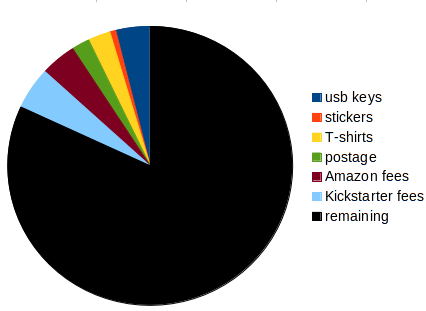
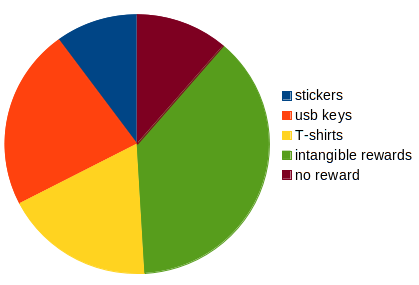
my Kickstarter pie (not including taxes)
While the Kickstarter was under way, several friends warned me that I might end up spending a lot of the money for rewards, or even shipping, and come out a loser. It's happened to some people, but I avoided it. Most of the pie went to its intended purpose.
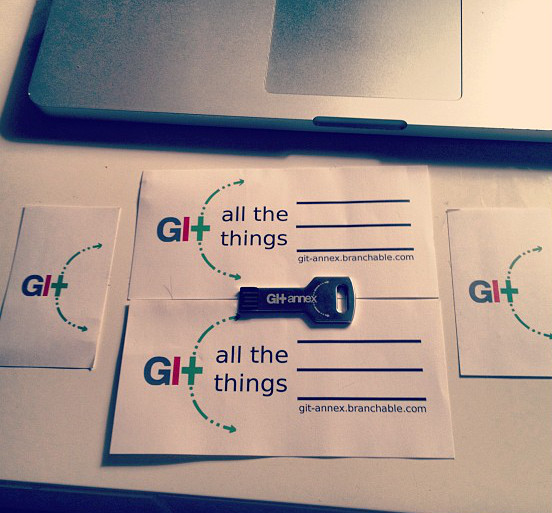
USB key arrives in Amsterdam
I kept shipping cost low by shipping everything by US postal service, including Air Mail for international shipping. This was particularly important for the stickers (which cost $1.05 to ship internationally). But I also shipped USB keys in regular mail envelopes, protected by bubble wrap, which worked very well and avoided the bother of shipping packages. The USPS will be annoyed at you for a rigid letter and add a non-machinable surcharge, but it's still a nice savings.
expenses
I spent more on rewards than on transaction fees, but the fees are still pretty large. Being dinged a second time by Amazon is the worst part. I have not been able to work out exactly what formula Kickstarter uses to determine its fee per pledge. It does not seem to be a simple percentage of the pledge. For example, they seem to have charged $0.25 per $10 pledge, but $25 for a $500 pledge. I wanted to solve this, but I'd have to match up all the pledges and fees manually to do it.
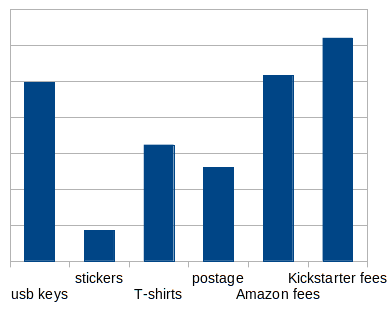
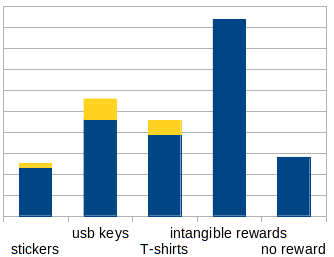
gross income by reward type
This chart is slightly innacurrate, because it puts any money pledged, beyond the amount needed to get a reward, into the "intangibles" category, despite the reward being probably responsible for that money being pledged. (The intangibles also includes people who did not ask for a reward, and several categories of rewards not involving shipping matter around.) But, the surprise for me is how large a peice the T-shirts are responsible for. It was my least favorite reward, and a low volume one, but I made out pretty well on it. However, I'd still try to avoid putting T-shirts on Kickstarter again. It's hard to do a good design (I didn't, really); they're expensive, and were by far the most annoying thing to ship. Also, I was not happy with the countries Cafe Press sourced their shirts from; I've been to Honduras and talked with people who have relatives in las machinas.
gross and net income by reward type (excluding shipping)
In contrast, the stickers had an amazing margin; they're so inexpensive to print that I printed up two kinds and included multiple with every other reward I mailed. I still have hundreds left over, too.. All the online print shops I tried have very annoying interfaces to upload artwork though. I had to do quite a bit of math to render TIFF files with appropriate DPI and margins. The USB keys were my favorite reward. I got them from USB Memory Direct, who gave me quite a nice deal. I was very happy that I was able to send them a SVG file of my artwork, so I didn't need to worry about lacking resolution for the laser engraving. And it came out looking great. The best part was when their sales guy Mike actually did a minor alteration of the artwork, to better fit on the key, when I, being overloaded with Kickstarter stuff asked him too. A bit above and beyond. There was an issue with their Chinese manufacturer's quality control of the 16 gb drives, but they were willing to send me replacement for all the ones I found problems with.
All told I spent probably 3 full days stuffing and shipping envelopes, and probably spent a week working on Kickstarter reward fullfillment. As work-related overhead goes, that's not bad. Maybe someone considering a Kickstarter will find this information useful somehow. Oh well, back to work. :)

20 February 2013

Vincent Bernat: lldpd 0.7.1

A few weeks ago, a new version of lldpd, a 802.1AB (aka LLDP) implementation for various Unices, has been released. LLDP is an industry standard protocol designed to supplant proprietary Link-Layer protocols such as EDP or CDP. The goal of LLDP is to provide an inter-vendor compatible mechanism to deliver Link-Layer notifications to adjacent network devices. In short, LLDP allows you to know exactly on which port is a server (and reciprocally). To illustrate its use, I have made a xkcd-like strip: xkcd-like strip for the use of LLDP If you would like more information about lldpd, please have a look at its new dedicated website. This blog post is an insight of various technical changes that have affected lldpd since its latest major release one year ago. Lots of C stuff ahead!

Version & changelog UPDATED: Guillem Jover told me how he met the same goals for libbsd :
  1. Save the version from git into .dist-version and use this file if it exists. This allows one to rebuild ./configure from the published tarball without losing the version. This also handles Thorsten Glaser s critic.
  2. Include CHANGELOG in DISTCLEANFILES variable.
Since this is a better solution, I have adopted the appropriate line of codes from libbsd. The two following sections are partly technically outdated.

Automated version In configure.ac, I was previously using a static version number that I had to increase when releasing:
AC_INIT([lldpd], [0.5.7], [bernat@luffy.cx])
Since the information is present in the git tree, this seems a bit redundant (and easy to forget). Taking the version from the git tree is easy:
AC_INIT([lldpd],
        [m4_esyscmd_s([git describe --tags --always --match [0-9]* 2> /dev/null   date +%F])],
        [bernat@luffy.cx])
If the head of the git tree is tagged, you get the exact tag (0.7.1 for example). If it is not, you get the nearest one, the number of commits since it and part of the current hash (0.7.1-29-g2909519 for example). The drawback of this approach is that if you rebuild configure from the released tarball, you don t have the git tree and the version will be a date. Just don t do that.

Automated changelog Generating the changelog from git is a common practice. I had some difficulties to make it right. Here is my attempt (I am using automake):
dist_doc_DATA = README.md NEWS ChangeLog
.PHONY: $(distdir)/ChangeLog
dist-hook: $(distdir)/ChangeLog
$(distdir)/ChangeLog:
        $(AM_V_GEN)if test -d $(top_srcdir)/.git; then \
          prev=$$(git describe --tags --always --match [0-9]* 2> /dev/null) ; \
          for tag in $$(git tag   grep -E '^[0-9]+(\.[0-9]+) 1, $$'   sort -rn); do \
            if [ x"$$prev" = x ]; then prev=$$tag ; fi ; \
            if [ x"$$prev" = x"$$tag" ]; then continue; fi ; \
            echo "$$prev [$$(git log $$prev -1 --pretty=format:'%ai')]:" ; \
            echo "" ; \
            git log --pretty=' - [%h] %s (%an)' $$tag..$$prev ; \
            echo "" ; \
            prev=$$tag ; \
          done > $@ ; \
        else \
          touch $@ ; \
        fi
ChangeLog:
        touch $@
Changelog entries are grouped by version. Since it is a bit verbose, I still maintain a NEWS file with important changes.

Core

C99 I have recently read 21st Century C which has some good bits and also handles the ecosystem around C. I have definitively adopted designated initializers in my coding style. Being a GCC extension since a long time, this is not a major compatibility problem. Without designated initializers:
struct netlink_req req;
struct iovec iov;
struct sockaddr_nl peer;
struct msghdr rtnl_msg;
memset(&req, 0, sizeof(req));
memset(&iov, 0, sizeof(iov));
memset(&peer, 0, sizeof(peer));
memset(&rtnl_msg, 0, sizeof(rtnl_msg));
req.hdr.nlmsg_len = NLMSG_LENGTH(sizeof(struct rtgenmsg));
req.hdr.nlmsg_type = RTM_GETLINK;
req.hdr.nlmsg_flags = NLM_F_REQUEST   NLM_F_DUMP;
req.hdr.nlmsg_seq = 1;
req.hdr.nlmsg_pid = getpid();
req.gen.rtgen_family = AF_PACKET;
iov.iov_base = &req;
iov.iov_len = req.hdr.nlmsg_len;
peer.nl_family = AF_NETLINK;
rtnl_msg.msg_iov = &iov;
rtnl_msg.msg_iovlen = 1;
rtnl_msg.msg_name = &peer;
rtnl_msg.msg_namelen = sizeof(struct sockaddr_nl);
With designated initializers:
struct netlink_req req =  
    .hdr =  
        .nlmsg_len = NLMSG_LENGTH(sizeof(struct rtgenmsg)),
        .nlmsg_type = RTM_GETLINK,
        .nlmsg_flags = NLM_F_REQUEST   NLM_F_DUMP,
        .nlmsg_seq = 1,
        .nlmsg_pid = getpid()  ,
    .gen =   .rtgen_family = AF_PACKET  
 ;
struct iovec iov =  
    .iov_base = &req,
    .iov_len = req.hdr.nlmsg_len
 ;
struct sockaddr_nl peer =   .nl_family = AF_NETLINK  ;
struct msghdr rtnl_msg =  
    .msg_iov = &iov,
    .msg_iovlen = 1,
    .msg_name = &peer,
    .msg_namelen = sizeof(struct sockaddr_nl)
 ;

Logging Logging in lldpd was not extensive. Usually, when receiving a bug report, I asked the reporter to add some additional printf() calls to determine where the problem was. This was clearly suboptimal. Therefore, I have added many log_debug() calls with the ability to filter out some of them. For example, to debug interface discovery, one can run lldpd with lldpd -ddd -D interface. Moreover, I have added colors when logging to a terminal. This may seem pointless but it is now far easier to spot warning messages from debug ones. logging output of lldpd

libevent In lldpd 0.5.7, I was using my own select()-based event loop. It worked but I didn t want to grow a full-featured event loop inside lldpd. Therefore, I switched to libevent. The minimal required version of libevent is 2.0.5. A convenient way to check the changes in API is to use Upstream Tracker, a website tracking API and ABI changes for various libraries. This version of libevent is not available in many stable distributions. For example, Debian Squeeze or Ubuntu Lucid only have 1.4.13. I am also trying to keep compatibility with very old distributions, like RHEL 2, which does not have a packaged libevent at all. For some users, it may be a burden to compile additional libraries. Therefore, I have included libevent source code in lldpd source tree (as a git submodule) and I am only using it if no suitable system libevent is available. Have a look at m4/libevent.m4 and src/daemon/Makefile.am to see how this is done.

Client

Serialization lldpctl is a client querying lldpd to display discovered neighbors. The communication is done through an Unix socket. Each structure to be serialized over this socket should be described with a string. For example:
#define STRUCT_LLDPD_DOT3_MACPHY "(bbww)"
struct lldpd_dot3_macphy  
        u_int8_t                 autoneg_support;
        u_int8_t                 autoneg_enabled;
        u_int16_t                autoneg_advertised;
        u_int16_t                mau_type;
 ;
I did not want to use stuff like Protocol Buffers because I didn t want to copy the existing structures to other structures before serialization (and the other way after deserialization). However, the serializer in lldpd did not allow to handle reference to other structures, lists or circular references. I have written another one which works by annotating a structure with some macros:
struct lldpd_chassis  
    TAILQ_ENTRY(lldpd_chassis) c_entries;
    u_int16_t        c_index;
    u_int8_t         c_protocol;
    u_int8_t         c_id_subtype;
    char            *c_id;
    int              c_id_len;
    char            *c_name;
    char            *c_descr;
    u_int16_t        c_cap_available;
    u_int16_t        c_cap_enabled;
    u_int16_t        c_ttl;
    TAILQ_HEAD(, lldpd_mgmt) c_mgmt;
 ;
MARSHAL_BEGIN(lldpd_chassis)
MARSHAL_TQE  (lldpd_chassis, c_entries)
MARSHAL_FSTR (lldpd_chassis, c_id, c_id_len)
MARSHAL_STR  (lldpd_chassis, c_name)
MARSHAL_STR  (lldpd_chassis, c_descr)
MARSHAL_SUBTQ(lldpd_chassis, lldpd_mgmt, c_mgmt)
MARSHAL_END;
Only pointers need to be annotated. The remaining of the structure can be serialized with just memcpy()1. I think there is still room for improvement. It should be possible to add annotations inside the structure and avoid some duplication. Or maybe, using a C parser? Or using the AST output from LLVM?

Library In lldpd 0.5.7, there are two possible entry points to interact with the daemon:
  1. Through SNMP support. Only information available in LLDP-MIB are exported. Therefore, implementation-specific values are not available. Moreover, SNMP support is currently read-only.
  2. Through lldpctl. Thanks to a contribution from Andreas Hofmeister, the output can be requested to be formatted as an XML document.
Integration of lldpd into a network stack was therefore limited to one of those two channels. As an exemple, you can have a look at how Vyatta made the integration using the second solution. To provide a more robust solution, I have added a shared library, liblldpctl, with a stable and well-defined API. lldpctl is now using it. I have followed those directions2:
  • Consistent naming (all exported symbols are prefixed by lldpctl_). No pollution of the global namespace.
  • Consistent return codes (on errors, all functions returning pointers are returning NULL, all functions returning integers are returning -1).
  • Reentrant and thread-safe. No global variables.
  • One well-documented include file.
  • Reduce the use of boilerplate code. Don t segfault on NULL, accept integer input as string, provide easy iterators,
  • Asynchronous API for input/output. The library delegates reading and writing by calling user-provided functions. Those functions can yield their effects. In this case, the user has to callback the library when data is available for reading or writing. It is therefore possible to integrate the library with any existing event-loop. A thin synchronous layer is provided on top of this API.
  • Opaque types with accessor functions.
Accessing bits of information is done through atoms which are opaque containers of type lldpctl_atom_t. From an atom, you can extract some properties as integers, strings, buffers or other atoms. The list of ports is an atom. A port in this list is also an atom. The list of VLAN present on this port is an atom, as well as each VLAN in this list. The VLAN name is a NULL-terminated string living in the scope of an atom. Accessing a property is done by a handful of functions, like lldpctl_atom_get_str(), using a specific key. For example, here is how to display the list of VLAN assuming you have one port as an atom:
vlans = lldpctl_atom_get(port, lldpctl_k_port_vlans);
lldpctl_atom_foreach(vlans, vlan)  
    vid = lldpctl_atom_get_int(vlan,
                               lldpctl_k_vlan_id));
    name = lldpctl_atom_get_str(vlan,
                                lldpctl_k_vlan_name));
    if (vid && name)
        printf("VLAN %d: %s\n", vid, name);
 
lldpctl_atom_dec_ref(vlans);
Internally, an atom is typed and reference counted. The size of the API is greatly limited thanks to this concept. There are currently more than one hundred pieces of information that can be retrieved from lldpd. Ultimately, the library will also enable the full configuration of lldpd. Currently, many aspects can only be configured through command-line flags. The use of the library does not replace lldpctl which will still be available and be the primary client of the library.

CLI Having a configuration file was requested since a long time. I didn t want to include a parser in lldpd: I am trying to keep it small. It was already possible to configure lldpd through lldpctl. Locations, network policies and power policies were the three items that could be configured this way. So, the next step was to enable lldpctl to read a configuration file, parse it and send the result to lldpd. As a bonus, why not provide a full CLI accepting the same statements with inline help and completion?

Parsing & completion Because of completion, it is difficult to use a YACC generated parser. Instead, I define a tree where each node accepts a word. A node is defined with this function:
struct cmd_node *commands_new(
    struct cmd_node *,
    const char *,
    const char *,
    int(*validate)(struct cmd_env*, void *),
    int(*execute)(struct lldpctl_conn_t*, struct writer*,
        struct cmd_env*, void *),
    void *);
A node is defined by:
  • its parent,
  • an optional accepted static token,
  • an help string,
  • an optional validation function and
  • an optional function to execute if the current token is accepted.
When walking the tree, we maintain an environment which is both a key-value store and a stack of positions in the tree. The validation function can check the environment to see if we are in the right context (we want to accept the keyword foo only once, for example). The execution function can add the current token as a value in the environment but it can also pop the current position in the tree to resume walk from a previous node. As an example, see how nodes for configuration of a coordinate-based location are registered:
/* Our root node */
struct cmd_node *configure_medloc_coord = commands_new(
    configure_medlocation,
    "coordinate", "MED location coordinate configuration",
    NULL, NULL, NULL);
/* The exit node.
   The validate function will check if we have both
   latitude and longitude. */
commands_new(configure_medloc_coord,
    NEWLINE, "Configure MED location coordinates",
    cmd_check_env, cmd_medlocation_coordinate,
    "latitude,longitude");
/* Store latitude. Once stored, we pop two positions
   to go back to the "root" node. The user can only
   enter latitude once. */
commands_new(
    commands_new(
        configure_medloc_coord,
        "latitude", "Specify latitude",
        cmd_check_no_env, NULL, "latitude"),
    NULL, "Latitude as xx.yyyyN or xx.yyyyS",
    NULL, cmd_store_env_value_and_pop2, "latitude");
/* Same thing for longitude */
commands_new(
    commands_new(
        configure_medloc_coord,
        "longitude", "Specify longitude",
        cmd_check_no_env, NULL, "longitude"),
    NULL, "Longitude as xx.yyyyE or xx.yyyyW",
    NULL, cmd_store_env_value_and_pop2, "longitude");
The definition of all commands is still a bit verbose but the system is simple enough yet powerful enough to cover all needed cases.

Readline When faced with a CLI, we usually expect some perks like completion, history handling and help. The most used library to provide such features is the GNU Readline Library. Because this is a GPL library, I have first searched an alternative. There are several of them: From an API point of view, the first three libraries support the GNU Readline API. They also have a common native API. Moreover, this native API also handles tokenization. Therefore, I have developed the first version of the CLI with this API3. Unfortunately, I noticed later this library is not very common in the Linux world and is not available in RHEL. Since I have used the native API, it was not possible to fallback to the GNU Readline library. So, let s switch! Thanks to the appropriate macro from the Autoconf Archive (with small modifications), the compilation and linking differences between the libraries are taken care of. Because GNU Readline library does not come with a tokenizer, I had to write one myself. The API is also badly documented and it is difficult to know which symbol is available in which version. I have limited myself to:
  • readline(), addhistory(),
  • rl_insert_text(),
  • rl_forced_update_display(),
  • rl_bind_key()
  • rl_line_buffer and rl_point.
Unfortunately, the various libedit libraries have a noop for rl_bind_key(). Therefore, completion and online help is not available with them. I have noticed that most BSD come with GNU Readline library preinstalled, so it could be considered as a system library. Nonetheless, linking with libedit to avoid licensing issues is possible and help can be obtained by prefixing the command with help.

OS specific support

BSD support Until version 0.7, lldpd was Linux-only. The rewrite to use Netlink was the occasion to abstract interfaces and to port to other OS. The first port was for Debian GNU/kFreeBSD, then for FreeBSD, OpenBSD and NetBSD. They all share the same source code:
  • getifaddrs() to get the list of interfaces,
  • bpf(4) to attach to an interface to receive and send packets,
  • PF_ROUTE socket to be notified when a change happens.
Each BSD has its own ioctl() to retrieve VLAN, bridging and bonding bits but they are quite similar. The code was usually adapted from ifconfig.c. The BSD ports have the same functionalities than the Linux port, except for NetBSD which lacks support for LLDP-MED inventory since I didn t find a simple way to retrieve DMI related information. They also offer greater security by filtering packets sent. Moreover, OpenBSD allows to lock the filters set on the socket:
/* Install write filter (optional) */
if (ioctl(fd, BIOCSETWF, (caddr_t)&fprog) < 0)  
    rc = errno;
    log_info("privsep", "unable to setup write BPF filter for %s",
        name);
    goto end;
 
/* Lock interface */
if (ioctl(fd, BIOCLOCK, (caddr_t)&enable) < 0)  
    rc = errno;
    log_info("privsep", "unable to lock BPF interface %s",
        name);
    goto end;
 
This is a very nice feature. lldpd is using a privileged process to open the raw socket. The socket is then transmitted to an unprivileged process. Without this feature, the unprivileged process can remove the BPF filters. I have ported the ability to lock a socket filter program to Linux. However, I still have to add a write filter.

OS X support Once FreeBSD was supported, supporting OS X seemed easy. I got sponsored by xcloud.me which provided a virtual Mac server. Making lldpd work with OS X took only two days, including a full hour to guess how to get Apple Xcode without providing a credit card. To help people installing lldpd on OS X, I have also written a lldpd formula for Homebrew which seems to be the most popular package manager for OS X.

Upstart and systemd support Many distributions propose upstart and systemd as a replacement or an alternative for the classic SysV init. Like most daemons, lldpd detaches itself from the terminal and run in the background, by forking twice, once it is ready (for lldpd, this just means we have setup the control socket). While both upstart and systemd can accommodate daemons that behave like this, it is recommended to not fork. How to advertise readiness in this case? With upstart, lldpd will send itself the SIGSTOP signal. upstart will detect this, resume lldpd with SIGCONT and assume it is ready. The code to support upstart is therefore quite simple. Instead of calling daemon(), do this:
const char *upstartjob = getenv("UPSTART_JOB");
if (!(upstartjob && !strcmp(upstartjob, "lldpd")))
    return 0;
log_debug("main", "running with upstart, don't fork but stop");
raise(SIGSTOP);
The job configuration file looks like this:
# lldpd - LLDP daemon
description "LLDP daemon"
start on net-device-up IFACE=lo
stop on runlevel [06]
expect stop
respawn
script
  . /etc/default/lldpd
  exec lldpd $DAEMON_ARGS
end script
systemd provides a socket to achieve the same goal. An application is expected to write READY=1 to the socket when it is ready. With the provided library, this is just a matter of calling sd_notify("READY=1\n"). Since sd_notify() has less than 30 lines of code, I have rewritten it to avoid an external dependency. The appropriate unit file is:
[Unit]
Description=LLDP daemon
Documentation=man:lldpd(8)
[Service]
Type=notify
NotifyAccess=main
EnvironmentFile=-/etc/default/lldpd
ExecStart=/usr/sbin/lldpd $DAEMON_ARGS
Restart=on-failure
[Install]
WantedBy=multi-user.target

OS include files Linux-specific include files were a major pain in previous versions of lldpd. The problems range from missing header files (like linux/if_bonding.h) to the use of kernel-only types. Those headers have a difficult history. They were first shipped with the C library but were rarely synced and almost always outdated. They were then extracted from kernel version with almost no change and lagged behind the kernel version used by the released distribution4. Today, the problem is acknowledged and is being solved by both the distributions which extract the headers from the packaged kernel and by kernel developers with a separation of kernel-only headers from user-space API headers. However, we still need to handle legacy. A good case is linux/ethtool.h:
  • It can just be absent.
  • It can use u8, u16 types which are kernel-only types. To work around this issue, type munging can be setup.
  • It can miss some definition, like SPEED_10000. In this case, you either define the missing bits and find yourself with a long copy of the original header interleaved with #ifdef or conditionally use each symbol. The latest solution is a burden by itself but it also hinders some functionalities that can be available in the running kernel.
The easy solution to all this mess is to just include the appropriate kernel headers into the source tree of the project. Thanks to Google ripping them for its Bionic C library, we know that copying kernel headers into a program does not create a derivative work.

  1. Therefore, the use of u_int16_t and u_int8_t types is a left-over of the previous serializer where the size of all members was important.
  2. For more comprehensive guidelines, be sure to check Writing a C library.
  3. Tokenization is not the only advantage of libedit native API. The API is also cleaner, does not have a global state and has a better documentation. All the implementations are also BSD licensed.
  4. For example, in Debian Sarge, the Linux kernel was a 2.6.8 (2004) while the kernel headers were extracted from some pre-2.6 kernel.

Keith Packard: DRI3000

DRI3000 Even Better Direct Rendering This all started with the presentation that Eric Anholt and I did at the 2012 X developers conference, and subsequently wrote about in my DRI-Next posting. That discussion sketched out the goals of changing the existing DRI2-based direct rendering infrastructure. Last month, I gave a more detailed presentation at Linux.conf.au 2013 (the best free software conference in the world). That presentation was recorded, so you can watch it online. Or, you can read Nathan Willis summary at lwn.net. That presentation contained a lot more details about the specific techniques that will be used to implement the new system, in particular it included some initial indications of what kind of performance benefits the overall system might be able to produce. I sat down today and wrote down an initial protocol definition for two new extensions (because two extensions are always better than one). Together, these are designed to provide complete support for direct rendering APIs like OpenGL and offer a better alternative to DRI2. The DRI3 extension Dave Airlie and Eric Anholt refused to let me call either actual extension DRI3000, so the new direct rendering extension is called DRI3. It uses POSIX file descriptor passing to share kernel objects between the X server and the application. DRI3 is a very small extension in three requests:
  1. Open. Returns a file descriptor for a direct rendering device along with the name of the driver for a particular API (OpenGL, Video, etc).
  2. PixmapFromBuffer. Takes a kernel buffer object (Linux uses DMA-BUF) and creates a pixmap that references it. Any place a Pixmap can be used in the X protocol, you can now talk about a DMA-BUF object. This allows an application to do direct rendering, and then pass a reference to those results directly to the X server.
  3. BufferFromPixmap. This takes an existing pixmap and returns a file descriptor for the underlying kernel buffer object. This is needed for the GL Texture from Pixmap extension.
For OpenGL, the plan is to create all of the buffer objects on the client side, then pass the back buffer to the X server for display on the screen. By creating pixmaps, we avoid needing new object types in the X server and can use existing X apis that take pixmaps for these objects. The Swap extension Once you ve got direct rendered content in a Pixmap, you ll want to display it on the screen. You could simply use CopyArea from the pixmap to a window, but that isn t synchronzied to the vertical retrace signal. And, the semantics of the CopyArea operation precludes us from swapping the underlying buffers around, making it more expensive than strictly necessary. The Swap extension fills those needs. Because the DRI3 extension provides an X pixmap reference to the direct rendered content, the Swap extension doesn t need any new object types for its operation. Instead, it talks strictly about core X objects, using X pixmaps as the source of the new data and X drawables as the destination. The core of the Swap extension is one request SwapRegion. This request moves pixels from a pixmap to a drawable. It uses an X fixes Region object to specify the area of the destination being painted, and an offset within the source pixmap to align the two areas. A bunch of data are included in the reply from the SwapRegion request. First, you get a 64-bit sequence number identifying the swap itself. Then, you get a suggested geometry for the next source pixmap. Using the suggested geometry may result in performance improvements from the techniques described in the LCA talk above. The last bit of data included in the SwapRegion reply is a list of pixmaps which were used as source operands to earlier SwapRegion requests to the same drawable. Each pixmap is listed along with the 64-bit sequence number associated with an earlier SwapRegion operation which resulted in the contents which the pixmap now contains. Ok, so that sounds really confusing. Some examples are probably necessary. I m hoping you ll be able to tell that in both cases, the idle swap count tries to name the swap sequence at which time the destination drawable contained the contents currently in the pixmap. Note that even if the SwapRegion is implemented as a Copy operation, the provided source pixmap may not be included in the idle list as the copy may be delayed to meet the synchronization requirements specfied by the client. Finally, if you want to throttle rendering based upon when frames appear on the screen, Swap offers an event that can be delivered to the drawable after the operation actually takes place. Because the Swap extension needs to supply all of the OpenGL SwapBuffers semantics (including a multiplicity of OpenGL extensions related to that), I ve stolen a handful of DRI2 requests to provide the necessary bits for that:
  1. SwapGetMSC
  2. SwapWaitMSC
  3. SwapWaitSBC
These work just like the DRI2 requests of the same names. Current State of the Extensions Both of these extensions have an initial protocol specification written down and stored in git:
  1. DRI3 protocol
  2. Swap protocol

10 February 2013

Stefano Zacchiroli: bits from the DPL for January 2013

(insert here: I've been to FOSDEM, I got a nasty flu, and other $lame_excuses for the delay in sending out this report) Dear Project Members, here's the monthly DPL activity report, this time for January 2013. About the next DPL This is the last DPL report before the start of the election process for the next term: around early March, about 20 days from now, the Secretary will send out the call for nominations. I'd like to respond (also) here to inquiries I'm receiving these days: I will not run again as DPL. So you have about 20 days to mob^Wconvince other DDs to run, or decide to run yourself. Do not to wait for the vary last minute, as that makes for lousy campaigns. I'm available to give feedback about my DPL experience to prospective candidates, ... and also to join mobbing^Wconvincing actions toward potential candidates. Just contact me. Call for helps Assets Cloud Images Work has gone on also on the front of supporting Debian installation in public "clouds". Thanks to Arnaud Patard, Jose Miguel Parrella Romero, Pierre Couzy, and Gianugo Rabellino, we now have Debian testing images for Microsoft Azure. Together with Amazon EC2, this is the second large provider supporting Debian via images maintained by Debian Developers. More providers are welcome, exactly as more hardware/CD vendors shipping Debian are always welcome. If you want to contribute support for other providers just show up on the -cloud mailing list and say so. Some documentation effort in view of Wheezy are in need of help too, in order to let our users know about "cloud" options, see #695681. DPL helpers The DPL helpers experiment goes on. We have had 2 more IRC meetings in January (see the minutes). Documentation of the "team" communication channels (mailing list, IRC, Git, etc.) is now available from the DPL wiki page. Talks I've given an invited Debian talk at Polytech'Grenoble, as part of a free software event organized for students of local universities. Slides of the talk are available. I'd like to thank Vincent Danjean for the event organization. Let's release Wheezy now!
Cheers.
PS the day-to-day activity log for January 2013 is available at the usual place master:/srv/leader/news/bits-from-the-DPL.txt.201301

Matthew Garrett: Linux Foundation Secure Boot support released - what does it mean?

The UEFI bootloader that the Linux Foundation have been working on has just been released. That means we now have two signed bootloaders available - this one and shim.
Does this mean Linux distributions can now support Secure Boot?They've actually been able to for a while. Ubuntu shipped with Secure Boot support last October, and Fedora shipped with Secure Boot support in January. Both used Shim rather than the Linux Foundation loader, and Shim's also being used by a variety of smaller distributions. The LF loader is a different solution to the same problem.
Is the Linux Foundation the preferred loader for distributions?Probably not in most cases. One of the primary functional differences between Shim and the LF loader is that the LF loader is based around cryptographic hashes rather than signing keys. This means that the user has to explicitly add a hash to the list of permitted binaries whenever a distribution updates their bootloader or kernel. Doing that involves being physically present at the machine, so it's kind of a pain.
Why use it at all, then?Being hash based means that you don't need to maintain any signing infrastructure. This means that distributions can support Secure Boot without having to change their build process at all. Shim already supports this use case (and some distributions are using it), but the LF loader has nicer UI for managing it.
Any other reasons?Actually, yes. Shim implements Secure Boot loading in a less than entirely ideal way - it duplicates the firmware's entire binary loading, validation, relocation and execution code. This is necessary because the UEFI specification doesn't provide any mechanism for adding additional authentication mechanisms. The main downside of this is that the standard UEFI LoadImage() and StartImage() calls don't work under Shim. The LF loader hooks into the low-level security architecture and installs its own handlers, which means the standard UEFI interfaces work. The upshot is that you can use bootloaders like Gummiboot or efilinux without having to modify them to call out to Shim.
Why doesn't Shim do the same?The UEFI architecture is slightly complicated. The UEFI specification itself defines the upper layers of the firmware, basically covering everything that UEFI applications and operating systems need. It doesn't define the lower layers of a UEFI implementation. Those are contained in the UEFI Platform Initialization spec, and that's what defines the security architecture interfaces that the LF loader hooks into. The problem is that it's completely valid to implement the UEFI specification without implementing the Platform Initialization specification, and if anyone does that then the LF loader will fail.
Can't you try both approaches?Yes, and that's actually pretty much the plan now. I'm working on integrating the LF loader's UI and security code into Shim with the aim of producing one loader that'll satisfy the full set of use cases, and James is happy with this.
Which should I use?Depends. If you want to support gummiboot (and aren't willing to patch it to call out to Shim), you'll need to use the LF loader. If you want to use key-based signing setups to avoid forcing re-enrolment on updates, you'll need to use Shim. If you're somewhere in the middle, you can probably use either. Once we've got the code merged, you won't have to make a choice.

comment count unavailable comments

8 February 2013

Neil Williams: Update on klibc for AArch64

klibc_2.0.1-3.2_arm64.changes

:-)

I've now completed the first patch for klibc 2.0.1 for arm64 support - it's completely untested and likely to break things, so it's up for review not usage. Those who are brave enough to look at the patch, please report issues via the github issue tracker.

35 files changed, 509 insertions(+), 19 deletions(-)

21 new C files to replace removed syscalls, most of which simply borrow from glibc and provide a general purpose call (like open) instead of the actual syscall (openat).

Next is to test the build and look into what is necessary to push the patch to the current 2.0.3 upstream.

5 February 2013

Wouter Verhelst: Transcoding videos

Since some people asked for it, and since it's (unfortunately) fairly nontrivial, here is the script that I'm using currently to transcode a .dv file into webm:
#!/bin/bash
set -e
newfile=$(basename $1 .dv).webm
wavfile=$(basename $1 .dv).wav
normalfile=$(basename $1 .dv)-normal.wav
normalfile=$(readlink -f $normalfile)
oldfile=$(readlink -f $1)
echo "Audio split"
gst-launch-0.10 uridecodebin uri=file://$oldfile ! progressreport ! audioconvert ! audiorate ! wavenc ! filesink location=$wavfile
echo "Audio normalize"
sox --norm $wavfile $normalfile
echo "Pass 1"
gst-launch-0.10 webmmux name=mux ! fakesink \
  uridecodebin uri=file://$oldfile name=demux \
  demux. ! ffmpegcolorspace ! deinterlace ! vp8enc multipass-cache-file=/tmp/vp8-multipass multipass-mode=1 threads=2 ! queue ! mux.video_0 \
  demux. ! progressreport ! audioconvert ! audiorate ! vorbisenc ! queue ! mux.audio_0
echo "Pass 2"
gst-launch-0.10 webmmux name=mux ! filesink location=$newfile \
  uridecodebin uri=file://$oldfile name=video \
  uridecodebin uri=file://$normalfile name=audio \
  video. ! ffmpegcolorspace ! deinterlace ! vp8enc multipass-cache-file=/tmp/vp8-multipass multipass-mode=2 threads=2 ! queue ! mux.video_0 \
  audio. ! progressreport ! audioconvert ! audiorate ! vorbisenc ! queue ! mux.audio_0
rm $wavfile $normalfile
It's fairly non-optimal, because many of these command-line A/V tools are either fairly badly documented, or have a horrific interface, or something similar. avconv is supposed to be able to do audio normalisation, but I haven't been able to figure out exactly how it's done. The options that are specified in the manpage seemingly have no effect. gstreamer has a 'ReplayGain' plugin which can do audio normalisation. Audio normalisation requires two passes; I could in theory just add the element in the gstreamer first-pass pipeline, add a '-t' to the gst-launch-0.10 invocation, and parse out the required gain value that I can then add to the second-pass pipeline. However, the elements that I can then pass that gain value to either have a different range for the gain (rgvolume's fallback-gain parameter) or expect a completely different unit of values with no obvious way to translate between the two (the 'volume' element's 'volume' parameter expects a multiplier, the replaygain plugin produces a dB value; a simple conversion seems wrong as it produces a value way out of range). The 'volume' element reportedly has an interface that takes a dB value, except you can't reach it from gst-launch-0.10. Bummer. So instead we split out the audio, do normalisation in sox, and mux that back in during the second pass of the video transcoding. Sox is good. Sox is easy. If all A/V command-line tools were like sox, I would be smiling now. What's missing from the above script is how to throw away the start or end of a file in case there's several minutes of uninterestingness there. This is easiest (in my experience) with avconv's -t and -ss options. I suspect gstreamer is capable of doing that, too; but I haven't figured out how, and this works. You may want to play with some of options of the vp8enc element. For instance, the threads= value can be increased (or decreased) depending on how many cores your transcoding machine has. You could probably also add a "target-bitrate" value if you find the quality is too low or the system uses too much diskspace. VP8 has several more options; the documentation lists them all. If you've done video recordings for a devroom at FOSDEM outside of the FOSDEM video team, note that FOSDEM is more than willing to host the videos. To do so, the easiest way is if the videos are online somewhere (this does not have to be a public system) that we can wget or scp them from; if you've done that, contact me with the location to the files and we'll put them on the FOSDEM video server.

4 February 2013

Matthew Garrett: Don't like Secure Boot? Don't buy a Chromebook.

(Edit: It's been suggested that the title of this could give the wrong impression. "Don't like Secure Boot? That's not a reason to buy a Chromebook" may have been better)

People are, unsurprisingly, upset that Microsoft have imposed UEFI Secure Boot on the x86 market. A situation in which one company gets to determine which software will boot on systems by default is obviously open to abuse. What's more surprising is that many of the people who are upset about this are completely fine with encouraging people to buy Chromebooks.

Out of the box, Chromebooks are even more locked down than Windows 8 machines. The Chromebook firmware validates the kernel, and the kernel verifies the filesystem. Want to run a version of Chrome you've built yourself? Denied. Thankfully, Google have provided a way around this - you can (depending on the machine) either flip a physical switch or perform a special keystroke in the firmware to disable the validation. Doing so deletes all your data in the process, in order to avoid the situation where a physically present attacker wants to steal your data or backdoor your system unnoticed, but after that it'll boot any OS you want. The downside is that you've lost the security that you previously had. If a remote attacker manages to replace your kernel with a backdoored one, the firmware will boot it anyway. Want the same level of security as the stock firmware? You can't. There's no way for you to install your own signing keys, and Google won't sign third party binaries. Chromebooks are either secure and running Google's software, or insecure and running your software.

Much like Chromebooks, Windows 8 certified systems are required to permit the user to disable Secure Boot. In contrast to Chromebooks, Windows 8 certified systems are required to permit the user to install their own keys. And, unlike Google, Microsoft will sign alternative operating systems. Windows 8 certified systems provide greater user freedom than Chromebooks.

Some people don't like Secure Boot because they don't trust Microsoft. If you trust Google more, then a Chromebook is a reasonable choice. But some people don't like Secure Boot because they see it as an attack on user freedom, and those people should be willing to criticise Google's stance. Unlike Microsoft, Chromebooks force the user to choose between security and freedom. Nobody should be forced to make that choice.

(Updated to add that some Chromebooks have a software interface for disabling validation)

comment count unavailable comments

Rapha&#235;l Hertzog: My Free Software Activities in January 2013

This is my monthly summary of my free software related activities. If you re among the people who made a donation to support my work (84.25 , thanks everybody!), then you can learn how I spent your money. Otherwise it s just an interesting status update on my various projects. Debian Packaging In one of my customer projects, I had to use libwebsockets and since it was not packaged for Debian, I filed a Request For Package (RFP #697671). I discovered a fork of this library on github and decided to mail the original author and the author of the fork to learn a bit more about the reason of the fork. It turns out that they miscommunicated and that the original author was interested by most of the improvements. The fork still exists but the important fixes and most of the improvements have been merged (and he released a version 1.0 after that!). Furthermore the original author setup a bug tracker to better organize the project and so that the author of the fork can submit patches and be sure that they won t be forgotten (as it happened in the past). I spend quite some time discussing with both parties but at the end I m pleased to see that good progress has been made (although nobody stepped up to maintain this package in Debian). I packaged zim 0.59 (an important bugfix release) and wordpress 3.5.1 (with several security fixes). I updated the dpkg-dev squeeze backports to version 1.16.9~bpo60+1 on request of Daniel Schepler. This backport led me to file #698133 on kgb-client because the bot literally spammed the #debian-dpkg IRC channel for multiple hours by resending old commit notices that got merged in the squeeze-backports branch. BTW, they need help to get this issue fixed. I updated python-django-registration to fix a compatibility issue with python3-sphinx (see #697721 for details). Misc Debian Stuff Serious bug with salt. I filed a grave bug on salt (#697747 ) and prepared the upload to fix the issue on request of the maintainer. In the mean time, the maintainer orphaned the package. Franklin G. Mendoza already announced its willingness to take over but this package deserves multiple maintainers since this is a good piece of software that is getting more and more popular. net-retriever and alternate keyrings. I filed a wishlist bug (#698618) on net-retriever to request a way for derivatives to use another keyring package (i.e. not debian-archive-keyring-udeb) without having to fork net-retriever. Linux 3.7 on armel/armhf. I helped the kernel maintainers to fix the 3.7 kernel on armel/armhf by reporting on IRC the results of successive failing kernel rebuilds on those architectures (this kernel version is only in experimental). Carl9170 firmware. I also pinged the kernels maintainers about a missing firmware for the carl9170 driver (already reported in #635840) and Ben Hutchings took care of re-activating its inclusion in upstream s linux-firmware.git and then uploaded firmware-free 3.2 to Debian. Thanks Ben! New QA team member. And to finish with the miscellaneous stuff, I helped Holger Levsen to be added to the qa group so that he could integrate his awesome work on automated QA checks with Jenkins. Debian France Preparation for Solutions Linux. The people organizing the village of associations in the Solutions Linux conference have asked all organizations to apply for a booth if they wanted one. Last year Carl Chenet took care of organizing this and this time we had to find someone else. I made multiple call for volunteers (on the mailing list, on my blog) without much success but I finally managed to convince Tanguy Ortolo to take care of this. Thank you Tanguy! Get in touch with treasurer who disappeared. During the transition with the former Debian France officers, it has been said that Aur lien G r me another former treasurer of Debian France had entirely disappeared together with some papers that he never gave to his successor. I didn t want to give up on this without at least trying to get in touch by myself so after multiple tries (over IRC, phone, and snail mail), and some weeks without answers, he got back to me, explaining that he s currently in a foreign country and that he will take care of that next time that he comes in France. \o/ New website in preparation. Replacing the single-page website webpage with a more comprehensive website is an important goal. Alexandre Delano provided a basic ikiwiki setup inspired by dsa.debian.org. I cleaned it and integrated it in a git repository on our machine. There s thus a new test website on http://france.debian.net/test/. Tanguy Ortolo and Fernando Lagrange immeditaly made some small improvements but since then nobody stepped up to further complete the website. I ll try to do this in February and put the new website in production. Paypal and handling of members. We installed a paypal plugin in galette so that members can renew their membership online. I asked Christian Bayle to try it out and we found some issues that I reported upstream and that got fixed. But this is only the first step, we want to go much further and automate all the membership handling, from membership renewal mail reminders up to integration in the accounting system. To this end, I filed some new tickets in the Galette tracker and completed some that were already opened: #490, #368 and #394. We requested a quote for those tickets and Debian France is going to fund the work on those tickets so that we have a 100% free software solution for our needs. Thanks See you next month for a new summary of my activities.

No comment Liked this article? Click here. My blog is Flattr-enabled.

1 February 2013

Matthew Garrett: The current state of UEFI and Linux

Executive summary: Most things work fine.

Things we know are broken:
Not an amazingly positive list, but as far as I know that's about it - other than some Samsungs, one range of Toshibas and one range of Lenovo desktops, Linux should be fine. If you have any other UEFI system that's unable to install Fedora 18, let me know and we'll do our best to work out what's going on.

comment count unavailable comments

31 January 2013

Russ Allbery: Consensus failure

As most people reading this have probably seen, xkcd found a particularly entertaining Wikipedia argument. (It is all true. There are at least 40,000 words arguing over whether to capitalize an "i" in a page title. I went and looked last night and spent several hours following the conversation.) This is, of course, funny, and I'm sure lots of people went away smiling at an excellent example of bikeshed painting on the Internet. But I think it's rather more serious than it appears to be. In fact, I would go so far as to say that it is a visible manifestation of a deeply-rooted problem that is the core of why I personally refuse to contribute to Wikipedia in any way that requires me to invest non-trivial time or become a member of that community. To explain that statement requires a bit of background. One of the very first services I found when I joined the Internet in 1993 was Usenet. Originally, I talked about comics collecting and then Magic: The Gathering, but I eventually ended up involved in Usenet governance. I spent more than ten years deeply invested in Usenet hierarchy administration; roughly, the process of agreeing on names for and sometimes moderators for global Usenet discussion groups, as well as all the supporting infrastructure for Usenet news server administrators to agree upon and share articles in those groups. Usenet newsgroup creation was, throughout that period, a consensus-driven process. There was a voting system that was used to measure consensus, but the voting system was largely designed to ensure that rough consensus existed (it was heavily skewed towards not changing anything). We took great pride in that fact. I'm sure that one could find many articles from me proudly championing the concept of a consensus-based decision-making process against many alternatives. That means I was also there when the toxic flaws at the heart of a consensus-based process completely destroyed it and, as a side effect, destroyed the community of people who had formed around it. I will never again invest my time and energy in a community that operates solely via a consensus process unless that community is small enough that consensus can actually work (which means not much more than twenty people). Consensus decision-making in large groups destroys communities and hurts people. These sorts of extended arguments on Wikipedia are not rare anomolies. They happen with some frequency; just by going through the debate xkcd references and looking at pointers, you can easily find others (Sega Genesis, cat ownership vs. companionship, endless notability debates... there are many). They look funny from outside, but from inside they're hugely demoralizing. Even when they don't get heated and spill over into personal animosity (and if they don't do that, you're lucky), they consume astonishingly vast quantities of time exactly not the resource that you want to be squandering in volunteer projects. And they do so without giving back anything emotionally. I know these arguments very well. One of the most contentious and angry arguments in the history of Usenet newsgroup creation was the argument over whether, when breaking up a group into multiple more focused groups, to rename the original group to end in *.misc or leave its existing name. This argument went on for years and led to deep, lingering hatred between the participants. It's the same sort of thing. These arguments happen in the way that they happen because there is toxic waste at the center of Wikipedia's governance process. And that toxic waste hurts people, wastes their time, and destroys their willingness to volunteer. It undermines community, which is sad and ironic because the whole point of consensus decision-making is to create, support, and empower community. But it doesn't work. It doesn't work for two very simple but very closely-related reasons: it's impossible to ever end an argument, and there is no incentive for anyone to shut up. As a result, it is nearly impossible to get the decision-making to cohere into something that is timely, consistent, unambiguous, and final. These are not optional requirements of a decision-making process. Without them, people will lose faith in the decision-making process itself, and some people will learn that, as long as they never stop talking about something, they can prolong the debate indefinitely and possibly eventually get their way. Now, of course, I'm deeply involved and invested in Debian. And on the surface, it may look like Debian also uses a consensus-based decision-making process. But while Debian decision-making has some problems, it's much healthier for a few reasons that are useful to examine:
  1. Individual packages in Debian are not managed by consensus, but rather fall under the authority of the package maintainer, who is either a single person or a small team. (Consensus works in small teams; it's great if the number of people involved is five or less.) This drastically limits the number of decisions that are subject to a large-scale consensus process. Nearly all decisions in Debian are made directly by the person doing the work, and only in exceptional circumstances can some larger process be invoked. This, on the surface, sounds like it could be similar to Wikipedia, but note that appeals to a larger process are much rarer in Debian than they are in Wikipedia. There is a strong bias in favor of letting the person working on the package do their job however they want to do it. This is more social than structural, but it's a core value (and we should be very careful about changing it). As a result, Debian operates less by mass consensus and more as a federation of semi-autonomous fiefdoms. This sounds worse: it sounds authoritarian and non-democratic. But it's significantly more functional, and it doesn't waste people's time.
  2. On appeal, and for broader questions that necessarily cut across multiple packages, there are several people in Debian who are perceived as having clear authority to make timely and relatively final decisions, who are almost never overruled, and who can therefore effectively end arguments. These include core teams like ftp-master or the release team, formal appeal bodies like the Technical Committee, and the Debian Project Leader. Not all of this ability is written in black and white in the governance process, but that's not the important part; the important part is that it works in practice to provide timely, consistent, unambiguous, and final decisions most of the time. (Some parts work better than others, and we do struggle with timely, but I've seen much, much worse.)
  3. There is a well-established ultimate appeal (a General Resolution), the ultimate appeal process is very specific and concrete, there is little or no ambiguity or human interpretation involved in analyzing the results, it is time-limited, and it's almost universally respected. Everyone abides by the result of a GR if matters get to that point, and while it's theoretically possible to propose another GR immediately to overturn the first one, this doesn't happen in practice. There's also substantial pushback against invoking the GR process for anything that isn't really important.
We still occasionally devolve into endless discussion, usually on some technical topic that cuts across the distribution and usually when the options haven't cohered enough for any authority to make a useful decision (often because it's too early for it to be possible to make a final decision). Those cases, such as the recurring systemd vs. upstart discussion, are still quite frustrating. But they're also relatively rare and largely ignorable because they have to be about just the right sort of issue. Wikipedia has these sorts of arguments all the time, and they're much less ignorable, because consensus is invoked for every minor dispute on any page in the entire project. You have to participate in endless consensus process or risk having your work undone, reverted, or removed. We would all like all decisions to be made by consensus, since we don't want anyone in a volunteer project to lose (and because we all love to convince other people we're right). And for small teams, consensus is wonderful. But that's precisely because governance in small teams is very easy; humans are naturally adapted for decision-making in small teams and have a huge variety of natural tools, tendencies, and abilities devoted to making those sorts of decisions. You rarely need any formal decision-making process; most decisions will just happen. You need a decision-making process when enough people are involved that mutual social pressure can't bring a dispute to resolution, and when you're in that situation, consensus is a horrible process. Due to my past experiences, I'm almost certainly at the extreme in dislike of consensus processes. Most people are not going to refuse to participate in communities solely on that basis. But be aware that 40,000 words of discussion about something that an outsider will not consider particularly important is not an accidental phenomenon. It's not something that just happens randomly on the Internet. It's an effect, and symptom, of a governance process, or lack thereof, and it's something that you can do something about if you want to.

29 January 2013

Jonathan Carter: Ubuntu Developer Summit for 13.04 (Raring)

The War on Time Whoosh! I ve been incredibly quiet on my blog for the last 2-3 months. It s been a crazy time but I ll catch up and explain everything over the next few entries. Firstly, I d like to get out a few details about the last Ubuntu Developer Summit that took place in Copenhagen, Denmark in October. I m usually really good at getting my blog post out by the end of UDS or a day or two after, but this time it just flew by so incredibly fast for me that I couldn t keep up. It was a bit shorter than usual at 4 days, as apposed to the usual 5. The reason I heard for that was that people commented in previous post-UDS surveys that 5 days were too long, which is especially understandable for Canonical staff who are often in sprints (away from home) for the week before the UDS as well. I think the shorter period works well, it might need a bit more fine-tuning, I think the summary session at the end wasn t that useful because, like me, there wasn t enough time for people to process the vast amount of data generated during UDS and give nice summaries on it. Overall, it was a great get-together of people who care about Ubuntu and also many areas of interest outside of Ubuntu. Copenhagen, Denmark I didn t take many photos this UDS, my camera is broken and only takes blurry pics (not my fault I swear!). So I just ended up taking a few pictures with my phone. Go tag yourself on Google+ if you were there. One of the first interesting things I saw when arriving in Copenhagen was the hotel we stayed in. The origami-like design reminded me of the design of the Quantal Quetzel logo that is used for the current stable Ubuntu release. 2012-10-28_05-50-14_21 quantal The Road ahead for Edubuntu to 14.04 and beyond St phane previously posted about the vision we share for Edubuntu 14.04 and beyond, this was what was mostly discussed during UDS and how we ll approach those goals for the 13.04 release. This release will mostly focus on the Edubuntu Server aspect. If everything works out, you will be able to use the standard Edubuntu DVD to also install an Edubuntu Server system that will act as a Linux container host as well as an Active Directory compatible directory server using Samba 4. The catch with Samba 4 is that it doesn t have many administration tools for Linux yet. St phane has started work on a web interface for Edubuntu server that looks quite nice already. I m supposed to do some CSS work on it, but I have to say it looks really nice already, it s based on the MAAS service theme and St phane did some colour changes and fixes on it already. edu-server-account edu-server-password From the Edubuntu installer, you ll be able to choose whether this machine should act as a domain server, or whether you would like to join an existing domain. Since Edubuntu Server is highly compatible with Microsoft Active Directory, the installer will connect to it regardless of whether it s a Windows Domain or Edubuntu Domain. This should make it really easy for administrators in schools with mixed environments and where complete infrastructure migrations are planned. Authentication Options Choosing machine role You will be able to connect to the same domain whether you re using Edubuntu on thin clients, desktops or tablets and everything is controllable using the Epoptes administration tool. Many people are asking whether this is planned for Ubuntu / Ubuntu Server as well, since this could be incredibly useful in other organisations who have a domain infrastructure. It s currently meant to be easily rebrandable and the aim is to have it available as a general solution for Ubuntu once all the pieces work together. Empowering Ubuntu Flavours This cycle, Ubuntu is making some changes to the release schedule. One of the biggest changes made this cycle is that the alpha and beta releases are being dropped for the main Ubunut product. This session was about establishing how much divergence and changes the Ubuntu Flavours (Ubuntu Studio, Mythbuntu, Kubuntu, Lubuntu and Edubuntu) could have from the main release cycle. Edubuntu and Kubuntu decided to be a bit more conservative and maintain the snapshot releases. For Edubuntu it has certainly helped so far in identifying and finding some early bugs and I m already glad that we did that. Mythbuntu is also a notable exception since it will now only do LTS releases. We re tempted to change Edubuntu s official policy that the LTS releases are the main releases and treat the releases in between more like technology previews for the next LTS. It s already not such a far stretch from the truth, but we ll need to properly review and communicate that at some point. Valve at UDS and Steam for Linux One of the first plenaries was from Valve where Drew Bliss talked about Steam on Linux. Steam is one of the most popular publishing and distribution systems for games and up until recently it has only been available on Windows and Mac. Valve (the company behind Steam and many popular games such as Half Life and Portal) are actively working on porting games to run natively on Linux as well. Some people have asked me what I think about it, since the system is essentially using a free software platform to promote a lot of non-free software. My views on this is pretty simple, I think it s an overwhelmingly good thing for Linux desktop adoption and it s been proven to be a good thing for people who don t even play games. Since the announcement from Valve, Nvidia has already doubled perfomance in many cases for its Linux drivers. AMD, who have been slacking on Linux support the last few years have beefed up their support drastically with the announcement of new drivers that were released earlier this month. This new collection of AMD drivers also adds support for a range of cards where the drivers were completely discontinued, giving new life to many older laptops and machines which would be destined for the dumpster otherwise. This benefits not only gamers, but everyone from an average office worker who wants snappy office suite performance and fast web browsing to designers who work with graphics, videos and computer aided design. Also, it means that many home users who prefer Linux-based systems would no longer need to dual-boot to Windows or OS X for their games. While Steam will actively be promoting non-free software, it more than makes up for that by the enablement it does for the free software eco-system. I think anyone who disagrees with that is somewhat of a purist and should be more willing to make compromises in order to make progress. Ubuntu Release Changes Last week, there was a lot of media noise stating that Ubuntu will no longer do releases and will become a rolling release except for the LTS releases. This is certainly not the case, at least not any time soon. One meme that I ve noticed increasingly over the last UDSs was that there s an increasing desire to improve the LTS releases and using the usual Ubuntu releases more and more for experimentation purposes. I think there s more and more consensus that the current 6 month cycle isn t really optimal and that there must be a better way to get Ubuntu to the masses, it s just the details of what the better way is that leaves a lot to be figured out. There s a desire between developers to provide better support (better SRUs and backports) for the LTS releases to make it easier for people to stick with it and still have access to new features and hardware support. Having less versions between LTS releases will certainly make that easier. In my opinion it will probably take at least another 2 cycles worth of looking at all the factors from different angles and getting feedback from all the stakeholders before a good plan will have formed for the future of Ubuntu releases. I m glad to see that there is so much enthusiastic discussion around this and I m eager to see how Ubuntu s releases will continue to evolve. Lightning Talks Lightning talks are a lot like punk-rock songs. When it s good, it s really, really amazingly good and fun. When it s bad, at least it will be over soon :) Unfortunately, since it s been a few months since the UDS, I can t remember all the details of the lightning talks, but one thing that I find worth mentioning is that they re not just awesome for the topic they aim to produce (for example, the one lightning talks session I attended was on the topic of Tests in your software ), but since they are more demo-like than presentation-like, you get to learn a lot of neat tricks and cool things that you didn t know before. Every few minutes someone would do something and I d hear someone say something like Awesome! I didn t know you could do that with apt-daemon! . It s fun and educational and I hope lightning talks will continue to be a tradition at future UDSs. Social Stefano Rivera (fellow MOTU, Debianista, Capetonian, Clugger) wins the prize for person I ve seen in the most countries in one year. In 2012, I saw him in Cape Town for Scaleconf, Managua during Debconf, Oakland for a previous UDS and Copenhagen for this UDS. Sometimes when I look at silly little statistics like that I realise what a great adventure the year was! Between the meet n greet, an evening of lightning talks and the closing party (which was viking themed and pretty awesome) there was just one free evening left. I used it to gather with the Debian folk who were at UDS. It was great to see how many Debian people were attending, I think we had around a dozen or so people at the dinner and there were even more who couldn t make it since they work for Canonical or Linaro and had to attend team dinners the same evening. It was as usual, great to put some more faces to names and get to know some people better. It was also great to have a UDS with many strong technical community folk present who is willing to engage in discussion. There were still a few people who felt missing but it was less than at some previous UDSs. I also discovered my face on a few puzzles! They were a *great* idea, I saw a few people come and go to work on them during the week, they seem to have acted as good menial activities for people to fix their brains when they got fried during sessions :) 2012-10-31_14-32-28_374 Overall, this was a good and punchy UDS. I ll probably not make the next one in Oakland due to many changes in my life currently taking place (although I will remotely participate), but will probably make the one later this year, especially if it s in Europe. I ll also make a point of live-blogging a bit more, it s just so hard remembering all the details a few months after the fact. Thanks to everyone who contributed their piece in making it a great week!


28 January 2013

Russ Allbery: Management and the problem stream

Well, today was another day of sleeping, zoning, and having no brain for programming (and no willpower for that or exercise, which is even more frustrating), so you all get more musing about missions and work. Tomorrow, I will re-engage my normal schedule and turn the television off again, because seriously, two days of recovery should be enough even for a whole afternoon of meetings. Perhaps the best concept in the scrum methodology for agile project management is the concept of the product backlog and the product owner. For those who aren't familiar, a scrum project has, as one of its inputs, a prioritized list of stories that the team will implement. During each planning session (generally between once a week and once a month), the development team estimates and takes from the front of the product backlog the top-priority stories that can be completed during that period of time. The product owner is responsible for building the list of pending development stories based on business needs and keeping them sorted in priority order so that the work of the team follows the goals of the larger organization. But the product owner does not get to say how difficult the stories are; the development team estimates the stories, and the product owner may change order based on those estimates (to do simpler things earlier, for example). We've been doing scrum to some extent or another for quite some time now, and while there are a variety of things that I like about it, I think this is the best part. And I think it has very useful concepts for management in general. The product backlog is effectively a problem stream of the sort that I talked about in my last couple of posts. It's a set of problems that need to be solved, that matter to other people. And, if the team is doing scrum properly, the problems are presented in a form that describe a complete unit of desired functionality with its requirements and constraints, but without assuming any sort of implementation. The problem is the domain of the product owner; the solution is the domain of the development team. I am increasingly convinced that my quality of life at work, and that of many other people doing similar sorts of development and project work, would be drastically improved if managers considered this role the core of their jobs. (Ironically, at least in our initial experiences with scrum, it was quite rare for regular managers to be product owners; instead, individual line staff or project managers act as product owners. I think this speaks to how confused a lot of managers are about their roles in a technical development organization. This seems to be improving.) The core of the sort of work that I do is a combination of ongoing maintenance and solving new problems. Both of those can be viewed as a sequence of (possibly recurring) stories; I know this because that's largely how I do my own time management. Apart from HR and staffing, the core role of a manager is almost exactly what scrum calls "backlog grooming": communicating with everyone who has input into what their group is doing, finding out what their problems are, translating that into a list of things that the organization needs to have done, prioritizing them, breaking them into manageable chunks, ensuring they are fully specified and actionable (read: well-written stories), and communicating their completion back to other stakeholders (and then possibly iterating). This lept out at me when I started thinking about our larger strategic vision. That strategic vision is a sort of product backlog: a set of development stories (or, in this case, epics that would be broken down into a large number of smaller stories). But most strategic plans have glaring flaws if they're evaluated by the standards of scrum product backlogs. They're normally written as marketing statements and aimed at the clients or customers rather than at the staff. From the staff perspective, they're often hopelessly vague, not concrete, actionable epics. Often, they are almost entirely composed of grand, conceptual epics that any scrum team would immediately reject as too large and nebulous to even discuss. And often they're undefined but still scheduled: statements that the organization will definitely complete some underspecified thing within the next year or two. Scrum rightfully rejects any form of scheduling for unspecified stories and epics. Additional vagueness and sketchiness is tolerated the farther the story is from the current iteration, so they can be put into the future backlog, but scrum makes no guarantees about when they'll get done until they've been sized and you can apply a reasonable velocity estimate. If you want to put a date on something, you have to make it concrete. This is exactly the problem that I have with long-range strategic plans. We already know this about technology development: long-range strategic plans are feel-good guesses, half-truths, and lies that we tell other people because we're expected to do so, but which no one really believes. The chance that we can predict anything about the shape of projects and rate of delivery of those projects three years from now is laughable, and certainly none of the work that would be required to make real estimates has normally been done for those sorts of long-term strategic projects. There are a lot of scrum advocates who would go farther than I in asking for a complete revolution of how technical projects are planned. I'm not sure how realistic that is, or how well the whole scrum process would work when rolling up work across dozens, if not hundreds, of scrum-sized teams. But in the specific area of the role of managers in a development organization, I think we could learn a lot from this product backlog concept. Right now, there is a constant tension between managers who feel like they need to provide some sort of visionary leadership and guidance (the cult of Steve Jobs) and line staff who feel like managers don't understand enough about specific technology to lead or guide anything. But if you ask a technical developer whether, instead, it would be useful for managers to provide a well-structured, priority-ordered, and clean problem stream from the larger organization so that the developer can trust the problem stream (and not have to go talk to everyone themselves) but have control over the choice of implementation within the described constraints, I think you would find a great deal of enthusiasm. As a further bonus, scrum has a lot of advice about what that problem stream should look like. I think some of the story structuring is overblown (for example, I can't stand the story phrasing structures, the "AS A... I WANT TO... SO THAT..." shackles), but one thing it does correctly emphasize is the difference between problem and solution. The purpose of the story is to describe the outcome from the perspective of the person who will use the resulting technology. Describing the constraints on the solution, in terms of cost or integrations, is actively encouraged. Describing the implementation is verboten; it's up to the project team to choose the implementation that satisfies the constraints. If managers in general would pick up even that simple distinction, I think it would greatly improve the engagement, excitement, and joy that developers could take in their work. There's very little that's more frustrating than to be given an interesting problem in the guise of a half-designed solution and be told that one is not permitted to apply any of one's expertise in elegance, robustness, or durability to replacing the half-baked partial solution. Or even be allowed to know the actual motivating problem, instead of the half-digested form that the manager is willing to pass on.

25 January 2013

Neil Williams: Hard drive death

My 1Tb laptop drive started misbehaving a few weeks ago, just spending a lot of time spinning when it should have been reading frequently changed files (like the browser cache). I was tempted to blame the browser at that point as no other packages appeared affected.

Wednesday night, a routine package upgrade on unstable brought in a bunch of qt4 updates which I wanted and a virtual box update that I didn't see much point in delaying ... 15 minutes later I couldn't work out why the virtualbox dkms task was still running, spotted it spinning in depmod and found some alarming messages in dmesg about short reads and errors reading from the hard drive. Hmm. The hard drive was out of control at this point, it quickly became apparent that no disc access was going to be possible and I couldn't get to a terminal to kill the current tasks, so I killed the power. The fsck which followed reboot showed more of the errors I'd seen in dmesg and fell back to the manual intervention stage. A few hours of confirming attempts to fix the errors, fsck finally finished. A short amount of usage showed that although fsck had finished, the drive was not happy and was starting to give short reads on other parts of the filesystem, resulting in ~40% of the filesystem appearing to be read-only when the rest was read-write. Somehow, I didn't think this was a welcome feature as the areas affected appeared to be quite random.

The drive in question was a replacement for the original 300Gb drive supplied with the ThinkPad, so a quick bit of switching of drives into a caddy and I could rsync my data off the large drive onto the smaller one. The rsync itself took a lot longer than it should have done because it got lots of short reads too. (Principally in /lib/modules/3.2.0-4/ and in the browser cache directories which had been the original symptom as well as most other places where one could have expected processes to have open files when the drive failed).

Now the 1Tb drive was a pig to fit into the Thinkpad originally because it was too big for the bay but I fitted it anyway. Yes, that was probably a mistake. It certainly meant that in order to fit it I had to not put the drive into the useful caddy provided by Lenovo which makes removal of the drive simple. Indeed the drive was wedged into the bay so tightly that it wasn't going to come out with normal levels of persuasion. This probably contributed to the failure of the drive, so live and learn.

With help from Andy Simpkins (it's always handy to have a hardware engineer on hand at times like this), the keyboard was lifted out, the case was dismantled and just enough room was made to get a screwdriver in behind the sata drive and lever it out of the bay. OK, rebuild laptop, put replacement drive into the caddy (because the smaller capacity drive is also a lot smaller in height than the 1Tb and therefore has plenty of clearance between it and the bay) and move on to the software recovery stage.

Hint: if this happens again, before turning off the broken system for the last time, just remember to download a recent Debian ISO to a USB stick - it saves having to ask someone else or find another machine to do the download. (Thanks Andy...)

OK, so after the usual complaints on reboot that there was no operating system, F12 got the boot order menu up and I was in Debian Installer Rescue Mode. Reinstalling grub failed initially for a few reasons:

  1. I'd deliberately not copied /dev /proc and /sys from the old harddrive but I'd also forgotten to create empty ones on the new drive...
  2. /etc/fstab helpfully referred to / as a UUID which no longer applied, so that had to be edited
  3. grub was confused and couldn't find the root filesystem

A few iterations later, I had a working /dev directory inside the /target chroot, bind mounted from the /dev outside the chroot, I was able to mount proc and sys, so grub was finally happy to reinstall itself and then update the initramfs setup for the new drive.

Reboot, another fsck, all appeared well. I was able to login via the terminal but not in X. Hmmm. Stop xdm, startx manually from the terminal, problems with /tmp/ - permission denied. Oops. Yes, it does help to create /tmp with the right permissions....

The final stage was to complete the dpkg --configure -a from the original failure. I've yet to reinstall the 3.2.0-4 kernel, so I'm back on 3.2.0-3 but that's OK.

So now I'm back on the original drive, albeit temporarily without any swap whatsoever (because I didn't partition the replacement drive to create /dev/sda5 before doing the copy) and now I remember the second reason I wanted to replace the original drive with the 1Tb drive - the original drive is as NOISY as hell. The whole edge of the laptop vibrates constantly, to the point that I can feel the vibration under the keys as I type. It's not that the drive is loose in the bay, it's just a constant vibration.

But, I have kept all my data and I have a usable laptop for the BSP this weekend. I will be looking at an SSD drive to replace this one though and having also found my old Acer laptop with power supply, I can now reference this entry when I transfer the system a second time.

Next.

Previous.