Search Results: "spa"

11 April 2025

Gunnar Wolf: Culture as a positive freedom

This post is an unpublished review for La cultura libre como libertad positiva
Please note: This review is not meant to be part of my usual contributions to ACM's Computing Reviews . I do want, though, to share it with people that follow my general interests and such stuff.
This article was published almost a year ago, and I read it just after relocating from Argentina back to Mexico. I came from a country starting to realize the shock it meant to be ruled by an autocratic, extreme right-wing president willing to overrun its Legislative and bent on destroying the State itself not too different from what we are now witnessing on a global level. I have been a strong proponent and defender of Free Software and of Free Culture throughout my adult life. And I have been a Socialist since my early teenage years. I cannot say there is a strict correlation between them, but there is a big intersection of people and organizations who aligns to both sides And rtica (and Mariana Fossatti) are clearly among them. Freedom is a word that has brought us many misunderstanding throughout the past many decades. We will say that Freedom can only be brought hand-by-hand with Equality, Fairness and Tolerance. But the extreme-right wing (is it still bordering Fascism, or has it finally embraced it as its true self?) that has grown so much in many countries over the last years also seems to have appropriated the term, even taking it as their definition. In English (particularly, in USA English), liberty is a more patriotic term, and freedom is more personal (although the term used for the market is free market); in Spanish, we conflate them both under libre. Mariana refers to a third blog, by Rolando Astarita, where the author introduces the concepts positive and negative freedom/liberties. Astarita characterizes negative freedom as an individual s possibility to act without interferences or coertion, and is limited by other people s freedom, while positive freedom is the real capacity to exercise one s autonomy and achieve self-realization; this does not depend on a person on its own, but on different social conditions; Astarita understands the Marxist tradition to emphasize on the positive freedom. Mariana brings this definition to our usual discussion on licensing: If we follow negative freedom, we will understand free licenses as the idea of access without interference to cultural or information goods, as long as it s legal (in order not to infringe other s property rights). Licensing is seen as a private content, and each individual can grant access and use to their works at will. The previous definition might be enough for many, but she says, is missing something important. The practical effect of many individuals renouncing a bit of control over their property rights produce, collectively, the common goods. They constitute a pool of knowledge or culture that are no longer an individual, contractual issue, but grow and become social, collective. Negative freedom does not go further, but positive liberty allows broadening the horizon, and takes us to a notion of free culture that, by strengthening the commons, widens social rights. She closes the article by stating (and I ll happily sign as if they were my own words) that we are Free Culture militants not only because it affirms the individual sovereignty to deliver and receive cultural resources, in an intellectual property framework guaranteed by the state. Our militancy is of widening the cultural enjoying and participation to the collective through the defense of common cultural goods ( ) We want to build Free Culture for a Free Society. But a Free Society is not a society of free owners, but a society emancipated from the structures of economic power and social privilege that block this potential collective .

7 April 2025

Scarlett Gately Moore: KDE Snap Updates, Kubuntu Updates, More life updates!

Icy morning Witch Wells AzIcy morning Witch Wells Az
Life: Last week we were enjoying springtime, this week winter has made a comeback! Good news on the broken arm front, the infection is gone, so they can finally deal with the broken issue again. I will have a less invasive surgery April 25th to pull the bones back together so they can properly knit back together! If you can spare any change please consider a donation to my continued healing and recovery, or just support my work  Kubuntu: While testing Beta I came across some crashy apps ( Namely PIM ) due to apparmor. I have uploaded fixed profiles for kmail, akregator, akonadiconsole, konqueror, tellico KDE Snaps: Added sctp support in Qt https://invent.kde.org/neon/snap-packaging/kde-qt6-core-sdk/-/commit/bbcb1dc39044b930ab718c8ffabfa20ccd2b0f75 This will allow me to finish a pyside6 snap and fix FreeCAD build. Changed build type to Release in the kf6-core24-sdk which will reduce the size of kf6-core24 significantly. Fixed a few startup errors in kf5-core24 and kf6-core24 snapcraft-desktop-integration. Soumyadeep fixed wayland icons in https://invent.kde.org/neon/snap-packaging/kf6-core-sdk/-/merge_requests/3 KDE Applications 25.03.90 RC released to candidate ( I know it says 24.12.3, version won t be updated until 25.04.0 release ) Kasts core24 fixed in candidate Kate now core24 with Breeze theme! candidate Neochat: Fixed missing QML and 25.04 dependencies in candidate Kdenlive now with Galxnimate animations! candidate Digikam 8.6.0 now with scanner support in stable Kstars 3.7.6 released to stable for realz, removed store rejected plugs. Thanks for stopping by!

4 April 2025

Gunnar Wolf: Naming things revisited

How long has it been since you last saw a conversation over different blogs syndicated at the same planet? Well, it s one of the good memories of the early 2010s. And there is an opportunity to re-engage! I came across Evgeni s post naming things is hard in Planet Debian. So, what names have I given my computers? I have had many since the mid-1990s I also had several during the decade before that, but before Linux, my computers didn t hve a formal name. Naming my computers something nice Linux gave me. I have forgotten many. Some of the names I have used:

Johannes Schauer Marin Rodrigues: To boldly build what no one has built before

Last week, we (Helmut, Jochen, Holger, Gioele and josch) met in W rzburg for a Debian crossbuilding & bootstrap sprint. We would like to thank Angest pselt e. V. for generously providing us with their hacker space which we were able to use exclusively during the four-day-sprint. We d further like to thank Debian for their sponsorship of accommodation of Helmut and Jochen. The most important topics that we worked on together were: Our TODO items for after the sprint are: In addition to what was already listed above, people worked on the following tasks specifically: Thank you all for attending this sprint, for making it so productive and for the amazing atmosphere and enlightening discussions!

3 April 2025

Gregor Herrmann: Debian MountainCamp, Innsbruck, 16 18 May 2025

the days are getting warmer (in the northern hemisphere), debian is getting colder, & quite a few debian events are taking place. in innsbruck, we are organizing MountainCamp, an event in the tradition of SunCamp & SnowCamp: no schedule, no talks, meet other debian people, fix bugs, come up with crazy ideas, have fun, develop things. interested? head over to the information & signup page on the debian wiki.

1 April 2025

Colin Watson: Free software activity in March 2025

Most of my Debian contributions this month were sponsored by Freexian. You can also support my work directly via Liberapay. OpenSSH Changes in dropbear 2025.87 broke OpenSSH s regression tests. I cherry-picked the fix. I reviewed and merged patches from Luca Boccassi to send and accept the COLORTERM and NO_COLOR environment variables. Python team Following up on last month, I fixed some more uscan errors: I upgraded these packages to new upstream versions: In bookworm-backports, I updated python-django to 3:4.2.19-1. Although Debian s upgrade to python-click 8.2.0 was reverted for the time being, I fixed a number of related problems anyway since we re going to have to deal with it eventually: dh-python dropped its dependency on python3-setuptools in 6.20250306, which was long overdue, but it had quite a bit of fallout; in most cases this was simply a question of adding build-dependencies on python3-setuptools, but in a few cases there was a missing build-dependency on python3-typing-extensions which had previously been pulled in as a dependency of python3-setuptools. I fixed these bugs resulting from this: We agreed to remove python-pytest-flake8. In support of this, I removed unnecessary build-dependencies from pytest-pylint, python-proton-core, python-pyzipper, python-tatsu, python-tatsu-lts, and python-tinycss, and filed #1101178 on eccodes-python and #1101179 on rpmlint. There was a dnspython autopkgtest regression on s390x. I independently tracked that down to a pylsqpack bug and came up with a reduced test case before realizing that Pranav P had already been working on it; we then worked together on it and I uploaded their patch to Debian. I fixed various other build/test failures: I enabled more tests in python-moto and contributed a supporting fix upstream. I sponsored Maximilian Engelhardt to reintroduce zope.sqlalchemy. I fixed various odds and ends of bugs: I contributed a small documentation improvement to pybuild-autopkgtest(1). Rust team I upgraded rust-asn1 to 0.20.0. Science team I finally gave in and joined the Debian Science Team this month, since it often has a lot of overlap with the Python team, and Freexian maintains several packages under it. I fixed a uscan error in hdf5-blosc (maintained by Freexian), and upgraded it to a new upstream version. I fixed python-vispy: missing dependency on numpy abi. Other bits and pieces I fixed debconf should automatically be noninteractive if input is /dev/null. I fixed a build failure with GCC 15 in yubihsm-shell (maintained by Freexian). Prompted by a CI failure in debusine, I submitted a large batch of spelling fixes and some improved static analysis to incus (#1777, #1778) and distrobuilder. After regaining access to the repository, I fixed telegnome: missing app icon in About dialogue and made a new 0.3.7 release.

Guido G nther: Free Software Activities March 2025

Another short status update of what happened on my side last month. Some more ModemManager bits landed, Phosh 0.46 is out, haptic feedback is now better tunable plus some more. See below for details (no April 1st joke in there, I promise): phosh phoc phosh-osk-stub phosh-mobile-settings phosh-tour pfs xdg-desktop-portal-gtk xdg-desktop-portal-phosh meta-phosh feedbackd feedbackd-device-themes gmobile livi Debian git-buildpackage feedbackd-device-themes wlroots ModemManager Tuba xdg-spec gnome-calls Reviews This is not code by me but reviews on other peoples code. The list is (as usual) slightly incomplete. Thanks for the contributions! Help Development If you want to support my work see donations. Comments? Join the Fediverse thread

Michael Ablassmeier: qmpbackup 0.46 - add image fleecing

I ve released qmpbackup 0.46 which now utilizes the image fleecing technique for backup. Usually, during backup, Qemu will use a so called copy-before-write filter so that data for new guest writes is sent to the backup target first, the guest write blocks until this operation is finished. If the backup target is flaky, or becomes unavailable during backup operation, this could lead to high I/O wait times or even complete VM lockups. To fix this, a so called fleecing image is introduced during backup being used as temporary cache for write operations by the guest. This image can be placed on the same storage as the virtual machine disks, so is independent from the backup target performance. The documentation on which steps are required to get this going, using the Qemu QMP protocol is, lets say.. lacking.. The following examples show the general functionality, but should be enhanced to use transactions where possible. All commands are in qmp-shell command format. Lets start with a full backup:
# create a new bitmap
block-dirty-bitmap-add node=disk1 name=bitmap persistent=true
# add the fleece image to the virtual machine (same size as original disk required)
blockdev-add driver=qcow2 node-name=fleecie file= "driver":"file","filename":"/tmp/fleece.qcow2" 
# add the backup target file to the virtual machine
blockdev-add driver=qcow2 node-name=backup-target-file file= "driver":"file","filename":"/tmp/backup.qcow2" 
# enable the copy-before-writer for the first disk attached, utilizing the fleece image
blockdev-add driver=copy-before-write node-name=cbw file=disk1 target=fleecie
# "blockdev-replace": make the copy-before-writer filter the major device (use "query-block" to get path parameter value, qdev node)
qom-set path=/machine/unattached/device[20] property=drive value=cbw
# add the snapshot-access filter backing the copy-before-writer
blockdev-add driver=snapshot-access file=cbw node-name=snapshot-backup-source
# create a full backup
blockdev-backup device=snapshot-backup-source target=backup-target-file sync=full job-id=test
[ wait until block job finishes]
# remove the snapshot access filter from the virtual machine
blockdev-del node-name=snapshot-backup-source
# switch back to the regular disk
qom-set path=/machine/unattached/device[20] property=drive value=node-disk1
# remove the copy-before-writer
blockdev-del node-name=cbw
# remove the backup-target-file
blockdev-del node-name=backup-target-file
# detach the fleecing image
blockdev-del node-name=fleecie
After this process, the temporary fleecing image can be deleted/recreated. Now lets go for a incremental backup:
# add the fleecing and backup target image, like before
blockdev-add driver=qcow2 node-name=fleecie file= "driver":"file","filename":"/tmp/fleece.qcow2" 
blockdev-add driver=qcow2 node-name=backup-target-file file= "driver":"file","filename":"/tmp/backup-incremental.qcow2" 
# add the copy-before-write filter, but utilize the bitmap created during full backup
blockdev-add driver=copy-before-write node-name=cbw file=disk1 target=fleecie bitmap= "node":"disk1","name":"bitmap" 
# switch device to the copy-before-write filter
qom-set path=/machine/unattached/device[20] property=drive value=cbw
# add the snapshot-access filter
blockdev-add driver=snapshot-access file=cbw node-name=snapshot-backup-source
# merge the bitmap created during full backup to the snapshot-access device so
# the backup operation can access it. (you better use an transaction here)
block-dirty-bitmap-add node=snapshot-backup-source name=bitmap
block-dirty-bitmap-merge node=snapshot-backup-source target=bitmap bitmaps=[ "node":"disk1","name":"bitmap" ]
# create incremental backup (you better use an transaction here)
blockdev-backup device=snapshot-backup-source target=backup-target-file job-id=test sync=incremental bitmap=bitmap
 [ wait until backup has finished ]
 [ cleanup like before ]
# clear the dirty bitmap (you better use an transaction here)
block-dirty-bitmap-clear node=disk1 name=bitmap
Or, use a simple reproducer by directly passing qmp commands via stdio:
#!/usr/bin/bash
qemu-img create -f raw disk 1M
qemu-img create -f raw fleece 1M
qemu-img create -f raw backup 1M
qemu-system-x86_64 -drive node-name=disk,file=disk,format=file -qmp stdio -nographic -nodefaults <<EOF
 "execute": "qmp_capabilities" 
 "execute": "block-dirty-bitmap-add", "arguments":  "node": "disk", "name": "bitmap" 
 "execute": "blockdev-add", "arguments":  "node-name": "fleece", "driver": "file", "filename": "fleece" 
 "execute": "blockdev-add", "arguments":  "node-name": "backup", "driver": "file", "filename": "backup" 
 "execute": "blockdev-add", "arguments":  "node-name": "cbw", "driver": "copy-before-write", "file": "disk", "target": "fleece", "bitmap":  "node": "disk", "name": "bitmap" 
 "execute": "query-block" 
 "execute": "qom-set", "arguments":  "path": "/machine/unattached/device[4]", "property": "drive", "value": "cbw" 
 "execute": "blockdev-add", "arguments":  "node-name": "snapshot", "driver": "snapshot-access", "file": "cbw" 
 "execute": "block-dirty-bitmap-add", "arguments":  "node": "snapshot", "name": "tbitmap" 
 "execute": "block-dirty-bitmap-merge", "arguments":  "node": "snapshot", "target": "tbitmap", "bitmaps": [ "node": "disk", "name": "bitmap" ] 
[..]
 "execute": "quit" 
EOF

31 March 2025

Russell Coker: Links March 2025

Anarcat s review of Fish is interesting and shows some benefits I hadn t previously realised, I ll have to try it out [1]. Longnow has an insightful article about religion and magic mushrooms [2]. Brian Krebs wrote an informative artivle about DOGE and the many security problems that it has caused to the US government [3]. Techdirt has an insightful article about why they are forced to become a democracy blog after the attacks by Trump et al [4]. Antoine wrote an insightful blog post about the war for the Internet and how in many ways we are losing to fascists [5]. Interesting story about people working for free at Apple to develop a graphing calculator [6]. We need ways for FOSS people to associate to do such projects. Interesting YouTube video about a wiki for building a cheap road legal car [7]. Interesting video about powering spacecraft with Plutonion 238 and how they are running out [8]. Interesting information about the search for mh370 [9]. I previously hadn t been convinced that it was hijacked but I am now. The EFF has an interesting article about the Rayhunter, a tool to detect cellular spying that can run with cheap hardware [10].
  • [1] https://anarc.at/blog/2025-02-28-fish/
  • [2] https://longnow.org/ideas/is-god-a-mushroom/
  • [3] https://tinyurl.com/27wbb5ec
  • [4] https://tinyurl.com/2cvo42ro
  • [5] https://anarc.at/blog/2025-03-21-losing-war-internet/
  • [6] https://www.pacifict.com/story/
  • [7] https://www.youtube.com/watch?v=x8jdx-lf2Dw
  • [8] https://www.youtube.com/watch?v=geIhl_VE0IA
  • [9] https://www.youtube.com/watch?v=HIuXEU4H-XE
  • [10] https://tinyurl.com/28psvpx7
  • Russ Allbery: Review: Ghostdrift

    Review: Ghostdrift, by Suzanne Palmer
    Series: Finder Chronicles #4
    Publisher: DAW
    Copyright: May 2024
    ISBN: 0-7564-1888-7
    Format: Kindle
    Pages: 378
    Ghostdrift is a science fiction adventure and the fourth (and possibly final) book of the Finder Chronicles. You should definitely read this series in order and not start here, even though the plot of this book would stand alone. Following The Scavenger Door, in which he made enemies even more dramatically than he had in the previous books, Fergus Ferguson has retired to the beach on Coralla to become a tea master and take care of his cat. It's a relaxing, idyllic life and a much-needed total reset. Also, he's bored. The arrival of his alien friend Qai, in some kind of trouble and searching for him, is a complex balance between relief and disappointment. Bas Belos is one of the most notorious pirates of the Barrens. He has someone he wants Fergus to find: his twin sister, who disappeared ten years ago. Fergus has an unmatched reputation for finding things, so Belos kidnapped Qai's partner to coerce her into finding Fergus. It's not an auspicious beginning to a relationship, and Qai was ready to fight once they got her partner back, but Belos makes Fergus an offer of payment that, startlingly, is enough for him to take the job mostly voluntarily. Ghostdrift feels a bit like a return to Finder. Fergus is once again alone among strangers, on an assignment that he's mostly not discussing with others, piecing together clues and navigating tricky social dynamics. I missed his friends, particularly Ignatio, and while there are a few moments with AI ships, they play less of a role. But Fergus is so very good at what he does, and Palmer is so very good at writing it. This continues to be competence porn at its best. Belos's crew thinks Fergus is a pirate recruited from a prison colony, and he quietly sets out to win their trust with a careful balance of self-deprecation and unflappable skill, helped considerably by the hidden gift he acquired in Finder. The character development is subtle, but this feels like a Fergus who understands friendship and other people at a deeper and more satisfying level than the Fergus we first met three books ago. Palmer has a real talent for supporting characters and Ghostdrift is no exception. Belos's crew are criminals and murderers, and Palmer does remind the reader of that occasionally, but they're also humans with complex goals and relationships. Belos has earned their loyalty by being loyal and competent in a rough world where those attributes are rare. The morality of this story reminds me of infiltrating a gang: the existence of the gang is not a good thing, and the things they do are often indefensible, but they are an understandable reaction to a corrupt social system. The cops (in this case, the Alliance) are nearly as bad, as we've learned over the past couple of books, and considerably more insufferable. Fergus balances the ethical complexity in a way that I found satisfyingly nuanced, while quietly insisting on his own moral lines. There is a deep science fiction plot here, possibly the most complex of the series so far. The disappearance of Belos's sister is the tip of an iceberg that leads to novel astrophysics, dangerous aliens, mysterious ruins, and an extended period on a remote and wreck-strewn planet. I groaned a bit when the characters ended up on the planet, since treks across primitive alien terrain with jury-rigged technology are one of my least favorite science fiction tropes, but I need not have worried. Palmer knows what she's doing; the pace of the plot does slow a bit at first, but it quickly picks up again, adding enough new setting and plot complications that I never had a chance to be bored by alien plants. It helps that we get another batch of excellent supporting characters for Fergus to observe and win over. This series is such great science fiction. Each book becomes my new favorite, and Ghostdrift is no exception. The skeleton of its plot is a satisfying science fiction mystery with multiple competing factions, hints of fascinating galactic politics, complicated technological puzzles, and a sense of wonder that reminds me of reading Larry Niven's Known Space series. But the characters are so much better and more memorable than classic SF; compared to Fergus, Niven's Louis Wu barely exists and is readily forgotten as soon as the story is over. Fergus starts as a quiet problem-solver, but so much character depth unfolds over the course of this series. The ending of this book was delightfully consistent with everything we've learned about Fergus, but also the sort of ending that it's hard to imagine the Fergus from Finder knowing how to want. Ghostdrift, like each of the books in this series, reaches a satisfying stand-alone conclusion, but there is no reason within the story for this to be the last of the series. The author's acknowledgments, however, says that this the end. I admit to being disappointed, since I want to read more about Fergus and there are numerous loose ends that could be explored. More importantly, though, I hope Palmer will write more novels in any universe of her choosing so that I can buy and read them. This is fantastic stuff. This review comes too late for the Hugo nominating deadline, but I hope Palmer gets a Best Series nomination for the Finder Chronicles as a whole. She deserves it. Rating: 9 out of 10

    30 March 2025

    Russ Allbery: Review: Cascade Failure

    Review: Cascade Failure, by L.M. Sagas
    Series: Ambit's Run #1
    Publisher: Tor
    Copyright: 2024
    ISBN: 1-250-87126-3
    Format: Kindle
    Pages: 407
    Cascade Failure is a far-future science fiction adventure with a small helping of cyberpunk vibes. It is the first of a (so far) two-book series, and was the author's first novel. The Ambit is an old and small Guild ship, not much to look at, but it holds a couple of surprises. One is its captain, Eoan, who is an AI with a deep and insatiable curiosity that has driven them and their ship farther and farther out into the Spiral. The other is its surprisingly competent crew: a battle-scarred veteran named Saint who handles the fighting, and a talented engineer named Nash who does literally everything else. The novel opens with them taking on supplies at Aron Outpost. A supposed Guild deserter named Jalsen wanders into the ship looking for work. An AI ship with a found-family crew is normally my catnip, so I wanted to love this book. Alas, I did not. There were parts I liked. Nash is great: snarky, competent, and direct. Eoan is a bit distant and slightly more simplistic of a character than I was expecting, but I appreciated the way Sagas put them firmly in charge of the ship and departed from the conventional AI character presentation. Once the plot starts in earnest (more on that in a moment), we meet Anke, the computer hacker, whose charming anxiety reaction is a complete inability to stop talking and who adds some needed depth to the character interactions. There's plenty of action, a plot that makes at least some sense, and a few moments that almost achieved the emotional payoff the author was attempting. Unfortunately, most of the story focuses on Saint and Jal, and both of them are irritatingly dense cliches. The moment Jal wanders onto the Ambit in the first chapter, the reader is informed that Jal, Saint, and Eoan have a history. The crew of the Ambit spent a year looking for Jal and aren't letting go of him now that they've found him. Jal, on the other hand, clearly blames Saint for something and is not inclined to trust him. Okay, fine, a bit generic of a setup but the writing moved right along and I was curious enough. It then takes a full 180 pages before the reader finds out what the hell is going on with Saint and Jal. Predictably, it's a stupid misunderstanding that could have been cleared up with one conversation in the second chapter. Cascade Failure does not contain a romance (and to the extent that it hints at one, it's a sapphic romance), but I swear Saint and Jal are both the male protagonist from a certain type of stereotypical heterosexual romance novel. They're both the brooding man with the past, who is too hurt to trust anyone and assumes the worst because he's unable to use his words or ask an open question and then listen to the answer. The first half of this book is them being sullen at each other at great length while both of them feel miserable. Jal keeps doing weird and suspicious things to resolve a problem that would have been far more easily resolved by the rest of the crew if he would offer any explanation at all. It's not even suspenseful; we've read about this character enough times to know that he'll turn out to have a heart of gold and everything will be a misunderstanding. I found it tedious. Maybe people who like slow burn romances with this character type will have a less negative reaction. The real plot starts at about the time Saint and Jal finally get their shit sorted out. It turns out to have almost nothing to do with either of them. The environmental control systems of worlds are suddenly failing (hence the book title), and Anke, the late-arriving computer programmer and terraforming specialist, has a rather wild theory about what's happening. This leads to a lot of action, some decent twists, and a plot that felt very cyberpunk to me, although unfortunately it culminates in an absurdly-cliched action climax. This book is an action movie that desperately wants to make you feel all the feels, and it worked about as well as that typically works in action movies for me. Jaded cynicism and an inability to communicate are not the ways to get me to have an emotional reaction to a book, and Jal (once he finally starts talking) is so ridiculously earnest that it's like reading the adventures of a Labrador puppy. There was enough going on that it kept me reading, but not enough for the story to feel satisfying. I needed a twist, some depth, way more Nash and Anke and way less of the men, something. Everyone is going to compare this book to Firefly, but Firefly had better banter, created more complex character interactions due to the larger and more varied crew, and played the cynical mercenary for laughs instead of straight, all of which suited me better. This is not a bad book, particularly once it gets past the halfway point, but it's not that memorable either, at least for me. If you're looking for a space adventure with heavy action hero and military SF vibes that wants to be about Big Feelings but gets there in mostly obvious ways, you could do worse. If you're looking for a found-family starship crew story more like Becky Chambers, I think you'll find this one a bit too shallow and obvious. Not really recommended, although there's nothing that wrong with it and I'm sure other people's experience will differ. Followed by Gravity Lost, which I'm unlikely to read. Rating: 6 out of 10

    28 March 2025

    Freexian Collaborators: Monthly report about Debian Long Term Support, February 2025 (by Roberto C. S nchez)

    Like each month, have a look at the work funded by Freexian s Debian LTS offering.

    Debian LTS contributors In February, 18 contributors have been paid to work on Debian LTS, their reports are available:
    • Abhijith PA did 10.0h (out of 8.0h assigned and 6.0h from previous period), thus carrying over 4.0h to the next month.
    • Adrian Bunk did 12.0h (out of 0.0h assigned and 63.5h from previous period), thus carrying over 51.5h to the next month.
    • Andrej Shadura did 10.0h (out of 6.0h assigned and 4.0h from previous period).
    • Bastien Roucari s did 20.0h (out of 20.0h assigned).
    • Ben Hutchings did 12.0h (out of 8.0h assigned and 16.0h from previous period), thus carrying over 12.0h to the next month.
    • Chris Lamb did 18.0h (out of 18.0h assigned).
    • Daniel Leidert did 23.0h (out of 20.0h assigned and 6.0h from previous period), thus carrying over 3.0h to the next month.
    • Emilio Pozuelo Monfort did 53.0h (out of 53.0h assigned and 0.75h from previous period), thus carrying over 0.75h to the next month.
    • Guilhem Moulin did 11.0h (out of 3.25h assigned and 16.75h from previous period), thus carrying over 9.0h to the next month.
    • Jochen Sprickerhof did 27.0h (out of 30.0h assigned), thus carrying over 3.0h to the next month.
    • Lee Garrett did 11.75h (out of 9.5h assigned and 44.25h from previous period), thus carrying over 42.0h to the next month.
    • Markus Koschany did 40.0h (out of 40.0h assigned).
    • Roberto C. S nchez did 7.0h (out of 14.75h assigned and 9.25h from previous period), thus carrying over 17.0h to the next month.
    • Santiago Ruano Rinc n did 19.75h (out of 21.75h assigned and 3.25h from previous period), thus carrying over 5.25h to the next month.
    • Sean Whitton did 6.0h (out of 6.0h assigned).
    • Sylvain Beucler did 52.5h (out of 14.75h assigned and 39.0h from previous period), thus carrying over 1.25h to the next month.
    • Thorsten Alteholz did 11.0h (out of 11.0h assigned).
    • Tobias Frost did 17.0h (out of 17.0h assigned).

    Evolution of the situation In February, we have released 38 DLAs.
    • Notable security updates:
      • pam-u2f, prepared by Patrick Winnertz, fixed an authentication bypass vulnerability
      • openjdk-17, prepared by Emilio Pozuelo Monfort, fixed an authorization bypass/information disclosure vulnerability
      • firefox-esr, prepared by Emilio Pozuelo Monfort, fixed several vulnerabilities
      • thunderbird, prepared by Emilio Pozuelo Monfort, fixed several vulnerabilities
      • postgresql-13, prepared by Christoph Berg, fixed an SQL injection vulnerability
      • freerdp2, prepared by Tobias Frost, fixed several vulnerabilities
      • openssh, prepared by Colin Watson, fixed a machine-in-the-middle vulnerability
    LTS contributors Emilio Pozuelo Monfort and Santiago Ruano Rinc n coordinated the administrative aspects of LTS updates of postgresql-13 and pam-u2f, which were prepared by the respective maintainers, to whom we are most grateful. As has become the custom of the LTS team, work is under way on a number of package updates targeting Debian 12 (codename bookworm ) with fixes for a variety of vulnerabilities. In February, Guilhem Moulin prepared an upload of sssd, while several other updates are still in progress. Bastien Roucari s prepared an upload of krb5 for unstable as well. Given the importance of the Debian Security Tracker to the work of the LTS Team, we regularly contribute improvements to it. LTS contributor Emilio Pozuelo Monfort reviewed and merged a change to improve performance, and then dealt with unexpected issues that arose as a result. He also made improvements in the processing of CVEs which are not applicable to Debian. Looking to the future (the release of Debian 13, codename trixie , and beyond), LTS contributor Santiago Ruano Rinc n has initiated a conversation among the broader community involved in the development of Debian. The purpose of the discussion is to explore ways to improve the long term supportability of packages in Debian, specifically by focusing effort on ensuring that each Debian release contains the best supported upstream version of packages with a history of security issues.

    Thanks to our sponsors Sponsors that joined recently are in bold.

    26 March 2025

    Dirk Eddelbuettel: RcppRedis 0.2.5 on CRAN: Fix Bashism in Configure, Maintenance

    A new minor release 0.2.5 of our RcppRedis package arrived on CRAN today. RcppRedis is one of several packages connecting R to the fabulous Redis in-memory datastructure store (and much more). RcppRedis does not pretend to be feature complete, but it may do some things faster than the other interfaces, and also offers an optional coupling with MessagePack binary (de)serialization via RcppMsgPack. The package has been deployed in production as a risk / monitoring tool on a trading floor for several years. It also supports pub/sub dissemination of streaming market data as per this earlier example. Given the changes around Redis, it is worth stressing that the package works just as well with valkey and uses only hiredis which remains proper open source. This update is again somewhat mechanical as a few maintenance things bubbled up in since the last release in the summer of 2023. As with other packages, continuous integration was updated a few times as were URLs and badges, and we update the use of our RApiSerialize. And, just as we did today and yesterday with littler, RQuantLib and RDieHarder, this addresses a nag from CRAN about implicit bash dependency in configure.ac (which we fixed in January as for the other packages but are under deadline now). Last but not least the newly-added extension of forbidden symbols in static libraries revealed that yes indeed I had forgotten to set -DNDEBUG when building the embedded hiredis in fallback mode and I now also converted its four uses of sprintf to snprintf so we are clean there too. The detailed changes list follows.

    Changes in version 0.2.5 (2025-03-26)
    • The continuous integration setup was updated several times
    • Badges and URLs in README.md have been updated
    • An updated interface from RApiSerialize is now used, and a versioned dependency on version 0.1.4 or later has been added
    • The DESCRIPTION file now uses Authors@R
    • Two possible bashisms have been converted in configure.ac
    • The (fallback if needed) build of libhiredis.a now sets -DNDEBUG, four uses of sprintf converted to snprintf

    Courtesy of my CRANberries, there is also a diffstat report for this this release. More information is on the RcppRedis page and at the repository and its issue tracker.

    This post by Dirk Eddelbuettel originated on his Thinking inside the box blog. If you like this or other open-source work I do, you can sponsor me at GitHub.

    25 March 2025

    Dirk Eddelbuettel: littler 0.3.21 on CRAN: Lots Moar Features!

    max-heap image The twentysecond release of littler as a CRAN package landed on CRAN just now, following in the now nineteen year history (!!) as a (initially non-CRAN) package started by Jeff in 2006, and joined by me a few weeks later. littler is the first command-line interface for R as it predates Rscript. It allows for piping as well for shebang scripting via #!, uses command-line arguments more consistently and still starts faster. It also always loaded the methods package which Rscript only began to do in recent years. littler lives on Linux and Unix, has its difficulties on macOS due to some-braindeadedness there (who ever thought case-insensitive filesystems as a default were a good idea?) and simply does not exist on Windows (yet the build system could be extended see RInside for an existence proof, and volunteers are welcome!). See the FAQ vignette on how to add it to your PATH. A few examples are highlighted at the Github repo:, as well as in the examples vignette. This release, the first is almost exactly one year, brings enhancements to six scripts as well as three new ones. The new ones crup.r offers CRan UPloads from the command-line, deadliners.r lists CRAN package by CRAN deadline, and wb.r uploads to win-builder (replacing an older shell script of mine). Among the updated ones, kitten.r now creates more complete DESCRIPTION files in the packages it makes, and several scripts support additional options. A number of changes were made to packaging as well, some of which were contributed by Jon and Michael which is of course always greatly appreciated. The trigger for the release was, just like for RQuantLib earlier today, a CRAN nag on bashisms half of which actually false here it was in a comment only. Oh well. The full change description follows.

    Changes in littler version 0.3.21 (2025-03-24)
    • Changes in examples scripts
      • Usage text for ciw.r is improved, new options were added (Dirk)
      • The noble release is supported by r2u.r (Dirk)
      • The installRub.r script has additional options (Dirk)
      • The ttlt.r script has a new load_package argument (Dirk)
      • A new script deadliners.r showing CRAN packages 'under deadline' has been added, and then refined (Dirk)
      • The kitten.r script can now use whoami and argument githubuser on the different *kitten helpers it calls (Dirk)
      • A new script wb.r can upload to win-builder (Dirk)
      • A new script crup.r can upload a CRAN submission (Dirk)
      • In rcc.r, the return from rcmdcheck is now explicitly printed (Dirk)
      • In r2u.r the dry-run option is passed to the build command (Dirk)
    • Changes in package
      • Regular updates to badges, continuous integration, DESCRIPTION and configure.ac (Dirk)
      • Errant osVersion return value are handled more robustly (Michael Chirico in #121)
      • The current run-time path is available via variable LITTLER_SCRIPT_PATH (Jon Clayden in #122)
      • The cleanup script remove macOS debug symbols (Jon Clayden in #123)

    My CRANberries service provides a comparison to the previous release. Full details for the littler release are provided as usual at the ChangeLog page, and also on the package docs website. The code is available via the GitHub repo, from tarballs and now of course also from its CRAN page and via install.packages("littler"). Binary packages are available directly in Debian as well as (in a day or two) Ubuntu binaries at CRAN thanks to the tireless Michael Rutter. Comments and suggestions are welcome at the GitHub repo.

    This post by Dirk Eddelbuettel originated on his Thinking inside the box blog. If you like this or other open-source work I do, you can sponsor me at GitHub.

    Dirk Eddelbuettel: RQuantLib 0.4.25 on CRAN: Fix Bashism in Configure

    A new minor release 0.4.25 of RQuantLib arrived on CRAN this morning, and has just now been uploaded to Debian too. QuantLib is a rather comprehensice free/open-source library for quantitative finance. RQuantLib connects (some parts of) it to the R environment and language, and has been part of CRAN for nearly twenty-two years (!!) as it was one of the first packages I uploaded to CRAN. This release of RQuantLib is tickled by a request to remove bashisms in shell scripts, or, as in my case here, configure.ac where I used the non-portable form of string comparison. That has of course been there for umpteen years and not bitten anyone as the default shell for most is in fact bash but the change has the right idea. And is of course now mandatory affecting quite a few packages is I tooted yesterday. It also contains an improvement to the macOS 14 build kindly contributed by Jeroen.

    Changes in RQuantLib version 0.4.25 (2025-03-24)
    • Support macOS 14 with a new compiler flag (Jeroen in #190)
    • Correct two bashisms in configure.ac

    One more note, though: This may however be the last release I make with Windows support. CRAN now also checks for forbidden symbols (such as assert or (s)printf or ) in static libraries, and this release tickled one such warning from the Windows side (which only uses static libraries). I have no desire to get involved in also maintaing QuantLib (no R here) for Windows and may simply turn the package back to OS_type: unix to avoid the hassle. To avoid that, it would be fabulous if someone relying on RQuantLib on Windows could step up and lend a hand looking after that library build. Courtesy of my CRANberries, there is also a diffstat report for the this release. As always, more detailed information is on the RQuantLib page. Questions, comments etc should go to the rquantlib-devel mailing list. Issue tickets can be filed at the GitHub repo. If you like this or other open-source work I do, you can now sponsor me at GitHub.

    This post by Dirk Eddelbuettel originated on his Thinking inside the box blog. Please report excessive re-aggregation in third-party for-profit settings.

    24 March 2025

    Arnaud Rebillout: Buid container images with buildah/podman in GitLab CI

    Oh no, it broke again! Today, this .gitlab-ci.yml file no longer works in GitLab CI:
    build-container-image:
      stage: build
      image: debian:testing
      before_script:
        - apt-get update
        - apt-get install -y buildah ca-certificates
      script:
        - buildah build -t $CI_REGISTRY_IMAGE .
    
    The command buildah build ... fails with this error message:
    STEP 2/3: RUN  apt-get update
    internal:0:0-0: Error: Could not process rule: No such file or directory
    internal:0:0-0: Error: Could not process rule: No such file or directory
    error running container: did not get container start message from parent: EOF
    Error: building at STEP "RUN apt-get update": setup network: netavark: nftables error: nft did not return successfully while applying ruleset
    
    After some investigation, it's caused by the recent upload of netavark 1.14.0-2. In this version, netavark switched from iptables to nftables as the default firewall driver. That doesn't really fly on GitLab Saas shared runners. For the complete background, refer to https://discussion.fedoraproject.org/t/125528. Note that the issue with GitLab was reported back in November, but at this point the conversation had died out. Fortunately, it's easy to workaround, we can tell netavark to keep using iptables via the environment variables NETAVARK_FW. The .gitlab-ci.yml file above becomes:
    build-container-image:
      stage: build
      image: debian:testing
      variables:
        # Cf. https://discussion.fedoraproject.org/t/125528/7
        NETAVARK_FW: iptables
      before_script:
        - apt-get update
        - apt-get install -y buildah ca-certificates
      script:
        - buildah build -t $CI_REGISTRY_IMAGE .
    
    And everything works again! If you're interested in this issue, feel free to fork https://gitlab.com/arnaudr/gitlab-build-container-image and try it by yourself.

    22 March 2025

    Dirk Eddelbuettel: RcppZiggurat 0.1.7 on CRAN: New Generators, Many Updates

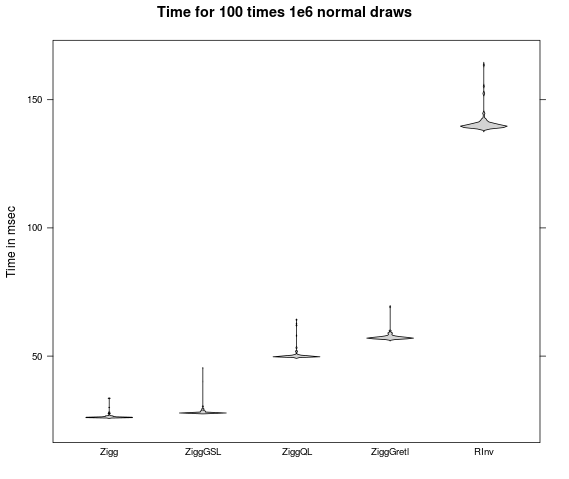
    ziggurats A new release 0.1.7 of RcppZiggurat is now on the CRAN network for R. This marks the first release in four and a half years. The RcppZiggurat package updates the code for the Ziggurat generator by Marsaglia and others which provides very fast draws from a Normal distribution. The package provides a simple C++ wrapper class for the generator improving on the very basic macros, and permits comparison among several existing Ziggurat implementations. This can be seen in the figure where Ziggurat from this package dominates accessing the implementations from the GSL, QuantLib and Gretl all of which are still way faster than the default Normal generator in R (which is of course of higher code complexity). This release brings a number of changes. Notably, based on the work we did with the new package zigg (more on that in a second), we now also expose the Exponential generator, and the underlying Uniform generator. Otherwise many aspects of the package have been refreshed: updated builds, updated links, updated CI processes, more use of DOIs and more. The other big news is zigg which should now be the preference for deployment of Ziggurat due to its much lighter-weight and zero-dependency setup. The NEWS file entry below lists all changes.

    Changes in version 0.1.7 (2025-03-22)
    • The CI setup was updated to use run.sh from r-ci (Dirk).
    • The windows build was updated to GSL 2.7, and UCRT support was added (Jeroen in #16).
    • Manual pages now use JSS DOIs for references per CRAN request
    • README.md links and badges have been updated
    • Continuous integration actions have been updated several times
    • The DESCRIPTION file now uses Authors@R as mandated
    • Use of multiple cores is eased via a new helper function reflecting option mc.core or architecture defaults, used in tests
    • An inline function has been added to avoid a compiler nag
    • Support for exponential RNG draws zrexp has been added, the internal uniform generator is now also exposed via zruni
    • The vignette bibliography has been updated, and switched to DOIs
    • New package zigg is now mentioned in DESCRIPTION and vignette

    Courtesy of my CRANberries, there is a diffstat report relative to previous release. More detailed information is on the Rcppziggurat page or the GitHub repository.

    This post by Dirk Eddelbuettel originated on his Thinking inside the box blog. If you like this or other open-source work I do, you can sponsor me at GitHub.

    Luke Faraone: I'm running for the OSI board... maybe

    The Open Source Initiative has two classes of board seats: Affiliate seats, and Individual Member seats. In the upcoming election, each affiliate can nominate a candidate, and each affiliate can cast a vote for the Affiliate candidates, but there's only 1 Affiliate seat available. I initially expressed interest in being nominated as an Affiliate candidate via Debian. But since Bradley Kuhn is also running for an Affiliate seat with a similar platform to me, especially with regards to the OSAID, I decided to run as part of an aligned "ticket" as an Individual Member to avoid contention for the 1 Affiliate seat.Bradley and I discussed running on a similar ticket around 8/9pm Pacific, and I submitted my candidacy around 9pm PT on 17 February. I was dismayed when I received the following mail from Nick Vidal:
    Dear Luke,

    Thank you for your interest in the OSI Board of Directors election. Unfortunately, we are unable to accept your application as it was submitted after the official deadline of Monday Feb 17 at 11:59 pm UTC. To ensure a fair process, we must adhere to the deadline for all candidates.

    We appreciate your enthusiasm and encourage you to stay engaged with OSI s mission. We hope you ll consider applying in the future or contributing in other meaningful ways.

    Best regards,
    OSI Election Teams
    Nowhere on the "OSI s board of directors in 2025: details about the elections" page do they list a timezone for closure of nominations; they simply list Monday 17 February. The OSI's contact address is in California, so it seems arbitrary and capricious to retroactively define all of these processes as being governed by UTC.I was not able to participate in the "potential board director" info sessions accordingly, but people who attended heard that the importance of accommodating differing TZ's was discussed during the info session, and that OSI representatives mentioned they try to accommodate TZ's of everyone. This seems in sharp contrast with the above policy. I urge the OSI to reconsider this policy and allow me to stand for an Individual seat in the current cycle. Upd, N.B.: to people writing about this, I use they/them pronouns

    Antoine Beaupr : Minor outage at Teksavvy business

    This morning, internet was down at home. The last time I had such an issue was in February 2023, when my provider was Oricom. Now I'm with a business service at Teksavvy Internet (TSI), in which I pay 100$ per month for a 250/50 mbps business package, with a static IP address, on which I run, well, everything: email services, this website, etc.

    Mitigation

    Email The main problem when the service goes down like this for prolonged outages is email. Mail is pretty resilient to failures like this but after some delay (which varies according to the other end), mail starts to drop. I am actually not sure what the various settings are among different providers, but I would assume mail is typically kept for about 24h, so that's our mark. Last time, I setup VMs at Linode and Digital Ocean to deal better with this. I have actually kept those VMs running as DNS servers until now, so that part is already done. I had fantasized about Puppetizing the mail server configuration so that I could quickly spin up mail exchangers on those machines. But now I am realizing that my Puppet server is one of the service that's down, so this would not work, at least not unless the manifests can be applied without a Puppet server (say with puppet apply). Thankfully, my colleague groente did amazing work to refactor our Postfix configuration in Puppet at Tor, and that gave me the motivation to reproduce the setup in the lab. So I have finally Puppetized part of my mail setup at home. That used to be hand-crafted experimental stuff documented in a couple of pages in this wiki, but is now being deployed by Puppet. It's not complete yet: spam filtering (including DKIM checks and graylisting) are not implemented yet, but that's the next step, presumably to do during the next outage. The setup should be deployable with puppet apply, however, and I have refined that mechanism a little bit, with the run script. Heck, it's not even deployed yet. But the hard part / grunt work is done.

    Other The outage was "short" enough (5 hours) that I didn't take time to deploy the other mitigations I had deployed in the previous incident. But I'm starting to seriously consider deploying a web (and caching) reverse proxy so that I endure such problems more gracefully.

    Side note on proper servics Typically, I tend to think of a properly functioning service as having four things:
    1. backups
    2. documentation
    3. monitoring
    4. automation
    5. high availability
    Yes, I miscounted. This is why you have high availability.

    Backups Duh. If data is maliciously or accidentally destroyed, you need a copy somewhere. Preferably in a way that malicious joe can't get to. This is harder than you think.

    Documentation I have an entire template for this. Essentially, it boils down to using https://diataxis.fr/ and this "audit" guide. For me, the most important parts are:
    • disaster recovery (includes backups, probably)
    • playbook
    • install/upgrade procedures (see automation)
    You probably know this is hard, and this is why you're not doing it. Do it anyways, you'll think it sucks, but you'll be really grateful for whatever scraps you wrote when you're in trouble.

    Monitoring If you don't have monitoring, you'll know it fails too late, and you won't know it recovers. Consider high availability, work hard to reduce noise, and don't have machine wake people up, that's literally torture and is against the Geneva convention. Consider predictive algorithm to prevent failures, like "add storage within 2 weeks before this disk fills up". This is harder than you think.

    Automation Make it easy to redeploy the service elsewhere. Yes, I know you have backups. That is not enough: that typically restores data and while it can also include configuration, you're going to need to change things when you restore, which is what automation (or call it "configuration management" if you will) will do for you anyways. This also means you can do unit tests on your configuration, otherwise you're building legacy. This is probably as hard as you think.

    High availability Make it not fail when one part goes down. Eliminate single points of failures. This is easier than you think, except for storage and DNS (which, I guess, means it's harder than you think too).

    Assessment In the above 5 items, I check two:
    1. backups
    2. documentation
    And barely: I'm not happy about the offsite backups, and my documentation is much better at work than at home (and even there, I have a 15 year backlog to catchup on). I barely have monitoring: Prometheus is scraping parts of the infra, but I don't have any sort of alerting -- by which I don't mean "electrocute myself when something goes wrong", I mean "there's a set of thresholds and conditions that define an outage and I can look at it". Automation is wildly incomplete. My home server is a random collection of old experiments and technologies, ranging from Apache with Perl and CGI scripts to Docker containers running Golang applications. Most of it is not Puppetized (but the ratio is growing). Puppet itself introduces a huge attack vector with kind of catastrophic lateral movement if the Puppet server gets compromised. And, fundamentally, I am not sure I can provide high availability in the lab. I'm just this one guy running my home network, and I'm growing older. I'm thinking more about winding things down than building things now, and that's just really sad, because I feel we're losing (well that escalated quickly).

    Resolution In the end, I didn't need any mitigation and the problem fixed itself. I did do quite a bit of cleanup so that feels somewhat good, although I despaired quite a bit at the amount of technical debt I've accumulated in the lab.

    Timeline Times are in UTC-4.
    • 6:52: IRC bouncer goes offline
    • 9:20: called TSI support, waited on the line 15 minutes then was told I'd get a call back
    • 9:54: outage apparently detected by TSI
    • 11:00: no response, tried calling back support again
    • 11:10: confirmed bonding router outage, no official ETA but "today", source of the 9:54 timestamp above
    • 12:08: TPA monitoring notices service restored
    • 12:34: call back from TSI; service restored, problem was with the "bonder" configuration on their end, which was "fighting between Montr al and Toronto"

    21 March 2025

    Jamie McClelland: AI's Actual Impact

    Two years after OpenAI launched ChatGPT 3.5, humanity is not on the cusp of extinction and Elon Musk seems more responsible for job loss than any AI agent. However, ask any web administrator and you will learn that large language models are having a significant impact on the world wide web (or, for a less technical account, see Forbes articles on bots). At May First, a membership organization that has been supporting thousands of web site for over 20 years, we have never seen anything like this before.

    Now what? So, no, unfortunately, your web site is not suddenly getting really popular. And, you are blessed with a whole new set of strategic decisions. Fortunately, May First has undergone a major infrastructure transition, resulting in centralized logging of all web sites and a fleet of web proxy servers that intercept all web traffic. Centralized logging means we can analyze traffic and identify bots more easily, and a web proxy fleet allows us to more easily implement rules across all web sites. However, even with all of our latest changes and hours upon hours of work to keep out the bots, our members are facing some hard decisions about maintaining an open web. One member of May First provides Google translations of their web site to every language available. But wow, that is now a disaster because instead of having every bot under the sun scrapping all 843 (a made up number) pieces of unique content on their site, the same bots are scraping 843 * (number of available languages) pieces of content on their site. Should they stop providing this translation service in order to ensure people can access their site in the site s primary language? Should web sites turn off their search features that include drop down options of categories to prevent bots from systematically refreshing the search page with every possible combination of search terms? Do we need to alter our calendar software to avoid providing endless links into the future (ok, that is an easy one)?

    What s next? Something has to change.
    • Lock down web 2.0. Web 2.0 brought us wonderful dynamic web sites, which Drupal and WordPress and many other pieces of amazing software have supported for over a decade. This is the software that is getting bogged down by bots. Maybe we need to figure out a way to lock down the dynamic aspects of this software to logged in users and provide static content for everyone else?
    • Paywalls and accounts everywhere. There s always been an amazing non-financial reward to providing a web site with high quality movement oriented content for free. It populates the search engines, provides links to inspiring and useful content in moments of crises, and can galvanize movements. But these moments of triumph happen between long periods of hard labor that now seems to mostly feed capitalist AI scumbags. If we add a new set of expenses and labor to keep the sites running for this purpose, how sustainable is that? Will our treasure of free movement content have to move behind paywalls or logins? If we provide logins, will that keep the bots out or just create a small hurdle for them to automate the account creation process? What happens when we can t search for this kind of content via search engines?
    • Cutting deals. What if our movement content providers are forced to cut deals with the AI entrepreneurs to allow the paying scumbags to fund the content creation. Eww. Enough said.
    • Bot detection. Maybe we just need to get better at bot detection? This will surely be an arms race, but would have some good benefits. Bots have also been filling out our forms and populating our databases with spam, testing credit cards against our donation pages, conducting denial of service attacks and all kinds of other irritating acts of vandalism. If we were better at stopping bots automatically it would have a lot of benefits. But what impact would it have on our web sites and the experience of using them? What about good bots (RSS feed readers, payment processors, web hooks, uptime detectors)? Will we cut the legs off any developer trying to automate something?
    I m not really sure where this is going, but it seems that the world wide web is about to head in a new direction.

    Next.

    Previous.