Search Results: "rul"

14 April 2022

Jonathan Dowland: hledger

This year I've decided to bite the bullet and properly try out hledger for personal accounting. It seems I need to commit to it properly if I'm to figure out whether it will work for me or not. Up until now I'd been strictly separating my finances into two buckets: family and personal. I'd been using GNUCash for a couple of years for my personal finances, initially to evaluate it for use for the family, but I had not managed to adopt it for that. I set up a new git repository to track the ledger file, as well as a notes.txt "diary" that documents my planning around its structure and how to use it, and a import.txt which documents what account data I have imported and confirmed that the resulting balances match those reported on monthly statements. For this evaluation, I decided to bite the bullet and track both family and personal finances at the same time. I'm still keeping them conceptually very separate. To reflect that I've organised my account names around that: all accounts relating to family are prefixed family:, and likewise personal jon:.1 Some example accounts:
family:assets:shared    - shared bank account
family:dues:jon         - I owe to family
family:expenses:cat     - budget category for the cat
income                  - where money enters this universe
jon:assets:current      - my personal account
jon:dues:peter          - money Peter owes me
jon:expenses:snacks     - budget category for coffees etc
jon:liabilities:amex    - a personal credit card
I decided to make the calendar year a strict cut-over point: my personal opening balances in hledger are determined by what GNUCash reports. It's possible those will change over this year, as adjustments are made to last year's data: but it's easy enough to go in and update the opening balances in hledger to reflect that. Credit cards are a small exception. January's credit card bills are paid in January but cover transactions from mid-December. I import those transactions into hledger to balance the credit card payment. As a consequence, the "spend per month" view of my data is a bit skewed: All the transactions in December should be thought of as in January since that's when they were paid. I need to explore options to fix this. When I had family and personal managed separately, occasionally something would be paid for on the wrong card and end up in the wrong data. The solution I used last year was to keep an account dues:family to which I posted those and periodically I'd settle it with a real-world bank transfer. I've realised that this doesn't work so well when I manage both together: I can't track both dues and expense categorisation with just one posting. The solution I'm using for now is hledger's unbalanced virtual postings: a third posting for the transaction to the budget category, which is not balanced, e.g.:
2022-01-02 ZTL*RELISH
    family:liabilities:creditcard        -3.00
    family:dues:jon                       3.00
    (jon:expenses:snacks)                 3.00
This works, but it completely side-steps double-entry book keeping, which is the whole point of using a double-entry system. There's also no check and balance that the figure I put in the virtual posting ( 3) matches the figure in the rest of the transaction. I'm therefore open to other ideas.

  1. there are a couple of places in hledger where default account names are used, such as the default place that expenses are posted to during CSV imports: expenses:unknown, that obviously don't fit my family/jon: prefix scheme. The solution is to make sure I specify a default posting-to account in all my CSV import rules.

8 April 2022

Dirk Eddelbuettel: RcppEigen 0.3.3.9.2 on CRAN: Maintenance

A new release 0.3.3.9.2 of RcppEigen arrived on CRAN today (and already went to Debian). Eigen is a C++ template library for linear algebra: matrices, vectors, numerical solvers, and related algorithms. This update was (as it happens) requested by CRAN as R aims to bring the Fortran / C interface to best practices. We call dgesdd twice in one example and use a character argument, and the-powers-that-be now prefer better control over that character argument. So we did. Another change, kindly contributed by Mikael Jagan, switches row and column indices for R_xlen_t allowing for greater range. Plus some more small tweaks mostly to CI, see the NEWS entry below for full details. And again as we said for the previous three releases:
One additional and recent change was the accomodation of a recent CRAN Policy change to not allow gcc or clang to mess with diagnostic messages. A word of caution: this may make your compilation of packages using RcppEigen very noisy so consider adding -Wno-ignored-attributes to the compiler flags added in your ~/.R/Makevars.
We still find this requirement rather annoying. Eigen is only usable if you set, say,
-Wno-deprecated-declarations -Wno-parentheses -Wno-ignored-attributes -Wno-unused-function
asoptions in~/.R/Makevars . But CRAN makes the rules. Maybe if a few of us gently and politely nudge them they may relent one day. One can only hope. The complete NEWS file entry follows.

Changes in RcppEigen version 0.3.3.9.2 (2022-04-05)
  • Added test coverage in continuous integration
  • Added new tests to increase test coverage
  • Small improvement to the RcppEigen.package.skeleton() code
  • Small updates and edits to README.md and inst/CITATION
  • Use R_xlen_t for vector rows and columns (by Mikael Jagan)
  • Support USE_FC_LEN_T by adding FCONE to two dgesdd calls

Courtesy of CRANberries, there is also a diffstat report for the most recent release. If you like this or other open-source work I do, you can sponsor me at GitHub.

This post by Dirk Eddelbuettel originated on his Thinking inside the box blog. Please report excessive re-aggregation in third-party for-profit settings.

Jacob Adams: The Unexpected Importance of the Trailing Slash

For many using Unix-derived systems today, we take for granted that /some/path and /some/path/ are the same. Most shells will even add a trailing slash for you when you press the Tab key after the name of a directory or a symbolic link to one. However, many programs treat these two paths as subtly different in certain cases, which I outline below, as all three have tripped me up in various ways1.

POSIX and Coreutils Perhaps the trickiest use of the trailing slash in a distinguishing way is in POSIX2 which states:
When the final component of a pathname is a symbolic link, the standard requires that a trailing <slash> causes the link to be followed. This is the behavior of historical implementations3. For example, for /a/b and /a/b/, if /a/b is a symbolic link to a directory, then /a/b refers to the symbolic link, and /a/b/ refers to the directory to which the symbolic link points.
This leads to some unexpected behavior. For example, if you have the following structure of a directory dir containing a file dirfile with a symbolic link link pointing to dir. (which will be used in all shell examples throughout this article):
$ ls -lR
.:
total 4
drwxr-xr-x 2 jacob jacob 4096 Apr  3 00:00 dir
lrwxrwxrwx 1 jacob jacob    3 Apr  3 00:00 link -> dir
./dir:
total 0
-rw-r--r-- 1 jacob jacob 0 Apr  3 00:12 dirfile
On Unixes such as MacOS, FreeBSD or Illumos4, you can move a directory through a symbolic link by using a trailing slash:
$ mv link/ otherdir
$ ls
link	otherdir
On Linux5, mv will not rename the indirectly referenced directory and not the symbolic link, when given a symbolic link with a trailing slash as the source to be renamed. despite the coreutils documentation s claims to the contrary6, instead failing with Not a directory:
$ mv link/ other
mv: cannot move 'link/' to 'other': Not a directory
$ mkdir otherdir
$ mv link/ otherdir
mv: cannot move 'link/' to 'otherdir/link': Not a directory
$ mv link/ otherdir/
mv: cannot move 'link/' to 'otherdir/link': Not a directory
$ mv link otherdirlink
$ ls -l otherdirlink
lrwxrwxrwx 1 jacob jacob 3 Apr  3 00:13 otherdirlink -> dir
This is probably for the best, as it is very confusing behavior. There is still one advantage the trailing slash has when using mv, even on Linux, in that is it does not allow you to move a file to a non-existent directory, or move a file that you expect to be a directory that isn t.
$ mv dir/dirfile nonedir/
mv: cannot move 'dir/dirfile' to 'nonedir/': Not a directory
$ touch otherfile
$ mv otherfile/ dir
mv: cannot stat 'otherfile/': Not a directory
$ mv otherfile dir
$ ls dir
dirfile  otherfile
However, Linux still exhibits some confusing behavior of its own, like when you attempt to remove link recursively with a trailing slash:
rm -rvf link/
Neither link nor dir are removed, but the contents of dir are removed:
removed 'link/dirfile'
Whereas if you remove the trailing slash, you just remove the symbolic link:
$ rm -rvf link
removed 'link'
While on MacOS, FreeBSD or Illumos4, rm will also remove the source directory:
$ rm -rvf link
link/dirfile
link/
$ ls
link
The find and ls commands, in contrast, behave the same on all three operating systems. The find command only searches the contents of the directory a symbolic link points to if the trailing slash is added:
$ find link -name dirfile
$ find link/ -name dirfile
link/dirfile
The ls command acts similarly, showing information on just a symbolic link by itself unless a trailing slash is added, at which point it shows the contents of the directory that it links to:
$ ls -l link
lrwxrwxrwx 1 jacob jacob 3 Apr  3 00:13 link -> dir
$ ls -l link/
total 0
-rw-r--r-- 1 jacob jacob 0 Apr  3 00:13 dirfile

rsync The command rsync handles a trailing slash in an unusual way that trips up many new users. The rsync man page notes:
You can think of a trailing / on a source as meaning copy the contents of this directory as opposed to copy the directory by name , but in both cases the attributes of the containing directory are transferred to the containing directory on the destination.
That is to say, if we had two folders a and b each of which contained some files:
$ ls -R .
.:
a  b
./a:
a1  a2
./b:
b1  b2
Running rsync -av a b moves the entire directory a to directory b:
$ rsync -av a b
sending incremental file list
a/
a/a1
a/a2
sent 181 bytes  received 58 bytes  478.00 bytes/sec
total size is 0  speedup is 0.00
$ ls -R b
b:
a  b1  b2
b/a:
a1  a2
While running rsync -av a/ b moves the contents of directory a to b:
$ rsync -av a/ b
sending incremental file list
./
a1
a2
sent 170 bytes  received 57 bytes  454.00 bytes/sec
total size is 0  speedup is 0.00
$ ls b
a1  a2	b1  b2

Dockerfile COPY The Dockerfile COPY command also cares about the presence of the trailing slash, using it to determine whether the destination should be considered a file or directory. The Docker documentation explains the rules of the command thusly:
COPY [--chown=<user>:<group>] <src>... <dest>
If <src> is a directory, the entire contents of the directory are copied, including filesystem metadata. Note: The directory itself is not copied, just its contents. If <src> is any other kind of file, it is copied individually along with its metadata. In this case, if <dest> ends with a trailing slash /, it will be considered a directory and the contents of <src> will be written at <dest>/base(<src>). If multiple <src> resources are specified, either directly or due to the use of a wildcard, then <dest> must be a directory, and it must end with a slash /. If <dest> does not end with a trailing slash, it will be considered a regular file and the contents of <src> will be written at <dest>. If <dest> doesn t exist, it is created along with all missing directories in its path.
This means if you had a COPY command that moved file to a nonexistent containerfile without the slash, it would create containerfile as a file with the contents of file.
COPY file /containerfile
container$ stat -c %F containerfile
regular empty file
Whereas if you add a trailing slash, then file will be added as a file under the new directory containerdir:
COPY file /containerdir/
container$ stat -c %F containerdir
directory
Interestingly, at no point can you copy a directory completely, only its contents. Thus if you wanted to make a directory in the new container, you need to specify its name in both the source and the destination:
COPY dir /dirincontainer
container$ stat -c %F /dirincontainer
directory
Dockerfiles do also make good use of the trailing slash to ensure they re doing what you mean by requiring a trailing slash on the destination of multiple files:
COPY file otherfile /othercontainerdir
results in the following error:
When using COPY with more than one source file, the destination must be a directory and end with a /
  1. I m sure there are probably more than just these three cases, but these are the three I m familiar with. If you know of more, please tell me about them!.
  2. Some additional relevant sections are the Path Resolution Appendix and the section on Symbolic Links.
  3. The sentence This is the behavior of historical implementations implies that this probably originated in some ancient Unix derivative, possibly BSD or even the original Unix. I don t really have a source on that though, so please reach out if you happen to have any more knowledge on what this refers to.
  4. I tested on MacOS 11.6.5, FreeBSD 12.0 and OmniOS 5.11 2
  5. unless the source is a directory trailing slashes give -ENOTDIR
  6. In fairness to the coreutils maintainers, it seems to be true on all other Unix platforms, but it probably deserves a mention in the documentation when Linux is the most common platform on which coreutils is used. I should submit a patch.

7 April 2022

Gunnar Wolf: How is the free firmware for the Raspberry progressing?

Raspberry Pi computers require a piece of non-free software to boot the infamous raspi-firmware package. But for almost as long as there has been a Raspberry Pi to talk of (this year it turns 10 years old!), there have been efforts to get it to boot using only free software. How is it progressing? Michael Bishop (IRC user clever) explained today in the #debian-raspberrypi channel in OFTC that it advances far better than what I expected: It is even possible to boot a usable system under the RPi2 family! Just There is somewhat incomplete hardware support: For his testing, he has managed to use a xfce environment but over the composite (NTSC) video output, as HDMI initialization support is not there. However, he shared with me several interesting links and videos, and I told him I d share them there are still many issues; I do not believe it is currently worth it to make Debian images with this firmware. Before anything else: Go visit the librerpi/lk-overlay repository. Its README outlines hardware support for each of the RPi families; there is a binary build available with nixos if you want to try it out, and instructions to build it. But what clever showed me that made me write this post Is the amount of stuff you can do with the RPi s VPU (why Vision Vector Processing Unit and not the more familiar GPU, Graphical Processing Unit? I don t really know But I trust clever s definitions beyond how I trust my own ) before it loads an opearting system: There s not too much I can add to this. I was just Truly amazed. And I hope to see the remaining hurdles for regular Linux booting on this range of machines with purely free software quickly go away! Packaging this for Debian? Well, not yet not so fast I first told clever we could push this firmware to experimental instead of unstable, as it is not yet ready for most production systems. However, pabs made some spot-on further questions. And yes, it requires installing three(!) different cross-compilers, one of which vc4-toolchain, for the VPU is free software, but not yet upstreamed, and hence is not available for Debian. Anyway, the talk continued long after I had to go. I have gone a bit over the backlog, but I have to leave now so that will be it as for this blog post

5 April 2022

Dirk Eddelbuettel: RcppArmadillo 0.11.0.0.0 on CRAN: Upstream Updates

armadillo image Armadillo is a powerful and expressive C++ template library for linear algebra aiming towards a good balance between speed and ease of use with a syntax deliberately close to a Matlab. RcppArmadillo integrates this library with the R environment and language and is widely used by (currently) 972 other packages on CRAN, downloaded over 24 million times (per the partial logs from the cloud mirrors of CRAN), and the CSDA paper (preprint / vignette) by Conrad and myself has been cited 465 times according to Google Scholar. This release brings a new upstream release 11.0.0. We tested this very rigorously via three different RC release each of which got a full reverse-dependencies run (for which results are always logged here). The full set of changes (since the last CRAN release 0.10.8.1.0) follows.

Changes in RcppArmadillo version 0.11.0.0 (2022-04-04)
  • Upgraded to Armadillo release 11.0.0 (Creme Brulee)
    • added variants of inv() and inv_sympd() that provide rcond (reciprocal condition number)
    • expanded inv() and inv_sympd() with options inv_opts::tiny and inv_opts::allow_approx
    • stricter handling of singular matrices by inv() and inv_sympd()
    • stricter handling of non-sympd matrices by inv() and inv_sympd()
    • stricter handling of non-finitie matrices by pinv()
    • more robust handling of rank deficient matrices by solve()
    • faster handling of diagonal matrices by rcond()
    • changed eigs_sym() and eigs_gen() to use higher quality RNG
    • quantile() and median() will now throw an exception if given matrices/vectors have NaN elements
    • workaround for yet another bug in Intel MKL
  • Until May 2022, protect correction to Field behavior via define of RCPP_ARMADILLO_FIX_Field
  • If a LAPACK installation with missing complex routines is found (as e.g. Ubuntu using 3.9.0) then the LAPACK unit test is skipped.

Changes in RcppArmadillo version 0.10.8.2.0 (2022-02-01)
  • Upgraded to Armadillo release 10.8.2 (Realm Raider)
    • fix potential speed regression in pinv() and rank()

Courtesy of my CRANberries, there is a diffstat report relative to previous release. More detailed information is on the RcppArmadillo page. Questions, comments etc should go to the rcpp-devel mailing list off the R-Forge page. If you like this or other open-source work I do, you can sponsor me at GitHub.

This post by Dirk Eddelbuettel originated on his Thinking inside the box blog. Please report excessive re-aggregation in third-party for-profit settings.

2 April 2022

Ian Jackson: Otter (game server) 1.0.0 released

I have just released Otter 1.0.0. Recap: what is Otter Otter is my game server for arbitrary board games. Unlike most online game systems. It does not know (nor does it need to know) the rules of the game you are playing. Instead, it lets you and your friends play with common tabletop/boardgame elements such as hands of cards, boards, and so on. So it s something like a tabletop simulator (but it does not have any 3D, or a physics engine, or anything like that). There are provided game materials and templates for Penultima, Mao, and card games in general. Otter also supports uploadable game bundles, which allows users to add support for additional games - and this can be done without programming. For more information, see the online documentation. There are a longer intro and some screenshots in my 2021 introductory blog post about Otter Releasing 1.0.0 I m calling this release 1.0.0 because I think I can now say that its quality, reliability and stability is suitable for general use. In particular, Otter now builds on Stable Rust, which makes it a lot easier to install and maintain. Switching web framework, and async Rust I switched Otter from the Rocket web framework to Actix. There are things to prefer about both systems, and I still have a soft spot for Rocket. But ultimately I needed a framework which was fully released and supported for use with Stable Rust. There are few if any Rust web frameworks that are not async. This is rather a shame. Async Rust is a considerably more awkward programming environment than ordinary non-async Rust. I don t want to digress into a litany of complaints, but suffice it to say that while I really love Rust, my views on async Rust are considerably more mixed. Future plans In the near future I plan to add a couple of features to better support some particular games: currency-like resources, and a better UI for dice-like randomness. In the longer term, Otter s, installation and account management arrangements are rather unsophisticated and un-webby. There is not currently any publicly available instance for you to try it out without installing it on a machine of your own. There s not even any provided binaries: you must built Otter yourself. I hope to be able to improve this situation but it involves dealing with cloud CI and containers and so-on, which can all be rather unpleasant. Users on chiark will find an instance of Otter there.

comment count unavailable comments

1 April 2022

Antoine Beaupr : Salvaged my first Debian package

I finally salvaged my first Debian package, python-invoke. As part of ITS 964718, I moved the package from the Openstack Team to the Python team. The Python team might not be super happy with it, because it's breaking some of its rules, but at least someone (ie. me) is actively working (and using) the package.

Wait what People not familiar with Debian will not understand anything in that first paragraph, so let me expand. Know-it-all Debian developers (you know who you are) can skip to the next section. Traditionally, the Debian project (my Linux-based operating system of choice) has prided itself on the self-managed, anarchistic organisation of its packaging. Each package maintainer is the lord of their little kingdom. Some maintainers like to accumulate lots of kingdoms to rule over. (Yes, it really doesn't sound like anarchism when you put it like that. Yes, it's complicated: there's a constitution and voting involved. And yes, we're old.) Therefore, it's really hard to make package maintainers do something they don't want. Typically, when things go south, someone makes a complaint to the Debian Technical Committee (CTTE) which is established by the Debian constitution to resolve such conflicts. The committee is appointed by the Debian Project leader, elected each year (and there's an election coming up if you haven't heard). Typically, the CTTE will then vote and formulate a decision. But here's the trick: maintainers are still free to do whatever they want after that, in a sense. It's not like the CTTE can just break down doors and force maintainers to type code. (I won't go into the details of the why of that, but it involves legal issues and, I think, something about the Turing halting problem. Or something like that.) Anyways. The point is all that is super heavy and no one wants to go there... (Know-it-all Debian developers, I know you are still reading this anyways and disagree with that statement, but please, please, make it true.) ... but sometimes, packages just get lost. Maintainers get distracted, or busy with something else. It's not that they want to abandon their packages. They love their little fiefdoms. It's just there was a famine or a war or something and everyone died, and they have better things to do than put up fences or whatever. So clever people in Debian found a better way of handling such problems than waging war in the poor old CTTE's backyard. It's called the Package Salvaging process. Through that process, a maintainer can propose to take over an existing package from another maintainer, if a certain set of condition are met and a specific process is followed. Normally, taking over another maintainer's package is basically a war declaration, rarely seen in the history of Debian (yes, I do think it happened!), as rowdy as ours is. But through this process, it seems we have found a fair way of going forward. The process is basically like this:
  1. file a bug proposing the change
  2. wait three weeks
  3. upload a package making the change, with another week delay
  4. you now have one more package to worry about
Easy right? It actually is! Process! It's magic! It will cure your babies and resurrect your cat!

So how did that go? It went well! The old maintainer was actually fine with the change because his team wasn't using the package anymore anyways. He asked to be kept as an uploader, which I was glad to oblige. (He replied a few months after the deadline, but I wasn't in a rush anyways, so that doesn't matter. It was polite for him to answer, even if, technically, I was already allowed to take it over.) What happened next is less shiny for me though. I totally forgot about the ITS, even after the maintainer reminded me of its existence. See, the thing is the ITS doesn't show up on my dashboard at all. So I totally forgot about it (yes, twice). In fact, the only reason I remembered it was that got into the process of formulating another ITS (1008753, trocla) and I was trying to figure out how to write the email. Then I remembered: "hey wait, I think I did this before!" followed by "oops, yes, I totally did this before and forgot for 9 months". So, not great. Also, the package is still not in a perfect shape. I was able to upload the upstream version that was pending 1.5.0 to clear out the ITS, basically. And then there's already two new upstream releases to upload, so I pushed 1.7.0 to experimental as well, for good measure. Unfortunately, I still can't enable tests because everything is on fire, as usual. But at least my kingdom is growing.

Appendix Just in case someone didn't notice the hyperbole, I'm not a monarchist promoting feudalism as a practice to manage a community. I do not intend to really "grow my kingdom" and I think the culture around "property" of "packages" is kind of absurd in Debian. I kind of wish it would go away. (Update: It has also been pointed out that I might have made Debian seem more confrontational than it actually is. And it's kind of true: most work and interactions in Debian actually go fine, it's only a minority of issues that degenerate into conflicts. It's just that they tend to take up a lot of space in the community, and I find that particularly draining. And I think think our "package ownership" culture is part of at least some of those problems.) Team maintenance, the LowNMU process, and low threshold adoption processes are all steps in the good direction, but they are all opt in. At least the package salvaging process is someone a little more ... uh... coercive? Or at least it allows the community to step in and do the right thing, in a sense. We'll see what happens with the coming wars around the recent tech committee decision, which are bound to touch on that topic. (Hint: our next drama is called "usrmerge".) Hopefully, LWN will make a brilliant article to sum it up for us so that I don't have to go through the inevitable debian-devel flamewar to figure it out. I already wrecked havoc on the #debian-devel IRC channel asking newbie questions so I won't stir that mud any further for now. (Update: LWN, of course, did make an article about usrmerge in Debian. I will read it soon and can then tell you know if it's brilliant, but they are typically spot on.)

29 March 2022

Dirk Eddelbuettel: RcppBDT 0.2.5: Maintenance

A minor maintenance release for the RcppBDT package is now on CRAN. The RcppBDT package is an early adopter of Rcpp and was one of the first packages utilizing Boost and its Date_Time library. The now more widely-used package anytime is a direct descentant of RcppBDT. Thanks again for the heads-up! This release mostly deals with a one-definition rule violation detected by link-time optimisation (which can be enable when configuring R itself at build time with --enable-lto). I confused myself into thinking Rcpp Modules may be at fault, but I aki was a little more awake than myself and noticed that I only needed to carry the (common) header RcppBDT.h to the file toPOSIXct.cpp added last summer. The NEWS entry follows:

Changes in version 0.2.5 (2022-03-29)
  • Ensure consistent compilation by ensuring RcppBDT.h is included in all files, this addresses an LTO/ODR issue
  • Correct one declaration in init.c
  • Minor additional cleanups

Courtesy of my CRANberries, there is also a diffstat report for this release. If you like this or other open-source work I do, you can now sponsor me at GitHub.

This post by Dirk Eddelbuettel originated on his Thinking inside the box blog. Please report excessive re-aggregation in third-party for-profit settings.

9 March 2022

Dirk Eddelbuettel: RcppRedis 0.2.0: Major Updates

A new major release of RcppRedis arrived on CRAN today. RcppRedis is one of several packages connecting R to the fabulous Redis in-memory datastructure store (and much more). RcppRedis does not pretend to be feature complete, but it may do some things faster than the other interfaces, and also offers an optional coupling with MessagePack binary (de)serialization via RcppMsgPack. The package has carried production loads for several years now. This release integrates support for pub/sub, a popular messaging pattern in which one or more clients can subscribe to one or more channels . Whenever a client instances publishes, the Redis server immediately updates all clients listening on the given channel. This pattern is fairly common to transmit data to listeners. A there is a bit more to explain about this, I also added a brand-new vignette describing pub/sub with RcppRedis, along with another introductory vignette about Redis itself. We blogged about this exciting new feature and its particular use for market monitoring in R4 #36 recently too. The pub/sub feature was available in package rredis by Bryan Lewis and has now been ported over by Bryan in a truly elegant yet compact implementation. We placed the code for the pub/sub examples, both for a single symbol (SP 500) as well as for a set of (futures) symbols, into a new examples/ subdirectory. Other changes in this release are the removal of the build-dependency on Boost (or, rather, my BH package), an update to the included hiredis library (used if no system-wide version is found), and an updated to the UCRT build for R. That last one is a bit of a sore spot and nobody at CRAN deemed it necessary to tell me they were waiting for me to make this change; communication with the CRAN team can still be challenging (and I am being generous here). Anyway, the package is now on CRAN so all is well now, at long last. The detailed changes list follows.

Changes in version 0.2.0 (2022-03-08)
  • Two simple C++11 features remove needs for BH and lexical_cast() (Dirk in #45 addressing #44).
  • Redis pub/sub is now supported (Dirk in #43, Bryan in #46).
  • Bryan Lewis is now a coauthor.
  • Added pub/sub examples for single and multiple Globex symbols.
  • The included hiredis sources have been updated to release 1.0.2.
  • Two vignettes have been added to introduce Redis and to described a live market-monitoring application included in directory pubsub/.
  • The UCRT build was updated per a suggestion by Tomas.

Courtesy of CRANberries, there is also a diffstat report for this release. More information is on the RcppRedis page. If you like this or other open-source work I do, you can now sponsor me at GitHub.

This post by Dirk Eddelbuettel originated on his Thinking inside the box blog. Please report excessive re-aggregation in third-party for-profit settings.

Fran ois Marier: Using a Streamzap remote control with MythTV on Debian Bullseye

After upgrading my MythTV machine to Debian Bullseye and MythTV 31, my Streamzap remote control stopped working correctly: the up and down buttons were working, but the OK button wasn't. Here's the complete solution that made it work with the built-in kernel support (i.e. without LIRC).

Button re-mapping Since some of the buttons were working, but not others, I figured that the buttons were probably not mapped to the right keys. Inspired by these old v4l-utils-based instructions, I made my own custom keymap by by copying the original keymap:
cp /lib/udev/rc_keymaps/streamzap.toml /etc/rc_keymaps/
and then modifying it to adapt it to what MythTV needs. This is what I ended up with:
<span class="createlink"><a href="/blog.cgi?do=create&amp;from=posts%2Fusing-streamzap-remote-with-mythtv-debian-bullseye&amp;page=protocols" rel="nofollow">?</a>protocols</span>
name = "streamzap"
protocol = "rc-5-sz"
[protocols.scancodes]
0x28c0 = "KEY_0"
0x28c1 = "KEY_1"
0x28c2 = "KEY_2"
0x28c3 = "KEY_3"
0x28c4 = "KEY_4"
0x28c5 = "KEY_5"
0x28c6 = "KEY_6"
0x28c7 = "KEY_7"
0x28c8 = "KEY_8"
0x28c9 = "KEY_9"
0x28ca = "KEY_ESC"
0x28cb = "KEY_MUTE"
0x28cc = "KEY_UP"
0x28cd = "KEY_RIGHTBRACE"
0x28ce = "KEY_DOWN"
0x28cf = "KEY_LEFTBRACE"
0x28d0 = "KEY_UP"
0x28d1 = "KEY_LEFT"
0x28d2 = "KEY_ENTER"
0x28d3 = "KEY_RIGHT"
0x28d4 = "KEY_DOWN"
0x28d5 = "KEY_M"
0x28d6 = "KEY_ESC"
0x28d7 = "KEY_L"
0x28d8 = "KEY_P"
0x28d9 = "KEY_ESC"
0x28da = "KEY_BACK"
0x28db = "KEY_FORWARD"
0x28dc = "KEY_R"
0x28dd = "KEY_PAGEUP"
0x28de = "KEY_PAGEDOWN"
0x28e0 = "KEY_D"
0x28e1 = "KEY_I"
0x28e2 = "KEY_END"
0x28e3 = "KEY_A"
Note that the keycodes can be found in the kernel source code. With my own keymap in place at /etc/rc_keymaps/streamzap.toml, I changed /etc/rc_maps.cfg to have the kernel driver automatically use it:
--- a/rc_maps.cfg
+++ b/rc_maps.cfg
@@ -126,7 +126,7 @@
 *      rc-real-audio-220-32-keys real_audio_220_32_keys.toml
 *      rc-reddo                 reddo.toml
 *      rc-snapstream-firefly    snapstream_firefly.toml
-*      rc-streamzap             streamzap.toml
+*      rc-streamzap             /etc/rc_keymaps/streamzap.toml
 *      rc-su3000                su3000.toml
 *      rc-tango                 tango.toml
 *      rc-tanix-tx3mini         tanix_tx3mini.toml

Button repeat delay To adjust the delay before button presses are repeated, I followed these old out-of-date instructions on the MythTV wiki and put the following in /etc/udev/rules.d/streamzap.rules:
ACTION=="add", ATTRS idVendor =="0e9c", ATTRS idProduct =="0000", RUN+="/usr/bin/ir-keytable -s rc0 -D 1000 -P 250"
Note that the -d option has been replaced with -s in the latest version of ir-keytable. To check that the Streamzap is indeed detected as rc0 on your system, use this command:
$ ir-keytable 
Found /sys/class/rc/rc0/ with:
    Name: Streamzap PC Remote Infrared Receiver (0e9c:0000)
    Driver: streamzap
    Default keymap: rc-streamzap
...
Make sure you don't pass the -c to ir-keytable or else it will clear the keymap set via /etc/rc_maps.cfg, removing all of the button mappings.

7 March 2022

Ayoyimika Ajibade: Progress Report!! Modifying Expectations...

Wait! Just like yesterday when I was accepted as an Outreachy intern and the first half of the internship is finished . How time flies when you are having a good time As part of the requirements for the final application during the contribution period for the Outreachy internship, I needed to provide a timeline to achieve our goal on my outreachy task which is transitioning of dependencies in node16 and webpack5. Having consulted my mentors who implied that the packages depending on webpack and nodejs combined are so numerous that its impossible to finish all within a space of three months but we have steps to guide us through the entire process to achieve most of our goals which are As of this writing(though a little late ) we have successfully rebuilt all reverse dependencies of webpack5 and split them equally each for I and my co-intern for all Javascript modules as ruby packages also depend on webpack which is a total of 44 packages. Filed a bug report on Debian bug tracking system for failing packages, also the original maintainer or uploader of the package to the Debian archive mostly Debian developers also get a mail in references to the package bug report. Sometimes the uploader who also receives the bug report decides to help out to fix the package and forward the patch upstream if need be. We have also filed an issue to upstream repo mostly via github where some respond and create PR to solve those errors and others are plain aversive to the whole idea. PR from the upstream developer is cherry-picked and a patch is created by us to incorporate the code into our own working repository. some package upstream maintainer rejects such issues or doesn't respond, we take it upon ourselves to fix the package. The total number of packages that are successfully updated and ready to be merged is 10 packages while 12 packages remain on my own end to be updated. One of the most challenging packages to update so far was prop-type as its runs its large test suite using jest of a lower version 19.0.2 compared to that of Debian OS which is version 27.5.1 updating and migrating its API's and methods to use the Debian updated version is so challenging after several googling, testing out the solution from StackOverflow, trials, and errors, reading documentations we eventually made progress with the help of my mentor, co-intern and the whole community member. It's so crazy that when I got it working I said to myself. phew it's not rocket science why can I figure it out sooner than expected I initially proposed that I would be halfway done with the project by now, I guess the reason am not able to achieve some of our goals which are finishing up with the packages for webpack and moving to transition some of the nodejs packages at all is DEBUGGING. Yes DEBUGGING! where you never can predict what the solution is. is the problem coming from Debian? or dependencies of the package you are working on, upstream bug, or dependencies of dependencies of the package you are working on, so many questions to answer. You can't easily find a solution to a bug as it takes time to try out so many guesses more of an educated guess, or even try out all the solutions from stack overflow and still no viable progress. Obviously, you cannot really know about something to set up a plan for unless you get right into it. One way of doing this, if I have to start again is the truly understand how the javascript package work under the hood, how its handles different interaction between packages, some of its dos and don't of transpiling, bundling, testing, e.t.c I guess my unrealistic goals need to be modified because some drawback that was not envisaged popped up and I underestimated the complexity of the tasks, which will be reducing the number of packages to update in transitioning of nodejs from what I planned My major focus for the second half of the internship is to fix bugs and errors I discover, file bug reports for future bugs to seek help from co-maintainer or developers, file issues upstream and close those whose bugs are already resolved for the remaining 12 packages, and ultimately successfully uploading all reverse dependencies. Also diving into transitioning of nodejs16. Thanks for stopping by

3 March 2022

Jonathan McDowell: Neat uses for a backlit keyboard

I bought myself a new keyboard last November, a Logitech G213. True keyboard fans will tell me it s not a real mechanical keyboard, but it was a lot cheaper and met my requirements of having some backlighting and a few media keys (really all I use are the volume control keys). Oh, and being a proper UK layout. While the G213 isn t fully independent RGB per key it does have a set of zones that can be controlled. Also this has been reverse engineered, so there are tools to do this under Linux. All I really wanted was some basic backlighting to make things a bit nicer in the evenings, but with the ability to control colour I felt I should put it to good use. As previously mentioned I have a personal desktop / work laptop setup combined with a UGREEN USB 3.0 Sharing Switch Box, so the keyboard is shared between both machines. So I configured up both machines to set the keyboard colour when the USB device is plugged in, and told them to use different colours. Instant visual indication of which machine I m currently typing on! Running the script on USB detection is easy, a file in /etc/udev/rules.d/. I called it 99-keyboard-colour.rules:
# Change the keyboard colour when we see it
ACTION=="add", SUBSYSTEM=="usb", ATTR idVendor =="046d", ATTR idProduct =="c336", \
        RUN+="/usr/local/sbin/g213-set"
g213-set is a simple bit of Python:
#!/usr/bin/python3
import sys
found = False
devnum = 0
while not found:
    try:
        with open("/sys/class/hidraw/hidraw" + str(devnum) + "/device/uevent") as f:
            for line in f:
                line = line.rstrip()
                if line == 'HID_NAME=Logitech Gaming Keyboard G213':
                    found = True
    except:
        break
    if not found:
        devnum += 1
if not found:
    print("Could not find keyboard device")
    sys.exit(1)
eventfile = "/dev/hidraw" + str(devnum)
#                                   z       r     g     b
command = [ 0x11, 0xff, 0x0c, 0x3a, 0, 1, 0xff, 0xff, 0x00, 2, 0, 0, 0, 0, 0, 0, 0, 0, 0, 0 ]
with open(eventfile, "wb") as f:
    f.write(bytes(command))
I did wonder about trying to make it turn red when I m in a root terminal, but that gets a bit more complicated (I m guessing I need to hook into GNOME Terminal some how?) and this simple hack gives me a significant win anyway.

Enrico Zini: Migrating from procmail to sieve

Anarcat's "procmail considered harmful" post convinced me to get my act together and finally migrate my venerable procmail based setup to sieve. My setup was nontrivial, so I migrated with an intermediate step in which sieve scripts would by default pipe everything to procmail, which allowed me to slowly move rules from procmailrc to sieve until nothing remained in procmailrc. Here's what I did. Literature review https://brokkr.net/2019/10/31/lets-do-dovecot-slowly-and-properly-part-3-lmtp/ has a guide quite aligned with current Debian, and could be a starting point to get an idea of the work to do. https://wiki.dovecot.org/HowTo/PostfixDovecotLMTP is way more terse, but more aligned with my intentions. Reading the former helped me in understanding the latter. https://datatracker.ietf.org/doc/html/rfc5228 has the full Sieve syntax. https://doc.dovecot.org/configuration_manual/sieve/pigeonhole_sieve_interpreter/ has the list of Sieve features supported by Dovecot. https://doc.dovecot.org/settings/pigeonhole/ has the reference on Dovecot's sieve implementation. https://raw.githubusercontent.com/dovecot/pigeonhole/master/doc/rfc/spec-bosch-sieve-extprograms.txt is the hard to find full reference for the functions introduced by the extprograms plugin. Debugging tools: Backup of all mails processed One thing I did with procmail was to generate a monthly mailbox with all incoming email, with something like this:
BACKUP="/srv/backupts/test- date +%Y-%m-d .mbox"
:0c
$BACKUP
I did not find an obvious way in sieve to create montly mailboxes, so I redesigned that system using Postfix's always_bcc feature, piping everything to an archive user. I'll then recreate the monthly archiving using a chewmail script that I can simply run via cron. Configure dovecot
apt install dovecot-sieve dovecot-lmtpd
I added this to the local dovecot configuration:
service lmtp  
  unix_listener /var/spool/postfix/private/dovecot-lmtp  
    user = postfix
    group = postfix
    mode = 0666
   
 
protocol lmtp  
  mail_plugins = $mail_plugins sieve
 
plugin  
  sieve = file:~/.sieve;active=~/.dovecot.sieve
 
This makes Dovecot ready to receive mail from Postfix via a lmtp unix socket created in Postfix's private chroot. It also activates the sieve plugin, and uses ~/.sieve as a sieve script. The script can be a file or a directory; if it is a directory, ~/.dovecot.sieve will be a symlink pointing to the .sieve file to run. This is a feature I'm not yet using, but if one day I want to try enabling UIs to edit sieve scripts, that part is ready. Delegate to procmail To make sieve scripts that delegate to procmail, I enabled the sieve_extprograms plugin:
 plugin  
   sieve = file:~/.sieve;active=~/.dovecot.sieve
+  sieve_plugins = sieve_extprograms
+  sieve_extensions +vnd.dovecot.pipe
+  sieve_pipe_bin_dir = /usr/local/lib/dovecot/sieve-pipe
+  sieve_trace_dir = ~/.sieve-trace
+  sieve_trace_level = matching
+  sieve_trace_debug = yes
  
and then created a script for it:
mkdir -p /usr/local/lib/dovecot/sieve-pipe/
(echo "#!/bin/sh'; echo "exec /usr/bin/procmail") > /usr/local/lib/dovecot/sieve-pipe/procmail
chmod 0755 /usr/local/lib/dovecot/sieve-pipe/procmail
And I can have a sieve script that delegates processing to procmail:
require "vnd.dovecot.pipe";
pipe "procmail";
Activate the postfix side These changes switched local delivery over to Dovecot:
--- a/roles/mailserver/templates/dovecot.conf
+++ b/roles/mailserver/templates/dovecot.conf
@@ -25,6 +25,8 @@
 
+auth_username_format = %Ln
+
 
diff --git a/roles/mailserver/templates/main.cf b/roles/mailserver/templates/main.cf
index d2c515a..d35537c 100644
--- a/roles/mailserver/templates/main.cf
+++ b/roles/mailserver/templates/main.cf
@@ -64,8 +64,7 @@ virtual_alias_domains =
 
-mailbox_command = procmail -a "$EXTENSION"
-mailbox_size_limit = 0
+mailbox_transport = lmtp:unix:private/dovecot-lmtp
 
Without auth_username_format = %Ln dovecot won't be able to understand usernames sent by postfix in my specific setup. Moving rules over to sieve This is mostly straightforward, with the luxury of being able to do it a bit at a time. The last tricky bit was how to call spamc from sieve, as in some situations I reduce system load by running the spamfilter only on a prefiltered selection of incoming emails. For this I enabled the filter directive in sieve:
 plugin  
   sieve = file:~/.sieve;active=~/.dovecot.sieve
   sieve_plugins = sieve_extprograms
-  sieve_extensions +vnd.dovecot.pipe
+  sieve_extensions +vnd.dovecot.pipe +vnd.dovecot.filter
   sieve_pipe_bin_dir = /usr/local/lib/dovecot/sieve-pipe
+  sieve_filter_bin_dir = /usr/local/lib/dovecot/sieve-filter
   sieve_trace_dir = ~/.sieve-trace
   sieve_trace_level = matching
   sieve_trace_debug = yes
  
Then I created a filter script:
mkdir -p /usr/local/lib/dovecot/sieve-filter/"
(echo "#!/bin/sh'; echo "exec /usr/bin/spamc") > /usr/local/lib/dovecot/sieve-filter/spamc
chmod 0755 /usr/local/lib/dovecot/sieve-filter/spamc
And now what was previously:
:0 fw
  /usr/bin/spamc
:0
* ^X-Spam-Status: Yes
.spam/
Can become:
require "vnd.dovecot.filter";
require "fileinto";
filter "spamc";
if header :contains "x-spam-level" "**************"  
    discard;
  elsif header :matches "X-Spam-Status" "Yes,*"  
    fileinto "spam";
 
Updates Ansgar mentioned that it's possible to replicate the monthly mailbox using the variables and date extensions, with a hacky trick from the extensions' RFC:
require "date"
require "variables"
if currentdate :matches "month" "*"   set "month" "$ 1 ";  
if currentdate :matches "year" "*"   set "year" "$ 1 ";  
fileinto :create "$ month -$ year ";

2 March 2022

Antoine Beaupr : procmail considered harmful

TL;DR: procmail is a security liability and has been abandoned upstream for the last two decades. If you are still using it, you should probably drop everything and at least remove its SUID flag. There are plenty of alternatives to chose from, and conversion is a one-time, acceptable trade-off.

Procmail is unmaintained procmail is unmaintained. The "Final release", according to Wikipedia, dates back to September 10, 2001 (3.22). That release was shipped in Debian since then, all the way back from Debian 3.0 "woody", twenty years ago. Debian also ships 25 uploads on top of this, with 3.22-21 shipping the "3.23pre" release that has been rumored since at least the November 2001, according to debian/changelog at least:
procmail (3.22-1) unstable; urgency=low
  * New upstream release, which uses the  standard' format for Maildir
    filenames and retries on name collision. It also contains some
    bug fixes from the 3.23pre snapshot dated 2001-09-13.
  * Removed  sendmail' from the Recommends field, since we already
    have  exim' (the default Debian MTA) and  mail-transport-agent'.
  * Removed suidmanager support. Conflicts: suidmanager (<< 0.50).
  * Added support for DEB_BUILD_OPTIONS in the source package.
  * README.Maildir: Do not use locking on the example recipe,
    since it's wrong to do so in this case.
 -- Santiago Vila <sanvila@debian.org>  Wed, 21 Nov 2001 09:40:20 +0100
All Debian suites from buster onwards ship the 3.22-26 release, although the maintainer just pushed a 3.22-27 release to fix a seven year old null pointer dereference, after this article was drafted. Procmail is also shipped in all major distributions: Fedora and its derivatives, Debian derivatives, Gentoo, Arch, FreeBSD, OpenBSD. We all seem to be ignoring this problem. The upstream website (http://procmail.org/) has been down since about 2015, according to Debian bug #805864, with no change since. In effect, every distribution is currently maintaining its fork of this dead program. Note that, after filing a bug to keep Debian from shipping procmail in a stable release again, I was told that the Debian maintainer is apparently in contact with the upstream. And, surprise! they still plan to release that fabled 3.23 release, which has been now in "pre-release" for all those twenty years. In fact, it turns out that 3.23 is considered released already, and that the procmail author actually pushed a 3.24 release, codenamed "Two decades of fixes". That amounts to 25 commits since 3.23pre some of which address serious security issues, but none of which address fundamental issues with the code base.

Procmail is insecure By default, procmail is installed SUID root:mail in Debian. There's no debconf or pre-seed setting that can change this. There has been two bug reports against the Debian to make this configurable (298058, 264011), but both were closed to say that, basically, you should use dpkg-statoverride to change the permissions on the binary. So if anything, you should immediately run this command on any host that you have procmail installed on:
dpkg-statoverride --update --add root root 0755 /usr/bin/procmail
Note that this might break email delivery. It might also not work at all, thanks to usrmerge. Not sure. Yes, everything is on fire. This is fine. In my opinion, even assuming we keep procmail in Debian, that default should be reversed. It should be up to people installing procmail to assign it those dangerous permissions, after careful consideration of the risk involved. The last maintainer of procmail explicitly advised us (in that null pointer dereference bug) and other projects (e.g. OpenBSD, in [2]) to stop shipping it, back in 2014. Quote:
Executive summary: delete the procmail port; the code is not safe and should not be used as a basis for any further work.
I just read some of the code again this morning, after the original author claimed that procmail was active again. It's still littered with bizarre macros like:
#define bit_set(name,which,value) \
  (value?(name[bit_index(which)] =bit_mask(which)):\
  (name[bit_index(which)]&=~bit_mask(which)))
... from regexp.c, line 66 (yes, that's a custom regex engine). Or this one:
#define jj  (aleps.au.sopc)
It uses insecure functions like strcpy extensively. malloc() is thrown around gotos like it's 1984 all over again. (To be fair, it has been feeling like 1984 a lot lately, but that's another matter entirely.) That null pointer deref bug? It's fixed upstream now, in this commit merged a few hours ago, which I presume might be in response to my request to remove procmail from Debian. So while that's nice, this is the just tip of the iceberg. I speculate that one could easily find an exploitable crash in procmail if only by running it through a fuzzer. But I don't need to speculate: procmail had, for years, serious security issues that could possibly lead to root privilege escalation, remotely exploitable if procmail is (as it's designed to do) exposed to the network. Maybe I'm overreacting. Maybe the procmail author will go through the code base and do a proper rewrite. But I don't think that's what is in the cards right now. What I expect will happen next is that people will start fuzzing procmail, throw an uncountable number of bug reports at it which will get fixed in a trickle while never fixing the underlying, serious design flaws behind procmail.

Procmail has better alternatives The reason this is so frustrating is that there are plenty of modern alternatives to procmail which do not suffer from those problems. Alternatives to procmail(1) itself are typically part of mail servers. For example, Dovecot has its own LDA which implements the standard Sieve language (RFC 5228). (Interestingly, Sieve was published as RFC 3028 in 2001, before procmail was formally abandoned.) Courier also has "maildrop" which has its own filtering mechanism, and there is fdm (2007) which is a fetchmail and procmail replacement. Update: there's also mailprocessing, which is not an LDA, but processing an existing folder. It was, however, specifically designed to replace complex Procmail rules. But procmail, of course, doesn't just ship procmail; that would just be too easy. It ships mailstat(1) which we could probably ignore because it only parses procmail log files. But more importantly, it also ships:
  • lockfile(1) - conditional semaphore-file creator
  • formail(1) - mail (re)formatter
lockfile(1) already has a somewhat acceptable replacement in the form of flock(1), part of util-linux (which is Essential, so installed on any normal Debian system). It might not be a direct drop-in replacement, but it should be close enough. formail(1) is similar: the courier maildrop package ships reformail(1) which is, presumably, a rewrite of formail. It's unclear if it's a drop-in replacement, but it should probably possible to port uses of formail to it easily.
Update: the maildrop package ships a SUID root binary (two, even). So if you want only reformail(1), you might want to disable that with:
dpkg-statoverride --update --add root root 0755 /usr/bin/lockmail.maildrop 
dpkg-statoverride --update --add root root 0755 /usr/bin/maildrop
It would be perhaps better to have reformail(1) as a separate package, see bug 1006903 for that discussion.
The real challenge is, of course, migrating those old .procmailrc recipes to Sieve (basically). I added a few examples in the appendix below. You might notice the Sieve examples are easier to read, which is a nice added bonus.

Conclusion There is really, absolutely, no reason to keep procmail in Debian, nor should it be used anywhere at this point. It's a great part of our computing history. May it be kept forever in our museums and historical archives, but not in Debian, and certainly not in actual release. It's just a bomb waiting to go off. It is irresponsible for distributions to keep shipping obsolete and insecure software like this for unsuspecting users. Note that I am grateful to the author, I really am: I used procmail for decades and it served me well. But now, it's time to move, not bring it back from the dead.

Appendix

Previous work It's really weird to have to write this blog post. Back in 2016, I rebuilt my mail setup at home and, to my horror, discovered that procmail had been abandoned for 15 years at that point, thanks to that LWN article from 2010. I would have thought that I was the only weirdo still running procmail after all those years and felt kind of embarrassed to only "now" switch to the more modern (and, honestly, awesome) Sieve language. But no. Since then, Debian shipped three major releases (stretch, buster, and bullseye), all with the same vulnerable procmail release. Then, in early 2022, I found that, at work, we actually had procmail installed everywhere, possibly because userdir-ldap was using it for lockfile until 2019. I sent a patch to fix that and scrambled to remove get rid of procmail everywhere. That took about a day. But many other sites are now in that situation, possibly not imagining they have this glaring security hole in their infrastructure.

Procmail to Sieve recipes I'll collect a few Sieve equivalents to procmail recipes here. If you have any additions, do contact me. All Sieve examples below assume you drop the file in ~/.dovecot.sieve.

deliver mail to "plus" extension folder Say you want to deliver user+foo@example.com to the folder foo. You might write something like this in procmail:
MAILDIR=$HOME/Maildir/
DEFAULT=$MAILDIR
LOGFILE=$HOME/.procmail.log
VERBOSE=off
EXTENSION=$1            # Need to rename it - ?? does not like $1 nor 1
:0
* EXTENSION ?? [a-zA-Z0-9]+
        .$EXTENSION/
That, in sieve language, would be:
require ["variables", "envelope", "fileinto", "subaddress"];
########################################################################
# wildcard +extension
# https://doc.dovecot.org/configuration_manual/sieve/examples/#plus-addressed-mail-filtering
if envelope :matches :detail "to" "*"  
  # Save name in $ name  in all lowercase
  set :lower "name" "$ 1 ";
  fileinto "$ name ";
  stop;
 

Subject into folder This would file all mails with a Subject: line having FreshPorts in it into the freshports folder, and mails from alternc.org mailing lists into the alternc folder:
:0
## mailing list freshports
* ^Subject.*FreshPorts.*
.freshports/
:0
## mailing list alternc
* ^List-Post.*mailto:.*@alternc.org.*
.alternc/
Equivalent Sieve:
if header :contains "subject" "FreshPorts"  
    fileinto "freshports";
  elsif header :contains "List-Id" "alternc.org"  
    fileinto "alternc";
 

Mail sent to root to a reports folder This double rule:
:0
* ^Subject: Cron
* ^From: .*root@
.rapports/
Would look something like this in Sieve:
if header :comparator "i;octet" :contains "Subject" "Cron"  
  if header :regex :comparator "i;octet"  "From" ".*root@"  
        fileinto "rapports";
   
 
Note that this is what the automated converted does (below). It's not very readable, but it works.

Bulk email I didn't have an equivalent of this in procmail, but that's something I did in Sieve:
if header :contains "Precedence" "bulk"  
    fileinto "bulk";
 

Any mailing list This is another rule I didn't have in procmail but I found handy and easy to do in Sieve:
if exists "List-Id"  
    fileinto "lists";
 

This or that I wouldn't remember how to do this in procmail either, but that's an easy one in Sieve:
if anyof (header :contains "from" "example.com",
           header :contains ["to", "cc"] "anarcat@example.com")  
    fileinto "example";
 
You can even pile up a bunch of options together to have one big rule with multiple patterns:
if anyof (exists "X-Cron-Env",
          header :contains ["subject"] ["security run output",
                                        "monthly run output",
                                        "daily run output",
                                        "weekly run output",
                                        "Debian Package Updates",
                                        "Debian package update",
                                        "daily mail stats",
                                        "Anacron job",
                                        "nagios",
                                        "changes report",
                                        "run output",
                                        "[Systraq]",
                                        "Undelivered mail",
                                        "Postfix SMTP server: errors from",
                                        "backupninja",
                                        "DenyHosts report",
                                        "Debian security status",
                                        "apt-listchanges"
                                        ],
           header :contains "Auto-Submitted" "auto-generated",
           envelope :contains "from" ["nagios@",
                                      "logcheck@",
                                      "root@"])
     
    fileinto "rapports";
 

Automated script There is a procmail2sieve.pl script floating around, and mentioned in the dovecot documentation. It didn't work very well for me: I could use it for small things, but I mostly wrote the sieve file from scratch.

Progressive migration Enrico Zini has progressively migrated his procmail setup to Sieve using a clever way: he hooked procmail inside sieve so that he could deliver to the Dovecot LDA and progressively migrate rules one by one, without having a "flag day". See this explanatory blog post for the details, which also shows how to configure Dovecot as an LMTP server with Postfix.

Other examples The Dovecot sieve examples are numerous and also quite useful. At the time of writing, they include virus scanning and spam filtering, vacation auto-replies, includes, archival, and flags.

Harmful considered harmful I am aware that the "considered harmful" title has a long and controversial history, being considered harmful in itself (by some people who are obviously not afraid of contradictions). I have nevertheless deliberately chosen that title, partly to make sure this article gets maximum visibility, but more specifically because I do not have doubts at this moment that procmail is, clearly, a bad idea at this moment in history.

Developing story I must also add that, incredibly, this story has changed while writing it. This article is derived from this bug I filed in Debian to, quite frankly, kick procmail out of Debian. But filing the bug had the interesting effect of pushing the upstream into action: as mentioned above, they have apparently made a new release and merged a bunch of patches in a new git repository. This doesn't change much of the above, at this moment. If anything significant comes out of this effort, I will try to update this article to reflect the situation. I am actually happy to retract the claims in this article if it turns out that procmail is a stellar example of defensive programming and survives fuzzing attacks. But at this moment, I'm pretty confident that will not happen, at least not in scope of the next Debian release cycle.

Keith Packard: picolibc-testing

Testing Picolibc with the glibc tests Picolibc has a bunch of built-in tests, but more testing is always better, right? I decided to see how hard it would be to run some of the tests provided in the GNU C Library (glibc). Parallel meson build files Similar to how Picolibc uses meson build files to avoid modifying the newlib autotools infrastructure, I decided to take the glibc code and write meson build rules that would compile the tests against Picolibc header files and link against Picolibc libraries. I decided to select a single target for this project so I could focus on getting things building and not worry too much about making it portable. I wanted to pick something that had hardware floating point so that I would have rounding modes and exception support, so I picked the ARM Cortex M7 with hard float ABI:
$ arm-none-eabi-gcc -mcpu=cortex-m7 -mfloat-abi=hard
It should be fairly easy to extend this to other targets, but for now, that's what I've got working. There's a cross-cortex-m7.txt file containing all of the cross compilation details which is used when running meson setup. All of the Picolibc-specific files live in a new picolibc directory so they are isolated from the main glibc code. Pre-loading a pile of hacks Adapt Picolibc to support the Glibc test code required a bunch of random hacks, from providing _unlocked versions of the stdio macros to stubbing out various unsupportable syscalls (like sleep and chdir). Instead of modifying the Glibc code, I created a file called hacks.h which is full of this stuff and used the gcc -include parameter to read that into the compiler before starting compilation on all of the files. Supporting command line parameters The glibc tests all support a range of command line parameters, some of which turned out to be quite useful for this work. Picolibc had limited semihosting support for accessing the command line, but that required modifying applications to go fetch the command line using a special semihosting function. To make this easier, I added a new crt0 variant for picolibc called (oddly) semihost. This extends the existing hosted variant by adding a call to the semihosting library to fetch the current command line and splitting that into words at each space. It doesn't handle any quoting, but it's sufficient for the needs here. Avoiding glibc headers The glibc tests use some glibc-specific extensions to the standard POSIX C library, so I needed to include those in the test builds. Headers for those extensions are mixed in with the rest of the POSIX standard headers, which conflict with the Picolibc versions. To work around this, I stuck stub #include files in the picolibc directory which directly include the appropriate headers for the glibc API extensions. This includes things like argp.h and array_length.h. For other headers which weren't actually needed for picolibc, I created empty files. Adding more POSIX to Picolibc At this point, code was compiling but failing to find various standard POSIX functions which aren't available in Picolibc. That included some syscalls which could be emulated using semihosting, like gettimeofday and getpagesize. It also included some generally useful additions, like replacing ecvtbuf and fcvtbuf with ecvt_r and fcvt_r. The _r variants provide a target buffer size instead of assuming that it was large enough as the Picolibc buf variants did. Which tests are working? So far, I've got some of the tests in malloc, math, misc and stdio-common running. There are a lot of tests in the malloc directory which cover glibc API extensions or require POSIX syscalls not supported by semihosting. I think I've added all of the tests which should be supported. For the math tests, I'm testing the standard POSIX math APIs in both float and double forms, except for the Bessel and Gamma functions. Picolibc's versions of those are so bad that they violate some pretty basic assumptions about error bounds built into the glibc test code. Until Picolibc gets better versions of these functions, we'll have to skip testing them this way. In the misc directory, I've only added tests for ecvt, fcvt, gcvt, dirname and hsearch. I don't think there are any other tests there which should work. Finally, for stdio-common, almost all of the tests expect a fully functioning file system, which semihosting really can't support. As a result, we're only able to run the printf, scanf and some of the sprintf tests. All in all, we're running 78 of the glibc test programs, which is a small fraction of the total tests, but I think it's the bulk of the tests which cover APIs that don't depend too much on the underlying POSIX operating system. Bugs found and fixed in Picolibc This exercise has resulted in 17 fixes in Picolibc, which can be classified as:
  1. Math functions taking sNaN and not raising FE_INVALID and returning qNaN. Almost any operation on an sNaN value is supposed to signal an invalid operand and replace that with a qNaN so that further processing doesn't raise another exception. This was fairly easy to fix, just need to use return x + x; instead of return x;.
  2. Math functions failing to set errno. I'd recently restructured the math library to get rid of the separate IEEE version of the functions which didn't set errno and missed a couple of cases that needed to use the errno-setting helper functions.
  3. Corner cases in string/float conversion, including the need to perform round-to-even for '%a' conversions in printf and supporting negative decimal values for fcvt. This particular exercise led to replacing the ecvtbuf and fcvtbuf APIs with glibc's ecvt_r and fcvt_r versions as those pass explicit buffer lengths, making overflow prevention far more reliable.
  4. A bunch of malloc entry points were not handling failure correctly; allocation values close to the maximum possible size caused numerous numeric wrapping errors with the usual consequences (allocations "succeed", but return a far smaller buffer than requested). Also, realloc was failing to check the return value from malloc before copying the old data, which really isn't a good idea.
  5. Tinystdio's POSIX support code was returning an error instead of EOF at end of file.
  6. Error bounds for the Picolibc math library aren't great; I had to generate Picolibc-specific ulps files. Most functions are between 0 and 3 ulps, but for some reason, the float version of erfc (ercf) has errors as large as 64 ulps. That needs investigation.
Tests added to Picolibc With all of the fixes applied to Picolibc, I added some tests to verify them without relying on running the glibc tests, that includes sNaN vs qNaN tests for math functions, testing fopen and mktemp, checking the printf %a rounding support and adding a ecvt/fcvt tests. I also discovered that the github-based CI system was compiling but not testing when using clang with a riscv target, so that got added in. Where's the source code? The Picolibc changes are sitting on the glibc-testing branch. I'll merge them once the current CI pass finishes. The hacked-up Glibc bits are in a glibc mirror at github in the picolibc project on the picolibc-testing branch. It would be interesting to know what additional tests should be usable in this environment. And, perhaps, finding a way to use this for picolibc CI testing in the future. Concluding thoughts Overall, I'm pretty pleased with these results. The bugs in malloc are fairly serious and could easily result in trouble, but the remaining issues are mostly minor and shouldn't have a big impact on applications using Picolibc. I'll get the changes merged and start thinking about doing another Picolibc release.

Fran ois Marier: Ways to refer to locahost in Chromium

The filter rules preventing websites from portscanning the local machine have recently been tightened in Brave. It turns out there are a surprising number of ways to refer to the local machine in Chromium. localhost and friends 127.0.0.1 is the first address that comes to mind when thinking of the local machine. localhost is typically aliased to that address (via /etc/hosts), though that convention is not mandatory. The IPv6 equivalent is [::1]. 0.0.0.0 0.0.0.0 is not a routable address, but that's what's used to tell a service to bind (listen) on all network interfaces. In Chromium, it resolves to the local machine, just like 127.0.0.1. The IPv6 equivalent is [::].

DNS-based Of course, another way to encode these numerical URLs is to create A / AAAA records for them under a domain you control. I've done this under my personal domain: For these to work, you'll need to:
  • Make sure you can connect to IPv6-only hosts, for example by connecting to an appropriate VPN if needed.
  • Put nameserver 8.8.8.8 in /etc/resolv.conf since you need a DNS server that will not filter these localhost domains. (For example, Unbound will do that if you use private-address: 127.0.0.0/8 in the server config.)
  • Go into chrome://settings/security and disable Always use secure connections to make sure the OS resolver is used.
  • Turn off the chrome://flags/#block-insecure-private-network-requests flag since that security feature (CORS-RFC1918) is designed to protect against these kinds of requests.
127.0.0.0/8 subnet Technically, the entire 127.0.0.0/8 subnet can used to refer to the local machine. However, it's not a reliable way to portscan a machine from a web browser because it only catches the services that listen on all interfaces (i.e. 0.0.0.0). For example, on my machine, if I nmap 127.0.0.1, I get:
PORT     STATE SERVICE   VERSION
22/tcp   open  ssh       OpenSSH 8.2p1
25/tcp   open  smtp      Postfix smtpd
whereas if I nmap 127.0.1.25, I only get:
PORT   STATE SERVICE VERSION
22/tcp open  ssh     OpenSSH 8.2p1
That's because I've got the following in /etc/postfix/main.cf:
inet_interfaces = loopback-only
which I assume is explicitly binding 127.0.0.1. Nevertheless, it would be good to get that fixed in Brave too.

25 February 2022

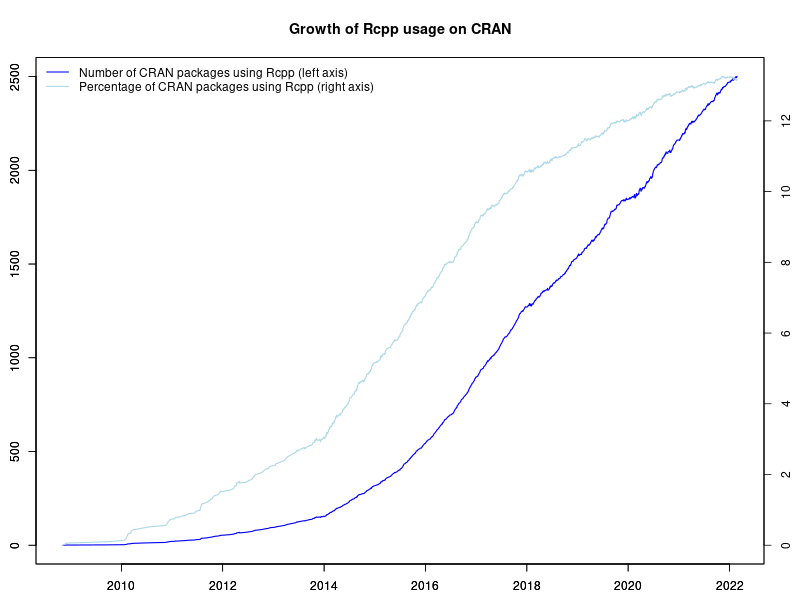
Dirk Eddelbuettel: Rcpp now used by 2500 CRAN packages!

2500 Rcpp packages As of this morning, Rcpp stands at 2501 reverse-dependencies on CRAN. The graph on the left depicts the growth of Rcpp usage (as measured by Depends, Imports and LinkingTo, but excluding Suggests) over time. Rcpp was first released in November 2008. It probably cleared 50 packages around three years later in December 2011, 100 packages in January 2013, 200 packages in April 2014, and 300 packages in November 2014. It passed 400 packages in June 2015 (when I tweeted about it), 500 packages in late October 2015, 600 packages in March 2016, 700 packages in July 2016, 800 packages in October 2016, 900 packages early January 2017, 1000 packages in April 2017, 1250 packages in November 2017, 1500 packages in November 2018, 1750 packages in August 2019, 2000 packages in July 2020, and 2250 package in March of last year. The chart extends to the very beginning via manually compiled data from CRANberries and checked with crandb. The next part uses manually saved entries. The core (and by far largest) part of the data set was generated semi-automatically via a short script appending updates to a small file-based backend. A (manually curated) list of packages using Rcpp is available too. Also displayed in the graph is the relative proportion of CRAN packages using Rcpp. The four per-cent hurdle was cleared just before useR! 2014 where I showed a similar graph (as two distinct graphs) in my invited talk. We passed five percent in December of 2014, six percent July of 2015, seven percent just before Christmas 2015, eight percent in the summer of 2016, nine percent mid-December 2016, cracked ten percent in the summer of 2017, eleven percent in 2018 and passed 12.5 percent or one in every eight CRAN packages dependens on Rcpp along with the 2000 packages mark. Truly stunning. As before, there is more detail in the chart: how CRAN seems to be pushing back more and removing more aggressively (which my CRANberries tracks but not in as much detail as it could), how the growth of Rcpp seems to be slowing somewhat outright and even more so as a proportion of CRAN as one would expect a growth curve to. The Rcpp team continues to aim for keeping Rcpp as performant and reliable as it has been (and see e.g. here for some more details). A really big shoutout and Thank You! to all users and contributors of Rcpp for help, suggestions, bug reports, documentation or, of course, code. If you like this or other open-source work I do, you can now sponsor me at GitHub. For the first year, GitHub will match your contributions.

This post by Dirk Eddelbuettel originated on his Thinking inside the box blog. Please report excessive re-aggregation in third-party for-profit settings.

24 February 2022

Dirk Eddelbuettel: #36: pub/sub for live market monitoring with R and Redis

Welcome to the 36th post of the really randomly reverberating R, or R4 for short, write-ups. Today s post is about using Redis, and especially RcppRedis, for live or (near) real-time monitoring with R. market monitor There is an saying that you can take the boy out of the valley, but you cannot the valley out of the boy so for those of us who spent a decade or two in finance and on trading floors, having some market price information available becomes second nature. And/or sometimes it is just good fun to program this. A good while back Josh posted a gist on a simple-yet-robust while loop. It (very cleverly) uses his quantmod package to access the SP500 in real-time . (I use quotes here because at the end of retail broadband one is not at the same market action as someone co-located in a New Jersey data center. It is however not delayed: as an index, it is not immediately tradeable as a stock, etf, or derivative may be all of which are only disseminated as delayed price information, usually by ten minutes.) I quite enjoyed the gist and used it and started tinkering with it. For example, it collects data but only saves (i.e. persists ) it after market close. If for whatever reason one needs to restart recent history is gone. In any event, I used his code and generalized it a little and published this about a year ago as function intradayMarketMonitor() in my dang package. (See this blog post announcing it.) The chart of the left shows this in action, the chart is a snapshot from a couple of days ago when the vignettes (more on them below) were written. As lovely as intradayMarketMonitor() is, it also limits itself to market hours. And sometimes you want to see, say, how the market opens on Sunday (futures usually restart at 17h Chicago time), or how news dissipates during the night, or where markets are pre-open, or . So I both wanted to complement this with futures, and also cache it locally so that, say, one machine might collect data and one (or several others) can visualize. For such tasks, Redis is unparalleled. (Yet I also always felt Redis could do with another, simple, short and sweet introduction stressing the key features of i) being multi-lingual: write in one language, consume in another and ii) loose coupling: no linking as one talks to Redis via standard tcp/ip networking. So I wrote a new intro vignette that is now in RcppRedis. I hope this comes in handy. Comments welcome!) Our RcppRedis package had long been used for such tasks, and it was easy to set it up. Standard use is to loop, fetch some data, push it to Redis, sleep, and start over. Clients do the same: fetch most recent data, plot or report it, sleep, start over. That works, but it has a dual delay as the client sleeping may miss the data update! The standard answer to this is called publish/pubscribe, or pub/sub. Libraries such as 0mq or zeromq specialise in this. But it turns out Redis already has it. I had some initial difficulty adding it to RcppRedis so for a trial I tested the marvellous rredis package by Bryan and simply instantiated two Redis clients. Now the data getter simply publishes a new data point in a given channel, by convention named after the security it tracks. Clients register with the Redis server which does all the actual work of keeping track of who listens to what. The clients now simply listen (which is a blocking operation) and as soon as data comes in receive it. market monitor This is quite mesmerizing when you just run two command-line clients (in a byobu session, say). As sone as the data is written (as shown on console log) it is consumed. No measruable overhead. Just lovely. Bryan and I then talked a litte as he may or may not retire rredis. Having implemented the pub/sub logic for both sides once, he took a good hard look at RcppRedis and just like that added it there. With some really clever wrinkles for (optional) per-symbol callback as closure attached to the instance. Truly amazeballs And once we had it in there, generalizing from publishing or subscribing to just one symbol easily generalizes to having one listener collect and publish for multiple symbols, and having one or more clients subscribe and listen one, more or even all symbol. All with ease thanks tp Redis. The second chart, also from a few days ago, shows four symbols for four (front-contract) futures for Bitcoin, Crude Oil, SP500, and Gold. As all this can get a little technical, I wrote a second vignette for RcppRedis on just this: market monitoring. Give this a read, if interested, feedback on this one is most welcome too! But all the code you need is included in the package just run a local Redis instance. Before closing, one sour note. I uploaded all this in a new and much improved updated RcppRedis 0.2.0 to CRAN on March 13 ten days ago. Not only is it still not there , but CRAN in their most delightful way also refuses to answer any emails of mine. Just lovely. The package exhibited just one compiler warning: a C++ compiler objected to the (embedded) C library hiredis (included as a fallback) for using a C language construct. Yes. A C++ compiler complaining about C. It s a non-issue. Yet it s been ten days and we still have nothing. So irritating and demotivating. Anyway, you can get the package off its GitHub repo. If you like this or other open-source work I do, you can sponsor me at GitHub.

This post by Dirk Eddelbuettel originated on his Thinking inside the box blog. Please report excessive re-aggregation in third-party for-profit settings.

23 February 2022

Russ Allbery: Review: Elder Race

Review: Elder Race, by Adrian Tchaikovsky
Publisher: Tordotcom
Copyright: November 2021
ISBN: 1-250-76871-3
Format: Kindle
Pages: 199
(It's a shame that a lot of people will be reading this novella on a black-and-white ebook reader, since the Emmanuel Shiu cover is absolutely spectacular. There's a larger image without the words at the bottom of that article.) When reports arrive at the court about demons deep in the forest that are taking over animals and humans and bending them to their will, the queen doesn't care. It's probably some unknown animal, and regardless, the forest kingdom is a rival anyway. Lynesse Fourth Daughter disagrees vehemently, but she has no power at court. Even apart from her lack of seniority, her love of stories and daring and adventures is a source of endless frustration to her mother. That is why this novella opens with her climbing the mountain path to the Tower of Nyrgoth Elder, the last of the ancient wizards, to seek his help. Nyr Illim Tevitch is an anthropologist second class of Earth's Explorer Corps, part of the second wave of Earth's outward expansion through the galaxy. In the first wave, colonies were seeded on habitable planets, only to be left stranded when Earth's civilization collapsed in an ecological crisis. Nyr was a member of a team of four, sent to make careful and limited contact with one of those lost colonies as part of Earth's second flourishing with more advanced technology. When the team lost contact with Earth, the other three went back while Nyr stayed to keep their field observations going. It's now 291 years of intermittent suspended animation later. Nyr's colleagues never came back, and there have been no messages from Earth. Elder Race is a Prime Directive anthropology story, a subgenre so long-standing that it has its own conventions and variations. Variations of the theme have been written by everyone from Eleanor Arnason to Iain M. Banks (linking to the book I have in mind is arguably a spoiler). Per the dedication, Tchaikovsky's take is based on Gene Wolfe's story "Trip, Trap," which I have not read but whose plot looks very similar. To that story structure, Tchaikovsky brings two major twists. First, Nyr is cut off from his advanced civilization, and has considerable reason to believe that civilization no longer exists. Do noninterference rules still have any meaning if Nyr is stranded and the civilization that made the rules is gone? Second, Nyr has already broken those rules rather spectacularly. More than a hundred years previously, he had ridden with Astresse Regent, a warrior queen and Lynesse's ancestor, to defeat a local warlord who had found control codes for abandoned advanced machinery and was using it as weaponry. In the process, he fell in love and made a rash promise to come to the aid of any of her descendants if he were needed. Lynesse has come to collect on the promise. Elder Race is told in alternating chapters between Nyr and Lynesse's viewpoints: first person for Nyr and tight third person for Lynesse. The core of the story is this doubled perspective, one from a young woman who wants to live in a fantasy novel and one from a deeply depressed anthropologist torn between wanting human contact, wanting to follow the rules of his profession, and wanting to explain to Lynesse that he is not a wizard. Nyr talks himself into helping with another misuse of advanced technology using the same logic he used a hundred years earlier: he's protecting Lynesse's pre-industrial society from interference rather than causing it. But the demons Lynesse wants him to fight are something entirely unexpected. This parallel understanding is a great story structure. What worked less for me was Tchaikovsky's reliance on linguistic barriers to prevent shared understanding. Whenever Nyr tries to explain something, Lynesse hears it in terms of magic and high fantasy, and often exactly backwards from how Nyr intended it. This is where my suspension of disbelief failed me, even though I normally don't have suspension of disbelief problems in SF stories. I was unable to map Lynesse's misunderstandings to any realistic linguistic model. Lynesse's language is highly complex (a realistic development within an isolated population), and Nyr complains about his inability to speak it properly given it's blizzard of complex modifiers. This is entirely believable. What is far less believable is that Lynesse perceives him as fluent in her language, but often saying the precise opposite of what he's trying to say. One chapter in the middle of the book gives Nyr's intended story side-by-side with Lynesse's understanding. This is a brilliant way to show the divide, but I found the translation errors unbelievable. If Nyr is failing that profoundly to communicate his meaning, he should be making more egregious sentence-level errors, occasionally saying something bizarre or entirely nonsensical, referring to a person as an animal or a baby, or otherwise not fluently telling a coherent story that's fundamentally different than the one he thinks he's telling. If you can put that aside, though, this is a fun story. Nyr has serious anxiety and depression made worse by his isolation, and copes by using an implanted device called a Dissociative Cognition System that lets him temporarily turn off his emotions at the cost of letting them snowball. He has a wealth of other augments and implants, including horns, which Lynesse sees as evidence that he's a different species of magical being and which he sees as occasionally irritating field equipment with annoying visual menus. The key to writing a story like this is for both perspectives to be correct given their own assumptions, and to offer insight that the other perspective is missing. I thought the linguistic part of that was unsuccessful, but the rest of it works. One of the best parts of novellas is that they don't wear out their welcome. This is a fun spin on well-trodden ground that tells a complete story in under 200 pages. I wish the ending had been a bit more satisfying and the linguistics had been more believable, but I enjoyed the time I spent in this world. Content warning for some body horror. Rating: 7 out of 10

5 February 2022

Louis-Philippe V ronneau: Migrating from ledger to hledger

I first started using ledger the original plain-text accounting software in 2017. Since then, I had been pretty happy with my accounting routine, but grew a little annoyed by the repetitive manual work I had to do to assign recurring transactions to the right account. To make things easier, I had a collection of bash scripts to parse and convert the CSV files from my bank's website1 into ledger entries. They were of course ugly, unreadable piles of sed-grep-regex and did not let met achieve the automation complexity I longed for. Dissatisfied with ledger's features, I decided to migrate to hledger. Contrary to ledger, hledger comes with a CSV parser one can use to import and classify recurring transactions automagically. Having a proper DSL for this makes all the difference: I can easily add new rules and understand the old ones. In the end, I get a very consistent result, something my old bash scripts weren't great at. Here is what my debit.csv.rules file looks like. It is used to tell hledger how CSV data from my debit card should be parsed:
# skip the headings line:
skip 1
# assign fields
fields , , , date, , description, , amount2-in, amount2-out
# assign account where the money comes from
# 99 to get it at the bottom of the transaction
account99 assets:checking
include matchers.rules
As you can see, the rules matching transactions to specific accounts are imported from another file, matchers.rules. I'm doing this since I want to be able to use the same set of rules for debit and credit and use the cards interchangeably. Here's a snippet of my matchers.rules file:
# house
if Loyer/bail
  account2  expenses:rent
# leisure
if PAYPAL .*STEAM GAMES
  account2  expenses:leisure:videogame
if PAYPAL .*BANDCAMP
  account2  expenses:leisure:music
Using this ruleset, a transaction looking like this:
"SOME ACCOUNT DESC","111111","EOP","2022/01/03",00002,"Loyer/bail","",521.00,"","","","",""
Would be transformed into:
2022-01-03 Loyer/bail
    expenses:rent                               521.00
    assets:checking
Sadly, hledger's CSV rules won't let you do arithmetics. This can be useful when you know a certain transaction needs to be split between accounts. This is where auto postings come in. They are a way to specify arbitrary rules when an account is encountered. Going back to my previous rent example, I split it 50/50 with my SO using this rule:
= expenses:rent
    assets:receivable:rent    *0.5
    assets:checking
After it is applied, the final transaction looks like this:
2022-01-03 Loyer/bail  ; modified:
    expenses:rent                               521.00
    assets:receivable:rent                      260.50  ; generated-posting: = expenses:rent
    assets:checking
Neat eh? Here is the little bash script I've written to automate all these steps:
 #!/bin/bash
#
# Convert CSV to ledger using hledger
declare -a assets=("credit" "debit")
# Read the array values with space
for i in "$ assets[@] "
do
  if test -f "$i.csv"
  then
    # convert to ledger
    LEDGER=$(hledger -f "$i.csv" --rules-file rules/"$i.csv".rules print)
    # add auto_postings
    LEDGER=$(printf "include rules/auto_postings.ledger\n\n$LEDGER\n"   hledger print -f- --auto)
    # remove superfluous assets:checking lines
    LEDGER=$(printf "$LEDGER"   sed '/assets:checking \+; generated.\+/d')
    printf "$LEDGER" > "$i.ledger"
  else
    printf "File $i.csv does not exist\n"
  fi
done
Migrating to hledger, I've cut down the time I spend on accounting from 1 hour per month to about 10 minutes, all while making my workflow much cleaner. Many thanks to the kind folks on #hledger @irc.libera.chat for the help!

  1. One for my checking+savings account and another one for my credit card.

Next.

Previous.