Search Results: "rra"

13 March 2021

Louis-Philippe V ronneau: Preventing an OpenPGP Smartcard from caching the PIN eternally

While I'm overall very happy about my migration to an OpenPGP hardware token, the process wasn't entirely seamless and I had to hack around some issues, for example the PIN caching behavior in GnuPG. As described in this bug the cache-ttl parameter in GnuPG is not implemented and thus does nothing. This means once you type in your PIN, it is cached for as long as the token is plugged. Security-wise, this is not great. Instead of manually disconnecting the token frequently, I've come up with a script that restarts scdameon if the token hasn't been used during the last X minutes. It seems to work well and I call it using this cron entry: */5 * * * * my_user /usr/local/bin/restart-scdaemon To get a log from scdaemon, you'll need a ~/.gnupg/scdaemon.conf file that looks like this:
debug-level basic
log-file /var/log/scdaemon.log
Hopefully it can be useful to others!
 #!/usr/bin/python3
# Copyright 2021, Louis-Philippe V ronneau <pollo@debian.org>
#
# This script is free software: you can redistribute it and/or modify it under
# the terms of the GNU General Public License as published by the Free Software
# Foundation, either version 3 of the License, or (at your option) any later
# version.
# 
# This script is distributed in the hope that it will be useful, but WITHOUT
# ANY WARRANTY; without even the implied warranty of MERCHANTABILITY or FITNESS
# FOR A PARTICULAR PURPOSE. See the GNU General Public License for more
# details.
# 
# You should have received a copy of the GNU General Public License along with
# this script. If not, see <http://www.gnu.org/licenses/>.
"""
This script restarts scdaemon after X minutes of inactivity to reset the PIN
cache. It is meant to be ran by cron each X/2 minutes.
This is needed because there is currently no way to set a cache time for
smartcards. See https://dev.gnupg.org/T3362#137811 for more details.
"""
import os
import sys
import subprocess
from datetime import datetime, timedelta
from argparse import ArgumentParser
p = ArgumentParser(description=__doc__)
p.add_argument('-l', '--log', default="/var/log/scdaemon.log",
               help='Path to the scdaemon log file.')
p.add_argument('-t', '--timeout', type=int, default="10",
               help=("Desired cache time in minutes."))
args = p.parse_args()
def get_last_line(scdaemon_log):
    """Returns the last line of the scdameon log file."""
    with open(scdaemon_log, 'rb') as f:
        f.seek(-2, os.SEEK_END)
        while f.read(1) != b'\n':
            f.seek(-2, os.SEEK_CUR)
        last_line = f.readline().decode()
    return last_line
def check_time(last_line, timeout):
    """Returns True if scdaemon hasn't been called since the defined timeout."""
    # We don't need to restart scdaemon if no gpg command has been run since
    # the last time it was restarted.
    should_restart = True
    if "OK closing connection" in last_line:
        should_restart = False
    else:
        last_time = datetime.strptime(last_line[:19], '%Y-%m-%d %H:%M:%S')
        now = datetime.now()
        delta = now - last_time
        if delta <= timedelta(minutes = timeout):
            should_restart = False
    return should_restart
def restart_scdaemon(scdaemon_log):
    """Restart scdaemon and verify the restart process was successful."""
    subprocess.run(['gpgconf', '--reload', 'scdaemon'], check=True)
    last_line = get_last_line(scdaemon_log)
    if "OK closing connection" not in last_line:
        sys.exit("Restarting scdameon has failed.")
def main():
    """Main function."""
    last_line = get_last_line(args.log)
    should_restart = check_time(last_line, args.timeout)
    if should_restart:
        restart_scdaemon(args.log)
if __name__ == "__main__":
    main()

6 March 2021

Shirish Agarwal: Making life difficult

Freedom house puts India in partly free Just couple of days ago, freedom house published its 2020 rankings for all countries including India. While freedom house shared how democracy in the world has weakened, India chose to take offense about it being called partly free .
India, leader in Internet shutdowns Access Now (copyright)
The above illustration is shared by accessnow . The next big ones who have Internet shutdowns are Yemen 6 and Ethiopia 4. Such internet shutdowns have and will have sad repercussions as would share in another story as well.

Color-coding journalists A story was broken by caravan magazine yesterday and which was followed by newslaundry which shows how the Govt. is looking to just drive some narrative, does not matter whether it s true or false, it should just show that the Govt. is right and others are all wrong. As can be seen, almost all reporters barring a few have kept silent rather than refuting statements attributed to them or happenings which didn t happen. And this goes to a much larger narrative and disinformation route taken by the Govt. which doesn t have any semblance to the truth or reality as people know it. I would illustrate couple of examples below which shares that. In all my young and even adult-life I hadn t seen a Govt. this much against its own people.

Omega Seiki puts a manufacturing plant in Bangladesh Now Omega Seiki is an Indian vendor who chose or had to go to manufacture their electric vehicles in Bangladesh. Now while this is a slightly old story this was broken on social media recently. Everybody starting blaming both the vendor and saying we should break FTA (Free Trade Agreement) with Bangladesh, not knowing that despite the FTA, India has put tariff barriers between India and Bangladesh. I had to share research from Brookings to show where India has been losing. Of course, those who don t want to see, wouldn t see anything wrong in the picture.

Teen raped, asked to marry the accused when she turns 18 Now you may see the above headlines and feel it is ridiculous, but the fact is that these orders were put or given by Madras High Court couple of months back. This was then reported by both Livelaw and BarandBench respectively. Now to be truthful, this news didn t make much noise as it should have, probably as I had shared previously that the Govt. wants to lower the marriageable age to 15 or even less. And this is despite all the medical evidence on the contrary, because it assuages this Govt s masculinity. There is also the very recent case where the SC CJI asked the rapist if he is willing to marry a girl who was underage when she reaches maturity. Another one in which it seems martial rape is not a crime according to the CJI. So it seems these are the state of things in which India finds itself today. There are judges like Vrinda Grover who do question CJI but they are few and there are costs to them who ask questions. Although, as shared this news was overtaken by other news and would have remained so, if not one of the leaders of the present Govt. , a Ramesh Jarkiholi, who hails from Belagavi region of north Karnataka was caught in a sex CD scandal basically asking sexual favors for a permanent Govt. job. He had made statements after the Madras High Court case applauding the judgement given by the judge. While, due to public pressure he had to resign, but not before stating that he had everybody blue films including the Chief Minister of the State. And sad to report that six Karnataka Ministers rushed today or rather yesterday to put a petition in the civil court to restrain media from airing/printing/publishing any defamatory content against them. The court has granted a media gag against 68 media houses for the same. Sadly, the recent happening only reinforce what has been happening in Karnataka since a decade. Update 07/03/2021 Seems yesterday another 10 odd ministers rushed to get the same order. Seems different laws apply to politicians vis-a-vis others. A recent example of Rhea Chakravarthy, an actress and girlfriend of Sushant Singh who was hounded in his suicide case and many accusations made on TV but no evidence till date. From what we know as facts, Sushant committed suicide as he was not getting work due to cronyism in Bollywood. In fact, those who were behind it have white-washed themselves, deleted their tweets etc. and while the public knows, no accountability on them. In fact, there is and was so much that I wanted to share as to what has been happening to women, sadly and thankfully arre did the needful for me. They wrote an entire article which tells what the situation for women in India today is. And if you are wondering why I said, that is because when a site which was made exclusively for people to laugh and have a good time and get relief, when they start writing serious articles, you can be sure that things have gone horribly wrong

Asking Tesla to come to India and at the same time ambivalent on battery Recently, Mr. Nitin Gadkari, a prominent minister of the present Govt. invited Tesla and gave all sorts of incentives to start a manufacturing plant here in India. And while it seems that Tesla has accepted, looking at the Vodafone case, hopefully Tesla does make such contracts where if something goes wrong and they need to sue the Govt. they can do it in States or elsewhere. The way the Govt. acted in the Vodafone case had been a dampener to any MNC investments so far. Although to be fair to both Tesla and GOI, the basic models even if they are manufactured in India will go to less than 1% of the population. The cheapest Tesla Model Y which retails in the U.S. for USD 40k would be around INR 30 lakh. And this is their cheapest car to date. I do know there are rumors of the 25k but that is probably 2-3 years away as shared by Tesla China President Tom Zhu in an interview shared on YT.

https://www.youtube.com/watch?v=aH5leMWFBxI There are couple of interesting comments being made. The fact that China is going to fully open its automobile market to western companies shows how confident China feels about their own vendors. And I m not much impressed about Tesla as I am about the tiny car revolution happening in China. India, if it wanted to, could learn many lessons from China. Even the electric buses they had started in 2010 itself where people in our auto industry thought it was all a fad. Sadly, we are missing most of the technology and if and by the time Tesla starts a production line, dunno where we could get our lithium. India hasn t been as aggressive as other countries when it comes to securing raw natural resources in other countries, as some other countries have.  Even besides that, it has been tough when you have so many people who still believe that ICE vehicles (Internal Combustion Engines) are better than EV s and even if they know they choose to believe the propaganda. Couple of months ago a young UK girl who had died due to asthma, an inquest found that air pollution was a factor. The girl s name was Ella Adoo-Kissi-Debrah. This is the first case where the doctor ruled air pollution as a chief factor in a person s death. Probably first of its kind of ruling anywhere in the world. I also shared TCO studies between BEV and ICE vehicles done by people who are considering an electric vehicle but those studies seem to fall on deaf ears.

Starlink This is another of Elon Musk s ventures and would be a money spinner for sure in around the globe. While Starlink has asked TRAI for permission, I don t think they will get it. There is also Bharti Global s Oneweb which probably has a better chance of getting permissions. The reason is censorship. As shared above, India is now a leader in Internet shutdowns and do see this trend only accelerate rather than go the other way around. For people who don t remember, remember how satellite phones were made illegal even though only businessmen could afford it. And this was just 5 years ago. As shared Oneweb would have better shot as they would accept all Government directives without a second thought. Unless Starlink gives a binding to the Govt. to be a willing partner when it wants to have internet shutdowns, it will not work. Now how Elon approaches that is to be seen and known. FWIW, you can t access Starlink webpage on BSNL broadband. My broadband provider gives at the most 300 kbps and sometimes, at late nights or early mornings, around 500 kbps.

Farmer Protests
Lastly, farmer protests have entered 100 days. In the interim, Vivek Kaul, an economist took stock of the Bihar APMC to see if things have really worked as the Govt. supporters were telling. The investigation and the results didn t inspire the confidence as the Govt. said. The sad part is though, that nowadays nobody, at least those in power as well as those who are supporters are keen to read, understand and even argue otherwise. They are all happy with whatsapp knowledge. Till date 200+ people have died in the farmer protests. All mainstream media houses have stopped talking about farmers in the hope that they will disappear. At the end of the day the Govt. wants that the corporates should win at whatever the cost.

4 March 2021

Gunnar Wolf: The power of EIDE

I am quite happy with the Raspberry tower I bought for keeping my Raspberries organized. Clustering them? No, not by a long shot. I just want to quickly know where they all are, and at a glance, be able to know which one I will work with. Bottom drawer has a RPi1B, second one has a RPi2, next comes a 3B+, and the top two ones are RPi4 (4 and 8GB). That allows me for quick testing of stuff. Yes, I am tempted to get the top one out of the array and use it in production but as it stands, that s the layout. My only quip with this? Serial console access. Connecting and releasing the three tiny cables (no, the red one is not required it provides +5V power, but it s not enough to power over USB more than the earliest RPis) with my big, fat and numb fingers Always takes a minute or three. Until I thought of the obvious: Why not connect the RPi headers to an old EIDE cable? They are of the same dimensions, and much more practical to connect and yank! with that interface expansion in place, I will be able to easily connect my console cables Or even more, I can put on a serious electronic look on my face, take out my soldering iro ehem my very small breadboard for those with limited abilities, and look more interesting! In fact, I am almost sure I can get these two little buggers to blink interestingly when bytes come and go to my RPis! I will finally gain a bit of self-respect as an electronic tinkerer! (yes, yes, I enjoy playing with RPis, but I treat them as Well Computers. I don t do interfacing to the real world, although I m sure it can be fun) What stopped me from doing so? Pin 20 of the EIDE specification. As a service to clumsy computer repairers such as myself, the standard specifies pin 20 is not to carry any signals, and the drive headers are to ship it cut (Key, pin missing), so that together with the notch on the outer part of the bracket inserting the cable upside down is physically impossible. So no, I m not able to finish the project with pieces at hand. I even went to two nearby electronic shops yesterday when I took my dog out for a walk, and could not find it there either So I ended up buying what appears to be a sweet, cheap product covering my needs from our corporate capitalist overlords.

2 March 2021

Russ Allbery: Review: The Lion, the Witch and the Wardrobe

Review: The Lion, the Witch and the Wardrobe, by C.S. Lewis
Illustrator: Pauline Baynes
Series: Chronicles of Narnia #1
Publisher: Collier Books
Copyright: 1950
Printing: 1978
ISBN: 0-02-044220-3
Format: Mass market
Pages: 186
Although it's been more than 20 years since I last read it, I believe I have read The Lion, the Witch and the Wardrobe more times than any other book. The count is certainly in double digits. As you might guess, I also have strong opinions about it, some of which are unorthodox, and I've been threatening to write this review for years. It seemed a fitting choice for my 1000th review. There is quite a lot that can and has been said about this book and this series, and this review is already going to be much too long, so I'm only going to say a fraction of it. I'm going to focus on my personal reactions as someone raised a white evangelical Christian but no longer part of that faith, and the role this book played in my religion. I'm not going to talk much about some of its flaws, particularly Lewis's treatment of race and gender. This is not because I don't agree they're there, but only that I don't have much to say that isn't covered far better in other places. Unlike my other reviews, this one will contain major spoilers. If you have managed to remain unspoiled for a 70-year-old novel that spawned multiple movies and became part of the shared culture of evangelical Christianity, and want to stay that way, I'll warn you in ALL CAPS when it's time to go. But first, a few non-spoiler notes. First, reading order. Most modern publications of The Chronicles of Narnia will list The Magician's Nephew as the first book. This follows internal chronological order and is at C.S. Lewis's request. However, I think Lewis was wrong. You should read this series in original publication order, starting with The Lion, the Witch and the Wardrobe (which I'm going to abbreviate as TLtWatW like everyone else who writes about it). I will caveat this by saying that I have a bias towards reading books in the order an author wrote them because I like seeing the development of the author's view of their work, and I love books that jump back in time and fill in background, so your experience may vary. But the problem I see with the revised publication order is that The Magician's Nephew explains the origins of Narnia and, thus, many of the odd mysteries of TLtWatW that Lewis intended to be mysterious. Reading it first damages both books, like watching a slow-motion how-to video for a magic trick before ever seeing it performed. The reader is not primed to care about the things The Magician's Nephew is explaining, which makes it less interesting. And the bits of unexpected magic and mystery in TLtWatW that give it so much charm (and which it needs, given the thinness of the plot) are already explained away and lose appeal because of it. I have read this series repeatedly in both internal chronological order and in original publication order. I have even read it in strict chronological order, wherein one pauses halfway through the last chapter of TLtWatW to read The Horse and His Boy before returning. I think original publication order is the best. (The Horse and His Boy is a side story and it doesn't matter that much where you read it as long as you read it after TLtWatW. For this re-read, I will follow original publication order and read it fifth.) Second, allegory. The common understanding of TLtWatW is that it's a Christian allegory for children, often provoking irritated reactions from readers who enjoyed the story on its own terms and later discovered all of the religion beneath it. I think this view partly misunderstands how Lewis thought about the world and there is a more interesting way of looking at the book. I'm not as dogmatic about this as I used to be; if you want to read it as an allegory, there are plenty of carefully crafted parallels to the gospels to support that reading. But here's my pitch for a different reading. To C.S. Lewis, the redemption of the world through the death of Jesus Christ is as foundational a part of reality as gravity. He spent much of his life writing about religion and Christianity in both fiction and non-fiction, and this was the sort of thing he constantly thought about. If somewhere there is another group of sentient creatures, Lewis's theology says that they must fit into that narrative in some way. Either they would have to be unfallen and thus not need redemption (roughly the position taken by The Space Trilogy), or they would need their own version of redemption. So yes, there are close parallels in Narnia to events of the Christian Bible, but I think they can be read as speculating how Christian salvation would play out in a separate creation with talking animals, rather than an attempt to disguise Christianity in an allegory for children. It's a subtle difference, but I think Narnia more an answer to "how would Christ appear in this fantasy world?" than to "how do I get children interested in the themes of Christianity?", although certainly both are in play. Put more bluntly, where other people see allegory, I see the further adventures of Jesus Christ as an anthropomorphic lion, which in my opinion is an altogether more delightful way to read the books. So much for the preamble; on to the book. The Pevensie kids, Peter, Susan, Edmund, and Lucy, have been evacuated to a huge old house in the country due to the air raids (setting this book during World War II, something that is passed over with barely a mention and not a hint of trauma in a way that a modern book would never do). While exploring this house, which despite the scant description is still stuck in my mind as the canonical huge country home, Lucy steps into a wardrobe because she wants to feel the fur of the coats. Much to her surprise, the wardrobe appears not to have a back, and she finds herself eventually stepping into a snow-covered pine forest where she meets a Fawn named Mr. Tumnus by an unlikely lamp-post. MAJOR SPOILERS BELOW, so if you don't want to see those, here's your cue to stop reading. Two things surprised me when re-reading TLtWatW. The first, which I remember surprising me every time I read it, is how far into this (very short) book one has to go before the plot kicks into gear. It's not until "What Happened After Dinner" more than a third in that we learn much of substance about Narnia, and not until "The Spell Begins to Break" halfway through the book that things start to happen. The early chapters are concerned primarily with the unreliability of the wardrobe portal, with a couple of early and brief excursions by Edmund and Lucy, and with Edmund being absolutely awful to Lucy. The second thing that surprised me is how little of what happens is driven by the kids. The second half of TLtWatW is about the fight between Aslan and the White Witch, but this fight was not set off by the children and their decisions don't shape it in any significant way. They're primarily bystanders; the few times they take action, it's either off-camera or they're told explicitly what to do. The arguable exception is Edmund, who provides the justification for the final conflict, but he functions more as plot device than as a character with much agency. When that is combined with how much of the story is also on rails via its need to recapitulate part of the gospels (more on that in a moment), it makes the plot feel astonishingly thin and simple. Edmund is the one protagonist who gets to make some decisions, all of them bad. As a kid, I hated reading these parts because Edmund is an ass, the White Witch is obviously evil, and everyone knows not to eat the food. Re-reading now, I have more appreciation for how Lewis shows Edmund's slide into treachery. He starts teasing Lucy because he thinks it's funny (even though it's not), has a moment when he realizes he was wrong and almost apologizes, but then decides to blame his discomfort on the victim. From that point, he is caught, with some help from the White Witch's magic, in a spiral of doubling down on his previous cruelty and then feeling unfairly attacked. Breaking the cycle is beyond him because it would require admitting just how badly he behaved and, worse, that he was wrong and his little sister was right. He instead tries to justify himself by spreading poisonous bits of doubt, and looks for reasons to believe the friends of the other children are untrustworthy. It's simplistic, to be sure, but it's such a good model of how people slide into believing conspiracy theories and joining hate groups. The Republican Party is currently drowning in Edmunds. That said, Lewis does one disturbing thing with Edmund that leaped out on re-reading. Everyone in this book has a reaction when Aslan's name is mentioned. For the other three kids, that reaction is awe or delight. For Edmund, it's mysterious horror. I know where Lewis is getting this from, but this is a nasty theological trap. One of the problems that religion should confront directly is criticism that questions the moral foundations of that religion. If one postulates that those who have thrown in with some version of the Devil have an instinctual revulsion for God, it's a free intellectual dodge. Valid moral criticism can be hand-waved away as Edmund's horrified reaction to Aslan: a sign of Edmund's guilt, rather than a possible flaw to consider seriously. It's also, needless to say, not the effect you would expect from a god who wants universal salvation! But this is only an odd side note, and once Edmund is rescued it's never mentioned again. This brings us to Aslan himself, the Great Lion, and to the heart of why I think this book and series are so popular. In reinterpreting Christianity for the world of Narnia, Lewis created a far more satisfying and relatable god than Jesus Christ, particularly for kids. I'm not sure I can describe, for someone who didn't grow up in that faith, how central the idea of a personal relationship with Jesus is to evangelical Christianity. It's more than a theological principle; it's the standard by which one's faith is judged. And it is very difficult for a kid to mentally bootstrap themselves into a feeling of a personal relationship with a radical preacher from 2000 years ago who spoke in gnomic parables about subtle points of adult theology. It's hard enough for adults with theological training to understand what that phrase is intended to mean. For kids, you may as well tell them they have a personal relationship with Aristotle. But a giant, awe-inspiring lion with understanding eyes, a roar like thunder, and a warm mane that you can bury your fingers into? A lion who sacrifices himself for your brother, who can be comforted and who comforts you in turn, and who makes a glorious surprise return? That's the kind of god with which one can imagine having a personal relationship. Aslan felt physical and embodied and present in the imagination in a way that Jesus never did. I am certain I was not the only Christian kid for whom Aslan was much more viscerally real than Jesus, and who had a tendency to mentally substitute Aslan for Jesus in most thoughts about religion. I am getting ahead of myself a bit because this is a review of TLtWatW and not of the whole series, and Aslan in this book is still a partly unformed idea. He's much more mundanely present here than he is later, more of a field general than a god, and there are some bits that are just wrong (like him clapping his paws together). But the scenes with Susan and Lucy, the night at the Stone Table and the rescue of the statues afterwards, remain my absolute favorite parts of this book and some of the best bits of the whole series. They strike just the right balance of sadness, awe, despair, and delight. The image of a lion also lets Lewis show joy in a relatable way. Aslan plays, he runs, he wrestles with the kids, he thrills in the victory over evil just as much as Susan and Lucy do, and he is clearly having the time of his life turning people back to flesh from stone. The combination of translation, different conventions, and historical distance means the Bible has none of this for the modern reader, and while people have tried to layer it on with Bible stories for kids, none of them (and I read a lot of them) capture anything close to the sheer joy of this story. The trade-off Lewis makes for that immediacy is that Aslan is a wonderful god, but TLtWatW has very little religion. Lewis can have his characters interact with Aslan directly, which reduces the need for abstract theology and difficult questions of how to know God's will. But even when theology is unavoidable, this book doesn't ask for the type of belief that Christianity demands. For example, there is a crucifixion parallel, because in Lewis's world view there would have to be. That means Lewis has to deal with substitutionary atonement (the belief that Christ died for the sins of the world), which is one of the hardest parts of Christianity to justify. How he does this is fascinating. The Narnian equivalent is the Deep Magic, which says that the lives of all traitors belong to the White Witch. If she is ever denied a life, Narnia will be destroyed by fire and water. The Witch demands Edmund's life, which sets up Aslan to volunteer to be sacrificed in Edmund's place. This triggers the Deeper Magic that she did not know about, freeing Narnia from her power. You may have noticed the card that Lewis is palming, and to give him credit, so do the kids, leading to this exchange when the White Witch is still demanding Edmund:
"Oh, Aslan!" whispered Susan in the Lion's ear, "can't we I mean, you won't, will you? Can't we do something about the Deep Magic? Isn't there something you can work against it?" "Work against the Emperor's magic?" said Aslan, turning to her with something like a frown on his face. And nobody ever made that suggestion to him again.
The problem with substitutionary atonement is why would a supposedly benevolent god create such a morally abhorrent rule in the first place? And Lewis totally punts. Susan is simply not allowed to ask the question. Lewis does try to tackle this problem elsewhere in his apologetics for adults (without, in my opinion, much success). But here it's just a part of the laws of this universe, which all of the characters, including Aslan, have to work within. That leads to another interesting point of theology, which is that if you didn't already know about the Christian doctrine of the trinity, you would never guess it from this book. The Emperor-Beyond-the-Sea and Aslan are clearly separate characters, with Aslan below the Emperor in the pantheon. This makes rules like the above work out more smoothly than they do in Christianity because Aslan is bound by the Emperor's rules and the Emperor is inscrutable and not present in the story. (The Holy Spirit is Deity Not-appearing-in-this-book, but to be fair to Lewis, that's largely true of the Bible as well.) What all this means is that Aslan's death is presented straightforwardly as a magic spell. It works because Aslan has the deepest understanding of the fixed laws of the Emperor's magic, and it looks nothing like what we normally think of as religion. Faith is not that important in this book because Aslan is physically present, so it doesn't require any faith for the children to believe he exists. (The Beavers, who believed in him from prophecy without having seen him, are another matter, but this book never talks about that.) The structure of religion is therefore remarkably absent despite the story's Christian parallels. All that's expected of the kids is the normal moral virtues of loyalty and courage and opposition to cruelty. I have read this book so many times that I've scrutinized every word, so I have to resist the temptation to dig into every nook and cranny: the beautiful description of spring, the weird insertion of Lilith as Adam's first wife, how the controversial appearance of Santa Claus in this book reveals Lewis's love of Platonic ideals... the list is endless, and the review is already much longer than normal. But I never get to talk about book endings in reviews, so one more indulgence. The best thing that can be said about the ending of TLtWatW is that it is partly redeemed by the start of Prince Caspian. Other than that, the last chapter of this book has always been one of my least favorite parts of The Chronicles of Narnia. For those who haven't read it (and who by this point clearly don't mind spoilers), the four kids are immediately and improbably crowned Kings and Queens of Narnia. Apparently, to answer the Professor from earlier in the book, ruling magical kingdoms is what they were teaching in those schools? They then spend years in Narnia, never apparently giving a second thought to their parents (you know, the ones who are caught up in World War II, which prompted the evacuation of the kids to the country in the first place). This, for some reason, leaves them talking like medieval literature, which may be moderately funny if you read their dialogue in silly voices to a five-year-old and is otherwise kind of tedious. Finally, in a hunt for the white stag, they stumble across the wardrobe and tumble back into their own world, where they are children again and not a moment has passed. I will give Lewis credit for not doing a full reset and having the kids not remember anything, which is possibly my least favorite trope in fiction. But this is almost as bad. If the kids returned immediately, that would make sense. If they stayed in Narnia until they died, that arguably would also make sense (their poor parents!). But growing up in Narnia and then returning as if nothing happened doesn't work. Do they remember all of their skills? How do you readjust to going to school after you've lived a life as a medieval Queen? Do they remember any of their friends after fifteen years in Narnia? Argh. It's a very "adventures are over, now time for bed" sort of ending, although the next book does try to patch some of this up. As a single book taken on its own terms, TLtWatW is weirdly slight, disjointed, and hits almost none of the beats that one would expect from a children's novel. What saves it is a sense of delight and joy that suffuses the descriptions of Narnia, even when locked in endless winter, and Aslan. The plot is full of holes, the role of the children in that plot makes no sense, and Santa Claus literally shows up in the middle of the story to hand out plot devices and make an incredibly sexist statement about war. And yet, I memorized every gift the children received as a kid, I can still feel the coziness of the Beaver's home while Mr. Beaver is explaining prophecy, and the night at the Stone Table remains ten times more emotionally effective for me than the description of the analogous event in the Bible. And, of course, there's Aslan.
"Safe?" said Mr. Beaver. "Don't you hear what Mrs. Beaver tells you? Who said anything about safe? 'Course he isn't safe. But he's good. He's the king, I tell you."
Aslan is not a tame lion, to use the phrase that echos through this series. That, I think, is the key to the god that I find the most memorable in all of fantasy literature, even in this awkward, flawed, and decidedly strange introduction. Followed by Prince Caspian, in which the children return to a much-changed Narnia. Lewis has gotten most of the obligatory cosmological beats out of the way in this book, so subsequent books can tell more conventional stories. Rating: 7 out of 10

27 February 2021

Dima Kogan: horizonator: terrain renderer based on SRTM DEMs

Check this out:
example-interactive.png
I just resurrected and cleaned up an old tool I had lying around. It's now nice and usable by others. This tool loads terrain data, and renders it from the ground, simulating what a human or a camera would see. This is useful for armchair exploring or for identifying peaks. This was relatively novel when I wrote it >10 years ago, but there are a number of similar tools in existence now. This implementation is still useful in that it's freely licensed and contains APIs, so fancier processing can be performed on its output. Sources and (barely-complete-enough) documentation live here: https://github.com/dkogan/horizonator

26 February 2021

Ritesh Raj Sarraf: Wayland KDE X11

KDE Impressions These days, I often hear a lot about Wayland. And how much of effort is being put into it; not just by the Embedded world but also the usual Desktop systems, namely KDE and GNOME. In recent past, I switched back to KDE and have been (very) happy about the switch. Even though the KDE 4 (and initial KDE 5) debacle had burnt many, coming back to a usable KDE desktop is always a delight. It makes me feel home with the elegance, while at the same time the flexibility, it provides. It feels so nice to draft this blog article from Kwrite + VI Input Mode Thanks to the great work of the Debian KDE Team, but Norbert Preining in particular, who has helped bring very up-to-date KDE packages into Debian. Right now, I m on a Plamsa 5.21.1 desktop, which is recent by all standards.

Wayland Almost all the places in the Linux world these days are busy with integrating Wayland as the primary display service. Not sure what the current status on the GNOME side is but I definitely keep trying KDE + Wayland with every release. I keep trying with every release because it still is not prime for daily use. And it makes me get back to X11, no matter how dated some may call. Fact is, X11 still shines to me as an end-user. Glitches with Wayland still are (Based on this week s test on Plasma 5.21.1):
  • Horrible performance compared to X11
  • Very crashy, especially when hotplugging secondary display. Plasma would just crash. X11 is very resilient to such things, part of the reason I can think is the age of the codebase.
  • Many many applications still need to be fixed for Wayland. Or Wayland needs to accomodate them in some way. XWayland does not really feel like the answer.
And while KDE keeps insisting users to switch to Wayland, as that s where all the new enhancements and fixes are put in, someone like me still needs to stick to X11 for the time being. So to get my shiny new LG 27" 4K Monitor (3840x2160 60.00*+) to work without too much glitch, I had to live with an alias:
$ alias   grep xrandr
alias rrs_xrandr_lg='xrandr --output DP-1 --mode 3840x2160 --scale .75x.75'
18:31                    

Plasma 5.21 On the brighter side, the Plasma 5.21.1 release brings some nice enhancements in other areas.
  • I m now able to make use of tighter integration with systemd/cgroups, with better organization and management of processes overall.
  • The new Plasma theme, Breeze Twilight, is a good blend of Light + Dark.
I also appreciate the work put in by Michail Vourlakos. The KDE project is lucky to have a developer/designer like him. His vision and work into the KDE desktop is well beyond a writing by me.
$ usystemctl status plasma-plasmashell.service 
  plasma-plasmashell.service - KDE Plasma Workspace
     Loaded: loaded (/usr/lib/systemd/user/plasma-plasmashell.service; enabled; vendor preset: enabled)
     Active: active (running) since Fri 2021-02-26 18:34:23 IST; 13s ago
   Main PID: 501806 (plasmashell)
      Tasks: 21 (limit: 18821)
     Memory: 759.8M
        CPU: 13.706s
     CGroup: /user.slice/user-1000.slice/user@1000.service/session.slice/plasma-plasmashell.service
              501806 /usr/bin/plasmashell --no-respawn
             
Feb 26 18:35:00 priyasi plasmashell[501806]: qml: recreating buttons
Feb 26 18:35:21 priyasi plasmashell[501806]: qml: recreating buttons
Feb 26 18:35:49 priyasi plasmashell[501806]: qml: recreating buttons
Feb 26 18:35:57 priyasi plasmashell[501806]: qml: recreating buttons
18:36                  

OBS - Open Build Service I should also thank the OpenSUSE folks for the OBS work. It has enabled the close equivalent (or better, in my experience) of PPAs for Debian. And that is what has enabled developers like Norbert to easily and quickly be able to deliver the entire KDE suite.

OBS - Some detail Christian asked for some more details on the OBS side of things, of my view. I m updating this article with it because the comment system may not always be reliable and I hate losing content. Having been using OBS myself, and also others in the Debian community who are making use of it, I surely think we as project should consider making use of OBS. Given that OBS is Free Software, it is a perfect fit for Debian. Gitlab is another example of what we ve made available in Debian. OBS is divided into multiple parts
  • OBS Server
  • OBS DoD service
  • OBS Publisher
  • OBS Workers
  • OBS Warden
  • OBS Rep Server
For every Debian release I care about, I add an OBS project per release. So I have OBS projects for: Sid, Bullseye, Buster, Jessie. Now, say you have a package, foo . You prep your package and enable all the releases that you want to build the package for. So the same package gets built, in separate clean environments, for every release I mentioned as an example above. You don t have to manually trigger the build for every release/every architcture. You should add the release (as projects) in OBS, set their supported architectures, and then add those enabled release projets as bits to your package. Every build involves:
  • Creating a new chroot for each build
  • Building the package
Builds can be scattered across multiple hosts, known as workers in OBS terminology. Your workers are independent machine entities, supporting different architectures. The machines can be Bare-Metal ones, VMs, even containers. So this allows for very nice scale-in and scale-out. There may be auto-scaling too but that is something worth investigating. Think of things like cross architecture builds. Let s assume the cloud vendors decide to donate resources to the Debian project. We could enable OBS worker instances on the respective clouds (different architectures) and plug them into the master OBS instance that Debian hosts. Fully distributed. Similarly, big hardware vendors willing to donate compute resources could house them in their premises and Debian could just easily establish a connection to them. All of this just a TCP connection away. So when I look at the features of OBS, from the point of view of Debian, I like it more. Extensibility won t be an issue. Supporting a new Debian release would just be a matter of bootstrapping the Debian release as a project in OBS, and then all done. The single effort of setting of the target release project is a one time job, and then all can leverage it. The PPA was a long craved feature missing in Debian, in my opinion. OBS allows to not just fulfil that gap but also extend it in a very easy way. Andrew Lee had put in a nice video presentation about the same @ Debconf 20

22 February 2021

Russ Allbery: Review: Finder

Review: Finder, by Suzanne Palmer
Series: Finder Chronicles #1
Publisher: DAW Books
Copyright: 2019
ISBN: 0-7564-1511-X
Format: Kindle
Pages: 391
Fergus Ferguson is a repo man, or professional finder as he'd prefer. He locates things taken by people who don't own them and returns them to their owners. In this case, the thing in question is a sentient starship, and the person who stole it is Arum Gilger, a warlord in a wired-together agglomeration of space habitats and mined-out asteroids named Cernekan. Cernee, as the locals call it, is in the backwaters of human space near the Gap between the spiral arms of the galaxy. One of Fergus's first encounters in Cernee is with an old lichen farmer named Mattie Vahn who happens to take the same cable car between stations that he does. Bad luck for Fergus, since that's also why Gilger's men first disable and then blow up the cable car, leaving Mattie dead and Fergus using the auto-return feature of Mattie's crates to escape to the Vahns' home station. The Vahns are not a power in Cernee, not exactly, but they do have some important alliances and provide an inroads for Fergus to get the lay of the land and map out a plan to recover the Venetia's Sword. This is a great hook. I would happily read a whole series about an interstellar repo man, particularly one like Fergus who only works for the good guys and recovers things from petty warlords. Fergus is a thoughtful, creative loner whose style is improvised plans, unexpected tactics, and thinking on his feet rather than either bluster or force (although there is a fair bit of death in this book, some of which is gruesome). About two-thirds of the book is in roughly that expected shape. Fergus makes some local contacts, maps out the political terrain, and maneuvers himself towards his target through a well-crafted slum of wired-together habitats and working-class miners. Also, full points for the creative security system on the starship that tries to solve a nearly impossible problem (a backdoor supplementing pre-shared keys with a cultural authentication scheme that can't be vulnerable to brute force or database searches). Halfway through, though, Palmer throws a curve ball at the reader that involves the unexplained alien presence that's been lurking around the system. That part of the plot shifts focus somewhat abruptly from the local power struggle Fergus has been navigating to something far more intrusive and personal. Fergus has to both reckon with a drastic change in his life and deal with memories of his early life on an Earth drowning in climate change, his abusive childhood, and his time spent in the Martian resistance. This is also a fine topic for an SF novel, but I think Finder suffered a bit from falling between two stools. The fun competence drama of the lone repossession agent striking back against petty tyrants by taking away their toys is derailed by the sudden burst of introspection and emotional processing, but the processing is not deep or complex enough to carry the story on its own. Fergus had an awful and emotionally alienated childhood followed by some nasty trauma, to which he has responded by carefully never getting close to anyone so that he never hurts anyone who relies on him. And yet, he's a fundamentally decent person and makes friends despite himself, and from there you can probably write the rest of the arc yourself. There's nothing wrong with this as the emotional substrate of a book that's primarily focused on an action plot, but the screeching change of focus threw me off. The good news is that the end of the book returns to the bits that I liked about the first half. The mixed news is that I thought the political situation in Cernee resolved much too easily and much too straightforwardly. I would have preferred the twisty alliances to stay twisty, rather than collapse messily into a far simpler moral duality. I will also speak on behalf of all the sentient starship lovers out there and complain that the Venetia's Sword was woefully underused. It had better show up in a future volume! This unsteadiness and a few missed opportunities make Finder a good book rather than a great one, but I was still happily entertained and willing to write that off as first-novel unevenness. There are a lot of background elements left unresolved for a future volume, but Finder comes to a satisfying conclusion. Recommended if you're looking for an undemanding space action story with a quick pace and decent, if not very deep, characters. Followed by Driving the Deep. Rating: 7 out of 10

14 February 2021

Chris Lamb: The Silence of the Lambs: 30 Years On

No doubt it was someone's idea of a joke to release Silence of the Lambs on Valentine's Day, thirty years ago today. Although it references Valentines at one point and hints at a deeper relationship between Starling and Lecter, it was clearly too tempting to jeopardise so many date nights. After all, how many couples were going to enjoy their ribeyes medium-rare after watching this? Given the muted success of Manhunter (1986), Silence of the Lambs was our first real introduction to Dr. Lecter. Indeed, many of the best scenes in this film are introductions: Starling's first encounter with Lecter is probably the best introduction in the whole of cinema, but our preceding introduction to the asylum's factotum carries a lot of cultural weight too, if only because the camera's measured pan around the environment before alighting on Barney has been emulated by so many first-person video games since.
We first see Buffalo Bill at the thirty-two minute mark. (Or, more tellingly, he sees us.) Delaying the viewer's introduction to the film's villain is the mark of a secure and confident screenplay, even if it was popularised by the budget-restricted Jaws (1975) which hides the eponymous shark for one hour and 21 minutes.
It is no mistake that the first thing we see of Starling do is, quite literally, pull herself up out of the unknown. With all of the focus on the Starling Lecter repartee, the viewer's first introduction to Starling is as underappreciated as she herself is to the FBI. Indeed, even before Starling tells Lecter her innermost dreams, we learn almost everything we need to about Starling in the first few minutes: we see her training on an obstacle course in the forest, the unused rope telling us that she is here entirely voluntarily. And we can surely guess why; the passing grade for a woman in the FBI is to top of the class, and Starling's not going to let an early February in Virginia get in the way of that. We need to wait a full three minutes before we get our first line of dialogue, and in just eight words ("Crawford wants to see you in his office...") we get our confirmation about the FBI too. With no other information other than he can send a messenger out into the cold, we can intuit that Crawford tends to get what Crawford wants. It's just plain "Crawford" too; everyone knows his actual title, his power, "his" office. The opening minutes also introduce us to the film's use of visual hierarchy. Our Hermes towers above Starling throughout the brief exchange (she must push herself even to stay within the camera's frame). Later, Starling always descends to meet her demons: to the asylum's basement to visit Lecter and down the stairs to meet Buffalo Bill. Conversely, she feels safe enough to reveal her innermost self to Lecter on the fifth floor of the courthouse. (Bong Joon-ho's Parasite (2019) uses elevation in an analogous way, although a little more subtly.)
The messenger turns to watch Starling run off to Crawford. Are his eyes involuntarily following the movement or he is impressed by Starling's gumption? Or, almost two decades after John Berger's male gaze, is he simply checking her out? The film, thankfully, leaves it to us.
Crawford is our next real introduction, and our glimpse into the film's sympathetic treatment of law enforcement. Note that the first thing that the head of the FBI's Behavioral Science Unit does is to lie to Starling about the reason to interview Lecter, despite it being coded as justified within the film's logic. We learn in the book that even Barney deceives Starling, recording her conversations with Lecter and selling her out to the press. (Buffalo Bill always lies to Starling, of course, but I think we can forgive him for that.) Crawford's quasi-compliment of "You grilled me pretty hard on the Bureau's civil rights record in the Hoover years..." then encourages the viewer to conclude that the FBI's has been a paragon of virtue since 1972... All this (as well as her stellar academic record, Crawford's wielding of Starling's fragile femininity at the funeral home and the cool reception she receives from a power-suited Senator Ruth Martin), Starling must be constantly asking herself what it must take for anyone to take her seriously. Indeed, it would be unsurprising if she takes unnecessary risks to make that happen.
The cold open of Hannibal (2001) makes for a worthy comparison. The audience remembers they loved the dialogue between Starling and Lecter, so it is clumsily mentioned. We remember Barney too, so he is shoehorned in as well. Lacking the confidence to introduce new signifiers to its universe, Red Dragon (2002) aside, the hollow, 'clip show' feel of Hannibal is a taste of the zero-calorie sequels to come in the next two decades.
The film is not perfect, and likely never was. Much has been written on the fairly transparent transphobia in Buffalo Bill's desire to wear a suit made out of women's skin, but the film then doubles down on its unflattering portrayal by trying to have it both ways. Starling tells the camera that "there's no correlation between transsexualism and violence," and Lecter (the film's psychoanalytic authority, remember) assures us that Buffalo Bill is "not a real transsexual" anyway. Yet despite those caveats, we are continually shown a TERFy cartoon of a man in a wig tucking his "precious" between his legs and an absurdly phallic gun. And, just we didn't quite get the message, a decent collection of Nazi memorabilia. The film's director repeated the novel's contention that Buffalo Bill is not actually transgender, but someone so damaged that they are seeking some kind of transformation. This, for a brief moment, almost sounds true, and the film's deranged depiction of what it might be like to be transgender combined with its ambivalence feels distinctly disingenuous to me, especially given that on an audience and Oscar-adjusted basis Silence of the Lambs may very well be the most transphobic film to come out of Hollywood. Still, I remain torn on the death of the author, especially when I discover that Jonathan Demme went on to direct Philadelphia (1993), likely the most positive film about homophobia and HIV.

Nevertheless, as an adaption of Thomas Harris' original novel, the movie is almost flawless. The screenplay excises red herrings and tuns down the volume on some secondary characters. Crucially for the format, it amplifies Lecter's genius by not revealing that he knew everything all along and cuts Buffalo Bill's origin story for good measure too good horror, after all, does not achieve its effect on the screen, but in the mind of the viewer. The added benefit of removing material from the original means that the film has time to slowly ratchet up the tension, and can remain patient and respectful of the viewer's intelligence throughout: it is, you could almost say, "Ready when you are, Sgt. Pembury". Otherwise, the film does not deviate too far from the original, taking the most liberty when it interleaves two narratives for the famous 'two doorbells' feint.
Dr. Lecter's upright stance when we meet him reminds me of the third act of Alfred Hitchcock's Notorious (1946), another picture freighted with meaningful stairs. Stanley Kubrick's The Killing (1956) began the now-shopworn trope of concealing a weapon in a flower box.
Two other points of deviation from the novel might be worthy of mention. In the book, a great deal is made of Dr. Lecter's penchant for Bach's Goldberg Variations, inducing a cultural resonance with other cinematic villains who have a taste for high art. It is also stressed in the book that it is the Canadian pianist Glenn Gould's recording too, although this is likely an attempt by Harris to demonstrate his own refined sensibilities Lecter would surely have prefered a more historically-informed performance on the harpsichord. Yet it is glaringly obvious that it isn't Gould playing in the film at all; Gould's hypercanonical 1955 recording is faster and focused, whilst his 1981 release is much slower and contemplative. No doubt tedious issues around rights prevented the use of either recording, but I like to imagine that Gould himself nixed the idea. The second change revolves around the film's most iconic quote. Deep underground, Dr. Lecter tries to spook Starling:
A census taker once tried to test me. I ate his liver with some fava beans and a nice Chianti.
The novel has this as "some fava beans and a big Amarone". No doubt the movie-going audience could not be trusted to know what an Amarone was, just as they were not to capable of recognising a philosopher. Nevertheless, substituting Chianti works better here as it cleverly foreshadows Tuscany (we discover that Lecter is living in Florence in the sequel), and it avoids the un-Lecterian tautology of 'big' Amarone's, I am reliably informed, are big-bodied wines. Like Buffalo Bill's victims. Yet that's not all. "The audience", according to TV Tropes:
... believe Lecter is merely confessing to one of his crimes. What most people would not know is that a common treatment for Lecter's "brand of crazy" is to use drugs of a class known as MAOIs (monoamine oxidase inhibitors). There are several things one must not eat when taking MAOIs, as they can case fatally low blood pressure, and as a physician and psychiatrist himself, Dr. Lecter would be well aware of this. These things include liver, fava beans, and red wine. In short, Lecter was telling Clarice that he was off his medication.
I could write more, but as they say, I'm having an old friend for dinner. The starling may be a common bird, but The Silence of the Lambs is that extremely rara avis indeed the film that's better than the book. Ta ta...

11 February 2021

Dirk Eddelbuettel: td 0.0.1 on CRAN: New Finance Data Package

Thrilled to announce that a new package of mine just made it to CRAN: the td package accesses the twelvedata API for financial data. Currently only the time_series REST access point is supported, but it is already supported with all meaningful options (we skipped only JSON or CSV which makes no sense here) so for example any resolution between 1 minute and 1 month can be requested for any stock, etf or currency symbol for a wide array of exchanges. Historical access is available too via (optional) start and end dates. We return either raw JSON or a data.frame or an xts object making it trivial to call high-end plotting functions on the data the project and repo pages show several examples. As just one example, here is GME during the follies. We simply request via
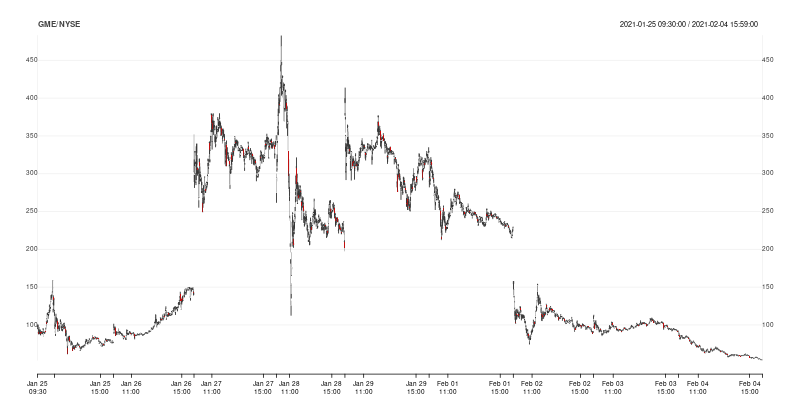
> gme <- time_series("GME", "1min",
+                    start_date="2021-01-25 09:30:00",
+                    end_date="2021-02-04 16:00:00", as="xts")
(where the API key is either in a user-local config file accessed via the new-ish R function tools::R_user_dir("td") pointing at this package s directory, or via an environment variable; either is accessed at package load or attachment) from which we can then plot via quantmod
> quantmod::chart_Series(gme, name=paste0(attr(gme, "symbol"), "/", attr(gme, "exchange")))
which shows how we also helpfully store metadata returned by twelvedata as extra attributes of the object. The chart is You will need an API key to have up to 800 daily accesses for free, higher-performance plans (including websocket access) are available for paying customers too. I have only used the free API so far myself. I plan to add quote and price support this weekend, and generalize the time series access to returning lists of objects as the API does in fact support multi-security access. As always, feedback is welcomed. Please post comments and suggestions at the GitHub repo. If you like this or other open-source work I do, you can now sponsor me at GitHub.

This post by Dirk Eddelbuettel originated on his Thinking inside the box blog. Please report excessive re-aggregation in third-party for-profit settings.

9 February 2021

Kees Cook: security things in Linux v5.8

Previously: v5.7 Linux v5.8 was released in August, 2020. Here s my summary of various security things that caught my attention: arm64 Branch Target Identification
Dave Martin added support for ARMv8.5 s Branch Target Instructions (BTI), which are enabled in userspace at execve() time, and all the time in the kernel (which required manually marking up a lot of non-C code, like assembly and JIT code). With this in place, Jump-Oriented Programming (JOP, where code gadgets are chained together with jumps and calls) is no longer available to the attacker. An attacker s code must make direct function calls. This basically reduces the usable code available to an attacker from every word in the kernel text to only function entries (or jump targets). This is a low granularity forward-edge Control Flow Integrity (CFI) feature, which is important (since it greatly reduces the potential targets that can be used in an attack) and cheap (implemented in hardware). It s a good first step to strong CFI, but (as we ve seen with things like CFG) it isn t usually strong enough to stop a motivated attacker. High granularity CFI (which uses a more specific branch-target characteristic, like function prototypes, to track expected call sites) is not yet a hardware supported feature, but the software version will be coming in the future by way of Clang s CFI implementation. arm64 Shadow Call Stack
Sami Tolvanen landed the kernel implementation of Clang s Shadow Call Stack (SCS), which protects the kernel against Return-Oriented Programming (ROP) attacks (where code gadgets are chained together with returns). This backward-edge CFI protection is implemented by keeping a second dedicated stack pointer register (x18) and keeping a copy of the return addresses stored in a separate shadow stack . In this way, manipulating the regular stack s return addresses will have no effect. (And since a copy of the return address continues to live in the regular stack, no changes are needed for back trace dumps, etc.) It s worth noting that unlike BTI (which is hardware based), this is a software defense that relies on the location of the Shadow Stack (i.e. the value of x18) staying secret, since the memory could be written to directly. Intel s hardware ROP defense (CET) uses a hardware shadow stack that isn t directly writable. ARM s hardware defense against ROP is PAC (which is actually designed as an arbitrary CFI defense it can be used for forward-edge too), but that depends on having ARMv8.3 hardware. The expectation is that SCS will be used until PAC is available. Kernel Concurrency Sanitizer infrastructure added
Marco Elver landed support for the Kernel Concurrency Sanitizer, which is a new debugging infrastructure to find data races in the kernel, via CONFIG_KCSAN. This immediately found real bugs, with some fixes having already landed too. For more details, see the KCSAN documentation. new capabilities
Alexey Budankov added CAP_PERFMON, which is designed to allow access to perf(). The idea is that this capability gives a process access to only read aspects of the running kernel and system. No longer will access be needed through the much more powerful abilities of CAP_SYS_ADMIN, which has many ways to change kernel internals. This allows for a split between controls over the confidentiality (read access via CAP_PERFMON) of the kernel vs control over integrity (write access via CAP_SYS_ADMIN). Alexei Starovoitov added CAP_BPF, which is designed to separate BPF access from the all-powerful CAP_SYS_ADMIN. It is designed to be used in combination with CAP_PERFMON for tracing-like activities and CAP_NET_ADMIN for networking-related activities. For things that could change kernel integrity (i.e. write access), CAP_SYS_ADMIN is still required. network random number generator improvements
Willy Tarreau made the network code s random number generator less predictable. This will further frustrate any attacker s attempts to recover the state of the RNG externally, which might lead to the ability to hijack network sessions (by correctly guessing packet states). fix various kernel address exposures to non-CAP_SYSLOG
I fixed several situations where kernel addresses were still being exposed to unprivileged (i.e. non-CAP_SYSLOG) users, though usually only through odd corner cases. After refactoring how capabilities were being checked for files in /sys and /proc, the kernel modules sections, kprobes, and BPF exposures got fixed. (Though in doing so, I briefly made things much worse before getting it properly fixed. Yikes!) RISCV W^X detection
Following up on his recent work to enable strict kernel memory protections on RISCV, Zong Li has now added support for CONFIG_DEBUG_WX as seen for other architectures. Any writable and executable memory regions in the kernel (which are lovely targets for attackers) will be loudly noted at boot so they can get corrected. execve() refactoring continues
Eric W. Biederman continued working on execve() refactoring, including getting rid of the frequently problematic recursion used to locate binary handlers. I used the opportunity to dust off some old binfmt_script regression tests and get them into the kernel selftests. multiple /proc instances
Alexey Gladkov modernized /proc internals and provided a way to have multiple /proc instances mounted in the same PID namespace. This allows for having multiple views of /proc, with different features enabled. (Including the newly added hidepid=4 and subset=pid mount options.) set_fs() removal continues
Christoph Hellwig, with Eric W. Biederman, Arnd Bergmann, and others, have been diligently working to entirely remove the kernel s set_fs() interface, which has long been a source of security flaws due to weird confusions about which address space the kernel thought it should be accessing. Beyond things like the lower-level per-architecture signal handling code, this has needed to touch various parts of the ELF loader, and networking code too. READ_IMPLIES_EXEC is no more for native 64-bit
The READ_IMPLIES_EXEC flag was a work-around for dealing with the addition of non-executable (NX) memory when x86_64 was introduced. It was designed as a way to mark a memory region as well, since we don t know if this memory region was expected to be executable, we must assume that if we need to read it, we need to be allowed to execute it too . It was designed mostly for stack memory (where trampoline code might live), but it would carry over into all mmap() allocations, which would mean sometimes exposing a large attack surface to an attacker looking to find executable memory. While normally this didn t cause problems on modern systems that correctly marked their ELF sections as NX, there were still some awkward corner-cases. I fixed this by splitting READ_IMPLIES_EXEC from the ELF PT_GNU_STACK marking on x86 and arm/arm64, and declaring that a native 64-bit process would never gain READ_IMPLIES_EXEC on x86_64 and arm64, which matches the behavior of other native 64-bit architectures that correctly didn t ever implement READ_IMPLIES_EXEC in the first place. array index bounds checking continues
As part of the ongoing work to use modern flexible arrays in the kernel, Gustavo A. R. Silva added the flex_array_size() helper (as a cousin to struct_size()). The zero/one-member into flex array conversions continue with over a hundred commits as we slowly get closer to being able to build with -Warray-bounds. scnprintf() replacement continues
Chen Zhou joined Takashi Iwai in continuing to replace potentially unsafe uses of sprintf() with scnprintf(). Fixing all of these will make sure the kernel avoids nasty buffer concatenation surprises. That s it for now! Let me know if there is anything else you think I should mention here. Next up: Linux v5.9.

2021, Kees Cook. This work is licensed under a Creative Commons Attribution-ShareAlike 4.0 License.
CC BY-SA 4.0

8 February 2021

Russ Allbery: Review: The Future of Another Timeline

Review: The Future of Another Timeline, by Annalee Newitz
Publisher: Tor
Copyright: September 2019
ISBN: 0-7653-9212-7
Format: Kindle
Pages: 350
Tess is a time traveler from 2022, a member of the semi-secret Daughters of Harriet who are, under the cover of an academic research project, attempting to modify the timeline to improve women's rights in the United States. Beth is a teenager in suburban Irvine in Alta California, with an abusive father, a tight-knit group of friends, and a love of feminist punk rock. The story opens with both of them at a Grape Ape concert in 1992. Beth is hanging out with her friends, and Tess is looking for signs of a conspiracy to alter the timeline to further restrict the rights of women. The Future of Another Timeline has a great science fiction premise. There are time machines buried in geologically-stable bedrock that have been there since before any current species evolved. The first was discovered by humans thousands of years before the start of the story. They can be controlled with vibrations in the rock and therefore don't need any modern technology to operate. Humanity has therefore lived with time travel for much of recorded history, albeit with a set of rules strictly imposed by these mysterious machines: individuals can only travel to their own time or earlier, and cannot carry any equipment with them. The timeline at the start of the book is already not ours, and it shifts further over the course of the plot. Time travel has a potentially devastating effect on the foundations of narrative, so most SF novels that let the genie of time travel out of the bottle immediately start trying to stuff it back in again. Newitz does not, which is a refreshing change. The past is not immutable, there is no scientific or magical force that prevents history from changing, and people do not manage to keep something with a history of thousands of years either secret or well-controlled. It's not a free-for-all: There is a Chronology Academy that sets some rules for time travelers, the Machines themselves have rules that prevent time travel from being too casual, and most countries have laws about what time travelers are allowed to do. But it's also not horribly difficult to travel in time, not horribly uncommon to come across someone from the future, and most of the rules are not strictly enforced. This does mean there are some things that one has to agree to not think about. (To take the most obvious example, the lack of government and military involvement in time travel is not believable, even given its constraints. One has to accept this as a story premise.) But it removes the claustrophobic rules-lawyering that's so common in time travel stories and lets Newitz tell a more interesting political story about the difficulty of achieving lasting social change. Unfortunately, this is also one of those science fiction novels that is much less interested in its premise and machinery than I was as a reader. The Machines are fascinating objects: ancient, mysterious, and as we learn more about them over the course of the story, rich with intriguing detail. After reading this summary, you're probably curious where they came from, what they can do, and how they work. So am I, after reading the book. The Future of Another Timeline is completely uninterested in that or any related question. About halfway through the book, a time traveler from the future demonstrates interfaces in the time machines that no one knew existed, the characters express some surprise, and then no one asks any meaningful questions for the rest of the book. At another point, the characters have the opportunity to see a Machine in something closer to its original form before aspects of its interface have eroded away. They learn just enough to solve their immediate plot problem and show no further curiosity. I found this immensely frustrating, in part due to the mixed signaling. Normally if an author is going to use a science fiction idea as pure plot device, they avoid spending much time on it, implicitly warning the reader that this isn't where the story is going. Newitz instead provides the little details and new revelations that normally signal that understanding these objects will be a key to the plot, and then shrugs and walks away, leaving every question unanswered. Given how many people enjoyed Rendezvous with Rama, this apparently doesn't bother other readers as much as it bothers me. If you are like me, though, be warned. But, fine, this is a character story built around a plot device rather than a technology story. That's a wholly valid mode of science fiction, and that part of the book has heft. It reminded me of the second-wave feminist science fiction of authors like Russ and Charnas, except updated to modern politics. The villains are a projection forward of the modern on-line misogynists (incels, specifically), but Newitz makes the unusual choice of not focusing on their motives or interior lives. They simply exist as a malevolent hostile force, much the way that women experience them today on-line. They have to be defeated, the characters of the book set out to defeat them, and this is done without melodrama, hand-wringing, or psychoanalysis. It's refreshingly straightforward and unambiguous, and it keeps the focus on the people trying to make the world a better place rather than on the redemption arc of some screaming asshole. The part I was less enamored of is that these are two of the least introspective first-person protagonists that I've seen in a book. Normally, first-person perspective is used to provide a rich internal monologue about external events, but both Tess and Beth tell their stories as mostly-dry sequences of facts. Sometimes this includes a bit of what they're feeling, but neither character delves much into the why or how. This improves somewhat towards the end of the book, but I found the first two-thirds of the story oddly flat and had a hard time generating much interest in or sympathy for the characters. There are good in-story reasons for both Tess and Beth to heavily suppress their emotions, so I will not argue this is unrealistic, but character stories work better for me with more of an emotional hook. Hand-in-hand with that is the problem that the ending didn't provide the catharsis that I was hoping for. Beth goes through absolute hell over the course of the book, and while that does reach a resolution that I know intellectually is the best type of resolution that her story can hope for, it felt wholly insufficient. Tess's story reaches a somewhat more satisfying conclusion, but one that reverses an earlier moral imperative in a way that I found overly sudden. And everything about this book is highly contingent and temporary in a way that is true to its theme and political statement but that left me feeling more weary than satisfied. That type of ending is a valid authorial choice, and to some extent my complaint is only that this wasn't the book for me at the time I read it. But I have read other books with similarly conditional endings and withdrawn characters that still carried me along with the force and power of the writing (Daughters of the North comes to mind). The Future of Another Timeline is not poorly written, but neither do I think it achieves that level of skill. The writing is a bit wooden, the flow of sentences is a touch cliched and predictable, and the characters are a bit thin. It's serviceable writing had there been something else (such as a setting-as-character exploration of the origins and purpose of the Machines) to grab my attention and pull me along. But if the weight of the story has to be born by the quality of the writing, I don't think it was quite up to the task. Overall, I think The Future of Another Timeline has a great premise that it treats with frustrating indifference, a satisfyingly different take on time travel with some obvious holes, some solid political ideas reminiscent of an earlier age of feminist SF, a refreshing unwillingness to center evil on its own terms, characters that took more than half the book to develop much depth, and a suitable but frustrating ending. I can see why other people liked it more than I did, but I can't recommend it. Content warning: Rape, graphic violence, child abuse, gaslighting, graphic medical procedure, suicide, extreme misogyny, and mutilation, and this is spread throughout the book, not concentrated in one scene. I'm not very squeamish about non-horror fiction and it was still rather a lot, so please read with care. Rating: 6 out of 10

6 February 2021

Andrew Cater: Debian 10.8 release process - Yay, it's a lot faster

Thanks to the changes behind the scenes, images are now being produced significantly faster than they were: the embarrassingly parallel speed up has worked, though at slight cost to the predictability of when we get each architecture produced for us to test.Thanks, as ever, to Sledge, RattusRattus and Isy over in Cambridge and to schweer who painstakingly tests all the debian-edu releases.83 out of 94 steps done and it's only 13:50 GMT - less popular architectures are coming on apace. There's still a lot of testing to do: we will never be able to test s390x for example. Other architectures - including mips* - we have no machines, we're building as best efforts and we can't guarantee how well they will work for anyone.Anybody installing the less popular architectures please let us know that you've installed them and how you get on. We'd like to see a positive report as well as bugs: we don't see much feedback at all to know how useful they are: evidence of installs on any architecture is always helpful to us.

30 January 2021

Reproducible Builds (diffoscope): diffoscope 166 released

The diffoscope maintainers are pleased to announce the release of diffoscope version 166. This version includes the following changes:
[ Chris Lamb ]
* New features and bugfixes:
  - Explicitly remove our top-level temporary directory.
    (Closes: #981123, reproducible-builds/diffoscope#234)
  - Increase fuzzy matching threshold to 130 ensure that we show more
    differences. (Closes: reproducible-builds/diffoscope#232)
  - Save our sys.argv in our top-level temporary directory in case it
    helps debug current/errant temporary directories.
  - Prefer to use "magic.Magic" over the "magic.open" compatibility
    interface. (Closes: reproducible-builds/diffoscope#236)
  - Reduce fuzzy threshold to 110 to prevent some test failures.
    (Closes: reproducible-builds/diffoscope#233)
* Output improvements:
  - Show fuzzyness amount in percentage terms, not out of the
    rather-arbitrary "400".
  - Improve the logging of fuzzy matching.
  - Print the free space in our temporary directory when we create it, not
    from within diffoscope.main.
* Codebase improvements:
  - Tidy the diffoscopecomparators.utils.fuzzy module.
  - Update my copyright years.
  - Clarify the grammar of a comment.
  - Clarify in a comment that __del__ is not always called, so temporary
    directories are not neccessary removed the *moment* they go out of scope.
[ Conrad Ratschan ]
* Fix U-Boot Flattened Image Tree ("FIT") image detection for larger image
  files. (MR: reproducible-builds/diffoscope!75)
You find out more by visiting the project homepage.

29 January 2021

Jamie McClelland: So... is Signal good or bad?

After Facebook updated their Whatsapp privacy policy, and a certain rich capitalist who doesn't like Facebook for reasons different then mine told the world to use Signal, Signal's downloads went up by 4,200%. As often happens when something becomes popular, the criticisms start to fly! For the record, I currently think promoting Signal is an important tactical strategy for the left. [I also think we should promote and install federated chat apps like conversations and element and delta chat whereever it is possible.] Here are some of the main criticisms I hear that I think are a distraction: Here are some criticisms that I think are nuanced: These last two are not exactly two sides of the same coin, but they are related. How Signal manages to balance privacy and protection from abuse will be the real test as to whether promoting Signal continues to be a useful strategy for the left.

27 January 2021

Russ Allbery: Review: A Deadly Education

Review: A Deadly Education, by Naomi Novik
Series: The Scholomance #1
Publisher: Del Rey
Copyright: 2020
ISBN: 0-593-12849-4
Format: Kindle
Pages: 319
Some children are born with magic, which grows as they mature. Magic attracts maleficaria: extremely deadly magical beasts that want to feast on that magic. Having innate magical ability is therefore a recipe for endless attacks from monsters and a death at a young age. This was true even for the enclaves, which are the rich, gated communities of the magical world. Hence, the Scholomance. This is a boarding school for magic users placed in the Void and protected against maleficaria as completely as possible while still letting the students graduate and leave after their senior year. Students are sent there via a teleportation spell with a weight allowance, taught magic by automated systems and magical artifacts, and left on their own to make alliances and survive. Or not survive; protected as well as possible still means that there are maleficaria everywhere, sneaking past the wards of the graduation hall and looking for snacks. The school sends cleansing fire through the halls at certain times; the rest of the time, the students either learn enough magic to defeat maleficaria themselves, form alliances with those who can, or die to feed the magic of the school. Enter Galadriel, or El as she prefers. She's not an enclave kid; she's the grumpy, misfit daughter of a hippie mother whose open-hearted devotion to healing and giving away her abilities make her the opposite of the jealously guarded power structures of the enclaves. El has no resources other than what she can muster on her own. She also has her mother's ethics, which means that although she has an innate talent for malia, drawing magic from the death of other living things, she forces herself to build her mana through rigorously ethical means. Like push-ups. Or, worse, crochet. At the start of the book, El is in her third year of four, and significantly more of her classmates are alive than normally would be. That's because of her classmate, Orion Lake, who has made a full-time hobby of saving everyone from maleficaria. His unique magical ability frees him from the constraints of mana or malia that everyone else is subject to, and he uses that to be a hero, surrounded by adoring fans. And El is thoroughly sick of it. This book is so good in so many different ways that I don't know where to start. Obviously, A Deadly Education is a twist on the boarding school novel, both the traditional and the magical kind. This is not a genre in which I'm that well-read, but even with my lack of familiarity, I noticed so many things Novik does to improve the genre tropes, starting with not making the heroic character with the special powers the protagonist. And getting rid of all the adults, which leaves way more space for rich social dynamics between the kids (complex and interesting ones that are entangled with the social dynamics outside of the school, not some simplistic Lord of the Flies take). Going alone anywhere in the school is dangerous, as is sitting at the bad tables in the cafeteria, so social cliques become a matter of literal life and death. And the students aren't just trying to survive; the ones who aren't part of enclaves are jockeying for invitations or trying to build the power to help their family and allies form their own. El is the first-person narrator of the story and she's wonderful. She's grumpy, cynical, and sarcastic, which is often good for first-person narrators, but she also has a core of ethics from her mother, and from her own decisions, that gives her so much depth. She is the type of person who knows exactly how much an ethical choice will cost her and how objectively stupid it is, and then will make it anyway out of sheer stubbornness and refuse to take credit for it. I will happily read books about characters like El until the end of time. Her mother never appears in this book, and yet she's such a strong presence because El's relationship with her matters, to both El and to the book. El could not be more unlike her mother in both personality and in magical focus, and she's exasperated by the sheer impracticality of some of her mother's ideals. And yet there's a core of love and understanding beneath that, a level at which El completely understands her mother's goals, and El relies on it even when she doesn't realize she's doing so. I don't think I've ever read a portrayal of a mother-daughter relationship this good where one of the parties isn't even present. And I haven't even gotten to the world-building, and the level to which Novik chases down and explores all the implications of this ridiculous murder machine of a school. I will offer this caveat: If you poke at the justification for creating this school in the way it was built, it's going to teeter a lot. That society thought this school was the best solution to its child mortality problem is just something you have to roll with. But once you accept that, the implications are handled so very well. The school is an inhuman character in its own right, with exasperating rules that the students learn and warn each other about. It tries to distract you with rare spellbooks or artifact materials because it's trying to kill you. The language tapes whisper horrific stories of your death. The back wall of your room is a window to the Void, from which you can demand spellbooks. You'll even get them in languages that you understand, for a generous definition of understand that may have involved glancing at one page of text, so be careful not to do that! The school replaces all of the adult teachers in the typical boarding school novel and is so much more interesting than any of them because it adds the science fiction thrill of setting as character. The world-building does mean a lot of infodumping, so be prepared for that. El likes to explain things, tell stories, and over-analyze her life, and reading this book is a bit like reading the journal of a teenage girl. For me, El's voice is so strong, authentic, stubborn, and sarcastically funny that I scarcely noticed the digressions into background material. And the relationships! Some of the turns will be predictable, since of course El's stubborn ethics will be (eventually) rewarded by the story, but the dynamic that develops between El and Orion is something special. It takes a lot to make me have sympathy with the chosen one boy hero, but Novik pulls it off without ever losing sight of the dynamics of class and privilege that are also in play. And the friendships El develops almost accidentally by being stubbornly herself are just wonderful, and the way she navigates them made me respect her even more. The one negative thing I will say about this book is that I don't think Novik quite nailed the climax. Some of this is probably because this is the first book of a series and Novik wanted to hold some social developments in reserve, but I thought El got a bit sidelined and ended up along for the ride in an action-movie sequence. Still, it's a minor quibble, and it's clear from the very end of the book that El is going to get more attention and end up in a different social position in the next book. This was a wholly engrossing and enjoyable story with a satisfying climax and only the barb of a cliffhanger in the very last line. It's the best SFF novel published in 2020 that I've read so far (yes, even better than Network Effect). Highly recommended, and I hope it gets award recognition this year. Followed by The Last Graduate (not yet published at the time of this review). Rating: 9 out of 10

23 January 2021

Dirk Eddelbuettel: prrd 0.0.4: More tweaks

prrd facilitates the parallel running [of] reverse dependency [checks] when preparing R packages. It is used extensively for Rcpp, RcppArmadillo, RcppEigen, BH, and possibly others. prrd screenshot image The key idea of prrd is simple, and described in some more detail on its webpage and its GitHub repo. Reverse dependency checks are an important part of package development that is easily done in a (serial) loop. But these checks are also generally embarassingly parallel as there is no or little interdependency between them (besides maybe shared build depedencies). See the (dated) screenshot (running six parallel workers, arranged in split byobu session). This release brings several smaller tweaks and improvements to the summary report that had accumulated in my use since the last realease last April. We also updated the CI runners as one does these days. The release is summarised in the NEWS entry:

Changes in prrd version 0.0.4 (2021-01-23)
  • Report summary mode is now compact, more robust and reports extended CRAN summaries. (Dirk via several changes)
  • Continuous Integration now uses run.sh from r-ci

My CRANberries provides the usual summary of changes to the previous version. See the aforementioned webpage and its repo for details. For more questions or comments use the issue tracker off the GitHub repo. If you like this or other open-source work I do, you can now sponsor me at GitHub.

This post by Dirk Eddelbuettel originated on his Thinking inside the box blog. Please report excessive re-aggregation in third-party for-profit settings.

17 January 2021

Wouter Verhelst: Software available through Extrepo

Just over 7 months ago, I blogged about extrepo, my answer to the "how do you safely install software on Debian without downloading random scripts off the Internet and running them as root" question. I also held a talk during the recent "MiniDebConf Online" that was held, well, online. The most important part of extrepo is "what can you install through it". If the number of available repositories is too low, there's really no reason to use it. So, I thought, let's look what we have after 7 months... To cut to the chase, there's a bunch of interesting content there, although not all of it has a "main" policy. Each of these can be enabled by installing extrepo, and then running extrepo enable <reponame>, where <reponame> is the name of the repository. Note that the list is not exhaustive, but I intend to show that even though we're nowhere near complete, extrepo is already quite useful in its current state:

Free software
  • The debian_official, debian_backports, and debian_experimental repositories contain Debian's official, backports, and experimental repositories, respectively. These shouldn't have to be managed through extrepo, but then again it might be useful for someone, so I decided to just add them anyway. The config here uses the deb.debian.org alias for CDN-backed package mirrors.
  • The belgium_eid repository contains the Belgian eID software. Obviously this is added, since I'm upstream for eID, and as such it was a large motivating factor for me to actually write extrepo in the first place.
  • elastic: the elasticsearch software.
  • Some repositories, such as dovecot, winehq and bareos contain upstream versions of their respective software. These two repositories contain software that is available in Debian, too; but their upstreams package their most recent release independently, and some people might prefer to run those instead.
  • The sury, fai, and postgresql repositories, as well as a number of repositories such as openstack_rocky, openstack_train, haproxy-1.5 and haproxy-2.0 (there are more) contain more recent versions of software packaged in Debian already by the same maintainer of that package repository. For the sury repository, that is PHP; for the others, the name should give it away. The difference between these repositories and the ones above is that it is the official Debian maintainer for the same software who maintains the repository, which is not the case for the others.
  • The vscodium repository contains the unencumbered version of Microsoft's Visual Studio Code; i.e., the codium version of Visual Studio Code is to code as the chromium browser is to chrome: it is a build of the same softare, but without the non-free bits that make code not entirely Free Software.
  • While Debian ships with at least two browsers (Firefox and Chromium), additional browsers are available through extrepo, too. The iridiumbrowser repository contains a Chromium-based browser that focuses on privacy.
  • Speaking of privacy, perhaps you might want to try out the torproject repository.
  • For those who want to do Cloud Computing on Debian in ways that isn't covered by Openstack, there is a kubernetes repository that contains the Kubernetes stack, the as well as the google_cloud one containing the Google Cloud SDK.

Non-free software While these are available to be installed through extrepo, please note that non-free and contrib repositories are disabled by default. In order to enable these repositories, you must first enable them; this can be accomplished through /etc/extrepo/config.yaml.
  • In case you don't care about freedom and want the official build of Visual Studio Code, the vscode repository contains it.
  • While we're on the subject of Microsoft, there's also Microsoft Teams available in the msteams repository. And, hey, skype.
  • For those who are not satisfied with the free browsers in Debian or any of the free repositories, there's opera and google_chrome.
  • The docker-ce repository contains the official build of Docker CE. While this is the free "community edition" that should have free licenses, I could not find a licensing statement anywhere, and therefore I'm not 100% sure whether this repository is actually free software. For that reason, it is currently marked as a non-free one. Merge Requests for rectifying that from someone with more information on the actual licensing situation of Docker CE would be welcome...
  • For gamers, there's Valve's steam repository.
Again, the above lists are not meant to be exhaustive. Special thanks go out to Russ Allbery, Kim Alvefur, Vincent Bernat, Nick Black, Arnaud Ferraris, Thorsten Glaser, Thomas Goirand, Juri Grabowski, Paolo Greppi, and Josh Triplett, for helping me build the current list of repositories. Is your favourite repository not listed? Create a configuration based on template.yaml, and file a merge request!

9 January 2021

Thorsten Alteholz: My Debian Activities in December 2020

FTP master This month I only accepted 8 packages and like last month rejected 0. Despite the holidays 293 packages got accepted. Debian LTS This was my seventy-eighth month that I did some work for the Debian LTS initiative, started by Raphael Hertzog at Freexian. This month my all in all workload has been 26h. During that time I did LTS uploads of: Unfortunately package slirp has the same version in Stretch and Buster. So I first had to upload slirp/1:1.0.17-11 to unstable, in order to be allowed to fix the CVE in Buster and to finally upload a new version to Stretch. Meanwhile the fix for Buster has been approved by the Release Team and I am waiting for the next point release now. I also prepared a debdiff for influxdb, which will result in DSA-4823-1 in January. As there appeared new CVEs for openjpeg2, I did not do an upload yet. This is planned for January now. Last but not least I did some days of frontdesk duties. Debian ELTS This month was the thirtieth ELTS month. During my allocated time I uploaded: As well as for LTS, I did not finish work on all CVEs of openjpeg2, so the upload is postponed to January. Last but not least I did some days of frontdesk duties. Unfortunately I also had to give back some hours. Other stuff This month I uploaded new upstream versions of: I fixed one or two bugs in: I improved packaging of: Some packages just needed a source upload: and there have been even some new packages: With these uploads I finished the libosmocom- and libctl-transitions. The Debian Med Advent Calendar was again really successful this year. There was no new record, but with 109, the second most number of bugs has been closed.
year number of bugs closed
2011 63
2012 28
2013 73
2014 5
2015 150
2016 95
2017 105
2018 81
2019 104
2020 109
Well done everybody who participated. It is really nice to see that Andreas is no longer a lone wolf.

6 January 2021

Urvika Gola: Dog tails and tales from 2020

There is no denying in the fact that 2020 was a challenging year for everybody, including animals. In India, animals such as dogs who mostly filled their bellies at street food stalls, were starving as there were no street eateries operating during a long long lockdown. I was in my home town, New Delhi, working from home like most of us. During the month of July 2020, a dog near the place I live (we fondly called her Brownie) delivered 7 pups in wilderness. I would never forget my first sight of them, inside a dirty, garbage filled land there were the cutest, cleanest, tiniest ball of fur! All of them were toppled as the land s surface was uneven.. The first instinct was to put them all together on a flat surface. After the search mission completed, this was the sight..
Brownie and her litter put together in the same land where she gave birth.
The next day, I sought help from a animal-lover person to build a temporary shed for the puppies! We came and changed sheets, cleaned the surroundings and put fresh water for Brownie until
..it started raining heavily one night and we were worried if the shed would sustain the heavy rainfall.
Next morning the first thing was to check on the pups, luckily, the pups were fine however, the entire area and their bed was damp. Without any second thought, the pups were moved from there to a safe house shelter as it was predicted that the rains will continue for a few more weeks due to monsoon. Soon, 2 months went by, from observing the pups crawl over, their eyes open and to their first bark, despite the struggles, it was an beautiful experience.
Brownie weaned off the pups and thus, they were ready for adoption! However, my biggest fear was, will anyone come forward to adopt them??

With such thoughts parallelly running in my mind, I started to post about adoption for these 7 pups.
To my biggest surprise, one by one, 5 amazing humans came forward and decided to give these pups a better life than what they would get on the streets of India. I wouldn t be able to express in words how grateful I will to be all the five dog parents who decided to adopt an Indian Street Puppy/Indies/Desi Puppy, opening up the space in their hearts and homes for the pups!

One of the 5 adopted pups is adopted by a person who hails from USA, but currently working in India. It s so heartwarming to see, that in India, despite so much awareness created against breeders and their methods, people still prefer to go for foreign bred puppy and disregard Indian/Desi Dogs.. On the other hand, there are foreigners who value the life of a Indian/Desi Dog : )

The 5 Adopted Pups who now have a permanent loving family!

The adorable, Robin !
Don and his new big brother!
The naughty and handsome, Swayze !
First Pup who got adopted Pluto
Playful and Beautiful, Bella !
If this isn t perfect, I don t know what is! God had planned loving families for them and they found it..
However, Its been almost six months now, that we haven t found a permanent home for 2 of the 7 pups, but they have the perfect foster family taking care of them right now.

UP FOR ADOPTION Delhi/NCR
Meet Momo and Beesa,
2 out of the 7 pups, who are still waiting for a forever home, currently living with a loving foster family.

Vaccinations, Deworming is done.
Female pups, 6 months old.

Now as winters are here, Along with one of my friend, who is also fostering the two pups, arranged gunny sack bags for our street, stray dogs. Two NGOs namely, Lotus Indie Foundation and We Exist Foundation who work Animal Welfare in India, were providing dog beds to ground volunteers like us. We are fortunate that they selected us and helped us to make winters less harsh for the stray dogs. However, the cold is such, I also purchased dog coats as well and put in on a few furries. After hours of running behind dogs and convincing them to wear coats, we managed to put it on a few.
Brownie, the mom dog!
This is a puppy!
She did not let us put coat on her
Another topic that needs more sensitivity is Sterilization/Neutering of dogs, that s a viable method cited by the Government to control dog population and end suffering of puppies who die under the wheels of cars. However, the implementation of this is worrisome, as it s not as robust. In a span of 6 months, I managed to get 5 dog sterilized in my area, number is not big but I feel it s a good start as an individual  When I see them now, healthier, happier, running around, with no fear of getting attacked by dogs, I can t express the content I feel. For 2 of the dogs (Brownie and her friend) I got it done personally from a private vet. For the other 3, I got it done via Municipal Corporations who do it for free for dogs, you d have to call them and they come with dog catchers and a van and drop them back in the same area, but volunteers like us have to be very vigilant and active during the whole process to follow up with them.
Dogs getting dropped off after sterilization.
My 2020 ended with this, I am not sure why I am I even writing this in my blog where mostly I focused on my technical work and experiences, but this pandemic was challenging was everybody and what we planned couldn t happen, but because of 2020, because of the pandemic, I was on WFH in my city and I was able to help a few dogs in my area have a healthy life ahead!

What I learned during this entire adventure was, there are a lot of sweet, sensitive, caring people that we are just yet to meet. Along the way, we will also meet insensitive and discouraging people, who are unwilling to change or listen, ignore them and continue your good.

Have 1 person by your side, it s so much stronger than 10 against you. Silver lining! Hope you all had some positive experiences despite the adversity faced by every single one of us.

4 January 2021

Russ Allbery: Review: The Once and Future Witches

Review: The Once and Future Witches, by Alix E. Harrow
Publisher: Redhook Books
Copyright: October 2020
ISBN: 0-316-42202-9
Format: Kindle
Pages: 515
Once upon a time there were three sisters. They were born in a forgotten kingdom that smelled of honeysuckle and mud, where the Big Sandy ran wide and the sycamores shone white as knuckle-bones on the banks. The sisters had no mother and a no-good father, but they had each other; it might have been enough. But the sisters were banished from their kingdom, broken and scattered.
The Once and Future Witches opens with Juniper, the youngest, arriving in the city of New Salem. The year is 1893, but not in our world, not quite; Juniper has witch-ways in her pocket and a few words of power. That's lucky for her because the wanted posters arrived before she did. Unbeknownst to her or to each other, her sisters, Agnes and Bella, are already in New Salem. Agnes works in a cotton mill after having her heart broken one too many times; the mill is safer because you can't love a cotton mill. Bella is a junior librarian, meek and nervous and uncertain but still fascinated by witch-tales and magic. It's Bella who casts the spell, partly by accident, partly out of wild hope, but it was Juniper arriving in the city who provided the final component that made it almost work. Not quite, not completely, but briefly the lost tower of Avalon appears in St. George's Square. And, more importantly, the three sisters are reunited. The world of the Eastwood sisters has magic, but the people in charge of that world aren't happy about it. Magic is a female thing, contrary to science and, more importantly, God. History has followed a similar course to our world in part because magic has been ruthlessly suppressed. Inquisitors are a recent memory and the cemetery has a witch-yard, where witches are buried unnamed and their ashes sown with salt. The city of New Salem is called New Salem because Old Salem, that stronghold of witchcraft, was burned to the ground and left abandoned, fit only for tourists to gawk at the supposedly haunted ruins. The women's suffrage movement is very careful to separate itself from any hint of witchcraft or scandal, making its appeals solely within the acceptable bounds of the church. Juniper is the one who starts to up-end all of that in New Salem. Juniper was never good at doing what she was told. This is an angry book that feels like something out of another era, closer in tone to a Sheri S. Tepper or Joanna Russ novel than the way feminism is handled in recent work. Some of that is the era of the setting, before women even had the right to vote. But primarily it's because Harrow, like those earlier works, is entirely uninterested in making excuses or apologies for male behavior. She takes an already-heated societal conflict and gives the underdogs magic, which turns it into a war. There is likely a better direct analogy from the suffrage movement, but the comparison that came to my mind was if Martin Luther King, Jr. proved ineffective or had not existed, and instead Malcolm X or the Black Panthers became the face of the Civil Rights movement. It's also an emotionally exhausting book. The protagonists are hurt and lost and shattered. Their moments of victory are viciously destroyed. There is torture and a lot of despair. It works thematically; all the external solutions and mythical saviors fail, but in the process the sisters build their own strength and their own community and rescue themselves. But it's hard reading at times if you're emotionally invested in the characters (and I was very invested). Harrow does try to balance the losses with triumphs and that becomes more effective and easier to read in the back half of the book, but I struggled with the grimness at the start. One particular problem for me was that the sisters start the book suspicious and distrustful of each other because of lies and misunderstandings. This is obvious to the reader, but they don't work through it until halfway through the book. I can't argue with this as a piece of characterization it made sense to me that they would have reacted to their past the way that they did. But it was still immensely frustrating to read, since in the meantime awful things were happening and I wanted them to band together to fight. They also worry over the moral implications of the fate of their father, whereas I thought the only problem was that the man couldn't die more than once. There too, it makes sense given the moral framework the sisters were coerced into, but it is not my moral framework and it was infuriating to see them stay trapped in it for so long. The other thing that I found troubling thematically is that Harrow personalizes evil. I thought the more interesting moral challenge posed in this book is a society that systematically abuses women and suppresses their power, but Harrow gradually supplants that systemic conflict with a villain who has an identity and a backstory. It provides a more straightforward and satisfying climax, and she does avoid the trap of letting triumph over one character solve all the broader social problems, but it still felt too easy. Worse, the motives of the villain turn out to be at right angles to the structure of the social oppression. It's just a tool he's using, and while that's also believable, it means the transfer of the narrative conflict from the societal to the personal feels like a shying away from a sharper political point. Harrow lets the inhabitants of New Salem off too easily by giving them the excuse of being manipulated by an evil mastermind. What I thought Harrow did handle well was race, and it feels rare to be able to say this about a book written by and about white women. There are black women in New Salem as well, and they have their own ways and their own fight. They are suspicious of the Eastwood sisters because they're worried white women will stir up trouble and then run away and leave the consequences to fall on black women... and they're right. An alliance only forms once the white women show willingness to stay for the hard parts. Black women are essential to the eventual success of the protagonists, but the opposite is not necessarily true; they have their own networks, power, and protections, and would have survived no matter what the Eastwoods did. The book is the Eastwoods' story, so it's mostly concerned with white society, but I thought Harrow avoided both making black women too magical or making white women too central. They instead operate in parallel worlds that can form the occasional alliance of mutual understanding. It helps that Cleopatra Quinn is one of the best characters of the book. This was hard, emotional reading. It's the sort of book where everything has a price, even the ending. But I'm very glad I read it. Each of the three sisters gets their own, very different character arc, and all three of those arcs are wonderful. Even Agnes, who was the hardest character for me to like at the start of the book and who I think has the trickiest story to tell, becomes so much stronger and more vivid by the end of the book. Sometimes the descriptions are trying a bit too hard and sometimes the writing is not quite up to the intended goal, but some of the descriptions are beautiful and memorable, and Harrow's way of weaving the mythic and the personal together worked for me. This is a more ambitious book than The Ten Thousand Doors of January, and while I think the ambition exceeded Harrow's grasp in a few places and she took a few thematic short-cuts, most of it works. The characters felt like living and changing people, which is not easy given how heavily the story structure leans on maiden, mother, and crone archetypes. It's an uncompromising and furious book that turns the anger of 1970s feminist SF onto themes that are very relevant in 2021. You will have to brace yourself for heartbreak and loss, but I think it's fantasy worth reading. Recommended. Rating: 8 out of 10

Next.

Previous.