Review:
Number Go Up, by Zeke Faux
| Publisher: |
Crown Currency |
| Copyright: |
2023 |
| Printing: |
2024 |
| ISBN: |
0-593-44382-9 |
| Format: |
Kindle |
| Pages: |
373 |
Number Go Up is a cross between a history and a first-person
account of investigative journalism around the cryptocurrency bubble and
subsequent collapse in 2022. The edition I read has an afterward from June
2024 that brings the story up to date with Sam Bankman-Fried's trial and a
few other events. Zeke Faux is a reporter for Bloomberg News and a fellow
of
New
America.
Last year, I read Michael Lewis's
Going
Infinite, a somewhat-sympathetic book-length profile of Sam
Bankman-Fried that made a lot of people angry. One of the common refrains
at the time was that people should read
Number Go Up instead, and
since I'm happy to read more about the absurdities of the cryptocurrency
world, I finally got around to reading the other big crypto book of 2023.
This is a good book, with some caveats that I am about to explain at
absurd length. If you want a skeptical history of the cryptocurrency
bubble, you should read it. People who think that it's somehow in
competition with Michael Lewis's book or who think the two books disagree
(including Faux himself) have profoundly missed the point of
Going
Infinite. I agree with Matt Levine: Both of these books are worth your
time if this is the sort of thing you like reading about. But (much) more
on Faux's disagreements with Lewis later.
The frame of
Number Go Up is Faux's quixotic quest to prove that
Tether is a fraud. To review this book, I therefore need to briefly
explain what Tether is. This is only the first of many extended
digressions.
One natural way to buy cryptocurrency would be to follow the same pattern
as a stock brokerage account. You would deposit some amount of money into
the account (or connect the brokerage account to your bank account), and
then exchange money for cryptocurrency or vice versa, using bank transfers
to put money in or take it out. However, there are several problems with
this. One is that swapping cryptocurrency for money is awkward and
sometimes expensive. Another is that holding people's investment money for
them is usually highly regulated, partly for customer safety but also to
prevent money laundering. These are often called KYC laws (Know Your
Customer), and the regulation-hostile world of cryptocurrency didn't want
to comply with them.
Tether is a stablecoin, which means that the company behind Tether
attempts to guarantee that one Tether is always worth exactly one US
dollar. It is not a speculative investment like Bitcoin; it's a
cryptocurrency substitute for dollars. People exchange dollars for Tether
to get their money into the system and then settle all of their subsequent
trades in Tether, only converting the Tether back to dollars when they
want to take their money out of cryptocurrency entirely. In essence,
Tether functions like the cash reserve in a brokerage account: Your Tether
holdings are supposedly guaranteed to be equivalent to US dollars, you can
withdraw them at any time, and because you can do so, you don't bother,
instead leaving your money in the reserve account while you contemplate
what new coin you want to buy.
As with a bank, this system rests on the assurance that one can always
exchange one Tether for one US dollar. The instant people stop believing
this is true, people will scramble to get their money out of Tether,
creating the equivalent of a bank run. Since Tether is not a regulated
bank or broker and has no deposit insurance or strong legal protections,
the primary defense against a run on Tether is Tether's promise that they
hold enough liquid assets to be able to hand out dollars to everyone who
wants to redeem Tether. (A secondary defense that I wish Faux had
mentioned is that Tether limits redemptions to registered accounts
redeeming more than $100,000, which is a tiny fraction of the people who
hold Tether, but for most purposes this doesn't matter because that
promise is sufficient to maintain the peg with the dollar.)
Faux's firmly-held belief throughout this book is that Tether is lying. He
believes they do not have enough money to redeem all existing Tether
coins, and that rather than backing every coin with very safe liquid
assets, they are using the dollars deposited in the system to make
illiquid and risky investments.
Faux never finds the evidence that he's looking for, which makes this
narrative choice feel strange. His theory was tested when there was a run
on Tether following the collapse of the Terra stablecoin. Tether passed
without apparent difficulty, redeeming $16B or about 20% of the
outstanding Tether coins. This doesn't mean Faux is wrong; being able to
redeem 20% of the outstanding tokens is very different from being able to
redeem 100%, and Tether has been fined for lying about its reserves. But
Tether is clearly more stable than Faux thought it was, which makes the
main narrative of the book weirdly unsatisfying. If he admitted he might
be wrong, I would give him credit for showing his work even if it didn't
lead where he expected, but instead he pivots to focusing on Tether's role
in money laundering without acknowledging that his original theory took a
serious blow.
In Faux's pursuit of Tether, he wanders through most of the other elements
of the cryptocurrency bubble, and that's the strength of this book. Rather
than write
Number Go Up as a traditional history, Faux chooses to
closely follow his own thought processes and curiosity. This has the
advantage of giving Faux an easy and natural narrative, something that
non-fiction books of this type can struggle with, and it lets Faux show
how confusing and off-putting the cryptocurrency world is to an outsider.
The best parts of this book were the parts unrelated to Tether. Faux
provides an excellent summary of the
Axie Infinity
speculative bubble and even traveled to the Philippines to interview
people who were directly affected. He then wandered through the bizarre
world of NFTs, and his first-hand account of purchasing one (specifically
a
Mutant Ape)
to get entrance to a party (which sounded like a miserable experience I
would pay money to get out of) really drives home how sketchy and weird
cryptocurrency-related software and markets can be. He also went to El
Salvador to talk to people directly about the country's supposed embrace
of Bitcoin, and there's no substitute for that type of reporting to show
how exaggerated and dishonest the claims of cryptocurrency adoption are.
The disadvantage of this personal focus on Faux himself is that it
sometimes feels tedious or sensationalized. I was much less interested in
his unsuccessful attempts to interview the founder of Tether than Faux
was, and while the digression into forced labor compounds in Cambodia
devoted to
pig
butchering scams was informative (and horrific), I think Faux leaned too
heavily on an indirect link to Tether. His argument is that cryptocurrency
enables a type of money laundering that is particularly well-suited to
supporting scams, but both scams and this type of economic slavery existed
before cryptocurrency and will exist afterwards. He did not make a very
strong case that Tether was uniquely valuable as a money laundering
service, as opposed to a currently useful tool that would be replaced with
some other tool should it go away.
This part of the book is essentially an argument that money laundering is
bad because it enables crime, and sure, to an extent I agree. But if
you're going to put this much emphasis on the evils of money laundering, I
think you need to at least acknowledge that many people outside the United
States do not want to give US government, which is often openly hostile to
them, veto power over their financial transactions. Faux does not.
The other big complaint I have with this book, and with a lot of other
reporting on cryptocurrency, is that Faux is sloppy with the term "Ponzi
scheme." This is going to sound like nit-picking, but I think this
sloppiness matters because it may obscure an ongoing a shift in
cryptocurrency markets.
A Ponzi scheme is not any speculative bubble. It is a very specific type
of fraud in which investors are promised improbably high returns at very
low risk and with safe principal. These returns are paid out, not via
investment in some underlying enterprise, but by taking the money from new
investments and paying it to earlier investors. Ponzi schemes are doomed
because satisfying their promises requires a constantly increasing flow of
new investors. Since the population of the world is finite, all Ponzi
schemes are
mathematically guaranteed to eventually fail, often in
a sudden death spiral of ever-increasing promises to lure new investors
when the investment stream starts to dry up.
There are some Ponzi schemes in cryptocurrency, but most practices that
are called Ponzi schemes are not. For example, Faux calls
Axie
Infinity a Ponzi scheme, but it was missing the critical elements of
promised safe returns and fraudulently paying returns from the investments
of later investors. It was simply a speculative bubble that people bought
into on the assumption that its price would increase, and like any
speculative bubble those who sold before the peak made money at the
expense of those who bought at the peak.
The reason why this matters is that Ponzi schemes are a self-correcting
problem. One can decry the damage caused when they collapse, but one can
also feel the reassuring certainty that they will inevitably collapse and
prove the skeptics correct. The same is not true of speculative assets in
general. You may think that the lack of an underlying economic
justification for prices means that a speculative bubble is guaranteed to
collapse eventually, but in the famous words of Gary Schilling, "markets
can remain irrational a lot longer than you and I can remain solvent."
One of the people Faux interviews explains this distinction to him
directly:
Rong explained that in a true Ponzi scheme, the organizer would have
to handle the "fraud money." Instead, he gave the sneakers away and
then only took a small cut of each trade. "The users are trading
between each other. They are not going through me, right?" Rong said.
Essentially, he was arguing that by downloading the Stepn app and
walking to earn tokens, crypto bros were Ponzi'ing themselves.
Faux is openly contemptuous of this response, but it is technically
correct. Stepn is not a Ponzi scheme; it's a speculative bubble. There are
no guaranteed returns being paid out of later investments and no promise
that your principal is safe. People are buying in at price that you may
consider irrational, but Stepn never promised you would get your money
back, let alone make a profit, and therefore it doesn't have the
exponential progression of a Ponzi scheme. One can argue that this is a
distinction without a moral difference, and personally I would agree, but
it matters immensely if one is trying to analyze the future of
cryptocurrencies.
Schemes as transparently unstable as Stepn (which gives you coins for
exercise and then tries to claim those coins have value through some
vigorous hand-waving) are nearly as certain as Ponzi schemes to eventually
collapse. But it's also possible to create a stable business around
allowing large numbers of people to regularly lose money to small numbers
of sophisticated players who are collecting all of the winnings. It's
called a poker room at a casino, and no one thinks poker rooms are Ponzi
schemes or are doomed to collapse, even though nearly everyone who plays
poker will lose money.
This is the part of the story that I think Faux largely missed, and which
Michael Lewis highlights in
Going Infinite. FTX was a legitimate
business that made money (a lot of money) off of trading fees, in much the
same way that a casino makes money off of poker rooms. Lots of people want
to bet on cryptocurrencies, similar to how lots of people want to play
poker. Some of those people will win; most of those people will lose. The
casino doesn't care. Its profit comes from taking a little bit of each
pot, regardless of who wins. Bankman-Fried
also speculated with
customer funds, and therefore FTX collapsed, but there is no inherent
reason why the core exchange business cannot be stable if people continue
to want to speculate in cryptocurrencies. Perhaps people will get tired of
this method of gambling, but poker has been going strong for 200 years.
It's also important to note that although trading fees are the most
obvious way to be a profitable cryptocurrency casino, they're not the only
way. Wall Street firms specialize in finding creative ways to take a cut
of every financial transaction, and many of those methods are more
sophisticated than fees. They are so good at this that buying and selling
stock through trading apps like Robinhood is free. The money to run the
brokerage platform comes from companies that are delighted to pay for the
opportunity to handle stock trades by day traders with a phone app. This
is not, as some conspiracy theories would have you believe, due to some
sort of fraudulent price manipulation. It is because the average person
with a Robinhood phone app is sufficiently unsophisticated that companies
that have invested in complex financial modeling will make a steady profit
taking the other side of their trades, mostly because of the spread (the
difference between offered buy and sell prices).
Faux is so caught up in looking for Ponzi schemes and fraud that I think
he misses this aspect of cryptocurrency's transformation. Wall Street
trading firms aren't piling into cryptocurrency because they want to do
securities fraud. They're entering this market because there seems to be
persistent demand for this form of gambling, cryptocurrency markets reward
complex financial engineering, and running a legal casino is a profitable
business model.
Michael Lewis appears as a character in this book, and Faux portrays him
quite negatively. The root of this animosity appears to stem from a
cryptocurrency conference in the Bahamas that Faux attended. Lewis
interviewed Bankman-Fried on stage, and, from Faux's account, his
questions were fawning and he praised cryptocurrencies in ways that Faux
is certain he knew were untrue. From that point on, Faux treats Lewis as
an apologist for the cryptocurrency industry and for Sam Bankman-Fried
specifically.
I think this is a legitimate criticism of Lewis's methods of getting close
to the people he wants to write about, but I think Faux also makes the
common mistake of assuming Lewis is a muckraking reporter like himself.
This has never been what Lewis is interested in. He writes about people he
finds interesting and that he thinks a reader will also find interesting.
One can legitimately accuse him of being credulous, but that's partly
because he's not even trying to do the same thing Faux is doing. He's not
trying to judge; he's trying to understand.
This shows when it comes to the parts of this book about Sam
Bankman-Fried. Faux's default assumption is that everyone involved in
cryptocurrency is knowingly doing fraud, and a lot of his research is
looking for evidence to support the conclusion he had already reached. I
don't think there's anything inherently wrong with that approach: Faux is
largely, although not entirely, correct, and this type of hostile
journalism is incredibly valuable for society at large. Upton Sinclair
didn't start writing
The Jungle with an open mind about the
meat-packing industry. But where Faux and Lewis disagree on
Bankman-Fried's motivations and intentions, I think Lewis has the much
stronger argument.
Faux's position is that Bankman-Fried always intended to steal people's
money through fraud, perhaps to fund his effective altruism donations, and
his protestations that he made mistakes and misplaced funds are obvious
lies. This is an appealing narrative if one is looking for a simple
villain, but Faux's evidence in support of this is weak. He mostly argues
through stereotype: Bankman-Fried was a physics major and a Jane Street
trader and therefore could not possibly be the type of person to misplace
large amounts of money or miscalculate risk.
If he wants to understand how that could be possible, he could read
Going Infinite? I find it completely credible that someone with
what appears to be uncontrolled, severe ADHD could be adept at trading and
calculating probabilities and yet also misplace millions of dollars of
assets because he wasn't thinking about them and therefore they stopped
existing.
Lewis made a lot of people angry by being somewhat sympathetic to someone
few people wanted to be sympathetic towards, but Faux (and many others)
are also misrepresenting his position. Lewis agrees that Bankman-Fried
intentionally intermingled customer funds with his hedge fund and agrees
that he lied about doing this. His only contention is that Bankman-Fried
didn't do this to steal the money; instead, he invested customer money in
risky bets that he thought would pay off. In support of this, Lewis made a
prediction that was widely scoffed at, namely that much less of FTX's
money was missing than was claimed, and that likely most or all of it
would be found.
And, well, Lewis was basically correct? The FTX bankruptcy is now expected
to recover considerably more than the amount of money owed to creditors.
Faux argues that this is only because the bankruptcy clawed back assets
and cryptocurrencies have gone up considerably since the FTX bankruptcy,
and therefore that the lost money was just replaced by unexpected windfall
profits on other investments, but I don't think this point is as strong as
he thinks it is. Bankman-Fried lost money on some of what he did with
customer funds, made money on other things, and if he'd been able to
freeze withdrawals for the year that the bankruptcy froze them, it does
appear most of the money would have been recoverable. This does not make
what he did legal or morally right, but no one is arguing that, only that
he didn't intentionally steal money for his own personal gain or for
effective altruism donations. And on that point, I don't think Faux is
giving Lewis's argument enough credit.
I have a lot of complaints about this book because I know way too much
about this topic than anyone should probably know. I think Faux missed the
plot in a couple of places, and I wish someone would write a book about
where cryptocurrency markets are currently going. (Matt Levine's
Money Stuff newsletter is quite good, but it's about all sorts of
things other than cryptocurrency and isn't designed to tell a coherent
story.) But if you know less about cryptocurrency and just want to hear
the details of the run-up to the 2022 bubble, this is a great book for
that. Faux is writing for people who are already skeptical and is not
going to convince people who are cryptocurrency true believers, but that's
fine. The details are largely correct (and extensively footnoted) and will
satisfy most people's curiosity.
Lewis's
Going Infinite is a better book, though. It's not the same
type of book at all, and it will not give you the broader overview of the
cryptocurrency world. But if you're curious about what was going through
the head of someone at the center of all of this chaos, I think Lewis's
analysis is much stronger than Faux's. I'm happy I read both books.
Rating: 8 out of 10
 Another short status update of what happened on my side last
month. The larger blocks are the
 Another musical retrospective. If you enjoy this, I also did a























































































 I have been working all year on a solar upgrade aimed at December. Now here
it is, midwinter, and my electric car is charging on a cloudy day from my
offgrid solar fence.
I lived happily enough with 1 kilowatt of solar that I













 Welcome to post 45 in the
 The distinction between hardware and software has historically been relatively easy to understand - hardware is the physical object that software runs on. This is made more complicated by the existence of programmable logic like FPGAs, but by and large things tend to fall into fairly neat categories if we're drawing that distinction.
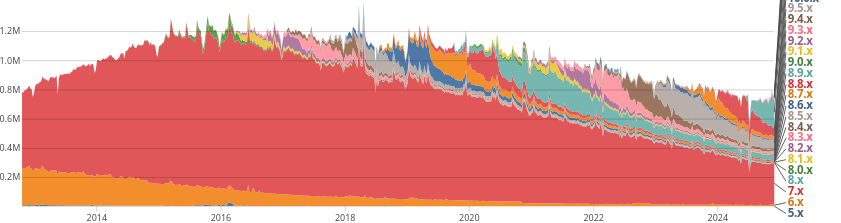 This graph is disgregated into minor versions, and I don t want to come up with
yet another graph for it but it supports (most of) the narrative I presented
above although I do miss the recent drop builtwith reported in D7 s
numbers!
 This release contains no new features or new user-facing changes but
reflects the standard package and repository maintenance over the
four-year window since the last release: updating of actions, updating
of URLs and addressing small packaging changes spotted by
ever-more-vigilant R checking code.
The NEWS entry for this release follows.