Search Results: "phil"

8 February 2013

Philipp Kern: Mozilla's direction

Am I the only one who's disappointed with the route Mozilla's taking and left wondering what the direction is? First they killed off the development of Thunderbird because, as we all know, people mainly use webmail these days. Then they presented us their view that the big Certificate Authorities are too big to fail, as CAs gravely violated our trust (c.f. Trustwave and their MitM authority). And "now" they're also blocking the introduction of new formats into their browser because they cannot be the one who innovates. Instead Microsoft and Apple obviously need to take the lead in introducing a format into their browsers because otherwise it wouldn't be useful. Even though it's safe to say that Chrome and Firefox make up for more than half of the desktop browser market share. It might be that Chrome's nibbling from Firefox's, still IE seems to be in decline and Safari is rather a further mention than something many people would care strongly about.

There were of course some valid reasons for not supporting WebP yet. But most of them got fixed in the meantime and all we hear is the referal to proprietary vendors who need to move first. If I'd want to depend on such vendors I'd go with proprietary operating systems. (Having to deal with hardware products of proprietary vendors at $dayjob is enough.) So what's up Mozilla? The solution is to ignore your users and tag bugs with patches wontfix?

The only real advantage of Firefox over Chromium these days is the vast amount of plugins and extensions (e.g. Pentadactyl, for which there is no real equivalent available). Another sad fact is that you need to pull Firefox from a 3rd party repository (even though packages are coming from the 2nd party) to get a current version onto your Debian system to work with the web. But then it's not Mozilla who's to blame here. Maybe we should've introduced one Iceweasel version that's allowed to have reverse-dependencies and one that cannot.

(This post might contain hyberboles, which should be considered as such.)

6 February 2013

Biella Coleman: Edward Tufte was a phreak

It has been so very long since I have left a trace here. I guess moving to two new countries (Canada and Quebec), starting a new job, working on Anonymous, and finishing my first book was a bit much. I miss this space, not so much because what I write here is any good. But it a handy way for me to keep track of time and what I do and even think. My life feels like a blur at times and hopefully here I can see its rhythms and changes a little more clearly if I occasionally jot things down here. So I thought it would nice to start with something that I found surprising: famed information designer, Edward Tufte, a professor emeritus at Yale was a phone phreak (and there is a stellar new book on the topic by former phreak Phil Lapsley. He spoke about his technological exploration during a sad event, a memorial service in NYC which I attended for the hacker and activist Aaron Swartz. I had my wonderful RA transcribe the speech, so here it is [we may not have the right spelling for some of the individuals so please let us know of any mistakes]:
Edward Tufte s Speech From Aaron Swartz s Memorial
Speech starts 41:00 [video cuts out in beginning]
We would then meet over the years for a long talk every now and then, and my responsibility was to provide him with a reading list, a reading list for life and then about two years ago Quinn had Aaron come to Connecticut and he told me about the four and a half million downloads of scholarly articles and my first question is, Why isn t MIT celebrating this? .
[Video cuts out again]
Obviously helpful in my career there, he then became president of the Mellon foundation, he then retired from the Mellon foundation, but he was asked by the Mellon foundation to handle the problem of JSTOR and Aaron. So I wrote Bill Bullen(sp?) an email about it, I said first that Aaron was a treasure and then I told a personal story about how I had done some illegal hacking and been caught at it and what happened. In 1962, my housemate and I invented the first blue box, that s a device that allows for free, undetectable, unbillable long distance telephone calls. And we got this up and played around with it and the end of our research came when we concluded what was the longest long distance call ever made, which was from Palo Alto to New York time-of-day via Hawaii, well during our experimentation, AT&T, on the second day it turned out, had tapped our phone and uh but it wasn t until about 6 months later when I got a call from the gentleman, AJ Dodge, senior security person at AT&T and I said, I know what you re calling about. and so we met and he said You what you are doing is a crime that would , you know all that. But I knew it wasn t serious because he actually cared about the kind of engineering stuff and complained that the tone signals we were generating were not the standard because they record them and play them back in the network to see what numbers they we were that you were trying to reach, but they couldn t break though the noise of our signal. The upshot of it was that uh oh and he asked why we went off the air after about 3 months, because this was to make long distance telephone calls for free and I said this was because we regarded it as an engineering problem and we made the longest long distance call and so that was it. So the deal was, as I explained in my email to Bill Bullen, that we wouldn t try to sell this and we were told, I was told that crime significance would pay a great deal for this, we wouldn t do any more of it and that we would turn our equipment over to AT&T, and so they got a complete vacuum tube isolator kit for making long distance phone calls. But I was grateful for AJ Dodge and I must say, AT&T that they decided not to wreck my life. And so I told Bill Bullen that he had a great opportunity here, to not wreck somebody s life, course he thankfully did the right thing.
Aaron s unique quality was that he was marvelously and vigorously different. There is a scarcity of that. Perhaps we can be all a little more different too.
Thank you very much.

Vincent Sanders: Two years of 3D printing

Almost two years ago my good friend Phil Hands invited me to attend a workshop at bath university to build a 3D printer. I had previously looked at the Reprap project and considered building the Darwin model, alas lack of time and funds had prevented me form proceeding.

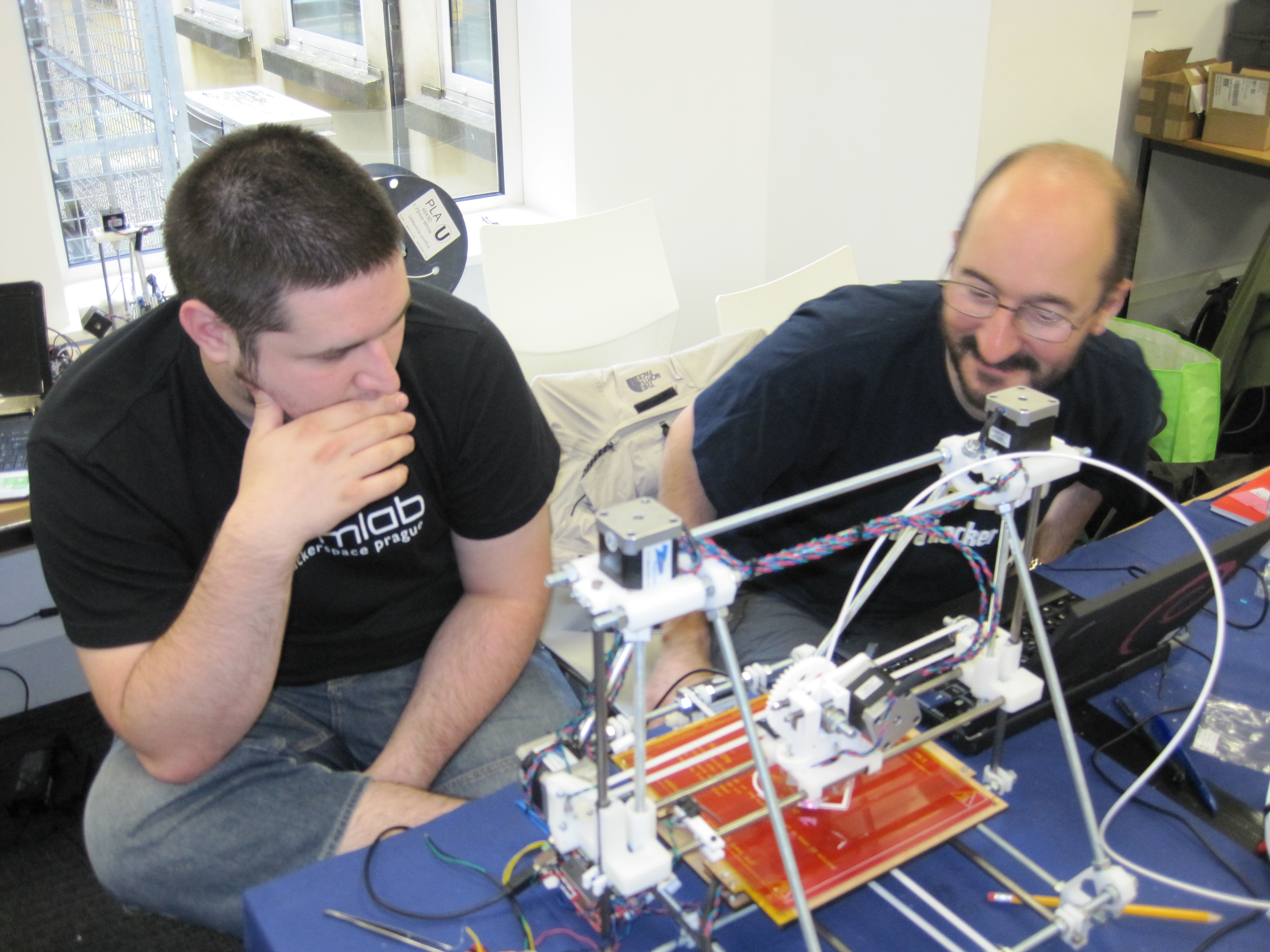
Jo Prusa and Phil Hands watching a heart print.
The workshop was to build a new, much simpler, design called the Prusa. Of course the workshop was booked and paid for well in advance which left me looking forwards to the event with anticipation. Of course I would not betaking the results of the workshop home as Phil had paid for it, so I started investigating what I would need for my own machine.

Of course at this point I muttered the age old phrase of "how hard can it be" and started acquiring parts for my own printer. By the time the workshop happened I already had my machine working as a plotter. I learned a lot from the Bath masterclass and a few days afterwards my own machine was complete.

First print
The results were underwhelming to say the least. There then came months and months of trial and error to fix various issues:
  • The filament feed bolt had to be replaced with a better one with sharper teeth.
  • The thermistor which reads the extruder temperature needed replacing (it still reads completely the wrong temperature even now).
  • The Y axis was completely inverted and needed re-wiring and the limit switches moving.
  • Endlessly replacing the printer firmware with new versions because every setting change requires a complete recompile and re-flash.
  • The bushings on the Y axis were simply not up to the job and the entire assembly needed replacing with ball bearings and a heated bed otherwise prints would be completely warped.
  • The Z axis couplings kept failing until I printed some alternates that worked much better
Once these issues had been fixed I started getting acceptable levels of output though the software in the workflow used to produce toolpaths (skeinforge) was exceptionally difficult to use and prone to producing poor results.

Alas the fundamental design issues of the Prusa remain. The A frame design provides exceptional rigidity in one plane...the other two? not so much. This coupled with an exceptionally challenging calibration to get the frame parallel and square means the printer is almost never true.

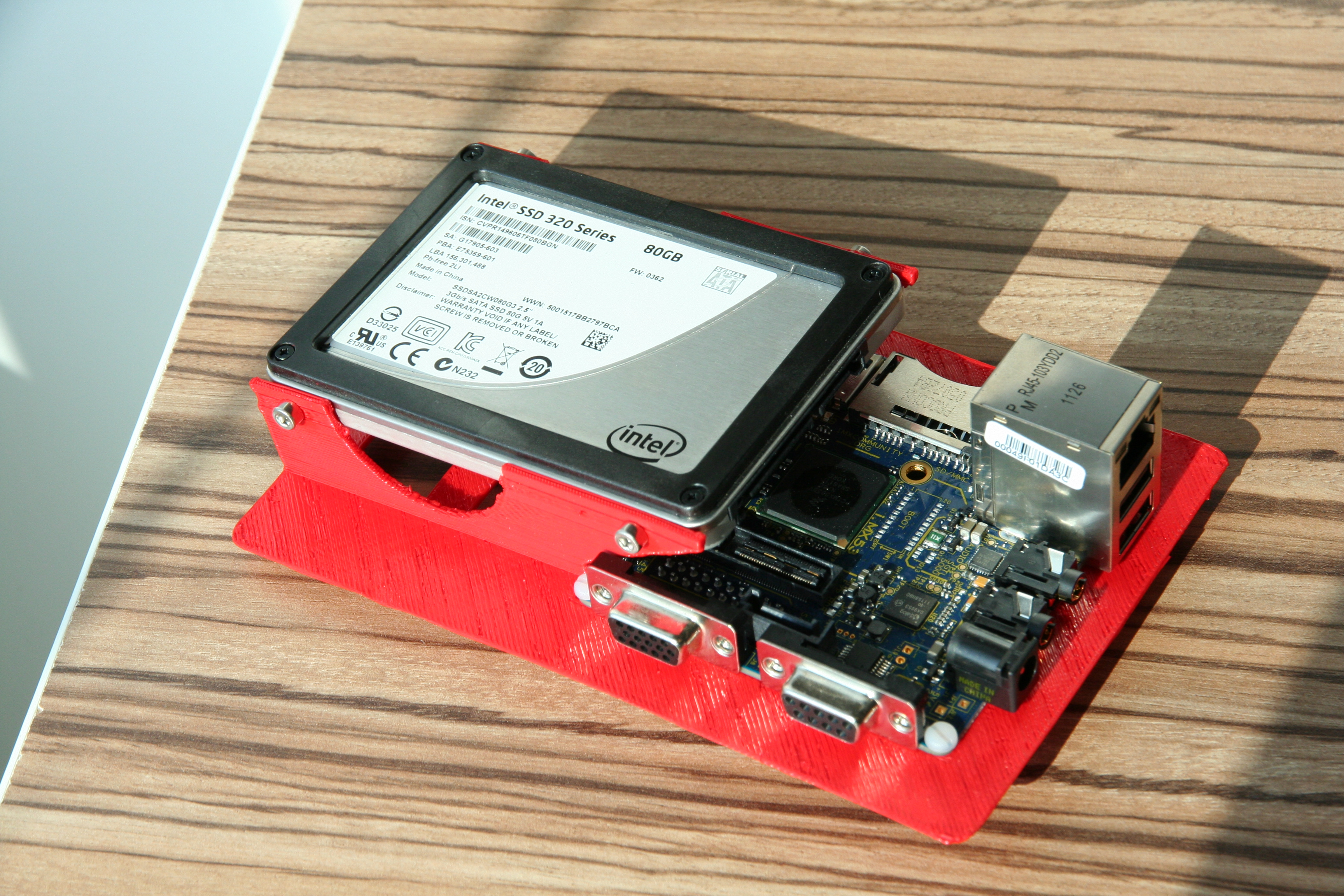
Prototype iMX53 dev board eurocard carrier printed on my printer
In operation the lack of rigidity in the x axis means the whole frame vibrates badly even with extra struts to try and improve its rigidity. I am not the first to notice these design flaws and indeed Chris has done something about it by creating a much superior design.

I do however have a working printer and have developed a workflow and understanding of what I can expect to work.

Improvements in the software means that slic3r has replaced skeinforge and gives superior results and the CAD software is continuously improving.

Currently I mainly use the printer to generate prototypes and simple profiles and then send the resulting designs to shapeways for final production though simpler designs are usable directly from the machine.

Because I am away from home a lot and moving the machine is simply not a workable option the printer does not get used for "fun" anywhere near as much as I had hoped and the workflow limitations mean I have not been able to make it available to my friends to use as a communal device.


5 February 2013

Antoine Beaupr : Why I don't like Pulseaudio

(This rant was originally part of the live streaming series, but I moved it to a separate article because people got stuck on it instead of responding to the actual subject of the article.) Before I get flamed for attacking Pulseaudio (PA), let's just settle this: I don't like it. I think PA is over-engineered and tries to do too many things at once. I used to (until just now) systematically purge pulseaudio-related packages from my system, mainly because PA has this awful tendency of automatically starting and staying around eternally, which wouldn't be so bad except PA has also the bad habit of hogging the audio device exclusively, which makes regular programs like mplayer, ogg123 fail to simply play audio, unless they go through the PA straight-jacket. (Update: this seems to be a bit better in newer versions of PA, where the audio device is released when sound is not being played. Thanks Philipp Kern for the correction.) In the GNU/Linux audio stack, we already have another system that supports multiple accesses: ALSA itself, so I believe that PA should at least behave nicely to other apps, and it seems I am always having problems with that. (The fact that ALSA itself is over-engineered is also telling of the poor state of the audio stack in GNU/Linux.) The other beef I have with PA is the Not Invented Here syndrome: instead of extending existing tools like ALSA or Jack, people just figured they could do everything better and start from scratch. So now we just have one more "standard" way of playing audio, good job Lennart.

27 January 2013

Russell Coker: LCA 2012

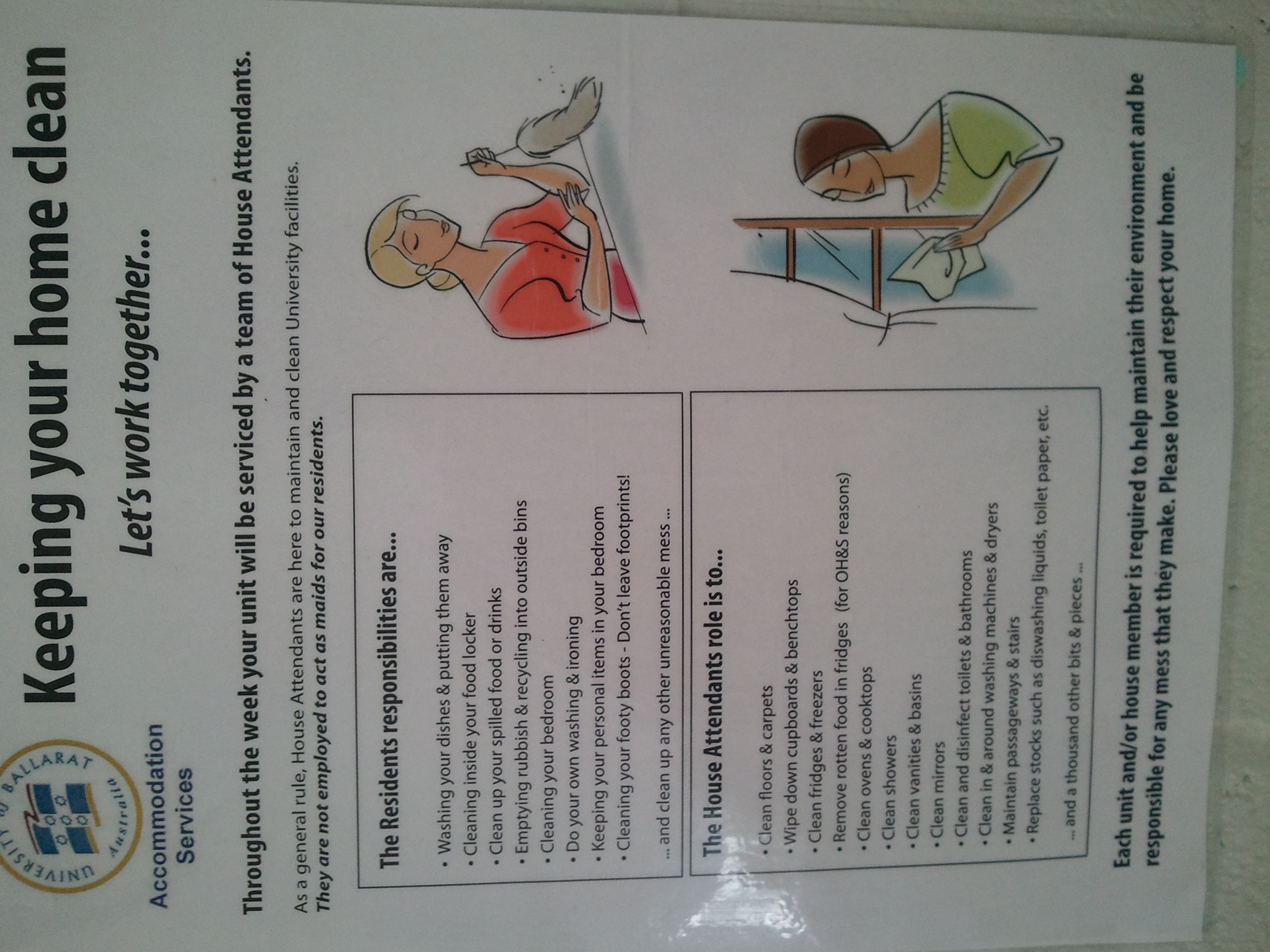
LCA 2013 [1] is starting so it seems like time to finish my write-up of LCA 2012. As usual it was a great conference, although I got sick immediately after getting there which reduced my ability to attend. Android A major unofficial theme of the conference was Android. Most delegates seemed to have Android phones, the Samsung Galaxy S and Galaxy Nexus seemed to be the most popular phones. Many delegates had two or more phones for development purposes. A large portion of the casual conversation at the conference concerned Android. There were a couple of really interesting talks about the Serval mesh networking project [2] which involves Android phones running in ad-hoc Wifi mode for long range communication without any official base station. Serval allows transferring messages, pictures, and voice calls. If you need to get longer range you can mount one phone in a convenient place and other phones will decide to use it as a relay there is no need to have a dedicated relay device (such as a mobile phone tower or Wifi access point). Serval is supposed to work with Wifi access points but due to Java not exposing some networking details to the higher levels of software the code that was available at the time of the conference didn t support networks other than a /24, which meant that the conference Wifi network didn t work with Serval. As an aside most people at the conference who installed Serval were using a development version that was newer than the version on the Android market. I can t remember what the extra features were though. Serval was designed for emergency situations, it can be installed on phones (and pushed to other phones via Wifi) in the field and allow communications when the infrastructure is broken. Also it s designed with some aim of circumventing censorship which among other things means that there are no facilities for tracking use. I think it would be really handy to be able to in some way track viewing of or interest in images that are transported via the mesh (maybe by something similar in concept to Google +1). Then in a crowd sourced environment people who take photos would be encouraged in their work by audience appreciation. One thing that interests me is the possibility of using Serval on a cruise ship. A cruise ship is an environment where mobile phone calls are unreasonably expensive, cabin phones aren t much use (who pays for a cruise and hangs out in their cabin?), and where there is usually a Wifi network installed. If a ship has a single bridged Wifi network that allows connecting to Wifi before authenticating for Internet access (which is probably the common case) then you could transport VOIP over that network without paying and without incurring any expense on the cruise company. One of the Serval developers assured me that this should be possible, of course a cruise ship with 3,000 passengers probably doesn t use a /24 for their Wifi so the current versions of Serval won t work At the geek my dinner event (a party where everyone brought $20 of food/drink which was cooked by volunteers) an artist showed me some art work that she created on her Samsung Galaxy Note (which was the biggest phone on sale at the time), it was very impressive. She recommended Picasso Mirror Draw, Sketch Free, Sketch Book Mobile Express, and Freenote as free graphical programs for Android. Samsung has a Noteworthy Project advertising campaign based on the artistic uses of the Galaxy Note which has some good videos of artists [3]. Chris Neugebauer and Paris Buttfield-Addison gave an informative and amusing talk about Android UI development (this link has the video) [4]. It s a pity that I missed seeing that one live but fortunately the video is of high quality. Accommodation picture of women cleaning As I ve become interested in Sociology I couldn t help but notice the pictures that accompanied the rules about cleaning the dormitory (which were displayed over the kitchen sink), it seems to imply that cleaning is only women s work. I wonder whether the people who created that poster deliberately chose pictures of women or whether they just chose the first available pictures from a collection of stock photos. Someone who was near my dorm room seemed to not realise how their alarm impacts other people. For the first two mornings I was woken repeatedly after 6AM by someone who was pressing the snooze button on their alarm. When sleeping in close proximity to other people the reasonable options involve some combination of having no loud alarm, immediately turning the alarm off and getting up (not pressing snooze to have it go off repeatedly), and setting the alarm for a time when almost everyone wants to get up (EG 1 hour before the first session). Networking Chris Neugebauer organised the Unprofessional Delegates Networking Session which was a great event. It was an event held at the same time as the Professional Delegates Networking Session with the difference being that you had to pay $5 for food and there was no free drink. A lot of great people attended the UPDNS so I m glad I don t pay for the PDNS. It seems that we won t have a UPDNS this year unfortunately. Conclusion LCA is always great fun and very educational. I recommend attending every year.

25 January 2013

Johannes Schauer: Bootstrappable Debian - New Milestone

This post is about the port bootstrap build ordering tool (naming suggestions welcome) which was started as a Debian Google Summer of Code project in 2012 and continued to be developed afterwards. Sources are available through gitorious. In the end of November 2012, I managed to put down an approximation algorithm to the feedback arc set problem which allowed to break the dependency graph into a directed acyclic graph with only few removed build dependencies. I wrote about this effort on our mailinglist but didnt mention it here because it was still too much of a proof-of-concept. Later, in January 2013, I mentioned the result of this algorithm in an email wookey and me wrote to debian-devel mailinglist. Many things happened since November 2012:

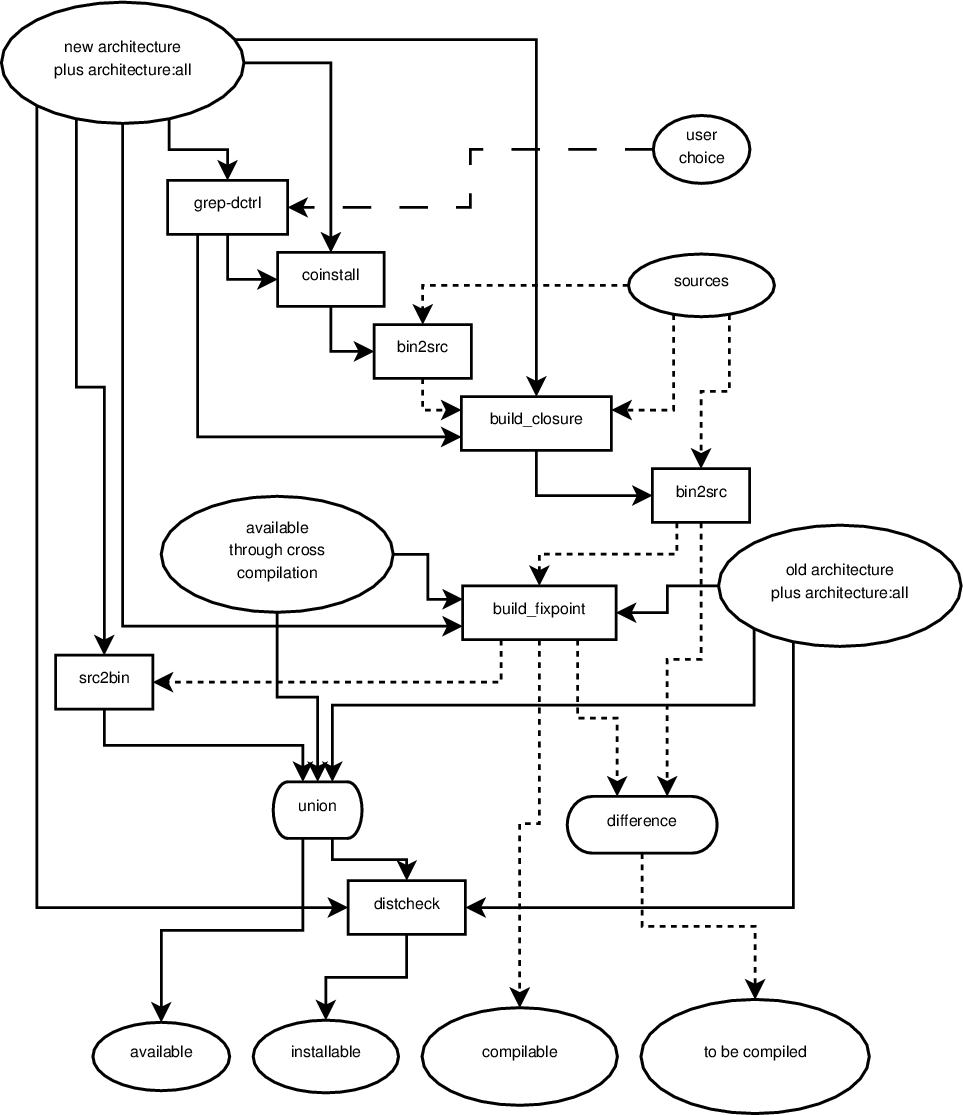
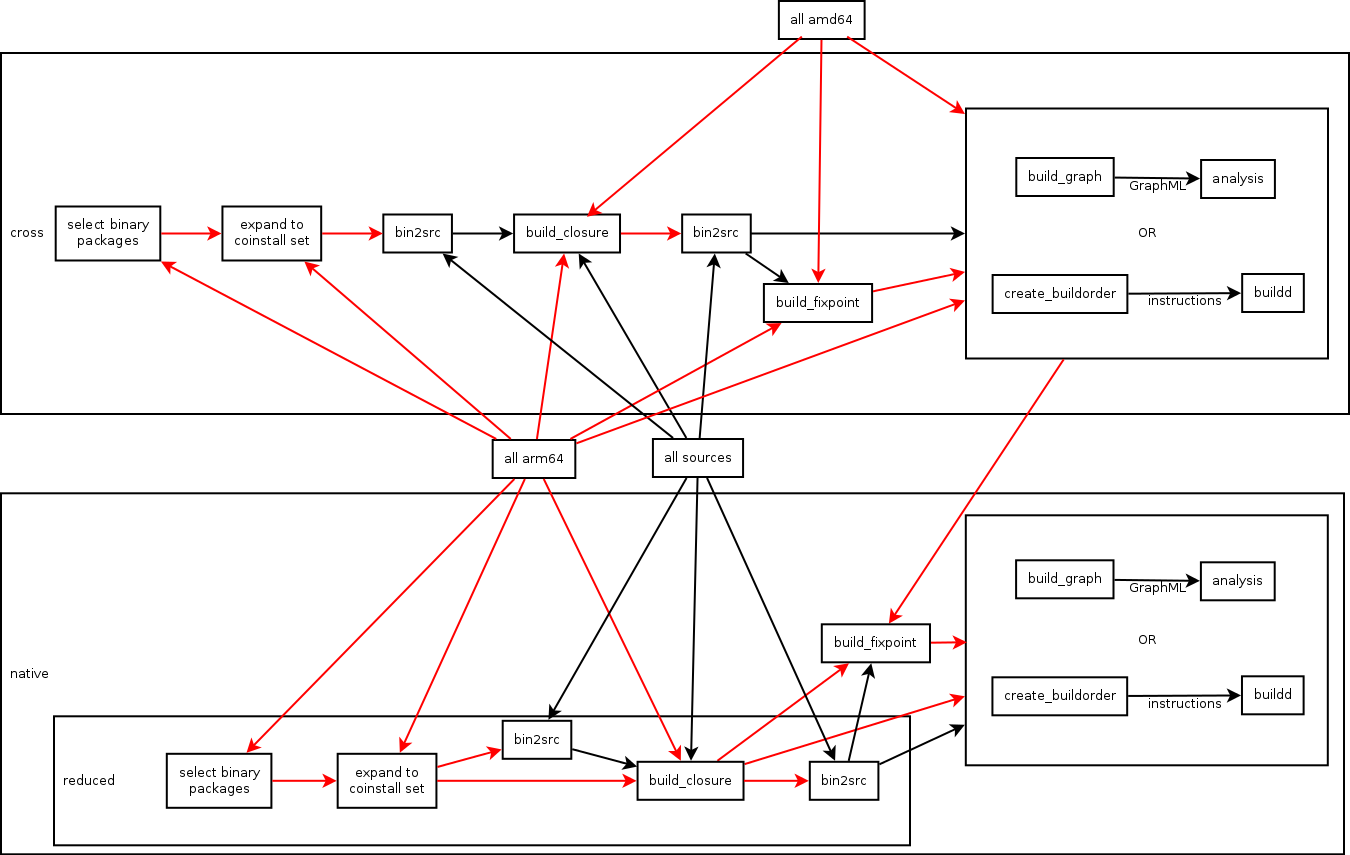
Processing pipeline instead of monolithic tools The tools I developed so far tried to accomplish everything by themselves, reusing functionality implemented in a central library. Therefor, if one wanted to try out even trivial new things, it mostly meant to hack some OCaml code. Pietro Abate suggested to instead develop smaller tools which could work independently of each other, would only execute one algorithm each and could easily be connected together in different ways to achieve different effects. This switch is now done and all functionality from the old tools is moved into a new toolset. The exchange format between the tools is either plain text files in deb822 control format (Packages/Sources files) or a dependency graph. The dependency graph is currently marshalled by OCaml but future versions should work with just passing a GraphML (an XML graph format) representation around. This new way of doing things seems close to the UNIX philosophy (each program does one thing well, data is stored as text, every program is a filter). For example the deb822 control output can easily be manipulated using grep-dctrl(1) and there exist many tools which can read, analyze and manipulate GraphML. It is a big improvement over the old, monolithic tools which did not allow to manipulate any intermediate result by external, existing tools. Currently, a shell script (native.sh) will execute all tools in a meaningful order, connecting them together correctly. The same tools will be used for a future cross.sh but they will be connected differently. I wrote about a first proposal of what the individual tools should do and how they should be connected in this email from which I also linked a confusing overview of the pipeline. This overview has recently been improved to be even more confusing and the current version of the lower half (the native part) now looks like this: native reduced Solid arrows represent a flow of binary packages, dottend arrows represent a flow of source packages, ovals represent a set of packages, boxes with rounded corners represent set operations, rectangular boxes represent filters. There is only one input to a filter, which is the arrow connected to the top of the box. Outgoing arrows from the bottom represent the filtered input. Ingoing arrows to either side are arguments to the filter and control how the filter behaves depending on the algorithm. I will explain this better once the pipeline proved to be less in flux. The pipeline is currently executed like this by native.sh.

Two new ways to break dependency cycles have been discovered So far, we knew of three ways to formally break dependency cycles:
  • remove build dependencies through build profiles
  • find out that the build dependency is only used to build arch:all packages and therefor put it into Build-Depends-Indep
  • cross compile some source packages
Two new methods can be added to the above:

Dependency graph definition changed Back in September when I was visiting irill, Pietro found a flaw in how the dependency graph used to be generated. He supplied a new definition of the dependency graph which does away with the problem he found. After fixing some small issues with his code, I changed all the existing algorithms to use the new graph definition. The old graph is as of today removed from the repository. Thanks to Pietro for supplying the new graph definition - I must still admit that my OCaml foo is not strong enough to have come up with his code.

Added complexity for profile built source packages As mentioned in the introduction, wookey and me addressed the debian-devel list with a proposal on necessary changes for an automated bootstrapping of Debian. During the discussiong, two important things came up which are to be considered by the dependency graph algorithms:
  • profile built source packages may not create all binary packages
  • profile built source packages may need additional build dependencies
Both things make it necessary to alter the dependency graph during the generation of a feedback arc set and feedback vertex set beyond the simple removal of edges. Luckily, the developed approximation algorithms can be extended to support such changes in the graph.

Different feedback arc set algorithms The initially developed feedback arc set algorithm is well suited to discover build dependency edges which should be dropped. It performs far worse when creating the final build order because it only considers edges by itself and not how many edges of a source package can be dropped by profile building it. The adjusted algorithm for generating a build order is more of a feedback vertex set algorithm because instead of greedily finding the edge with most cycles through it, it greedily finds the source package which would break most cycles if it was profile built.

Generating a build order with less profile built source packages After implementing all the features above I now feel more confident to publish the current status of the tools to a wider audience. The following test shows a run of the aforementioned ./native.sh shell script. Its final output is a list of source packages which have to be profile built and a build order. Using the resulting build order, starting from a minimal build system (essential:yes, build-essential and debhelper), all source packages will be compiled which are needed to compile all binary packages in the system. The result will therefor be a list of source and binary packages which fulfill the following property:
  • all binary packages can be built from the available source packages
  • all source packages can be built with the available binary packages
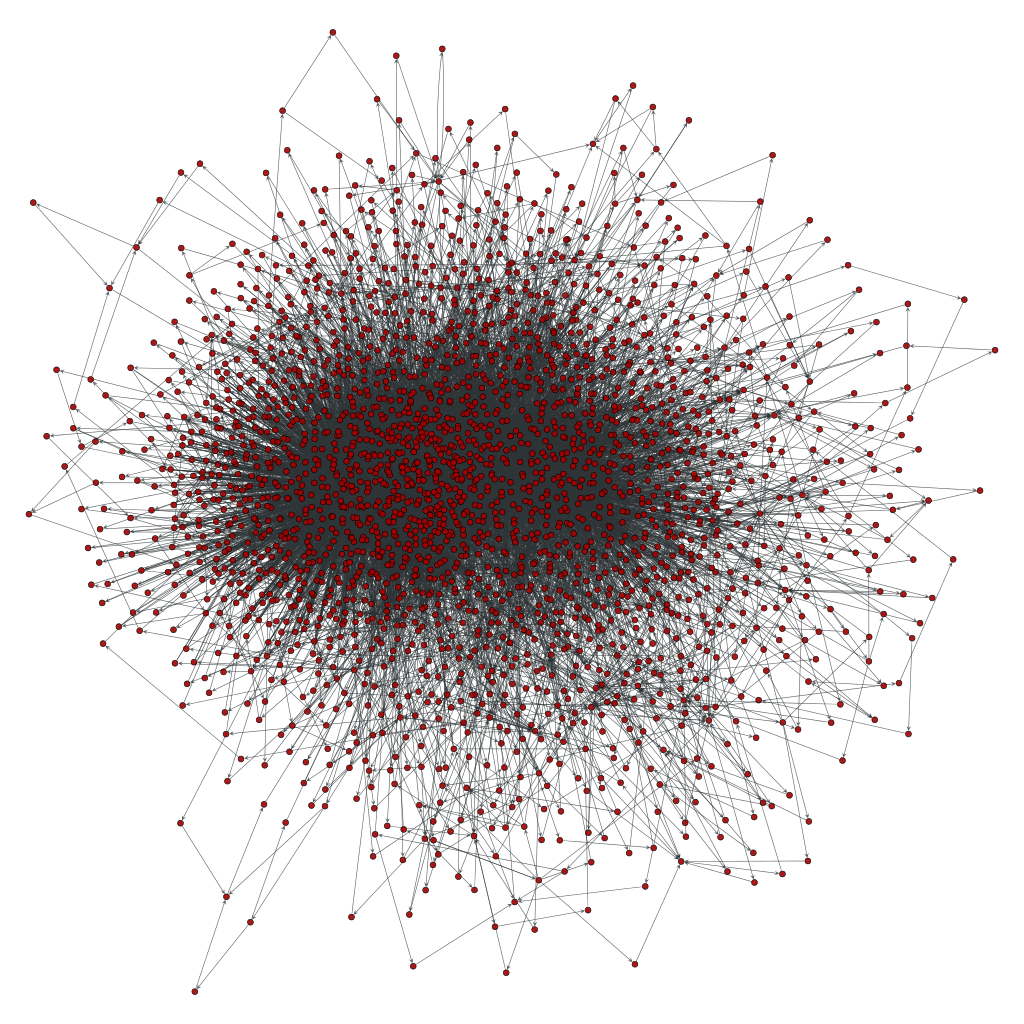
I called this a "reduceded distribution" in earlier posts. The interesting property of this specific selection is, that it contains the biggest problem set of Debian when bootstrapping it: a 900 to 1000 nodes big strongly connected component. Here is a visualization of the problem: hideous mess Source packages do not yet come with build profiles and the cross build situation can not yet be analyzed, so the following assumptions were made: The last point is about 14 build dependencies which were decided to be broken by the feedback arc set algorithm but for which other data sources did not indicate that they are actually breakable. Those 14 are dynamically generated by native.sh. If above assumptions should not be too far from the actual situation, then not more than 73 source packages have to be modified to bootstrap a reduced distribution. This reduced distribution even includes dependency-wise "big" packages like webkit, metacity, iceweasel, network-manager, tracker, gnome-panel, evolution-data-server, kde-runtime, libav and nautilus. By changing one line in native.sh one could easily develop a build order which generates gnome-desktop or really any given (meta-)package selection. All of native.sh takes only 80 seconds to execute on my system (Core i5, 2.5 GHz, singlethreaded). Here is the final build order which creates 2044 binary packages from 613 source packages.
  1. nspr, libio-pty-perl, libmcrypt, unzip, libdbi-perl, cdparanoia, libelf, c-ares, liblocale-gettext-perl, libibverbs, numactl, ilmbase, tbb, check, libogg, libatomic-ops, libnl($), orc($), libaio, tcl8.4, kmod, libgsm, lame, opencore-amr, tcl8.5, exuberant-ctags, mhash, libtext-iconv-perl, libutempter, pciutils, gperf, hspell, recode, tcp-wrappers, fdupes, chrpath, libbsd, zip, procps, wireless-tools, cpufrequtils, ed, libjpeg8, hesiod, pax, less, dietlibc, netkit-telnet, psmisc, docbook-to-man, libhtml-parser-perl, libonig, opensp($), libterm-size-perl, linux86, libxmltok, db-defaults, java-common, sharutils, libgpg-error, hardening-wrapper, cvsps, p11-kit, libyaml, diffstat, m4
  2. openexr, enca, help2man, speex, libvorbis, libid3tag, patch, openjade1.3, openjade, expat, fakeroot, libgcrypt11($), ustr, sysvinit, netcat, libirman, html2text, libmad, pth, clucene-core, libdaemon($), texinfo, popt, net-tools, tar, libsigsegv, gmp, patchutils($), dirac, cunit, bridge-utils, expect, libgc, nettle, elfutils, jade, bison
  3. sed, indent, findutils, fastjar, cpio, chicken, bzip2, aspell, realpath, dctrl-tools, rsync, ctdb, pkg-config($), libarchive, gpgme1.0, exempi, pump, re2c, klibc, gzip, gawk, flex-old, original-awk, mawk, libtasn1-3($), flex($), libtool
  4. libcap2, mksh, readline6, libcdio, libpipeline, libcroco, schroedinger, desktop-file-utils, eina, fribidi, libusb, binfmt-support, silgraphite2.0, atk1.0($), perl, gnutls26($), netcat-openbsd, ossp-uuid, gsl, libnfnetlink, sg3-utils, jbigkit, lua5.1, unixodbc, sqlite, wayland, radvd, open-iscsi, libpcap, linux-atm, gdbm, id3lib3.8.3, vo-aacenc, vo-amrwbenc, fam, faad2, hunspell, dpkg, tslib, libart-lgpl, libidl, dh-exec, giflib, openslp-dfsg, ppl($), xutils-dev, blcr, bc, time, libdatrie, libpthread-stubs, guile-1.8, libev, attr, libsigc++-2.0, pixman, libpng, libssh2, sqlite3, acpica-unix, acl, a52dec
  5. json-c, cloog-ppl, libverto, glibmm2.4, rtmpdump, libdbd-sqlite3-perl, nss, freetds, slang2, libpciaccess, iptables, e2fsprogs, libnetfilter-conntrack, bash, libthai, python2.6($), libice($), libpaper, libfontenc($), libxau, libxdmcp($), openldap($), cyrus-sasl2($), openssl, python2.7($)
  6. psutils, libevent, stunnel4, libnet-ssleay-perl, libffi, readline5, file, libvoikko, gamin, libieee1284, build-essential, libcap-ng($), lcms($), keyutils, libxml2, libxml++2.6, gcc-4.6($), binutils, dbus($), libsm($), libxslt, doxygen($)
  7. liblqr, rarian, xmlto, policykit-1($), libxml-parser-perl, tdb, devscripts, eet, libasyncns, libusbx, icu, linux, libmng, shadow, xmlstarlet, tidy, gavl, flac, dbus-glib($), libxcb, apr, krb5, alsa-lib
  8. usbutils, enchant, neon27, uw-imap, libsndfile, yasm, xcb-util, gconf($), shared-mime-info($), audiofile, ijs($), jbig2dec, libx11($)
  9. esound, freetype, libxkbfile, xvidcore, xcb-util-image, udev($), libxfixes, libxext($), libxt, libxrender
  10. tk8.4, startup-notification, libatasmart, fontconfig, libxp, libdmx, libvdpau, libdrm, libxres, directfb, libxv, libxxf86dga, libxxf86vm, pcsc-lite, libxss, libxcomposite, libxcursor, libxdamage, libxi($), libxinerama, libxrandr, libxmu($), libxpm, libxfont($)
  11. xfonts-utils, libxvmc, xauth, libxtst($), libxaw($)
  12. pmake, corosync, x11-xserver-utils, x11-xkb-utils, coreutils, xft, nas, cairo
  13. libedit, cairomm, tk8.5, openais, pango1.0($)
  14. ocaml, blt, ruby1.8, firebird2.5, heimdal, lvm2($)
  15. cvs($), python-stdlib-extensions, parted, llvm-2.9, ruby1.9.1, findlib, qt4-x11($)
  16. xen, mesa, audit($), avahi($)
  17. x11-utils, xorg-server, freeglut, libva
  18. jasper, tiff3, python3.2($)
  19. openjpeg, qt-assistant-compat, v4l-utils, qca2, jinja2, markupsafe, lcms2, sip4, imlib2, netpbm-free, cracklib2, cups($), postgresql-9.1
  20. py3cairo, pycairo, pam, libgnomecups, gobject-introspection($)
  21. gdk-pixbuf, libgnomeprint, gnome-menus, gsettings-desktop-schemas, pangomm, consolekit, vala-0.16($), colord($), atkmm1.6
  22. libgee, gtk+3.0($), gtk+2.0($)
  23. gtkmm2.4, poppler($), openssh, libglade2, libiodbc2, gcr($), libwmf, systemd($), gcj-4.7, java-atk-wrapper($)
  24. torque, ecj($), vala-0.14, gnome-keyring($), gcc-defaults, gnome-vfs($)
  25. libidn, libgnome-keyring($), openmpi
  26. mpi-defaults, dnsmasq, wget, lynx-cur, ghostscript, curl
  27. fftw3, gnupg, libquvi, xmlrpc-c, raptor, liboauth, groff, fftw, boost1.49, apt
  28. boost-defaults, libsamplerate, cmake, python-apt
  29. qjson, qtzeitgeist, libssh, qimageblitz, pkg-kde-tools, libical, dwarves-dfsg, automoc, attica, yajl, source-highlight, pygobject, pygobject-2, mysql-5.5($)
  30. libdbd-mysql-perl, polkit-qt-1, libdbusmenu-qt, raptor2, dbus-python, apr-util
  31. rasqal, serf, subversion($), apache2
  32. git, redland
  33. xz-utils, util-linux, rpm, man-db, make-dfsg, libvisual, cryptsetup, libgd2, gstreamer0.10
  34. mscgen, texlive-bin
  35. dvipng, luatex
  36. libconfig, transfig, augeas, blas, libcaca, autogen, libdbi, linuxdoc-tools, gdb, gpm
  37. ncurses, python-numpy($), rrdtool, w3m, iproute, gcc-4.7, libtheora($), gcc-4.4
  38. libraw1394, base-passwd, lm-sensors, netcf, eglibc, gst-plugins-base0.10
  39. libiec61883, qtwebkit, libvirt, libdc1394-22, net-snmp, jack-audio-connection-kit($), bluez
  40. redhat-cluster, gvfs($), pulseaudio($)
  41. phonon, libsdl1.2, openjdk-6($)
  42. phonon-backend-gstreamer($), gettext, libbluray, db, swi-prolog, qdbm, swig2.0($)
  43. highlight, libselinux, talloc, libhdate, libftdi, libplist, python-qt4, libprelude, libsemanage, php5
  44. samba, usbmuxd, libvpx, lirc, bsdmainutils, libiptcdata, libgtop2, libgsf, telepathy-glib, libwnck3, libnotify, libunique3, gnome-desktop3, gmime, glib2.0, json-glib, libgnomecanvas, libcanberra, orbit2, udisks, d-conf, libgusb
  45. libgnomeprintui, libimobiledevice, nautilus($), libbonobo, librsvg
  46. evas, wxwidgets2.8, upower, gnome-disk-utility, libgnome
  47. ecore, libbonoboui
  48. libgnomeui
  49. graphviz
  50. exiv2, libexif, lapack, soprano, libnl3, dbus-c++
  51. atlas, libffado, graphicsmagick, libgphoto2, network-manager
  52. pygtk, jackd2, sane-backends, djvulibre
  53. libav($), gpac($), ntrack, python-imaging, imagemagick, dia
  54. x264($), matplotlib, iceweasel
  55. strigi, opencv, libproxy($), ffms2
  56. kde4libs, frei0r, glib-networking
  57. kde-baseapps, kate, libsoup2.4
  58. geoclue, kde-runtime, totem-pl-parser, libgweather, librest, libgdata
  59. webkit
  60. zenity, gnome-online-accounts
  61. metacity, evolution-data-server
  62. gnome-panel
  63. tracker
The final recompilation of profile built source packages is omitted. Source packages marked with a ($) are selected to be profile built. All source packages listed in the same line can be built in parallel as they do not depend upon each other. This order looks convincing as it first compiles a multitude of source packages which have no or only few build dependencies lacking. Later steps allow fewer source packages to be compiled in parallel. The amount of needed build dependencies is highest in the source packages that are built last.

24 January 2013

Russell Coker: Power Supplies and Wires

For some time I ve been wondering how the wire size for power supplies limits the power. So I ve done some quick calculations to determine if it s a problem. The first type that is of interest are the Inverters that are used to convert 12VDC to 240VAC (mains power) to allow electric devices to be operated in a car. I ve seen some reports from dissatisfied user about Inverters not supplying as much power as expected and I ve had problems with my 150W Inverter not always supplying my Thinkpad (which definitely doesn t draw 150W). The second type is phone chargers as charging a phone in a reasonable amount of time is always a problem. Inverter Rating Fine Print vs Laptop PSU My Thinkpad Power Supply claims Efficiency Level IV which according to the US EPA document describing the efficiency marking protocol for external power supplies [1] means that it is at least 85% efficient when supplying 50W+. The peak output of the PSU is 4.5A at 20V which is 90W peak output, 90/0.85 == 106W power drawn. One would hope that wouldn t be a problem from a 150W PSU. But the fine print on the PSU says that it can provide 110W continuously and 150W for 10 minutes. So according to my calculations I m within 4W of overloading the PSU if my Thinkpad uses full power. It also says that it is designed for 13.8V input. I have no idea how the performance of the Inverter changes as the supply Voltage changes between the 12.6V that a 6 cell lead-acid battery is designed to provide and the 13.8V charge from the car alternator. But I have had occasions when my Inverter stopped working correctly presumably due to being unable to supply as much current as my Thinkpad draws. As an aside I measured the Voltage in my car (with the engine off) at 12.85V from the cigarette lighter socket and 13.02V directly from the battery. I wonder if there is some sort of overload protection on the cigarette lighter which has a side effect of reducing the Voltage. Resistance in wires reduces the Voltage, but all Voltage meters are designed to have a high resistance to prevent that from being an issue. If anyone has an explanation for the 0.17Volt drop then please write a comment! Can a Car Provide 130W from the Cigarette Lighter socket? If the Inverter is also 85% efficient (and it might be less as it has no indication of efficiency on the box) then when supplying 110W it would draw 110/0.85 == 129.4W (I ll round it up to 130W). The power in Watts is equal to the Voltage multiplied by the current in Amps (W=V*I). Therefore I=W/V so if the car battery was at 12.85V then 130W/12.85V == 10.12A will flow. The current that goes through a circuit is equal to the Voltage divided by the resistance (see the Wikipedia page on Ohm s law for more information). This also means that the resistance equals the Voltage divided by the current. 12.85V/10.12A == 1.27 Ohms. Note that this is the resistance of the entire circuit, all the wires going to the battery, the circuitry inside the Inverter, and the internal resistance of the battery. The Inverter s cable is 1M long (2 meters of wire) and each wire is about 3.5mm in diameter including the insulation which means that the copper wire is probably equivalent to a single core conductor that is about 1mm in diameter. According to one of the online guides to resistance [2] wire that is 1.02mm in diameter will have a resistance of 0.02 Ohms per meter which gives a resistance of 0.04 Ohms. 0.04 Ohms is 3% of the total resistance of the circuit which doesn t seem like it will be a real problem. In practice I ve noticed that the connector gets extremely hot when it s in use while the cable doesn t get warm enough to notice. I suspect that the quality of the connector limits the power that is available but I don t have an easy way of measuring this. Inverters that are rated at 300W are designed to attach directly to the battery. An Inverter that is rated at 300W would draw 300W/0.85 == 352W from the battery. That needs 352W/13.02V == 27.04A and therefore a circuit resistance of 13.02V/27.04A == 0.48 Ohms total resistance. I wonder whether dirt on the battery terminals would give a significant portion of that. Phone Charging I ve also been wondering about why mobile phones take so long to charge, and now I ve finally done the calculations. The latest standard for mobile phones is to use USB for charging. The Wikipedia page about USB says that the standard is for USB 2.0 to supply up to 500mA at 5V +-5%. That means 0.5A*5V == 2.5W +- 5%. If we assume that the internal power supply in a phone is also 85% efficient then that means 2.5*0.85 == 2.125W going to the battery. My Samsung Galaxy S3 has a battery which is rated at 7.98Wh. According to the Wikipedia page about Lithium Ion batteries the charge/discharge efficiency is 80% to 90% I ll assume that it s 85% for further calculations. If the battery in the phone is 85% efficient and the phone is doing nothing but charging then the charge time for a regular USB port would be 7.98Wh/0.85/2.125W == 4.42 hours (4 hours 25 minutes) of charge time. That probably means something closer to 5 hours to totally charge the phone while it s running. There are dedicated charging ports for USB which can supply up to 1.5A. The 3rd party charger which came with my phone was rated at 1A and would hopefully be capable of completely charging the phone in less than 3 hours (but in practice isn t). It s interesting to note that MacBooks expose the amount of current drawn from a USB port with a GUI, so it should be possible to measure a phone charge rate by connecting it to a MacBook (which is cheaper than cutting up a phone cable). My old Samsung Galaxy S has a battery which is rated at 5.55Wh, by the same calculations it would take slightly more than 3 hours to charge on a standard USB port or 1.5 hours on my newest USB charger. In practice it has never got anywhere close to that, I presume that the phone is designed to draw less than 500mA. Phone Cable Resistance The charger that came with my Galaxy S has a cable that is about 1.75M long, the cable is flat and measures just over 1mm thick and about 2mm wide. Presumably the wire is equivalent to a single core that s about 0.4mm in diameter thus giving it a resistance of about 0.134 Ohm per meter, or 1.75*2*0.134 == 0.469 Ohm for the cable. The charger is rated at 0.7A. To supply 0.7A at 5V the resistance would be 5V/0.7A == 7.143 Ohm so about 6.6% of the total resistance of the circuit would be in the wire from the charger to the phone. The charger that came with my Galaxy S3 has a round cable that s just over 3mm thick and about 90cm long. If each wire in the cable is equivalent to a solid wire that is 0.912mm in diameter then it would be 0.0264 Ohm per meter of wire or 0.9*2*0.0264 == 0.0475 Ohm. The total circuit resistance would be 5V/1A == 5 Ohm. So 0.0475 Ohm is less than 1% of the circuit resistance. Voltage Drop The Voltage across a part of a circuit is proportional to the resistance (see the Wikipedia page on Series and Parallel Circuits for a good explanation). Basically this means that if 1% of the resistance of a circuit is in the wire then 1% of the Voltage drop will also be in the wire, so if we have a 5V supply with my Galaxy S3 cable then each of the two wires in the cable will have a difference of about 0.025V between the ends and the phone will receive a supply of 4.95V, the difference isn t something that is worth worrying about. But the cable from my Galaxy S has a resistance equivalent to 6.6% of the circuit resistance which means that the theoretical charge time will be 6% longer than it might be or 6% more current will be drawn from the mains than should be needed. Conclusion The charger that came with my Samsung Galaxy S isn t much good. Wasting 6.6% of the power in the wire is unreasonable. Phones keep getting more power hungry and batteries keep getting larger. There are third party phone batteries and external batteries that are charged by USB which have more than twice the capacity of the stock phone batteries this means more than twice the charge time. This problem will keep getting worse. The problem of a phone in active use drawing more power than the charger can provide (and running out of battery while on the charger) seems likely to stay with us. So while an Android phone has the potential to be a great little embedded server it seems that hacking the power supply is going to be a required first step for realising that potential. The decision to make 5V the USB power standard was reasonable at the time as it was the voltage used for most things on the motherboard. The decision to use USB as the phone charging standard was also reasonable, it allows phones to be charged anywhere. The combination of those two decisions isn t good for the user. If a higher Voltage such as 12V was used then 5* the power could be supplied through the same wires at the same level of efficiency. It would be really good if cars came with built in Inverters and supplied 240VAC or 110VAC depending on the region they were manufactured for. It s becoming a fairly common feature to have a cigarette lighter port in the car boot as well as at least two ports inside the car. When a car has three sockets and only one device to actually light cigarettes (which I suspect is only provided to fill an empty socket) it s very obvious that people want to connect random devices. Also having USB charging ports inside the car would be a really good idea (one for each seat would be good for Ingress).

22 January 2013

Jon Dowland: FLOS UNIX

I just read this excellent blog post called "Linux Future" which defines a term "FLOS" to describe what the current direction of Linux development appears to be. Specifically, it addresses the divergence from what one might call the "UNIX" philosophy in new core technologies like systemd. I think sticking a new name to define this philosophical direction is a great idea. "FLOS" is something that both proponents and haters can rally around. It acknowledges the move away from the UNIX way of doing things, and doesn't overload a term like Linux, "ownership" of which is claimed by both camps (and others who just want to keep their heads down and get on with things!) The next step, after embracing it, would be to define the strategy and the roadmap. Where is FLOS going? What's the endgame? Perhaps with such a vision we may end up with some technologies which will stand the test of time, like Apple's CoreAudio (10 years old) or Microsoft's win32 API (now 20 years old), rather than the ludicrously high plumbing turnover we endure right now. (Oh my goodness, I finally wrote an actual Linux blog post.)

Jon Dowland: Possible future coding project

Re-implement ikiwiki, or something like it, in go. See how much the language's features and philosophy colour the design. In particular I'm wondering how much the first-class treatment of concurrency might change how you structure things: one thread per page, or hot pages... you'd want to approach it with lots of micro-locks rather than one big lock to rule them all. I can see some future ikiwiki refactoring work being a bit like the Linux Kernel's efforts to get rid of their big kernel lock. See also: Joey's proposed Haskell ikiwiki rewrite. I may be remembering wrong, but I thought he had some beginning code up somewhere. Perhaps I'm conflating it with John Goerzen's one-time OfflineIMAP rewrite, which might also be lost to the sands of time...

Jon Dowland: HD audio and more archiving

Having obtained a respectable set of headphones last year, I started pondering about high definition music. Could I hear the difference between a track mixed at CD quality, 16 bit samples / 44.1kHz sample rate, and the same track mixed at a higher bit or sample rate? A number of artists have made HD audio releases available in a variety of formats, most of which are now obsolete (see: SACD, DVD-Audio) and/or hard to demux to something more modern. However some artists have made digital HD audio releases. The last two Nine Inch Nails records were released in HD and are more readily available.
These releases also had nice per-track embedded art These releases also had nice per-track embedded art
"Ghosts - " had a standard-quality digital release but a high quality Blu-Ray release was also available, commercially. All versions were Creative Commons licensed, so people have legimitely demuxed the Blu Ray release and made it available in other formats. One was uploaded to archive.org, although it sadly lacks precise lineage information: "The Slip" was released in HD audio digitally. However, I noticed that nobody had uploaded the HD release to archive.org, and having developed an interest in archiving, I did: I tried performing some listening tests on my desktop computer, which has an M-Audio "Audiophile" 24/96 PCI sound card. However, in non-blind tests, I failed to distinguish the SD and HD versions of these songs. A friend suggested that despite the card's quoted rates, the signal-to-noise ratio was such that you wouldn't get high enough fidelity to play 24/96 properly. I can only take their word for it My preferred music player can only decode 24/44.1 but I recently learned that my phone, an Apple iPhone, can decode up to 24 bit, 48kHz. I decided to downsample the above two releases in order to try further listening tests on my phone. I uploaded both to archive.org: So far in non-blind tests I have not noticed a particular difference. Whether it's my equipment, my ears, these particular tracks or whether HD audio being audibly better than CD quality is a myth, I am not sure yet. I'm planning to do some proper ABX testing of various lossy codecs and bitrates prior to a major CD ripping exercise, so I may try proper ABX testing of HD audio at the same time. (I'm collecting together past and future log posts about archiving under the tag 'archiving').

16 January 2013

Francois Marier: Moving from Blogger to Ikiwiki and Branchable

In order to move my blog to a free-as-in-freedom platform and support the great work that Joey (of git-annex fame) and Lars (of GTD for hackers fame) have put into their service, I decided to convert my Blogger blog to Ikiwiki and host it on Branchable. While the Ikiwiki tips page points to some old instructions, they weren't particularly useful to me. Here are the steps I followed.

Exporting posts and comments from Blogger Thanks to Google letting people export their own data from their services, I was able to get a full dump (posts, comments and metadata) of my blog in Atom format. To do this, go into "Settings Other" then look under "Blog tools" for the "Export blog" link.

Converting HTML posts to Markdown Converting posts from HTML to Markdown involved a few steps:
  1. Converting the post content using a small conversion library to which I added a few hacks.
  2. Creating the file hierarchy that ikiwiki requires.
  3. Downloading images from Blogger and fixing their paths in the article text.
  4. Extracting comments and linking them to the right posts.
The Python script I wrote to do all of the above will hopefully be a good starting point for anybody wanting to migrate to Ikiwiki.

Maintaining old URLs In order to make sure I wouldn't break any existing links pointing to my blog on Blogger, I got the above Python script to output a list of Apache redirect rules and then found out that I could simply email these rules to Joey and Lars to get them added to my blog. My rules look like this:
# Tagged feeds
Redirect permanent /feeds/posts/default/-/debian http://feeding.cloud.geek.nz/tags/debian/index.rss
Redirect permanent /search/label/debian http://feeding.cloud.geek.nz/tags/debian
# Main feed (needs to come after the tagged feeds)
Redirect permanent /feeds/posts/default http://feeding.cloud.geek.nz/index.rss
# Articles
Redirect permanent /2012/12/keeping-gmail-in-separate-browser.html http://feeding.cloud.geek.nz/posts/keeping-gmail-in-separate-browser/
Redirect permanent /2012/11/prefetching-resources-to-prime-browser.html http://feeding.cloud.geek.nz/posts/prefetching-resources-to-prime-browser/

Collecting analytics Since I am no longer using Google Analytics on my blog, I decided to take advantage of the access log download feature that Joey recently added to Branchable. Every night, I download my blog's access log and then process it using awstats. Here is the cron job I use:
#!/bin/bash
BASEDIR=/home/francois/documents/branchable-logs
LOGDIR=/var/log/feedingthecloud
# Download the current access log
LANG=C LC_PAPER= ssh -oIdentityFile=$BASEDIR/branchable-logbot b-feedingthecloud@feedingthecloud.branchable.com logdump > $LOGDIR/access.log
It uses a separate SSH key I added through the Branchable control panel and outputs to a file that gets overwritten every day. Next, I installed the awstats Debian package, and configured it like this:
$ cat /etc/awstats/awstats.conf.local
SiteDomain=feedingthecloud.branchable.com
LogType=W
LogFormat=1
LogFile="/var/log/feedingthecloud/access.log"
Even if you're not interested in analytics, I recommend you keep an eye on the 404 errors for a little while after the move. This has helped me catch a critical redirection I had forgotten.

Limiting Planet feeds One of the most common things that happen right after someone migrates to a new blogging platform is the flooding of any aggregator that subscribes to their blog. The usual cause being the change in post identifiers. Unsurprisingly, Ikiwiki already had a few ways to avoid this problem. I chose to simply modify each tagged feed and limit them to the posts added after the move to Branchable.

Switching DNS Having always hosted my blog on a domain I own, all I needed to do to move over to the new platform without an outage was to change my CNAME to point to feedingthecloud.branchable.com. I've kept the Blogger blog alive and listening on feeding.cloud.geek.nz to ensure that clients using a broken DNS resolver (which caches records for longer than requested via the record's TTL) continue to see the old posts.

13 January 2013

Russ Allbery: afs-monitor 2.4

I love free software. Two more patches from users of my AFS monitoring scripts (primarily for Nagios) on the heels of the last release, so have another release. This one adds another ignore line to check_afs_bos for the output when there are long-running scheduled jobs, and adds an optional regex filter to check_afs_quotas to select the volumes whose quota one wants to check. Thanks to Georg Sluyterman and Christian Ospelkaus for the patches. You can get the latest version from the afs-monitor distribution page. As before, Debian packages have been uploaded to my personal repository. Also, a quick note about a previous journal entry: Philip Martin and Bernhard R. Link pointed me at the relevant part of the gpg source, which will only check signatures if all signatures use the same class and digest. I updated my previous entry. Thank you!

11 January 2013

Russ Allbery: release 1.45 and multiple PGP signatures

release is the tool that I use to manage software releases. This version adds support for signing a tarball with multiple PGP keys at once. For WebAuth, we have an official signing key, but I also wanted to add my personal signature. The minimum supported version of Python was also bumped to 2.5 (see below for why). You can get the latest version from my scripts page. Normally, I wouldn't announce this to everyone, since it's a fairly minor change, except I had a question and a quick Python note. The question: how does one get GnuPG to verify multiple signatures? When I run GnuPG on the resulting detached *.asc file created by this new code, I get the following:
gpg: WARNING: multiple signatures detected.  Only the first will be checked.
gpg: Signature made Thu 10 Jan 2013 03:58:43 PM PST using RSA key ID 5736DE75
gpg: Good signature from "Russ Allbery <rra@stanford.edu>"
gpg:                 aka "Russ Allbery <rra@debian.org>"
gpg:                 aka "Russ Allbery <eagle@windlord.stanford.edu>"
gpg:                 aka "Russ Allbery <eagle@eyrie.org>"
That's nice, I suppose, but it's not as helpful as it could be. Why not verify both signatures and report all of the results? I searched both the gpg man page and the Internet for some option I'm missing, without any luck. (Searching Google for that exact message amusingly turns up lots of verbatim output from Debian repository verification and almost nothing else.) If anyone knows, send me email (rra@stanford.edu or any other convenient address), and I'll update this post with the answer. UPDATE: gpg can currently only verify multiple signatures if the signatures are from keys with the same class and digest. I was attempting this with a 2048-bit RSA key and a 1024-bit DSA key, which gpg does not support. (Yet another reason to replace the WebAuth signing key with a newly-generated key.) Thanks to Philip Martin and Bernhard R. Link for the information! The note is that, way back when I was first learning Python, one of the things that bothered me the most was the lack of safe program execution. The best available was os.spawnv(), which left something to be desired. If you too were bothered by this but don't program in Python enough to keep track of the current state of the art, there's now a subprocess module that has much saner interfaces that work properly, do reasonable things, and avoid the shell. It was added in Python 2.4, with some nicer interfaces added in Python 2.5, so it's fairly safe to use at this point.

5 January 2013

Jan Wagner: Brainfucked intellectual property rights

This issue is about a bit specific situation in Germany and it's (mainly tax-financed) public service broadcasting. If you think you are not interested, please skip this entry. :) Just beginning from scratch... In Germany we have (like most european countries) a public service broadcasting. Starting with 2013 the system collecting the funding of the public service broadcasting changed from GEZ to Beitragsservice.
To make it short (and a bit simplified) ... it changed from "most 'families' have to pay" to "every menage has to pay". This means, even if you don't have any device to use the service of the german public service broadcasting but are a menage, you have to pay for it. This sitiation is even more worse than pay-TV. Don't get me wrong ... I'm neither against public service broadcasting nor against paying for it in principle. In the rare cases I'm watching TV, this is most likely a channel of the public service broadcasting. Same counts for the rest of my small family. Mostly we are watching news and documentations ... also some movies are watched. The kids are watching KiKA, which we like cause it's Ads-free and it's not just some cartoons with hidden violence. So we most likely benefit from public service broadcasting. Anyways ... in common we are not using "TV" as most of the others may do. We still like some sort of the broadcast, but we are missing it cause various reasons. For our luck there is a service called 'Mediathek' provided by the most german public service broadcasting channels. If you missed a broadcast or are prevented for any reason, you may watch the broadcast there. Unfortunately the timeframe you can access the broadcast is very short, in most cases 7 days. This is manifested in the so called Rundfunkstaatsvertrag, more precisely in the 12. Rundfunk nderungsstaatsvertrag. The 'Tagesschau' has a good explanation about the issue. This means, in simple words, the tax payed broadcasts needs to be deleted after a (in my eyes) short time. WTF?!? Why do we wipe work we all payed for it? Guess what ... it was implemented by lobbying from commercial print media and private (e.g. ads-financed) TV-channels. A comment about a related problem, which I agree, can be found here. Another challenge ... How do you know there is a broadcasting your are interested in? How do you know when it is broadcasted? I remember, my parents was subscribed to a daily newspaper, which included an additional TV paper, my parents-in-law bought also one.
As we are neither subscribed to a daily newspaper nor buying a TV paper, we have to solve that differently (beside that a printed paper won't help us I think). When we use the opportunity to watch TV at the evening, I just use an electronical TV paper (-app). If we find something which fits, we are fine .. if not, we do other things. This sounds a bit like an old school behaviour and it is not, how I would like to use a media today. I like using a feedreader. You can subscribe differnt 'channels' of information feeds and it is a way I would love to use TV. In the past I used a tool called 'Mediathek', which is a tool for Mac OSX. With this tool it was easily possible to find broadcasts, you could subscribe to so called 'channels', which means broadcasts of a same series for example. You could also mark them as "unread" und "read" .. something like a feedreader.
On the other way, it was also possible to list recent broadcast per genres and popular broadcast of the recent and the last week. This was very comfortable as this was working for several mediathek sites for german public service broadcasting channels in one central place. For every broadcast you could just view it or download it to view it later. You could even download subscribed channels automatically. After using the Mediathek-App and being satisfied by the Mediathek sites of the german public service broadcasting channels for several years, this week the server(s) behind the App was shut down. What the f....?!? On Twitter the author stated that the shutdown was cause by problems with the copyright law. Das Erste, ZDF and WDR denied that they has anything todo with this recent issue. The question is ... what is the direct cause for shutting down such a good service. This smells a bit like the PirateBay issue, but in this case the content which is Mediathek providing access to isn't pirated, but legal hosted. So where is the real issue? In my mind, the german citizen has payed to produce this content and should have the right to access the content is an usable way. The Mediathek App did provide such a way and it is really pissing me off that this access isn't available anymore, at least for this reason. Actually I don't see any solution to access our payed content in a decent way. Footnote: I think it's obscenely, that publishing houses and commercial broadcaster trying to gain their turnover at the expense of the german citizen by forcing the german legislature to implement Depublication,.

29 December 2012

Russell Coker: Samsung Galaxy Camera a Quick Review

I recently had a chance to briefly play with the new Samsung Galaxy Camera [1]. The Galaxy Camera is an Android device with a 4.8 display (the same size as the Samsung Galaxy S3) that has a fairly capable camera (IE nothing like a typical phone camera). It runs Android 4.1 (Jelly Bean) and the camera has 21* zoom with a 16 megapixel sensor. Camera Features It seems that professional photographers are often annoyed when they see someone with a DSLR set in auto mode. It s widely regarded that auto mode is a waste of a good camera, although the better lenses used with DSLRs will usually give a better result than any compact camera even when it s in auto mode. The problem is that photography is quite complex, in an earlier post about digital cameras I summarised some of the technical issues related to cameras and even without any great detail it became a complex issue [2]. The Galaxy Camera has a reasonably friendly GUI for changing camera settings which even includes help on some of the terms, I expect that most people who use it will end up using most of the features which could make it a good training camera for someone who is going to move to a DSLR. A DSLR version of the Galaxy Camera could also be an interesting product. The camera also has modes such as Waterfall and Panorama , hopefully the settings for those would be exposed to the user so they could devise their own similar groups of settings. I ve seen the phone criticised for the lack of physical controls as the expert mode in software is inherently slower than manually turning dials on a DSLR. But it seems obvious to me that anyone who knows how to use the controls manually should be using a DSLR or bridge camera and anyone who doesn t already know how to do such things will be better suited by the software controls. It supports 120fps video at 720*480 resolution (with a file format stating that it s 30fps to give 1/4 speed) which could be useful. I used to have a LG Viewty smart-phone that did 120fps video but the resolution was too low to be useful. 720*480 is enough resolution to see some detail and has the potential for some interesting video, one use that I ve heard of is filming athletes to allow them to analyse their performance in slow motion. It also does 60fps video at 720p (1280*720) resolution. One down-side to the device is that the lens cover doesn t seem particularly sturdy. It s quite OK for a device that will be stored in a camera case but not so good for a device that will be used as a tablet. I didn t get to poke at the lens cover (people don t like it if you mess with their Christmas presents) but it s design is a couple of thin flaps that automatically retract when the camera is enabled which looks quite weak. I d like to see something solid which doesn t look like it will slide back if the device is treated as roughly as a phone. I think that the lack of a solid lens cover could be the one factor that prevents it from being used as a replacement for a smart phone. Apart from that a Galaxy Camera and a cheap GSM phone could perform all the functions of a high end phone such as the Galaxy S3 while also producing great pictures. It would probably make sense for retailers to bundle a cheap phone with a Galaxy Camera for this purpose. Tablet Features The device boasts WiFi Direct to allow multiple cameras and phones to talk to each other without a regular WiFi access point [3]. I didn t test this and I don t think it would be particularly useful to me, but it seems like a handy feature for less technical users. It can connect to the Internet via Wifi or 3G, supports automatic upload of pictures (it comes with Dropbox support by default like the Galaxy S3), and has a suite of photo and video editing software. I don t expect that any photo editing software that runs on an Android device would be much good (I think that you really need fine cursor control with a mouse and a high resolution screen), but it would probably be handy for sending out a first draft of photos. Most Android apps should just work, the exceptions being apps that rely on a camera that faces the user or full phone functionality. So the Galaxy Camera can do almost anything that an Android phone or tablet can do. Value The RRP for the Galaxy Camera is $599, that puts it in the same price range as a DSLR with a single lens. While that s not a bad price when compared to smart-phones (it s cheaper than the LTE version of the Galaxy S3 phone) it s still quite expensive for a camera that s not a DSLR. Fortunately Kogan is selling it for $469 and has free shipping at the moment [4]. This still makes it more expensive than some of Bridge Cameras which probably have significantly better optical features, but in terms of what the typical user can do with a camera the Galaxy Camera will probably give a much better result. The sensor in the Galaxy Camera is smaller than that in the Nokia 808 PureView [5] (1/2.3 vs 1/1.2 ) so the Nokia PureView should be able to take better pictures in some situations. Unfortunately the Nokia 808 doesn t run Android, I d probably own one if it did. Some of the reviews are rather harsh, the Verge has a harsh but fair review by Aaron Souppouris which makes a number of negative comparisons to cheaper cameras [6]. I really recommend reading Aaron s review as there s a lot of good information there. But I think that Aaron is missing some things, for example he criticises the inclusion of ebook software by saying that he wouldn t read a book on a camera. But the device is a small tablet computer which also has a compact camera included. I can easily imagine someone reading a book or playing Angry Birds on their camera/tablet while in transit to where they are will photograph something. I can also imagine a Galaxy Camera being a valuable tool for a journalist who wants to be able to write short articles and upload pictures and video when out of the office. Aaron concludes by suggesting that the Galaxy Camera is a $200 camera with $300 of editing features. I think of it as $200 in camera hardware with software that allows less skilled users to take full advantage of the hardware and the ability to do all the software/Internet things that you would do on a $450+ smart-phone. Would I Buy One? No. The Galaxy Camera is among other things a great toy, I d love to have one to play with but I can t spare $469 on one. Part of the reason for this is that my wife just bought a DSLR and is getting lessons from a professional photographer, so I really won t get better pictures from a Galaxy Camera. The DSLR on auto mode will allow me to take pictures that will usually be better than a Galaxy Camera can achieve (sometimes you just can t beat a good lens). For more demanding pictures my wife can tweak the DSLR. The 120fps video is a really nice feature, I don t know if my wife s DSLR can do that, but it s a toy feature not something I really need. I ve just bought a Galaxy S3 which is a great little tablet computer (most of the time it won t be used for phone calls). I don t need another 4.8 tablet so a significant part of the use of the Galaxy Camera doesn t apply to me. I recommend the Galaxy Camera to anyone who wants to take good photos but can t get a DSLR and lessons on how to use it properly. But if you would rather get a 35mm camera with interchangeable lenses that runs Android then it might be worth waiting. I expect that the Galaxy Camera will be a great success in the market (it s something you will love when you see it). That will drive the development of similar products, if Samsung doesn t release a 35mm Android camera soon then someone else will (for example Sony develops both high end cameras and Android phones). If my wife didn t have a DSLR then I d probably have bought a Galaxy Camera already. I will recommend it to my parents and many other people I know who want an OK camera and can benefit from a tablet, but don t know how to use a DSLR properly (or don t want to carry a bulky camera).

28 December 2012

Russell Coker: SIM Annoyances

My new Samsung Galaxy S3 phone takes a micro-SIM (see the Wikipedia page about Subscriber Identity Modules for details [1]). All my other mobile devices take a mini-SIM so I can t just put the SIM from my old phone in my new phone. I ve just made my second application to Virgin Mobile for a new micro-SIM, the first time they sent me a nano-SIM by mistake. Also if my new phone breaks I will have difficulty in getting a micro-SIM to run in a mini-SIM device (it should be possible, but will be difficult at least). I may even have to ask my Telco to send me a new mini-SIM to allow the use of an older phone if my Galaxy S3 breaks. The difference between micro and mini SIMs is 25*15mm vs 15*12mm. For a phone with a 4.8 display this doesn t seem to be a great benefit. It doesn t seem that the phone would be much bigger if they had designed it for a mini-SIM. If they had used a nano-SIM which is 0.09mm thinner that might have allowed them to make the entire phone thinner, I think that such thin phones are a bad idea but the reviewers seem to like thin phones with small batteries. I think that any device which is large enough to have a speaker somewhere near my ear and a microphone somewhere near my mouth will be big enough to fit a 25mm long SIM card. It seems to have been a trend in Australia in the last few years towards only selling unlocked phones on contracts (relying on the contract terms to lock the customer in) and only use locked phones for discount sales for pre-paid use. Also the free phones in Australia are considerably more expensive than buying a phone outright [2]. So I m sure that most people have a collection of older phones which in future can t be easily interchanged with new phones due to SIM card size differences. This is more of a problem due to the fact that modern phones seem to have a low quality of hardware production, the majority of Android phones owned by my relatives have failed in some substantial way well within the two year replacement period. I don t believe that I can rely on my Galaxy S3 working until I want to buy something better, I expect that my old Galaxy S (which has a hardware fault that makes it crash regularly but is mostly usable) will be pressed into service again. In terms of phone purchases, buying a phone that takes a micro-SIM seems like a bad strategy as there is an even smaller nano-SIM available. For all I know Samsung will release a Galaxy S4 or Note3 that uses a nano-SIM and give me the same upgrade problem in a couple of years time. I wish that the people who reviewed phones would pay more attention to the real world use cases than to slightly better specifications. The micro and nano SIMs seem to provide no real benefit for users. Saving a fraction of a gram in device mass or a fraction of a millimeter in one dimension might seem nice when aggregated with other small savings, but for the user it s no real benefit. Being able to interchange a bunch of random phones is a real benefit. It s also a real benefit to be able to buy a phone and expect it to just work immediately. With the current state of the market one can t buy a phone and make any assumptions about the SIM size that it will accept, at best this requires some extra research before buying and at worst this could involve some time without phone service. I think that a major feature for a review of an important device like a modern smart phone should be how quickly and easily it can be deployed for full use. When SIM size issues prevent a new device from being used properly for over a week (as has happened for me) then it seems like a design failure.

25 December 2012

Russ Allbery: Kindle haul

Happy winder holiday of choice to all and sundry! Enough new Kindle books have accumulated that it seems time for another post so that I can remember what I bought. Elizabeth Bear Garret Investigates (sff)
eluki bes shahar Hellflower (sff)
Elizabeth Cleghorn Gaskell Cranford (mainstream)
John Scalzi Subterranean Scalzi Super Bundle (sff) Cranford was free since it was written in the 1800s. I picked it up because of Jo Walton's review on Tor.com. The eluki bes shahar novel is from Daniel Moran's e-book site FS&, an impulse buy from browsing through his catalog while picking up the Long Run bundle for my mother. The Scalzi super-bundle is a collection of five separately-published novellas and chapbooks plus one non-fiction essay, only one of which I already owned (The God Engines), which seemed like a fairly good deal. In a separate note, the problem with watching interesting lectures on YouTube (apart from the fact that it's very easy to lose a day doing so) is that I usually end up wanting to buy the book on the topic and then read that. That happened to me today: I finally got around to watching Philip Ball's lecture on the chemistry of painting, and now Bright Earth is in my non-fiction want list. And there are three more hour-long TVO programs linked off of related material that look interesting. I fear the day may disappear.... Well, I will be rescued at least partly by being called to help decorate Christmas cookies. This is the beginning of by far my favorite two weeks of the year, although not for the reasons that people might suspect. Other than food (yum) my family doesn't do Christmas: no decorations, no huge family get-togethers, and we all give each other the freedom from guilt and stress of having to find presents. But I get two weeks of mandatory vacation from work, as does, importantly, everyone else. Which means there's nothing going on to suck me in from vacation and a very pleasant sense of resting and resetting for the new year. It's quiet, I can sit and read, I can focus on one thing at a time, and I can reorganize and order my life and revisit priorities and to-do lists with a lovely sense of perspective. Any other mandatory or at least widespread holiday would work as well, so it's unrelated to the season. (I find the commercialism somewhat distracting rather than a positive part of the experience.) But this is the one that we get, and it happens to coincide nicely with the meaningless but psychologically significant change of the year number. And it's delightful every year.

20 December 2012

Russell Coker: Samsung Galaxy S3 First Review with Power Case

My new Samsung Galaxy S3 arrived a couple of days ago. Kogan added to the weirdness in their shipping that I documented in a previous post [1] by shipping the two phones on consecutive days with separate invoices for $789 each (as opposed to the $449 that I paid). This means that if customs were to track this down they could bust me for import duties (which apply whenever you order more than $1000 of electronics from another country) as multiple shipments in a small period of time are aggregated for tax purposes. It also means that it would be easy to defraud the tax office or an employer about the cost of the devices if I didn t blog about it Phone and Case Review back of power case with S3 installed next to back plastic of S3S3 and case next to each other To install the Samsung Galaxy S3 in the power case I bought from Kogan the back of the S3 has to be removed. One annoying implication of this is that when using the phone in it s case I will either have to carry the back of the phone with me or have no option of removing the case during the day. The phone has to slide in to the case from a small angle and if it s removed carelessly there seems to be a risk of breaking the power connector on the case. S3 on power case standedge view of S3 in power case stand The above photos show the kick-stand on the power case in use, I haven t yet had an opportunity to use the stand for anything other than photography and as it s made of thin plastic there s a reasonable chance that it will break off before I ever use it properly. One major deficiency of the power case is that it has no protection for the screen. The typical gel case will extend by about 2mm above the screen which means that you can place the phone screen-down on a table without a risk of scratching the screen. Also if a phone in a gel case is dropped on a hard surface it seems likely that the chance of the screen hitting a bump and cracking will be lower although I m not aware of any research regarding how well this theory works in practice. This combined with the fact that the power case is smooth and difficult to grip makes it quite unsuitable for regular use. I am concerned that the added mass of the power case would increase the risk of serious phone damage if it s dropped screen-down. I plan to buy a gel case ASAP which I will use most of the time. I will swap the gel case for the power case on the occasions when I expect to spend an extended period of time away from home or an office where I can charge my phone. The power case really should have been designed with a flange that extends above the level of the screen on all sites. It also shouldn t be smooth on the outside. Phone Review The Galaxy S3 equals the Galaxy S for the title of the most slippery phone I ve ever owned. This combined with the fact that the Galaxy S3 is slightly thinner and also 10% wider and longer makes it a more difficult phone to hold. It s a phone that really needs a case with a lot of grip. The camera is reasonable given the fact that any device that is 8.6mm thick will have a very small focal length and also a very small CCD for receiving light. The laws of physics just don t allow something the size of the Galaxy S3 to have a half-decent camera. My ideal mobile phone would be about the size of the Galaxy S3 with the power case, it would use the extra thickness for a big battery as well as a much longer focal length for the camera. I d like a phone to be about 16mm thick over most of it s area with a section that s 20mm for the camera. The burst shot mode (which allows you to take 20 pictures rapidly) is good for capturing certain types of relatively slow movement (EG someone s mouth moving when they talk). But it s no good at all if you try to pan the camera while doing burst mode. When I first started using the phone it gave me lots of hints about using various functions. This wasn t particularly useful for me as most things are obvious to anyone who has much experience with computers and the non-obvious things are probably going to be forgotten if you are doing something else when the help system prompts you. It will be useful for my sister in law who s getting the other phone, but the down-side of this is that I can t configure her phone before delivering it. She needs to use it first to see all the tips. The Galaxy S3 has a screen that s 4.8 diagonally which is slightly larger than the 4.0 screens of my previous Android phones (Sony Ericsson Xperia X10 and Samsung Galaxy S). That gives 44% more screen area which is a good thing. Unfortunately many apps seem to display the same amount of data, I had hoped that 44% more area and 140% more pixels would result in most apps displaying more data by default. Fortunately ConnectBot (my SSH client of choice) gives me 60 rows and 120 columns on the Galaxy S3 as opposed to the mere 31 rows and 80 columns on the Xperia X10. I don t use ConnectBot that often (a phone is a really bad ssh client no matter how you do it), but when I do it s really important and the extra space matters. The down-side of the larger screen for me is that the distance from the center of the palm of my hand to the end of my thumb is slightly less than 4.8 . This means that I can t hold the Galaxy S3 with one corner in the palm of my hand and still reach the far corner of the screen. So I am forced to hold the sides of the phone for one-handed use which means that it would be easier for it to slip out of my hand. A further complication is that the settings and back buttons are very close to the edge of the phone and can be hit by accident very easily. Hopefully a gel case will alleviate that. But I have never owned a hand-held device which was so difficult to hold in a stock configuration. According to AndroSensor (one of my favorite demo programs for showing useless things that a phone can do) the Galaxy S3 lacks support for measuring humidity and external temperature but it has all the other sensors. I think I can survive without knowing how hot and humid my pockets are, but it would still be nice to have every possible feature. The default partitioning of the phone storage is to have all internal storage used for applications and none used for a VFAT filesystem accessible over USB. It s nice that I won t run out of application storage space (a problem I ve had with every other Android device) but it does mean that I ll have to buy a micro SD card before I can use the phone properly. Micro SD storage costs about $1.50 per gig in the size range from 8G to 32G, it s not particularly expensive but it s annoying to have the phone not be fully usable right from the start. Without using a SD card I have to use gphoto2 to download pictures from the phone so it s fully usable in every way. But the cost of the power case, the gel case I m about to buy, and an SD card make the phone less of a bargain. The phone has more RAM, a faster CPU, and Android 4.1. These are all really good things, but nothing worth writing about in a review. Conclusions The power case is very poorly designed, I probably wouldn t buy it if I knew then what I know now. For one-handed phone use by someone like me with longer than average fingers a 4.0 phone is about the largest possible. This doesn t mean that phones should stay small, but it does mean that Apple weren t being entirely silly when they released all the 3.5 iPhones. Presumably a large portion of the population would find a 3.5 phone to be as usable as a 4.0 phone is for me. It now seems to me that as a 4.8 screen is going to be impractical for one-hand use by almost everyone the phone designers should concentrate more on larger phones similar to the Samsung Galaxy Note. I think that the 4.8 screen size may be ideal for some young children who could use it the way an adult might use a 7 tablet an Android phone seems to be a relatively common present for children in the 6-12 age range. Generally I think that no-one should ever buy a new phone or tablet without trying one of the same size. While I am happy with the S3 it really doesn t work in the way I expected. Having 2.9* as many characters on screen for ConnectBot is a massive benefit. If I ever write another magazine article on a hand-held device the extra size and resolution will really help if I found a suitable editor (please make suggestions in the comments). For the WordPress client to write long blog posts on it then the screen could potentially be reasonably useful, but so far it seems that it s more suited to reviewing posts and comments than to writing posts. Generally the Samsung Galaxy S3 is a good phone and I think it s great value for money when it s less than $500.

10 December 2012

Russell Coker: Returning the Aldi Tablet

I have decided to return the 7 Android tablet I bought from Aldi last week [1]. I still think that the tablet isn t all bad, but the main problem I had is the short battery life. The battery can be entirely exhausted in less than an hour s use. Another problem is the fact that most of the Angry Birds games just abort on startup, as my plans for the tablet involved some recreational use this is a significant problem. The final factor that made me decide to return it is the fact that Kogan offered a special deal on a Samsung Galaxy S3 [2] for $449. That ended up as $507 per phone for two phones that have PowerCases (which more than double the battery life as well as protecting the phone from being dropped). So a Galaxy S3 increments my Android device count and with a 4.8 720*1280 display will compete well with a low-end 7 tablet that only has a 800*480 display (the Galaxy S3 has 2.4* as many pixels). Aldi offers 60 days money back, so I ll return the tablet when my Galaxy S3 arrives.

3 December 2012

Joey Hess: hledger

Apologies in advance for writing a long blog post about the dull and specialised subject of double-entry accounting from the Unix tools perspective, that ends up talking about Monads to boot. I can't believe I'm about to write such a thing, but I'm finding it an oddly interesting subject. double-entry accounting I've known of, though probably not really understood double entry accounting for a while, thanks to GnuCash. I think GnuCash did something rather special in making such a subject approachable to the layman, and I've been happy to recommend GnuCash to friends. I was stoked to find a chapter in my sister Anna's new book that happily and plausibly suggests readers use GnuCash. But for my personal use, GnuCash is clunky. I mean, I'm a programmer, but I can't bring any of my abilities to bear on it, without a deep dive into the code. The file format is opaque (and a real pain to keep checked into git with all the log files); the user interface is often confusing, but there's no benefit to its learning curve, it never seems to get better than manually entering data into its ledger, or perhaps importing data from a bank. I've never found the reports very useful. I've got perhaps a year of data in GnuCash, but it's fragmented and incomplete and not something I've been able to motivate myself to keep up with. So I have less financial data than I'd like. I'm hoping ledger will change that. ledger I've known about ledger for a while, at least since This Linux Weekly News article. It's a quintessential Unix tool, that simply processes text files. The genius of it is the simplicity of the file format, that gets the essence and full power of double entry bookeeping down to something that approaches a meme. Once you get the file format stuck in your head, you're done for.
2004/05/27 Book Store
      Expenses:Books                 $20.00
      Liabilities:Visa
starting to use hledger Now as a Haskell guy, I was immediately drawn to the Haskell clone, hledger. It's nice that there are two (mostly) compatable implementations of ledger too. So from here on, I'll be talking about hledger. I sat down and built a hledger setup for myself the other day. I started by converting the GnuCash books I have been keeping up-to-date, for a small side business (a rental property). It quickly turned into something like programming, in the best way, as I used features like: a modern unix program While I've been diving into hledger, I've been drawing all kinds of parallels between it and other modern Unix-friendly programs I use lately. I think we've gone over a bit of a watershed recently. Unix tools used to be either very simple and crude (though often quite useful), or really baroque and complex with far too many options (often due to 10-30 years of evolution). Or they were a graphical user interface, like GnuCash, and completely divorced from Unix traditions. The new unix programs have some commonalities... importing data After manually converting my GnuCash data, I imported all my PayPal history into hledger. And happily it calculates the same balance Paypal does. It also tells me I've paid PayPal $180 in transaction fees over the years, which is something PayPal certianly doesn't tell you on their website. (However, my current import from PayPal's CSV files is a hackish, and only handles USD currency, so I miss some currency conversion fees.) I also imported my Amazon Payments history, which includes all the Kickstarter transactions. I almost got this to balance, but hledger and Amazon disagree about how many hundreths of a cent remain in my account. Still, pretty good, and I know how much I paid Amazon in fees for my kickstarter, and how much was kicked back to Kickstarter as well. (Look for a cost breakdown in some future blog post.) At this point, hledger stats says I have 3700 transactions on file, which is not bad for what was just a few hours work yesterday. One problem is hledger's gotten a little slow with this many transactions. It takes 5 seconds to get a balance. The ledger program, written in C, is reportedly much faster. hledger recently had a O(n^2) slowdown fixed, which makes me think it's probably only starting to be optimised. With Haskell code, you can get lucky and get near C (language, not speed of light) performace without doing much, or less lucky and get not much better than python performance until you dive into optimising. So there's hope. harnessing haskell If there's one place hledger misses out on being a state of the art modern Unix program, it's in the rules files that are used to drive CSV imports. I found these really hard to use; the manual notes that "rules file parse errors are not the greatest"; and it's just really inflexible. I think the state of the art would be to use a Domain Specific Language here. For both my Amazon and PayPal imports I had CVS data something like:
date, description, amount, fees, gross
I want to take the feeds into account, and make a split transaction, like this:
date description
    assets:accounts:PayPal             $9.90
    expenses:transaction fees:PayPal   $0.10
    income:misc:PayPal                 -$10.00
This does not seem possible with the rules file. I also wanted to combine multiple CVS lines, to do with currency conversions, into a single transaction, and couldn't. The problem is that the rules file is an ad-hoc format, not a fully programmable one. If instead, hledger's rules files were compiled into standalone haskell programs that performed the import, arbitrarily complicated conversions like the above could be done. So, I'm thinking about something like this for a DSL.. I doubt I'll get much further than this, since I have a hacked together multi-pass importer that meets my basic needs. Still, this would be nice, and being able to think about adding thing kind of thing to a program cleanly is one of the reasons I reach for the Haskell version when possible these days. First, here's part of one of my two paypal import rules files (the other one extracts the transaction fees):
amount-field 7
date-field 0
description-field %(3) - %(4) - %(11)
base-account assets:accounts:PayPal
Bank Account
assets:accounts:checking
.*
expenses:misc:PayPal
That fills out the basic fields, and makes things with "Bank Account" in their description be categorised as bank transfers. Here's how it'd look as Haskell, carefully written to avoid the $ operator that's more than a little confusing in this context. :)
main :: IO ()
main = convert paypalConveter
paypalConverter :: [CSVLine] -> [Maybe Transaction]
paypalConverter = map convert
  where
    convert = do
        setAmount =<< field 7
        setDate =<< field 0
        setDescription =<< combine " - " [field 3, field 4, field 11]
        defaultAccounts
            "assets:accounts:PayPal" ==> "expenses:misc:PayPal"
        inDescription "Bank Account" ?
            "assets:accounts:PayPal" ==> "assets:accounts:checking"
That seems like something non-haskell people could get their heads around, especially if they didn't need to write the boilerplate function definitions and types at the top. But I may be biased. :) Internally, this seems to be using a combination Reader and Writer monad that can get at fields from a CSV line and build up a Transaction. But I really just made up a simple DSL as I went along and thew in enough syntax to make it seem practical to implement. :) Of course, a Haskell programmer can skip the monads entirely, or use others they prefer. And could do arbitrarily complicated stuff during imports, including building split transactions, and combining together multiple related CVS lines into a single transaction.

Next.

Previous.