Search Results: "oku"

9 March 2008

Steve Kemp: Some people get by with a little understanding

Since my last example of fixing a bug received some interesting feedback (although I notice no upload of the package in question ..) we'll have another go. Looking over my ~/.bash_history file one command I use multiple times a day is make. Happily GNU make has at least one interesting bug open: I verified this bug by saving the Makefile in the report and running make:
skx@gold:~$ make
make: file.c:84: lookup_file: Assertion  *name != '\0'' failed.
Aborted
(OK so this isn't a segfault; but an assertion failure is just as bad. Honest!) So I downloaded the source to make, and rebuilt it. This left me with a binary with debugging symbols. The execution was much more interesting this time round:
skx@gold:~$ ./make
*** glibc detected ***
  /home/skx/./make: double free or corruption (fasttop): 0x00000000006327b0 ***
======= Backtrace: =========
/lib/libc.so.6[0x2b273dbdd8a8]
/lib/libc.so.6(cfree+0x76)[0x2b273dbdf9b6]
/home/skx/./make[0x4120a5]
/home/skx/./make[0x4068ee]
/home/skx/./make[0x406fb2]
...
[snip mucho texto]
And once I'd allowed core-file creation ("ulimit -c 9999999") I found I had a core file to help debugging. Running the unstripped version under gdb showed this:
(gdb) up
#5  0x00000000004120a5 in multi_glob (chain=0x1c, size=40) at read.c:3106
3106			    free (memname);
So it seems likely that this free is causing the abort. There are two simple things to do here: To get started I did the first of these: Commenting out the free() call did indeed fix the problem, or at least mask it (at the cost of a memory leak):
skx@gold:~$ ./make
make: *** No rule to make target  Erreur_Lexicale.o', needed by  compilateur'.  Stop.
So, now we need to go back to read.c and see why that free was causing problems. The function containing the free() is "multi_glob". It has scary pointer magic in it, and it took me a lot of tracing to determine the source of the bug. In short we need to change this:
free (memname);
To this:
free (memname);
memname = 0;
Otherwise the memory is freed multiple times, (once each time through the loop in that function. See the source for details). Patch mailed.

13 February 2008

Bernhard R. Link: IPv6 strikes again

If you ever wondered, why exim4 needs so long to start when you have no net access, though you were sure that configured as satellite for a smarthost it should have nothing to lookup as the smarthost in in /etc/hosts, you might just have forgotten to put a
     disable_ipv6 = true
   
in your exim4.conf. (I'm not sure, but that might also help to actually deliver mail to hosts which also have ipv6 addresses on servers with outgoing smtp when you forgot to blacklist the ipv6 module).

29 January 2008

Michal Čihař: Gammu stable version 1.18.0

Good news everyone, first stable Gammu release in this year is out. Since 1.17.92 only few small fixes in SMS decoding and AT engine did happen, but there is quite big list of changes compared to 1.17.0: You can download from usual place: http://cihar.com/gammu/.

Julian Andres Klode: Improved aufs support in Ubuntu, Debian


pre-compiled aufs modules for Ubuntu Hardy will be available soon. Today, the linux-ubuntu-modules git has seen the commit which adds the aufs module for generic and server kernels on the i386 and amd64 architectures. But this is not the only thing. 5 patches from the aufs source have been commited to Ubuntu Hardy’s kernel repo.
  1. Export __lookup_hash: and is needed for NFS
  2. Export put_filp: This patch exports put_filp and is needed for NFS.
  3. Export do_splice_from and do_splice_to:
  4. Export security_inode_permission(), also used by UnionFS, where it is currently disabled
  5. Export deny_write_access():
The aufs source package will see an update in Debian soon, which will be sync’ed into Ubuntu Hardy. This update uses the same code as the aufs code in linux-ubuntu-modules. This new code has improved XFS support, improved TMPFS support, improved support for lhash and put_filp patches. It’s also the first revision to support kernel 2.6.24. In the next days, we may see first disks using aufs. I’ll provide patches for the software tomorrow. If nothing goes wrong, Ubuntu Hardy disks may use aufs instead of UnionFS, which may still be provided as a fallback.

25 January 2008

Ian Haken: Snail-mail is (arguably) less buggy

If anyone tried to email me via ianhaken.com in the last three weeks, you probably met with little success. My contract for dedicated hosting ended at the beginning of the year, and for my small personal uses it wasn't worth the cost to renew it. Since I already had an always-on file server at home, I decided to move my hosting services to my own server. After some downtime associated with transfering domain registrars, I was able to get this much setup.

Since I'm just hosting on a cheap ISP connection, I of course don't get a static IP. Many free DNS services offer dynamic IP update clients which solve this problem, but of course you can't quite take advantage of your personal domain name. I took advantage of a tip I received to redirect all hostname lookups with a CNAME entry to my dynamic DNS domain name, which stays up-to-date with the free client. So in short, a little indirection was able to solve the dynamic IP problem.

What I failed to realize is the affect this would have on my MX records. While I had them properly configured for my domain name, I realized that mail was still not getting through. It took me longer than it should have to perform a manual MX lookup and figure out that my CNAME was being resolved and then MX records were being searched for this canonical name rather than ianhaken.com. So after adding identical MX records to my dynamic IP service all seems to be well again.

On a related note, I've also been trying to get exim working on my internal server. Since I do run a dynamic IP I can't run a full-blown mail-server, but I'll I really want to do is be able to send outbound messages anyway. I've been able to make this happen by configuring exim use gmail as a smarthost. Ideally, I would also like local mail to be delivered to my external mailbox. I figured this would do it:

echo myname@gmail.com > ~/.forward

and it seems to get half way there. Sending a message to myname@localhost results in the following lines in my log:

2008-01-06 13:50:46 1JBdOI-0005sm-4Q = myname@localhost U=myname P=local S=388
2008-01-06 13:50:48 1JBdOI-0005sm-4Q => myname@gmail.com R=smarthost T=remote_smtp_smarthost H=gmail-smtp.l.google.com [209.85.199.109] X=TLS-1.0:RSA_3DES_EDE_CBC_SHA1:24 DN="C=US,ST=California,L=Mountain View,O=Google Inc,CN=smtp.gmail.com"
2008-01-06 13:50:48 1JBdOI-0005sm-4Q Completed


By the look of it, exim realizes it is supposed to be delivering out to the smarthost, but it's still sending to myname@localhost. At any rate, I'm definitely not seeing anything in my inbox on either end. Anyone know if I'm just not understanding the .forward file or is there something in the exim config I need to change? It's not particularly critical, but it would be nice to see error mail go to my inbox.

15 January 2008

Michal Čihař: Gammu test version 1.17.91

New Gammu testing version is out. Besides fixing there is important feature for people finding proper flags for not supported phones - you can do it now without recompiling Gammu! Full list of changes: You can download from usual place: http://cihar.com/gammu/.

Andrew Pollock: [tech] zomg Zonbu!

Zonbu I've been quietly coveting the Zonbu for a number of months now. I finally caved in and ordered one when we got back from Australia, with the intention of using it to replace minotaur, the computer that exports my RAID10 via ATA over Ethernet to my MythTV box. minotaur is the old daedalus, which I bought back around 2000. It's a VA Linux Pentium III. It's old, noisy, and has no idea what power management is. The Zonbu has more grunt than it (in terms of BogoMIPS), and it's a fraction of the size. Our linen cupboard is now significantly quieter (and hopefully cooler). Heck, hopefully the power bill will be lower as well. Anyway, I put the order in when we returned from Australia, with the expectation that it'd turn up some time while Sarah was in hospital, or shortly afterwards, and I could use the rest of the month that I was off work to play with it. Well, I got an email on the 31st of December, telling me they were out of stock, and unless I wanted to pay $29 more for one with built-in WiFi, I'd have to wait until mid-January. As I just couldn't see the point of having WiFi (or spending more money) and not needing the thing in a hurry anyway, because I had more important things to worry about in the meantime, I opted to wait. This morning, I emailed them to enquire about whether or not more stock had arrived, and they emailed back to say that they were still waiting, but they'd found one they could sell to me anyway. The company happens to be close by in Menlo Park, so I picked it up today in our travels. Let me just say that it is a very cool little computer, just if you use it for its intended purpose. It's running a customised Gentoo Linux, with a 2.6.22 kernel. I'm a bit surprised about their choice of Gentoo. I think they'd be better off partnering with Canonical, given that Mark Shuttleworth is trying to make a Linux distribution easy enough for his grandmother to use. That'd take the work of engineering the operating system out of the equation, then they could just focus on the hardware and a bit of integration with Amazon's S3. The thing I have to give them mad props for is documenting how to hack the tripe out of the box. They tell you how to enable root. They tell you how to enable PXE booting. So once I figured out that the front USB port seems to get treated slightly differently for a USB keyboard than the back ones, it was very easy to PXE boot it and install Debian. I initially started with trying to install Etch, but I kept getting missed interrupts on the CompactFlash device, which resulted in the filesystems panicking. So I gave up and went with Lenny, and presumably because it also uses 2.6.22, everything seemed to go fine. The box comes with a 4Gb CompactFlash card, which is ample for my needs. It's running the 686-optimised kernel, which is probably not ideal, but works. We'll see how things go. Interestingly, I blew another hard drive power supply, exactly like last time. I've no idea if it's the act of plugging everything back in again that's causing the problem, or they're generally flaky, and they don't fail until they're powered off and back on again. Maybe that IEC Y-cable wasn't such a good idea after all. I've now run out of spare power supplies, so I'm going to have to get some more for when these two inevitably fry themselves. Overall, I'm very pleased with this purchase, but it's a bit early to see how it's going to perform. I can't imagine it's going to perform worse than the computer it's replacing, but it was probably never intended for what I'm using it for either... Oh, and I discovered vblade-persist, which seems to be a very nice framework for managing ATA over Ethernet exports. Now I just need to get my hands on a big tub of Lego to build a nice chassis for the whole thing.

7 January 2008

NOKUBI Takatsugu: Pisa 3.0.10 Japanese localization (and maybe CJK)

I made a patch for pisa 3.0.10, to add Japanese support. pisa is a HTML to PDF converter written in Python. The patch is located to http://www.daionet.gr.jp/~knok/software/patches/pisa-3.0.10+jp1.diff .
The patch is very simple, add Japanese CID fonts and use them as default. The core part is following:
--- sx/pisa3/pisa_context.py    (revision 14)
+++ sx/pisa3/pisa_context.py    (working copy)
@@ -338,6 +339,10 @@
         self.debugLevel = debug
         self.text = u""
         self.uidctr = 0
+        # for Japanese
+        self.loadCIDFont(['HeiseiMin-W3', 'mincho'], 'HeiseiMin-W3')
+        self.loadCIDFont(['HeiseiKakuGo-W5', 'gothic'], 'HeiseiKakuGo-W5')
+        self.fontList['helvetica'] =  'HeiseiKakuGo-W5'
         self.pageSize = A4
         self.template = None
I tried to change to use another asian font, it seems work well however I need to change "font = UnicodeCIDFont(fontName, False, True) " on loadCIDFont() to "font = UnicodeCIDFont(fontName)". pisa uses html5lib and it supports charset infomation in HTML meta tag, so it is really easy to adopt major asian languages. Then I need to contribute it to the upstream.

10 December 2007

Ingo Juergensmann: Windows problems with Samba fileservers

Lately our Windows Server 2003 TerminalServer reports frequent errors when logging on. In fact, this only happens with our secretary does her login... Anyway, Windows seems to loose chars of filenames it wants to copy from fileserver (running Debian stable and Samba) to its local storage of user environments.

Die Datei \\ned\user\profiles\.msprofile\Anwendungsdaten\Thunderbird\Profiles\nc6lmfyt.default\ - ImapMail\mail.intranet.wbs-germany.de\mailadmin-1.m konnte nicht nach C:\Dokumente und Einstellungen\user.MOE\Anwendungsdaten\Thunderbird\Profiles\nc6lmfyt.default\ -
ImapMail\mail.intranet.wbs-germany.de\mailadmin-1.m kopiert werden. M gliche Fehlerursachen sind Netzwerkprobleme oder nicht ausreichende Sicherheitsrechte. Wenden Sie sich an den Netzwerkadministrator, wenn das Problem weiterhin besteht.

Details - Das System kann die angegebene Datei nicht finden.


(rough translation: "The file \\ned\...\mailadmin-1.m couldn't be copied to C:\...\mailadmin-1.m. Possible reasons are network problems or no sufficient permissions. Ask your system administrator if the problem persist. Details - the system couldn't find the given file.")

A short search in Microsofts Knowledge Base leads to this article, stating:
Most frequently, this issue affects .lnk, .url or .xml files. During the update of roaming profiles, they are renamed to .tmp while the profile is written back to the home folder on a NetApp Filer share.


Ok, we're not using NetApp Filers but beside that everything is matching our problem. So, if someone knows a solution for Samba fileservers, please comment below! TIA!

UPDATE:
chrismaster wrote in a comment that this behaviour is caused by a Debian bug in Debians Samba package. Thanks!

7 December 2007

Erich Schubert: Spammers and DNS WTF.

My domains DNS is still hosted with the company I registered it at. I'm planning to move it to a different company early next year. So when a friend asked me for secondary nameserver exchange, I already set up the new DNS.So my current setup is like this:Primary and secondary nameserver are at my old provider, serving their copy of the DNS zone (which obviously lists their nameservers as NS)The A and MX records point to my server, which will sometime also be the new master NS. This host has an own copy of the zone file, which agrees on the 'regular' entries, but lists my server as well as the friends two servers as NS. This is the only link from the domain to the friends servers. Let me emphasize this: neither my server nor my friends servers are currently listed in the .tld database. Their NS entries still point to the old providers server. I'm planning to change that in January.Now my friend told me, that he had about 10 email delivery attempts to my domain in his logs, obviously coming from some spammers.WTF? In order to link my domain to his server, you'd need to What is the reason to jump through all those hoops? Do many admins configure a secondary NS to be an unlisted, unprotected relay for incoming email?Is it common for secondary NS to receive random emails from spammers?

25 November 2007

Pierre Habouzit: QOTD

<pusling> we should have okular released with debian lenny. lenny the bin-okular-s

10 November 2007

Russell Coker: Postfix with MySQL

I have just got a CentOS system running with a MySQL database to store account data, Postfixadmin [1] to manage the account data stored in the MySQL database, and Dovecot for serving the mail via POP and IMAP. It was a minor annoyance that Postfixadmin is not packaged for CentOS (and doesn’t appear to be packaged for Debian). I installed it under /usr/local and apart from a bug whereby it refused to talk to MySQL anywhere other than localhost it worked well enough. One thing to note is that you must not use AllowOverride None in the Apache configuration section for the Postfixadmin directory as it relies on a .htaccess file to determine who can login as the overall administrator (the person who delegates domain administration rights to the people who run the various domains). Also it was a little annoying that Postfixadmin seems to only be able to talk to a MySQL instance on localhost. The next issue was getting Postfix to talk to MySQL. For some reason (which unfortunately is not mentioned in the changelogs) the Postfix package in CentOS is built without MySQL support, but there is a macro on the second line of the postfix.spec file to enable this. Obviously at some time in the past MySQL support was added to that packaged and then removed. It’s a pity that they haven’t chosen to do what is done in Debian and create separate packages with shared objects to support MySQL, LDAP, and PostgreSQL lookups for Postfix.

Simon Richter: C and multithreading

Ian Lance Tailor started a discussion that has in the meantime reached Planet Debian via Miry and Giacomo. The single-threaded memory model is the only sane choice for languages that are as close to the "metal" as C and C++ are. For a multi-threaded model to work, the compiler needs to have intrinsic knowledge of "locking", and it needs to emit the appropriate code around all accesses to variables that cannot be accessed atomically (which also means that signal handling does not work — the signal might arrive in a critical section). Java uses such a model. In the language, there is the "synchronized" keyword, which can be used either as a modifier on a method definition (locking the object the method is called on), or before a block (locking an explicitly specified object). The lock is recursive, so calling another "synchronized" method on the same object works fine, leaving the last one finally unlocks the object. Memory consistency is achieved by flushing the object before unlocking (so accessing an object that another thread may use without locking it is still undefined behaviour — but class authors can avoid that by allowing access only through "synchronized" methods). I doubt we want the same in C/C++. For one, it adds a recursive lock to each instance of a class or struct, whether needed or not, since the compiler cannot rule out that some code might want to use this object as a lock. Also, the object inclusion and inheritance rules are quite different, as Java does not have inclusion, and only allows simple inheritance. Basically, if I were to emulate Java's rules, I'd need a "virtual" base class to provide the lock, which is a lot of extra overhead since every derived class now needs to keep the offset to the most derived class. The other two big show stoppers are the "intrinsic" knowledge of locking that the compiler must have (it needs to know how to embed a recursive lock into an object, which is an operating-system dependent structure as it stores some thread identifier for the current holder of the lock) and that it becomes a lot more difficult to write signal handlers, as you need to avoid any code that might implicitly lock some object (which is true already, but there is no implicit locking). Java can do that, as they have a virtual machine that provides locking primitives and object lookup (so they can keep the lock separate). There is a change to the memory model I'd like to see though: the concept of an I/O buffer that behaves like regular memory (so load/store coalescing/reordering is allowed), but will be flushed before volatile accesses and re-read afterwards (optionally, with finer grained control). This would work for both hardware accesses (where the volatile access triggers some hardware) and for "hosted" environments (where the compiler assumes that system calls perform volatile accesses), and still allow most optimisations like writing in the hardware's natural bus width. If you want to write reliable multi-threaded code with current compilers, there are two simple rules:
  1. any data structure shared by multiple threads needs to be marked volatile
  2. any access to a shared data structure needs to be guarded by a lock
The accesses to the shared data structure are ordered with regard to the locking functions and cannot be optimized out, which is exactly what you want. The appropriate mental model is that anything that is not declared volatile (or handled by a platform locking primitive) cannot be seen by the other threads.

7 November 2007

Roland Mas: Planet scores

Top posters in a few Debian-related Planets:
$ planet-scores.sh 
Planet Debian-FR :
     19 Rapha l Hertzog
      4 Roland Mas
      3 Jean-Christophe Dubacq
      2 Gr gory Colpart
      2 Alexis Sukrieh
Sometimes I think this should be renamed Planet Buxy.
Planet Debian-FR (utilisateurs) :
     10 Julien Candelier
      8 Emilien Macchi
      4 Guilhem Bonnefille
      3 Shams Fantar
      1 Rapha l Hertzog
      1 Olivier Berger (perso)
      1 Jean-Christophe Dubacq
      1 Jean-Baptiste H tier (djib)
      1 Eric Veiras Galisson
Newly added contributors to that planet have all their recent articles aggregated, not only the ones they wrote since they were added.
Planet Debian :
     40 Christian Perrier
      2 Russell Coker
      2 Raphael Geissert
      1 Wouter Verhelst
      1 Steve Kemp
      1 Romain Francoise
      1 NOKUBI Takatsugu
      1 Michal  iha 
      1 John Goerzen
      1 Joey Schulze
      1 Gerfried Fuchs
      1 Fathi Boudra
      1 Enrico Zini
      1 Emanuele Rocca
      1 Dirk Eddelbuettel
      1 David Welton
      1 Christine Spang
      1 Antti-Juhani Kaijanaho
      1 Adam Rosi-Kessel
Planet "Christian loves rugby".
debian-community.org :
      4 Holger Levsen
      3 Andrew Donnellan
      2 Evgeni Golov
      1 Wolfgang Lonien
      1 Rapha l Hertzog
      1 Martin Albisetti
      1 Marcos Marado
      1 Jean-Christophe Dubacq
      1 Cord Beermann
      1 Benjamin A'Lee
      1 Andreas Putzo
$
I know I have an encoding problem on some planets, but that script is a very basic curl+shell+sed+grep+recode+sort+uniq pipeline, and I only use it for the amusement value. Maybe I'll recode it with a proper RSS parser some day if I feel utterly bored.

NOKUBI Takatsugu: R.I.P. itojun, a great hacker

Yesterday, I went to a ceremony for Junichiro "itojun" Hagino, a famous hacker. He passed away on 29 October and he was 37 years old. The formal funeral is today(7 November). Anyway I can't realize it even now...

23 October 2007

Enrico Zini: axi-query-pkgtype

apt-xapian-index: adding simple result filters to the query I've recently posted an introduction of apt-xapian-index and an example of how to query it. Today I'll show how to add simple Debtags-based result filters to a query. I'll expand axi-query-simple.py with a --type comman line option that allows to filter for package type. As a starter I'll implement filtering for "game", "gui", "cmdline" or "editor". If you feel like reimplementing my examples in another language, let me know and I'll include it to the post. The filters are implemented using Xapian queries. Xapian allows to build queries as well as combine existing queries using a large amount of operators. This allows us to create a little database of ready made queries:
# This is our little database of simple Debtags filters we provide: the name
# entered by the user in "--type" maps to a piece of Xapian query
filterdb = dict(
    # We can do simple AND queries...
    game = xapian.Query(xapian.Query.OP_AND, ('XTuse::gameplaying', 'XTrole::program')),
    # Or we can do complicate binary expressions...
    gui = xapian.Query(xapian.Query.OP_AND, xapian.Query('XTrole::program'),
        xapian.Query(xapian.Query.OP_OR, 'XTinterface::x11', 'XTinterface::3d')),
    cmdline = xapian.Query(xapian.Query.OP_AND, 'XTrole::program', 'XTinterface::commandline'),
    editor = xapian.Query(xapian.Query.OP_AND, 'XTrole::program', 'XTuse::editing'))
    # Feel free to invent more
It's now trivial to lookup a query and AND it to the main query:
# Build the query by ORing together various terms
query = xapian.Query(xapian.Query.OP_OR, termlist)
# If a filter was requested, AND it with the query
if extrafilter:
    query = xapian.Query(xapian.Query.OP_AND, query, filterdb[extrafilter])
That's it. Simple, trivial feature to add to a search, but very useful and simple to use. You can use the wsvn interface to get to the full source code and the module it uses. Try running it as:
axi-query-pkgtype.py --type=gui image editor
axi-query-pkgtype.py --type=cmdline image editor
axi-query-pkgtype.py --type=game image editor
you will see that the results change radically. What are the games that match "image editor", you would ask?
74% xjig - An X11 jigsaw puzzle
69% wmpuzzle - WindowMaker dock app 4x4 puzzle
66% xflip - programs to mirror-image or melt your display
Jigsaws, of course :) The code is now colourised thanks to Simon Ward who pointed me at the syntax plugin for ikiwiki. Next in the series: suggesting new terms for improving the query.

13 October 2007

Biella Coleman: On Networks and Experimental Writing

One of my dissertation thesis advisors, Christopher Kelty, is teaching a superb looking course at Harvard this fall on networks. The only thing I would add to that syllabus right now is a book by a department colleague, Alexander Galloway, who just published a book with Eugene Thacker The Exploit. And while I have not read more than a chapter, what I like about it is its experimental style. They open this book with the following orientation:
It is our intention in this book to avoid the limits of academic writing in favor of a more experimental, speculative approach. To that end, we adopt a two-tier format. Throughout Part I, “Nodes,” you will find a number of condensed, italicized header that are glued together with more standard prose. For quick immersion, we suggest skikking Part I by reading the italicized sections only…. In this sense, we hope you will experience the book not as the step-by-step propositional evolution of a complete theory but as a series of marginal claims, disconnected in a living environment of many thoughts, distributed across as many pages.
The good thing is while the form is experimental, at the sentence level, things are quite clear. I have often had the experience of reading experimental work whose content was the experiment but not the form, and basically I did not understand a thing. In this case, it is the form that achieves their desire to explore and present their marginal claims. Annemarie Mol in The Body Multiple also uses a two-tiered experimental approach that is just fantastic, especially since her writing is especially accessible.

3 October 2007

Ross Burton: Roku SoundBridge

Yesterday my new NAS arrived, to replace my aging and failing hacked Linkstation. As part of the bundle I also received a Roku SoundBridge, which was a nice surprise. Basically, it's a consumer-orientated device which plays music from iTunes or Internet radio, which you would plug into a hifi or powered speakers. I'd heard of these before but I've been using my old ThinkPad X22 for this duty for a while now, and MPD has served me well. I thought I'd give it a go, and I'm actually really impressed with it. Physically the SoundBridge is pretty good looking: a sliver and black ten inch cylinder about two inches in diameter, with a large LCD panel on the front. When turned on it found my wireless network, asked for the WEP key, and promptly upgraded its firmware. Once all that was done, it let me select from two libraries: Vicky's Music or Internet Radio. Vicky was running iTunes on her laptop which exports the library over DAAP, so I listened to Tori Amos whilst I explored the Internet Radio options. Then I listened to the most excellent Groove Salad on SomaFM (apparently the #4 station on the Roku Radio charts). At this point I discovered that there was a SoundBridge link in Epiphany, the SoundBridge uses mDNS to publish the web control panel: a useful application of clue from Roku. Then it just got better. The SoundBridge will stream from DAAP and UPnP servers (they pimp mt-daapd and SlimServer), and announces the web interface over mDNS and UPnP. There is a web site which indexes Internet radio streams, currently it has over 5000 entries. This site uses a Java applet (currently only tested in Windows though, I haven't installed Java yet) to talk to your SoundBridge so it can show the currently playing station and tell it to play another station. Then I discovered this in the manual.
Geeks - read this. The M-bridge has a command line interface that you can telnet to for piddling abut. You will need to telnet to port 4444. Type "?" at the command prompt to see a list of commands. ... M-bridge has a built-in UPnP AV "media renderer". This protocol can be used to control the M-bridge from your own software.
The SoundBridge supports both a custom protocol (documented in a 200-page PDF) and the standard UPnP protocol for controlling it. They even documented the signals the remote control uses. This is probably one of the most hackable "consumer" devices I've seen for a long time, short of the N800. Well done Roku, you've created a damn neat product which actually does just work out of the box. NP: theJazz, Internet radio

28 September 2007

Neil Williams: Associating events with contacts

This is more of a reminder to myself to investigate this within GPE. The basic problem is that many events recorded in applications like gpe-calendar have a direct relationship with a specific person in the contact database and can also be linked to records in the expenses database. Expenses are relatively easy if the time of the expense occurring can be related to the duration of the event but a formal link may be more useful for extra granularity.
Relating an event to a person would typically involve the event being a work placement, a project name, a customer name or the name of an organisation. It could link an event to the organiser of the event or provide a quick lookup for the location of the event to eliminate entry duplication. (Why have the address of the event in the event record if the address is already in the contacts database? Equally, why have the dates of an event in the contact record for the organiser of the event when the same organiser may well be putting on a similar event again in the future?)
I'm thinking that gpe-calendar and equivalent applications could have a field within the event record for an ID in the contact database and a preference setting for the "category" of contacts to be shown in that field, e.g. Business or Conferences. Entry of the association would simply be a drop-down box of contacts that have the appropriate category set. A similar associative field can be implemented in expenses.
This all makes creating an invoice much more reliable. The current pilot-qof method depends on the user specifying the name of the contact as the description of the event and the "vendor" or "city" of the expense.
I'm sure there are other uses for associating events with contacts and/or expenses.
No time to investigate this just yet but it is another essential step in migrating PIM into a business-friendly format, SBIM (for want of a better name).
Small business support is lacking in current free software programs, IMHO. The applications that do exist do not work together to ease the administration burden of a small business the way that the system tools work together to ease the sysadmin burden. Understandable, yes, but small businesses need this kind of support to migrate to free software. "Joined-up thinking" is the buzzword but it's basically eliminating duplication in data entry/retrieval, associating business data across disparate data sources and enabling queries and data mining to support tax calculations, business plans, time management, project management, customer data handling ... the usual small office/home office workload.
I'm inevitably concentrating on data integration in an embedded devices like iPAQs, smart phones or blueberry-type handhelds but similar requirements need to be met within the rest of the free software world too. Once I've got time to investigate this, expect some threads on debian-devel looking at how Lenny could be made more business-friendly; not seeking an "Enterprise" version but simply making it easier to administer a small business using Debian.

21 September 2007

Michael Prokop: grml-live - framework for building a live system

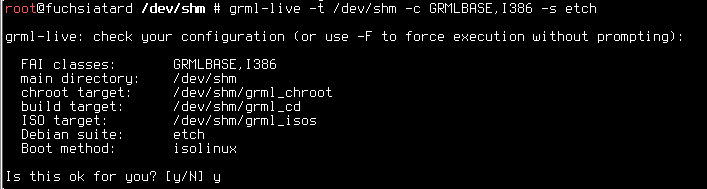
[Gnaaaaa, sorry Planet Debian for sending a german article to you a few hours ago. I just chose the wrong category for the article. I removed the tag already and the article disappeared from Planet Debian right now; so if you don’t know what I’m talking about just don’t care. ;-) To the german readers: it’s just the same article as my previous one, but this time in english. :-)] grml-live is a framework which lets you build a grml/Debian based Linux Live-CD with one single command. grml-live is based on FAI (Fully Automatic Installation) and uses its class based concept: Screenshot: grml-live In this example I built a full grml-ISO. All I did was setting the Debian-Mirror in /etc/grml/grml-live.conf to my local one (to save traffic and time) and invoking the following command:
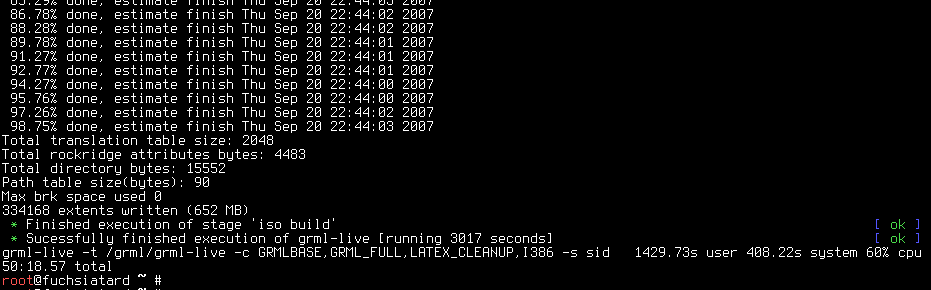
# grml-live -t /grml/grml-live -c GRMLBASE,GRML_FULL,LATEX_CLEANUP,I386 -s sid
About 50 minutes later I have a grml-ISO inside grml_isos at directory /grml/grml-live/ (-t …). It was built using the classes (-c …) GRMLBASE (all the core, essential stuff), GRML_FULL (software selection like official grml provides), LATEX_CLEANUP (clean up some very big LaTeX directories) and I386 (x86-specific packages like kernel). Debian unstable/sid was used as the suite (-s). And that’s it. You want a smaller grml-version using Debian/stable? No problem, let’s do it in shared memory (being very fast, and with enough RAM and mountoptions rw,suid,dev no problem at all): Screenshot grml-live: the beginning A ‘grml-live -t /dev/shm -c GRMLBASE,I386 -s etch’ and not even 5(!) minutes later I’ve my 135MB small grml: Screenshot grml-live: done So using grml-live you can build your own, customized Linux Live-CD without having to deal with remastering in detail. Via creating a new class (or just editing an existing one) its easy to include the software you would like to get. So, will the official grml-ISOs become obsolet? No, definitely not. The goal of grml-live is to give the grml-team a buildsystem providing exactly what we need. It should give us the possibility to concentrate on the important and interesting tasks, like: testing, bugfixing, implementing new features, working on the kernel, quality assurance, documentation,… grml-live should work on every Debian based system. If you want to give it a try just grab the Debian package from grml’s repository. The source is available (as usual) via mercurial. Find more details on the grml-live-webpage. If you have any further questions that aren’t answered by the docs yet, have feature requests, bugreports or patches: please let me know.

Next.

Previous.