Search Results: "mt"

3 May 2021

Russell Coker: DNS, Lots of IPs, and Postal

I decided to start work on repeating the tests for my 2006 OSDC paper on Benchmarking Mail Relays [1] and discover how the last 15 years of hardware developments have changed things. There have been software changes in that time too, but nothing that compares with going from single core 32bit systems with less than 1G of RAM and 60G IDE disks to multi-core 64bit systems with 128G of RAM and SSDs. As an aside the hardware I used in 2006 wasn t cutting edge and the hardware I m using now isn t either. In both cases it s systems I bought second hand for under $1000. Pedants can think of this as comparing 2004 and 2018 hardware. BIND I decided to make some changes to reflect the increased hardware capacity and use 2560 domains and IP addresses, which gave the following errors as well as a startup time of a minute on a system with two E5-2620 CPUs.
May  2 16:38:37 server named[7372]: listening on IPv4 interface lo, 127.0.0.1#53
May  2 16:38:37 server named[7372]: listening on IPv4 interface eno4, 10.0.2.45#53
May  2 16:38:37 server named[7372]: listening on IPv4 interface eno4, 10.0.40.1#53
May  2 16:38:37 server named[7372]: listening on IPv4 interface eno4, 10.0.40.2#53
May  2 16:38:37 server named[7372]: listening on IPv4 interface eno4, 10.0.40.3#53
[...]
May  2 16:39:33 server named[7372]: listening on IPv4 interface eno4, 10.0.47.0#53
May  2 16:39:33 server named[7372]: listening on IPv4 interface eno4, 10.0.48.0#53
May  2 16:39:33 server named[7372]: listening on IPv4 interface eno4, 10.0.49.0#53
May  2 16:39:33 server named[7372]: listening on IPv6 interface lo, ::1#53
[...]
May  2 16:39:36 server named[7372]: zone localhost/IN: loaded serial 2
May  2 16:39:36 server named[7372]: all zones loaded
May  2 16:39:36 server named[7372]: running
May  2 16:39:36 server named[7372]: socket: file descriptor exceeds limit (123273/21000)
May  2 16:39:36 server named[7372]: managed-keys-zone: Unable to fetch DNSKEY set '.': not enough free resources
May  2 16:39:36 server named[7372]: socket: file descriptor exceeds limit (123273/21000)
The first thing I noticed is that a default configuration of BIND with 2560 local IPs (when just running in the default recursive mode) takes a minute to start and needed to open over 100,000 file handles. BIND also had some errors in that configuration which led to it not accepting shutdown requests. I filed Debian bug report #987927 [2] about this. One way of dealing with the errors in this situation on Debian is to edit /etc/default/named and put in the following line to allow BIND to access to many file handles:
OPTIONS="-u bind -S 150000"
But the best thing to do for BIND when there are many IP addresses that aren t going to be used for DNS service is to put a directive like the following in the BIND configuration to specify the IP address or addresses that are used for the DNS service:
listen-on   10.0.2.45;  ;
I have just added the listen-on and listen-on-v6 directives to one of my servers with about a dozen IP addresses. While 2560 IP addresses is an unusual corner case it s not uncommon to have dozens of addresses on one system. dig When doing tests of Postfix for relaying mail I noticed that mail was being deferred with DNS problems (error was Host or domain name not found. Name service error for name=a838.example.com type=MX: Host not found, try again . I tested the DNS lookups with dig which failed with errors like the following:
dig -t mx a704.example.com
socket.c:1740: internal_send: 10.0.2.45#53: Invalid argument
; <
> DiG 9.16.13-Debian <
> -t mx a704.example.com
;; global options: +cmd
;; connection timed out; no servers could be reached
Here is a sample of the strace output from tracing dig:
bind(20,  sa_family=AF_INET, sin_port=htons(0), 
sin_addr=inet_addr("0.0.0.0") , 16) = 0
recvmsg(20,  msg_namelen=128 , 0)       = -1 EAGAIN (Resource temporarily 
unavailable)
write(4, "\24\0\0\0\375\377\377\377", 8) = 8
sendmsg(20,  msg_name= sa_family=AF_INET, sin_port=htons(53), 
sin_addr=inet_addr("10.0.2.45") , msg_
namelen=16, msg_iov=[ iov_base="86\1 
\0\1\0\0\0\0\0\1\4a704\7example\3com\0\0\17\0\1\0\0)\20\0\0\0\0
\0\0\f\0\n\0\10's\367\265\16bx\354", iov_len=57 ], msg_iovlen=1, 
msg_controllen=0, msg_flags=0 , 0) 
= -1 EINVAL (Invalid argument)
write(2, "socket.c:1740: ", 15)         = 15
write(2, "internal_send: 10.0.2.45#53: Invalid argument", 45) = 45
write(2, "\n", 1)                       = 1
futex(0x7f5a80696084, FUTEX_WAIT_PRIVATE, 0, NULL) = 0
futex(0x7f5a80696010, FUTEX_WAKE_PRIVATE, 1) = 0
futex(0x7f5a8069809c, FUTEX_WAKE_PRIVATE, 1) = 1
futex(0x7f5a80698020, FUTEX_WAKE_PRIVATE, 1) = 1
sendmsg(20,  msg_name= sa_family=AF_INET, sin_port=htons(53), 
sin_addr=inet_addr("10.0.2.45") , msg_namelen=16, msg_iov=[ iov_base="86\1 
\0\1\0\0\0\0\0\1\4a704\7example\3com\0\0\17\0\1\0\0)\20\0\0\0\0\0\0\f\0\n\0\10's\367\265\16bx\354", 
iov_len=57 ], msg_iovlen=1, msg_controllen=0, msg_flags=0 , 0) = -1 EINVAL 
(Invalid argument)
write(2, "socket.c:1740: ", 15)         = 15
write(2, "internal_send: 10.0.2.45#53: Invalid argument", 45) = 45
write(2, "\n", 1)
Ubuntu bug #1702726 claims that an insufficient ARP cache was the cause of dig problems [3]. At the time I encountered the dig problems I was seeing lots of kernel error messages neighbour: arp_cache: neighbor table overflow which I solved by putting the following in /etc/sysctl.d/mine.conf:
net.ipv4.neigh.default.gc_thresh3 = 4096
net.ipv4.neigh.default.gc_thresh2 = 2048
net.ipv4.neigh.default.gc_thresh1 = 1024
Making that change (and having rebooted because I didn t need to run the server overnight) didn t entirely solve the problems. I have seen some DNS errors from Postfix since then but they are less common than before. When they happened I didn t have that error from dig. At this stage I m not certain that the ARP change fixed the dig problem although it seems likely (it s always difficult to be certain that you have solved a race condition instead of made it less common or just accidentally changed something else to conceal it). But it is clearly a good thing to have a large enough ARP cache so the above change is probably the right thing for most people (with the possibility of changing the numbers according to the required scale). Also people having that dig error should probably check their kernel message log, if the ARP cache isn t the cause then some other kernel networking issue might be related. Preliminary Results With Postfix I m seeing around 24,000 messages relayed per minute with more than 60% CPU time idle. I m not sure exactly how to count idle time when there are 12 CPU cores and 24 hyper-threads as having only 1 process scheduled for each pair of hyperthreads on a core is very different to having half the CPU cores unused. I ran my script to disable hyper-threads by telling the Linux kernel to disable each processor core that has the same core ID as another, it was buggy and disabled the second CPU altogether (better than finding this out on a production server). Going from 24 hyper-threads of 2 CPUs to 6 non-HT cores of a single CPU didn t change the thoughput and the idle time went to about 30%, so I have possibly halved the CPU capacity for these tasks by disabling all hyper-threads and one entire CPU which is surprising given that I theoretically reduced the CPU power by 75%. I think my focus now has to be on hyper-threading optimisation. Since 2006 the performance has gone from ~20 messages per minute on relatively commodity hardware to 24,000 messages per minute on server equipment that is uncommon for home use but which is also within range of home desktop PCs. I think that a typical desktop PC with a similar speed CPU, 32G of RAM and SSD storage would give the same performance. Moore s Law (that transistor count doubles approximately every 2 years) is often misquoted as having performance double every 2 years. In this case more than 1024* the performance over 15 years means the performance doubling every 18 months. Probably most of that is due to SATA SSDs massively outperforming IDE hard drives but it s still impressive. Notes I ve been using example.com for test purposes for a long time, but RFC2606 specifies .test, .example, and .invalid as reserved top level domains for such things. On the next iteration I ll change my scripts to use .test. My current test setup has a KVM virtual machine running my bhm program to receive mail which is taking between 20% and 50% of a CPU core in my tests so far. While that is happening the kvm process is reported as taking between 60% and 200% of a CPU core, so kvm takes as much as 4* the CPU of the guest due to the virtual networking overhead even though I m using the virtio-net-pci driver (the most efficient form of KVM networking for emulating a regular ethernet card). I ve also seen this in production with a virtual machine running a ToR relay node. I ve fixed a bug where Postal would try to send the SMTP quit command after encountering a TCP error which would cause an infinite loop and SEGV.

30 April 2021

Chris Lamb: Free software activities in April 2021

Here is my monthly update covering what I have been doing in the free software world during April 2021 (previous month): Reproducible Builds One of the original promises of open source software is that distributed peer review and transparency of process results in enhanced end-user security. However, whilst anyone may inspect the source code of free and open source software for malicious flaws, almost all software today is distributed as pre-compiled binaries. This allows nefarious third-parties to compromise systems by injecting malicious code into ostensibly secure software during the various compilation and distribution processes. The motivation behind the Reproducible Builds effort is to ensure no flaws have been introduced during this compilation process by promising identical results are always generated from a given source, thus allowing multiple third-parties to come to a consensus on whether a build was compromised. The project is proud to be a member project of the Software Freedom Conservancy. Conservancy acts as a corporate umbrella allowing projects to operate as non-profit initiatives without managing their own corporate structure. If you like the work of the Conservancy or the Reproducible Builds project, please consider becoming an official supporter. This month, I:
Debian
Debian Long Term Support (LTS) This month I have worked 18 hours on Debian Long Term Support (LTS) and 12 hours on its sister Extended LTS project: You can find out more about the project via the following video:

28 April 2021

Russell Coker: Links April 2021

Dr Justin Lehmiller s blog post comparing his official (academic style) and real biographies is interesting [1]. Also the rest of his blog is interesting too, he works at the Kinsey Institute so you know he s good. Media Matters has an interesting article on the spread of vaccine misinformation on Instagram [2]. John Goerzen wrote a long post summarising some of the many ways of having a decentralised Internet [3]. One problem he didn t address is how to choose between them, I could spend months of work to setup a fraction of those services. Erasmo Acosta wrote an interesting medium article Could Something as Pedestrian as the Mitochondria Unlock the Mystery of the Great Silence? [4]. I don t know enough about biology to determine how plausible this is. But it is a worry, I hope that humans will meet extra-terrestrial intelligences at some future time. Meredith Haggerty wrote an insightful Medium article about the love vs money aspects of romantic comedies [5]. Changes in viewer demographics would be one factor that makes lead actors in romantic movies significantly less wealthy in recent times. Informative article about ZIP compression and the history of compression in general [6]. Vice has an insightful article about one way of taking over SMS access of phones without affecting voice call or data access [7]. With this method the victom won t notice that they are having their sservice interfered with until it s way too late. They also explain the chain of problems in the US telecommunications industry that led to this. I wonder what s happening in this regard in other parts of the world. The clown code of ethics (8 Commandments) is interesting [8]. Sam Hartman wrote an insightful blog post about the problems with RMS and how to deal with him [9]. Also Sam Whitton has an interesting take on this [10]. Another insightful post is by Selam G about RMS long history of bad behavior and the way universities are run [11]. Cory Doctorow wrote an insightful article for Locus about free markets with a focus on DRM on audio books [12]. We need legislative changes to fix this!

15 April 2021

Martin Michlmayr: ledger2beancount 2.6 released

I released version 2.6 of ledger2beancount, a ledger to beancount converter. Here are the changes in 2.6: Thanks to Alexander Baier, Daniele Nicolodi, and GitHub users bratekarate, faaafo and mefromthepast for various bug reports and other input. Thanks to Dennis Lee for adding a Dockerfile and to Vinod Kurup for fixing a bug. Thanks to Stefano Zacchiroli for testing. You can get ledger2beancount from GitHub.

11 April 2021

Vishal Gupta: Sikkim 101 for Backpackers

Host to Kanchenjunga, the world s third-highest mountain peak and the endangered Red Panda, Sikkim is a state in northeastern India. Nestled between Nepal, Tibet (China), Bhutan and West Bengal (India), the state offers a smorgasbord of cultures and cuisines. That said, it s hardly surprising that the old spice route meanders through western Sikkim, connecting Lhasa with the ports of Bengal. Although the latter could also be attributed to cardamom (kali elaichi), a perennial herb native to Sikkim, which the state is the second-largest producer of, globally. Lastly, having been to and lived in India, all my life, I can confidently say Sikkim is one of the cleanest & safest regions in India, making it ideal for first-time backpackers.

Brief History
  • 17th century: The Kingdom of Sikkim is founded by the Namgyal dynasty and ruled by Buddhist priest-kings known as the Chogyal.
  • 1890: Sikkim becomes a princely state of British India.
  • 1947: Sikkim continues its protectorate status with the Union of India, post-Indian-independence.
  • 1973: Anti-royalist riots take place in front of the Chogyal's palace, by Nepalis seeking greater representation.
  • 1975: Referendum leads to the deposition of the monarchy and Sikkim joins India as its 22nd state.
Languages
  • Official: English, Nepali, Sikkimese/Bhotia and Lepcha
  • Though Hindi and Nepali share the same script (Devanagari), they are not mutually intelligible. Yet, most people in Sikkim can understand and speak Hindi.
Ethnicity
  • Nepalis: Migrated in large numbers (from Nepal) and soon became the dominant community
  • Bhutias: People of Tibetan origin. Major inhabitants in Northern Sikkim.
  • Lepchas: Original inhabitants of Sikkim

Food
  • Tibetan/Nepali dishes (mostly consumed during winter)
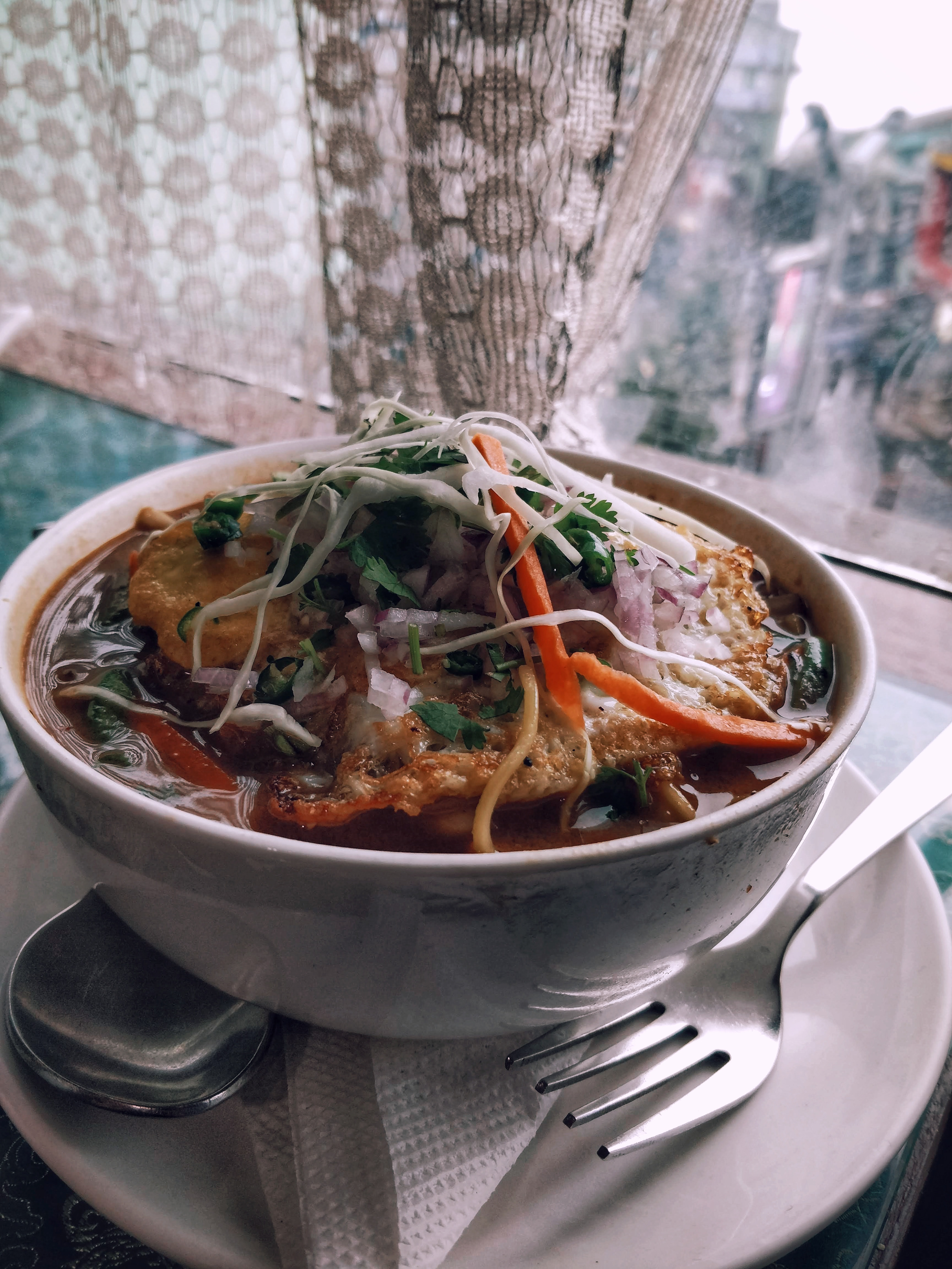
    • Thukpa: Noodle soup, rich in spices and vegetables. Usually contains some form of meat. Common variations: Thenthuk and Gyathuk
    • Momos: Steamed or fried dumplings, usually with a meat filling.
    • Saadheko: Spicy marinated chicken salad.
    • Gundruk Soup: A soup made from Gundruk, a fermented leafy green vegetable.
    • Sinki : A fermented radish tap-root product, traditionally consumed as a base for soup and as a pickle. Eerily similar to Kimchi.
  • While pork and beef are pretty common, finding vegetarian dishes is equally easy.
  • Staple: Dal-Bhat with Subzi. Rice is a lot more common than wheat (rice) possibly due to greater carb content and proximity to West Bengal, India s largest producer of Rice.
  • Good places to eat in Gangtok
    • Hamro Bhansa Ghar, Nimtho (Nepali)
    • Taste of Tibet
    • Dragon Wok (Chinese & Japanese)

Buddhism in Sikkim
  • Bayul Demojong (Sikkim), is the most sacred Land in the Himalayas as per the belief of the Northern Buddhists and various religious texts.
  • Sikkim was blessed by Guru Padmasambhava, the great Buddhist saint who visited Sikkim in the 8th century and consecrated the land.
  • However, Buddhism is said to have reached Sikkim only in the 17th century with the arrival of three Tibetan monks viz. Rigdzin Goedki Demthruchen, Mon Kathok Sonam Gyaltshen & Rigdzin Legden Je at Yuksom. Together, they established a Buddhist monastery.
  • In 1642 they crowned Phuntsog Namgyal as the first monarch of Sikkim and gave him the title of Chogyal, or Dharma Raja.
  • The faith became popular through its royal patronage and soon many villages had their own monastery.
  • Today Sikkim has over 200 monasteries.

Major monasteries
  • Rumtek Monastery, 20Km from Gangtok
  • Lingdum/Ranka Monastery, 17Km from Gangtok
  • Phodong Monastery, 28Km from Gangtok
  • Ralang Monastery, 10Km from Ravangla
  • Tsuklakhang Monastery, Royal Palace, Gangtok
  • Enchey Monastery, Gangtok
  • Tashiding Monastery, 35Km from Ravangla


Reaching Sikkim
  • Gangtok, being the capital, is easiest to reach amongst other regions, by public transport and shared cabs.
  • By Air:
    • Pakyong (PYG) :
      • Nearest airport from Gangtok (about 1 hour away)
      • Tabletop airport
      • Reserved cabs cost around INR 1200.
      • As of Apr 2021, the only flights to PYG are from IGI (Delhi) and CCU (Kolkata).
    • Bagdogra (IXB) :
      • About 20 minutes from Siliguri and 4 hours from Gangtok.
      • Larger airport with flights to most major Indian cities.
      • Reserved cabs cost about INR 3000. Shared cabs cost about INR 350.
  • By Train:
    • New Jalpaiguri (NJP) :
      • About 20 minutes from Siliguri and 4 hours from Gangtok.
      • Reserved cabs cost about INR 3000. Shared cabs from INR 350.
  • By Road:
    • NH10 connects Siliguri to Gangtok
    • If you can t find buses plying to Gangtok directly, reach Siliguri and then take a cab to Gangtok.
  • Sikkim Nationalised Transport Div. also runs hourly buses between Siliguri and Gangtok and daily buses on other common routes. They re cheaper than shared cabs.
  • Wizzride also operates shared cabs between Siliguri/Bagdogra/NJP, Gangtok and Darjeeling. They cost about the same as shared cabs but pack in half as many people in luxury cars (Innova, Xylo, etc.) and are hence more comfortable.

Gangtok
  • Time needed: 1D/1N
  • Places to visit:
    • Hanuman Tok
    • Ganesh Tok
    • Tashi View Point [6,800ft]
    • MG Marg
    • Sikkim Zoo
    • Gangtok Ropeway
    • Enchey Monastery
    • Tsuklakhang Palace & Monastery
  • Hostels: Tagalong Backpackers (would strongly recommend), Zostel Gangtok
  • Places to chill: Travel Cafe, Caf Live & Loud and Gangtok Groove
  • Places to shop: Lal Market and MG Marg

Getting Around
  • Taxis operate on a reserved or shared basis. In case of the latter, you can pool with other commuters your taxis will pick up and drop en-route.
  • Naturally shared taxis only operate on popular routes. The easiest way to get around Gangtok is to catch a shared cab from MG Marg.
  • Reserved taxis for Gangtok sightseeing cost around INR 1000-1500, depending upon the spots you d like to see
  • Key taxi/bus stands :
    • Deorali stand: For Darjeeling, Siliguri, Kalimpong
    • Vajra stand: For North & East Sikkim (Tsomgo Lake & Nathula)
    • Rumtek taxi: For Ravangla, Pelling, Namchi, Geyzing, Jorethang and Singtam.
Exploring Gangtok on an MTB

North Sikkim
  • The easiest & most economical way to explore North Sikkim is the 3D/2N package offered by shared-cab drivers.
  • This includes food, permits, cab rides and accommodation (1N in Lachen and 1N in Lachung)
  • The accommodation on both nights are at homestays with bare necessities, so keep your hopes low.
  • In the spirit of sustainable tourism, you ll be asked to discard single-use plastic bottles, so please carry a bottle that you can refill along the way.
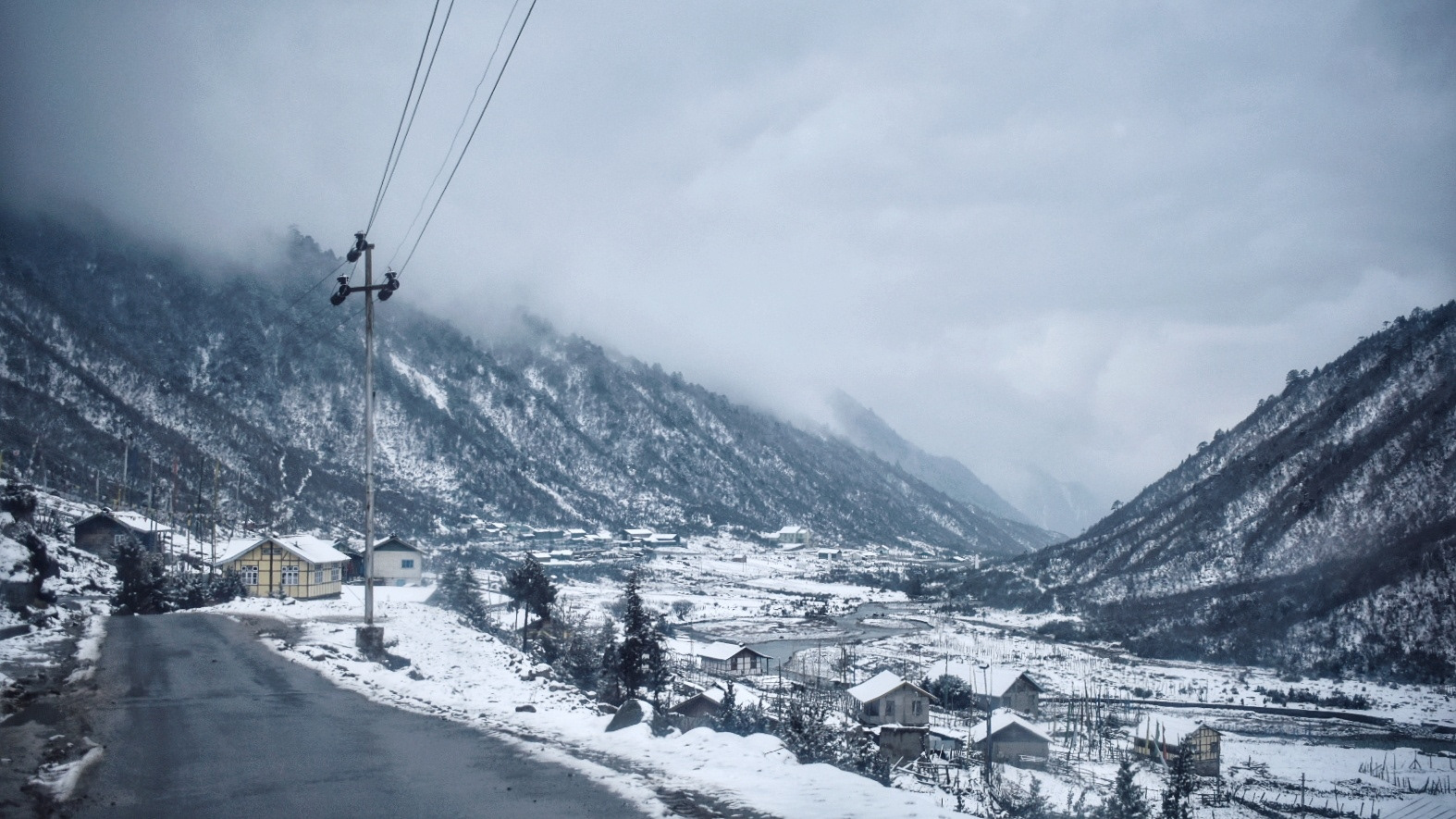
  • Zero Point and Gurdongmer Lake are snow-capped throughout the year
3D/2N Shared-cab Package Itinerary
  • Day 1
    • Gangtok (10am) - Chungthang - Lachung (stay)
  • Day 2
    • Pre-lunch : Lachung (6am) - Yumthang Valley [12,139ft] - Zero Point - Lachung [15,300ft]
    • Post-lunch : Lachung - Chungthang - Lachen (stay)
  • Day 3
    • Pre-lunch : Lachen (5am) - Kala Patthar - Gurdongmer Lake [16,910ft] - Lachen
    • Post-lunch : Lachen - Chungthang - Gangtok (7pm)
  • This itinerary is idealistic and depends on the level of snowfall.
  • Some drivers might switch up Day 2 and 3 itineraries by visiting Lachen and then Lachung, depending upon the weather.
  • Areas beyond Lachen & Lachung are heavily militarized since the Indo-China border is only a few miles away.

East Sikkim

Zuluk and Silk Route
  • Time needed: 2D/1N
  • Zuluk [9,400ft] is a small hamlet with an excellent view of the eastern Himalayan range including the Kanchenjunga.
  • Was once a transit point to the historic Silk Route from Tibet (Lhasa) to India (West Bengal).
  • The drive from Gangtok to Zuluk takes at least four hours. Hence, it makes sense to spend the night at a homestay and space out your trip to Zuluk

Tsomgo Lake and Nathula
  • Time Needed : 1D
  • A Protected Area Permit is required to visit these places, due to their proximity to the Chinese border
  • Tsomgo/Chhangu Lake [12,313ft]
    • Glacial lake, 40 km from Gangtok.
    • Remains frozen during the winter season.
    • You can also ride on the back of a Yak for INR 300
  • Baba Mandir
    • An old temple dedicated to Baba Harbhajan Singh, a Sepoy in the 23rd Regiment, who died in 1962 near the Nathu La during Indo China war.
  • Nathula Pass [14,450ft]
    • Located on the Indo-Tibetan border crossing of the Old Silk Route, it is one of the three open trading posts between India and China.
    • Plays a key role in the Sino-Indian Trade and also serves as an official Border Personnel Meeting(BPM) Point.
    • May get cordoned off by the Indian Army in event of heavy snowfall or for other security reasons.


West Sikkim
  • Time needed: 3N/1N
  • Hostels at Pelling : Mochilerro Ostillo

Itinerary

Day 1: Gangtok - Ravangla - Pelling
  • Leave Gangtok early, for Ravangla through the Temi Tea Estate route.
  • Spend some time at the tea garden and then visit Buddha Park at Ravangla
  • Head to Pelling from Ravangla

Day 2: Pelling sightseeing
  • Hire a cab and visit Skywalk, Pemayangtse Monastery, Rabdentse Ruins, Kecheopalri Lake, Kanchenjunga Falls.

Day 3: Pelling - Gangtok/Siliguri
  • Wake up early to catch a glimpse of Kanchenjunga at the Pelling Helipad around sunrise
  • Head back to Gangtok on a shared-cab
  • You could take a bus/taxi back to Siliguri if Pelling is your last stop.

Darjeeling
  • In my opinion, Darjeeling is lovely for a two-day detour on your way back to Bagdogra/Siliguri and not any longer (unless you re a Bengali couple on a honeymoon)
  • Once a part of Sikkim, Darjeeling was ceded to the East India Company after a series of wars, with Sikkim briefly receiving a grant from EIC for gifting Darjeeling to the latter
  • Post-independence, Darjeeling was merged with the state of West Bengal.

Itinerary

Day 1 :
  • Take a cab from Gangtok to Darjeeling (shared-cabs cost INR 300 per seat)
  • Reach Darjeeling by noon and check in to your Hostel. I stayed at Hideout.
  • Spend the evening visiting either a monastery (or the Batasia Loop), Nehru Road and Mall Road.
  • Grab dinner at Glenary whilst listening to live music.

Day 2:
  • Wake up early to catch the sunrise and a glimpse of Kanchenjunga at Tiger Hill. Since Tiger Hill is 10km from Darjeeling and requires a permit, book your taxi in advance.
  • Alternatively, if you don t want to get up at 4am or shell out INR1500 on the cab to Tiger Hill, walk to the Kanchenjunga View Point down Mall Road
  • Next, queue up outside Keventers for breakfast with a view in a century-old cafe
  • Get a cab at Gandhi Road and visit a tea garden (Happy Valley is the closest) and the Ropeway. I was lucky to meet 6 other backpackers at my hostel and we ended up pooling the cab at INR 200 per person, with INR 1400 being on the expensive side, but you could bargain.
  • Get lunch, buy some tea at Golden Tips, pack your bags and hop on a shared-cab back to Siliguri. It took us about 4hrs to reach Siliguri, with an hour to spare before my train.
  • If you ve still got time on your hands, then check out the Peace Pagoda and the Darjeeling Himalayan Railway (Toy Train). At INR 1500, I found the latter to be too expensive and skipped it.


Tips and hacks
  • Download offline maps, especially when you re exploring Northern Sikkim.
  • Food and booze are the cheapest in Gangtok. Stash up before heading to other regions.
  • Keep your Aadhar/Passport handy since you need permits to travel to North & East Sikkim.
  • In rural areas and some cafes, you may get to try Rhododendron Wine, made from Rhododendron arboreum a.k.a Gurans. Its production is a little hush-hush since the flower is considered holy and is also the National Flower of Nepal.
  • If you don t want to invest in a new jacket, boots or a pair of gloves, you can always rent them at nominal rates from your hotel or little stores around tourist sites.
  • Check the weather of a region before heading there. Low visibility and precipitation can quite literally dampen your experience.
  • Keep your itinerary flexible to accommodate for rest and impromptu plans.
  • Shops and restaurants close by 8pm in Sikkim and Darjeeling. Plan for the same.

Carry
  • a couple of extra pairs of socks (woollen, if possible)
  • a pair of slippers to wear indoors
  • a reusable water bottle
  • an umbrella
  • a power bank
  • a couple of tablets of Diamox. Helps deal with altitude sickness
  • extra clothes and wet bags since you may not get a chance to wash/dry your clothes
  • a few passport size photographs

Shared-cab hacks
  • Intercity rides can be exhausting. If you can afford it, pay for an additional seat.
  • Call shotgun on the drives beyond Lachen and Lachung. The views are breathtaking.
  • Return cabs tend to be cheaper (WB cabs travelling from SK and vice-versa)

Cost
  • My median daily expenditure (back when I went to Sikkim in early March 2021) was INR 1350.
  • This includes stay (bunk bed), food, wine and transit (shared cabs)
  • In my defence, I splurged on food, wine and extra seats in shared cabs, but if you re on a budget, you could easily get by on INR 1 - 1.2k per day.
  • For a 9-day trip, I ended up shelling out nearly INR 15k, including 2AC trains to & from Kolkata
  • Note : Summer (March to May) and Autumn (October to December) are peak seasons, and thereby more expensive to travel around.

Souvenirs and things you should buy

Buddhist souvenirs :
  • Colourful Prayer Flags (great for tying on bikes or behind car windshields)
  • Miniature Prayer/Mani Wheels
  • Lucky Charms, Pendants and Key Chains
  • Cham Dance masks and robes
  • Singing Bowls
  • Common symbols: Om mani padme hum, Ashtamangala, Zodiac signs

Handicrafts & Handlooms
  • Tibetan Yak Wool shawls, scarfs and carpets
  • Sikkimese Ceramic cups
  • Thangka Paintings

Edibles
  • Darjeeling Tea (usually brewed and not boiled)
  • Wine (Arucha Peach & Rhododendron)
  • Dalle Khursani (Chilli) Paste and Pickle

Header Icon made by Freepik from www.flaticon.com is licensed by CC 3.0 BY

Jonathan Dowland: 2020 in short fiction

Cover for *Episodes*
Following on from 2020 in Fiction: In 2020 I read a couple of collections of short fiction from some of my favourite authors. I started the year with Christopher Priest's Episodes. The stories within are collected from throughout his long career, and vary in style and tone. Priest wrote new little prologues and epilogues for each of the stories, explaining the context in which they were written. I really enjoyed this additional view into their construction.
Cover for *Adam Robots*
By contrast, Adam Robert's Adam Robots presents the stories on their own terms. Each of the stories is written in a different mode: one as golden-age SF, another as a kind of Cyberpunk, for example, although they all blend or confound sub-genres to some degree. I'm not clever enough to have decoded all their secrets on a first read, and I would have appreciated some "Cliff's Notes on any deeper meaning or intent.
Cover for *Exhalation*
Ted Chiang's Exhalation was up to the fantastic standard of his earlier collection and had some extremely thoughtful explorations of philosophical ideas. All the stories are strong but one stuck in my mind the longest: Omphalos) With my daughter I finished three of Terry Pratchett's short story collections aimed at children: Dragon at Crumbling Castle; The Witch's Vacuum Cleaner and The Time-Travelling Caveman. If you are a Pratchett fan and you've overlooked these because they're aimed at children, take another look. The quality varies, but there are some true gems in these. Several stories take place in common settings, either the town of Blackbury, in Gritshire (and the adjacent Even Moor), or the Welsh border-town of Llandanffwnfafegettupagogo. The sad thing was knowing that once I'd finished them (and the fourth, Father Christmas's Fake Beard) that was it: there will be no more.
Cover for Interzone, issue 277
8/31 of the "books" I read in 2020 were issues of Interzone. Counting them as "books" for my annual reading goal has encouraged me to read full issues, whereas before I would likely have only read a couple of stories from each issue. Reading full issues has rekindled the enjoyment I got out of it when I first discovered the magazine at the turn of the Century. I am starting to recognise stories by authors that have written stories in other issues, as well as common themes from the current era weaving their way into the work (Trump, Brexit, etc.) No doubt the Pandemic will leave its mark on 2021's stories.

28 March 2021

Dirk Eddelbuettel: RcppSpdlog 0.0.5 on CRAN: New upstream versions

About three months after the last update, we can announce a new version 0.0.5 of RcppSpdlog. It contains releases 1.8.3, 1.8.4 and 1.8.5 of spdlog which were made in quick succession mid-week (while we were waiting on an update of CRAN s own machinery) and was processed yesterday and overnight. RcppSpdlog bundles spdlog, a wonderful header-only C++ logging library with all the bells and whistles you would want that was written by Gabi Melman, and also includes fmt by Victor Zverovich. The NEWS entry for this release follows.

Changes in RcppSpdlog version 0.0.5 (2020-12-11)
  • Upgraded to upstream release spdlog 1.8.5 (and 1.8.4 and 1.8.3)
  • Small enhancements to DESCRIPTION files

Courtesy of my CRANberries, there is also a diffstat report. More detailed information is on the RcppSpdlog page. If you like this or other open-source work I do, you can sponsor me at GitHub.

This post by Dirk Eddelbuettel originated on his Thinking inside the box blog. Please report excessive re-aggregation in third-party for-profit settings.

27 March 2021

Antonio Terceiro: Migrating from Chef to itamae

The Debian CI platform is comprised of 30+ (virtual) machines. Maintaining this many machines, and being able to add new ones with some degree of reliability requires one to use some sort of configuration management. Until about a week ago, we were using Chef for our configuration management. I was, for several years, the main maintainer of Chef in Debian, so using it was natural to me, as I had used it before for personal and work projects. But last year I decided to request the removal of Chef from Debian, so that it won't be shipped with Debian 11 (bullseye). After evaluating a few options, I believed that the path of least resistance was to migrate to itamae. itamae was inspired by chef, and uses a DSL that is very similar to the Chef one. Even though the itamae team claim it's not compatible with Chef, the changes that I needed to do were relatively limited. The necessary code changes might look like a lot, but a large part of them could be automated or done in bulk, like doing simple search and replace operations, and moving entire directories around. In the rest of this post, I will describe the migration process, starting with the infrastructure changes, the types of changes I needed to make to the configuration management code, and my conclusions about the process. Infrastructure changes The first step was to add support for itamae to chake, a configuration management wrapper tool that I wrote. chake was originally written as a serverless remote executor for Chef, so this involved a bit of a redesign. I thought it was worth it to do, because at that point chake had gained several interesting managements features that we no directly tied to Chef. This work was done a bit slowly over the course of the several months, starting almost exactly one year ago, and was completed 3 months ago. I wasn't in a hurry and knew I had time before Debian 11 is released and I had to upgrade the platform. After this was done, I started the work of migrating the then Chef cookbooks to itamae, and the next sections present the main types of changes that were necessary. During the entire process, I sent a few patches out: Code changes These are the main types of changes that were necessary in the configuration code to accomplish the migration to itamae. Replace cookbook_file with remote_file. The resource known as cookbook_file in Chef is called remote_file in itamae. Fixing this is just a matter of search and replace, e.g.:
-cookbook_file '/etc/apt/apt.conf.d/00updates' do
+remote_file '/etc/apt/apt.conf.d/00updates' do
Changed file locations The file structure assumed by itamae is a lot simpler than the one in Chef. The needed changes were: Explicit file ownership and mode Chef is usually design to run as root on the nodes, and files created are owned by root and have move 0644 by default. With itamae, files are by default owned by the user that was used to SSH into the machine. Because of this, I had to review all file creation resources and add owner, group and mode explicitly:
-cookbook_file '/etc/apt/apt.conf.d/00updates' do
-  source 'apt.conf'
+remote_file '/etc/apt/apt.conf.d/00updates' do
+  source 'files/apt.conf'
+  owner   'root'
+  group   'root'
+  mode    "0644"
 end
In the end, I guess being explicit make the configuration code more understandable, so I take that as a win. Different execution context One of the major differences between Chef itamae comes down the execution context of the recipes. In both Chef and itamae, the configuration is written in DSL embedded in Ruby. This means that the recipes are just Ruby code, and difference here has to do with where that code is executed. With Chef, the recipes are always execute on the machine you are configuring, while with itamae the recipe is executed on the workstation where you run itamae, and that gets translated to commands that need to be executed on the machine being configured. For example, if you need to configure a service based on how much RAM the machine has, with Chef you could do something like this:
total_ram = File.readlines("/proc/meminfo").find do  l 
  l.split.first == "MemTotal:"
end.split[1]
file "/etc/service.conf" do
  # use 20% of the total RAM
  content "cache_size = # ram / 5 KB"
end
With itamae, all that Ruby code will run on the client, so total_ram will contain the wrong number. In the Debian CI case, I worked around that by explicitly declaring the amount of RAM in the static host configuration, and the above construct ended up as something like this:
file "/etc/service.conf" do
  # use 20% of the total RAM
  content "cache_size = # node['total_ram'] / 5 KB"
end
Lessons learned This migration is now complete, and there are a few points that I take away from it: All in all, the system is working just fine, and I consider this to have been a successful migration. I'm happy it worked out.

23 March 2021

Jonathan Dowland: The Cure: 40 Live

Back in 2019, The Cure released a double-video-album featuring two live shows from 2018, their 40th anniversary concert at Hyde Park (which I attended) and their experimental "Curaetion" show from the Meltdown festival a few weeks earier. Rumours that there would be a release had been circulating since the gig itself, where video director Tim Pope was spotted filming the gig (sporting a tee shirt reading "Yes I'm Filming. No I don't know when you'll see it."). Earlier in 2019 the "Anniversary" half had a limited run in cinemas, but the home video release was not officially revealed until much later, and the inclusion of Curaetion an unexpected bonus. 'deluxe' releases The release is available in several configurations. The "standard" issue is a two-DVD (or Blu Ray) set in a hard-book case, with some liner notes in the middle. A "deluxe" issue is a roughly twice-as-large boxed set containing the two video discs and two CD-audio discs of the shows. When it comes to deluxe editions, I would historically have been the perfect "mark", but I've had some bad experiences with other releases (this is a story for another blog post), so for this release I pre-ordered the standard BR edition. Right up until release, I wondered whether I should have made the other choice. Eventually, pictures of other people's Deluxe Editions started to circulate, and I was re-assured that I made the right call. The larger box is just something harder to store, the larger booklet is an exact reproduction of the smaller, standard edition liner notes, which are not really notable. The shows I think the shows are great. The Hyde Park show is a fairly standard "best of" setlist, and my enjoyment of it might be coloured by having been at the show and having fond memories of it. But it's a great performance and very well captured, so I think there's something for people who like the Cure but weren't there to enjoy too. I wasn't at the Meltdown show. The setlist for that one is much more esoteric, and it's lovely to have renditions of songs that are rarely performed live (And: across the two sets you get If Only Tonight We Could Sleep twice). Getting the audio I knew in advance that I would likely listen to the shows more often than watch them, so the CDs in the Deluxe set would have been useful for that, but I was fairly sure the audio mix would be the same as on the video discs, so I could just extract that. I was half-right: the BR set (at least) has 5.1 surround and separate lossless stereo mixes, but they have been mastered quite differently to the CD audio, which appears to be brick-wall mastered, to such an extent that the audio distorts quite noticeably in a few places. The BR audio does not seem to suffer from the same problems. Getting the audio off the discs was interesting. On Linux, the tool of choice for decoding encrypted Blu Rays is libaacs, which requires a list of Blu Ray keys which you must source separately. With my BR drive I was not able to decode the discs using the keys I could find online. However, the separate tool MakeMKV was able to decode them. I don't know exactly how but I speculate that MakeMKV contains some leaked hardware player keys that are not in more general circulation. Once I had decoded copies of the two videos, the trusty tool ffmpeg is able to easily extract the PCM stereo audio track. Unfortunately it cannot, in one go, split the audio track at the chapter boundary points. This is easy to script around: one ffmpeg invocation to get the chapter offsets, then some scripting to turn that into seek and duration command-line arguments for further ffmpeg invocations. For space reasons, I opted to transcode to FLAC at the same time as extracting each track. I hit an interesting (although not fatal) problem: the time taken to extract each track got progressively slower, almost as if ffmpeg was transcoding the entire audio track up to the point specified as the offset to start extracting from. If I wanted to answer categorically whether the BR audio was preferable, I would need to perform a double-blind listening test, using a tool such as squishyball. I certainly can't be bothered: the BR audio is fine for me.

Antoine Beaupr : Major email crash with syncmaildir

TL:DR; lost half my mail (150,000 messages, ~6GB) last night. Cause uncertain, but possibly a combination of a dead CMOS battery, systemd OnCalendar=daily, a (locking?) bug in syncmaildir, and generally, a system too exotic and complicated.

The crash So I somehow lost half my mail:
anarcat@angela:~(main)$ du -sh Maildir/
7,9G    Maildir/
anarcat@curie:~(main)$ du -sh Maildir
14G     Maildir
anarcat@marcos:~$ du -sh Maildir
8,0G    Maildir
Those are three different machines:
  • angela: my laptop, not always on
  • curie: my workstation, mostly always on
  • marcos: my mail server, always on
Those mails are synchronized using a rather exotic system based on SSH, syncmaildir and rsendmail. The anomaly started on curie:
-- Reboot --
mar 22 16:13:00 curie systemd[3199]: Starting pull emails with syncmaildir...
mar 22 16:13:00 curie smd-pull[4801]: rm: impossible de supprimer '/home/anarcat/.smd/workarea/Maildir': Le dossier n'est pas vide
mar 22 16:13:00 curie systemd[3199]: smd-pull.service: Main process exited, code=exited, status=1/FAILURE
mar 22 16:13:00 curie systemd[3199]: smd-pull.service: Failed with result 'exit-code'.
mar 22 16:13:00 curie systemd[3199]: Failed to start pull emails with syncmaildir.
mar 22 16:14:00 curie systemd[3199]: Starting pull emails with syncmaildir...
mar 22 16:14:00 curie smd-pull[7025]:  4091 ?        00:00:00 smd-push
mar 22 16:14:00 curie smd-pull[7025]: Already running.
mar 22 16:14:00 curie smd-pull[7025]: If this is not the case, remove /home/anarcat/.smd/lock by hand.
mar 22 16:14:00 curie smd-pull[7025]: any: smd-pushpull@localhost: TAGS: error::context(locking) probable-cause(another-instance-is-running) human-intervention(necessary) suggested-actions(run(kill 4091) run(rm /home/anarcat/.smd/lock))
mar 22 16:14:00 curie systemd[3199]: smd-pull.service: Main process exited, code=exited, status=1/FAILURE
mar 22 16:14:00 curie systemd[3199]: smd-pull.service: Failed with result 'exit-code'.
mar 22 16:14:00 curie systemd[3199]: Failed to start pull emails with syncmaildir.
Then it seems like smd-push (from curie) started destroying the universe for some reason:
mar 22 16:20:00 curie systemd[3199]: Starting pull emails with syncmaildir...
mar 22 16:20:00 curie smd-pull[9319]:  4091 ?        00:00:00 smd-push
mar 22 16:20:00 curie smd-pull[9319]: Already running.
mar 22 16:20:00 curie smd-pull[9319]: If this is not the case, remove /home/anarcat/.smd/lock by hand.
mar 22 16:20:00 curie smd-pull[9319]: any: smd-pushpull@localhost: TAGS: error::context(locking) probable-cause(another-instance-is-running) human-intervention(necessary) suggested-actions(ru
mar 22 16:20:00 curie systemd[3199]: smd-pull.service: Main process exited, code=exited, status=1/FAILURE
mar 22 16:20:00 curie systemd[3199]: smd-pull.service: Failed with result 'exit-code'.
mar 22 16:20:00 curie systemd[3199]: Failed to start pull emails with syncmaildir.
mar 22 16:21:34 curie smd-push[4091]: default: smd-client@smd-server-anarcat: TAGS: stats::new-mails(0), del-mails(293920), bytes-received(0), xdelta-received(26995)
mar 22 16:21:35 curie smd-push[9374]: register: smd-client@smd-server-register: TAGS: stats::new-mails(0), del-mails(0), bytes-received(0), xdelta-received(215)
mar 22 16:21:35 curie systemd[3199]: smd-push.service: Succeeded.
Notice the del-mails(293920) there: it is actively trying to destroy basically every email in my mail spool. Then somehow push and pull started both at once:
mar 22 16:21:35 curie systemd[3199]: Started push emails with syncmaildir.
mar 22 16:21:35 curie systemd[3199]: Starting push emails with syncmaildir...
mar 22 16:22:00 curie systemd[3199]: Starting pull emails with syncmaildir...
mar 22 16:22:00 curie smd-pull[10333]:  9455 ?        00:00:00 smd-push
mar 22 16:22:00 curie smd-pull[10333]: Already running.
mar 22 16:22:00 curie smd-pull[10333]: If this is not the case, remove /home/anarcat/.smd/lock by hand.
mar 22 16:22:00 curie smd-pull[10333]: any: smd-pushpull@localhost: TAGS: error::context(locking) probable-cause(another-instance-is-running) human-intervention(necessary) suggested-actions(r
mar 22 16:22:00 curie systemd[3199]: smd-pull.service: Main process exited, code=exited, status=1/FAILURE
mar 22 16:22:00 curie systemd[3199]: smd-pull.service: Failed with result 'exit-code'.
mar 22 16:22:00 curie systemd[3199]: Failed to start pull emails with syncmaildir.
mar 22 16:22:00 curie smd-push[9455]: smd-client: ERROR: Data transmission failed.
mar 22 16:22:00 curie smd-push[9455]: smd-client: ERROR: This problem is transient, please retry.
mar 22 16:22:00 curie smd-push[9455]: smd-client: ERROR: server sent ABORT or connection died
mar 22 16:22:00 curie smd-push[9455]: smd-server: ERROR: Unable to open Maildir/.kobo/cur/1498563708.M122624P22121.marcos,S=32234,W=32792:2,S: Maildir/.kobo/cur/1498563708.M122624P22121.marco
mar 22 16:22:00 curie smd-push[9455]: smd-server: ERROR: The problem should be transient, please retry.
mar 22 16:22:00 curie smd-push[9455]: smd-server: ERROR: Unable to open requested file.
mar 22 16:22:00 curie smd-push[9455]: default: smd-client@smd-server-anarcat: TAGS: stats::new-mails(0), del-mails(293920), bytes-received(0), xdelta-received(26995)
mar 22 16:22:00 curie smd-push[9455]: default: smd-client@smd-server-anarcat: TAGS: error::context(receive) probable-cause(network) human-intervention(avoidable) suggested-actions(retry)
mar 22 16:22:00 curie smd-push[9455]: default: smd-server@localhost: TAGS: error::context(transmit) probable-cause(simultaneous-mailbox-edit) human-intervention(avoidable) suggested-actions(r
mar 22 16:22:00 curie systemd[3199]: smd-push.service: Main process exited, code=exited, status=1/FAILURE
mar 22 16:22:00 curie systemd[3199]: smd-push.service: Failed with result 'exit-code'.
mar 22 16:22:00 curie systemd[3199]: Failed to start push emails with syncmaildir.
There it seems push tried to destroy the universe again: del-mails(293920). Interestingly, the push started again in parallel with the pull, right that minute:
mar 22 16:22:00 curie systemd[3199]: Starting push emails with syncmaildir...
... but didn't complete for a while, here's pull trying to start again:
mar 22 16:24:00 curie systemd[3199]: Starting pull emails with syncmaildir...
mar 22 16:24:00 curie smd-pull[12051]: 10466 ?        00:00:00 smd-push
mar 22 16:24:00 curie smd-pull[12051]: Already running.
mar 22 16:24:00 curie smd-pull[12051]: If this is not the case, remove /home/anarcat/.smd/lock by hand.
mar 22 16:24:00 curie smd-pull[12051]: any: smd-pushpull@localhost: TAGS: error::context(locking) probable-cause(another-instance-is-running) human-intervention(necessary) suggested-actions(run(kill 10466) run(rm /home/anarcat/.smd/lock))
mar 22 16:24:00 curie systemd[3199]: smd-pull.service: Main process exited, code=exited, status=1/FAILURE
mar 22 16:24:00 curie systemd[3199]: smd-pull.service: Failed with result 'exit-code'.
mar 22 16:24:00 curie systemd[3199]: Failed to start pull emails with syncmaildir.
... and the long push finally resolving:
mar 22 16:24:00 curie smd-push[10466]: smd-client: ERROR: Data transmission failed.
mar 22 16:24:00 curie smd-push[10466]: smd-client: ERROR: This problem is transient, please retry.
mar 22 16:24:00 curie smd-push[10466]: smd-client: ERROR: server sent ABORT or connection died
mar 22 16:24:00 curie smd-push[10466]: smd-client: ERROR: Data transmission failed.
mar 22 16:24:00 curie smd-push[10466]: smd-client: ERROR: This problem is transient, please retry.
mar 22 16:24:00 curie smd-push[10466]: smd-client: ERROR: server sent ABORT or connection died
mar 22 16:24:00 curie smd-push[10466]: smd-server: ERROR: Unable to open Maildir/.kobo/cur/1498563708.M122624P22121.marcos,S=32234,W=32792:2,S: Maildir/.kobo/cur/1498563708.M122624P22121.marcos,S=32234,W=32792:2,S: No such file or directory
mar 22 16:24:00 curie smd-push[10466]: smd-server: ERROR: The problem should be transient, please retry.
mar 22 16:24:00 curie smd-push[10466]: smd-server: ERROR: Unable to open requested file.
mar 22 16:24:00 curie smd-push[10466]: default: smd-client@smd-server-anarcat: TAGS: stats::new-mails(0), del-mails(293920), bytes-received(0), xdelta-received(26995)
mar 22 16:24:00 curie smd-push[10466]: default: smd-client@smd-server-anarcat: TAGS: error::context(receive) probable-cause(network) human-intervention(avoidable) suggested-actions(retry)
mar 22 16:24:00 curie smd-push[10466]: default: smd-server@localhost: TAGS: error::context(transmit) probable-cause(simultaneous-mailbox-edit) human-intervention(avoidable) suggested-actions(retry)
mar 22 16:24:00 curie systemd[3199]: smd-push.service: Main process exited, code=exited, status=1/FAILURE
mar 22 16:24:00 curie systemd[3199]: smd-push.service: Failed with result 'exit-code'.
mar 22 16:24:00 curie systemd[3199]: Failed to start push emails with syncmaildir.
mar 22 16:24:00 curie systemd[3199]: Starting push emails with syncmaildir...
This pattern repeats until 16:35, when that locking issue silently recovered somehow:
mar 22 16:35:03 curie systemd[3199]: Starting pull emails with syncmaildir...
mar 22 16:35:41 curie smd-pull[20788]: default: smd-client@localhost: TAGS: stats::new-mails(5), del-mails(1), bytes-received(21885), xdelta-received(6863398)
mar 22 16:35:42 curie smd-pull[21373]: register: smd-client@localhost: TAGS: stats::new-mails(0), del-mails(0), bytes-received(0), xdelta-received(215)
mar 22 16:35:42 curie systemd[3199]: smd-pull.service: Succeeded.
mar 22 16:35:42 curie systemd[3199]: Started pull emails with syncmaildir.
mar 22 16:36:35 curie systemd[3199]: Starting pull emails with syncmaildir...
mar 22 16:36:36 curie smd-pull[21738]: default: smd-client@localhost: TAGS: stats::new-mails(0), del-mails(0), bytes-received(0), xdelta-received(214)
mar 22 16:36:37 curie smd-pull[21816]: register: smd-client@localhost: TAGS: stats::new-mails(0), del-mails(0), bytes-received(0), xdelta-received(215)
mar 22 16:36:37 curie systemd[3199]: smd-pull.service: Succeeded.
mar 22 16:36:37 curie systemd[3199]: Started pull emails with syncmaildir.
... notice that huge xdelta-received there, that's 7GB right there. Mysteriously, the curie mail spool survived this, possibly because smd-pull started failing again:
mar 22 16:38:00 curie systemd[3199]: Starting pull emails with syncmaildir...
mar 22 16:38:00 curie smd-pull[23556]: 21887 ?        00:00:00 smd-push
mar 22 16:38:00 curie smd-pull[23556]: Already running.
mar 22 16:38:00 curie smd-pull[23556]: If this is not the case, remove /home/anarcat/.smd/lock by hand.
mar 22 16:38:00 curie smd-pull[23556]: any: smd-pushpull@localhost: TAGS: error::context(locking) probable-cause(another-instance-is-running) human-intervention(necessary) suggested-actions(run(kill 21887) run(rm /home/anarcat/.smd/lock))
mar 22 16:38:00 curie systemd[3199]: smd-pull.service: Main process exited, code=exited, status=1/FAILURE
mar 22 16:38:00 curie systemd[3199]: smd-pull.service: Failed with result 'exit-code'.
mar 22 16:38:00 curie systemd[3199]: Failed to start pull emails with syncmaildir.
That could have been when i got on angela to check my mail, and it was busy doing the nasty removal stuff... although the times don't match. Here is when angela came back online:
anarcat@angela:~(main)$ last
anarcat  :0           :0               Mon Mar 22 19:57   still logged in
reboot   system boot  5.10.0-0.bpo.3-a Mon Mar 22 19:57   still running
anarcat  :0           :0               Mon Mar 22 17:43 - 18:47  (01:03)
reboot   system boot  5.10.0-0.bpo.3-a Mon Mar 22 17:39   still running
Then finally the sync on curie started failing with:
mar 22 16:46:35 curie systemd[3199]: Starting pull emails with syncmaildir...
mar 22 16:46:42 curie smd-pull[27455]: smd-server: ERROR: Client aborted, removing /home/anarcat/.smd/curie-anarcat__Maildir.db.txt.new and /home/anarcat/.smd/curie-anarcat__Maildir.db.txt.mtime.new
mar 22 16:46:42 curie smd-pull[27455]: smd-client: ERROR: Failed to copy Maildir/.debian/cur/1613401668.M901837P27073.marcos,S=3740,W=3815:2,S to Maildir/.koumbit/cur/1613401640.M415457P27063.marcos,S=3790,W=3865:2,S
mar 22 16:46:42 curie smd-pull[27455]: smd-client: ERROR: The destination already exists but its content differs.
mar 22 16:46:42 curie smd-pull[27455]: smd-client: ERROR: To fix this problem you have two options:
mar 22 16:46:42 curie smd-pull[27455]: smd-client: ERROR: - rename Maildir/.koumbit/cur/1613401640.M415457P27063.marcos,S=3790,W=3865:2,S by hand so that Maildir/.debian/cur/1613401668.M901837P27073.marcos,S=3740,W=3815:2,S
mar 22 16:46:42 curie smd-pull[27455]: smd-client: ERROR:   can be copied without replacing it.
mar 22 16:46:42 curie smd-pull[27455]: smd-client: ERROR:   Executing  cd; mv -n "Maildir/.koumbit/cur/1613401640.M415457P27063.marcos,S=3790,W=3865:2,S" "Maildir/.koumbit/cur/1616446002.1.localhost"  should work.
mar 22 16:46:42 curie smd-pull[27455]: smd-client: ERROR: - run smd-push so that your changes to Maildir/.koumbit/cur/1613401640.M415457P27063.marcos,S=3790,W=3865:2,S
mar 22 16:46:42 curie smd-pull[27455]: smd-client: ERROR:   are propagated to the other mailbox
mar 22 16:46:42 curie smd-pull[27455]: default: smd-client@localhost: TAGS: error::context(copy-message) probable-cause(concurrent-mailbox-edit) human-intervention(necessary) suggested-actions(run(mv -n "/home/anarcat/.smd/workarea/Maildir/.koumbit/cur/1613401640.M415457P27063.marcos,S=3790,W=3865:2,S" "/home/anarcat/.smd/workarea/Maildir/.koumbit/tmp/1613401640.M415457P27063.marcos,S=3790,W=3865:2,S") run(smd-push default))
mar 22 16:46:42 curie systemd[3199]: smd-pull.service: Main process exited, code=exited, status=1/FAILURE
mar 22 16:46:42 curie systemd[3199]: smd-pull.service: Failed with result 'exit-code'.
mar 22 16:46:42 curie systemd[3199]: Failed to start pull emails with syncmaildir.
It went on like this until I found the problem. This is, presumably, a good thing because those emails were not being destroyed. On angela, things looked like this:
-- Reboot --
mar 22 17:39:29 angela systemd[1677]: Started run notmuch new at least once a day.
mar 22 17:39:29 angela systemd[1677]: Started run smd-pull regularly.
mar 22 17:40:46 angela systemd[1677]: Starting pull emails with syncmaildir...
mar 22 17:43:18 angela smd-pull[3916]: smd-server: ERROR: Unable to open Maildir/.tor/new/1616446842.M285912P26118.marcos,S=8860,W=8996: Maildir/.tor/new/1616446842.M285912P26118.marcos,S=886
0,W=8996: No such file or directory
mar 22 17:43:18 angela smd-pull[3916]: smd-server: ERROR: The problem should be transient, please retry.
mar 22 17:43:18 angela smd-pull[3916]: smd-server: ERROR: Unable to open requested file.
mar 22 17:43:18 angela smd-pull[3916]: smd-client: ERROR: Data transmission failed.
mar 22 17:43:18 angela smd-pull[3916]: smd-client: ERROR: This problem is transient, please retry.
mar 22 17:43:18 angela smd-pull[3916]: smd-client: ERROR: server sent ABORT or connection died
mar 22 17:43:18 angela smd-pull[3916]: default: smd-server@smd-server-anarcat: TAGS: error::context(transmit) probable-cause(simultaneous-mailbox-edit) human-intervention(avoidable) suggested
-actions(retry)
mar 22 17:43:18 angela smd-pull[3916]: default: smd-client@localhost: TAGS: error::context(receive) probable-cause(network) human-intervention(avoidable) suggested-actions(retry)
mar 22 17:43:18 angela systemd[1677]: smd-pull.service: Main process exited, code=exited, status=1/FAILURE
mar 22 17:43:18 angela systemd[1677]: smd-pull.service: Failed with result 'exit-code'.
mar 22 17:43:18 angela systemd[1677]: Failed to start pull emails with syncmaildir.
mar 22 17:43:18 angela systemd[1677]: Starting pull emails with syncmaildir...
mar 22 17:43:29 angela smd-pull[4847]: default: smd-client@localhost: TAGS: stats::new-mails(29), del-mails(0), bytes-received(401519), xdelta-received(38914)
mar 22 17:43:29 angela smd-pull[5600]: register: smd-client@localhost: TAGS: stats::new-mails(2), del-mails(0), bytes-received(92150), xdelta-received(471)
mar 22 17:43:29 angela systemd[1677]: smd-pull.service: Succeeded.
mar 22 17:43:29 angela systemd[1677]: Started pull emails with syncmaildir.
mar 22 17:43:29 angela systemd[1677]: Starting push emails with syncmaildir...
mar 22 17:43:32 angela smd-push[5693]: default: smd-client@smd-server-anarcat: TAGS: stats::new-mails(0), del-mails(0), bytes-received(0), xdelta-received(217)
mar 22 17:43:33 angela smd-push[6575]: register: smd-client@smd-server-register: TAGS: stats::new-mails(0), del-mails(0), bytes-received(0), xdelta-received(219)
mar 22 17:43:33 angela systemd[1677]: smd-push.service: Succeeded.
mar 22 17:43:33 angela systemd[1677]: Started push emails with syncmaildir.
Notice how long it took to get the first error, in that first failure: it failed after 3 minutes! Presumably that's when it started deleting all that mail. And this is during pull, not push, so the error didn't come from angela.

Affected data It seems 2GB of mail from my main INBOX was destroyed. Another 2.4GB of spam (kept for training purposes) was also destroyed, along with 700MB of Sent mail. The rest is hard to figure out, because the folders are actually still there, just smaller. So I relied on ncdu to figure out the size changes. (Note that I don't really archive (or delete much of) my mail since I use notmuch, which is why the INBOX is so large...) Concretely, according to the notmuch-new.service which still runs periodically on marcos, here are the changes that happened on the server:
mar 22 16:17:12 marcos notmuch[10729]: Added 7 new messages to the database. Removed 57985 messages. Detected 1372 file renames.
mar 22 16:22:43 marcos notmuch[12826]: No new mail. Removed 143842 messages. Detected 6072 file renames.
mar 22 16:27:02 marcos notmuch[13969]: No new mail. Removed 82071 messages. Detected 1783 file renames.
mar 22 16:29:45 marcos notmuch[15079]: Added 22743 new messages to the database. Detected 1 file rename.
mar 22 16:31:48 marcos notmuch[16196]: Added 22779 new messages to the database. Removed 5 messages.
mar 22 16:33:11 marcos notmuch[17192]: Added 3711 new messages to the database.
mar 22 16:40:41 marcos notmuch[19122]: Added 74558 new messages to the database. Detected 1 file rename.
mar 22 16:43:21 marcos notmuch[20325]: Added 9061 new messages to the database. Detected 4 file renames.
mar 22 17:43:08 marcos notmuch[7420]: Added 1793 new messages to the database. Detected 6 file renames.
That is basically the entire mail spool destroyed at first (283 898 messages), and then bits and pieces of it progressively re-added (134 645 messages), somehow, so 149 253 mails were lost, presumably.

Recovery I disabled the services all over the place:
systemctl --user --now disable smd-pull.service smd-pull.timer smd-push.service smd-push.timer notmuch-new.service notmuch-new.timer
(Well, technically, I did that only on angela, as I thought the problem was there. Luckily, curie kept going but it seems like it was harmless.) I made a backup of the mail spool on curie:
tar cf - Maildir/   pv -s 14G   gzip -c > Maildir.tgz
Then I crossed my fingers and ran smd-push -v -s, as that was suggested by smd error codes themselves. That thankfully started restoring mail. It failed a few times on weird cases of files being duplicates, but I resolved this by following the instructions. Or mostly: I actually deleted the files instead of moving them, which made smd even unhappier (if there ever was such a thing). I had to recreate some of those files, so, lesson learned: do follow the advice smd gives you, even if it seems useless or strange. But then smd-push was humming along, uploading tens of thousands of messages, saturating the upload in the office, refilling the mail spool on the server... yaay!... ? Except... well, of course that didn't quite work: the mail spool in the office eventually started to grow beyond the size of the mail spool on the workstation. That is what smd-push eventually settled on:
default: smd-client@smd-server-anarcat: TAGS: error::context(receive) probable-cause(network) human-intervention(avoidable) suggested-actions(retry)
default: smd-client@smd-server-anarcat: TAGS: stats::new-mails(151697), del-mails(0), bytes-received(7539147811), xdelta-received(10881198)
It recreated 151 697 emails, adding about 2000 emails to the pool, kind of from nowhere at all. On marcos, before:
ncdu 1.13 ~ Use the arrow keys to navigate, press ? for help
--- /home/anarcat/Maildir ------------------------------------
    4,0 GiB [##########] /.notmuch
  717,3 MiB [#         ] /.Archives.2014
  498,2 MiB [#         ] /.feeds.debian-planet
  453,1 MiB [#         ] /.Archives.2012
  414,5 MiB [#         ] /.debian
  408,2 MiB [#         ] /.quoifaire
  389,8 MiB [          ] /.rapports
  356,6 MiB [          ] /.tor
  182,6 MiB [          ] /.koumbit
  179,8 MiB [          ] /tmp
   56,8 MiB [          ] /.nn
   43,0 MiB [          ] /.act-mtl
   32,6 MiB [          ] /.feeds.sysadvent
   31,7 MiB [          ] /.feeds.releases
   31,4 MiB [          ] /.Sent.2005
   26,3 MiB [          ] /.sage
   25,5 MiB [          ] /.freedombox
   24,0 MiB [          ] /.feeds.git-annex
   21,1 MiB [          ] /.Archives.2011
   19,1 MiB [          ] /.Sent.2003
   16,7 MiB [          ] /.bugtraq
   16,2 MiB [          ] /.mlug
 Total disk usage:   8,0 GiB  Apparent size:   7,6 GiB  Items: 184426
After:
ncdu 1.13 ~ Use the arrow keys to navigate, press ? for help
--- /home/anarcat/Maildir ------------------------------------
    4,7 GiB [##########] /.notmuch
    2,7 GiB [#####     ] /.junk
    1,9 GiB [###       ] /cur
  717,3 MiB [#         ] /.Archives.2014
  659,3 MiB [#         ] /.Sent
  513,9 MiB [#         ] /.Archives.2012
  498,2 MiB [#         ] /.feeds.debian-planet
  449,6 MiB [          ] /.Archives.2015
  414,5 MiB [          ] /.debian
  408,2 MiB [          ] /.quoifaire
  389,8 MiB [          ] /.rapports
  380,8 MiB [          ] /.Archives.2013
  356,6 MiB [          ] /.tor
  261,1 MiB [          ] /.Archives.2011
  240,9 MiB [          ] /.koumbit
  183,6 MiB [          ] /.Archives.2010
  179,8 MiB [          ] /tmp
  128,4 MiB [          ] /.lists
  106,1 MiB [          ] /.inso-interne
  103,0 MiB [          ] /.github
   75,0 MiB [          ] /.nanog
   69,8 MiB [          ] /.full-disclosure
 Total disk usage:  16,2 GiB  Apparent size:  15,5 GiB  Items: 341143
That is 156 717 files more. On curie:
ncdu 1.13 ~ Use the arrow keys to navigate, press ? for help
--- /home/anarcat/Maildir ------------------------------------------------------------------
    2,7 GiB [##########] /.junk
    2,3 GiB [########  ] /.notmuch
    1,9 GiB [######    ] /cur
  661,2 MiB [##        ] /.Archives.2014
  655,3 MiB [##        ] /.Sent
  512,0 MiB [#         ] /.Archives.2012
  447,3 MiB [#         ] /.Archives.2015
  438,5 MiB [#         ] /.feeds.debian-planet
  406,5 MiB [#         ] /.quoifaire
  383,6 MiB [#         ] /.debian
  378,6 MiB [#         ] /.Archives.2013
  303,3 MiB [#         ] /.tor
  296,0 MiB [#         ] /.rapports
  237,6 MiB [          ] /.koumbit
  233,2 MiB [          ] /.Archives.2011
  182,1 MiB [          ] /.Archives.2010
  127,0 MiB [          ] /.lists
  104,8 MiB [          ] /.inso-interne
  102,7 MiB [          ] /.register
   89,6 MiB [          ] /.github
   67,1 MiB [          ] /.full-disclosure
   66,5 MiB [          ] /.nanog
 Total disk usage:  13,3 GiB  Apparent size:  12,6 GiB  Items: 342465
Interestingly, there are more files, but less disk usage. It's possible the notmuch database there is more efficient. So maybe there's nothing to worry about. Last night's marcos backup has:
root@marcos:/home/anarcat# find /mnt/home/anarcat/Maildir   pv -l   wc -l
 341k 0:00:16 [20,4k/s] [                             <=>                                                                                                                                     ]
341040
... 341040 files, which seems about right, considering some mail was delivered during the day. An audit can be performed with hashdeep:
borg mount /media/sdb2/borg/::marcos-auto-2021-03-22 /mnt
hashdeep -c sha256 -r /mnt/home/anarcat/Maildir   pv -l -s 341k > Maildir-backup-manifest.txt
And then compared with:
hashdeep -c sha256 -k Maildir-backup-manifest.txt Maildir/
Some extra files should show up in the Maildir, and very few should actually be missing, because I shouldn't have deleted mail from the previous day the next day, or at least very few. The actual summary hashdeep gave me was:
hashdeep: Audit failed
   Input files examined: 0
  Known files expecting: 0
          Files matched: 339080
Files partially matched: 0
            Files moved: 782
        New files found: 107
  Known files not found: 106
So 106 files added, 107 deleted. Seems good enough for me... Postfix was stopped at Mar 22 21:12:59 to try and stop external events from confusing things even further. I reviewed the delivery log to see if mail that came in during the problem window disappeared:
grep 'dovecot:.*stored mail into mailbox' /var/log/mail.log  
  tail -20  
  sed 's/.*msgid=<//;s/>.*//'   
  while read msgid; do 
    notmuch count --exclude=false id:$msgid  
      grep 0 && echo $msgid missing;
  done
And things looked okay. Now of course if we go further back, we find mail I actually deleted (because I do do that sometimes), so it's hard to use this log as an audit trail. We can only hope that the curie spool is sufficiently coherent to be relied on. Worst case, we'll have to restore from last night's backup, but that's getting far away now: I get hundreds of mails a day in that mail spool, and reseting back to last night does not seem like a good idea. A dry run of smd-pull on angela seems to agree that it's missing some files:
default: smd-client@localhost: TAGS: stats::new-mails(154914), del-mails(0), bytes-received(0), xdelta-received(0)
... a number of mails somewhere in between the other two, go figure. A "wet" run of this was started, without deletion (-n), which gave us:
default: smd-client@localhost: TAGS: stats::new-mails(154911), del-mails(0), bytes-received(7658160107), xdelta-received(10837609)
Strange that it sync'd three less emails, but that's still better than nothing, and we have a mail spool on angela again:
anarcat@angela:~(main)$ notmuch new
purging with prefix '.': spam moved (0), ham moved (0), deleted (0), done
Note: Ignoring non-mail file: /home/anarcat/Maildir//.uidvalidity
Processed 1779 total files in 26s (66 files/sec.).
Added 1190 new messages to the database. Removed 3 messages. Detected 593 file renames.
tagging with prefix '.': spam, sent, feeds, koumbit, tor, lists, rapports, folders, done.
Notice how only 1190 messages were re-added, that is because I killed notmuch before it had time to remove all those mails from its database.

Possible causes I am totally at a loss as to why smd started destroying everything like it did. But a few things come to mind:
  1. I rewired my office on that day.
  2. This meant unplugging curie, the workstation.
  3. It has a bad CMOS battery (known problem), so it jumped around the time continuum a few times, sometimes by years.
  4. The smd services are ran from a systemd unit with OnCalendar=*:0/2. I have heard that it's possible that major time jumps "pile up" execution of jobs, and it seems this happened in this case.
  5. It's possible that locking in smd is not as great as it could be, and that it corrupted its internal data structures on curie, which led it to command a destruction of the remote mail spool.
It's also possible that there was a disk failure on the server, marcos. But since it's running on a (software) RAID-1 array, and no errors have been found (according to dmesg), I don't think that's a plausible hypothesis.

Lessons learned
  1. follow what smd says, even if it seems useless or strange.
  2. trust but verify: just backup everything before you do anything, especially the largest data set.
  3. daily backups are not great for email, unless you're ready to lose a day of email (which I'm not).
  4. hashdeep is great. I keep finding new use cases for it. Last time it was to audit my camera SD card to make sure I didn't forget anything, and now this. it's fast and powerful.
  5. borg is great too. the FUSE mount was especially useful, and it was pretty fast to explore the backup, even through that overhead: checksumming 15GB of mail took about 35 minutes, which gives a respectable 8MB/s, probably bottlenecked by the crap external USB drive I use for backups (!).
  6. I really need to finish my backup system so that I have automated offsite backups, although in this case that would actually have been much slower (certainly not 8MB/s!).

Workarounds and solutions I setup fake-hwclock on curie, so that the next power failure will not upset my clock that badly. I am thinking of switching to ZFS or BTRFS for most of my filesystems, so that I can use filesystem snapshots (including remotely!) as a backup strategy. This seems so much more powerful than crawling the filesystem for changes, and allows for truly offsite backups protected from an attacker (hopefully). But it's a long way there. I'm also thinking of rebuilding my mail setup without smd. It's not the first time something like this happens with smd. It's the first time I am more confident it's the root cause of the problem, however, and it makes me really nervous for the future. I have used offlineimap in the past and it seems it was finally ported to Python 3 so that could be an option again. isync/mbsync is another option, which I tried before but do not remember why I didn't switch. A complete redesign with something like getmail and/or nncp could also be an option. But alas, I lack the time to go crazy with those experiments. Somehow, doing like everyone else and just going with Google still doesn't seem to be an option for me. Screw big tech. But I am afraid they will win, eventually. In any case, I'm just happy I got mail again, strangely.

20 March 2021

Dirk Eddelbuettel: An Ode to Stable Interfaces: R and R Core Deserve So Much Praise

A few days ago, a friend and I were riffing about the wonderful stability of R and (subsets of) R packages. The rigorous ASAN/UBSAN/Valgrind/ checks, while at times frustrating for us package maintainers when we do not have easily replicable setups [1], really help in ensuring code quality. As do of course all other layers of quality control at CRAN, and for R. In passing, I mentioned there was an older blog post demonstrating a little power-law-alike behaviour between the most frequent R Core committer and everybody else. So I was intrigued. Could we just pick up a blog post I had written in August of 2007, or almost fourteen years ago, and run it as is? [2] Yes, we can. Which is truly, truly awesome. Back then I must have taken a minor shortcut and analysed just one calendar year of SVN that was pre-extracted (and a few more still exists here if one scrolls down). Maybe then I might not have had the r-devel SVN repo checkout. But these days (and for probably a decade now) I do, and just a few lines of bash get us a full log:
#!/bin/bash

## adjust as needed
svn=$ HOME /svn/r-devel

rev=$(cd $ svn  && svn info --show-item revision)
today=$(date +%Y-%m-%d)

echo -n "Extracting $ rev  revisions at $ today  ... "
(cd $ svn  && svn log --limit $ rev  )   gzip -9 > svn-log-$ today .txt.gz
echo "done"
So that leads to one code adjustments given the different input source. But otherwise the first paragraph runs as is (and now gives us 49.2% for the amazing Prof Ripley):
logfile <- "svn-log-2021-03-20.txt.gz"

## cf http://dirk.eddelbuettel.com/blog/2007/08/11/
x <- readLines(logfile)
rx <- x[grep("^r",x)]
who <- gsub(" ","",sapply(strsplit(rx,"\\ "),"[",2))
twho <- table(who)
twho["ripley"]/sum(twho)
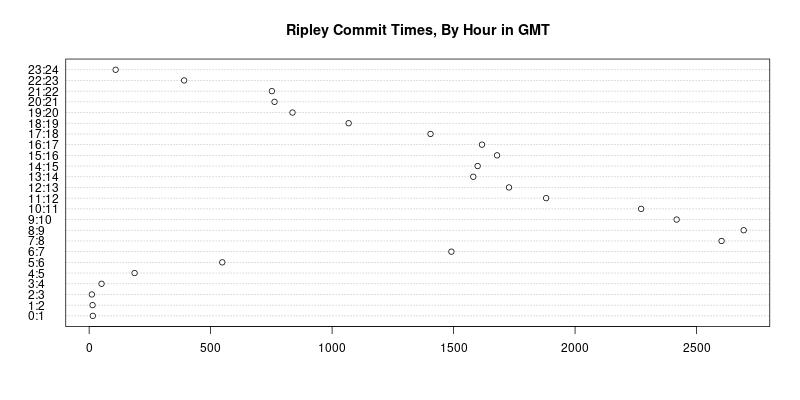
That is what one gets by trusting stable interfaces: code untouched for fourteen years runs unchanged. R itself has had well over sixty releases since then, including two major and eighteen minor releases. Yet the code just runs, including the code for two graphs one can reproduce with the exact same code as we show next.
tod <- unlist(sapply(rx,function(x)strsplit(x,split=" ")[[1]][6]))
tod <- tod[who=="ripley"]

tz <- sub(pattern=".*(-[0-9] 4 ).*",replacement="\\1",x=rx)
tz <- tz[who=="ripley"]
tz <- as.numeric(tz)/100
offset <- 3600*tz

z <- strptime(tod,format="%H:%M:%S")
hist(z,"hours",main="Ripley Commit Times in SVN TZ")

h <- z - offset
h <- format(h,format="%H")
h <- factor(as.numeric(h), levels=0:23)
## added as.vector() here to suppress a warning
dotchart(as.vector(table(h)), main="Ripley Commit Times, By Hour in GMT",
         labels=paste(0:23,1:24,sep=":"))
The code reproduces the chart from 2008, but this time uses the full twenty plus years of SVN history. I added just one as.vector() to suppress one new warning which appears under current R and which was presumably added in the fourteen years since (at the chart is produces without it too). The remainder of the code also runs. I just added one library(zoo) my blog post had omitted. No other changes.
## rather extract both  date and time
dat <- unlist(sapply(rx, function(x)  
  txt <- strsplit(x,split=" ")[[1]]
  paste(txt[5], txt[6])
 ))
## subset on Prof Ripley
dat <- dat[who == "ripley"]
## and convert to POSIXct, correcting by tz as well
datpt <- as.POSIXct(strptime(dat,format="%Y-%m-%d %H:%M:%S")) - offset

## turn into zoo -- we use a constant series of ones as each
## committ is taken as a timestamped event
library(zoo)
datzoo <- zoo(1, order.by=datpt)
## and use zoo to aggregate into commits per date
daily <- aggregate(datzoo, as.Date(index(datzoo)), sum)

## now plot as grey bars
plot(daily, col='darkgrey', type='h', lwd=2,
     ylab="Nb of SVN commits, three-week median",
     xlab="R release dates 2.5.0 and 2.5.1 shown in orange",
     main="The amazing Prof. Ripley")
## mark the two R releases of 2007
abline(v=c(as.Date("2007-04-24"),as.Date("2007-06-28")),col='orange',lwd=1.5)
## and do a quick centered rolling median
lines(rollmedian(daily, 21, align="center"), lwd=3)
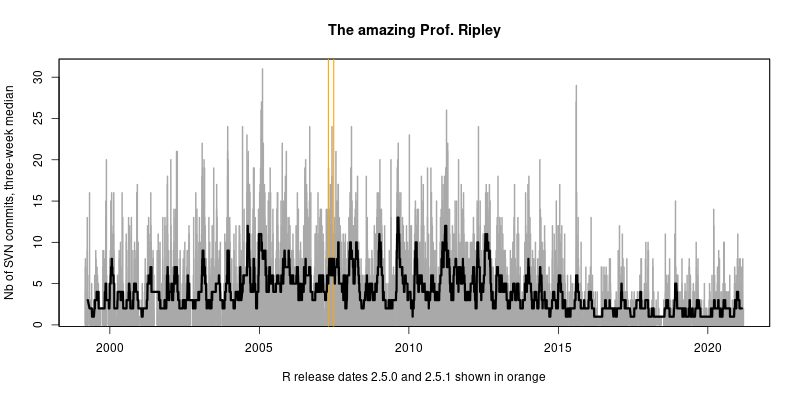
It produces this chart spanning two decades of commits. [3] The subtitle highlighting the then-most-recent releases is a little quaint now given that R has had eighten major.minor releases, and over sixty total releases, since then. Stable and rigourously maintained interfaces are a fantastic resource that is dramatically under-appreciated. Efforts such as the ten-year reproduction challenge demonstrate that this really is not a given. Maybe instead of celebrating band aides ( look, I reproduce via code I have frozen in a virtual environment / container / machine / ) we should celebrate languages, ecosystems, packages, that allow us to rely on just the code itself. Because we can. And we should strengthen and reinforce that ability. And discourage rapid changes just for changes sake. Code running for a decade, or even longer, is a huge boon to everybody relying on it. Three cheers to R Core. [1] Docker containers would be really good, and a step above the specs in the README. Winston s nice r-debug sumo container comes closest and helps a lot, and is updated regularly (which my earlier r-devel-san container is not). [2] The post owes some of its code ideas to Ben Bolker and Simon Jackman, but links to now-stale prior affiliations of theirs. [3] And the singularly impressive contributions charted remain unparalled, but were already the focus of the previous post. Yet over three times as a long period, they remain even more stunning. Edit 2021-03-21: Two minor fixes for grammar and typing.

15 March 2021

Matthew Garrett: Exploring my doorbell

I've talked about my doorbell before, but started looking at it again this week because sometimes it simply doesn't send notifications to my Home Assistant setup - the push notifications appear on my phone, but the doorbell simply doesn't trigger the HTTP callback it's meant to[1]. This is obviously suboptimal, but it's also tricky to debug a device when you have no access to it.

Normally I'd just head straight in with a screwdriver, but the doorbell is shared with the other units in this building and it seemed a little anti-social to interfere with a shared resource. So I bought some broken units from ebay and pulled one of them apart. There's several boards inside, but one of them had a conveniently empty connector at the top with "TX", "RX" and "GND" labelled. Sticking a USB-serial converter on this gave me output from U-Boot, and then kernel output. Confirmation that my doorbell runs Linux, but unfortunately it didn't give me a shell prompt. My next approach would often me to just dump the flash and look for vulnerabilities that way, but this device uses TSOP-48 packaged NAND flash rather than the more convenient SPI NOR flash that I already have adapters to access. Dumping this sort of NAND isn't terribly hard, but the easiest way to do it involves desoldering it from the board and plugging it into something like a Flashcat USB adapter, and my soldering's not good enough to put it back on the board afterwards. So I wanted another approach.

U-Boot gave a short countdown to hit a key before continuing with boot, and for once hitting a key actually did something. Unfortunately it then prompted for a password, and giving the wrong one resulted in boot continuing[2]. In the past I've had good luck forcing U-Boot to drop to a prompt by simply connecting one of the data lines on SPI flash to ground while it's trying to read the kernel - the failed read causes U-Boot to error out. It turns out the same works fine on raw NAND, so I just edited the kernel boot arguments to append "init=/bin/sh" and soon I had a shell.

From here on, things were made easier by virtue of the device using the YAFFS filesystem. Unlike many flash filesystems, it's read/write, so I could make changes that would persist through to the running system. There was a convenient copy of telnetd included, but it segfaulted on startup, which reduced its usefulness. Fortunately there was also a copy of Netcat[3]. If you make a fifo somewhere on the filesystem, you can cat the fifo to a shell, pipe the shell to a netcat listener, and then pipe netcat's output back to the fifo. The shell's output all gets passed to whatever connects to netcat, and whatever's sent to netcat gets passed through the fifo back to the shell. This is, obviously, horribly insecure, but it was enough to get a root shell over the network on the running device.

The doorbell runs various bits of software, one of which is Lighttpd to provide a local API and access to the device. Another component ("nxp-client") connects to the vendor's cloud infrastructure and passes cloud commands back to the local webserver. This is where I found something strange. Lighttpd was refusing to start because its modules wanted library symbols that simply weren't present on the device. My best guess is that a firmware update went wrong and left the device in a partially upgraded state - and without a working local webserver, there was no way to perform any further updates. This may explain why this doorbell was sitting on ebay.

Anyway. Now that I had shell, I could simply dump the flash by copying it directly off the /dev/mtdblock devices - since I had netcat, I could just pipe stuff through that back to my actual computer. Now I had access to the filesystem I could extract that locally and start digging into it more deeply. One incredibly useful tool for this is qemu-user. qemu is a general purpose hardware emulation platform, usually used to emulate entire systems. But in qemu-user mode, it instead only emulates the CPU. When a piece of code tries to make a system call to access the kernel, qemu-user translates that to the appropriate calling convention for the host kernel and makes that call instead. Combined with binfmt_misc, you can configure a Linux system to be able to run Linux binaries from other architectures. One of the best things about this is that, because they're still using the host convention for making syscalls, you can run the host strace on them and see what they're doing.

What I found was that nxp-client was calling back to the cloud platform, setting up an encrypted communication channel (using ChaCha20 and a bunch of key setup stuff I couldn't be bothered picking apart) and then waiting for commands from the cloud. It would then proxy those through to the local webserver. Since I couldn't run the local lighttpd, I just wrote a trivial Python app using http.server and waited to see what requests I got. The first was a GET to a CGI script called editcgi.cgi, along with a path name. I mocked up the GET request to respond with what was on the actual filesystem. The cloud then proceeded to POST to editcgi.cgi, with the same pathname and with new file contents. editcgi.cgi is apparently able to read and write to files on the filesystem.

But this is on the interface that's exposed to the cloud client, so this didn't appear immediately useful - and, indeed, trying to hit the same CGI binary over the local network gave me a 401 unauthorized error. There's a local API spec for these doorbells, but they all refer to scripts in the bha-api namespace, and this script was in the plain cgi-bin namespace. But then I noticed that the bha-api namespace didn't actually exist in the filesystem - instead, lighttpd's mod_alias was configured to rewrite requests to bha-api through to files in cgi-bin. And by using the documented API to get a session token, I could call editcgi.cgi to read and write arbitrary files on the doorbell. Which means I can drop an extra script in /etc/rc.d/rc3.d and get a shell on my doorbell.

This all requires the ability to have local authentication credentials, so it's not a big security deal other than it allowing you to retain access to a monitoring device even after you've moved out and had your credentials revoked. I'm sure it's all fine.

[1] I can ping the doorbell from the Home Assistant machine, so it's not that the network is flaky
[2] The password appears to be hy9$gnhw0z6@ if anyone else ends up in this situation
[3] https://twitter.com/mjg59/status/654578208545751040

comment count unavailable comments

13 March 2021

Jonathan Dowland: Internal Gotek

This is the eleventh part in a series of blog posts. The previous post was FlashFloppy OLED display. The whole series is available here: Amiga.
It's still mostly all quiet on the Amiga project front. The last few months with both my kids at home have been too difficult and busy with no time for side projects. Primary Schools in the UK went back this week, and I've finally got around to installing the Gotek floppy emulator inside the Amiga A500's chassis. I followed A short "Internal Gotek Floppy" Installation Guide , which explains that you don't need to print (or buy) a special mount for it: Simply removing the Gotek's top plastic case is enough for it to fit inside, and you can support it with some nuts and bolts.
Gotek bolted into place Gotek bolted into place
Easy in theory, but it still took me a while, with plenty of trial and error to line it up just right. I ended up using some M4 bolts and smaller (the kind that you use in electrical sockets) to support the bottom part of the Gotek case in three places: one, at the front, re-using an original vertical support for the old floppy drive; and two at the back, screwing through two holes in the A500's outer case and mainboard. If I'd chosen short enough bolts, the back of the Gotek case could have probably just rested on the ends of those bolts, but the ones I had were another few cm longer, so I drilled holes in the Gotek case to run the bolts through, and secured it with nuts.
Knob, display and mount, external Knob, display and mount, external
In that guide, the author has an OLED display for their Gotek that they wanted on the top of the Amiga case, so they fed the four tiny wires through the grill. I had a go at that, but I've got the OLED display and a rotary encoder, so that's 8 wires total, and damn fiddly. Instead for now I've just routed them all out through the hole left behind by the floppy drive's Button. I'm going to try and tidy it up with some heat shrink or similar. So finally, my Amiga is one "unit" again, without dangly bits hanging off it (if you ignore those 8 tiny wires for now) that I can move around to store or use much more easily.

7 March 2021

Louis-Philippe V ronneau: New Year, New OpenPGP Key

-----BEGIN PGP SIGNED MESSAGE-----
Hash: SHA512
Sun, 07 Mar 2021 13:00:17 -0500
I've recently set up a new OpenPGP key and will be transitioning away from my
old one.
It is a chance for me to start using a OpenPGP hardware token and to transition
to a new personal email address (my main public contact is still my
 @debian.org  address).
Please note that I've partially redacted some email addresses from this
statement to minimise the amount of spam I receive. It shouldn't be hard for
actual humans to follow the instructions below to find the complete addresses.
The old key will continue to be valid for a few months, but will eventually be
revoked.
You might know my old OpenPGP certificate as:
pub   rsa4096/0x7AEAC4EC6AAA0A97 2014-12-22 [expires: 2021-06-02]
      Key fingerprint = 677F 54F1 FA86 81AD 8EC0  BCE6 7AEA C4EC 6AAA 0A97
uid       Louis-Philippe V ronneau <REDACTED@riseup.net>
uid       Louis-Philippe V ronneau (alias) <REDACTED@riseup.net>
uid       Louis-Philippe V ronneau (debian) <REDACTED@debian.org>
My new OpenPGP certificate is:
pub   ed25519/0xE1E5457C8BAD4113 2021-03-06 [expires: 2022-03-06]
      Key fingerprint = F64D 61D3 21F3 CB48 9156  753D E1E5 457C 8BAD 4113
uid       Louis-Philippe V ronneau <REDACTED@veronneau.org>
uid       Louis-Philippe V ronneau <REDACTED@debian.org>
These days, I mostly use my key for Debian and to sign git commit. I don't
really expect you to sign my new key if you had signed my old one.
I've published the new certificate on keys.openpgp.org as well as on my
personal website. You can fetch it like this:
    $ wget -O- https://veronneau.org/media/openpgp.key   gpg --import
-----BEGIN PGP SIGNATURE-----
iQIzBAEBCgAdFiEEZ39U8fqGga2OwLzmeurE7GqqCpcFAmBFFM8ACgkQeurE7Gqq
CpcuchAAscAeszdtA+TlCI4YvK5nlk+nJnCnNBSnl7Et+jiNjq8kB/Fud+dWMTXC
Zag8oJkalbbxub0BT0bEAn+BiBunu58E0gd0Xq4syTbqZ5o5IN17S/tfxCD0k1hf
ewrnYZ2l0i5g4YvHGKC+Xv4D+Z84BylnIRaXHqlUdluOVfVYDfLybOAqoktO/KUH
I+vQBwXj0Fr/QAtgiz5Nwh/YHFiU9xMSvr5ozRwAFs6+xfIqFHuVPRRkEN5iVo4D
kkMIz+kFfkoh4aWIP4dgAu39XnEgxwTR9J+4yE8TzCCMzO7xCK0X6vqgPAxYMPvb
RuP4FnGWOnGnlcudCUAUkOaryrwRi+dPQTnNICHTYsvVc7dg+W0EhVUkwEuuEwpI
qtcB/Y5AGhqK0Cc11uXiFjIQwLTgwcUez4F0xrGeqsTtAM5gyRup2w0jbocTuYSh
ZRv/2zwrq/S3xVrUYGqdT+L5odmkBzz9zOwY5WlU2H9CMFOdh71XOv9wWQXan9ou
hLRodeOQ8MinIBP+sX36ol1zg/aP7mCHvRRSBzWt7l3WhVxgZFpNwIfp/RZqU0R4
IEq48mntFhPvHJjFmAKLKK/ckzNMtSn+HWQPJV3HTInKCTu5PTNMU3SAvPHOHEps
V6WWSOPB+1Lm/tlIULDc+0SopWoiWO4NObCSs8zMZHlYPBk5x/KIdQQBFgoAHRYh
BMqnQAcHqBawIC/DzfQlelCyHPqFBQJgRRTPAAoJEPQlelCyHPqFFVEA/1qScaAk
O+eBEE4q0BaJDsqweCS1XCcuQGkQCKi5Zv6kAQChQ96Ve7cKbN/wRkT9pdIhmx01
+CmIsnp3k6N0ZYLLCg==
=onl0
-----END PGP SIGNATURE-----

6 March 2021

Michael Stapelberg: Debian Code Search: OpenAPI now available

Debian Code Search now offers an OpenAPI-based API! Various developers have created ad-hoc client libraries based on how the web interface works. The goal of offering an OpenAPI-based API is to provide developers with automatically generated client libraries for a large number of programming languages, that target a stable interface independent of the web interface s implementation details.

Getting started
  1. Visit https://codesearch.debian.net/apikeys/ to download your personal API key. Login via Debian s GitLab instance salsa.debian.org; register there if you have no account yet.
  2. Find the Debian Code Search client library for your programming language. If none exists yet, auto-generate a client library on editor.swagger.io: click Generate Client .
  3. Search all code in Debian from your own analysis tool, migration tracking dashboard, etc.

curl example
curl \
  -H "x-dcs-apikey: $(cat dcs-apikey-stapelberg.txt)" \
  -X GET \
  "https://codesearch.debian.net/api/v1/search?query=i3Font&match_mode=regexp" 

Web browser example You can try out the API in your web browser in the OpenAPI documentation.

Code example (Go) Here s an example program that demonstrates how to set up an auto-generated Go client for the Debian Code Search OpenAPI, run a query, and aggregate the results:
func burndown() error  
	cfg := openapiclient.NewConfiguration()
	cfg.AddDefaultHeader("x-dcs-apikey", apiKey)
	client := openapiclient.NewAPIClient(cfg)
	ctx := context.Background()
	// Search through the full Debian Code Search corpus, blocking until all
	// results are available:
	results, _, err := client.SearchApi.Search(ctx, "fmt.Sprint(err)", &openapiclient.SearchApiSearchOpts 
		// Literal searches are faster and do not require escaping special
		// characters, regular expression searches are more powerful.
		MatchMode: optional.NewString("literal"),
	 )
	if err != nil  
		return err
	 
	// Print to stdout a CSV file with the path and number of occurrences:
	wr := csv.NewWriter(os.Stdout)
	header := []string "path", "number of occurrences" 
	if err := wr.Write(header); err != nil  
		return err
	 
	occurrences := make(map[string]int)
	for _, result := range results  
		occurrences[result.Path]++
	 
	for _, result := range results  
		o, ok := occurrences[result.Path]
		if !ok  
			continue
		 
		// Print one CSV record per path:
		delete(occurrences, result.Path)
		record := []string result.Path, strconv.Itoa(o) 
		if err := wr.Write(record); err != nil  
			return err
		 
	 
	wr.Flush()
	return wr.Error()
 
The full example can be found under burndown.go.

Feedback? File a GitHub issue on github.com/Debian/dcs please!

Migration status I m aware of the following third-party projects using Debian Code Search:
Tool Migration status
Debian Code Search CLI tool Updated to OpenAPI
identify-incomplete-xs-go-import-path Update pending
gnome-codesearch makes no API queries
If you find any others, please point them to this post in case they are not using Debian Code Search s OpenAPI yet.

28 February 2021

Jamie McClelland: From openbox to sway

I've been running the Openbox window manager since 2005. That's longer then I've lived in any one apartment in my entire life! However, over the years I've been bracing for a change. It seems clear the Wayland is the future, although when that future is supposed to begin is much more hazy. Really, I've felt a bit like a ping pong ball, from panicking over whether Xorg is abandoned (with a follow up from a X server maintainer) to anxiously wondering if literally everything will break the moment I switch to Wayland. In fact, I started this blog post over a year ago when I first decided to switch from the Openbox to Sway. This is my third major attempt to make the change and I think it will finally stick this time. In retrospect, it would have been more sensible to first switch from openbox to i3 (which is a huge transition) and then from i3 to sway, but I decided to dive into the deep end with both changes. So... I'm on debian bullseye so I installed sway and friends (from sid). Then I copied /etc/sway/config to ~/.config/sway/config. I start openbox after logging in with exec startx so after rebooting, I ran exec sway and to my astonishment sway started. Hooray! However, I found that ssh-agent wasn't running so I couldn't ssh into any servers. That's kinda a problem. Launching ssh-agent under openbox was buried deep in /etc/X11/Xsession.d/90x11-common_ssh-agent and clearly was not going to happen via wayland. Since programs using ssh-agent depend on the environment variables SSH_AUTH_SOCK and SSH_AGENT_PID being globally available I thought I could simply run $(eval ssh-agent) via my tty terminal before running exec sway. And, that would have worked. Except... I like to add my keys via ssh-add -c so that everytime my key is being used I get a ssh-askpass prompt to confirm the use. It seems that since ssh-add is started before a window manager is running, it can't run the prompt. Ok, we can fix this. After searching the web, I came upon a solution of running ssh-agent via systemctl --user:
# This service myst be started manually after sway
# starts.
[Unit]
Description=OpenSSH private key agent
IgnoreOnIsolate=true
[Service]
Type=forking
Environment=SSH_AUTH_SOCK=%t/ssh-agent.socket
ExecStart=/usr/bin/ssh-agent -a $SSH_AUTH_SOCK
Then, in my ~/.bashrc file I have:
if [ -n WAYLAND_DISPLAY ]; then
  export SSH_AUTH_SOCK=/run/user/1000/ssh-agent.socket
fi
I think $SSH_AGENT_PID is only used by ssh-agent to kill itself. Now that is running via systemd - killing it should be do-able without a global environment variable. Done? Hardly. I've been using impass (nee assword) happily for years but alas it is tightly integrated with xdo and xclip. So... I've switched to keepassxc which works out of the box with wayland. My next challenge was the status bar. Farewell faithful tint2. One of the reasons I failed on my first two attempts to switch to Sway was the difficulty of getting the swaybar to work how I wanted, particularly with nm-applet. Two things allowed me to move forward: Next up: the waybar clock module doesn't work, but that is easy enough to work around. Replacing my uses of xclip with wl-clipboard was a little tedious but really not that difficult. Getting my screen shot and screen recorder functionality was a bit harder. I did a lot of searching before I finally found and compiled both swappy, screen shot and wf-recorder. In the course of all my adventures, I came across the following helpful tips:
Updates
  1. I've installed libreoffice-gtk3 to ensure libre office runs under wayland
  2. I've installed the latest Gimp via flatpak to get proper wayland support
  3. I've exported MOZ_ENABLE_WAYLAND to ensure firefox works properly.
  4. I've found that passing -c to my ssh-add command to ensure I am prompted for each use of my key seems to cause sway to crash intermittently.
  5. I am working on a questionable work around to get screen sharing to work in zoom. I haven't actually tried it on a real zoom call yet.
  6. Speaking of screen sharing - when using Firefox, I can only share Xwayland screens. Firefox is running under wayland so I can't share it. Chromium is running under xwayland, so I have to use Chromium when screen sharing.
  7. Wait, scratch that about screen sharing in Firefox. I've installed xdg-desktop-portal-wlr, added export XDG_CURRENT_DESKTOP=sway and export XDG_SESSION_TYPE=wayland to my .bashrc, and after hours of frustration, realize that I needed to configured firejail to allow it so that I can share my entire screen in Firefox. It doesn't yet support sharing a specific window, so I still have to keep chromium around for that (and Chromium can only share xwayland windows). Sigh. Oh, one more thing about Firefox: the option to choose what to share doesn't have "Entire Screen" as an option, you are just supposed to know that you should choose "Use operating system settings".
  8. I still am getting weekly crashes. Some of them I've fixed by switching to wayland friendly versions (e.g. Libre Office and Gimp) but others I haven't yet tracked down.
  9. My keyboard does not have an altgr key, so even though I have selected the "English (US) - English (intl., with AltGr dead keys)" I can't get accent marks. I went down a rabbit hole of trying to re-map the Alt key to the right of my space bar but it all seemed too complicated. So - I found a way easier approach. In my ~/.config/sway/config file I have: bindsym Mod4+e exec wtype " ". I have repeated that line for the main accent marks I need.
  10. Due to a Firefox Bug, when I share my desktop or mic or camera, the sharing indicator expands like a normal tiling window instead of remaining a tiny little box on each desktop reminding me that I'm sharing something. I'd prefer to have it be a tiny little box, but since I can't figure that out, I've disabled it by typing about:config in the Firefox location window, searching for privacy.webrtc.legacyGlobalIndicator and setting it to False. The reddit thread also suggested finding privacy.webrtc.hideGlobalIndicator and setting it to True, but that setting doesn't seem to be available and setting the first one alone seems to do the trick.
  11. Oh, one more environment variable to set: GDK_BACKEND=wayland,x11. First I just set it to wayland to get gtk3 apps to use wayland (like gajim). But that broke electron apps (like signal) which notice that variable but don't have a way to display via wayland (at least not yet). Setting it to "wayland,x11" shows the priority. Thank you ubuntu community.
  12. I've also finally consolidated where my environment variables go. I've added them all to ~/.config/sway/env. That seems like an official sway place to put them, but sway doesn't pay any attention to them. So I start sway via my own bash script which sources that file via [ -f "$HOME/.config/sway/env" ] && . "$HOME/.config/sway/env" before exec'ing sway.

22 February 2021

John Goerzen: Recovering Our Lost Free Will Online: Tools and Techniques That Are Available Now

As I ve been thinking and writing about privacy and decentralization lately, I had a conversation with a colleague this week, and he commented about how loss of privacy is related to loss of agency: that is, loss of our ability to make our own choices, pursue our own interests, and be master of our own attention. In terms of telecommunications, we have never really been free, though in terms of Internet and its predecessors, there have been times where we had a lot more choice. Many are too young to remember this, and for others, that era is a distant memory. The irony is that our present moment is one of enormous consolidation of power, and yet also one of a proliferation of technologies that let us wrest back some of that power. In this post, I hope to enlighten or remind us of some of the choices we have lost and also talk about the ways in which we can choose to regain them, already, right now. I will talk about the possibilities, the big dreams that are possible now, and then go into more detail about the solutions. The Problems & Possibilities The limitations of online We make the assumption that we must be online to exchange data. This is reinforced by many modern protocols; Twitter clients, for instance, don t tend to let you make posts by relaying them through disconnected devices. What would it be like if you could fully participate in global communities without a constant Internet connection? If you could share photos with your friends, read the news, read your email, etc. even if you don t have a connection at present? Even if the device you use to do that never has a connection, but can route messages via other devices that do? Would it surprise you to learn that this was once the case? Back in the days of UUCP, much email and Usenet news a global discussion forum that didn t require an Internet connection was relayed via occasional calls over phone lines. This technology remains with us, and has even improved. Sadly, many modern protocols make no effort in this regard. Some email clients will let you compose messages offline to send when you get online later, but the assumption always is that you will be connected to an IP network again soon. NNCP, on the other hand, lets you relay messages over TCP, a radio, a satellite, or a USB stick. Email and Usenet, since they were designed in an era where store-and-forward was valued, can actually still be used in an entirely offline fashion (without ever touching an IP-based network). All it takes is for someone to care to make it happen. You can even still do it over UUCP if you like. The physical and data link layers Many of us just accept that we communicate in a few ways: Wifi for short distances, and then cable modems or DSL for our local Internet connection, and then many people are fuzzy about what happens after that. Or, alternatively, we have 4G phones that are the local Internet connection, and the same fuzzy things happen after. Think about this for a moment. Which of these do you control in any way? Sometimes just wifi, sometimes maybe you have choices of local Internet providers. After that, your traffic is handled by enormous infrastructure companies. There is choice here. People in ham radio have been communicating digitally over long distances without the support of the traditional Internet for decades, but the technology to do this is now more accessible to anyone. Long-distance radio has had tremendous innovation in the last decade; cheap radios can now communicate over several miles/km without any other infrastructure at all. We all carry around radios (Wifi and Bluetooth) in our pockets that don t have to be used as mere access points to the Internet or as drivers of headphones, but can also form their own networks directly (Briar). Meshtastic is an example; it s an instant messenger that can form a mesh over many miles/km and requires no IP infrastructure at all. Briar is similar. XBee radios form a mesh in hardware, allowing peers to reach each other (also over many miles/km) with a serial or framed protocol. Loss of peer-to-peer Back in the late 90s, I worked at a university. I had a 386 on my desk for a workstation not a powerful computer even then. But I put the boa webserver on it and could just serve pages on the Internet. I didn t have to get permission. Didn t have to pay a hosting provider. I could just DO it. And of course that is because the university had no firewall and no NAT. Every PC at the university was a full participant on the Internet as much as the servers at Microsoft or DEC. All I needed was a DNS entry. I could run my own SMTP server if I wanted, run a web or Gopher server, and that was that. There are many reasons why this changed. Nowadays most residential ISPs will block SMTP for their customers, and if they didn t, others would; large email providers have decided not to federate with IPs in residential address spaces. Most people have difficulty even getting a static IP address in the first place. Many are behind firewalls, NATs, or both, meaning that incoming connections of any kind are problematic. Do you see what that means? It has weakened the whole point of the Internet being a network of peers. While IP still acts that way, as a practical matter, there are clients that are prevented from being servers by administrative policy they have no control over. Imagine if you, a person with an Internet connection to your laptop or phone, could just decide to host a website, or a forum on it. For moderate levels of load, they are certainly capable of this. The only thing in the way is the network management policies you can t control. Elaborate technologies exist to try to bridge this divide, and some, like Tor or cjdns, can work quite well. More on this below. Expense of running something popular Related to the loss of peer-to-peer infrastructure is the very high cost of hosting something popular. Do you want to share videos with lots of people? That almost certainly is going to require expensive equipment and bandwidth. There is a reason that there are only a small handful of popular video streaming sites online. It requires a ton of money to host videos at scale. What if it didn t? What if you could achieve economies of scale so much that you, an individual, could compete with the likes of YouTube? You wouldn t necessarily have to run ads to support the service. You wouldn t have to have billions of dollars or billions of viewers just to make it work. This technology exists right now. Of course many of you are aware of how Bittorrent leverages the swarm for files. But projects like IPFS, Dat, and Peertube have taken this many steps further to integrate it into a global ecosystem. And, at least in the case of Peertube, this is a thing that works right now in any browser already! Application-level walled gardens I was recently startled at how much excitement there was when Github introduced dark mode . Yes, Github now offers two colors on its interface. Already back in the 80s and 90s, many DOS programs had more options than that. Git is a decentralized protocol, but Github has managed to make it centralized. Email is a decentralized protocol pick your own provider, and they all communicate but Facebook and Twitter aren t. You can t just pick your provider for Facebook. It s Facebook or nothing. There is a profit motive in locking others out; these networks want to keep you using their platforms because their real customers are advertisers, and they want to keep showing you ads. Is it possible to have a world where you get to pick your own app for sharing photos, and it works even if your parents use a different one? Yes, yes it is. Mastodon and the Fediverse are fantastic examples for social media. Pixelfed is specifically designed for photos, Mastodon for short-form communication, there s Pleroma for more long-form communication, and they all work together. You can use Mastodon to read Pleroma content or look at Pixelfed photos, and there are many (free) providers of each. Freedom from manipulation I recently wrote about the dangers of the attention economy, so I won t go into a lot of detail here. Fundamentally, you are not the customer of Facebook or Google; advertisers are. They optimize their site to keep you on it as much as possible so that they can show you as many ads as possible which makes them as much money as possible. Ads, of course, are fundamentally seeking to manipulate your behavior ( buy this product ). By lowering the cost of running services, we can give a huge boost to hobbyists and nonprofits that want to do so without an ultimate profit motive. For-profit companies benefit also, with a dramatically reduced cost structure that frees them to pursue their mission instead of so many ads. Freedom from snooping (privacy and anonymity) These days, it s not just government snooping that people think about. It s data stolen by malware, spies at corporations (whether human or algorithmic), and even things like basic privacy of one s own security footage. Here the picture is improving; encryption in transit, at least at a basic level, has become much more common with TLS being a standard these days. Sadly, end-to-end encryption (E2EE) is not nearly as much, perhaps because corporations have a profit motive to have access to your plaintext and metadata. Closely related to privacy is anonymity: that is, being able to do things in an anonymous fashion. The two are not necessarily equal: you could send an encrypted message but reveal who the correspondents are, as with email; or, you could send a plaintext message over a Tor exit node that hides who the correspondents are. It is sometimes difficult to achieve both. Nevertheless, numerous answers exist here that tackle one or both problems, from the Signal messenger to Tor. Solutions That Exist Today Let s dive in to some of the things that exist today. One concept you ll see in many of these is integrated encryption with public keys used for addressing. In other words, your public key is akin to an IP address (and in some cases, is literally your IP address.) Data link and networking technologies (some including P2P) P2P Infrastructure While some of the technologies above, such as cjdns, explicitly facitilitate peer-to-peer communication, there are some other application-level technologies to look at. Instant Messengers and Chat I won t go into a lot of detail here since I recently wrote a roundup of secure mesh messengers and also a followup article about Signal and some hidden drawbacks of P2P. Please refer to those articles for some interesting things that are happening in this space. Matrix is a distributed IM platform similar in concept to Slack or IRC, but globally distributed in a mesh. It supports optional E2EE. Social Media I wrote recently about how to join the Fediverse, which covered joining Mastodon, a federeated, decentralized social network. Mastodon is the largest of these, with several million users, and is something of a much nicer version of Twitter. Mastodon is also part of what is known as the Fediverse , which are applications that are loosely joined together by their support of the ActivityPub protocol. Other popular Fediverse applications include Pixelfed (similar to Instagram) and Peertube for sharing video. Peertube is particularly interesting in that it supports Webtorrent for efficiently distributing popular videos. Webtorrent is akin to Bittorrent running efficiently inside your browser. Concluding Remarks Part of my goal with this is encouraging people to dream big, to ask questions like: What could you do if offline were easy? What is possible if you have freedom in the physical and data link layers? Dream big. We re so used to thinking that it s quite difficult for two devices on the Internet to talk to each other. What would be possible if this were actually quite easy? The assumption that costs rise dramatically as popularity increases is also baked into our thought processes. What if that weren t the case could you take on Youtube from your garage? Would lowering barriers to entry lower the ad economy and let nonprofits have more equal footing with large corporations? We have so many walled gardens, from Github to Facebook, that we almost forget it doesn t have to be that way. So having asked these questions, my secondary point is to suggest that these aren t pie-in-the-sky notions. These possibilites are with us right now. You ll notice from this list that virtually every one of these technologies is ad-free at its heart (though some would be capable of serving ads). They give you back your attention. Many preserve privacy, anonymity, or both. Many dramatically improve your freedom of association and communication. Technologies like IPFS and Bittorrent ease the burden of running something popular. Some are quite easy to use (Mastodon or Peertube) while others are much more complex (libp2p or the lower-level mesh network systems). Clearly there is still room for improvement in many areas. But my fundamental point is this: good technology is here, right now. Technical people can vote with their feet and wallets and start using it. Early adopters will help guide the way for the next set of improvements. Join us!

19 February 2021

Jonathan Dowland: Wrist Watches

red strap red strap
This is everything I have to say about watches (or time pieces, or chronometers, if you prefer: I don't). I've always worn a watch, and still do; but I've never really understood the appeal of the kind of luxury watches you see advertise here there and everywhere, with their chunky cases, over-complicated faces and enormous price-tags. So the world of watch-appreciation was closed to me, until my 30th birthday (a while ago) when my wife bought me a Mondaine Evo "Big Date" quartz watch. It's not an analogue watch nor an "heirloom timepiece", neither of which are properties that matter to me. The large face has almost nothing extraneous on it, although my model includes day-of-the-month. I like it very much. And so I cracked open the door a little onto the world of watches and watch fashion and had a short spell of interest in some other styles, types, and the like. This drew to a close with buying a selection of cheap, coloured nylon fabric "nato"-style straps. Now whenever I feel the itch for a change, I just change the strap. Smart Watches have never appealed to me. I can see some of their advantages, but the last thing I need is another gadget to regularly charge, or another avenue to check my email. I appreciate that wearing a wrist watch at all is anachronistic (sorry), and I did wonder whether it's a habit I could get out of. A few weeks ago, during our endless Lockdown, my watch battery ran out, so I spent a couple of weeks un-learning my reliance on a wristwatch to orient myself. I've managed to get it replaced now (some watch repair places being considered Essential Services) and I'm comfortably back in my default mode of wearing and relying upon it.

18 February 2021

Jonathan McDowell: Hacking and Bricking the EE Opsrey 2 Mini

I ve mentioned in the past my twisted EE network setup from when I moved in to my current house. The 4GEE WiFi Mini (also known as the EE Osprey 2 Mini or the EE40VB, and actually a rebadged Alcatel Y853VB) has been sitting unused since then, so I figured I d see about trying to get a shell on it. TL;DR: Of course it s running Linux, there s a couple of test points internally which bring out the serial console, but after finding those and logging in I discovered it s running ADB on port 5555 quite happily available without authentication both via wifi and the USB port. So if you have physical or local network access, instant root shell. Well done, folks. And then I bricked it before I could do anything more interesting. There s a lack of information about this device out there - most of the links I can find are around removing the SIM lock - so I thought I d document the pieces I found just in case anyone else is trying to figure it out. It s based around a Qualcomm MDM9607 SoC, paired with 64M RAM and 256M NAND flash. Wifi is via an RTL8192ES. Kernel is 3.18.20. Busybox is v1.23.1. It s running dnsmasq but I didn t grab the version. Of course there s no source or offer of source provided. Taking it apart is fairly easy. There s a single screw to remove, just beside the SIM slot. The coloured rim can then be carefully pried away from the back, revealing the battery. There are then 4 screws in the corners which need removed in order to be able to lift out the actual PCB and gain access to the serial console test points. EE40VB PCB serial console test points My mistake was going poking around trying to figure out where the updates are downloaded from - I know I m running a slightly older release than what s current, and the device can do an automatic download + update. Top tip; don t run Jrdrecovery. It ll error on finding /cache/update.zip and wipe the main partition anyway. That ll leave you in a boot loop where the device boots the recovery partition which tries to install /cache/update.zip which of course still doesn t exist. So. Where next? First, I need to get the device into a state where I can actually do something other than watch it boot into recovery, fail to flash and reboot. Best guess at present is to try and get it to enter the Qualcomm EDL (Emergency Download) mode. That might be possible with a custom USB cable that grounds D+ on boot. Alternatively I need to probe some of the other test points on the PCB and see if grounding any of those helps enter EDL mode. I then need a suitable firehose OEM-signed programmer image. And then I need to actually get hold of a proper EE40VB firmware image, either via one of the OTA update files or possibly via an Alcatel ADSU image (though no idea how to get hold of one, other than by posting to a random GSM device forum and hoping for the kindness of strangers). More updates if/when I make progress
Qualcomm bootloader log
Format: Log Type - Time(microsec) - Message - Optional Info
Log Type: B - Since Boot(Power On Reset),  D - Delta,  S - Statistic
S - QC_IMAGE_VERSION_STRING=BOOT.BF.3.1.2-00053
S - IMAGE_VARIANT_STRING=LAATANAZA
S - OEM_IMAGE_VERSION_STRING=linux3
S - Boot Config, 0x000002e1
B -    105194 - SBL1, Start
D -     61885 - QSEE Image Loaded, Delta - (451964 Bytes)
D -     30286 - RPM Image Loaded, Delta - (151152 Bytes)
B -    459330 - Roger:boot_jrd_oem_main
B -    461526 - Welcome to key_check_poweron!!!
B -    466436 - REG0x00, rc=47
B -    469120 - REG0x01, rc=1f
B -    472018 - REG0x02, rc=1c
B -    474885 - REG0x03, rc=47
B -    477782 - REG0x04, rc=b2
B -    480558 - REG0x05, rc=
B -    483272 - REG0x06, rc=9e
B -    486139 - REG0x07, rc=
B -    488854 - REG0x08, rc=a4
B -    491721 - REG0x09, rc=80
B -    494130 - bq24295_probe: vflt/vsys/vprechg=0mV/0mV/0mV, tprechg/tfastchg=0Min/0Min, [0C, 0C]
B -    511546 - come to calculate vol and temperature!!
B -    511637 - ##############battery_core_convert_vntc: NTC_voltage=1785690
B -    517280 - battery_core_convert_vntc: <-44C, 1785690uV>, present=0
B -    529358 - bq24295_set_current_limit: setting=0mA, mode=-1, input/fastchg/prechg/termchg=-1mA/0mA/0mA/0mA
B -    534360 - bq24295_set_charge_current, rc=0,reg_val=0,i=0
B -    539636 - bq24295_enable_charge: setting=0, chg_enable=-1, otg_enable=0
B -    546072 - bq24295_enable_charging: enable_charging=0
B -    552172 - bq24295_set_current_limit: setting=0mA, mode=-1, input/fastchg/prechg/termchg=-1mA/0mA/0mA/0mA
B -    561566 - bq24295_set_charge_current, rc=0,reg_val=0,i=0
B -    567056 - bq24295_enable_charge: setting=0, chg_enable=0, otg_enable=0
B -    579286 - come to calculate vol and temperature!!
B -    579378 - ##############battery_core_convert_vntc: NTC_voltage=1785777
B -    585539 - battery_core_convert_vntc: <-44C, 1785777uV>, present=0
B -    597617 - charge_main: battery is plugout!!
B -    597678 - Welcome to pca955x_probe!!!
B -    601063 - pca955x_probe: PCA955X probed successfully!
D -     27511 - APPSBL Image Loaded, Delta - (179348 Bytes)
B -    633271 - QSEE Execution, Start
D -       213 - QSEE Execution, Delta
B -    638944 - >>>>>>>>>>>>>>>>>>>>>>>>>>>>>>>>>Start writting JRD RECOVERY BOOT
B -    650107 - >>>>>>>>>>>>>>>>>>>>>>>>>>>>>>>>>Start writting  RECOVERY BOOT
B -    653218 - >>>>>>>>>>>>>>>>>>>>>>>>>>>>>>>>>read_buf[0] == 0
B -    659044 - SBL1, End
D -    556137 - SBL1, Delta
S - Throughput, 2000 KB/s  (782884 Bytes,  278155 us)
S - DDR Frequency, 240 MHz
littlekernel aboot log
Android Bootloader - UART_DM Initialized!!!
[0] welcome to lk
[0] SCM call: 0x2000601 failed with :fffffffc
[0] Failed to initialize SCM
[10] platform_init()
[10] target_init()
[10] smem ptable found: ver: 4 len: 17
[10] ERROR: No devinfo partition found
[10] Neither 'config' nor 'frp' partition found
[30] voltage of NTC  is 1789872!
[30] voltage of BAT  is 3179553!
[30] usb present is 1!
[30] Loading (boot) image (4171776): start
[530] Loading (boot) image (4171776): done
[540] DTB Total entry: 25, DTB version: 3
[540] Using DTB entry 0x00000129/00010000/0x00000008/0 for device 0x00000129/00010000/0x00010008/0
[560] JRD_CHG_OFF_FEATURE!
[560] come to jrd_target_pause_for_battery_charge!
[570] power_on_status.hard_reset = 0x0
[570] power_on_status.smpl = 0x0
[570] power_on_status.rtc = 0x0
[580] power_on_status.dc_chg = 0x0
[580] power_on_status.usb_chg = 0x0
[580] power_on_status.pon1 = 0x1
[590] power_on_status.cblpwr = 0x0
[590] power_on_status.kpdpwr = 0x0
[590] power_on_status.bugflag = 0x0
[590] cmdline: noinitrd  rw console=ttyHSL0,115200,n8 androidboot.hardware=qcom ehci-hcd.park=3 msm_rtb.filter=0x37 lpm_levels.sleep_disabled=1  earlycon=msm_hsl_uart,0x78b3000  androidboot.serialno=7e6ba58c androidboot.baseband=msm rootfstype=ubifs rootflags=b
[620] Updating device tree: start
[720] Updating device tree: done
[720] booting linux @ 0x80008000, ramdisk @ 0x80008000 (0), tags/device tree @ 0x81e00000
Linux kernel console boot log
[    0.000000] Booting Linux on physical CPU 0x0
[    0.000000] Linux version 3.18.20 (linux3@linux3) (gcc version 4.9.2 (GCC) ) #1 PREEMPT Thu Aug 10 11:57:07 CST 2017
[    0.000000] CPU: ARMv7 Processor [410fc075] revision 5 (ARMv7), cr=10c53c7d
[    0.000000] CPU: PIPT / VIPT nonaliasing data cache, VIPT aliasing instruction cache
[    0.000000] Machine model: Qualcomm Technologies, Inc. MDM 9607 MTP
[    0.000000] Early serial console at I/O port 0x0 (options '')
[    0.000000] bootconsole [uart0] enabled
[    0.000000] Reserved memory: reserved region for node 'modem_adsp_region@0': base 0x82a00000, size 56 MiB
[    0.000000] Reserved memory: reserved region for node 'external_image_region@0': base 0x87c00000, size 4 MiB
[    0.000000] Removed memory: created DMA memory pool at 0x82a00000, size 56 MiB
[    0.000000] Reserved memory: initialized node modem_adsp_region@0, compatible id removed-dma-pool
[    0.000000] Removed memory: created DMA memory pool at 0x87c00000, size 4 MiB
[    0.000000] Reserved memory: initialized node external_image_region@0, compatible id removed-dma-pool
[    0.000000] cma: Reserved 4 MiB at 0x87800000
[    0.000000] Memory policy: Data cache writeback
[    0.000000] CPU: All CPU(s) started in SVC mode.
[    0.000000] Built 1 zonelists in Zone order, mobility grouping on.  Total pages: 17152
[    0.000000] Kernel command line: noinitrd  rw console=ttyHSL0,115200,n8 androidboot.hardware=qcom ehci-hcd.park=3 msm_rtb.filter=0x37 lpm_levels.sleep_disabled=1  earlycon=msm_hsl_uart,0x78b3000  androidboot.serialno=7e6ba58c androidboot.baseband=msm rootfstype=ubifs rootflags=bulk_read root=ubi0:rootfs ubi.mtd=16
[    0.000000] PID hash table entries: 512 (order: -1, 2048 bytes)
[    0.000000] Dentry cache hash table entries: 16384 (order: 4, 65536 bytes)
[    0.000000] Inode-cache hash table entries: 8192 (order: 3, 32768 bytes)
[    0.000000] Memory: 54792K/69632K available (5830K kernel code, 399K rwdata, 2228K rodata, 276K init, 830K bss, 14840K reserved)
[    0.000000] Virtual kernel memory layout:
[    0.000000]     vector  : 0xffff0000 - 0xffff1000   (   4 kB)
[    0.000000]     fixmap  : 0xffc00000 - 0xfff00000   (3072 kB)
[    0.000000]     vmalloc : 0xc8800000 - 0xff000000   ( 872 MB)
[    0.000000]     lowmem  : 0xc0000000 - 0xc8000000   ( 128 MB)
[    0.000000]     modules : 0xbf000000 - 0xc0000000   (  16 MB)
[    0.000000]       .text : 0xc0008000 - 0xc07e6c38   (8060 kB)
[    0.000000]       .init : 0xc07e7000 - 0xc082c000   ( 276 kB)
[    0.000000]       .data : 0xc082c000 - 0xc088fdc0   ( 400 kB)
[    0.000000]        .bss : 0xc088fe84 - 0xc095f798   ( 831 kB)
[    0.000000] SLUB: HWalign=64, Order=0-3, MinObjects=0, CPUs=1, Nodes=1
[    0.000000] Preemptible hierarchical RCU implementation.
[    0.000000] NR_IRQS:16 nr_irqs:16 16
[    0.000000] GIC CPU mask not found - kernel will fail to boot.
[    0.000000] GIC CPU mask not found - kernel will fail to boot.
[    0.000000] mpm_init_irq_domain(): Cannot find irq controller for qcom,gpio-parent
[    0.000000] MPM 1 irq mapping errored -517
[    0.000000] Architected mmio timer(s) running at 19.20MHz (virt).
[    0.000011] sched_clock: 56 bits at 19MHz, resolution 52ns, wraps every 3579139424256ns
[    0.007975] Switching to timer-based delay loop, resolution 52ns
[    0.013969] Switched to clocksource arch_mem_counter
[    0.019687] Console: colour dummy device 80x30
[    0.023344] Calibrating delay loop (skipped), value calculated using timer frequency.. 38.40 BogoMIPS (lpj=192000)
[    0.033666] pid_max: default: 32768 minimum: 301
[    0.038411] Mount-cache hash table entries: 1024 (order: 0, 4096 bytes)
[    0.044902] Mountpoint-cache hash table entries: 1024 (order: 0, 4096 bytes)
[    0.052445] CPU: Testing write buffer coherency: ok
[    0.057057] Setting up static identity map for 0x8058aac8 - 0x8058ab20
[    0.064242]
[    0.064242] **********************************************************
[    0.071251] **   NOTICE NOTICE NOTICE NOTICE NOTICE NOTICE NOTICE   **
[    0.077817] **                                                      **
[    0.084302] ** trace_printk() being used. Allocating extra memory.  **
[    0.090781] **                                                      **
[    0.097320] ** This means that this is a DEBUG kernel and it is     **
[    0.103802] ** unsafe for produciton use.                           **
[    0.110339] **                                                      **
[    0.116850] ** If you see this message and you are not debugging    **
[    0.123333] ** the kernel, report this immediately to your vendor!  **
[    0.129870] **                                                      **
[    0.136380] **   NOTICE NOTICE NOTICE NOTICE NOTICE NOTICE NOTICE   **
[    0.142865] **********************************************************
[    0.150225] MSM Memory Dump base table set up
[    0.153739] MSM Memory Dump apps data table set up
[    0.168125] VFP support v0.3: implementor 41 architecture 2 part 30 variant 7 rev 5
[    0.176332] pinctrl core: initialized pinctrl subsystem
[    0.180930] regulator-dummy: no parameters
[    0.215338] NET: Registered protocol family 16
[    0.220475] DMA: preallocated 256 KiB pool for atomic coherent allocations
[    0.284034] cpuidle: using governor ladder
[    0.314026] cpuidle: using governor menu
[    0.344024] cpuidle: using governor qcom
[    0.355452] msm_watchdog b017000.qcom,wdt: wdog absent resource not present
[    0.361656] msm_watchdog b017000.qcom,wdt: MSM Watchdog Initialized
[    0.371373] irq: no irq domain found for /soc/pinctrl@1000000 !
[    0.381268] spmi_pmic_arb 200f000.qcom,spmi: PMIC Arb Version-2 0x20010000
[    0.389733] platform 4080000.qcom,mss: assigned reserved memory node modem_adsp_region@0
[    0.397409] mem_acc_corner: 0 <--> 0 mV
[    0.401937] hw-breakpoint: found 5 (+1 reserved) breakpoint and 4 watchpoint registers.
[    0.408966] hw-breakpoint: maximum watchpoint size is 8 bytes.
[    0.416287] __of_mpm_init(): MPM driver mapping exists
[    0.420940] msm_rpm_glink_dt_parse: qcom,rpm-glink compatible not matches
[    0.427235] msm_rpm_dev_probe: APSS-RPM communication over SMD
[    0.432977] smd_open() before smd_init()
[    0.437544] msm_mpm_dev_probe(): Cannot get clk resource for XO: -517
[    0.445730] smd_channel_probe_now: allocation table not initialized
[    0.453100] mdm9607_s1: 1050 <--> 1350 mV at 1225 mV normal idle
[    0.458566] spm_regulator_probe: name=mdm9607_s1, range=LV, voltage=1225000 uV, mode=AUTO, step rate=4800 uV/us
[    0.468817] cpr_efuse_init: apc_corner: efuse_addr = 0x000a4000 (len=0x1000)
[    0.475353] cpr_read_fuse_revision: apc_corner: fuse revision = 2
[    0.481345] cpr_parse_speed_bin_fuse: apc_corner: [row: 37]: 0x79e8bd327e6ba58c, speed_bits = 4
[    0.490124] cpr_pvs_init: apc_corner: pvs voltage: [1050000 1100000 1275000] uV
[    0.497342] cpr_pvs_init: apc_corner: ceiling voltage: [1050000 1225000 1350000] uV
[    0.504979] cpr_pvs_init: apc_corner: floor voltage: [1050000 1050000 1150000] uV
[    0.513125] i2c-msm-v2 78b8000.i2c: probing driver i2c-msm-v2
[    0.518335] i2c-msm-v2 78b8000.i2c: error on clk_get(core_clk):-517
[    0.524478] i2c-msm-v2 78b8000.i2c: error probe() failed with err:-517
[    0.531111] i2c-msm-v2 78b7000.i2c: probing driver i2c-msm-v2
[    0.536788] i2c-msm-v2 78b7000.i2c: error on clk_get(core_clk):-517
[    0.542886] i2c-msm-v2 78b7000.i2c: error probe() failed with err:-517
[    0.549618] i2c-msm-v2 78b9000.i2c: probing driver i2c-msm-v2
[    0.555202] i2c-msm-v2 78b9000.i2c: error on clk_get(core_clk):-517
[    0.561374] i2c-msm-v2 78b9000.i2c: error probe() failed with err:-517
[    0.570613] msm-thermal soc:qcom,msm-thermal: msm_thermal:Failed reading node=/soc/qcom,msm-thermal, key=qcom,core-limit-temp. err=-22. KTM continues
[    0.583049] msm-thermal soc:qcom,msm-thermal: probe_therm_reset:Failed reading node=/soc/qcom,msm-thermal, key=qcom,therm-reset-temp err=-22. KTM continues
[    0.596926] msm_thermal:msm_thermal_dev_probe Failed reading node=/soc/qcom,msm-thermal, key=qcom,online-hotplug-core. err:-517
[    0.609370] sps:sps is ready.
[    0.613137] msm_rpm_glink_dt_parse: qcom,rpm-glink compatible not matches
[    0.619020] msm_rpm_dev_probe: APSS-RPM communication over SMD
[    0.625773] mdm9607_s2: 750 <--> 1275 mV at 750 mV normal idle
[    0.631584] mdm9607_s3_level: 0 <--> 0 mV at 0 mV normal idle
[    0.637085] mdm9607_s3_level_ao: 0 <--> 0 mV at 0 mV normal idle
[    0.643092] mdm9607_s3_floor_level: 0 <--> 0 mV at 0 mV normal idle
[    0.649512] mdm9607_s3_level_so: 0 <--> 0 mV at 0 mV normal idle
[    0.655750] mdm9607_s4: 1800 <--> 1950 mV at 1800 mV normal idle
[    0.661791] mdm9607_l1: 1250 mV normal idle
[    0.666090] mdm9607_l2: 1800 mV normal idle
[    0.670276] mdm9607_l3: 1800 mV normal idle
[    0.674541] mdm9607_l4: 3075 mV normal idle
[    0.678743] mdm9607_l5: 1700 <--> 3050 mV at 1700 mV normal idle
[    0.684904] mdm9607_l6: 1700 <--> 3050 mV at 1700 mV normal idle
[    0.690892] mdm9607_l7: 1700 <--> 1900 mV at 1700 mV normal idle
[    0.697036] mdm9607_l8: 1800 mV normal idle
[    0.701238] mdm9607_l9: 1200 <--> 1250 mV at 1200 mV normal idle
[    0.707367] mdm9607_l10: 1050 mV normal idle
[    0.711662] mdm9607_l11: 1800 mV normal idle
[    0.716089] mdm9607_l12_level: 0 <--> 0 mV at 0 mV normal idle
[    0.721717] mdm9607_l12_level_ao: 0 <--> 0 mV at 0 mV normal idle
[    0.727946] mdm9607_l12_level_so: 0 <--> 0 mV at 0 mV normal idle
[    0.734099] mdm9607_l12_floor_lebel: 0 <--> 0 mV at 0 mV normal idle
[    0.740706] mdm9607_l13: 1800 <--> 2850 mV at 2850 mV normal idle
[    0.746883] mdm9607_l14: 2650 <--> 3000 mV at 2650 mV normal idle
[    0.752515] msm_mpm_dev_probe(): Cannot get clk resource for XO: -517
[    0.759036] cpr_efuse_init: apc_corner: efuse_addr = 0x000a4000 (len=0x1000)
[    0.765807] cpr_read_fuse_revision: apc_corner: fuse revision = 2
[    0.771809] cpr_parse_speed_bin_fuse: apc_corner: [row: 37]: 0x79e8bd327e6ba58c, speed_bits = 4
[    0.780586] cpr_pvs_init: apc_corner: pvs voltage: [1050000 1100000 1275000] uV
[    0.787808] cpr_pvs_init: apc_corner: ceiling voltage: [1050000 1225000 1350000] uV
[    0.795443] cpr_pvs_init: apc_corner: floor voltage: [1050000 1050000 1150000] uV
[    0.803094] cpr_init_cpr_parameters: apc_corner: up threshold = 2, down threshold = 3
[    0.810752] cpr_init_cpr_parameters: apc_corner: CPR is enabled by default.
[    0.817687] cpr_init_cpr_efuse: apc_corner: [row:65] = 0x15000277277383
[    0.824272] cpr_init_cpr_efuse: apc_corner: CPR disable fuse = 0
[    0.830225] cpr_init_cpr_efuse: apc_corner: Corner[1]: ro_sel = 0, target quot = 631
[    0.837976] cpr_init_cpr_efuse: apc_corner: Corner[2]: ro_sel = 0, target quot = 631
[    0.845703] cpr_init_cpr_efuse: apc_corner: Corner[3]: ro_sel = 0, target quot = 899
[    0.853592] cpr_config: apc_corner: Timer count: 0x17700 (for 5000 us)
[    0.860426] apc_corner: 0 <--> 0 mV
[    0.864044] i2c-msm-v2 78b8000.i2c: probing driver i2c-msm-v2
[    0.869261] i2c-msm-v2 78b8000.i2c: error on clk_get(core_clk):-517
[    0.875492] i2c-msm-v2 78b8000.i2c: error probe() failed with err:-517
[    0.882225] i2c-msm-v2 78b7000.i2c: probing driver i2c-msm-v2
[    0.887775] i2c-msm-v2 78b7000.i2c: error on clk_get(core_clk):-517
[    0.893941] i2c-msm-v2 78b7000.i2c: error probe() failed with err:-517
[    0.900719] i2c-msm-v2 78b9000.i2c: probing driver i2c-msm-v2
[    0.906256] i2c-msm-v2 78b9000.i2c: error on clk_get(core_clk):-517
[    0.912430] i2c-msm-v2 78b9000.i2c: error probe() failed with err:-517
[    0.919472] msm-thermal soc:qcom,msm-thermal: msm_thermal:Failed reading node=/soc/qcom,msm-thermal, key=qcom,core-limit-temp. err=-22. KTM continues
[    0.932372] msm-thermal soc:qcom,msm-thermal: probe_therm_reset:Failed reading node=/soc/qcom,msm-thermal,
key=qcom,therm-reset-temp err=-22. KTM continues
[    0.946361] msm_thermal:get_kernel_cluster_info CPU0 topology not initialized.
[    0.953824] cpu cpu0: dev_pm_opp_get_opp_count: device OPP not found (-19)
[    0.960300] msm_thermal:get_cpu_freq_plan_len Error reading CPU0 freq table len. error:-19
[    0.968533] msm_thermal:vdd_restriction_reg_init Defer vdd rstr freq init.
[    0.975846] cpu cpu0: dev_pm_opp_get_opp_count: device OPP not found (-19)
[    0.982219] msm_thermal:get_cpu_freq_plan_len Error reading CPU0 freq table len. error:-19
[    0.991378] cpu cpu0: dev_pm_opp_get_opp_count: device OPP not found (-19)
[    0.997544] msm_thermal:get_cpu_freq_plan_len Error reading CPU0 freq table len. error:-19
[    1.013642] qcom,gcc-mdm9607 1800000.qcom,gcc: Registered GCC clocks
[    1.019451] clock-a7 b010008.qcom,clock-a7: Speed bin: 4 PVS Version: 0
[    1.025693] a7ssmux: set OPP pair(400000000 Hz: 1 uV) on cpu0
[    1.031314] a7ssmux: set OPP pair(1305600000 Hz: 7 uV) on cpu0
[    1.038805] i2c-msm-v2 78b8000.i2c: probing driver i2c-msm-v2
[    1.043587] AXI: msm_bus_scale_register_client(): msm_bus_scale_register_client: Bus driver not ready.
[    1.052935] i2c-msm-v2 78b8000.i2c: msm_bus_scale_register_client(mstr-id:86):0 (not a problem)
[    1.062006] irq: no irq domain found for /soc/wcd9xxx-irq !
[    1.069884] i2c-msm-v2 78b7000.i2c: probing driver i2c-msm-v2
[    1.074814] AXI: msm_bus_scale_register_client(): msm_bus_scale_register_client: Bus driver not ready.
[    1.083716] i2c-msm-v2 78b7000.i2c: msm_bus_scale_register_client(mstr-id:86):0 (not a problem)
[    1.093850] i2c-msm-v2 78b9000.i2c: probing driver i2c-msm-v2
[    1.098889] AXI: msm_bus_scale_register_client(): msm_bus_scale_register_client: Bus driver not ready.
[    1.107779] i2c-msm-v2 78b9000.i2c: msm_bus_scale_register_client(mstr-id:86):0 (not a problem)
[    1.167871] KPI: Bootloader start count = 24097
[    1.171364] KPI: Bootloader end count = 48481
[    1.175855] KPI: Bootloader display count = 3884474147
[    1.180825] KPI: Bootloader load kernel count = 16420
[    1.185905] KPI: Kernel MPM timestamp = 105728
[    1.190286] KPI: Kernel MPM Clock frequency = 32768
[    1.195209] socinfo_print: v0.10, id=297, ver=1.0, raw_id=72, raw_ver=0, hw_plat=8, hw_plat_ver=65536
[    1.195209]  accessory_chip=0, hw_plat_subtype=0, pmic_model=65539, pmic_die_revision=131074 foundry_id=0 serial_number=2120983948
[    1.216731] sdcard_ext_vreg: no parameters
[    1.220555] rome_vreg: no parameters
[    1.224133] emac_lan_vreg: no parameters
[    1.228177] usbcore: registered new interface driver usbfs
[    1.233156] usbcore: registered new interface driver hub
[    1.238578] usbcore: registered new device driver usb
[    1.244507] cpufreq: driver msm up and running
[    1.248425] ION heap system created
[    1.251895] msm_bus_fabric_init_driver
[    1.262563] qcom,qpnp-power-on qpnp-power-on-c7303800: PMIC@SID0 Power-on reason: Triggered from PON1 (secondary PMIC) and 'cold' boot
[    1.273747] qcom,qpnp-power-on qpnp-power-on-c7303800: PMIC@SID0: Power-off reason: Triggered from UVLO (Under Voltage Lock Out)
[    1.285430] input: qpnp_pon as /devices/virtual/input/input0
[    1.291246] PMIC@SID0: PM8019 v2.2 options: 3, 2, 2, 2
[    1.296706] Advanced Linux Sound Architecture Driver Initialized.
[    1.302493] Add group failed
[    1.305291] cfg80211: Calling CRDA to update world regulatory domain
[    1.311216] cfg80211: World regulatory domain updated:
[    1.317109] Switched to clocksource arch_mem_counter
[    1.334091] cfg80211:  DFS Master region: unset
[    1.337418] cfg80211:   (start_freq - end_freq @ bandwidth), (max_antenna_gain, max_eirp), (dfs_cac_time)
[    1.354087] cfg80211:   (2402000 KHz - 2472000 KHz @ 40000 KHz), (N/A, 2000 mBm), (N/A)
[    1.361055] cfg80211:   (2457000 KHz - 2482000 KHz @ 40000 KHz), (N/A, 2000 mBm), (N/A)
[    1.370545] NET: Registered protocol family 2
[    1.374082] cfg80211:   (2474000 KHz - 2494000 KHz @ 20000 KHz), (N/A, 2000 mBm), (N/A)
[    1.381851] cfg80211:   (5170000 KHz - 5250000 KHz @ 80000 KHz), (N/A, 2000 mBm), (N/A)
[    1.389876] cfg80211:   (5250000 KHz - 5330000 KHz @ 80000 KHz), (N/A, 2000 mBm), (N/A)
[    1.397857] cfg80211:   (5490000 KHz - 5710000 KHz @ 80000 KHz), (N/A, 2000 mBm), (N/A)
[    1.405841] cfg80211:   (5735000 KHz - 5835000 KHz @ 80000 KHz), (N/A, 2000 mBm), (N/A)
[    1.413795] cfg80211:   (57240000 KHz - 63720000 KHz @ 2160000 KHz), (N/A, 0 mBm), (N/A)
[    1.422355] TCP established hash table entries: 1024 (order: 0, 4096 bytes)
[    1.428921] TCP bind hash table entries: 1024 (order: 0, 4096 bytes)
[    1.435192] TCP: Hash tables configured (established 1024 bind 1024)
[    1.441528] TCP: reno registered
[    1.444738] UDP hash table entries: 256 (order: 0, 4096 bytes)
[    1.450521] UDP-Lite hash table entries: 256 (order: 0, 4096 bytes)
[    1.456950] NET: Registered protocol family 1
[    1.462779] futex hash table entries: 256 (order: -1, 3072 bytes)
[    1.474555] msgmni has been set to 115
[    1.478551] Block layer SCSI generic (bsg) driver version 0.4 loaded (major 251)
[    1.485041] io scheduler noop registered
[    1.488818] io scheduler deadline registered
[    1.493200] io scheduler cfq registered (default)
[    1.502142] msm_rpm_log_probe: OK
[    1.506717] msm_serial_hs module loaded
[    1.509803] msm_serial_hsl_probe: detected port #0 (ttyHSL0)
[    1.515324] AXI: get_pdata(): Error: Client name not found
[    1.520626] AXI: msm_bus_cl_get_pdata(): client has to provide missing entry for successful registration
[    1.530171] msm_serial_hsl_probe: Bus scaling is disabled                      [    1.074814] AXI: msm_bus_scale_register_client(): msm_bus_scale_register_client: Bus driver not ready.
[    1.083716] i2c-msm-v2 78b7000.i2c: msm_bus_scale_register_client(mstr-id:86):0 (not a problem)
[    1.093850] i2c-msm-v2 78b9000.i2c: probing driver i2c-msm-v2
[    1.098889] AXI: msm_bus_scale_register_client(): msm_bus_scale_register_client: Bus driver not ready.
[    1.107779] i2c-msm-v2 78b9000.i2c: msm_bus_scale_register_client(mstr-id:86):0 (not a problem)
[    1.167871] KPI: Bootloader start count = 24097
[    1.171364] KPI: Bootloader end count = 48481
[    1.175855] KPI: Bootloader display count = 3884474147
[    1.180825] KPI: Bootloader load kernel count = 16420
[    1.185905] KPI: Kernel MPM timestamp = 105728
[    1.190286] KPI: Kernel MPM Clock frequency = 32768
[    1.195209] socinfo_print: v0.10, id=297, ver=1.0, raw_id=72, raw_ver=0, hw_plat=8, hw_plat_ver=65536
[    1.195209]  accessory_chip=0, hw_plat_subtype=0, pmic_model=65539, pmic_die_revision=131074 foundry_id=0 serial_number=2120983948
[    1.216731] sdcard_ext_vreg: no parameters
[    1.220555] rome_vreg: no parameters
[    1.224133] emac_lan_vreg: no parameters
[    1.228177] usbcore: registered new interface driver usbfs
[    1.233156] usbcore: registered new interface driver hub
[    1.238578] usbcore: registered new device driver usb
[    1.244507] cpufreq: driver msm up and running
[    1.248425] ION heap system created
[    1.251895] msm_bus_fabric_init_driver
[    1.262563] qcom,qpnp-power-on qpnp-power-on-c7303800: PMIC@SID0 Power-on reason: Triggered from PON1 (secondary PMIC) and 'cold' boot
[    1.273747] qcom,qpnp-power-on qpnp-power-on-c7303800: PMIC@SID0: Power-off reason: Triggered from UVLO (Under Voltage Lock Out)
[    1.285430] input: qpnp_pon as /devices/virtual/input/input0
[    1.291246] PMIC@SID0: PM8019 v2.2 options: 3, 2, 2, 2
[    1.296706] Advanced Linux Sound Architecture Driver Initialized.
[    1.302493] Add group failed
[    1.305291] cfg80211: Calling CRDA to update world regulatory domain
[    1.311216] cfg80211: World regulatory domain updated:
[    1.317109] Switched to clocksource arch_mem_counter
[    1.334091] cfg80211:  DFS Master region: unset
[    1.337418] cfg80211:   (start_freq - end_freq @ bandwidth), (max_antenna_gain, max_eirp), (dfs_cac_time)
[    1.354087] cfg80211:   (2402000 KHz - 2472000 KHz @ 40000 KHz), (N/A, 2000 mBm), (N/A)
[    1.361055] cfg80211:   (2457000 KHz - 2482000 KHz @ 40000 KHz), (N/A, 2000 mBm), (N/A)
[    1.370545] NET: Registered protocol family 2
[    1.374082] cfg80211:   (2474000 KHz - 2494000 KHz @ 20000 KHz), (N/A, 2000 mBm), (N/A)
[    1.381851] cfg80211:   (5170000 KHz - 5250000 KHz @ 80000 KHz), (N/A, 2000 mBm), (N/A)
[    1.389876] cfg80211:   (5250000 KHz - 5330000 KHz @ 80000 KHz), (N/A, 2000 mBm), (N/A)
[    1.397857] cfg80211:   (5490000 KHz - 5710000 KHz @ 80000 KHz), (N/A, 2000 mBm), (N/A)
[    1.405841] cfg80211:   (5735000 KHz - 5835000 KHz @ 80000 KHz), (N/A, 2000 mBm), (N/A)
[    1.413795] cfg80211:   (57240000 KHz - 63720000 KHz @ 2160000 KHz), (N/A, 0 mBm), (N/A)
[    1.422355] TCP established hash table entries: 1024 (order: 0, 4096 bytes)
[    1.428921] TCP bind hash table entries: 1024 (order: 0, 4096 bytes)
[    1.435192] TCP: Hash tables configured (established 1024 bind 1024)
[    1.441528] TCP: reno registered
[    1.444738] UDP hash table entries: 256 (order: 0, 4096 bytes)
[    1.450521] UDP-Lite hash table entries: 256 (order: 0, 4096 bytes)
[    1.456950] NET: Registered protocol family 1
[    1.462779] futex hash table entries: 256 (order: -1, 3072 bytes)
[    1.474555] msgmni has been set to 115
[    1.478551] Block layer SCSI generic (bsg) driver version 0.4 loaded (major 251)
[    1.485041] io scheduler noop registered
[    1.488818] io scheduler deadline registered
[    1.493200] io scheduler cfq registered (default)
[    1.502142] msm_rpm_log_probe: OK
[    1.506717] msm_serial_hs module loaded
[    1.509803] msm_serial_hsl_probe: detected port #0 (ttyHSL0)
[    1.515324] AXI: get_pdata(): Error: Client name not found
[    1.520626] AXI: msm_bus_cl_get_pdata(): client has to provide missing entry for successful registration
[    1.530171] msm_serial_hsl_probe: Bus scaling is disabled
[    1.535696] 78b3000.serial: ttyHSL0 at MMIO 0x78b3000 (irq = 153, base_baud = 460800 [    1.544155] msm_hsl_console_setup: console setup on port #0
[    1.548727] console [ttyHSL0] enabled
[    1.548727] console [ttyHSL0] enabled
[    1.556014] bootconsole [uart0] disabled
[    1.556014] bootconsole [uart0] disabled
[    1.564212] msm_serial_hsl_init: driver initialized
[    1.578450] brd: module loaded
[    1.582920] loop: module loaded
[    1.589183] sps: BAM device 0x07984000 is not registered yet.
[    1.594234] sps:BAM 0x07984000 is registered.
[    1.598072] msm_nand_bam_init: msm_nand_bam_init: BAM device registered: bam_handle 0xc69f6400
[    1.607103] sps:BAM 0x07984000 (va:0xc89a0000) enabled: ver:0x18, number of pipes:7
[    1.616588] msm_nand_parse_smem_ptable: Parsing partition table info from SMEM
[    1.622805] msm_nand_parse_smem_ptable: SMEM partition table found: ver: 4 len: 17
[    1.630391] msm_nand_version_check: nand_major:1, nand_minor:5, qpic_major:1, qpic_minor:5
[    1.638642] msm_nand_scan: NAND Id: 0x1590aa98 Buswidth: 8Bits Density: 256 MByte
[    1.646069] msm_nand_scan: pagesize: 2048 Erasesize: 131072 oobsize: 128 (in Bytes)
[    1.653676] msm_nand_scan: BCH ECC: 8 Bit
[    1.657710] msm_nand_scan: CFG0: 0x290408c0,           CFG1: 0x0804715c
[    1.657710]             RAWCFG0: 0x2b8400c0,        RAWCFG1: 0x0005055d
[    1.657710]           ECCBUFCFG: 0x00000203,      ECCBCHCFG: 0x42040d10
[    1.657710]           RAWECCCFG: 0x42000d11, BAD BLOCK BYTE: 0x000001c5
[    1.684101] Creating 17 MTD partitions on "7980000.nand":
[    1.689447] 0x000000000000-0x000000140000 : "sbl"
[    1.694867] 0x000000140000-0x000000280000 : "mibib"
[    1.699560] 0x000000280000-0x000000e80000 : "efs2"
[    1.704408] 0x000000e80000-0x000000f40000 : "tz"
[    1.708934] 0x000000f40000-0x000000fa0000 : "rpm"
[    1.713625] 0x000000fa0000-0x000001000000 : "aboot"
[    1.718582] 0x000001000000-0x0000017e0000 : "boot"
[    1.723281] 0x0000017e0000-0x000002820000 : "scrub"
[    1.728174] 0x000002820000-0x000005020000 : "modem"
[    1.732968] 0x000005020000-0x000005420000 : "rfbackup"
[    1.738156] 0x000005420000-0x000005820000 : "oem"
[    1.742770] 0x000005820000-0x000005f00000 : "recovery"
[    1.747972] 0x000005f00000-0x000009100000 : "cache"
[    1.752787] 0x000009100000-0x000009a40000 : "recoveryfs"
[    1.758389] 0x000009a40000-0x00000aa40000 : "cdrom"
[    1.762967] 0x00000aa40000-0x00000ba40000 : "jrdresource"
[    1.768407] 0x00000ba40000-0x000010000000 : "system"
[    1.773239] msm_nand_probe: NANDc phys addr 0x7980000, BAM phys addr 0x7984000, BAM IRQ 164
[    1.781074] msm_nand_probe: Allocated DMA buffer at virt_addr 0xc7840000, phys_addr 0x87840000
[    1.791872] PPP generic driver version 2.4.2
[    1.801126] cnss_sdio 87a00000.qcom,cnss-sdio: CNSS SDIO Driver registered
[    1.807554] msm_otg 78d9000.usb: msm_otg probe
[    1.813333] msm_otg 78d9000.usb: OTG regs = c88f8000
[    1.820702] gbridge_init: gbridge_init successs.
[    1.826344] msm_otg 78d9000.usb: phy_reset: success
[    1.830294] qcom,qpnp-rtc qpnp-rtc-c7307000: rtc core: registered qpnp_rtc as rtc0
[    1.838474] i2c /dev entries driver
[    1.842459] unable to find DT imem DLOAD mode node
[    1.846588] unable to find DT imem EDLOAD mode node
[    1.851332] unable to find DT imem dload-type node
[    1.856921] bq24295-charger 4-006b: bq24295 probe enter
[    1.861161] qcom,iterm-ma = 128
[    1.864476] bq24295_otg_vreg: no parameters
[    1.868502] charger_core_register: Charger Core Version 5.0.0(Built at 20151202-21:36)!
[    1.877007] i2c-msm-v2 78b8000.i2c: msm_bus_scale_register_client(mstr-id:86):0x3 (ok)
[    1.885559] bq24295-charger 4-006b: bq24295_set_bhot_mode 3
[    1.890150] bq24295-charger 4-006b: power_good is 1,vbus_stat is 2
[    1.896588] bq24295-charger 4-006b: bq24295_set_thermal_threshold 100
[    1.902952] bq24295-charger 4-006b: bq24295_set_sys_min 3700
[    1.908639] bq24295-charger 4-006b: bq24295_set_max_target_voltage 4150
[    1.915223] bq24295-charger 4-006b: bq24295_set_recharge_threshold 300
[    1.922119] bq24295-charger 4-006b: bq24295_set_terminal_current_limit iterm_disabled=0, iterm_ma=128
[    1.930917] bq24295-charger 4-006b: bq24295_set_precharge_current_limit bdi->prech_cur=128
[    1.940038] bq24295-charger 4-006b: bq24295_set_safty_timer 0
[    1.945088] bq24295-charger 4-006b: bq24295_set_input_voltage_limit 4520
[    1.972949] sdhci: Secure Digital Host Controller Interface driver
[    1.978151] sdhci: Copyright(c) Pierre Ossman
[    1.982441] sdhci-pltfm: SDHCI platform and OF driver helper
[    1.989092] sdhci_msm 7824900.sdhci: sdhci_msm_probe: ICE device is not enabled
[    1.995473] sdhci_msm 7824900.sdhci: No vreg data found for vdd
[    2.001530] sdhci_msm 7824900.sdhci: sdhci_msm_pm_qos_parse_irq: error -22 reading irq cpu
[    2.009809] sdhci_msm 7824900.sdhci: sdhci_msm_pm_qos_parse: PM QoS voting for IRQ will be disabled
[    2.018600] sdhci_msm 7824900.sdhci: sdhci_msm_pm_qos_parse: PM QoS voting for cpu group will be disabled
[    2.030541] sdhci_msm 7824900.sdhci: sdhci_msm_probe: sdiowakeup_irq = 353
[    2.036867] sdhci_msm 7824900.sdhci: No vmmc regulator found
[    2.042027] sdhci_msm 7824900.sdhci: No vqmmc regulator found
[    2.048266] mmc0: SDHCI controller on 7824900.sdhci [7824900.sdhci] using 32-bit ADMA in legacy mode
[    2.080401] Welcome to pca955x_probe!!
[    2.084362] leds-pca955x 3-0020: leds-pca955x: Using pca9555 16-bit LED driver at slave address 0x20
[    2.095400] sdhci_msm 7824900.sdhci: card claims to support voltages below defined range
[    2.103125] i2c-msm-v2 78b7000.i2c: msm_bus_scale_register_client(mstr-id:86):0x5 (ok)
[    2.114183] msm_otg 78d9000.usb: Avail curr from USB = 1500
[    2.120251] come to USB_SDP_CHARGER!
[    2.123215] Welcome to sn3199_probe!
[    2.126718] leds-sn3199 5-0064: leds-sn3199: Using sn3199 9-bit LED driver at slave address 0x64
[    2.136511] sn3199->led_en_gpio=21
[    2.139143] i2c-msm-v2 78b9000.i2c: msm_bus_scale_register_client(mstr-id:86):0x6 (ok)
[    2.150207] usbcore: registered new interface driver usbhid
[    2.154864] usbhid: USB HID core driver
[    2.159825] sps:BAM 0x078c4000 is registered.
[    2.163573] bimc-bwmon 408000.qcom,cpu-bwmon: BW HWmon governor registered.
[    2.171080] devfreq soc:qcom,cpubw: Couldn't update frequency transition information.
[    2.178513] coresight-fuse a601c.fuse: QPDI fuse not specified
[    2.184242] coresight-fuse a601c.fuse: Fuse initialized
[    2.192407] coresight-csr 6001000.csr: CSR initialized
[    2.197263] coresight-tmc 6026000.tmc: Byte Counter feature enabled
[    2.203204] sps:BAM 0x06084000 is registered.
[    2.207301] coresight-tmc 6026000.tmc: TMC initialized
[    2.212681] coresight-tmc 6025000.tmc: TMC initialized
[    2.220071] nidnt boot config: 0
[    2.224563] mmc0: new ultra high speed SDR50 SDIO card at address 0001
[    2.231120] coresight-tpiu 6020000.tpiu: NIDnT on SDCARD only mode
[    2.236440] coresight-tpiu 6020000.tpiu: TPIU initialized
[    2.242808] coresight-replicator 6024000.replicator: REPLICATOR initialized
[    2.249372] coresight-stm 6002000.stm: STM initialized
[    2.255034] coresight-hwevent 606c000.hwevent: Hardware Event driver initialized
[    2.262312] Netfilter messages via NETLINK v0.30.
[    2.266306] nf_conntrack version 0.5.0 (920 buckets, 3680 max)
[    2.272312] ctnetlink v0.93: registering with nfnetlink.
[    2.277565] ip_set: protocol 6
[    2.280568] ip_tables: (C) 2000-2006 Netfilter Core Team
[    2.285723] arp_tables: (C) 2002 David S. Miller
[    2.290146] TCP: cubic registered
[    2.293915] NET: Registered protocol family 10
[    2.298740] ip6_tables: (C) 2000-2006 Netfilter Core Team
[    2.303407] sit: IPv6 over IPv4 tunneling driver
[    2.308481] NET: Registered protocol family 17
[    2.312340] bridge: automatic filtering via arp/ip/ip6tables has been deprecated. Update your scripts to load br_netfilter if you need this.
[    2.325094] Bridge firewalling registered
[    2.328930] Ebtables v2.0 registered
[    2.333260] NET: Registered protocol family 27
[    2.341362] battery_core_register: Battery Core Version 5.0.0(Built at 20151202-21:36)!
[    2.348466] pmu_battery_probe: vbat_channel=21, tbat_channel=17
[    2.420236] ubi0: attaching mtd16
[    2.723941] ubi0: scanning is finished
[    2.732997] ubi0: attached mtd16 (name "system", size 69 MiB)
[    2.737783] ubi0: PEB size: 131072 bytes (128 KiB), LEB size: 126976 bytes
[    2.744601] ubi0: min./max. I/O unit sizes: 2048/2048, sub-page size 2048
[    2.751333] ubi0: VID header offset: 2048 (aligned 2048), data offset: 4096
[    2.758540] ubi0: good PEBs: 556, bad PEBs: 2, corrupted PEBs: 0
[    2.764305] ubi0: user volume: 3, internal volumes: 1, max. volumes count: 128
[    2.771476] ubi0: max/mean erase counter: 192/64, WL threshold: 4096, image sequence number: 35657280
[    2.780708] ubi0: available PEBs: 0, total reserved PEBs: 556, PEBs reserved for bad PEB handling: 38
[    2.789921] ubi0: background thread "ubi_bgt0d" started, PID 96
[    2.796395] android_bind cdev: 0xC6583E80, name: ci13xxx_msm
[    2.801508] file system registered
[    2.804974] mbim_init: initialize 1 instances
[    2.809228] mbim_init: Initialized 1 ports
[    2.815074] rndis_qc_init: initialize rndis QC instance
[    2.819713] jrd device_desc.bcdDevice: [0x0242]
[    2.823779] android_bind scheduled usb start work: name: ci13xxx_msm
[    2.830230] android_usb gadget: android_usb ready
[    2.834845] msm_hsusb msm_hsusb: [ci13xxx_start] hw_ep_max = 32
[    2.840741] msm_hsusb msm_hsusb: CI13XXX_CONTROLLER_RESET_EVENT received
[    2.847433] msm_hsusb msm_hsusb: CI13XXX_CONTROLLER_UDC_STARTED_EVENT received
[    2.855851] input: gpio-keys as /devices/soc:gpio_keys/input/input1
[    2.861452] qcom,qpnp-rtc qpnp-rtc-c7307000: setting system clock to 1970-01-01 06:36:41 UTC (23801)
[    2.870315] open file error /usb_conf/usb_config.ini
[    2.876412] jrd_usb_start_work open file erro /usb_conf/usb_config.ini, retry_count:0
[    2.884324] parse_legacy_cluster_params(): Ignoring cluster params
[    2.889468] ------------[ cut here ]------------
[    2.894186] WARNING: CPU: 0 PID: 1 at /home/linux3/jrd/yanping.an/ee40/0810/MDM9607.LE.1.0-00130/apps_proc/oe-core/build/tmp-glibc/work-shared/mdm9607/kernel-source/drivers/cpuidle/lpm-levels-of.c:739 parse_cluster+0xb50/0xcb4()
[    2.914366] Modules linked in:
[    2.917339] CPU: 0 PID: 1 Comm: swapper Not tainted 3.18.20 #1
[    2.923171] [<c00132ac>] (unwind_backtrace) from [<c0011460>] (show_stack+0x10/0x14)
[    2.931092] [<c0011460>] (show_stack) from [<c001c6ac>] (warn_slowpath_common+0x68/0x88)
[    2.939175] [<c001c6ac>] (warn_slowpath_common) from [<c001c75c>] (warn_slowpath_null+0x18/0x20)
[    2.947895] [<c001c75c>] (warn_slowpath_null) from [<c034e180>] (parse_cluster+0xb50/0xcb4)
[    2.956189] [<c034e180>] (parse_cluster) from [<c034b6b4>] (lpm_probe+0xc/0x1d4)
[    2.963527] [<c034b6b4>] (lpm_probe) from [<c024857c>] (platform_drv_probe+0x30/0x7c)
[    2.971380] [<c024857c>] (platform_drv_probe) from [<c0246d54>] (driver_probe_device+0xb8/0x1e8)
[    2.980118] [<c0246d54>] (driver_probe_device) from [<c0246f30>] (__driver_attach+0x68/0x8c)
[    2.988467] [<c0246f30>] (__driver_attach) from [<c02455d0>] (bus_for_each_dev+0x6c/0x90)
[    2.996626] [<c02455d0>] (bus_for_each_dev) from [<c02465a4>] (bus_add_driver+0xe0/0x1c8)
[    3.004786] [<c02465a4>] (bus_add_driver) from [<c02477bc>] (driver_register+0x9c/0xe0)
[    3.012739] [<c02477bc>] (driver_register) from [<c080c3d8>] (lpm_levels_module_init+0x14/0x38)
[    3.021459] [<c080c3d8>] (lpm_levels_module_init) from [<c0008980>] (do_one_initcall+0xf8/0x1a0)
[    3.030217] [<c0008980>] (do_one_initcall) from [<c07e7d4c>] (kernel_init_freeable+0xf0/0x1b0)
[    3.038818] [<c07e7d4c>] (kernel_init_freeable) from [<c0582d48>] (kernel_init+0x8/0xe4)
[    3.046888] [<c0582d48>] (kernel_init) from [<c000dda0>] (ret_from_fork+0x14/0x34)
[    3.054432] ---[ end trace e9ec50b1ec4c8f73 ]---
[    3.059012] ------------[ cut here ]------------
[    3.063604] WARNING: CPU: 0 PID: 1 at /home/linux3/jrd/yanping.an/ee40/0810/MDM9607.LE.1.0-00130/apps_proc/oe-core/build/tmp-glibc/work-shared/mdm9607/kernel-source/drivers/cpuidle/lpm-levels-of.c:739 parse_cluster+0xb50/0xcb4()
[    3.083858] Modules linked in:
[    3.086870] CPU: 0 PID: 1 Comm: swapper Tainted: G        W      3.18.20 #1
[    3.093814] [<c00132ac>] (unwind_backtrace) from [<c0011460>] (show_stack+0x10/0x14)
[    3.101575] [<c0011460>] (show_stack) from [<c001c6ac>] (warn_slowpath_common+0x68/0x88)
[    3.109641] [<c001c6ac>] (warn_slowpath_common) from [<c001c75c>] (warn_slowpath_null+0x18/0x20)
[    3.118412] [<c001c75c>] (warn_slowpath_null) from [<c034e180>] (parse_cluster+0xb50/0xcb4)
[    3.126745] [<c034e180>] (parse_cluster) from [<c034b6b4>] (lpm_probe+0xc/0x1d4)
[    3.134126] [<c034b6b4>] (lpm_probe) from [<c024857c>] (platform_drv_probe+0x30/0x7c)
[    3.141906] [<c024857c>] (platform_drv_probe) from [<c0246d54>] (driver_probe_device+0xb8/0x1e8)
[    3.150702] [<c0246d54>] (driver_probe_device) from [<c0246f30>] (__driver_attach+0x68/0x8c)
[    3.159120] [<c0246f30>] (__driver_attach) from [<c02455d0>] (bus_for_each_dev+0x6c/0x90)
[    3.167285] [<c02455d0>] (bus_for_each_dev) from [<c02465a4>] (bus_add_driver+0xe0/0x1c8)
[    3.175444] [<c02465a4>] (bus_add_driver) from [<c02477bc>] (driver_register+0x9c/0xe0)
[    3.183398] [<c02477bc>] (driver_register) from [<c080c3d8>] (lpm_levels_module_init+0x14/0x38)
[    3.192107] [<c080c3d8>] (lpm_levels_module_init) from [<c0008980>] (do_one_initcall+0xf8/0x1a0)
[    3.200877] [<c0008980>] (do_one_initcall) from [<c07e7d4c>] (kernel_init_freeable+0xf0/0x1b0)
[    3.209475] [<c07e7d4c>] (kernel_init_freeable) from [<c0582d48>] (kernel_init+0x8/0xe4)
[    3.217542] [<c0582d48>] (kernel_init) from [<c000dda0>] (ret_from_fork+0x14/0x34)
[    3.225090] ---[ end trace e9ec50b1ec4c8f74 ]---
[    3.229667] /soc/qcom,lpm-levels/qcom,pm-cluster@0: No CPU phandle, assuming single cluster
[    3.239954] qcom,cc-debug-mdm9607 1800000.qcom,debug: Registered Debug Mux successfully
[    3.247619] emac_lan_vreg: disabling
[    3.250507] mem_acc_corner: disabling
[    3.254196] clock_late_init: Removing enables held for handed-off clocks
[    3.262690] ALSA device list:
[    3.264732]   No soundcard [    3.274083] UBIFS (ubi0:0): background thread "ubifs_bgt0_0" started, PID 102
[    3.305224] UBIFS (ubi0:0): recovery needed
[    3.466156] UBIFS (ubi0:0): recovery completed
[    3.469627] UBIFS (ubi0:0): UBIFS: mounted UBI device 0, volume 0, name "rootfs"
[    3.476987] UBIFS (ubi0:0): LEB size: 126976 bytes (124 KiB), min./max. I/O unit sizes: 2048 bytes/2048 bytes
[    3.486876] UBIFS (ubi0:0): FS size: 45838336 bytes (43 MiB, 361 LEBs), journal size 9023488 bytes (8 MiB, 72 LEBs)
[    3.497417] UBIFS (ubi0:0): reserved for root: 0 bytes (0 KiB)
[    3.503078] UBIFS (ubi0:0): media format: w4/r0 (latest is w4/r0), UUID 4DBB2F12-34EB-43B6-839B-3BA930765BAE, small LPT model
[    3.515582] VFS: Mounted root (ubifs filesystem) on device 0:12.
[    3.520940] Freeing unused kernel memory: 276K (c07e7000 - c082c000)
INIT: version 2.88 booting

9 February 2021

Kees Cook: security things in Linux v5.8

Previously: v5.7 Linux v5.8 was released in August, 2020. Here s my summary of various security things that caught my attention: arm64 Branch Target Identification
Dave Martin added support for ARMv8.5 s Branch Target Instructions (BTI), which are enabled in userspace at execve() time, and all the time in the kernel (which required manually marking up a lot of non-C code, like assembly and JIT code). With this in place, Jump-Oriented Programming (JOP, where code gadgets are chained together with jumps and calls) is no longer available to the attacker. An attacker s code must make direct function calls. This basically reduces the usable code available to an attacker from every word in the kernel text to only function entries (or jump targets). This is a low granularity forward-edge Control Flow Integrity (CFI) feature, which is important (since it greatly reduces the potential targets that can be used in an attack) and cheap (implemented in hardware). It s a good first step to strong CFI, but (as we ve seen with things like CFG) it isn t usually strong enough to stop a motivated attacker. High granularity CFI (which uses a more specific branch-target characteristic, like function prototypes, to track expected call sites) is not yet a hardware supported feature, but the software version will be coming in the future by way of Clang s CFI implementation. arm64 Shadow Call Stack
Sami Tolvanen landed the kernel implementation of Clang s Shadow Call Stack (SCS), which protects the kernel against Return-Oriented Programming (ROP) attacks (where code gadgets are chained together with returns). This backward-edge CFI protection is implemented by keeping a second dedicated stack pointer register (x18) and keeping a copy of the return addresses stored in a separate shadow stack . In this way, manipulating the regular stack s return addresses will have no effect. (And since a copy of the return address continues to live in the regular stack, no changes are needed for back trace dumps, etc.) It s worth noting that unlike BTI (which is hardware based), this is a software defense that relies on the location of the Shadow Stack (i.e. the value of x18) staying secret, since the memory could be written to directly. Intel s hardware ROP defense (CET) uses a hardware shadow stack that isn t directly writable. ARM s hardware defense against ROP is PAC (which is actually designed as an arbitrary CFI defense it can be used for forward-edge too), but that depends on having ARMv8.3 hardware. The expectation is that SCS will be used until PAC is available. Kernel Concurrency Sanitizer infrastructure added
Marco Elver landed support for the Kernel Concurrency Sanitizer, which is a new debugging infrastructure to find data races in the kernel, via CONFIG_KCSAN. This immediately found real bugs, with some fixes having already landed too. For more details, see the KCSAN documentation. new capabilities
Alexey Budankov added CAP_PERFMON, which is designed to allow access to perf(). The idea is that this capability gives a process access to only read aspects of the running kernel and system. No longer will access be needed through the much more powerful abilities of CAP_SYS_ADMIN, which has many ways to change kernel internals. This allows for a split between controls over the confidentiality (read access via CAP_PERFMON) of the kernel vs control over integrity (write access via CAP_SYS_ADMIN). Alexei Starovoitov added CAP_BPF, which is designed to separate BPF access from the all-powerful CAP_SYS_ADMIN. It is designed to be used in combination with CAP_PERFMON for tracing-like activities and CAP_NET_ADMIN for networking-related activities. For things that could change kernel integrity (i.e. write access), CAP_SYS_ADMIN is still required. network random number generator improvements
Willy Tarreau made the network code s random number generator less predictable. This will further frustrate any attacker s attempts to recover the state of the RNG externally, which might lead to the ability to hijack network sessions (by correctly guessing packet states). fix various kernel address exposures to non-CAP_SYSLOG
I fixed several situations where kernel addresses were still being exposed to unprivileged (i.e. non-CAP_SYSLOG) users, though usually only through odd corner cases. After refactoring how capabilities were being checked for files in /sys and /proc, the kernel modules sections, kprobes, and BPF exposures got fixed. (Though in doing so, I briefly made things much worse before getting it properly fixed. Yikes!) RISCV W^X detection
Following up on his recent work to enable strict kernel memory protections on RISCV, Zong Li has now added support for CONFIG_DEBUG_WX as seen for other architectures. Any writable and executable memory regions in the kernel (which are lovely targets for attackers) will be loudly noted at boot so they can get corrected. execve() refactoring continues
Eric W. Biederman continued working on execve() refactoring, including getting rid of the frequently problematic recursion used to locate binary handlers. I used the opportunity to dust off some old binfmt_script regression tests and get them into the kernel selftests. multiple /proc instances
Alexey Gladkov modernized /proc internals and provided a way to have multiple /proc instances mounted in the same PID namespace. This allows for having multiple views of /proc, with different features enabled. (Including the newly added hidepid=4 and subset=pid mount options.) set_fs() removal continues
Christoph Hellwig, with Eric W. Biederman, Arnd Bergmann, and others, have been diligently working to entirely remove the kernel s set_fs() interface, which has long been a source of security flaws due to weird confusions about which address space the kernel thought it should be accessing. Beyond things like the lower-level per-architecture signal handling code, this has needed to touch various parts of the ELF loader, and networking code too. READ_IMPLIES_EXEC is no more for native 64-bit
The READ_IMPLIES_EXEC flag was a work-around for dealing with the addition of non-executable (NX) memory when x86_64 was introduced. It was designed as a way to mark a memory region as well, since we don t know if this memory region was expected to be executable, we must assume that if we need to read it, we need to be allowed to execute it too . It was designed mostly for stack memory (where trampoline code might live), but it would carry over into all mmap() allocations, which would mean sometimes exposing a large attack surface to an attacker looking to find executable memory. While normally this didn t cause problems on modern systems that correctly marked their ELF sections as NX, there were still some awkward corner-cases. I fixed this by splitting READ_IMPLIES_EXEC from the ELF PT_GNU_STACK marking on x86 and arm/arm64, and declaring that a native 64-bit process would never gain READ_IMPLIES_EXEC on x86_64 and arm64, which matches the behavior of other native 64-bit architectures that correctly didn t ever implement READ_IMPLIES_EXEC in the first place. array index bounds checking continues
As part of the ongoing work to use modern flexible arrays in the kernel, Gustavo A. R. Silva added the flex_array_size() helper (as a cousin to struct_size()). The zero/one-member into flex array conversions continue with over a hundred commits as we slowly get closer to being able to build with -Warray-bounds. scnprintf() replacement continues
Chen Zhou joined Takashi Iwai in continuing to replace potentially unsafe uses of sprintf() with scnprintf(). Fixing all of these will make sure the kernel avoids nasty buffer concatenation surprises. That s it for now! Let me know if there is anything else you think I should mention here. Next up: Linux v5.9.

2021, Kees Cook. This work is licensed under a Creative Commons Attribution-ShareAlike 4.0 License.
CC BY-SA 4.0

Next.

Previous.